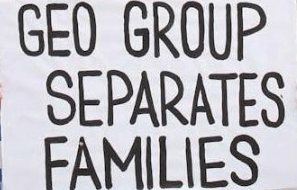
 On Thursday, it was announced that the private prison corporation, known as the GEO Group, will begin a 10-year contract to run the former North Lake Correctional Facility in Baldwin, Michigan.
The headline from MLive reads, Private prison to reopen to house ‘non-U.S. citizen criminals’, which is a line taken directly from the GEO Group Press Release. It’s unfortunate that MLive chose to use the language from GEO Group about who would be incarcerated at the North Lake Correctional Facility, since it frames undocumented immigrants as criminals. To be fair, the GEO Group Press Release also used the term “aliens.”
The MLive article cites a GEO Group spokesperson and a Lake County Commissioner, Howard Lodholtz, who is quoted as saying about the GEO Group contract, “This is just going to be a super thing.”
The only other person cited in the article was a spokesperson with the Michigan Department of Corrections, basically saying that the State of Michigan has no jurisdiction over the private prison industry.
The MLive article ends by using more content from the GEO Group Press Release, and providing no counter perspective on what this new contract between and the GEO Group will mean moving forward.
So, a private prison corporation will now be able to provide “housing” for approximately 1,800 people through a contract with the Federal Bureau of Prisons. The facility that will now be run by the GEO Group will not be an ICE detention facility, rather a prison for immigrants who have been charged in criminal cases in federal court.
I spoke with immigration attorney Richard Kessler, who told me, “most of the immigrants who will be held in the GEO Group prison will be people who are convicted on non-violent crimes, such as re-entry.” This means that those who have re-entered the US a second time without documentation are being charged with federal crimes. Kessler said,
“My biggest concern is that this will further the criminalization of immigration. These are essentially status crimes, because people are here to be with family and most of the people who will end up in this detention facility are those coming from the south and the southwest, making it extremely difficult for families to visit those being held in Baldwin.”
What the MLive article didn’t tell about the GEO Group coming to Baldwin, MI
The State Senator from the 35th District, Curt VanderWall, also released a statement on the GEO Group announcement that they would be running a private prison in Baldwin, saying:
“To hear that the former Michigan Youth Correctional Facility is going to be reactivated is wonderful news for the community. This contract will create up to 320 permanent jobs in the village of Baldwin — a remarkable number for a town with a population under 1,500. I look forward to Geo Group establishing the prison and becoming a valuable member of the community.”
According to the Center for Responsive Politics, the GEO Group has contributed nearly $4 million to political candidates since 2004 and spent just over $9 million on lobbying during the same amount of time. However, the money the company has spent on lobbying has increased significantly since 2017, when the Trump administration took power, as can be seen in the graph below.

In June of 2018, Human Rights Watch released a report, Code Red: The Fatal Consequences of Dangerously Substandard Medical Care in Immigration Detention, which documents the poor medical treatment for inmates in private detention facilities (GEO Group and other corporations) in the US and an increase in inmate deaths.
From an In These Times article on who is profiting from the increased ICE activity in the US:
 According to data from the Urban Justice Center’s Corrections Accountability Project, 72 percent of all migrants under ICE’s control sleep in privatized detention beds, mostly managed by private prison behemoths Geo Group and CoreCivic (formerly Corrections Corporation of America). In 2017, Geo Group and CoreCivic together earned $985 million from ICE contracts, more than a third of what ICE spends each year on custody operations. The corporations get paid whether the beds are full or not, arguably providing government an incentive to seek out prisoners so as not to “waste money.”
Data and analysis from the American Friends Service Committee provides us with a much larger picture of the various ways that GEO Group is profiting from the Prison Industrial Complex:
The GEO Group (GEO) is the second largest private prison corporation in the United States, and the largest provider of “community corrections” and electronic monitoring services in the world. As of July 2018, GEO manages or owns 96,000 beds within 141 prisons and detention facilities in the United States, Australia, South Africa, Canada, and the United Kingdom.
In 2017, GEO reported $2.26 billion in revenue, an increase from $2.18 billion in 2016. The majority of GEO’s revenue is derived from federal contracts with the Bureau of Prisons (BOP), Immigration and Customs Enforcement (ICE), and the U.S. Marshals and continues to increase. In 2014, federal contracts accounted for 42 percent of total revenue, and, in 2017, it accounted for 47.3 percent. The increase has come primarily from ICE, which accounts for 23.9 percent of total revenue in 2017, an increase from 18 percent in 2015.
The AFSC information on the GEO Group and their ankle monitoring or e-incarceration capacity is instructive and reflects the insidiousness of the company’s desire to make a profit:
In 2011, GEO Group purchased BI Incorporated for $415 million dollars. With this acquisition, GEO Group “ensured that whether ICE is expanding detention or expanding alternative forms of detention, they’re getting paid”. While the “Alternatives to Detention Program” is designed to focus on people with serious criminal histories or pose a threat to public safety, 89 percent of individuals in ISAP are not considered “dangerous or violent” by ICE’s own criteria. In 2015, immigration attorneys from Texas filed a formal complaint to the Department of Homeland Security, which oversees ICE, documenting how asylum seekers were deliberately misled and/or coerced into agreeing to wear ankle bracelets in order to be released from detention. The complaints included charges that personnel threatened to withhold medical care for their children if they chose to seek bond hearings instead of agreeing to wear the ankle monitors.
This is just a sampling of the information on the GEO Group, but it should be enough to concern anyone about the announcement that the GEO Group will now be operating a private prison in Baldwin through a contract with the Federal Bureau of Prisons.

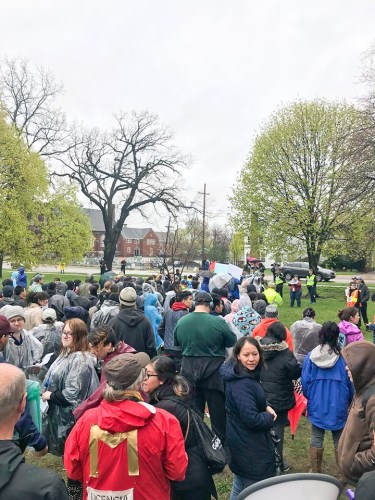 (Photo credit goes to Luis Fonseca)
It is important that I let those who read this that I was one of the crowd safety people who was at the May Day march, assisting Movimiento Cosecha GR to help keep people safe from those who wished to do harm to immigrants – both individual racists and the police, which have demonstrated their allegiance to state violence by cooperating with Immigration & Customs Enforcement (ICE).
Many of us gathered early at Garfield Park and wondered what kind of a turnout we would get. The rain was coming down steady at 11am, which would no doubt deter some from marching with us. However, the main reason we would have smaller numbers this day was due to the GRPD and the City of Grand Rapids insistence that we walk on the sidewalk or risk arrest. The GRPD put out a message on Tuesday, which stated in part:
Without a permit, any participant who enters the street or uses a bullhorn, sound truck or other electronic sound amplifying device may be cited by police and/or arrested.
This threat against the immigrant community kept some from participating in the march yesterday. We know that in recent months that there has been increased ICE activity, with more people being detained and more families being separated. Our brother Brandon Reyes, a bright and passionate DACA student will be taking a voluntary departure this Friday, as the US legal system has determined that he in not worthy to stay in a country he has know for most of his young life.
Despite the weather and despite the levels of state violence that the immigrant community has endured, there was no indication that those who were slowly gathering at Garfield Park would be anything but intimidated by the threats of arrest. Movimiento Cosecha GR organizers and volunteers did an amazing job preparing for this march, making connections with people and following the lead of those in the community who have told them over and over again that the ability to obtain a drivers license would be a huge win.
The insurgent hope that grew as we got closer to noon could be felt in the crowd that was gathering, it could be heard in the excitement in people’s voices as they began to chant and urge each other on in this struggle and it could felt in the deep affection and solidarity being exchanged in the embraces 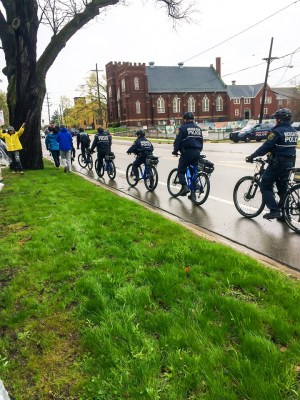 people gave each other.
My job for the day was to talk to the cops and convey whatever they were telling us to the organizers. The GRPD arrived early, with cruisers parked around the perimeter of the park, then with a whole team of cops of bicycles who waited in the distance. Eventually, two officers approached us in order to communicate the “plans they had for us.” Frustrated that they could not get information from us, the two police officers made it clear to us that if we attempted to walk in the street at any point, that we would be arrested. In addition, they stated that they were going to use their own amplification system to let those gather at Garfield Park know that there would be consequences if people walked in the street.
Despite the police presence and the threats made against people, it did not deter people from their excitement as the marchers began walking around 12:30. The rain had also stopped at this point, which we took as a positive sign. As we began walking along Burton Street, the cops on bikes rode next to us making sure that people would not enter the street.
The energy was high as lead marchers used megaphones to begin chants, chants that animated to crowd throughout the march. There were families who marched, the young, the old, those who sang, those who prayed and those who demanded justice. As we made our way down Division people came out of their homes and some out of businesses to greet us, some even joined the march as it made its way through the mostly Latino/Latinx business district of Burton Heights. One business owner came out and pointed to the sign she put up show that they would be closed for the day in support of Cosecha’s call to not shop, to not go to work and to not go to school. It was a beautiful demonstration of solidarity and those marching let her know how grateful they were by cheering and touching her outstretched hand signifying the mutual love that was so evident throughout the day.
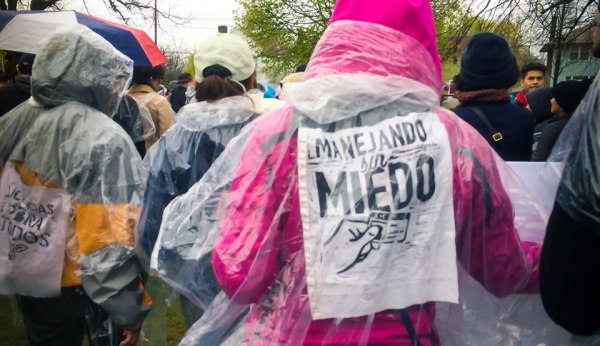
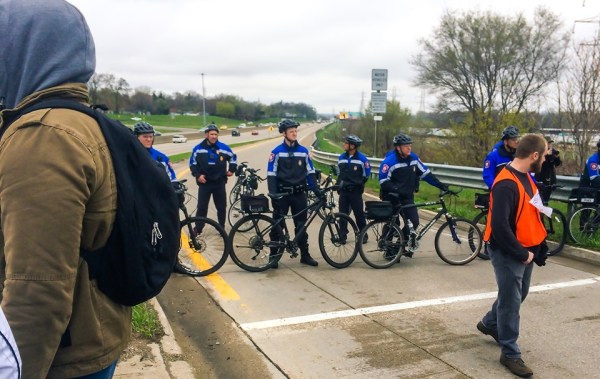
At one point we realized that the Michigan State Police also had their own bicycle squad. While walking south on Division, not only did we realize that the State Police were there, but that even more GRPD officers were present in cruisers blocking roads. As we approached 28th street, the number of police grew even more, as the Wyoming police now joined the already excessive police presence, mostly in cruisers. At this point there were easily more than 100 cops present to make sure that we did not march in the street.
One of the legal observers there said to me, “I wonder how much money these three police departments are spending today in their attempt to control the march?” It was an important question and I don’t think it would be unreasonable to think that tens of thousands of dollars were spent of taxpayers money to attempt to manage the demonstration. I thought to myself, imagine how many people who were currently being detained by ICE, could be bonded out on the amount of taxpayer dollars that were being wasted on policing a march being organized by those who practice non-violence?
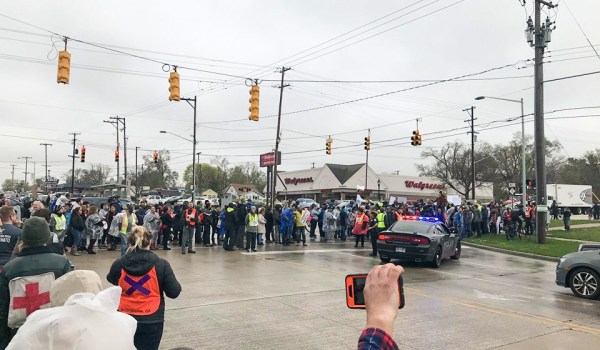
The police kept saying that they didn’t want us to interfere with motorist’s ability to move about during the march. The irony is that it was the decision of the police to stopped traffic all along the route, blocking intersections and highways exits all along the route. The fact is, it was the police who disrupted traffic and provided us a larger public audience to communicate with throughout the day. There were some who expressed their frustration with those marching, but the overwhelming response was one of support, with cars and semi-trailers honking horns, signaling to the crowd that they too were with us in the struggle.
As the march made its way west on 28th Street, we soon approached Roger’s Plaza. The plaza is home to numerous retail stores and restaurants, but it also has a Secretary of the State office. Now walking on the far end of the parking lot of Roger’s Plaza, the space provided people with the opportunity to widen the march, which re-energized the crowd. Sensing the electricity of the people, Cosecha organizers stopped in the parking lot, right at the spot that was parallel with the Secretary of State Office. Cosecha organizers then used this opportunity to once again talk about the importance of the campaign to obtain Drivers Licenses for All and how it would provide those in the immigrant community greater freedoms and lessen the chance of being detained by police and ending up in the custody of ICE.
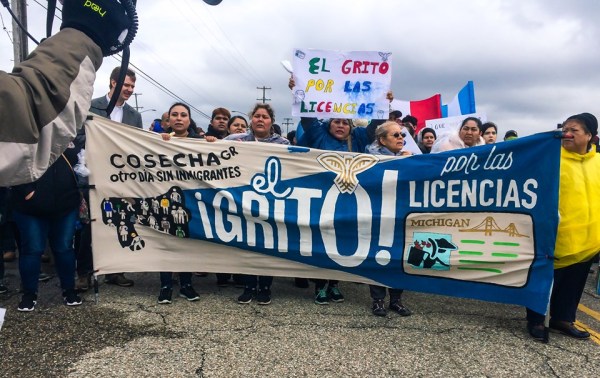
The timing of the group pause in front of the Secretary of State Office was amazing. Just as the march began again, the sun appeared in the sky and we turned off of 28th street in the final stretch of the march.
As we moved along the road to our final destination, we passed the Wyoming Police Department, which now included GRPD and Michigan State cops in such large numbers that would have thought there was a police convention being held that day. However, no amount of police presence, nor the threat of arrest, was ever going to dampen the spirits of those marching.
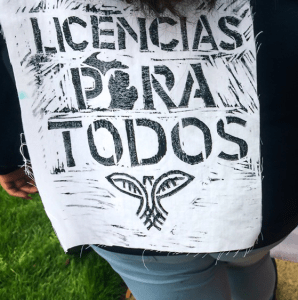 As we made our way into the park, we gathered in a large circle in order to hear from a few of the Cosecha organizers who expressed their gratitude for everyone who made this day possible – those who made signed, those who did crowd safety, the businesses that closed for the day, the churches that donated supplies, the medics, the businesses who donated food, the people who set up the amazing feast we were about to partake in and the countless volunteers who gave time and energy over the past few months. There were also members of Brandon Reyes’ family who spoke, sharing their gratitude and communicating Brandon’s deep affection for everyone who has supported him and the ongoing fight for immigrant justice.
Just as the march had begun, people again began to embrace each other as they moved through lines in the area set up for getting food. There was a great deal of laughter and story telling going on. People sat at the tables in the park and some sat on the ground, eating tamales and tacos and fresh fruit that was available. I sat with friends, Mexicanos, who language shifted from Spanish to English and back again, sometimes switching in mid-sentence. Once we were done with our food, we embraced and said our goodbyes.
Today was a powerful display of community and even though we have not yet won Drivers Licenses for All, one got the feeling that it was an inevitable outcome that you could see on the faces of those who spent the last 5 hours chanting, marching and sharing food. This is the same spirit that was embodied in those who gathered in Haymarket Square in Chicago in 1886, where workers were demanding an 8 hour work day. People showed solidarity on that original May Day gathering, they engaged in mutual aid, they fought for justice and they believed in revolutionary love. The same spirit of resistance and love was demonstrated today and I was grateful to both witness and be a part of it. La Lucha Sigue y Sigue.
 Catholic Charities West Michigan announced recently that they will be filing a lawsuit against the State of Michigan because of the decision by Attorney General Dana Nessel to overturn previous legislation in Michigan that allowed adoption agencies the ability to deny same sex couples from adopting children.
HB 4188 was passed in 2015 and often framed as a religious freedom bill. The legislation allowed adoption agencies in Michigan the ability to deny LGBT couples/partners/families from adopting because it violated the “sincerely held religious beliefs” of most of the adoption agencies in Michigan, like Catholic Charities West Michigan.
We reported on this piece of legislation in 2015, since the bill was introduced by Rep. Andrea LaFontaine (R). Rep. LaFontaine received $8,100 in campaign contribution in 2014 from the DeVos family, as did many of the cosponsors of HB 4188.
Now that the Michigan Attorney General has reversed this policy, there is pushback from some adoption agencies. Catholic Charities West Michigan filed a lawsuit last Thursday in the State Court of Claims arguing that the Attorney General’s decision discriminates against religious institutions and puts Catholic Charities adoption and foster care ministry at risk of closure.
According to an MLive article, the head of Catholic Charities West Michigan declined to comment and he referred any media inquiries to the Alliance Defending Freedom Group, which is based in Arizona and will be representing Catholic Charities in the lawsuit.
What the MLive article did not reveal is that the Alliance Defending Freedom was an entity that was founded by some 30 different Christian ministries that make up a large part of the Religious Right in the US. The Alliance Defending Freedom was started in 1994, with the backing of people like Bill Bright (Campus Crusade for Christ), James Kennedy (Coral Ridge Ministries) and James Dobson (Focus on the Family). The intent of the Alliance Defending Freedom was to provide the religious community with legal representation that was counter to what the ACLU provides.
According to a statement released on Friday by Alliance Defending Freedom:
“Adoption and foster care providers exist to serve children and for decades Catholic Charities has done that well,” explained ADF Senior Counsel Kate Anderson. “Michigan law already affirms that faith-based ministries provide essential services to the state and may continue to serve children in a manner consistent with their beliefs. The state has no business ignoring the law, implementing Attorney General Nessel’s hostile political agenda, or punishing a religious organization because of its Catholic identity and beliefs. Children in Grand Rapids, throughout Michigan, and across the country will suffer if this hostility toward faith-based adoption providers becomes the status quo.”
The Southern Poverty Law Center lists Alliance Defending Freedom as a Hate Group on the Hate Map, with the following list of grievances:
- Supported the recriminalization of homosexuality in the U.S. and criminalization abroad
- Defended state-sanctioned sterilization of trans people abroad
- Linked homosexuality to pedophilia
- Claims that a “homosexual agenda” will destroy Christianity and society
The Southern Poverty Law Center also states that the, “ADF also works to develop “religious liberty” legislation and case law that will allow the denial of goods and services to LGBT people on the basis of religion. Despite its regular defamation of LGBT people, the group has managed to win special advisory status at the United Nations, in the European Union, and with the Organization of American States. Since the election of President Donald Trump, the ADF has become one of the most influential groups informing the administration’s attack on LGBT rights.”
It is unfortunate that the news media in Michigan has omitted any serious contextual information about Alliance Defending freedom, specifically it longstanding anti-LGBTQ positions.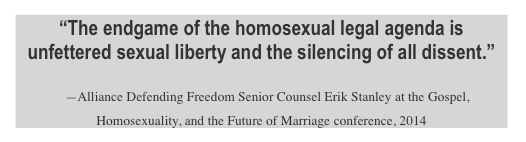
We will continue to report on this legal battle as it plays out in the coming months, but it is important that people fully understand who is legally representing Catholic Charities of West Michigan.
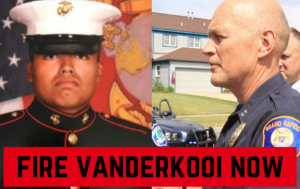 On Friday, the Internal Affairs Unit of the Grand Rapids Police Department announced that Captain VanderKooi, who has been put on administrative leave since February 28 of 2019, would now be reinstated.
The GRPD released a statement saying:
The investigation has concluded and, based on the evidence, Captain VanderKooi was not in violation of the impartial policing policy. As a result, Captain VanderKooi has been reinstated to full duty effective Monday, April 29. The complainant in this matter previously filed an appeal, and that appeal will move forward and be heard by the Civilian Appeals Board on May 15.
We understand the sensitivity of matters involving ICE and the concerns of our community. Upon review of the U-visa certification process, I have determined that it is better served as a function of the Records Unit rather than the Investigations Division. The change means Captain VanderKooi will no longer have direct involvement in that process as the Investigations Division Commander.
Our department is sensitive to the nature of citizenship status and we remain committed to developing a new policy that clearly defines expectations for how our officers interact with federal authorities, including ICE. The policy is expected to be completed in the near future. At that time, it will be shared with the community and be available on the City’s website along with our other policies.
Since this matter is under appeal, we do not plan to make any further comments on it at this time.
The ACLU and the Michigan Immigrant Rights Center (MIRC) have appealed this decision and will speak before the Civilian Appeal Board on May 15, at a hearing specifically for this case.
The ACLU and MIRC have also provided us with new information, based on the Internal Affairs report and e-mail communications between the GRPD and ICE, which they have posted on the ACLU website at this link.
There are several major issues here that need further elaboration, with the first having to do with Captain VanderKooi’s role with the U-visa program. While we are glad to know that Captain VanderKooi will no longer have a role in the U-visa program, we believe it is important that people know exactly why he was so dangerous in this position.
Based on the e-mail communication between ICE and the GRPD, documents which were obtained through a Freedom of Information Act request, here are the most egregious:
p. 81: “With my new assignment as Division Commander of Investigative Services, I am the U-visa gatekeeper.”
p. 43 – VanderKooi volunteers last known address of U-Visa applicant to ICE.
49: describes a situation where someone is applying for a U visa as “one of those comical situations” where a person gets arrested for DV and the couple gets back together.
42: VanderKooi and ICE officer Klifman discuss a U visa application which appears to be related to the abuse of 12-year-old victim. The exchange is redacted, but the two discuss whether to issue the requested U visa, and VanderKooi indicates that it will be denied because the person’s attorney did not return a phone call. The last email in the exchange has Klifman indicating that he has an arrest warrant and will be attempting to locate the person.
There is a great deal of arrogance and callousness demonstrated in these e-mails between ICE and Captian VanderKooi, along with clear indication that VanderKooi was assisting ICE to track down individuals the agency was targeting.
A second major issue, it the significant cooperation between the Captain VanderKooi and Immigration and Customs Enforcement (ICE) that is also revealed in the internal communication that is separate from the U-visa program. Here are a few of those communications:
From Internal Affairs Report
p. 14: “Information pertaining to place of birth, country of origin, lack of English proficiency, or immigration status, although tied to national origin, can appropriately be considered … in making a decision to contact immigration officials.”
5, # 23: Email from ICE Agent Klifman to Cpt. VanderKooi requesting a “good address”
From FOIA Release
p. 19: appears to be forwarding anonymous tips about undocumented people to ICE.
p. 103: VanderKooi asks Klifman to check on someone’s status. Then the two email about the fact that the person is a minor. Kilfman says there was no guardian present, and since “I could see an attorney having a field day with that one,” he wants to wait to see if the youth is convicted or until he turns 18.
 p. 106: After giving VanderKooi an immigration status update on someone ICE had been unable to deport, Klifman writes “Please let me know if I can be of any more assistance.” VanderKooi responds “One plane ticket?” Kliffman replies “I’ll see what I can do.”
p. 136: After VanderKooi requests status check on a suspect, ICE emails saying that they are now looking into his parents.
Again, the use of language is revealing and the cavalier attitude about deportation is appalling. More importantly, the first example here from page 19 demonstrates that the GRPD are tipping off ICE about undocumented immigrants.
The last issue that these new documents reveal has to do with the organized efforts to resist ICE in Grand Rapids. On Pages 170 – 172, there are screen shots (one here on the right) of a Facebook event page for the GR Rapid Response to ICE Training from May of 2017.
Captain Vincent Reilly (GRPD Commander – South Service Area) says:

Notice that in the e-mail Subject line it says, Interference with ICE Training.
Lastly, in one of the screen shots of the GR Rapid Response to ICE event, there is a tab open for Equity Drinks.

With all of this new information it should be clear that the GRPD (not just Captain VanderKooi) is sharing information with Immigration and Customs Enforcement (ICE), even thought the GRPD has denied that at least since people in the community began to challenge then-Chief Rahinsky during a meeting in December of 2016.
It also should be clear that the GRPD and ICE know about the work of GR Rapid Response to ICE and are monitoring the work of that group.
Most importantly, it should be clear that the GRPD, especially through Captain VanderKooi, plays an integral part in the efforts of ICE to arrest, detain and deport members of the undocumented community. In other words, the GRPD is actively involved in the separation of families right here in Grand Rapids.
The Jerry & Marcia Tubergen Foundation: The DeVos Family operative you may not have heard about
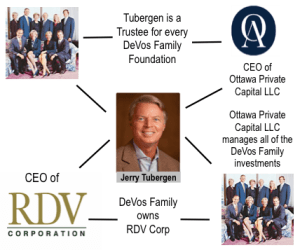 The Jerry & Marcia Tubergen Foundation is not a very large foundation, with just under $3 million in contributions since the foundation began.
Jerry and his wife Marcia primarily contribute funds to christian organizations and private christian schools. Some of the organizations they contribute to are: the Acton Institute, Chico Daniels Ministries, Mel Trotter Ministries, the Pregnancy Resource Center and Right to Life Michigan.
The private christian schools that receive money from the Jerry & Marcia Tubergen Foundation are: Calvin College, Church Planter’s Training International, Cornerstone University, Northpointe Christian Schools and Potters House.
Almost all of these groups are based in West Michigan, but there are a few entities that are not based in the area that receive the largest sums from this foundation. For the most recent 990 documents between 2014 – 2016, the Jerry & Marcia Tubergen Foundation gave Cure International over $1 million per year. Not surprising, Jerry Tubergen sits on the board of Cure International, which is a christian ministry that provides health services for people living in countries in the Global South. The other non-local entity that receives a larger sum of funds from the Tubergen Foundation is the Museum of the Bible Inc, which receives about $100,000 annually.
There is nothing terribly unusual for the Jerry & Marcia Tubergen Foundation’s contribution to mostly christian entities. After all, Jerry Tubergen is the CEO of one of the largest components of the DeVos empire, the RDV Corporation.
In addition to being the CEO of RDV Corporation, Jerry Tubergen is listed as a trustee for every DeVos family foundation, according to the 990 reports. Thus Jerry Tubergen is a trustee of the Dick & Betsy DeVos Foundation, the Doug & Maria DeVos Foundation, the Dan & Pamela DeVos Foundation and the Richard & Helen DeVos Foundation.
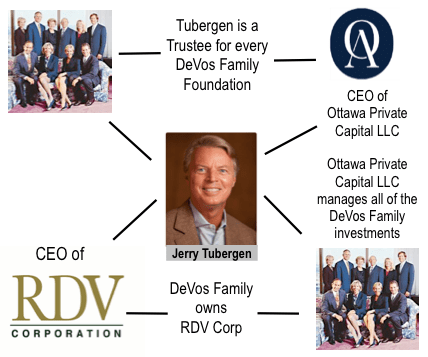 There isn’t a great deal of information about Jerry Tubergen online, but it is interesting that he is a trustee for every DeVos family foundation, along with being the CEO of RDV Corporation. In addition, all of the DeVos family foundations and RDV Corporation have the same address, which is 126 Ottawa Ave. NW, in downtown Grand Rapids.
In 2015, the DeVos Family created their own investment firm, which is called Ottawa Private Capital LLC, also run by Jerry Tubergen and is located at 126 Ottawa Avenue NW, in downtown Grand Rapids.
In early 2017, after Betsy DeVos was in the process of becoming the US Secretary of Education, she had to disclose documents of every group she was involved with and a listing of all the businesses she had investments in. This was a rare look into the details of the investments that the DeVos family has and it are these investments that Jerry Tubergen manages on behalf of the DeVos family in his role as head of Ottawa Private Capital LLC. You can read the pages and pages of investments the DeVos family has, based on the documents that Betsy DeVos was forced to submit before becoming the US Secretary of Education.
Jerry Tubergen is a name we rarely see, yet he is one of the most trusted confidants of the most powerful family in West Michigan, the DeVos family. It’s time we start to pay more attention to this man and what role he plays in the Grand Rapids Power Structure.
Human Rights was once again the focus of Grand Rapids City Commission meeting, with overwhelming support for Human Rights Ordinance
On the agenda of last night Grand Rapids City Commission meeting, there was a public hearing specifically for a revised and updated version of the City’s Human Rights Ordinance. This proposed ordinance came forward by staff from LINC and the numerous community meetings that were held.
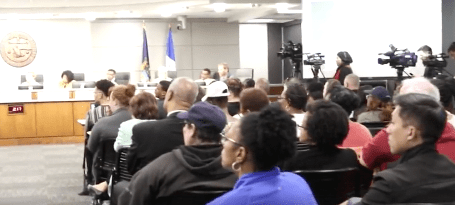
While much of the news media has focused on the issue of people calling 911with an clear bias against people of color, as was headlined on MLive. However, the actual language of the ordinance does not just include biased reporting against people of color when contacting 911. The ordinance includes more than just people of color, stating:
No person shall knowingly or recklessly report to a City police officer, City dispatcher, or other City personnel that an individual who is an actual or perceived member of a protected class as identified in Sec. 9.935 of this Ordinance has committed, or may or will commit, a crime, if such report is based in whole or in part on the individual’s membership in a protected class and not on a reasonable suspicion of criminal activity in consideration of all available facts and the totality of the circumstances.
The opening language of the revised ordinance provides a list of those who are protected under the ordinance:
the actual or perceived color, race, religion or creed, sex, gender identity or expression, sexual orientation, national origin, genotype, age, marital status, medical condition, disability, height, weight, or source of lawful income (cumulatively known as protected classes).
While racial prejudice has certainly been a major concern in recent years, with the violence that the GRPD has inflicted against communities of color, but it is important that people understand that there are many other ways that people are being discriminated against.
There were numerous people who came forward to comment on the revised Human Rights Ordinance. LaDonna Norman asked the question about who is going to “watch the watchers,” where she specifically addressed the GRPD’s assault against communities of color.
Another African American man, who is a businessman and fought the GRPD’s pressure to post No Trespassing signs posted outside of business, an issue that the ACLU fought and won.
Elena Gormley, who is a member of Jewish community, made it clear that the issue of biased reporting should also apply to members of the GRPD, as in the case of Captain VanderKooi who used racist language direct at Jilmar Ramos-Gomez.
Jeremy Moore, who is with Equity PAC, also addressed the bias demonstrated by the GRPD against Jilmar Ramos-Gomez. He also addressed increased oversight of the GRPD, which should be reflected in the new city budget and the upcoming police union contract.
Robin Jerome Benton spoke in favor of the proposed ordinance, but wanted to make sure that since it is named as a Human Rights Ordinance, that it have the power and work in conjunction with the United Nations Human Rights Council and to have the force of law beyond just what the City of Grand Rapids will use as an enforcement mechanism.
Another young African American man who has been discriminated against by the GRPD. He stated that he has been handcuffed by the police, even though he was not doing anything wrong. He also addressed how the police will be held accountable and how this is an important first step, but it should not be the end point.
Lorena Aguayo Marquez addressed the significant fear that exists in the immigrant community, so she supports the ordinance based on the idea that it would help to reduce the existing fear that permeates the immigrant and undocumented community.
There were several people who came forward to just support the proposed revision of the Human Rights Ordinance, by simply affirming what is in the ordinance. Many of these people who spoke addressed police abuse as one of the more pressing aspects of current human rights violations.
There were also some people who were, in general, supportive of the ordinance, but had questions about how this might negatively impact those who make the calls, even if it means censoring them out of fear that they might be punished.
Lastly, one man got up to speak out against abortions being performed in the city of Grand Rapids and why the “unborn were not included in the ordinance.” He also displayed 2 large photos of aborted fetuses, but was quickly told that he could not show these because they violated the ban on signs during commission meetings. Towards the end of his comments he made the claim that the majority of women who came to the clinic for an abortion are black women, which received a great deal of push back from others who were also in attendance.
By the end of the public hearing on the Human Rights Ordinance, 33 people had spoke in favor of the ordinance, with 4 speaking in opposition to it.
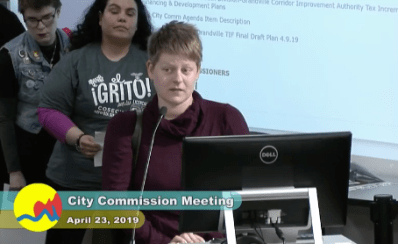 Beyond the Human Rights Ordinance, there were several people who spoke during the general public comment period, specifically for those who are involved with Movimiento Cosecha GR and GR Rapid Response to ICE. A list of demands were read, which included the following:
- Fire Captain Curt VanderKooi and the unnamed officer who beat the young man in the car. VandeKooi has a long history of discrimination based on race and he is not safe for our neighborhoods.
- Stop all cooperation with ICE and use no city resources to do the work of ICE. There should be no police role of “ICE liaison.”
- Support Driver’s Licenses for All in the State of Michigan.
- Release the code of conduct for officers and the track record of each officer in following this code of conduct, including complaints against them. Release the reports of their investigations so that the public can track their accountability processes. Create an accountability reprimand policy for all officers that stand by during instances of beatings or other harm.
- Create subpoena powers and investigative powers for our Civilian Appeals Board.
- Give a vote of No Confidence to Acting Chief Kiddle.
- Create a program whereby GRPD pays for at minimum 5 years of trauma-related therapy especially for any youth interaction deemed inappropriate regarding harassment, profiling, excessive force etc.
- Appropriate the million dollars a year that the city has set aside to deal with community police relations directly to the community instead of it just standing by while police incidents continue to separate our community. The community knows best what to do with that money to make our neighborhoods safer.
After the last person from Movimiento Cosecha GR spoke, they shared flyers with the City Commission, inviting them to the participate in the May 1st march for immigrant justice and Drivers Licenses for All.
There were several people in attendance representing the Voice of the Badge group, who have been coming to City Commission meetings to defend the GRPD, often with unsubstantiated claims. Johnny Brann attempted to make the point that “the GRPD face a great deal of injustice,” even though he could not cite any evidence to support said claims.
Lastly, it should be noted that three of the four people who spoke out against the Human Rights Ordinance also spoke in support of the GRPD, spoke out against undocumented immigrants (calling them illegal aliens) or used anti-Trans and homophobic language in their comments.
 (Editor’s Note: GRIID is in no way a defender of the Catholic Papacy. My interest is speaking with NBC had to do with shedding light on the politics of the Acton Institute.)
A month ago, a reporter with NBC News in London contacted me to let me know they were doing a story on Pope Francis and the attacks coming from the far right, including the Acton Institute.
Here is what the NBC News reported, Michelle Simon, asked me:
My name is Michelle and I’m a journalist at NBC News in London. I work closely with our chief foreign correspondent Richard Engel. We are working on a story about Pope Francis and the general feeling amongst right-wing conservative American Catholics who are growing disenchanted with the Pope.
I know you’ve done a lot of research on the Acton Institute via GRIID. Action features quite significantly in our story, and I was wondering if you had a moment to chat, just on-background, over the phone today? Hoping that you might be able to help me fill out some holes in my knowledge.
I agreed to talked and we spoke for about 40 minutes and discussed the politics of the Acton Institute and they let me know that they would be traveling to Grand Rapids to interview Fr. Robert Sirico about his criticism of Pope Francis.
NBC did come to Grand Rapids and here is the 14 minute video story they did, which includes Steve Bannon, Michael Voris (who runs the group Church Militant in Detroit) and Fr. Robert Sirico. The news story that NBC ran this past Sunday night on MSNBC, with worth watching, primarily because it links the Acton Institute with another think tank called Dignitatis Humanae Institute.
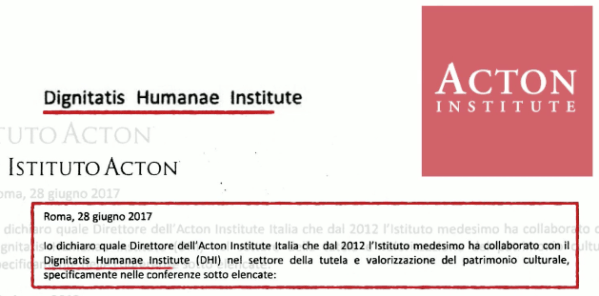
The NBC reported called Acton Institute founder, Fr. Sirico out about the relationship between Acton Institute and the Dignitatis Humanae Institute, which begins at about 10 minutes in to the video. In the NBC piece, the Acton Institute wrote a letter to the Italian government asking for the support of the Dignitatis Humanae Institute. Fr. Sirico says he didn’t know anything about it, which seems improbable since he is the leader of Acton.
It was certainly refreshing to see a mainstream news source challenge the Acton Institute and make the connections to a larger religious right network that we should pay attention to, since the Acton Institute is based right here in Grand Rapids.
Environmental Justice and White moderates in Grand Rapids
 A new report, published by LINC and Detroiters Working for Environmental Justice was released in Grand Rapids. The report, entitled, Neighborhood Environmental Action Report: Health, Environment and Race in Grand Rapids, also included numerous partners, listed on page 41 and 42 of the report.
I salute the energy and effort that was applied to this report and the ongoing work of groups like the Healthy Homes Coalition, WMEAC, Our Kitchen Table and Urban Roots. These four groups are the only entities in Grand Rapids that have done any work that could be considered anything remotely under the banner of Environmental Justice.
There are also several entities included as partners that have questionable credibility in terms of speaking on and practicing environmental justice work, such as GVSU, Spectrum Health, Start Garden and the West Michigan Sustainable Business Forum. These four entities operate from the belief that we can maintain an economic system of capitalism and still promote ecologically sound practices. This notion that capitalism and environmentalism are compatible is in violation of one of the principles of Environmental Justice Preamble, which states:
WE, THE PEOPLE OF COLOR, gathered together at this multinational People of Color Environmental Leadership Summit, to begin to build a national and international movement of all peoples of color to fight the destruction and taking of our lands and communities, do hereby re-establish our spiritual interdependence to the sacredness of our Mother Earth; to respect and celebrate each of our cultures, languages and beliefs about the natural world and our roles in healing ourselves; to ensure environmental justice; to promote economic alternatives which would contribute to the development of environmentally safe livelihoods; and, to secure our political, economic and cultural liberation that has been denied for over 500 years of colonization and oppression, resulting in the poisoning of our communities and land and the genocide of our peoples, do affirm and adopt these Principles of Environmental Justice:
Another important point about those involved in the creation of the report, is that most of these groups are not led by people of color, which again conflicts with the environmental justice preamble, We, The People of Color.
Lastly, since the preamble mentions 500 years of colonizations and oppression, it is important that we acknowledge that the land that the city of Grand Rapids current occupies was taken from the Anishinaabe people and that the oppression that continues is a direct result of settler colonialism and white supremacy.
The documentation in this report covers the following themes – vapor intrusion, lead poisoning, food justice, green space, air quality and climate change, each with a Next Steps section. Unfortunately, the Next Steps sections are not really a call to action in order to deal with serious issues like climate change and food justice.

Environmental justice is a term which has gained more traction in recent years, but it is still a concept that is not well understood. What I am proposing, is that based on the 17 Environmental Justice principles, listed on pages 39 & 40 of the report, is to assess where Grand Rapids is with these principles. These principles can and should be used as a measuring stick for whether or not Environmental Justice principles are being practiced in this community.
- Environmental Justice affirms the sacredness of Mother Earth, ecological unity and the interdependence of all species, and the right to be free from ecological destruction. It is hard to quantify this principle, since it reflects an over-arching ideological worldview. However, it is safe to say that this principle is not being practiced or taken seriously in Grand Rapids.
- Environmental Justice demands that public policy be based on mutual respect and justice for all peoples, free from any form of discrimination or bias. Public Policy from the Federal government, the State government, the County government and the City of Grand Rapids does not reflect respect and justice for all people, especially communities of color – black, brown and indigenous. Most policies, in fact, are crafted by think tanks and lobbyists, who pressure politicians that have been funded by the capitalist class, who pass legislation that more often than not negatively impacts communities of color.
- Environmental Justice mandates the right to ethical, balanced and responsible uses of land and renewable resources in the interest of a sustainable planet for humans and other living things. There is a growing interest to attempt to practice this principle, but practicing this principle would require land reparations to indigenous people, African Americans and a serious shift to how we use land and resources now. For example, in Grand Rapids, too much of the land is paved over, because we are dependent primarily on fossil fuel-based vehicles, which also necessitates extractivist processes, creates more pollution and does harm to humans and all other species.
- Environmental Justice calls for universal protection from nuclear testing, extraction, production and disposal of toxic/hazardous wastes and poisons and nuclear testing that threaten the fundamental right to clean air, land, water, and food. I am not aware of nuclear use in Grand Rapids, but there are other toxic materials that are used on a daily bases by industry, with limited regulation and almost no transparency. For example, those involved in migrant labor are regularly exposed to toxic pesticide use in the agricultural land that surrounds Grand Rapids. Many of those migrant workers live in Grand Rapids. What attention is being given to that injustice and are there any efforts to organize against this practice?
- Environmental Justice affirms the fundamental right to political, economic, cultural and environmental self determination of all peoples. How many people who live in Grand Rapids, particularly in communities of color, can say they have political, economic, cultural and environmental self determination?
- Environmental Justice demands the cessation of the production of all toxins, hazardous wastes, and radioactive materials, and that all past and current producers be held strictly accountable to the people for detoxification and the containment at the point of production. This would be wonderful if it were practiced, but when was the last time you saw a headline saying that an specific industry or company in Grand Rapids was being held accountable for producing toxic and hazardous materials?
- Environmental Justice demands the right to participate as equal partners at every level of decision making, including needs assessment, planning, implementation, enforcement and evaluation. How often do people really get to participate as equal partners when decision are made in Grand Rapids? Think about all of the development projects, the daily practices of industry and how those things impact people, especially communities of color.
- Environmental Justice affirms the right of all workers to a safe and healthy work environment without being forced to choose between an unsafe livelihood and unemployment. It also affirms the right of those who work at home to be free from environmental hazards. Again, how does this principle apply to migrant workers? How many workers in Grand Rapids have to deal with poor air quality where they work, exposure to toxic materials or dangerous work environments?
- Environmental Justice protects the right of victims of environmental injustice to receive full compensation and reparations for damages as well as quality health care. People, especially people of color, rarely receive reparations for environmental injustice. Ask indigenous people in the area if they have been given reparations from the land that was stolen from them or the health affects from eating local fish, because of the high levels of mercury in the fish. Under the current for-profit health insurance system, it would be a joke to say that people have quality health care.
- Environmental Justice considers governmental acts of environmental injustice a violation of international law, the Universal Declaration On Human Rights, and the United Nations Convention on Genocide. If we were to apply the legal consequences of environmental injustices against those in government, using international law, the UN Declaration on Human Rights and the UN Convention on Genocide, a lot of politicians would be going to prison for crimes against humanity.
- Environmental Justice must recognize a special legal and natural relationship of Native Peoples to the U.S. government through treaties, agreements, compacts, and covenants affirming sovereignty and self-determination. To this principle I would just say that people should ask those who are part of the Anishinaabe community if indigenous people in this area think that the State of Michigan has honored their treaties and if they Anishinaabe community believes that they have sovereignty and self-determination.
- Environmental Justice affirms the need for urban and rural ecological policies to clean up and rebuild our cities and rural areas in balance with nature, honoring the cultural integrity of all our communities, and provided fair access for all to the full range of resources. Are neighborhoods in Grand Rapids, where significant numbers of black and brown people live: are they free of gentrification; do they have a just amount of green space; are they in areas where air quality is healthy; and do they have easy access to fresh produce? These are just some of the questions that need to be answered in regards to this principle.
- Environmental Justice calls for the strict enforcement of principles of informed consent, and a halt to the testing of experimental reproductive and medical procedures and vaccinations on people of color. There is a long history of non-consent with communities of color around reproductive health and vaccinations. Also, communities of color in Grand Rapids have higher infant mortality rates and have less access to affordable health care their white residents do.
- Environmental Justice opposes the destructive operations of multi-national corporations. There are numerous large corporations that operate in Grand Rapids – Walmart, Fifth Third Bank, Amway, Meijer, Gordon Foods, Farmers Insurance, etc – all of which contribute negatively to ecosystems around the world because of what they manufacture, what they finance and what products they sell. There is nothing in the new Environmental Justice report that addresses this issue.
- Environmental Justice opposes military occupation, repression and exploitation of lands, peoples and cultures, and other life forms. Grand Rapids is home to numerous weapons manufacturers, including the Defense Logistics Agency, which oversees all US military contracts in West Michigan. Then there is the fact that the amount of the tax base that leaves Grand Rapids to fund the US military budget for 2017 was $324 million, according to the National Priorities Project. One addition reality with US militarism is that communities of color are disproportionately recruited to serve in the US military and communities of color around the world are the ones who disproportionately suffer because of US military intervention, aid, training and weapons sales.
- Environmental Justice calls for the education of present and future generations which emphasizes social and environmental issues, based on our experience and an appreciation of our diverse cultural perspectives. Do you think that the public, charter or private schools adequately teach children about the principles of environmental justice in such a way so that students can experience and an appreciation of our diverse cultural perspectives.
- Environmental Justice requires that we, as individuals, make personal and consumer choices to consume as little of Mother Earth’s resources and to produce as little waste as possible; and make the conscious decision to challenge and reprioritize our lifestyles to ensure the health of the natural world for present and future generations. I would say that compared to the other sixteen environmental justice principles, this one is more widely practiced in Grand Rapids. And while I think it is important for people to consume with a conscience and alter their lifestyles, individual consumption behaviors will not address the serious environmental crisis that we current face.
 Now that we have finished our assessment of the 17 Environmental Justice principles and how they apply in Grand Rapids, I think it is important to point out one other fundamental dynamic.
Systems of power and oppression will never allow any major shift towards justice, environmental or otherwise, without significant pushback. What people are working on, as documented in the Neighborhood Environmental Action Report: Health, Environment and Race in Grand Rapids report, while important, is not at the level that will make those in power feel threatened. There will have to be an elevation of environmental justice work in order to challenge systems of power and oppression. For that to happen, there will need to be an environmental movement that is led by people of color and operates outside of the non-profit industrial complex. One additional thibg that needs to happen is that more white people to be involved in the process of learning about environmental justice and to become real allies in the work that communities of color are engaged in. This will not be easy, since many white people do not like operate outside of their comfort zones. To explain what I mean by that, let’s turn to what Dr. King had to say when he wrote his Letter from a Birmingham Jail.
“First, I must confess that over the last few years I have been gravely disappointed with the white moderate. I have almost reached the regrettable conclusion that the Negro’s great stumbling block in the stride toward freedom is not the White Citizen’s Council-er or the Ku Klux Klanner, but the white moderate who is more devoted to “order” than to justice; who prefers a negative peace which is the absence of tension to a positive peace which is the presence of justice; who constantly says “I agree with you in the goal you seek, but I can’t agree with your methods of direct action;” who paternalistically feels he can set the timetable for another man’s freedom; who lives by the myth of time and who constantly advises the Negro to wait until a “more convenient season.”
It is the white moderates that we have to be concerned about, as much as those who have power in Grand Rapids. If environmental justice is to be achieved there must be a radical re-altering of business as usual in this city, but it is a fight that is necessary and worth taking part in.
Profiting from the legalization of Marijuana in Grand Rapids: The ongoing legacy of the racist War on Drugs
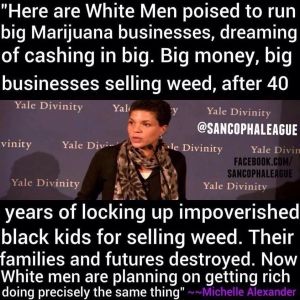 In 2014, Michelle Alexander, author of the book The New Jim Crow: Mass Incarceration in the Age of Colorblindness, was asked about states there were passing laws to decriminalize the sale of small amounts of marijuana. Her response was:
“Here are white men poised to run big marijuana businesses, dreaming of cashing in big—big money, big businesses selling weed—after 40 years of impoverished black kids getting prison time for selling weed, and their families and futures destroyed. Now, white men are planning to get rich doing precisely the same thing? So, that’s why I think we have to start talking about reparations for the war on drugs. How do we repair the harms caused?”
Michelle Alexander is not against the decriminalization of marijuana. What Alexander, and many other people are concerned about, is who is going to profit from marijuana sales, now that the industry will firmly in the hands of a capitalist system.
Unfortunately, this was not a question asked by a recent MiBiz article, with the headline, Non-locals make up vast majority of medical marijuana biz applicants.
In the MiBiz article the focus is on whether or not those setting up marijuana-related businesses in Grand Rapids, would be locally owned or companies based in other parts of the state or other parts of the country.
 The MiBiz story does provide some useful information, such as where the medical marijuana dispensaries will be located with Grand Rapids. The article includes a useful map (seen here on the right) that shows where the areas of concentration are for the new businesses.
There was also useful information in terms of costs associated with getting a license from the city of Grand Rapids, in order to sell marijuana. One business owner said, they needed to spend $5,000 for an option to buy the building, $5,000 on the city’s application for a provisioning center, and $6,000 for the state’s licensing application, for which they needed to show upwards of $300,000 in available capital. That’s all while they’re awaiting pre-qualification at the state level.
Based on the MiBiz source, one would need to pay $16,000 up front, plus ongoing rental or mortgage costs, and then have up to $300,000 in available capital. The question that should be asked, but wasn’t by the MiBiz reporter, is, who can afford to own a medical marijuana dispensary? The answer is fairly obvious……..white people. We can verify this by looking at some of the known businesses that will be operating medical marijuana dispensaries.
First, there is Healing Tree LCC, which is owned by Leafly and has dispensaries all over Michigan, as well as other states in the US. Leafly is a subsidiary of a much larger company, Privateer Holdings, which owns numerous other businesses within its portfolio.
Another company which stands to make profits from the medical marijuana dispensaries in Grand Rapids is the Bricks & Mortar Group, which prides itself on being an all woman-owned business. The only women that are seen on the Bricks & Mortar site are white women.
A third company listed in the MiBiz article is Humble Roots LLC. According to the Co-founder’s linkedin page (Ben Migdal), “Humble Roots is a self-funded, vertically integrated, pre-licensed, Michigan cannabis group.Our founders started in the industry in California, Colorado, and Michigan over a decade ago and have expanded into Michigan’s emerging cannabis market. Our team has award winning genetics, flower, and a portfolio of municipally licensed real estate ready for build out. Our primary and immediate goal is to build out our existing cultivation and processing facility into the finest running cannabis facilities in all of Michigan while expanding our retail footprint throughout the state. The Linkedin page for the Humble Roots LLC co-founder also says that he co-founded BPMD Realty LLC, which is an entity utilized by Humble Roots LLC to ensure upkeep and standards for all properties acquired in Michigan.
Now, Ben Migdal doesn’t appear to be white, but he clearly has significant access to capital, in order to start and expand his cannabis enterprise.
The other owners listed in the MiBiz article are Jeff & Tami Vandenberg, co-owners of the Meanwhile and Pyramid Scheme bars.
So it appears that most of the owners listed in the MiBiz article are white and all of them have numerous assets and access to an amount of capital that most people could never have access to, especially people of color.
For years now, those who have fought and pushed for the legalization of marijuana have been marginalized groups – communities of color, people with disabilities, AIDS patients and veterans, but these groups do not have access to the capital that white people do, thus making it more difficult for them to benefit from the legalization of marijuana.
The other important point that Michelle Alexander makes in the statement at the beginning of this article is, what are we going to do about “reparations for the war on drugs. How do we repair the harms caused?”
We know that for at least the past 40 years of an official US war on drugs, that black and brown communities have suffered tremendous harm, even with marijuana. Look at the important study done by the ACLU in 2013, entitled The War on Marijuana in Black and White. This report makes it clear that arrests rates are much higher for black and brown communities than they are for white counterparts. Billions of dollars have been spent policing black and brown communities and arresting black and brown youth for marijuana sales or possession. So what reparations work are we going to be involved in that will undo this harm? If the trend is going to be white people disproportionately owning and operating medical marijuana dispensaries, that will not undo the harm done to black and brown communities for decades of drug-related arrests and incarceration.
 Think about the millions of dollars lost to black and brown communities because of the years lost in jail or in prison just from drug violations and what that kind of disinvestment in their communities has meant. Looking at the map where there have been applications for medical marijuana dispensaries in Grand Rapids, are the areas where those dispensaries are located now at risk of further gentrification?
These are all important questions to think about and to act on. If we claim to be people who want to promote racial justice and to dismantle the decades of white supremacist drug war policies, then we can not sit on the sidelines content with the fact that the purchasing and consumption of marijuana is now legal.
I wrote to the City of Grand Rapids to find out if the information on all of the medical marijuana dispensaries is public information. As of this writing that information is not fully public, particularly in terms of which entities will own and operate the dispensaries. However, we did learn that this information will be made public sometime the week of April 22nd at this link on the City’s website. Once that information has been posted we will write a follow up story to see which entities are owning and operating the medical marijuana dispensaries, where they are from and what the racial makeup of those who will be profiting from the sale of marijuana.
More GRPD video of police violence gets reaction from the community, the police union and the Friends of GRCops
 On Tuesday, the GRPD released dashcam and body camera video footage of two recent incidents that have come under scrutiny by many in Grand Rapids, because of police violence. The 11 minutes of footage can be viewed here, although watching the footage could be triggering, since it shows police violence.
WOOD TV 8 ran a story on Tuesday as well about this new video footage, footage they received after submitted a Freedom of Information Action request. The GRPD refused to make a statement on camera, so WOOD TV 8 referred to the statement the GRPD posted along with the video on their Facebook page from Tuesday at 10:10am.
As is expected, the GRPD statement justifies their use of violence (which they refer to as force), because people were not compliant. Another interesting note is that the GRPD stated they had 10 hours of footage from the vehicle and body cameras for all the officers and cruisers on scene, yet they only released 11 minutes worth. The police did say “this is a compilation of the best angles to provide an overview of the arrests.” Since the GRPD chose to select what footage they would share with the public, one wonders what the other 9 hours and 49 minutes of footage would have revealed. However, apparently representatives of LINC and the NAACP have all 10 hours of the footage. The public should request that both organizations make the footage available to the community.
The channel 8 story did provide responses from the director of the NAACP and LINC, referring to them as “urban leaders.” Both sources talked primarily about the lack of trust between the community and the police.
However, the Friends of GRCops Facebook page, a page that is run by Ed Kettle, had their own take on the WOOD TV 8 story, with the following comments:
The ridiculous merry go round goes round and round. Jeremy and Clee have been front and center in the battle between police and people of color. They never offer any solutions. They pass it off to “city leaders.” Well, city leaders have taken the police department on a wild ride for three years. There have been study groups, neighborhood meetings, and hundreds of thousands of dollars spent on consultants. And where are we today?
Police enforce the laws. The vast majority of people of every background just naturally obey those laws. There are ample stories and evidence of unfortunate encounters between police and people of color. No one at GRPD has ever denied that. Instead, they dug deep, complied with every direction sent to the by this city commission and have made substantial changes in how they encounter people in both good and bad situations. But the bottom line is, if a person is told by a police officer to get out of the car, they should get out of the car. Resisting arrest is against the law. There is no Constitutional protection for resisting. Many people within low income groups fear that the system won’t work for them. Then let’s get to work on that. GR has an excellent Legal Aid organization and an equally excellent roster of court appointed lawyers. If there are flaws in that system let’s fix it. The facts remain the same. Shut up. Don’t resist and ask for an attorney.
The other fact is, the clear majority of the people of Grand Rapids support the police. The videos shown on social media and TV are hard to watch. Harder to understand if you’re not a cop or connected in some way. Even still, they support GRPD. Those are the voices, while mostly unheard, that city hall needs to listen to once in a while.
 There is an awful lot to unpack in this statement. First, there have been many clear solutions offered by the community for the past several months. Those solutions/demands are as follows:
1. Support Driver’s Licenses for All in the State of Michigan.
2. Fire police officers who have committed brutality by beating and kicking Black drivers. Fire Captain Curt VanderKooi who has a long history of discrimination based on race and is not safe for our neighborhoods.
3. Stop all cooperation with ICE and use no city resources to do the work of ICE. There should be no police role of “ICE liaison.”
4. Release the code of conduct for officers and the track record of each officer’s misconduct report, including complaints against them. Release the reports of their investigations so that the public can track their accountability processes. Create an accountability reprimand policy for all officers that stand by during instances of beatings or other harm.
5. Create subpoena powers and investigative powers for our Civilian Appeals Board.
6. Give a vote of No Confidence to Acting Chief Kiddle.
7. Create a program whereby GRPD pays for at minimum 5 years of trauma-related therapy especially for any youth interaction deemed inappropriate regarding harassment, profiling, excessive force etc.
8. Regarding the million dollars over five years that the city has set aside to deal with community police relations: appropriate that to the community to keep our neighborhoods safe.
Second, Kettle makes numerous generalizing statements about what cops do and what most of the public does, which is unsubstantiated. Third, the Friends of GRCops rant says that people should just shut up and obey the commands of the police. Such a statement is condescending and suggests that the GRPD should be trusted, despite their track record of abuse, intimidation and harassment. Fourth, these were not “unfortunate encounters,” rather the result of how policing is done in neighborhoods of color. Lastly, Kettle states that it is a fact that most of the people in the city support the GRPD, but never substantiates this. There has never been any evidence presented to suggest that most people support the GRPD and to suggest that is the case is plain false.
The Friends of GRCops was started by Ed Kettle. On Kettle’s website he states, “I am presently working with the Grand Rapids Police Officers Association to build their community and political profile. I formed Friends of GRCops, essentially a social media effort, to help solidify public support for our police officers and to create opportunities for public dialogue.”
The Grand Rapids Police Officers Association reposted Kettle’s comments from the Friends of GRCops page, since Kettle has them as a client. The community and the news media need to pay more attention to these two groups, since they are the ones who have been most vocally opposed to any kind of public scrutiny of GRPD actions against communities of color.

