In late March, several regional and state news sources reported that nearly half of Michigan household are facing financial instability. At least this is how some news sources framed the issue.
MiBiz ran the headline, Study: 43% of Michigan residents face financial instability. The newly former Lansing-based news source, Michigan Advance, had a different headline, one that read, Low-wage working households on the rise in Michigan.
These articles were the result of a new study put out by the Michigan Association of United Ways, entitled, ALICE in Michigan: A Financial Hardship Study. The 41-page report is based on a methodology for how to measure Asset Limited, Income Constrained, Employed – ALICE. ALICE is essentially a household that is living above the federal poverty level, but still unable to meet their basic needs.
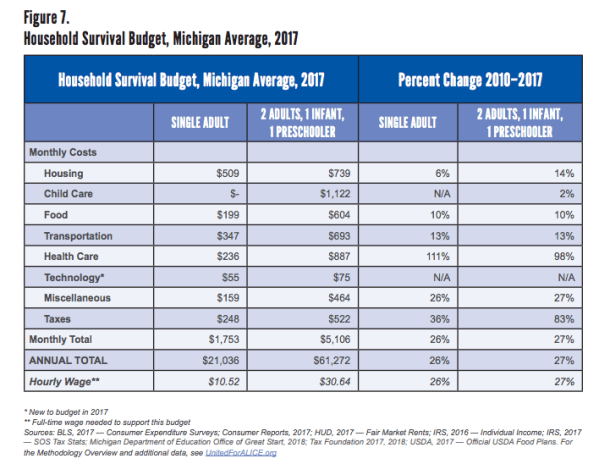
There is a recognition in this new report that nearly half of the households in Michigan are financially struggling. The report includes lots of data, like what you see in the graph above. However, the notion of what individuals and families need to live off of can and should be challenged, since many of the amounts listed above would be inadequate. For example, the housing cost for an individual and a family doesn’t fit the current housing costs in West Michigan.
The new report is an important contribution to our understanding of poverty and income for those living in Michigan. If nearly 50% of the households in Michigan are financially unstable, what does that say about the current economy within a neoliberal capitalist framework? Does this mean that capitalism only works for half the population? I would argue that more than half of the population suffers under the economic system of capitalism, since so many more individuals and families are in debt and at the mercy of the unstable nature of the speculative market.
Another aspect of the news coverage about the ALICE report, is that we primarily get the perspective of those who work in the social services field and those in the United Way. We do get some insight into the realities facing families who are struggling, but their lived experience is not center or explored in depth.
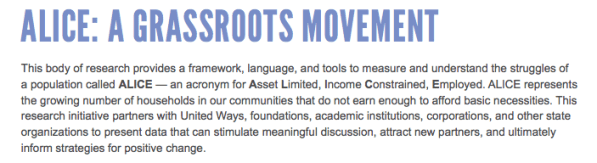
Early on in the report, those who put it together refer to is as a grassroots movement. (see above) To call it a grassroots movement is an inaccurate way of framing the research. While the research is useful, it is not grassroots, since non-profits agencies, in partnership with governments and corporate sponsors are NOT grassroots. 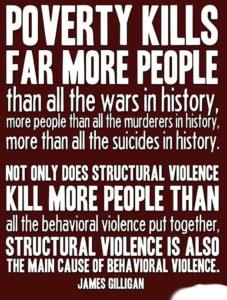 If you read the last sentence in the statement below, it makes it clear who the partners are who is omitted. Those who are experiencing poverty and financial instability are not identified as being involved in determining the “strategies for positive change.” Any grassroots movement that addresses social issues must be led by the people who are most affected, which in this case are the individuals, families and communities that are experiencing poverty and other forms of harm under the economic system of capitalism.
The fact that corporations are seen as partners with the United Way, should be a red flag for anyone who really wants to develop strategies that will be beneficial for those currently affected by the economic system. In the same edition of MiBiz that included their article on the ALICE report, another story was headlined, Michigan execs remain optimistic about state economy, job growth.
It is imperative that when people talk about the growth of the economy, it does not correlate that what is good for “the economy” is good for the people. If there is anything that we should learn from capitalism, it’s that economic growth primarily means that those at the top, the one percent or the capitalist class, are the ones who will benefit.
West Michigan Policy Forum teams up with the Mackinac Center to push for continued Medicaid work requirements
 On Friday, the West Michigan Policy Forum posted a link (seen here on the right) to a Detroit News opinion piece, co-authored by a representative from the West Michigan Policy Forum and the Mackinac Center for Public Policy.
The opinion piece that appeared in the Detroit News was co-authored by former State Representative Jase Bolger and Lindsay Killen, a staffer at the Mackinac Center for Public Policy.
Bolger left political office a few years ago and formed the Tusker Strategies LLC group, which represents groups working on public policy changes in Michigan. According to the Tusker website, the West Michigan Policy Forum (WMPF) appears to be Bolger’s only client. In addition to representing the WMPF, Bolger also joined the board of the Great Lakes Education Project, the entity created by Betsy DeVos to undermine public education across the state.
Bolger co-wrote the opinion piece with Lindsay Killen, who is the VP for strategic outreach and communications at the Mackinac Center and member of the Board of Policy Advisors at the Heartland Institute. The Heartland Institute is another far right think tank that is one of the leading think tanks that denies the existence of Climate Change. Killen also used to work for the Freedom Alliance, managing outreach to organizations for the Sean Hannity Freedom Concerts with Lt.Col. Oliver North.
Considering the reactionary positions and organizations that both Bolger and Killen represent, it is no surprise that they would be pushing for Michigan to maintain work requirements for those who receive Medicaid benefits. The Snyder administration pushed for the same Medicaid work requirements, we he signed a bill asking the federal government for permission to implement work and community engagement requirements for able-bodied adults enrolled in Healthy Michigan. If Governor Whitmer doesn’t reverse that decision, then the work requirements aspect of Medicaid would begin in 2020.
 Bolger and Killen think that requiring those on Medicaid to work (if they are able to) is a good thing and they also believe that when people work, “it feeds the human spirit.” I wonder if Jase Bolger or Lindsay Killen has ever had a job that was physically demanding, with little pay and long hours? Not all work “feeds the human spirit.”
In addition, it is interesting that those who support this kind of policy position don’t require the same kind of conditions for corporations and businesses that receive massive subsidies, also known as corporate welfare. Public money subsidized businesses with nearly $30 million simply for the purpose of developing talent so that companies can compete at the global level.
Lastly, it should be noted that if we had a single payer health care policy in the US or a Medicaid for All plan, people would be better off and not have to adopt to more of the austerity measures that policy makers want to impose on them.
Does DGRI endorse the radical politics of the Rad Women images they are displaying all over downtown Grand Rapids?
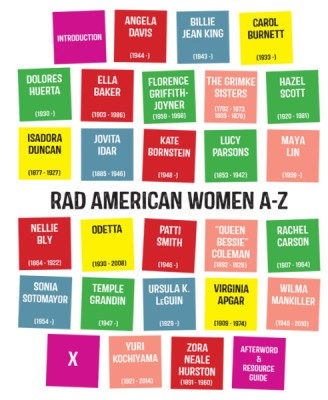
 “In honor of International Women’s Day and Women’s History Month 2019, Downtown Grand Rapids Inc. (DGRI) announces a sweeping public art project to recognize and celebrate the contributions women have made to the United States of America.”
The above statement was posted in early March from DGRI, the quasi-government entity that includes the Downtown Development Authority, the Downtown Improvement District and the Monroe North Tax Increment Finance Authority. These groups are represented by most government and business people who have been responsible for the ongoing development of the greater downtown area of Grand Rapids, a development process that has served the interests of the Grand Rapids Power Structure.
Thus, the announcement that DGRI would be not only celebrating women’s history month, but celebrating women who are the subjects of the book, Rad American Women A – Z, written by Kate Schatz and Illustrated by Miriam Klein Stahl, was rather surprising to me, especially considering what many of the women celebrated in the book represent. Indeed, these women were/are engaged in radical politics and radical imagination in such a way that would actually challenge and confront the kinds of activities that DGRI engages in.
Lets take a look at these women and the kinds of work, vision and commitment they collectively have brought to many of the social movements throughout US history. Since the book presents these women alphabetically, let’s provide a summary of their collective herstory alphabetically.
Angela Davis – Angela Davis was a member of the US Communist Party, a revolutionary that went to prison for being part of the Black Power Movement. Davis has been a professor for decades teaching radical theory and history, has written numerous books on black liberation and black radical theory and has been part of the movement to Abolish Prisons. She is an anti-capitalist who is known throughout the world and has been deeply committed to the liberation of black, brown, Indigenous and Palestinian people.
Billie Jean King – The famous US tennis player who not only fought for equal pay for women tennis players, but was one of the first lesbian athletes to publicly challenge heteronormative politics in the US.
Carol Burnett – Carol Burnett has been an entertainer for decades and challenged the Patriarchy in Hollywood for as long as she has been an entertainer. Carol Burnett has also made us laugh, which in the US can been seen as both subversive and liberating and the same time.
Dolores Huerta – One of the leaders of the United Farm Workers, Dolores Huerta not only demonstrated the power of organized workers vs organized wealth, she taught us the power of collective action, of cooperative politics and the power of non-violent direct action.
Ella Baker – Ella Baker was one of the most important organizers in the black freedom struggle, often referred to as the Civil rights Movement. Ella Baker taught a whole generation of young black and brown organizers and was part of the NAACP, the Southern Christian Leadership Conference and the Student Nonviolent Coordinating Committee. Ella Baker was one of the most important organizers of the 20th century and believed in the power of direct action to challenge systems of oppression.
Florence Griffith-Joyner – Florence was an Olympic sprinter that amazed us with her speed and her grace. Known as Flo Jo, she wore spectacular running outfits that were matched by her powerful physique.
The Grimke Sisters – Sarah and Angela Grimke were the daughters of slave owners, who rejected their families and went on the become part of the Abolitionist Movement, the Women’s Suffrage Movement and the early US Labor Movement. The Grimke sisters saw women’s liberation, black liberation and the liberation of workers as part of the same thread of freedom.
Hazel Scott – Hazel Scott was a jazz and classical pianist, a singer and an actor that performed in the US in the 1930s, 40s and 50s. She was the first black female to have her own TV show. However, Scott was investigated by the House Un-American Activities Committee for her politics and was Blacklisted. Like many other black performers in that era, she moved to Paris to continue her career, but eventually moved back to the US in 1967.
Isadora Duncan – Isadora Duncan was a performer who loved to dance. Duncan loved dancing so much that she wanted to teach others, especially children and opened numerous dance schools throughout her career. Duncan hated the commercial aspect of performing, so she committed most of her life to teaching. Isadora was also a feminist, an atheist and drawn to communism in the later part of her life. She moved to Russia in 1921, shortly after the revolution.
Jovita Idar – Jovita Idar was a teacher, a journalist and an organizer, primarily in the Mexican-American and Chicano movements. Idar was originally from Laredo, Texas where she first experienced the way that Mexicans were treated in the US. Idar was part of many groups, including the League of Mexican Women, the Primer Congreso Mexicanista and during the Mexican Revolution went to Mexico to care for the wounded and to protest the US military invasion of northern Mexico.
Kate Bornstein – Kate Bornstein was one of the first persons to challenge the gender binary in the US. They wrote about many topics, but is best know for their work on challenging the gender binary. Bornstein was also a playwright and performance artist who is best know for their book Gender Outlaws.
Lucy Parsons – Lucy Parsons was a radical organizer, anarchist, anti-racist and anti-capitalist. Parsons was a Latinx woman who was married to Albert Parsons, also a radical organizer and one of the four men arrested during the Haymarket riot. Albert was eventually executed, but Lucy kept organizing and speaking out against the evils of capitalism and White Supremacy until she died.
Maya Lin – Maya Lin is a famous artist and architect who is best known for her urban land art. Lin designed the Vietnam Veterans Memorial in Washington, DC and has created urban memorials all across the US, including the Civil Rights Memorial in Montgomery, Alabama.
Nellie Bly – Nellie Bly was a journalist in the early part of the 20th century, famous for making a trip around the world in 72 days. However, Bly’s more important work was her contribution to investigative journalism, especially the journalism she practiced by exposing the brutal practices of mental health institutions and asylums in the US.
Odetta – Odetta Holmes was a singer, actress, guitarist and lyricist who became known as the “Voice of the Civil Rights Movement.” Odetta performed for the 1963 March on Washington for Jobs and Freedom. Odetta’s music spanned decades and influenced the likes of Harry Belafonte, Bob Dylan, Joan Biaz and Janis Joplin.
Patti Smith – Patti Smith has been an American singer, songwriter and performer for decades and was influential in the early Punk Rock scene in New York City. Patti has played in numerous bands and collaborated with other musicians over the years. She has also done benefit concerts for the anti-war movement, in support of AIDS activism and a number of other social movements over the years.
Queen Bessie Coleman – Queen Bessie Coleman was only 32 when she died. She was the first African American and Native American pilot to get a pilot license in the US.Queen Bessie was also part of an activist community in Florida in the 1920s, a community connected to the Mount Zion Missionary Baptist Church.
Rachel Carson – Rachel Carson was a scientist, ecologist and feminist who gave us one of the most important environmental books of the 20th century, Silent Spring. Carson’s research proved that pesticide use was having a negative impact on species, eco-systems and humans.
Sonia Sotomayor – Sonia Sotomayor is a member of the US Supreme Court. Nominated to the court in 2009, Sotomayor became the first Latina to rise to that position.
Temple Grandin – Temple Grandin is a professor of animal science and consultant to the livestock industry. Grandin is also one of the first persons with autism to publicly talk about her lived experience with autism and invented what is now called the “hug box.”
Ursula K. LeGuin – Ursula K. LeGuin is one of the best science fiction writers in US history. LeGuin, was a feminist, who imagined what the world would look like through a feminist and futurist lens. LeGuin practiced radical imagination in her writing and was an outspoken critic on many social issues during her lifetime.
Virginia Apgar – Virginia Apgar was an American obstetrical anesthesiologist and developed a methodology for assessing the health of new born babies, known as the Apgar score.
Wilma Mankiller – Wilma Mankiller was an activist, community developer and the first woman elected to be Chief of the Cherokee Nation. Mankiller took part in the occupation of Alcatraz and was influenced by the American Indian Movement. She adopted lots of programs from AIM and developed those programs within her Cherokee community.
Yuri Kochiyama – Yuri Kochiyama was an American activist that was influenced deeply by her parents who were forced into Japanese Internment Camps in the US during WWII. Yuri was a friend of Malcolm X, supported Black separatists, the anti-war movement and later worked for reparations for Japanese American internees.
 Zora Neale Hurston – Zora Neale Hurston was one of the most important black writers of the early 20th century. Hurston gave us such works as, Mules and Men; Moses, Man of the Mountain; and Their Eyes were Watching God. Hurston was also an anthropologist who did extensive research on Haitian Voodoo.
One can see that many of these radical women were engaged in important social movements and in abolitionist politics. Imagine what Angela Davis, the Grimke sisters, Lucy Parsons, Dolores Huerta and Ella Baker would have to say about the racist gentrification of Grand Rapids, the police brutality of black and brown communities or the celebration of wealth that is so much of the Grand Rapids community. Imagine what artists and performers like Carol Burnett, Maya Lin, Odetta, Patti Smith and journalist Nellie Bly would have to say about spectacles like ArtPrize. Imagine was feminists like Ursula LeGuin, Rachel Carson, Wilma Mankiller and critic of the gender binary theorist Kate Bernstein would have to say about the homophobia, transphobia and rich, white, male power structure of Grand Rapids.
Lastly, considering that most of these radical women believed in the power of direct action, does this mean that DGRI is endorsing grassroots tactics and movements that are fighting against gentrification, white supremacy, capitalism and state violence that harms black, brown and immigrant communities every day in Grand Rapids? You can’t use the images of radical women and then engage in politics that undermines the very things they fought for.
Senator Stabenow justifies her ongoing support for the Israeli occupation and for the criminalization of BDS
Last month, I posted a response I received from Michigan Senator Gary Peters on his vote to continue to support the State of Israel and to vote for criminalizing support for the international Boycott, Divestment & Sanctions campaign, known as BDS.
Yesterday, I received a similar message from Michigan Senator Debbie Stabenow. She writes:
Thank you for contacting me about the Combating Boycott Divestment Sanctions (BDS) Act, which was included in the Strengthening America’s Security in the Middle East Act (S.1). I appreciate you taking the time to make me aware of your views.
I supported S.1 because it includes legislation to maintain our security partnerships with Jordan and Israel and keeps critical sanctions on officials in Syria that are involved in the slaughter of innocent civilians.
The Combating BDS Act authorizes states to enact laws related to anti-boycott activity. In Michigan, former Governor Snyder signed two anti-BDS bills into law last year, just before the end of his term. I do not oppose an individual’s right to boycott, and I understand your concerns about these types of legislation.
The Strengthening America’s Security in the Middle East Act passed the Senate on February 5, 2019; it now awaits action by the House of Representatives.
An interesting choice os words from Senator Stabenow. She refers to the “security partnership” with Israel, but US military aid Israel ($3 Billion a year) has little to do with Israel’s security and more to do with supporting the Israeli occupation of Palestinian land. The global community through the United Nations has determined for years now that the Israeli occupation of Palestinian land is illegal. In addition, the Israeli occupation of Palestinian land results in the death of Palestinian civilians. According to the 2018 Human Rights Watch report:
The Israeli government continued to enforce severe and discriminatory restrictions on Palestinians’ human rights; restrict the movement of people and goods into and out of the Gaza Strip; and facilitate the unlawful transfer of Israeli citizens to settlements in the occupied West Bank.
Israeli forces stationed on the Israeli side of the fences separating Gaza and Israel responded to demonstrations for Palestinian rights on the Gaza side with excessive lethal force. Between March 30 and November 19, security forces killed 189 Palestinian demonstrators, including 31 children and 3 medical workers, and wounded more than 5,800 with live fire.
The Israeli human rights group, B’Tselem, provides regular human tights reports, with accompanying maps. Here is what they documented between March 23 and April 5 of 2019.

From March 23 through April 5 Israeli security forces arrested at least 115 Palestinians, including 7 minors; made at least 178 raids on towns and villages; raided at least 124 homes; and set up at least 176 flying checkpoints.
▪ In the Hebron District, Israeli security forces arrested at least 6 Palestinians; made at least 6 raids on towns and villages and raided at least 8 homes; and set up at least 18 flying checkpoints.
▪ In the Bethlehem District, Israeli security forces arrested at least 10 Palestinians; made at least 5 raids on towns and villages and raided at least 11 homes; and set up at least 5 flying checkpoints.
▪ In the Ramallah District, Israeli security forces arrested at least 41 Palestinians, including 3 minors; made at least 32 raids on towns and villages and raided at least 45 homes; and set up at least 48 flying checkpoints.
▪ In the Nablus District, Israeli security forces arrested at least 15 Palestinians, including 1 minor; made at least 21 raids on towns and villages and raided at least 7 homes; and set up at least 20 flying checkpoints.
▪ In the Jordan Valley, Israeli security forces arrested at least 9 Palestinians; made at least 27 raids on towns and villages and raided at least 11 homes; and set up at least 17 flying checkpoints.
▪ In the northern West Bank, Israeli security forces arrested at least 34 Palestinians, including 3 minor; made at least 87 raids on towns and villages and raided at least 42 homes; and set up at least 68 flying checkpoints.
In addition to completely ignoring Israeli human rights abuses, Senator Stabenow also says, “I do not oppose an individual’s right to boycott.” If this were truly the case, then Senator Stabenow would not have voted for the Combating BDS Act, which criminalizes the boycotting of Israeli companies or other multinational corporations that are profiting from the Israeli occupation of Palestinian land.
Senator Stabenow’s support for Israel and the criminalization of BDS is consistent with her longtime support of US military aid to Israel. Senator Stabenow has voted for US military aid to Israel for as long as she has been a US Senator, beginning in 1998. According to OpenSecrets.org, Senator Stabenow has received a total of $837,576 from the Pro-Israel Lobby.
The Immigrant Justice Movement in Grand Rapids Part II
(Editor’s note: I am currently working on a book, tentatively entitled, A People’s History of Grand Rapids, which is related to this article.)
In Part I, we looked at the beginnings of an immigrant justice movement in Grand Rapids, specifically between 2005 and 2016.
The immigrant justice movement evolved significantly after the 2016 election, with the news that the new Trump administration would be escalating repressive measures against undocumented immigrants, with talk of building a wall along the US/Mexican border and adding 15,000 additional ICE agents across the country.
A group of people were invited to a meeting that was being hosted by the CRC’s office of Social Justice just weeks after the 2016 election. Some 40 people were at that meeting to discuss the possibility of doing sanctuary work, along with a whole range of ideas that would provide opportunities for solidarity with the undocumented community. However, there was one thing missing from this meeting……there was no one from the immigrant or the undocumented community.
However, people from this initial gathering continued to meet and form committees. The committee I was a part of, was a group that was looking to intervene when ICE agents were attempting to arrest and detain people.
There was a community forum held in January of 2017, at the Eastern Avenue Christian Reformed Church to talk about what could be done to respond to the anticipated anti-immigrant rhetoric coming out of Washington. Some people met to talk about offering sanctuary, while others met to discuss the work of a group calling itself the GR Rapid Response to ICE project.
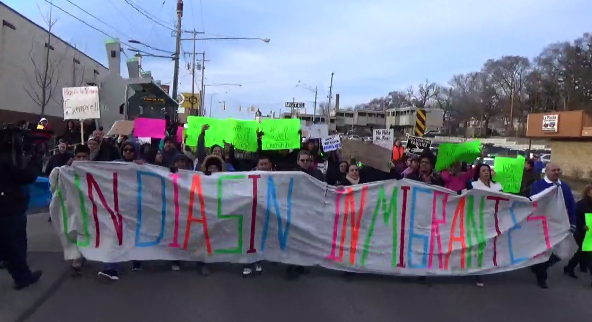
GR Rapid Response to ICE hosted its first training in February of 2017, with over 100 people attending, which did reflect that many people had a growing concern about the fate of immigrants under the Trump administration. In that same month, a march was organized by the immigrant community to draw attention to their concerns and fears about the increased repression they were feeling. Several thousand people showed up at that march in February, with a banner that read, Un Dia Sin Immigrantes – A Day Without Immigrants.
It was out of this immigrant-led march that Movimiento Coscha GR was born. Some of the organizers from that march traveled to Boston to participate in a training with the Cosecha national and came back determined to organize the immigrant community in Grand Rapids.

Cosecha GR continued its organizing work with other marches and an action at the local ICE office where three people were arrested to expose the bankrupt immigration policies of this country.
One focus of Cosecha GR has been to use boycotts to address systemic problems around immigration, by making it clear that without immigrants the US economy would come to a stop. The boycott campaign saw several thousand people marching and refusing to buy anything on May 1st, an action at Walmart that exposed the wages of migrant workers and the current Turkey Boycott Campaign.
 In October of 2017, there was also a powerful display of solidarity, where Movimiento Cosecha GR had decided to support a contract dispute with the bus drivers union in Grand Rapids and the union in turn supported Cosecha GR and their push to get an Equal Services policy adopted by the City of Grand Rapids, which would prevent city employees from asking people about their legal status.
Unfortunately, the GRPD lobbied to not be included in the Equal Services policy and the City attorney revised the content to exclude them from the policy, which means the GRPD could ask people what their status is.
GR Rapid Response to ICE and Movimiento Cosecha GR continued to organize and offer trainings at the beginning of 2018. The first major immigration action took place in January, when Congress was debating whether or not to continue the federal policy known as DACA. People from Grand Rapids went to DC to take part in actions and then organized an action on January 19, where protestors shut down traffic at an intersection by the Grand Rapids Federal Building.
At that January 19 action, police officers did not act when motorists forced their way through the protestors on the street. Movimiento Cosecha GR held a press conference in response to this form of state violence in February. The GRPD showed up to intimidate the immigrant-led group and then waited in the parking lot to make sure that they could talk to the news media that came to the press conference.
Then in March, a church which was working with the group GR Rapid Response to ICE, publicly declared themselves a sanctuary for undocumented immigrants.
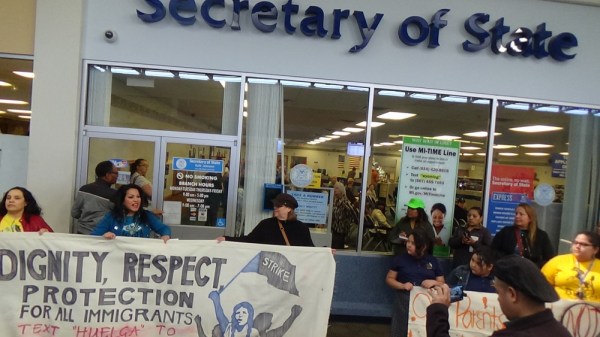
Beginning in early April, Movimiento Cosecha GR began promoting their upcoming days of action, which would begin at the end of April. These four days of action were part of a larger strategy of getting to a seven day strike, where immigrants and allies would demonstrate the kind of economic power they have to force the country to come to terms with the unjust immigration policies that currently permeate the US.
Movimiento Cosecha GR also used these four days of action to kick-off their campaign to get drivers licenses for all in Michigan. On April 30th, the movement participated in an action at the Secretary of State’s office in Wyoming, MI.
On May 1st, an estimated 2,000 people marched in the streets of Grand Rapids to demonstrate the power of immigrants. The GRPD had increased their presence during the march and tried to dictated the route, but movement organizers would not comply, thus demonstrating their commitment to a truly grassroots politics that took its direction from the people most impacted by the unjust immigration policies.

There was an increase in the amount of calls that GR Rapid Response to ICE was getting, which led that group to look into the Kent County Sheriff Department’s relationship with ICE. It was discovered that Kent County had begun a contract with ICE in 2012. As GR Rapid Response to ICE was gearing up to protest the county’s contract with ICE, along with Movimiento Cosecha GR, the US was separating immigrant families near the US border and putting children in cages.
Capitalizing on the national outcry over the treatment of immigrants, GR Rapid Response to ICE and Movimiento Cosecha GR organized an action at the Kent County Commission meeting in late June of 2018, which turned out over 200 people on a Thursday morning. There were several people arrested during that action, but more importantly, that action led to a larger End the Contract campaign, where both Movimiento Cosecha GR and GR Rapid Response to ICE were calling for an end to the county’s contract with ICE.
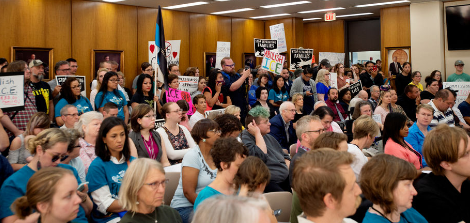
Since the End the Contract campaign began in late June, Movimiento Cosecha GR and GR Rapid Response to ICE have participated in over a dozen actions on the contract, including actions at various ICE offices, a march and rally held outside of the Kent County Jail, various actions at the regular Kent County Commission meetings, a No Business with ICE Action Day and even a disruptive action during ArtPrize to draw attention to the fear and terror that immigrants were experiencing in Kent County.
In addition, once the End the Contract campaign had begun, there was the development of Cosecha Allies trainings, as a way to bring more allies into the movement and to build capacity for the expanding struggle for immigrant justice. This was important, not just for working on the End the Contract campaign, but for the Movimiento Cosecha GR 5 day pilgrimage to Lansing for their drivers licenses for all campaign.
In early January of 2019, Kent County made national news with the revelation that Jimar Ramos-Gomez, a man born in the US, who later served in the US military in Afghanistan, was detained by Immigration and Customs Enforcement (ICE).
Shortly after this news went national, the Kent County Sheriff held a press conference, stating that the Sheriff’s Department, “will no longer honor federal immigration holds without an arrest warrant signed by a judge.”
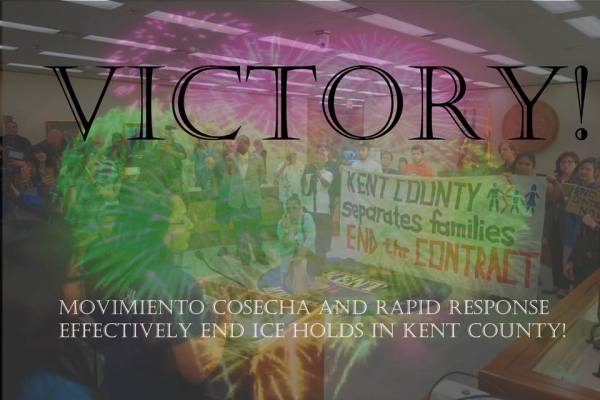
This was a major victory, which Movimiento Cosecha GR and GR Rapid Response to ICE celebrated, because it demonstrated that the End of the Contract campaign was effective, since they believe that the constant pressure put on by both groups resulted in the Sheriff Department’s change in policy.
 However, it was also discovered during the arrest and detainment of Jilmar Ramos-Gomez, that the GRPD was involved. The ACLU and MIRC had called for an investigation of the GRPD’s role in the Jilamr Ramos-Gomez case and in the process obtained numerous documents that clearly demonstrated that the GRPD acted in a racist manner in their collaboration with ICE.
Movimiento Cosecha GR and GR Rapid Response to ICE had already begun to confront the City of Grand Rapids and make demands, but after they looked at the ACLU/MIRC documents they engaged in a larger action in late February of 2019, calling for Captain VanderKooi to be fired.
In addition to pressuring the City of Grand Rapids around immigrant justice issues, Movimiento Cosecha GR has been gearing up for the May 1st action, which again has Drivers Licenses for All as the main theme. For more information on the May 1st action, go to their Facebook event page linked here.
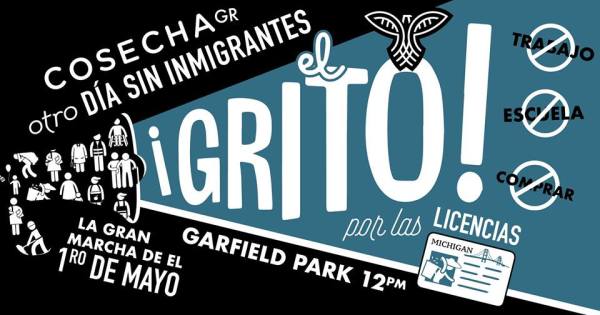
Movimiento Cosecha GR and GR Rapid Response to ICE continue to do important work in building a strong immigrant justice movement. In many ways this movement has been the longest sustained movement in Grand Rapids, since the anti-Iraq War movement some 15 years ago, and their is no evidence that this movement is going away anytime soon. Hasta La Huelga!
Kent County’s Immigration Focus group has little immigrant involvement, no transparency: Who are they accountable to?
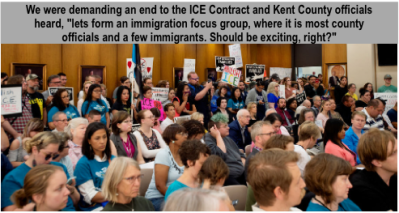 When Movimiento Cosehca GR and GR Rapid Response was pressuring Kent County Commissioners and the Sheriff’s Department to end the contract with ICE, the best we could get out of some commissioners was that they would set up a “focus group” to look into the concerns of immigrant.
Of course, this had little to do with the demand to end the contract that ICE had with the Kent County Sheriff’s Department. First, calling for an immigrant “focus group” was dismissive of the evidence that was provided from the two groups demanding the end of the contract, which included testimony from the affected community.
Second, holding an immigration “focus group” is significantly broader focus than the demand to end the contract, which specifically impacted the undocumented immigrant community. Some members of the Kent County Commission kept saying that they wanted to invite people from the immigrant community to sit down and have a conversation with the Sheriff’s Department, so that they could build trust. Movimiento Cosecha GR and GR Rapid Response to ICE kept saying that those most impacted by current ICE practices live in fear of law enforcement and would not likely meet with law enforcement, especially since local law enforcement has been cooperative with ICE arrests and detentions in Kent County.
The other issue with the immigration focus group is the lack of transparency. When people attending a Kent County Commission meeting in January, we heard that they planned to begin meeting. I have yet to find anything online about the meetings, who is attending and what topics are being discussed.
I wrote to the Kent County Commissioner who represents my district, Stephen Wooden, and he responded by saying that he is happy to look into it. He also shared video from the March 28, Kent County Commission meeting and towards then end Commissioner Sparks did mention that the group has meet once.
Commissioner Sparks stated that those in attendance besides herself, were the Kent County Sheriff’s Department, Comm. Talen, Comm. Womack, Commissioner Antor, the County Administrator, someone from the County’s communication staff and members of the Hispanic Chamber of Commerce. Comm. Sparks stated, they had “a very inspirational meeting,” that it was a great discussion and “very positive.”
This was not much of a report back, it doesn’t inspire confidence in the county commission and it says that a conversation about immigration was mostly attended by people not from the immigrant community and not likely someone from the undocumented community, since the only non-governmental voices were from the Hispanic Chamber of Commerce. The Hispanic Chamber of commerce is not exactly representative of the immigrant community (check out who sits on their board), especially those who live in fear of ICE and law enforcement.
In many ways this immigration focus group is what many of us expected and it has relatively nothing to do with what Movimiento Cosecha GR and GR Rapid Response to ICE had confronted the County Commission on since last June.
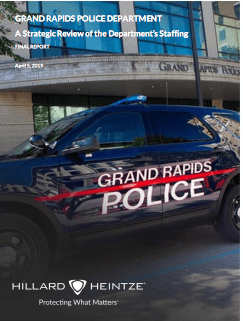 A Chicago-based firm Hillard-Heintze, LLC, presented their findings at the Grand Rapids City Commission Tuesday morning. Hillard-Heintze, LLC, was hired by the city to provided an assessment of whether or not the GRPD needed to hire more officers, which the department has been arguing for years. The report cost taxpayers just short of $100,000.
According to their website:
Hillard Heintze is one of the leading security risk management firms in the world. We are trusted around the globe to deliver innovative, prevention-oriented advisory solutions that help our clients improve performance and outcomes in protecting what matters: their people, performance, interests and reputation. Since our inception in 2004, more than 85 Fortune-ranked enterprises, 150 of the world’s most affluent families and 500 U.S. and international brands have gained insight, assurance and confidence through our services – and are better managing security risk.
The CEO and co-founder, Arnette Heintze, has decades of experience in law enforcement and used to work for the US Secret Service as security details for George & Barbara Bush and Bill & Hillary Clinton.
If one spends any time on Hillard Heintze’s website, you can clearly see that they are a pro-law enforcement agency that has a great deal of respect for police and other security agents. They have a blog, which shares regular insights and opinions about law enforcement, such as their recent piece entitled, 5 Major Law Enforcement Trends That Will Shape 2019.
The Report produced by Hillard Heintze can be viewed within the April 9, GR City Commission meeting of the Whole document, linked here. The report begins on page 53 and runs through page 110.
According to the firm of Hillard Heintze, they were contracted to review and assess the following.
- Current operational, administrative and investigative components to ensure alignment, efficiency and effectiveness.
- Current civilian staffing assignments, including classifications for appropriate personnel allocation, excluding dispatch assignments.
- Current patrol assignments for appropriate staffing levels as based on relevant computer-aided dispatch (CAD) data and other organizational priorities.
- Current policies and practices regarding employee stress, fatigue, overtime and succession planning.
In the letter that the CEO of Hillard Heintze LLC sent to acting Chief David Kiddle, Heintze states:
The GRPD is at an important juncture as your City continues its search for a new Chief. The budget and staffing decisions of the past continue to impact the department’s ongoing success, particularly as it seeks to address succession planning and effective allocation of resources. Our analysis has found that while sworn staffing is sufficient to meet current demand, limited administrative support and the absence of usable of data to direct resource allocation contributes to the pressures felt by officers and managers within the GRPD. Our observations and analysis identify that providing more support through increased administrative staffing will allow officers to engage in the proactive policing activities.
In many ways the report is tedious, with lots of details about work schedules and operational practices. However, the report does provide some very useful information about what the GRPD spends most of their time on.
 The report states that, “most calls are not for emergency police services, such as immediate physical danger, but rather are service oriented. Seventy percent of calls for service in 2018 were categorized as “low priority.” For example, the most common calls for service included 4,982 for property damage-only traffic crashes and 4,050 calls for burglar alarms, most of which are false. On average, officers spend almost an hour on scene resolving calls for service, so a significant amount of patrol time is spent addressing non-emergency calls. This evolving demand for a variety of services from law enforcement is a trend that we see nationally, and many communities continue to struggle with identifying what, when and how they want police services delivered. This is of concern for many municipalities as police budgets are often the largest component of municipal expenditures.”
You can also see from graphic, the numerical breakdown of why people are calling the GRPD.
Based on this data, most of the calls the GRPD receives are non-emergency and low priority calls, often responding to traffic accidents and burglar alarms. The report recommends that more civilian staff could take care of more of the non-emergency calls to allow the GRPD officers to attend to other matters.
The Grand Rapids Police union has already responded to the report and has expressed frustration with the city officials who have already made the study public. This response from the police union is not surprising, considering that they have been antagonistic towards city officials in recent years over growing concerns and demands from the community over police brutality, specifically in communities of color.
The report does provide a list of recommendations on the last two pages of the report. Those recommendations are primarily organizational in focus and less on procedure.
While this report provides some useful information and data on the GRPD, it doesn’t address more pressing issues such as:
- How much of the City’s budget is consumed by the GRPD
- Recent examples of Police brutality, specifically within black and latino/latinx neighborhoods
- GRPD cooperation with Immigration Customs & Enforcement (ICE)
DeVos Family infographic #1
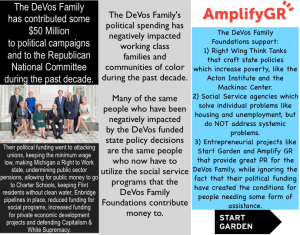 The infographic we provide here is based upon our documentation of the DeVos Family’s collective political contributions over the years, the 990 documents from the various family foundations and the state policies that have been passed by politicians that the DeVos Family has funded.
You can find all of this documented in our 460 page downloadable document, The DeVos Family Reader. For additional sources, please check out the Michigan Campaign Finance Network for election contributions from the DeVos Family or Guidestar for investigating the various DeVos Family Foundations and who they have contributed to.

The Immigrant Justice Movement in Grand Rapids Part I
 (Editor’s note: I am currently working on a book, tentatively entitled, A People’s History of Grand Rapids, which is related to this article.)
I have been in Grand Rapids since 1982. During the past 37 years I have been involved in a variety of activist work and organizing efforts. However, it is important to state up front that activism is often not organizing work.
One thing that differentiates organizing from activism is that, activism is often done singularly and rarely does it have a larger goal. Organizing, on the other hand, is well thought out, with tactics, strategies and goals, especially when it is part of a larger social movement.
Activism can be part of organizing work, but activism by itself is insufficient for the long term goals of social movements. People can be motivated by a singular event or moment in history, like the moment last June when people became aware that the US government was detaining and separating immigrant families just inside the US border. People were outraged when they saw children in cages, and rightfully so. People maybe signed an online petition, donated to a group or attended a rally calling for the end of immigrant family separation.
However, many people didn’t know what to do to sustain their anger and eventually lost interest in what was happening or did not seek out organizations or movements that were addressing the issue of immigrant family separation.
I have participated in several social movements in the Grand Rapids area since the early 1980s, including the Central American Solidarity Movement, the Sanctuary Movement, the Disarmament Movement, the Anti-Globalization Movement, the Anti-Iraq War/Occupation Movement and the Food Justice Movement. I have learned a great deal from the people in those movement and it is what has inspired me to want to write A People’s History of Grand Rapids.
Immigrant Justice Movement
The roots of the current immigrant justice movement really began in 2005. Wisconsin Representative Sensenbrenner had introduced a bill, the the Border Protection, Antiterrorism and Illegal Immigration Control Act of 2005. This bill would criminalize undocumented immigrants and even punish those who offered them any assistance. The proposed bill mobilized people all across the US, including in Grand Rapids.
There were meetings that were being held at the Burton Heights United Methodist Church (which has since been demolished), with 200 – 400 people coming to each meeting over the next several months to discuss what actions to take. In conjunction with a national effort, it was decided by the immigrant community to turn out in large numbers in opposition to the Sensenbrenner bill.
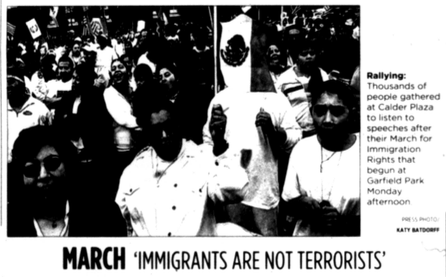 On March 26th, 2006 an estimate 10,000 people marched in Grand Rapids from Garfield Park to downtown Grand Rapids to protest the anti-immigration legislation. Some observers say that this was one of the largest marches in the history of the city, if not the largest. What is more important is that this march was made up of mostly people from the immigrant and undocumented community.
I was at that march in 2006 and wrote about it for an indymedia blog called Media Mouse. The story I wrote at the time, along with how the Grand Rapids Press covered it, is documented in a post on the Grand Rapids People’s History Project site.
There was another action organized as a follow up to this march, which took place on May 1st of 2006. This action also took place at Garfield Park, but it was much smaller, did not involve a march, but was being called Un Dia Sin Imigrantes – A Day Without Immigrants, which I also wrote about for Media Mouse. Unfortunately, after the May Day action, the moment was gone and organizers did not capitalize on the energy and numbers of those who took over the streets 5 weeks earlier.
There were still some meetings that were being organized, but primarily by those in the non-profit sector, religious people and immigration lawyers. These meetings took place primarily at the Hispanic Center and focused on policy rather than organizing the affected community.
By 2007, people began to rally around the idea of Comprehensive Immigration Reform Act of 2007 and the 2008 Presidential Elections. There was a big push within the immigrant community to register people to vote. When it was clear that Barack Obama was going to get the Democratic nomination and if elected, he would make Comprehensive Immigration Reform a priority, which motivated a lot of people.
Barack Obama did become the President and promised to pass Comprehensive Immigration Reform within the first 100 days. This however, did not happen and in fact, it never happened during the 8 years he was in office.
Many people in the immigrant community were disappointed by this outcome and many became disillusioned by electoral politics, especially when the Obama administration escalated the war against the undocumented community, deporting an estimated 3 million during those eight years.
A group that came together during the time, called the West Michigan Coalition for Immigration Reform, began to meet monthly. One of their main goals was to get Comprehensive Immigration Reform passed in Congress. They held a Press Conference in early September of 2009, to kickoff a new campaign to push politicians to embrace Comprehensive Immigration Reform.
The month before, GRIID agreed to conduct a series of interviews from people directly impacted from ICE raids and arrests or those who worked with people impacted, such as lawyers and social workers. Here is one of those interviews with an ALCU lawyer who shared her research on detention center across the US.
A week after their September Press Conference, the West Michigan Coalition for Immigration Reform held a public forum to kickoff their campaign to get Comprehensive Immigration Reform passed and in the minds of millions of Americans. The forum was held at GVSU’s downtown campus and co-sponsored by the Latin American Studies Department. The following month there was another rally held at Garfield Park, just prior to people traveling to DC to lobby Congress on Comprehensive Immigration Reform.
 There was limited activity for a few years, until the 2012 Presidential Election, when the argument was made that “people needed to re-elect President Obama in order to achieve Comprehensive Immigration Reform.” However, at the same time there was increased ICE activity in West Michigan and more and more people were being arrested, detained and deported. At the monthly meetings of the West Michigan Coalition for Immigration Reform we kept hearing of arrests, raids and the growing fear that the immigrant community was feeling. There was even an attempt to create a Rapid Response to ICE project, but for a variety of reasons it never got off the ground.
However, in late 2012, there was also dissatisfaction with what was happening at the national level. In November of 2012, about 250 people went to Lansing to demand immigrant rights and Drivers Licenses for All.
In December of 2012, over 200 people showed up at a Grand Rapids City Commission meeting, mostly those from the immigrant community. Again, those who spoke were demanding that the city support their effort to get Drivers Licenses for the undocumented community. A Latino pastor addressed the Grand Rapids City Commission with a passionate plea for Drivers Licenses for All.
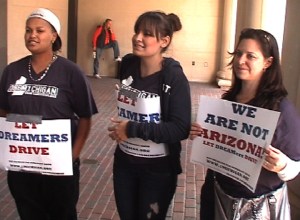
Young immigrants were especially disillusioned at this time and began organizing efforts to gain protections for themselves, which eventually lead to the Dream Act. Young immigrants were showing up all over the country whenever President Obama was scheduled to speak. They engaged in action that were disruptive and directly called out the President on his failure to push legislation that would be beneficial to undocumented immigrants.
Comprehensive Immigration Reform was eventually voted on in 2013, but it narrowly lost and there hasn’t been any attempt since then to get something like it passed.
However, there was a valuable lesson learned by these young immigrant organizers. They learned that putting their hopes into an electoral campaign was useless, unless there was a social movement that was organized by those who were most vulnerable to arrest, detention and deportation.
It was in 2014-2015, that immigrant organizers met to discuss and strategize around the importance of creating an immigrant-led movement that was calling for immigrant justice.
In Part II of this article, we will look at what has happened in Grand Rapids around immigrant justice, since Donald Trump was elected in November of 2016 and up until the present.
Acton Institute reports on Trump visit to Grand Rapids: Says Detroit and Flint should be like Grand Rapids
 The March 28 visit to Grand Rapids by President Donald Trump generated a great deal of local and national attention. Some articles focused on the protest that greeted Trump and his supporters outside, while other journalists wrote about what was said inside the Van Andel arena.
Trump’s visit even received a blog post from the Grand Rapids-based far right think tank, the Acton Institute.
In a blog post from last week, Acton research fellow Dylan Pahman chose to focus on one specific thing that Trump said during his visit to Grand Rapids. The headline from Pahman’s article read, President Trump visits Grand Rapids, promises to turn it into Detroit.
It is an interesting topic to focus on, especially since there were so many other things that Trump has to say. However, if you spend any time on the Acton Institute blog, you realize that their writers go out of their way to focus primarily on the wonders of the free market, topped off with some theological justifications for the virtues of capitalism.
Pahman brings up the fact that Trump said that the auto industry is coming back, and then talks about the difference between Detroit and Grand Rapids.
We haven’t put all of our eggs in the basket of the auto industry, that’s why. For one thing, while there has been and still is auto manufacturing in the Grand Rapids area, we were once Furniture City, USA and are now proudly Beer City, USA. Grand Rapids can — and does — boast a dynamic, diversified economy.
There is a great deal to unpack in this statement, so lets begin by saying that the Acton Institute writer leaves out a whole lot of history.
First, Pahman leaves out a decades long history of the Big Three automakers constant attack of organized labor, an attack that is well documented in the book, Detroit: I Do Mind Dying, A Study in Urban Revolution. Another dynamic well documented in Detroit: I Do Mind Dying, is the long-standing structural racism in Detroit that was exposed in the 1967 uprising and the massive white flight (people and investment) that ensued. Since the 1970s, Detroit has been struggling, in part because of the de-industrialization of the mid-west, but also because of the ongoing war being waged against the black community. These dynamics are well documented in the book, The Fifty-Year Rebellion: How the US Political Crisis Began in Detroit.
However, the Acton writer wants to simplify Detroit’s problems around the protectionist policies applied to the auto industry. Pahman completely ignores the fact that White Supremacy and Neoliberal economic policies, including harsh austerity measures has devastated Detroit, particularly black Detroit.
Second, when Pahman says that Grand Rapids went from Furniture City to Beer City, he also ignores the complexities of what has happened over the past century. The Acton writer ignores the exploitative practices of the furniture barons, which gained national attention during the 1911 furniture workers strike. In fact, the capitalist class in Grand Rapids was so freaked out by the 1911 strike that they changed the City Charter, making Grand Rapids go from a 12 ward city to a three ward city, which allowed for the capitalist class to consolidate their control over the political and economic climate.
Third, the Acton writer also ignores the White Supremacy that has plagued Grand Rapids since the 1920s, a dynamic that is well documented in Todd Robinson’s book, A City Within a City: The Black Freedom Struggle in Grand Rapids, Michigan. Robinson argues that Grand Rapids adopt a form of “managerial racism” that was a more subtle and covert form of White Supremacy.
Fourth, while Grand Rapids did not experience the same level of de-industrialization that Detroit did, the wealth was, and continues to be, concentrated in the white community. In fact, Grand Rapids has the largest wealth gap in the entire state, based on a 2016 study. Economic development has primarily benefited the white community, with massive subsidies and other financial incites offered to developers from the City of Grand Rapids and the State of Michigan. This fact flies in the face of what the Acton writer claims about the market freedoms practiced in Grand Rapids, compared to Detroit.
Fifth, the Acton writer then quotes Experience Grand Rapids, which is nothing more than an entity that promotes the city through a Neoliberal economic lens. Here is what Pahman cities from Experience GR:
West Michigan’s global manufacturers supply customers with everything from circuit boards and medical devices, to personal care products, to bullet-proof composites for military and industrial vehicles, to smart rearview mirrors that automatically control a vehicle’s high beam headlights. Grand Rapids’ thriving craft beer industry has even driven manufacturing innovation, with one small startup designing and manufacturing a tool that allows breweries and cideries to can their own beverages for carry out directly from their taproom bars.
While these industries are thriving, they primarily benefit white people and those who are already economically well off. What Experience GR and the Acton Institute do not acknowledge is the profound realities of White Supremacy in Grand Rapids, which is profoundly reflected in the gentrification taking place in numerous parts of the city, coupled with the disproportionately high levels of poverty in the black and latino/latinx communities.
The Acton writer ends his piece with another criticism of Trump by saying:
Rather than promising to turn Grand Rapids into Detroit, the president would do better to encourage Detroit, Flint, and other former auto manufacturing centers in Michigan to reinvent themselves and adapt like we’ve done here.

What the Acton Institute writer is essentially saying is that what Detroit and Flint should do is adopt economic and social policies that benefit white people over communities of color. In fact, this is exactly what Detroit did. The major difference is that there has been more militant resistance from the black community in Detroit and more managerial racism in Grand Rapids. Both cities experience structural racism, its just that Grand Rapids hides it better.

