Deconstructing the Rule of Law and Undocumented Immigrants
On Tuesday, MLive reported on a proposed resolution in Muskegon County to make that county a Welcoming Community. The proposal was specifically referring to immigrant being welcomed, whether they were documented or undocumented.
 The reaction, from mostly white Muskegon County residents, was one of shock and disgust. Most of the people cited in the story made mention of the fact that “this is a nation of laws,” implying that those immigrants who were here without documentation, should not be allowed to be in Muskegon County or the rest of the country for that matter. If you read the comments section on MLive for this story (which I do not recommend), you can see that words like illegal and phrases like “a nation of laws” are used quite a bit. There is also a great deal of racist and White Supremacist language used in the comments, which is a more honest reflection about how people really feel. However, I wanted to take some time to deconstruct the notion that the US is a nation of laws and what people mean when they say the US shouldn’t allow “illegals” in the country.
A Nation of Laws
When politicians, law enforcement officials or just regular folks use language like, “we are a nation of laws,” to justify discriminatory treatment of undocumented immigrants, what does that really mean? There are several reasons why, reasons we want to look at and deconstruct, specifically around laws and immigrants (although, we will use other legal examples as well.)
First, the idea that nations create laws to make sure that society is kept in check, is an idea we are taught in 9th grade civil class. However, the reality is that laws are generally created by people in power, people who have specific interests at stake. For example, from the founding of the US up until 1865, slavery was legal, mostly because those who made the laws were white men, some of which owned slaves and many of them benefited economically from the institution of slavery. (see Edward Baptist’s book, The Half Has Never Been Told: Slavery and the Making of American Capitalism.) Slavery was eventually abolished, primarily because of the abolitionist movement’s efforts, which culminated in the Civil War.
The example of slavery being abolished in not an unusual example, since it highlights how most laws are changed in order to minimize harm, namely when social movements force lawmakers to change the law. This has been the case with all social movements in the US, whether it was the abolitionist movement, the labor movement, the suffrage movement, the civil right movement, the environmental movement, etc.
Second, when people say the US is a nation of laws it is important to distinguish between laws and morality. Just because a law exists, doesn’t make it a just law. The US has been replete with laws that were unjust. It was legal to kill indigenous people, make money by scalping them and then taking their land.
Even today, there are all kinds of laws that are unjust or social norms that are legal. Here are just a few:
- It is legal to manufacture and drop nuclear bombs, weapons that by their very nature kill indiscriminately.
- It is legal for corporations to pollute when they extract resources from the earth and in the process of manufacturing create waste and pollution.
- It is legal for a small group of people to make billions of dollars, while billions of people live in poverty.
- It is legal for development companies to profit from housing, while so many people are homeless or live in horrid living conditions.
- It is legal for the capitalist class to spend millions of dollars to influence elections.
- It is legal for a handful of corporations to control the majority of news media sources.
- It is legal to discriminate against people who identify as Lesbian, Gay, Bi-sexual, Transgender of Queer.
- It is legal for corporations and other businesses to pay workers wages so low that they can’t afford basic necessities, often resulting in people having multiple jobs to make ends meet.
- It is legal to incarcerate millions of people in the US, mostly black and brown, for non-violent offenses.
Just because we have laws, doesn’t mean we have to abide by them, especially if they are unjust. In fact, how many people do we revere because the deliberately broke the law in order to defy or change those very laws? How many of us celebrate the likes of Rosa Parks, Angela Davis, Dr. Martin Luther King Jr., Dolores Huerta, Cesar Chavez, Harvey Milk, Silvia Rivera, Fred Hampton, the Berrigan Brothers, Dorothy Day, etc. These are all people who purposefully broke the law in order to make change.
Third, when people argue that undocumented immigrants shouldn’t be allowed into the US because we are a nation of laws, how else can we respond? Besides acknowledging that laws are made by those in power who have economic interests and that many laws are inherently unjust, it is also important to recognize that laws have evolved over time as a reaction to various social dynamics.
Historian Aviva Chomsky states in her book, Undocumented: How Immigration Became Illegal:
“Explicitly national manifestations of control of movement emerged in the late nineteenth century, imbued with racial ideas. The first restrictive immigration laws in the United States conflated race and nation. Chinese exclusion in 1882 was based on race: as racially ineligible to citizenship, the Chinese should be excluded from entering the country as well.”
What Chomsky makes clear in her book is that the US has always deliberately discriminated against certain people from coming to the US, first the Chinese, then Japanese, Germans during WWI, Jews who were fleeing Nazi Germany, Mexicans and Central Americans – increasingly since the late 1970s and Haitians since the 1990s, just to name a few.
US immigration policy has always been race based, but it has also always been about country of origin and what relationship the US has had with those countries. For example, since the 1959 Cuban revolution, Cubans have been generally allowed to come to the US, because the US has had an antagonistic relationship with Cuba. At the same time, Haitians who were fleeing political violence or abject poverty, were not as easily granted legal status or asylum, since the US has mostly had a favorable relationship with the Haitian government, from Papa Doc Duvalier up to the present.
There are plenty of other arguments we can use when people say that the US is a nation of laws, so undocumented people should not be allowed here, but these three main arguments are important.
Lastly, it is worth noting that the current immigrant-led immigration justice movement is not advocating lawlessness. What those involved in this movement are arguing is that the federal immigration laws are unjust and racist in nature. The immigration justice movement believes that through non-violent direct action they can not only demonstrate how unjust the current immigration laws are, but they can demonstrate how economically dependent the US economy is on the labor of the estimated 11 million undocumented people living in this country.
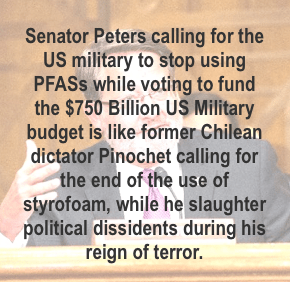
Senator Peters votes for the $750 Billion US Military Budget, but doesn’t want the US Military to use firefighting foams containing PFAS at military installations
 Editor’s note: Today, marks the 18th anniversary of 9/11 in the US. Amidst all of the commemorations for what happened eighteen years ago, ask yourself why the US continues to spend more on militarism than any other country in the world?
Last week, Michigan Senator Gary Peters posted a press release with the headline, Peters Blasts White House Objections to Bipartisan PFAS Provisions in Defense Bill.
The statement from Senator Peters was based on his effort to:
“….address the PFAS crisis in Michigan and across the country, including requiring the Department of Defense (DOD) to phase out the use of firefighting foams containing PFAS at military installations.”
While I am all in favor of getting corporations and the US Military to stop using PFAS producing products, the larger issue here, which is that Senator Gary Peters, along with the majority of Congress, voted in favor of the $750 Billion US Military Budget for 2020, known as the National Defense Authorization Act. In other words, if you really wanted to do something to address environmental contamination, then you wouldn’t vote to fund the largest military budget on the planet.
The US Military, which includes roughly 1,000 military bases worldwide, all of the planes, tanks, trucks, submarines, missiles, guns, bullets, etc, makes the US military one of the worst environmental polluters on the planet. (see the book, Green Zone: The Environmental Costs of Militarism)
On top of all of the fossil fuels used by the US military and all of the other ecological devastation they perpetrate, one of their main functions is to protect the economic interests of multinational corporations, which are also wreaking havoc on the environment around the globe. Therefore, it seems to me that asking the US military to stop using PFAS producing products while simultaneously voting for the $750 Billion US Military Budget is like Nazi Germany practicing composting at the death camps they operated throughout Europe. If such a comparison seems too outlandish to you, then how about this – Senator Peters calling for the US military to stop using PFAS producing products while voting to fund the largest military in the world is like former Chilean dictator Pinochet calling for the end of the use of styrofoam, while he slaughter political dissidents during his reign of terror.
Now, the point here is not just to point out the blatant contradiction in Senator Peters’ actions, but to challenge all of us to think about the very real and daily harm that the US military perpetrates against the environment and against human beings around the world. Noted scholar Noam Chomsky has repeatedly made it clear, along with numerous other researchers and writers, that the US military has cumulatively caused more harm in the past century than any other military on the planet – US military invasion, weapons sales, US military training, direct support of dictators, militarily supporting proxy forces, etc.
This is a sobering reality. However, equally as sobering, is the fact that entirely too many people in the US either have never heard this fact or won’t accept it as fact, which should tell us something about how we all internalize imperialist thinking in the US.
Foundation Watch: The Peter & Emajean Cook Foundation
 Peter Cook is the former Chairman of Mazda Great Lakes, where he made millions off the labor of others and the sale of cars. Cook has funded numerous groups on the religious right, such as Campus Crusade for Christ, Michigan Family Forum, the Mackinac Center, the Acton Institute, Teach Michigan and Gospel Films in Muskegon. Like Richard DeVos, Cook also served as a member on the board of the Council for National Policy. Cook was a major funder, along with Richard DeVos, for the new GVSU health sciences building on Michigan St. in Grand Rapids. During the fund raising efforts in 1995 for the proposed health sciences building, Cook and DeVos threatened to withdraw funding for the building if the university passed domestic partner benefits for faculty and staff. Money won out and domestic partner benefits were denied until 13 years later in 2008, as is documented in the film, A People’s History of the LGBTQ Community in Grand Rapids.
In addition, Peter Cook was a major contributor to the Republican Party for years, funding that has supported candidates and policies that have benefited the wealthiest people at the expense of the working class and communities of color.
We looked at the 990 documents for the Peter & Emajean Cook Foundation between 2014 and 2017. What follows are the larger contributions from those four years.
Hope College $1,750,000
The Potter’s House School $550,000
Davenport College $466,000
GVSU Foundation $400,000
Grandville Academy of the Arts $400,000
Western Theological Seminary $350,000
YMCA $327,000
Van Andel Institute $325,000
Mary Free Bed Rehabilitation Hospital $250,000
Reformed Church in America $250,000
Meijer Gardens $200,000
Habitat for Humanity $200,000
Ada Christian School Education Foundation $150,000
Boys & Girls Club of Grand Rapids $150,000
Camp Geneva $150,000
Children’s Assessment Center $150,000
Safe Haven Ministries $150,000
ArtPrize $120,000
Grand Rapids Catholic Central $100,000
Next Step of West Michigan $100,000
Freedom Alliance $80,000
Camp Rogers $50,000
Calvin Theological Seminary $50,000
 As you can see, the bulk of funding has gone to Christian entities, particularly Christian educational entities like Hope College and The Potter’s House. There is also funding to entities that were started by families who make up the Grand Rapids Power Structure, like Meijer Gardens, the Van Andel Institute and ArtPrize.
Then there is more targeted funding, particularly in the Grandville Avenue/Roosevelt Park area, such as the Grandville Academy of the Arts, Habitat for Humanity (specifically for new housing in the Grandville Avenue corridor) and the Roosevelt Park Neighborhood Association (not listed here, but still receiving a substantial amount).
Part of the slight shift in funding in recent years has been after Peter Cook died in 2010. While there is still significant funding from the foundation that goes to conservative Christian entities, the groups in the Roosevelt Park area represent somewhat of a move to support non-profits that are more rooted in that neighborhood.
What does it mean when the GRPD union contributes to candidates for Grand Rapids City Commission?
 In the past few years, the Grand Rapids Police Officers Association and the Grand Rapids Police Command Officers Association (both of which are police unions), have been on the defensive because the public has been deeply critical of how they interact with the community.
Some of the criticisms from various sectors within the community have expressed concerns, frustrations and anger of the GRPD’s treatment of African Americans and Latinx residents throughout the city. These criticisms of the GRPD have been over issues like beating motorists, intimidating and arresting youth because they “fit a certain profile,” and collaborating and contacting Immigration and Customs Enforcement (ICE).
An example of how the police union has been on the defense, was in a statement released earlier this year:
Furthermore, it has become perfectly clear to all members of the Grand Rapids Police Command Officers Association that over the past two years the elected officials and appointed leadership within the City of Grand Rapids will dismiss any actions by members of the Grand Rapids Police Department that are in compliance with established laws, policies, and recognized best practices in law enforcement and will instead cower to any “mob rule” behavior of any organizations that raise vocal opposition.
As an example of this reality, we were previously made aware of the collusion between our elected and appointed officials and several of the groups currently calling for the termination of Captain VanderKooi. On May 1, 2018, during a large protest, leaders of Movimiento Cosecha GR intentionally overran a police position for the second year in a row. Warrants were sought, sworn to, and issued by a judge for the arrests of two individuals. Shortly thereafter, the Acting City Manager and the Mayor became involved and the warrants were squashed. There is no clearer example that our city leadership would rather appease these groups who intentionally violate the law to purposely disrupt businesses and residents in Grand Rapids while endangering the lives of our officers, the general public, and their own protestors. Having known about this obstruction of justice, of which the current City Manager has also been notified, we are only left to believe that support for our personnel while acting with great restraint and being overrun by law breaking individuals does not and will not exist.
At the end of August, after it was announced that Captain VanderKooi received a mere 20 hour suspension for calling ICE on a US citizen while using racist comments directed at this US citizen, the police union put out another statement, which also is rather defensive:
“The Grand Rapids Police Command Officer’s Association is shocked and dismayed at how the rights of Captain Curt VanderKooi, who has served the City of Grand Rapids for nearly 40 years with honor and integrity, could have his rights so blatantly violated in an effort to discipline him for the first time in his career. His due process rights, the GRPCOA collective bargaining agreement, along with state law were trampled on throughout the Citizen’s Appeal Board process and now by the final disposition issued by the City Manager. He, and many others in City Hall, were put on notice and advised of these violations in the form of our grievance which was originally filed May 23, 2019. We were forced to file this grievance after he was cleared of the most serious accusations following an unprecedented three iterations of the same investigation.
Captain VanderKooi was given a two day suspension, which has recently been served. The City Manager advised the GRPCOA that he was willing to uphold the original exoneration in exchange for his agreement to retire. This discipline was unwarranted and is clearly an attempt to appease a vocal group of activists who made him a scape goat for their own political gain. We will be amending the grievance to appeal this most recent decision by the City Manager. We are also awaiting a very copious FOIA request involving all the communication reference this investigation and those involved in it. Captain VanderKooi is pleased to announce he has decided to postpone his original retirement date in 2020 and looks forward to serving the citizens and crime victims in the City of Grand Rapids as Commander of the Investigations Unit for an additional year.”
Such responses reflect a temper tantrum-like behavior, especially since we are led to believe that the police are supposed to work for the public. However, those who have bothered to investigate the history of policing in the US, are well aware of the fact that the police department were an outgrowth of slave patrols and have always serve systems of power. (see Kristian Williams book, Our Enemies in Blue: Police and Power in America)
In addition to releasing public statements and claiming that Grand Rapids City officials are cowering to activists, the police union has been some of the largest contributors to candidates running for city office. Based on public election campaign documents provided by the Kent County Clerk’s office, here is what the current members of the City Commission have received from the local police unions. I’ve also included David Allen, since he was the other 3rd Ward Commissioner last elected, besides Senita Lenear.
- Mayor Bliss – Grand Rapids Police Officers Labor Council PAC $3,000
- John O’Connor (1st Ward) – Grand Rapids Police Officers Labor Council PAC $1,000
- Kurt Reppart (1st Ward) – Grand Rapids Police Officers Association PAC $1,500
- Ruth Kelly (2nd Ward) $0
- Joe Jones (2nd Ward) $0
- David Allen (3rd Ward) – Grand Rapids Police Labor Union PAC $5,000
- Senita Lenear (3rd Ward) $0
- Nathaniel Moody (3rd Ward – has not been elected, only appointed) – Moody is a current candidate for 3rd Ward, with no campaign finance documents as this date
- Allison Lutz (current candidate for 1st Ward) no campaign documents as this date
- Wendy Falb (current candidate for 2nd Ward) Grand Rapids Police Officers Union PAC $5,000
- Melinda Ysasi (current candidate for 2nd Ward) $0
The current City Commission and potentially those who may be elected in November, have received substantial sums of money from the unions that make up the GRPD. It is rare for candidates who are running for the Grand Rapids City Commission to receive more than $1,000 for any one source, so this makes the police union PACs some of the largest single contributors to candidates for city office.
So, what does this funding mean for the police unions? Does it automatically mean that these candidates are in the pockets of the cop unions? Does it mean that cop unions have added access to city commissioners? Should the police unions even be allowed to financially influence City Commission decisions? These are all important questions that we need to think about, along with additional questions not even mentioned here, that we should be asking current members of the Grand Rapids City Commission and those who are running for the Grand Rapids City Commission. This dynamic of the likely financial influence of elected city officials by the police unions demonstrates the lack of real democracy at the city level, a practice that should not be tolerated.
MiBiz article on Drivers Licenses for All leaves out immigrant organizers in their reporting
 Earlier this week, MiBiz published an article announcing that State Senator Stephanie Chang would be introducing legislation that would allow undocumented immigrants to obtain a drivers license in Michigan.
The article provides some of the basic arguments for supporting drivers licenses for all, such as it increases public safety and it is good for the economy.
Besides the comments from Sen. Chang, there are also supporting comments from the Michigan Immigrant Rights Center (MIRC) and the Michigan Farm Bureau.
The Grand Rapids Chamber of Commerce and the Michigan Chamber of Commerce declined to respond, saying they “don’t have formal policy positions on the issue.”
The article does acknowledge that there is already clear opposition to the proposed legislation, coming directly from Republican House Speaker Lee Chatfield, who said that providing drivers licenses to undocumented immigrants, “encourages undocumented immigration.” Chatfield’s position is naive and reflects that he has no idea why people who are undocumented takes such great personal risk to come to the US. This attitude was also recently expressed by State Senator Tom Barrett who voiced his opposition to drivers licenses for all, saying:
“We have to respect the laws of our country, not encourage or reward people for being here illegally.”
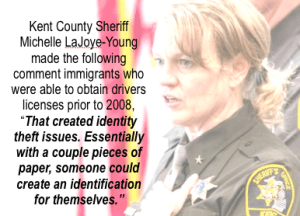
Another opponent to the proposed legislation that was cited in the MiBiz article, was Kent County Sheriff Michelle LaJoye-Young. The Kent County Sheriff stated immigrants who were able to obtain drivers licenses prior to 2008:
“That created identity theft issues. Essentially with a couple pieces of paper, someone could create an identification for themselves.”
The most glaring omission from the MiBiz article is that we don’t hear the opinions or perspectives of those who would most benefit from the proposed drivers license legislation, namely the immigrant community. This is a particularly egregious omission, especially since the largest immigrant led movement in Michigan, Movimiento Cosecha, has not only made drivers licenses for all the focus of their organizing over the past year, they also got Gov. Whitmer to publicly endorse drivers licenses for all in early August, when they spoke with Michigan’s Governor at the Democratic debates being held in Detroit.
In addition, one could argue that the whole reason that Senator Chang is going to introduce drivers licenses for all legislation in the coming weeks, is precisely because the immigrant community, especially through the organizing of Movimiento Cosecha, has made drivers licenses for all a central immigrant justice issue. Unfortunately, this seems to not be on the radar of the reporters at MiBiz.
The Business Roundtable, MiBiz and the free-market lie
 On August 19, the Business Roundtable, a coalition of the most powerful corporations in the US, released a statement “revising” their Purpose of a Corporation.”
MIBiz reported on this announcement, included a copy of the text of the Purpose of a Corporation and provided two responses to the statement from the Business Roundtable. The responses were the CEO of Steelcase and a GVSU professor of business, Tim Syfert.
The Business Roundtable was founded in 1972. This group is different than the Chamber of Commerce, in that they are only made up of large corporations and not all businesses, like the Chamber.
The Business Roundtable also exists as a way for corporations to collectively lobby Congress at the federal level. According to OpenSecrets.org, the Business Roundatable spent $23 million on lobbying in 2018 and $27 million in 2017. Since 1998, when OpenSecrets started tracking this data, the Business Roundtable has spent on average $15 million a year lobbying Congress on public policy.
The responses from the CEO of Steelcase and the GVSU business professor both accept the fundamental premise of the statement and the purpose of corporations. And while the GVSU professor provides some mild criticisms around the issue of sustainability, neither of these responses provides any serious examination of the Business Roundtable Purpose of a Corporation statement.
An anti-Capitalist response
The Business Roundtable statement begins with this sentence:
We believe the free-market system is the best means of generating good jobs, a strong and sustainable economy, innovation, a healthy environment and economic opportunity for all.
There is no evidence to support such claims that the free-market system will do all the things this statement claims. The notion that the free-market generates “good jobs” is a joke. How many people in the world have a job that pays a living wage, provides just health benefits, a just pension and allows people to have lots of vacation time?

OLYMPUS DIGITAL CAMERA
When it comes to the free-market and a healthy environment, no one in their right mind would say that this has been true. The free-market system is dependent upon fossil fuels, which has caused and is continuing to cause massive levels of environmental destruction, from the extraction of fossil fuels, the transportation of fossil fuels and the burning of fossil fuels.
The Purpose of a Corporation statement then identifies 5 “stakeholders” that they are committed to, listed here below. We provide a brief response to each of these points, which are in bold.
- Delivering value to our customers. We will further the tradition of American companies leading the way in meeting or exceeding customer expectations. It’s all about consumers, not human beings. Capitalism needs consumers. Capitalism does not want people to critical think human or believe they have agency. Capitalism convinces the public that they need most of the environmentally destructive, toxic and unhealthy products that are produced by corporations. Food Justice advocates have been saying for years that most of the food that is sold in grocery stores is more like food stuff, highly processed and unhealthy for humans to consume.
- Investing in our employees. This starts with compensating them fairly and providing important benefits. It also includes supporting them through training and education that help develop new skills for a rapidly changing world. We foster diversity and inclusion, dignity and respect. What exactly does fairly compensate even mean? The Business Roundtable, like the Chamber of Commerce, has fought paying people a livable wage and providing them with just and full benefits. Using the language of “compensating them fairly” is nothing more than rhetorical, since most corporations have demonstrated over the past century that workers only get treated well when they fight for economic justice and workplace democracy.
- Dealing fairly and ethically with our suppliers. We are dedicated to serving as good partners to the other companies, large and small, that help us meet our missions. Again, very vague language here. Ask yourselves, are farmers treated with respect and dignity in economic terms, by how they are compensated from food brokers, food processing corporations or grocery stores? Most small farmers work long hours and rarely are they fairly compensated for their work in growing food. Large farmers are more likely to survive, since they are compensated by the US Farm Bill, which is a form of government subsidies and has nothing to do with the free-market” system.
- Supporting the communities in which we work. We respect the people in our communities and protect the environment by embracing sustainable practices across our businesses. There are examples in every community that corporations operate where public health and a sustainable environment are disregarded. The list is long, but some examples are: what the coal industry has done to communities and the environment across the county; the pollution generated by corporations like Dow Chemical & Dupont; the deforestation caused by the paper industry or the beef industry; groundwater contamination from CAFOs that exist all over the country; look at what uranium and other mining corporation have done to local communities; and what about Wolverine Worldwide as a recent example of complete disregard for environmental and public health.
- Generating long-term value for shareholders, who provide the capital that allows companies to invest, grow and innovate. We are committed to transparency and effective engagement with shareholders. Corporations and their commitment to shareholders is actually a true statement, since they need people to buy into the shareholder model, allowing corporations to use people’s money to do whatever they want. On the matter of transparency, corporations do practice this to a degree with shareholders, but NOT with the public. In fact, corporations are fundamentally totalitarian entities which are not accountable to the public. You can not walk into a corporation and demand access to documentation or to observe their manufacturing processes. Well, you can demand these things, but most corporations will remove you, forcibly if necessary, from their property and not allow you to come back.
This newly revised Purpose of a Corporation statement is nothing more than rhetorical window dressing and means little considering how many people in the US are living in poverty, how many people cannot afford housing & health care, and how corporations are one of the largest contributors to the Climate Crisis we are all facing.
A brief overview of the US Labor Movement: Part II – Grand Rapids
In Part I, we discussed the history of the labor movement throughout the US, how it went from a more radical movement that primarily relied on direct action then shifted to backing the Democratic Party as a means of achieving their goals. Today, we want to provide an overview of the labor movement in the greater Grand Rapids area.
Despite the overly religious aspects of Grand Rapids history and the politically conservative stereotype, there has always been a dissident and insurgent element in Grand Rapids.
An effort to organize for an 8 hour work day in Grand Rapids was actually adopted for city workers in 1867, but it was repealed the very next year. (The Story of Grand Rapids: A Narrative of Grand Rapids, Michigan, by Z.Z. Lydens)
 Labor organizers were fighting to win a shortened work day as early as 1881. One can barely make out this clip from the Grand Rapids Daily Eagle, which shows that workers were attempting to fight for a 10 hour work day.
These efforts were eventually fought in a highly organized manner from the capitalist class, with the creation of the Grand Rapids Furniture Manufacturers Association, the first of its kind, in 1881. This battle continued for decades and its resistance was most visible in the 1911 furniture workers strike, which, amongst other demands, was fighting for an 8 hour work day.
However, even prior to the famous 1911 Furniture Workers Strike, there were other strikes in Grand Rapids. There was the threat of a strike in 1886, the same year that Grand Rapids had an 8 hour work day/May Day parade in the downtown area. There was also a major strike in 1891, involving both cable and horse car workers.
The 1911 Furniture Workers Strike
We have been researching this historic event over the years and want to offer the following information for those who want to familiarize themselves with this history, learn from it and think about the significance of working class tactics for todays organizing efforts.
First we highly recommend Jeffrey Kleiman’s book, Strike: How the Furniture Workers Strike of 1911 Changed Grand Rapids.
In addition, on the Grand Rapids People’s History site, we have written or republished numerous articles based on our own research over the years as it relates to the 1911 Grand Rapids Furniture workers strike.
First is a two-part article written by Michael Johnston, who is know by many as the unofficial labor historian of Grand Rapids. In Part I of his two-part series, Johnston provides important historical context, a context that led to the massive worker walkout on April 19 of 1911.
In Part II, Johnston writes about the role that the IWW (industrial Workers of the World) played in the 1911 strike and how the local power structure and even many of the other unions saw them as a threat.
We also include in this primer on the 1911 furniture workers strike, some articles about other factors that played into the outcome of the strike. First, we look at the role of religion and how Christian Reformed Church members were told not to participate in the strike, while the Catholic Bishop at the time was in full support of the striking workers.
Then there are those who documented the strike at the time. We wrote a piece that contrasted the observations of Viva Flaherty, a socialist, who provides a great reflection on what happened during the 1911 strike, and how one of the Furniture barons (R. W. Irwin) documented what took place.
In another article we have written, we note that there were 10,000 workers marching in the Labor Day parade in 1911. Not only was this an impressive number of workers, but it was essentially about 10% of the entire population of Grand Rapids in 1911. Imagine if 10% of working class people took part in a contemporary Labor Day parade or action.
Lastly, we include an article about the backlash from the 1911 furniture workers strike. The capitalist class was not happy about the 1911 strike, even though they ended up winning. However, those in power are never content with just winning certain battles, they want to prevent future attempts to challenge their power. What the Robber Baron class did was to change the City Charter, which resulted in decreasing the number of city wards to just 3 and eliminating a strong mayor position. The result of this charter change would make it harder for working class people to have real representation on the city commission and to make the mayor a glorified commissioner.

More often than not, Grand Rapids labor history ends with the 1911 Furniture Workers Strike. Fortunately, a great deal of organizing took place over the past century. For example, in 1936-37, there was the wildcat strikes in Flint, Michigan, organized by auto workers who wanted to unionize. The radical direct action efforts of the workers in Flint scared the business community enough to be willing to negotiate with angry workers in Grand Rapids, for fear that a wildcat strike might break out here. When people engage in radical direct action it pushes everything to shift. Workers in Grand Rapids were able to seize the moment created by the wildcat strike in Flint and mobilize workers here to push for greater demands and to unionize several thousand workers over the next several decades.
Each of these examples of labor organizing in Grand Rapids continued to build upon the growing push for workers to join unions. After the UAW and the CIO began organizing in Grand Rapids, union membership grew significantly. However, union leadership at the national level cut a deal with business leaders and the Roosevelt administration and agreed to not strike while the US was involved in World War II.
 Despite the no-strike pledge, union membership in the US grew from 7.2 million in 1940 to 14.5 million at the end of WWII. However, the strikes began almost the moment that the bombs stopped dropping on Japan. In September 1945, 43,000 petroleum workers and 200,000 coal workers struck. In October 44,000 lumber workers, 70,000 teamsters, and 40,000 machinists joined them.
Then in November 1945, the UAW called its first major strike against GM since the company was unionized in 1937. Nearly a quarter of a million men walked out. In Grand Rapids, this same dynamic began where workers who had years of frustrations during the no-strike pledge of WWII began to challenge the capitalist class by engaging in walk outs and strikes.
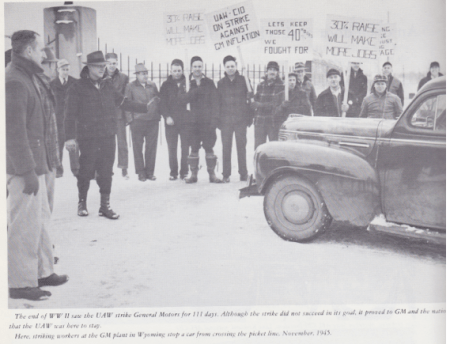
In 1946, workers at the UAW Local 730 at the GM plant in Wyoming, Michigan were part of the national UAW strike that lasted for 113 days. (see photos above and below, sourced from The Story of the UAW Region 1-D) The UAW striking workers were fighting for better wages, pensions and improved working conditions, all of which were denied them during the no-strike pledge during WWII.
As we mentioned in yesterday’s article, there was a purge of communists in the US labor movement at the beginning of the Cold War and McCarthyism. This was also the case in Grand Rapids, which you can read about at this link.
We are still unclear if there was any serious attempt to organize migrant workers in West Michigan, like what the United Farm Workers were able to achieve in the 1960s and 70s, but there was a Migrant Worker Solidarity groups in the area at least since the late 1970s.
There is no better a symbol of anti-unionism in West Michigan, than the ultra conservative company founded by Rich DeVos and Jay Van Andel, known as Amway. However, there was a serious effort to organize Amway workers in 1980, which almost succeeded, according to a series of articles written by Michael Johnston, which you can read about here.
Beginning in the mid-1990s, there were also efforts to organize against sweatshops, which was part of the larger anti-globalization movement.
The anti-globalization movement really took off after the 1999 WTO Protest in Seattle and there was even substantial organizing taking place in Grand Rapids. This type of anti-globalization organizing continued with resistance to NAFTA and CAFTA in Grand Rapids in 2004.
In the last decade, there have also been more radical labor organizing that has taken place in Grand Rapids, with the IWW being revived and gaining national recognition for their actions against Starbucks or the anti-austerity actions that have been organized to confront the policies of Gov. Snyder in 2011 and beyond.
Like the mainstream labor unions we mentioned in yesterday’s article, have continued to avoid direct action and place their hopes in the Democratic Party, there are examples of groups that are fighting for economic justice and using time honored labor tactics, like boycotts and strikes, such as the group Movimiento Cosecha GR.
Like at the national level, these new movements, often led by communities of color, are reviving labor struggles, even if their main focus is on issues like racial or immigrant justice. It is in these new movements that workers can regain their sense of power and give hope to a new generation.
A brief overview of the US Labor Movement: Part I
 Today is Labor Day. Most people will enjoy the day off, relaxing with family and likely throwing something on the grill. It’s funny, that there is only one day of the year that is dedicated to celebrating working people. The reality is that working people are the very people who generate most of the wealth in the US, but they do not get to keep it.
The history of working class people and organized labor is something that we do not learn in the K – 12 education system and often not even at the university level. Business classes are the norm, even business majors, but working class history and how to organize unions are phrases that are rarely uttered in college classrooms.
The history of working class people organizing themselves has been part of the US from the very beginning, This history is complex and unions have not always made working class people the focus of their existence, especially people of color.
In the 19th century, labor unions in the US provided people with an opportunity to fight against the tyranny of capital. However, labor unions did not agree on the best way to achieve justice. One of the oldest union, the American Federation of Labor (AFL), particularly under the leadership of Samuel Gompers, believed that the system of capitalism was a fair system, but it needed organized labor for checks and balances. The AFL was essentially a business union and took the approach that workers should negotiate with businesses, rather than be antagonistic to the capitalist class.
On the other end of the spectrum there were radical unions such as the Knights of Labor and the Industrial Workers of the World (IWW), which believed that capitalism was the enemy and that workers did not need bosses and should cooperatively manage economics that would benefit all working class people.
Unions like the IWW believed in using direct action tactics, such as strike, wildcat strikes, work slow-downs and work stoppages. The more radical unions also believed that anyone could join their union, as long as you were not a boss.
There were periods of massive labor unrest, where hundreds of thousands of workers were organized in such a way that challenged the power of the capitalist class. These periods included the 1880s – the end of the 19th century, the early part of the 20th century and the period just after the Great Depression. The power that organized labor demonstrated during the late 19th Century and up to the 1930s is well documented in books like, Prisoners of the American Dream: 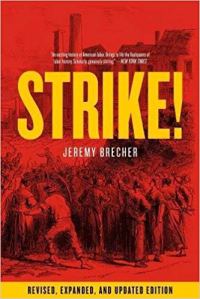 Politics and Economy in the History of the US Working Class, by Mike Davis; Strike, by Jeremy Brecher; and, The Fall of the House of Labor, by David Montgomery. For example, in the early 1930s, there were several thousand separate labor strikes, with more than a million workers participating in those strikes. One result of all the direct action of organized labor, was the policies adopted by the Roosevelt administration, also known as the New Deal. None of these policies would have been adopted without the direct action of organized labor.
However, when the US government formally made labor unions legal, with the passage of the Wagner Act in 1934, it began to shift the fight from the factory floor to the courts. This shift is well documented in David Montgomery’s book The Fall of the House of Labor, as well as by radical historian Howard Zinn who said:
Unions were not wanted by employers, but they were more controllable – more stabilizing for the system than wildcat strikes, the factory occupations of the rank and file.”
In fact, by 1946, the main demand in contract talks from the UAW at companies like General Motors, was “union responsibility for uninterrupted production.”
The Cold War and McCarthyism also saw most of the mainstream unions siding with the US government, where Communists were purged from union ranks and labor leadership cooperated with the McCarthy Hearings. This is also the period when the Taft-Hartley Act was adopted (1947). Taft-Hartley was essentially an anti-labor strike law that took away any real tactical power that unions had.
The post WWII period also saw another major shift with organized labor, which decided to back the Democratic Party. President Harry Truman got labor backing when he agreed to veto the Taft-Hartley Act, if the unions would get behind his re-election. Congress, with the support of many Democrats were able to override Truman’s veto, but Truman said that he would repeal it in his second term. Truman never even attempted to repeal Taft-Hartley and this began a process where the main unions abandoned any serious challenge to the capitalist class and started pumping millions of dollars into the Democratic Party. The Democratic Party has never really made working class concerns the center of their platform, but were able to keep organized labor loyal to their party (spending millions endorsing candidates) by arguing that the Republicans were worse when it came to economic matters. For more details on this history see The Democrats: A Critical History, by Lance Selfa.
There have been attempts to revise organized labor since the 1960s, with the farm workers movement, embodied by the UFW and FLOC, along with black-led labor insurgency in industrial sectors such as the Dodge Revolutionary Union Movement (DRUM) in Detroit that began in 1968.
 Other radical labor efforts have happened in the past few decades, with a revitalization of the IWW, the Restaurant Opportunities Centers (ROC), the Coalition of Immokalee Workers (CIW) and Nurses Union and recent shifts amongst teacher unions across the country. However, union membership has continued to decline and working class movements are often marginalized.
If you go to the Labor Day Celebration in Grand Rapids today, you will see lots of tables for Democratic candidates. In addition, there will be numerous Democratic candidates speaking to the crowd about the importance of backing the Democratic Party. What you will not hear are working class people talking about strikes or other forms of direct action being used against companies that want to suppress worker rights.
While this does not paint a terribly positive picture about the power of working class people, there are efforts outside of mainstream unions that are demonstrating the power of organized labor. We mentioned the teacher unions that have won major victories in the last few years in several states across the country. There is also a growing immigrant justice movement that is seeking to use the power of boycotts and strikes to win the demands of immigrants.
Organized labor can be a threat to the interests of the capitalist class, but only if it organizes itself with goals that are inherently anti-capitalist. Organized labor can be a threat to the capitalist class if it uses Direct Action tactics and if it see itself as part of larger social movements like the immigrant justice movement, the Black Lives Matter movement, Queer & trans liberation movements or the Climate Justice movement. Labor Unions which are not part of these lager liberation movements will signal the death of organized labor.
In Part II, we will discuss the history of the labor movement in the Grand Rapids area.
Foundation Watch: Cheri DeVos and the CDV5 Foundation
 The Cheri DeVos Foundation, also known as the CVD5 Foundation, is probably the least known of the DeVos family foundations. This is not surprising, as Cheri DeVos is not in the news like her other siblings, Dick, Doug and Dan. However, the lack of media attention, doesn’t mean that Cheri DeVos doesn’t have the same ideological commitments as the rest of the family.
Besides being born into the DeVos family wealth, Cheri DeVos owns numerous brands throughout the area. She owns CDV5 Property Management, that new restaurant on the corner of Wealthy & Fuller – Hancock, MSA Fieldhouse, MSA Sport Spot, MSA Woodland, Ottawa Beach General Store and Ada Village General Store. For more details on the various brands owned by Cheri DeVos, click here.
On the CDV5 Foundation website, it says, “We partner with select causes and organizations that are closely aligned with our passions.” So lets see what the foundation’s passions are that they contribute large sums of money to and what that means.
We looked at the three most recent years (2015 – 2017) of 990 documents for the CDV Foundation, as provided by the site Guidestar. According to Guidestar, this foundation has $61.5 million in assets. Some of the larger contributions from the CDV5 Foundation went to similar areas or entities as the other DeVos foundation supported.
(Public Education)
- Wake Forest $7,000,000
- Michigan State University $1,550,000
- Grand Rapids Student Advancement Foundation $770,000
(Private Education)
- Hope College $4,650,000
- Grand Rapids Christian School Association $2,875,000
- Ada Christian School Society $1,260,000
- Rehoboth Christian School Association $650,000
- Potters House $650,000
- ICCF $1,515,000 (all in 2017)
- Grand Rapids Whitewater Inc. $1,275,000
- Kids Food Basket $1,150,000
- Bethany Christian Services $685,000
- Mackinac Center for Public Policy $300,000
- AmplifyGR $160,417
Most of these contributions from the CDV5 Foundation are consistent with contributions from the Dick & Betsy DeVos Foundation, the Doug & Maria DeVos Foundation and the Dan & Pamela DeVos Foundation.
Like the other DeVos foundations, the CDV5 Foundation made significant contributions to private Christian schools, which certainly fits within the family’s ideological framework. What may not seem so predictable is the funding that the CDV5 Foundation has provides in recent years to the Grand Rapids Student Advancement Foundation ($770,000), which is a funding arm of the Grand Rapids Public Schools.
Providing funding to the Grand Rapids Public Schools may seem to fall outside of the ideological commitments of the DeVos family, but that is because much of the public has been unaware of the DeVos families efforts to transform the GRPS. As we noted in our recent post on the Doug & Maria DeVos Foundation, that foundation contributed $1,122,800 to the Grand Rapids Student Advancement Foundation, along with the fact that Maria DeVos sits on the board of that foundation.
Another significant common recipient of DeVos foundation money has been the Inner City Christian Federation (ICCF). Above we noted that the CDV5 Foundation contributed $1,515,000 to ICCF in 2017, which is the same year that other DeVos foundations contributed over $1 million each, along with other families in the Grand Rapids Power Structure. These contributions to ICCF coincided with the their announced partnership with AmplifyGR.
Other notable contributions from the CDV5 Foundation, as listed above, shows that Cheri DeVos also has support right wing think tanks like the Mackinac Center and has contributed to charity groups like Kids Food Basket, which do not have a commitment to ending the causes of hunger or poverty. Like the other DeVos family foundations, the CDV5 Foundation contributes to numerous charity-based entities because it is great PR for the family and because they know that these charity-based groups will not challenge or question the role that the DeVos families plays in creating poverty and increasing the wealth gap in Michigan.
 It has been two days since it was announced that Captain Kurt VanderKooi, the GRPD officer who called Immigrations and Customs Enforcement (ICE) on Jilmar Ramos-Gomez, was formally suspended for two hours for his biased and racist actions.
Most of the daily news sources have reported on the matter, including MLive, WOOD TV 8, WZZM 13 and WXMI 17.
All four of these news outlets provided the Grand Rapids Police Officer’s Association with an opportunity to respond to the revelation that VanderKooi was suspended for two days, but only channel’s 8 and 17 reprinted the entire statement from the police union.
“The Grand Rapids Police Command Officer’s Association is shocked and dismayed at how the rights of Captain Curt VanderKooi, who has served the City of Grand Rapids for nearly 40 years with honor and integrity, could have his rights so blatantly violated in an effort to discipline him for the first time in his career. His due process rights, the GRPCOA collective bargaining agreement, along with state law were trampled on throughout the Citizen’s Appeal Board process and now by the final disposition issued by the City Manager. He, and many others in City Hall, were put on notice and advised of these violations in the form of our grievance which was originally filed May 23, 2019. We were forced to file this grievance after he was cleared of the most serious accusations following an unprecedented three iterations of the same investigation.
Captain VanderKooi was given a two day suspension, which has recently been served. The City Manager advised the GRPCOA that he was willing to uphold the original exoneration in exchange for his agreement to retire. This discipline was unwarranted and is clearly an attempt to appease a vocal group of activists who made him a scape goat for their own political gain. We will be amending the grievance to appeal this most recent decision by the City Manager. We are also awaiting a very copious FOIA request involving all the communication reference this investigation and those involved in it. Captain VanderKooi is pleased to announce he has decided to postpone his original retirement date in 2020 and looks forward to serving the citizens and crime victims in the City of Grand Rapids as Commander of the Investigations Unit for an additional year.”
It is instructive to note that the only part of the police union statement that was contested in the news coverage, had to do with the conversation between the police union and City Manager Mark Washington. The point in question was specifically about whether or not the City Manager offered to exonerate VanderKooi if he was willing to take an early retirement.
However, this shouldn’t be the central issue surrounding VanderKooi’s two-day suspension. There are more important issues that should have taken front and center in the local news stories.
First, there is no formal response from Jilmar Ramos’Gomez’s family or his lawyer, there is no response included from the ACLU or the Michigan Immigrant Rights Center, there was no response included by the Grand Rapids Civilian Appeals Board, and there was no response included by GR Rapid Response to ICE or Movimiento Cosecha GR, all of which took public positions on this matter and the later two entities even called for VanderKooi to be fired for the harm he caused Ramos-Gomez.
Second, there was no inquiry made by the local news agencies, asking for a response to the claims made by the police union in reference to the 2-day suspension:
“This discipline was unwarranted and is clearly an attempt to appease a vocal group of activists who made him a scape goat for their own political gain.”
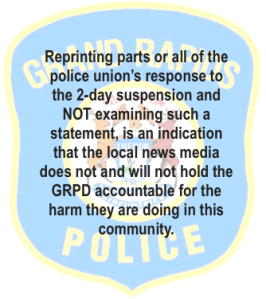
This claim by the Grand Rapids Police Officer’s Association is not only baseless, but it is a deflection from the actual harm done by VanderKooi’s decision to contact ICE on Jilmar Ramos-Gomez. More importantly, reprinting parts or all of the police union’s response to the 2-day suspension and NOT examining such a statement, is an indication that the local news media does not and will not hold the GRPD accountable for the harm they are doing in this community.
Third, there is plenty of attention in the local news coverage surrounding VanderKooi’s two-day suspension, that he must attend some additional training sessions and that VanderKooi has decided to delay his retirement. Again, there is little attention to the fact that Jilmar Ramos-Gomez actually spent 3 days in ICE detention because of VanderKooi. There seems to be little concern of how the detention impacted Ramos-Gomez and there is little or no concern over how this issue impacted the larger immigrant community.
None of the news agencies seem concerned with how Jilmar Ramos-Gomez was victimized in this situation and how he must of felt when being put into the custody of ICE because of Captain VanderKooi. In addition, there seems to be no concern as to how the rest of the immigrant community feels about VanderKooi only having to serve a 2-day suspension. The immigrant community, in light of the minor consequences to VanderKooi, has to feel like racial profiling against their community is not taken very seriously by the City of Grand Rapids or the GRPD, considering VanderKooi only received a two-day suspension and the police union is challenging even that.
The news coverage of the 2-day suspension of Vanderkooi is symptomatic of larger issues, such as police accountability, how the GRPD contributes to the harm being done to the immigrant community and the larger mobilization of immigrants and allies fighting for immigrant justice. In every area listed above, the local news media has fallen short of providing the kind of reporting that asks hard questions and engages in critical analysis.


