 Ever since it was announced that Nancy Pelosi would pursue impeachment proceedings against Donald Trump, this news has dominated much of the commercial media coverage and the interest within liberal circles.
Let me say that I believe that Trump should be impeached and that his administration has not only violated numerous domestic and international laws, the policies under the Trump administration have caused tremendous harm……harm to immigrants, refugees, the black community, the latinx community, indigenous communities, the LGBTQ community, women and the disability community.
Mehdi Hasan, who writes for the Intercept, has laid out a long list of reasons that Trump should be impeached in his article, The A to Z of Things Trump Could and Should Have Been Impeached For.
However, even if Donald Trump is impeached, it will not move us in the direction of dismantling systems of oppression, corruption and violence, systems which got Trump elected in the first place. The brilliant Indian writer, Arundhati Roy, articles this sentiment, in the meme here on the right.
The system that produced the election of Donald Trump, is a complex and intertwining systems of systems, such as, 1) the US political system, which is so dominated by private money, corporate money and lobbyists, that few politicians can actually represent the interests of the communities they represent; 2) a commercial media system which is not only subservient to its owners, but treats journalism as a spectacle that is driven by advertising dollars and is rarely interested in holding systems of power accountable; 3) the system of White Supremacy, which permeates all institutions in the US and does not allow communities of color to threaten the wealth, land and other assets that are almost exclusively owned and controlled by white people; and 4) the system of capitalism, which also permeates all sectors of US society, constantly re-directing wealth upward and smashing any efforts from people to engaging in radically imagining life in ways that do not include the profit motive.
These systems (and their are many more) are wreaking havoc on the planet in the form of imperialist wars, settler colonialism, climate disaster, gentrification, mass incarceration and an increasingly larger wealth gap.
If Trump is impeached, these systems will still to function and will not miss a beat. So, what is problematic about our obsession (to us Arundhati’s description) with just getting Trump impeached or defeated in the 2020 election?
There are numerous problems with our failure to have a systems analysis of the current state of affairs. I want to explore three of those failures:
- putting our faith into a political system that has demonstrated over and over again that it is not interested in challenging systems of power and oppression.
- not addressing the consequences/harm of the existing systems of power and oppression, and
- not focusing our energy on direct action, movement building and radical imagination.
Giving our power away
Putting our faith in the current political system means we ultimately give away our power. When was the last time you attended a Kent County Commission meeting, a Grand Rapids City Commission meeting or a Grand Rapids School Board meeting? These elected bodies often do most of their decision-making in secret or in committee meetings that the public rarely attends. At the public meetings, they often feel like an exercise in bureaucracy, where elected officials formally vote on agenda items that were already decided up at an earlier meeting. The public does get an opportunity to speak, but the 3 minutes they are granted is met with silence, since these government bodies do not participate in dialogue at these meetings, leaving one feeling as if their participation was ineffectual. At the state and federal level, the access to politicians is further diminished, unless of course you contribute handsomely to their campaigns or have lobbying groups that have deep pockets.
Electoral politics has all shifted to the right since the Reagan years, with Democratic Party administrations acting as one branch of the Capitalist Party. Think about many of the major policies adopted by the Clinton and Obama administrations, such as expanding the police state, making the prison industrial complex a growth industry, removing social welfare support for working class people, implementing NAFTA & CAFTA, punishing the undocumented community, continuing the racist war on drugs, bailing out Wall Street, expanding the Military Industrial Complex and paying lip service to environmental concerns while allowing the fossil fuel industry to destroy the planet. This system will remain after Trump is impeached and there is no indication that either party will take seriously matters like climate catastrophe, gentrification, an end to oil pipelines, dismantling the prison industrial complex or ending the detention and deportation of immigrants.
Addressing the harm done by these systems
Humans and other species suffer the harm of these systems of power and oppression on a daily basis. Instead of just voting, we need to spend more time and energy on reducing and ending the harm being caused. How many people suffer under mass incarceration? The US has the largest percentage of its population in jail, prison, on parole or probation that any other country on the planet. Most people are charged with non-violent crimes, yet they are often subjected to the violence of the prison industrial complex. What if we spent less money on policing and punishing and more on education, health care and housing that gives people the dignity they deserve? This is what good community organizers do, they work on addressing the harm that the system causes and then provides people with the opportunities to collectively organize to demand more.
From Solidarity to Movement Building and Radical Imagination
This type of organizing is an act of solidarity, not charity. It sees the inherent value in every person and then takes direct action to create the kind of change we want to see in the world. Direct Action means we use our collective power to get the results we want to see in the world. It’s one thing to be concerned about affordable housing, but direct action would mean that we provide hospitality for those who are homeless, create tenant unions, re-direct government subsidies that normally go to developers and give them directly to families and communities most affected by gentrification.
A concrete example of solidarity that has moved towards movement building is the work of Movimiento Cosecha and GR Rapid Response to ICE. These autonomous movements begin with the premise that all immigrants should have dignity, respect and be given permanent protection from arrest, detention and deportation. These movements to not wait for politicians to create immigration policy that is just and fair, they take matters into their own hands to provide mutual aid to immigrants who are being harmed by government agents, they organize those most affected by racist anti-immigration policies to fight for what they need (like driver’s licenses) and the directly confront the systems of oppression like ICE, law enforcement agencies that collaborate with ICE or companies that profit from the harm done to immigrants.
People often see the marches, the protests or disruptions these groups engage in, but they don’t see the amount of time that goes into creating a movement culture, where people are equal, where people are heard, where everyone has a say and where we look at for each other. In addition, movement culture also creates space for radical imagination to take place. This means that people are encouraged to imagine that another world is possible and to create practices and structures that are not limited to representative democracy or the non-profit industrial complex.
Another world is indeed possible, but this requires us to stop limiting ourselves to thinking that the current political system works or that by simply voting someone into office or impeaching someone out of office that it will result in the kind of collective liberation we need. As long as the political system that gave us Donald Trump is allowed to continue, we are not likely to have a future worth fighting for.
MLive doesn’t verify the claims made by Trump on immigration policy during his speech in Battle Creek
 Donald Trump was in Battle Creek on Tuesday, where he gave a speech to his supporters during a rally. MLive wrote several different articles about the Trump visit, but posted one on late Tuesday, because President Trump mentioned Kent County in his remarks.
Trump actually mentioned that there were “sanctuary cities” in Michigan and then he talked about how dangerous and criminal these undocumented people are.
MLive wrote:
The president told the crowd he was surprised to learn Michigan had sanctuary cities.
The Center for Immigration Studies lists Ingham County, Kalamazoo County, Kent County and Wayne County as having “laws, ordinances, regulations, resolutions, policies, or other practices that obstruct immigration enforcement and shield criminals from ICE,” according to its website.
What MLive did NOT do was to verify the claims made by the Center for Immigration Studies on whether or not the communities cites are actually sanctuary cities. The fact is that none of the four counties cited are actual sanctuary cities, since they all cooperate with ICE to arrest and detain undocumented immigrants. There are certainly immigrant-led movements in each of those four counties that have been resisting ICE repression, but the counties themselves continue to collaborate with ICE.
MLive also didn’t tell us anything about the Center for Immigration Studies. The Center for Immigration Studies is actually an anti-immigration policy organization that is part of the racist John Tanton network, according to Sourcewatch.
Towards the end of the MLive article, it states that Trump, “bashed Kent County for its “sanctuary” policy after Sheriff Michelle LaJoye-Young told ICE that her department will not agree to immigrant detainer requests from ICE unless they have a judicial warrant from a judge.” However, this is misleading, since Trump did not say this during the speech in Battle Creek. Trump’s comments about Kent County were actually from March of 2019, when the White House and ICE expressed their displeasure that the Kent County Sheriff was now requiring judicial warrants in order to hold undocumented immigrants.
What Trump actually said about Kent County in his speech in Battle Creek on Tuesday, was this:
Earlier this year, authorities in the sanctuary, jurisdiction of Kent County, Michigan — anybody know Kent County? Released an illegal alien charged with assault with intent to murder after he repeatedly and viciously stabbed a man in the head with a broken bottle. They let him go to roam free in Michigan communities.
Now, this statement is also unsubstantiated, but it is a significantly different statement than the one MLive included in their article on Trump, Kent County and immigration policy.
City data on the GRPD and Trust is not reflective of the lived experience on communities of color in Grand Rapids
 On Tuesday, the City of Grand Rapids posted information about their new resource to gauge public trust of the GRPD.
The data that the City is collecting is being done through a new digital polling tool, from the company called Elucd. Elucd features a quote from former GRPD Chief Rahinsky, who says that the way law enforcement is being judged is changing.
Currently, the GRPD scores 68 out of 100 in terms of public trust.
There is no breakdown of this score, so we have no idea who is saying they trust or don’t trust the GRPD or even how many people have actually taken part in the polling. According to the research done by Alex Vitale, author of the book, The End of Policing, public trust of local law enforcement is at an all-time low in the US. This lack of trust stems from the fact that corruption in law enforcement is high, police brutality is high and the lived experience of communities of color and poor working class white people says that the police serve power & privilege.
The City’s post from Tuesday, also quotes the CEO of Elucd, Michael Simon:
“The Grand Rapids Police Department is a national leader in its commitment to fostering greater transparency as it works to build trust with the residents it serves. By leveraging 21st century technology, Grand Rapids leaders are prioritizing hearing from everyone in their city as they improve both safety and quality of life in every neighborhood.”
To suggest that the GRPD makes transparency a priority or improving the safety and quality of life in every neighborhood is simply a joke. Recent history would suggest otherwise, with numerous reports of police abuse in black and latinx neighborhoods, which have led to numerous protests and press conferences denouncing the GRPD.
It is instructive that the city posted this new information about public trust and the GRPD, especially in light of the headlines from yesterday. In one story, the City is looking to purchase the ShotSpotter system and drones. According to an article on MLive, the GRPD wants to role out a pilot program with these new proposed technology solutions, which suggests to this writer that it is already a done deal. Technology does not reduce crime and there are plenty of other community-based solution to reducing violence and crime that do not rely heavily on police, rather they rely on what the Movement for Black Lives calls Community Control.
In other news, it was announced on Wednesday that, Grand Rapids will pay $225,000 to the American Civil Liberties Union of Michigan as part of a settlement that will end the legal battle over the police department’s former trespassing policy. MLive reported that this agreement to pay $225,000, stems from a case in 2013. If you add that to the recent announcement that the City of Grand Rapids will pay out $190,000 in a settlement over racial bias, where the GRPD called ICE on a former US Marine.
These news stories, along with numerous reported incidents of police violence against black and latinx residents, in no way suggests that there is a high level of trust between the community and the GRPD.
Cosecha GR talks about the importance of the driver’s licenses for all victory in New Jersey
 On Monday, Movimiento Cosecha New Jersey won their campaign to get driver’s licenses for the undocumented community.
Movimiento Cosecha GR has been working on a similar campaign here in Michigan. In light of the victory in New Jersey, Cosecha GR posted this commented:
The NJ immigrant community has giving us an example of people power. We are celebrating their victory for #LicensesForAll. A great deal of respect for Cosecha New Jersey for their restless fight and we are realizing that in Michigan we have a lot of work to do so that one day we will have a historical video like this one.
Last night GRIID spoke with an organizer with Movimiento Cosecha GR, Ana Isabel, about the significance of the victory in New Jersey and what impact it can have for the current campaign here in Michigan.
 A new report from the Network for Public Education, entitled, Still Asleep at the Wheel: How the Federal Charter Schools Program Results in a Pile of Fraud and Waste, identifies Michigan as having the worst record on Charter School abuse of funds.
The report, which looks at the Charter Schools at the national level, begins their report with an example of how undemocratic the Charter Schools are in Michigan.
“In May of 2019, the Michigan State Board of Education voted to stop the disbursement of a $47 million grant from the federal Charter Schools Program (CSP). The duly elected Board had good reason to take action, especially given that the Michigan Department of Education had applied for the money without the Board’s consent. Ironically, just three years before, the Michigan Department’s 2015 grant application had been rejected by the CSP; reviewers of the application noted the lack of supervision of the 44 authorizers that approve and monitor the state’s charter schools. Charter school authorizing had become a lucrative business for colleges and universities that enjoy a three percent cut of the millions of tax dollars that charter schools receive each year. Nearly 80 percent of the charters in Michigan are controlled by for-profits that have their vested interest in growth as well. But Washington had changed, and now Michigan billionaire Betsy DeVos was in charge. Previous reservations about oversight were set aside and her home state got the grant.
State Board of Education President, Casandra Ulbrich, explained to us why the Board tried to block the grant.
The State Board of Education was presented with a set of grant criteria to ultimately spend up to $47 million expanding and creating new charters in Michigan. The Board was never consulted when the state applied for the funds, and had severe reservations focusing on two areas. The first was concern over previous use of the grant funds. The second was whether a state with a 17-year record of student enrollment declines, and parallel declines in student achievement, needed to open more charter schools. Following the vote, I began reviewing previous grant information and today, am even more alarmed by what I have found.
Despite the objections of the state’s elected Board, the Michigan Attorney General ruled that the grant must be dispersed.”
Some of the major finds from the report are listed here:
- The disbursement of over one billion dollars during the program’s first decade was never monitored for its impact or results. There is no record of which schools received the funds.
- Although the overall rate of failed charter projects was 37 percent, in some states the rate of failure was much higher. The Michigan failure rate was over 44 percent ($21 million).
- Five hundred thirty-seven (537) schools listed in the database never opened at all. Many received over $100,000 in federal funds. In Michigan 77 Charter Schools never opened.
- Although Congress forbids for-profit operators from directly receiving CSP grants, they still benefit by having their schools apply.
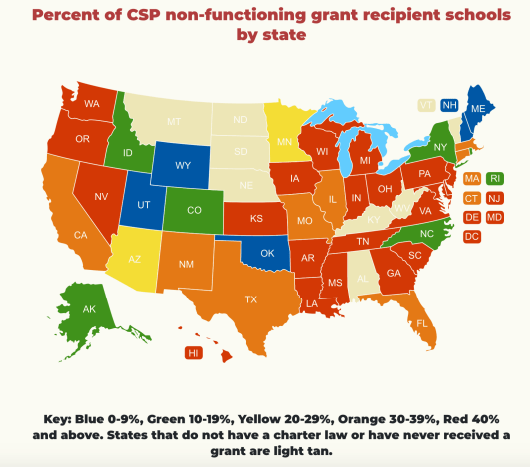
The report has lots of great case studies, data and clear recommendations on how to move forward. The two most important recommendations are:
- that Congress end appropriations for new charter school grants in the upcoming budget and continue funding only for obligated amounts only to legitimate projects.
- thorough audits by Congress of previous grant awards, the establishment of regulations to ensure grant awards still under term are being responsibly carried out and that misspent money is returned to the federal coffers.
West Michigan is the home of Secretary of Education Betsy DeVos, yet we have seen limited news coverage or investigation on funding for Charter Schools or Charter School performance evaluations.
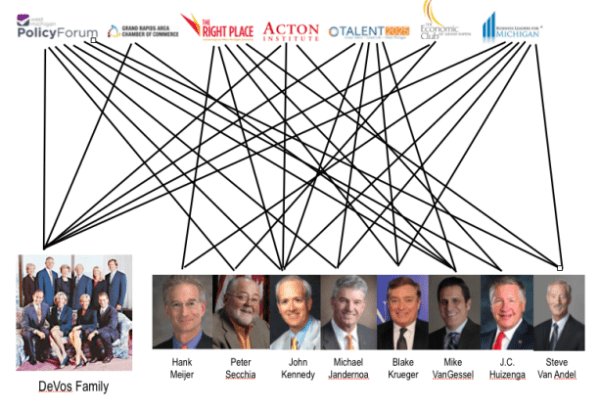
One of the largest Charter School operations is run by the National Heritage Academies Inc. The CEO of the National Heritage Academies is JC Huizenga, a person who is part of the Grand Rapids Power Structure and a major player in far right politics, especially as a board member of the Mackinac Center for Public Policy, the Acton Institute and the West Michigan Policy Forum.
GVSU chair of philanthropy demonstrated his allegiance to the billionaire families that run Grand Rapids in a recent radio interview
 Last week on the radio show Stateside, part of the program was devoted to the influence that billionaires have had on Grand Rapids.
The text for the program that dealt with the influence of billionaires on Grand Rapids, reads as follows:
Stateside continues our series exploring the impact of billionaire philanthropy in Michigan. We have talked about billionaires’ influence in Detroit and Kalamazoo. Now we look at Grand Rapids.
Michael Moody is the Frey Foundation Chair for Family Philanthropy at the Dorothy A. Johnson Center for Philanthropy at Grand Valley State University. He broke down how powerful families with deep pockets, like the DeVos, Van Andel and Meijer families, have made their mark on the Grand Rapids area.
Michael Moody didn’t really break down how billionaires have made their mark on Grand Rapids, Moody simply praises them in such a way as to suggest that Grand Rapids is thriving because of the likes of the DeVos, Van Andel and Meijer families.
The first question posed to Moody was how these families impacted the philanthropic and business communities. Moody particularly zeros in on how they transformed downtown Grand Rapids.
Moody was also asked about comparisons between Grand Rapids philanthropy and Detroit or Kalamazoo. Moody believes that Grand Rapids billionaires have done some things differently, such as create entities to help foster project based development, such as Grand Action. In addition, Moody thinks that the DeVos, Van Andel and Meijer families have figured out a way to work with local, state and federal governments to get public money used for project-based development in the downtown area. Moody celebrates this dynamic and the interviewer doesn’t question the fact that public money has been used for every major development project in Grand Rapids, even though the public had no say in it – the Van Andel Arena, DeVos Place, the Downtown Market, etc.
The interviewer then asks Moody if the public should be concerned about the influence that these billionaires have over public life and even government influence? Moody responds with vague comments about democracy and public dialogue, but he avoids responding to how families, like DeVos, deeply influence public policy through their funding of candidates/politicians at all levels of government. Moody says there should be checks and balances, and that philanthropy is trying to figure out a way to better engage the public, so we should all just relax and enjoy their generosity.
The interviewer continues to outdo themselves in terms of offer up softball questions, by then asking how popular the billionaires in Grand Rapids are? Moody’s response was that if people attend events at the Van Andel Arena or DeVos place they then realize that these spaces were made possible by the billionaires, so they would then look favorably on the buildings that are plastered with billionaire names.
The last question posed to Moody was, what would Grand Rapids look like if the local billionaires were not donating their money? Again, the interviewer doesn’t challenge the existence of billionaires amidst massive levels of poverty in Grand Rapids, but assumes that they are a sum benefit to the community. Moody doesn’t think there would be places like the arena or the convention center, the public/private projects, which are essentially Neo-Liberal economics at it best. Public/private partnerships ultimately means that public money gets transferred to the private sector with little or not public oversight. In the Global South this is referred to as Structural Adjustment Policies (SAPs), but in the US we call them public/private partnerships, which means that the partnership is really just taking public money for private gain.
None of what Moody had to say is a surprise, especially considering that he works for the Dorothy Johnson Center for Philanthropy at GVSU. The DeVos family has been the single largest contributor to GVSU for several decades now, so it would follow that their center for philanthropy celebrates the role of billionaires and millionaire donors.
The radio show continued with a conversation with Anand Giridharadas, former New York Times columnist and author of Winners Take All: The Elite Charade of Changing the World. Giridharadas definitely provided a counter to the overall comments made by Moody, but it is unfortunate that there was no West Michigan counter-part to Moody’s comments.
One counter to Moody’s glowing review of Grand Rapids billionaires could be a panel I participated in in 2017, entitled, Grassroots Responses to Big Philanthropy: Grand Rapids Activism in the Shadow of Amway, ArtPrize and DeVos.
For all of Michael Moody’s lofty comments about democracy, he ended up demonstrating his allegiance to the billionaire families that run Grand Rapids. If he is serious about public input and dialogue, then he should actively seek out critical voices in this city, especially those on the front lines of social movements that are not only countering the billionaire class, but creating a new and radical vision for how we can practice collective liberation.
Making sense of US foreign policy – Part II: US Imperialism is a Bipartisan project
 (In Part I we provided a framework for how to critically examine US Foreign Policy.)
Last week, the US House of Representatives overwhelmingly approved the 2020 US Defense Budget, at $738 Billion.
The Senate had already adopted legislation to support the largest military budget on the planet, and in both instances there was large bipartisan support. Even though the Democrats control the House and are in the midst of attempting to impeach President Trump, they overwhelmingly supported passing a $738 Billion US Military Budget.
This most recent vote demonstrates a truism about funding for US foreign policy – it is and has always had bipartisan project. Since the US embarked on expanding their influence around the globe, with the interventions in Cuba, the Philippines and Puerto Rico near the end of the 19th Century, there has been pretty much a bipartisan support for funding what used to be called the US War Department.
Sure, there have been differences between the Republicans and the Democrats in regards to foreign policy, but those have been generally tactical differences. For instance, the Reagan administration wanted to aggressively intervene in Central American in the 1980s, primarily by sending US troops to squash the revolutionary movements in Nicaragua, El Salvador and Guatemala. For the Democrats, which controlled the Congress at that time, they supported the larger strategy of not wanting revolution to spread, they just disagreed on the tactics. Democrats in Congress during the Reagan years supported military aid to El Salvador and Guatemala, they supported an economic blockade of Nicaragua and they supported turning Honduras into a US military outpost.
If we think about who sits in the White House and what that means for US foreign policy and US intervention, again, it is a bipartisan project. Here is a listing of US Presidents since Lyndon Johnson, showing where the US intervened directly, covertly, offered training and provided military funding to dictatorships:
Lyndon Johnson D (1963 – 1969) Vietnam, Cuba, Dominican Republic, Indonesia, Guatemala, Israel, Egypt, Mexico
Richard Nixon R (1969 – 1974) Vietnam, Cuba, Lao, Cambodia, Chile, Dominican Republic, Nicaragua, Haiti
Gerald Ford R (1974 – 76) Vietnam, Cuba, Cambodia, Indonesia, East Timor, Angola, Egypt, Argentina
Jimmy Carter D (1976 – 1980) Cuba, Angola, East Timor, Iran, Nicaragua, El Salvador, Afghanistan, Vietnam
Ronald Reagan R (1980 – 1988) Vietnam, Cuba, Iran, Nicaragua, Angola, El Salvador, Afghanistan, Lebanon, Grenada, Libya, Honduras, Guatemala, South Africa
George Bush R (1988 – 1992) Cuba, Nicaragua, El Salvador, Angola, Iran, Afghanistan, Panama, Iraq, Somalia, Haiti
Bill Clinton D (1992 – 2000) Cuba, Iran, Afghanistan, Iraq, Somalia, Haiti, Sudan, Yugoslavia, Indonesia
George W Bush R (2000 – 2008) Cuba, Iran, Afghanistan, Iraq Philippines, Venezuela, Colombia, Haiti, Pakistan
Barack Obama D (2009 – 2016) Cuba, Iraq, Iran, Venezuela, Afghanistan, Colombia, Honduras, Pakistan, Libya, Syria, Yemen
Donald Trump R (2016 – ) Cuba, Syria, Yemen, Venezuela, Honduras, Afghanistan, Iraq, Iran
If we then look at domestic opposition to US imperialism and militarism abroad, we can make some significant conclusions. For example, there was a substantial anti-war movement against the Bush administration’s occupation of Iraq between 2002 – 2008. However, there was no serious opposition to the US led sanctions against Iraq that the Clinton administration presided over, which led to at least the deaths of 500,000 Iraqi children. In addition, the US military regularly bombed Iraq during the Clinton administration, yet the deaths of Iraqi children and regular bombing did not translate into any serious opposition in the US.
During the anti-Vietnam war movement, there was no fundamental difference between the opposition that occurred during the Johnson administration as opposed to the Nixon years. However, in more recent decades, liberals are less committed to challenging war and militarism when a Democrat occupies the White House, as opposed to a Republican. When the Obama administration escalated the US war in Afghanistan in 2009, there was little domestic opposition, nor was there any real critique of the increased use of drones for targeted assassination that grew exponentially during the Obama years.
Besides the issue of Capitalism, US imperialism is and has always been a bipartisan project, both in terms of funding and support for the various forms of US intervention that make up US foreign policy.
Supporting Resources:
US Imperialism: From the Spanish-American War to the Iranian Revolution, by Mansour Farhang
Empire and Revolution: The US and the Third World Since 1945, edited by Peter Hahn and Mary Ann Heiss
Rogue State: A Guide to the World’s Only Superpower, by William Blum
America’s Deadliest Export, Democracy: The Truth about US Foreign Policy and Everything Else, by William Blum
Imperial Alibis: Rationalizing US Intervention After the Cold War, by Stephen Shalom
Overthrow: America’s Century of Regime Change from Hawaii to Iraq, by Stephen Kinzer
Lying for Empire: How to Commit War Crimes With a Straight Face, by David Model
Thank God They’re on Our Side: The United States and Right-Wing Dictatorships, 1921 – 1965, by David Schmitz
Lawless World: America and the Making and Breaking of Global Rules from FDR’s Atlantic Charter to George W. Bush’s Illegal War, by Philippe Sands
Deterring Democracy, by Noam Chomsky
Is Grand Rapids an LGBTQ-friendly city?
Last month, MLive ran a story about the City of Grand Rapids receiving a high score for being an LGBTQ-friendly city.
The LGBTQ-friendly status was based on a metric that comes from the national organization, the Human Rights Campaign (HRC). Below is a chart of how the City of Grand Rapids scored, looking at the following areas: non-discrimination laws, municipality as employer, law enforcement and leadership on LGBTQ equality.
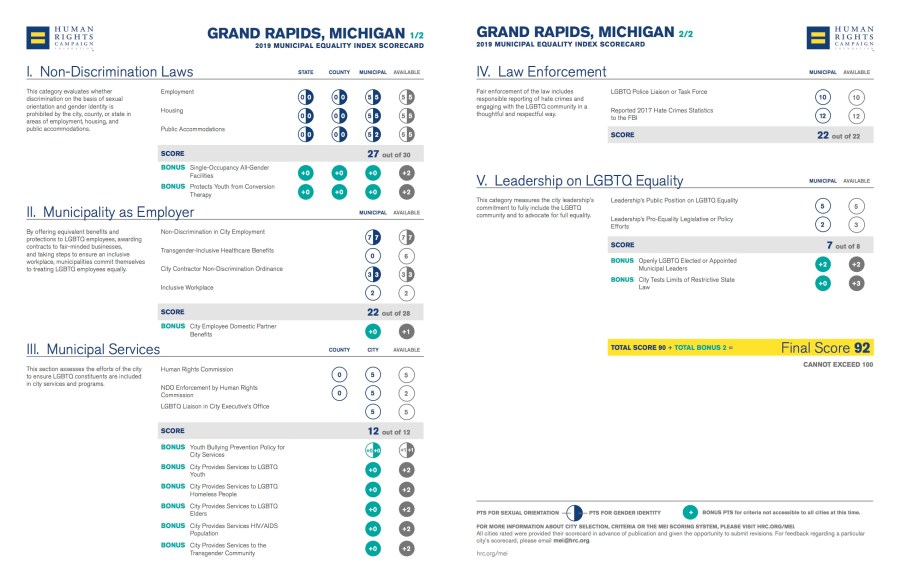
I found the high score somewhat unbelievable, based on interactions and conversations I have had in recent years with those who identify as LGBTQ, so I sent the MLive article and the HRC scorecard to numerous people to get their response. Here are four responses that I received
Colleen – As an openly gay minister from a liberal church here in Grand Rapids I am contacted throughout the year by teenagers or parents of LGBTQA+ youth. At issue is the teen coming out to their family members and facing rejection. Parents even if they are accepting face being ostracized by other family members, friends and faith communities. Organizations that support homeless youth like HQ and 3:11 Housing report that the high numbers of youth who face housing insecurity are from the LGBTQA+ identities. They are put in crisis because they have been kicked out of their family homes. There is still a deep seeded culture in Grand Rapids that is oppressive to the LGBTQA+ folx. Even an honorable judge recently was singled out by her priest who denied her a sacrament of her faith.
Eight years ago, my wife and I moved here from Boston, Massachusetts. Boston has a long history of being a welcoming city to the gay community. We were in a bit of a culture shock when we first arrived in Grand Rapids. I was repeatedly called a sinner by complete strangers, something I had never experienced before in my life. I appreciate the efforts to be more inclusive but personally I think the HRC 92 out of 100 ranking is extremely premature. We have much more work to do to be a truly inclusive city.
Aaminah – First, it is important to note that the organization that provides this scoring system is a deeply problematic organization with a terrible track record regarding racial justice, engaging in/supporting biphobia, and lack of meaningful support for transgender individuals including erasure of non-binary people. So frankly, their ranking is questionable to begin with. Second, I notice that the two primary areas they are claiming the city has improved is in relation to policing and employment. There are so many things wrong with this focus. To say we have a equality in this city on the basis of the police force now having a liaison and some training is, frankly, horrifying. The GRPD engages in so much inequitable behavior and having a liaison isn’t going to magically transform the nature of policing and the overarching methods. The same goes for these claims about employment that are, frankly, simply false. Having some laws in place doesn’t change the fact that we are more likely to be unemployed or underemployed, more likely to be laid off or fired, and unable to seek legal redress for it. Creating a position for a cis, white, gay man to get paid to chair a community relations commission doesn’t mean anything at all. You cannot just create positions for cis, white, abled gay people and call it doing the work on justice. That’s just PR. It’s not substantial change or movement. And all of this is actually perfectly emblematic of the ways that Grand Rapids is NOT a safe, inclusive, or friendly community for LGBTQIA people. Everything that is being used to show growth is only beneficial to a certain kind of lesbian or gay person – not bi/pansexual, not trans, not non-binary, not intersex, not asexual, and not even anyone who is overtly queer. These growth policies absolutely center white and abled gay and lesbian citizens. And I say “citizens” purposefully, because “improved” policing disproportionately does more harm to Black, Indigenous, Latinx, and other people of color, and non-citizens are also disproportionately harmed. In fact, this focus on “the police are our friends” has explicitly led to white cis gay individuals and businesses just feeling better about using the police against others in the community. I could name specific examples of how this PR campaign has actively contributed to harm to people in the community who don’t conform to a middle-class, professional, and white, cis, abled set of expectations. Local LGBTQ+ organizations have been undermined by this PR campaign and efforts to “look good” that don’t include actual justice or equity for the most vulnerable, most marginalized, and most impacted members of our community. Looking good shouldn’t be the goal. Actual services, access, and sustainable resources for all LGBTQIA people in the community needs to happen, and it isn’t happening right now.
Raina – Basically, myself and some other activists organized a march for Pride protesting police violence. We rented a U-Haul truck and trailer and made a float. People gathered at Veteran’s Memorial Circle and waited for me to drive the float there. The plan was to have the float lead a march down Division to the gates of Pride Fest. We did the same thing the year before and one police car followed us there without intervening. This year there were numerous cruisers and a bunch of bike cops. As soon as I pulled up, I was warned that I could not lead the march and could drive directly to the gates but only at the speed limit and not impeding traffic. As I was being warned, a couple activists jumped in the back of the trailer. I was told to drive immediately or be arrested, even with people in the back. I began to drive down Division, but I was worried about the folks in the back, so I pulled over to tell them to get out. A cop car immediately put its lights on and pulled behind me. The cop told me I had been warned and told me to get out of the vehicle. She cuffed me and put me in the back of her cruiser. Kylie, who was in the trailer, jumped out and was expressing her concern for my arrest. She was also arrested and briefly resisted. The truck and trailer were both impounded. I was charged with failure to obey and creating a disturbance. Kylie was charged with felony resisting and obstructing.
David – It’s a good first start for demographics. This just deals with municipal interactions and those possibilities. It doesn’t seem to ask about interactions in neighborhoods or among individuals, one to one stuff.
I would want a fuller picture for serious pat the community on the back for being LGBTQ welcoming. I think the following set of questions need asking:
What support is given to Pride celebrations, LGBTQ history, youth and families. How many LGBTQ homeless are there, and how many are 14-16, 16-18?
How many social services agencies are there? i.e. Pride Center, AIDS Resource Center, Red Project, HQ, welcoming, affirming, inclusive faith communities. How many LGBTQ folks were interviewed by HRC? There needs to be a representative sample to test for overall inclusion, support for living, welcome by neighbors or lack thereof. How many members of the LGBTQ community have experienced verbal or physical violence?
Betsy DeVos presents at the ALEC Conference: Just one more example of how the Neo-Liberal Education model is being promoted by the US Secretary of Education
Last week, the American Legislative Exchange Council (ALEC) hosted their annual States & Nation Policy Summit.
The ALEC policy summit was held in Arizona and featured speakers who fit their long-term agenda, which is to transform state and federal policy that furthers Neo-Liberalism. You can see this reflected in their agenda, which features speakers and facilitated workshops on areas that have been part of the ALEC agenda for decades. You can see if the graphic below the ALEC agenda and which think tanks/groups are involved in each area. Notice that Fiscal policy and Education policy have the largest number of groups working on those respective areas.

Thus, it should come as no surprise that US Secretary of Education, Betsy DeVos, was one of the featured speakers at this years ALEC policy summit. As we have documented in previous Betsy DeVos Watch articles, the Secretary of Education spends a great deal of her time speaking to organizations that embrace the Neo-Liberal Education Model.
DeVos delievred a speech, no doubt written by her staff, a speech which begins with this statement:
 It’s good to be with so many friends and leaders shaping policy across all 50 states. For more than 30 years, state-initiated solutions to intractable issues were my primary focus—and they still are. States are where the action is—or, at least, where it should be.
In the rest of DeVos’ speech, she using standard content from the Neo-Liberal playbook, arguing states rights, choice, the market-place of ideas and even attempting to use language such as, “We the People.” One aspect of the Neo-Liberal playbook is to convince people that whatever policy the right wants to promote is all about freedom and liberty. In addition, one other major theme is to attack the federal government. This message has been central to every administration since Ronald Reagan, even though the Neo-Liberal agenda is not always against the Federal Government. For instance, entities like ALEC or the State Policy Network a deeply in favor of government intervention and policy when it comes to the annual US military budget, tax policies that benefit the wealthy and massive subsidies for corporations. Thus, the Neo-Liberal Agenda is quite selective in their notion of choice and freedom, especially when it comes to policies that benefit the Capitalist Class.
Betsy DeVos continued this theme in a brief interview she did with ALEC TV. Pay close attention to the language used in the questions and the language used by DeVos, which is all right out of the Neo-Liberal Agenda playbook.
Lastly, Betsy DeVos was at the ALEC policy summit to make sure that those attending the gathering were committed to getting her Education Freedom Scholarships adopted. The Education Freedom Scholarships are another example of promoting a Neo-Liberal Education Model, since they allow for individuals and corporations to contribute funds to private & charter schools and then claim it as a tax write-off. This also makes the Education Freedom Scholarships policy just another way for those in the Capitalist class to transfer public money to private interests, which is the foundation of the Neo-Liberal Agenda.
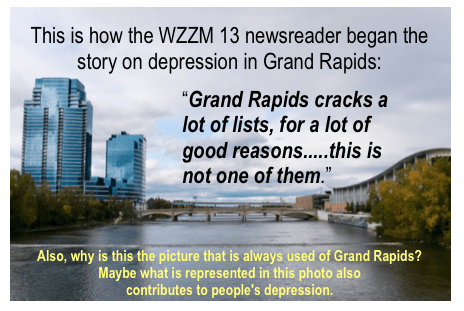
Grand Rapids cracks a lot of lists, for a lot of good reasons…..this is not one of them: Living in Grand Rapids is depressing for lots of people
 Depression is a very serious issue and one that is often misunderstood. Millions of people in the US struggle with depression.
Some experts present depression as more of a chemical issue, while others emphasize sociological factors that determine people who are more susceptible to depression. My own view is that both of these major factors contribute to depression. In fact, part of the problem is that we tend to look at these factors in silos, instead of seeing how they are often intertwined.
This is certainly the case with a recent study that was conducted by the Centers for Disease Control and Prevention, which was cited in an Insurance Providers article, which states that in metropolitan areas of 1 million or more, Grand Rapids has the highest rate of depression nationwide.
 The study on depression was reported on by WZZM 13 recently. Unfortunately, the channel 13 story was only 35 seconds long and only reported on the data presented in the Insurance Providers article, based on the CDC data. The WZZM 13 story did list contributing factors to stress, as can be seen in this screen shot, here on the right.
Unfortunately, WZZM 13 doesn’t explore any of these dynamics in Grand Rapids and how they are contributing to depression. Essentially, the channel 13 story just repeats a version of a press release, without doing any real work or journalism of any kind. The opening comments from the WZZM 13 news reader makes it clear why the abc affiliate chose not to make this a story, even a series of stories. The news readers introduces the story, by saying, “Grand Rapids cracks a lot of lists, for a lot of good reasons…..this is not one of them.”
So what might be some of the contributing factors for being depressed in Grand Rapids? Here is our running list:
- Settler Colonialism being at the root of the founding of Grand Rapids.
- White Supremacy is woven into the fabric of Grand Rapids.
- Lots of shitty jobs, with wages that require lots of people in Grand Rapids to have more than one job.
- Gentrification
- Lack of truly affordable housing.
- Diversity & Inclusion, instead of dismantling White Supremacy.
- DeVos, Meijer and other billionaires.
- A constant reminder of DeVos, Meijer and other billionaires with their names plastered all over Grand Rapids.
- Working for non-profits that accept funding from DeVos, Meijer and other billionaires.
- Having to deal with the spiritual violence that churches commit in Grand Rapids.
- The overt and and covert homophobia and transphobia in Grand Rapids.
- The GRPD’s treatment of black, latinx and other communities of color in Grand Rapids.
- The GRPD’s cooperation with ICE in Grand Rapids.
- The lack of sun and cold winter days.

