The AmplifyGR proposal, conflicts of interest and the value of a Community Benefits Agreement
 On Thursday, the number of people who came to the GR Planning Commission meeting to weigh in on the DeVos-created AmplifyGR development proposal, spill out into the hallway. In fact, the Planning Commission had to set up a TV on another floor, just so people could hear what was being said during the proceedings.
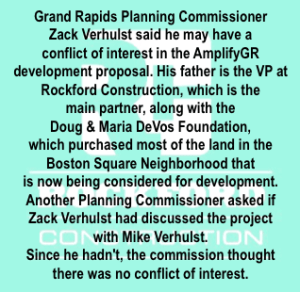
The Planning Commissioners began with what is standard, asking if there is any potential conflicts of interest with the commissioners. One commissioner, Zack Verhulst, said that his father works for Rockford Construction. Another commissioner asked if he had talked to his father about this project and the commissioner said, no. No one on the Planning Commission had any further questions and it was then decided that there was no conflict of interest.
What those in attendance of the GR Planning Commission Public Hearing might not have known is that Rockford Construction, along with the DeVos Foundation, had begun the process of buying up properties in 2015 (spending roughly $10 million) without the knowledge of residents in the Boston Square area, until AmplifyGR went public in the 2017.
As to the conflict of interest, the planning commissioner was not only related someone with Rockford Construction, the person in question is Mike Verhulst, who is the Vice President of Rockford Construction. Rockford Construction stands to profit handsomely, if the City of Grand Rapids approves the project. Rockford Construction’s CEO, Mike VanGessel, was present at the GR Planning Commission meeting as well, although none of the news media mentioned this and they completely ignored the potential conflict of interest with Planning Commissioner Zack Verhulst.
Some of the news media did report that there were people in support of the project, as well as detractors. This writer counted 12 people who spoke in favor of the project and 8 people who voiced opposition. Those opposing the project brought up issues of displacement and gentrification, but the most consistent comment was to ask the Planning Commissioners to hold off on making a decision, since many people felt like there were too many unanswered questions about the project, or that too many residents in the surrounding area had not been engaged in the process. The public comment period was messy at times, even uncomfortable, but democracy is often messy, especially when people could only have three minutes to express themselves.
There were also several supporters of the project who used the argument that those who aren’t from the neighborhood should either not have a say or that some of the anti-AmplifyGR voices were the loudest. It is difficult to determine who the “loud” anti-AmplifyGR voices are, since they haven’t really been reported on in the news media. In contrast, I would argue that the loudest voices in this entire process are the ones with the most power, the DeVos/Rockford Construction/AmplifyGR voices. They are the ones who have engaged in a massive land grab in the area and they are the ones who have dictated the process from 2015 until now.
On the issue of not allowing people who are not from the neighborhood to have a say in this process, it is instructive that it is rarely acknowledged that DeVos and Rockford Construction are not from the neighborhood either. I do think that what happens in the Boston Square area and in Southtown in general, should be decided primarily by those who live in that area. I have stated this repeatedly in recent posts, but I also think that there are other ways for the residents of the Boston Square area to get what they want without subjecting themselves to the dictates of the private sector.
However, those who presented from the AmplifyGR team made it clear that they would be seeking state funding for the housing projects they wish to develop in the Boston Square area. If they are seeking to use public money (likely millions by the time the project is completed), then it seems reasonable that the public should have a say in how their tax dollars will be used to support projects like the AmplifyGR development proposal. To argue that the public should not have a say in how public dollars are used is just another form of Neo-liberal capitalism, which essentially give primacy to the private sector.
In reading much of the commentary on the AmplifyGR proposal on social media, one suggestion that keeps coming up is that those who live in the Boston Square area should seeking a Community Benefits Agreement (CBA). For people who live in neighborhoods where development projects are being proposed, a CBA is a way for people to leverage their collective power to get certain things/agreements in the process. This link provides some clear examples of what a Community Benefits Agreements could look like.
A Community Benefits Agreement might be the best possible outcome for those who live in the Boston Square area, but the proposed development from the DeVos-created AmplifyGR still has to get approval from the Grand Rapids City Commission. It does seem likely that the GR City Commission will support the proposal, especially with recent news coverage around the lack of investment in the southeast part of Grand Rapids. We will continue to follow this story as it unfolds and let people know when the AmplifyGR proposal goes before the City Commission.
What about Reparations for the Boston Square neighborhood?
(What follows is a letter I sent to the GR Planning Commission in response to the DeVos-created AmplifyGR proposal.)
 I am writing to you today to urge you to not approve the development proposal from AmplifyGR. My objections to the AmplifyGR 9-acre proposal for the Boston Square neighborhood are as follows:
First, do we really want to allow the most powerful family in West Michigan, the DeVos family, dictating development projects in neighborhoods throughout this city? So few people can spend more than $10 million to purchase the land they did in the Boston Square neighborhood. They purchased this land in 2015, but residents of that neighborhood did not find out about it until they went public with the non-profit they created in 2017, AmplifyGR. For all their talk about this proposal being led by community input, the DeVos-created AmplifyGR staff fail to acknowledge that the community had no say in their land grab in 2015. This is an important point I believe, since it means that the acquisition of $10 million worth of property in the Boston Square neighborhood puts the DeVos family in a position of power over the residents of that neighborhood. There is no equity or justice when one family can own this much property and then claim that they want to do right by the residents of the Boston Square neighborhood.
Second, another important point about the DeVos family is that they are worth billions. Their collective net worth is not easy to determine, but based on public documentation their collective worth is an estimate $10 billion. Of course, much of their family wealth was created through the Amway Corporation, which recruits individuals with a get rich quick message that is really nothing more than a pyramid scheme, where a few people at the top get rich off the work of others. See Stephen Butterfield’s book, Amway: The Cult of Free Enterprise.
Third, the DeVos family also uses their wealth to influence public policy, at the federal, state and local level, primarily by contributing to candidates who will further their policy agenda in Kent County, in Lansing and in DC. According to the Michigan Campaign Finance Network, the DeVos family has contributed over $100 million to politicians since 1999. The politicians that the DeVos family has contributed to have consistently done the following:
- Keep minimum wages well below what people can actually live off of.
- Undermine and attack labor unions.
- Making tax laws to favor the super rich, while punishing working class families.
- Making Michigan a Right to Work State.
- Supporting politicians that voted for the deregulation of industries like banking.
- Supporting politicians who voted for bailing out Wall Street.
- Getting school districts to no longer be financially responsible for public teacher pensions. They are attempting to do the same to public sector/government employees in the State of Michigan right now.
- Pressuring local municipalities to provide massive subsidies to developers, which is means transfer public money over to companies like Rockford Construction.
- Pushing for the privatization of public services.
- Attacking public education in favor of Charter and other Private School systems.
All of this is to say that the billionaire class, like the DeVos family, has contributed significantly to creating a massive wealth gap in Grand Rapids. Now, they want to come to a neighborhood that has experienced tremendous poverty and disinvestment, which the DeVos family contributed to, all so they can play the savior role.
I understand what it is like to live in a neighborhood that has experienced disinvestment and structural racism. I lived in the Forgotten Corner Neighborhood on the near Southeast side of Grand Rapids for 27 years. I saw what happen to my neighborhood that has now been completely gentrified. The residents of the Boston Square neighborhood deserve to have better and affordable housing. The residents of the Boston Square neighborhood deserve to live in a community that is free of crime and free of predatory landlords. The residents of the Boston Square neighborhood could have all of that and more.
Reparations
 Instead, I would propose something that would give the residents of the Boston Square neighborhood what they deserve AND remove the DeVos family from having any influence over the future of that neighborhood. The $10 million that DeVos/Rockford Construction has spent on land in the Boston Square area could be given directly to the people who live in that neighborhood, in a Community Land Trust or however the people who live there decide. In addition, the DeVos family could give an additional $20 million to the residents of the Boston Square neighborhood, money that has been taken out of the neighborhood over decades by the very same policies that the DeVos family has benefitted from. What I am suggesting is that the DeVos family pay reparations ($30 million) for the financial harm they have caused in neighborhoods like the Boston Square neighborhood. This would not only give those residents complete and total control over their future, it would fulfill an element of justice for communities who have historically been disenfranchised by white collar theft and institutionalized racism. Once the reparations are paid, AmplifyGR could dissolve, especially since the residents of the Boston Square neighborhood won’t have any need for such an entity.
How the local news media is framing the DeVos-created AmplifyGR development proposal in the Boston Square area of Grand Rapids
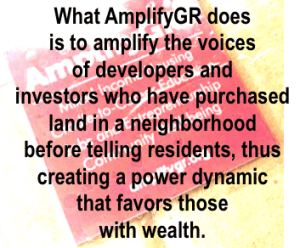 Ever since the MiBiz article from Sunday, December 29, there have been at least four additional local news stories about the DeVos-created AmplifyGR 9-acre development proposal for the Boston Square neighborhood in the southeast part of Grand Rapids.
It is always important deconstruct how news organization cover critical topics and how they frame the issues that they are reporting on. News framing is not just how journalists/reporters talk about the subject they are covering, but what internalized values they may bring to a particular story. For instance, the dominant narrative in the US is that whenever development is proposed, it is seen as a positive, even a necessary outcome. There might be concerns raised about development projects, but in general development projects are seen as a community benefit. This is the dominant narrative in the US and therefore it is a narrative that commercial news agencies adopt.
The first article to appear, was from MiBiz, on Sunday, December 29. MiBiz is a business-focused news agency, that includes real estate/development as a primary news category. Their article from December 29 reads like it was based on a press release that came directly from the DeVos-created entity known as AmplifyGR. The story provides a basic narrative about what the proposal includes, a listing of organizations that AmplifyGR has partner with, along with a list of development partners, including companies hired to design and build aspects of the project. There is only one person cited in the story, Jon Ippel, who is the executive director for AmplifyGR. Lastly, the article does mention that there is Grand Rapids Planning Commission meeting on January 9th, which will discuss the project, but MiBiz doesn’t tell readers that there is a public hearing about the project on January 9. In addition, the only image included was one that AmplifyGR provided, which is a rendering of the geographical area of the project.
The next news story about the DeVos-created AmplifyGR project was done by posted on Michigan Radio on January 5. The Michigan Radio story is based upon a public meeting that was held on Saturday, January 4, at the Boston Square Neighborhood Association. The neighborhood group had posted on Facebook that they were hosting the event, so community members came to learn about the project. Someone this writer had spoken to, who attended this meeting, said that AmplifyGR came and also did a formal presentation at the community meeting.
There were two people cited in the story, with the first being the president of the neighborhood association who said he was skeptical about the project and was concerned about the possibility of gentrification. The other source cited in the story was a staff person from AmplifyGR, someone who assured those in attendance that this project would not displace people. The story also mentioned that there was a GR Planning Commission meeting on January 9, but no mention that there was a public hearing about the proposal from AmplifyGR. The only image used in the story was taken by Michigan Radio, which showed the AmplifyGR staff person and a map of the project area.
MLive ran a story that was posted on Monday, January 6, with a headlined that read, DeVos-backed nonprofit aims to transform Grand Rapids neighborhood. The MLive article was based upon their reporter going to the Boston Square Neighborhood to interview people and to take pictures of the area. The MLive story does provide a basic narrative about the project and some background on what has happened since 2015, when the project began with the purchasing on nearly two dozen properties at the cost of $10 million.
The MLive article cites the executive director of AmplifyGR, someone who serves on AmplifyGR’s neighborhood advisory committee, the executive director of Oakdale Neighbors and a rental property owner who has an office in the Boston Square neighborhood. It should be mentioned that the Oakdale Neighbors received $273,500 from the DeVos family in recent years. The only critical voice of the four cited was the rental property owner and his comments were about the demographic of people in the area and what they could afford in regards to rent.
The MLive article provides a significant amount of space to AmplifyGR to talk about all the positive things the organization has done in the past two years in the neighborhood, but it also lists who sits on the AmplifyGR board, which includes Cheri & Maria DeVos. There are 17 pictures that accompany the article and a link to the what AmplifyGR will be presenting. There is mention that AmplifyGR will be presenting at a GR Planning Commission meeting, but there is no mention of the date for that meeting or that there is a public hearing on January 9.
On Monday night, the DeVos-created AmplifyGR decided to host another meeting for people who wanted to see their development proposal. This event resulted in two more local news stories, one from WOOD TV8 and WZZM 13.
The channel 8 story provides a basic narrative of the proposed project. The two sources cited in the story are the executive director of Oakdale Neighbors and a staff member of AmplifyGR. The channel 8 reporter then says that there are concerns about gentrification, based on what has happened in other areas of the city like wealthy street, but both people cited in the story say that won’t or doesn’t have to happen in this case. The story does mention that the DeVos-created AmplifyGR will be presenting to the GR Planning Commission on Thursday, but there was no mention that there was a public hearing.
The WZZM 13 story also reported from the open house that AmplifyGR was hosting and did address concerns about gentrification, but the only person who viewers heard from talking about gentrification was an AmplifyGR staff person and they believed that would not be an issue with this project. The channel 13 web-based article does use AmplifyGR-provided images for the proposal. There was also mention that AmplifyGR would present to the GR City Planning Commission on Thursday at 1pm, but again there was no mention that this was a public hearing.
Local News omissions
There were some obvious omissions in the local news coverage of the DeVos-created AmplifyGR development proposal. The most obvious was the fact that none of the stories mentioned that the GR Planning Commission was hosting a Public Hearing on January 9 at 1pm. This is a significant omission, since all of the 5 stories failed to let the public know that they could weigh in on this proposal.
Another significant omission with the local news coverage were voices of those who were not part of AmplifyGR or the organizations collaborating with them. While there were numerous mentions about gentrification, there was only one person cited in all five stories who expressed concern about the possibility of gentrification in this project. None of the news agencies sought out other voices in the community, instead they relied on AmplifyGR staff or those directly connected to the project. Such a limited scope of perspectives not only excludes different perspectives, it sends the message (by omission) that there are no dissenting voices.
A third significant omission is the lack of context and the failure of reporters to ask more probing questions. The MLive article did provide some background information, but did not follow that information up with more poignant questions. None of the news agencies talked about how structural racism has played into the disinvestment in the Boston Square neighborhood and non of the news agencies raised issues around the fact that the DeVos/Rockford Construction tandem had begun buying land in the Boston Square area in 2015, but didn’t tell residents until mid-2017. There were some news agencies that identified this project as a DeVos-back project, yet there was no exploration of what that could mean. In other words, none of the local news agencies asked a question like, why did the most powerful family in West Michigan create this non-profit and should people be concerned about their short term and long term intentions? This question is an important one and it is exactly why GRIID has been reporting on the DeVos-created AmplifyGR work since May of 2017.
Campaign promises and Line 5
 During the election cycle of 2018, then Gubernatorial candidate Gretchen Whitmer and candidate for Attorney General, Dana Nessel, both made the promise that they would shut down the Enbridge oil pipeline that runs through through the state and under Lake Michigan, also known as Line 5.
It has been a year, yet Line 5 continues to carry millions of gallons of oil, putting the Great Lakes at risk.
Governor Whitmer at times has used rhetoric that she will close Line 5, yet she continues to have talks and negotiations with the Enbridge Corporation. Attorney General Dana Nessel has initiated some legal actions around Line 5, but there hasn’t been much coming from her office on how and when Line 5 will close.
In fact, in a June 27 communication from Governor Whitmer, it reads:
“The governor has never viewed litigation as the best solution to this problem, and for this reason she entered negotiations with Enbridge about the possible construction of a tunnel. Her reasonable requirement has been that the dual pipelines through the Straits cease operation at a date certain, after allowing for a period of transition. Enbridge, however, has insisted that it be allowed to run oil through the Great Lakes indefinitely. Rather than negotiating, Enbridge walked away and filed a lawsuit. Today, Governor Whitmer filed her response asking the court to dismiss Enbridge’s lawsuit.
From this statement, it seems to this writer that Governor Whitmer is NOT opposed to Enbridge’s proposal to build a tunnel under the Straits of Mackinac. This is what the Enbridge has been pursuing for months now, with all of their advertising campaigns in Michigan, to get approval to build a tunnel under the lake and to continue to pump millions of gallons of oil. In addition to the advertising dollars that Enbridge is spending to convince the public, they are spending lots of money lobbying the Michigan Legislature, according to the Michigan Campaign Finance Network.
There are numerous environmental groups that oppose the proposed Enbridge tunnel, but their efforts to stop seemed to be limited to public education and engaging in their own talks with the Governor’s office.
Have we not learned anything from Indigenous resistance to the current climate disaster? Every major battle against oil pipelines in the US and Canada are being led by Indigenous communities. These communities get the importance of doing Direct Action against companies like Enbridge, especially in the midst of the current climate crisis. Safety isn’t the only issue. We cannot continue to burn fossil fuels if we want to have a future for our children and for the non-human communities.
We cannot put our faith in elected officials. Over and over again they make promises, but rarely do they keep them. We must take matters into our own hands and organize for the kind of future that we want to have. We can’t vote our way to climate justice.
GRIID encourages you to watch the following two videos. The first puts the current climate crisis in proper context and the second video shows us an example of what it means to be a climate justice warrior. These are the struggles that we need to support and this is the kind of action we need to take.
Making sense of US foreign policy – Part III: The US has been waging war on Iranians since 1953
 In Part I, we provided a framework for how to critically examine US Foreign Policy. In Part II, we made it clear that US imperialism is a bi-partisan affair, demonstrating that there is no fundamental difference between who controls the White House or Congress, as both the Republicans and Democrats are deeply committed to US imperialism.
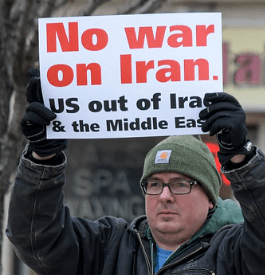
In Part III, we want to look at how the US has been waging war on the Iranian people since 1953. With the Trump administration’s killing of a high ranking Iranian official and sending several thousand US troops to the region, it is understandable that people mobilized over the weekend to express their opposition to a potential war with Iran. However, it is vitally important for us to take the long-view of US foreign policy as it relates to Iran, since the last four generations of Iranians have experienced one form or another of US imperialism.
CIA Coup in 1953
 In his conversations with the Shah, Kermit Roosevelt said he had at his disposal “the equivalent of about $1 million” and several “extremely competent, professional organizers” who could “distribute pamphlets, organize mobs, keep track of the opposition – you name it, they’ll do it.” He described Operation Ajax as based on “four lines of attack” First, a campaign in mosques, the press, and the streets would undermine Mossadegh’s popularity. Second, royalist military officers would deliver the decree dismissing him. Third, mobs would take control of the streets. Fourth, General Zahedi would emerge triumphantly and accept the Shah’s nomination as prime minister.
This excerpt of the CIA planning for the coup in Iran, is from Stephen Kinzer’s book, All the Shah’s Men: An American Coup and the Roots of Middle East Terror. The CIA coup was prompted by the nationalization of Iran’s oil in 1951. Iran’s oil had been under the control of the British Empire before the nationalization, but like many countries in the Global South at that time, Mossadegh sought to use Iranian resources to benefit the Iranian people. However, Mossadegh did offer the British compensation for nationalizing the oil, included a continuing 25% of net profits from the oil and retention of all British oil employees.
The British responded with military threats and sanctions, which had hurt the an already struggling Iranian economy. The Truman administration supported the British position, as did the Eisenhower administration, but it was the Eisenhower administration, specifically John Foster Dulles (Secretary of State) and Allen Dulles (Director of the CIA) that gave the green light to Kermit Roosevelt to implement Operation Ajax.
The CIA also sent Major General Norman Schwarzkopf Sr. to persuade the exiled Shah to return to rule Iran. Schwarzkopf trained the security forces that would become known as SAVAK to secure the shah’s hold on power.
When the Shah returned to power he quickly sought to crack down on pro-democracy forces and paid off the Islamic parties to support his rule. However, over time, many of the mullahs would reject the Shah’s plans for Iran, specifically his desire to Westernize the country. With the Islamic leadership increasingly becoming critical, the Shah began to repress Islamic institutions. In March 1963, the Shah’s security forces attacked Faizeiyejh Theological School, arresting dozens of students and killing two. The survivors ran to the nearby home of Iran’s most respected cleric, the Ayatollah Khomeini.
US governments would continue to support the Shah of Iran, all the way from Eisenhower through Jimmy Carter. The support they offered was both economy and military support, despite the fact that the Iranian security forces, SAVAK, had essentially become a death squad. In 1976, Amnesty International announced that Iran had the worst human rights record in the world. Iran’s horrendous human rights record, didn’t stop US President Jimmy Carter from inviting the Shah to Washington in 1978, toasting the Iranian leader by saying, “Iran under the leadership of the Shah is an island of stability in one of the more troubled areas of the world.
Just weeks after visiting with Jimmy Carter, the Shah escalated his repression and killed over a thousand protestors on September 8, 1978, a day known as Black Friday in Iran.
Of course, a year later, the Shah would be forced to flee Iran, as the opposition forces coalesced behind Khomeini. Henry Kissinger and David Rockefeller, friends of the Shah, lobbied to bring him to the US. Their efforts were successful.
Unfortunately for many Iranians, the Ayatollah turned out to be as ruthless as the Shah and he began torturing and murdering dissidents. In addition, the Iranians took the US Embassy in February of 1979, holding Americans hostage. The Carter administration was unable to bargain for their release and according to investigative reporter Robert Parry, a separate bargain was made with a group of ex-CIA officers who were supporting a Reagan-Mush presidential campaign. The bargain was made in October of 1980, in what became known as the October Surprise, since Khomeini made a deal with the US to release hostages in exchange for $40 million is US military equipment. The US also required a list of known Iranian leftists, which Khomeini rounded up and executed.
At this time the US news media had made Iran a pariah state, filled with evil muslims. In this context, the Reagan administration had no problem demonizing the Middle Eastern country. The Iran-Iraq war began in 1980 and lasted a decade, resulting 200,000 Iranian deaths. The US provided weapons to both sides, but only Chemical weapons to Iraq, which used them on Iranians.
 Despite the ongoing animus towards Iran, the US sold even more weapons to Iran in 1986, which was a violation of the Arms Export Control Act. However, the sale of US weapons to Iran was part of a much larger US foreign policy objective, one which would play out over the next year, in what was referred to as the Iran/Contra Scandal.
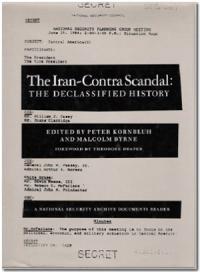
The Iran Contra scandal was the biggest scandal since Watergate, it dominated the news starting in late 1986, when word broke about the administration’s illegal backing of Contra rebels in Nicaragua and illicit sales of high-tech weapons to the Islamic Republic of Iran. When President Ronald Reagan acknowledged that the two operations were connected it raised the stakes even higher, including rumblings for impeachment. However, Oliver North became the fall guy for the Reagan administration, leaving many members of the Reagan White House untouched. For details on the Iran/Contra scandal, see Malcolm Byrne and Peter Kornbluh’s important book, The Iran-Contra Scandal: The Declassified History.
The Clinton administration continued to treat Iran as a parian state, adding increased sanctions. In May of 1995, Clinton signed an executive order prohibiting all American trade, trade financing, loans and financial services to the Islamic Republic. To further punish Iran, Clinton signed into law in August of 1996 a bill that imposed a secondary boycott on foreign companies and governments investing more than $40 million in Iran’s oil and natural gas industry. This law provided an array of additional sanctions as well.
After the US war with Iraq in 1991, the US was also rethinking some of its foreign policy in the region. Israel was the main US partner in the Middle East and Israel began pushing the US to adopt even more punitive measures against Iran. The main issue for Israel was Iran’s interest in developing a nuclear industry. The reality is that Israel is the only country in that region, which possesses nuclear weapons. For the last 20 years, this issue has dominated US policy towards Iran.
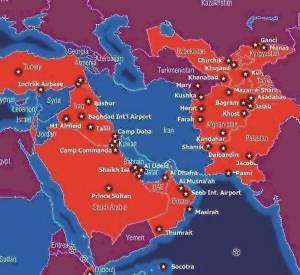 The George W. Bush administration made Iran part of the Axis of Evil, along with North Korea and Syria. Iran, during the Bush administration claimed, was exporting terrorism and needed to be overthrown. This was an interesting claim, especially since the United Nations had ended disbanded their special committee on Iran in 1998, stating that human rights violations were significantly reduced with the Khatami government.
The Bush administration then began its war/occupation of Iraq in 2003, which took their attention away from Iran momentarily. However, the doctrine of pre-emptive strike in Iraq was now sounding like it could apply to Iran. All of this rhetoric was never based in fact, since Iran was not exporting terrorism and not a serious threat in the region. In fact, the real threat in the region was the US, especially to Iran, since the US had dozens of military bases in several countries, essentially surrounding Iran.
The Bush policy was then adopted and continued by the Obama administration. Much of the same rhetoric was used and Iran was still being isolated by the US. However, in 2014, the US government decided to use a different tactic to pressure Iran to accept a no nuclear position. Iran eventually agreed to this position and the US media celebrated the outcome. What was instructive, particularly about US media coverage during these negotiations is that the US news media failed to ask some fundamental questions during the negotiations. First, there was rarely any acknowledgement that Israel possessed nuclear weapons, even though the US repeatedly denied it. Secondly, why was it acceptable for the US to have the largest nuclear arsenal on the planet, but Iran could not develop even a nuclear power program? The US is the only country to have used nuclear weapons on another country (Japan), so how does the US have any moral authority on this matter? Of course, the US doesn’t, but they are the most powerful nation on the planet and remain largely unchallenged.
For an excellent investigation into the past 20 years of US policy with Iran, specifically how the nuclear issue became central to this policy, see Gareth Porter’s excellent book, Manufactured Crisis: The Untold Story of the Iran Nuclear Scare.
As the Trump administration deliberates on relations with Iran and whether or not to go to war, it is vital that we familiarize ourselves with this history and begin to realize that the US has been waging war on the Iranian people since 1953.
Resources
 Trailer for new documentary on the CIA Coup in 1953, entitled Coup 53 https://www.youtube.com/watch?time_continue=10&v=uSK6wdqo0xY&feature=emb_logo
National Security Archives documents on US/Iran Relations
https://nsarchive.gwu.edu/project/iran-us-relations
All the Shah’s Men: An American Coup and the Roots of Middle East Terror, by Stephen Kinzer
Killing Hope: Us Military and CIA Interventions Since WWII, by William Blum
Boomerang: How Our Covert Wars Have Created Enemies Across the Middle East and Brought Terror to America, by Mark Zepezauer
Lying for Empire: How to Commit War Crimes With a Straight Face, by David Model
Sowing Crisis: The Cold War and American Dominance in the Middle East, by Rashid Khalidi
Inventing the Axis of Evil: The Truth About North Korea, Iran and Syria, by Bruce Cummings, Ervand Abrahamian and Moshe Ma’Oz
Who Rules the World, by Noam Chomsky
Retargeting Iran, by David Barsamian
(Photos credited to John Rothwell)
Reporting on Climate Change while taking money from Enbridge
In the most recent issue of MiBiz, there is a short article about statewide Climate Change goals on page 29, headlined, Climate Change Outlook: Advocates expect ambitious statewide climate change goals in 2020.
The article is not particularly compelling, since it provides just a few comments from DEQ staffer and the Director of the Michigan Climate Action Network. The Michigan Climate Action Network director, Kate Madigan, is using the “good 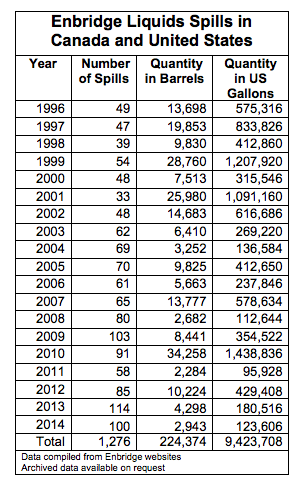 climate policy is good for Michigan’s economy” argument, although the reporter doesn’t press her on what that means or how their goals will be achieved. In fact, the article doesn’t address how the state legislature is pretty compromised, especially considering how much elected officials get from energy corporations during election cycles. The Michigan Campaign Finance Network provides all that data, which you can search by elected officials here.
However, it makes complete sense that MiBiz would not really want to ask hard questions about Climate Change, especially considering that on two pages before the article with Michigan Climate Action Network, there was a full page ad from energy giant and Line 5 operator, Enbridge.
The Enbridge ad was presenting the global energy company like all there ads do, as a responsible company, essentially guaranteeing that the oil tunnel they are proposing to build under Lake Michigan will not leak. Enbridge makes this promise, despite the fact that there are hundreds of documented incidents of pipeline malfunction that Enbridge is responsible for in the past, according to World350.org.
Unfortunately, MiBiz is more interested in advertising dollars than they are in facts.
On Thursday, January 9th at 1pm, there will be a public hearing at the Grand Rapids Planning Commission for a new development project being proposed by AmplifyGR in the Boston Square neighborhood. The public hearing will be held at 1120 Monroe Ave NW in the city’s Development Center, in the Public Hearing Room on the 2nd floor.
This is the first concrete proposal that AmplifyGR has submitted to the City, since the public first became aware of their existence in May of 2017. GRIID was the first to write about AmplifyGR and the fact that is was a creation of the Doug & Maria DeVos Foundation. AmplifyGR had been meeting with the Southtown Corridor Improvement District, based on documents we found from January of 2017. However, most of the people in the Boston Square neighborhood were completely unaware of the fact that the Doug & Maria DeVos Foundation had been funding this new entity called AmplifyGR and was working with the Rockford Construction Company to purchase 22 separate pieces of property at the cost of $10 million. You can read a breakdown of the property costs for all 22 pieces of land at this link.
It is important to recognize that the DeVos/Rockford Construction land grab took place with little knowledge of residents in the area, yet AmplifyGR wants people to trust that they have the best intentions. Are we to believe that the wealthiest family in West Michigan has nothing but noble intentions? The Doug & Maria DeVos Foundation and Rockford Construction Company, both white-owned and operated entities, have nothing but good intentions by spending $10 million to purchase land in a mostly black neighbor?
In late June of 2017, AmplifyGR held its first public meeting, with over 200 in attendance. People came with lots of concerns and questions about what was happening in their neighborhood without their knowledge. A second meeting was then held in late July of 2017, with even more pushback from the community. At one point during this second public meeting, someone asked what if there was 70% opposition to this project? The Executive Director of AmplifyGR, John Ippel responded by saying, “even if 70% of the community opposed this, we would just have to get back up and move forward and do it better.” You could heard several people in the audience gasp in horror and the level of arrogance they heard coming from the AmplifyGR spokesperson.
After a few more meetings, AmplifyGR decided to put an end to public meetings and try a new tactic to engage people. After cancelling other public meetings AmplifyGR posted on the website the following statement:
“Still, those of us on the front lines agree: If going slower is the price of getting this right… of NOT repeating the mistakes of the past… it’s worth it. You’re worth it. Our community is worth it. And our commitment and passion to achieving the above priorities has never been greater.”
One could certainly conclude that the DeVos create/funded entity was going to do whatever it is they set out to do, regardless of community pushback.
This tactical shift, by not holding town hall-style meetings, has been effective. What AmplifyGR has done is to hold open door gatherings, where there are refreshment, displays of project proposals and people there to answer questions from anyone who has them. What this means is that people don’t hear the questions or concerns being voiced by other people, since the interaction is more one on one. The problem with this meeting style is that it not only prevents people from hearing important questions/objections, it denies people the opportunity to hear questions/objections that maybe they had never thought of. In addition, if there are people who raise hard questions, it is easier to isolate them, since they are asking these questions without any public response.
According to AmplifyGR, they have held three of these kinds of meetings, which were coordinated by the PR firm Lambert. You can read their FAQ document for the meetings here.
A few days ago, MiBiz reported on the proposed AmligyGR project. In that article, it states that AmplifyGR, “has worked on the plans for the redevelopment project with Boston Square Together, which includes Oakdale Neighbors, a community development organization; the Early Learning Neighborhood Collaborative; and the Boston Square Neighborhood Association.”
The Boston Square Neighborhood Association only has a Facebook page and there is no information on who sits on their board of directors. Oakdale Neighbors and the Early Learning Neighborhood Collaborative have both received substantial amounts of funding from various DeVos family foundations. Between 2013 and 2017, Oakdale Neighbors has received a total of $273,500 from the DeVos family and the Early Learning Neighborhood Collaborative has received $1,070,800 from the Doug & Maria DeVos Foundation alone. It would be hard for any reasonable person to think that either of these entities is not compromised in this process.
The Grand Rapids Planning Commission already has a packet for the January 9th public hearing, which you can read here. The pages that are specific to the AmplifyGR development proposal can be found on pages 67 through 343. Most of the documentations is made up of traffic data, but is was instructive to see that on pages 71 – 74, Kurt Hassberger has signed several documents giving permission to AmplifyGR to rezone parts of the Boston Square neighborhood. These page refer to Hassberger as the being connected to an entity called Boston Square Residential LLC. Hassberger is in fact legal counsel for the Rockford Construction Company, the same company that bought all of the property in the Boston Square neighborhood for $10 million in partnership with the Doug & Maria DeVos Foundation. Upon further investigation, I found that Boston Square Residential LLC’s address is 601 First Street NW, Grand Rapids, 49504, which is also the address for Rockford Construction.

The Public Hearing is Thursday, January 9 and 1pm, 1120 Monroe Ave NW in the city’s Development Center, in the Public Hearing Room on the 2nd floor. This would be a great time for people to ask some poignant questions or make statements. GRIID will be there to report on the public hearing.
 This is the last (and third) post for our GRIID end of the year in review. In Part I, we provided a summary of some of the significant social movements active in Grand Rapids in 2019. In Part II, we demonstrate the importance of monitoring those in power and provide some analysis of the individuals, families and organizations in Grand Rapids that have the most political and economic power.
In this final post in our end of the year in review series, we want to look at the numerous articles we posted that dissected the local news media. In many ways, monitoring the news media is similar to holding centers of power accountable, especially since most commercial media is owned by large, multinational corporations.
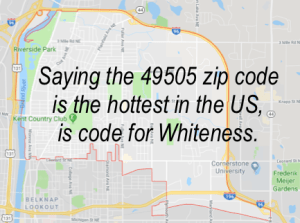
In 2019, we wrote dozens of articles critiquing commercial news stories. One theme that we critiqued was the local media’s propensity to run stories about how Grand Rapids is so wonderful. One example was a January article about how Grand Rapids is a hotbed for entrepreneurs. Another example was from a story that WGVU radio did in August, where they referred to Grand Rapids as a “superstar city.” A similar story was also aired in August, on WXMI 17, where they stated that 49505 was the “hottest zip code in the country.” Of course, none of these stories provide any critical assessment of the claims they make or repeat in their coverage.
A second important theme with how local news reports is their propensity to act as stenographers for the rich and powerful. For example, when MLive reported on the 60th anniversary of the Amway corporation it was as if they let Amway write the story. Another example of the local news coddling the rich and powerful, was a story on MLive where Dick DeVos was complaining about the Governor cutting funding for Charter Schools. One last example in this category was how MLive reported on the DeVos family philanthropy in a late November story.
However, most of our critiques of local news media were centered around how local news reported on immigration issues, including the GRPD, the Kent County Sheriff’s Department and Immigration and Customs Enforcement (ICE). One example is how the local news reported on the arrest and eventual deportation of a DACA student.
A great deal of the local news reporting on immigration and ICE, also tends to center the voices of law enforcement, as we pointed out in a March 5th critique.
 The same bias was reflected in the late July coverage of a 3rd Congressional District candidate who visited the US/Mexican border and then praised law enforcement officials for their work. In late August, MLive ran a story, where they essentially reprinted the content of an ICE Press Release.
Additionally, how the local news reported on the suspension of GRPD Captain Vanderkooi is reflective of how the commercial news media sees police as a force for good.
Lastly, the local news media often fails us when reporting on economic development, as was the case with their reporting on the lack of investment into the southeast part of Grand Rapids. Even the editorial staff at MLive perpetuated structural racism in their editorial piece in late October, regarding the lack of investment in the southeast part of Grand Rapids.
To view all of the stories we posted under the category of Dissecting the Local News, go to this link.
For 2020, we plan to continue to document the efforts of local social movements, shine light on what the Grand Rapids Power Structure is up to and to act as a media watchdog, documenting the bias and lack of critical reporting.
GRIID End of the Year in Review: Part II – Monitoring the Powerful in Grand Rapids
In their book The Elements of Journalism, Bill Kovach and Tom Rosenstiel identify the essential principles and practices of journalism. One of those principles is to monitor power.
Kovach and Rosensteil write:
Journalism has an unusual capacity to serve as watchdog over those whose power and position most affect citizens. It may also offer voice to the voiceless. Being an independent monitor of power means watching over the powerful few in society on behalf of the many to guard against tyranny.
Being a watchdog of those with power is something that GRIID was founded on and continues to do. Here is an overview of the ways we monitored power in Grand Rapids in 2019.
As we wrote in Part I of this series, there were several local social movements that confronted and held power accountable, specifically local governments, private entities collaborating with ICE and the Grand Rapids School Board, in the case of Grand Rapids for Education Justice.
In January of 2019, we posted a story about former Michigan Representative Daniela Garcia, being hired to work for the Department of Education. In that post we noted that Garcia was a longtime recipient of DeVos money while working in Lansing, so her transition to the Department of Education was fairly seamless, now working for Betsy DeVos. In fact, one of our regular posts was to monitor, critique and provide analysis of what Betsy DeVos was doing with education policy, specifically in our series entitled, Betsy DeVos Watch.
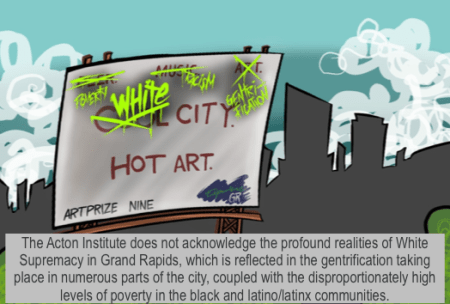 There are several organizations that make up that Grand Rapids Power Structure and GRIID continued to monitor their activities. One of those groups is the Acton Institute. In February, we posted a story about a presentation that the Acton Institute hosted, which featured a speaker from AmplifyGR, talking about the neo-liberal education model.
The Acton Institute used the Trump visit to Grand Rapids to say that cities like Flint and Detroit need to be more like Grand Rapids. During Pride month, the Acton Institute demonstrated their organization’s homophobia and we wrote another piece on Acton in June making the claim that they are more dangerous than neo-nazis.
The far right think tank, the Acton Institute, also used their website to dismiss the 1619 Project and later referred to climate activist Greta Thunberg as pathological.
We also reported on another prominent group within the Grand Rapids Power Structure, the West Michigan Policy Forum. In February, we posted a critique of their push to eliminate public sector pension for government employees in Michigan, calling them unfunded liabilities. In April the West Michigan Policy Forum teamed up with the Mackinac Center to push for continued work requirements for those receiving Medicaid in Michigan and beginning in July the WMPF was proposing that the state borrow money from the Michigan Teacher’s pension and put it towards road construction.
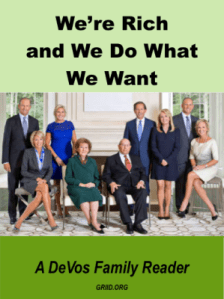 GRIID also did a series of articles on several of the West Michigan-based foundations, specifically the foundations run by the most powerful families in the area. We reported on the Richard & Helen DeVos Foundation contributions, the Edgar & Elsa Prince Foundation, the Jerry & Marcia Tubergen Foundation, the Dick & Betsy DeVos Foundation, the Doug & Maria DeVos Foundation, the Van Andel family Foundations, the Cheri DeVos Foundation, the Peter Cook Foundation and the Jandernoa Foundation.
In addition, we continued our monitoring of the most powerful family in Grand Rapids, the DeVos family. We posted numerous stories on their funding of candidates at the state level, their influence in local politics, the wealth expansion and their role in the religious right. All of these articles, along with every article we have ever written about the DeVos family, can be found at the ever growing DeVos Family Reader publication at this link.
GRIID End of the Year in Review: Part I – Reporting on Social Movements in Grand Rapids
Social Movements in the greater Grand Rapids area have continued to develop and flourish in many ways. One movement in particular, the immigrant justice movement, has continued to fight against state violence and build a movement to fight for the undocumented community.
Movimiento Cosehca GR continued to build capacity amongst the immigrant community and to engage allies to work in solidarity with them. GR Rapid Response to ICE has continued to work closely with Cosecha GR in a variety of ways, and specifically in the fight against ICE violence in Kent County.
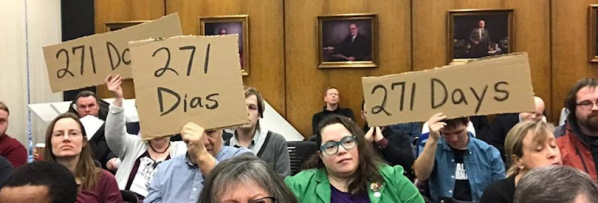
2019 began with an action at the Kent County Commission meeting, where immigrant activists and allies were continuing their call for end end to the contract with ICE.
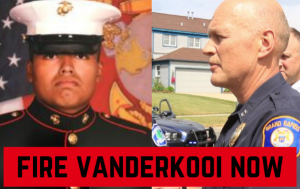
Kent County’s contract with ICE had been receiving national news near the end of 2018, when the GRPD called ICE on Jilmar Ramos-Gomez, a former US Marine. The arrest of Ramos-Gomez was an embarrassment for the GRPD and for the Kent County Sheriff’s Department, both of whom have been collaborating with ICE to arrest and detain immigrants in Kent County.
 However, in late January, after ongoing pressure from Movimiento Cosecha GR, GR Rapid Response to ICE, the ACLU and MIRC, the Kent County Sheriff announced that they would now be requiring ICE to obtain a judicial warrant in order for the Kent County Jail to put a hold on immigrants being detained. This announcement was clearly a victory for the immigrant justice movement, since Kent County and the Sheriff’s Department would never have had to make these kinds of decisions without the campaign to End the Contract with ICE, a campaign that began in June of 2018.
The City of Grand Rapids also came under greater scrutiny because of the GRPDs role in the Jilmar Ramos-Gomez campaign. The ALCU and MIRC demanded transparency on the arrest of Ramos-Gomez, seeking to find out the role that the GRPD played in this case.
Movimiento Cosecha GR and GR Rapid Response to ICE then began to pressure the Grand Rapids City Commission on the GRPD’s collaboration with ICE and to make several clear demands at a commission meeting in early February.
Movimiento Cosecha GR and GR Rapid Response to ICE then escalated their efforts with the City of Grand Rapids during a February 26th commission meeting, effectively shutting it down over the GRPD’s role in the Jilmar Ramos-Gomze case. Both groups were calling for the City to fire Captain Kurt VanderKooi, the GRPD’s ICE liaison and the officer who called ICE on Jilmar Ramos Gomez.
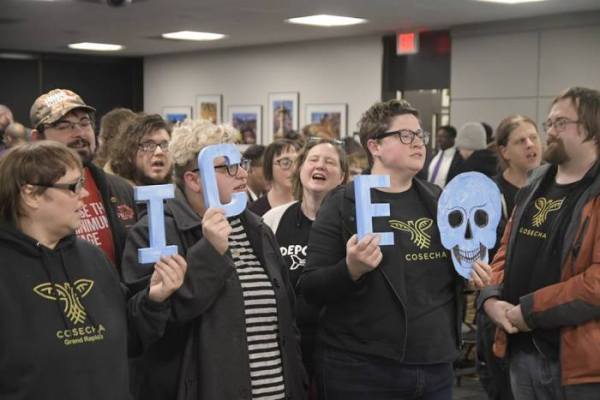
The GRPD union pushed back on this pressure from immigrant justice groups and released a statement on February 28th on how city officials were cowering before immigration activists.
At the same time that the cops were complaining of immigrant activists, the GRPD was coming under greater scrutiny, because of specific acts of violence against black and brown residents. This violence was receiving a great deal of attention from the news media and on social media, but it also led to an effort amongst several groups in the immigrant justice community and the African American community to come together to make even more demands from the city. These demands were laid out in press conference held near the end of March.
In late April the City of Grand Rapids reinstated Captain Kurt VanderKooi, after the officer had been put on administrative leave in late February. The ACLU and MIRC submitted a FOIA request on the role that VanderKooi played and GRIID reported on those findings in late April. The FOIA documents revealed more details on the GRPD’s collaboration with ICE and it exposed the GRPD’s role in monitoring Movimiento Cosecha GR and GR Rapid Response to ICE.
On May 1st, Cosecha GR organized another successful march to mobilize people to demand driver’s licenses for all in Michigan. The City of Grand Rapids tried to force Cosecha to obtain a permit for their march, but Cosecha held firm in their commitment to not dance with politicians.
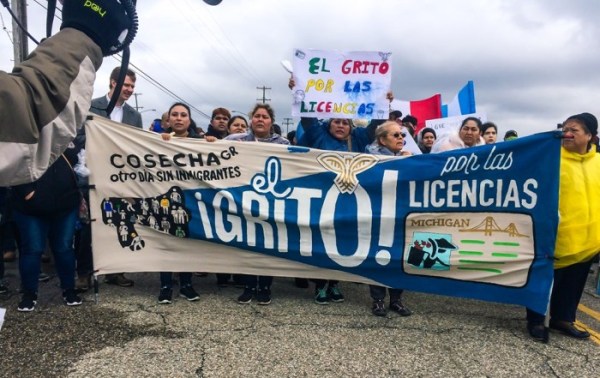
The City of Grand Rapids continued to ignore immigration activists demands, so the groups released a statement in response to the City’s failure to act. The statement was sent in mid-May, the day before the Civilians Appeals board voted to reverse the GRPD’s decision to reinstate Captain VanderKooi.
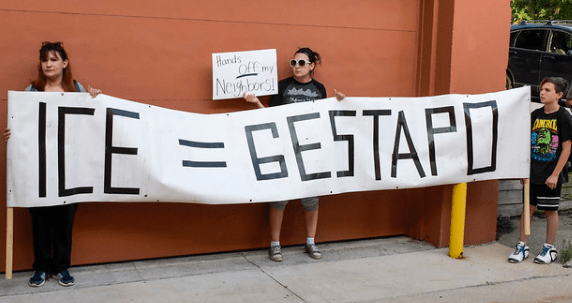
All across the US there was growing involvement from the Jewish community to confront ICE oppression, with actions happening in several cities. In July, the Jewish Community organized an anti-ICE action in Grand Rapids, specifically at one of the ICE offices on Ottawa NW. Later that month, GR Rapid Response to ICE organized another action at the same ICE office, specifically to draw attention to how ICE was separating families in Kent County.
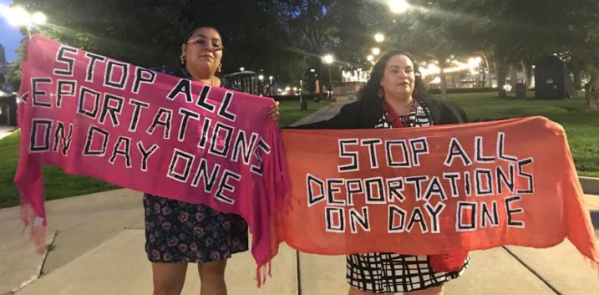
In early August, the Democratic Presidential candidates held a debate in Detroit and immigration activists from all over the state came to Detroit to confront the candidates on US immigration policy. Several people were arrested for blockading the tunnel between the US and Canada, while other activist interrupted the candidate debate with powerful immigrant justice messages.
In late August, another action was organized at the Kent County Jail, to demand an end to the ICE contract and to expose the Kent County Sheriff’s Department in their continued collaboration with ICE. That same day, ICE released a statement saying that they would not be renewing their contract with Kent County. Too much bad press had been created in the past 13 months, because of the work of Movimiento Cosecha GR and GR Rapid Response to ICE. The Kent County Sheriff’s Department did release a statement about how they would continue to cooperate with ICE, even though ICE did not want to renew their contract.
In mid-September, GR Rapid Response to ICE organized a demonstration at the GRPD headquarters, as a response to the City’s decision to only give Captain VanderKooi a 20 hour suspension in his role in the arrest and detention of Jilmar Ramos-Gomez.
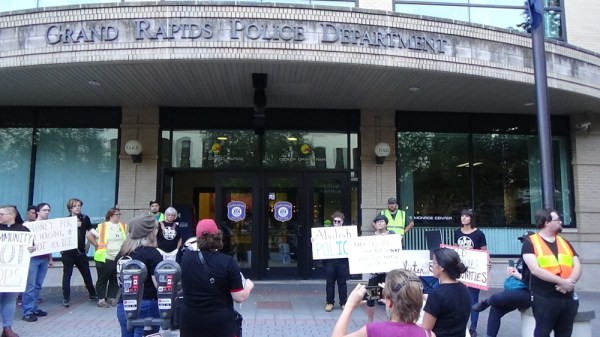
Movimiento Cosecha GR continued its campaign to get driver’s licenses for all in Michigan and organized an action in late October to pressure the City to formally support the statewide campaign.
The following week, Movimiento Cosecha celebrated their role in getting state lawmakers to introduce new legislation to allow undocumented immigrants to obtain a driver’s license at a press conference.
Grand Rapids for education Justice
In late July, we posted a story about local education activists who had submitted a FOIA request with the Grand Rapids Public Schools. The activists talked about how the GRPS had been dragging their feet on the request, which raised serious questions about what the school district was hiding.
These activists were actually part of a new movement in Grand Rapids, calling themselves Grand Rapids for Education Justice (GREJ). This new group went public when they held a press conference before a school board meeting in early October.
The GREJ continued to make waves at subsequent school board meetings, one in early November. Several school board members were dismissive of the group, so GREJ created a video response to the school board’s inaction on demands they laid out in early October.
In late November, the GREJ released another video statement, this time challenging the curriculum that will be used at the new Hospitality and Tourism Academy, which is essentially a school designed to train students to work in the service sector.
The GREJ group is still relatively new, but already they have forced a larger community conversation around the role of public education in the age of Neo-Liberal education policies, policies that are being pushed at the federal level by Betsy DeVos.
There certain have been other organized efforts for social justice in Grand Rapids, including some organizing around climate justice, but the movements cited above are the only ones that have been consistent and have had an impact locally.

