Acton Institute writer puts faith in the market to solve the housing crisis, is dismissive of rent control as a solution
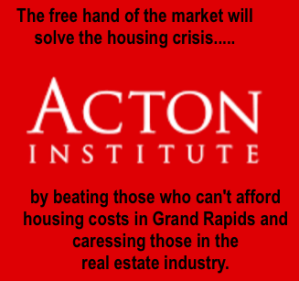 Last week, Acton Institute writer, Dan Hugger, wrote an article headlined, Sen. Bernie Sanders tweets a blueprint for a housing crisis.
The Acton writer acknowledges that there is a housing crisis, but frames the solution around the market, instead of policy or grassroots organizing. Hugger goes on to cite Kevin Erdmann’s book, Shut Out, but omits the critique of gentrification that is in the paragraph right after the one the Acton writer cites.
The Acton writer then goes on to say:
Senator Sanders’ call for national rent control does nothing about this underlying shortage but rather exacerbates it.
The Acton writer is correct to point out that rent control by itself would be inadequate, plus it would take too long in most states to get rent control passed. However, grassroots organizing by tenant unions across the country have demonstrated that it is more effective to pressure landlords/property management companies, than to wait for states to pass rent control policies.
The Acton writer concludes with his own solutions to the housing crisis. He offers a vague comment about having fewer barriers for developers and one concrete suggestions about flexible zoning, citing Oregon and California’s ban on single family zoning. I agree that more flexible zoning would be important, but if the Acton writer looked beyond the tweet from Bernie Sanders, he would actually see there is a pretty robust plan for dealing with the housing crisis.
Here is what Senator Sanders’ campaign is calling for:
- End the housing crisis by investing $2.5 trillion to build nearly 10 million permanently affordable housing units.
- Protect tenants by implementing a national rent control standard, a “just-cause” requirement for evictions, and ensuring the right to counsel in housing disputes.
- Make rent affordable by making Section 8 vouchers available to all eligible families without a waitlist and strengthening the Fair Housing Act.
- Combat gentrification, exclusionary zoning, segregation, and speculation.
- End homelessness and ensure fair housing for all
- Revitalize public housing by investing $70 billion to repair, decarbonize, and build new public housing.
This platform is what housing advocates, like Right to the City and Hones for All national, having been calling for for more than a decade.
The Acton writer should get their facts straight instead of primarily calling for the market to solve all of our problems. The market approach to problem solving is what the Acton Institute always promotes, which is no surprise to those who have read this blog before. In addition, it seems that the Acton Institute was clearly picking on Senator Sanders, considering their contempt for the ideals of socialism and anybody who espouses them, which I suspect was the real motivation for this post, the housing crisis was merely a mechanism to be dismissive of socialist policies in favor of Neo-Liberal market policies.
We need Food Justice, not Food Charity: The urgency of finding real solutions to food insecurity, poverty and structural racism
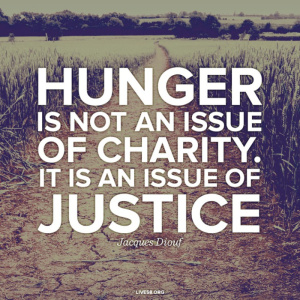 Over the years, we have posted numerous articles that challenges a food charity approach to hunger. In those articles we have challenged groups like Feeding America and Kids Food Basket.
Now, when I say we challenged these groups, I mean to challenge the strategies they employ to end hunger. It is not a bad thing for organizations to provide food relief to people who are food insecure. However, food charity is ultimately a false solution that only perpetuates food insecurity, plus it often makes the people who engage in food security work to feel better about themselves, rather than to seriously investigate the root causes of hunger.
Kids Food Basket (KFB) is a prime example of an organization that practices food charity. They provide food to elementary age children through their sack supper program. This program has received tremendous support over the years, so much so that Kids Food Basket has grown so fast, they have had to move numerous times to accommodate that growth.
Last September, KFB opened their new $7.5 million facility on Leonard St. and just last week they announced another expansion plan to provide more sack suppers to children in Ottawa and Allegan counties.
This continued expansion is ultimately an expansion in charity and does nothing to address the root causes of hunger. On the website of Kids Food Basket, under their FAQ section, one question asks:
How is Kids Food Basket addressing the root causes of hunger? Their answer is that they will continue to practice a false solution, by making sack suppers. In fact, they state, “We meet immediate critical needs with our Sack Suppers and we also need organizations that do work like corner store reform, lobbying at the state and national levels for legislation that encourages universal access to food, and in other areas such as housing, transportation, and employment.” What KFB is suggesting only addresses food access, but there is no discussion about how to fight poverty and hunger.
What are the alternatives?
- It would be important for any and all groups who do food triage work to acknowledge that just providing food assistance on a regular basis does not solve the problem. I’m not saying that people shouldn’t practice mutual aid and assist people in a time of crisis. We absolutely should practice mutual aid when we can. However, it is not enough to just provide charity, we must work towards transformative justice.
- Once Kids Food Basket can acknowledge that hunger is a much larger and systemic economic and racial problem, then they can, with other like-minded groups, begin to develop multi-pronged strategies to fight for economic and racial justice.
- They should end partnerships with corporations and families which are part of the local power structure, which supports candidates who pass policies that create more poverty.
- Promoting and participating in a Living Wage campaign at the city/county level. Currently, many groups around the country are calling for a $15 minimum wage. However, a Living Wage would go further, because it would force us to have a much more substantial conversation about economic policy and the larger wealth gap in this community.
- Wealth re-distribution in the form of reparations. Those families, communities and corporations which have exploited workers and communities for decades, should be required to pay back the communities, families and individuals they have exploited. This is especially the case in the African American community, which has been exploited for centuries and where reparations should begin. Kids Food Basket should call for reparations.
- Organizations like Kids Food Basket need to adopt clear racial justice policies that recognize historical racism and how it currently in manifested in West Michigan. How is it that the people who pick most of our food in West Michigan, migrant farmworkers, have a high rate of poverty?
- The Kids Food Basket location on Leonard St. sits on several acres that they are using to grow food. What if part of that land was used to allow people to come to this newly acquired land and grow food together, specifically the families that are benefiting from the sack supper program. KFB could provide people with the skills, transportation and child care so they could chose to be involved in producing some of their own food. This could also be done by supporting more programs in neighborhoods that are experiencing poverty, by assisting those neighborhoods with urban food production, if that is something residents want to do. This would require the use of more urban land specifically for food production.
These are only just a few suggestions, but I believe that many more creative and powerful ideas could surface if we changed the narrative around how to respond to hunger from food charity to food justice. In fact, GVSU is hosting a Food Summit this Friday, and it would be the perfect place for these kinds of conversations could be had about the need to address the root causes of hunger and to practices food sovereignty.
 The local group Talent 2025, is an entity that seeks to influence the education systems in West Michigan and to develop talent (code for students) that will be ready to fill the employment needs on area businesses.
Their most recent blog post is, Teacher Retention and the Future of the Education Workforce. In that blog post, the author recognizes and acknowledges a serious problem in the very first sentence:
Between the years of 2008 and 2016, enrollment in teacher preparation programs within the state of Michigan decreased by 66 percent.
One of the main reasons for the decrease in teacher preparation programs and teacher retention in Michigan and across the country, is low and inadequate salaries. Teacher salaries have been one of the fundamental issues that has led to teacher strikes in the past three years in states like California, Illinois and West Virginia.
Unfortunately, the Talent 2025 blog post does not acknowledge teacher salaries as being a key issue in teacher retention. Instead, the Talent 2025 article focuses on tactics that some school districts in West Michigan are employing to address the shortage of teachers.
When talking about the Grand Rapids Public Schools (GRPS), Talent 2025 writes:
In Kent County, Grand Rapids Public Schools identified a significant shortage of bilingual teachers and a subsequent lack of local candidates sufficient in the language skills they desired. Through research and conversations with other local school districts, GRPS officials learned of an opportunity to hire bilingual teachers from Puerto Rico. With support from the community, designees from GRPS headed to Puerto Rico to identify candidates with the potential to thrive at Grand Rapids Public Schools.
According to an article in School News Network, the GRPS sent four people to Puerto Rico for 5 days in early November with the intent of getting letters of intent from a half a dozen teachers. According to the same article, “Their trip will be partially funded by a $6,000 grant from the Grand Rapids-based Jandernoa Foundation.”
Since the article states that the trip was partly funded by the Jandernoa Foundation, we can probably assume that the rest was paid for by the GRPS, which means public money was used for this trip. The decision to try to recruit teachers in Puerto Rico to come to Grand Rapids and teach in the Grand Rapids Public Schools raises all sorts of questions that we would like to address.
First, it should be noted that the Grand Rapids Public Schools has the lowest teacher salaries in the area, according to data provided by MLive in 4/2019. The MLive article provides a searchable database, which shows the following teacher salaries by school districts:
- West Ottawa $69,518
- Byron Center $69,271
- Forest Hills $69,219
- East GR $68,960
- Cedar Springs $60,910
- Coopersville $59,276
- Allendale $57,302
- Godfrey Lee $56,892
- Grand Rapids $54,844
If the GRPS was committed to teacher retention and want to attract news teachers to come to this community, then they need to increase the teacher salary.
Second, what else is the GRPS doing to retain and attract teachers, particularly bilingual teachers that they so desperately need because of the growing latino/latinx student population? The GRPS should be working groups like the Hispanic Center or the Latino Coalition to begin the process of cultivating greater opportunities for local latinos/latinx people who want to become teachers. The GRPS could provides incentives for people from this community to return to Grand Rapids after obtaining an education degree and commit to teaching within the GRPS.
Third, it is instructive that Puerto Rico is the place that the GRPS went to recruit teachers. It is critical that we understand that not only have teachers been deeply affected by hurricane Maria in 2017, but that the public school system in Puerto Rico has also been under attack. According to Naomi Klein’s book, The Battle for Paradise, “between 2010 and 2017, roughly 340 public schools were shut down; arts and physical education programs were virtually eliminated in many elementary schools; and the board announced plans to slash the University of Puerto Rico’s budget in half.”
In addition, Puerto Rico’s financial struggles began way before hurricane Maria. The island was facing massive Neo-liberal forms austerity measures, which included the defunding of public education. In fact, Julia Keleher, who was appointed in 2016 to be the Secretary of Education, by the now deposed Puerto Rican Governor, Rossello. Keleher, right after the hurricane, created an education reform bill with the assistance of US Secretary of Education, Betsy DeVos. This new education reform package included exactly what DeVos has imposed on the mainland, which is expanding charter schools and school-voucher programs. (See Aftershocks of Disaster: Puerto Rico Before and After the Storm, edited by Bonilla and LeBron.)
Finally, the Jandernoa Foundation (which provided $6,000 for the GRPS trip to Puerto Rico) is the foundation of Michael Jandernoa, one of the people who makes up the Grand Rapids Power Structure. Jandernoa is connected to Talent 2025 and the West Michigan Policy Forum, both of which support and promote policies that seek to undermine public education and to develop students (talent) to fill jobs within the West MI business community. Jandernoa has also contributed significantly to the Student Advancement Foundation and he has contributed to several current and former Grand Rapids Public School Board members. If Jandernoa funded part of the trip, then people should be very suspicious of his influence in this process.
Last week, Secretary of Education Betsy DeVos announced that the Department of Education was updating rules on  prayer in schools and a proposed rule on faith-based education institutions.
None of this has received much attention in the mainstream commercial news media, but we believe it is important for people to be made aware of any new or proposed policies, particularly that rely on public tax dollars. This is especially the case with this issue, particularly since Betsy DeVos identifies very publicly as a Christian and as someone who embraces a very conservative theological framework.
In the announcement from the Depart of Education, Secretary DeVos says, “The Department’s efforts will level the playing field between religious and non-religious organizations competing for federal grants, as well as protect First Amendment freedoms on campus and the religious liberty of faith-based institutions. I proudly share President Trump’s commitment to religious freedom and the First Amendment.”
It is well know that Betsy DeVos and the DeVos family support a form of Christian Reconstruction, which essentially means that society should be run by biblical values, rather than secular values. DeVos has continued to inject her faith-based values since she became the Secretary of Education in 2017, something we have been documenting in our Betsy DeVos Watch articles and it is the main topic of a well researched article that appeared in Mother Jones in 2017, entitled, Betsy DeVos Wants to Use America’s Schools to Build “God’s Kingdom.”
The updated prayer guideline can be found at this link, which was originally part of the Elementary and Secondary Education Act of 1965 and further strengthen in the Every Student Succeeds Act (2015). The Every Student Succeeds Act was an extension of the No Child Left Behind Act, with some modifications.
The proposed rule that was announced last week and is not yet policy, is what DeVos and the Department of Education have been working on since the US Supreme Court ruling in the case of Trinity Lutheran Church of Columbia, Inc. v. Comer. In that ruling, which we reported on in 2017, which basically means that the State of Missouri must give taxpayer funding to a house of worship.
In the new proposal, announced last week by the Department of Education, it would pave the way for allowing faith-based institutions to access more federal funding and it would provide more opportunities for faith-based entities to discriminate against vulnerable populations. The ACLU reaction to this new proposal from the Department of Education is instructive:
The Trump administration proposed multiple new regulations today that will roll back critical legal protections under the guise of religious liberty.
The proposed regulations would revoke key protections for beneficiaries of government-funded social services, eliminating requirements that religious providers refer individuals who ask to a secular alternative and notify individuals of their rights. Agencies affected touch nearly every area of life, and include: Veterans Affairs, Health and Human Services, Labor, Agriculture, Education, Justice, Homeland Security, and International Development.
The regulations also would make it more difficult for some individuals to access critical social services funded by the government. Specifically, the new rules would ease certain restrictions that have prevented federally-funded religious social service providers from imposing religious requirements on individuals seeking help or turning them away just because they are LGBTQ or follow a different faith, in situations where no secular alternative provider is available.
Again, it is important to note that this is only a proposal, but it could become formal policy unless there is organized opposition.
New Medicaid Work Requirements are just one aspect of the class war that the West Michigan Policy Forum is waging throughout the state
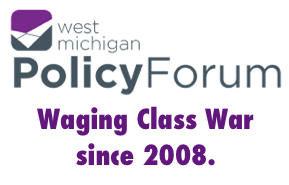 The new Medicaid work requirements are set to begin this week in Michigan. The new law, which was signed by former Governor Rick Snyder, will require those receiving medicaid benefits to work at least 80 hours a month in order to continue to receive those benefits.
This policy has been promoted by the West Michigan Policy Forum for several years and they recently wrote the following on their Facebook page:
Michigan’s new Medicaid work requirement will boost the state’s economy and help guide able-bodied participants in the Medicaid expansion program on a path to economic self-sufficiency.
The Michigan Chamber of Commerce cites a state “workforce shortage and talent gap” that leaves as many as 100,000 jobs currently unfilled.
Work requirements “could help employers with their labor shortages and create a pathway for independence for enrollees,” Wendy Block, the chamber’s vice president of business advocacy, told Bridge Magazine.
It is no surprise that the Michigan Chamber of Commerce would also endorse this policy as they are always seeking to reduce government spending that benefits working class people. The West Michigan Policy Forum argument is that these new Medicaid work requirements will help people become “economically self-sufficient.”
Of course, the notion that economic self-sufficiency only applies to those who are suffering from the exploitative and brutal economic policies of Neo-liberal capitalism, which punishes the poor and rewards the rich. Never mind that the tax systems benefits the wealthy and never mind that corporations in Michigan also receive tax breaks and massive subsidies, otherwise known as corporate welfare.
This most recent policy further demonstrates the cruelty of those who promote these policies, the West Michigan Policy Forum, the Michigan Chamber of Commerce and the Mackinac Center for Public Policy. Each of these entities have been pushing policies, like Medicaid work requirements, all in the name of fiscal responsibility.
Recently, Senate Majority leader Mike Shirkey has said that health officials have had enough time to let the residents of Michigan know about these new requirements. Shirkey, who sponsored the 2018 work rule law regarding Medicaid, says “the implementation can’t happen fast enough.”
It is no surprise that Senator Shirkey is bankrolled by the some the wealthiest individuals and large corporations in Michigan. In fact, two of the top three contributors to Mike Shirkey from 2011 to the present are both from Grand Rapids and members of the West Michigan Policy Forum. John Kennedy, the CEO of Autocam has contributed $200,000 to Shirkey and the DeVos family has contributed $71,000, according to the Michigan Campaign Finance Network.
There are already legal complaints that have been submitted in the Michigan courts over this policy, and according to a recent article from the Michigan Advance, most of the states that have implemented Medicaid work requirements have either, “suspended or delayed them as a direct result of litigation or as a way to avoid it.”
This policy is not only cruel, it contributes to further undermining government safety nets for the most vulnerable people in our society. The Medicaid work requirements are consistent with what the West Michigan Policy Forum promotes in terms of labor policy, which includes:
- Maintain Michigan’s Freedom to Work Status
- Repeal of the Prevailing Wage mandate
- Grow Michigan’s Labor Participation rate – Addition of Medicaid work requirements for able-bodied adults
- Paid Sick Leave Reform (Defense)
- Minimum Wage Reform (Defense)
The West Michigan Policy Board of Directors is made up of the wealthiest and most powerful powerful people in the area, including Doug DeVos, Mike VanGessel, Michael Jandernoa, John Kennedy, Peter Secchia, J.C. Huizenga and Rick Baker, just to name a few. These people are waging a class war on communities of color, working class people and other vulnerable members of society. These people have addresses and must be stopped!
I’m sorry to have to say that the vast majority of White Americans are racists, either consciously or unconsciously
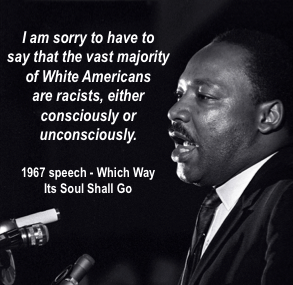 The title to this post is a quote from Dr. Martin Luther King Jr.’s 1967 speech entitled, Which Way Its Soul Shall Go. The speech was given at the annual American Psychological Association convention in September of 1967, just 6 months before he was assassinated in Memphis.
Dr. King would go on to say:
If the Negro needs social sciences for direction and for self-understanding, the white society is in even more urgent need. White America needs to understand that it is poisoned to its soul by racism and the understanding needs to be carefully documented and consequently more difficult to reject. The present crisis arises because although it is historically imperative that our society take the next step to equality, we find ourselves psychologically and socially imprisoned. All too many white Americans are horrified not with conditions of Negro life but with the product of these conditions-the Negro himself.
White America is seeking to keep the walls of segregation substantially intact while the evolution of society and the Negro’s desperation is causing them to crumble. The white majority, unprepared and unwilling to accept radical structural change, is resisting and producing chaos while complaining that if there were no chaos orderly change would come.
These words are not what many of us white people are accustomed to hearing, since we too often prefer to hear kind and affirming words from black people. However, after King had moved his operations to Chicago in 1966, King began to see that the “liberal” north was in fact as deeply committed to White Supremacy as they were in the south.
What Dr. King is telling us in this 1967 speech, is that white people are racists. It’s true, we are racists, whether we are conscious of it or not. We can deny it and we can sit in shame of this fact, or we can accept it and then work towards ending our racism or at least our complicity in racist structures and systems that govern our society more than 50 years after King’s death.
How to Be An Anti-Racist?
First, we must accept the fact that for those of us who are white, we engage in racist behavior and are the beneficiaries of structural racism. Second, we need to come to terms with the fact that the problem with racism is not black people, it’s white people. Think about it this way. The problem with sexism isn’t women, it’s men. However, we often think that sexism is a woman’s problem, since men become the absent referent. Often a headline will say, “Woman is sexually assaulted on campus.” The problem with the way this is framed is that the male perpetrator is completely absent from the headline, thus sexual assault is a woman’s problem.
The same is true with racism. Too often, we think that racism is the black community’s problem, when in fact racism is really the white community’s problem. This doesn’t mean that black people shouldn’t do anything about racism, especially since the black community has taken on the primary responsibility of racism. What we need to do as white people is to acknowledge that racism is our problem and then work to dismantle it.
 A third thing white people need to do is to not expect black people to hold our hands and show us how to be anti-racist. White people cannot put that burden on black people and make them responsible for showing us how to be anti-racist. We, white people, have to do the work ourselves, to invest emotionally and intellectually in doing the work to dismantle racism. This doesn’t mean we can’t or shouldn’t learned from the lived experiences or the organic intellectualism of black people. We should read and study and expose ourselves to the rich tradition and history of lack liberation struggles and black resistance.
Fourth, once we have accepted that we, as white people, are racist, that we benefit from structural racism, that we must invest in doing the work of becoming an anti-racist, then we have to actually work to dismantle systemic racism. This doesn’t mean that attending another MLK Day event will get us off the hook. There is a big difference from being seen as an anti-racist and actually doing anti-racist work.
Practicing anti-racist work can look like this:
- Confronting systemic racism in our neighborhoods by not participating in gentrification and by fighting against those seeking to gentrify.
- Demanding that our faith community publicly acknowledge that they perpetuate and benefit from systemic racism.
- By acknowledging that we are living on stolen land and are the beneficiaries of white settler colonialism…..and then doing the work to dismantle white settler colonialism.
- White people need to give political power to black people……..period.
- White people need to pay reparations and make the institutions in our society pay reparations for the past and present harm that has been done to the black community.
Notice, that I am not using the words diversity and inclusion when talking about how white people can practice being anti-racist. That is because diversity and inclusion are Neo-Liberal terms used by white people to get black people to think we give a shit about their condition. Remember, Dr. King said, “The white majority, unprepared and unwilling to accept radical structural change, is resisting and producing chaos while complaining that if there were no chaos orderly change would come.”
To my fellow white people, what are we going to do to practice being anti-racist?
 In Part I, we looked at some of the more radical and less-known positions that Dr. King had, particularly in the last years of his life. In Part II, we explored one of the systems of oppression that Dr. King challenged, one of the evil triplets, militarism.
In Part III, we thought it would be interesting to look at how the local news media reported on the 1963 march on Washington, the murder of the four girls in Alabama and how Dr. King’s death was covered by the Grand Rapids Press. We base this post on articles that have appeared on the Grand Rapids People’s History site, which began in 2011.
The first article looks at how the Grand Rapids Press reported on the Civil Rights marches in Detroit and in Washington DC in the summer of 1963. Dr. King and other leaders decided to do the march in Detroit a few months before going to DC as sort of a test run for what to expect in the nation’s capital.
The GR Press article (on page 5) states that the UAW, the NAACP and the Congress on Racial Equality (CORE), were all sending people to participate in the historic march. The same article in the also mentions that the AFL-CIO, the Grand Rapids Urban League and the Human Relations Commission (City of Grand Rapids), did not send their members to the historic march in Washington.
One final article from the Grand Rapids Press coverage of the 1963 March on Washington, was written after the marchers had returned from DC. The photo that accompanies the article shows 5 people, 4 with the NAACP and one from the UAW, looking at newspaper coverage of the march.
The article that accompanied the photo, provided some basic reflection from the 5 featured in the article, about what they liked and what they were impressed by. Unfortunately, the article did not reflect any sense of urgency that the marchers had brought to DC that day, not much of a sense of the efforts put into making the march happen or the larger historical context of the 1963 march on Washington. Besides Gary Younge’s book, The Speech, another excellent resource is, Nobody Turn Me Around: A People’s History of the 1963 March on Washington, by Charles Euchner.
 There was also an editorial that ran in the Grand Rapids Press about the march on Washington in 1963. The editorial demonstrates what one might call a form of white paternalism
Just weeks after the march on Washington, racists bombed a church in Birmingham, Alabama, killing four African American girls. People all across the US were outraged, including in Grand Rapids. This post from the GR People’s History site looks at the march that took place in Grand Rapids, where 3000 people came out to march against the racist violence that had taken place in Alabama, like the family pictured here.
Two things stood out to this writer, when reading that Grand Rapids Press article. First, the Rev. W. L. Patterson, with True Light Baptist Church, made this comment to the white people who marched that day. He said, “You have marched with us today, but please march with us tomorrow because we need jobs and places to live right here in Grand Rapids.”
Patterson’s comment made in clear that what the black community was asking the white community was for them to stand with them in the struggle for economic equality and housing justice, which the black community had been struggling to achieve, based on reports from the Urban League in 1940 and 1947, which we have cited in previous postings
The second comment cited in the article that stood out was a comment from Rev. Hugh Michael Beahan, a Catholic priest. Beahan stated, “Those of us who are accidentally white must be a little careful about our righteous indignation. We should see if our hands are clean – maybe too clean because we never lifted a finger.” Essentially, Beahan was calling out his fellow white community members for not doing anything to fight against segregation, institutionalize racism and white supremacy.
Lastly, it is worth looking at how the Grand Rapids Press reported on Dr. King’s assassination in 1968. There were several reaction from residents in Grand Rapids, one of which stated:
Reggie Gatling, referred to as a black power militant, said, “Members of the black community had a meeting last night and decided we would not give out a public statement that would be reflective of feelings. We’re in mourning for Dr. King, but to say anything further would only give comfort, or possibly discomfort, to white racists.”
In another Press article, “Grand Rapids officials recognized, however, that the situation still was touchy Saturday, and denied a request for a permit to hold a peaceful, silent march in tribute to Dr. King.
 In Part I, we looked at some of the more radical and less-known positions that Dr. King had, particularly in the last years of his life. In Part II, we want to explore one of the systems of oppression, which he called evil triplets, militarism.
In King’s 1967 speech at Riverside Church, the speech he gave that laid out his analysis of the US war in Vietnam, the civil rights leader made the important link between justice in our communities and justice abroad.
Since I am a preacher by calling, I suppose it is not surprising that I have seven major reasons for bringing Vietnam into the field of my moral vision. There is at the outset a very obvious and almost facile connection between the war in Vietnam and the struggle I and others have been waging in America. A few years ago there was a shining moment in that struggle. It seemed as if there was a real promise of hope for the poor, both black and white, through the poverty program. There were experiments, hopes, new beginnings. Then came the buildup in Vietnam, and I watched this program broken and eviscerated as if it were some idle political plaything on a society gone mad on war. And I knew that America would never invest the necessary funds or energies in rehabilitation of its poor so long as adventures like Vietnam continued to draw men and skills and money like some demonic, destructive suction tube. So I was increasingly compelled to see the war as an enemy of the poor and to attack it as such.
The civil rights leader could not reconcile the massive amounts of money the US spent on militarism, while at the same time not making sure that the people living in the US had access to basic rights like housing, education, health care, etc.
As Dr. King stated, he had seven reasons to speak out against the US war in Vietnam. Here is the third reason he gives, one that speaks to the moral bankruptcy of US foreign policy.
My third reason moves to an even deeper level of awareness, for it grows out of my experience in the ghettos of the North over the last three years, especially the last three summers. As I have walked among the desperate, rejected, and angry young men, I have told them that Molotov cocktails and rifles would not solve their problems. I have tried to offer them my deepest compassion while maintaining my conviction that social change comes most meaningfully through nonviolent action. But they asked, and rightly so, “What about Vietnam?” They asked if our own nation wasn’t using massive doses of violence to solve its problems, to bring about the changes it wanted. Their questions hit home, and I knew that I could never again raise my voice against the violence of the oppressed in the ghettos without having first spoken clearly to the greatest purveyor of violence in the world today: my own government. For the sake of those boys, for the sake of this government, for the sake of the hundreds of thousands trembling under our violence, I cannot be silent.
In his Beyond Vietnam speech, Dr. King also demonstrates a sharp understanding of US foreign policy and a great deal of compassion for the Vietnamese people. This sharp analysis of global politics was part of the black liberation tradition, from Frederick Douglass to W.E.B. DuBois, Paul Robeson to Malcolm X, Angela Davis and groups like the Black Panther Party for Self-Defense and Black Lives Matter.
Dr. King then brings his critique of the Vietnam war back to how it connects to US domestic policies, particularly economic priorities, by stating:
A true revolution of values will soon cause us to question the fairness and justice of many of our past and present policies. On the one hand we are called to play the Good Samaritan on life’s roadside, but that will be only an initial act. One day we must come to see that the whole Jericho Road must be transformed so that men and women will not be constantly beaten and robbed as they make their journey on life’s highway. True compassion is more than flinging a coin to a beggar. It comes to see that an edifice which produces beggars needs restructuring.
A true revolution of values will soon look uneasily on the glaring contrast of poverty and wealth. With righteous indignation, it will look across the seas and see individual capitalists of the West investing huge sums of money in Asia, Africa, and South America, only to take the profits out with no concern for the social betterment of the countries, and say, “This is not just.” It will look at our alliance with the landed gentry of South America and say, “This is not just.” The Western arrogance of feeling that it has everything to teach others and nothing to learn from them is not just.
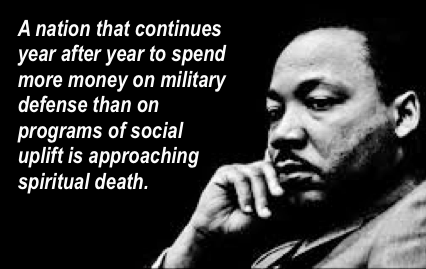 A true revolution of values will lay hand on the world order and say of war, “This way of settling differences is not just.” This business of burning human beings with napalm, of filling our nation’s homes with orphans and widows, of injecting poisonous drugs of hate into the veins of peoples normally humane, of sending men home from dark and bloody battlefields physically handicapped and psychologically deranged, cannot be reconciled with wisdom, justice, and love. A nation that continues year after year to spend more money on military defense than on programs of social uplift is approaching spiritual death.
Dr. King’s deeply intersectional and passionate analysis of US militarism should provide us with critical aspects of resistance to militarism today. However, if the resistance to militarism does not bring a critique of capitalism, white supremacy and other systems of oppression, we will be ineffective in our efforts to not only resist US militarism, but to be able to work from a solid foundation in order to build a better society.
In Part III, we will look at how the local news media reported on the 1963 march on Washington, the murder of the four girls in Alabama and how Dr. King’s death was covered.
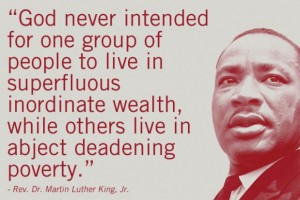 I have written numerous articles about the legacy and message of Dr. King over the years and there are a number of great books that have been written by Dr. King and about him. Some of those books can be found at this link.
Over the next three days we will be posting a collection of previous writings on the legacy and message of Dr. King. In today’s post we want to provide a window into the Dr. Martin Luther King Jr that is not as widely known. Dr. King was a complex man, one who evolved over time. He was a man that cannot be summed up in phrases or quotes, especially since he was a man that was hated by those with power in the United States.
In this post from 2016, we explore the message and significance of the 1967 speech that Dr. King gave on the Vietnam War at Riverside Church. The speech, entitled, “Beyond Vietnam: A Time to Break the Silence,” was revolutionary on many levels. In this speech, which further marginalized him from the Civil Rights community, Dr. King identified what he called the Evil Triplets – racism, capitalism and militarism.
“This business of burning human beings with napalm, of filling our nation’s homes with orphans and widows, of injecting poisonous drugs of hate into the veins of peoples normally humane, of sending men home from dark and bloody battlefields physically handicapped and psychologically deranged, cannot be reconciled with wisdom, justice, and love. A nation that continues year after year to spend more money on military defense than on programs of social uplift is approaching spiritual death.”
In another article from 2016, we look at what Dr. King had to say about poverty and capitalism, themes that he addressed in the years just before he was assassinated. In 1966, Dr. King, along with numerous organizations began a campaign in Chicago to challenge poverty, particularly poverty in the form of housing. King often referred to communities were Blacks lived as slums and he began to organize tenants to fight for rights, particularly through various forms of direct action. One such action was the closing down of the Dan Ryan expressway, where hundreds of people took over the highway and shut down parts of the city in order to make a statement against the violence of slums. Dr. King said that slums are the handiwork of a vicious system of white society.
In this third article, we looked at Dr. King’s message about racism and White Supremacy. In a speech he gave in Canada in 1967. Dr. King stated:
 Negroes were outraged by inequality; their ultimate goal was freedom. Most of the white majority were outraged by brutality; their goal was improvement, not freedom nor equality. When Negroes could use public facilities, register and vote in some areas of the South, find token educational advancement, again in token form find new areas of employment, it brought the Negro a sense of achievement, but it brought to the whites a sense of completion. When Negroes assertively moved on to ascend the second rung of the ladder, a firm resistance from the white community developed. This resistance characterized the second phase, which we are now experiencing. In some quarters it was a courteous rejection, in others it was a stinging white backlash. In all quarters unmistakably it was outright resistance. The arresting of the limited forward progress by white resistance revealed the latent racism that was deeply rooted in US society.
In this same article, we look at Dr. King’s message about racism at what that means in Grand Rapids.
Tomorrow, in Part II, we will look more deeply at US militarism, what Dr. King called a demonic, destructive suction tube.
Documentary screenings of the film King in the Wilderness, will raise funds for those who have suffered state violence in Grand Rapids
 The immigration justice group, GR Rapid Response to ICE, will be hosting two screenings of the powerful documentary, King in the Wilderness in the coming weeks.
King in the Wilderness chronicles the final chapters of Dr. Martin Luther King Jr.’s life, revealing a conflicted leader who faced an onslaught of criticism from both sides of the political spectrum. While the Black Power movement saw his nonviolence as weakness, and President Lyndon B. Johnson saw his anti-Vietnam War speeches as irresponsible, Dr. King’s unyielding belief in peaceful protest became a testing point for a nation on the brink of chaos.
Dr. King’s leadership during the bus boycotts, the sit-ins and the historic Selma to Montgomery marches is now legendary, but much of what happened afterward – during the last three years of his life – is rarely discussed. It’s a time when Dr. King said his dream “turned into a nightmare.” From the passage of the Voting Rights Act in 1965 to his assassination in 1968, King remained unshakably committed to nonviolence in the face of an increasingly unstable country.
The two screenings will be held on:
Sunday, January 19 at 3:30pm
All Souls Community Church
2727 Michigan St NE, Grand Rapids
https://www.facebook.com/events/2616924278591340/
Monday, January 27 at 7pm
Westminster Presbyterian Church
47 Jefferson Ave SE, Grand Rapids
https://www.facebook.com/events/618870842256745/
Both screenings are asking for a $5 suggested donation and all the funds raised will go directly to immigrant families that have been impacted by ICE violence. If you are unable to attend, you can still contribute by donating here. Again, 100% of all funds raised will go directly to immigrant families impacted by ICE violence.

