American Patriot Rally in Grand Rapids defies Stay-at-Home order, with no regard for social distancing
Last night, between 300 – 400 people gathered in downtown Grand Rapids for what was billed as an American Patriot Rally. One of the main organizers, Ryan Kelley, has also been involved in several of the anti-lockdown protests in Lansing, as we reported last week.

The rally was held at Rosa Parks Circle, with dozens of police with the GRPD closing off streets with cruisers, cops on bikes, on horseback and on foot. The GRPD even had their own photographer present, taking pictures throughout the entire rally.
Just before the rally started, the Trump truck – a large flatbed truck that looks like a float – drove by on Monroe, which caused those gathering to erupt into applause. While the event organizers wanted to downplay partisan politics, it was clear that there was a substantial pro-Trump element at the rally, with shirts, hats and Trump 2020 signs. In addition, the event organizers took every opportunity to slam Gov. Whitmer, even using an audio-recording (out of context) at the beginning of the rally to make it sound like Whitmer was endorsing those who gathered in downtown Grand Rapids. There was also a large sign with Gov. Whitmer’s face, as can be seen in the photo above.
The rally began with 2 little girls doing a dance to a song with the refrain, “we all bleed the same.” After the dance, someone led the crown in the singing of the national anthem, followed by the Pledge of Allegiance, followed by an overtly Christian prayer.
Rally organizer Ryan Kelley also spoke briefly, before introducing a woman who was identified as a constitutional law expert. This person droned on about how the stay-at-home orders were a violation of the Michigan Constitution. Even many in the crowd were becoming restless, with all of the legal citations, but then applauded when that same person talked about the real authority to follow……Jesus.
There was a mix of both Hebrew and Christian scriptures that were cited throughout the rally, along with Christian prayers. At one point I noticed that some of the armed militia members, who were there to provide “security,” could be seen with their heads bowed and eyes closed during times of prayer.
There was also a man who was identified as a military veteran and a member of the Men’s Rights Movement, which is essentially a reactionary movement that has tried to undermine some of the gains made by the feminist movement.
However, the featured speaker was Barry County Sheriff Dar Leaf. Leaf’s primary message was two-fold. First, he emphasized that the Stay-at-Home orders were unconstitutional, and secondly, that it is the duty of law enforcement agents everywhere to uphold the constitution, which in his mind would be to not allow or to not comply with the Stay-at-Home orders.
The majority of those who were present at the rally, not only were defying the social distancing policies, most people were also not wearing masks. At no point did the members of the GRPD do anything to enforce social distancing policies, they only seemed interested in making sure that the rally was contained.
Senate Majority Leader Mike Shirkey, also addressed the crowd, thus making a clear connection between the GOP opposition to the Stay-at-Home orders and the anti-lockdown protests. We noted in an article last week, that rally organizer Ryan Kelley and Sen. Shirkey were texting each other during a recent anti-lockdown protest in Lansing.
Lastly, the crowd gathered at the American Patriot’s Rally was essentially a sea of White people, despite the efforts of rally organizers to downplay race and to deny that they were racists. In fact, one speaker even compared themselves and the barber who defied the Governor’s orders to not operate, as acting in the same spirit as Rosa Parks. Comparisons to Rosa Parks were just plain insulting, since it was clear that this rally was primarily driven by the politics of White resentment.
Interview with Women’s Clinic employee after the arrest of two anti-choice protesters in Grand Rapids
 Editor’s Note: The person whom we spoke with for this interview chose to remain anonymous.
GRIID – Can you talk about the arrests that just happened at the clinic. What did those who were arrested do and what was their message?
There are a number of regular protestors outside of the clinic every week. Those that came and did the protest demonstration on 5/14/2020 are, as far as I’m aware, not affiliated with the local protestors and organized this protest on their own. They belong to an organization called Citizens for a Pro-Life America, and the demonstration they coordinated is what’s called a “Red Rose Rescue”. These folks organize protests all over the country at medical clinics that offer abortion services. According to their website, their goal is to enter clinic buildings in order to speak with scheduled patients to persuade them to continue their pregnancy. This was the fourth or fifth protest they have held in Michigan and have never targeted our clinic before in the past. Tactics include giving patients red roses as a sign of “life, peace, and love” (according to their website); entering and then remaining inside the clinic building for as long as possible (aka – until forcibly removed) as a “non-violent act of defense”; engaging in Christian ministry with patients; performing as “prayer warriors” or “sidewalk counselors” outside of the clinic; and having multiple people filming the protest.
On the day of their protest, they showed up in a large group, gathering outside of the clinic. When patients exited their vehicles, they would either shout loudly at the patients or would directly approach them. They were verbally aggressive and their voices were elevated (we could hear them screaming from inside the clinic). One particular protestor, a woman named Caroline Davis, was seen and heard screaming “Repent your sins”, “You’re going to regret this every day”, and more to patients. Many members of the group entered the building in the stairwell in an attempt to gain access to inside the clinic, but due to the safety and privacy measures we always have in place, in addition to the diligence of precautionary measures our staff took, they were not successful with entering.
Patients came into the clinic visibly shook up and unhappy. Patients disclosed to us that protestors had approached their cars and physically banged on their car windows. One protestor held open the door to the clinic for a patient and told her to “have a nice day” (in a way that felt insincere and manipulative to the patient). Another patient came to her appointment in a vehicle with a business logo on the side, and a protestor called that business to inform them of where they were, violating their privacy.
GRPD was contacted several times by our clinic staff and also by those in the community who live in the neighborhood or were driving by. When the police arrived, they had many conversations with those in the group, mostly with the folks who were on our property in our parking lot or entering the building. The police gave them all warnings, but they continued to remain on property. Due to this, the police arrested five people. Two were taken into custody overnight, and the others were released, but all five received citations, fines, and a warning. Each time someone was arrested and put in the police vehicle, the rest of the crowd sang “Our God is an Awesome God”. They praised their fellow members, saying words of support like “God bless you”, but would antagonize the police officers by saying things like “Making arrests is making you look bad”, or making threats towards our staff. While Caroline Davis was being arrested, she vacillated between sobbing and then happily smiling. The crowd remained outside until around 12:30 PM.
This demonstration was alarming for a number of reasons, including the fact that none of the 30-35 people were practicing social distancing, and very few had masks on. The few that did have masks wore them incorrectly, such as under their nose. Many of the protestors stated loudly that if our clinic can still operate during a pandemic, then they are still allowed to protest during the pandemic. To be clear, our clinic offers medical care services that are considered to be essential by Governor Whitmer, whose office we contacted directly when isolation began. We are operating with the utmost precautions in order to keep our patient and staff safe. We screen every patient who enters to make sure they are symptom-free before continuing with their appointment. Since asymptomatic carriers are a large concern, all surfaces are routinely sanitized, including door handles, pens, clipboards, desks, keyboards, etc. Every person in the building is required to wear a mask and asked to socially distance as much as possible. We have reduced our schedule and do not allow supportive folks in the office in order to limit the number of people in the building. We have a professional cleaning crew who deep-cleans the clinic. We are taking every precaution necessary in order to limit contact and spread of the virus, so when protestors continue to gather outside every day, come into our building, and approach our patients, they are putting not only us but the entire West Michigan community at grave risk during this pandemic.
Red Rose Rescue’s website and social media describes their presence as “peaceful and non-violent deeds of merciful love”, with their ultimate goal of building a global movement built on the “peace, fortitude, humility, mercy, and love of Jesus”. Additionally, conservative social media and a LifeSiteNews article published on Thursday made many false comments about their presentation, stating they were “calm”, “peaceful”, etc. during the protest. However, when they were here, the staff and patients could hear their elevated shouting from inside the clinic. They came onto our property on the driveway, parking lot, and into the building’s staircase. They approached patients directly, were verbally aggressive, and unrelenting. They came to a medical office to harass the patients and workers, designedly cause a scene by purposefully getting arrested, and possibly causing trauma to patients or staff – and then purported the next day that they didn’t do anything. This is a classic manipulative abuse tactic called ‘gaslighting’. In one statement they reported that they weren’t being emotionally violent or aggressive, and in another statement reported that a protestor was “preaching the gospel non-stop in a loud voice from the sidewalk in front of the facility”. So…did they or did they not behave peacefully?? This is the ultimate gaslighting and I am fucking exhausted.
GRIID – There have been protests at this clinic for decades. I remember when Operation Rescue came here in the late 80s to protest at the clinic. What has it been like in recent years in terms of the protests and how does that impact those who work at the clinic and those seeking services at the clinic?
 I have seen pictures of those protests and heard stories! Some of their demonstrations have been pretty wild. The protestors we have currently are more mild than Operation Rescue, but are still unrelenting and overwhelming nonetheless. They continue to show up despite the stay-at-home orders, and still gather in groups despite social distancing requirements. They will pat each other on the arm or back; lean in together to look at something on someone’s phone; hug each other; stand closely to sing or pray; and more.
“Generally, a typical day involves three to ten protestors that stand outside of the clinic. They are out there every Wednesday through Friday, every single week,, starting before 8am. They will occasionally speak to the staff, including the doctor, to try and persuade us to leave our jobs. They tell us they can find us other jobs, and sometimes offer us money to leave. Then throughout the rest of the morning, they do what they refer to as “sidewalk counseling”: trying to persuade patients to continue their pregnancy. They use the same lines over and over in an attempt to persuade, offer goody bags for patients to take, and raise their voices until finally the patient has entered the building. In addition to the unrelenting harassment, these folks also talk horribly about patients behind their backs (or sometimes, even boldly to the patient’s face). I have heard the things they say, both as a counter-protester and a staff member. They victim blame, slut shame, sex shame. I have heard them say disgusting things that make me feel sick all day. It is important to know that they are out there for one reason: Political & Religious Agenda. They do not care about the patient. They do not care about the fetus. They would not care about the child if the patient continues the pregnancy and gives birth. Because if they did, they would not harass, bully, and shame folks going to a doctor’s appointment. If they really, truly, undeniably believed that living beings were being murdered 156 days out of the year, they would not be standing awkwardly on the sidewalk – they would be charging into the building 156 days out of the year. Abortion care is a social good. It is normal, common, and necessary. And we should be putting PRIORITY on the health and livelihoods of femme and uterus-having bodies, not trying to “change the minds” of patients using shame and fear tactics. I celebrate self-knowledge, self-awareness, autonomy, and empathy. I wish more of our society did the same, so that our patients did not have to deal with the madness outside.”
GRIID – The Catholic Right media group, Militant Church, was filming the protest. Have you ever dealt with them before?
To my knowledge this group has not been to the clinic before, so it was surprising to us that there was a “film crew” out there. Capturing patients and clinic staff on tape is an incredible violation of privacy, and safety. Many patients are in living or career situations that could become poor or dangerous due to lack of anonymity. For example, patients in domestic violence situations, minors with abusive parents, patients with Christian employers that could terminate their job. This is not only about privacy – this is about safety precautions as well. Videos and pictures of patients could cost them so much.
GRIID – What are some of the most important things you think that the public needs to know about women’s reproductive rights, and why they are so critical in West MI?
Many times, people hear “reproductive justice” and think that it is solely a pro-choice vs. anti-choice issue. It is so much more than that, though: It is ensuring that people who want to have and raise children have the adequate means to do so, and should be able to build a family on their own terms. They should be financially prepared with a living wage, paid family leave, and unbiased employers. We need social structures that allow for anyone regardless of background to receive proper pregnancy and childbirth care. There should be easy access to free or affordable contraceptives, STD/STI/HIV testing, and safe sexual health measures, such as condoms or other birth control, PrEP medication, etc. Equal access to abortion care, regardless of reason. Comprehensive sex education in public and private schools. Freedom from sexual and domestic violence. Supporting LGBTQ parents, teen parents, birth parents, and adoptive parents. Other issues that are often overlooked or not considered to be – but are 100% interrelated with reproductive justice –include food security and access to clean water; unwavering support of gender and sexual identity/presentation; immigration justice; environmental justice; disability justice; indigenous rights; and more. We must build and sustain safe communities for EVERYONE.
West Michigan is an ultra-conservative hotbed of folks who are not only anti-abortion, but so intensively and loudly outspoken that they have influenced and impacted our community in many negative ways. Seeking knowledge and learning more about all of these issues are connected is important to ending false narratives about abortion, and to hopefully begin to the pave the way for more progressive policies that will help strengthen our communities.
GRIID – If people want to be involved in supporting the work of the clinic and those using their services, what concrete ways can people get involved?
I’ve outlined some key ways that you can support our services and reproductive justice in general, whether or not you live in West Michigan!
- Donate financially to HCFW’s Pad & Underwear fund with a cash donation sent by mail.
- Donate financially to HCFW’s Anonymous Donation fund with a cash donation sent by mail.
- Donate to Fountain Street Church (FSC) Choice Fund online (visit: https://www.fountainstreet.org/choice-fund). This fund supports patients financially at both HCFW and Planned Parenthood in Grand Rapids.
- Attend local fundraisers where the proceeds help patients seeking abortion care services, such as the yearly Bowl-A-Thon, FSC spaghetti dinner, or the FSC Thanksgiving pie bake sale.
- Peacefully counter-protest outside of the clinic on Wednesdays, Thursdays, and Fridays from 8 am to noon. Bring a supportive sign, but please do not talk to the patients. Note: The counter-protesting will begin after the pandemic.
- Write a supportive letter to the clinic staff – it would make our day!
- Speak out honestly about reproductive justice issues with friends, family, or on social media. There is so much misinformation about abortion medical care in the news, media, and coming from people that we know. Learn the facts and spread truthful, scientific knowledge.
- Attend workshops, conferences, lectures on reproductive justice issues. Read books and articles. Learn as much as you can – knowledge is power!
- SUPPORT – WITHOUT JUDGEMENT – ANYONE WHO HAS HAD AN ABORTION OR DISCLOSES TO YOU THAT THEY ARE GOING TO HAVE ONE. REGARDLESS OF THIS PERSON’S REASON. EVEN IF YOU DO NOT AGREE OR YOU YOURSELF WOULD NOT CHOOSE TO HAVE AN ABORTION.
GRIID – What does it mean for you personally to be involved in the reproductive justice movement?
My heart lies in this movement. As a person with a uterus, and also as someone that society instinctually views as having very specific roles related to my gender and presentation (must bear and raise children, for example), I feel compelled and drawn to this social justice issue. I care deeply about all aspects of our health – mental, emotional, physical, spiritual, and sexual. I believe in fighting for instituting social structures that will reduce abortions. I feel strongly that our society needs to dismantle institutions upholding damaging beliefs about women, people with uterus’, and transgender or gender non-comforming folks; sex, power and militant control over femme bodies; and ending violent or destructive forms of power/injustice stemming from white supremacy and power, misogyny and sexism, transphobia, classism, toxic masculinity…I could go on. All of these issues need to be equally addressed in order to also dismantle harmful anti-abortion rhetoric and practice.
I have been actively involved with the reproductive justice movement for over a decade in West Michigan and Grand Rapids. I have been involved in this movement academically and in the community, holding a variety of roles throughout the years. I have also worked at the clinic in a counseling social work role. I will continue to seek ways I can be an advocate because this work is going to be persist for as long as I am alive, and I don’t intend to arrive at the end of my life without having been a fierce advocate for radical reproductive justice.
 There are a great number of things about how the local, state and federal government in the United States has responded to the COVID-19 crisis that are deeply problematic.
One major flaw in the government response has been a failure to provide testing to anyone who wants it, especially to people who are considered essential workers, those working on the front lines of the crisis. This would included all hospital workers, general health care workers, people who do direct care in nursing homes, adult foster care facilities, veterans facilities, etc.
On April 21st, I read an MLive article that said:
Michigan residents working the front lines during the coronavirus pandemic are now eligible for COVID-19 testing, whether they’re experiencing symptoms or not.
The same article also provided a link to Michigan.gov site, which provided people with a way to search where they could get tested. This Michigan government site also states at the top:
Please note: Testing criteria for Coronavirus Disease (COVID-19) has been expanded in Michigan to include individuals with mild symptoms and essential workers still reporting to work in person, whether they have symptoms or not.
You can find testing sites by entering your address, which I did, since I am a direct case worker with Hope Network. When I entered my address, six potential testing sites came up. I contacted all of them in the order they were listed, with Spectrum Health being the first on the list.
When I spoke with a Spectrum Health worker about getting tested, they asked me if I have any symptoms. I said no, but I then told them that I had read the MLive article and doubled checked the state site, which also said that essential workers were now eligible for testing, even if they are showing now symptoms. The Spectrum Health worker took down my contact info and said that a doctor would be getting back to me soon to set up an appointment.
Sure enough, a doctor with Spectrum Health called me back within 10 minutes and then asked me a series of questions related to COVID-19. Again, I reiterated that I was not showing any symptoms, but that I was wanting to get tested as I am a front line worker. The Spectrum Health physician said they were unaware of testing for front line workers and suggested I call my health care provider.
I then called my health care provider and was told the same thing……there is no testing unless people are displaying symptoms. The person I spoke with then suggested I call the Kent County Health Department, which might have some answers.
I called the Kent County Health Department and was re-directed to a community resources liaison. The community resources liaison was very sympathetic, but said that they were unaware of any testing happening for frontline/essential workers at this time. They did say that I was not the first person calling with the same questions, so apparently other people are aware of the state site.
The Kent County Health Department staff person took down my contact information and said they would call me if they found out if testing for frontline/essential workers was indeed a real thing. As of this writing I have not heard back from that person, whom I called on Monday.
The only conclusion I can draw at this point is that despite the state’s well intentioned announcement that essential workers could be tested, it simply isn’t happening here in Kent County. Just one more example of how the current health care system is deeply flawed for regular people, but works perfectly for the pharmaceutical industry, the health insurance industry and those who have invested in those systems. In the meantime, people all across the country, the state and in Kent County are dying from COVID-19.
 On May 3rd, we posted an article about a new COVID-19 resource that tracks the confirmed cases and deaths from the virus in Kent County. We stated in that article the following:
This data on COVID-19 for Kent County, based on race is a clear indication of structural racism and White Supremacy. In addition, the zip codes that have the highest number of cases are 49503, with 294 reported cases, and 49507, with 239 cases. The 49503 zip code has the highest percentage of African Americans than any other zip code in Kent County and 49507 is one of the highest for African Americans.
On Tuesday, the Acton Institute for the Study of Religion and Liberty posted an article on their website entitled, What’s behind COVID-19 racial health disparities? Was the Acton writer going to draw the same conclusions that we had about why black, latinx and native people are disproportionately contracting COVID-19 more than white people?
The Acton writer surveys several news sources on the topic of racial health disparities and COVID-19, looking at NPR, the Los Angeles Times, the Chicago Tribune and the online news source Vox. The Acton write provides an excerpt from the Vox article stating:
Hundreds of years of slavery, racism, and discrimination have compounded to deliver poor health and economic outcomes for black people heart disease, diabetes, and poverty, for starters — that are only being magnified under the unforgiving lens of the coronavirus pandemic. And negligible efforts to redress black communities are being agitated like a bee’s nest prodded with a stick.
However, the Acton writer said:
“we now know that the most significant factors in the disproportionate deaths of blacks and Hispanics during the pandemic are age and certain preexisting health conditions like hypertension, diabetes, obesity, and respiratory challenges like as asthma.”
The Acton writer then sets up his punchline by asking the question, “why do so many blacks and Latinos have the types of preexisting conditions that make them vulnerable to the worst effects of a coronavirus that has taken the lives of thousands of people across the United States?”
Finally, the Acton writer answers his own question as to why so many people of color have pre-existing conditions that make them more vulnerable to contracting COVID-19. His answer is revealing and instructive.
“The actual data point to something other than systemic racism in the health care system or lack of access. What seems to be emerging is that those who are the most at risk of infection and death are those receiving the most government assistance for health care, income assistance, and public housing, especially for senior citizens.”
Wow…..so it seems that notion of structural racism, systemic racism or the system of White Supremacy have been getting a bad rap. The problem, according to Acton Institute writer Anthony Bradley, is that government assistance is the problem, which in turn means those who are accessing government assistance are the problem. So, with this “logic,” it seems that black, latinx and native people who are dying at a higher rate of COVID-19 than white people, the reason is that it is their fault for using government assistance.
Just when you think that the Acton Institute couldn’t sink any lower and demonstrate their loyalty to the White Supremacist, Capitalist, Patriarchy, they surprise us and demonstrate that they have really awful analysis……and frankly, they lack any genuine humanity.
 Over the years one of the major points we have been making about how the DeVos family uses their money, is that while their foundations provide funding to social service and charity organizations, the amount of money they give to political candidates with the Republican Party is to push policies that actually create the social, political and economic conditions that results in people having to utilize social service & charity-based resources.
The most recent election cycle demonstrates not only how much money the DeVos family contributes to the GOP, but what their money is buying in terms of policy.
In doing a search on the site OpenSecrets.org, I found 39 entries for DeVos family members just in the first quarter of 2020. The family members listed are Dick DeVos, Doug DeVos, Dan DeVos, Maria DeVos, Pamela DeVos and Cheri DeVos.
The total amount contributed by these members of the DeVos family in the first quarter of 2020 to Republican candidates and a Republican committee was $130,800. Of course, this amount doesn’t include money the contributes to PACs, Dark money groups like Donor’s Trust or funds to candidates running for state and local offices. Here is a breakdown of the candidates and committees that the DeVos family members contributed to just in the first quarter of 2020:
- Great American Committee $30,000
- Peter Meijer $22,400
- Randy Feenstra $16,800
- Jessica Taylor $14,000
- Esther Joy King $16,800
- Genevieve Collins $16,800
- Beth Van Duyne $14,000
Looking at where the members of the DeVos family contributed their political money certainly reveals a great deal to confirm the point made at the beginning of this article. The Great American Committee, “supports candidates and elected officials who fight with the President in making America Great again, and is led by our Chairman, Vice President Mike Pence.”
There is a place on the Great American Committee site to make contributions and only links to the twitter account of President Trump and Vice President Pence. The Trump administration has made it a point to increase the gap between the very rich and everyone else, thus pushing more families into poverty. In addition to the economic harm, his administration has openly promoted White Supremacy, misogyny, ablism, homophobia/transphobia and contempt for immigrants. The amount of harm this administration has done is hard to quantify, but this is exactly what the DeVos family is paying for – violence, harm, hatred and suffering.
We could stop there to make our point about how the DeVos family finances candidates that once elected push policies that hurt working people, immigrants and the black community, but lets at least look at the candidates they contributed to in the first quarter of 2020.
Peter Meijer is running for the 3rd Congressional District in Michigan. If you look at his issues page, you can see clearly what the DeVos family members are paying for – anti-abortion, merit-based immigration policies, defense of gun owners, small government, deregulation of the economy, a tax system that benefits the super rich, school choice, militarized border and emphatic support for Israel.
Randy Feenstra is running for the 4th Congressional District of Iowa. Randy says he is a champion of taxpayers, wants to stop illegal immigration, protect Christian values and protect gun owners.
Jessica Taylor was running for a Congressional seat in Alabama, but lost in the primary. Taylor hates Socialism and regularly used a flamethrower in her videos, with a Trump sticker prominently displayed. This is what members of the DeVos family were endorsing with their money.
Esther Joy King is running for the 17th Congressional District of Illinois. Her priorities are supporting agribusiness, supporting a market-based health care system, continuing the anti-immigration policies of the Trump administration, for the US to be the world’s military leader, the system of capitalism, opposing women’s reproductive rights and supporting gun owners. This is what the DeVos family members are endorsing with their money.
Genevieve Collins is running for the 32nd Congressional District of Texas. Her website features Genevieve exercising. On the issues, Genevieve is committed to the economic system of capitalism, school choice, a strong military, a market-based health care system, defense of Israel, a continuation of Trumps immigration policies, opposes women’s reproductive rights and supporting the fossil fuel industry, particularly in Texas.
Beth Van Duyne is running for the 24th Congressional District of Texas. Her website says she is a Christian, Conservative, Mother. Beth doesn’t have issues listed, but writes:
 I’ve been asked what prompted me to run for public office; the answer is simple – my children. We live in a very fragile time for our nation, our families, and the future of the American Dream. Socialism is on the rise, our border crisis has never been worse, and we face constant threats from hostile nations willing to use cyber-attacks, nuclear weapons, and terrorist jihad. When I think about my two children, I want them to have the same opportunities in life that I did; I want them to be able to grow up safe and proud of our country.
This is also what the members of the DeVos family are buying with their money, which is to say they are buying hatred of immigrants, hatred of the LGBTQ community, white supremacy, capitalism, US imperialism and an end to women’s reproductive rights.
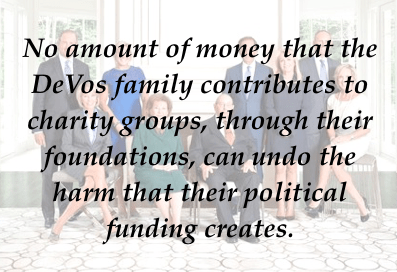
No amount of money that the DeVos family contributes to charity groups through their foundations can undo the harm that their political funding creates.
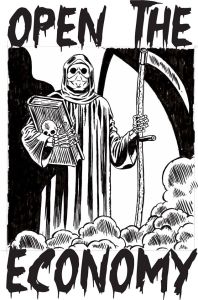 The West Michigan Policy Forum (WMPF), an entity that came out of the Grand Rapids Chamber of Commerce in 2008, is an organization that creates and then lobbies for public policy that benefits the capitalist class. The WMPF’s leadership is also made up of members of the Grand Rapids Power Structure.
Yesterday, the WMPF paid for space on MLive’s digital platform, with the headline, Michigan’s slow pandemic response: Sacrificing livelihoods without saving lives.
The paid content from the WMPF presents the standard message about how businesses know what they are doing and can keep their employees safe, since their employees are their most important “assets.”
The WMPF’s paid content is critical of Gov. Whitmer and praises Senate Majority Leader’s Mike Shirkey, who, “announced a well-conceived, risk-based plan to reopen Michigan way back on April 16.” The same Mike Shirkey who was texting with organizers of the anti-lockdown protests on April 30th in Lansing.
There are two main WMPF spokespersons that are cited in the paid content piece, John Kennedy and Jase Bolger. Kennedy, who is the CEO of Autocam, has been the number campaign contributor to Sen. Mike Shirkey, so it’s no surprise that the WMPF article gushes over Shirkey’s plan.
The paid content also presents data on on COVID 19 cases and deaths, but the graphic they use is a bit misleading. They present a graph that has southeast Michigan, Michigan and West Michigan. A more honest and less confusing representation of the COVID 19 data is the interactive map, which shows cases and deaths per county across the state. The data also shows that in Michigan there are 4,674 daily cases confirmed. This is an unacceptably large number of new COVID 19 cases on a daily basis. How can the WMPF guarantee that opening more businesses won’t push those numbers higher?
Lastly, the paid for content attempts to provide other examples of states or countries that have opened their economies sooner than Michigan. The article refers to adjacent states, Ohio and Indiana, both of which have opened their economies sooner. Ohio, for example, will be opening bars and restaurants later this month. How is opening space where people gather, especially with alcohol as part of the equation?
The paid content piece also uses Germany as a model that Michigan can learn from. This is a ridiculous comparison for many reasons. First, Germany doesn’t have a deeply divided political class, like Michigan does and German politics is not dominated by an unlimited amount of money that the business class can contribute to those running for office, unlike Michigan. Second, Germany has far superior social policies, from mass transit, to wages to a socialized health care system that doesn’t put profits before people. Germany takes care of its people better than the US and Michigan.
Lastly, the fact that the West Michigan Policy Forum is buying space on MLive’s digital platform, demonstrates how committed they are to pushing their capitalist messaging to the general public. We shouldn’t buy it, since the WMPF is fundamentally only interested in re-opening Michigan’s economy for the benefit of its members.
Graphic credit: Brett Colley
Holy Shit: Thoughts on the Ionia County Commission meeting about the proposed ICE Detention facility
 Yesterday, I was on the zoom meeting with the Ionia County Commissioners as they were set to vote on the proposal for a ICE detention facility, a facility that would be run by the group Immigration Centers of America (ICA).
Everyone who spoke during the public comment that I heard was emphatically opposed to the ICE detention center. There was a wide range of objections and talking points against the ICE detention center, most of which were arguments that the immigrant justice movement has been making for years. All of these comments were fabulous!
But……..Holy Shit! Every time one of the commissioners spoke, it was like watching a really bad b-movie. I don’t mean a really bad, it’s so good b-movie, but a really bad, awful b-movie.
The commission chair said that they had received 30 – 40 e-mails, with 5 major themes/questions. One had to do with the conditions of the facility, to which the commission chair simply read the ICA response.
The Commission chair then made the claim that 20% in the federal prison system are “illegals”, most of who are murderers and rapists. Now, this commissioner offer no sources on this claim, but he did say he heard this information after visiting some friends in San Diego. He then acknowledged that the number of undocumented immigrants who commit serious crimes was a small percent, but “we need to protect ourselves from them.” Holy Shit!
Another Commissioner then jumped in to say that, “people should come here with proper documentation and a green card. If people are coming here illegally, they shouldn’t be afforded all the rights that people are talking about.” He then went on to say that the commission should talk with ICE officials to get “good information.” Holy Shit!
Yet another commissioner stated that this detention center will be built within a 180 mile radius of Detroit and someone will get the taxes from this, so this is something to consider. Holy shit!
The level of misinformation was astounding and it seemed clear that these commissioners had already made up their minds about this, despite the fact that the opposition to this, at least from those who participated in the zoom call that I heard, were clearly opposed to a new, privately run detention facility.
Their understanding of what ICE does and the realities of what undocumented immigrants face was virtually non-existent. The majority of people who come to the US without documentation do so out of economic and political desperation. In fact, most people who enter the US without documentation at the US/Mexican border, are coming to the US because of the long standing economic and military policies that the US has imposed on Mexico and Central America. I have first hand experience of that reality, with several years of accompaniment work in Mexico and Central America, plus I have a long-standing relationship with many of the undocumented who have come to Grand Rapids over the past 35 years.
Fortunately, the Ionia County Commission did not make a final decision about the proposed ICE detention facility. In light of this, I would be willing to offer my time to provide a larger historical context of US immigration policy, which have been teaching over the past two years – using this popular education tool and all of the reading that comes with it – to the members of the Ionia County Commission. And yes, Holy Shit, I’m serious about this offer.
 Another round of protests against Gov. Whitmer’s stay-at-home order, are being planned for this Thursday, May 14. There are two scheduled protest, one in Lansing at the State Capitol from 9am – 1pm, and one in Grand Rapids, from 5:30 – 8:30pm. Update: the protest in Grand Rapids has been changed from the 14th to Monday, May 18.
The protest that will take place in Lansing this Thursday, is being promoted by the group, Michigan United for Liberty, which is calling the protest Judgement Day. The protest planned for Thursday in Lansing states:
The legislators continue to play scheduling games with us, so we will be there whether they are or not, in large numbers. We will gather to raise awareness of the many hypocrisies of Governor Gretchen Whitmer, and to give a voice to the voiceless.
We The People are done with the unfair coverage by the media, claiming we are racist right-wing extremists. We The People come from diverse backgrounds and political affiliations. We know our rights, and we stand for liberty.
The protest in Grand Rapids, which will take place at Rosa Parks Circle, is being hosted by four names, according to the Facebook event post. However, it is worth noting that both Ryan D. Kelley and Jason Howland were part of the April protests that took place in Lansing. In fact, based on a blog post from AmericanPatriotRally.com, both Kelley and Howland were referred to as organizers of the April 30 protest in Lansing.
“We received several death threats,” said organizer Ryan Kelley, “and the second amendment was designed to protect the first.”
“We organized the rally with the constitution in mind,” said Jason Howland, “and this is the way it was designed to work. The guys from the militia are always portrayed by the media in a negative light, and they are genuinely necessary. They did a great job at the event.”
According to the Facebook profiles of both Kelley and Howland, they reside in Grand Rapids. The rally they are organizing in Grand Rapids for this Thursday, states:
Join some of our distinguished Sheriffs as we encourage peace officers across the state to uphold the constitution and refuse to enforce illegal executive orders. Come dressed for a special event and we ask that, if possible, you exercise your 2nd amendment right as a show of support to law enforcement in their fight against tyranny.
One of the reasons the rally in Grand Rapids is hosting Sheriff’s is that those organizing the event believe that law enforcement officials have a constitutional obligation to not listen to politicians who support the COVID-19 lockdown. The American Patriot Rally even has letters that people can send to law enforcement officials, urging them to not support the lockdown. Here is an excerpt from that letter:
“Now, there are many who are saying that this current Covid-19 crisis makes it necessary to suspend the exercise of God-given, constitutionally protected rights; including the freedom to practice religion, freedom of assembly and association as well as the freedom to move about without molestation.
However, no governor, in any state, has the authority to suspend the Constitution. And no pretended “Emergency Powers” legislation can give it to him/her because the legislature cannot give the Governor an authority that they, themselves, do not have.
And any attempt for a Governor to suspend Constitutional rights is an act of lawlessness and a violation of his/her oath of office.
When you took your oath of office, as a Sheriff, police, or other law enforcement official, you swore obedience and fidelity to the United States Constitution and the Constitution of your state, Michigan. You solemnly declared THAT YOU WOULD ALWAYS FOLLOW THE CONSTITUTION. You did not swear allegiance to a mayor or a governor or a judge or a president.”

Another interesting statement from Ryan D. Kelley, is that he admits that the primary function of the April 30th protest in Lansing was to get members of the legislature to vote against Whitmer’s Stay-at-Home order. In fact, Kelley said that he received a text from Sen. Mike Shirkey, one of the main anti-lockdown spokespersons in Michigan. Shirkey told Kelley in the text message that, “he was standing up to the Governor,” which meant he and his colleagues would be voting against an extension of the stay-at-home order.
The fact that the anti-lockdown protestors we working in tandem with Sen. Mike Shirkey is confirmed in one of their blog posts, where it states:
“The irony is that the American Patriot Rally was organized with one thin in mind: to encourage the senate to vote no on extending Whitmer’s emergency declaration, which they did. It was a victory. If Sean had taken the time to be a journalist, he’d have known that we got exactly what we came for,” Kelley said.
The fact that the Senate Majority Leader in Michigan is in direct contact with the anti-lockdown protest confirms that there is a connection between those organizing these protests and Republican members of the Michigan legislature. Although, Sen. Shirkey would likely deny such a connection, it is clear that his opposition to Gov. Whitmer’s stay-at-home order has created a political opening for the anti-lockdown protesters.
 The Edgar & Elsa Prince Foundation is one of the largest foundations in West Michigan. Edgar and Elsa Prince, who are the parents of Erik Prince and Betsy DeVos, have made it a point to use their foundation to provide contributions to primarily faith-based organizations or organizations that advocate for what are often referred to as “American values”……..nationalism, capitalism and xenophobia.
The Edgar and Elsa Prince Foundation used to have Betsy DeVos as their director, but ever since Betsy was nominated as Secretary of Education, the position of Director has been taken over by her brother Erik.
Erik Prince, the former Navy Seal, was the founder of Blackwater, the private mercenary group that made millions after the the US decided to use private military contractors in Afghanistan and Iraq beginning in the early 2000’s. In Jeremy Scahill’s book, Blackwater: The Rise of the World’s Most Powerful Mercenary Army, the author argues that Erick Prince embrace a far right religious viewpoint, seeing the US military as contemporary Crusaders, fighting infidels around the world.
After numerous scandals, where Blackwater was being accused of murdering Iraqi civilians, Prince left Blackwater. Prince ended up doing private security for the United Arab Emirates, which also meant that the US could not extradite Prince for war crimes.
More recently, Prince became the chairman of Frontier Services Group Ltd, a Hong Kong-based company that advises Chinese investors on gas and oil in Africa. In addition, Erik Prince has had an inside track in the Trump administration, often acting as an advisor. The latest example of Prince engaging in reprehensible acts, was when numerous media sources reported on Prince’s role in recruiting spies to infiltrate progressive organizations.
Now, Erik Prince is the Director of the Edgar & Elsa Prince Foundation, which means he is part of the group that makes decisions about where his parent’s foundation will contribute their money. We looked at the most recent 990s (2018) for the Edgar & Elsa Prince Foundation and here are some notable contributions that Erik Prince and the other members of the foundation made.
As we noted earlier, there are two main groups that the Edgar & Elsa Prince have made contributions to, Christian organizations and secular groups that promote capitalism, privatized education and nationalistic interests. Some of the Christian organizations they have funded are:
- Haggai Institute $600,000
- Potter’s House Christian School $180,000
- Family Research Council $135,000
- Prison Fellowship Ministries $105,000
- Christian Leaders Institute $50,000
- Acton Institute $30,000
- Right to Life of Michigan $20,000
- Pregnancy Resource Center $5,000
Some of the secular groups that have been recipients of funds from the Edgar & Elsa Prince Foundation are:
- American Values $30,000
- Freedom Alliance $30,000
- Gateways to Better Education $30,000
- American Federation for Children’s Education $25,000
- Council for National Policy $20,000
- Center for Military Readiness $10,000
- Mackinac Center for Public Policy $10,000
- West Michigan Aviation Academy $10,000
- Hillsdale College $5,000
Certainly one question that would be interesting to ask these organizations is, do they have a moral problem with having Erik Prince, a known war criminal, making decisions that results in their organization receiving funds from the Edgar & Elsa Prince Foundation? Based on our investigation of these organization, it would seem that they would not have a problem with Erik Prince’s involvement in the foundation, nor his personal history, since many of these groups embrace a version of Christianity that believes in Christian supremacy, even if that means imposing the faith on other people.
The secular groups also seem to embrace the same kind of pro-capitalist, pro-America, pro-private education values that sit well with both the Prince and DeVos families. Even if the groups that are recipients of Prince Foundation money are facing a moral dilemma, it’s not preventing them from taking the money, nor is it causing them to be critical of the foundation.
 On Saturday, the City of Grand Rapids posted a video, which attempted to speak to the COVID-19 crisis. On first look, the video seems to be well intentioned, even attempting to inspire.
You can watch the video at this link, but here is the narrative that accompanies the images.
It’s a strange time we live in. We are part of a millenary history, made of dark times and the unknown. And together we face a common enemy, an enemy that does not discriminate, an enemy that threatens our home.
Home is not four walls and a roof over head. Home is everything we experience. Home is where family and friends gather. Home is where the heart is. Grand Rapids, our home. Our home was invaded by an intruder. Our lives were disrupted. Our way of life altered, and we were forced to close our home. But this is our home. We love our home. And now, we must protect our home. We are a family of Grand Rapidians. A diverse family made up of businesses, neighborhoods and residents, all sharing a common bond. With the will to fight, to live, to win. And the strength and resiliency to move forward.
No intruder is too powerful for us. No challenge is too big for us. We don’t, we won’t back down. No, instead, we focus on our recovery. Our home, our city will recover and come back stronger. Our enduring family bonds will not relent. The intruder may have disrupted our lives, may have forced us to dig deep. And we did. We will be back from this disruption. There is an other side to this. The ding will soon return to our neighborhoods. We’ll support our businesses and help them get started again. We will re-open our home. We are in this together. And we will rise together.
After watching the video several times, I came to see the video not as well intentioned, but a very deliberate attempt to use the COVID 19 crisis as a way to present Grand Rapids as a city that is a wonderful place to live. It is true that Grand Rapids is a wonderful place to live…….for some.
The video footage used is dominated by scenes of downtown Grand Rapids, with landmark places such as DeVos Hall, the Van Andel Arena, Calder Plaza and the Grand Rapids Police Department. There are fewer images of residential neighborhoods. When it comes to people, we see a nurse, some volunteers, people being helped and several images of either people from the fire department or police officers.
However, the narrative is what is particularly problematic. First, the narrative wants viewers to think that Grand Rapids is a home, which has been invaded by an intruder. The use of the word intruder is hear more than once, along with the word disrupted. The narrator also implores the viewer to help in protecting this home, because we all have a common bond.
I’m sorry, but using the term intruder, with several images of cops and a line that says we need to protect our home, just ends up using a crime narrative, with good guys and bad guys. A virus is not an intruder and a virus does not have ill intent. A virus just is. More importantly, this video exposes some of the major problems of the city, even if it is intended to make us feel that we can defeat the intruder together.
In many ways the video produced by the City of Grand Rapids reveals what the COVID-19 pandemic has revealed about much of the world. What it reveals is that the ways we have been doing things – our economic system, our health care system, even the notion of labor and business are being exposed as inadequate, even fraudulent.
The video wants us to feel as though we are can get back to business as usual. However, the way things were in Grand Rapids before the COVID-19 pandemic was not so wonderful for everyone. Grand Rapids is:
- A city that has deep rooted and institutionalized racism & White Supremacy
- A city with thousands living in poverty
- A city with a lack or affordable housing
- A city where the GRPD disproportionately harasses and abuses black and latinx residents.
- A city with the largest wealth gap in the state.
- A city that practices a great deal of charity, but little justice.
- A city that values places value on businesses and entrepreneurs over human rights.
All of these things are intrusions and disruptions in the lives of people in Grand Rapids. If Grand Rapids wants to deal with real intrusions and disruptions, then Grand Rapids needs to dismantle White Supremacy, end poverty, make housing a right for everyone, stop criminalizing black and latinx people, dismantle capitalism, practice justice and make human rights central to the work of the city.
Watching this video demonstrated once again that Grand Rapids oooozes whiteness and strives be embrace normative politics and culture. In the end the video does not represent the reality of Grand Rapids, it merely wants us all to believe that we are a family that will once again get back to normal, without disruptions.

