Another ICE Detention Facility is being proposed in Ionia by Immigration Centers of America
 Within the last week, there have been articles from MLive and the Ionia Sentinel-Standard, about another proposal from Immigration Centers of America (ICA) to build an ICE detention facility in the Ionia area.
In October of 2018, ICA first proposed an ICE detention facility, using an old Ionia prison facility. However, after there was significant grassroots opposition across the state, specifically from the group No Detention Centers in Michigan, Gov. Whitmer denied ICA a permit to use state land.
Now, ICA is proposing to build a brand new ICE detention facility that could house up to 600 ICE detainees. The current proposal would use land that ICA would purchase from Jeffrey and Gloria Badder, land that is south of downtown Ionia and north of the Ionia County Airport.
According to MLive, ICE officials sent a letter to Ionia County officials, “seeking input on an environmental assessment for the site.” GRIID sent a request to the Ionia County Clerk, requesting a copy of this letter and is waiting a response.
According to the Ionia Sentinel-Standard, there are at least three of the seven Ionia County Commissioners that have given verbal approval of the new private ICE detention center in Ionia. The three commissioners who support the proposal are Jack Shattuck, Georgia Sharp and Scott Wirtz. All three of these commissioners are Republicans, as are all seven members of the Ionia County Board.
Commissioner Shattuck was quoted as saying, “I think it would be a huge asset for the county and community having that kind of opportunity made available.” The County Board Chairman, David Hodges was quoted as saying about the proposal, a downside would potentially be losing guards from the Ionia County Jail, but added “a little competition’s not a bad thing for the county.” They will be voting on the ICA proposal on Tuesday, May 12.
MLive also reported that ICA has John Truscott as their spokesperson on this proposal. Truscott is the former Press Secretary for Michigan Gov. John Engler, who co-founded the PR Firm of Truscott Rossman. Truscott Rossman got a contract in 2017 with the City of Grand Rapids and Engler hired Truscott in 2018 to do deal with MSU’s communications issues during the Larry Nassar sexual assault cases.
For those interested in being involved in organized resistance to detention centers in Michigan, GRIID encourages you to like the FB page for No Detention Centers in Michigan.
 The Acton Institute for the Study of Religion and Liberty has defended all sorts of conservative positions, both religious and political.
It’s founder, Rev. Robert Sirico, is a pompous man who spends a great deal of his time in the company of the capitalist class. Sirico was the priest that Erik Prince asked to preside over his second marriage.
I’m never surprised anymore about who or what the Acton Institute acts as an apologist for. However, in a recent Acton Institute column, I was somewhat surprised by the fact that they were complaining about a show that is currently running on the online streaming service Hulu.
The show that the Acton Institute took issue with is the show Mrs. America, a show about the battle between pro-ERA activists and the conservative icon, Phyliss Schlafly. The article, which appeared on the Acton Institute’s website was entitled, ‘Mrs. America’: How Hollywood rewrites history. The article was written by Caroline Roberts. Roberts produces Acton’s weekly podcast called, Acton Line.
The article by Roberts takes issue with how Phyliss Schlafly is portrayed, but also with what she stood for and the women who worked with her. Personally, I’m not terribly invested in the Hulu show, although I did watch a few episodes. What I am more interested in, is the fact that the Acton Institute writer was defending a woman who was not only an anti-feminist, but someone who was a racist, anti-abortionist who hated the LGBT community.
Phyliss Schlafly was deeply committed to the Republican Party and became a party delegate in 1956, until just before she died. Schlafly was part of the ultra-right part of the GOP, the same crowd that pushed to get Barry Goldwater on the ticket in the 1960s. Schlafly actually believed that the Republican Party was controlled by an elaborate conspiracy of bankers and financiers who were assisting a global communist conquest.
In the 1990s, Schlafly founded the Republican National Coalition for Life (NCL) in 1990 for the purpose of electing a majority of pro-life delegates in as many states as possible.
However, Phyliss Schlafly’s most notable contribution was her commitment to ending the Equal Rights Amendment. Schlafly detested feminism and embraced what she believed to be was a biblical belief that men are the head of the household and that women should obey their husbands.
Arch-conservative beer manufacturer, Joseph Coors, funded Schlafly during her anti-ERA work. Schlafly once said, “The ERA mentality is the source of today’s social evils – hostility toward women, preborn babies, men, family church, state and God.” In fact, Schlafly believed that feminists were really just lesbians who had a much larger agenda. According to Chip Berlet, in his book, Eyes Right: Challenging the Right Wing Backlash:
“Schlafly made heavy use of the accusation of lesbianism in her early 1980s attacks on Equal Rights Amendment organizers. She argued that the ERA would promote gay rights, leading, for example, to the legitimization of same sex marriage, the protection of gay and lesbian rights in the military, the protection of persons with AIDS, and the voiding of sodomy laws.”
The organization that Schlafly founded, the Eagle Forum, not only organized against the ERA, but against any kind of rights for the LGBTQ community, against women’s reproductive rights, and she was opposed to immigration reform. In fact, Schlafly was most clearly a racist, as has been well documented on the site Right Wing Watch. In one article, published in May of 2016, Schlafly was calling on Christian leaders to stop push for immigration reform and to rally behind then presidential candidate Donald Trump.
Phyliss Schlafly did not live to see Donald Trump elected, but the last book she published was entitled, The Conservative Case for Donald Trump. In many ways, one could argue that Phyliss Schlafly was as much to blame as anybody else for Donald Trump’s ascendency to the White House.
So, the Acton Institute writer has decided that the Hulu show about Phyliss Schlafly is not an honest depiction and then spends an entire article acting as an apologist for the woman who fought tooth and nail to prevent gender equity, a woman who hated the LGBTQ community, who didn’t believe that women had reproductive rights and told Christian leaders to get behind Donald Trump. I don’t think any hollywood depiction of Phyliss Schlafly would do justice to the hateful and harmful work that “Mrs. America” engaged in for more than 60 years.
New resource on COVID-19 for Kent County and what it reveals: Structural Racism and White Supremacy
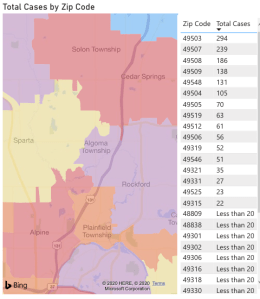 On Friday, the Kent County Health Department began tracking cases of COVID-19 for the Kent county, with the number of deaths, the racial breakdown of cases, age demographics, by gender and zip code.
MLive reported on the new COVID-19 resources on Friday, but only included information on COVID-19 cases by zip code. This limited reporting is not only unfortunate, it is a weak form of journalism that doesn’t ask larger and more urgent questions about which populations appear to be more at risk.
Looking at the racial breakdown of COVID-19 cases is instructive for Kent County. According to the 2010 Census data, the percentage of African Americans living in Kent County was 10.5 %, compared to 82.3% White. However, in looking at the racial breakdown of COVID-19 cases, 22.1% of White people have contracted COVID-19, compared to 18.6% of African Americans. While the number of White people living in Kent County is roughly 8 times greater than African Americans, they are nearly equal in contracting COVID-19. This means that African Americans are between 7 or 8 times more likely to contract COVID-19 than White people are.
This data on COVID-19 for Kent County, based on race is a clear indication of structural racism and White Supremacy. In addition, the zip codes that have the highest number of cases are 49503, with 294 reported cases, and 49507, with 239 cases. The 49503 zip code has the highest percentage of African Americans than any other zip code in Kent County and 49507 is one of the highest for African Americans.
In Detroit, the structural racism in COVID-19 cases is even more disturbing, as Mark Fancher writes in Black Black Agenda Report, and the same dynamic is taking place in New York, according to the Center for Public Integrity.
None of this data, from around the US or right here in Kent County should be surprising, unless you are white and are in denial about the systemic function of White Supremacy. The data should be disturbing and should cause outrage over the fact that proportionately more African Americans in this community will die than White people. As was the case before COVID-19, we have to dismantle the system of White Supremacy in the Grand Rapids area.
 Yesterday, nearly 100 vehicles were part of a “caravan for dignity,” that brought attention to critical issues facings the undocumented immigrant community in Grand Rapids.
This was the fourth consecutive year that Movimiento Cosecha GR has organized a May 1st action to demand dignity, respect and permanent protection for all 11 million undocumented immigrants living in the US.
It was difficult to say exactly how many people were part of the action yesterday, since most people were in cars and practicing social distancing. There were crowd safety people on foot and on bicycle, but there would easily have been over 100 people, since most of the vehicles I saw had multiple people inside. The amount of people that took a public stand in the face of the COVID-19 crisis was impressive, but unfortunately both WOOD TV 8 and WZZM 13 stated that there were “dozens of protesters.” Just looking at some of the images that came from yesterday’s action, with long lines of vehicles, confirms that it was more than dozens of protesters.
Movimiento Cosecha GR was once again demanding driver’s licenses for all, but they also emphasized the fact that immigrant workers are essential workers, particularly migrant workers. Migrant workers do the back breaking work in the fields that puts food on all of our tables, work that is so essential, that without them the food system would collapse. Another important point that Movimiento Cosecha GR made yesterday was that the 11 million undocumented immigrants in the US are not eligible for any of the COVID-19 relief funds coming from the federal government, thus causing even extra hardship for the immigrant families that are already terrorized by law enforcement.
 The Grand Rapids Police Department (GRPD) once again had an excessive amount of police presence during the non-violent immigrant-led caravan. There were police in marked cruisers, unmarked cars, on foot and on bicycles. In the pictures that MLive took of yesterday’s action, every time the GRPD was shown in the photos, the caption always read, “Members of the Grand Rapids Police Department discuss safety with protesters.” The notion that the GRPD was there for safety reasons is patently false. The GRPD has demonstrated over the part four years, that whenever there is a Movimiento Cosecha GR action, particularly a May 1st action, that they are NOT there for the safety of the immigrant community. The GRPD shows up in large numbers for the following reasons:
- To intimidate and harass those involved in Movimiento Cosecha GR actions.
- To engage in surveillance of the organizers and allies who are fighting for immigrant justice, which means collective data and images on certain activists.
- To ensure that business as usual is maintained, which means the GRPD does not want any disruption or interruption of the functioning of commerce and government. Why else did the GRPD have large city-owned trucks and police cruisers blocking the on ramp and off ramps along US 131 and i96 yesterday?
Apart from what members of Movimiento Cosecha GR have witnessed over the last four years from the GRPD, there is also plenty of evidence to support the three reasons cited above, especially since we were able to obtain some 250 pages in a Freedom of Information Act (FOIA) request late last year.
However, despite the efforts of the GRPD to limit the collective power of the immigrant justice movement in Grand Rapids, the movement once again demonstrated their resiliency, their commitment and their determination to win dignity, respect and permanent protection for all 11 million undocumented immigrants in the US. Hasta La Huelga!


 Two weeks ago, we posted an article about a COVID-19 relief fund that the DeVos-funded AmplifyGR organization had announced. We noted in that article that the relief project was in partnership with the Family Independence Initiative and the Koch brothers created group, Stand Together.
In that initial announcement from AmplifyGR, they stated:
A generous group of Kent County residents have partnered with a nonprofit called the Family Independence Initiative (FII) to create a fund for families that are experiencing financial hardship because of COVID-19.
Well, we now know that the “generous group of Kent County residents,” is actually referring to members of the DeVos family. The project is called the Kent County Relief Fund and the funding has come from 4 different DeVos family foundations – the Dick & Betsy DeVos Foundation, the Doug & Maria DeVos Foundation, the Dan and Pamela DeVos Foundation and the CDV5 Foundation.
Now, it’s not just the funding that the DeVos family is providing, the address for the Kent County Relief Fund is 48 Fountain St. NW, Grand Rapids, which is the address for the Doug & Maria DeVos Foundation.
As of a few days ago, the Kent County Relief Fund post an update stating that the fund had given away all of its available resources. People still apply, but they will be put on a waiting list. The update also noted that the Kent County Relief Fund has given $1,679,000, which seems like a lot of money. However, considering the wealth of the DeVos family, this is like contributing $20 for most of us. In fact, as we reported 10 days ago, the DeVos family members, and all other millionaires and billionaires in Kent County, will get on average $1.7 million (each) in a tax break as part of the Care Act. Therefore, between the four DeVos foundations that have providing the funding for the Kent County Relief Fund, they would collectively be receiving $6.8 million in tax breaks for doing nothing. It seems to be that the DeVos foundations should provide another $5 million to the relief fund, since they got these funds from an unjust tax policy that was crafted by the same politicians that the DeVos family funds through campaign contributions.
There are also several other important things to point out about the Kent County Relief Fund.
First, the application process for the Kent County Relief Fund has very similar conditions that we see in other charity-based assistance. People have to present some form of government issued ID and provide tax returns or a recent pay stub. This kind of scrutiny carries with it the same shame-based conditions that those experiencing poverty too often experience.
Second, the community partner list provided on the Kent County Relief Fund’s website is very instructive. These nonprofit supporters and partners are not just random entities, rather they were deliberately selected since virtually all of these groups have some major DeVos connection.
 This means that of the 23 partners working with the Kent County Relief Fund, 20 of them have a direct connection to the DeVos family. The only nonprofits partners that do not have a direct DeVos family connection are Dwelling Place, River City Scholars Charter Academy (part of the National Heritage Academies – J.C. Huizenga) and Michigan Works.
The fact that the majority of nonprofit partners working with the DeVos-created Kent County Relief Fund should tell us something. First, the DeVos family is very strategic and does not like working with entities that they cannot control. Second, most of these groups are Christian in orientation, which is what the DeVos family prefers. Third, the nonprofits are not known for challenging systems of power and oppression in Grand Rapids, which means they do not exist to fight the structural or root causes of the problems of the people they serve.
Lastly, while I am glad for the families that have received the $500 funds provided by the Kent County Relief Fund, but make no mistake about it, this project is designed only as a form of charity. More importantly, the very people that the Kent County Relief Fund has provided money to, are the same families who have been negatively affected by the policies that were created by the politicians that the DeVos family has funded over the decades, policies which have benefited the millionaire/billionaire class and punished poor families, especially families of color.
 There are numerous things that we have all learned about ourselves during the COVID-19 pandemic and there are lots of things we have learned about our community.
One thing that seems to be overwhelmingly clear, is that we cannot go back to the way things were before this crisis. In fact, the current crisis has revealed to us that the existing systems of power and oppression in Grand Rapids have not only exacerbated the crisis, but they created the long standing conditions that have led to so much suffering in this community.
The conditions I am referring to are the profound levels of poverty that so many families live in, especially black, latinx and native families. Add to the fact that thousands more in Grand Rapids are now unemployed and you have a major economic crisis. The government “stimulus” checks are not getting to people fast enough, plus there are lots of other families, namely immigrant families, who are not even eligible to receive them.
However, at the same time that thousands of people are struggling to survive in Grand Rapids, those who have economic and political power and using the crisis to push and expand their own agenda. We have been reporting on what groups like the West Michigan Policy Forum are doing to not only get back to normal, but to use this crisis to push for further policy changes that will benefit the business class. In addition, many of the same people who serve as part of the Grand Rapids Power Structure, those who are billionaires and millionaires, are benefiting from this crisis, because of tax breaks that were built into the Cares Act. This small group of people are profiting off the crisis, while thousands in Grand Rapids are left wondering if they can pay rent, pay their utilities or feed their families.
Then there is the issue of what the system is referring to as “essential workers” during this crisis. Essential workers are generally the people on the front lines of the health care industry, like nurses, doctors, direct care staff, hospital kitchen staff, hospice workers, etc. But essential workers also includes those who are part of the food system, migrant workers, fast food workers and grocery store workers, all of which do not make a livable wage in this system. The current crisis also reveals that these workers were always essential, but the system of capitalism doesn’t value the work they do.
Other conditions we could identify are the housing crisis in Grand Rapids, police violence and the prison industrial complex and the homophobic/transphobic systems that exists in Grand Rapids.
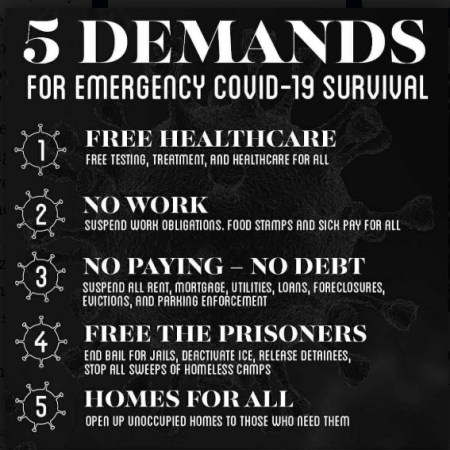 These systems of power and oppression in Grand Rapids are nothing new, but if we are interested in not just surviving the COVID-19 crisis, but thriving afterwards, then we need to collectively organize for the things we want. Already there are powerful examples of grassroots responses to the COVID-19 crisis, like the Grand Rapids Area Mutual Aid Network, the La Lucha Fund, No Rent Michigan. Together We Are Safe and Movimiento Cosecha GR. Hundreds of volunteers and practicing Mutual Aid to make sure that the families who are the most vulnerable right now are getting some of their needs met.
However, unless we dismantle the systems of power and oppression that have created the conditions for the current crisis, then there will always be a crisis. People living in poverty is a crisis. People living with pain or dying from preventable diseases or conditions is a crisis. People living on the streets is a crisis. People suffering under white supremacy and settler colonialism is a crisis. People living under patriarchy and heterosexism is a crisis. Climate change is a crisis.
The Grand Rapids Power Structure is not sitting around during this crisis, just waiting for things to get back to normal. They are strategizing and planning to figure out ways to benefit from this crisis and to shore up the power they have. We need to strategize, to plan, to organize and radically imagine that another world is possible.
In the coming weeks, we will post pieces that look at what is possible. We will look at ways to get to a just food system, a just housing system, how to get to climate justice, workers justice and a just health care system. Another World is Possible!!!!
Betsy DeVos makes statement about how US History is taught
 On Thursday, US Secretary of Education, Betsy DeVos, released a statement on the National Assessment of Educational Progress (NAEP) 2018 Civics, Geography, and U.S. History Assessments for 8th Graders:
“America’s antiquated approach to education is creating a generation of future leaders who will not have a foundational understanding of what makes this country exceptional. We cannot continue to excuse this problem away. Instead, we need to fundamentally rethink education in America. It is the only way our nation’s students will be in a position to lead our nation and the world.
The results are stark and inexcusable. A quarter or more of America’s 8th graders are what NAEP defines as ‘below basic’ in U.S. history, civics and geography. In the real world, this means students don’t know what the Lincoln-Douglas debates were about, nor can they discuss the significance of the Bill of Rights, or point out basic locations on a map. And only 15% of them have a reasonable knowledge of U.S. history. All Americans should take a moment to think about the concerning implications for the future of our country.”
While I agree that the way US history is taught in American schools is deeply troubling, what Betsy DeVos thinks is important about US history and what should be taught about US history are vastly different.
Betsy DeVos’ father-in-law, Richard DeVos Sr., had a view of US history, one that has been taught for a long time. The co-founder of Amway, in his book Believe, when talking about freedom and the founding of the US, says:
“that call of freedom went forth from a rugged wilderness, and Europe and Asia and Africa sent their sons of adventure to hew out a new society in a land of forests and savages.”
Is this what Betsy DeVos means by a foundational understanding of what makes this country exceptional? The statement above by Richard DeVos is reflective of one of the foundational aspects of US history, namely the genocide of Indigenous people. The other major foundational aspect of US history is the enslavement of African people, the very same people who created a great deal of the wealth in the US, but did not benefit from their labor.
Indeed, based on the lived experience of Betsy DeVos, growing up as part of the Prince family and then marrying into the DeVos family, the US Secretary of Education would see US history through the lens of someone who is deeply privileged. Betsy DeVos no doubt views US history as something that the capitalist class built, a history that believes the US was founded on Christian principles, and one that is governed by White Supremacy.
US History has primarily been taught through the view of the historical victors, as Howard Zinn used to say. US history is always about the powerful, those with great wealth and very much centered on wars and US global dominance.
This type of US history began to be challenged at the university level in the 1960s, with the introduction of women’s studies and ethnic studies, particularly black studies. Unfortunately, what is being taught at the university level hasn’t always trickled down to the K-12 level. There are some amazing US history teachers across the country, but they are in a minority. Some of these US history teachers have been influenced by Zinn’s, A People’s History of the United States or the resources offered through groups like Rethinking Schools.
The group Grand Rapids for Education Justice has heard from the black, latinx and Anishinaabe communities that they want to see their communities’ history taught and not just the dominant. white version of history.
US Secretary of Education, Betsy DeVos, is right to point out the antiquated way in which US history is taught. However, we cannot and should not allow people like her to determine how US history is taught, nor what version of US History.
“I’m worried that students will take their obedient place in society and look to become successful cogs in the wheel — let the wheel spin them around as it wants without taking a look at what they’re doing. I’m concerned that students not become passive acceptors of the official doctrine that’s handed down to them from the White House, the media, textbooks, teachers and preachers.” Howard Zinn
West Michigan CEOs who are pushing to open their businesses
 Last week, the West Michigan Policy Forum (WMPF) hosted an online forum with CEOs talking about how to get Michigan businesses up and running.
This discussion from the WMPF happened the day before Gov. Whitmer announced another extension of the stay-at-home, with the extension going til May 15. However, there will be some relaxation of the previous order, allowing some sectors to open, particularly the lawn and garden industry, greenhouses, boating and golf courses.
The WMPF event involved Amway President Doug DeVos as the moderator, with several CEOs offering information on their respective businesses, along with a few other voices in the mix.
The hour-long forum was recorded and you can watch the video on the WMPF Facebook page, at this link.
In his opening comments, DeVos made the point that, “we are very alined with what Sen. Shirkey’s plan is.” We wrote about Senator Mike Shirkey’s plan on Tuesday.
Another important thing that Doug DeVos mentioned had to do with regulations that have slowed the business community down for years, and that “once we come back from this crisis, maybe some of those could be changed or eliminated.” Such a statement comes as no surprise, since the West Michigan Policy Forum has more than a decade of working to change state policy in ways that benefits their interests. Deregulation would be the next logical step for this group.
The CEOs and other executives that took part in the online forum were:
- Mike VanGessel, the CEO of Rockford Construction,
- Bill Dobbins, Caster Concepts
- Brian Cooper, ELCo Enterprises, Inc.
- Kelly Presta Sturgis Molded Products
- Kurk Wilks, Mann + Hummel
- Matthew Haworth, Chairman of Haworth
- Ron Geisman, Lomar Machine & Tool
- Steve London, Bekum America
- Birgid Klohs, CEO of the Right Place Inc.
- John Hendrickson, C=H Solutions
- Jennifer Owens, Lakeshore Advantage
- Jase Bolger, WMPF advisor
- Mike Hill, Coldbrook Insurance
- Johnny Brann Jr., Brann’s Restaurants,
Several of these businesses are in West Michigan, specifically in Grand Rapids. It is interesting that there has been a significant increase in COVID-19 cases in the Grand Rapids area, just within the last week. Therefore, while the business community in West Michigan continues to push for “re-opening” the state’s economy, they are ignoring the fact that COVID-19 cases are up in Grand Rapids. Having more people go back to work will most likely put more people are risk of contracting the coronavirus. Thus, these business leaders are taking a very similar position as those who protested in Lansing on April 15, a position that says, “profits before people.”
 Yesterday, several dozen people protested outside of the Governor’s mansion in Lansing, calling on Gov. Whitmer to re-open Michigan’s economy.
The person credited with organizing the demonstration is Brandon Hall. Hall was quoted in the news source, Up North Live as saying:
“Gretchen Whitmer is tyranny, this is like a third world country. It’s like V for Vendetta and Idiocracy hooked up and they produced this baby that is 2020.”
Brandon Hall is originally from Grand Haven and was sentenced to 30 days in jail in 2012 for election fraud. Hall is the editor of a blog called West Michigan Politics, which ironically has as its banner on Facebook an image of Richard DeVos Sr.
Brandon Hall said that Nick Somberg, a lawyer, also helped to organize the protest. Somberg, is also with the group Michigan United for Liberty, which brought a lawsuit against Governor Whitmer a few days ago.
Michigan United for Liberty is a fairly new entity that has a number of people on their “team” who have previous experience with campaign organizing and other conservative efforts. Michigan United for Liberty is claiming that Facebook has blocked their anti-government protest events on the social media platform, but that is not preventing them from promoting several upcoming actions.
On April 30th, Michigan United for Liberty is hosting another protest at the State Capitol in Lansing. According to their announcement, Governor Whitmer’s, “executive orders are direct violations of our constitutional rights and are infringing upon our basic freedoms.” The protest on April 30 is also sponsored by the Michigan Conservative Union, a group that has been around since 1975 and includes former State Rep. Dave Agema. The other group involved in the April 30th protest is Libertarian Party of Michigan.
Then on May 1st, Michigan United for Liberty is organizing a MayDay to PayDay action. This action is a call to business owners to start back up again, regardless of what the Michigan Governor has to say. The MayDay to PayDay action says:
Calling all small business owners! Are you fed up? Ready to re-open and start making an income again?
Michigan United for Liberty believes ALL jobs are essential and we want to help you re-open! Unite with us as we band together to make this a reality!
Join us in our stand for freedom by committing to re-opening your business on May 1st!
Clearly, the groups involved in the April 15 protest at the Lansing State Capitol, the protest at the Governor’s mansion and the upcoming protests have generated a fair amount of interest from the public. It would be a mistake to be dismissive of these groups, as Ben Burgis stated in a recent article in the Jacobin Magazine.
Many on the Right have cheered on the protesters. Centrists have mostly just rolled their eyes. The Left needs a better response. While the lockdowns are necessary, it’s unacceptable to ask everyone to continue paying their bills without far more robust government assistance. We should offer genuine solutions to legitimate economic worries even as we acknowledge that much of what was said and advocated at the protest was irresponsible and absurd.
In addition, I think it is not a matter of simply giving blind support to Gov. Whitmer. I agree with the stay-at-home orders, since we need to flatten the curve. However, people are hurting and we need some short-term and long-term ways of addressing the fact that millions of people are struggling around having basic needs met. We need to pressure the State Government and Gov. Whitmer to make sure that people are being taken care of. We need a rent freeze, an end to evictions, and to release people from prisons, jails and detention centers. We need to demand that health care workers, agricultural workers, those working in grocery stores and fast food restaurants, along with all other essential workers – who do essential work – get real, substantive hazard pay.
Some conservative groups are saying, We’re suing that woman from Michigan, while liberals are saying, We support that woman from Michigan. Such simplistic slogans are meaningless if we don’t have clear-headed strategies and plans to make sure that people have the resources to make sure they can stay safe, have access to food, housing and the health care we all need.

