 The group that has been organizing anti-lockdown protests in Lansing, will be hosting another demonstration at the Capitol on Sunday, May 31st.
Billed as Sunday Funday, Michigan United for Liberty is hosting a demonstration in defiance of the Stay-at-Home orders, this time with the focus being on venders who are currently not allowed to be open.
Join us for a celebration of our freedom and a direct action to restore Michigan by coming to the Capitol to engage in the great American tradition of free enterprise.
According to their Press Release for the event, the event will feature food, live music, and vendors, including arts and crafts, beauticians, massage therapy and more.
“Our previous Capitol demonstrations have thoroughly made the point that the people of Michigan are fed up with the governor’s lockdown orders and will not be intimidated by her empty threats. Now it’s time to strike a more positive tone, to celebrate our constitutional rights, not just by exercising our freedom of speech and assembly, but our fundamental right to the pursuit of happiness by earning a living,” explained organizer Jenny Darling. “It’s long past time to re-open Michigan, and we are going to lead by example.”
I think most people are aware of how small businesses are being impacted by the COVID-19 crisis, but this protest on Sunday doesn’t really have much to do with supporting small businesses. Here is our take on what the Michigan United for Liberty demonstration is really about:
- It’s about White people being upset that in the midst of a pandemic their ability to do whatever the hell they want has been limited…..and that’s just not very American.
- It’s about White people with guns knowing that they will not be subjected to state violence or state repression, thus providing the world with yet another example of how White Privilege and White Supremacy works.
- It’s about how these White people will never be on the streets or organizing against cops killing black people, ICE agents arresting and detaining immigrants, religious groups policing queer and trans people or how capitalism is killing the planet.
- It’s about how these White people are really distracting us from paying attention to how the Billionaire class – Bezos, Zuckerberg, DeVos, Meijer – are getting the federal government to re-direct more public money into their hands, and state governments to push policies they will benefit from.
- It’s about how these White people, who are using this opportunity to blame Gov. Whitmer for everything, while rallying other White people to support Trump.
Why we can’t go back to the way things were in Grand Rapids: Part III – Radically re-imagining work and a new economy
 Last month, we posted an initial article about Grand Rapids can’t go back to normal after the COVID 19 crisis. We made the argument that the inequities that existed before the crisis which amplified with the crisis, but they would continue to exist long after COVID 19, unless we begin to radically re-image another way of organizing ourselves.
In Part II, we focused on food, the current food system and why we need to radically re-imagine a new food system in this community. https://griid.org/2020/05/06/why-we-cant-go-back-to-the-way-things-were-in-grand-rapids-part-ii-re-imagining-a-new-food-system/ In Part III, we want to look at labor, labor unions and the future of work.
While most of this post will be discussing the nature of work within a capitalist system, it is critical that we think about and imagine work in a post-capitalist system. Part of the problem with labor/work in a capitalist system is that it is too often framed as jobs, specifically jobs that require bosses and owners.
Work, however, can be a liberating experience, if we see work as what people do when growing a garden, cooking, doing grassroots organizing, raising children, making music, art or any other activity that is uniquely human.
Unfortunately, before we can get to a more liberated notion of work, we need to create opportunities for people to see the possibilities of labor organizing within the current capitalist system.
Most of us have jobs, where we spend a great deal of time on a daily, weekly, monthly and yearly basis. However, how many of us go to a job where the workplace itself is based on cooperation, where the workplace is democratic?
Current estimates are that only 10% of those who have a job in the US are part of a labor union. This percentage is the lowest it has been in more than a century. IF we want our workplaces to be more cooperative, more democratic, where people feel valued and have a voice in how things operate, then why not join a union or start your own?
How many people have been saying for years that they could do their job from home? Working from home has been a demand of those with disabilities for decades, but most employers were not interested in such ideas. Now with COVID-19 we see that indeed many people can work from home. If more labor unions existed, such a demand could have become a reality, way before we were in the midst of a pandemic. But here is thing, we have to make working from home a demand right now, even after the pandemic is over. What would employers use as an argument post-COVID-19 for not allowing people to work from home?
When people have labor unions, they have the possibility for workplace democracy. People can demand better wages, better benefits, better working conditions, plus they can advocate as workers to have greater say in day to day operations.
We know that labor unions have fought and won the 8 hour work day, workers compensation, workplace safety, better wages, pensions, improved workplace environment and the abolition of child labor. These were all victories that workers fought for, since they were never a gift from bosses, corporations or members of the capitalist class. For an important overview of this history, see From the Folks Who Brought You the Weekend, by Priscilla Murolo and A.B. Chitty.
However, since the end of WWII, labor union have been losing ground on numerous fronts. The number of workers in the US that are part of a labor union has steadily declined since the 1950s. The Taft-Hartley Act of 1947 was a major blow to workers, since it attempted to make strikes, particularly wildcat strikes illegal.
The de-industrialization in the US, also weakened worker unions, as did the rise of globalization, which included trade agreements that fundamentally undermined unions and workers rights in general. However, a major factor in the weakening of organized labor has been its decision to attach itself to the Democratic Party, especially in the past 50 years. Now, before people dismiss this point, I ask you to think about 2 things. First, how much money have unions and their members dished out in recent decades to support Democrats, and second, how has that money resulted in worker justice and increased workplace democracy?
Unions and the Financial backing of the Democratic Party
If we look at the data provided by the Center for Responsive Politics, we can see what the major unions have contributed to the Democratic Party since 1990. Lets take a look at four examples, especially four of the major labor unions in the US; the United Auto Workers, the AFL-CIO, the National Education Association and the American Federation of State, County and Municipal Employees.
- Since 1990, the UAW has contributed nearly $55 million to Democrats and spent another $40 million to lobby members of Congress.
- The AFL-CIO has contributed just shy of $66 million to Democrats and spent another $91 million lobbying Congress.
- AFSCME has contributed $116 million to mostly Democrats and another $47 million to lobby Congress.
- The National Education Association has contributed $128 million to Democrats and another $53 million on lobbying Congress.
This means that these four major unions combined have spent $365 million to influence elections and another $231 million to lobbying those already elected. What this says is that these four unions have used $596 million of their members money to try to influence election and policy at the federal level since 1990.
In Michigan, the trend is not much different. If you look at the data provided by the Michigan Campaign Finance Network (MCFN) for all the state races in the 2018 election, you will see that the Democratic candidates have received hundreds of thousands from various labor unions within the past 18 months and will continue to receive thousands more before the November election. In addition, some of the largest Political Action Committees in the state are labor unions, which you can also see from the MCFN.
A more specific example of how unions have spent money during an election cycle, was in 2012, when unions spent $21.9 million to pass Proposal 2. The business community however, spent $25.9 million to defeat the measure, which it did. Just after the November election in 2012, there was a major rally held in Lansing, where some 10,000 workers and allies came to protest the austerity measures being passed by the state, particularly making Michigan a Right to Work state. Unfortunately, instead of occupying the capitol building or shutting down Lansing, most of the rally organizers proposed that they get their people elected in 2014……….which didn’t happen.
What have unions and workers won with millions going to the Democrats?
It will be argued that if unions did not support Democrats with millions during elections in recent decades that the GOP would have pass even more draconian laws to further weaken labor laws and give private capital even greater power. This may be true to some extent, but what such an argument doesn’t take into account, is the fact that in the heyday of the labor movement – late 19th Century through 1945 – is that workers won a great deal without primarily aligning themselves with the Democrats. In fact, what labor historians have made clear is that the labor movement, by engaging in massive organizing efforts and using direct action were the reasons why they won so many labor disputes.
In more recent decades, say during the 8 years of the Clinton administration and the 8 years of the Obama administration, we need to ask what major labor victories took place? My read on those years was that there were no major labor victories, but there was a steady decline of union membership and numerous set backs for working people. Think of the number of trade agreements that were enacted since 1992, when NAFTA went into effect. The massive WTO protest in Seattle took place in 1999, while Clinton was in the White House.
During the Obama years, the only significant thing that organized labor asked from the Obama administration was to not sign on to more trade policies like the TPP and to pass the Employee Free Choice Act (EFCA). The TPP did not pass, despite the Obama administration’s support of it and the EFCA never got any traction. Again, unions may argue that if they had not financially backed Democrats then workers would have lost more ground, but the real question should be, what are labor union getting/winning by giving millions to Democrats?
Time for a new Labor Movement/Labor Strategy?
Ok, so lets say that organized labor decides to stop funding the Democratic Party and instead focuses on movement building. Union members could still vote for Democrats if they chose, but they could be part of a new labor movement that would not be beholden to political parties and could actually affect change.
There are already some signs to workers and unions pushing for more transformative justice. There is the $15 an hour movement, the numerous teacher strikes across the country and there are efforts to organize workers from corporations like Amazon. However, these efforts are often unconnected and they are not primarily focused on workplace democracy.
First, what if organized labor used the funding that they would have put towards elections and use it for paying people to organize shops and other work places? Not only would this scare the shit out of the capitalist class, it would give more workers an opportunity to be part of a union that actually fought for them. This kind of union organizing should also take place outside of specialized work and organize migrant labor, service sectors, restaurant workers and the unemployed.
Second, workers could engage in wildcat strikes, walkouts or other forms of direct action that would force companies to the table. In demonstrating their power, workers could negotiate wages, benefits and workplace dynamics that would result in victories. As individual shops and work places win labor battles, these same unions could join other labor struggles and support workers who were fighting get get a union and all the possibilities that come with being organized.
Third, unions could re-direct the money that they were spending for elections and lobbying to provide mutual aid to families that are experiencing poverty, facing foreclosure or any other economic hardships, including the corporate-driven health care costs. Not only would this kind of mutual aid help build relationships with working class people, it could result in an increase in union membership.
Fourth, what if the labor movement began to develop their own independent media. The commercial media will not represent the collective struggles of workers, in large part because they are dependent on advertising dollars from the very entities that exploit workers. We used to have a lively labor press in the US, but so little of that exists now. We need an independent media that tells the stories of the people whom the commercial media ignores. With an independent media, more people will have access to information that the commercial media marginalizes or represses. I’m not talking about just online media, I’m talking about labor-based press, a newspaper that is run by and for workers. Such a tool and other forms of media are weapons we need in the war of propaganda that the capitalist press is winning.
These proposals are not necessarily new, since much of what we have been talking about has been done before, with a great deal of success. However, we do need to do some things differently from what organized labor has done in the past.
Fifth, the worker-led movement needs to also connect to other movements around fighting white supremacy, patriarchy, ablism, homophobia, transphobia and fighting for food justice, immigrant justice and climate justice. Class issues can bring us together, but only if we do not make class the center of all justice struggles. The new work-led movement needs to be intersectional and transformative and not settle for just fighting against capitalism, but creating new economic systems that are democratic, local and multifaceted. We can take a cue from the wobblies who believed that, “An injury to one is an injury to all.”
Organized Labor is Not Enough: We need a new economic system
As we noted in the beginning of this article, we need to radically re-imagine our beliefs about work and what is truly essential in a post-COVID-19 world. It seems that the COVID-19 crisis has demonstrated to millions around the world that the current system of capitalism primarily benefits the super rich and it is ecologically unsustainable.
Workers around the world have already been demanding more and going on strike in record numbers. Well, when I say record numbers, I mean for what we have seen in recent decades. However, if we look to a previous crisis in the US, say the Great Depression, then the amount of strikes that are happening now are minuscule, compared to then.
According to the book Strike!, by Jeremy Brecher, there were literally thousands of strikes that took place in the early and mid-1930s, mostly due to the growing unrest amongst workers and the Capitalist system. There was also lots of frustration with the American Federation of Labor (AFL), which was focused on craft unions and did not share the same anti-capitalist sentiment that a growing number of workers felt. This political climate is what gave birth to the Committee for Industrial Organizing (CIO).
It is also important to note that many of these strike in the post-Great Depression era were wildcat strikes or sit-down strikes, where workers were not outside of factories on a picket line, but where workers showed up for work and then refuse to do anything. Sometimes these wildcats strikes involved workers literally taking over a factory and not allowing bosses or owners to enter. According to Brecher, in 1936, there were 48 sit-down strikes and in 1937, there were 477. Not only did these strikes scare the shit out of the capitalist class, it forced the administration of FDR to adopt more labor-friendly policies in the 1930s. When the labor movement was well organized and engaged in direct action, that is when they were able to win legislative victories. They did not need to be tethered to a political party.
Labor strikes and General strikes can and should be a tactic that we use today. What would it look like if migrant farm workers went on strike and had millions of people supporting them? If our food system comes to a halt, then the chances of winning demands of farmworkers would likely become a reality.
However, all of these efforts should not limit un to thinking about a new economic system(s), where people and the planet are truly valued. Equally important is the idea that we cannot limit ourselves into thinking that doing work is the same as having a job. There are millions of people who hate their jobs. They hate their jobs because they are not financially compensated in a just way, they have no power, and for many people they hate their jobs because it is meaningless, often soul-crushing, work.
Lets face it, there are millions of jobs that exist that perpetuate environmental destruction and the consumption of shitty products. In a radically imagined world, where work was truly valued and people were not forced to find a job, do you think people would willingly chose to build bombs or manufacture Monsanto products? Most of us have jobs to pay the bills, to pay off our student-loans and to have some form of health care coverage. In a radically re-imagined world we could all participate in doing doing work that was life affirming, that was nurturing, work that was creative and work that was not environmental destructive. In a radically re-imagined world we would all have more time for relaxation, for pursuing our creative interests and for play. Anything is possible if we are organized and practice direct action to win the kind of demands we want. Another World is possible!!!
Last week, I wrote about the American Patriot Rally that was held in downtown Grand Rapids, where anti-lockdown protesters filled Rosa Parks Circle and defied the Stay-at-Home order of Gov. Whitmer.

Today’s post is a follow up, with some new information about some of the people who spoke at that rally.
First, the people who organized the rally have created their own blog, which has been live since May 8. The blog does contain a post about the Grand Rapids Rally, with all of the obvious biases, referring to the event as a “smashing success.” This particular post is instructive to read, in terms of how the writer reflects on what happened and how the rally was framed.
 Second, one of the speakers at the rally was US congressional candidate, Mike Detmer, who is running for Michigan’s 8th district. Detmer is running against an incumbent, Elissa Slotkin (D), but based on the campaign finance data so far, Detmer doesn’t seem to have much of a chance and is behind several of the other Republican candidates running for the same seat.
Detmer is running on a far-right platform, with little information on the issues and virtually no sourcing of his positions. Detmer claims he will protect Michigan jobs, provide better health care access, push for more border security, supports gun rights, is anti-choice and claims he wants to support US military veterans. Detmer’s entire issues page is based largely on rhetoric, with few facts and no clear proposals.
Lastly, the person who led the prayer at the American Patriots Rally is Bernadette Elizabeth Smith. Bernadette and her husband Phillip, are co-pastors at the Eternal Word Church in Grandville, Michigan.
 According to Bernadette’s Facebook profile, she has been involved in some of the anti-lockdown protests in Lansing, also in a ministerial capacity. Bernadette and her husband Phillip have both been supporters of President Trump, with Phillip giving an invocation at a Trump rally held in Grand Rapids in 2016. Bernadette was also featured in a GOP video that was tweeted, where she claims in 2018 that unemployment for African Americans is the lowest it has ever been. Bernadette’s husband Phillip, right after Trump was nominated as the GOP candidate in 2016, tweeted this:
How do we know if the illegal Mexican immigrants aren’t a Trojan Horse sending their army ahead for a future conquest?
All of this is to say that the kind of people who were involved in the American Patriot Rally in Grand Rapids last week, are people who embrace who a White Supremacist ideology, promote xenophobia and use the US Constitution to justify their own brand of free market fanaticism that will likely result in a spike of new COVID-19 cases in Michigan.
Liberal responses to the anti-Lockdown protest: Why we need more than a binary political vision
 We celebrate the abolition of slavery, the welfare state and women’s right to vote as if these were wrestled away from the hands of dictators whose interests lay in bygone ideologies. This is despite the obvious fact that it was the fight against liberal elites which led to these achievements, against liberals did direct interests. – From the book: Reactionary Democracy: How Racism and the Populist Far Right Became Mainstream
Over the past several weeks, I have been writing about the groups that have organized the anti-lockdown protests in Lansing and in Grand Rapids. During those weeks I have also been trying to pay attention to the responses that people are offering on social media about these protests and the people involved.
Some responses are understandable, where people have expressed anger and frustration against those protesting Gov. Whitmer’s decision to have the Stay-at Home orders. I too have been disturbed by some of the comments from protesters and the signs they have made. I agree that the Stay-at Home orders have been important to try to protect lives and flatten the curve.
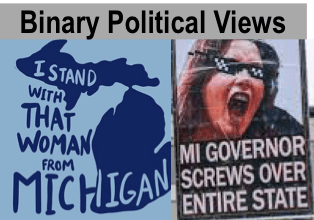
However, it has been instructive to see how people, who would generally refer to themselves as liberals, have responded to the anti-lockdown protesters. Many of the responses demonstrate a very binary worldview. What I mean by a binary response is that people are either against what the Governor has done or supportive of what she has done. At some level I get this, but by just saying you “support that woman from Michigan,” doesn’t really mean much in the end.
For example, one response I saw was a suggestion that the National Guard be called to the State Capitol to arrest the anti-lockdown protesters, particularly those with guns. This of course did not happen, but it said to me that the person making the suggestion was unaware of the history of the National Guard being called in to deal with domestic conflicts. The majority of examples of the National Guard coming into communities was to respond to black resistance to police brutality, to housing injustice or to larger urban renewal policies, often resulting in displacement of black residents. Calling in the National Guard to deal with white, armed protesters would only further legitimize their existence.
A second example of a liberal response to the anti-lockdown protesters was a response to the Sheriff who spoke at the Grand Rapids rally earlier this week, who was calling for law enforcement officials to defy Whitmer’s Stay-at-Home order, because it was against the US Constitution. One liberal response was that law enforcement should also defy orders to put children in cages. Now, I would support cops not complying with orders to put children in cages, but the reality is that law enforcement agencies have been fully cooperative with ICE efforts to arrest, detain and deport undocumented immigrants. The primary function of law enforcement agencies is to maintain the status quo, to maintain business as usual, and to protect systems of power. Their function is not now, nor has it ever been to really protect people, especially black people, indigenous people, queer and trans people or even white people, particularly those who are resisting the status quo.
In the recently published book, Reactionary Democracy: How Racism and the Populist Far Right Became Mainstream, the authors make an important point:
“The far-right is used as a decoy, diverting our attention away from new political imaginaries: our only choice is between an increasingly resented status quo and the far right.
Liberal democracies have become consumed by a fight for survival against a threat they have themselves nurtured, to divert attention away from their inability to respond to the inequalities and growing number of historical crises fuelled by capitalism and its innate conflict with liberal-democratic ideals of liberty and equality.“
Now, I’m not suggesting that the far right, whether they are armed protesters, the Acton Institute or the members of the Grand Rapids Power Structure – all of which are calling for a re-opening of the state’s economy – should be ignored. However, if all we are doing is to simply react to the far right by saying that they are idiots, then we just end up feeling good about ourselves. What I believe the excerpt above is saying to us is that; 1) we often use the far right as a diversion to maintain business as usual; and 2) we fail to craft a vision and agenda that truly practices collective liberation, resulting in economic justice and racial equity.
As I said before, in general I have been in support of the Stay-at-Home orders from Gov. Whitmer, but that doesn’t mean that I give blind support. The movement for de-carceration has pushed the Governor to release people from jails and prisons during the COVID-19 crisis, yet that has not happened. The housing justice movement has forced the Governor to pass eviction moratoriums, but housing inequities are still a major problem across the state. Gov. Whitmer ran on a campaign promise to shut down the Enbridge operated Line 5. Not only has Line 5 not been shut down, Enbridge is currently moving forward with plans to construct a oil line tunnel under the Straights of Mackinac.
This is why I think it is critical to stand outside of the binary positions of “standing with that woman from Michigan” and “lock her up.” Our political vision has to be more robust, more radical and more imaginative. Do we want to live in a state that encourages and allows cops to kill black people? Do we want to live in a state where corporations can profit from bottling water? Do we want to live in a state where Immigration and Customs Enforcement can destroy the lives of immigrant families? If your answer is NO, then we can’t just be content with mediocre politics and policies. We can’t be content with business as usual or with just getting back to normal after the pandemic.
The Billionaire class continues to grow during the COVID-19 pandemic, even in Grand Rapids
 A new report from the Institute for Policy Studies (IPS) shows that the wealth gap in the US continues to grow, with more billionaires, many of which have been profiting from the COVID-19 crisis.
The report, entitled, Billionaire Bonanza 2020: Wealth Windfalls, Tumbling Taxes, and Pandemic Profiteers, demonstrates that the economic system of capitalism benefits a very small percentage of people, people who use their wealth and power to exploit everyone else and to make sure that their wealth will continue to expand with their ability to purchase public policy.
Here are just 2 key indicators from the report about the Billionaire class:
- Between 1990 and 2020, U.S. billionaire wealth soared 1,130 percent in 2020 dollars, an increase more than 200 times greater than the 5.37 percent growth of U.S. median wealth over this same period.
- Between 1980 and 2018, the tax obligations of America’s billionaires, measured as a percentage of their wealth, decreased 79 percent.
The analysis of the report also provides us with critical information that tells us who really runs this country. The first critical analysis point has to do with how the billionaire class buys policy, which benefits their interests.
In their 2018 study, Billionaires and Stealth Politics, political scientists Benjamin Page, Jason Seawright, and Matthew Lacombe found that billionaires overwhelmingly favor cutting their own taxes and reducing social safety net benefits. Their political contributions, whether they go to Democrats or Republicans, reflect these preferences. Billionaire dollars, in short, are fraying our social safety net. To add to the insult: Working-class Americans now pay, after the billionaire-backed GOP tax cuts, a higher percentage of their income in taxes than billionaires.
Billionaires are paying millions to dodge billions in taxes, a dynamic that leaves far fewer resources available to support programs that help ordinary people. Multimillionaires and billionaires are bankrolling an entire “wealth defense industry” of professionals — tax lawyers, accountants, wealth managers — who help hide mega fortunes in offshore tax havens and dynasty trusts. With trillions in otherwise taxable income stashed overseas, middle- and working-class taxpayers who lack access to these tax-dodging mechanisms are left covering a larger share of the U.S. tax burden.
A second major point in the reports analysis contrasts the increase in the number of billionaires in the US, along with the amount of wealth they now control and then contrasts that with average US families.
In 1990, there were 66 billionaires in the US, but in 2020 there are 614. The report states:
Between 1990 and 2020, the U.S. billionaire class has seen its net worth increase over 1,130 percent. Meanwhile, U.S. median household net worth between 1989 and 2016 grew by a mere 5.37 percent. Billionaire wealth has grown 210 times faster than median wealth.
When you contrast the wealth of the billionaire class with everyone else, it is rather astounding.
The concentration of wealth at the top contrasts starkly with the number of households living on the edge. Even before the current economic crisis, a growing number of U.S. households had zero or negative net worth (meaning they owed more than they owned). These “underwater” households increased as a share of the U.S. total from 15.5 percent in 1983 to 21.2 percent in 2016. For people of color, the trend has been even more disturbing. Over 32 percent of Latino families and 37 percent of black families have zero or negative wealth.
A third major point in the IPS report makes it clear that there are several of the members of the billionaire class that have been profiting from the COVID-19 pandemic. From the report:
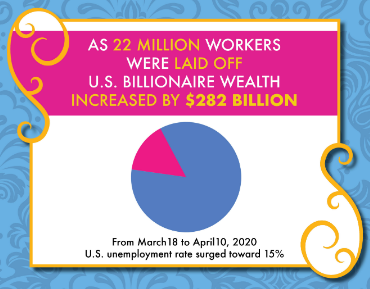
This year’s Forbes report examines billionaire wealth as of March 18, 2020, a bit later than the February dates fixed upon in the magazine’s previous 33 annual reports. By April 5, two-plus weeks after March 18, U.S. billionaires had seen their collective wealth rise back to $3.017 trillion, and by April 10 their wealth had surged to $3.229 trillion, surpassing the 2019 level. Between March 18 — the near bottom point of the pandemic financial swoon — and April 10, 2020, U.S. billionaire wealth rebounded by $282 billion.
The Jeff Bezos Wealth Surge is an unprecedented dynamic in the history of modern markets. Tracking Bezos’ wealth requires a real-time hour-by-hour tracker. As of the publication of this report, Bezos’ wealth has increased over $25 billion since January 1, 2020 and $12 billion since February 21st, 2020, the beginning of the Covid-19 pandemic.
According to a recent piece on CommonDreams.org, despite Bezos $30 billion increase in wealth since January 1st, 2020, his company Amazon will stop paying workers the $2 an hour wage on June 1st, that the workers won on March 16th at the beginning of the pandemic.
In addition to Jeff Bezos, other billionaires that have profited from the COVID-19 pandemic are Elon Musk (Tesla CEO), Eric Yuan (ZOOM CEO), Steve Ballmer (former Microsoft CEO) and John Albert Sobrato (Silicon Valley real estate mogul).
Grand Rapids Billionaires: DeVos and Meijer
The DeVos and Meijer families are not the only billionaires in Grand Rapids, but they are the wealthiest and the families that have tremendous political influence.
According to the 2017 Forbes 400 list, the combined wealth of these two families was $12.6 Billion – Doug & Hank Meijer were worth $7.2 Billion in 2018 and Richard DeVos was worth $5.4 Billion in 2018, the same year he died. Now, this doesn’t include the wealth of the other DeVos family members, which would easily put the total over $15 Billion between these two families.
What the combined wealth of the Meijer and DeVos family could translate into, is that NO ONE in Grand Rapids would have to worry about not working during the COVID-19 crisis, EVERYONE would have access to testing, proper health care, food, housing and any other basic needs. The JW Marriott just announced that they were closing, which means there are hundreds of empty bed that could be used by individuals and families who are facing a housing crisis right now. The wealth of the Meijer and DeVos families could translate into our ability in Kent County to truly flatten the curve and minimize the number of deaths from COVID-19.
Unfortunately, we know that the Meijer and DeVos families will not give up significant amounts of their combined $15 Billion in order to save lives in Kent County. These two families have demonstrated for decades that they are more interested in maintaining and expanding their wealth than they are in the well being of all residents of Kent County.
Yes, it is true that the DeVos family has contributed a few million to the Kent County Relief Fund, but that is like you and I donating $10.
People reading this might be saying, “well, it’s their money, they can do what they want with it.” First, this completely ignores the fact that these two families made their wealth off the labor of others. Secondly, and more to the current crisis, the Meijer and DeVos families do not have the right to maintain their disgusting amounts of wealth, while countless numbers of people in Grand Rapids die from the COVID-19 virus. Their failure to act in the midst of this pandemic would be their real legacy.
What do anti-lockdown protesters have in common with the business class that is pushing for Michigan to re-open?
 Last week, Alex Kotch, posted an excellent article about how some of the long-standing national far right organizations are providing significant support to several of the anti-lockdown protests that have occurred in the US in recent weeks.
The article, entitled Secretive Right-Wing Nonprofit Plays Role in COVID-19 Organizing, provides important information and analysis about the role that the Council for National Policy (CNP) has been playing in the anti-lockdown protests in several states.
The article does not provide any direct connection between the CNP and anti-lock-down protests in Michigan, but it does mention the connection between the DeVos family and the Council for National Policy.
Richard DeVos, the father-in-law of Education Secretary Betsy DeVos, is a former president of CNP, and his family foundation has funded the group. DeVos’s parents’ family charity, the Edgar and Elsa Prince Foundation, are regular donors, having given money in the 2018 fiscal year, the most recent on record.
More importantly, the article from Kotch demonstrates that the anti-lockdown protests are getting strategic support from national groups like the Council for National Policy, which is connected to the larger far right network in the United States.
Again, this article does not mention Michigan specifically, but it does signal that those who are organizing and attending the anti-lockdown protests are getting support from well connected and well funded national groups that have been around for decades.
What about Michigan?
There is definitely a connection between the anti-lockdown protestors in Michigan and Senate Majority leader Mike Shirkey, as we noted in our most recent post. Shirkey has been in communication with Ryan Kelley, who was involved in organizing some of the anti-lockdown protests in Lansing, plus Sen. Shirley attended and spoke at the American Patriot rally in Grand Rapids that took place on Tuesday night.
However, even if there is not a direct connection and even if we do not have clear evidence of the relationship between centers of power and the anti-lockdown protesters, it is worth looking at the ways in which their agendas overlap.
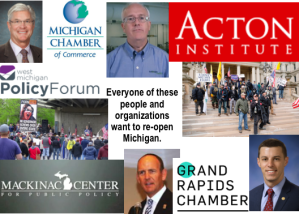
It is interesting that the anti-lockdown protesters, which essentially calling for Michigan to re-open, have the same agenda as members of the GOP (like Sen. Shirkey & Rep. Chatfiled), the Michigan Chamber of Commerce, the Grand Rapids Chamber of Commerce, the Mackinac Center for Public Policy, the West Michigan Policy Forum, the Acton Institute, even if their messaging isn’t always in sync.
- Sen. Shirkey and Rep. Chatfield are bankrolled by the DeVos family and AutoCam CEO John Kennedy, and Shirkey has been in direct communication and support of the anti-lockdown protesters.
- Groups like the Mackinac Center for Public Policy, the Great Lakes Education Project and the Michigan Freedom Fund are using the COVID-19 crisis as a means to push through policy that not only benefits the business class, but it embraces some of the same larger policy objectives as groups like the Michigan United for Liberty and the Michigan Conservative Union, which are calling for small government, de-regulation and certain aspects of privatization.
- The Christian groups that are suing Gov. Whitmer are objecting to how the Stay-at-Home orders are an attack on religious freedoms, which is the same message as the Acton Institute, as was stated by Acton Institute founder Rev. Robert Sirico in a recent radio interview he did.

- The business-centered groups throughout the state and the anti-lockdown protesters both have a very narrow, even naive, notion about testing for COVID-19 and the likelihood that without adequate testing, Michigan will see another spike in cases across the state, especially those areas that are not currently experiencing high numbers. With more people going out into the community, the likelihood that the number of COVID-19 cases will increase, whether that means people going back to work or those going out to shop or eat in public places. In addition, what about all the people who live in urban settings and going to their cottages or to tourist destinations? Without adequate testing, it just increases the likelihood that the virus will spread. It is clear from social media that people do not trust the anti-lockdown protesters, when it comes to social distancing, but why would we put trust in groups like the Chamber, the Acton Institute or the West Michigan Policy Forum, since these groups have nothing but contempt for working class individuals and families, plus black and latinx communities, based on the policies they craft and the politicians they endorse and fund with campaign contributions.
It is easy to scoff at the anti-lockdown protesters that have been demonstrating in Lansing and most recently in Grand Rapids, but it would be a mistake to not see the overlapping agendas they have with powerful organizations across the state we have identified in this post. In fact, while we are focusing our collective attention on the dudes with the guns at the anti-lockdown protests, we are often ignoring or unaware of what those with real economic and political power are up to.
American Patriot Rally in Grand Rapids defies Stay-at-Home order, with no regard for social distancing
Last night, between 300 – 400 people gathered in downtown Grand Rapids for what was billed as an American Patriot Rally. One of the main organizers, Ryan Kelley, has also been involved in several of the anti-lockdown protests in Lansing, as we reported last week.

The rally was held at Rosa Parks Circle, with dozens of police with the GRPD closing off streets with cruisers, cops on bikes, on horseback and on foot. The GRPD even had their own photographer present, taking pictures throughout the entire rally.
Just before the rally started, the Trump truck – a large flatbed truck that looks like a float – drove by on Monroe, which caused those gathering to erupt into applause. While the event organizers wanted to downplay partisan politics, it was clear that there was a substantial pro-Trump element at the rally, with shirts, hats and Trump 2020 signs. In addition, the event organizers took every opportunity to slam Gov. Whitmer, even using an audio-recording (out of context) at the beginning of the rally to make it sound like Whitmer was endorsing those who gathered in downtown Grand Rapids. There was also a large sign with Gov. Whitmer’s face, as can be seen in the photo above.
The rally began with 2 little girls doing a dance to a song with the refrain, “we all bleed the same.” After the dance, someone led the crown in the singing of the national anthem, followed by the Pledge of Allegiance, followed by an overtly Christian prayer.
Rally organizer Ryan Kelley also spoke briefly, before introducing a woman who was identified as a constitutional law expert. This person droned on about how the stay-at-home orders were a violation of the Michigan Constitution. Even many in the crowd were becoming restless, with all of the legal citations, but then applauded when that same person talked about the real authority to follow……Jesus.
There was a mix of both Hebrew and Christian scriptures that were cited throughout the rally, along with Christian prayers. At one point I noticed that some of the armed militia members, who were there to provide “security,” could be seen with their heads bowed and eyes closed during times of prayer.
There was also a man who was identified as a military veteran and a member of the Men’s Rights Movement, which is essentially a reactionary movement that has tried to undermine some of the gains made by the feminist movement.
However, the featured speaker was Barry County Sheriff Dar Leaf. Leaf’s primary message was two-fold. First, he emphasized that the Stay-at-Home orders were unconstitutional, and secondly, that it is the duty of law enforcement agents everywhere to uphold the constitution, which in his mind would be to not allow or to not comply with the Stay-at-Home orders.
The majority of those who were present at the rally, not only were defying the social distancing policies, most people were also not wearing masks. At no point did the members of the GRPD do anything to enforce social distancing policies, they only seemed interested in making sure that the rally was contained.
Senate Majority Leader Mike Shirkey, also addressed the crowd, thus making a clear connection between the GOP opposition to the Stay-at-Home orders and the anti-lockdown protests. We noted in an article last week, that rally organizer Ryan Kelley and Sen. Shirkey were texting each other during a recent anti-lockdown protest in Lansing.
Lastly, the crowd gathered at the American Patriot’s Rally was essentially a sea of White people, despite the efforts of rally organizers to downplay race and to deny that they were racists. In fact, one speaker even compared themselves and the barber who defied the Governor’s orders to not operate, as acting in the same spirit as Rosa Parks. Comparisons to Rosa Parks were just plain insulting, since it was clear that this rally was primarily driven by the politics of White resentment.
Interview with Women’s Clinic employee after the arrest of two anti-choice protesters in Grand Rapids
 Editor’s Note: The person whom we spoke with for this interview chose to remain anonymous.
GRIID – Can you talk about the arrests that just happened at the clinic. What did those who were arrested do and what was their message?
There are a number of regular protestors outside of the clinic every week. Those that came and did the protest demonstration on 5/14/2020 are, as far as I’m aware, not affiliated with the local protestors and organized this protest on their own. They belong to an organization called Citizens for a Pro-Life America, and the demonstration they coordinated is what’s called a “Red Rose Rescue”. These folks organize protests all over the country at medical clinics that offer abortion services. According to their website, their goal is to enter clinic buildings in order to speak with scheduled patients to persuade them to continue their pregnancy. This was the fourth or fifth protest they have held in Michigan and have never targeted our clinic before in the past. Tactics include giving patients red roses as a sign of “life, peace, and love” (according to their website); entering and then remaining inside the clinic building for as long as possible (aka – until forcibly removed) as a “non-violent act of defense”; engaging in Christian ministry with patients; performing as “prayer warriors” or “sidewalk counselors” outside of the clinic; and having multiple people filming the protest.
On the day of their protest, they showed up in a large group, gathering outside of the clinic. When patients exited their vehicles, they would either shout loudly at the patients or would directly approach them. They were verbally aggressive and their voices were elevated (we could hear them screaming from inside the clinic). One particular protestor, a woman named Caroline Davis, was seen and heard screaming “Repent your sins”, “You’re going to regret this every day”, and more to patients. Many members of the group entered the building in the stairwell in an attempt to gain access to inside the clinic, but due to the safety and privacy measures we always have in place, in addition to the diligence of precautionary measures our staff took, they were not successful with entering.
Patients came into the clinic visibly shook up and unhappy. Patients disclosed to us that protestors had approached their cars and physically banged on their car windows. One protestor held open the door to the clinic for a patient and told her to “have a nice day” (in a way that felt insincere and manipulative to the patient). Another patient came to her appointment in a vehicle with a business logo on the side, and a protestor called that business to inform them of where they were, violating their privacy.
GRPD was contacted several times by our clinic staff and also by those in the community who live in the neighborhood or were driving by. When the police arrived, they had many conversations with those in the group, mostly with the folks who were on our property in our parking lot or entering the building. The police gave them all warnings, but they continued to remain on property. Due to this, the police arrested five people. Two were taken into custody overnight, and the others were released, but all five received citations, fines, and a warning. Each time someone was arrested and put in the police vehicle, the rest of the crowd sang “Our God is an Awesome God”. They praised their fellow members, saying words of support like “God bless you”, but would antagonize the police officers by saying things like “Making arrests is making you look bad”, or making threats towards our staff. While Caroline Davis was being arrested, she vacillated between sobbing and then happily smiling. The crowd remained outside until around 12:30 PM.
This demonstration was alarming for a number of reasons, including the fact that none of the 30-35 people were practicing social distancing, and very few had masks on. The few that did have masks wore them incorrectly, such as under their nose. Many of the protestors stated loudly that if our clinic can still operate during a pandemic, then they are still allowed to protest during the pandemic. To be clear, our clinic offers medical care services that are considered to be essential by Governor Whitmer, whose office we contacted directly when isolation began. We are operating with the utmost precautions in order to keep our patient and staff safe. We screen every patient who enters to make sure they are symptom-free before continuing with their appointment. Since asymptomatic carriers are a large concern, all surfaces are routinely sanitized, including door handles, pens, clipboards, desks, keyboards, etc. Every person in the building is required to wear a mask and asked to socially distance as much as possible. We have reduced our schedule and do not allow supportive folks in the office in order to limit the number of people in the building. We have a professional cleaning crew who deep-cleans the clinic. We are taking every precaution necessary in order to limit contact and spread of the virus, so when protestors continue to gather outside every day, come into our building, and approach our patients, they are putting not only us but the entire West Michigan community at grave risk during this pandemic.
Red Rose Rescue’s website and social media describes their presence as “peaceful and non-violent deeds of merciful love”, with their ultimate goal of building a global movement built on the “peace, fortitude, humility, mercy, and love of Jesus”. Additionally, conservative social media and a LifeSiteNews article published on Thursday made many false comments about their presentation, stating they were “calm”, “peaceful”, etc. during the protest. However, when they were here, the staff and patients could hear their elevated shouting from inside the clinic. They came onto our property on the driveway, parking lot, and into the building’s staircase. They approached patients directly, were verbally aggressive, and unrelenting. They came to a medical office to harass the patients and workers, designedly cause a scene by purposefully getting arrested, and possibly causing trauma to patients or staff – and then purported the next day that they didn’t do anything. This is a classic manipulative abuse tactic called ‘gaslighting’. In one statement they reported that they weren’t being emotionally violent or aggressive, and in another statement reported that a protestor was “preaching the gospel non-stop in a loud voice from the sidewalk in front of the facility”. So…did they or did they not behave peacefully?? This is the ultimate gaslighting and I am fucking exhausted.
GRIID – There have been protests at this clinic for decades. I remember when Operation Rescue came here in the late 80s to protest at the clinic. What has it been like in recent years in terms of the protests and how does that impact those who work at the clinic and those seeking services at the clinic?
 I have seen pictures of those protests and heard stories! Some of their demonstrations have been pretty wild. The protestors we have currently are more mild than Operation Rescue, but are still unrelenting and overwhelming nonetheless. They continue to show up despite the stay-at-home orders, and still gather in groups despite social distancing requirements. They will pat each other on the arm or back; lean in together to look at something on someone’s phone; hug each other; stand closely to sing or pray; and more.
“Generally, a typical day involves three to ten protestors that stand outside of the clinic. They are out there every Wednesday through Friday, every single week,, starting before 8am. They will occasionally speak to the staff, including the doctor, to try and persuade us to leave our jobs. They tell us they can find us other jobs, and sometimes offer us money to leave. Then throughout the rest of the morning, they do what they refer to as “sidewalk counseling”: trying to persuade patients to continue their pregnancy. They use the same lines over and over in an attempt to persuade, offer goody bags for patients to take, and raise their voices until finally the patient has entered the building. In addition to the unrelenting harassment, these folks also talk horribly about patients behind their backs (or sometimes, even boldly to the patient’s face). I have heard the things they say, both as a counter-protester and a staff member. They victim blame, slut shame, sex shame. I have heard them say disgusting things that make me feel sick all day. It is important to know that they are out there for one reason: Political & Religious Agenda. They do not care about the patient. They do not care about the fetus. They would not care about the child if the patient continues the pregnancy and gives birth. Because if they did, they would not harass, bully, and shame folks going to a doctor’s appointment. If they really, truly, undeniably believed that living beings were being murdered 156 days out of the year, they would not be standing awkwardly on the sidewalk – they would be charging into the building 156 days out of the year. Abortion care is a social good. It is normal, common, and necessary. And we should be putting PRIORITY on the health and livelihoods of femme and uterus-having bodies, not trying to “change the minds” of patients using shame and fear tactics. I celebrate self-knowledge, self-awareness, autonomy, and empathy. I wish more of our society did the same, so that our patients did not have to deal with the madness outside.”
GRIID – The Catholic Right media group, Militant Church, was filming the protest. Have you ever dealt with them before?
To my knowledge this group has not been to the clinic before, so it was surprising to us that there was a “film crew” out there. Capturing patients and clinic staff on tape is an incredible violation of privacy, and safety. Many patients are in living or career situations that could become poor or dangerous due to lack of anonymity. For example, patients in domestic violence situations, minors with abusive parents, patients with Christian employers that could terminate their job. This is not only about privacy – this is about safety precautions as well. Videos and pictures of patients could cost them so much.
GRIID – What are some of the most important things you think that the public needs to know about women’s reproductive rights, and why they are so critical in West MI?
Many times, people hear “reproductive justice” and think that it is solely a pro-choice vs. anti-choice issue. It is so much more than that, though: It is ensuring that people who want to have and raise children have the adequate means to do so, and should be able to build a family on their own terms. They should be financially prepared with a living wage, paid family leave, and unbiased employers. We need social structures that allow for anyone regardless of background to receive proper pregnancy and childbirth care. There should be easy access to free or affordable contraceptives, STD/STI/HIV testing, and safe sexual health measures, such as condoms or other birth control, PrEP medication, etc. Equal access to abortion care, regardless of reason. Comprehensive sex education in public and private schools. Freedom from sexual and domestic violence. Supporting LGBTQ parents, teen parents, birth parents, and adoptive parents. Other issues that are often overlooked or not considered to be – but are 100% interrelated with reproductive justice –include food security and access to clean water; unwavering support of gender and sexual identity/presentation; immigration justice; environmental justice; disability justice; indigenous rights; and more. We must build and sustain safe communities for EVERYONE.
West Michigan is an ultra-conservative hotbed of folks who are not only anti-abortion, but so intensively and loudly outspoken that they have influenced and impacted our community in many negative ways. Seeking knowledge and learning more about all of these issues are connected is important to ending false narratives about abortion, and to hopefully begin to the pave the way for more progressive policies that will help strengthen our communities.
GRIID – If people want to be involved in supporting the work of the clinic and those using their services, what concrete ways can people get involved?
I’ve outlined some key ways that you can support our services and reproductive justice in general, whether or not you live in West Michigan!
- Donate financially to HCFW’s Pad & Underwear fund with a cash donation sent by mail.
- Donate financially to HCFW’s Anonymous Donation fund with a cash donation sent by mail.
- Donate to Fountain Street Church (FSC) Choice Fund online (visit: https://www.fountainstreet.org/choice-fund). This fund supports patients financially at both HCFW and Planned Parenthood in Grand Rapids.
- Attend local fundraisers where the proceeds help patients seeking abortion care services, such as the yearly Bowl-A-Thon, FSC spaghetti dinner, or the FSC Thanksgiving pie bake sale.
- Peacefully counter-protest outside of the clinic on Wednesdays, Thursdays, and Fridays from 8 am to noon. Bring a supportive sign, but please do not talk to the patients. Note: The counter-protesting will begin after the pandemic.
- Write a supportive letter to the clinic staff – it would make our day!
- Speak out honestly about reproductive justice issues with friends, family, or on social media. There is so much misinformation about abortion medical care in the news, media, and coming from people that we know. Learn the facts and spread truthful, scientific knowledge.
- Attend workshops, conferences, lectures on reproductive justice issues. Read books and articles. Learn as much as you can – knowledge is power!
- SUPPORT – WITHOUT JUDGEMENT – ANYONE WHO HAS HAD AN ABORTION OR DISCLOSES TO YOU THAT THEY ARE GOING TO HAVE ONE. REGARDLESS OF THIS PERSON’S REASON. EVEN IF YOU DO NOT AGREE OR YOU YOURSELF WOULD NOT CHOOSE TO HAVE AN ABORTION.
GRIID – What does it mean for you personally to be involved in the reproductive justice movement?
My heart lies in this movement. As a person with a uterus, and also as someone that society instinctually views as having very specific roles related to my gender and presentation (must bear and raise children, for example), I feel compelled and drawn to this social justice issue. I care deeply about all aspects of our health – mental, emotional, physical, spiritual, and sexual. I believe in fighting for instituting social structures that will reduce abortions. I feel strongly that our society needs to dismantle institutions upholding damaging beliefs about women, people with uterus’, and transgender or gender non-comforming folks; sex, power and militant control over femme bodies; and ending violent or destructive forms of power/injustice stemming from white supremacy and power, misogyny and sexism, transphobia, classism, toxic masculinity…I could go on. All of these issues need to be equally addressed in order to also dismantle harmful anti-abortion rhetoric and practice.
I have been actively involved with the reproductive justice movement for over a decade in West Michigan and Grand Rapids. I have been involved in this movement academically and in the community, holding a variety of roles throughout the years. I have also worked at the clinic in a counseling social work role. I will continue to seek ways I can be an advocate because this work is going to be persist for as long as I am alive, and I don’t intend to arrive at the end of my life without having been a fierce advocate for radical reproductive justice.
 There are a great number of things about how the local, state and federal government in the United States has responded to the COVID-19 crisis that are deeply problematic.
One major flaw in the government response has been a failure to provide testing to anyone who wants it, especially to people who are considered essential workers, those working on the front lines of the crisis. This would included all hospital workers, general health care workers, people who do direct care in nursing homes, adult foster care facilities, veterans facilities, etc.
On April 21st, I read an MLive article that said:
Michigan residents working the front lines during the coronavirus pandemic are now eligible for COVID-19 testing, whether they’re experiencing symptoms or not.
The same article also provided a link to Michigan.gov site, which provided people with a way to search where they could get tested. This Michigan government site also states at the top:
Please note: Testing criteria for Coronavirus Disease (COVID-19) has been expanded in Michigan to include individuals with mild symptoms and essential workers still reporting to work in person, whether they have symptoms or not.
You can find testing sites by entering your address, which I did, since I am a direct case worker with Hope Network. When I entered my address, six potential testing sites came up. I contacted all of them in the order they were listed, with Spectrum Health being the first on the list.
When I spoke with a Spectrum Health worker about getting tested, they asked me if I have any symptoms. I said no, but I then told them that I had read the MLive article and doubled checked the state site, which also said that essential workers were now eligible for testing, even if they are showing now symptoms. The Spectrum Health worker took down my contact info and said that a doctor would be getting back to me soon to set up an appointment.
Sure enough, a doctor with Spectrum Health called me back within 10 minutes and then asked me a series of questions related to COVID-19. Again, I reiterated that I was not showing any symptoms, but that I was wanting to get tested as I am a front line worker. The Spectrum Health physician said they were unaware of testing for front line workers and suggested I call my health care provider.
I then called my health care provider and was told the same thing……there is no testing unless people are displaying symptoms. The person I spoke with then suggested I call the Kent County Health Department, which might have some answers.
I called the Kent County Health Department and was re-directed to a community resources liaison. The community resources liaison was very sympathetic, but said that they were unaware of any testing happening for frontline/essential workers at this time. They did say that I was not the first person calling with the same questions, so apparently other people are aware of the state site.
The Kent County Health Department staff person took down my contact information and said they would call me if they found out if testing for frontline/essential workers was indeed a real thing. As of this writing I have not heard back from that person, whom I called on Monday.
The only conclusion I can draw at this point is that despite the state’s well intentioned announcement that essential workers could be tested, it simply isn’t happening here in Kent County. Just one more example of how the current health care system is deeply flawed for regular people, but works perfectly for the pharmaceutical industry, the health insurance industry and those who have invested in those systems. In the meantime, people all across the country, the state and in Kent County are dying from COVID-19.
 On May 3rd, we posted an article about a new COVID-19 resource that tracks the confirmed cases and deaths from the virus in Kent County. We stated in that article the following:
This data on COVID-19 for Kent County, based on race is a clear indication of structural racism and White Supremacy. In addition, the zip codes that have the highest number of cases are 49503, with 294 reported cases, and 49507, with 239 cases. The 49503 zip code has the highest percentage of African Americans than any other zip code in Kent County and 49507 is one of the highest for African Americans.
On Tuesday, the Acton Institute for the Study of Religion and Liberty posted an article on their website entitled, What’s behind COVID-19 racial health disparities? Was the Acton writer going to draw the same conclusions that we had about why black, latinx and native people are disproportionately contracting COVID-19 more than white people?
The Acton writer surveys several news sources on the topic of racial health disparities and COVID-19, looking at NPR, the Los Angeles Times, the Chicago Tribune and the online news source Vox. The Acton write provides an excerpt from the Vox article stating:
Hundreds of years of slavery, racism, and discrimination have compounded to deliver poor health and economic outcomes for black people heart disease, diabetes, and poverty, for starters — that are only being magnified under the unforgiving lens of the coronavirus pandemic. And negligible efforts to redress black communities are being agitated like a bee’s nest prodded with a stick.
However, the Acton writer said:
“we now know that the most significant factors in the disproportionate deaths of blacks and Hispanics during the pandemic are age and certain preexisting health conditions like hypertension, diabetes, obesity, and respiratory challenges like as asthma.”
The Acton writer then sets up his punchline by asking the question, “why do so many blacks and Latinos have the types of preexisting conditions that make them vulnerable to the worst effects of a coronavirus that has taken the lives of thousands of people across the United States?”
Finally, the Acton writer answers his own question as to why so many people of color have pre-existing conditions that make them more vulnerable to contracting COVID-19. His answer is revealing and instructive.
“The actual data point to something other than systemic racism in the health care system or lack of access. What seems to be emerging is that those who are the most at risk of infection and death are those receiving the most government assistance for health care, income assistance, and public housing, especially for senior citizens.”
Wow…..so it seems that notion of structural racism, systemic racism or the system of White Supremacy have been getting a bad rap. The problem, according to Acton Institute writer Anthony Bradley, is that government assistance is the problem, which in turn means those who are accessing government assistance are the problem. So, with this “logic,” it seems that black, latinx and native people who are dying at a higher rate of COVID-19 than white people, the reason is that it is their fault for using government assistance.
Just when you think that the Acton Institute couldn’t sink any lower and demonstrate their loyalty to the White Supremacist, Capitalist, Patriarchy, they surprise us and demonstrate that they have really awful analysis……and frankly, they lack any genuine humanity.

