The Billionaire class continues to profit during the COVID-19 pandemic, like Hank & Doug Meijer
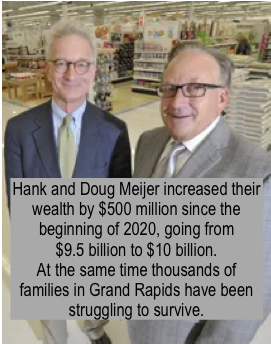 The Institute for Policy Studies (IPS) published their most recent findings on how the billionaire class continue to make massive profits during the current health crisis and while there is a national uprising against White Supremacy.
America’s billionaires saw their wealth increase by 20%, or $584 billion, roughly since the beginning of the pandemic, as 45.5 million Americans lost their jobs and the economy cratered.
The findings from IPS also state:
“This orgy of wealth shows how fundamentally flawed our economic system is,” said Frank Clemente, ATF’s executive director. “In three months about 600 billionaires increased their wealth by far more than the nation’s governors say their states need in fiscal assistance to keep delivering services to 330 million residents. Their wealth increased twice as much as the federal government paid out in one-time checks to more than 150 million Americans. If this pandemic reveals anything, it’s how unequal our society has become and how drastically it must change.”
Most people are familiar with the Jeff Bezos and the Bill Gates of the world, both of which made billions in the last three months. Jeff Bezos made $43 billion during the last three months and Bill Gates made $11 billion during that time, despite the fact that millions of people across the US are unemployed, are facing eviction and don’t know what the immediate future holds in the face of the COVID-19 pandemic.
One of the wealthiest families in Michigan is also on that billionaire list – Hank & Doug Meijer. According to the Forbes Richest list for 2020, Hank & Doug Meijer are the 173rd richest people in the US. The wealth of the two Meijer brothers has increased by $500 million since the beginning of the year. Imagine making $500 million over the past 6 months. Just let that sink in for a moment.
Now consider this, what if that $500 million that Hank & Doug Meijer made in the past 6 months went to the families in Grand Rapids that are experiencing poverty? The thousands of families in this community would have enough money to pay their mortgage, their rent, purchase healthy food, take care of the health care costs, pay for utilities and have plenty left over. This would still leave Hank & Doug Meijer with $9.5 billion. Now, in what world is this kind of wealth justified when so many people are struggling to survive? Another world is possible!
Grand Rapids Police Officers Association releases statement against the calls for Defunding the GRPD
 On Thursday, the Grand Rapids Police Officers Association (GRPOA) released a statement that is a clear sign of push back against the national and local public calls for defunding the police.
The 2-page document clearly demonstrates that the GRPOA is pushing back against any and all calls for DeFunding the GRPD.
The GRPOA statement begins by saying that they acknowledge that people are frustrated by “recent incidents.” Of course the cop union doesn’t want to state clearly that the “incidents” are the police murder of black people around the country. The GRPOA statement does give a vague objection to police engaged in “criminal acts,” but they just don’t seem able to say they opposed police killing black people.
The statement says that there are probably plenty of people who are frustrated, particularly those who live in neighborhoods with an increase in “violent criminal activity.” Again, the GRPOA statement is vague, since they won’t mention which neighborhoods in Grand Rapids are experiencing an increase in “violent criminal activity.” The statement then goes on to say:
“Please be clear, the residents mentioned above, who continue to call the GRPD for help will be disparately impacted in the GRPD is defunded.”
This sentence is clearly meant to confuse and intimidate people who live in core city neighborhoods and those who are calling for the Defunding of the GRPD.
The statement then goes on to say that most of the calls are for returning to the City Charter guaranteed 32% of the City budget for the GRPD, which is just not accurate. Two days ago, Grand Rapids Commissioners said they had received 2,500 e-mails to Defund the GRPD, but at least half of those e-mails came from the Together We Are Safe campaign to Defund the GRPD, which is not only calling for a total defunding of the GRPD, but a re-direction of the money that currently goes to the GRPD to go to black and brown communities, and they would have control over how that money is allocated.
The GRPOA statement then tries to convince us that a serious reduction in their budget will mean that cop numbers will be reduced (that is the point of defunding) and that certain investigative units would be negatively impacted.
Near the end of their statement they provide some “data” on violent crime in Grand Rapids, which is again designed to make us all believe that the only way to deal with violence is to have cops. We posted an article that looks at all kinds of models for community safety that doesn’t rely on cops just a few days ago.
Also, in the midst of the violent crimes data, the GROPA slips in these two sentences:
We have also been experiencing consistent incidents when large groups have unlawfully been interfering with traffic in major intersections in our city. Further, these groups have interfered with and delayed responses to medical, fire and police emergencies in the vicinity of these intersections.
Here the GRPOA is clearly attempting to call out organized actions that have taken place in recent years, by numerous groups that use direct action and disruption as a tactic to disrupt business as usual. The GRPOA wants the public to think that organized protesters are a problem and are dangerous. This is complete nonsense and I believe that most people don’t buy this line of thinking at all.
The statement ends by saying that they are simply responding to an “outspoken minority” who wants to defund the GRPD. If the commissioners are admitting that they have received 2500 e-mails, just in the past 10 days, this is no minority. It is not often that city officials receive that level of communications from the public.
Defund the GRPD NOW!!!!
State Representative Lynn Afendoulis is crafting legislation that would classify rioting as Social and Domestic Terrorism
 On Tuesday, WZZM 13 ran a story about the recent riot in Grand Rapids, which focused on the property damage done, but failed to mention anything about the police murder of George Floyd or Black Lives Matter.
As we noted in a previous post, where local news media as changed the narrative around the recent and ongoing uprising against police violence against the black community, this most recent WZZM 13 story continues to value property over people.
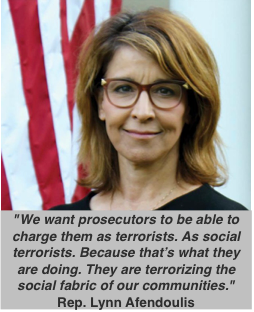
Rep. Lynn Afendoulis wants to push for harsher legal penalties for those involved in “rioting”, although the 73rd State House Representative did not clarify what she means by rioting. Afendoulis said, “We want prosecutors to be able to charge them as terrorists. As social terrorists. Because that’s what they are doing. They are terrorizing the social fabric of our communities.’’
This is the type of response we have come to know from Rep. Afendoulis, who announced last year that she was also running for the 3rd Congressional District. In announcing her candidacy for Congress, Afendoulis toured the US/Mexican border and made the statement that the US Congress and Justin Amash were not doing enough to support ICE.
It’s interesting that Rep. Afendoulis wants harsher legal penalties for people who break windows, yet doesn’t see how ICE agents destroy immigrant families, by arresting parents, throwing them in detention and then getting them deported. Apparently property destruction is an act of terrorism, but ICE repression that targets immigrants is just a form of law enforcement.
Of course, it is important to note that Rep. Lynn Afendoulis has been financially backed by numerous members of the Grand Rapids Power Structure, specifically Peter Secchia, the DeVos family, Mark Murray, the Haworth family and John Kennedy.
Supporting Rep. Afendoulis’ quest to craft legislation to further punish those who riot, is Kent County Commissioner Tom Antor. In the WZZM 13 story, Antor said, “I don’t think the penalty is strong enough for people that come in and riot.” In fact, Antor wants to go after people’s assets and make them pay for any property damages.
Besides supporting Rep. Afendoulis on classifying rioters as Social and Domestic Terrorists, Commissioner Antor also shares Rep. Afendoulis’s admiration for Immigration and Customs Enforcement (ICE). During Movimiento Cosecha GR’s campaign to end Kent County’s contract with ICE, Commissioner Antor was consistently in support of ICE and demonstrated nothing but contempt of the immigrant activists who wanted the County to end their contract with ICE. In fact, after one of the many anti-ICE actions, Antor used the same lies about undocumented immigrants that the Trump administration has used over the past four years, as we noted in an August 2018 story we wrote.
It is unfortunate that WZZM 13 provides both Rep. Afendoulis and Commissioner Antor a platform to seek harsher treatment of those who riot, yet do not hold them accountable for supporting state violence that is committed by ICE. However, this is what we have come to expect from the local news media, which has internalized the values of those in power.
Acton Institute says looting hurts the poor, but fails to cite one single person who is actually poor in their argument
The Acton Institute once again has it all backwards. Last week, one of their main writers, Rev. Ben Johnson, posted an article entitled, 6 ways looting hurts the poor.

The Acton writer provides a brief intro, before presenting his 6 arguments. However, he concludes the introductory comments with one accurate statement, where he says:
Looting and riots are sometimes presented as “a lashing-out against capitalism,” or even a form of reparations. But here are 6 ways looting most harms the poorest people.
The hyperlink that says reparations has nothing to do with reparations. In fact, the hyperlink is to a far right blogging site, that is explicitly anti-antifa. Rev. Johnson clearly dismisses looting as a form of anti-capitalism or reparations, and he just wants to get on with convincing us how looting hurts the poor.
Before critiquing the 6 arguments that the Acton writer presents, it is worth noting that nowhere in his article does Rev. Johnson cite someone who is poor or experiencing poverty. In fact, he only cites business people, elected officials and a religious leader.
Argument #1 – Looting deprives poor and minority communities of essential services. Politicians are cited and one unidentified woman, but no one who is actually poor or from communities of color is sourced in this argument. Rev. Johnson mentions food deserts and how people have to travel long distances to get food. Food deserts are a euphemistic term for Food Apartheid, which means that the lack of access to food for poor black or poor latinx residents is because of the the history of food systems that are based on profits, rather than on food justice.
Argument #2 – Looting drives away businesses and jobs. Rev. Johnson provides no real evidence to support this argument, only anecdotal references to the WalMart and Target stores that were looted in Minneapolis. Again, only politicians and business people are cited. What Rev. Johnson doesn’t mention is the fact that most of the items taken from the Target store in Minneapolis were then set up in a makeshift camp, where people who needed these items could take them. This is what many of us call a Really, Really, Free Market.
Argument #3 – Looting leads to a population drain. Again, the Acton writer has it wrong. He cites Detroit as an example, after the 1967 riot. The reality is that White people had been fleeing to the suburbs of Detroit way before the 1967 riot, because white people did not want to live with black people. It’s called White Flight. See the excellent book by Scott Kurashige, The Fifty-Year Rebellion: How The US Political Crisis Began in Detroit.
Argument #4 – Looting erodes the tax base. Here the Acton writer is just being ridiculous, since they argue that looting causes people to leave urban area, thus less money for city services. The reality is that cities services are primarily for white people and members of the Capitalist class. The only real city services that those living in poverty (which are primarily black and brown residents) receive are policing, which most often means policing that negatively impacts communities of color who are living in poverty.
Argument #5 – Looting causes long-term economic damage. Here Rev. Johnson is blaming looting for unemployment and the decline of the black family medium income. Again, the Acton writer lives in a world of deep racial and economic privilege, since unemployment and the decline in black family income is the direct result of structural racism and the wealth gap, which has been created by exploitation, tax policies and the re-direction of public money to the private sector.
Argument #6 – Looting makes the church’s job harder. Here Rev. Johnson cites a pastor in Chicago who wrote an article in publication, The American Conservative, which should tell you something about the pastor. Rev. Johnson obviously does not come from a liberationist view of the church, like that of the murdered Archbishop of El Salvador, Oscar Romero. Rev. Johnson comes from the hierarchical church, which spent centuries looting communities all around the world, as is documented in Eduardo Galeano’s book, Open Veins of Latin American.
As we have documented over the years, the Acton Institute acts as an apologist for the Neo-liberal Capitalism and its members, who are part of the business class and only see the poor as opportunities to practice charity. As the founder of the Acton Institute Rev. Sirico once said, when quoting Mother Theresa:
“We don’t have the right to condemn the rich. We don’t believe in class struggle and class warfare. We believe in class encounter. Where the rich save the poor and the poor save the rich.”
How did a third of the City’s Budget get designated to the GRPD: The Safety 95 Campaign and White fear in Grand Rapids
 The Clinton crime bill of 1994 introduced mandatory life imprisonment for persons convicted of a third felony in certain categories. It maintained the 100-to-1 disproportion in sentencing for crimes involving powder and crack cocaine, even though the US Sentencing Commission had concluded that the disparity was racist. It expanded to fifty the number of crimes that could draw the death penalty in a federal court, reaching even to crimes that did not include murders–the largest expansion of the death penalty in history. Pell grants giving prisoners an avenue to higher education were cut off. Federal judges were stripped of their powers to enforce the constitutional rights of prisoners and the power of states to set sentencing standards for drug crimes was greatly diminished.
The above comment is a summary of the 1994 Crime Bill, more formally known as the Violent Crime Control and Law Enforcement Act of 1994. This legislation, which was written by Senator Joe Biden, led to the massive incarceration of black and brown people, so much so that the US became the country with the highest percentage of civilians incarcerated in the world.
The Crime Bill passed under a Democratic Party leadership, using white supremacist fear-mongering as a tactic to get public support for the legislation. Not surprisingly, Grand Rapids took a page from the Crime Bill’s playbook, to not only get 95 more police officers added to the GRPD, they got voters to support a change to the City’s Charter to guarantee that 32% of the annual budget would be allocated to the Grand Rapids Police Department.
With the help of the wonderful people at the Grand Rapids Public Library, I was able to access much of the news coverage and material that was produced by the Safety 95 Campaign Committee, all of which you can view on the Grand Rapids People’s History Project site.
The Safety 95 Campaign Committee, was made up of 32 people, even though we have been unable to find out who most of them were. We do know that former Grand Rapids Mayor, Gerald Helmholdt and Ella Ramirez, who lost two sons to murder, were the Safety 95 Campaign Committee’s co-chairs, based on a story in the GR Press (page 7 of the 44 pages we have on the Safety 95 Campaign Committee) The campaign also hired David Doyle, who has run numerous ballot initiatives over the years in Grand Rapids and was the former director of Silent Observer in Grand Rapids.
Looking at the GR Press coverage, one can see that then Police Chief William Hegarty was a major source cited throughout the campaign. Rarely do we hear the voices of residents in Grand Rapids and even less from black and brown residents, even though the Chief Hegarty often cited urban crime as a major problem. There is included in the documentation (on page 14), a copy of a flyer that was in the Afro American Gazette, published in late February of 1995. This flyer, with the headline No Means No, dismantles the argument that the city needs more cops.
On page 8 of the collected documents, there is a GR Press article with the headline that reads, Crime drops as city asks for more police. The article also includes data showing that crime, particularly violent crimes had declined.
There was also an instructive article on page 16/17, which provided some information on who had made financial contributions to the Safety 95 Campaign. The article reveals that the Michigan Consolidated Gas Co. contributed $5,000 to the campaign, and Butterworth Hospital donated another $1,500. Other notable contributors to the campaign to get more cops and change the City’s charter to guarantee that one-third of the City’s budget automatically goes to the GRPD, were Mayor John Logie, City Manager Kurt Kimball and City Commissioners Linda Samuelson, Roy Schmidt and George Heartwell. Members of the Downtown Development Authority (DDA) also contributed, along with David Frey, one of the co-chairs of Grand Action.
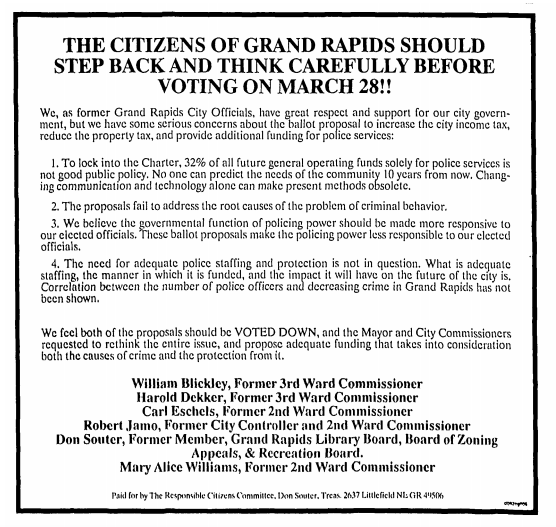
On pages 18/19, there is a GR Press article about six former city officials who opposed the need to add more cops to the GRPD. In addition, these six former city officials took out a paid ad (page 35) in the GR Press expressing their opposition to more police and to the change in the city charter, seen here below.
On page 20, the GR Press writes that the Grand Rapids police union was endorsing the tax increase, which would be used for an additional 95 cops.
Then on pages 37 – 41, there are examples of what the Safety 95 Campaign Committee were distributing, along with what the City of Grand Rapids was sending out to voters before the March 28, 1995 vote. So, not only did the Mayor of Grand Rapids and half of the City Commissioners contribute to the Safety 95 Campaign, the City used public money to encourage residents to vote for more police and to change the City Charter to solidify a third of the budget for the GRPD. Part of the language in the pamphlet that the City sent out before the vote included this:
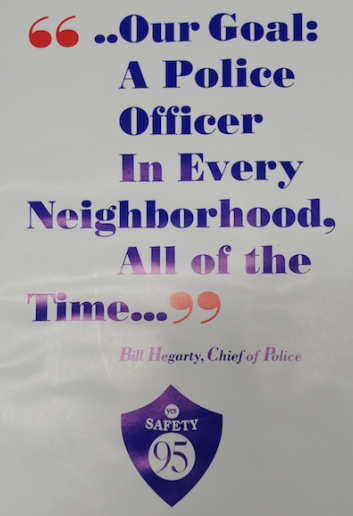 The Grand Rapids Police Department plans to assign officers to all of our neighborhoods all of the time. Police officers will be able to more promptly respond to calls; prevent and control neighborhood problems such as property thefts, disorderly youth, gang activity, drug violations, and traffic complaints; and work directly with neighborhood associations, block clubs, and neighborhood schools.
According to a GR Press story from March 29 (page 43-44), 18.9% of the City’s voting population turned out, with the income tax increase passing by more than 2,000 votes, but the charter change barely passing by a margin of 804 votes. One of the reasons that these two ballot initiatives passed, especially the income tax increase initiative, was because property taxes would be reduced by 2 mills over two years. We know that home owners vote at a higher percentage than those who rent, which is what the Safety 95 Campaign Committee was banking on.
Therefore, it seems that Safety 95 Campaign Committee was using the same fear tactics that got the Crime Bill pass just a few short months before Grand Rapids was asked to vote. Add to that the financial incentives offered to home owners, along with City officials endorsing the campaign and using public money to turn out the vote, and you have a solid formula. White fear, white privilege and white liberals were used to solidify more cops and more funding for the GRPD, so they could primarily patrol black and brown neighborhoods, thus protecting white lives. This is how it is done in Grand Rapids.
 The Movement for Black Lives has recently created a wonderful toolkit for communities that are considering a campaign to defund their police.
This is a powerful resource, which not only provides very practical and useful tactics and strategies for actually defunding police departments, it provides great examples of what other communities are doing. In addition, their analysis is rooted in the lived experience of the black community, which is reflected in the introduction of the toolkit:
#DefundPolice is a demand that has gained popularity in response to recent police killings of George Floyd, Breonna Taylor, and Tony McDade. It is rooted in the failure of decades of commissions, investigations, police reforms, and oversight to prevent their deaths.
It is also a response to the fact that, in the face of a pandemic and the most devastating economic crisis of a generation, in which cities, counties, and states are experiencing drastic losses in revenues, many life-saving programs are on the chopping block while o cials increase or maintain police budgets.
It is a demand to #DefendBlackLives by shutting o resources to institutions that harm Black people and redirecting them to meeting Black communities’ needs and increasing our collective safety.
#DefundPolice is a demand to cut funding and resources from police departments and other law enforcement and invest in things that actually make our communities safer: quality, affordable, and accessible housing, universal quality health care, including community- based mental health services, income support to stay safe during the pandemic, safe living wage employment, education, and youth programming. It is rooted in a larger Invest/Divest framework articulated in the Movement for Black Lives’ Vision for Black Lives.
#DefundPolice is a strategy that goes beyond dollars and cents—it is not just about decreasing police budgets, it is about reducing the power, scope, and size of police departments. It is about delegitimizing institutions of surveillance, policing and punishment, and these strategies, no matter who is deploying them, to produce safety. It is a strategy (part of the HOW) to advance a long term vision of abolition of police through divestment from policing as a practice, dismantling policing institutions, and building community-based responses to harm, need, and conflict that do not rely on surveillance, policing and punishment.
Please, share this toolkit as a valuable resource in your community and help us to Defund the GRPD!
In the past week, Together We Are Safe, along with partner groups Movimiento Cosecha GR and GR Rapid Response to ICE, have initiated a Defund the GRPD campaign.
As of this writing we have had 1,200 people send letters to Grand Rapids City officials, thus demonstrating that Defunding the GRPD has significant support as a political goal.
Of course, it is important to note that the Defund the GRPD campaign consists of three major components:
- First, to do away funding the GRPD, which in 2019 received $54 million, roughly 37% of the City’s budget
- Second, by defunding we mean the abolition of the GRPD, which is fundamentally different than a reformist position
- Third, redirecting an equivalent amount of Grand Rapids taxpayer that goes to the GRPD, to fund those most affected by GRPD intimidation, harassment and violence, where those most affected would make the decisions about how this money would be used.
While there has been significant support for the Defund the GRPD campaign in the first week, there are also plenty of people who have trouble imagining a world without the GRPD. This is understandable, since none of us have ever experienced Grand Rapids without the police. So what would Grand Rapids look like without the GRPD and what needs to happen in order to achieve that goal?
Those of us who have been promoting the Defund the GRPD campaign are not naive and we recognize how hard it will be to not have the GRPD. However, we also believe in radical praxis and radical imagination.
Together We Are Safe already encourages people to not call the GRPD when there is a conflict or a problem in the community. They distribute a two-page document that provides reasons why not to call the GRPD and then provides other valuable resources in the community that would more effectively respond to the conflicts in our community. When the GRPD becomes involved in conflicts, it only increases the possibility that the conflict will escalate.
So what are alternatives to having heavily armed cops in our neighborhoods, which often result in a disproportionately large number of black and brown residents going to jail?
One major alternative is an integral part of the Defund the GRPD campaign, which is the divestment/investment component. If the $54 million a year were to go to uplift residents most impacted by the harm the GRPD does, imagine how much those residents/neighborhoods could benefit from that kind of funding. With $54 million infused into communities harmed by the GRPD, the result would almost certainly result in reducing conflict and crime, thus reducing the need to have cops.
However, a divestment/investment strategy is not enough. In Zach Morris’s book, We Keep Us Safe: Building Secure, Just and Inclusive Communities, he acknowledges that we live in a failed state. What Morris means by a failed state, is that too many people do not have their basic human needs met – housing, health care, food, transportation, child care, employment/wages. The result is the Prison Industrial Complex, the War on Drugs, Gentrification, a health care system based on profits over human needs, a dysfunctional transportation system and employment that is based on exploitation. One powerful example of how the failed state impacts black people, is this statement from Prison Abolition group Critical Resistance.

What We Keep Us Safe advocates, in the face of a failed state, is a care-based strategy for public safety that overturns more than 200 years of fear-based discrimination, othering, and punishment. In addition, the book:
“We Keep Us Safe is a blueprint of how to hold people accountable while still holding them in community. The result reinstates full humanity and agency for everyone who has been dehumanized and traumatized so they can participate fully in life, in society, and in the fabric of our democracy.”
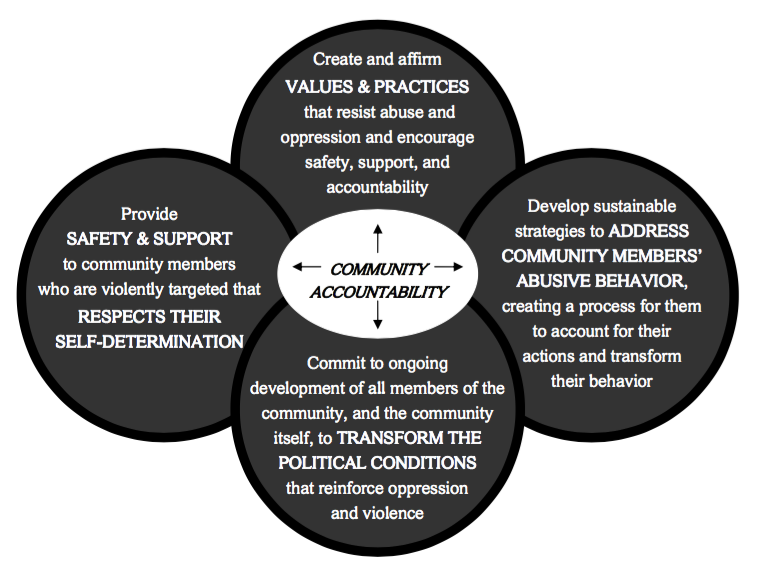
In addition to ideas and examples provided in We Keep Us Safe, there are other very practical ways that people can practice community safety. One solid resource is an anti-racist neighborhood watch manual that was developed by people in Portland Oregon. This 31 page manual provides great practical resources and application around community safety, specifically that are anti-racist. In some ways, this manual builds on the work of the Black Panther Party for Self Defense, which was essentially about responding to the ongoing police harassment and violence directed at black communities across the country.
Another great resource, which was produced by the Women of Color group, INCITE!, is a 121-page toolkit that focuses on why calling the police is especially problematic for women of color and trans people of color. This toolkit also covers the following areas:
- Gender Policing
- Immigration Enforcement
- Cops in Schools
- Policing Sex Work
- The War on Drugs
- Police Violence and Domestic Violence
- Law Enforcement Violence and Disaster
A second major section of the toolkit, provides great examples of practicing community safety from several organizations. This toolkit is a must read and resource for people who want to practice community safety, plus it is a great resource to help us all radically imagine how life could be without the cops.
Lastly, I think it is worth quoting from the final page of the book, We Keep Us Safe:
“Real safety happens when we bridge the divides and build relationships with each other, overcoming suspicion and distrust. Real safety comes from strategic, smart investment – meaning resources directed towards our stability and well-being. Real safety addresses harms that the current system is failing to tackle, and holds people accountable for those harms while still holding them in community. Real safety results from reinstating full humanity and agency for everyone who has been dehumanized and traumatized, so they can participate fully in society. If we are able to transform our old system and create a culture of caring and healing in its place, we may have an actual shot at creating real democracy for the first time.”
 Transparency is rare with the members of the Capitalist Class, and the DeVos family is one family that doesn’t like to share it personal wealth.
However, when one of the members of your family happens to be part of the federal government, then there are some requirements about divulging your personal wealth. Based on the documentation that Secretary of Education Betsy DeVos was legally required to submit, we get a closer understanding of how much her wealth grew in 2019.
According to research by the group Citizens for Responsibility and Ethics in Washington (CREW), Betsy DeVos expanded her personal wealth by at least $50 million in 2019, but quite like by more than $100 million. According to CREW:
It is possible that DeVos earned significantly more than $100 million in 2019 because she is not required to specify amounts received from particular assets above $1 million for her spouse or amounts above $5 million for herself. In her most recent disclosure, DeVos reported income from 11 sources that exceeded $1 million or $5 million without specifying the actual amount received.
If you look at the 77-page document submitted by Betsy DeVos, you can see exactly what the researchers at CREW were talking about in regard to the vagueness surrounding assets that Betsy and her husband Dick DeVos have.
Many of us who have followed the DeVos family closely over the years are aware of assets such as Alitcor, RDV Corporation, The Windquest Group, RDV Sports, The Stow Company, Boxed Water and Neurocore, but there are dozens of asset entries that are not as familiar.
Betsy DeVos has assets in numerous Grand Rapids and Holland real estate entities, such as DBD Properties LLC, Ada Holdings LLC, 130 Central Avenue LLC, 139 River Avenue LLC and Holland Property Holdings LLC, just to name a few.
Then there are some assets that she has investments in, such as CWD 111 Lyon LLC and DWD Urban Fund, both of which show that she has over $1 million in assets. Again, this is rather vague, because it could mean multiple millions in those assets.
Betsy DeVos also lists assets with GR Michigan Street Holdings, 50 Monroe II LLC, Northside Entertainment Holdings and the Bridge Street Capital Fund.
Now, it should come as no surprise that people who are part of the federal government are personally worth a disgusting amount of money. OpenSecrets.org provides us with the personal wealth of those in Congress, where we find that the Speaker of the House, Nancy Pelosi, is worth $114 Million.
However, the personal wealth of those who claim to be working for the public, should be a major issue and a major concern, especially in light of the fact that the wealth gap between the super rich and everyone else has grown at a staggering rate over the past 20 years.
Lastly, it is rather troubling that none of the West Michigan news outlets have reported on the matter of the growth of Betsy DeVos’ personal wealth while serving as Secretary of Education, especially since so much of her wealth is tied to this community. We need the kind of journalism that will not hesitate to provide a detailed accounting of those who are members of the Grand Rapids Power Structure, in order to be able to effectively organize against those with tremendous economic and political power in West Michigan.
If Grand Rapids really wanted to promote anti-racism and equity, then they would embrace Defund the GRPD
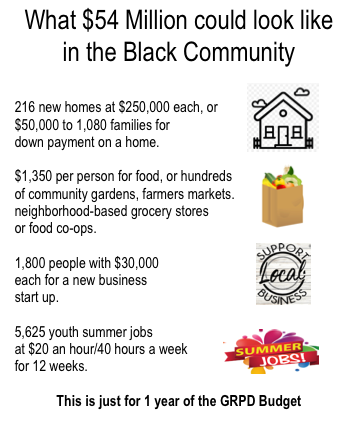 Grand Rapids has a population of 201,013 in 2020, based on current census data, with African Americans making up 19%, which is just under 40,000.
So, what would it mean if 40,000 African Americans could decide what to do with the annual GRPD budget of $54 million? Now, that is completely up to those in the African American community. However, that doesn’t prevent us from looking at numbers, just to provide some idea of what kind of impact the current GRPD budget money could do to benefit the black community.
One could call this is a form of reparations to the black community or we could call it what the Vision for Black Lives calls a strategy of Divestment/Investment. Whatever, we call it, this amount of money, which is just one year of the current GRPD budget, would actually go a long way to creating racial justice and equity in a city that constantly claims to promote racial and economic equity.
If we distributed $54 million equally amongst the black community, that would mean that every black person, of the 40,000 in Grand Rapids, would receive $1,350. What about housing. How many new homes could $54 million build? Ok, so lets say that a new house would cost $250,000, it would translate into 216 brand new homes for black families. How about $50,000 to every black family to use as a down payment for a home? This would allow 1,080 black families a chance to purchase a home.
What about food? $54 million could buy a lot of food, but it could also create opportunities for black people to create thriving fresh food dynamics in neighborhoods where Food Apartheid exists. This could mean dynamic community gardens, robust farmers markets, community based grocery stores or food co-ops, and it could mean creating community based kitchens, where food can be prepared collectively, shared collectively and preserved collectively.
Then there is the issue of re-directing funding from the GRPD that the black community could be used to start local businesses. $30,000 for a business start up is significant, and $54 million would provide 1,800 people will $30,000 to start their own business.
The City of Grand Rapids says they want to work with the business community to “increase summer job opportunities for youth.” This is a rather vague notion, but if the $54 million was redirected to create jobs for black you, that could mean providing summer jobs to black youth – at $20 an hour & 40 hours a week, for 12 weeks, which is $9,600. The annual GRPD budget of $54 million could provide 5,625 black youth summer jobs making $20 an hour.
Of course, these are just a few examples, based on looking at the numbers. Equally important would be how this amount of money could radical improve the lives of the black community – physically, emotionally and psychologically. If Grand Rapids is truly committed to racial and economic equity, then there doesn’t seem to be a strong argument for NOT Defunding the GRPD.
They are going to do what they want: Grand Rapids, the GRPD and the illusion of Democracy
 Over the past few years, many of us who have been involved with Movimiento Cosecha GR and GR Rapid Response to ICE, have attended many city and county commission meetings. One thing has been clear at those meetings, that despite our collective efforts to demand clear policy changes, the city and county commissioners have refused to not only take us seriously, they have been unwilling to adopt the policy demands we have worked on.
In many ways, these commission meetings are a facade and a shallow form of democracy. I have never left these meetings feeling like the system works. Fortunately, many of us do not put much faith that these systems of power will do what we are asking, but they do respond to lots of public pressure, disruption and direct action.
This brings us to the most recent Digital TownHall on Policing, which was hosted by the City of Grand Rapids on Wednesday. However, before discussing that forum, it is important to provide some context.
The actions of the GRPD have been under constant public scrutiny, especially from the black and latinx communities, for numerous years. The City of Grand Rapids likes to think that they are progressive on community/police relations, but this has not been the experience of many who continue to witness or be the targets of harassment, intimidation and harm at the hands of the GRPD.
Over the past few weeks, hundreds of thousands of people have taken to the streets to protest police brutality, in light of the murders of several black people, the most recent being George Floyd. On May 30, there was a large rally/march in Grand Rapids centering on the lived experience of black lives and police violence. Despite the commercial media coverage and the claims of the City of Grand Rapids, the GRPD has been on the offensive, attempting to limit public dissent, using tear gas, physical force and even bringing in the National Guard at one point.
Over the past two weeks there have been actions in the streets demanding everything from the demilitarization of the GRPD, greater mechanisms of accountability for the GRPD and a call to abolish the GRPD, specifically through the Defund the GRPD campaign.
In fact, the DeFund the GRPD campaign, which began on Monday, is fast approaching 1,000 signatures. Yesterday, I received the following message from a staff member from Mayor Bliss’s office, stating:
Thank you for your email to Mayor Bliss’ office. We appreciate your engagement as the Mayor does appreciate hearing your thoughts and recommendations. As you can likely imagine, we are hearing from hundreds of people throughout the community about ways to move forward and how best to implement police reform and eliminate systemic racism. I assure you that the Mayor is committed to closely examining each idea and recommendation and then moving forward with meaningful action.
This vague and weak response has been indicative of what many who have been organizing to expose and fight the actions of the GRPD have experienced. On Wednesday, the City of Grand Rapids held a Press Conference in the afternoon, where the City Manager, the Office of Oversight & Accountability, and the Chief of Police, all presented information on what the City is doing to address what they referred to as equity, racial justice and police reforms.
You can read the list of things that the City said they would be doing, most of which set a rather low bar for any substantive changes. For example, the GRPD will no longer shoot at moving vehicles or engage in the practice of chokeholds. Gee, thanks. This list also includes lots of vague language or language that provides plenty of wiggle room for the GRPD to do whatever they want. For example, one point states, “Require officers to exhaust all other reasonable alternatives, including non-force and less-lethal force options, before resorting to deadly force.” Who exactly gets to determine when deadly force can be used? We have all seen this dynamic before. The police pull their guns, people react, then the police brutalize someone because they “felt threatened,” etc. It all comes down to the word of the GRPD vs the public, and how many times in this dynamic has the GRPD got off without any real consequences?
The Press Conference, along with the pre-determined “changes” were designed to undermine real public input. In fact, the Digital TownHall on Policing began with City Manager Mark Washington providing an overview of these “changes.” Now, people could call in or post comments on the Facebook and Youtube pages, but did people who called really feel like their voice was heard? This was especially the case when people were directly challenging the City and the GRPD about police actions since May 30 or on larger issues, such as the amount of the City’s budget is dedicated to the GRPD or the Defund the GRPD campaign. Everyone from the City, the City Manager, the Office of Oversight & Accountability, and the Chief of Police, all of them had the power to respond to comments, to minimize them, or to ignore them. They even had a slide up saying that the City Charter requires that 32% of the City’s budget be allocated for the GRPD. However, they failed to mention that the City Commission could vote to amend the City Charter on this matter, if they wanted to.
In addition, the City Manager, when responding to the Defund the GRPD position, made the case that the City needed to increase funding for the GRPD because of all of the overtime that cops have been logging. In many ways, this response was a way of giving the public a big middle finger.
I sat through both the Press Conference and the Digital TownHall on Policing with an empty feeling in my stomach. Once again, people who challenged the system were dismissed, minimized or ignored. However, we have seen this kind of response before, which means that our resistance to the White Supremacist practices of the GRPD and the City of Grand Rapids will need to escalate. There is important work to be done and lots of groups doing the work on the ground. As in any struggle, the question we always ask is, which side are you on?

