 Last week, we wrote about the importance of having a Defund the GRPD campaign.
This week a Defund the GRPD campaign was begun by the group Together We Are Safe, with support from Movimiento Cosecha GR and GR Rapid Response to ICE.
The push to defund police departments is part of a larger conversation around the role of policing in the US. There is tremendous potential and lots of political openings right now, allowing for more radical imagination and revolutionary praxis.
The Defund the GRPD campaign is gaining lots of traction, especially since the campaign is not only calling for Defunding the GRPD, but for black and brown communities to decide how the money that has been going to the GRPD can be used to benefit their communities. This strategy of Divest/Invest, is exactly what the Movement for Black Lives has been calling for since 2014.
Another component of Defunding the GRPD campaign should also include information about how the police union in Grand Rapids, the Grand Rapids Police Officers Association PAC, has been working to influence public policy, by making financial contributions to Grand Rapids area elected officials and candidates.
It is critical that we Defund the GRPD, but it is also important to pressure candidates to NOT take money from the Grand Rapids Police Officers Association PAC and to NOT vote for candidates that accept money from the Grand Rapids Police Officers Association PAC.
What follows below is a list of candidates that the Grand Rapids Police Officers Association PAC has contributed to and the amount, based on campaign finance data from the Michigan Secretary of State’s office.
One thing that is interesting about this list is that, for all of the partisan candidates, all of them, except Kevin Green and Robert Regan, are Democrats.
October 2019
- Wendy Falb $5,000
July 2019
- Wendy Falb $5,000
April 2019
- Jon O’Conner $5,000
- Winnie Brinks $500
- Carol Hennessy $250
October 2018
- Alida Bryant $2,000
- Blair Lachman $1,500
- Phil Skaggs $500
- Carol Hennessy $250
July 2018
- Blair Lachman $2,000
- Winnie Brinks $1,500
January 2018
- Winnie Brinks $1,000
October 2017
- Kurt Reppart $1,500
April 2017
- Phil Skaggs $250
January 2017
- David Allen $1,000
- Jon O’Connor $1,000
October 2016
- David LaGrand $500
- Deb McNab $250
April 2016
- Winnie Brinks $1,000
- Chris Becker $1,000
October 2015
- David Allen $2,500
- Winnie Brinks $500
- David LaGrand $500
- Rosalynn Bliss $500
July 2015
- David Allen $2,500
- David LaGrand $1,000
April 2015
- Rosalynn Bliss $2,500
- Brandon Dillion $250
February 2015
- Jon O’Connor $1,000
October 2014
- Winnie Brinks $500
July 2014
- Kevin Green $250
- Robert Regan $250
- Brandon Dillon $200
April 2014
- Brandon Dillon $500
- Dan Morse $250
February 2014
- Matthew Janiskee $1,000
For those interested in finding out which politicians in other communities have taken money from police unions, check out the resource, No More Cop Money.
 Politicians have made all sorts of public comments over the past week, as the country has erupted into mass protests against the police murder of black people.
In Michigan, the comments from elected officials has been fairly consistent with those across the country. State Rep. Thomas Albert (R), who represents the 86th District, which includes part of Kent and Ionia Counties, stated the following:
“The death of George Floyd was a horrific tragedy and justice must be served. While I understand and respect anyone who wants to demonstrate peacefully to bring attention to this injustice, it is discouraging that what was clearly intended to be a peaceful protest quickly devolved into a riot instigated by extremists with an anarchist ideology.”
First, it is instructive that Rep. Albert did not state that George Floyd was murdered by a police officer. However, the more revealing comment from the Republican legislator was his comment that he can respect people if they protest peacefully, but that those who instigated the riot were “extremists with an anarchist ideology.” Albert is doing the exact same thing that we wrote about yesterday, by trying to create a dichotomy about how people should respond when the police murder black people. Albert then adds that the riot was instigated by those with an anarchist ideology. I seriously doubt that Rep. Albert has any real understanding of anarchist principles and practices, but for the State Representative, that doesn’t matter, since he just wanted ton associate rioting with anarchism, thus marginalizing those who embrace anarchist values.
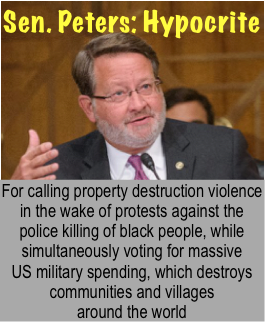
On the same day, Michigan Senator Gary Peters, made a similar statement, along with fellow Senator, Ron Johnson, from Wisconsin. Both Senators stated:
Over the past few days, we have witnessed widespread protests across the country. The vast majority of protestors are exercising their First Amendment rights to protest systemic injustice and demand change. Unfortunately, a small number of violent actors—reportedly anarchists and other violent opportunists—have taken advantage of the moment to commit violence and destroy property.
Both Peters and Johnson make the same link as Rep. Albert, by linking anarchism with violence. In this case, the statement isn’t just about Grand Rapids, but protests that have taken place across the country.
One significant difference between the statement from State Rep. Albert and Senator Gary Peters, is that Peters sits on the Armed Services and Homeland Security & Government Affairs Committees. Senator Peters has also consistently voted to approve the annual US Department of Defense Budgets, which means he supports US Militarism and Imperialism abroad.
It seems a bit hypocritical to condemn property destruction in protests directed at the police killings of black people and then approve a $750 billion US military budget (2019), which we know is used to destroy communities and villages all around the world. However, the public is not likely to see Senator Peters called out for this kind of hypocrisy, since most commercial news outlets believe that the US military is a force for good, much the same way they associate police departments and public safety.
 Over the past week, Grand Rapids, like many cities around the country, has seen an incredible outpouring of collective anger directed at the state and in particular, police departments.
The most resistance started in Minneapolis, after someone filmed a cop murder George Floyd. The collective anger in Minneapolis took on many forms, with a growing critique of police brutality, White Supremacy, State violence and the Neo-Liberal Capitalism.
This collective rage then spread across the country, in dozens of cities, even in Grand Rapids. Last Saturday, thousands of people converged on Grand Rapids, demonstrating against state violence, first with an informal rally, then a march and later an uprising that resulted in property destruction and an escalation of GRPD violence.
The City of Grand Rapids then responded by imposing a curfew and bringing in heavily armed soldiers in the form of the National Guard. Since then, the commercial news media and the City of Grand Rapids has hijacked the public narrative to the police murder of George Floyd and so many other black people.
The narrative is now framed around whether or not the resistance or the protest is peaceful or not. This re-framing of the collective rage against police violence was highlighted last week, when the Grand Rapids Police Chief and other local law enforcement officials took a knee during one of the protests, even going as far as saying, “Black Lives Matter.”
Over the past week, the most common reference in both the general narrative and often in news headlines was the phrase “peaceful protest.” But what exactly does such a phrase mean? It is important for us to us-pack what peaceful protest means and why it is such a problematic phrase.
First, it is important to come to terms with the use of the word peace, which for many people means the absence of conflict. If we think about peace in terms of a protest, then we have to ask ourselves if there is no conflict. The very nature of a protest, whether we are talking about climate change, US militarism or police violence against black people, there is always an inherent conflict. People protest because some injustice has occurred, because they want to express some grievances, grievances often directed at the very institutions were are at the heart of the conflict. Therefore, we can conclude that a protest cannot be peaceful, since there indeed is a conflict.
Second, it is important that we frame the issue of racism, White Supremacy and the police murder of black people through the lens of power. Systems of power, like police departments, have the backing of the legal system, the political system and propaganda systems like news media, popular culture and schooling, all of which present a general narrative that police are necessary and most of them are “good.” All of these systems of power protect and legitimize police and policing. However, police departments are one clear example of structural violence, which we are conditioned to not think about. As Alex Vitale, author of the book, The End of Policing, states:
Well-trained police following proper procedure are still going to be arresting people for mostly low-level offenses, and the burden will continue to fall primarily on communities of color because that is how the system is designed to operate – not because of the biases or misunderstandings of officers.
Third, the presence of police at a protest, means there are people with guns, tasers, mace, clubs, tear gas, rubber bullets and a whole range of other high tech weapons. As anyone who has ever participated in a protest knows, it doesn’t take much for the police to use any number of these weapons. In fact, one could argue that the police are looking for a reason to use such weapons. However, even if they don’t use these weapons, there is always the threat of their use, which means that whenever cops are at a protest it CANNOT be peaceful.
Fourth, calling a protest peaceful, when protests are anything but peaceful, is a way for the system(s) to dictate the narrative about what is happening. When the police say a protest was peaceful, they mean that those protesting obey their orders, did nothing to disrupt business as usual and often it means that protest organizers cooperate and even collaborate with the police. In fact, one could argue that if this happens, then it is not really a protest, instead it becomes a performance. Such forms of “protests” are almost always organized by white liberals to make other white people feel good about themselves, without having to interrogate systems of power and oppression.
Lastly, the GRPD Chief of Police taking a knee during a protest against police killings of black people does nothing more than make a mockery of the countless number of people who are now in the streets, AND, it insults the memory of the black people who have been murdered by cops.
Protest, Tactics and Strategies
Peter Gelderloos, in his important book, How Non-Violence Protects the State, makes this observation:
“Non-violence in the hands of white people has been and continues to be a colonial enterprise.”
Now, it is important that we think about the phrase, “non-violence in hands of white people.” White people have the luxury of organizing peaceful protests, because they generally don’t have to worry about suffering the full force of the state – cops, courts, prisons, etc. White people can preach non-violence, because they often don’t want to disrupt business as usual, since they are the primary beneficiaries of law and order.
At this point, some people will say, but didn’t Dr. King advocate non-violence? Yes, he did, but Dr. King understand the tactical and strategic value of using non-violence to disrupt business as usual – whether it was a boycott, a strike, shutting down roads or engaging in civil disobedience.
However, it is equally important for us to come to terms with the fact that using force, property destruction or armed self-defense can also be employed as tactics and strategies in the struggle for freedom. There have been numerous insurrectionary movements, both in the US and around the world, that have used insurrectionary tactics and strategies to obtain their goals, such as the Black Panther Party for Self-Defense, the Deacons for Defense, the American Indian Movement, the Zapatistas or the African National Congress. The point here is that all forms of protest should be examined and people should not be judged based upon the tactics and strategies that they use.
The State will always use force and violence to maintain order, to maintain business as usual, which really means they will use force or the threat of force to maintain White Supremacy, Capitalism, homophobia, Patriarchy and ecological destruction. What we have to decide is how we will resist such injustices and what tactics/strategies we will use in the process.
New Zines for the current political climate
 Just wanted to let people know about a couple of new zines that have been produced, one is specific to Grand Rapids, while the other one addresses an issue that has been raised over and over again in the past week as a result of the national uprising over police killings of black people.
The first zine, entitled, The Monsters We Know: A Brief overview of the racism and abuse of power of the GRPD, is a great 2-page zine that provides a quick overview of some recent cases where the GRPD abused their power, particularly with black and brown people in Grand Rapids. The zine was produced by the West Michigan Anarchist Federation and can be downloaded at this link.
The other zine, entitled, The Outside Agitator Myth, is a 31-page zine that provides excellent analysis and history around this idea that protests only “get out of hand” because of outside agitators. Such a claim is always meant to discredit actions or uprisings, and this myth can be used to diminish solidarity amongst those engaged in dissent. This zine can be downloaded at this link.
Zines are a great way to share information and radical ideas. For people who want help spread the word about radical zines, we encourage everyone to check out Sprout Distro, which has an excellent collection of zines, covering a wide range of topics.
How the local Commercial News Coverage has Hijacked the narrative around Black Lives Matter protests in Grand Rapids
 Critical analysis and media literacy are essential for moments like these, especially when marginalized black voices are pleading with the rest of society to listen and learn.
This urgency around critical thinking is particularly important as it relates to news coverage, especially since most news coverage we consume is commercial, with tremendous financial pressures, along with the fact that news rooms, news executives and editors are dominated by white people.
Therefore, I thought it would be useful to look at how 4 of the largest daily news sources in Grand Rapids have been reporting on the protests in town since Saturday, May 30 through the June 3rd protest in Grand Rapids. This is only 5 days of coverage, but it can tells us a great deal about how the commercial news media has been framing the protests and how they influence public perception, particularly white consumers of local news media, which are still the majority in West Michigan.
The number of stories we tracked were 22 from MLive, 23 from WOODTV8, 19 from WZZM 13 and 33 from WXMI 17.
In a media saturated world, it is well documented that people will often not go beyond the headlines, so we looked at all of the headlines from each of these news sources during the 5 day period.
Headlines
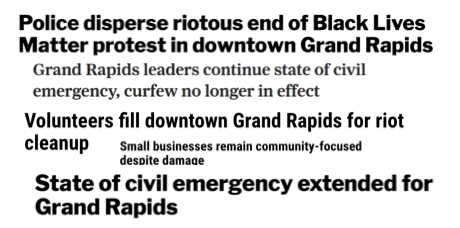
The MLive headlines had several themes, but out of the 22 MLive stories we looked at, there were only two with the words Police Brutality in it, compared to 14 headlines with the word Riot in it. WOODTV8 has 14 headlines with the word Riot, with not one headline that had the words Police Brutality. WZZM 13 had 4 headlines with the word Riot, along with others focused on property destruction or violence, but not one that had the words Police Brutality in the headline. WXMI 17 had 14 headlines with the word Riot, but none with the words Police Brutality.
Right away this should tell us something about how powerful language can be used to mold public perception. There were also lots of headlines from all four news sources that used the word Peaceful, but such a term is often also misleading, since it doesn’t provide a larger contextual framework. For instance, there were several headlines using terms like curfew and National Guard, but never referring to them as “violent,” even though the presence of the National Guard, the GRPD – both of which are heavily armed – and the imposing of curfews, would be considered violent by many.
I mean, the use of the term peaceful in this recent coverage is exclusively centered around public behavior, but not institutional behavior. Consider all the stories of the GR Police Chief and other cops kneeling with protestors. If protesters had sidearms they would not be considered peaceful, but cops and members of the National Guard can have guns, tasers, mace, clubs, etc., and that is not seen by many and certain not by the media as an expression of violence.
Each of the four commercial news sources we looked at also had stories that about the GRPD setting up an online portal for people to submit information, pictures and video in order to arrest people involved in last Saturday’s protest. Why did the commercial news media feel the need to report on this, if it were not for the fact that they agree with the same principles of “law and order” that the GRPD promotes.
In addition, each of the four commercial news sources we looked at, had multiple stories about either the “cleanup” or businesses that were impacted from any property destruction last Saturday night. MLive has 4 of such stories, WOODTV8 had 6, WZZM 13 had 2 and WXMI 17 had 9 stories that centered around the organized clean up or business impacted from last Saturday.
Sources cited
Who the news media talks to is important, since it centers some voices over others. Media Watchdog groups like Fairness & Accuracy in Reporting have been documenting how news sources influence our understanding of issues and events. GRIID has been doing some of the same kind of work, looking at the Grand Rapids news market, so we are familiar with how central sources are to the overall narrative of news stories.
In the MLive stories we looked at during the 5 day period, we found the following sources cited:
- Government officials – 12
- GRPD – 11
- Downtown Business owners/employees – 11
- Protesters – 7
- Those assisting with the clean up – 3
- Residents opposed to “vandalism” – 2
WOODTV8 sources cited:
- Government officials – 15
- GRPD – 14
- Downtown Businesses – 7
- Those assisting with clean up – 7
- Protesters – 6
- Urban Leaders – 2
- Former cop – 1
- Mother of cop – 1
- Resident who witnessed 1967 riot – 1
WZZM 13 sources cited:
- Government officials – 12
- GRPD – 10
- Protesters – 10
- Urban Leaders – 2
WXMI 17 sources cited:
- Government officials – 14
- GRPD – 10
- Those assisting with clean up – 7
- Downtown Businesses – 6
- Protesters – 5
- Lawyer – 1
- Witness – 1
The sources cited from each commercial news source, also indicates which voices were centered in the coverage of the protests and government response over the 5 day study period. Government and police voices are the most dominant, with business and clean up voices combined taking up the next most space, with protesters being the least important. In addition, the protester voices that did appear in the commercial news sources we documented, were voices that were primarily after the uprising/riot took place, always with the news media framing these protest voices as “peaceful” and almost completely avoiding the larger structural issue of White Supremacy. What should have been an opportunity to amplify black voices, resulted in the same voices that are always centered – state voice, business voices and cop voices.
Internalizing the values of the System
This brings us to the larger issue of how these news stories were collectively framed. Media framing is often described as the angle or perspective from which a news story is told. While news is often thought to be objective and value free this is rarely if ever the case. In fact, what media researchers have been saying for decades is that commercial news sources tend to internalize the over-arching values of the dominant culture and the larger systems of society, which are fundamentally systems of oppression.
This means that the coverage of what took place in Grand Rapids since last Saturday, was framed through the dominant social, cultural and political values. For example, protesting can only be viewed through the lens of peaceful or non-confrontational, when in fact a great deal of public dissent and protest has been very confrontational throughout US history and often operates outside of the legal framework – civil disobedience, insurrection, uprisings, strikes and occupations are all part of how people have protested/dissented. Therefore, to create the good/bad protester framework in just dishonest.
Another major value that the commercial news media has internalized, is the fact that they rarely recognize structural violence or structural looting. Every day in Grand Rapids, black people are are subjected to poverty, police harassment/intimidation, limited resources, limited choices, redlining and gentrification, yet these issues are rarely acknowledged. Therefore, when people rise up and demonstrate their collective anger and pain, the commercial news media sees vandalism and disrespect for the law, when in fact what is often happening is a collective response to the the oppression of White Supremacy, Capitalism and State violence. The City of Grand Rapids brings the National Guard in to “restore order,” when in fact the order they are restoring is racial injustice, a massive wealth gap, despair and whiteness.
Looking at these news stories collectively affirms our analysis and demonstrates that the commercial news media in Grand Rapids plays a major role in how the dominant culture views West Michigan. We need to come to terms with the fact that are growing number of people, especially black people, who are tired of living under the boot of West Michigan Nice.
MLive stories
Grand Rapids protesters scatter after police, National Guard move in
Video
Michigan National Guard Humvees line street in downtown Grand Rapids
video
Protesters walk through Grand Rapids, cars honk in solidarity
WOODTV8 stories
https://www.woodtv.com/news/grand-rapids/grpd-sets-up-portal-to-submit-photos-from-riots/
https://www.woodtv.com/news/grand-rapids/gr-police-watchdog-aims-for-meaningful-change/
https://www.woodtv.com/news/grand-rapids/live-people-gather-in-grand-rapids-for-silent-protest/
https://www.woodtv.com/news/grand-rapids/5-more-charged-including-minor-in-downtown-gr-riot/
https://www.woodtv.com/news/grand-rapids/grand-rapids-chief-to-march-with-community-wednesday/
https://www.woodtv.com/news/grand-rapids/overnight-curfew-in-grand-rapids-will-not-be-extended/
https://www.woodtv.com/news/grand-rapids/2nd-person-faces-charges-in-grand-rapids-riot/
https://www.woodtv.com/news/grand-rapids/scope-of-damage-slows-police-reports-for-riot-damage/
https://www.woodtv.com/news/grand-rapids/small-businesses-remain-community-focused-despite-damage/
https://www.woodtv.com/news/grand-rapids/grpd-sets-up-portal-to-submit-photos-from-riots/
https://www.woodtv.com/news/grand-rapids/memorial-of-fallen-grand-rapids-officer-defaced/
https://www.woodtv.com/news/grand-rapids/villa-in-downtown-gr-remains-positive-despite-damage/
https://www.woodtv.com/news/grand-rapids/grand-rapids-riots-53-years-apart-but-so-much-alike/
https://www.woodtv.com/gallery/photos-volunteers-clean-up-grand-rapids-after-riots/
https://www.woodtv.com/gallery/protesters-march-for-george-floyd-in-grand-rapids/
WZZM 13 stories
WXMI 17 stories
https://www.fox17online.com/news/local-news/grand-rapids/spontaneous-peaceful-protest-takes-place
https://www.fox17online.com/news/local-news/grand-rapids/grand-rapids-not-extending-curfew
https://www.fox17online.com/news/local-news/grand-rapids/grpd-chief-payne-my-heart-is-heavy-tonight
https://www.fox17online.com/homepage-showcase/restaurants-face-additional-challenges-after-gr-riots
https://www.fox17online.com/the-clean-up-begins-in-grand-rapids
https://www.fox17online.com/news/local-news/grand-rapids/police-cruisers-after-fire-on-pearl-street
We don’t need more implicit bias training for cops
 There has been a great deal of news coverage about new legislation being proposed in Lansing, specifically legislation that would require that all incoming law enforcement officers complete training on implicit bias, de-escalation techniques, and mental health screening.
The legislation, known as SB 0945, was introduced by Democratic Senator Jeff Irwin and has a slew of other Democratic State Senators as co-sponsors. The legislation was first proposed on May 28, which was after the police murder of George Floyd, but before the uprisings that have rocked the state since then. However, on June 4, it passed in the Michigan Senate, which was no doubt because of the uprising and protests that have happened across the state in the last week.
Some people may see this as a positive step forward, but my read of history and the institutional structure of policing, is that not only does this kind of training result in fewer police acts of violence, it lulls us into thinking that we are making progress.
Alex Vitale, author of the insightful book, The End of Policing, has this to say about the kind of training that SB 0945 is pushing.
“Many advocates also call for cultural sensitivity trainings designed to reduce racial and ethnic bias. A lot of this training is based on the idea that most people have at least some unexamined stereotypes and biases that they are not consciously aware of but that influence their behavior. Controlled experiments consistently show that people are quicker and more likely to shoot at a black target than a white one in simulations. Trainings such as “Fair and Impartial Policing” use roleplaying and simulations to help officers see and consciously adjust for these biases. Diversity and multicultural training is not a new idea, nor is it terribly effective. Most officers have already been through some form of diversity training and tend to describe it as politically motived, feel-good programming divorced from the realities of street policing. Researchers have found no impact on problems like racial disparities in traffic stops or marijuana arrests; both implicit and explicit bias remain, even after targeted and intensive training. This is not necessarily because officers remain committed to their racial biases, though this can be true, but because institutional pressures remain intact.”
Last year, the Grand Rapids City’s fiscal committee voted to spend $21,268 to send two GRPD officers to Boston for a 2 week training on “racial reconciliation.” We have to stop spending public money on ineffective, feel-good programs like this.
In addition, there has been a long standing and growing call for defunding the police. Legislation like SB 0945 will not solve the problem, it lulls us into thinking we are making progress, but most importantly, it means that those making and supporting these kinds of policies are not listening to black voices and are not learning from the lived experiences of black people.
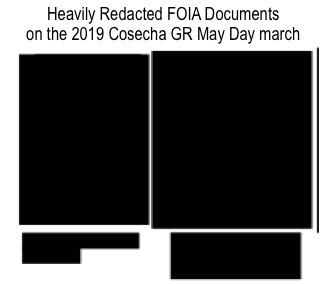 In December, we reported that a Freedom of Information Act (FOIA) request was submitted in September of 2019, asking the City of Grand Rapids to turn over all documents related to the 2019 May Day Action organized by Movimiento Cosecha GR.
A group of people obtained the documents in late 2019 and had made some of that information known in March of 2020, but then the COVID-19 crisis happened, so the urgency to get it out had diminished. However, now that the GRPD is under greater scrutiny for their repression of protests surrounding the murder of black people in other communities, it seemed appropriate to post all of the FOIA documents we received.
On Monday, we posted A Brief History of how the GRPD responds to protests and dissent, and the 2019 Cosecha GR May Day Action documents are the most recent example we wanted to cite.
It should be stated that since Movimiento Cosecha GR and it’s ally group, GR Rapid Response to ICE, began organizing in early 2017, the GRPD has consistently engaged in surveillance, monitoring, harassment and intimidation tactics of this movement. On many occasions, when organizers engaged in specific actions, there were as many, and at times, more police officers present than there were those protesting.
In what follows, you will see that the GRPD spent a great deal of energy, resources and taxpayer money to monitor, harass and threaten a consistently non-violent movement for immigration justice.
The FOIA documents we obtained can be viewed at this link, with 271 pages of e-mail communication, text messages, photos, and other documents related to the 2019 May Day action that Cosecha GR had planned.
On pages 269 – 271, you can see the final cost of the FOIA request, which was $551.01. However, if one goes through the pages, it is clear that 90-95% of the documents were redacted by the GRPD. Here is the explanation they provide on the redaction:
Your request for these records is GRANTED in part and DENIED in part. Please be advised that information has been redacted from the documents under MCL 15.243(1)(a)(information of a personal nature release of which would constitute a clearly unwarranted invasion of an individual’s privacy) and MCL 15.243(1)(b)(iii) (law enforcement records release of which would constitute an unwarranted invasion of personal privacy). It is the City’s position that the public interest in the disclosure of this information is outweighed by the public interest in keeping this information private. The core purpose of the FOIA is to contribute significantly to public understanding of the operations or activities of the government. Requests for information that involve private citizens in government files that reveal little to nothing about the inner working of government do not serve the core purpose of the FOIA.
Apparently, the GRPD does not want the public to know what they did, and more importantly, how they operate. So much for transparency.
On page 255, the FOIA document states this:

One could certainly make the point that the work of Movimiento Cosecha GR is anti-fascist, but the idea that there are “professional protesters” is just plain ridiculous.
Even more disturbing in the document on page 238, which shows what the GRPD was threatening to do if people marched in the street:
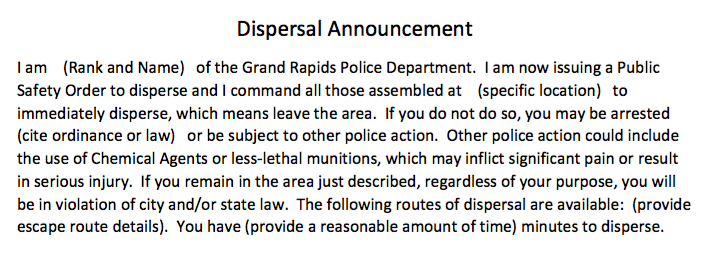
Remember, Movimiento Cosecha GR is a non-violent movement, but this is how the GRPD planned on responding if people marched in the streets. with violent repression.
On page 240, they GRPD included pictures they took that day, but every single one of those pictures are redacted.
However, the bulk of the FOIA documents are from e-mails by the GRPD within the department. Again, most of what are contained in the e-mails are redacted, but there are some useful and revealing comments that were used, which we want to look at.
Page 17 – It states, “Just touching base to make sure we are up and running for tomorrow’s Movimiento event as Arrest Team 2.” The GRPD is always eager to arrest someone.
Page 28 – Here the GRPD is talking about a Crowd Management plan, which means they want to manage what those protesting do. The police are always trying to bend actions the way they want them.
Page 39 – “I believe the below link is the video, but it is Movimiento Cosecha explaining that they are going to march without a permit tomorrow and know that the march will disrupt people.I would like it maintained for evidence the event we end up making arrests.”
Pages 53-57 – Includes communication between Cosecha GR and the City of Grand Rapids. The question should be asked as to why the GRPD would include this communication?
Page 59 – The GRPD is trying to set up a meeting with “Hispanic Community Leaders,” but they were rebuked saying that Cosecha GR is the group that needed to be at the table. The GRPD uses the tactic here to marginalize on the ground organizers, by meeting with people who are considered leaders, but not doing the on the ground work.
Page 72 – Operations plan is completely redacted
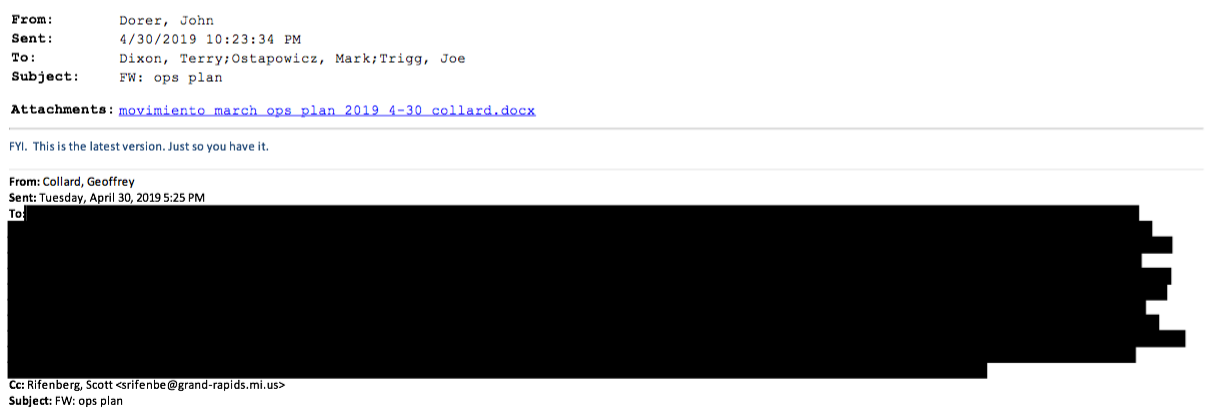
Pages 82-84 – The GRPD provides numerous links to articles “of interest” about the planned May Day march.
Page 103 – The GRPD says, “Being May 1, that is the date of the Mayday March organized by Movmiento Cosecha, an immigrant rights group that seeks to disrupt traffic each year. Last year was a mess and we expect worse this year.”
Page 105 – The GRPD again talking about meeting with community leaders, but that they should not initiate, “as it may be seen by some as an attempt to interfere with march plans.”
Page 173 – The GRPD writes, “I don’t think he is a member of Cosecha but I think we can make him do whatever we want…doesn’t he work for you guys?” Seems as if they are trying to get someone to infiltrate and/or collect intelligence for them.
While these examples are not terribly revealing, they do provide a window into the mindset of the GRPD and their efforts to manipulate and marginalize social movements. More importantly, the GRPD clearly does not believe in transparency, since most of the documents are redacted, thus preventing the public from having any understanding of how the GRPD functions. The larger questions are; 1)what are they hiding?, and 2) what can we learn from these documents and this example in terms of how social movements can be best prepared to deal with state violence and repression?
 One of the things I learned from Noam Chomsky, was the value of reading the business press. According to Chomsky, the business press if often more honest in the sense that it provides a forum for the wealthiest people to speak freely.
This happened in a Grand Rapids Business Journal article on June 1st, where Sam Cummings, one of the partners with CWD, provided his reaction to Saturday’s uprising in Grand Rapids. The article was entitled, CWD Real Estate sees silver lining in aftermath of violent protests, with Cummings stating:
Sam Cummings, managing partner with CWD, said he was “mad as hell” Saturday night and Sunday morning, but witnessing the community outreach and cleanup afterward restored his faith in West Michigan.
“That is not who we are, and that was confirmed by talking to some folks on the police force,” Cummings said. “Who we were was (Sunday).”
“The peaceful gatherings are a justified, honorable and rightful thing to have occur,” Cummings said. “Those things should be protected, but when they escalate to damaging small businesses — we got guys who have had their entire inventory wiped out — when they escalate to damaging other people’s property or their employees, it’s not acceptable.”
None of what Cummings has to say is surprising, since he values above all else – profit making and power. His comments are instructive in that they reflect this whitewashed history of GR – which ignores the history of settler colonialism and Jim Crow policies that have brutalized and looted black communities for decades.
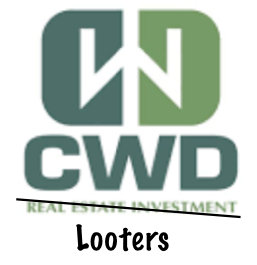
We have to see Cummings, and his partners Wierda and DeVos, as some of the real looters in this city. As we wrote in 2017:
CWD was in the news last Thursday, after the Grand Rapids City Commission voted unanimously to approve $2.3 million in reimbursements through brownfield funding for a new hotel project. In addition, the Downtown Development Authority awarded CWD an additional $895,000 in tax abatements this past February.
These reimbursements or subsidies is taxpayer money, public money, and this $3 million is from just one development project. In addition, according to the CWD website, they own more than 3 million square feet or retail and urban office real estate in the area. We have to ask ourselves, how is it that three white men were able to acquire this much property, especially while so many in the black community live in shitty housing, that many of them cannot afford.
Sam Cummings has been involved in the Economic Club of Grand Rapids, the Michigan Association of Realtors, currently sits on the Aquinas College Foundation Board, is a GVSU Foundation Trustee, was a Trustee at the Grand Rapids Community Foundation, a former board member of The Right Place Inc and former Grand Rapids Art Museum Foundation Trustee. Cummings was also instrumental in the failed Grand Prix races in downtown GR back in 1996. The Grand Prix shut down the downtown for several days, cost the city a ton of money and disrupted the lives of people who lived in downtown at the time. In fact, Cummings drove one of the race cars, seeing Grand Rapids as his own little play ground.
I am grateful for the comments by Sam Cummings in the GRBJ, since they contribute to our understanding of how members of the Grand Rapids Power Structure think, plus it should help us have clarity about the fact that Sam Cummings has been looting Grand Rapids for decades.
We need a campaign to Defund the GRPD
The actions on the part of the Grand Rapids Police Department (GRPD), and city officials in the past few days, have made it clear that the GRPD does NOT have the interests of many in this community, especially black, brown, indigenous and immigrant communities.
This has been the case for a long time, especially for the most marginalized communities. Therefore, it seems like this is a perfect time to talk about and act on the idea of defunding the GRPD. It is also what communities across the country have been calling for and is specifically part of the Black Lives Matter Vision.

In the chart above, which is from the 2019 Grand Rapids City Budget (2020 is still being decided upon), you can see that the GRPD receives the largest amount of funding of all departments in the City – $53,727,579. The total expenses for 2019 are $142,683,745, thus reflecting that the GRPD uses over a third of the City’s budget.
Considering how much taxpayer money is consumed by the GRPD, it is important that we then recognize what they are doing, particularly as it relates to what they do in black and brown neighborhoods. The GRPD spends more time “patrolling” in black and brown neighborhoods, and with the constant and intense presence, it not only results in creating a greater climate of terror, it results in a high rate of harassment, intimidation and arrests amongst black and brown residents. Below is a short and partial list of incidents that have been documented in recent years. However, it is important to note that this kind of repression happens all the time, even if it doesn’t receive media attention or isn’t reported.
- October 2016 – Tasers were drawn on Black Youth and they were handcuffed and detained.
- April 2017 – Police held youth at gunpoint at the Kroc Center and they were handcuffed and detained. Police refused to apologize to the youth when they realized that they had stopped the wrong people.
- April 2017 – The Police Traffic Stop Study revealed that Black drivers were twice as likely to be stopped, searched, and handcuffed, which was followed by a call to action from the black community.
- December 2017 – 11-years-old African American girl was held at gunpoint, cuffed, and detained while GRPD searched for a 40-year-old white suspect.
- September 2018 – Count Commissioner Robert Womack organized a march to protest handcuffing Black Children after GRPD again handcuffed a child.
- February 2019 – People protest at GR City Commission meeting to demand that GRPD Captain VanderKooi be fired for his role in calling ICE on Jilmar Ramos-Gomez.
- March 2019 – It is revealed by the police union that they wanted to arrested people during the 2018 immigration protest, organized by Movimiento Cosecha GR, simply because participants didn’t follow the police determined route.
- March 2019 – Latino youth were stopped at gunpoint by the GRPD for walking in their neighborhood
- March 2019 – the Michigan Department of Civil Rights hears testimony on racial discrimination from 80 Grand Rapids residents, open 23 separate investigations as a result.
- May 2020 – Despite increasing awareness around policing concerns caused by the death of people such as Breonna Taylor and George Floyd, the GRPD proposed cuts to community programs and staff positions for oversight, data collection, and accountability. *Budget is restored only after the community raises concerns for their continued need. (part of this list came from a recent message sent out by LINC)
Since the GRPD consumes over a third of the City’s budget and because they have repeatedly demonstrated that they will use violent tactics to repress people, why not create a movement to Defund the Police? Here is a proposal.
One option would be to cut the GRPD’s funding by one-third over the next three years, thus fading out what is now the GRPD. If we use the 2019 amount of the GRPD’s budget, which is $53,727,579, one-third of that would be $17,909,193. This would do two things. First, defunding the GRPD would send a strong message to people that the City is finally taking their concerns seriously, plus it would likely result in a reduction of the harm they would be doing, since the GRPD would have less taxpayer money. Second, the City should then re-invest the money that is being defunded from the GRPD, by proving it to communities that are experiencing poverty (especially black and brown communities), who would then decide how they want to money to be used. Funding could go to housing, creating community gardens, or more specifically to community-based safety projects, which would reduce crime and thus the need for cops.
Imagine what roughly $18 million could be used for, each year for three year period that the City would defund the GRPD. After the three year period of phasing out the GRPD, then residents could demand that there be ongoing funding for neighborhoods and communities disproportionately impacted by police intimidation, police harassment, police surveillance and police violence. The people of Grand Rapids would then not only have a say in how tax dollars are being spent, but be able to benefit from the funding of radically imagined ideas and projects that would enrich the lives of people who most desperately need it.
According to a press release from the City of Grand Rapids, 7 people were arrested on the night of May 30 / early morning of May 31 during protests against police in downtown Grand Rapids. Additionally, several people were arrested on the subsequent two nights for violating a curfew instituted in response to the protests.
].
The Grand Rapids Police Department (GRPD) is pledging to make future arrests, threatening “hundreds” of arrests
as they comb over surveillance camera footage, social media posts, and evidence submitted through their online snitch portal.
In response, a group of folks in Grand Rapids are working with the Michigan Solidarity Bail Fund to raise money to support those arrested as a result of the recent actions in Grand Rapids.
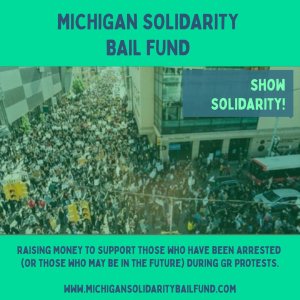 Link to donate:
https://secure.actblue.com/donate/michigan-solidarity-bail-fund
Further updates will be forthcoming. Check out the website and/or follow on Instgram. If you know of anyone arrested, please get in touch with the Michigan Solidarity Bail Fund at michigansolidaritybaildfund [at] gmail [dot] com.
Also, please remember to be careful with what you post online — even innocent seeming posts can incriminate others. This includes photos/video, speculation, rumors, and accusations about what individuals did, where they live, and/or what their motivations may be. Please don’t do the work of the state.

