Local News Coverage of so-called unity rally in Grand Rapids makes it clear it was nothing more than a pro-police event
 Yesterday, we posted an article that deconstructed a WOODTV8 story about a rally that was co-hosted by Voice of the Badge and GOP candidate Tom Norton. We made it clear in that post, that the rally had nothing to do with unity, and everything to do with presenting a pro-police narrative.
Now that the rally has happened, we want to provide a deconstruction of the commercial news coverage from the rally that was held on June 29th at Calder Plaza in Grand Rapids.
There were three news outlets that reported on the pro-police rally, WZZM 13, WOODTV8 and MLive. There was mention of the rally on WOOD Radio, but it was essentially a like to the WOODTV8 story.
The WZZM 13 story, which was 1 minute and 38 seconds, began with a random white guy from out of town who came to show his support for the GRPD and then walked around with a sign, even after the rally was over.
Besides the guy from out of town, the other sources cited in the story were all speakers from the rally. The WZZM 13 did not have a dominant narrative, but it clearly demonstrated that the rally had nothing to do with unity and everything to do with defending the police.
The WOODTV8 coverage of the began with news readers stating clearly that the rally was to show support for the GRPD. The news readers then cut to reporter Leon Hendricks, who stated, “it was a rally to support law enforcement officers who put their lives on the line each day in service to the community.” By framing the news story this way, the channel 8 reporter already inserts the idea that the police are self-sacrificing, thus making the notion that any criticism of their policies and practices as wrong.
The channel 8 story cited the Grand Rapids Police Chief, the mother of deceased officer Robert Kozminski, GOP candidate Tom Norton and a Latina mom of another police officer.
Chief Payne stated that he was hearing over and over again that the public supports the GRPD. While this may be true that he is receiving positive feedback from the community, we do know that there have been lots of calls to defund the GRPD at the policing town hall meetings that were held online, plus MLive reported on June 19 that:
“Since May 31, a total 3,060 people have called and emailed Mayor Rosayln Bliss’ office advocating for some form of defunding or divestment from the police department, according to records obtained by MLive/The Grand Rapids Press. Only four people in that time period explicitly communicated their opposition to some form of defunding.”
Such a disparity in numbers suggests that most people who have bothered to communicate with City officials favor defunding.
The Mother of deceased GRPD officer Robert Kozminski, also spoke at the rally about the loss of her son and against defunding the GRPD, on the grounds that she doesn’t want any other family to go through what her family went through. However, the death of her son has nothing to do with how much the GRPD gets from the City’s budget on an annual basis.
At one point, the reporter does acknowledge that there were few people of color in attendance, but that observation was followed by a comment from GOP candidate Tom Norton who contradicts the reporter and said, “there were more (people of color) so than people would expect at an event like this.” The comment from Norton speaks for itself, in that the organizers didn’t expect that many people of color would come, since it was clear that this event was a space for whiteness. When I say it was a space for whiteness, I mean that it was not a safe space for Black and Brown residents, unless they fully embraced the pro-police platform. This was affirmed by the fact that the story ended with a brief comment from a Latina woman who had a son in the GRPD.
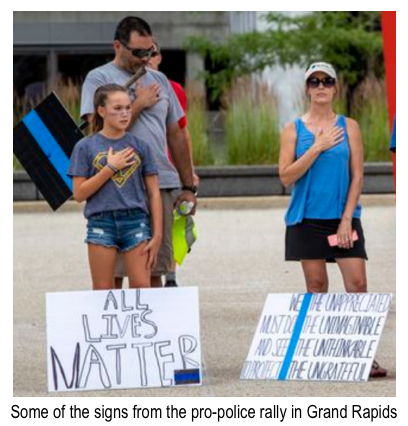 The MLive article, which was headlined as, Rally to support police, oppose defunding, held in downtown Grand Rapids, also affirmed the fact that this was a pro-police rally and had absolutely nothing to do with unity.
The MLive article cited Mark Gurley and identified his as the founder of the Make Michigan Great Again group. Gurley has as his Facebook page cover photo a picture from the American Patriot Rally that was held in Grand Rapids on May 18th. Gurley is quoted in the MLive article stating:
“Most of what’s happening here is not about police. It’s about a new ideology, an old ideology called Marxism trying to remove things from a free America.”
Gurley is followed by a retired cop, who said:
“We do have to hold these city leaders accountable. Have to. I don’t wish any of them, especially our chief and our sheriff, to ever have to kneel again unless it’s in prayer for our officers,” Moreno said to resounding applause.
Chief Payne was also cited, making the same claim he did in the WOODTV8 story about hearing from lots of pro-police supporters and never acknowledging the thousands of communications calling for defunding.
MLive does acknowledge the DeFund the GRPD campaign and that two City Commissioners are considering it, but ends the article with a comment from a woman from Ionia who also came to show her support to the GRPD.
After viewing each of the stories about the pro-police rally, it was clear that it had nothing to do with building trust between the police and the community. In fact, the coverage demonstrated that the Voice of the Badge rally was nothing more than a pro-police rally that was in direct response to the ongoing protests since May 30, the Defund the GRPD campaign and the countless stories that Black community members have been sharing about their experience of harm and violence at the hands of the GRPD.
Taking money from Police Unions is a Bi-partisan affair across the country and in Michigan
 Earlier in the month we posted an article about the politicians and candidates from West Michigan that have taken money from the Grand Rapids Police Officers Association PAC.
One observation from the data we found for candidates in the Greater Grand Rapids area, was that there were certainly candidates who ran as Republicans and Democrats that accepted money from the Grand Rapids Police Officers Association PAC. This dynamic of police unions contributing to both parties seems to be fairly consistent throughout the US, although at a national level, the Democrats have been getting more money from the Fraternal Order of Police, as you can see from this link on OpenSecrets.org.
In our initial article on police union funding, we also posted a link to a statewide campaign No More Cop Money, which provides data and research capabilities on which politicians in Michigan have been on the receiving end of contributions from police unions.
On the No More Cop Money site, they have a map of the US, which shows which states have more police union money going to it. The dollar amounts that accompany the map, also shows that Democrats have received a much larger portion of funds from police union than Republicans have, with Democrats getting $10,096,356 and Republicans getting $4,514,754.
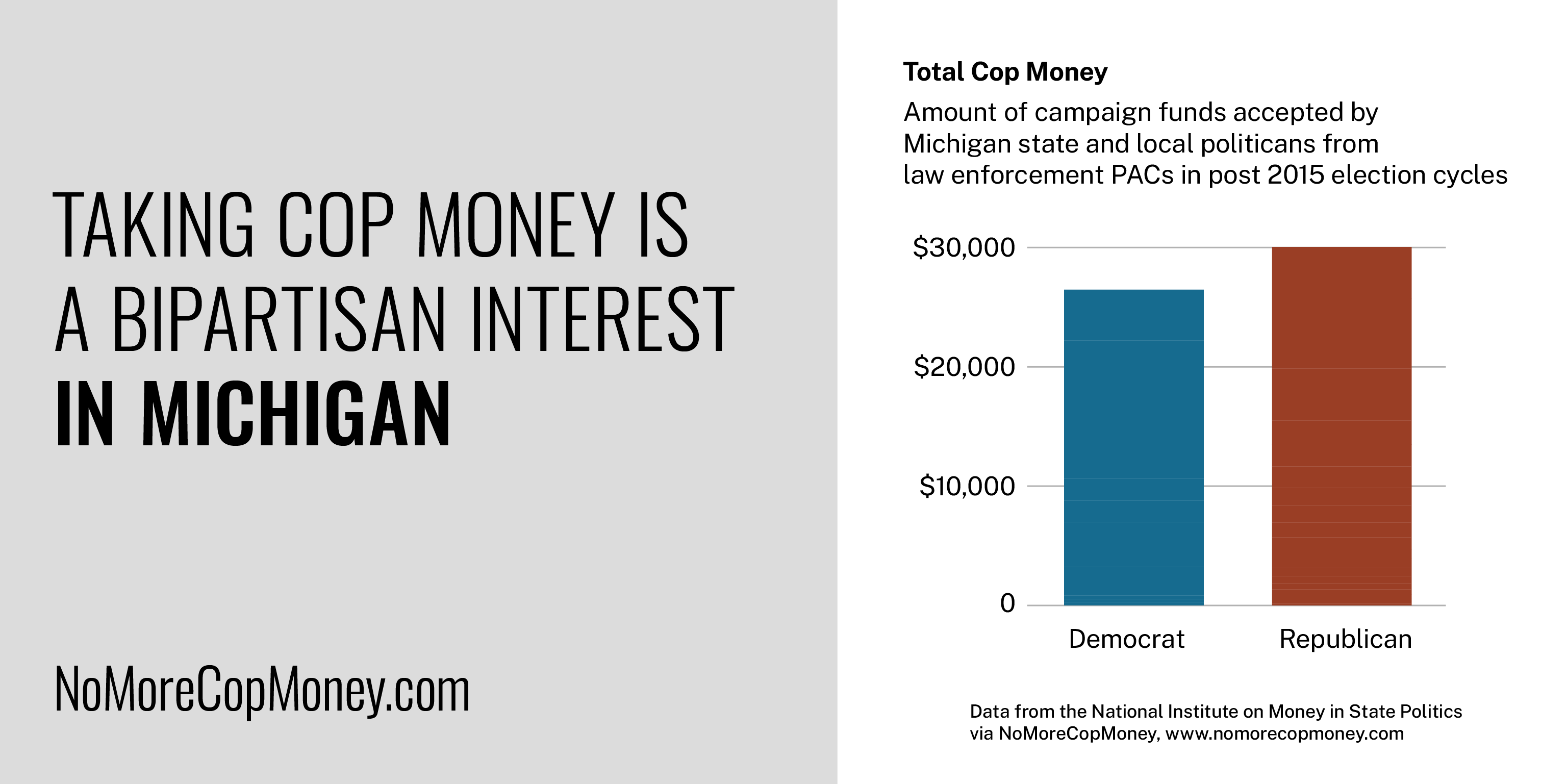
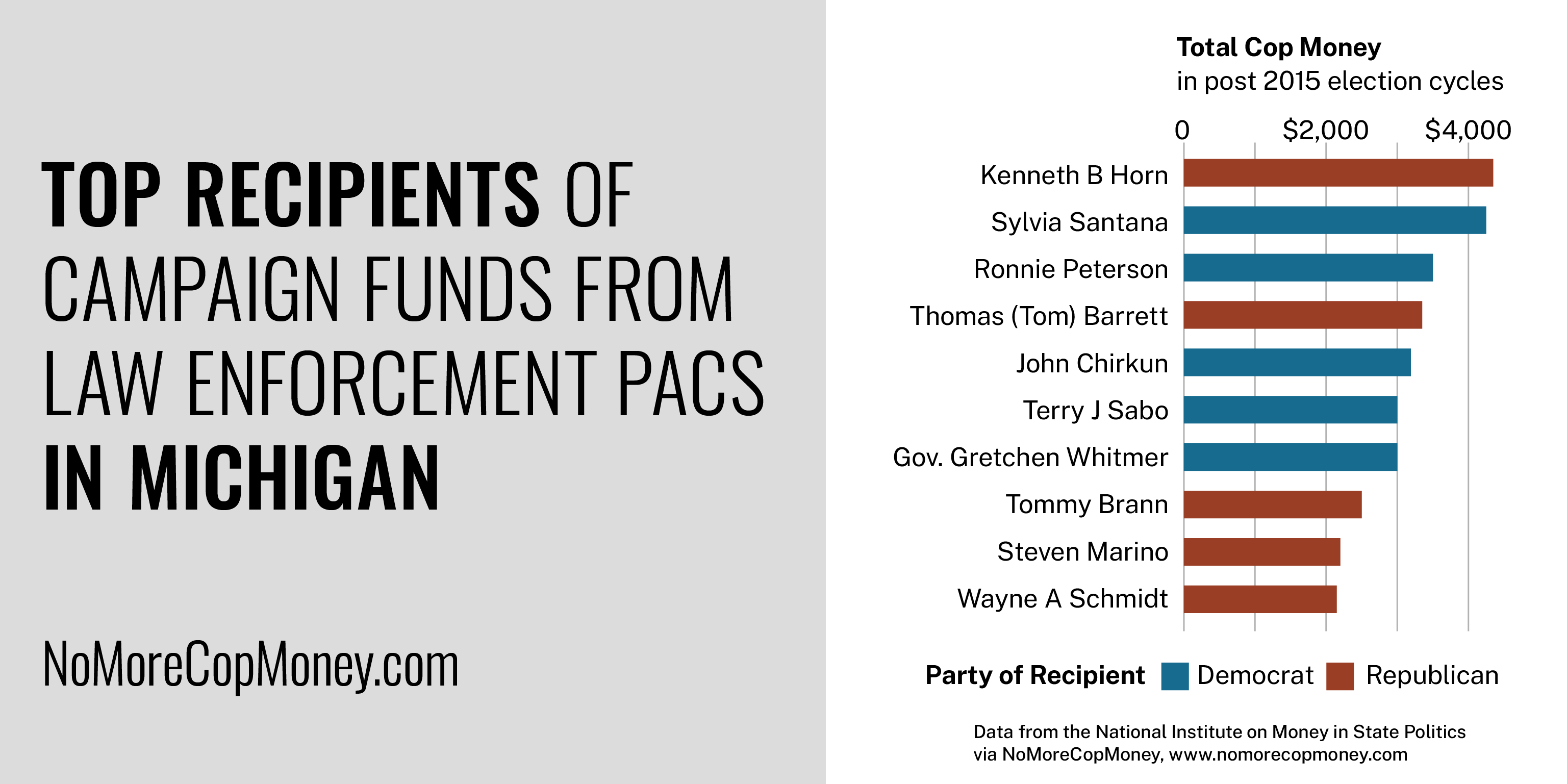
In Michigan, since 2015, GOP candidates are slightly ahead of Democrats on the receiving end of money from police unions, as can be seen in the graphic above. In addition, No More Cop Money also has a graphic showing which politicians in the state have received the most money since 2015 from the police unions, seen here below.
So whether we are talking about national, state or local politicians, it seems pretty clear that in the US, taking contributions from police unions is a bi-partisan affair.
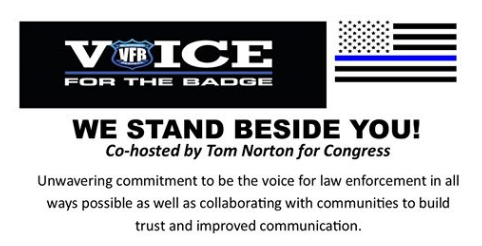 A group known as Voice of the Badge, which has come to Grand Rapids City Commission meetings over the past 18 months, for the purpose of praising the GRPD and condemning those who have criticized the Grand Rapids Police Department. The most visible member of Voice of the Badge is Johnny Brann Sr., of Brann’s restaurants.
Now, Voice of the Badge is hosting a rally on Calder Plaza to show “support for law enforcement,” according to the Facebook event page. However, for those who saw the story that WOODTV8 aired on Sunday, people would think the event was a unity rally.
The channel 8 story is so awful on so many levels. The news reporter says early on that this unity rally is meant for “both sides to find common ground,” meaning those that want to hold the GRPD accountable and those that praise the police. The reality is that people who have been protesting in recent weeks will not be attending this event, since there is no space for them to do so and feel safe.
All one has to do is look at the Facebook event pages to see that this event has nothing to do with unity and everything to do with those who are pro-police, whether it is the page hosted by Tom Norton for Congress or the Voice of the Badge Unity Event Page.
In fact, the text for the event was crafted by a candidate for the 3rd Congressional District, Tom Norton. The description for this event disparages those involved in Defund the GRPD. Here is a sample of what the Voice for the Badge event says:
While protesters swear at them, threaten them, and insult them, officers stand and protect their right to do so. And while some of the protesters turn into rioters and burn and loot cities, these officers are the ones attempting to protect the public.
The rest of the description is filled with falsehoods and pro-police propaganda.
Then there is the fact that the Facebook event is being hosted by Tom Norton for Congress. The WOODTV8 story said that the “unity rally” was not an event for candidate Tom Norton, but the Facebook event language says otherwise. The contact information for the Facebook event says Norton for Congress, with Norton’s phone number and his e-mail address.
Tom Norton is a zealous Trump supporter and embraces the same far right agenda that that Trump does. Norton’s Facebook page has a picture of him with Vice President Mike Pence and the content is nothing but slamming all things leftists. In one video, Norton appropriates the death of George Floyd and turns it into an opportunity to push an All Lives Matter message.
Don’t be fooled by the Voice of the Badge or their so-called unity rally. This event is nothing more than White Supremacy rally to push their pro-police, All Lives Matter propaganda. And shame on WOODTV8 for not only giving them free advertising, but for misinforming the West Michigan Community.
 “Public education is not broken. It is not failing or declining. The diagnosis is wrong, and the solutions of the corporate reformers are wrong. Our urban schools are in trouble because of concentrated poverty and racial segregation. But public education is not ‘broken.’ Public education is in a crisis only so far as society is and only so far as this new narrative of crisis has destabilized it.” Diane Ravitch
For weeks that Grand Rapids Public Schools have made it known that they were planning on making major cuts to their budget, in light of the COVID-19 crisis and reduced State funding.
The initial proposed cuts were to close three schools in the district and to make changes to the Montessori programs. Upon hearing this news, many members of the community communicated with the school district, expressing their opposition to the proposed cuts. In addition to individual responses, there were at least two community-based groups that also opposed the proposed GRPS budget cuts, Grand Rapids for Education Justice and the Urban Core Collective.
In fact, there was so much public opposition to the initial GRPS budget cut proposal, that the GRPS backtracked on virtually every aspect of the initial proposal. The GRPS released a statement saying that there will be no school closings and no changes to the Montessori programs. In fact, the public response got the GRPS to make budget cuts exactly where the organized opposition suggested. The GRPS statement said the cuts would be with, “additional staff and budget reductions at the cabinet and central office levels in order to limit potential reduction of teaching positions.”
We spoke with organizers with Grand Rapids for Education Justice (GREJ) and the Urban Core Collective about the importance of organized resistance to the initial proposed GRPD budget cuts and the power that social movements can have.
Jack Prince, a volunteer organizer with GREJ, had to say:
“The GREJ is encouraged to see the GRPS district responding to long persisted concerns and objectives which have been espoused by the group for months. Members were buoyed today to hear that the district would indeed halt the closing of 3 targeted schools and would replace lost funding to ensure their continuance by reducing administration pay. This is especially rewarding as the GREJ through consistent and organized protest had stressed that the exceedingly high administrative pay could be better used to further the education of students here. Many postings and presentations to the board highlighted the sheer and empirical data exposing outrageous pay comparison to other local districts. It has become clear today how important to us to continue with facts and stay true to our objectives of fairness. We want to push on with such objectives as seeing the closing of theme schools and the enrichment and restoration of the local neighborhood schools. We will continue to push for the cessation of privatization and the increase of compensation for the hard working teachers. We have now seen progress in some dismantling of the two tier system and will not rest until all our objectives are realized.”
The Urban Core Collective has also been organizing around GRPS policies over the last year. They hosted an event, where they interviewed two representatives with the GRPS to discuss the proposed budget cuts and to invite community members to call in and ask additional questions. This input also had a tremendous impact on the decision by the GRPS to drastically alter their original budget cut plan.
 GRIID spoke with Kyle Lim, who is a member of the Urban Core Collective, to get his take on the importance of organized opposition to the original GRPS budget cut proposal.
“These changes to GRPS policy decisions are a direct result of our community getting organized and speaking up for what is important. Budgets are moral documents, and it is critical that we demand institutions to live up to our values of justice and equity. But we are entering into a season of decision-making… so it is critical that we stay attentive, but it is most important that we stay organized and committed to our values.”
It is important to note that both the Urban Core Collective and Grand Rapids for Education Justice have only been organizing around public education policy and the GRPS in the past 9 months. Despite being relatively new in the fight for public education, both groups have had a significant impact on the GRPS budget and both groups have acknowledged that there are numerous other policy changes they seek to change in the coming school year.
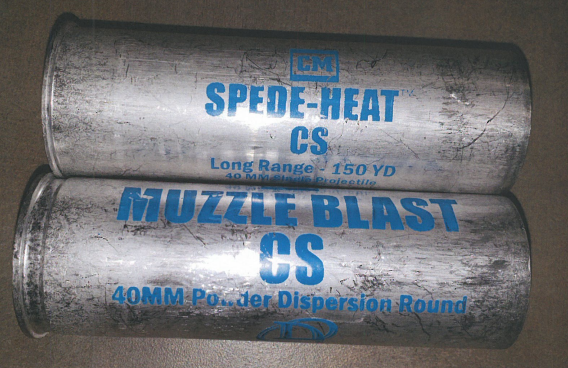 On Friday, the local commercial news media reported that the Grand Rapids Police officer who shot a 40mm chemical round, also known as “spede heat”, has been cleared of any criminal charges, according to Kent County prosecutor Chris Becker.
Unfortunately, the local news media does not explore a couple of critical aspects of this case, which occurred during the May 30 uprising in Grand Rapids, an uprising that was sparked by the police murder of Black people across the US.
One major issue is how the Kent County Prosecutor interpreted the law in this case. WOODTV8 does provide a link to the document, which contains the legal decision made by the Kent County Prosector. People should read this document, since it provides a window into how so many laws that are adopted favor the police and limit the ability of the public to dissent.
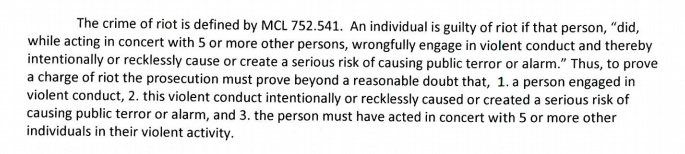
On page two of this document, one can read the legal language about why a riot is considered a crime. The language is very vague and as always allows the state a great deal of power to interpret what “causing public terror or alarm” actually means.
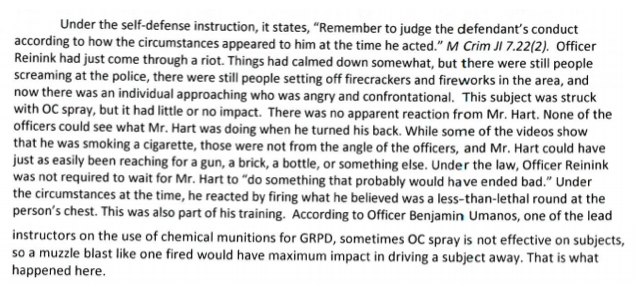
The Kent County Prosecutor then weights in on the cop who shot a civilian with the 40mm chemical round during the May 30 uprising. Again, the language of the law protects police behavior, even if that behavior does harm.
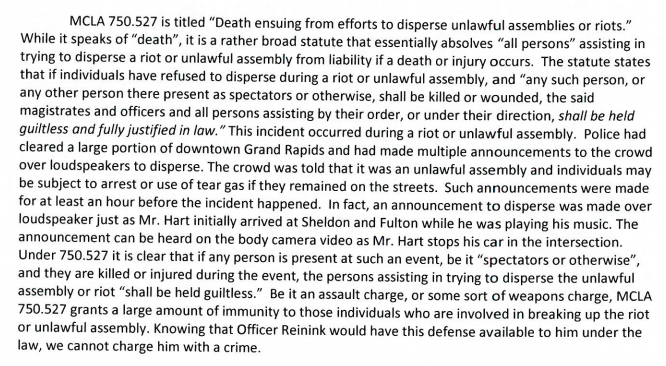
I also found the comment from the munitions instructor with the GRPD rather revealing above.
The last paragraph of the document is maybe the most revealing, in that it provides language which essentially absolves the cops of any harm they inflict on people during “an unlawful assembly or riot.”
None of these issues were really discussed in the local new reporting on this legal decision to not charge the GRPD cop with a crime for shooting a 40mm chemical round at a civilian.
One additional issue, which the local news media failed to discussed, is why does the police department even have such weapons and where are they purchasing these weapons from?
Again, the Kent County Prosecutor provides an image of what the weapons used look like, as seen here in the photo below.
The top weapon, the spede heat, was what the cop fired at the civilian, and the bottom image is what the cop thought they loaded into their weapon.
The weapons pictured above are manufactured by a company called Defense Technology, which is a subsidiary of Safariland Group. Safariland Group is part of what could be called the Riot-Control Industrial Complex.
The Riot-Control Industrial Complex is a small group of weapons manufacturers, which control the market for weapons like pepper spray, tear gas, rubber bullets and the 40mm chemical round used by the GRPD.
Safariland Group is owned by Warren Sanders, who has built an empire is what is euphemistically referred to as non-lethal weaponry. Sanders has been coming under a great deal of fire in recent years, especially after US Border & Customs agents tear gassed immigrants seeking asylum at the southern US border in 2018.
The growth of Safariland Group and other companies in the Riot-Control Industrial Complex, can clearly be attributed to the laws passed in the US after 9/11. According to Anna Feigenbaum’s book Tear Gas, Safariland Group’s CEO, Warren Sanders, joined the board of the Federal Enforcement Homeland Security Foundation FEHSF), which is “a private-public partnership between concerned business leaders and current and former high-ranking federal enforcement officials…..Functioning as a nonprofit, FEHSF gives out financial aid to assist in creating synergy between federal departments for homeland security purposes.”
Law Enforcement agencies, like the GRPD, have become more militarized since 9/11, which allows them to use the kinds of weapons we saw on May 30. Those working on the Defund the GRPD campaign might consider also demanding that the GRPD provide a complete listing of all the weapons in their arsenal, thus allowing the entire community to see what kind and how much weaponry they have, weaponry they can use against any of us.
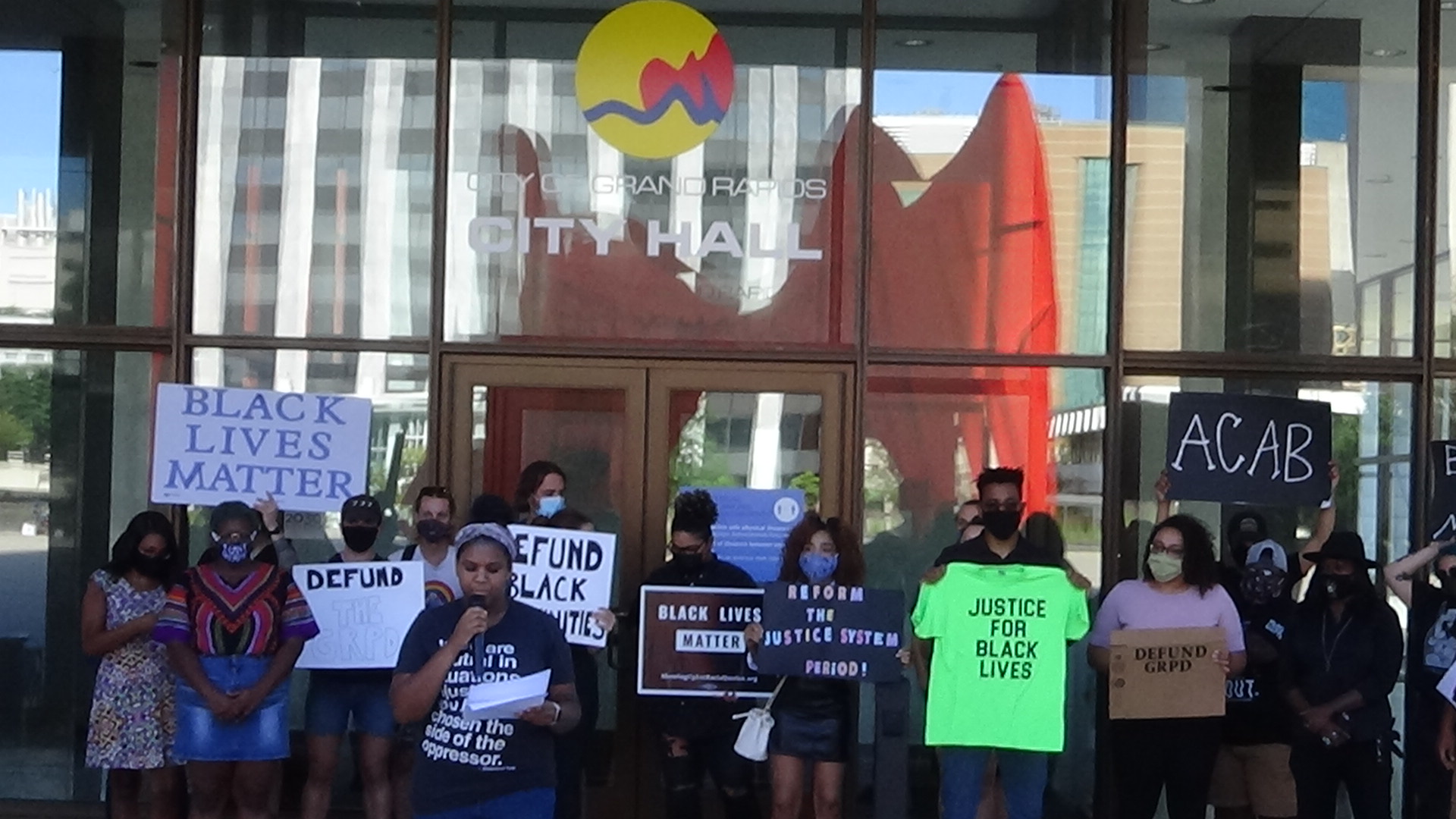
Defund the GRPD campaign makes clear demands on the City of Grand Rapids during Press Conference
Last night, a coalition of groups working on defunding the GRPD, held a Press Conference in front of City Hall. The coalition consists of the following groups Together We Are Safe, the Grand Rapids Area Mutual Aid Network, The People’s Budget GR, Movimiento Cosecha GR and GR Rapid Response to ICE. Also involved here several Black organizers who have been instrumental in many of the recent marches and protests centered around police violence against the Black community.

Five different people spoke during the Press Conference. Danah Montgomery began the Press Conference and provided numerous examples of how the GRPD has terrorized Black residents of Grand Rapids, making the point that this kind of violence doesn’t just happen in other cities.
Another speaker, Sam Przy, spoke about their own lived experience with the GRPD, having been stopped and harassed by them on several occasions in recent years. In addition to each presenter’s own personal experience with the GRPD, the speakers presented a list of clear demands from the Defund the GRPD coalition.
- The GRPD has a long history of intimidation, harassment and violence against the Black community in Grand Rapids. Those of us who are part of this coalition have experienced this harm and have heard from countless others who have been victimized by the GRPD. There have been numerous efforts to reform the GRPD, but we know it is now time to DeFund the GRPD.
- We are demanding that the City of Grand Rapids hold an emergency meeting by June 30 to adopt a Defunding the GRPD position, wherein the police budget will be reduced to the 32% City Charter mandated level for the upcoming fiscal year.
- We are also demanding that the money from this budget cut should be refunded to the Black community and the Black community should have complete control over how this money will be used.
- DeFunding the GRPD and Refunding Black Communities must happen if there is to be any trust built with the Black community. It is one of the few things that will work to actively promote equity in the Black community, which is so desperately needed.
- The DeFund the GRPD Campaign Coalition believes that there are better ways to practice community safety and that Grand Rapids needs to begin the process of having deep conversation about how to practice community safety that does not rely on policing.
Therefore the city must draft a plan by July 31 to have open conversations with and among several sectors of the Black community, including Black women, Black trans women and other Black queer and trans folks, disabled Black folks with a disability justice framework, Black folks who are currently or formerly incarcerated, and others that are most affected by and vulnerable to the violence of policing.
Local news Coverage of the Press Conference
There were several local news agencies that came to the Defund the GRPD Press Conference, including MLive, WZZM 13 and WOODTV8. The MLive article presented comments from a few of the speakers, but chose to focus their story on Demand #2, cutting the GRPD budget down to the 32% City Charter requirement. The MLive reporter did reference a comment from Police Chief Eric Payne, primarily as a means to elicit a response from those who spoke at the Press Conference.
The WZZM 13 story also focused a great deal on the City’s budget deadline, but also addressed four of the five demands presented by the coalition. The channel 13 story ended with the reporter addressing the need for the City to have a July 31st plan in place to have a serious conversation with the Black community on the future of policing.
The WOODTV8 story was the most problematic of the three local news stories. The reporter begins by saying that time is running out on defunding the GRPD, which is not really true. Yes, there is an urgency surrounding the City’s budget deadline, but even if the City does not make a decision before June 30th, the Defund the GRPD coalition can still pressure City officials to reduce funding for the police department. However, the most problematic aspect of this story was the fact that they used 20 seconds of time to the Grand Rapids police union, using footage of the press conference that group held last week, along with parts of a statement that was presented.
Lastly, the channel 8 reporter said that the Grand Rapids police union was sticking with the statement they made last week, which means WOODTV8 reached out to the police union and did they story live from in front of the GRPD headquarters. The reason why this is so problematic is that rarely do local news groups solicit responses from the community when the GRPD or the police union holds a press conference or releases a statement. It was also problematic to end the channel 8 story in front of the GRPD headquarters and citing the police union, which essentially undermines and minimizes the voices of those who spoke at the Defund the GRPD Press Conference.
The dominant narrative of Grand Rapids is Whiteness: A deconstruction of the We Are GRStrong video
 When we have finally overcome the COVID-19 pandemic, many will reflect back on what happened and how Grand Rapids responded to this crisis. However, as with any aspect of our collective history, those who often control the narrative are those with the most power.
This kind of dominant narrative, a narrative created by those with power, can be seen in the most recent video created by SALT and Cre8gency, entitled, WE Are GRStrong.
The video tells a narrative that primarily centers what businesses did to respond to the COVID-19 crisis. We learned from the video that these businesses “innovated” and “created” new opportunities and collaborations that put the well-being of people before profits. The person who says that businesses put the well being before profits was an Amway executive, who was standing in front of the Amway headquarters in Ada. If fact, Amway also has another cameo in the video, where we see one of their vans delivering supplies in boxes, conveniently label with the company name.
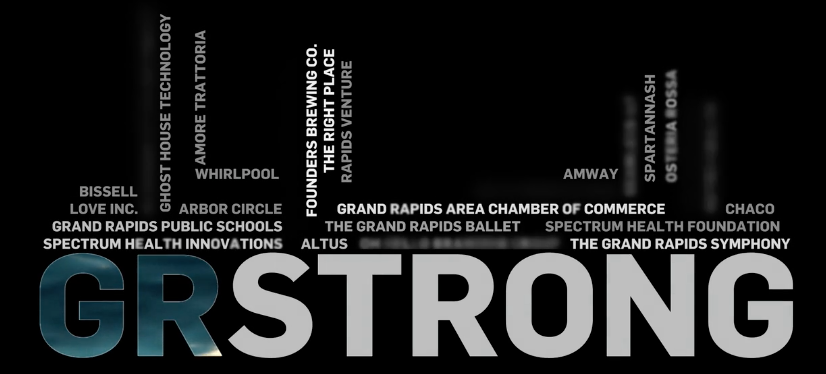
There were numerous companies and business associations involved in this video project, which are listed in the graphic below. However, what I found most offensive about this video was the not just the narrative it sought to communicate, but more importantly the narrative that was omitted.
The video presents a feel-good, people coming together kind of vibe, with lots of white saviors coming to the rescue. One of the white people interviewed even said that this was a time of heroes, which was overwhelmingly represented by white people in the video. I counted 19 times where a white person was speaking on camera and only two times where the person speaking was a person of color. Whiteness is the dominant narrative of Grand Rapids, where white saviors come to the rescue, particularly white Christian, business owners.
When I say whiteness, I am not just talking about white people, I am talking about a way of being in the world, one that centers and privileges white reality and white values. Now ask yourself who has economic and political power in this city? Who has power to impose their will on other people or whole communities? What entities spend a great deal of time celebrating Grand Rapids and all of the lists that the city has been included in recent years? Who in this city makes it a point to say that Grand Rapids is a great place to raise a family? The answer is always white people. Whether we are talking about the DeVos family, the Meijer family, Secchia, Jandernoa, Rockford Construction, the Right Place Inc., the Art Museum, the Christian Reformed Church, the commercial news media, Experience GR, Mel Trotter Ministries or ArtPrize, all of these people and entities ooze whiteness.
However, there is another narrative that we need to tell. We need to tell a narrative that is insurgent and a narrative that disrupts whiteness. We need to tell a narrative that provides context and critiques power. We need to tell a narrative that doesn’t reflect business as usual and centers those most affected by whiteness.
This insurgent, radical narrative would honestly reflect on how the very centers of power would benefit from the COVID-19 crisis, despite their efforts to presents themselves as saviors. A radically insurgent narrative would make clear how the systems of White Supremacy and Capitalism were exposed during the COVID-19 crisis. This narrative would talk about all of the Mutual Aid that people engaged in throughout the community, whether we are talking about the Grand Rapids Area Mutual Aid Network, La Lucha Fund or the other ways that people looked out for each other.
We could talk about how the data shows that those disproportionately impacted by the COVID-19 virus were Black residents. We could talk about how a Black-led resistance movement was born during the Covid-19 crisis and that this Black-led resistance movement pulled back the curtain on Grand Rapids and allowed us to see what those in power are really all about. We learned that that property is more valuable than Black lives. We learned that so-called progressive leaders brought in the National Guard to assist the GRPD in their attempts to suppress an uprising, and this Black-led resistance movement provided an opportunity to demand more than weak reformist platforms.
We must call the We Are GRStrong video what it is, a narrative that whitewashes systemic oppression. According to those who produced the 4 minute video, they are going to produce a feature documentary that will further solidify the Whiteness of Grand Rapids. Who wants to work on creating a counter narrative?
Why we can’t go back to the way things were in Grand Rapids: Part IV – Climate Justice, Environmentalism and White Supremacy
In April, we posted an article arguing that in the midst of the  COVID-19 pandemic, we could not return to normal. In early May, we posted Part II in this series, focusing on the Food System and then in late May, we wrote Part III, which focuses on labor and a new economy. One common theme in each of these posts was that the pandemic exposed the serious flaws in Capitalism and how millions in the US are clearly considered expendable by the systems of power and oppression.
Then, the Black-led uprising happened, which exposed how White Supremacy is woven throughout society. People, especially white people, have been confronted with the brutal realities of White Supremacy and the ongoing resistance has signaled that what is happening is not just a response to the police murders of Breonna Taylor and George Floyd, but a movement that seeks to dismantle White Supremacy in all of its manifestations.
This Black-led resistance has demonstrated that there are a growing number of people who will no longer tolerate police violence against Black people, will not tolerate the Prison Industrial Complex and will not tolerate how White Supremacy impacts every facet of our society, whether we are talking about the economy, education, health care or the environment. Today’s post we focus on how to utilize the framework of anti-White Supremacy to talk about why we can’t go back to normal in terms of how we deal with ecological issues, particularly Climate Change.
It is important that we come to terms with the fact that the US environmental movement, since the first Earth Day in the early 70s, has primarily been a white movement. This is not to say that the mainstream environmental movement has not done important work, but the white-led movement has not made the lives of Black, indigenous of latinx people a priority. And it’s not a question that environmental groups need to start recruiting Black, indigenous and latinx members, since that is definitely an inappropriate response, indeed, it is a racist response. What environmental groups need to do educate themselves about how larger ecological issues are impacting communities of color, listen to Black, indigenous and latinx voices and then ask what they can do to support the ecological concerns of those communities.
A good place to start would be to learn about the Environmental Justice Movement, which began in the early 1980s, and was specifically a response to the white environmental-led organizations and their failure to see structural racism as an environmental issue. Read the statement and principles that came out of the Environmental Justice Movement, which is radically different than what white eco-groups were/are about. The preamble to the Environmental Justice Movement state reads:
WE, THE PEOPLE OF COLOR, gathered together at this multinational People of Color Environmental Leadership Summit, to begin to build a national and international movement of all peoples of color to fight the destruction and taking of our lands and communities, do hereby re-establish our spiritual interdependence to the sacredness of our Mother Earth; to respect and celebrate each of our cultures, languages and beliefs about the natural world and our roles in healing ourselves; to ensure environmental justice; to promote economic alternatives which would contribute to the development of environmentally safe livelihoods; and, to secure our political, economic and cultural liberation that has been denied for over 500 years of colonization and oppression, resulting in the poisoning of our communities and land and the genocide of our peoples, do affirm and adopt these Principles of Environmental Justice:
The Environmental Justice Movement is rooted in the struggle against Settler Colonialism, White Supremacy and Capitalism, thus any white-led environmental group needs to be about the same kinds of things.
 Within the past few days, we have learned that there was once again a leak in the Enbridge owned and operated Line 5. The State of Michigan asked for a report, but Enbridge decided to ignore that and start Line 5 up again. Groups like Oil and Water Don’t Mix are asking people to send a message to Gov. Whitmer to shut down Line 5. Whitmer, along with Attorney General Dana Nessel, campaigned in 2018 on the promise to shut down Line 5, yet that has not happened. White-led environmental groups put too much faith in government to make the changes we seek. How can we realistically expect governments, at any level, to actually fulfill the will of the people? Governments are too compromised by the power of the fossil fuel industry and business in general. All one has to do is look at how much money corporations give to candidates and how much money they spend on lobbying to realize that local, state and federal governments are help captive by the power of these corporations, plus they are compromised by their allegiance to the economic system of capitalism.
Again, we need to learn from to global climate justice movement, which is primarily led by Black, indigenous and other communities of color. We need to see how the resistance at Standing Rock and all other indigenous-led struggles against fossil fuel companies are using Direct Action as their strategies for resistance, not collaborating with big business, like most of the mainstream, white-led eco groups, often referred to as Gang Green.
Another critical issue with the mainstream, white-led eco groups is their failure to take a stand against militarism. US militarism and US imperialism is one of the main driving forces behind Climate Change, according to a recent report from the National Priorities Project and the Institute for Policy Studies.
Virtually every week there is a new study that comes out about human-caused climate change and the need for radical structural change before it is too late. Unfortunately, most of the white-led environmental groups are still spending most of their energy trying to either get people to change their personal consumption habits or appeal to governments to enact change. We have to stop being fooled by these approaches, start coming to terms with the seriousness of climate change and start learning from Black, indigenous and other communities of color that are rooted the struggle against White Supremacy, Settler Colonialism and Capitalism.
 We need to radically imagine a different kind of future. We can no longer afford to think that we can maintain our current levels of consumption and our way of life, by simply using green energy. This is a false solution and it is a lie. We cannot return to normal after the pandemic, since before the pandemic, the systems of White Supremacy, Capitalism, Heterosexism, Ablism and Patriarchy were the norm. If we want a future as human beings, then there needs to be serious, radical and revolutionary goals to work towards. Here is a short list, all of which are connected to Climate Justice, if we are willing to do the intellectual, emotional, social and cultural work to see how these things are connected.
- We need to acknowledge that we are all living on indigenous land.
- We need to ask indigenous communities what they want from us moving forward.
- We need Defund the US military. The US military is one of the largest consumers of fossil fuels and its primary function is to occupy other people’s lands and protect the interests of global capitalists.
- If we Defund the US military ($850 billion for 2020), then if make sure that money goes to Black, indigenous and latinx communities to decide how to use it, imagine how that could radically alter lives in those communities.
- Defund the Police. Again, it would reduce violence against, Black, indigenous and latinx communities and re-direct police budgets to those communities.
- All environmental groups must incorporate into their mission an anti-Settler Colonial, anti-White Supremacy and anti-Capitalist framework.
- Abolish the Prison Industrial Complex.
- Abolish Immigration and Customs Enforcement.
- Abolish the Agri-business system of food and practice Food Justice and Food Sovereignty.
- End all Fossil Fuel Subsidies and demand reparations from the fossil fuel industry for decades of ecological destruction, the murder of countless Black, indigenous and latinx people and the role that the fossil fuel industry has played in deny climate change.
- Make all utilities publicly controlled, and by public I mean community-based control.
- Make public transit free.
- Make housing free for everyone.
- Make health care free for everyone.
- End wage slavery.
- End representative government and move towards direct democracy and local control.
Another World is Possible!!!!
The Grand Rapids-based Acton Institute has essentially declared war on the Movement for Black Lives
 What kind of a political vision do you support, especially when your organization acts as an ideological cheerleader for Neo-Liberal Capitalism? Such an organization would not support a vision that promotes collective liberation and challenges systems of oppression, such as White Supremacy.
The Acton Institute continues to demonstrate not only its allegiance to Capitalism, they continue to solidify their commitment to White Supremacy.
Since the current uprising against police violence against the Black community, the Acton Institute for the Study of Religion and Liberty has posted several articles that have attacked the uprising taking place across the county.
We have documented two instances since the police murder of George Floyd in May. The first article that demonstrates their allegiance to White Supremacy was posted in late May, where the Acton Institute writer states that “too much information” led to the riot in Minneapolis.
Last week, Acton writer Rev. Ben Johnson made the claim that the looting of businesses during the riots “hurts the poor.” Rev. Johnson continued his arrogance in the face of what Black insurgent scholar Robin D.G. Kelley refers to as one of the most important liberation movements since the 1960s – the Black Lives Matter movement.
In Rev. Johnson’s most recent article, he calls into question the vision of Black Lives Matter by stating:
It is a radical pressure group that embraces a vista of controversial, extremist positions. Those who march under its banner are unwittingly putting themselves in a position to be identified by BLM’s activists as endorsing these beliefs.
What Rev. Ben Johnson has done in his article, is to distort the message and vision of Black Lives Matter, by attempting to reframe what they are calling for. For example, Johnson uses headings in black to highlight BLM principles. In one example, he says that BLM wants to Dismantle the Family. It is true that BLM wants to dismantle the idea of the nuclear family, by advocating for a larger communal/village commitment to raising children. The Acton Institute writer equates this vision with an expansion of the welfare system.
It is vitally important for those of us who want to be allies in the Movement for Black Lives, to familiarize ourselves with the political vision of this movement, especially since organizations like the Acton Institute not only want to marginalize the Movement for Black Lives, they want to dismiss the lived experiences of the Black community and their struggles against White Supremacy. The Acton Institute for the Study of Religion and Liberty has in effect declared war on the Movement for Black Lives, and since the think tank is headquartered in Grand Rapids, it is important that we expose them for the White Supremacists that they are.
What we can learn from the 1967 riot/uprising in Grand Rapids and how it compares to what is happening in 2020
 It has been 3 weeks since the uprising against the most recent police murder of Black people began. Protests around the world, around the country and in Grand Rapids are continuing in all kinds of ways.
Maybe now is a good time to step back and look at history and see what we can learn from previous uprisings and how they compare to what is happening now. In Grand Rapids, there was a three day riot/uprising in July of 1967, a riot/uprising that one could argue that was very similar to what we are seeing in 2020. Let’s take a look at the similarities and differences between the riot/uprising of 1967 in Grand Rapids and the current uprising, both of which have been led by Black people.
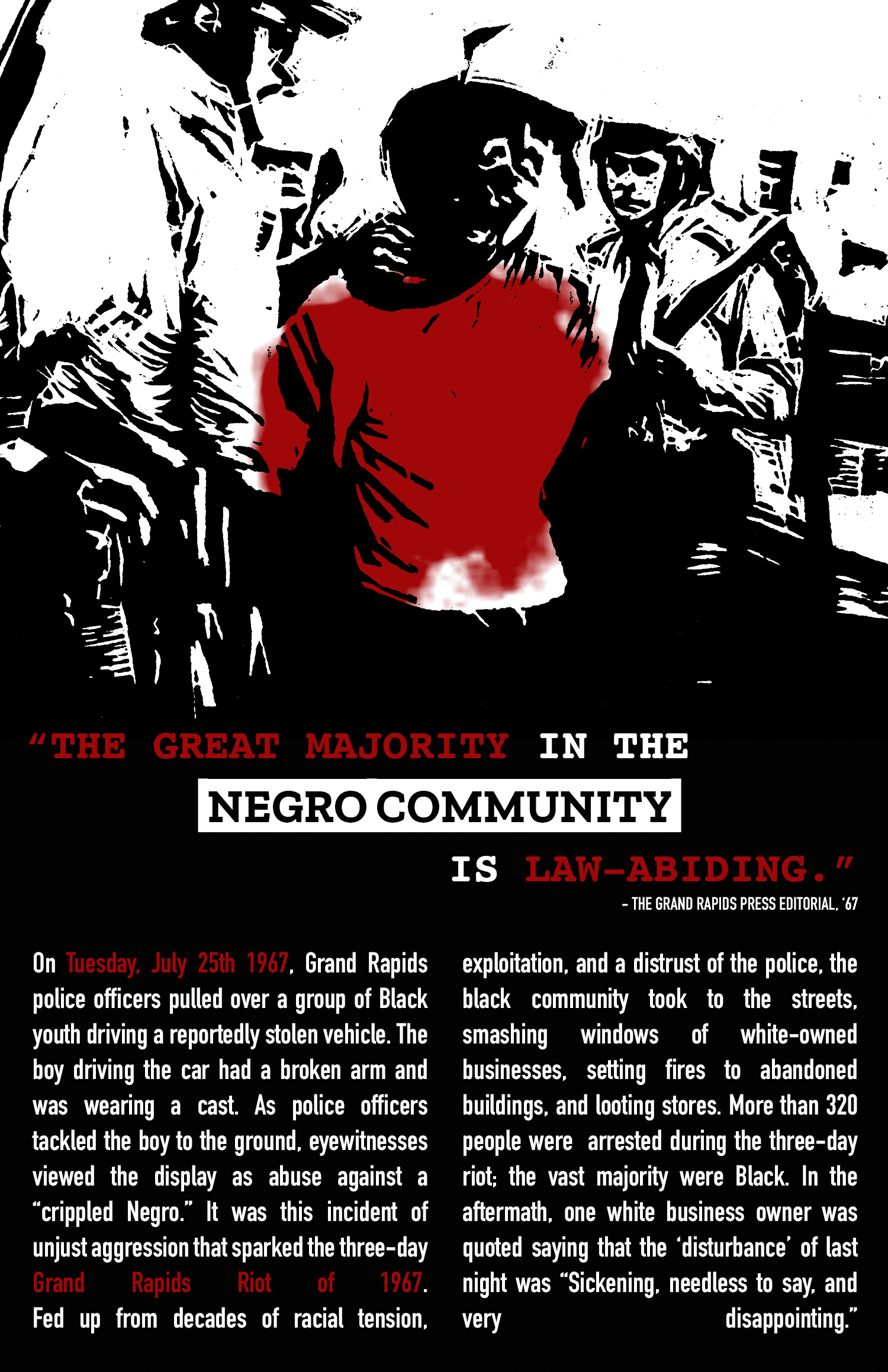
In both the 1967 riot/uprising and the 2020 riot/uprising, the main spark for people taking to the streets was directly connected to police targeting Black people. We know that the May 30, 2020 protests in downtown Grand Rapids were centered around the recent police murders of George Floyd and Breonna Taylor. In 1967, the spark was the GRPD harassment of several Black youth who were stopped by the police in July of that year.
One source says that the officers may have used excessive force in dealing with the Black youth, according to an eyewitness account.
News reports on the first day of the uprising never mention the police abuse. Instead the headlines read that, “gangs threaten a riot” and “S. Division beset by young mob.” In fact, most of the Grand Rapids Press coverage focused on the property damage and police arrests, but never on the motives of those who took action.
However, in both cases, it wasn’t just the police murder of Black people or the GRPD harassment of Black youth, it was the larger context of White Supremacy and Structural racism that have plagued Grand Rapids for over a century, as it relates to the Black community. For a larger context, I would suggest that people read Randal Jelks’ book African Americans in the Furniture City: The Struggle for Civil Rights in Grand Rapids and A City within a City: The Black Freedom Struggle in Grand Rapids, Michigan, by Todd Robinson.
However, the 1967 riot did not occur in a vacuum. The African American community had been exploited and denied equality for decades in Grand Rapids. We know that housing segregation was systemic, with the financial red-lining of blacks and organized white resistance to Blacks moving into their neighborhood.
We know from reports conducted by the Grand Rapids chapter of the Urban League, that housing an unemployment conditions were appalling, based on reports from 1940 and 1947.
The civil rights movement in Grand Rapids responded to these forms of white supremacy and institutionalized racism in a variety of ways. We know that blacks organized a march a week after the racist church bombing in Birmingham, Alabama in 1963, that left four blacks girls dead.
Black students were also resisting institutionalized racism and school segregation in the 1960s, which culminated in what was referred to as the Mustache Affair in 1966.
Thus, the riot in the summer of 1967 was just waiting to happen, considering the harsh realities that the Black community was facing in Grand Rapids. The same could be said about why so many people took to the streets on May 30th, 2020, in downtown Grand Rapids. based on a list of recent incidents where the GRPD harassed, threatened, terrorized and beat Black people in Grand Rapids.
A second similarity between 1967 and 2020 in Grand Rapids was how the local commercial news media responded to the riots/uprisings. We have written about the local news coverage of the 1967 riot. Here is a story we did 5 years ago, which looks specifically at how the Grand Rapids Press reported on the riot in 1967.
We have also come across some channel 8 archival stories from the 1967 riot, with a posting of the video footage you can watch here that includes reporting from Detroit, which was rioting at the same time.
In addition, we posted another story about the how the channel 8 reporting centered white voices and white perspectives and ignored black voices and the black point of view.
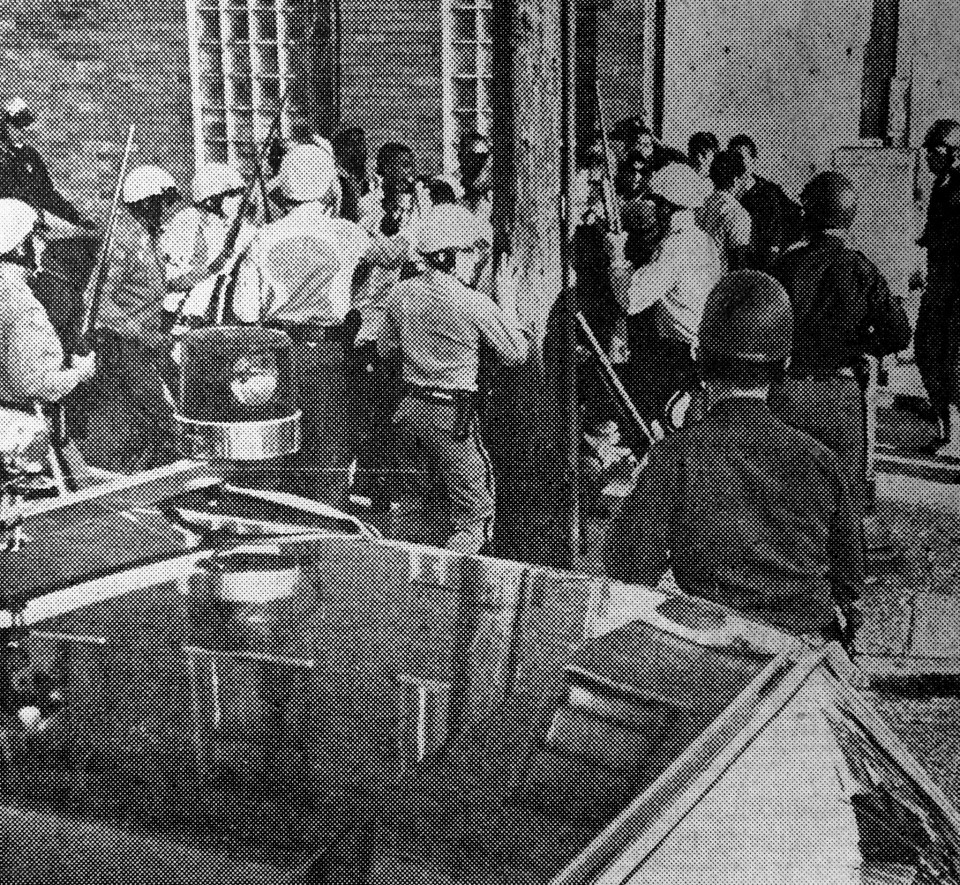 We also have a posting that looks at some of the archival photos from the 1967 riot, photos that were taken on behalf of the Grand Rapids Press. These photos tell a certain story from a certain perspective, what we call the White Gaze.
We also wrote an analysis of the local commercial news coverage of the during the first five days of coverage from May 30 through June 3rd, where the coverage also marginalizes the struggle for Black freedom and centered too many non-Black voices.
A third comparison would be how white people responded to the riots/uprisings of 1967 and 2020. In 1967, based on Grand Rapids Press reports White residents of surrounding communities, when asked about their response to the uprising, stated the following:
A woman from Ionia said, “We heard they were coming here on Tuesday. We all had our guns ready if we had to.” Another White woman in Lowell was quoted as saying, “I think it is terrible. They are destroying their own property – hurting their own cause.” A resident of Saranac stated, “It is a terrible thing to say, too, but authorities should open fire on them, do something drastic to wake them up.” A man from Holland agreed with serious force being used against those rioting. He stated, “The troops should have orders to stop them anyway necessary.”
In addition to the racist comments from surrounding communities, several White Grand Rapidians contacted the GRPD to volunteer to assist in putting down the uprising and several White residents were arrested near the area of the riot because they had concealed weapons.
Lastly, those in power commissioned a study that was issued months later, entitled, Anatomy of a Riot. The report not only documents what took place from the perspective of those in power, it offers “solutions” to prevent future uprisings from taking place. On page 34 of the report, there is a list of problems that need to be addressed. Everyone of these problems that are listed focus on behavior or are framed in such a way as to ignore any systemic forms of racism and White Supremacy. In other words, the report was just another attempt to offer just enough of a reformist response without ever having to challenge or dismantle the system of White Supremacy.
In 2020, there is still significant resistance from white people who do not want to examine or confront the system of White Supremacy in Grand Rapids. However, there have been white people who have begun to deal with White Supremacy, by participating in the ongoing protests since May 30, by calling for a defunding of the GRPD and by directly supporting the Black grassroots organizers that are centering the message of Black Lives Matter in Grand Rapids.
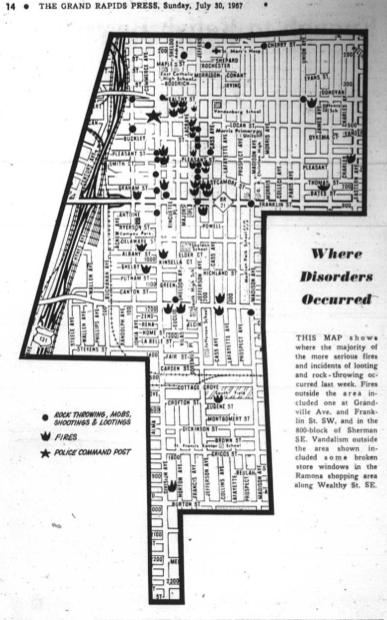 A fourth area of comparison is looking how the City of Grand Rapids has responded to both the 1967 riot/uprising and the one happening right now. In both cases the City of Grand Rapids instituted a curfew. In 1967, the GRPD locked down an large area of the southeast part of Grand Rapids, where the riot/uprising had begun, based on the map you can see here on the right. The City of Grand Rapids also called in the Michigan National Guard in both instances, thus further militarizing the state response to the riot/uprising.
At the first meeting after the 1967 riot/uprising, the Grand Rapids City Commission passed a resolution, which praised the police department and any business or individual that “cooperated” with the cops. In 2020, the City of Grand Rapids has had a fairly similar response, where the GRPD has been praised, where the “rioters” were condemned and where the City officials acted in disbelief, as if they never thought that this would happen in Grand Rapids.
This type of disbelief and denial also existed in 1967. In a Grand Rapids People’s History article, it states:
At a meeting on July 12, 1967, the head of the Grand Rapids Urban League, Paul I Phillips, communicated to Mayor Sonneveldt, the City Manager and the Grand Rapids Chief of Police that according to the national Urban League office, Grand Rapids was on a “dangerous list” of cities with racial tensions. Despite the comments from the Urban League, Mayor Sonneveldt, the City Manager and the Chief of Police “positively denied that riots were possible in the city.”
A fifth comparison between 1967 and 2020 is that there was property destruction in both riots.uprisings. In both cases, the destruction was primarily targeting white owned businesses and institutions that reflect white power, like the GRPD headquarters, the court house, etc. In 1967, since the location was different, some white businesses were targeted and the property of white landlords.
Lastly, it is important that we think about what happens next and whether or not a significant social movement can grow out of the rage and frustration of Black people to systemic oppression.
Paul I Phillips, the former director of the Grand Rapids Urban League, whom we mentioned earlier, continued to write and assess the condition of the Black community after the 1967 riot/uprising. In 1976, Phillips wrote a 2-page document with some of the following observations under the heading of unemployment:
For Whites, a recession, for Blacks, a depression. Unemployment among blacks is double that among whites.
Phillips goes on to note that median income for black families in 1974 was $7,802 and for white families $13,830, nearly double.
The next observation is rather instructive, since he refers to the 1970s policies as “benign neglect,” with the depression of 1974-75 as “effectively undermining the economic gains made by blacks in the 1960’s. In response to this dynamic, Phillips writes that “an increasing number of black families are doubling up and pooling meager resources.”
He ends his notes with the statement, “this preferential treatment of blacks and other minorities must not be permitted to continue.”
Earlier in the document Phillips cites an unemployed black person who says, “Maybe America has forgotten how smoke smells. Maybe we need a refresher course.” This comment is particularly instructive, since Phillips did not cite anyone else in the 2-page document.
The importance of this assessment from Paul I Phillips should not be lost on us today. The injustices that the Black community faces in Grand Rapids today, are not much different than they were in the 1960s or 70s. Todd Robinson calls the form of racism in Grand Rapids, managerial racism, which is an instructive way of naming how Grand Rapids practices White Supremacy. Managerial racism is alive and well in Grand Rapids and unless there are significant steps to radically alter this reality, Grand Rapids will always be subject to future riots/uprisings.

