 There has been some additional attention around the power and politics of the DeVos family, even in commercial media.
Gov. Whitmer made the claim that Betsy DeVos was financially contributing to the Michigan Freedom Fund, one of the organizations behind the protest held on April 15, calling into question the governor’s stay-at-home policy.
In addition, there has been some focus on the DeVos funding of the Mackinac Center for Public Policy and how the DeVos family, along with other millionaires and billionaires in the country will be getting massive tax breaks, as part of the Cares Act.
If you just can’t get enough about the power, influence and history of the DeVos family, then we invite you to check out our 536 page document, We’re Rich and We Do What We Want: A DeVos Family Reader.
The document includes:
- Introduction to their Religious and Political Ideology
- Early Critiques of DeVos/Amway
- DeVos Family, Elections and Money
- DeVos Family and West MI Politics
- DeVos Family Foundations
- West MI Media and the DeVos Family
- ArtPrize
- Betsy DeVos Watch
- Additional Resources
In these pages you can read about the cumulative impact that the most powerful family in West Michigan has had on Grand Rapids politics, State politics and Federal politics. You can read about how Amway workers tried to form a union in the early 1980s, how the DeVos family transformed GVSU, how much money they have spent on buying elections, the impact of their foundations, and how they so often get a free pass from the commercial media.
We believe the DeVos Family Reader is a great resource for those who want to understand how power functions and just how much influence this family has across the state.
Help pressure the City of Grand Rapids to provide support for immigrant workers during the current crisis
 A few weeks back, we posted an article that pointed out how some cities are providing financial support to immigrant workers during the current pandemic. That article talked about my interaction with Grand Rapids City Commissioners about their willingness to offer the same kind of support.
Now there is a new call to action around the same issue, coming from the group GR Rapid Response to ICE.
In their Action Alert, they state:
Immigrant workers are on the front line of this pandemic. Many continue to work in dangerous conditions because they have no choice–they do not receive unemployment, will not receive a relief/stimulus check from the federal government, and still need to support themselves and their families. We are calling on the City of Grand Rapids to immediately start providing COVID-19 pandemic relief to all immigrant members of the community–regardless of status or documentation–including payments for rent, food, utilities, and any other benefits the city is providing to the rest of the community.
The Action Alert then invites people to send a message to Grand Rapids City officials, by going to this link.
It’s a simple action, but an important one, especially if the City of Grand Rapids hears from enough people, thus making them commit to providing critical support to immigrant workers and their families during the crisis. Please send the message and share it with your networks on social media.
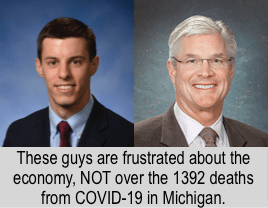
 Towards the end of last week, both Senator Mike Shirkey and Rep. Lee Chatfield, continued to push Gov. Whitmer on the need to re-open the economy in Michigan.
Last Monday, we reported on how Shirkey and Chatfield had expressed “frustration” with Gov. Whitmer over the extended stay-in-place order, that current goes on into the end of the month. We reported that Shirkey and Chatfield both were taking the position that re-opening the economy was more important than preventing people from contracting the COVID-19 virus and possibly dying.
Now Sen. Shirkey and Rep. Chatfield are continuing to push to let businesses re-open, this time with the support of powerful allies and with a “plan.”
Senator Mike Shirkey was doing a Q & A with the Jackson County Chamber of Commerce on Friday, plus the Michigan Chamber of Commerce posted their own news, with a headline that read, Senate Republicans and Whitmer Increase Focus on Economic Reopening. In that Michigan Chamber post, it stated:
The Michigan Chamber is encouraged by the Senate’s action and currently analyzing their proposal. The Senate’s proposal, referred to as Open Michigan Safely, is summarized as “relying on measurable data points to serve as indicators of decreased risk. The proposal is structured in phases that outline conditions in the state, suggest safe business operations, and propose levels of citizen activity.”
On April 15, the Michigan Chamber of Commerce released a a set of guidelines for policymakers to create clear and consistent expectations for employers. These guidelines were crafted with the help of the Mackinac Center for Public Policy, which we also reported on last month, with their policy wish list during the crisis and their new partnership with the Great Lakes Education Project and the Michigan Freedom Fund. The guidelines that the Michigan Chamber and the Mackinac Center have released are rather basic, but also very vague. It is important to remember that the Mackinac Center was the main driving force behind Michigan’s Right to Work policy, plus they have a long history of undermining public sector unions and public education.
Meanwhile, the Senate Republican caucus has released their own set of guidelines, which is described in 5 phases. One thing that I find troubling about their plan is the lack of testing. The Senate Republican Caucus does mention testing, but only as something people could do. There is no plan for statewide testing and there is no clear plan for what to do if there another outbreak across the state. Also, it would seem that this commitment to re-open businesses doesn’t fully take into account the seriousness of the human loss of life across the country and across the state. In addition, there is no known cure for COVID-19, which seems like that should be a larger priority than businesses opening back up again.
Closer to home, the West Michigan Policy Forum (WMPF), which was created in 2008 to provide the business community with an opportunity to push their own state policies agenda, has affirmed the push by Senator Mike Shirkey and the Senate Republican Caucus. The WMPF stated on their Facebook page on April 16:
The principles offered by Senator Mike Shirkey today smartly allows for a regional and phased approach to safely reopening businesses and protecting employees as they go back to work. We must reject the false choice between work and safety, so these outlined principles rightly empower workers, protect customers and increase economic security. We applaud Senator Shirkey’s welcoming approach to further input by medical experts. We urge the governor, lawmakers and business leaders to further refine the appropriate and sensible proposal by Senator Shirkey to coalesce around one plan to protect both lives and livelihoods and provide a safe pathway to restart our economy.
The WMPF, then posted yesterday, a link to a Detroit News article, where West Michigan Policy Forum chair John Kennedy was interviewed. In that interview, Kennedy talks about how his business, Autocam, has continued to operate during the COVID-19 crisis and what precautions they are taking. However, Kennedy primarily responds to the plan that Sen. Mike Shirkey is pushing. One thing that Shirkey believes, and Kennedy agrees with, is that roughly 75% of businesses could re-open if they followed certain protocols. One thing that was not revealed in this interview with John Kennedy, is that Kennedy is the number one campaign contributor to Sen. Mike Shirkey since 2011.
Again, it seems to this writer that there is still so much that we do not know about the virus, then add to that the lack of systemic testing and the fact that no cure has yet been developed, which leaves us very vulnerable to many people contracting and dying from the coronavirus. We know that the business community has a great deal of leverage with state policy makers, since they have been major campaign contributors and are always at the top of entities engaged in lobbying. The question for those of us who identify more with civil society is, should we have as much say as the capitalist class? Maybe we need to organize in such a way as to have more say than the capitalist class.
The 600 Millionaires living in Kent County will receive on average $1.7 million because of the COVID-19 Relief Policy
“The class which has the power to rob upon a large scale has also the power to control the government and legalize their robbery.” —Eugene V. Debs
Several news sources, including the Washington Post, have been reporting that:
 More than 80 percent of the benefits of a tax change tucked into the coronavirus relief package Congress passed last month will go to those who earn more than $1 million annually, according to a report by a nonpartisan congressional body expected to be released Tuesday.
This information is based on the research done by group known as the Joint Committee on Taxation (JCT), a nonpartisan Congressional body.
Forbes reported that the 43,000 millionaires and billionaires in the US will get on average $1.7 million because of the Cares Act.
While wealthy Americans are not eligible for the comparatively measly $1,200 stimulus checks that are now being disbursed to many Americans, they are on pace to do even better. 43,000 taxpayers, who earn more than $1 million annually, are each set to receive a $1.7 million windfall, on average, thanks to a provision buried in the Coronavirus Aid, Relief, and Economic Security (CARES) Act.
If there are 43,000 millionaires (some being billionaires) in the US and each of them will receive an average of $1.7 million because of the Cares Act, that would mean that the wealthiest people in the US will collectively receive $73,100,000,000, which is $73 billion and change. That is a massive amount of money, almost too big to comprehend, and it is going to the wealthiest people in the US because that is how the tax structure is set up through policy.
 If we were to think about this on a local level, what would this mean? According to the most recent data (2019), there are 600 millionaires in Kent County. If they each receive on average $1.7 million because of the Cares Act, that equals a total of $1,020,000,000 coming to those 600 millionaires collectively. This means that people like Doug DeVos, John Kennedy, Michael Jandernoa, Peter Secchia, Steven Van Andel, those that make up the Grand Rapids Power Structure, will be benefitting from the Cares Act, just for being disgustingly rich.
Now, image for a moment, how $1,020,000,000 could benefit the individuals and families who are no longer working in Kent County because of COVID-19. Imagine how much this money could be used to pay people’s rent or mortgages in Kent County. Imagine how this money could be used to provide testing to every resident in Kent County. Imagine how this money could feed all those who are food insecure in Kent County. The crisis isn’t just COVID-19, the crisis is capitalism and the capitalists who push policies to the politicians they have bought, policies which the capitalists benefit from.
The Acton Institute provides the ideological framework for the kinds of responses we saw in Lansing on Wednesday
 As someone who has been monitoring the work of the Acton Institute since its founding in the early 1990s, I continue to want to impress upon people the importance of coming to terms with the mission and message of this right wing Think Tank.
The Acton Institute, and particularly their founder, Rev. Robert Sirico, have continued to push their “free market” mantra, even in the face of the COVID-19 pandemic. We last wrote about the Acton Institute’s free market fanaticism in a post from April 5, Acton Institute Founder wants a Tax Holiday for businesses, while an Acton writer tells the Governor that golf courses should stay open.
The most recent example of free market fanaticism coming from the Acton Institute, can he seen in an interview done by the Eternal Word Television Network (EWTN), speaking with Acton Institute’s founder and President, Rev. Sirico. The EWTN is a right-wing Catholic media entity.
Listen to the kind of language that Sirico uses in this interview.
Notice how Rev. Sirico uses language like “central government,” specifically referring to Michigan. Rev. Sirico then goes on to claim that when we have a strong economy, we have healthier people. Such a claim completely ignores the realities of the long-standing health care crisis in the US, specifically because it is a health care system driven by the pharmaceutical and insurance industries. Rev. Sirico also pushes the idea of a “Tax Holiday,” which essentially means more massive tax breaks for the private sector.
It is important that we recognize that the ideological framework that Rev. Sirico and the Acton Institute are promoting, are being manifested in the proposals from politicians in Michigan and the demonstration that we saw in Lansing on Wednesday. The knee-jerk reactions that the far right is having to the Stay-in-place orders in Michigan, are directly linked to the free market fanaticism of the Acton Institute, along with their belief that Capitalism and Christianity make wonderful bedfellows.
The 1911 Furniture Workers Strike, labor militancy and radical imagination after COVID-19
 On April 19, it will be the 109th anniversary of the 1911 Grand Rapids Furniture Workers Strike. On that day in 1911, thousands of furniture workers went on strike, with demands for better wages, safer working conditions, an 8 hour work day, and the right to form a union.
The strike lasted for several months before it ended and while the 1911 Grand Rapids Furniture Workers Strike didn’t win every demand, it did demonstrate the power of organized direct action.
However, there are several lessons we can learn from the 1911 strike, lessons that we can build on. The COVID-19 pandemic has exposed the banality of Capitalism and we need to not allow things to go back to normal. We can’t be happy with just getting rid of Trump, instead we need to develop and employe a radical imagination about what can of a world we really want to live in.
The first lesson we can learn from the 1911 Furniture Workers Strike is the power of solidarity. Not only did thousands of workers go on strike, they took care of each other, provided support and mutual aid to make sure that people’s daily needs were met.
A second lesson was the importance of creating a narrative about what took place during the 1911 strike, particularly from the perspective of the working class. Viva Flaherty, a socialist, created a powerful narrative about what happened during the 1911 strike, which was in stark contrast to the narrative created by one of the furniture barons R.W. Irwin. For a look at the contrasting narratives, go to this link.
A third lesson is that workers during the strike were not afraid to engage in militant tactics. When the furniture barons brought in scab workers, those on strike attempted to prevent them from entering the factories, even by throwing bricks at them. If you look at the 1911 strike monument in downtown Grand Rapids, you can see that the woman in the monument had bricks at her feet, just under her dress. We have to be willing to defend ourselves and our livelihoods and not allow those in power to try to crush us.
A fourth lesson we can take away from the 1911 strike is how the strike exposed the class warfare that the furniture barons engaged in against the workers. This class warfare was not just reflected in the tactics used to break the strike, but it was made apparent by the massive wealth gap between the workers and the furniture barons.
A fifth lesson from the 1911 strike is that those with economic and political power were five steps ahead of the labor movement. The system of power in Grand Rapids changed the political structure of the city, by changing the ward system, in order to consolidate power.
Expanding on the Lessons of the 1911 Grand Rapids Furniture Workers Strike
It is not enough to just learn from history, but to critically engage history and create a new vision for how to move forward. Those in power are certainly thinking about how to do things different once the COVID-19 crisis is over, which means that we must also strategize and radically imagine a different world.
First, we need to reclaim the radicalism of organized labor. The labor movement has such a rich history of fighting back in this country, from the early days of the Knights of Labor, to the Wobblies and the CIO. Hell, even the UAW started as a more radical union and did not shy away from engaging in direct action through the wildcat strikes that forced the auto industry to accept their demands, beginning with the 1936-37 Flint factory occupations. We need to utilize the tactics of strikes, walkouts, workplace occupations, boycotts and even a general strike, which are all actions that give us real power. These kinds of actions are being utilized right now and we cannot stop using them even after the pandemic.
Second, we need to redirect financial resources toward organizing where we are. For decades the labor movement has been pumping millions of dollars into electoral politics instead of organizing in the workplace and building capacity amongst workers to have the skills to do radical politics. Workplace democracy is arguably more important than voting in a system of representative democracy. We need to create thousands of workplace organizers so that anyone of us can take action when it is needed, instead of just waiting for the next election cycle to see change.
Third, we need to stop thinking about elections as the main strategy. Virtually every major struggle we can think of in this country – end of slavery, women’s rights, worker rights, civil rights, environmental justice and LGBTQ rights – did not come about from elections, they came about through direct action and struggle. Elections have to be seen as simply a tactic in the larger strategy and in a radically different way. We know how to turn people out for actions and to vote. Doing so does not require a ton of money, since most election money is spent on electronic advertising.
But before we turn people out to vote, we need to think differently about voting. If we have stronger coalitions of grassroots groups, we can create a collective platform that candidates must endorse before they get our support. This way they can’t get the pro-choice vote without the pro-LGBTQ vote, or the Climate justice vote without an Anti-Racist vote. Think of it this way, we don’t endorse candidates, they endorse/embrace our collective platform. We have to stop giving away our votes without demanding anything. Candidates need fight to get our votes.
Fourth, we need to have a broader, more radical vision beyond the workplace. What we saw during the Sanders campaign from the grassroots was a call for Medicare for All, Housing Justice, Climate Justice, immigrant justice, an end to White Supremacy, an end to state violence and the prison industrial complex, food justice and food sovereignty, an end to homophobia, transphobia, ablism and misogynistic patriarchy. We need to smash the system of Capitalism and build a movement of movements!
 Fifth, we need to practice Mutual aid and Solidarity. It is amazing how many people are rising up taking care of each other during the COVID-19 pandemic. Everything we need is already in our community. We know how to do this work and we can continue to practice new ways of taking care of each other outside of what bell hooks calls the white supremacist, capitalist, patriarchy.
Lastly, we need to create new and radical ways of living. This one might be the hardest for us to think about, since most of us don’t know of any other way of organizing society. However, there are lots of examples from neighborhoods to villages and even cities. These forms of cooperative systems of living can be learned from indigenous communities, worker-run collectives, anarchist struggles and even religious communities like the Quakers and other liberation movements.
This is not just a pipe dream, but a real possibility that we need to serious investigate in our struggles for greater justice. These new ways of living with each other also might not be enough, especially considering the urgency we face through climate change. If humanity is to have a future, we have to radically rethink how we are going to both resist the current systems of oppression and how to form new and liberating systems based on justice, cooperation and revolutionary love.
Returning to normal is not an option!
Who is behind the AmplifyGR COVID-19 Relief Fund?
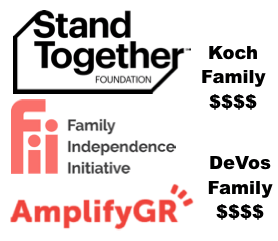 On Monday, the DeVos-funded entity, AmplifyGR, announced that they were now providing some relief funding due to the COVID-19 crisis.
The relief funds will be available only for those who live in the neighborhoods where AmplifyGR operates, namely the Oakdale, Boston Square, Madison Square area in the southeast part of the city.
For those who live in the neighborhoods that AmplifyGR serves, there are also some restrictions. According to what AmplifyGR posted on their Facebook page, those who qualify for COVID-19 relief funds must meet the following qualifications:
- A registered address in the Oakdale/Boston Square, Madison Square or northern Garfield Park neighborhoods
- Recently became unemployed or laid off,
- Had an annual household income $50,000 or less before being laid off
- Worked at a business with 250 employees or less.
The announcement also stated the following:
A generous group of Kent County residents have partnered with a nonprofit called the Family Independence Initiative (FII) to create a fund for families that are experiencing financial hardship because of COVID-19. Amplify GR, is piloting this program with FII to identify families who may need some financial assistance during this time. This is a great opportunity to CONNECT neighbors who are experiencing financial hardship to a cash assistance fund.
Now, we don’t know who the group of generous Kent County residents are that are partnering with the Family Independence Initiative, but based on what the philosophy of the Family Independence Initiative is, we could make some sound conclusions.
The Family Independence Initiative states on their website that they want to “make poverty escapable.” Sounds good, but when you investigate further, the Family Independence Initiative (FII) is all about providing capital to families in poverty so they can create wealth, primarily through entrepreneurism. In other words, the FII works with family experiencing poverty, as long as they want to start businesses. There is nothing on the FII site that discusses the massive wealth gap that exists in the US, labor exploitation, how the tax structure has been created by the wealthy to serve the wealthy, and there is nothing about how structural racism and slavery have resulted in African Americans being screwed by capitalism from the beginning. Since structural racism and White Supremacy are not something the Family Independence Initiative are opposed to, they don’t advocate reparations for African Americans.
However, the COVID-19 Relief Fund that is being offered through AmplifyGR, is different than what the Family Independence Initiative normally does. These new funds, specifically for people affected by the coronavirus, are being distributed through a partnership between Stand Together and the Family Independence Initiative.
Stand Together, which is really the Stand Together Foundation, is an entity created by Charles Koch, of the Koch Brothers. The goal of the Stand Together Foundation is to, “break the cycle of poverty by supporting the creative solutions of individuals and communities around the country. Our goal is to help effective, high-performing social entrepreneurs maximize impact—to help them help more—by bringing a business-like approach to the social sector.” Sound familiar?
The Stand Together Foundation and the Family Independence Initiative are partnering together to provide direct cash assistance to families during COVID-19, using the tag line “GiveTogetherNow#.
Now, I am all in favor of people receiving any kind of relief because of the COVID-19 crisis, but it is instructive to me that all the entities involved – AmplifyGR, the Family Independence Initiative and the Stand Together Foundation – are organizations that are funded by some of the most conservative families in the country – the Koch family and the DeVos family. More importantly, both the Koch and DeVos families have been shoving public policy down the throats of people in this country, public policy that has been anti-labor, anti-government regulation, anti-public education, anti-poor and racist as hell. Therefore, it is important that we recognize and come to terms with who is actually behind this COVID-19 relief fund and what their broader agenda might be.
Last Friday, Secretary of Education, Betsy DeVos, announced that the Department of Education has awarded $65 million to create and expand Public Charter Schools.
In a Press Release, DeVos claimed that hundreds of thousands of kids were on a charter school wait list and that these charter schools would serve, “families living in economically distressed communities.”
This claim, made by many Charter Schools advocates, that they will serve students in economically distressed communities, is a rather deceptive way of framing the issue. Charter Schools were created across the country by people like Betsy & Dick DeVos as a way to bring organized religion into schools, to re-direct public funding for private educational systems, and to undermine public teacher unions.

The Department of Education’s press release, doesn’t mention anything about how the federal agency will monitor and account for the effectiveness of the $65 million that are being allocated to the 13 Charter Schools systems across the country. This should be an urgent matter for taxpayers, especially since Charter Schools across the country have a fairly poor track record when it comes to federal funding.
According to the 2019 report, Still Asleep at the Wheel: How the Federal Charter School Programs Results in a Pileup of Fraud and Waste, there has been over $1 billion in federal funding for Charter Schools that either never opened or have since closed. The report’s Executive Summary states:
It is impossible to document total waste for the entire 25 year program because the Department never required the states to report the names of funded schools until 2006. However, we have now documented $502,468,123 (28 percent of the total database amount) that was awarded to schools from grants that were active between SY 2006-07 and SY 2013-14 that never opened or that have closed. Applying that percentage to the total expenditures ($4.1 billion) of the CSP programs designed to create new schools, approximately $1.17 billion in federal funding has likely been spent on charters that either never opened, or that opened and have since shut down.
In addition, of the 13 Charter School programs that are recipients of this latest round of Department of Education’s Charter School Program (CSP), some of them have ties to the DeVos network, while others have been charged with misuse of funds.
For instance, IDEA Public Schools, which is based in Texas, will be receiving $8.1 million from the federal government. According to an article from Education Week, the IDEA charter school network, a recipient of federal charter grants, has spent money on pro basketball tickets and said they were planning to lease a private jet.
A second example, Achievement First, Inc., which will receive $3.5 million, has had issues around racism. According to a recent article in Forbes:
Achievement First, Inc of Connecticut was in the news a year ago when events at one school forced management to take a hard look at its handling of racism, discipline and leadership. AF hired independent investigators, made personnel changes, and by fall of 2019 expressed a commitment to a culture change.
A third example is Mater Academy, Inc, which will be receiving $19.2 million, has come under a great deal of scrutiny, much like many of the private and charter schools in Florida, where Mater Academy, Inc. is based. According to a 2019 Washington Post article, Mater Academy Inc, was being audited. The Office of Inspector General, writes the Post reporter:
OIG’s audit of the two Mater charter schools identified related party transactions between the for-profit Academica and a real estate company that leased both buildings and security services to the schools.
One last example is Responsive Education Solutions, which will receive $14 million of public money for their charter schools. Responsive Education Solutions runs Charter Schools in several states and these schools are run through a partnership with the ultra-conservative Michigan school, Hillsdale College.
Even though $65 million is a small amount of money in the larger scheme of things, those who are concerned about accountability and the larger war on public education, this new announcement from Betsy DeVos should be of great concern to us all.
To join the fight for public education in Grand Rapids, go to Grand Rapids for Education Justice.
Michigan lawmakers are frustrated with extended stay-at-home order, think the economy is more important than people dying from COVID-19
 On Friday, MLive ran a headline that read, With Michigan’s coronavirus stay-at-home order extended, frustration builds over what’s been deemed non-essential.
As is often the case, this headline is a bit misleading, especially since it does not identify who are the ones that are frustrated about the extended stay-at-home order. Of course, many people are frustrated and for a whole range of reasons. However, this article only cites state officials, both elected and appointed, and one business spokesperson.
Governor Whitmer is cited, defending the extended stay-at-home order, along with Chief Medical Executive Dr. Joneigh Khaldun. The primary people cited who are expressing concern and opposition to the extended stay-at-home order are House Speaker Lee Chatfield and Senate Majority Leader Mike Shirkey, both Republicans. Their complaints both have to do with how the extended stay-at-home order will hurt businesses. Rep. Chatfield said the extended stay-at-home order, “puts fear ahead of public safety” and Sen. Shirkey said, it will unnecessarily hurt regions of our state and sectors of our economy that can operate, safely.
Senator Shirkey, also said in a statement he released on April 9:
We believe business owners will act responsibly and take care within their establishments to clean and disinfect their equipment, protect their workers and customers, and meet strict health and safety standards. We believe parents will protect their children, clergy will make worship services safe for their congregants, and neighbors will look out for their communities.
Ok, so I get the point that in the regions of the state that are not having many COVID-19 cases, there are businesses that want to open back up. However, I really think that the extended stay-at-home order is in the best interest of all of us. First, we still do not know how many people will be affected and how many will die all across the state, since we have not yet flattened the curve. What will happen if those communities that currently do not have high numbers of COVID-19 cases, all of a sudden see an increase? The stay-at-home order is in place to protect the greater good, until everyone is safe from pandemic.
Second, when Sen. Shirkey says that that businesses will be responsible when protecting their workers, we should all be highly skeptical. The Occupation Safety and Health Administration (OSHA) has been weakened in recent decades, meaning there is limited accountability with health and safety standards for businesses. Third, we do not have nearly enough testing, which means that people who are positive for the coronavirus might not even know they are infected.
Fourth, Chatfield and Shirkey, both have a history of relying heavily on campaign funding from corporations, the Chamber of Commerce and members of the business class, like the DeVos family John Kennedy.
Fifth, when looking at all of the pronouncements from Senator Shirkey and Rep. Chatfield, since the beginning of March, there is not one statement from either of them that expresses “frustration” or rage and sadness of any kind of emotion having to do with the number of deaths that have happened in Michigan from COVID-19. There is not even an acknowledgement that a disproportionately high number of African Americans are dying from COVID-19, especially on the east side of state.
 Neither of these two Republicans have bothered to make any public denouncements of the anti-Asian racism that has increased due to the current pandemic and neither of these two lawmakers have made public pronouncements thanking the front line workers – health care workers, migrant farm workers and those in the food service industry. I could not find anywhere on these two politician’s websites and indication that they have nothing but the greatest of admiration for “essential workers” during this pandemic or any kind of workers. Not surprising, both Shirkey and Chatfield DO NOT support organized labor nor the right of workers to organize for workplace democracy.
Within a system of capitalism, the profit motive is always more important than the well being of workers. Senator Shirkey and Rep. Chatfield are just defending capitalism when they express their frustration over the extended stay-at-home order. And like most politicians, regardless of which party they belong to, defending the system of capitalism is a priority.
This week marks the anniversary of the 1911 Grand Rapids Furniture Workers Strike. In an upcoming post, we’ll look at ways in which organized labor can be re-imagined in light of the COVID-19 pandemic.
 When the US Government passed the Stimulus Bill a few weeks ago, a piece of legislation that was primarily a corporate bailout bill, there is one group of people who will not be receiving any relief money, even though they are some of the most vulnerable in the country.
I’m talking about undocumented immigrants. In fact, even if undocumented immigrants have had children born in the US since they have been here, their children are also not eligible for any of the COVID-19 relief money.
For all the talk about “essential workers,” one would think that that includes people who pick our food, who wash dishes in restaurants, who manicure our lawns, who change the linen in hotels or work in construction. Again, I am talking about undocumented workers, workers who are absolutely essential to the US, but who do not qualify for any financial support from the federal government.
However, within the past week, two major cities in the US, have announced that they will step up to support the essential undocumented workers and their families, even if the federal government won’t. On Friday, April 3rd, the Mayor of Minneapolis announced that the city would create a $5 million relief fund, regardless of one’s immigration or documentation status.
Then on Tuesday, April 7, the Mayor of Chicago, “signed an executive order to ensure that refugee and immigrant communities have equal access to benefits and services provided by the city, including COVID-19 disaster relief.”
Both of these examples are leading demonstrating to the country that even if the federal or state governments do not want to provide support to some of the most vulnerable communities, that cities can chose to act and support the undocumented community.
The question for those of us who live in West Michigan is, will Grand Rapids step up and do the same. I known that several people in the community have sent messages to the Grand Rapids City Commissioners, the Mayor and the City Manager, asking whether or not the City would step up and follow the examples of Minneapolis and Chicago.
I also sent a message to the six city commissioners and the Mayor last Saturday, April 4. As of this writing, I have only received 3 responses. Someone from Mayor Bliss’s office wrote a word of thanks and will make sure that the Mayor is aware of my feedback.
First Ward Commissioner Kurt Reppart responded by saying:
I have been looking into how Minneapolis structured their fund and if it doesn’t come up this afternoon in our update on the City’s response and plans as we navigate Covid-19 I will be sure to follow up with the City Manager to ensure that whatever supportive solutions we propose are accessible to our undocumented neighbors.
Lastly, newly elected Second Ward Commissioner Milina Ysasi responded yesterday, specifically about whether or not it was on the City Agenda at Tuesday’s Commission meeting. She responded by saying:
We did discuss briefly when we talked about our budget and overall funding and how not to duplicate efforts and ensure those who do not have access are able to recover from this global pandemic. I anticipate ongoing conversations at our standing meeting next week which includes public comment.
As with most issues, governments are most likely to take action because of pressure from the community. It would be great if people could contact the Mayor, the Commissioners and the City Manager before Tuesday, to let them know that undocumented families need the support of the city right now.
Please send them a message and share this Action Alert with others:
Mayor Bliss mayor@grcity.us
John O’Connor joconnor@grcity.us
Kurt Reppart kreppart@grcity.us
Joe Jones jdjones@grcity.us
Milinda Ysasi mysasi@grcity.us
Senita Lenear slenear@grcity.us
Nathaniel Moody nmoody@grcity.us
Mark Washington manager@grcity.us
If you get a response, please send it to me jsmith@griid.org and/or post it on social media. Please take a few minutes to write Grand Rapids City officials in support of the undocumented community and as a show of solidarity.
 Grand Rapids Institute for Information Democracy