 Over the past two weeks, we have posted 4 articles taking a look at how the DeVos family has utilized their wealth during the 2020 Election Cycle.
In Part I of this series, we looked at how two of the companies the DeVos family owns, Amway and RDV Corporation, have provided significant funding to candidates in the 2020 Election.
In Part II, we looked at candidates in Kent County who have received funding from then DeVos family.
In Part III, we looked at how the DeVos family members were influencing electoral outcomes through their campaign contributions at the state level.
In Part IV, we looked at how the DeVos family members were pumping millions into the federal elections through their campaign contributions.
The total amount of money coming from the DeVos family in the 2020 election cycle comes to roughly $12.7 million. During the 2018 election cycle, the DeVos family campaign contributions were comparable, which means that have easy contributed over $20 million during the Trump administration.
Now if there is anything that we have learned about this administration in the past 4 years, we have learned that much of what the Trump administration has been about is the perpetuation of White Supremacy. Now, if we use the definition that is used by the group, Challenging White Supremacy, then that definition would be:
White Supremacy is an historically based, institutionally perpetuated system of exploitation and oppression of continents, nations and peoples of color by white peoples and nations of the European continent, for the purpose of maintaining and defending a system of wealth, power and privilege.
This definition of White Supremacy is the very ideologically driven motivation for the DeVos family’s insertion of millions of dollars in every campaign cycle since the Reagan era, and it is the over-riding factor during the past 4 years of the Trump administration.
Over the past 4 years, we have witnessed the expansion and promotion of mass incarceration, the widening of the wealth gap in the US, the further gentrification of our communities, the growing use of police power to suppress any resistance (especially resistance from the Black community) the xenophobic cracked down on the immigrant community, and the growth of domestic terrorism in the guise of “patriotism.” During the COVID 19 crisis we have seen this administration use White Supremacy to bailout out Wall Street, while throwing crumbs to the millions of Black, latinx and even poor white families that are facing unemployment, eviction, sickness and even death. This is what the DeVos family has been funding over the past 4 years.
Besides the direct funding of the Republican Party during the last four years, the DeVos family has also utilized the following entities to perpetuate much of White Supremacist policies that have been adopted at the federal, state and local level:
Grand Rapids Chamber of Commerce, the West Michigan Policy Forum, The Right Place Inc., the Acton Institute, the Mackinac Center, the Michigan Freedom Forum, the Great Lakes Education Project, Grand Action 2.0, Talent 2025 and all of the various family foundations they operation, which we have written about. All of these entities also utilize DeVos family funding and the considerable political influence that the DeVos family has to make sure that policies and practices are in place that are driven by White Supremacy – the maintenance and defense of a system of wealth, power and privilege.
This is what the DeVos family has done for the past several decades and most clearly during the Trump era, the promotion of White Supremacy. Therefore, I ask you how can you even consider defending or supporting in any way the work that is being done in Grand Rapids through the numerous non-profits that that DeVos family contribute to? In addition, how can you support the numerous DeVos created entities that also operated in Grand Rapids, such as ArtPrize, AmplifyGR and Start Garden? The DeVos family bludgeons people with White Supremacy, especially Black people, and then offers entrepreneurial programs, as if to say, “your problems are not structural, you just haven’t been given the opportunity to shine.” This is managerial racism at its finest.
 In Part I of this series, we looked at how two of the companies the DeVos family owns, Amway and RDV Corporation, have provided significant funding to candidates in the 2020 Election.
In Part II, we looked at candidates in Kent County who have received funding from then DeVos family.
In Part III, we looked at how the DeVos family members were influencing electoral outcomes through their campaign contributions at the state level.
Today, we will look at their campaign contributions at the federal level.
For this research, we use the data from the Center for Responsive Politics, also known as Opensecrets.org. You can search by zip code or by individual names. What follows is a breakdown of what each DeVos family member contributed to federal candidates during the 2019-2020 Election cycle, including the dollar amount and date. We only include the details on Maria DeVos, just so you can see an example of how many different times a DeVos family member made a campaign contribution during the current election cycle. Imagine someone making that many campaign contributions and at those amounts on a regular basis. These people do live in an entirely different world.
Maria DeVos
$5,600 3/19/2019 Mike Rounds (R)
$5,600 3/19/2019 John Moolenaar (R)
$5,600 3/20/2019 Tim Walberg (R)
$5,600 3/20/2019 David Perdue (R)
$5,600 3/21/2019 Bill Huizenga (R)
$5,600 3/22/2019 Paul Mitchell (R)
$16,000 3/23/2019 Lindsey Graham (R)
$5,600 3/26/2019 Tom Cotton (R)
$5,600 3/26/2019 Dan Sullivan (R)
$5,600 3/26/2019 Joni Ernst (R)
$2,800 3/26/2019 Steven Daines (R)
$5,600 3/26/2019 Martha McSally (R)
$5,600 3/26/2019 Thom Tillis (R)
$5,600 3/27/2019 Mitch McConnell (R)
$5,600 3/28/2019 Cyndy Hye-Smith (R)
$5,600 3/29/2019 John Cornyn (R)
$5,600 3/31/2019 Cory Gardner (R)
$5,600 6/27/2019 Bradley Byrne (R)
$5.600 6/27/2019 Bill Cassidy (R)
$5.600 6/30/2019 John James (R)
$11,200 6/30/2019 Ben Sasse (R)
$5,600 6/30/2019 Shelley Moore Capito (R)
$2,800 9/12/2019 Paul Mitchell (R)
$2,800 9/20/2019 Liz Cheney (R)
$20,000 9/30/2019 Republican Party of Michigan
$5,600 9/30/2019 John Bergman (R)
$35,000 10/1/2019 Republican National Committee
$50,000 10/2/2019 Republican National Committee
$5,600 10/30/2019 Donald Trump (R)
$14,400 12/5/2019 Republican National Committee
$5,000 12/5/2019 Majority Committee PAC
$5,600 12/5/2019 Kevin McCarthy (R)
$75,000 12/5/2019 Congressional Leadership Fund
$100,000 12/9/2019 Better Future Michigan Fund
$5,600 12/13/2019 Shane Hernandez (R)
$125,000 12/19/2019 Senate Leadership Fund
$2,800 12/19/2019 Beth Van Duyne (R)
$2,800 12/19/2019 Genevieve Collins (R)
$2,800 12/20/2019 Esther Joy King (R)
$2,800 12/21/2019 Jessica Taylor (R)
$5,600 3/9/2020 Randy Feenstra (R)
$5,000 3/30/2020 Great America Committee
$11,200 3/30/2020 Fred Upton (R)
$11.200 3/30/2020 Peter Meijer (R)
$2,800 3/31/2020 Braley Byrne (R)
$150,000 6/10/2020 Senate Leadership Fund
$50,00 6/12/2020 Congressional Leadership Fund
$200,000 6/12/2020 America First Action
$40,000 6/25/2020 Republican Party of Michigan
$71,000 6/25/2020 National Republican Senatorial Committee
$50,000 9/25/2020 Republican National Committee
$2,800 9/29/2020 Lisa McClain (R)
$5,600 9/30/2020 Paul Junge (R)
$5,600 9/30/2020 Eric Esshanki (R)
$2,800 9/30/2020 Ashley Hinson (R)
$2,800 9/30/2020 Wesley Hunt (R)
$2,800 9/30/2020 Mario iaz-Balart (R)
$2,800 10/7/2020 Tommy Tuberville (R)
Total: $1,162,000
Richard DeVos Jr $620,600
Daniel DeVos $1,625,605
Suzanne Cheryl DeVos $1,270,100
Pamela DeVos $27,000
Doug DeVos $735,400
When we tally up all of these DeVos family member campaign contributions, we get $5,440,705 for the 2019/2020 Federal Elections. This is what power looks like. This is what money buys. It buys, influence, access, loyalty and policy that benefits their financial an ideological interests.
 In Part I of this series, we looked at how two of the companies the DeVos family owns, Amway and RDV Corporation, have provided significant funding to candidates in the 2020 Election.
In Part II, we looked at candidates in Kent County who have received funding from then DeVos family. In Part III, we take a look at how much the DeVos family has contributed to candidates running for state office.
We used Michigan Secretary of State Campaign Finance data to see how much candidates and other groups that influence state office have received from the DeVos family.
There were two State House races in Michigan in West Michigan, where the DeVos family made substantial campaign contributions, in the 73rd an 74th House District races. We included Steve Ehmann again, since he is the Executive Director of one of the DeVos companies, RDV Corp.
Brian Posthumus – GOP candidate running for the 73rd District
- Doug DeVos $1,050
- Maria DeVos $1,050
- Suzanne Cheryl DeVos $1,050
- Pamela DeVos $1,050
- Daniel DeVos $1,050
- Steve Ehmann $1,050
Mark Huizenga – GOP candidate running for the 74th District
- Doug DeVos $1,050
- Maria DeVos $1,050
- Suzanne Cheryl DeVos $2,100
- Pamela DeVos $1,050
- Daniel DeVos $1,050
- Richard DeVos $1,050
People might ask, why on two State House candidates? Again, it is important to make it clear that the DeVos campaign contributions are strategic and not random. The 73rd and 74th State Houses Races are important to win in order to maintain Republican control of the State House. The other issue is that the DeVos family also contributed to the House and Senate Republican Campaign Committees, which in turn, fund state candidates. These PACs make determinations on which state candidates to contribute money to, based on the importance of the race and on how hotly contested they are. This is a dynamic we see at the federal candidate level with the DeVos family, where they are more inclined to contribute to PACs than they are to individual candidates. So, look at how much money the DeVos family members contributed to state races through these two GOP PACs.
House Republican Campaign Committee
- Doug DeVos $83,950
- Maria DeVos $83,950
- Suzanne Cheryl DeVos $83,950
- Pamela DeVos $83,950
- Daniel DeVos $83,950
- Richard DeVos $83,950
- Steve Ehmann $83,950
Senate Republican Campaign Committee
- Doug DeVos $83,950
- Maria DeVos $83,950
- Suzanne Cheryl DeVos $125,925
- Pamela DeVos $83,950
- Daniel DeVos $83,950
- Richard DeVos $83,950
- Steve Ehmann $83,950
The total for the State elections from the DeVos family comes to $1,217,275, and that doesn’t include state races outside of West Michigan. This is the kind of numbers we would expect from the DeVos family, which has been one of the major Republican Party donors across the country and number one in Michigan for several decades. In Part IV, we will look at the DeVos family campaign contributions at the federal level.
 One would think that after last weekend, the American Patriot Council would want to write about the so-called Freedom March they held in Allendale, Michigan. They didn’t, probably because once again they were out numbered by counter-protesters, and they failed to rally their base, even though they had been planning these Freedom Marches since August.
Instead of writing about their Freedom March, which was essentially a pro-Trump rally, the American Patriot Council founding fathers decided to write about their “Criminal Watch List.”
The American Patriot Council has now decided to add Facebook CEO Mark Zuckerberg to their Criminal Watch List, because, as they claim, “Facebook has been deleting conservatives and conservative stories in recent weeks.”
First, even to the average Facebook user, it seems pretty clear that “conservative stories” are in abundance. In fact, the Tech Transparency Project did a study earlier this year about White Supremacist groups using Facebook. Here is what they found:
- Of the 221 designated white supremacist organizations, more than half—51%, or 113 groups—had a presence on Facebook.
- Those organizations are associated with a total of 153 Facebook Pages and four Facebook Groups. Roughly one third of the organizations (34) had two or more Pages or Groups on Facebook. Some had Pages that have been active on the platform for a decade.
- Many of the white supremacist Pages identified by TTP were created by Facebook itself. Facebook auto-generated them as business pages when someone listed a white supremacist or neo-Nazi organization as their employer.
- Facebook’s “Related Pages” feature often directed users visiting white supremacist Pages to other extremist or far-right content, raising concerns that the platform is contributing to radicalization.
- One of Facebook’s strategies for combatting extremism—redirecting users who search for terms associated with white supremacy or hate groups to the Page for “Life After Hate,” an organization that promotes tolerance—only worked in 6% (14) of the 221 searches for white supremacist organizations.
- In addition to the hate groups designated by SPLC and ADL, TTP found white supremacist organizations that Facebook had explicitly banned in the past. One known as “Right Wing Death Squad” had at least three Pages on Facebook, all created prior to Facebook’s ban.
Ryan Kelley and Jason Howland, both founding fathers of the American Patriot Council, say that they will be contacting the FBI and the Department of Justice to make formal complaints against anyone who is on their “Criminal Watch List.” The article they posted on October 27th, states that they have already filed complaints against Michigan Governor Gretchen Whitmer. That’s interesting, because it seems that the only recent thing we have heard about the FBI and Gov. Whitmer, was the failed plot to kidnap her by a group of domestic terrorists, some of which have connections to Ryan Kelley and the American Patriot Council.
Ryan Kelley is also quoted in the article as saying that he got some, “criticism recently by far left Antifa and BLM groups for the saving of an historical statue in his home town.” Interesting that he refers to the statue as historical, when in fact it is essentially a Confederate statue that people have been protesting against for months.
Lastly, the American Patriot Council made the claim that the media around the country is noticing their “Criminal Watch List.” The media around the country link they are referring to is a small TV station in Maine, which featured maybe 12 people participating in an American Patriot Council Freedom March.
It would seem that the American Patriot Council is a bit full of themselves, almost bordering on comical narcissism.
DeVos money in the 2020 Elections: Part II – Even at the local level, DeVos money bankrolls candidates
 In Part I of this series, we looked at how two of the companies the DeVos family owns, Amway and RDV Corporation, have provided significant funding to candidates in the 2020 Election.
In Part II, we take a look at candidates who have received funding from candidates at the local level, often candidates who are not on the public radar, and how much funding they have received from DeVos family members.
Before looking at the data, it is important that we recognize that the DeVos family does not give money to candidates in a random fashion, rather they are very strategic with their money. It would be easy and a mistake to say that they fund all GOP candidates, but this would be a mistake. The DeVos family funds certain GOP candidates because of the strategic role they play in politics. While we may find the DeVos influence repulsive, they are not stupid.
Kent County Sheriff
In August of 2019, Immigration and Customs Enforcement (ICE), ended their 8 year contract with Kent County. This was certainly a victory for the immigrant justice movement, yet some might see this as a tactical decision by Sheriff Michelle LaJoye-Young. The first female Sheriff in Kent County made a decision, after the Jilmar Ramos-Gomez case made national news, to require ICE to have a judicial order to have people detained at the Kent County Jail. What we wrote in August, challenged that narrative, making it clear that the immigrant justice movement, led by Movimiento Cosecha, made the ICE contract public and pressured the county to end that contract. The County would not end their contract and made clear that they would continue to cooperate with ICE officials.
With that context in mind, it was instructive to look and see who some of the big campaign contributors were to Michelle LaJoye-Young. According to the county clerk’s data, the following members of the DeVos family gave money to Sheriff Young’s bid to stay in her position in Kent County:
- Doug DeVos $2,000
- Maria DeVos $2,000
- Suzanne Cheryl DeVos $2,000
- Pamela DeVos $2,000
- Daniel DeVos $2,000
- Richard DeVos $2,000
That is $12,000 that the DeVos clan contributed to Michelle LaJoye-Young’s campaign, and if you include another $2,000 from the Executive Director of RDV Corporation, Steve Ehmann, then that total is $14,000.
Kent County Clerk
Lisa Posthumus-Lyons is running for re-election for the Kent County Clerk position, a position that wields a significant amount of power. According to data from the Kent County Clerk’s office, the following members of the DeVos family contributed to her re-election campaign:
- Doug DeVos $2,000
- Maria DeVos $2,000
- Suzanne Cheryl DeVos $2,000
- Pamela DeVos $2,000
- Daniel DeVos $2,000
- Richard DeVos $2,000
That makes $12,000 that the DeVos clan contributed to Lisa Posthumus-Lyons campaign, and if you include another $2,000 from the Executive Director of RDV Corporation, Steve Ehmann, then that total is $14,000. See a pattern?
Also worth noting is the fact that Peter Secchia contributed $7,100 to Posthumus-Lyons as well.
Kent County Treasurer
The race for county treasurer is also a strategic battle for the DeVos family. The GOP candidate, Peter MacGregor, has been the beneficiary of lots of DeVos money over the years. In fact, as a State Senator, the DeVos family has been the number one campaign contributor to MacGregor, according to the Michigan Campaign Finance Network.
According to the clerk’s data, Peter MacGregor has received funding from the following members of the DeVos family:
- Doug DeVos $2,000
- Maria DeVos $2,000
- Suzanne Cheryl DeVos $4,000
- Pamela DeVos $2,000
- Daniel DeVos $2,000
- Richard DeVos $2,000
The total here is $14,000 from the DeVos family to Peter MacGregor, as he seeks to win the seat for the Kent County Treasurer.
There are also 19 Kent County Commission races, but the only ones we could find where the DeVos family contributed were in 2 races. The first was to Mandy Bolter, who is the current Chair of the Board of Commissioners. This makes sense, again, from a strategic point of view, that the DeVos family would fund her campaign, since Bolter gets to influence the agenda for the county. Here is a list of the eVos family members who contributed to her campaign:
- Doug DeVos $1,000
- Maria DeVos $1,000
- Suzanne Cheryl DeVos $1,000
- Pamela DeVos $1,000
- Daniel DeVos $1,000
- Richard DeVos $1,000
In this race the Executive Director for RDV Corporation, Steve Ehmann, also contributed $1,000, making the total DeVos contributions to Many Bolter $7,000.
The only other Kent County Commission candidate to receive campaign contributions from the DeVos family was Lindsey Thiel, who is currently the commissioner for the 11th District. Only one DeVos family member contribute to her campaign, Dick DeVos, who gave $1,000 to Thiel.
When we add up all the money that the DeVos family contributed to races at the Kent County level, they contributed $50,000 to influence the outcome. This may not seem like a great deal of money local elections, but their contributions as a group were more than any other private entity, with only the Kent County Republican Party contributing more in some of the county races.
Who is bankrolling the Ballot Proposals in Grand Rapids?
 There are two groups spending money to convince voters on whether or not to make local elections even years or keep them on odd years, like it is now?
The group that is opposed to Proposal 1 goes by the name, Keep GR Local. Based on the campaign finance data, the group raised $14.178.33 to convince people to vote no. Mayor Bliss contributed $500, former Mayor George Heartwell $100, Current City Commissioner Ysasi gave $150, former City Commissioner Ruth Kelly contributed $100, Steve Pestka $500 and the COO of Rockford Construction contributed $500. However, the bulk of the funding came from the Grand Rapids Area Chamber of Commerce Ballot Question Committee, which contributed $10,000 to this campaign.
On the opposing side there is the group Empower the Citizens, which collected the signatures to put this issue on the ballot. According to the Campaign Finance documents from the Kent County Clerk, they raised a total of $36,000. Some of the largest contributors to this campaign were:
- Bonnie Burke $7,100
- Sidney Jansma $3,500
- Norma Van Kuiken $5,000
- Barbara Gordon $5,000
- Margaret Potter $4,500
- Robert Powers $2,000
- Rev. Robert Sirico $2,000
Jansma is the Chairman of the Board at Wolverine Oil & Gas. Norma Van Kuiken lives in Ada, and has historically contributed to GOP candidates, and the Rev. Robert Sirico is the founder and President of the far right think tank, the Acton Institute.
Seems like there are big bankrollers on both sides, and the biggest are connected to power.
Hank Meijer is being scrutinized for his campaign contributions, not his $10.192 billion in wealth
 On Saturday, MLive first reported that Hank Meijer (Meijer retail stores) failed to include his name on a campaign finance document.
The document and money in question that Hank Meijer contributed was for the Congressional Leadership Fund, which is a GOP Political Action Committee, specifically to elected people to the House of Representatives.
The Campaign Legal Center (CLC) filled a complaint with the Federal Election Commission (FEC), which you can read at this link.
MLive cites John Truscott in their story, but they never say who he is speaking on behalf of, whether it is the Meijer family, the Meijer Foundation or Peter Meijer’s campaign. Truscott, who now runs a high powered PR firm,Truscott Rossman, used to be the press secretary for Gov. John Engler.
However, the major omission in this article was any real discussion about the problem of money in politics in general, plus the issue of transparency. Money in politics has always been a problem in the US, but it has only escalated since Citizens United. There is the issue of the huge increase in the amount of money that can be channeled to candidates, which as of this writing is nearing $11 billion for the 2020 election, which is nearly 50% more than what was spent in 2016.
Then there is the issue of Dark Money, which “refers to spending meant to influence political outcomes where the source of the money is not disclosed, according to the Center for Responsive Politics.
In this particular case, the entity that was created using Meijer funds, was called Montcalm LLC. Hank Meijer’s name should have been attached to the campaign contributions, according to Truscott, which only amounted to $150,000.
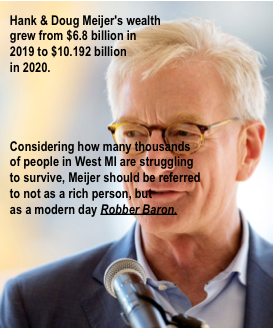
Hank Meijer, along with his brother Doug, is listed as #60 in the wealthiest billionaires, according to recent data compiled by Americans for Tax Fairness and the Institute for Policy Studies.
Between February of 2019 and October or 2020, the wealth of Hank & Doug Meijer grew from $6.8 billion to $10.192 billion, which is a pretty substantial increase, especially considering that the pandemic over the last 6 months has created millions of unemployed people, food insecure people and millions of people facing eviction. The amount of money that Hank Meijer is said to have contributed to the Congressional Leadership Fund – $150,000, is pennies compared to the Meijer family wealth. In fact, Meijer would have to contributed $150,000 a total of 67,946 times to equal their total wealth of $10,192,000,000.
The excess wealth of the Meijer family is not in question here, although that should be what MLive and any other local news source should investigate, in addition to campaign financing. In a world where the wealth gap is at its largest in modern history, we should be having serious conversation about how so few people can accumulate so much wealth, while so many are struggling to simply survive.
Local news once again fails to provide substantive coverage of White Supremacist groups and those opposing them
 The local news coverage today of the demonstrations in Allendale, Michigan were indicative of how the news media functions and how it fails the public in terms of providing people with the necessary and critical information to participate in public life.
Look at how MLive framed this story in their headline, Lots of guns, but simultaneous West Michigan rallies by opposing groups stays peaceful.
This headline is not only misleading, it provides no real context. Sure the article, provides perspectives from both demonstrations, those with the American Patriot Council and those with Justice for Black Lives. The article also presents information centering around the person of Ryan D. Kelley, the founder of the American Patriot Council, who has organized anti-lockdown protests in Lansing and Grand Rapids, along with pro-Confederate statue gatherings in Allendale. At several of those events, there were people in attendance that were also arrested in the plot to kidnap Gov. Whitmer. The American Patriot Council an Ryan D. Kelley are claiming that they have not connection to those who plotted the action against Gov. Whitmer, but it is clear that at a minimum, the American Patriot Council has created a climate that has nurtured the anti-government actions taken by those that attempted to kidnap the Governor.
However, the problem with the MLive article is that it provides no context for why Justice for Black Lives (JBL) asked for armed security people to come to Allendale on Saturday. The main reason is that JBL heard that the American Patriot Council had invite people from Detroit and other communities, specifically other armed groups to attend their march on Saturday, thus JBL wanted to make sure that people would feel safe by having their own security people in place.
The local TV news stations also played up the whole – there were two opposing views, but no major problems – angle for their coverage. WOOD TV8 focused on Ryan D. Kelley an the calls to have him remove from the Allendale Planning Commission, with a brief mention about demands to remove the Confederate statue in the park.
The online post from WZZM 13 gives a misleading headline, which read, Nationwide Freedom March in Allendale brings out city and county neighbors with opposing views.
The channel 13 story also centers around the controversy with Ryan D. Kelley, with marginal reference to sign and flag differences in the two protests. However, to say that this was a nationwide freedom march is a bit misleading. The American Patriot Council claimed that there were other similar marches happening in a few other communities in the country, but WZZM 13 doesn’t verify this. Also, it wasn’t so much a freedom march as it was a Pro-Trump rally. Lastly, channel 13 stated that both sides “emphasized the same points: faith, government, and the right to freedom of speech.” I’m not sure what was said at the American Patriot Council organized event, but at the Justice for Black Lives event the major themes were on justice, voting, removing Kelley from office, White Supremacy, Colonialism and solidarity.

WXMI 17 was the worst, in that they had information posted about what was going to happen with both protests, with inflated numbers for the so-called Freedom March, and then they sent you a video on the two rallies that was unedited, with little commentary and poor audio.
Once again the local news media has failed to provide substantive coverage of current events and to present information that would expose hate groups. This is a point I made two weeks ago, about how the news media has been complicit with White Supremacists, because of how they have reported on issues over the past 6 months. The coverage of yesterday’s actions in Allendale, only confirms that dynamic.
Bankrolling hate and harm: On the Death of Peter Secchia
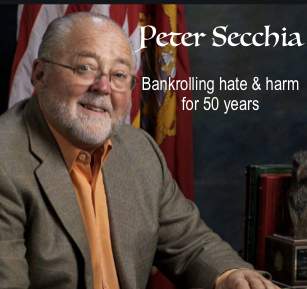 A few days have passed since the announcement that Peter Secchia has died. The local news media has done what one would expect, they have presented him as someone who loved Grand Rapids and has contributed to this community generously.
Just look at some of the headlines. From MLive, the headline reads, Philanthropist, former U.S. Ambassador Peter Secchia has died. In fact, virtually all of the coverage in MLive, WOOD TV8, WZZM 13, WXMI 17 and the Grand Rapids Business Journal, all use terms like philanthropist, former Ambassador, businessman and community advocate.
The rest of the local news coverage includes a brief history of Secchia, how he came from “humble beginnings”, his ascent in Universal Forest Products, his community involvement and his commitment to the Republican Party.
The local news coverage also included condolences from various organizations that Secchia was involved in, such as the Grand Rapids Chamber of Commerce, the Right Place Inc and the West Michigan Policy Forum. WXMI 17 even included statements from the DeVos family, Mayor Rosalynn Bliss and the Bishop from the Grand Rapids Catholic Diocese.
In many ways I am not surprised by the way these news media has presented Secchia, yet I still find it astounding the level of obedience that local news agencies give to anyone who is a member of the Grand Rapids Power Structure. There is not one bit of critical or controversial information presented in any of the coverage of Secchia’s death. People might say that now is not the time to critically examine who Peter Secchia was and that it would be insensitive to offer any criticisms while his family is in morning. Bullshit. When someone is a public figure, who not only used their wealth to influence power dynamics in Grand Rapids, but used their position with the GOP to push policies that negatively impacted millions, then this is the exact time to sound off.
It is true that Peter Secchia had a foundation and contributed money to numerous projects, particularly to MSU. However, like all philanthropists, we need to ask ourselves how Secchia became a multi-millionaire. Was it simply because he worked hard or does it have anything to do with how he was able to exploit resources and workers during his time at Universal Forest Products? What about the property investment company (SIBSSCO) that Secchia and his sons started in the 1980s? There is no mention of how much property Peter Secchia and his family own in any of the news coverage.
In terms of some of the community projects he has been behind, lets look at the Community Legends Project. The statues that have been erected all over the downtown area were selected by a group of people working with Secchia. The public had no say in any of these, even though they are in public spaces. In addition, many of the statues are of people who have done significant harm in this community, such as Bishop Baraga, Jay Van Andel, and Arthur Vandenberg.
However, the more important critique we can offer about Peter Secchia was is long standing commitment to the Republican Party. Secchia was deeply involve in the GOP for decades, especially in West Michigan, and is sometimes credited with growing the GOP in Kent County.
This means that since the late 1970s, Peter Secchia has been intimately involved in the political party that gave us Ronald Reagan, George Bush, George W. Bush and now Donald Trump. These Republican administrations have all contributed to the following: (Editors note: the Democratic Party has also been responsible for some of these same issues listed below, but since we are talking about Secchia, we will just focus on the GOP.)
- Increasing the wealth gap
- Lowering taxes for the wealthy
- Waging war on working class people
- Criminalizing Black people through the War on Drugs
- Mass Incarceration
- Environmental degradation
- Climate denial and Climate change
- Environmental Racism
- Criminalizing immigrants
- Trade Policies which have caused people to flee their own countries
- Trade Policies that have undermined organized labor
- Waging a war against public sector unions
- Blaming and shaming women for sexual assault
- Perpetuating gender inequality
- Promoting a rape culture
- Violence against the Queer and Trans communities
- Undermining public education
- Expanding US Imperialism
- The so-called War on Terrorism
 Of course this is only a partial list, but the point is, Peter Secchia has been intimately involved with the organized efforts through the Republican Party, to do tremendous harm to millions of human beings and the environment.
Here are just two examples. First, Peter Secchia was a huge supporter of the George W. Bush administration and was instrumental in bringing Bush and Dick Cheney to Grand Rapids on several occasions. Secchia had a hand in Bush choosing to come to Grand Rapids just prior to the US invasion and occupation of Iraq in 2003, despite the fact that some 2,000 protesters greeted Bush as he drove down Michigan Ave.
A few years later, Secchia invited Dick Cheney to speak about the US occupation of Iraq at the Ford Museum, to a invite-only crowd. You can see Secchia and Cheney in the picture here, walking to the Ford Museum before Cheney would address the invitation-only audience.
Then in 2006, Secchia again invite Dick Cheney to speak about the Iraq war. Anti-war organizers found out that Secchia was hosting an gathering at his home in East Grand Rapids. About 25 protesters showed up near Secchia’s home to send a message to Cheney that he and the Bush administration had committed war crimes in Iraq – indiscriminate bombing of civilians, destruction of public infrastructure, torture and looting of Iraqi resources. The indy media group Media Mouse reported on that action in September of 2006.
 The second example, is from four years ago, just prior to the 2016 Presidential Election. Peter Secchia spoke at a rally for Donald Trump and was quoted as saying:
“I have a message for the Bushes and Mitt Romney, If you don’t want to support Donald Trump: Shut up! If you don’t know where you are today, you’re a loser.”
For more than 5 decades, Peter Secchia contributed money to the Republican Party, which means that he funded the hateful rhetoric and the harmful policies of the Republican Party, from Ronald Reagan all the way through the neo-fascist Trump Administration.
This is why the local news coverage of Secchia’s death is dishonest, because it fails to talk about and assess the vicious and harmful stuff the GOP has done to so many people across the world, in the United States and in this community. Therefore, I will not morn the death of Peter Secchia.
Betsy DeVos thinks young people are an unholy mob
 It has been six and a half months since the US Secretary of Education, Betsy DeVos, has given a public speech. Back in late March, DeVos made some remarks on COVID 19 and education, but began her comments by thanking President Trump for his “clear-eyed leadership during these challenging times.”
Six months later, there have been 221,000 deaths in the US because of the pandemic. So much for clear-eyed leadership.
Once Betsy DeVos decided to leave the confines of Washington, DC, or one of the many DeVos mansions, she chose to go to the most non-threatening place she could find to give a speech, Hillsdale College.
Hillsdale College is an arch-Conservative school that has a long history of promoting free market Capitalism and US global supremacy. One of the college’s former Presidents, George Roche, was on the advisory board of the US affiliate of the World Anti-Communist League. Roche also was vehemently anti-public education and believed that the US government should not be involved in the education of American children.
So, you can see why Betsy DeVos would decide to make her first public appearance in six months at a college that shares the same ideological framework that she does.
DeVos’s speech before the Hillsdale College audience was sort of what you would expect from the champion of the Neo-Liberal Education model. There were standard comments about “school choice” and putting parents in charge of their children’s education. However, there was a an even meaner, nastier, maybe more desperate aspect of Betsy’s speech. At one point she said, Let me suggest we could fix education for so many children in America if we “go Dutch..”
Now, to those at Hillsdale College, listening to DeVos’s speech, the idea of going Dutch might not have been offensive. However, when one considers that a disproportionate number of Black and Latinx public school students in the US, the idea of going Dutch might seem offensive, even ridiculous.
DeVos clarifies her point about what she means to go Dutch, saying:
That means we embrace the family as the sovereign sphere that it is. A sphere that predates government altogether. It’s been said, after all, that the family is not only an institution; it’s also the foundation for all other institutions. The nuclear family cultivates art, athletics, business, education, faith, music, film—in a word, culture. And just as the family shapes its culture, it also shapes its government.
Following her narrow definition of what the family means, DeVos then continues her school choice mantra and more attacks against teacher unions.
About two thirds of the way into the speech, DeVos then shifts gears and begins to trash the idea of Socialism.
Too many today—especially among our rising generation—don’t seem to understand the dangers of such a view. They somehow have come to believe that socialism is the cure, not the deadly disease it really is.
Tragically, it’s because no one has taught them differently. And worse, some have been indoctrinated to believe not in themselves, but in government.
Not only is she trashing Socialism, DeVos is talking shit about young people. I know lots of “our rising generation” from my own first hand experience and I can confidentially say that they understand a great deal about economics and how the world works…….mostly against them.
When Betsy DeVos says, “It’s ignorant to hate capitalism when you don’t really know how communism hasn’t worked. It’s ignorant to hate freedom, when you don’t really know how tyranny hasn’t worked,” how can we possible take her seriously? This is a person who was born into wealth and privilege and then married into even more wealth and privilege. In addition, Betsy reflects her own narrow binary view of the world, by thinking there is either capitalism or communism, and nothing else.There have been countless economic models that humans have used and created, many of which were based on cooperation. Just because Betsy’s family in part of the Billionaire Class doesn’t mean that Capitalism works for everyone.
DeVos, then gets real nasty, saying:
So, the unholy mob thinks our economies need redistributing. It thinks our Constitution needs rewriting. It thinks our families need restructuring. One prominent group was explicit about its desire to “disrupt the Western-prescribed nuclear family structure.”
That’s taken right from the old Marxist playbook. It admits the goal is to “[do] away with private property and [educate] children on a communal basis, and in this way [remove] the two bases of traditional marriage.”
When DeVos says “the unholy mob,” she is referring to the hundreds of thousands of people, most Black people, who have taken to the streets over the past several months, demanding an end to police brutality, mass incarceration, and the plague capitalism, which has devastated Black communities.
Betsy DeVos can’t even imagine that the people on the streets are anything other than Marxists ideologues. Living in an ivory tower has prevented DeVos from being on the ground with real people who are not only tired of the lies of Capitalism, they are tired from having 2 or 3 jobs just to pay the bills an pay off the students loans. DeVos would also learn that people all over the US are practicing Mutual Aid, where they take care of each other in multiples ways, including financially. The rising generation is practicing community care, cooperation, and compassion.
As long as Betsy DeVos stays confined to her $40 million yacht, in one of her multi-million dollar homes, in the halls of government, or the ideologically safe confines of Hillsdale College, she will never really understand that most people are struggling to barely survive under Capitalism. They know that the system isn’t working for them and they want something else and are likely to get want they want by any means necessary.

