The Power of the Zapatista concept of Ya Basta! and a poem
 We have a very important weapon which the government does not have. That weapon is called dignity. With this weapon no one and nothing can defeat us. They can kill us or jail us, but they will never defeat us. EZLN Communique, Sept. 12, 1997 after the murder of 45 campesinos in Acteal, Chiapas
In my younger years, I had the opportunity to do accompaniment work in Guatemala, El Salvador and Chiapas, Mexico.
Do accompaniment work led me to write the book, Sembramos, Comemos, Sembramos: Learning Solidarity on Mayan Time and to make the film, Reversing the Missionary Position: Learning Solidarity on Mayan Time.
I always reflect on the end of the year, since I had the opportunity to be in Chiapas during the late December/early January period, doing international solidarity work in the Zapatista communities of La Realidad and Oventic.
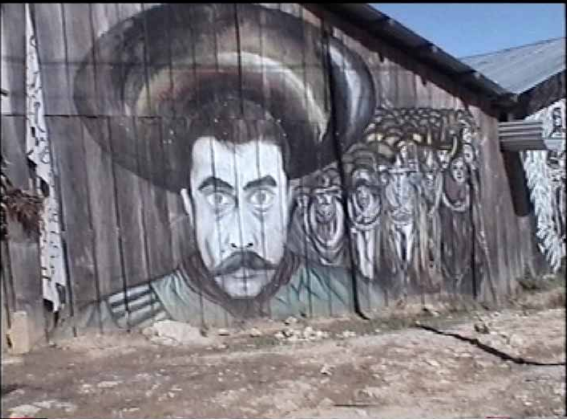 What follows is a journal entry for December 28th, 1999, while I was doing accompaniment in the EZLN community of Oventic, along with a poem I wrote on that same trip.
I just finished re-reading Holliway’s article “The Concept of Power and the Zapatistas.” A refreshing articulation of power, especially after reading Bishop Ruiz’s piece in a magazine that Elisa loaned me. Ruiz has some important things to say about the marginalization of the indigenous populations, but he still advocates an evangelization “that incorporates age-old religious and mystical experiences of other peoples….Missionary action is not difficult when we know that the subjects are not us but them. They are the subjects of their own evangelization, embodied and experienced from within different cultural models.” This is a nice articulation, one that reflects sensitivity, but premised on the expectation of missionary work as a necessary component of the work of Christians. For me, this still reflects a certain sense of superiority or monopolization of truth. If we are to come to terms with our role in 506 years of oppression these medieval notions must be abandoned.
 Holliway frames it differently in talking about the Zapatista concept of power. “The power of the zapatistas is in the power of the YA Basta!….the negation of oppression, which exists in the depths of all of us.” This is a radical departure from the missionary position which posits a sense that what I have to offer is better, richer, more truthful.
In the cool December morning
I rise to greet the warmth of the sun
Dew drips off plants and roof
While barefooted Indians pass by
On the road below Oventic, Aguascalientes of youth
Where children walk hand in hand
Or lean up against siblings
Their eyes are as dark As the earth
Their smiles bring hope From the mountains
Zedillo calls the young Zapatistas terrorists
As they prepare the New Years festival
pine needles are spread out like a royal carpet
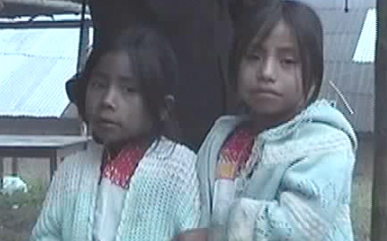 where musicians create ancient songs
with marimba and flute
their bodies sway in rhythm
like trees that bend in the wind along a narrow path
the view of people gathered is more beautiful than any painted canopy or ecclesiastical ceiling
families sit proudly on benches built for this open air arena of democracy
while helicopters fly above monitoring games & ice cream vendors
as the night approaches
the Mayan moon illuminates the court
where dancing and Tzotzil speeches fill our souls,
and even though we do not understand the words
we know their truth
the way lovers know each other’s touch
It is here that I understand The meaning of justice
Its hunger satisfied
And like the mountains,
These proud people have Withstood the weathering of history and the cruelty of men…
walking in paths of freedom
GR police union starts campaign to lobby City Officials to counter Defund the GRPD organizing
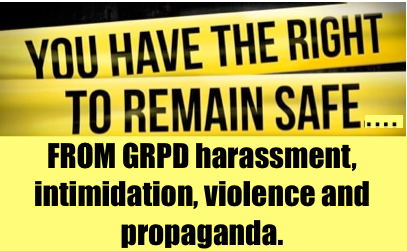
 On December 23rd, the Grand Rapids Police Officer’s Association (GRPOA) posted this graphic on their Facebook page, shown here on the right.
The GR cop union is clearly feeling the pressure from various efforts to hold accountable the Grand Rapids Police Department, especially the organizing being done by Defund the GRPD.
Since the May 30th rebellion in Grand Rapids, the GRPD has demonstrated that they do not welcome public criticism and will go to great lengths to undermine any efforts to reduce the estimated $55 million annual budget they have. In addition, the GRPD and the GRPOA have tried to control the narratives around policing in Grand Rapids, even using the increased gun violence as a diversion from having to talk about the possibility of defunding the GRPD.
The GRPOA also began their own billboard campaign, using Orwellian language presenting the GRPD as “peace officers.”
Now the GRPOA has their own online campaign, encouraging supporters to contact City officials, using the following biased narrative:
“The men and women of GRPD have taken an oath to serve and protect the residents of Grand Rapids. To effectively do this, we need the city commission to support us with the resources needed to keep you safe. 2020 has been the deadliest year on record in Grand Rapids, but the commission recently turned down $500,000 in federal grants that would’ve been used to combat violence in Grand Rapids. The vote was split on accepting the money, and when they couldn’t agree on how the money should be used to reduce crime, they simply decided not to accept it. Please contact the mayor and your commissioner and urge them to allocate the necessary resources to make our Grand Rapids neighborhoods safer.”
The GRPOA narrative clearly distorts what happened with the GR City Commission vote and why their was opposition to using CARES Act funding for ShotSpotter technology. We watched that City Commission discussion/vote on November 17th and posted our own analysis of what took place. In many ways, the main reason that several commissioner gave for not supporting the CARES Act funding from the County, was because the the language of a GRPD memo, which continued to push for use of the ShotSpottter technology, plus the hundreds of messages that the Commissioners received from the community in opposition to it.
The GRPOA online campaign also has 6 different banner messages that constantly rotates. Those messages are:
- You Have a Right to Remain Safe
- Gun Related Killings are up 80%
- 37 GR Homicides in 2020 – deadliest year ever
- Reports of Gunfire up 210%
- Attempted Murders Using a Gun up 195%
- Gun Related Assaults up 58%
Now, none of the data provided by the cop union is accompanied by a source, which means we are all supposed to just accept these numbers on face value. More importantly, the one message that the GRPOA doesn’t have on their website, is how many acts of gun violence have been prevented by the GRPD. Such a statement doesn’t exist, because the GRPD doesn’t really prevent gun violence, they only respond to the shootings after the fact. In fact, all of the messages that the GRPOA provides on their website are misleading, since they do not ask a more fundamental question, which is – how do we create community safety in Grand Rapids.
 At the very bottom of the page, there is an addition message, with an accompanying image of a jar full of bullet cartridges – Over 1600 rounds of ammunition illegally fired since May of 2020.
Lastly, it is worth noting that the list of commissioners from top to bottom, doesn’t follow an order that is ward sequential or in alphabetical order. What is instructive about the order of the commissioners listed, is that those listed on the top have been the commissioners who have been most responsive to their constituents input on policing in GR, which has meant the commissioners near the top of the list have asked questions and voted in favor of reducing the police budget and against the use of ShotSpotter technology. Apparently, the GRPOA wants people to target the commissioners who have been most open to hearing public concerns and criticisms of the GRPD.
GRIID Year in Review Part IV: Reporting on the Power of Social Movements in Grand Rapids in 2020
 (Editor’s note: GRIID does not ask for money, since we do not to make money for the IndyMedia we produce. We do, however, invite people to share our content, as we believe it can help foster important conversation about critical issues in this community.)
On Friday, we shared Part I of this four part series, with a look at how GRIID continues to monitor the news media and deconstruct their narratives. In Part II, we looked at the 2020 GRIID posts that looked at what the Grand Rapids Power Structure was up to. In Part III, we looked at the COVID crisis, specifically through the lens of how systems of power responded to the crisis, who is benefiting from the pandemic and which communities are the most hard hit. In today’s post we will look back at all of the amazing work done by social movements in Grand Rapids.
Immigrant Justice Movement
There are several established social movements in the Grand Rapids area, some of which were born in 2017, such as the immigrant justice movement, led by Movimiento Cosecha GR and supported by GR Rapid Response to ICE. Since much of 2020 has been impacted by the COVID crisis, Cosecha and their allies have been fighting to get support for undocumented immigrants, which are not eligible for federal relief funds. The pressure that Cosecha GR and GR Rapid Response to ICE applied since March, when the COVID crisis hit, resulted in the creation of the La Lucha Fund in Grand Rapids.
 However, Cosecha GR has primarily focused on their Driver’s Licenses for All campaign, which saw them pressuring local governments to support the statewide campaign to pass legislation to once again allow undocumented immigrants to obtain driver’s licenses. We reported on Cosecha GR actions in February at the Wyoming City Commission, which often exposed the deep levels of racism and xenophobia that immigrants face in this community.
Like in previous years, Cosecha GR organized their annual May Day action, which was a car caravan, due to the COVID crisis. In September, Cosecha GR, along with Cosecha circles from across the state, converged on Lansing to pressure state lawmakers to host public hearings on Driver’s Licenses for All. Since then, Cosecha GR has been pressuring other state legislators, by doing demonstrations outside of their homes, like the action they did outside of State Representative O’Malley’s home in November.
GR Rapid Response to ICE has primarily been doing Mutual Aid for due to the limited ICE activity since the beginning of the COVID crisis, providing support to Cosecha’s work and kicking off a campaign to invite more of the faith community to become sanctuaries for the undocumented.
 However, maybe the most revealing work done by Cosecha GR and GR Rapid Response to ICE, was submitting a FOIA request to the City of Grand Rapids, in order to obtain information on GRPD surveillance of the immigrant justice movement, specifically the May 1, 2019 action organized by Cosecha GR. The FOIA request resulted in 271 pages of documents that were mostly redacted, since the GRPD did not want to make public the kind of repressive tactics they have been using against the immigrant justice movement since 2017.
Grand Rapids Area Mutual Aid Network
Another amazing social movement we documented was the work of the Grand Rapids Area Mutual Aid Network (GRAMAN). Several organizers who were doing work with GR Rapid Response to ICE, who had a history of doing Mutual Aid work, started a Mutual Aid Fund for those impacted by the COVID crisis, beginning in March, when we did an interview with them.
Since then, GRAMAN has raised over $100,000, providing Black, latinx and indigenous families with financial support, food support and PPE support. The amount of money they continue to raise is amazing, but what has also been amazing is the number of people who have stepped forward to be part of this Mutual Aid work, demonstrating once again the belief that everything we need can be found in our community. The work of GRAMAN has been inspiring to so many, plus it also exposes the eep failures of the Capitalist system to actually meet the needs of people, plus it has shown that local governments also o not serve those who are the most marginalized.
 Movements confronting White Supremacy: From Justice for Black Lives to Defund the GRPD
No one could have predicted that the public lynching of George Floyd would have sparked such a massive, insurgent anti-White Supremacy movement, but in May of 2020, this is exactly what happened. In Grand Rapids, there were protests organized for May 30th, but those protests led to a rebellion in Grand Rapids, the likes of which hadn’t been seen since 1967.
There was a lot of posturing that came out of the May 30th rebellion in Grand Rapids, both from City officials, but also lots of organizations that continued to counsel caution and reform. However, too many people were not buying that same old reformist mantra an two groups/movements that came out of the May 30th rebellion in Grand Rapids were Black Lives for Justice and DeFund the GRPD.
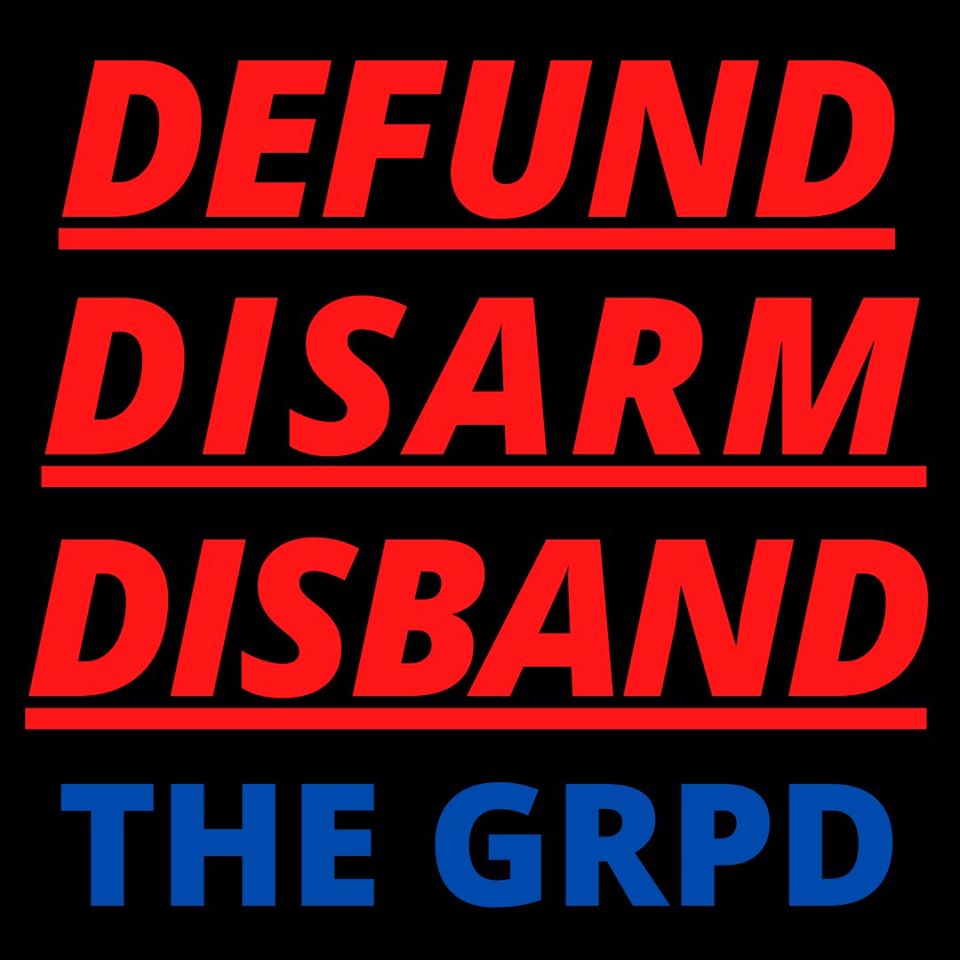
Justice for Black Lives has kept the pressure on to maintain a presence in the streets, protesting White Supremacy and Structural Racism in Grand Rapids, while DeFund the GRPD has worked to challenge the ridiculous amount of public money that funds the police in Grand Rapids, to demystify that function of policing and to call for divestment in policing in order to invest in the Black community.
GRIID has devoted over 50 posts since June on the work of these two movements, along with numerous posts that provides analysis of the GRPD budget and how City officials have been trying to undermine the efforts of these movements. What follows are some highlights of this movement work and accompanying analysis:
A Brief History of how the GRPD responds to protests and dissent
Grand Rapids Police Officers Association releases statement against the calls for Defunding the GRPD
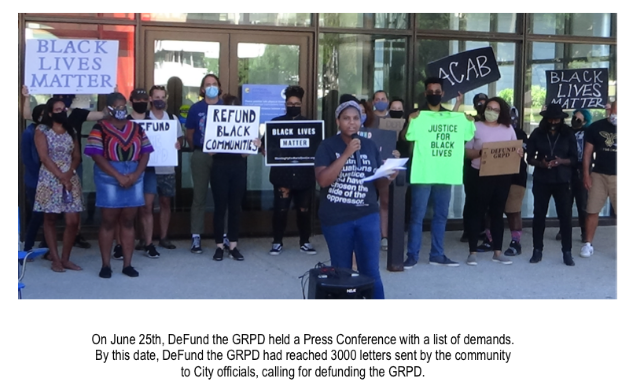
Defund the GRPD campaign makes clear demands on the City of Grand Rapids during Press Conference
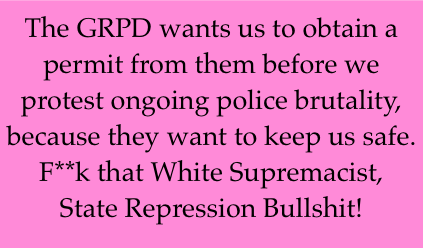
We don’t need no stinking permits to protest: 100 years of dissent and disruption in Grand Rapids
The GRPD & Respectability Politics vs Community Control over public safety 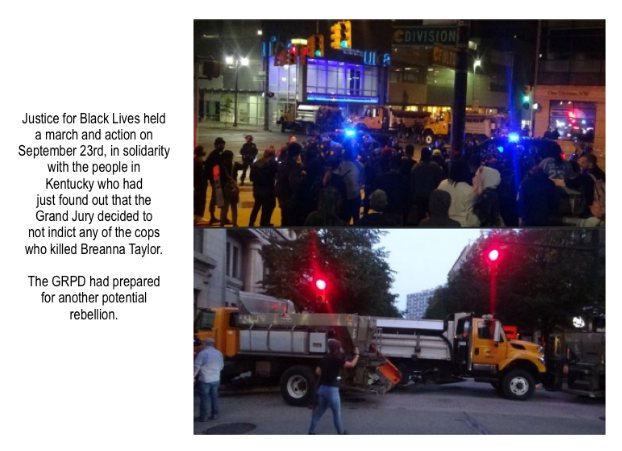
Grand Rapids is using bureaucratic management to further marginalize the Defund the GRPD campaign
Setting the parameters for input by controlling the narrative: The GRPD Strategic Plan Survey
Grand Rapids participates in statewide Solidarity Action, GRPD threatens activists with arrest
The GRPD planned for another riot in the wake of no justice for Breonna Taylor action
Gun Violence, Structural Violence and the GRPD
 In addition, we documented these movement to defund the GRPD and the ongoing street protests against White Supremacy, with a post entitled, A visual timeline of how the GRPD has tried to control the narrative about public safety since the May 30th rebellion in Grand Rapids.
Lastly, we did not include other movement work in Grand Rapids, but want to acknowledge the work of other Black, Indigenous, latinx and queer organizing that had a significant impact on this community, along with groups like Together We Are Safe, the Urban Core Collective, the Grand Rapids Area Tenant Union and Grand Rapids for Education Justice, all of which are making an impact on structural change in Grand Rapids.
In 2021, GRIID will continue to be a media watchdog, exposed those in power and write about the social movements in Grand Rapids, which are ultimately the only thing that challenges the systems of power and oppression that are part of the very fabric of the city we call Grand Rapids.
GRIID Year in Review Part III: Reporting on the COVID crisis and how systems of power responded in West Michigan
 (Editor’s note: GRIID does not ask for money, since we do not to make money for the IndyMedia we produce. We do, however, invite people to share our content, as we believe it can help foster important conversation about critical issues in this community.)
On Friday, we shared Part I of this four part series, with a look at how GRIID continues to monitor the news media and deconstruct their narratives.
In Part II, we looked at the 2020 GRIID posts that looked at what the Grand Rapids Power Structure was up to.
In Part III, we will focus on posts that looked at the COVID crisis, specifically through the lens of how systems of power responded to the crisis, who is benefiting from the pandemic and which communities are the most hard hit.
Organizations that are part of the power structure wasted no time in promoting their own policy agendas once the COVID pandemic hit Michigan. Marc Lamont Hill refers to this crisis as Corona Capitalism, which exposes how the system of Capitalism fails the public during a crisis, like what we are facing right now.
Beginning at the end of March, we posted stories entitled Disaster Capitalism in Michigan, with Part I focusing on Americans for Prosperity and Part II involving the Mackinac Center for Public Policy, which has a long history of support from members of the Grand Rapids Power Structure.
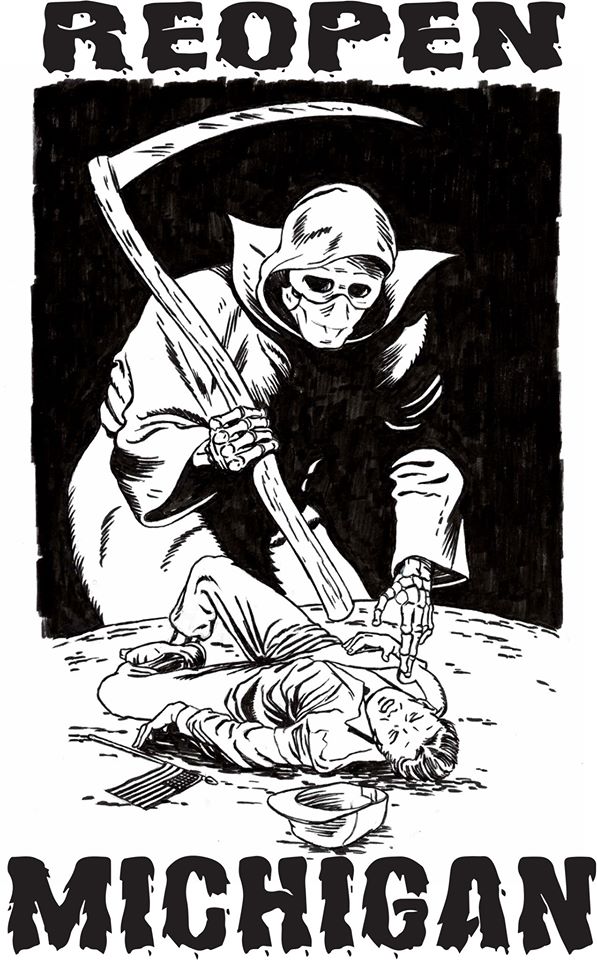
We then continued with how organizations that are part of the power structure continued to promote Corona Capitalism, like the Acton Institute, which was providing the ideological framework to support the anti-lockdown protests.
By late April, there were coalitions being formed within the Capitalist Class to promote re-opening Michigan’s economy along with many West Michigan business leaders.
Another tactic that was being used by the Capitalist Class was to offer, as they often do, charity, which is primarily motivated by their desire to get good press. The DeVos family was doing this with the Kent County Relief Fund, which only lasted a few months.
In early May, the Kent County Health Department (KCHD) was tracking COVID 19 cases in this area, providing numbers by zip code and a breakdown of cases by race. The data the KCHD provided was consistent with what was happening across the country, with people experiencing poverty and Black residents had higher rates of infection and death.
Later in May, the City of Grand Rapids had posted a video called We Will Rise, which attempted to present the same old narratives about Grand Rapids, narratives that not only sought to downplay who was being disproportionately impacted from the virus, but how centers of power were “helping.” The video also grossly underestimated the failure of the government/business response to the COVID crisis.
By July we were able to report on the Paycheck Protection Program (PPP) funds coming to Grand Rapids, an how sectors of power were often the beneficiaries of this funding.
In August, Secretary of Education Betsy DeVos was brazen enough to publicly state that the pandemic was benefitting the kinds of education policies she has promoting for decades, the privatization of education and the undermining of public education.
In September, the Michigan Supreme Court ruled against Gov. Whitmer’s Stay at Home orders and Republican lawmakers began to push the insidious idea of herd immunity.
Not surprising, once more businesses opened up, we saw a major spike in COVID cases across the state, especially in Kent County, despite all the claims from the Corona Capitalists that West Michigan was unique.
Ultimately, what the COVID crisis has revealed is the deep structural problems with the system of capitalism and how it is designed to reward those with power and privilege and punish everyone else. In Part IV, we will look back at some of the amazing work that was done in 2020 by grassroots social movements in the Grand Rapids area.
Graphic by Brett Colley
 (Editor’s note: GRIID does not ask for money, since we do not to make money for the IndyMedia we produce. We do, however, invite people to share our content, as we believe it can help foster important conversation about critical issues in this community.)
On Friday, we shared Part I of this four part series, with a look at how GRIID continues to monitor the news media and deconstruct their narratives.
In Part II, we will look at the 2020 GRIID posts that looked at what the Grand Rapids Power Structure was up to. We monitor the local power structure for a variety of reasons, but also because we believe that this is a primary function of journalism….to expose, critique and challenge those in power.
We posted stories about organizations that are part of the Grand Rapids Power Structure, such as the West Michigan Policy Forum, which earlier in the year was pushed state lawmakers to maintain work requirements for those receiving Medicaid. Another example of an organization that represents the GR Power Structure, is the Right Place Inc, where we critique their strategic goals of class warfare.
Then there are groups like the DeVos-created AmplifyGR, which went before the Planning Commission at the beginning of 2020, which resulted in a follow up story we did about how a member of the Planning Commission had a serious conflict of interest on this matter, even if his fellow commissioners didn’t think so.
Since it was an election year, we tracked how members of the Grand Rapids Power Structure were contributing to political campaigns in March and just before the August Primary. However, the most important reporting we did on election coverage, was the 4 part series we did on the DeVos family election contributions, just prior to the November election.
Part of the monitoring of power that we engage in, is reporting on how the wealth of the capitalist class increases, especially while others are struggling. This was the case in a story we posted in April, about how the wealthiest people in Kent County were benefitting from the CARES Act, and again the following month where we noted how the Meijer and DeVos family wealth had increased while thousands in West Michigan were unemployed, facing food insecurity and potential eviction.
We also did our annual look at the latest information on the foundations that members of the local power structure operate. In early May, we posted a piece about the Prince family foundation and a five-part series on the DeVos family foundations.
Beginning in October, we began to follow the latest development proposal from Grand Action, which was scheming on a project to bring an outdoor amphitheater to Grand Rapids. By November, there were more details revealed about the project, where we made the point that when the powerful want something done they often get their way, while some parts of Grand Rapids continue to be underfunded.
 We also expanded our exploration of the Grand Rapids Power Structure to look at what we referred to as the second tier of power in Grand Rapids, in an article we posted in October.
Lastly, we reported on the death of Peter Secchia, which was a more honest assessment of his life, compared to what the dominant news sources were saying. In early December, we critiqued a letter that was sent to the Grand Rapids City Commission from Sam Cummings, which was rather instructive about how those with power think. And of course, we updated our online resource known as the DeVos Family Reader, which is now at about 600 pages long.
Again, we do this work because it should be the function of journalism to comfort the afflicted and and afflict the comfortable. We also believe it is essential for those organizing for radical change to have a robust understanding of the local power structure, especially if we want to defeat them.
In Part III of this series we will look at the COVID crisis and how systems of power responded to this pandemic.
ACLU sends letter to the City of Grand Rapids demanding they halt the Heartside encampment evictions
 Yesterday, I received a letter that was sent to the Mayor of Grand Rapids, City Commissioners, the City Manager and Police Chief Payne. The letter makes legal claims that evicting those at the Heartside encampment would be a violation of what the CDC and the Michigan Department of Health and Human Services have said about housing during COVID 19.
Early on in the ACLU letter, it states:
We ask that the City pause the evictions at least until plans can be made to offer safe single-occupancy accommodations, not just congregate shelter, to camp residents. We also write to alert the City that is legally required to ensure that Camp Heartside residents receive clear notice, including information about how to reclaim property, and that the City must inventory and store any seized property and provide owners a reasonable opportunity to claim it. The City should also be aware that it cannot make it a crime for people to engage in life-sustaining activities like camping unless there is sufficient housing available for those individuals.
Recent guidelines released by both the U.S. Centers for Disease Control and Prevention (CDC) and the Michigan Department of Health and Human Services (MDHHS) state that an immediate moratorium on homeless encampment sweeps should be implemented during the COVID-19 pandemic unless the city can offer individual housing. The CDC and MDHHS guidelines are clear that communities should not clear outdoor encampments unless the people living in those locations are offered access to individual housing units because doing so increases the risk of infectious disease spread.
The letter does acknowledge the City’s offer for people to go to the Purple East building, but makes it clear that this is not adequate, based on what the CDC is saying:
We appreciate that the City and its partners have worked to increase shelter capacity in Grand Rapids by converting the former Purple East building into an emergency warming center and overnight shelter. But that is not the type of individual housing contemplated by the CDC. There are too few individual housing options available in Grand Rapids for unsheltered people, and congregate shelter settings can put this already highly vulnerable population at great risk for COVID-19 due to issues with physical distancing, air circulation, and sanitation. While we are sure the City and shelter providers are doing their best to provide a safe environment, congregate environments are inherently dangerous during the pandemic. Individual housing, as recommended by the CDC, is critically needed.
The ACLU letter concludes with two specific demands of the City:
- Halt the evictions at least until plans can be made to offer hotel accommodations as an additional alternative to Camp Heartside residents.
- Ensure that any actions take against Camp Heartside residents or their property comport with the Constitution, including clear notice that includes information about how to reclaim property, inventorying and storing any seized property in a safe place to provide owners a reasonable opportunity to claim it, and ensuring that life-sustaining activities like camping are not criminalized absent clear evidence that the City has adequate housing available for every Camp Heartside resident.
You can read the entire ACLU letter by going to this link. In addition, if you have not read our post from yesterday, please check out what other actions people can take to support those at the Heartside encampment.
Grand Rapids plans to evict those at the Heartside encampment by Monday
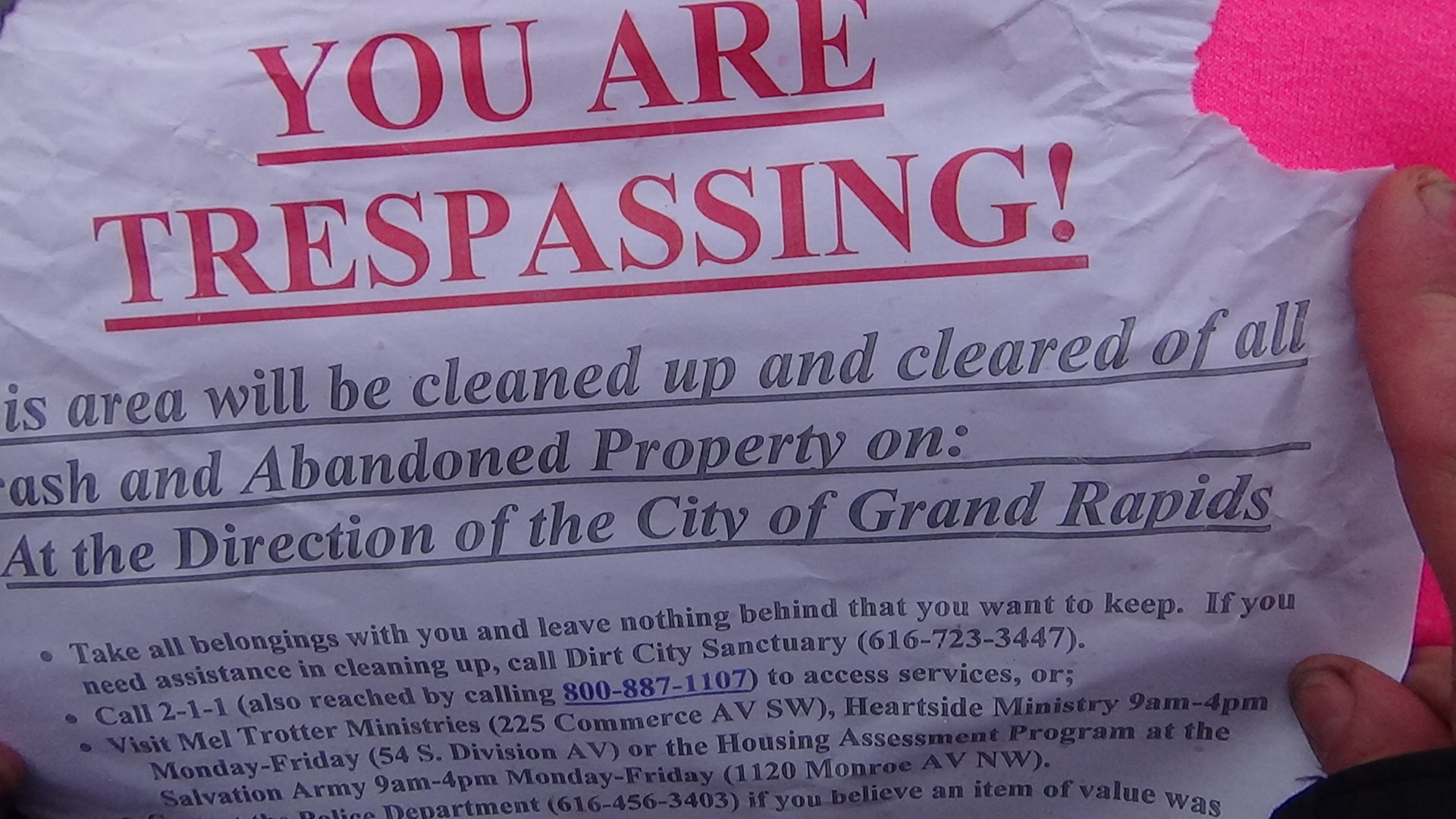 In the midst of this pandemic, which has caused people to be unemployed, food insecure, loss of health insurance and unstable housing, the response from the City of Grand Rapids has been to evict people from the encampment in the Heartside district, just south of the downtown area.
The City is “offering” temporary housing in the Purple East building, which is right across from the encampment, but many people are concerned about being in an enclosed space an contracting the COVID virus. According to one of the solidarity organizers I spoke with, many people would prefer to stay at the outdoor encampment, than risk exposure to COVID.
The eviction notice, shown here on the right, is what the City posted at the encampment on Friday, which says that people needed to be gone from that space no later than Monday afternoon or face possible arrest.
This response by the City is not only cruel and cold-hearted, it demonstrates once again that City officials are willing to use state violence (the GRPD) to deal with people they consider to be both disobedient and disposable.
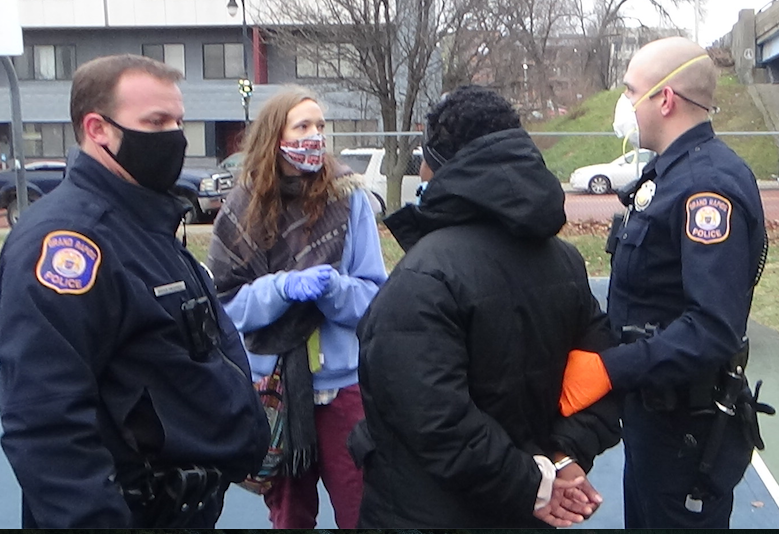 While I was speaking with one of the solidarity organizers, I saw to large white men whom I have seen at Movimiento Cosecha protests, men we believe to be undercover cops. They were talking with some of the people who were part of the encampment and then left.
Shortly after this incident, two GRPD uniformed officers were walking through the encampment towards the south end, when they approached a Black woman. Within minutes the cops then began to cuff this woman. One of the solidarity organizers began to film the arrest and another person began questioning why the cops were arresting this woman. The woman being arrested said she believed that she was being arrested because she had contacted the Health Department to make a formal complaint about the unsanitary conditions of Mel Trotter Ministries.
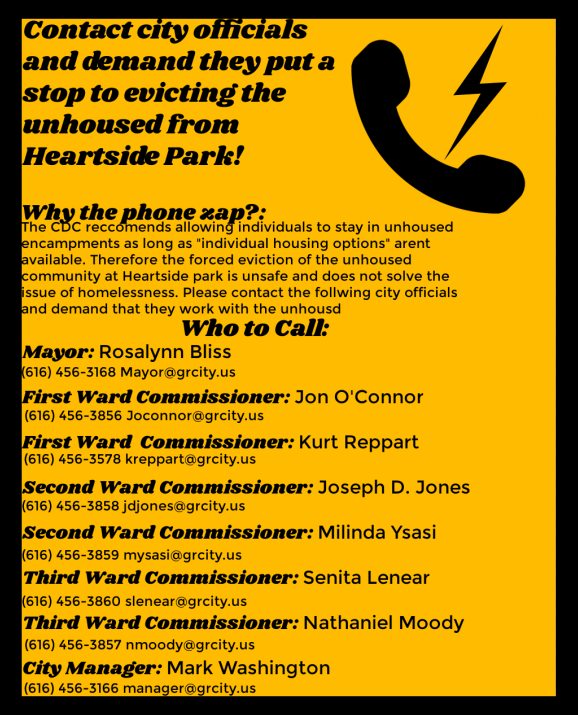 As of right now, this is what the people at the encampment, both those who are living there and those who are providing support and solidarity, are asking of the larger community:
- They are in need of boots, gloves, men’s pants, but not other kinds of clothing items.
- They welcome most foods, especially something hot to eat, along with medicines or people with medical training to help with diagnostic work.
- They also need people to pressure City officials to NOT evict people who want to stay at the encampment, as well as people who can come either Sunday night or Monday before the City of Grand Rapids sends the GRPD to forcible remove people who want to remain at the encampment.
If you are able to take action on any of these items, please do so and let others know about what is happening!
GRIID Year in Review Part I: Monitoring the Dominant News Media
 (Editor’s note: GRIID does not ask for money, since we do not to make money for the IndyMedia we produce. We do, however, invite people to share our content, as we believe it can help foster important conversation about critical issues in this community.)
It is that time of the year, where we look back at what we have been posting about and what has been taking place in 2020 in West Michigan.
Today’s post is the first in a four part series where we identify the work that GRIID does. In Part I, we will look at the narratives put forth by the dominant news sources in West Michigan and how those narratives serve power. In Part II, we will look at how GRIID reported on the Grand Rapids Power Structure. Part III will explore the impact of the COVID pandemic, who was most impacted by it and who used the pandemic to their own benefit. In Part IV, we will explore the role that social movements have played in 2020, those that have been organizing for several years and new movements that came about, particularly after the May 30th rebellion in Grand Rapids.
Deconstructing the Dominant News
In 2020, we posted 45 different news deconstructions, some that dealt with single stories and some that provided a critique of numerous news sources on the same issue or event.
Most of the news stories we deconstruct has to do with how the local news media reports on those with power, both financial and political power. We began the year with a critique of how the news media reported on the DeVos-created AmplifyGR project in the Boston Square neighborhood.
We also regularly deconstructed how the dominant news sources reported on politicians, such as the interview with the Grand Rapids Mayor, which only included coverage of progress that has been made in recent years.
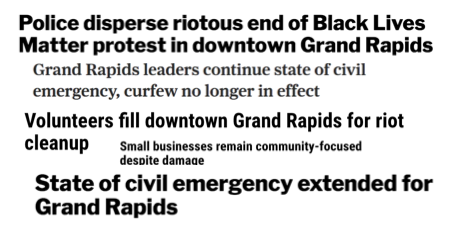
However, the major source of news deconstructions that we did in 2020, centered around the COVID crisis and the aftermath of the May 30th rebellion in Grand Rapids, particularly how the dominant news reported on the GRPD and White Supremacist groups.
We looked at how the dominant news agencies reported on the anti-lockdown protests in Lansing and in Grand Rapids in May.
In early June, we looked at dozens of local news stories on the May 30th rebellion in Grand Rapids an found that the dominant news sources centered the voices of elected officials, downtown businesses and the GRPD, while marginalizing Black voices that were involved in organizing the resistance to state violence.
From June until now, the dominant news sources have not only centered the perspective of the GRPD, they often would run stories based almost exclusively on Media Release put out by the City of Grand Rapids or the GRPD. Here are two examples of the how the dominant news agencies cooperate with the GRPD; Grand Rapids news media acts as a conduit for the GRPD, twice in the same day and The Local News Media continues to be a Press Agent for the GRPD.

Equally disturbing is how the local news agencies either provided a platform for White Supremacist groups or failure to adequately investigate them. In early July, WOOD TV 8 did a story on the Michigan Liberty Militia, never challenging once the claims made by its members. Just a few days later, channel 8 then did a story that essentially tried to demonize anti-racist and anti-fascist organizers.
The ongoing failure of how dominant news sources treated White Supremacist groups, became evident after several armed white guys, all associated with White Supremacist groups, attempted to kidnap Gov. Whitmer. Here is what we wrote about how the dominant news sources were complicit in this act of domestic terrorism, The local news media has been complicit in White Supremacy by providing White Supremacist groups an uncritical platform to promote hate.
As you can see, poor journalism and journalism that doesn’t hold those in power has real world consequences and often contributes to harm done to those who are the most vulnerable.
In Part II, we will look back at the articles we posted in 2020, which exposed and challenged the local power structure.
Betsy DeVos Watch: When the Secretary of Education says faith-based organizations, she really means Christian organizations
 In possibly her last act as Secretary of Education, Betsy DeVos declared earlier this week that, “the Department of Education announced a joint final rule with eight other agencies — the Department of Justice, the Department of Homeland Security, the Department of Labor, the Department of Health and Human Services, the Department of Housing and Urban Development, the Department of Agriculture, the Agency for International Development, and the Department of Veterans Affairs — to implement President Trump’s Executive Order No. 13831, on the Establishment of a White House Faith and Opportunity Initiative. This rule ensures that religious and non-religious organizations are treated equally in Department-supported programs, and it clarifies that religious organizations do not lose their legal protections and rights just because they participate in federal programs and activities.”
Accompanying this announcement was a direct comment from DeVos herself, who said:
“Religious liberty is a bedrock founding principle that this Administration consistently demonstrates its commitment to vigorously defend. At the Department of Education, we’re continuing to ensure faith-based organizations, including faith-based institutions, do not give up their First Amendment rights as a condition of participating in taxpayer programs. We will continue to ensure faith-based educational providers are treated equally alongside their secular counterparts. Under this Administration, religious discrimination in education is never tolerated.”
Of course, what DeVos means by faith-base organizations, she means Christian organizations. It would be naive to think that this administration would be defending Muslims, Buddhists, Native American religious traditions or any other faith-based groups that are outside of the Judeo-Christian framework.
In addition, such a pronouncement also raises the questions around the use of public taxpayer money for religious purposes. When this initiative was first adopted by the Trump Administration in May of 2018, the ACLU released a statement saying:
Freedom of religion is one of our most fundamental and cherished rights. But that freedom does not give any of us the right to harm other people, to impose our beliefs on others, or to discriminate. The ACLU will be watching this initiative closely to ensure that it does not promote policies that violate these core principles. Many in the U.S., including people of faith, don’t want to give taxpayer-funded agencies or businesses open to the public a license to discriminate.
In late June, we reported on the US Supreme Court ruling on that would force taxpayers to underwrite religious education in the US, so it will be very interesting to see what the incoming Biden Administration will do to challenge these dynamics.
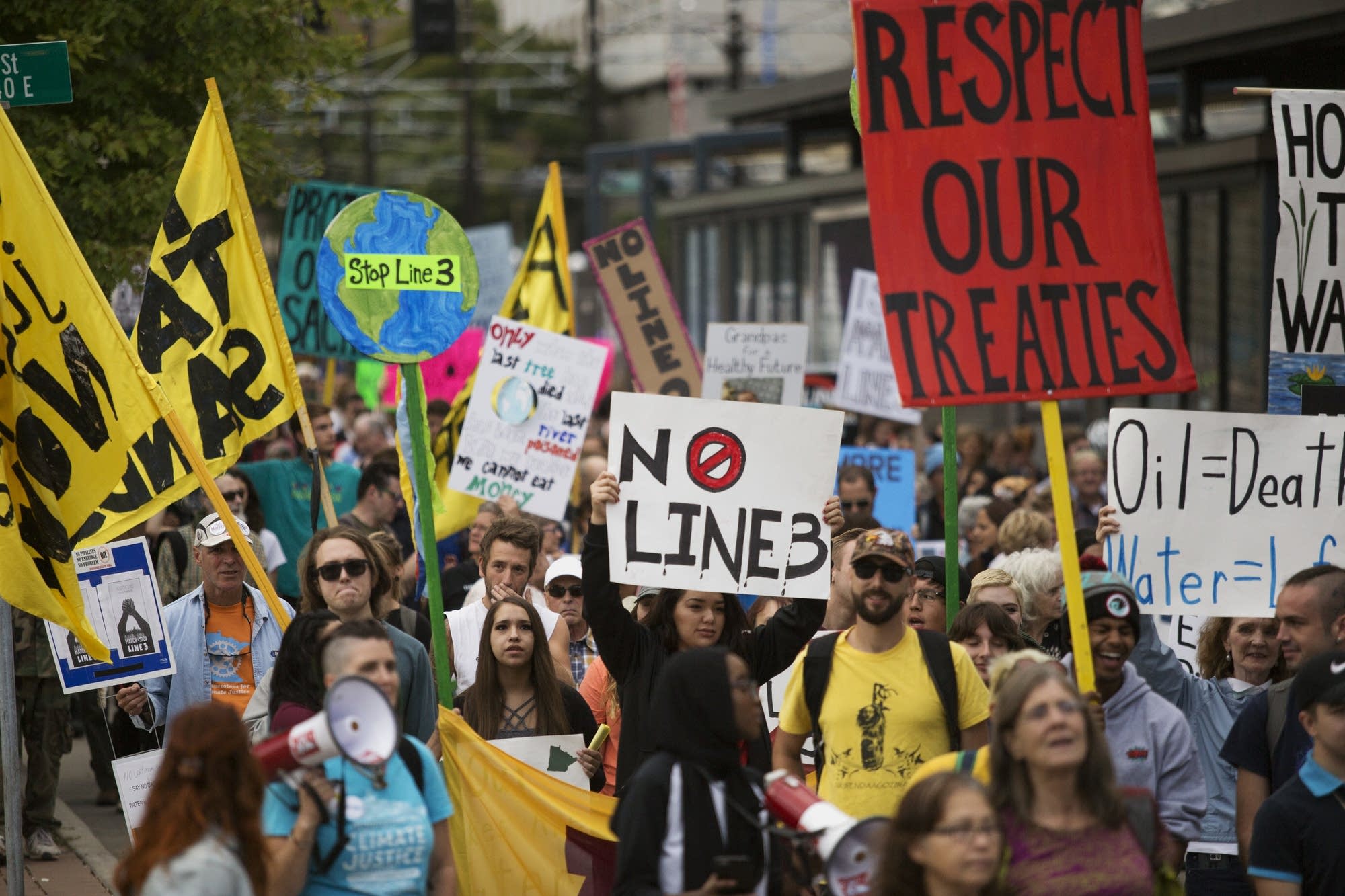 It has been less than 24 hours since the Biden camp has announced that former Michigan Governor Jennifer Granholm has been nominated as Secretary of Energy.
So far, the liberal establishment has been celebrating this news. This celebration includes many establishment environmental groups, like GreenPeace, which said:
“We’re glad that President-elect Biden is listening to the thousands of climate justice activists who opposed fossil fuel representatives like Ernest Moniz for Secretary of Energy. Jennifer Granholm has forcefully spoken out against both the Keystone XL and Dakota Access pipelines and advocated for shifting investment from oil and gas to renewable energy solutions. That’s the kind of leadership the Department of Energy has been sorely missing.
Still, Granholm has her work cut out for her to prove she can lead the transition to a more just, democratic, clean energy system. The DOE’s role in COVID-related economic stimulus and the responsibility of carrying out Biden’s plan to make the nation’s electrical grid carbon-neutral by 2035 will both fall to Granholm. Climate destruction is only possible in a world in which racism is tolerated, and we need leaders in government who aren’t afraid to call out oil and gas corporations for their decades of unjust pollution. We’ll be watching to see if Granholm rises to the challenge.”
Now, the GreenPeace statement does conclude with a we’ll see sort of optimism, but what I find in this kind of celebratory announcement is no real assessment of what Granholm was doing, as it relates to energy issues, while she served two terms in office as Michigan’s Governor. Here are some reasons why I am not jumping for joy over the announcement about Granholm:
- As Governor, Granholm worked with the Obama administration on the bailout of the auto industry. This led to forcing auto workers to accept further cuts to benefits and wages, but it also meant that the fossil fuel-dependent auto industry would get public money to continue to produce gas guzzling vehicles, thus normalizing fossil fuel consumption.
- Granholm was the Governor in Michigan during the Enbridge Kalamazoo River oil crimes. Granholm was critical of the clean up efforts by Granholm, but there was NO call by the Granholm administration to shut down the Enbridge Line 5 in Michigan. Not calling for a shut down of Line 5 after the disastrous oil crime in the Kalamazoo River basin should give us all reason to not blindly celebrate the Biden nomination of Granholm.
- While some eco-groups are claiming that Granholm opposed the Keystone XL an the Dakota Access pipelines, I am unaware of her actual participation in resisting these pipelines and actively supporting the indigenous-led resistance that continues to this day.
Instead of celebrating this choice, which is both naive and partisan group think, how about we continue to demand the end of the Dakota Access pipeline, shutting down Line 3, Line 5 and all other pipelines, especially those that Indigenous communities are resisting.
Instead of relaxing, we need to continue to demand massive defunding of the fossil fuel industry, that the Biden administration pass the New Green Deal and a deep commitments to fighting the climate crisis. If those things happen, then I will celebrate.

