Betsy DeVos’ resignation was cowardly and in no way diminishes her complicity in the harm that the Trump Administration inflicted on the world
 On Friday, Secretary of Education Betsy DeVos, resigned from the Trump Administration, just weeks for she would have had to vacate her position.
DeVos, who is part of one of the most powerful family mergers in the country – the DeVos/Prince Family Cartel – sent a letter of resignation on Thursday to President Trump.
The letter of resignation from DeVos is instructive, for a variety of reasons.
First, DeVos spends the bulk of the letter highlighting her accomplishments within the Trump Administration, even speaking fondly of Trump and his efforts to champion the Neo-Liberal Education model DeVos has promoted for decades.
Second, DeVos even takes yet another opportunity to denigrate teacher unions by saying, “Millions (of students) are being denied meaningful access to education right now, in no small part because of the union bosses who control so much of the traditional system.”
Third, it is not until over halfway through the letter that DeVos expresses her sentiments about what happened on Wednesday at the Capitol. “That behavior was unconscionable for our country. There is no mistaking the impact your rhetoric had on the situation, and it is the inflection point for me.”
Ok, so putting immigrant children in cages and separating them from their parents was not an inflection point for you Betsy? How about four years of endorsing White Supremacy with the Trump Administration, which not only fostered a climate for white nationalists to intimidate and harm Black, latinx and indigenous people, it sanctioned and nurtured a long standing practice of law enforcement agencies to brutalize Black, latinx and indigenous people. This was not a point of inflection for you Betsy?
Fourth, Betsy then seems to care about how the MAGA coup attempt at the US Capitol may have impacted children who were watching what went down. Really! How does Betsy think that children, who saw her ascendancy, as a billionaire, into the Trump Administration, with no previous public education experience, would react to what went own on Wednesday? More importantly, how will the parents and teachers help make meaning of what happened at the US Capitol. Will they challenge the official version of US history, a version that DeVos embraces when she says things like the children, “must know from us that America is greater than what transpired yesterday,” or will they expose them to a more honest People’s History version of how systems of power have functioned in the US since it was founded on Settler Colonialism and Slavery?
Fifth, the fact that DeVos is trying to distance herself from what happened at the US Capitol on Wednesday is also a desperate attempt to deflect the fact that the DeVos family spent millions in the last four years to elect Republicans, many of which have encouraged the White Nationalist who attempted the coup, plus they contributed to Trump’s re-election in 2020.
Lastly, it is worth saying that Betsy’s resignation is just another attempt by those who have benefited from Trumpism to try to save face. The reality is that the resignation of Betsy DeVos was a cowardly act, in a long line of cowardly acts that she and the rest of the Capitalist Class have been committing for a very long time.
Grand Rapids Area Tenant Union holds Press Conference outside the Eviction Courts to demand a moratorium on evictions
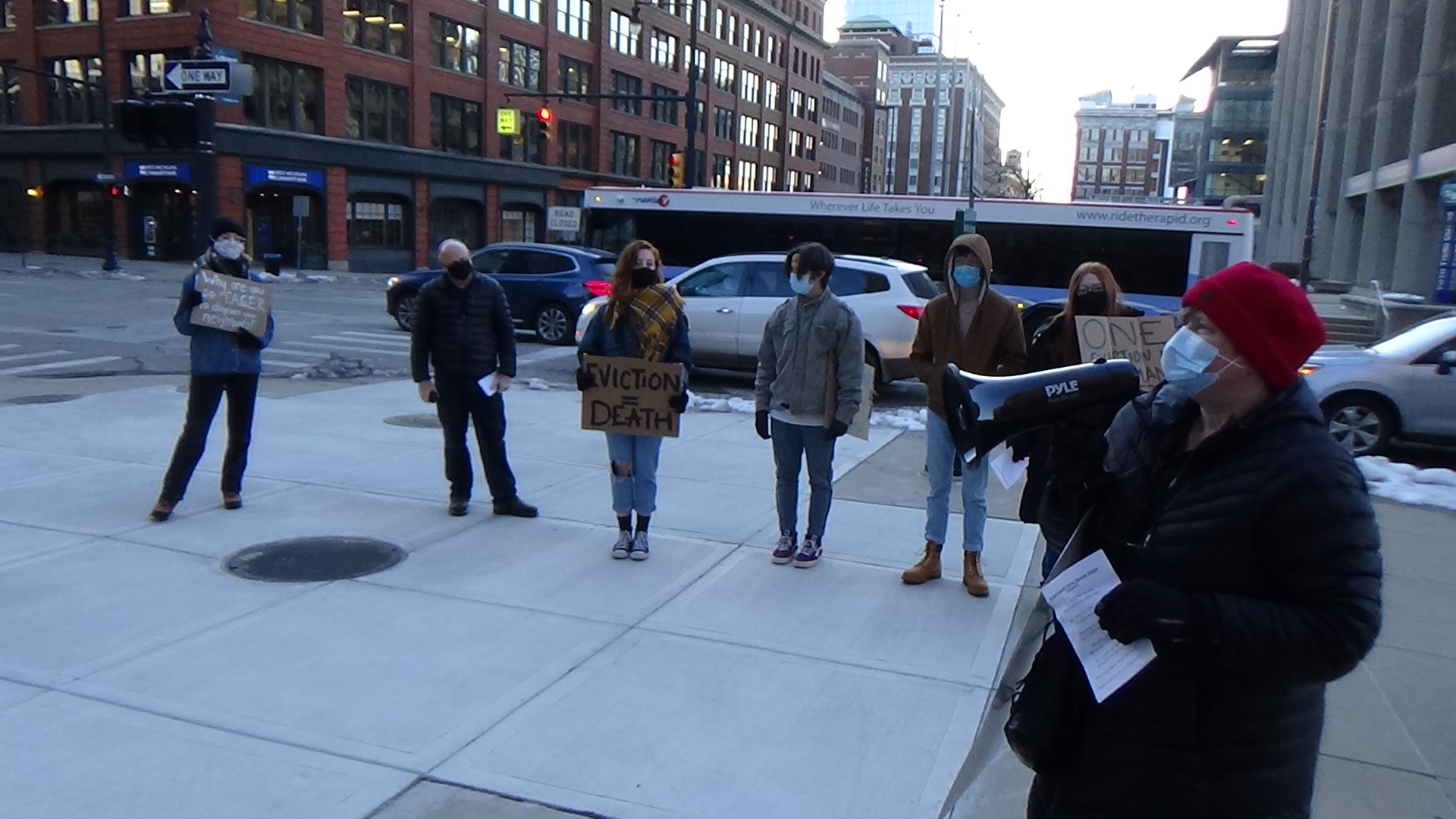
The Grand Rapids Area Tenant Union organized a media action in front of the Kent County Court House on Thursday, just before the courthouse closed.
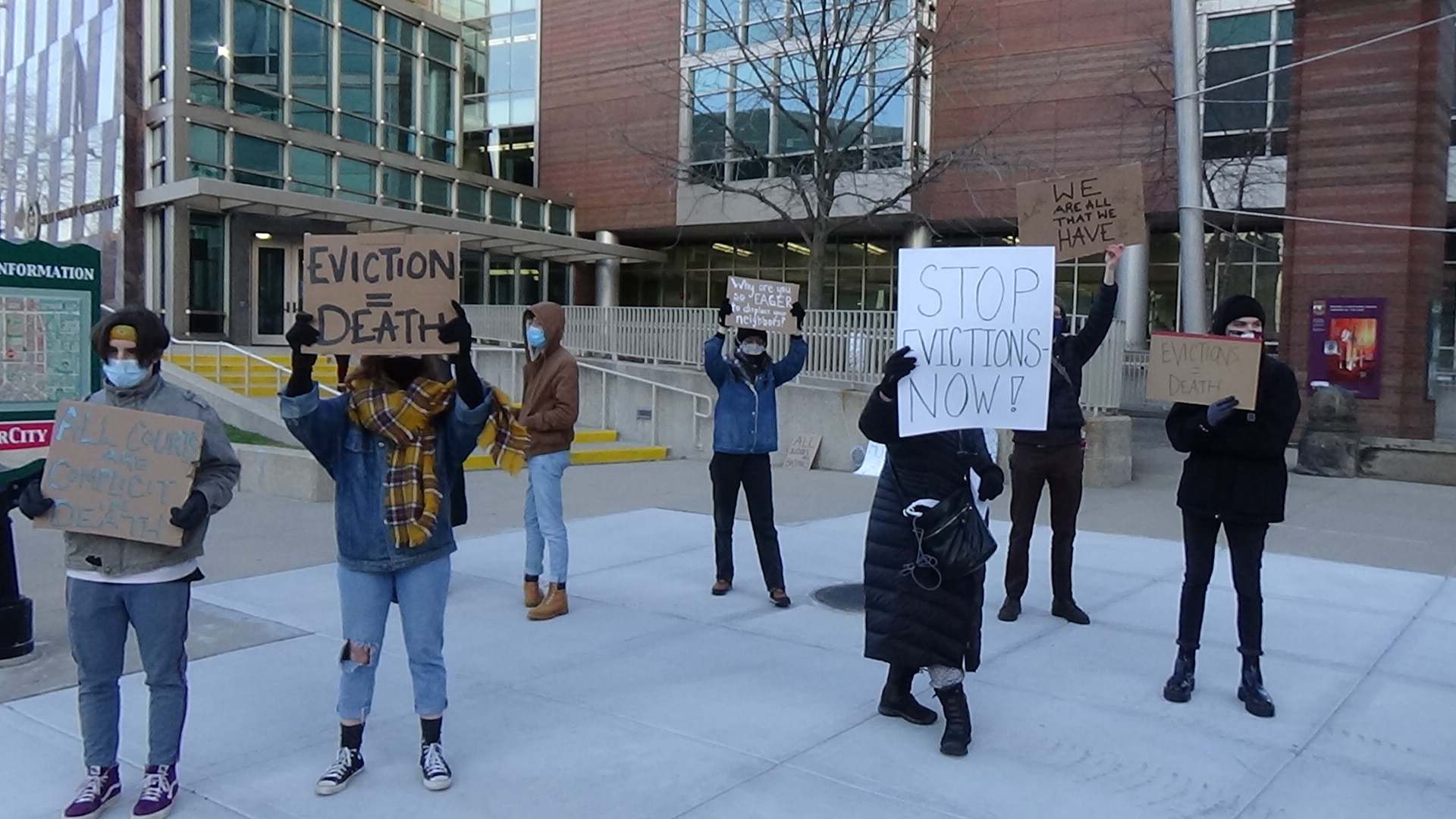
A small group of tenants and allies came together, wearing masks and socially distancing to learn more about what the relatively new tenant union was doing, particularly in preparation for the likelihood of mass evictions at the end of the month.
 Before the media action even began, deputies from the courthouse came out to let people know that they heard about the action and didn’t want things to get “out of hand.” In addition, three separate GRPD cruisers drove by to keep an eye on what the anti-eviction activists and supporters were doing.
The Grand Rapids Area Tenant Union chose to host their media action outside the courthouse, since eviction proceedings happen there.
The tenant union organizers then listed several demands, which included:
- A demand that the incoming Biden administration a complete moratorium on evictions, on day one. They were also calling on Governor Whitmer and all the local Mayors in Kent County, to also support a moratorium against evictions as well.
- Another demand was to call on all Judges to not enforce eviction proceedings in the midst of the pandemic, since putting people out on the street is both cruel and criminal.
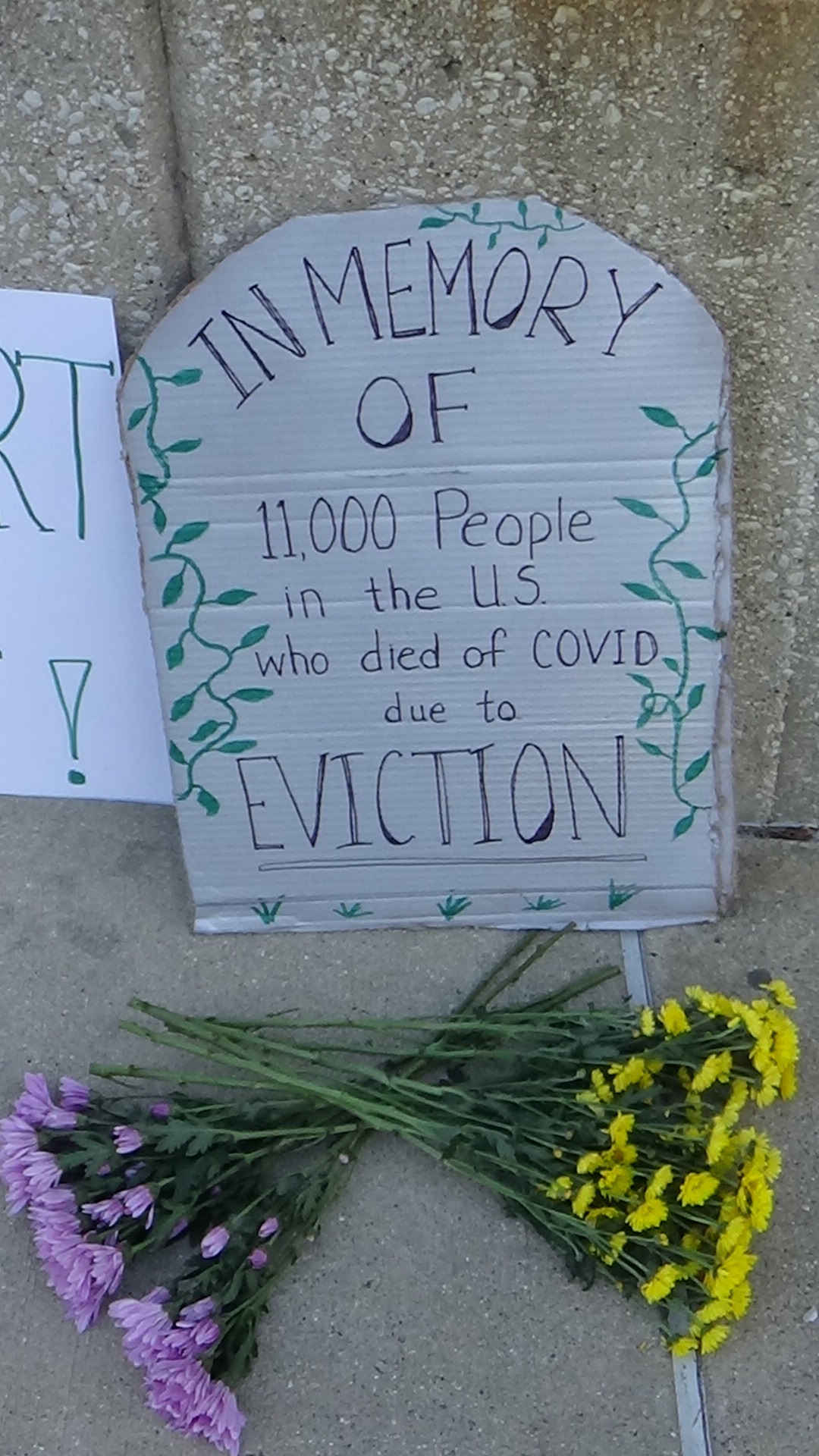
The organizers also cited a recent study, which looked at the states that lifted eviction moratoriums early in the pandemic, found that between March 13 and September 3, that 10,700 deaths from COVID 19 occurred because people were evicted.
At one point tenants were invited to share their own experiences with landlords and Property Management Companies. One tenant said they rented from Urban Pharm, and that within the first week of living there, part of the roof collapsed. In addition, they have had issues with rodents, along with a general lack of upkeep on the property. They also shared that rent was too high and has risen 200% in recent years, making it very difficult for them pay increased rental fees, on top of other living expenses.
Organizers also stated that the media action was in conjunction with Housing is the Cure events happening in cities all across the country, action that were coordinated through Right to the City.
In preparation of the likelihood of lots of evictions, the Grand Rapids Area Tenant Union also let people know about their upcoming Eviction Defense Training, which will be this Saturday at noon, in an online format. For those interested in participating, you can go to the event page at this link.
West Michigan Policy Forum fought to end the Stay at Home order, now they want people to wear masks and keep shopping!
The great scientist Albert Einstein once said, “You cannot simultaneously prevent and prepare for war.”
 The same could be said for how some group that are connected to the local power structure are responding to the COVID 19 pandemic.
Ever since the COVID 19 pandemic began, there have been numerous groups who have outright denied the existence of the virus and the public health risks involved. These people, like the American Patriot Council, refuse to wear masks and believe that it is some sort of government conspiracy.
Then there are groups that have fought Governor Whitmer’s Stay at Home orders from the get go, thinking it was bad business. Groups like the Chamber of Commerce, the Acton Institute and the West Michigan Policy Forum. All of these groups have resisted the Stay at Home orders, primarily out of economic interests. These groups have mostly worked to lobby Michigan legislators to oppose the Stay at Home orders and to allow the business community to make their own decisions about how to respond to the pandemic.
The West Michigan Policy Forum (WMPF) was particularly aggressive when it came to pushing against the Stay at Home orders. In April we reported on an online forum that the WMPF hosted, where CEOs were talking about getting Michigan business open again.
In May, the WMPF took out paid ads on MLive to promote their views on the Stay at Home order in Michigan, primarily that it was an infringement on their rights to engage in commerce.
After ongoing lobbying by the WMPF to get the GOP-controlled State Legislature to vote against the Stay at Home order, we then saw a spike in COVID cases and deaths across the state, particularly in November and December. We made the point in an article we wrote in November, that many of the members of the WMPF had also contributed significant amounts of campaign funds to State House leader Lee Chatfield and Senate leader Mike Shirkey.
In the past fews days, the West Michigan Policy Forum has been posting videos on their Facebook page, with the CEO of Spectrum Health, the President of the Small Business Association of Michigan and Grand Rapids Mayor Bliss, all imploring people to mask up and support local businesses. Again, the videos primarily push the idea that profit making should continue, despite the public health risks of the COVID crisis.
It’s hard to know the real motivations behind posting these recent videos, but we do know that the West Michigan Policy Forum has been one of the leading voices of the business community that fought Gov. Whitmer’s Stay at Home order and financed the politicians who got the Stay at Home order overturned.
We would argue that the spike in new COVID cases and COVID deaths is a direct result of the efforts of groups like the West Michigan Policy Forum. It seems that their call for people to mask up is primarily motivated by profit making, NOT the well being of the general population and particularly the most marginalized in our community that have been most impacted by the COVID 19 crisis. You cannot simultaneously make massive profits and call for an end to the pandemic by simply asking people to wear masks.
In the summer of 1990, it began clear that the US government was beginning to marginalize Iraq, with the intent of going to war with the Middle Eastern nation.
The US was claiming that Iraq’s border dispute with Kuwait was an act of aggression and by late Summer of 1990, the US began a military build-up against Iraq, getting Saudi permission to use their country as a base in which to begin an invasion.

Activists in Grand Rapids began holding weekly demonstrations in front of the federal building in downtown, sometime in September of 1990. The weekly demonstrations grew in size between September and the New Year, as the Bush Administration began to ramp up campaign to justify an invasion of Iraq.
The US news media was going along with US government’s propaganda and also began to beat the war drums. CNN, which was a fairly recent player in news market, became the first 24 hour news platform and made the US build-up to the war in Iraq its main focus, providing daily coverage of US military press briefings and creating digital graphics for promoting the Gulf War.
The US military assault on Iraq, known as Operation Desert Storm, began as the national known as Martin Luther King Jr. day was being celebrated. Once the war started, the Pentagon, along with most major news outlets began framing the issue to the public as Support for the Troops. Many cities across the country, including Grand Rapids, decorated their downtown districts with yellow ribbons tied on trees or lamp posts. Such displays was meant to silence any anti-war sentiment and equate being agains the US war as being against the US troops.
There were protests every Monday in Grand Rapids, mostly in front of the Federal building, but sometimes those in the demonstrations would march. The picture above is a student-led march that began at the Federal building, but continued throughout the downtown area. These demonstrations lasted until late February of 1991, when the US ended their military attack against Iraq.
During those 6 weeks of protesting, there were other actions that were organized in Grand Rapids:
▪ In late January the Institute for Global Education organized a Teach-In on the Gulf War, which provided sessions on a history of US foreign policy in that region and workshops on civil disobedience.
▪ At a GVSU hosted MLK Day (downtown GR campus) there was a workshop done on US militarism and racism, with an emphasis on what is referred to as an economic draft. An economic draft, means that a disproportionate amount of black and latino/latinx youth were joining the US military because of the lack of work and education opportunities.
▪ There were also workshops being done in Grand Rapids with college and high schools students about how to become a conscientious objector or war resister if a draft was re-instated and to provide people with more information on being a CO or war resister.
However, since the US military portion of the war ended so quickly, it made it difficult to build a mass movement in Grand Rapids to oppose the war. Just weeks after the US military ended the invasion/war on Iraq in February of 1991, it became known that the PR film of Hill & Knowlton had done a great deal to sway public opinion and the US Congress to get their support for war. The Center for Media & Democracy initially published a report on how the PR firm had fabricated information, particularly the story about Iraqi soldiers taking Kuwaiti children out of their incubators and killing them. This PR effort used a Kuwaiti girl, who testified at a Congressional hearing, but was only discovered later that she was the daughter of the Kuwaiti Ambassador to the US. Watch this documentary on the PR industry and at 24:50 you will hear how Hill & Knowlton developed their campaign to demonize Iraq.
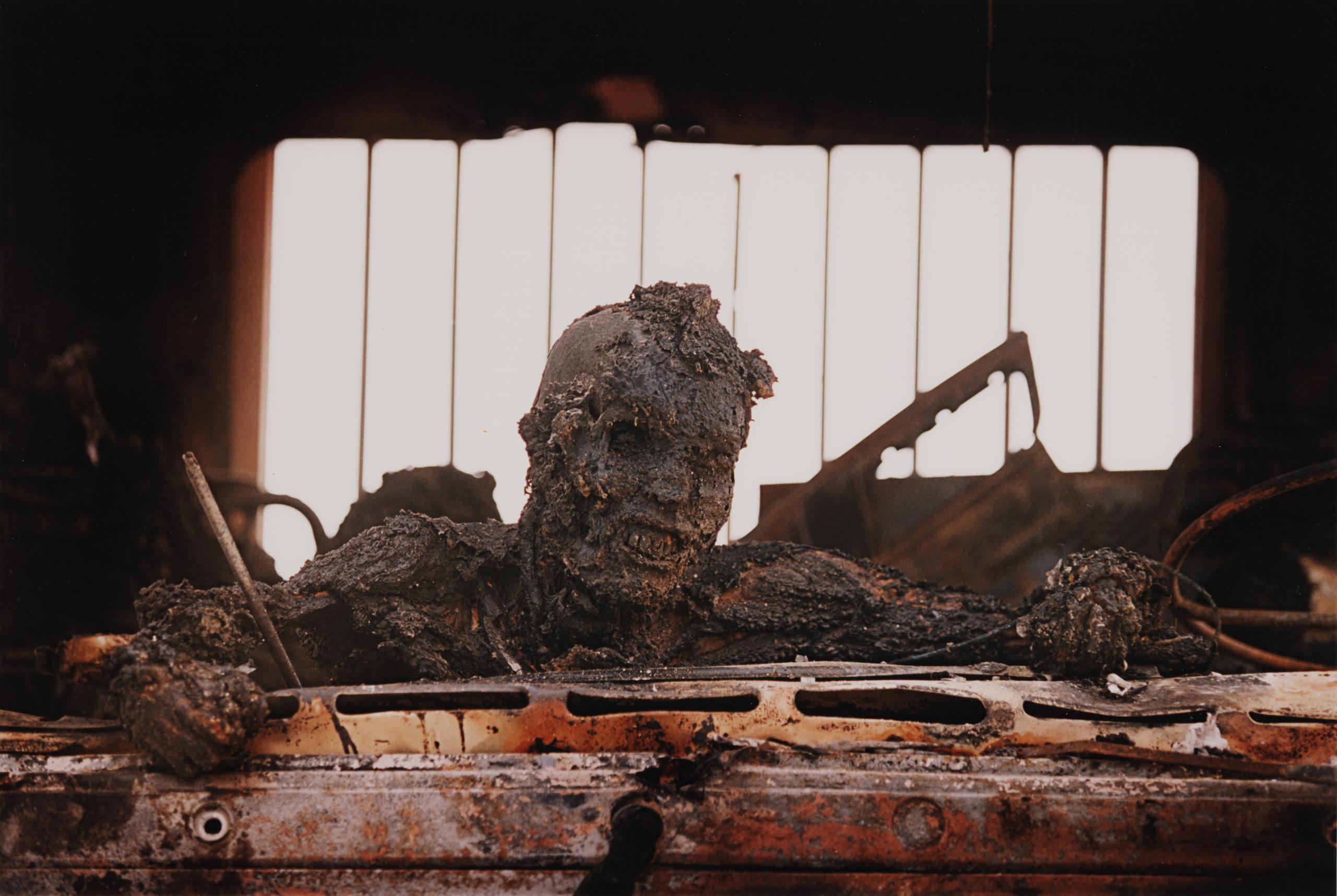
Another thing that came out of the war was the brutal air assaults by the US military, particularly on Iraqi troops that were in retreat. In late February of 1991, US fighter pilots dropped bombs on the Iraqi military, which was retreating on highway 80 towards Basara. One of the images that came out of the US military assault was the picture below, of an Iraqi soldier who had been burned alive in the vehicle he was in during the US bombing campaign.
Another incident that received attention later, was the revelation that the US military was putting snow plows on the front of Abrams M1 tanks and burying Iraqi soldiers alive in the desert. The independent media had reported on this earlier, but here is a link from a New York Times article later that year. It was this crime that got the attention of several anti-war activists in Grand Rapids.
In late June of 1991, the Grand Rapids Press announced that George H.W. Bush would be coming to town to celebrate the 4th of July. It was also reported that the same kind of tanks that were used to bury Iraqi soldiers alive in the desert just months earlier, would also be in a parade that Grand Rapids would be having for President Bush.
Three Grand Rapids anti-war activists decided that they would protest not only Bush’s visit, but the tanks that were used to violate international law, which would be in the parade. You can see from a GR Press photo below, that the three activists tried to lay down in front of the tanks, but were quickly stopped by Secret Service and local cops.
 The three activists decided to challenge their arrest by using International Law as a defense. The group went to trial in November 1991 and defended themselves. The day before the trial the court change the judge, who would no longer allow them to use International Law as a defense, despite the fact that they had submitted a 40-page brief.
Judge Christensen would not allow them to use an International Law argument, so the three activists just tried to get the jury to hear their side of the story. The three activists were charged with blocking a roadway. However, the jury did not find the three activists guilty, since the cops dragged them out of the way so fast that the parade never missed a beat.
The Grand Rapids City Attorney was so upset, since he was beaten by three young activists who defended themselves. Unfortunately, there was no other resistance to the Gulf War or its aftermath, like the ongoing US bombing of Iraq in the No Fly Zones that took place during the entire 8 years of the Clinton Administration, right through the first two years of the George W. Bush administration, until another war/invasion of Iraq took place in March of 2003.
 Welcome to the next installment of West Michigan Far Right Watch, where we keep tabs on the far right in this area and provide a summary of what they are up to and what kind of messages they are promoting in this community. As a matter of clarification, when we say the Far Right, we mean those in the streets who fight to defend White Supremacy, those who promote far right ideology, and those with political and economic power.
We have three examples for this installment. The first one comes to us from the police apologist group, Voice for the Badge. After MLive reported that the suspension of GRPD officer VanderKooi was overturned by an unsourced arbitrator, Voice for the Badge posted the following ramblings on their Facebook page on December 31st.
WOW GRPD WE FINALLY WIN ONE!!
Captain Curt Vandercooi -exemplary GRPD officer for 40 years/highly respected by citizens and peers has been vindicated. IMPARCIAL arbitrator determined-there was not just cause for the disciplinary action that Captain Vandercooi received. So he was proactive in addressing a 100% legitimate concern in regards to potential domestic terrorism. Turned out the gentleman wasn’t but what if he was??? Think about it.
The Civilian {{with the exception of a couple} Board voted for his dismissal {with the exception of a couple}. As proven it was a horrible decision and what should be embarrassing—but then again the civilian boards job is to critique our PD. Another layer of b.s. for our PD. Personally I think the civilian board is worthless especially since we added the position of Oversight of Police and Fire–yea OK -I’m still trying to figure out what Brandon Davis does. At least the civilian board works for free but then again I would pay to have an impartial board or better yet the elimination of this board.
Remember they damn near ruined a great police officers career and reputation. They should be ashamed.
We have become accustomed to these kinds of posts from the VFB, since they defend the GRPD no matter what kind of harm they do in the community, especially the harm they do to Black people and immigrants.
Our second example today, comes to us from the American Patriot Council, where co-founder Jason Howland decides to make a video while he is driving, a video that presents all sorts of conspiracy theories and misinformation about public schools. In this 15 minute video, Howland claims that children can’t spread COVID, that school milages are unconstitutional and that public school teachers are indoctrinated children.
Our last example is from the Far Right Think Tank, the Acton Institute. In an article posted on December 31st, the editor of Acton’s journal Religion & Liberty, posted an article about the state of freedom in the world. His primary sources for determining freedom are the Cato Institute, which was founded by the Koch Brothers, and the Fraser Institute, which also receives funding from the Koch Brothers, is a member of the right wing State Policy Network and is a known climate denier.
The Acton Institute article also takes an opportunity to remind their readers that the rebellions after the public lynching of George Floyd hurt poor & minority communities, and that the police were the victims of rioters. Of course, the Acton writer doesn’t even mention George Floyd or the many other Black people who were murdered and brutalized by police across the country. Such commentary, is consistent with what the Acton Institute has posted in recent years.
A look at the Homelessness Industrial Complex in Grand Rapids
 The issue of people who are unhoused in this community has gained extra attention in recent weeks, because of the various encampments in Grand Rapids, particularly the encampment that was at Heartside Park.
Just before Christmas, the City of Grand Rapids had told those who were staying at the encampment to vacate or be evicted. City officials said they had alternatives, but most of those alternatives violated the rights of people, as was pointed out by the ACLU in a letter they sent to Grand Rapids City officials.
Various grassroots groups organized quickly to provide some support and relief to those who were being evicted from Heartside Park. In addition, there was a protest last week and an online campaign to pressure Grand Rapids City officials to not criminalize those who are unhoused where nearly 400 people sent messages. Of course, we all received a canned message in response from the Mayor’s office, which included these comments:
“The City has also created a Homelessness Work Group, appointed the City’s first full-time homelessness coordinator, and formed the Homeless Outreach Team (HOT) in conjunction with the Grand Rapids Fire Department, Grand Rapids Police Department and Network180. We are also working with the Michigan Department of Health and Human Services for the Eviction Prevention Program in the 61st District Court.
Ensuring people have a safe and warm place to sleep each night is a priority. We also have to respond to some of the significant health and safety issues occurring in some public spaces. These are complex issues that require a community response and we are doing all that we can to find solutions.”
Noticeably absent from the City’s response was their failure to actually address the issued raised in the online letter, along with the the fact that they do not acknowledge their role in criminalizing homelessness.
In the coming weeks, the number of unhoused in Kent County may increase significantly, due to the end of the CDC’s moratorium on eviction, which ended on December 31st. While this crisis is exacerbated because of the pandemic, it is important that we come to terms with the fact that there has been a decades long problem of homelessness in the Grand Rapids area.
Therefore, we need to examine not only the larger social factors which lead to people being unhoused, we also need to take a more honest look at what we might call the Homelessness Industrial Complex in Grand Rapids and why their function primarily serves to perpetuate homelessness in this community.
Before people get their tighty-whities all in a bunch, I am not suggesting that we just do away the organizations which provide temporary shelter to those experiencing homelessness, at least not without having something else in place. I know there are well-intentioned people who work for these groups, some who even care. However, we need to stop looking at complex social issues through the binary lens of good/bad when it comes to the non-profits who make up the Homelessness Industrial Complex in Grand Rapids. In many ways, like most non-profits, these groups only respond to the symptoms of the problem, instead of addressing the root causes.
Homelessness Industrial Complex in Grand Rapids
On December 25th, the Grand Rapids Business Journal published an opinion piece by Dennis Van Kampen, the President and CEO of Mel Trotter Ministries. The opinion piece is entitled, Do we have the will to end homelessness in Kent County. It’s not a very insightful article by Van Kampen. In fact, the opinion piece reflects an important aspect of why the Homeless Industrial Complex is part of the problem. Van Kampen states that one of the strengths of this community is growth and development, even though it has consequences. Van Kampen acknowledges that while rent has nearly doubled in the last decade, wages have not. However, what is extremely instructive about the piece by Van Kampen, is that he doesn’t provide a solution to the problem of homelessness.
In the 40 years that I have lived in this community, there has been a significant increase in the number of homeless shelters and housing assistance organizations. Most people view these increases as a good thing. On the contrary, the increase in services is not a good thing, in my opinion, rather it only expands and perpetuates the need for the Homeless Industrial Complex, which is highly problematic. One of the reasons that it is problematic, is that these agencies only address individual or family needs, but fail to address the larger structural problems, which cause people to be without stable housing. In other words, the shelter model, which i also the White Savior model in this community, is a false solution. So what factors contribute to the Homelessness Industrial Complex as being a False Solution?
First, most of the shelters and homeless advocacy groups in this community are Christian groups. More accurately, they are Christian groups that practice a form of White Saviorism, rather than theology of liberation. Many Christians in this community can avoid having to practice radical hospitality, because the shelters like Guiding Light or Mel Trotter Ministries will take care of that problem. On top of most Christians getting a free pass on the homelessness issue, there is the issue of people who utilize the services of these groups with having to constantly deal with religion being imposed on them. For people who are not Christian, this can be a huge turn off and more importantly it is a form of spiritual violence.
Second, there is the issue of Non-Profits having the 501c3 required Board of Directors. Those who sit on the boards of non-profits are often interested in how it will look on their resumes or because they work in the financial sector or corporate world and have access to people with deep pockets. Those who sit on boards of shelters are generally not those who have experienced homelessness, but often people in positions of privilege. Having boards with status and privilege doesn’t foster a conversation about the root causes of people who are unhoused. Take a look for yourself to see who sits on the boards of Mel Trotter Ministries, Degage Ministries, Guiding Light, Family Promise, ICCF and Matthew’s House Ministries.
Third, there is the issue of careerism with the non-profit sector, which doesn’t tend to lend itself to wanting to actually eliminate the problem of homelessness. Part of the careerism is that those in leadership positions can make a pretty decent salary, especially compared to most workers. I looked at the salary of the CEO of Mel Trotter and Degage, which were $111,000 and $80,000 respectively, based on 2018 990 records.
Fourth, there is the issue of funding. Most of the shelters in the Grand Rapids area rely on foundation funding, which is money that comes from those who are part of the local power structure. If a non-profit’s goal was to eliminate homelessness by attacking the root causes, such groups would have a hard time getting funding from those who made their millions/billions by exploiting people and buying politicians who craft public policies that are beneficial to members of the Capitalist Class. Just looking at the 990 documents for 2018 (the most recent available) from the various DeVos family foundations, non-profits like Mel Trotters, Degage, Guiding Light, Family Promise and ICCF have all been recipient of sizable contributions.
The fifth and last reason is because none of the organizations that make up the Homelessness Industrial Complex in Grand Rapids are attacking the root causes of people being unhoused. None of these groups actively promote and demand that all people make a living wage, which in this market, would be roughly $20 an hour in order to have a mortgage or be able to rent, especially for families. None of the members of the Homelessness Industrial Complex in Grand Rapids are exposing or challenging the serious wealth gap that exists in this area. We have several families that are worth billions and according to 2016 data, there are 600 millionaires in Kent County.
In addition, until stable and secure housing is actually a right in this community, we will always be at the mercy of landlords, property management companies, real estate companies, housing developers and mortgage brokers, all of which operate within the framework of the profit system, which means they inherently see housing as a means to make a profit, not as a fundamental right of people.
Now, I recognize that dismantling capitalism is a tall task, but it is possible. It won’t happen over night, but we can begin to work on it in stages, with ideas and solutions that make housing justice the goal of our movement. However, if we are unwilling to begin having conversations and develop strategies that centers housing justice, we will be stuck with Homelessness Industrial Complex in Grand Rapids and its relationship to the local power structure that will always oppose the core belief that everyone has the right to secure and safe housing. Housing Justice Now!
Senator Peters and Stabenow don’t fight for the $2000 COVID relief checks, but they do vote for $740.5 billion in US militarism
On Friday, the majority of the Democratic Senate demonstrated just exactly what they stand for by voting with Mitch McConnell to override a veto of the National Defense Authorization Act for Fiscal Year 2021.

The effort by Senator Bernie Sanders to try to force a vote to give the majority of people in this country, millions who are unemployed and facing eviction in the midst of the pandemic, $2000 per person, was voted down 80 – 12.
This means that not only did the majority of Senate Democrats decided not to fight to give $2000 to millions of people who are suffering under Corona Capitalism, they also voted in favor of another $740.5 Billion for militarism and imperialism.
In a December 23rd statement on the National Defense Authorization Act for Fiscal Year 2021, Michigan Senator Gary Peters was at least honest about the reality of the annual US military budget, when he said:
“This vital legislation has traditionally received broad, bipartisan support – and this year was no exception.”
US militarism, like Capitalism, have always enjoyed bipartisan support.
Michigan Senator Debbie Stabenow, also voted with the majority of the Senate to adopt the $740.5 Billion US military budget. Senator Peters and Stabenow both posted statements on why they voted the way they did with rhetoric about supporting US troops and Michigan weapons manufacturers, but this is not how the rest of the world experiences the largest annual transfer of US taxpayer money to militarism and imperialism.
The $740.5 Billion public subsidy of the US military is just a number, but what does the vote mean in concrete terms, especially for the rest of the world. Here are a few of the consequences that the rest of the world has to endure:
- 800 US military bases that occupy other countries around the world. Not only is there a constant threat of invasion or support of proxy forces around the world, the 800 US military bases also perpetuates sex trafficking, since US soldiers always need to be “serviced.” (See David Vine’s Base Nation and Cynthia Enloe’s Bananas, Beaches and Bases.)
- Continued US military actions which leaves thousands of civilians dead or wounded on an annual basis, particularly in the Middle East, in Afghanistan, throughout Africa an Latin America.
- Continued US support for dictatorships and foreign governments that provide access to multinational corporations to exploit resources and labor around the world.
- Unexploded US ordinance, which kills and wounds thousands of civilians annually, in countries like Vietnam.
- Toxic waste from US military bases and operations, which contaminate ecosystems around the world.
- The perpetuation of US weapons sales, particularly to countries like Saudi Arabia, Colombia and Mexico, which have atrocious human rights records.
- The perpetuation of the consumption of fossil fuels, which makes the US military complicit in the climate crisis.
- Lastly, voting for the annual military budget means that the US outspends the rest of the world on militarism and it means that roughly half of US taxpayer money goes to militarism, instead of going to things like Medicare for All, housing justice, renewable energy, etc.
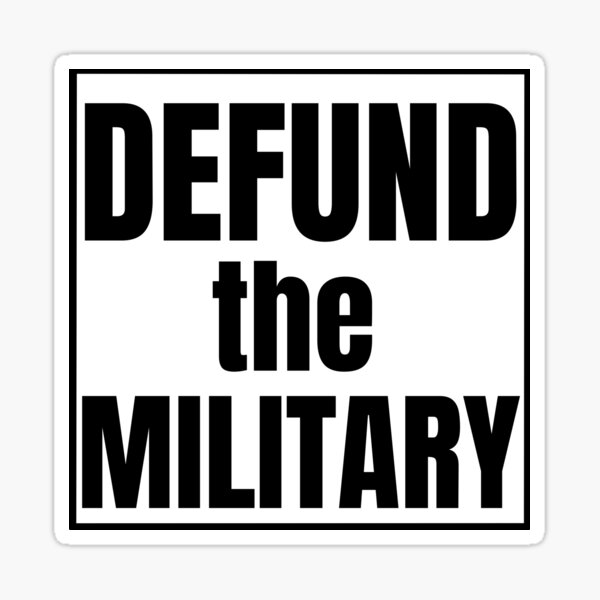 What is interesting and at the same time aggravating about all of this is that people will still continue to vote for the likes Senator Peters and Senator Stabenow. But lets be honest, when people vote for Peters and Stabenow they are ensuring the perpetuation of US militarism and US imperialism, which translates into the brutalization of humans and ecosystems across the planet. As Dr. King said in his famous Beyond Vietnam speech:
This business of burning human beings with napalm, of filling our nation’s homes with orphans and widows, of injecting poisonous drugs of hate into the veins of peoples normally humane, of sending men home from dark and bloody battlefields physically handicapped and psychologically deranged, cannot be reconciled with wisdom, justice, and love. A nation that continues year after year to spend more money on military defense than on programs of social uplift is approaching spiritual death.
More evidence that the Defund the GRPD movement is an effective campaign
On Monday, we posted a story about the new online efforts of the Grand Rapids Police Officer’s Association (GRPOA) to lobby city officials to not Defund the GRPD.

In response to that post a couple of GRIID supporters said they saw a billboard using the same visual theme as the online GRPOA campaign to oppose defunding the GRPD. Located on US 131 South, there is this billboard shown above, that is just south of Franklin St.
Using the phrase, We’re Calling for Backup, as clever as it may seem, is misleading. The Grand Rapids Police Department is funded with public tax money from people who reside in Grand Rapids. As we wrote in a post this past summer, the GRPD, along with several elected officials put forth a ballot proposal to change the City Charter to make the police department’s budget a full third of the entire city budget. This campaign took place just months after the federal government adopted what is referred as the Crime Bill, which contributed significantly to mass incarceration in the US.
Since that 1995 campaign to solidify an increase in funding for the GRPD, the actual funding has fluctuated between 36% and 39% of the City’s over all budget. The GRPD billboard is misleading because the public already has the backs of the police, because the public pays their salary. It is only because there is greater scrutiny by the public of the GRPD, that the Grand Rapids Police Officer’s Association has pushed back against the significant call for a decrease in the police budget. The irony is, that even those who are part of the Defund the GRPD campaign, are contributing to the police department’s budget, if they pay city taxes. Many of those who are calling for Defunding also recognize that they have a right to call for a reduction or outright defunding of the police budget, which they have been doing since June. However, the City Manager (someone who is not elected) stepped in and put a stop to any vote that could defund the GRPD back in July, thus demonstrating that the public has no say about how their tax dollars are used in this city.
 While getting a picture of the GRPOA billboard, we spotted a second billboard, which had a more direct attack on the call for defunding the GRPD. Just south of Burton St on US 131, on the east side of the highway, there is this billboard pictured here, which says, Oppose Defunding Police, with the tag line below that says, Brothers in Blue GR. We could find no reference to Brothers in Blue GR, but it is clear that another group is paying for this billboard.
What is instructive about the GRPOA campaign to oppose defunding is that they are spending significant money on a website and billboards. This is in sharp contrast to DeFund the GRPD, which has raised money is recent months to buy refrigerator magnets that provides alternatives to calling the GRPD when there is a conflict, plus they purchased children’s books to give away, specifically in the Black community, just before the holidays.
One thing for sure is that the campaign to Defund the GRPD is effective. Why else would the Grand Rapids Police Officer’s Association spend so much money and effort to oppose the public call for Defunding the GRPD.
 As part of the Trump administration, Betsy DeVos will soon have to relinquish her status as US Secretary of Education. However, DeVos is still using her position in the Trump administration to continue to push her own ideological agenda about education.
Betsy DeVos released at statement on Monday, December 28th, as possibly her last opportunity as Secretary of Education, a statement that once again makes clear of her desire to expand the Neo-Liberal Education model that has it roots in the White Supremacist push back of communities who opposed the desegregation of public schools. (See A Wolf at the Schoolhouse Door: The Dismantling of Public Education and the Future of School, by Jack Schneider and Jennifer Berkshire.)
The statement released by DeVos addressed educational aspects of the House bill on COVID relief. While the house bill passed, the Senate still has to vote on it (as of this writing).
There are several things about DeVos’s statement that are worth pointing out. First, DeVos celebrates that Congress agrees that relief aid should be for both public and private education.
The emergency taxpayer funding set aside for the Education Stabilization Fund will continue to help keep learning going and will hopefully take excuses off the table for schools that remain closed. I am pleased to see that Congress has finally acknowledged what this Administration has said all along: All students and all educators at all schools — private, parochial, and public — are affected by this pandemic, and they all need and deserve support for PPE, cleaning supplies, learning materials, and more. And, through the GEER fund, governors remain empowered to do what’s best for their students.
When DeVos refers to the GEER fun, she means the Governor’s Emergency Education Relief fund, which gives each state the power to decide which schools will benefit from COVID relief fun. In September, Betsy DeVos sent a letter to the Chief State School Officers round the country, admonishing them to, “provide equitable services to private schools as soon as possible.”
Second, DeVos then chastises members of Congress that do not completely buy into the Neo-Liberal education mantra of School Choice, which is code for, “let’s undermine public education.
Third, Betsy DeVos then makes a backhanded comment about those who are proposing to eliminate student debt, by saying:
There are many wrongheaded proposals right now concerning student debt, so I was pleased to see that Congress adopted one sensible way to address the issue by expanding the ability of employers to provide tax-free payments of up to $5,250 of an employee’s federal student loans, including those taken out prior to their employment. This provision will help students pay down their debts faster and keep employers engaged and invested in what students need to be successful — a win for students and job creators alike.
What is wrongheaded is that Betsy DeVos doesn’t understand that there is an entire movement of students that are demanding that the federal government eliminate student debt. What is wrongheaded is that corporations and stock holders are profiting off of student debt, which includes Betsy DeVos. Earlier this month, DeVos addressed student by saying:
“More than two-thirds of Americans don’t pursue a four-year college education. Many pursue different, and just as valid, paths to gain the skills needed for successful careers. It’s fundamentally unfair to ask two-thirds of Americans who don’t go to college to pay the bills for the mere one-third who do.”
Now, I don’t believe that Betsy DeVos is a stupid person. Betsy, like the rest of the DeVos family surround themselves with advisors and consultants, to help their family make strategic decision. Betsy DeVos is fully aware of the fact that the wealthy 1% of the population, which includes her family, benefit from a tax systems which burdens the other 99% of the population with paying for the tax breaks the 1% gets. DeVos uses the language in the quote above as a means of appealing to working class people who have embraced some of the talking points of the Capitalist class.
However, since Betsy DeVos has made those comments about a student debt, the incoming Biden administration has backed off of any commitment to only reducing, not cancelling student debt.
Lastly, it is worth noting that while Betsy DeVos has issued this statement in regards to the COVID relief bill, she fails to acknowledge that whatever relief amount that the government will decide upon is grossly inadequate. For someone who claims to support students and parents, it is the height of irony that the federal government COVID relief funds that have been and will be adopted are nothing short of a slap in the face of families across the country who are suffering at the hands of the billionaire class, which includes DeVos.
The Power of the Zapatista concept of Ya Basta! and a poem
 We have a very important weapon which the government does not have. That weapon is called dignity. With this weapon no one and nothing can defeat us. They can kill us or jail us, but they will never defeat us. EZLN Communique, Sept. 12, 1997 after the murder of 45 campesinos in Acteal, Chiapas
In my younger years, I had the opportunity to do accompaniment work in Guatemala, El Salvador and Chiapas, Mexico.
Do accompaniment work led me to write the book, Sembramos, Comemos, Sembramos: Learning Solidarity on Mayan Time and to make the film, Reversing the Missionary Position: Learning Solidarity on Mayan Time.
I always reflect on the end of the year, since I had the opportunity to be in Chiapas during the late December/early January period, doing international solidarity work in the Zapatista communities of La Realidad and Oventic.
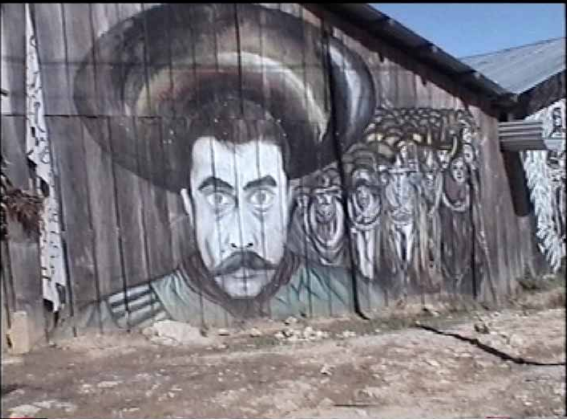 What follows is a journal entry for December 28th, 1999, while I was doing accompaniment in the EZLN community of Oventic, along with a poem I wrote on that same trip.
I just finished re-reading Holliway’s article “The Concept of Power and the Zapatistas.” A refreshing articulation of power, especially after reading Bishop Ruiz’s piece in a magazine that Elisa loaned me. Ruiz has some important things to say about the marginalization of the indigenous populations, but he still advocates an evangelization “that incorporates age-old religious and mystical experiences of other peoples….Missionary action is not difficult when we know that the subjects are not us but them. They are the subjects of their own evangelization, embodied and experienced from within different cultural models.” This is a nice articulation, one that reflects sensitivity, but premised on the expectation of missionary work as a necessary component of the work of Christians. For me, this still reflects a certain sense of superiority or monopolization of truth. If we are to come to terms with our role in 506 years of oppression these medieval notions must be abandoned.
 Holliway frames it differently in talking about the Zapatista concept of power. “The power of the zapatistas is in the power of the YA Basta!….the negation of oppression, which exists in the depths of all of us.” This is a radical departure from the missionary position which posits a sense that what I have to offer is better, richer, more truthful.
In the cool December morning
I rise to greet the warmth of the sun
Dew drips off plants and roof
While barefooted Indians pass by
On the road below Oventic, Aguascalientes of youth
Where children walk hand in hand
Or lean up against siblings
Their eyes are as dark As the earth
Their smiles bring hope From the mountains
Zedillo calls the young Zapatistas terrorists
As they prepare the New Years festival
pine needles are spread out like a royal carpet
 where musicians create ancient songs
with marimba and flute
their bodies sway in rhythm
like trees that bend in the wind along a narrow path
the view of people gathered is more beautiful than any painted canopy or ecclesiastical ceiling
families sit proudly on benches built for this open air arena of democracy
while helicopters fly above monitoring games & ice cream vendors
as the night approaches
the Mayan moon illuminates the court
where dancing and Tzotzil speeches fill our souls,
and even though we do not understand the words
we know their truth
the way lovers know each other’s touch
It is here that I understand The meaning of justice
Its hunger satisfied
And like the mountains,
These proud people have Withstood the weathering of history and the cruelty of men…
walking in paths of freedom

