 This is our sixth installment of this posting, which takes a critical look at Grand Rapids politics and policies, based primarily on the public record, such as committee agendas and minutes.
There are 4 issues we want to focus on in this installment of The Devil is in the Details, with the first issue being the continued lack of transparency on the 1601 Madison SE project, despite their likely use of public subsidies.
This is the sixth time in the past three months that we have reported on the AmplifyGR/Rockford Construction – affiliated project at 1601 Madison SE. From the beginning AmplifyGR has been secretive about what business will occupy the 1601 Madison SE property, even though the following exchange took place between 3rd Ward City Commissioner Moody and AmplifyGR’s Executive Director, as was reported by MLive on December 1st:
He (Comm. Moody) said his only concern was that Amplify has not yet revealed the name of the prospective tenant.
“I have an idea who the tenant is, but I think it’s important that sooner or later you let us know who the tenant is,” Moody said. “Because as a Third Ward commissioner we don’t want anything to slip up on us that we’re not aware of.”
Amplify’s executive director, Jon Ippel, told Moody that he understands “the uneasiness” created by not identifying the tenant.
“We’re hoping that by the end of the year we can be a little bit more public with that,” he said. “So hopefully it’s a matter of weeks and not months.”
Well, it has been month, not weeks, yet despite the complete lack of transparency the City will be awarding a subsidy to this AmplifyGR/Rockford Construction project through the Brownfield Development Authority to the tune of $1,943,810. (See pages 12 – 13 in the Brownfield Development Authority packet for 2/24)
The second issue we want to address is the proposed housing project by the group legally known as 900 W. Leonard LLC. The project shows up in both the Westside Corridor Improvement Authority (beginning on page 9) and the Economic Development Team Project packet for 3/9/2021 (beginning on page 12).
The 900 W. Leonard LLC housing project registered agent is Jack Hoedeman. The address listed for 900 W. Leonard LLC is 280 Ann St NW, Grand Rapids, which is the office of Compass Insurance. Jack Hoedeman is the CEO of Compass Insurance. Hoederman is also co-founder of Victory Development group, which formed in 2020 and lists the 900 W. Leonard Project as their current project.
The 900 W. Leonard LLC project is seeking both a Brownfield Development Authority subsidy of $914,207 and a Neighborhood Enterprise Zone tax exemption for year 1 at $139,751. This will put the total public subsidy over $1 million.
The third issue we want to draw your attention to is the ongoing development projects that are in the works for Market Ave SW in Grand Rapids. On pages 40 – 45 of the Community Development Committee packet for 3/9/2021, the City of Grand Rapids is proposing to award Kamminga & Roodvoets, Inc.a contract for $8,003,502.80 to, “relocate of a portion of the Eastside Trunk Sewer from parcels on the west side of Market Avenue to Market Avenue right-of-way to allow for the redevelopment to occur on the parcels. The relocated trunk sewer construction will now include Wealthy Street from the Grand River to Market Avenue, Market Avenue from Wealthy Street to Fulton Street and Fulton Street from the Grand River to Market Avenue.”
Kamminga & Roodvoets, Inc. Was founded by two white business partners and has expanded over the years from just an office in Grand Rapids, to offices in Tennessee and Florida. It’s unfortunate that the City of Grand Rapids continues to award these kinds of contracts to white businesses, instead of Black or Brown business contractors.
The fourth, and last issue, we wanted to draw your attention to today comes from the 3/11/2021 City Planning Commission packet. There are three new Recreational Cannabis retailers set to be approved. The three new Recreational Cannabis retailers are QPS Michigan Holdings, LLC, which will be located at 1148 Leonard St NW; Fish Ladder Holdings, LLC, which is located at 2301 44th St SE; and Nature’s ReLeaf, LLC, which will be at 666 Leonard St NW. It should be noted that QPS Michigan Holdings LLC and Fish Ladder Holdings LLC are both represented by Ankur Rungta, who is the CEO of C3 Industries. The 3rd company listed is Nature’s ReLeaf, LLC, which means that all three of these new Recreational Cannabis Retailers are all businesses that are not based in Grand Rapids. This is not surprising, since it has been the trend so far with both medical and recreational cannabis retailers that have sought approval to do business in Grand Rapids.
 Four activists are going public with a message to the larger West Michigan community, a message that says White Supremacy will not be tolerated.
The four activists in question have court dates later this month, but they wanted to send out a Media Release (see below) to clarify why they took the actions that they did.
In May of 2020, after a Minneapolis police officer publicly lynched George Floyd, a rebellion took place in cities across the US. The Black Lives Matter actions sent a strong message to those who refused to acknowledge that Structural Racism is deeply entrenched in this society and its institutions.
All across the US there were calls for defunding the police, abolishing the prison industrial complex, changing the names of sports teams and purging consumer culture of longstanding racist images that accompanied numerous products.
One area of resistance to White Supremacy and its legacy has been centered on the removal of statues and historical markers that perpetuate the legacy of slavery and settler colonialism. Just weeks after the public lynching of George Floyd, activists and community organizers targeted a Confederate statue in Allendale, Michigan.
The statue in question has continued to be source of conflict between those who refuse to acknowledge the ways in which White Supremacy permeate our society and those who seek to dismantle the ways in which White Supremacy manifests itself in our communities.
As a matter of transparency, the four activists listed in the Media Release below, asked this writer to be their Media Liaison. I sent out this Media Release and am working with the activists to be a bridge between them and area news agencies.
As someone who has been a media watchdog for nearly three decades in West Michigan, I urge people to think critically and apply media literacy principles to how the local news has been and will continue to report on White Supremacy in this media market. Pay attention to the sources cited in the stories, how the news agencies are framing the story and what kind of push back will result from centers of power and oppression, particularly from Allendale Township.
The importance of what the four activists have done in regards to the Confederate statue in Allendale, is a microcosm of a much larger problem of how White Supremacy permeates our institutions and how too many of us continue to tolerate its existence, often in the name of civility. I urge all of those reading this to use this moment as an opportunity to have the difficult and uncomfortable conversations about White Supremacy and then to take an active role in being part of the important anti-racist work that is being done, particularly the work that is being led by Black, Indigenous and other communities of color.
Please read the Media Release below. Some of the photos used in this post are from the four activists and these photos are what was sent to the local news agencies, along with the Media Release.

Racism on Trial in Allendale, Michigan
Peaceful anti-racism demonstrators charged with alleged “vandalism,” “littering,” and “disobeying a park sign.”
On January 8th—just two days after violent White Supremacists, including at least one township official, attacked the United States Capitol—officials from Allendale Charter Township filed misdemeanor criminal charges against four activists affiliated with the Michigan Association of Civil Rights Activists or MACRA.
Mitchell Kahle and Holly Huber, of Norton Shores, and Anthony Miller and Jessica Miller (Griffin), of Allendale, are each alleged of multiple counts in five separate complaints.
“This is a political prosecution designed to chill free speech and quell activists’ opposition to the township’s racist statues,” Kahle said.
“This is a prosecution against minorities in our community, to silence us, keep the township status quo, and remind people of color of ‘their place’ in American society,” Miller (Griffin) said.
Allendale has been at the center of controversy since last June, when protests erupted over a concrete statue—honoring Confederate soldiers and demeaning Black Americans—on display in the township’s “Garden of Honor” located in the community park. Over the course of last summer and fall, several large protests and counter-protests were held. Groups supporting the racist statues included heavily armed militia and white nationalists flying Confederate flags. (See attached photos.)
Allendale officials filed five separate criminal complaints following two peaceful free-speech demonstrations opposing the township’s offensive and historically inaccurate depiction of a Confederate soldier, a Union soldier, and an enslaved Black child, on the ground, wearing a cotton-picking sack, at the feet of his White oppressors.
“As parents of a biracial child, the township’s depiction of an enslaved biracial child in our community park is offensive and intolerable. For our family, those statues represent the historical enslavement, murder, rape, and oppression of Black Indigenous People of Color by White Supremacists and the overt and unrestrained racism that continues to this day in Allendale, Michigan,” the Millers said.
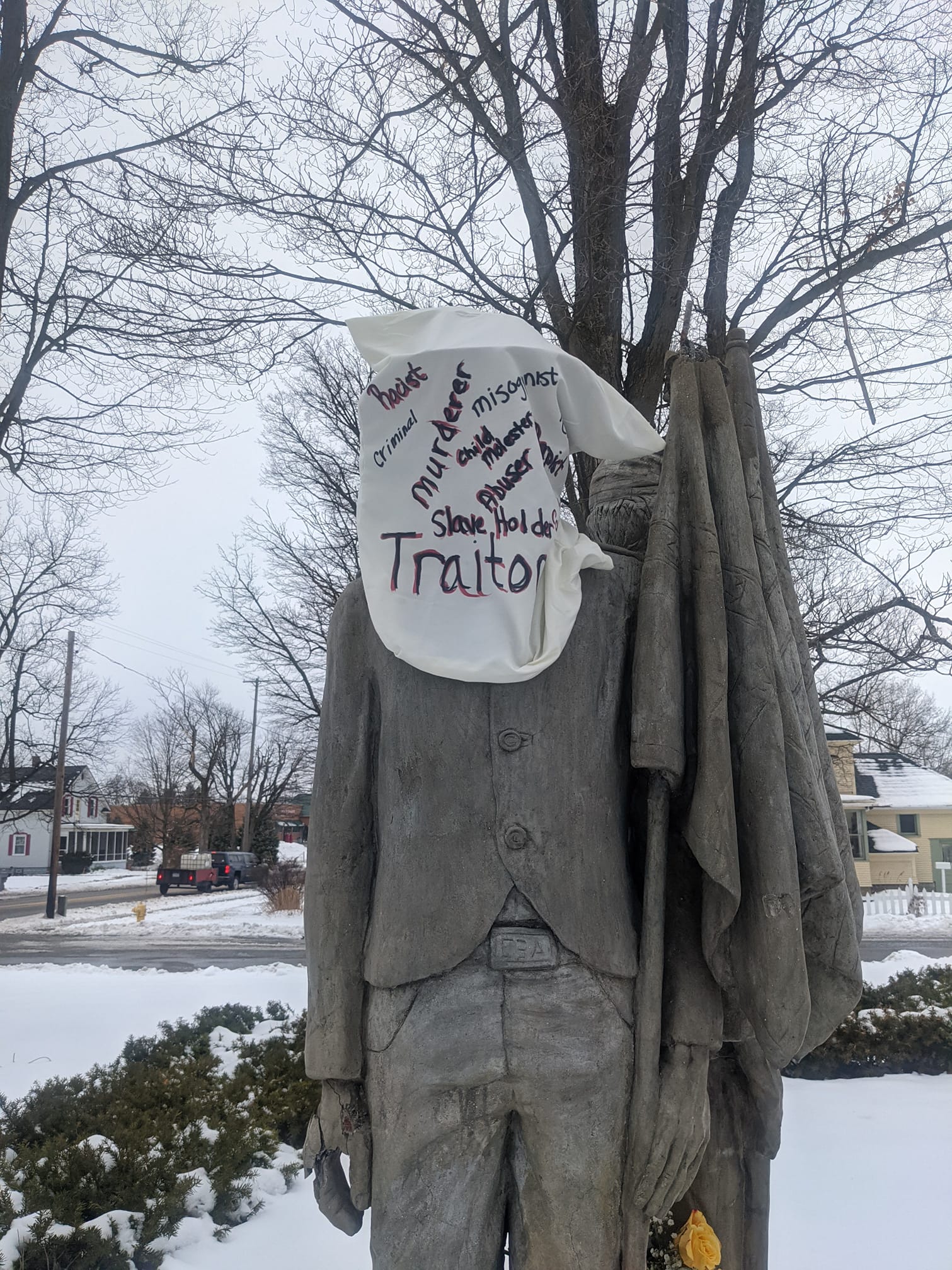
The first demonstration allegedly took place on the afternoon of Monday, January 4th, when the Millers allegedly placed a white pillowcase over the head of the Confederate soldier, with the words “Traitor,” “Slaveholder, “Murderer,” and others describing Confederate soldiers, were written on the pillowcase. Fresh flowers and candles were left out of respect for the enslaved Black child (and all people of color affected by the system of oppression the White soldiers represent). A clown face was allegedly painted on the Union soldier using washable Crayola paint to emphasize the historical complicity of all colonizers. (See attached photos.)
 The second demonstration (lasting fewer than 8 minutes) took place at 6 p.m. on Friday, January 8th, when Kahle, Huber, and Miller (Griffin) allegedly reenacted a “tar and feathering” of the Confederate soldier, using a water-and-cornstarch mixture and white goose feathers. A small cardboard placard with the word “Traitor” was allegedly placed on the Confederate soldier and flowers left in respect for the enslaved child. (See attached photos.)
When presented with the alleged details, including eye-witness statements, photos and video of the demonstrations, Ottawa County Prosecutor Lee Fisher declined to bring charges, saying, “…although both actions resulted in a clean-up, neither caused lasting damage to the statue … the makeup and feathers were washed off without permanent damage.”
This was by design. Activists tested their water-based paint and “tar” mixtures in advance to ensure everything would wash away in the rain or with a hose. The fresh flowers and natural feathers left no lasting mark, waste, or damage whatsoever. In fact, these same four activists were responsible, with others, for numerous other similar free-speech demonstrations throughout the summer and fall of 2020. Including twice chalking and painting “BLACK LIVES MATTER” and “TAKE IT DOWN” in large letters on the township’s parking lot. (See attached photos.)
“Township officials’ decision to prosecute is politically motivated and violates activists’ rights to free speech and assembly under the First Amendment to the Constitution of the United States. The charges are designed purely to intimidate and chill activists’ speech. The statues in this case represent government speech in a public park, where citizens enjoy the greatest of all free-speech protections,” Attorney Jeffery S. Crampton said.
These acts were not vandalism, but acts of love and free speech. The substances were not litter, they were all-natural mediums of artistic expression. There was no violation of township ordinances, activists were lawfully in the park only during official hours of operation.
Make no mistake. Racism is on display in Allendale—in the form of a racist statue, as well as the actions by Allendale officials to perpetuate systemic racism. If Allendale Township proceeds with its attempt to silence and infringe the constitutional rights of the defendants, not only will racism be on display in Allendale, racism will go on trial at the expense of the community’s finances and reputation.
 On February 23rd, Kayla Sosa, in an article for the Michigan Advance, wrote an article pointing out that co-founder of the American Patriot Council, Ryan Kelley, is now running for Governor in Michigan.
The headline of the article reads, A GOP West Mich. official who was reportedly at the Jan. 6 insurrection is now running for governor.
Lots of media outlets have been reporting on the announcement that American Patriot Council co-founder Ryann Kelley, had announced that he was running for Governor in Michigan in 2022. We wrote about it on February 4, in a post entitled, Why I think Ryan Kelley’s announcement to run for Governor in Michigan can be a benefit to the anti-racism/Black Lives Matter movement.
The article in the Michigan Advance is a pretty straight forward piece and rather conciliatory, since it references Kelley’s campaign site, Allendale Township Supervisor Adam Elenbass, who is quoted as defending him, and the township lawyer who also provides comments that are not detrimental to Kelley.
In fact, the Michigan Advance article does not make any accusations, it only raises questions about Ryan Kelley’s attendance at the January 6 storming of the US Capitol, his role in challenging the 2020 election count in Michigan and his relationship with one of the men accused of being part of the plot to kidnap Governor Whitmer last fall. This is what was written in the Michigan Advance article.
In response, the American Patriot Council decides to blog about what appeared in the Michigan Advance. However, the American Patriot Council writer begins their story by confusing the Michigan Advance, which is an online publication, with the Advance, which is a weekly newspaper in Kent County. The dead giveaway, was when the American Patriot Council referred to the newspaper as, “at the end of every Michigan driveway, dirty, wet and mashed to a pulp, is the writings of failed reporters.” Thus, the American Patriot Council writer didn’t even know the difference between these two media sources.
The there is the issue of whether or not the American Patriot Council even bothered to refute the “accusations” made in the Michigan Advance article. They didn’t. The only thing the American Patriot Council writer had to say in response to the Michigan Advance piece was:
The parts of the story not copied from other publications, is mostly quotes extracted by Kelley’s colleague, Adam Elenbass, who repeatedly told the Advance that he “preferred not to comment.” Elenbass did say that he had seen “no proof that Ryan had broken the law.”
This is not a refutation of the claimed accusations, it is simply a restating of the obvious.
The rest of the very short article then quotes Kelley and refers to him as responding with his “typical grace and dignity.” Of course the writer is going to present Ryan Kelley only in the most glowing way, but what is even more ridiculous is the American Patriot Council writer asked Kelley if he was going to seek any corrections from the Michigan Advance reporter. Kelley’s response, “I don’t ask the Times for corrections, I’m not going to start with the Advance.”
Now, it is quite possible that Ryan Kelley is the author of the American Patriot Council, thus he is just quoting himself in this most recent piece. The reason that we think he might be the writer is the fact that every article on the American Patriot Council’s blog is written by someone calling themselves A Closer. This is terminology often used in the real estate business, by those who close the deal on a house, and Ryan Kelley is a realtor.
However, regardless of who A Closer is, it is painfully clear that they do not write well, they provided false information in this most recent article and they provided no evidence to refute the claims made in the Michigan Advance story.
GRIID Class on US Social Movements – Part VI: The Anti-Apartheid Movement in Grand Rapids
 In the 6th week of the class on US social movements, we looked at the South African Anti-Apartheid Movement in Grand Rapids, using a chapter from my forthcoming book, A People’s History of Grand Rapids.
The Chapter that people read was called The Other Eighties, which looked at the three major movements from that decade, the Anti-Nuclear Freeze Movement, the Central American Solidarity Movement and the Anti-Apartheid Movement. The chapter began with the Anti-Apartheid Movement and that is what the discuss was primarily centered on.
The Anti-Apartheid Movement in Grand Rapids is based on the articles on that topic from the Grand Rapids People’s History Project. In addition to those articles, there is an archival resource section with 92 pages of archival materials on the Anti-Apartheid Movement in Grand Rapids.
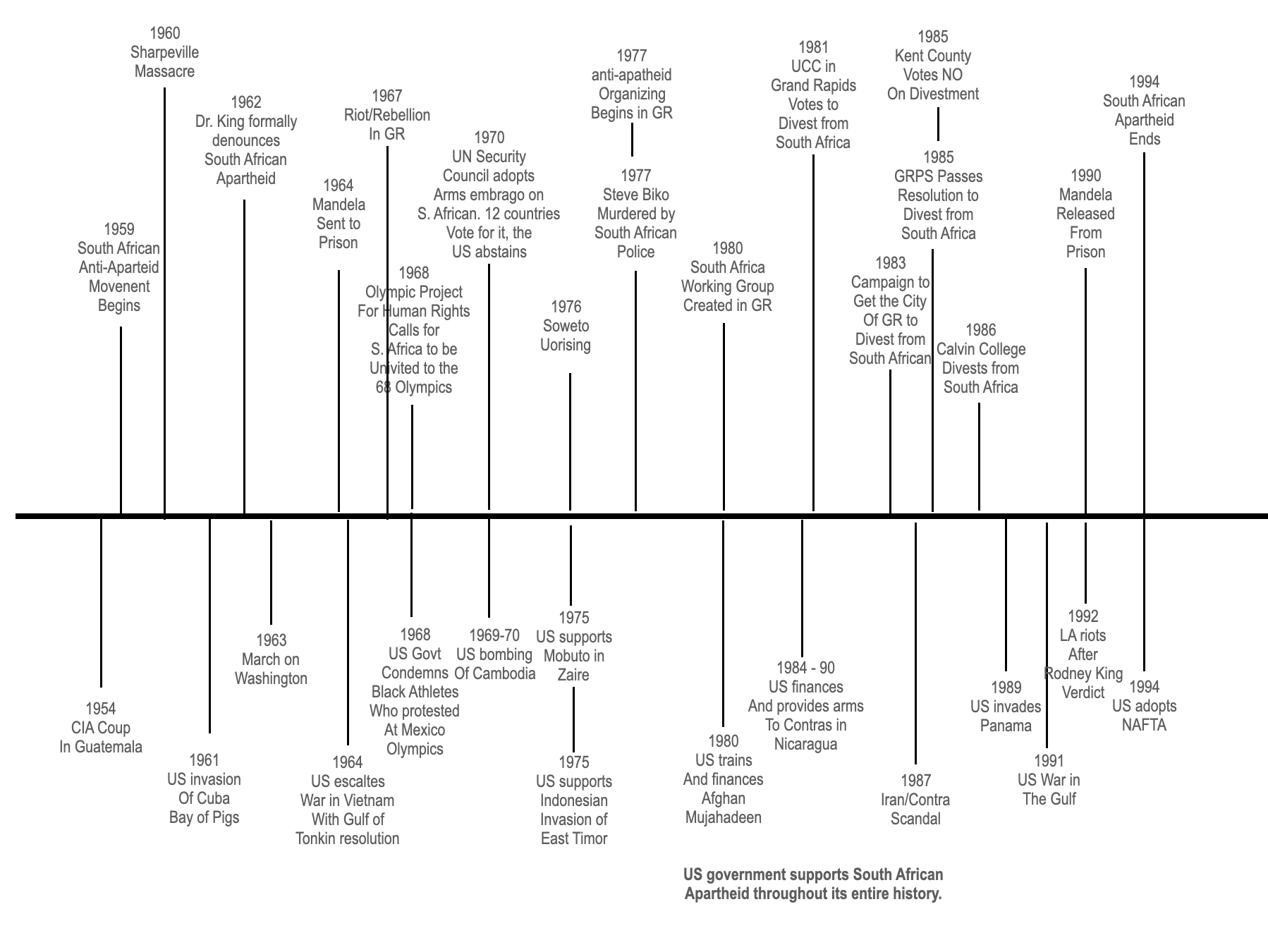
The class discussed then history of the South African Anti-Apartheid Movement, and the US Government position, which was complicit with the Apartheid regime. We then discussed when the movement began in Grand Rapids, which was largely due to statewide organizing, right around the time of the Soweto Massacre in 1976. The American Friends Service Committee (The Quakers) had begun doing educational and organizing work in Grand Rapids in the late 1970s. However, the American Friends Service Committee eventually dissolved in Grand Rapids, which led to several people coming together to form the Institute for Global Education (IGE).
IGE became the primary clearinghouse for organizing around South Africa, even though there were numerous other groups doing solidarity and educational work. However, beginning in 1983, the task force on South Africa began talking to organizations in the community to get support to pressure the City of Grand Rapids to formally divest from companies doing business in South Africa. Several organizations signed on to the campaign and wrote letters that influenced a resolution that was crafted by the Community Relations Commission and then put before the Grand Rapids City Commission. In 1984, the City adopted the resolution and moved their finances out of what was then the Old Kent Bank and into another bank that had no direct connection to South African.
From there the campaign got the Grand Rapids Public Schools to adopt a similar position in 1985. The same organizers then tried to get the Kent County Commission to adopt the same position, but in this instance they were unsuccessful.
We also talked about an effort by students and faculty at Calvin College to divest from South Africa. This campaign was important, in large part because the Christian Reformed Church (CRC) had a long history of supporting the Apartheid regime in South Africa and Calvin College was a CRC college. After more than a year of organizing, Calvin College formally divested from South Africa, which was a significant victory.
Below is a timeline used for week 6.
In addition, we did talk briefly about the Anti-Nuclear Movement and the Central American Solidarity Movement, which also were connected to the work of the Institute for Global Education, although the direct action aspect of these movements were autonomous of IGE. Several participants commented on the importance of having examples of how people were involved in these movements right here in Grand Rapids, which makes it seem more real in some ways, since it was not in some distant city, state or country.
 A few short months ago, the financial conglomerate known as JP Morgan Chase announced that it was committing $30 Billion over the next 5 years to advance racial equity, especially for Black and Latinx Americans.
At first look it would seem that JP Morgan Chase is really making a case for reparations, but upon further investigation, this is far from the truth.
What JP Morgan Chase is actually doing is what they always do – they provide housing loans, business loans, promote workforce diversity and will assist Black and Latinx people to open up checking and savings accounts with them.
So, to be clear, JP Morgan Chase is not giving back $30 billion to promote racial equity, they aren’t practicing reparations. Instead, what this global financial institution is hoping to capitalize on the current political moment to present themselves as having some sort of commitment to racial justice…….they don’t!
However, JP Morgan Chase should be practicing reparations to the Black community, especially since it has been well documented that their origins are rooted in profiting from Chattel Slavery in the US. According to a 2005 article in The Guardian, JP Morgan Chase admitted that they profited off of slavery and even wrote an apology letter. Well, sort of an apology.
“We apologize to the African-American community, particularly those who are descendants of slaves, and to the rest of the American public for the role that Citizens’ Bank and Canal Bank played. The slavery era was a tragic time in US history and in our company’s history.”
Slavery was not a tragic time in US history, it was a legalized system of exploitation and White Supremacy. The Guardian article also stated that the, “company estimated that between 1831 and 1865 the two banks accepted approximately 13,000 slaves as collateral and ended up owning about 1,250 slaves.”
JP Morgan Chase did set up a $5 million scholarship fund for Black students at the time, but this too is not reparations, it is charity. You can’t profit off of using those in slavery as collateral and even own those who were enslaved and then just make an apology and set up a scholarship fund that you can then use as a tax right off.
In addition to JP Morgan Chase profiting from using those in slavery as collateral and actually owning people who were enslaved, there are other ways in which the financial behemoth was both complicit in slavery and profited from it. According to one source, JP Morgan Chase financed the colonial prison industry in the US, the laundered billions of dollars and provided ships for CIA-backed drug trafficking and during the COVID pandemic, JP Morgan Chase has made substantial profits, while Black people and other communities of color have been disproportionately impacted by COVID deaths and illness.
Reparation’s legislation
In April of 2019, legislation was once again introduced into Congress on the matter of reparations for Black people in the US. The language to the introduction of the bill, known as S. 1083 (116th: H.R. 40 Commission to Study and Develop Reparation Proposals for African-Americans Act) reads as follows:
To address the fundamental injustice, cruelty, brutality, and inhumanity of slavery in the United States and the 13 American colonies between 1619 and 1865 and to establish a commission to study and consider a national apology and proposal for reparations for the institution of slavery, its subsequent de jure and de facto racial and economic discrimination against African-Americans, and the impact of these forces on living African-Americans, to make recommendations to the Congress on appropriate remedies, and for other purposes.
While this legislation can be viewed as a positive move towards reparations, the language is vague, since it says, “to establish a commission to study and consider a national apology and proposal for reparations for the institution of slavery.” If the study were to conclude that Black people should receive reparations, there would definitely be a major battle over what amount that might look like. If Congress was serious about this, they should invite Black communities all across the US to provide testimony and allow the Black community to determine the dollar amount for said reparations. Authors of the book From Here to Equality: Reparations for Black Americans in the Twenty-First Century, estimate that the US would have to pay between $10 and $12 Trillion for reparations, which is about $800,000 to each African American household in the US.
 In addition, the US Conference of Mayors passed a resolution last July in support of the federal Reparations legislation. Part of that resolution reads, “We recognize and support your legislation as a concrete first step in our larger reckoning as a nation, and a next step to guide the actions of both federal and local leaders who have promised to do better by our Black residents.”
Grand Rapids Mayor Bliss is part of the US Conference of Mayors, who endorsed the Reparations legislation. I sent a message to Mayor Bliss asking her to confirm her endorsement of Reparations for the Black community. Once I receive a response I will post it on this blog.
Lastly, the National Coalition of Blacks for Reparations in America (N’COBRA) sent a letter to Representatives Pelosi, McCarthy, Nadler, Jordon, McConnell and Schumer in August of last year, demand Reparations Now! Their letter is powerful and those of us who identify as white need to fully support and push for immediate reparations for Black Americans.
 Last week, MLive posted a story with the following headline, 2 people enter pleas for roles in Grand Rapids riot.
The MLive article is short and very clinical, since it simply provides a legal summary of what two of the people who are facing criminal charges after the May 30th rebellion in Grand Rapids.
At the very end of the article, there is also mention of four other people who are facing “riot charges,” with a sentence about how, if found guilty, will have to pay restitution for Wyoming police cars that were set on fire.
Just below the article, MLive provided two links to “related” to this post, Looking back at Grand Rapids riot, the damage and charges in ‘unprecedented’ melee and Grand Rapids riot costs now exceed $2.4 million, per rough estimate. The second article is primarily about the costs to property destruction, whereas the first linked article is about others who were charged in the May 31st rebellion. More importantly, the article Looking back at Grand Rapids riot, the damage and charges in ‘unprecedented’ melee is not a real reflection on what took place during the May 30th rebellion in Grand Rapids, since the only sources cited in the article are the County prosecutor and the President of the Grand Rapids Chamber of Commerce.
It is appropriate for the only daily print/online news source in Grand Rapids, to cite the County Prosector and the President of the Grand Rapids Chamber of Commerce, since they represent the legal enforcer of State Violence and one of the primary spokespersons for the Grand Rapids Power Structure.
This is all to say that, the problem with this type of reporting is that MLive not only centers the voices of those in government and those with economic power, it completely excludes the voices of Black organizers, who called for demonstrations on that day. The MLive article also excludes the voices of the thousands of people who participated in the May 30th rebellion, thus excluding the myriad of reasons why people rebelled that day.
Part of the problem with MLive doing this type of reporting is because MLive, like all dominant news sources, is that they internalize the values of the systems of power. This means that MLive looks down on May 30th rebellion, especially because they believe, like politicians and cops do, that expressing grievances publicly are acceptable, as long as you do it in a manner that those in power find acceptable. Those in power were happy when Chief Payne took a knee with protesters in June and they are happy when protestors are content to march, hold signs and chant. However, when those protesting the way policing is done in this community disrupt business as usual – block traffic, occupy offices of those in power or engage in property destruction – then, those in power demonstrate their contempt for those protesting.
In fact, the City of Grand Rapids adopted a resolution on June 2nd, just days after the May 30th rebellion, a resolution which reads:

Based on this resolution, it is clear that the City of Grand Rapids was more interested in maintaining “order”, protecting property and use the full force of the law – cops and Michigan National Guard – to suppress any rebellious actions that would have taken place since then. In addition, the City of Grand Rapids has undermined the efforts of Defund the GRPD to get a vote from the City on reducing the police budget, as we saw in early July when the City Manager and City Attorney stepped in and halted a vote from City Commissioners to reduce the police budget.
One week after the May 30th rebellion in Grand Rapids, Michigan Senator Gary Peters condemned the action and stated, “While I understand and respect anyone who wants to demonstrate peacefully to bring attention to this injustice, it is discouraging that what was clearly intended to be a peaceful protest quickly devolved into a riot instigated by extremists with an anarchist ideology.” Such a statement is hypocritical coming from someone who consistently votes for hundreds of billions in US military spending, which is often used to destroy people and property around the world.
Then there was the reaction from co-CEO of CWD, Sam Cummings, who made this statement after the May 30th rebellion, “The peaceful gatherings are a justified, honorable and rightful thing to have occur,” Cummings said. “Those things should be protected, but when they escalate to damaging small businesses — we got guys who have had their entire inventory wiped out — when they escalate to damaging other people’s property or their employees, it’s not acceptable.” This coming from a man who has consistently looted public funds for years through his business ventures.
These sorts of sentiments from politicians and members of the Capitalist class are expected, since rebellions and other forms of revolutionary activity is a direct threat to their power.
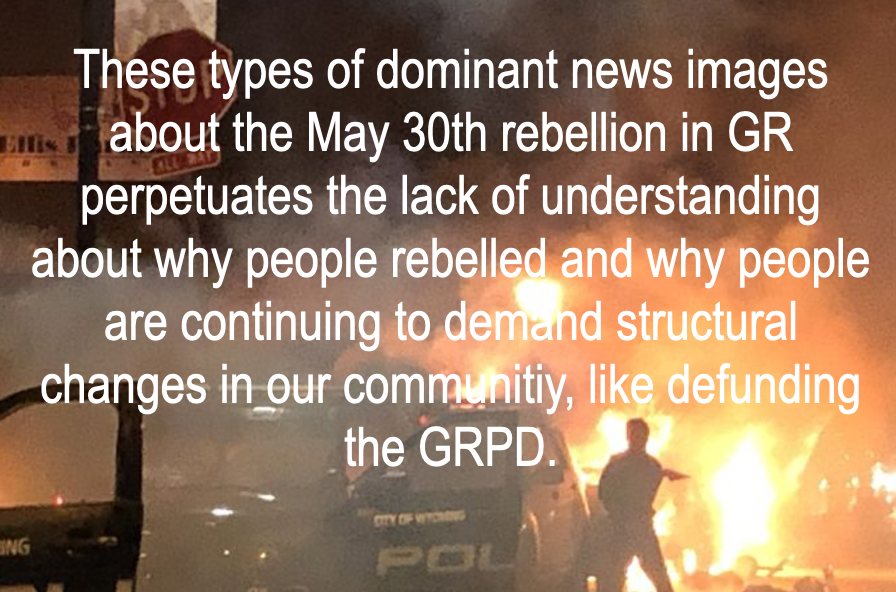
Add to this the fact that the MLive article from last week, was accompanied by 35 photos, almost all of which features images of property destruction, with no serious effort to provide context. This kind of imagery only perpetuates the “bad protester” image in the public mind and never addresses the serious grievances that Black and Brown communities have over how policing impacts their lives on a daily basis.
Lastly, it is important for all of us to put riots, rebellions, uprisings, or whatever else you want to call them, into proper historical context. The same kinds of condemnation from those in power and the white community in general, was what we saw in the 1967 riot in Grand Rapids.
In Vicky Osterweil’s book, In Defense of Looting: A Riotous History of Uncivil Action, the author provides a robust investigation of when and why riots occur, along with the looting that often accompanies the rioting. Osterweil states:
Rioting and looting similarly redistribute and reduce the wealth and the surplus, leveling material power differentials. The potlatch was outlawed by the Canadian government as a part of its ongoing genocide of the First Nations: the potlatch was considered one of the most important obstacles to their becoming civilized and Christian. Like looting, this nonwhite, noncom modified communal approach to property was seen as a dangerous threat to capitalism and “civilization.”
 It’s easy for the local dominant news sources to paint those who are calling for a defunding of the GRPD as being violent or desiring chaos. However, what we know is that those involved in Defund the GRPD is that while calling for the defunding and eventual abolition of policing, they are also calling for community control of public safety and a redistribution of police funds to communities directly affected by policing. This means that while groups like Defund the GRPD are calling for a dismantling of systems of oppression, they are simultaneously calling for a redistribution of wealth, resources and a re-imagining of what community safety could look like. Unfortunately, the dominant news media doesn’t provide us with this sort of a narrative.
The bullshit response I got from Senator Stabenow on her vote to deny COVID relief funds to undocumented immigrants
 A few weeks ago, several Democratic Senators, including Michigan Senators Gary Peters and Debbie Stabenow, voted against providing COVID Relief money to undocumented immigrants.
This vote angered Immigrant Justice groups across the country, especially considering the fact that most undocumented immigrants have taxes withheld from their jobs, yet are unable to get the same kind of relief that the rest of the country has received since the pandemic began last year.
Locally, Movimiento Cosecha GR has begun organizing in response to Peters’ and Stabenow’s vote, holding a demonstration outside of the office of Senator Peters last Friday. Cosecha members stated during that protest that there would be many more actions to confront Peters and Stabenow in the coming weeks and months.
At the same time, GR Rapid Response to ICE created an online way for people to send messages directly to Senator Peters and Senator Stabenow, letting them know how the community felt about their vote, which you can do at this link.
I sent one of those messages and a few days later got a message back from Senator Stabenow, a response I included here below.
 Thank you for contacting me about my recent vote on an amendment prohibiting Economic Impact Payments for undocumented immigrants.
As you may know, Senator Young introduced this amendment during floor debate over our nation’s budget and President Biden’s economic plan. Some have inaccurately described the amendment as taking away benefits from American children who live with their undocumented parents (mixed-status families). That is not true. I would never vote to deny this benefit to American children.
In fact, this amendment simply reflects and restates current law, a law that passed the Senate late last year by a vote of 92-6. Under this law, undocumented immigrants are not eligible for Economic Impact Payments. However, U.S. citizens, including children living in a household with an undocumented immigrant, are eligible for payments. This amendment does not change that eligibility. This interpretation was affirmed by the amendment’s sponsor, who stated in the public record that “this {amendment} would not impact mixed-status families.”
With the new Biden administration, we are at a pivotal time for immigration reform. What is most disturbing to me is how those who oppose meaningful comprehensive immigration reform continue to easily sow the seeds of division and conflict.
I strongly support comprehensive reform to recognize the value and dignity of undocumented individuals who are an important part of our economy and communities. But we will never succeed in reaching that goal without focusing on our common ground and a shared vision of what legal immigration means in America. My goal is to move us toward this kind of thoughtful discussion and debate.
This is such a typical response from a politician. The response is both condescending and avoids having to own any blame for harm that is being done to the undocumented community. Senator Stabenow acknowledges the value and dignity of undocumented individuals who are an important part of our economy and communities. This is especially true in Michigan, where so much of the agricultural sector relies on undocumented migrant workers to make them money. As Chairperson of the Agriculture, Forestry and Nutrition Committee, Stabenow had to know how much money that undocumented immigrants make for the agricultural sector, since they are an important part of our economy, and yet she does not fight for them.
In the closing paragraph, Senator Stabenow also uses terms like comprehensive reform and legal immigration. These are buzz words which are meant to suggest that Stabenow and the Democratic Party support serious immigration justice policies. However, if one reads the history of US immigration policy, you will learn that the Democratic Party has not been committed to immigration justice. Movimiento Cosecha – the immigrant-led movement – names immigrant justice as dignity, respect and permanent protection for the estimated 11 million undocumented currently residing in the US. Since this is what one of the most active and powerful immigration justice movement proponents is calling for, then that should be the foundation of what the Democrats identify as Comprehensive Immigration Reform.
For further investigation into where US policy towards immigrants has been in recent decades, I would highly recommend the following books:
All-American Nativism: How the Bipartisan War on Immigrants Explains Politics as We Know It, by Daniel Denvir
Border and Rule: Global Migration, Capitalism, and the Rise of Racist Nationalism, by Harsha Walia
Also a recent interview with Harsha Walia entitled, THE DEMOCRATS’ LONG WAR ON IMMIGRANTS.
The new Grand Action Riverfront study and White Settler Colonialism
 Last week, Grand Action 2.0 released a 4 page study with recommendations on how to further develop along the Grand River, with an emphasis on the east side of the river, with heavy concentration in the downtown area.
The study has the usual corporate rhetoric of diversity and green space, along with the usual tokenism efforts to “engage the community.”
This effort on the part of Grand Action to further develop the downtown part of the city has been going on for decades, with the most recent wave beginning in 2016, with another study they commissioned to promote entertainment and tourism along the river.
This process of developing along the river escalated with the DeVos land grab and proposal to construct a 12,000 seat amphitheater last October. The process involved the usual public/private partnership model – the private sector gets the public to cough up lots of money, while the private sector pockets the bulk of the profits.
In November, there were more details about this process, where it was announced that millions would go to the project for the amphitheater, while Black neighborhoods continued to be either divested or received minimal investment funds from both the City government and the private sector, a process we named as Structural Racism.
Then in late November, Grand Action 2.0 hosted an event with a speaker to talk about more ways to attract tourists to GR, with lots of talk about engaging Stakeholders. At that event, Dick DeVos stated that during the COVID crisis, “this is the perfect time to develop ideas.” It’s perfect for him and the rest of the members of the Grand Rapids Power Structure, since they are not struggling to survive and not having to worry whether or not the COVID virus will harm their families. This is the thing about this class of people, they can talk about making the river front area accessible to people, but they fail to recognize that leisure is a luxury that thousands in this community can’t really afford, especially when so many families are facing eviction, food insecurity, unemployment, employment with non-livable wages and limited access to health care.
With this most recent study, we could discuss what is fundamentally wrong with the process and how it will disproportionately benefit the business class. However, instead to going down that path, I think what we all need to come to terms with is that the land that they are talking about developing along the Grand River, was taken from the Indigenous communities who had been living along the river long before Settler Colonialists arrived.
Maybe we need to start talking about how White Europeans who came to the area we now call Grand Rapids and how they: 1) disrespected Indigenous spiritual traditions by trying to convert them – the earliest Settler Colonialist were Catholic and Baptist Missions; 2) used legalized violence, also known as treaties to take land, such as the Treaty of Washington in 1836, which allowed Settler Colonialists to acquire an additional 13,837,207 acres of land; and 3) to displace most of the Indigenous population through force, coercion and attrition.
In addition to taking this land, Settler Colonialists have been doing serious harm to the Grand River in this area over the past 2 centuries, by polluting the river with industrial waste, constructing damns, using the river for logging purposes during the heyday of the furniture industry and constructing a highway system that crisscrosses over the river. Now, Settler Colonialists want to re-develop the area along the river, despite the decades of harm we have done. In fact, it is wrong to refer to the Grand Action proposal as re-developement. Instead, we should be using the term that Eco-Feminist Vandana Shiva has coined, maldevelopment. She argues that “maldevelopment”—the violation of the integrity of organic, interconnected, and interdependent systems that sets in motion a process of exploitation, inequality, and injustice—is dragging the world down a path of self-destruction, and threatening survival itself.
Do we really want to put our trust in Grand Action 2.0? Do we really want to put our faith in the most recent iteration of White Settler Colonialism?
Far Right news platform Breitbart, posts about the group Defund the GRPD
 On Monday, the grassroots group known as Defund the GRPD, hosted an online Press Conference to talk about their work and the upcoming panel discussion they were hosting on Community Accountability.
I sat in on that Press Conference, since I am an ally in Defund the GRPD. Several Black organizers with Defund the GRPD spoke about the work of the group, their accomplishments and the upcoming panel discussion, before opening it up to questions from reporters.
One thing that was obvious to this writer, was that the questions the reporters were asking, reflected that they didn’t really get the organizational framework of Defund the GRPD, nor did they understand the group’s theory of change. Reporters kept wanting to find out if Defund the GRPD was going to pass a charter amendment to challenge the 32% mandated City Budget allocation for the GRPD, which was adopted in 1995.
In the end the Black organizers with Defund the GRPD didn’t leave the reporters anywhere to go, since they stuck to their talking points, which resulted in local news agencies essentially provided an overview of what was said during the Monday Press Conference.
However, this did not prevent other dominant news sources from picking up the story. One dominant news source Breitbart, which caters to the far right, posted a story on the Defund the GRPD Press Conference this past Tuesday. The article that appeared on Breitbart was written by Kyle Olson, with a headline that read, Defund the Police’ Returns: Activists Demand Deep Cut in Michigan.
The large photo that appears just below the headline show a masked person in the foreground with several items on fire in the background. The picture is credited to David Ryder, who is a Seattle-based photographer, so the picture has nothing to do with Grand Rapids or Defund the GRPD, but it provides Breitnart readers with the kind of imagery that the far right associates with Black Lives Matter or any other group that is critical of policing in America.
There are also several prominent ads on the page that has the article by Kyle Olson, particularly ads from the NRA on gun purchases and an ad from a pro-israeli group known as Stand for Israel.
It is also important to note that besides being a reporter for Breitbart, Kyle Olson also has syndicated radio show that airs Saturdays on Michigan stations, called The Kyle Olson Show. Olson is also the founder of a group based out of Muskegon, Michigan called Education Action Group, which hates teacher unions and promotes the same Neo-liberal model of Education that Betsy DeVos does, such as School Vouchers, Charter Schools and the privatization of public education.
The article by Kyle Olson about Defund the GRPD isn’t particularly bad, since he was relying on what other West Michigan News agencies reported. The article is very short and half of the story consists of Olson cutting and pasting from the Defund the GRPD Facebook page, specifically about the Worst of GR Awards.
While the article on Breitbart is not terribly problematic, the more important issue is that it is on Breitbart. Since Breitbart posted a story about Defund GRPD, it now leaves that group and their organizers open to even more harassment from those who embrace White Supremacist values, which condemns anyone who is critical of or challenges the function of law enforcement agencies, like the Grand Rapids Police Department.
In late January, we wrote a piece that was critical of Kids Food Basket, particularly because their lawyers sent threatening letters to Defund the GRPD organizers. This threat was coming from a liberal non-profit group, so imagine what potential harm could come from the far right audience that relies on Breitbart. If you are an ally, an accomplice in anti-racism work, particularly anti-racism work that is led by Black organizers, you need to not only know about the potential threats to Defund the GRPD, you need to demonstrate your solidarity with their work. Join the Community Conversation on Accountability on Thursday, February 25th at 7pm, listen to what Black organizers are saying and support their work.
GRIID Class on US Social Movements – Part V: How Social Movements get coopted and other impediments to collective liberation
 (Over the next 8 weeks, we will be posting a summary of the class we are facilitating on US Social Movements. These posts will include a summary of the discussion, the questions we presented to frame each social movement that is discussed, a timeline and additional books that are relevant to each movement.)
In week 5 of the US Social Movements class discussion, we took a break from looking at historical examples of social movements.
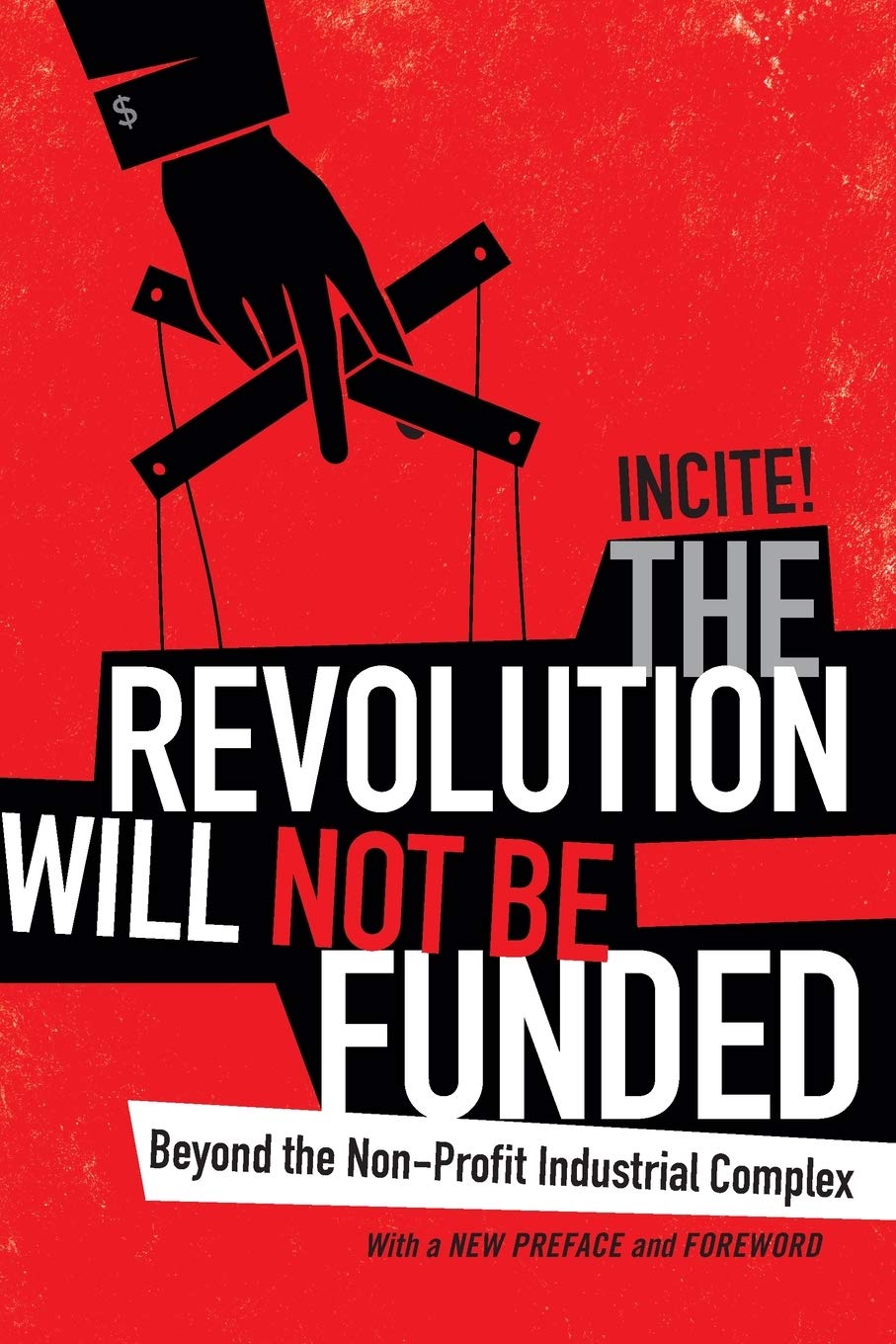
Instead, we read two chapters from two separate books that both look at some of the major obstacles to social movements. The first piece we read was from the book, The Revolution Will Not Be Funded: Beyond the Non-Profit Industrial Complex, specifically the chapter from Paul Kivel entitled, Social Service or Social Change?
Kivel writes about the fundamental difference between confronting and dismantling systems of oppression, and what social service agencies and non-profits do, which is to provide individual relief to social problems or to offer mild reformist solutions to structural injustices.
In addition, Kivel provides important analysis around what he refers to as how social service agencies and non-profits acts as a buffer for systems of power and oppression. If just enough relief can be offered to individuals, then that can often have the affect of pacifying oppressed populations, thus preventing them from engaging in organized resistance or rebellion against White Supremacy, poverty, environmental racism, etc. Several participants noted how well thought out Kivel’s analysis was and that they appreciated the questions included in his chapter, which offer people an opportunity to further reflect on the themes being discussed.
The second reading used for week 5’s discussion, was a chapter from Lance Selfa’s book, The Democrats: A Critical History. The chapter we used from Selfa’s book is entitled, Social Movements and “The Party of the People.”
The chapter from Selfa’s book makes the argument that the Democratic Party has a history of co-opting social movements, by getting them to compromise on major social issues or to spend their time and energy getting Democratic candidates elected, only to later be betrayed or disappointed by those who were elected.
Selfa makes his argument by providing several historical examples from the US Labor Movement and the Civil Rights Movement. Selfa also talks about the women’s movement, the anti-Iraq war movement and the LGBTQ movement as well.
During the discussion there were several issues raised. One issue was how too often social movements don’t demand enough from partisan politics and too often they eventually endorse Democratic candidates on the premise that, “at least they aren’t as bad as Republicans.” Another issue that came up was the fact that whatever gains that have been made in the US, were won through social movements, not as a gift from those in power. If the US political establishment has ever passed legislation that is beneficial to the general population or to affected communities, it is precisely because social movements have forced policymakers to meet those demands. This was even the case with FDR, who was so afraid of the power of the US Labor Movement that in the end, whatever social policies were adopted, were motivated by wanting prevent the US from a massive worker uprising.
With both of the readings, participants felt challenged by the analysis presented, but several people also voiced the importance of the arguments presented and how it relates to the history of social movements.

