On July 4th, the local pro-police group, Voice For the Badge (VFB), posted another propaganda image on their Facebook page (shown below), with two flags. The first flag was the USA flag, which accompanied by the tag line, This is Why We Are Free. The second flag is the pro-police flag, which had the tag line, This is Why We Are Safe.

There are several things worth pointing out about the VFB post. First, the image they used is from the Far-Right group Turning Point USA, which not only believes that the US military is a force for good, they believe that cops protect people from Black Lives Matter activists and ANTIFA.
However, when it comes to deconstructing the beliefs that the US Military makes us free and that cops in the US keep us safe, there are lots of fabulous sources to call both beliefs bullshit.
If you haven’t been completely seduced by Hollywood depictions of the US military or bought the ongoing collusion between dominant US news media companies and the US Military, then you know that the US Military has invaded dozens of countries, occupied lots of countries, bombed civilian targets, murdered millions, tortured, repressed and then left politicians in charge to look out for US interests. Zoltan Grossman has been documenting US Military interventions for decades and he has a great list that begins with the 1890 US Military attack at Pine Ridge (killing 300 indigenous people) all the way up to the present. Spend some time looking at that list and then tell me is you really believe that the US Military makes people in the US free.
As for whether or not the police in the US keep us safe, one way to determine if that is true would be to look at statistics of how often cops murder civilians. Check out the data at https://mappingpoliceviolence.org/ and see how many civilians are killed by police each year, along with the disproportionately high number of Black people that are killed by cops.
It’s bad enough that Voice For the Badge pushes it’s pro-cop propaganda, now they want to deny that the US Military is not a brutal, repressive and imperialist force in the world.

We just posted an article about the legacy of the Klan in Grand Rapids in 1925. https://griid.org/2021/06/30/the-legacy-of-the-1925-klan-gathering-in-grand-rapids/ Today, we want to talk about a Klan rally held in Kent County in 1970.
The only archival record we could find about the 1970 Klan rally in Kent County is because a reporter from the Grand Rapids Press attended the rally and wrote a piece in their Wonderland Magazine section of the paper. https://grpeopleshistory.files.wordpress.com/2021/07/kkk-in-kent-county-1970.pdf
The Klan rally took place at a farm in Kent County, a farm that was somewhere along US 131, just south of Grand Rapids. We know this, because the GR Press reporter mentions US 131 several times in the article. In fact, the reporter states that the Klan members parked in the driveway of Bill Post’s farm and walked through his barnyard to get to the location where the rally was being held.
The headline of the article was entitled, The Klan in Kent County, which also featured a photo of a burning cross and a quote from a Christian Pastor who spoke at the Klan rally, saying, “We ask you Lord, to stand behind us in our effort to keep America white.”
Just after the pastor spoke these words, several Klan members dressed in white robes light their torches and then set on fire a large cross they had erected on the farm property. Just as the Klan members were setting the cross on fire, another Klan member in a green robe shouts, “This is a light for all white America.”
The reporter then notes that the cross burned for about an hour before in collapsed on a Saturday night in July of 1970. The reporter goes on to say about the fiery cross, “It falls atop a hill seven miles south of Grand Rapids, and less than 100 yards west of US 131.”
The article also reports that the Grand Dragon of the Michigan unit of the United Klans of America Inc, spoke to the crowd and his names was Robert Miles from Howell, Michigan. The Press reporter notes that he smiles a lot and tells jokes.
On page 4 of the article it notes that there are several armed men patrolling the perimeter of the Klan rally, making sure no “intruders” showed up. According to the Press reporter, there were two main themes in the speech made by the Grand Dragon. First, that white people are a minority, “defending themselves against hostile blacks, Communists, atheists and federal bureaucrats.” The second theme was that history backs up what the Klan teaches.
The Press reporter then states that as the Grand Dragon was finishing with a prayer, he then concluded with these words:
“This cross is but a symbol of our belief that white America will last, that the white race will not be subjugated by the experimenters, that we shall retreat no longer.”
What I find instructive about this article is that the reporter does a good job of reporting on what was said by the Klan spokesperson, but there in no indication that he tried to interview the Grand Dragon. In addition, there is also no reflection on the comments made by the Grand Dragon, no analysis and no contextual information about the realties that Black people were facing in Grand Rapids in 1970, nor does the reporter challenge the claim that white people are the minority, as claimed by the Klan speaker. The truth is that Grand Rapids was still very much made up of mostly white people and that white people controlled the political and economic power in the city.
At the conclusion of the article it states that there were Kent County Sheriff’s deputies and Michigan State police waiting by the cars of the Klan members who were at the rally. The Press reporter writes that the police were writing down the names of the people in attendance, had confiscated “a few rifles and arrested on man for trying to run over a policemen with his car.”

The Legacy of the 1925 Klan Gathering in Grand Rapids
In early July of 1925, KKK delegates from 50 counties throughout Michigan came to Grand Rapids for three days of meetings. This was the largest Klan gathering ever in Grand Rapids, with thousands in attendance.
There was coverage of the Klan gathering in both the Grand Rapids Herald and the Grand Rapids Press. Let’s take a look at what was reported and what was excluded from the local newspaper coverage.
The Grand Rapids Herald published three articles. The headline of the first article read, Klan, Looking for 16,000 here today, erects tent city. The article talks about delegated from 50 counties, “numbering 6,000” on July 3rd, but they were expecting as many as 16,000 by July 4. The first article includes a large list of food and beverages needed for the gathering, along with a brief description of the program that was held, then ending with information about the July 4th parade.
The headline for the second article from the Herald reads, 3,000 Klansmen Parade in Robes Through Streets. The article included the parade route, the order they marched in, floats represented in the parade and a brief description about all the cars that covered nearby hillsides.
There was a short 3rd article that states, “The Herald was also requested to announce that a large quantity of foodstuffs remained unused, and would gladly be given to anyone who could use it……..Neither race nor religious convictions will be considered in distributing this material.”
The two articles from the Grand Rapids Press are shorter, with most of the same information that appeared in the Grand Rapids Herald. The only new information, was the names of the KKK field delegate for Kent County, Maj. Wilbur Ryman and the women’s representative, Mrs. Maggie Elliot.
There were a few instructive comments in the Grand Rapids Herald article, stating that there were “throngs” of people who greeted the Klan parade and that at the parade was led by a “squad of motorcycle police.”
Now the parade began on the westside, at Lincoln Park and moved east on Bridge St. The westside at that time had a very large Catholic population and the parade would have marched past both St. James Church and St. Mary’s. The platform of the KKK was staunchly anti-Catholic, yet there was no evidence that there were detractors who showed up to protest the parade.
The Significance of the Klan Gathering in Grand Rapids
Based on the newspaper coverage, to seems clear that at least 6,000 Klan members gathered for three days in Grand Rapids in 1925. This gathering is significant and says something about the political climate in Grand Rapids at that time. Here are some reasons why we think the Klan gathering in 1925 was significant.
- The Kent County chapter of the KKK was the host of this Klan gathering, signifying that they must have had a large and active membership, which means that there were KKK members in Grand Rapids.
- The City of Grand Rapids not only provided a permit for the parade, they provide a police escort.
- The newspaper coverage completed omits the messages from speakers during the three days. What we do know about the 2nd wave of the KKK, is that they were anti-Catholic, anti-Jewish, anti-immigrant and anti-Black, yet there was no reporting on the Klan platform and no one from the Catholic, Jewish, recent immigrant or Black community was asked to comment on the large gathering of a White Nationalist and White Supremacist organization. (See Craig Fox’s book, Everyday Klansfolk: White Protestant Life and the KKK in 1920s Michigan, for additional background on the Klan.)
- Todd Robinson, in his ground breaking book, A City Within a City: The Black Freedom Struggle in Grand Rapids, MI, states that there was a KKK “club” based at South High, “which was considered one of the most prestigious secondary schools in Grand Rapids.” More importantly, Robinson notes that there was a 1924 Klan parade planned in Grand Rapids, but because of bad weather, the parade was postponed until the following year.
- According to a retrospective piece by GR Press writer Garrett Ellison, where he relies on GVSU history professor Matthew Daley, Ellison writes, “Members began arriving in Grand Rapids in the weeks ahead of July 4 and set up a tent city on the municipal outskirts near the Bridge Street hillside. Daley said mentions of “a symbol” seen atop the hill the night of July 3 suggest Klansmen fired off a cross, possibly with a matching one over Belknap, to announce their presence the next day.” Such a display certainly sent a message to the residents of Grand Rapids.
It is important that we come to terms with this history in Grand Rapids, not only in some intellectual sense, but to grapple with the significance of the large display of White Supremacy. There was no documented opposition, which in many ways is understandable, since there were thousands of KKK members present and likely thousands more who would identify as supporters. Therefore, it could be said that Grand Rapids was the perfect place to hold a Klan gathering/parade, since White Supremacy was normalized in this community.
Lastly, we also need to come to terms with what this legacy means for what is happening right now in Grand Rapids. While there may not be many white rob-wearing KKK members in the area, the White Supremacist values are very much alive in this city. We have government officials in the city and the county that have opposed any reduction of funding for the GRPD, we have GRPD cooperation with ICE, we had a county that until recently had a contract with Immigration and Customs Enforcement, a Sheriff’s Department that still cooperates with ICE, and an ongoing strategy of divestment of funding and gentrification in the Black community. Just because people aren’t wearing white robes doesn’t mean the same White Supremacist values aren’t being practiced in this city.

Senator Peters gets endorsement from police groups for proposed legislation that provides federal dollars to recruit more cops
Last Tuesday, Senator Gary Peters re-introduced legislation called the Strong Communities Act. According to his office’s Press Release:
“It’s critical to build trust between local law enforcement and the communities they serve,” Senator Peters said. “By encouraging community policing, this bipartisan bill would help build stronger relationships between local law enforcement and the neighborhoods they serve. It would also incentivize people to serve in law enforcement in the communities they call home. Community policing can lead to better outcomes and more accountability, which is important as our nation works to reform policing.”
Senator Peters had introduced this legislation last year just days after the country erupted with protests over the police murder of George Floyd. Peters introduced the legislation with U.S. Senator John Cornyn, a Republican from Texas, who used to be the State Attorney General in Texas, where he pushed a pro-police agenda.
This legislation that Senator Peters has re-introduced does two main things. First, it further legitimizes the notion of community policing as a positive way of doing policing. However, as Alex Vitale, author of The End of Policing notes:
The research shows that community policing does not empower communities in meaningful ways. It expands police power, but does nothing to reduce the burden of overpricing on people of color and the poor.
In addition, the co-authors of the book, Life During Wartime: Resisting Counterinsurgency, make the argument that Community Policing is primarily about the ability of local police departments to build relationships with residents for the specific purpose of gathering information and engaging in surveillance…..thus community policing is a form of counterinsurgency, especially in response to an organized populace that is making demands of the state.
The second thing that this legislation from Senator Peters and Senator Cornyn does is offer financial incentives to recruit news cops and then have them live in the neighborhood they serve for at least 4 years. Police reform groups have long advocated that police officers should live in the communities that they serve. The group Communities United Against Police Brutality, has this response to that belief:
“Throughout our research, we have never encountered a shred of evidence that requiring or incentivizing police officers to live in the communities in which they work has any positive effect on the quality of policing,”
It is worth noting that just days before Senator Peters first introduced this legislation in June of 2020, he came out strong against the protests taking place across the US, stating:
“The death of George Floyd was a horrific tragedy and justice must be served. While I understand and respect anyone who wants to demonstrate peacefully to bring attention to this injustice, it is discouraging that what was clearly intended to be a peaceful protest quickly devolved into a riot instigated by extremists with an anarchist ideology.”
This statement from Senator Peters is rather hypocritical, especially considering that Peters sits on the Armed Forces Committee, consistently votes for massive levels of US military spending and praises US militarism abroad, such as airstrikes, drone strikes and other forces of violent tactics that often kill innocent civilians.
The last argument for seeing Senator Peters’ reintroduction of the Strong Communities Act as deeply troubling, is the fact that it has received the endorsement of the largest and oldest police organization in the US, the National Fraternal Order of Police.
The National Fraternal Order of Police has a long history of supporting police departments across the US that have a particularly brutal history, has a leadership that is all white, spends millions on lobbying Congress and endorsed Donald Trump in 2016.
In the end, for those who want to see systemic change around policing, they cannot be seduced by language of community policing and the notion that cops who live in the communities where they work will make a difference. It just doesn’t matter to people who are harassed, arrested, tasered or beaten by cops, that they live in the same neighborhood as the people they are oppressing.

West Michigan Foundation Watch: Richard and Helen DeVos Foundation still funding the Christian Right
In this edition of West Michigan Foundation Watch, we look at the 990 document for the Richard & Helen DeVos Foundation for 2019.
The 2019 990 document is significant, especially since this is the first year after the death of Richard DeVos, who died in 2018. It is significant, in that the numbers are down for the 2019 contributions from the Richard & Helen DeVos Foundation, which could be an indication that the foundation might be phasing out.
The only trustee listed on the 990 document for 2019, is the longtime DeVos family financial advisor, Jerry Tubergen. Tubergen is the CEO of RDV Corporation, and he is the CEO of Ottawa Private Capital LLC.
However, even though the 2019 contributions from the Richard & Helen DeVos Foundation are down from previous years, they still contributed just over $31 million.
The largest contributions, ones that are a million dollars or more are as follows:
Aquinas College $1,000,000
Central Presbyterian Church of New York $1,000,000
George W Bush Foundation $2,000,000
Grand Rapids Community College $1,000,000
Grand Valley State University $2,010,000
Kings College $5,000,000
Michigan State University Office of University Development $2,500,000
Spectrum Health Foundation $3,350,000
West Michigan Horticultural Society $1,035,000
These contributions alone come to just shy of $20 million of the $31 million contributed in 2019. The contributions to local Colleges and Universities has been consistent for decades for the Richard & Helen DeVos Foundation, primarily as a mechanism of influencing school policies, with GVSU as one example. https://griid.org/2018/09/13/gvsu-canonizes-rich-devos-but-some-students-push-back/
The entities to receive a million or more outside of West Michigan are due to the politics of those entities, such as Kings College, a Catholic school with a heavy emphasis on business; Central Presbyterian Church of New York, because of their conservative politics; and the George W Bush Foundation, since the DeVos family helped to elected George W Bush, with massive campaign contributions.
However, there is a longer list of entities that received foundation contributions from the Richard & Helen DeVos Foundation, entities that would fall under the category of Religious Right.
In the anti-Choice category, you have the Right to Life of Michigan Educational Fund receiving $50,000, and the Pregnancy Resource Center receiving the same $50,000 amount.
Then there are Christian groups that engage in White Saviorism, listed here, with the amount of money they received from the Richard & Helen DeVos Foundation:
World Renew $150,000
Partners Worldwide $500,000
Mel Trotter Ministries $50,000
Luis Palau Association $200,000
International Aid Inc. $48,200
Guiding Light Mission $75,000
Music Mission Keiv Inc. $50,000
Evangelism Explosion III International Inc. $165,000
Christian Leaders NPF $150,000
Cardus Inc. $300,000
Back to God Ministries International $50,000
Zuni Christian Mission School $100,000
Rehoboth Christian School Association $350,000
The Richard & Helen DeVos Foundation also funds private schools and organizations which work to undermine public education:
Potters House $525,000
Mackinac Center $100,000
Grand Rapids Initiative for Leaders $20,000
Alliance for Children Everywhere $200,000
There are also non-profits in Grand Rapids that do important work, but taking money from DeVos foundations also buys their silence, thus preventing them from speaking out on the harm that the DeVos family engages in, with their financial interests and their political funding.
Even after both Richard & Helen DeVos pave passed away, their legacy of funding the political and religious right continues.
Within the past week, the Grand Rapids Police Officer’s Association (GRPOA) has made two posts on their Facebook page about defunding the police. The first one stated, “For all the de-funders that follow our page, what is the solution to get this violence under control?” The second comment read, “Still waiting for an answer from the de-funders. How do we stop the violence if properly staffing the police department is not the answer?” In both instances, the GRPOA included a story about gun violence in Grand Rapids.
These posts by the GRPOA are an intellectually sophomoric way of trying to say that those who advocate for defunding the police have no answers to the issue of gun violence or crime being committed in Grand Rapids.
The fact is, the GRPOA is not even interested in what those who are advocating defunding the police have to say. Their question is nothing more than a ruse, meant as a distraction so that we don’t actually have a serious community conversation about how to reduce violence in the city and practice different forms of public safety.
The real question that we should be asking, and a question that should be posed to the GRPOA is, what evidence is there that the GRPD actually prevents violence in Grand Rapids? The reality is that with all of their resources and more than a third of the City’s budget, the GRPD rarely prevents crime. Whether it is gun violence, assaults, theft, etc, the GRPD primarily shows up after the fact with the intent of investigating these so-called crimes.
Two years ago, there was a study done by the group Hillard-Heintze, LLC, to determine what kind of calls the GRPD was getting from the community. The study demonstrated that the majority of calls from the community were not ones that required police, such as disorderly conduct, parking violations, noise complaints, etc. In other words, most of the calls received by dispatch could be handled by someone other than the GRPD.
But back to the GRPOA’s question about gun violence. First, the fact that gun-related violence has been on the rise recently demonstrates that the GRPD does not deter people from engaging in gun violence. Second, the GRPD doesn’t do violence prevention work, they show up after the fact. Third, we need to ask ourselves why there is violence in the community, and once we understand why there is violence in the community, we can address appropriate responses.
There are no simple solutions to community violence and we will not solve the problem overnight. However, if we are really serious about ending violence in our community, then we have to look at the bigger picture and not only talk about root causes of violence, but structural violence as well.
Most news stories having to do with violence are about homicides. This is understandable, since a person being shot is horrible and traumatic. However, if we expand our thinking to address structural violence, then we can see how the GRPD not only does not prevent structural violence from happening, they allow it to persist. People living in poverty is structural violence. People not able to make enough money, because of low wages, is a form of structural violence. Malnutrition is a form of structural violence, as is the for-profit driven health care system and rent/housing costs. White Supremacy is a form of structural violence.
Now, the GRPD does nothing to address these forms of violence. The GRPD doesn’t arrest billionaires who pay no taxes, they don’t arrest corporations for paying shitty wages, they don’t intervene to prevent landlords from evicting people. However, the GRPD will make sure that people who are fighting for a livable wage, Medicare for All, truly affordable housing and healthy food will, especially if they are using direct action tactics, will be harassed, intimidated, monitored and arrested by the GRPD. In other words, the GRPD defends structural violence.
Moving towards a radical community safety model requires two things. First, a divest/invest plan, which has always been part of the Movement for Black Lives agenda. If we defund the police and invest in the communities most affected by policing, it will create greater equity. We wrote about what the budget of the GRPD – $54 million, if invested in the Black community could do. Mind you, the $54 million (based on the 2020 City Budget) is just for one year, so we need to imagine what that kind of monetary investment into communities affected by policing would look like in the short term and the long term.
$54 million a year would lift thousands of families out of poverty. $54 million a year would allow people to purchase homes. $54 million a year would make sure that people didn’t have to chose between heating their homes or feeding their kids. $54 million a year would go along way to provided needed health care to people, as well as educational resources and opportunities to reduce pollution and create sustainable ways of living. Greater equity would actually reduce and potentially eliminate crime and violence, both personal and structural.
The second step needed would then be to look at models of community safety that do not relay of policing. Those of us who have been promoting the Defund the GRPD campaign are not naive and we recognize how hard it will be to not have the GRPD. However, we also believe in radical praxis and radical imagination.
Together We Are Safe already encourages people to not call the GRPD when there is a conflict or a problem in the community. They distribute a two-page document that provides reasons why not to call the GRPD and then provides other valuable resources in the community that would more effectively respond to the conflicts in our community. When the GRPD becomes involved in conflicts, it only increases the possibility that the conflict will escalate.
So what are alternatives to having heavily armed cops in our neighborhoods, which often result in a disproportionately large number of black and brown residents going to jail?
In Zach Morris’s book, We Keep Us Safe: Building Secure, Just and Inclusive Communities, he acknowledges that we live in a failed state. What Morris means by a failed state, is that too many people do not have their basic human needs met – housing, health care, food, transportation, child care, employment/wages. The result is the Prison Industrial Complex, the War on Drugs, Gentrification, a health care system based on profits over human needs, a dysfunctional transportation system and employment that is based on exploitation. One powerful example of how the failed state impacts black people, is this statement from Prison Abolition group Critical Resistance.
While Blacks only represent 13% of drug users, Black drug users represent 38% of those arrested for drug offenses, 55% of those convicted of drug offenses and 74% of those sent to prison.
What We Keep Us Safe advocates, in the face of a failed state, is a care-based strategy for public safety that overturns more than 200 years of fear-based discrimination, othering, and punishment. In addition, the book:
“We Keep Us Safe is a blueprint of how to hold people accountable while still holding them in community. The result reinstates full humanity and agency for everyone who has been dehumanized and traumatized so they can participate fully in life, in society, and in the fabric of our democracy.”
In addition to ideas and examples provided in We Keep Us Safe, there are other very practical ways that people can practice community safety. One of the most important and misunderstood aspects of the Defund the Police movement is that people have not taken the time to actually read what is being proposed. We encourage people to read the Defund the Police Toolkit, which is a powerful document.
Another solid resource is an anti-racist neighborhood watch manual that was developed by people in Portland Oregon. This 31 page manual provides great practical resources and application around community safety, specifically that are anti-racist in application. In some ways, this manual builds on the work of the Black Panther Party for Self Defense, which was essentially about responding to the ongoing police harassment and violence directed at black communities across the country.
A third great resource, which was produced by the Women of Color group, INCITE!, is a 121-page toolkit that focuses on why calling the police is especially problematic for women of color and trans people of color. This toolkit also covers the following areas:
- Gender Policing
- Immigration Enforcement
- Cops in Schools
- Policing Sex Work
- The War on Drugs
- Police Violence and Domestic Violence
- Law Enforcement Violence and Disaster
A second major section of the toolkit, provides great examples of practicing community safety from several organizations. This toolkit is a must read and resource for people who want to practice community safety, plus it is a great resource to help us all radically imagine how life could be without the cops.
Lastly, I think it is worth quoting from the final page of the book, We Keep Us Safe:
“Real safety happens when we bridge the divides and build relationships with each other, overcoming suspicion and distrust. Real safety comes from strategic, smart investment – meaning resources directed towards our stability and well-being. Real safety addresses harms that the current system is failing to tackle, and holds people accountable for those harms while still holding them in community. Real safety results from reinstating full humanity and agency for everyone who has been dehumanized and traumatized, so they can participate fully in society. If we are able to transform our old system and create a culture of caring and healing in its place, we may have an actual shot at creating real democracy for the first time.”
As the late historian Howard Zinn has taught is, history is often presented from the perspective of those with privilege and power.
Recently, there has been some social media posts that have suggested that Democratic members of the Kent County Commission were the ones who ended the contract that the county had with Immigration and Customs Enforcement (ICE). This is indeed revisionist history, and we want to set the record straight.
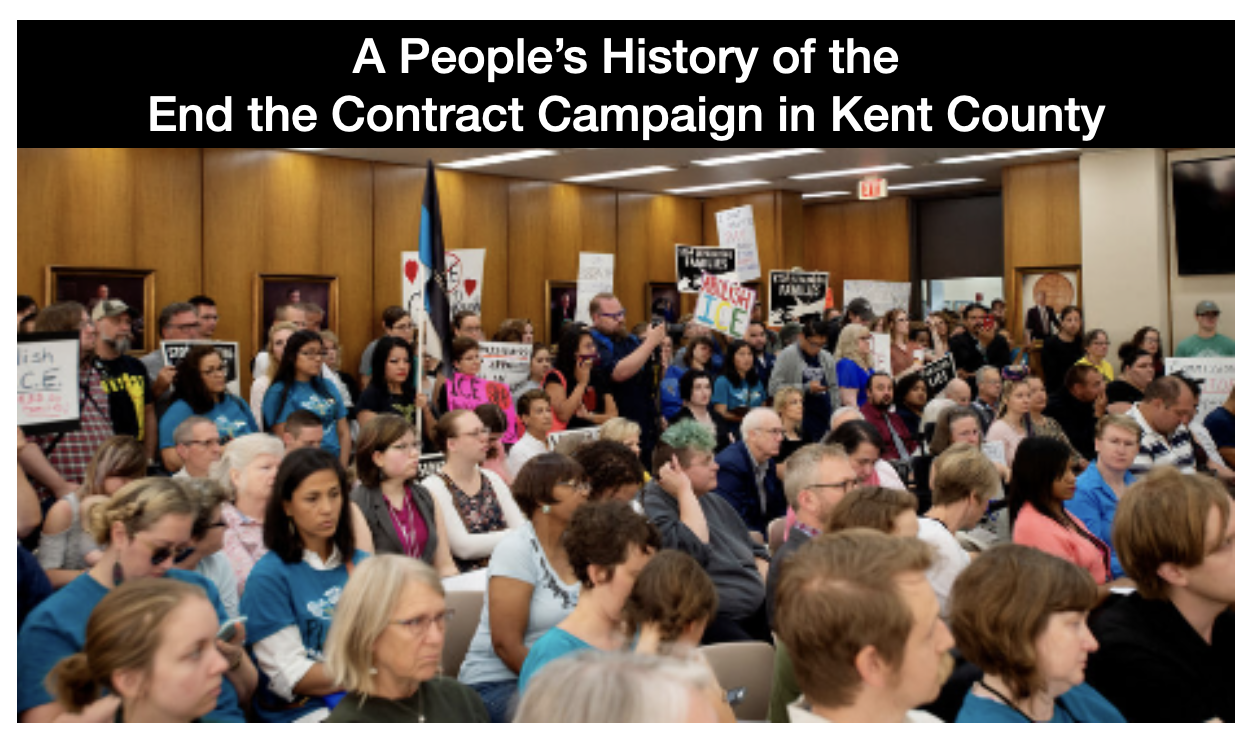
My aim here, is not to convince those with power and privilege, but to present a people’s history of how the contract was ended between ICE and the Kent County Sheriff’s Department.
Kent County began its contract with ICE in 2012. In looking at previous documentation, there was never any real opposition to this contract by any members of the Kent County Commission, from the adoption of the contract in 2012, through the contract’s termination in 2019.
Beginning in the early part of 2018, the group GR Rapid Response to ICE began investigating contracts that ICE might have had in Kent County. We discovered that there was a contract that began in 2012, a contract extension signed in 2017, and a 2018 letter from the National Sheriffs’ Association sent to Congress, which then Kent County Sheriff Larry Stelma had signed onto. The letter presented a false narrative, which stated in part:
Because Congress has failed to enact the necessary reforms, our citizens and legal residents face even greater dangers, our national security is more vulnerable, and our enforcement efforts have been seriously compromised.
Once we had collected all of this information, GR Rapid Response to ICE and Movimineto Cosecha GR decided to begin a campaign to End the Contract between ICE and the Kent County Sheriff’s Department. Since the Sheriff’s Department had no public meetings, we decided to plan an action at the Kent County Commission meeting in late June of 2018.
Just weeks prior to the publicly announced plan to attend the Kent County Commission meeting, the Trump administration had been detaining immigrants at the US/Mexican border, putting them in detention centers, where images of children in cages became national news. When planning the first action to end the contract, we used the national news to make it clear that ICE was not just separating families at the border, they were also separating families in Kent County.
We packed the room at the June 28, 2018 Kent County Commission, with some 250 people who came to say End the Contract Now! The Republican Commissioners left the room when we decided to take over the meeting, as did some of the Democratic Commissioners. I wrote about this action, which you can read here.
This was the beginning of actions taken to End the Contract. Here is a list of everything we did to End the ICE Contract:
- We held dozens of strategy meetings, which always resulted in planning future actions.
- We attended every Kent County Commission Meeting to continue to make our demands, to offer testimony on family separation that was happening by ICE in Kent County and to monitor any comments made by commissioners about the contract.
- Some of the people involved in the campaign met with individual commissioners
- We ran a petition campaign to End the Contract, which we delivered at one of the Commission meetings.
- We held a protest outside of Chairman Saalfeld’s home the night before one of the commission meetings.
- We organized several protests at the Kent County Jail.
- We organized several protest outside of the various ICE offices in downtown Grand Rapids.
- We organized a disruption protest during ArtPrize, on their main stage, drawing attention to family separation in Kent County.
- We created educational materials, which we distributed.
- We created artwork and had sign making parties.
- We spoke to community-based groups about the campaign.
- We utilized social media to education and get the word out about the End the Contract Campaign.
- We held a People’s Commission action during one of the Kent County Commission meetings.
- We worked with the Western Michigan branch of the ACLU and MIRC, who not only obtained their own FOIA documents, but offered their legal expertise on why Kent County was not legally obligated to cooperate with ICE.
As you can see from this list, we spent a great deal of time and energy to End the Contract in Kent County.
Then the GRPD called ICE on Jilmar Ramos Gomez, a US citizen and former Marine, who was suffering from PTSD and started a fire at Spectrum Hospital. Based on the FOIA documents that were obtained by the Grand Rapids Civilian Appeal Board, it was clear that Captain Curt VanderKooi demonstrated racial bias in the Jilmar Ramos Case. This story began to get national news and within a few months, the acting Kent County Sheriff had changed their policy with ICE, by requiring ICE to get a judicial warrant to put a hold on people who were in the Kent County Jail.
This was a victory for the campaign, since 6 months before all of this, no one was talking about the ICE contract with Kent County. The Sheriff’s decision to require a judicial warrant was a direct result of our pressure campaign to End the Contract and the constant news media attention we were getting and creating ourselves. However, the contract with ICE was still in place and was up for renewal in September of 2019.
In the meantime, families affected by ICE violence and some of the lawyers who represented them, shared with us that as a way of getting around the County’s requirement to get a judicial warrant to hold people, ICE was now waiting inside the Kent County Jail and apprehending people who were about to be released from the jail and taking them to detention in Battle Creek.
We were still receiving calls every week from people in the community who had family members arrested and detained by ICE, so we continued with the work to End the Contract.
In late August, we organized another march/protest at the Kent County Jail, where we took over the lobby area in the jail. During the protest inside the jail, we invited several people to share their stories about how ICE had been waiting inside the Kent County Jail to apprehend their family members, just as they were about to be released. This action also generated a great deal of news media attention.
The very next day, the day after our action at the Kent County Jail, the Kent County Sheriff’s Office released a statement saying that ICE would be terminating their contract with Kent County in September and would not be renewing their contract with the jail. This, we believe, was a direct result of the End the Contract Campaign, which had begun 13 months prior.
This is how the contract with ICE had ended. For members of the Kent County Democratic Party to claim they ended the contract is not only absurd, it is an out right lie. In fact, Democratic Kent County Commissioners fought the movement to End the Contract, engaged in gaslighting of some of the latinx organizers and made no public effort to support our demands or work to End the Contract. One Democratic Kent County Commissioner went so far as to mock the very organizers of the End the Contract Campaign, often referring to what we were doing as Bolshevik cosplay.
The ICE contract with Kent County happened because the of the countless hours and deep passion that organizers and volunteers put in to force the end of the contract, since the campaign was polarizing so many people. The End the Contract campaign was the direct result of the immigrant justice movement in Kent County, demonstrating once again the power social movements can have in our communities.
Critical Thinking in the Age of Neo-Liberalism: Part II
In Part I of this post, we presented an updated version of the Branded Alphabet and invited people to test their ability to recognize both branded products and high ranking officials in the Biden Cabinet. https://griid.org/2021/06/21/critical-thinking-in-the-age-of-neo-liberalism-part-i/
In the second part, we want to present information on the members of the Biden Cabinet that are part of this media literacy exercise, shown again here below.
Critical thinking is vitally important today, with both of overload of images and messages we are constantly bombarded with. In addition, it is vitally important to think critically about the US political and economic system, which can be accurately described as Neo-liberal. For a solid explanation of what NeoLiberalism is, go to this link. https://corpwatch.org/article/what-neoliberalism
Thinking critically is especially important in this moment, since there are plenty of people that believe with a Democrat in the White House and a Democratic Party majority in Congress, that we can all relax now, because Trump is no longer in charge.
However, we can not simply assume that just because President Biden does not spend hours playing golf or tweeting offensive messages, that things are fundamentally better off for the majority of people living in the US. We can’t afford to get caught up in the spectacle of politics, but must learn to focus on policy and historical facts.
People may have watched the various hearings that were being held earlier this year, hearings to decide on whether or not the Biden Cabinet members shown below would be accepted. Of course, we always need to think about what kind of questions were being asked of the nominees and also what additional information or analysis was provided by the national news media. However, since most members of Congress are bought and paid for by members of the Capitalist class and since the dominant national news sources have internalized the values of those with economic and political power, we want to provide some independent information of the members of the Biden Cabinet. Just look at the revolving door of corporate interests represented in the Biden Cabinet in the excellent resource and visual provide by the Revolving Door Project. https://therevolvingdoorproject.org/personnel/
Secretary of State Antony Blinken – Blinken was a top aide to Biden when the then-Senator voted to authorize the US invasion of Iraq, and Blinken helped Biden develop a proposal to partition Iraq into three separate regions based on ethnic and sectarian identity. As deputy national security adviser, Blinken supported the disastrous military intervention in Libya in 2011, and in 2018 he helped launch WestExec Advisors, a “strategic advisory firm” that is secretive about its clients, along with other Obama administration alumni like Michèle Flournoy. Jonathan Guyer writes in the American Prospect, “I learned that Blinken and Flournoy used their networks to build a large client base at the intersection of tech and defense. An Israeli surveillance startup turned to them. So did a major U.S. defense company. Google billionaire Eric Schmidt and Fortune 100 companies went to them, too.”
Source: https://www.jacobinmag.com/2020/11/joe-biden-administration-cabinet-picks-pro-war-hawks
Secretary of the Treasury Janet Yellen – Janet Yellen, who served as Federal Reserve chair from 2014 to 2018, had raked in millions from speeches to Wall Street firms and other corporate interests. After spending the past four years criticizing the Trump administration’s corruption, some liberals are now arguing that Yellen’s paid speeches aren’t relevant or worth reporting — even though the payouts are sizable and germane to her position as Secretary of the Teasury. Yellen’s financial disclosure shows she made more than $7 million from speaking fees in just the three years after she left her government job. The bulk of the money, $4 million, came from companies and trade groups that have reported lobbying the Treasury Department in the past two years.
Sources: https://www.counterpunch.org/2013/11/18/the-coronation-of-janet-yellin/ https://www.jacobinmag.com/2021/01/joe-biden-cabinet-janet-yellen-antony-blinken-lobbying
Secretary of Defense Lloyd Austin – Austin was until recently, listed as a partner at Pine Island Capital Partners, which is a private equity firm. In addition, Austin has endorsed current Biden positions on US funding for Israel, the subversive war on Venezuela, the continued US occupation of Guantanamo, the use of drone strikes, maintaining roughly 800 US military bases around the world and the proposed 2022 US Defense Budget, which is actually a slight increase from the Trump Administration.
Sources: https://www.jacobinmag.com/2020/11/biden-administration-access-sirota-flournoy-austin-pine-island-capital-partners https://www.counterpunch.org/2021/06/15/the-pentagons-untouchable-budget/
US Attorney General Merrick Garland – Garland gave an absurd defense of the extraordinarily generous funding that police departments enjoy because Capitol police officers were attacked by white supremacist Trump supporters on January 6. He told senators during his hearing that he is of the same mind as the current liberal president: “Biden has said he does not support defunding the police, and neither do I.” Garland said he believes “in giving resources to police departments to help them reform and gain the trust in their communities.” In other words, he understands there is deep racism in American society but is unwilling to take the hard steps to dismantle it.
Sources: https://www.jacobinmag.com/2021/02/corporate-power-amazon-big-law-department-of-justice-biden
Secretary of the Interior Deb Haaland – Haaland is the first Native American to hold this position. Haaland did announce recently that she would be investigating the historic impact that boarding schools had a Native communities. However, watching this interview with Native organizers who are presenting what the call the Red Deal, which goes much further than the proposed Green New Deal, making Native Sovereignty and anti-colonialism central to Climate Justice. https://www.democracynow.org/2021/4/22/the_red_deal_extended_interview_with
Secretary of Agriculture Tom Vilsack – Villsack was Obama’s Ag secretary and before that was himself part of the AgriBusiness sector. Vilsack will perpetuate the unsustainable agribusiness system, which is most reflected in the US Farm Bill.
Secretary of Commerce Gina Raimondo – Gina Raimondo has been a steadfast ally of Wall Street and corporate America throughout her time in politics: as state treasurer, she sold out her state’s pension fund to Wall Street hedge funds, whilst compelling a regime of cuts to benefits for retirees, over strenuous objection from the American Federation of Teachers, the National Education Association, the American Federation of State, County and Municipal Employees, the International Association of Fire Fighters, and others. A Koch-funded conservative libertarian advocacy group later tried to spread this policy nationwide.
Sources: https://nocorporatecabinet.com/persons-of-interest/gina-raimondo
https://www.jacobinmag.com/2020/12/gina-raimondo-rhode-island-governor-covid-coronavirus
Secretary of Energy Jennifer Granholm – While Governor of Michigan, Grandholm supported the government bailout of the US automakers, which perpetuated a fossil fuel-based transportation system. Granholm did not really penalize or hold accountable the Enbridge Corporation, despite the Kalamazoo River oil disaster during her tenure as Governor in Michigan. Granholm also has historically supported Line 5 in Michigan.
https://www.fox2detroit.com/video/914443
White House Chief of Staff Ron Klain – Klain, along with Rahm Emmanuel, helped craft the Biden-led 1994 Crime Bill, which provided a massive increase in funding for the police and further criminalization of Black and Brown communities.
Source: https://www.jacobinmag.com/2020/12/bill-clinton-biden-crime-bill-1994-rahm
Secretary of Homeland Security Alejandro Mayorkas – A Cuban American Mayorkas will be a good soldier in the Biden Administration and perpetuate the continued militarization of the US/Mexican border. Mayorkas is also committed to maintaining current levels of ICE operations, which means the continued arrests, detentions and deportations of undocumented immigrants.
Sources: https://www.tni.org/files/publication-downloads/bidens-border-briefing-tni-feb14.pdf
https://www.jacobinmag.com/2021/05/us-mexico-militarized-border-immigration-crisis-rhetoric

Critical Thinking in the Age of Neo-Liberalism: Part I
I have been using the Branded Alphabet for more than twenty years as a teaching tool on critical thinking.
Of course, I always have to update it, with every new White House administration, sometimes during administrations, as key staff changes are made.
This version of the Branded Alphabet includes members of the Biden Cabinet, since those seats have now been filled.
The Branded Alphabet media literacy exercise is a great way for people to:
- Understand the pervasive nature of advertising in our society and how we are all being targeted by advertising campaigns.
- Understand how the news media functions and how they decide what information to give us, when to give it to us, and how to give it to us.
- Juxtapose the Branded Alphabet with the current administration cabinet as a way to demonstrate the gap between our knowledge of products vs our knowledge of politics.
- Understand how the media system is constructed in such a way as to make consumerism a priority over an informed public
We invite you to test your knowledge, by participating in this Media Literacy Exercise. First, see if you can identify the product for each letter of the alphabet. Second, see how many people you can name in the Biden Cabinet, along with what position they hold in his administration.
Now think about why it is easier for people to identify branded products, than to identify politicians that have a significant impact on policies that affect all of our lives. Some of the most common reasons that people give are:
- The products have been around for decades, but administration officials change regularly.
- The images of the alphabet are different, colorful and engaging, whereas the image of politicians are very similar.
- As a society we are inundated by commercial images, but the faces of administration officials are only on certain news channels or websites that focus on national politics.
- We consume products, but we don’t consume politicians.
Can you come up with more reasons why we know more of the Branded Alphabet over members of the Biden Cabinet?
In Part II of this post, we will then discuss how much or how little people know about the actual members of the. Biden Cabinet.

Last week, MLive reported that State GOP Representatives are pushing legislation that would allow local law enforcement officers to coordinate with federal officials on immigration status checks.
“House Bills 4197 and 4539 would prevent counties, cities and other local governments from passing ordinances preventing or limiting law enforcement from contacting federal immigration authorities,” according to the MLive article.
House Bill 4197 states:
A bill to prohibit local units of government from enacting or enforcing any law, ordinance, policy, or rule that limits local officials, officers, or employees from communicating or cooperating with appropriate federal officials concerning the immigration status of individuals; to prescribe the powers and duties of certain state and local officers, officials, and employees; and to prescribe penalties and remedies.
This proposed legislation also states that after 2 months of the bill is adopted by the stated, if local governments do not comply, “the attorney general shall bring an action to enforce this act in the circuit court in the judicial district in which that local unit of government is located.”
House Bill 4539 will do the exact same thing, except it identifies county governments specifically to comply with the proposed legislation. HB 4539 was introduced in March, while HB 4197 was introduced in February. As of right now, the bills were just discussed in committees and could be presented to the full house for a vote in the near future.
Previous iterations of this legislation have been proposed since 2017, as an ongoing way to both undermine and punish local governments that became sanctuary cities. In addition, this legislation also provides some push back against all of the criticism that police departments across the state have received since the 2020 uprisings that took place throughout the country and the state after the police murdered George Floyd.
Another instructive component of the MLive article is that it only cites the Michigan Municipal League and the ACLU of Michigan as opponents of this legislation. However, the ACLU of Michigan did submit written testimony, which cites a case in Kent County at length, stating:
Take ICE detainers1 for example, over fifty jurisdictions outside of Michigan have abandoned their prior practice of automatically honoring ICE detainers. In 2019, Kent County changed its detainer compliance policy after ICE unlawfully requested the detention of Jilmar Ramos-Gomez, a United States citizen and decorated military veteran. Kent County, which received the largest percentage of detainer requests from ICE in Michigan, now requires that ICE provide a judicial warrant in order for the Sheriff to hold individuals for immigration purposes. ICE has tried to minimize those disturbing patterns by claiming that its detainer requests only target people with serious criminal records. But ICE’s own data shows that this is false. The vast majority of detainer requests are issued against people with little to no criminal history. Indeed, two-thirds of the people targeted for deportation have no criminal convictions of any kind. The reality is that ICE detainer requests are indiscriminately issued against almost anyone who comes into contact with local police—immigrants, refugees, students, moms, dads, brothers, sisters, grandmothers and grandfathers—instilling fear in already scared communities. The liability risks are large in magnitude and high in probability. Federal courts have consistently held that local agencies and officials can be sued for complying with ICE detainers. First, courts agree that extending a person’s detention based on an ICE detainer constitutes a new arrest. Second, courts agree that a local agency violates the Fourth Amendment when it makes a detainer arrest without sufficient probable cause.Third, courts agree that because detainers are fully voluntary, local officials can be held liable for damages when they effectuate a detainer without probable cause. As a result, police and sheriffs across the country have paid millions of dollars in damages, settlements, and attorney fees for detainer arrests. As an example, the City of Grand Rapids recently paid $190,000 for its participation in the unlawful detention of U.S. citizen Jilmar Ramos Gomez, who was held on an ICE detainer. Detainer-related lawsuits have continued to impose major legal costs elsewhere in the country as well. And the federal government has consistently refused to reimburse these costs. Moreover, the time period in which a person is detained via such a request is not reimbursed by the federal government. The proposed legislation guarantees local communities are put in the impossible position of being stuck between costly litigation or in violation of the statute and subject to injunctions and fees.
Since the case ICE/Police case against Jilmar Ramos Gomez was cited at length by the ACLU statement, one would think that MLive would want to get an opinion by immigrant-led groups that are based in Grand Rapids, like Movimiento Cosecha GR. Movimiento Cosecha Michigan is working to get Driver’s Licenses for all adopted in the state. Driver’s Licenses is an important quality of life issue, since allowing the undocumented immigrant to obtain a driver’s license would provide greater freedom to go to work, pick up children from school, access health care and other basic necessities. In addition, if undocumented immigrants had a driver’s license, they would not end up in local jails after being stopped by local police in Michigan. (Failure to have a driver’s license or an expired license are some of the main reasons why immigrants end up in ICE custody.) Once they are in jail, Immigration and Customs Enforcement is often contacted, which then lands members of the undocumented community in detention center, with the possibility of deportation. The proposed legislation would solidify and expand this relationship between local law enforcement and ICE agents, thus further terrorizing the immigrant community.
I asked Gema Lowe, with Movimiento Cosecha GR, what she thought about the proposed legislation:
“Local police doesn’t need another law that would further more their cooperation with ICE. As it stands, police already cooperates with ICE and intimidates the undocumented community in Michigan. The argument in favor of these bills that would make Michigan a safer place is so far away from reality. The undocumented immigrant workers in Michigan don’t pose a safety threat to the state, on the contrary, our labor and our consumption sustains the economy and we are an essential part of the state. Undocumented workers want to live a dignified life without the fear of driving without a license and being detained by the police, questioned and being turned over to ICE. Undocumented workers just want to get to work.”
We also asked Karen Meyers, with GR Rapid Response to ICE, what the proposed legislation would mean. Their response was:
“If passed, this bill would not protect communities. It would only further protect police from being fired when they racially profile people, which harms the immigrant community. We know this is true from the many people we have provided support for after a police traffic stop or other minor offense has led to detainment by ICE. We also know from the case of GRPD Captain Curt VanderKooi that when an officer racially profiles someone, that person can end up in ICE custody even if they are a citizen, and the officer responsible will not only not be fired, they will not be punished at all. Bills like these are evidence that–regardless of what party is in power–grassroots immigration rights groups need to be alert and ready to do direct action and provide mutual aid for our under-documented community members.”
Lastly, it is worth noting that there are 17 GOP legislators who either introduced or cosponsored these two pieces of legislation. Of those 17 State Representatives, over half have received a substantial amount of campaign contributions from the DeVos family, which essentially means that the DeVos family has backed state legislators that want to further criminalize the undocumented immigrant community and give more power to local law enforcement agencies to target the undocumented immigrant community.


