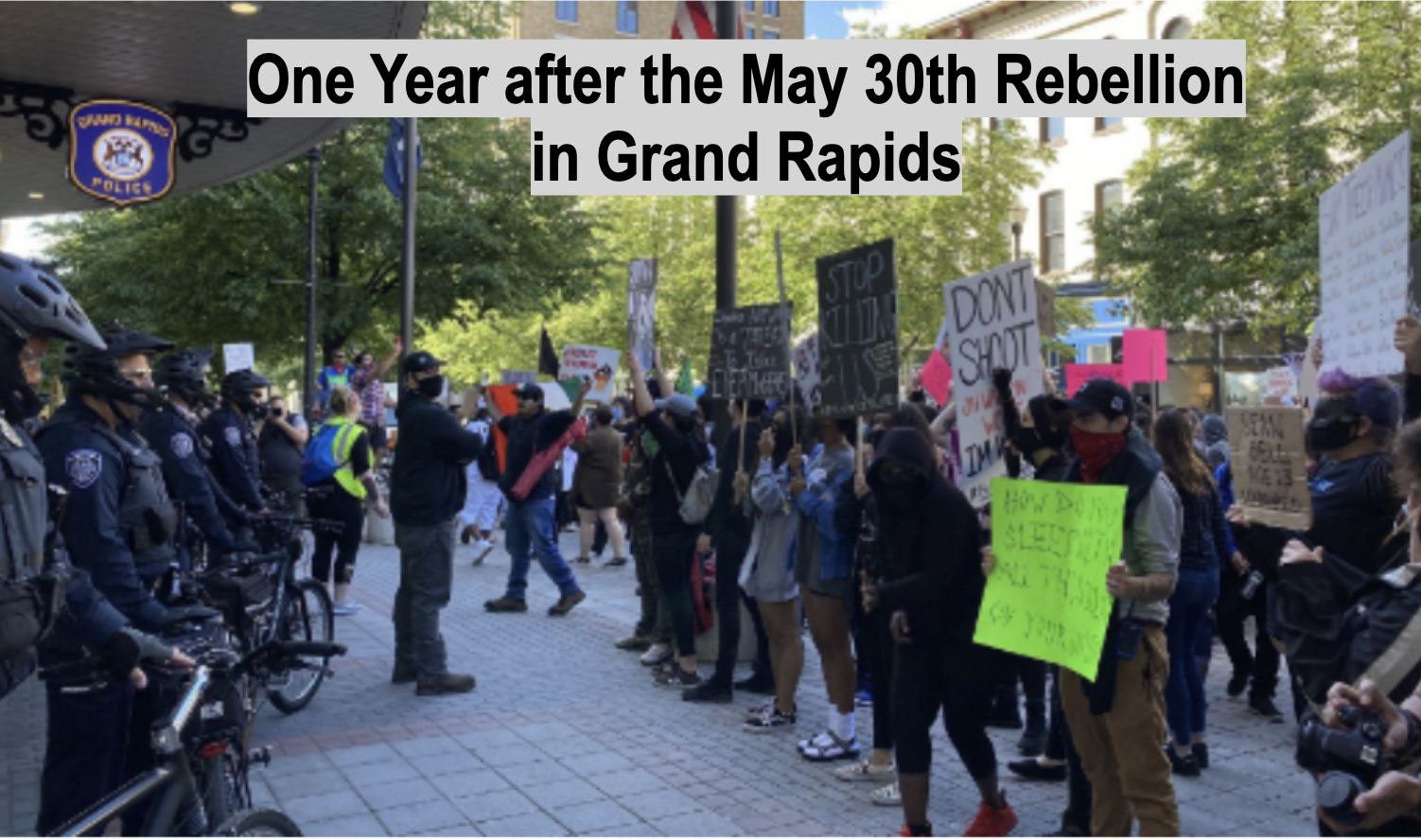
It has been a year since the May 30th Rebellion in Grand Rapids and there are three overarching narratives that are competing for what happened then and where Grand Rapids is now.
Before we look at these narratives, it is important for me to state why I use the term rebellion for what happened on May 30th of 2020, as opposed to the term riot. What I saw and what I experienced on May 30th was thousands of people expressing their collective anger towards the ongoing brutalization of Black people by cops.
It is rare for Grand Rapids to see thousands of people take to the streets against systems of power and oppression, but this is exactly what happened on May 30th. The speeches that were given in Rosa Parks Circle, the thousands marching in the streets of Grand Rapids, the confrontation between the community and the GRPD, the burning of cop cars and the smashing of windows in the downtown area was a big fuck you to those with economic and political power who have ignored, dismissed or tried to minimize the amount of suffering and hardship that people have experienced in this city. This is particularly the case for how those in power have ignored the Black community; have invested in all their shiny development projects while not giving a shit about Black people being subjected to poverty; for dismissing the constant calls from the Black community to end the GRPD’s harassment, targeting and abuse of Black residents; and for maintaining a system of White Supremacy, which is the real meaning behind the phrase West Michigan Nice.
Narrative #1 is the narrative of systems of power
With all of the collective anger, frustration and cries for justice that took place on May 30th, how did systems of power and oppression respond? First, it must be said that the GRPD, with all their riot gear, their tear gas and their use of 40mm chemical weapons they fired at civilians, they were the ones doing the real harm and violence on May 30th…….all in the name of protecting economic and political power.
Secondly, the Mayor of Grand Rapids called in the Michigan National Guard to further militarize the city, with heavily armed soldiers, and then threaten to arrest people who violated a newly imposed curfew in the city.
On Tuesday, June 2nd, 2020, the Grand Rapids City Commission unanimously adopted a resolution that condemned what the resolution referred to as unlawful assembly and civil disorder, giving the Mayor authority to bring in the Michigan National Guard and imposing a curfew to deal with the “state of civil emergency.”
Mind you this resolution was adopted unanimously, by a group of locally elected officials that many consider to be progressive or liberal or whatever other term white people like to use. To me, it is very instructive that they refer to civil unrest, what I call a rebellion, as a state of emergency. It is an emergency because people are not playing by the rules that are dictated from those who have the most to lose. Equally instructive is the fact that 1 in 4 Black children in Grand Rapids is living in poverty, with substandard housing and ongoing food insecurity, yet the City of Grand Rapids doesn’t declare this a fucking emergency???
Another aspect of the narrative presented by political and economic systems of power in Grand Rapids was the notion that what happened on May 30th, “wasn’t the Grand Rapids I know.” This was one of the comments that Mayor Bliss gave to the news media the day after the rebellion. This sentiment, was also shared by one of the economic power brokers in the city, Sam Cummings. As the Grand Rapids Business Journal reported on June 1st:
“That is not who we are, and that was confirmed by talking to some folks on the police force,” Cummings said. “Who we were was (Sunday).”
What is so instructive about the comments from the Mayor and Sam Cummings is that it reflects a reality that says they are either in denial about the tremendous inequality that exists in this city or they don’t really know or don’t care. Again, the rebellion was not just about people articulating their collective rage against how Black people are being policed, it was also about the disgusting wealth gap that exists across the country and in Grand Rapids.
Within days of the May 30th uprising we also saw a tremendous amount of sustained organizing and resistance, particularly around the issue of Defunding the GRPD. The Grand Rapids Police Department and the Grand Rapids Police Officer’s Association have responded to this call for defunding the police budget by attempting to control the larger social narrative in Grand Rapids, by engaging in an escalation of copaganda – where the cops take pictures of themselves in the community attempting to show how much they care, developing a new strategic plan that is filled with reformist rhetoric, having supporters put up over a dozen anti-defunding billboards, co-opting the language of the Defund movement, while at the same time escalating their repression of the Defund movement.
Grand Rapids City officials have also played a signifiant role in supporting the GRPD. Beginning in late June of 2020, there where an estimated 4,000 messages (based on several media sources referencing messages that commissioners had received) send to City officials demanding a reduction in the GRPD. That level of public communication around a specific issue is rarely seen in Grand Rapids, especially considering that if 10% of the voting population shows up for a Grand Rapids City election the clerk’s office is euphoric.
However, despite the high number of public participation in the call for defunding the GRPD, Grand Rapids City officials have not only put a stop to any possible vote on the GRPD budget, they have fundamentally ignored the high number of calls and comments from people during City Commission meetings, comments that have overwhelmingly call for defunding. In fact, every public comment portion of City Commission meetings since the May 30th Rebellion has been dominated by defunding comments, apart from calls around ShotSpotter technology, the use of helicopters during Operation Safe Neighborhoods or the eviction of unhoused people from Heartside Park – all of which involved the GRPD.
No issue has dominated City Commission meetings in recent memory, like the call for defunding the GRPD. However, despite the historic public input, Grand Rapids City officials have refused to defund the Grand Rapids Police Department, have adopted the GRPD’s Strategic Plan and has unanimously approved a 2022 budget that actually provides additional funds to the GRPD budget.
Narrative #2 is the narrative of liberalism and normalcy
A second major narrative that we have heard over the past year is a narrative of liberalism and normalcy…….which, if we are honest is a narrative of whiteness. White people made the biggest stink about property damage during the May 30th Rebellion. White people are the ones who are calling for “peaceful demonstrations”, even though they fully want to cooperate with the GRPD. White people are the ones who kept saying that defunding the police really doesn’t mean abolish the police, it just means to make the cops get more training so they can be nicer while they beat you or spray you in the face with pepper spray. White people are the ones that kept saying “we need to police, otherwise there will be chaos” or “police violence is just a few bad apples.”
White people are also the ones that wanted to redirect the energy of the May 30th Rebellion away from resistance and into electoral politics. White people are the ones that have stop saying Black Lives Matter and have stoping showing up for Black-led organizing, because it just got too hard, or it’s enough already and besides there are less COVID restrictions so I just want to have fun and not be bothered by the fact that the condition of Black people in Grand Rapids has not improved in the past year.
This narrative, a white liberal narrative, also believes that what we need is unity. Well, when has there ever been unity? Calls for unity is just another way of saying, “can’t we all just get along. This notion of unity is naive, because it completely ignores the fact that there are systems of power and oppression that will never willingly giving up their power and wealth. Lastly, this white liberal narrative also believes that in terms of the police, when the GRPD doesn’t something “bad”, then the system is broken. On the contrary, when cops beat someone repeatedly with claims that the suspect was reaching for the officer’s gun, then this is a demonstration that the system works, because the cops were trained to do this, thus the system is working when the GRPD brutalizes Black people. In other words, this system of policing in Grand Rapids was and has always been designed to do exactly what they have been doing.
Narrative #3 is organized resistance and a call to Defund the GRPD
To be transparent, this third narrative is the narrative that reflects the ongoing movement to Defund the GRPD, a movement that this writer is part of. The call for defunding the GRPD began within days after the May 30th Rebellion in Grand Rapids. This call for defunding was what was happening all across the country, because it was part of the larger platform of the Movement for Black Lives and had been part of their platform since the beginning. Calling the for the defunding of police departments didn’t begin with the police murder of George Floyd, although the commercial news media would have us believe that this is where it began. The Movement for Black Lives has referred to defunding of police departments as a Divest/Invest strategy, in their A Vision for Black Lives document.
As was stated before, the call to defund the GRPD began with days of the May 30th Rebellion. This call to defund the GRPD has followed the Divest/Invest strategy, whereby reducing the funding for the GRPD would be step one, with a re-directing of those funds into the Black community as step two.
This call for defunding the GRPD has involved social media education, the creation of magnets that offer community resources that people can contact without calling the cops, protests, marches, press conferences, numerous action alerts throughout the past year, regular summaries of the Grand Rapids City Commission meetings, phone zaps and a great deal of behind the scenes by volunteer Black organizers. The most recent efforts were centered around the City’s 2022 budget.
It is also important for people to know that what Defund the GRPD is calling for is a radical reimagining of what community safety looks like, particularly what it would look like without cops. If we have real equity in this community and if we can create models of community safety, then there will be no need for the GRPD. What this movement is ultimately calling for is the abolition of policing as we know it.
Miriame Kaba, the prison abolitionist organizer writes:
Demands for arrests and prosecutions of killer cops are inconsistent with demands to #DefundPolice because they have proven to be the source of violence not safety. We can’t claim the system must be dismantled because it is a danger to Black Lives and at the same time legitimize it by turning to it for justice. As Angela Davis points out, “we have to be consistent” in our analysis and not respond to violence in a way that compounds it. We need to use our radical imaginations to come up with new structures of accountability beyond the system we are working to dismantle.
This narrative, the abolitionist narrative of defunding the police, is the narrative that I want to embrace. I invite you to join this movement by liking the Defund the GRPD Facebook page and then asking how to get involved.
On Tuesday, May 25th, the Michigan Association of Civil Rights Activists (MACRA) sent an e-mail to bands that are scheduled to play at an outdoor concert series being hosted in Allendale. The outdoor concert series will be held in the same park that the Confederate statue is located.
The e-mail sent to the bands read as follows:
Dear Artists and Performers:
We ain’t gonna play Allendale Concerts in the Park!
You may have heard about the ongoing controversy in Allendale Charter Township, Michigan, concerning the public display of a statue honoring Confederate soldiers and another depicting an enslaved biracial child, half-naked, picking cotton, at the feet of their oppressors. (See attached photos below.) These racist and offensive statues are located approximately 100 yards from the bandstand and grassy area used by the township to hold the “Concerts in the Parks” series.
Just as many anti-apartheid protests in the 1980s were led by musicians and artists—e.g., Artists United Against Apartheid (see info below)—we are asking you and your band to join our anti-racism boycott by declining to perform for event sponsored by or hosted by Allendale Charter Township, at least until the racist statues have been removed or covered.
Artists United Against Apartheid: “Ain’t Gonna Play Sun City”(See links to audio, song lyrics, and Wikipedia article below.)
We know that it may be difficult or go against your principles to decline a paying gig (however modest the compensation), but the circumstances in Allendale are unique and call for empathy and compassion for Black, Indigenous, people of color, and other minorities, who have suffered far too long from abuses of the majority in this small community. Allendale is known as the “Confederate Capital of Michigan” and one of the few remaining “sundown towns” in the state.
This summer (as with last), Allendale will likely be the site of numerous protests. If you are not familiar with the ongoing controversy there, please see the many media stories linked below for more information.
And as if the overt racism in Allendale weren’t enough reason to decline this meaningless gig, the township recently reduced compensation for bands from the higher amounts paid in previous years. In fact, the lowered pay for musicians was somewhat of a joke at the March 22 meeting of the Board of Trustees. When the Rotary Club, which produces the concert series, requested approval to expand from 6 to 10 concerts—with no commensurate increase in funds to compensate musicians—Garry Murphy told the Trustees: “All the bands are hungry and willing to work for less money than normal. It’s a good time to expand. We’ll get more bands for our bucks.” These comments were received with chuckles from board members. On average this year each band is being offered $200 less compensation than in 2019. (See the township’s proposed band compensation chart below for comparison.)
Is it true? Are you all “hungry” for this gig? Is the very low—some might say insulting—$50 to $100 pay worth the stigma of appearing to support a township that demonstrates overt racism toward minorities and a clear disrespect for musicians?
There is one more thing to consider as you weigh whether to accept or decline: protests are being planned that may coincide with some of the “Concerts in the Park.” Which particular dates are chosen for protests this summer will depend on which (if any) bands agree to perform for the apartheid government of Allendale Charter Township. We appeal to your conscience in this matter.
We ain’t gonna play Allendale Concerts in the Park — and neither should you!
Please contact MACRA if you have any questions.
Sincerely,
Mitch Kahle
Michigan Association of Civil Rights Activists (MACRA)
GRIID decided to do an interview with Mitch Kahle, with MACRA, who promptly responded to our questions here below.
GRIID – The Allendale Charter Township continues to ignore pleas from those in West Michigan to remove the Confederate Statue that stands in the main park within the township? MACRA just issued a call for people to boycott the summer concert series being hosted in the same park that is home to the Confederate statue. How did you come to make the decision to use this tactic with the Allendale Charter Township Trustees?
MACRA: Artists and musicians have always been involved in the struggle for civil rights. The idea for a performer boycott of “Concerts in the Park” seemed right from the first suggestion.
GRIID – In the letter you send to all of the bands, you include information about how musicians and artists were instrumental in the South African Anti-Apartheid Campaign, since many of them refused to play in South Africa because of the system of Apartheid that existed then. Do you believe that local bands, many of whom are not known outside of the area, have an obligation to not support systemic racism, which the statue represents?
MACRA: Artists and musicians are typically aware of social injustices and sensitive to issues like racism. This isn’t a call to boycott the performers; it’s a call for performers to boycott the venue or sponsor in this case. If the concerts go on, those dates will be considered for more anti-racism protests directed at the Allendale Board of Trustees.
GRIID – Do you have any concerns about potential backlash to the call for the concert boycott, especially considering that so many people are dying to hear live music again after more than a year of restrictions because of COVID?
MACRA: Live music venues are opening all over the state. There will be plenty of opportunities for people to enjoy live music again without endorsing or supporting a racist venue like Allendale.
GRIID – Why do you think the Allendale Charter Township officials have been so resistant to the calls to remove the Confederate statute, considering it has now been a full year that this campaign has been going on?
MACRA: The Allendale trustees have made no secret of their unanimous desire to maintain the status quo. Left to follow their own moral compass, the trustees would be happy to leave the statues as they are.
GRIID – How important is it for people to understand that these kinds of campaigns often don’t result in quick victories and that ongoing organizing and pressuring systems of power are necessary for social movements to be effective?
MACRA: Patience and persistence are the keys to successful activism. It’s easy for the average person to get frustrated or burned out and abandon a cause because the prospects of winning may seem long and remote. Look at the struggle for LGBTQ equality, same-sex marriage, same-sex parenting and adoption, gender identity, etc.—we’ve been fighting these battles for 40 years.
GRIID – Beyond removing the Confederate statue, how else can municipalities like Allendale Charter Township come to terms with their own perpetuation of racism/White Supremacy or their complicity in racism/White Supremacy?
MACRA: Allendale is a tough case. It’s place where the majority of racists don’t think they are racist, yet virtually every word they speak or write has racist overtones. For now, we’ll be happy to see the offensive statues removed.
GRIID also sent messages to the bands that were invited to play in Allendale, asking if they were aware of the Confederate statue that is in the park where they will be playing, and it they had were willing to boycott the concert series.

As we approach the one year anniversary of the May 30th rebellion in Grand Rapids, the commercial media has been regurgitating the same awful narratives about what happened during the protests that took place in the aftermath of the police murder of George Floyd.
I use the term regurgitate, because one week after the May 30th rebellion, GRIID conducted a 5 day study of the dominant local news sources – MLive, WOOD TV8, WZZM 13 and WXMI 17 – to see how these news sources were reporting on the rebellion. Our conclusion was that the local commercial news sources we looked at hijacked the narrative, whereby they: 1) diverted attention from the root causes of the rebellion and framed the news around rioting & looting; 2) gave more space for City Officials and the GRPD to have an opinion, and; 3) the four news agencies demonstrated that they have internalized the values of systems of power and privilege, through their failure to seriously questions structural racism and White Supremacy in this community.
In the past few days, there have been numerous 1 year anniversary stories in the local news, but most of those stories have aired on WOOD TV 8. In fact, on May 25th, channel 8 ran a total of six stories for their 1 – year after series, all of which continue to hijack a narrative away from Black Lives Matter and a narrative that centers whiteness.
The six stories cover the following themes:
- People involved in the downtown Grand Rapids cleanup the day after the rebellion.
- The art that was produced on the boarded up windows after the rebellion.
- Those arrested and charged for property damage during the rebellion.
- Black-owned businesses that were impacted by the rebellion.
- An interview with one activist on police reform.
- An interview with Police Chief Payne
In the first story, the channel 8 reporter begins by saying, “An incredible thing happened in the hours after rioters tore our city apart.” Never did channel 8 use the word incredible, referring to the thousands of people who took to the streets on May 30th, 2020. Also interesting is the fact that they said “our city.” The length of this news story was 3:01, with 1 Black woman and 2 white women being interviewed.
The second story aired by WOOD TV8, focused on the art that was created on the plywood of the boarded up windows on the downtown business and government buildings after the May 30th rebellion. The length of this story was 2:35 and center the voices of two white women.
A third story that channel 8 aired focused on those who were arrested charged with property damage and/or looting during the May 30th rebellion. The channel 8 piece began with his comment, “You’re looking at the faces of those charged with torching and tearing apart of the heart of Grand Rapids.” The primary voice in this story was that of a white prosecuting attorney and the length of the story was 3:17. The reporter was Susan Samples, who had done an awful story last year that used far right sources to demonize anti-racists and anti-fascist organizers.
A fourth story aired by WOOD TV8, focused on some of the Black businesses that were impacted by the May 30th rebellion. This news story ran for 3:33 and began with the reporter framing the story by saying, “There were police cars being set on fire, people were being hurt, businesses were destroyed.” The story featured interview with two Black businesses owners in downtown Grand Rapids and comments from Jamiel Robinson, founder of the Grand Rapids Area Black Businesses.
A fifth story that ran on channel 8, featured a family member of Breonna Taylor, with a length of 3:53. The story was framed using the language of police reform and never mentioned defunding, nor did it discuss other non-police forms of community safety. This was the only story that featured a Black activist, but this activist was not from the two prominent groups that have been organizing for the past year, which are Justice for Black Lives and Defund the GRPD.
The sixth story that was aired by WOOD TV8, was an interview with Grand Rapids Police Chief Eric Payne. This story was 9 minutes and 42 seconds long, with one soft ball question after another. Chief Payne adamantly defended his officers in the interview and touted the “new” neighborhood policing model. The reality is that there is nothing fundamentally new about this model, since there have been specific police officers assigned to specific neighborhoods for decades, specifically the cops assigned to neighborhood associations. However, the channel 8 reporter never questions Payne, instead asking him things like, “what are you most proud of in your 35 year career?”
WOOD TV 8 once again demonstrated that they completely embrace the values of systems of power in this community, refuse to look at larger structural issues at play, will not hold those in power accountable and continue to center white voices and white feelings.

Koch family funding has influenced higher education across the country and in West Michigan
The Koch Brothers have been a financial dynasty and the creator of right wing networks that is far reaching in the United States and around the globe.
Over the decades the Koch Brothers have contributed millions to political candidates, spent millions on lobbying Congress, creating the American Legislative Exchange Council (ALEC) and a main driving force behind the State Policy Network, all of which is well documented on SourceWatch and in the book by Christopher Leonard, Kochland: The Secret History of Koch Industries and Corporate Power in America.
However, there is another arena that the Koch Brothers have also used their wealth and influence, an arena that is less know. The group UnKoch My Campus, has just released a new report which documents how the Koch dynasty has been funding universities all across the US. The report is entitled, Increased Funding, Increased Influence: Koch University Funding, May 2005 – 2019.
In its Executive Summary, the report states:
As the epicenter of modern day lobbying veers farther away from Washington, D.C. and into our daily lives, college campuses are increasingly subject to the influence of private and corporate influence. There are many culprits we can point to in this arena, but one billionaire donor has distinguished himself for his aggressively coordinated spending and wielding of political influence through university grants.
Charles Koch, CEO of Koch Industries, has overseen over $458 million in grants to over 550 universities and higher ed adjacent non-profits since 2005. Unlike other philanthropists backing higher education, Koch gives to schools with the explicit goal of creating intellectual fodder for his network of political interest groups, and recruiting and training students to integrate into that network.
Charles Koch himself admits that his funding of hundreds of universities across the country is intended to mainstream free market ideas and approaches to public policy that support the Koch network’s legislative goals at the state and federal levels:
“… there are basically four ways in which [the pro-capitalist businessman] can fight for free enterprise – through education, through the media, by legal challenges, and by political action… I do maintain, however, that the educational route is both the most vital and the most neglected… We should [support] only those programs, departments or schools that contribute in some way to our individual companies or to the general welfare of our free enterprise system.”
The report documents how the Koch family has used various family foundations and the Charles Koch Institute, to funnel over $458 million dollars to influence universities all across the country.
There is also a database, which provides an alphabetical run down of all the colleges and universities in the country that have received funding from the Koch dynasty between 2005 – 2019. Not surprising, there are several colleges and Universities in West Michigan that have been targeted by the Koch family with their wealth.
Here is a run down of the West Michigan schools, including schools that have satellite campuses in West Michigan, and how much that have received:
Aquinas College $4,000
Ferris State University $194,495
Hope College $328,900
Michigan State University $417,842
University of Michigan $423,596
Western Michigan University $280,004
While these numbers are not as large as what the DeVos Family has contributed locally, it is important to think about how this funding influences institutes of higher learning in West Michigan, both in terms of content and how members of the Capitalist Class are able to have significant access to students and faculty because of their contributions.

Grand Rapids Chamber of Commerce says they want everyone to be prosperous, but they really only mean business owners
Restaurant owners and workers have been in the news a great deal recently, since many restaurants are looking for staff, but workers are generally opposed to returning, since the wages are ridiculously low.
While there have been some places that are beginning to increase wages, there is also movement from federal politicians to pressure Governors around the US to “end state’s enhanced unemployment benefits.” In Michigan, seven Republican members of Congress are leaning on Gov. Whitmer to end enhanced unemployment benefits, claiming that it’s contributing to a labor shortage.
In addition, the US Chamber of Commerce is pressuring Congress to put an end to the COVID-induced unemployment benefits. The left publication, Jacobin, reported recently:
As Washington’s largest spender on federal lobbying in 2020, the Chamber is widely considered the most powerful influence peddler for large corporations. Last week, the Chamber declared that “paying people not to work is dampening what should be a stronger jobs market” and called for “ending the $300 weekly supplemental unemployment benefit.” Sixteen Republican governors have followed that demand after the Chamber’s Institute for Legal Reform dumped $850,000 into the Republican Governors Association in the last few years.
Restaurant workers are getting more organized and more people are waking up to the exploitative nature of the food industry.
We could find no concrete evidence on whether or not the Grand Rapids Chamber of Commerce is advocating for the same thing, although it seems like that they would endorse the same position that the national Chamber of Commerce is adopting.
As was mentioned in the Jacobin article, the US Chamber of Commerce is one of the most powerful lobbies in Washington. The Michigan Chamber of Commerce, along with regional Chambers in Michigan, also make it a point to lobby State Legislators on matters of interest to them. The Grand Rapids Chamber has a monthly “breakfast with Legislators” gathering, plus they have several staff and subcommittees committed to lobbying for state policies that would benefit the business class.
This is counter to what the Grand Rapids Chamber uses as part of their mission statement, which says, “The Grand Rapids Chamber continues to work toward cultivating a region that is thriving and prosperous for ALL.” This simply isn’t true. The Grand Rapids Chamber of Commerce is committed to promoting and defending the interests of the business class in this city. The GR Chamber does an annual survey to find out what its members want the Chamber to make as its priorities. Just check out this short video, which lays out the 2021 legislative priorities for the Grand Rapids Chamber of Commerce.
The video makes it clear that the Grand Rapids Chamber of Commerce is “working to shape the policies to support a vibrant business climate.” The video states that the GR Chamber wants:
- Property tax deferment for businesses, which Whitmer has vetoed twice
- Regulatory flexibility
- A possible end to licensing fees
- Eliminate or reduce business unemployment fees
- Improve work research requirements to make people take jobs that don’t pay well
- Education testing to make sure that students are work ready. In other words, the GR Chamber sees education as talent production
- Creating more childcare options to get people back into the workforce and improve productivity
- Criminal Justice reform for the GR Chamber is about getting more formerly incarcerated people into the workforce, which the Chamber also sees as a Talent issue
- Continuation of the Going Pro Program, which transfers public money to private businesses for training purposes
- Wants more housing, but not housing justice
You might remember in 2018, when there was backlash against the Grand Rapids Chamber of Commerce for endorsing Bill Schuette for Governor because of his anti-LGBTQ stance. We pointed out then that the GR Chamber of Commerce has a long history of endorsing policies that do tremendous harm, especially economic harm. The Grand Rapids Chamber of Commerce is part of the Grand Rapids Power Structure and we need to understand that they represent systems of power and oppression, regardless of what their mission statement might suggest about wanting everyone to be prosperous.

Longtime DeVos Family operative, Greg McNeilly, is defending the Enbridge Corporation’s Line 5
Last Friday, Greg McNeilly, Chairman of the Michigan Freedom Fund, posted a comment on the organization’s blog, entitled, Party Like It’s 1979.
The blog post was making a cheeky remark about the Colonial Pipeline shut down and that Michigan might also be experiencing a rise in gas prices, especially if Gov. Whitmer “gets her way.”
McNeilly goes on to write:
This week the Governor bowed to the radical environmentalists in her political base, and ordered Enbridge energy to shutter their Line 5 pipeline. It’s a move that would take 540,000 barrels per day of light crude oil, light synthetic crude oil and natural gas liquids out of the state and away from the region.
It’s unfortunate that McNeilly, and other commentators, use the term radical in a negative way. A more honest understanding of the term radical, means to get to the root of something. However, McNeilly uses the term radical to suggest someone who is an extremist.
Not only does McNeilly misuse the term radical, his suggestion that Gov. Whitmer is bowing to radical environmentalists is simply ridiculous. Whitmer campaigned against Line 5 during her 2018 run for the office, plus virtually every mainstream environmental group in the state endorses the shutdown of Line 5. More importantly, indigenous communities throughout the Great Lakes area, which have been at the forefront of the campaign against Line 5, are not extremists. In fact, for Greg McNeilly to refer to Indigenous people as radical environmentalists is not only dead wrong, it is highly problematic. Does McNeilly, the Republican operative, really want to marginalize indigenous people in the Great Lakes area? If so, he is marginalizing the very people who have lived in harmony within the Great Lakes for thousands of years.
Such tasteless rhetoric from Greg McNeilly is not unusual for him. McNeilly is not only the Chairman of the Michigan Freedom Fund, he is the Chief Operating Officer for The Windquest Group, which is owned by Dick and Betsy DeVos.
In 2006, McNeilly served as campaign manager for Michigan gubernatorial candidate Dick DeVos.
McNeilly was also Executive Director of Choices for Children, a Michigan-based group that was working to undermine public education. In addition, McNeilly currently serves on the Board of Directors of the DeVos-created Great Lakes Education Project, which also seeks to undermine public education and replace it with privatized education.
McNeilly is also on the Board of Directors of the Grand Rapids Downtown Development Authority, which is a non-elected entity that uses public tax dollars to promote downtown GR and fund development projects for the business community.
Again, saying that Gov. Whitmer is bowing to radical environmentalists on the potential Enbridge Line 5 shutdown is nothing more than political theater. If there is anyone that should be considered extremists on this issue, it’s McNeilly, for his longtime work as a DeVos-family operative, and the Enbridge Corporation, which constantly puts the Great Lakes ecosystem at risk with their pipelines.
Last night, the Grand Rapids City Commission held their final opportunity for people to comment on the 2022 City Budget.
As has been the case for the past year, the overwhelming number of people who called in were in favor of Defunding the GRPD to the City Charter mandated 32%. Those who favored reducing the GRPD budget also echoed the demands of the group Defund the GRPD, which included a no vote on adopting the 2022 Budget as is and providing a participatory budgeting process so that the public has a real say in how their tax money is spent.
There were some who called in to support the GRPD and the current proposed City Budget, which included former police officers, the head of Voice for the Badge, people (white) who didn’t live in Grand Rapids and someone representing the Grand Rapids Chamber of Commerce. You can draw these conclusions for yourself, by watching/listening to last nights City Commission meeting.
There was some local commercial news coverage of last night’s meeting, but not as much as one would think. Only MLive and WZZM 13 ran stories, as of this posting. The coverage from both of these dominant news sources was fairly standard as far as commercial news reporting goes.
First, both channel 13 and MLive did the whole both sides of the issue perspective. WZZM 13 had short comments from someone who is with Defund the GRPD and a neighborhood association representative. The headline for the Live article read, Opinions for and against ‘defunding the police’ voiced to Grand Rapids city commissioners. However, the MLive writer even acknowledged in the second paragraph:
“about 30 people called in to the Grand Rapids City Commission’s virtual meeting, with the majority of them telling city commissioners to defund the Grand Rapids Police Department.”
This didn’t stop the MLive writer from providing equal comments from those who were demanding a defunding of the GRPD and those who supporter the GRPD. This is just dishonest reporting, all in the name of presenting both sides.
Second, both news agencies never bother to provide any verification of the claims made by the public or City officials, instead they chose to act as stenographers on a topic that has far reaching implications for this community.
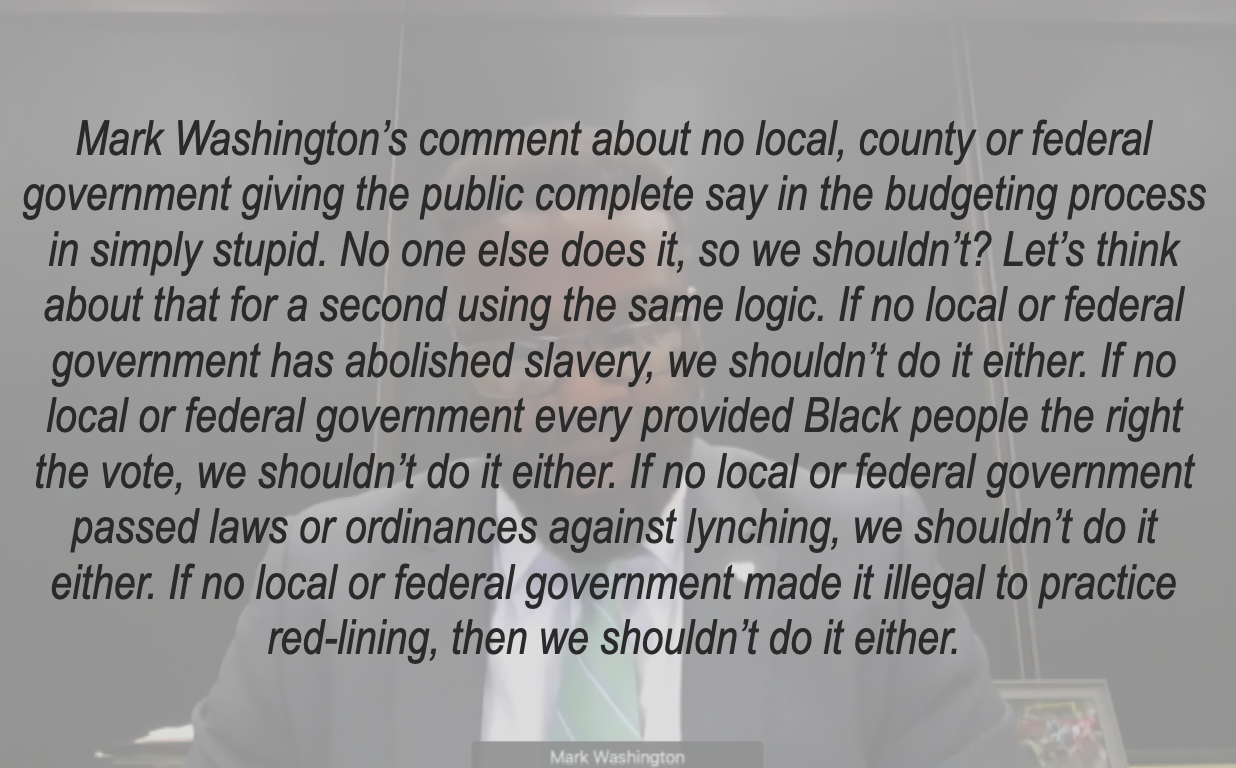
Third, the MLive article then gave the most space to City Manager Mark Washington. Washington, who is appointed by the City Commission and not elected, stated that the examples of cities that are using participatory budgeting, “only allocate a small fraction of their budgets for residents to directly say where the money goes.” While this may be true in some cases, it is not so in all cases, as one can read on the Participatory Budgeting Project page. Such dismissive comments from Washington miss the main point, which is the fact that there are cities all across the country and all across the world where the public has a say in how they want municipalities to spent public money.
Washington is then quoted at length, saying:
“There is no city, mid-size urban city that turns over the entire budget from which there are bond requirements, there are debt obligations, contractual obligations for the entire — there’s no government that, the state doesn’t do it, the county doesn’t do it, the federal government surely doesn’t do it,” Washington said. “But there are ways to engage community members in the budgeting process and I think this budget has done that prior to the post-budget adoption process and we are even willing to do it even more (after the budget is adopted).”
First, when Washington claims the city has engaged the community in this budgeting process without providing clear examples of how that has happened is bullshit. The MLive writer should have questioned him or at least verified such a claim.
Secondly, Washington’s comment about no local, county or federal government giving the public complete say in the budgeting process in simply stupid. No one else does it, so we shouldn’t? Let’s think about that for a second using the same logic. If no local or federal government has abolished slavery, we shouldn’t do it either. If no local or federal government every provided Black people the right the vote, we shouldn’t do it either. If no local or federal government passed laws or ordinances against lynching, we shouldn’t do it either. If no local or federal government made it illegal to practice red-lining, then we shouldn’t do it either…….hopefully, you get the point.
Ultimately, what Mark Washington is saying is that the public is incapable of having an informed say in the “complexities” of the City Budget. Washington and the rest of the City Officials have made it clear that they do not believe in participatory democracy and that lots of people in this community – which is code for Black, Brown and poor – do not know what is best for themselves. Fortunately, many social justice movements in this community, specifically Defund the GRPD, fully believe in the value of letting people, particularly people most affected by police harm, have a say in how money should be spent in this community.
- Get educated. See the list of books, films and online sources below. It is especially critical that we understand the history of US support for Israel, if we want to understand the Palestinian struggle.
- Make sure you center the voices and lived experiences of Palestinians who live in West Michigan. Contact the Arab American Association of West Michigan.
- Protest US Aid to Israel. Do actions at Senator Peters and Senator Stabenow’s offices, since both of them have consistently support Israel. Senator Peters is a major recipient of Pro-Israel PAC money.
- Participated in the International Boycott, Divestment, Sanctions (BDS) Campaign, which is one of the most effective ways to be in solidarity with Palestinians. https://bdsmovement.net/
- In Grand Rapids, target groups like the Right Place Inc, which has lobbied to bring Israeli companies to West Michigan. https://griid.org/2016/04/06/israeli-apartheid-week-targets-the-right-place-inc-in-grand-rapids/
- Understand and Confront Christian Zionism, which is rampant in West Michigan.
Books
Boycott, Divestment, Sanctions: The Global Struggle for Palestinian Rights, by Omar Barghouti
Except for Palestine: The Limits of Progressive Politics, by Marc Lamont Hill and Mitchell Plitnick
Hundred Years’ War on Palestine, Rashid Khalidi
The Ethnic Cleansing of Palestine, by Ilan Pappe
Popular Resistance in Palestine: A History of Hope and Empowerment, by Mazin Qumsiyeh
The Battle for Justice in Palestine, by Ali Abunimah
On Palestine, Noam Chomsky and Ilan Pappe
Against Apartheid: The Case for Boycotting Israeli Universities, Edited by Ashley Dawson and Bill Mullen
Inter/Nationalism: Decolonizing Native America and Palestine, by Steven Salaita
Ten Myths About Israel, by Ilan Pappe
Apartheid Israel: The Politics of an Analogy, by Jon Soske and Sean Jacobs
Israel Lobby and U.S. Foreign Policy, by John Mearsheimer and Stephen Walt
Fateful Triangle: The United States, Israel, and the Palestinians, by Noam Chomsky
Films
Occupation 101
The Occupation of the American Mind: Israel’s Public Relations War in the United States
Peace, Propaganda and the Promised Land: US Media and the Israeli-Palestinian Conflict
Al-Nakba: The Palestinian Catastrophe 1948
Waiting for Armageddon
With God on Our Side
Online Resources
https://electronicintifada.net/
Home
Home

On Thursday, MLive reported that a group of Republican lawmakers in Michigan had presented their police funding plan, which would include $80 million for recruiting and training.
The article cites House Speaker Jason Wentworth and his fellow Republican, Rep. Mike Mueller. While the MLive article mentions some of what the proposed $80 million would go towards, they leave out a whole list of items, such as:
- Tuition assistance for people considering the police academy
- A work study program to give people an opportunity to consider a career
- Incentives for community policing
- Incentives for expanded use of body cameras
- Incentives for de-escalation training
- Access to mental health services for police, corrections workers and other first responders
- A signing bonus for new officers
- State support for secondary road patrols
- State support for recruiting strong candidates into the academies
All of these items listed are meant to convey the message that police are valued and that the government can provide incentives to provide more resources to the police. The financial incentives are offensive, since taxpayers already pay the salaries of police departments across the state.
Then there is the matter of body cameras, while are generally seen as a form of accountability. However, there is plenty of evidence that body cams do not lead to more accountability and they are often a distraction in the much larger issue of what the real function of policing is in the US.
Incentives for community policing is just a a form of branding to suggest that cops will be more integrated into the community, when in fact, as police historian Kristian Williams has documented, community policing is another form of surveillance and tool of counter-insurgency. (See the book, Life During Wartime: Resisting Counterinsurgency)
Lastly, the notion that cops don’t have enough training is just plain not based in fact. Alex Vitale, author of the book, The End of Policing, documents that regardless of the type of training, whether it is racial sensitivity or de-escalation, it has no positive impact on how policing is done throughout the country.
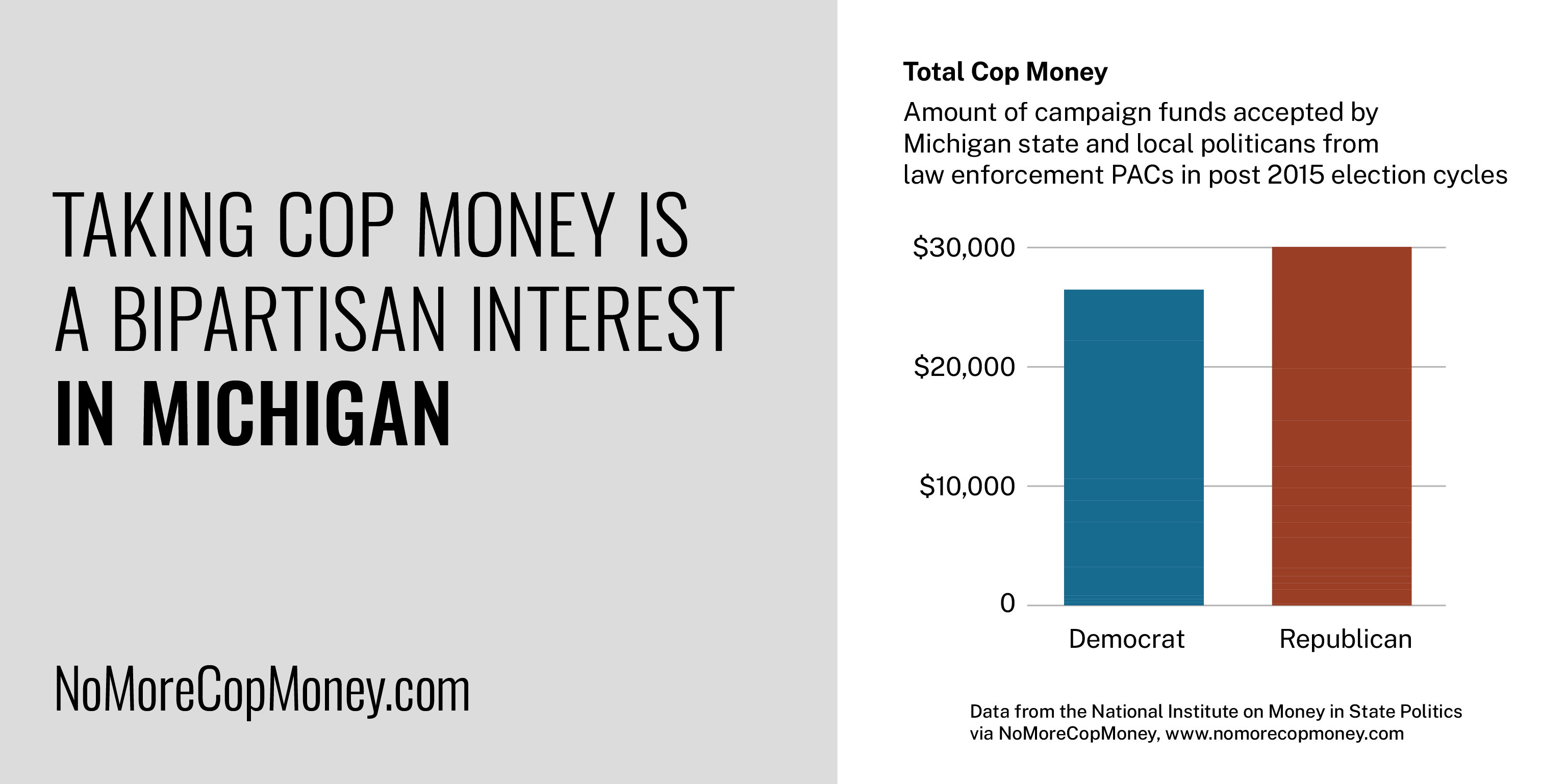
The MLive article also does not tell us that the GOP legislators cited in the article have both received funding from various policing unions in Michigan, with Wentworth receiving $1,250 and Mueller receiving $800, according to the site No More Cop Money.
MLive also wrote:
House Democrats were critical of the plan, noting their caucus’ proposed budget amendments incorporating similar proposals were voted down by House Republicans this week.
However, the MLive article fails to mention that the Michigan Democrat who was arguing about their police funding plan, Rep. Donna Lasinski, has also been the recipient of police union funding, to the tune of $1,500. In fact, No More Cop Money makes it clear that police unions fund both Republicans and Democrats in Michigan. This is just one of the reasons why the Defund the Police movement does not trust that elected officials will easily respond to their demands, especially since they are taking money from police unions and crafting police policy simultaneously.
Last week, water protectors showed up in Lansing and in Mackinaw City to send a strong message to the Enbridge Corporation, that they are now illegally operating Line 5 in Michigan.
In fact, as we reported on May 4th:
Water Protectors, Tribal Citizens and Grassroot Organizations are mobilizing to demonstrate support for Governor Whitmer and DNR Director Eichinger’s termination of the 1953 easement permit. Great Lakes Water Protector’s would like to invite the ALL Sovereign Tribes of the Great Lakes region and ALL State Officials from the Executive Office, Governor’s Office, EGLE, State and Federal Congressional and Senate Delegations. Tell the citizens of this State how OUR REPRESENTATIVES plan to proceed with Enbridge’s unwillingness to uphold the decision of the State.
This resistance to the Enbridge Corporation, which is a fossil fuel fascist, has been growing, with Climate Justice movements, particularly indigenous people leading the way. During the Eviction Party last week in Mackinaw City, there were also Water Protectors who came from Minnesota, people who have been fighting the Enbridge Line 3. Long-time organizer, author and Water Protector, Winona LaDuke, who is one of the main organizers against Line 3, spoke at the Eviction Party, which you can watch here.
Despite all of the growing resistance to Enbridge’s Line 5, on May 12th, the Michigan Senate passed an amendment to Senate Bill 90, which would:
require the state to pay the legal fees of the Line 5 gas pipeline company after Gov. Whitmer revoked the 1953 easement that authorizes its pipeline to cross Mackinac Straits bottomlands, if the company prevails in a lawsuit against the taking.
The amendment to pay legal fees to Enbridge passed 20 – 16, completely on partisan lines, with 20 Republicans voting for the amendment and 16 Democrats voting against it. The amendment was proposed by Sen. Ed McBroom, who represents Michigan’s Upper Peninsula. On May 11th, Sen. McBroom joined other members of the GOP on the lawn of the State Capitol for some public theater, claiming that shutting down Line 5 would take away jobs, as can be seen in the video here.
McBroom and other Republican Senators standing on the State Capitol lawn, claiming to care about workers, is both laughable and absurd, considering how often Michigan Republicans attack unions, oppose an increase in minimum wages, and support massive tax breaks to businesses.
What McBroom and his fellow Republicans are doing with this amendment is to use taxpayer money to pay Enbridge’s legal fees while the fossil fuel giant has made billions in profits and constantly threatens the Great Lakes and all of the adjacent water systems.

 Grand Rapids Institute for Information Democracy