 According to a report by the Williams Institute:
Conversion therapy, also known as sexual orientation or gender identity change efforts, is a practice grounded in the belief that being LGBT is abnormal. It is intended to change the sexual orientation, gender identity, or gender expression of LGBT people.1 Conversion therapy is practiced by some licensed professionals in the context of providing health care and by some clergy or other spiritual advisors in the context of religious practice.2 Efforts to change someone’s sexual orientation or gender identity are associated with poor mental health,3 including suicidality. As of June 2019, 18 states, the District of Columbia, and a number of localities have banned health care professionals from using conversion therapy on youth.
That same report, published in 2019, also states, “698,000 LGBT adults (ages 18-59)5 in the U.S. have received conversion therapy, including about 350,000 LGBT adults who were subjected to the practice as adolescents.”
According to the Grand Rapids LGBTQ+Healthcare Consortium, Twenty states have banned this discredited and harmful practice, Michigan is not one of them. There are 7 municipalities that have banned conversion therapy in Michigan, Grand Rapids needs to be the 8th.
The Campaign in Grand Rapids began just recently, and they are asking people to sign a petition demanding that the City of Grand Rapids not allow this kind of hateful and harmful practice to continue in this community.
You can sign the petition at this link https://banconversiontherapymi.com/.
Much of this practice of “conversation therapy” comes out of the Christian Community, with the belief that anyone identifying as LGBTQ+ has been mislead and therefore needs to go through a process of converting themselves back to “hetero-normativity.” We are unaware of specific licensed health care providers that might be engaging in the practice of “conversion therapy,” but there was a story last November on Fox 17 about a Christian Pastor in Muskegon who advocates for the harmful practice.
On the Grand Rapids LGBTQ+Healthcare Consortium petition page, you can see a list of organizations and individuals which endorse the campaign. This list needs to grow exponentially, so talk to organizations you are part of and get them to endorse the campaign. You can also share the petition through social media to encourage others to sign and to share.
What if taxes from cannabis sales were used as reparations for the War on Drugs in Grand Rapids?
 “After 40 years of impoverished black men getting prison time for selling weed, white men are planning to get rich doing the same things. So that’s why I think we have to start talking about reparations for the war on drugs. How do we repair the harms caused? You can’t just destroy a people and say, ‘It’s over, we’re stopping now.’”
The above comment is from Michelle Alexander, author of the book, The New Jim Crow: Mass Incarceration in the Age of Colorblindness. Alexander made this comment years ago, before many states, like Michigan, legalized the sale of cannabis. Her observations, in my opinion, are spot on, both in terms of the primary beneficiaries of those who dominate the cannabis industry (White people), as well as her main point about the need to pay reparations for those most affected by the War on Drugs.
On Saturday, MLive posted an article entitled, ‘It’s huge:’ One Kent County government’s cut from marijuana tax about 9% of general fund.
The MLive article provides some concrete numbers in terms of tax dollars that several local government entities have made because they have allowed cannabis businesses to set up shop in their communities. The MLive article goes on to say:
With Grand Rapids’ first recreational dispensary having opened October 2020, this is the first year the city saw a share of the funds.
The city will receive about $677,000 for the 12 marijuana retailers in operation during the collection period, according to the state treasury.
“This is good news and exceeds expectations that were incorporated into our current fiscal plan,” city spokesperson Steve Guitar said.
Guitar said the city can’t share any of the potential uses of the marijuana dollars at this time, as City Manager Mark Washington is still working them into the upcoming 2022-2023 preliminary budget plan.
That plan will be introduced April 26 to the city commission.
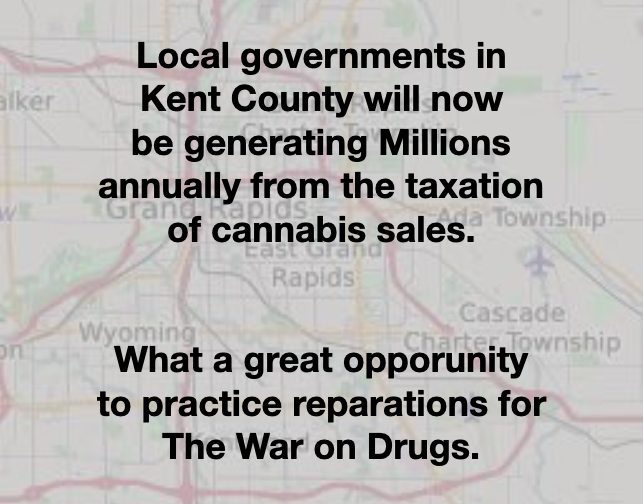
The fact that local governments are now seeing an economic windfall from the taxation of cannabis sales was predicted, since there have been several years of examples from other states and communities doing the same thing. While there is no clear information from the MLive article about what the City of Grand Rapids will do with the tax money from cannabis sales, it seems that it will be woven into the annual budget.
The MLive article states that the City of Lowell will receive about $282,000, the City Grand Rapids will make $677,000, and Kent County will receive $1.07 million. Between just these three governmental bodies, the total amount of money the will collectively be receiving from the taxation of cannabis is $2,029,000.
Now, if we are to take seriously Michelle Alexander’s admonition to pay reparations, which we should, the governments of Grand Rapids, Lowell and Kent County have an opportunity to financially compensate those most affected by the War on Drugs.
For the disproportionately high number of Black and Latinx people who have gone to jail or prison on marijuana charges, the cost has been significant. Here is a list of just a few consequences of that cost:
- The separation of families, in some cases for years. What is the cost of having a loved one separated from their children, spouses, parents and siblings?
- In the case of income earners who went to jail/prison, how much did that impact families which no longer could count on that income?
- The psychological and emotional cost to the individuals imprisoned and their families.
- The fracturing of those neighborhoods and communities, which were impacted by the War on Drugs.
- The missed opportunities for education, employment and other contributions to their communities, because they were incarcerated during the War on Drugs.
You cannot put a price tag on the cost of the War on Drugs for Black and Latinx individuals, families and communities. However, since we live in a society that is driven by the profit motive, why not begin undoing some of the historical harm done from the War on Drugs, and give that money to the individuals, families and communities most impacted.
From the the three governmental entities cited above, we are talking about a little more than $2 million for one year of taxing the sale of cannabis. $2 million dollars wouldn’t go very far, but what if that kind of money were to be used for reparations for the War on Drugs in perpetuity?
Grand Rapids and Kent County always like to talk about equity. Well, here is an opportunity to not only practice equity, by providing concrete forms of reparations to Black and Latinx communities who have been impacted by the War on Drugs. Exactly how this would work, I can’t say. However, Alexander said we need to “start talking about reparations for the war on drugs.” What if there were meetings held in those communities most impacted from the War on Drugs, with the full knowledge that there will be annual funds coming from the sale of cannabis. Let those communities decide what to do with that money. It doesn’t begin to undo the harm from the War on Drugs, but it would be a good start.
DeVos family has contributed nearly half a million to DeSantis, making them complicit in the Don’t Say Gay bill
Earlier this week, Florida Gov. Ron DeSantis signed into law what is referred to as the “Don’t Say Gay Bill.”
The bill bans classroom instruction on sexual orientation or gender identity in kindergarten through third grade and states that any instruction on those topics cannot occur “in a manner that is not age-appropriate or developmentally appropriate for students in accordance with state standards, according to the legislation HB 1557.
The bill signed into law by DeSantis, has mobilized people in Florida, particularly students, many of which have engaged in protests, such as the one that took place at Western High School on March 11th.
In addition, many LGBTQ groups across the country are concerned that other states might also begin the process of introducing this kind of legislation.
West Michigan Connection
As is the case throughout the US, there are numerous anti-LGBTQ organizations, along with a substantial number of Evangelical Christians that also oppose any civil rights or even the acceptance of those who identify as LGBTQ.
In Florida, one anti-LGBTQ entity is Dr. James Kennedy Ministries, formerly known as Truth in Action and Coral Ridge Presbyterian Church. Kennedy has been dead since 2007, but he has been one of the most anti-LGBTQ pastors for decades. Kennedy had organized a national conference for the religious rights for years called, “Reclaiming America for Christ.”
One newsletter from D. James Kennedy’s Coral Ridge Ministries featured a photograph of very young children under the headline “SEX WITH CHILDREN? HOMOSEXUALS SAY YES!” The newsletter asserts “Adult sex with children has been a crucial component of the homosexual movement all along, and officially since the 1993 March on Washington when it was included as a demand (#55) in their famous manifesto.”
Over the years, Kennedy emphasized anti-gay rhetoric, particularly in his TV ministry. He recommended as “essential” the virulent work of R.J. Rushdoony, who believed practicing gays should be executed.
Considering the strong religious right presence in West Michigan, it should come as no surprise that people like Richard DeVos have been a major donors to anti-LGBTQ groups in Florida.
In 2008, the DeVos family was the largest contributor ($100,000) to the Florida4Marriage group, which put Amendment 2 on the ballot calling for marriage between only a man and a woman. The Amendment passed in 2008 and outlawed same sex marriages in Florida until that decision was overturned by the US Supreme Court decision last year.
In addition, the DeVos family owns the Orlando Magic basketball team, which has allowed the arena to be used for Evangelical Christian Faith Nights. These Christian rallies have also provide a platform for anti-LGBTQ organizing in Orlando. (See Bad Sports, by Dave Zirin)
Then there is the history of DeVos family members contributing to the political campaigns of Ron DeSantis, both while he was a member of Congress and now as Governor of Florida.
DeSantis first ran for the Governor’s seat in 2018 and is currently raising money for re-election in 2022. Here is a list of DeVos family member contributions during both of those election cycles, with the likelihood of more contributions before the November Election.
2018
Daniel DeVos – $53,000
Doug DeVos – $53,000
Cheri DeVos – $53,000
Dick DeVos – $53,000
2022
Dick DeVos – $76,159.38
Daniel DeVos – $51,159.38
Doug DeVos – $51,159.37
Cheri DeVos – $51,159.37
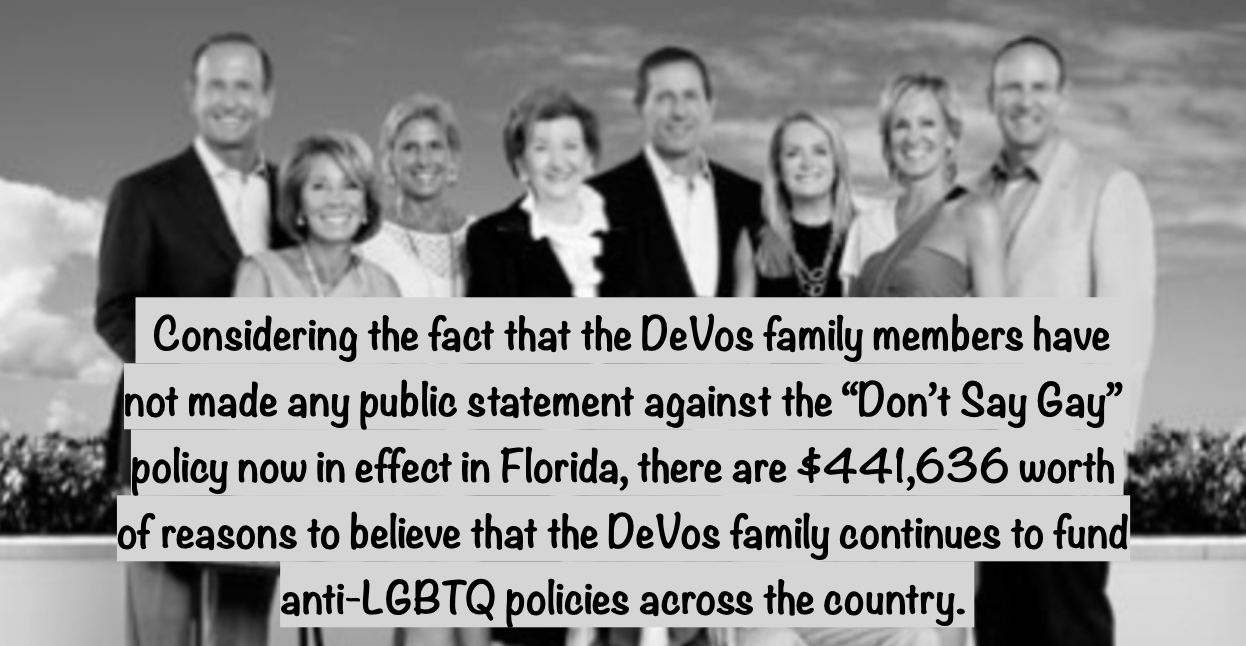
This means that the DeVos family has contributed a total of $441,636 to Gov. Ron DeSantis.
Now, there are many people in the Grand Rapids area that believe that since Richard and Helen DeVos have both died, their children do not embrace the same anti-LGBTQ ideology as their parents. Considering that the second generation of the DeVos dynasty has contributed nearly a half a million dollars to DeSantis, who recently signed an anti-LGBTQ bill, the DeVos family cannot claim to be distancing themselves from their parents hateful anti-LGBTQ ideology. In addition, the DeVos family members have not made any public statement against the “Don’t Say Gay” policy now in effect in Florida, thus it seems there are $441,636 worth of reasons to believe that the DeVos family continues to fund anti-LGBTQ policies across the country.
At Tuesday Grand Rapids City Commission Committee of the Whole session, city officials unanimously approved the next phase in the process to make the 12,000 seat amphitheater a reality.
The presentation by the the Assistant City Manager used lots of slides and lots of progressive language, but it failed to address who was really driving this whole money making scheme – often referred to as development – from the very beginning. You can watch the video, where the discussion about the Amphitheater project begins at 2 hours and 15 minutes in.
The amphitheater project, along with other money making interests, was a project that came from Grand Action 2.0. You remember, the private entity that came up with the idea of building the downtown arena and the downtown market. Grand Action 2.0 is currently being led by Dick DeVos, Tom Welch and Carol Van Andel, along with a bunch of other power brokers that make up the Executive and Advisory Committee.
We first reported on the latest money making scheme from Grand Action 2.0 back in October of 2020, with a headline that read, With thousands of families struggling with the pandemic economy in Grand Rapids, Grand Action is proposing a downtown Amphitheater.
 We followed up on the initial article and wrote a second piece in November of 2020, focusing on how much public money would be used and how this same kind of public funding for a single project doesn’t happen in neighborhoods with a majority Black and Brown residents.
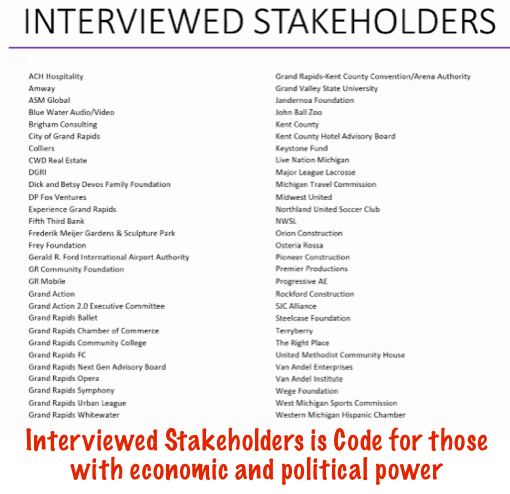
In late November of 2020, Grand Action 2.0 brought in a speaker and consultant to talk about the amphitheater project and other riverfront money making plans as well. One thing that was discussed was the importance of talking with stakeholders. Stakeholders is often code for those who have power and privilege, as is evidenced by the majority of those who were invited to give input in the graphic here.
The next GRIID article on the amphitheater project was published in February of 2021, where we talked a bit about some of the land being used for this project was owned by the 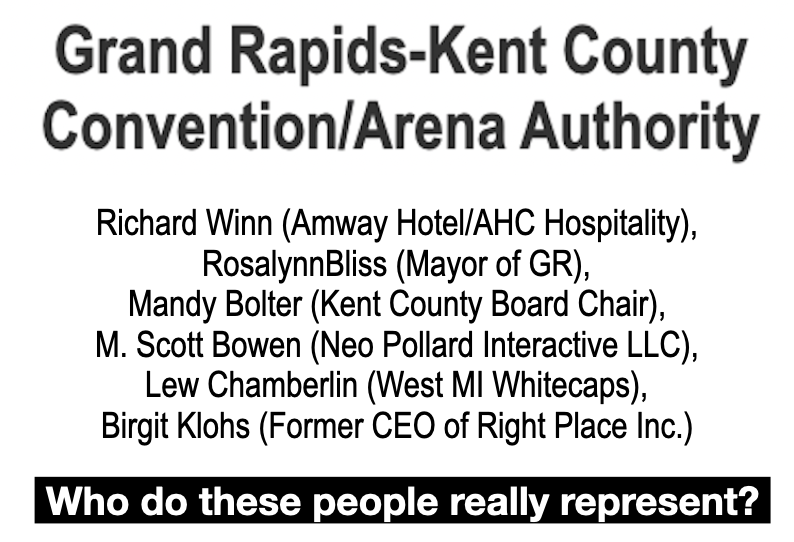 DeVos family. In addition, we discussed how the Convention Arena Authority (CAA) was run by people who are connected to the Grand Rapids Power Structure or represent other corporate interests.
Then in June of 2021, we posted another article looking at an updated cost of public money for the amphitheater project and wondered how the city could continue to justify this kind of public money that will benefit those who are already disgustingly rich during a time that the pandemic was raging thousands of people were potentially facing eviction in Grand Rapids.
We think it is important to refer to the past articles we have posted, especially since the local commercial news media has not asked these kinds of questions, not challenged who are the player pushing for these money making schemes along the riverfront.
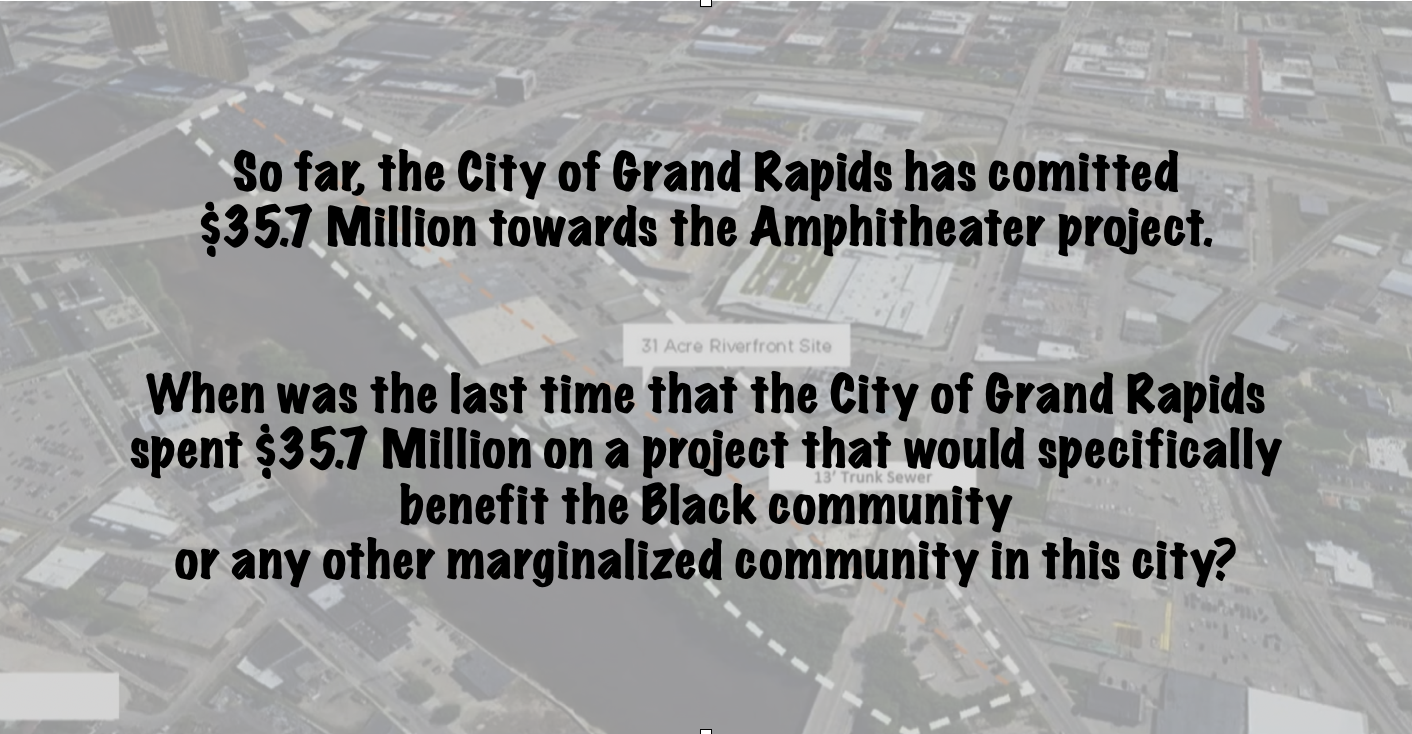
Beyond the fact that this project was driven by Grand Action 2.0, a second point to discuss the the amount of public money being used in the process with limited public input. After the announcement of the riverfront money making project, the City agreed to pay $6,252,643 for the sewage system upgrade/relocation along Market Ave. The City then agreed to spend $2 million to convert Market Ave. into a downtown street. Then there was the $7.45 Million the City agreed to pay for the relocation of the Kent County Road Commission site. Lastly, the Grand Rapids Downtown Development Authority or the Grand Rapids Brownfield Authority would borrow $20 million to finance the project. All together, that means the City, which includes the DDA, would spend roughly $35.7 Million of public money, with little public input.
A third point to make here, is to ask the question, when was the last time that the City of Grand Rapids spent $35.7 Million on a project that would specifically benefit the Black community or any other marginalized community in this city? In fact, we could expand this question to include the amount of money that is estimate to be spent on the larger 31 acre riverfront development (includes the amphitheater), which is $500 Million. When was the last time the City of Grand Rapids spent $500 Million to benefit the BIPOC community in this city?
Fourth, during the Committee of the Whole meeting, there was a great deal of discussion and affirmations around the fact that, 1) there would be between 1500 – 1700 new housing units included in the riverfront development project (including affordable housing), and 2) that there would likely be a built in mechanism to funnel some of the profits from this project into the City’s Affordable Housing Fund. I’m glad that they are thinking about affordable housing, but they are missing the point here. When construction companies decide to build “affordable housing,” they always apply for state funds (meaning public funds) to subsidize their total costs. This is great for construction companies and private developers, but the problem with affordable housing is not just the construction costs, it is the fact that there are thousands of people living in this city that do not make a livable wage. The real solution is to make sure everyone has a livable wage, since even the affordable housing is a lot more expensive that many can afford.
This brings us back to the primary beneficiaries of this project, those connected to Grand Action 2.0 and the other members of the Grand Rapids Power Structure. Since they are the primary owners of the land/property in the downtown area, they will reap the profits of the amphitheater construction, since it will make Grand Rapids an even more attractive destination city for tourists. (Several City officials made reference to Grand Rapids being a destination city during the discussion on Tuesday.) Grand Action 2.0 Executive Committee members control most of the hotels downtown, many restaurants, bars and non-city controlled parking. This is why these people push these kinds of projects, because they will be the primary beneficiaries in the long run. Plus, these are the same people who spent millions on electing candidates at the city, county, state and federal level, politicians that vote for public policies to benefit the billionaire class, the military industrial complex, the prison industrial complex, give a pass to corporate polluters, attack unions, promote systemic racism and harm the LGBTQ community.
Now, several City officials did say that will have inclusive and equitable plans in the larger riverfront development moving forward, which means they want to give contracts to as many minorities companies as possible. I certainly wouldn’t discourage this, but the fact is that most BIPOC people are not business owners, they are workers. The City can use all of the equity and inclusion language they want, but it will not impact most BIPOC or white working class people.
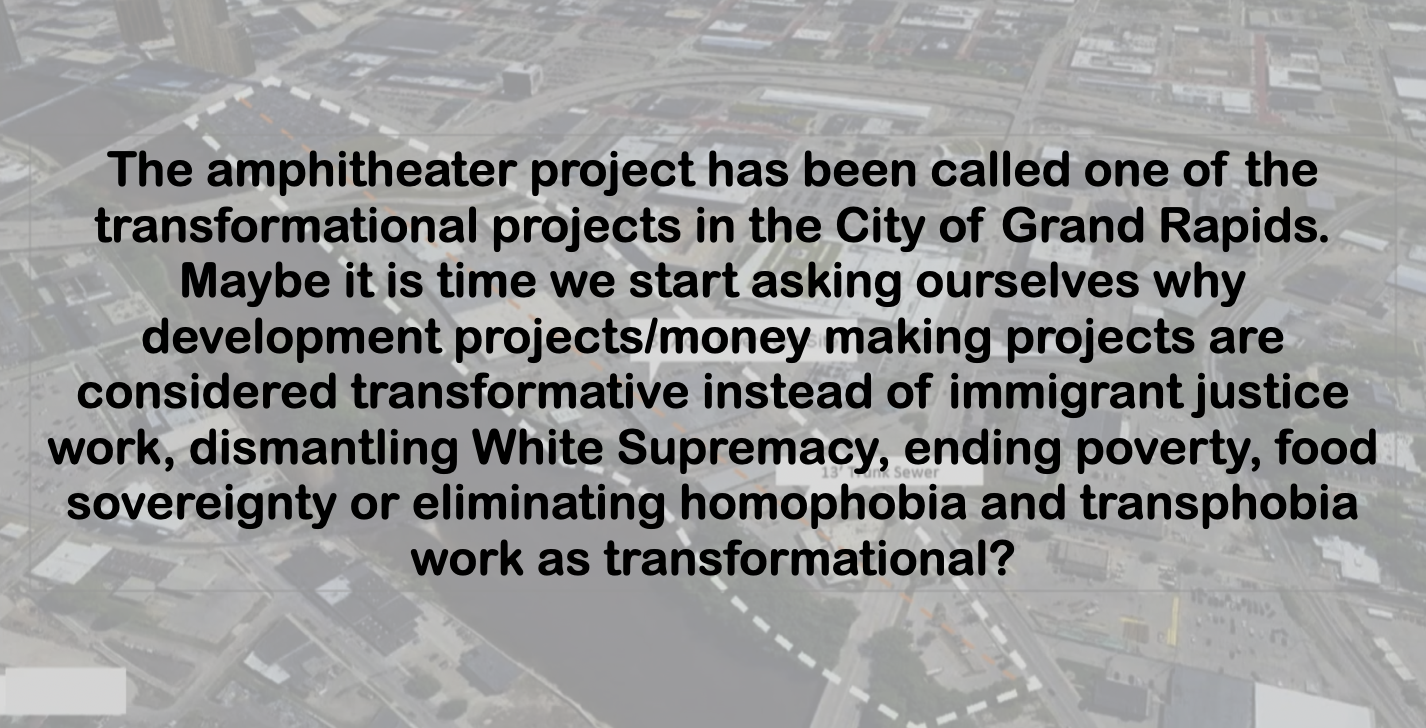
Lastly, the amphitheater project has been called one of the transformational projects in the City of Grand Rapids. Maybe it is time we start asking ourselves why development projects/money making projects are considered transformative instead of immigrant justice work, dismantling White Supremacy, ending poverty, food sovereignty or smashing homophobia and transphobia work as transformational? There is nothing transformational about projects that primarily benefit those who already have the most economic and political pow in this city.
A Brief history of Women-led Movements in Grand Rapids: Part III – The Women’s Action Network
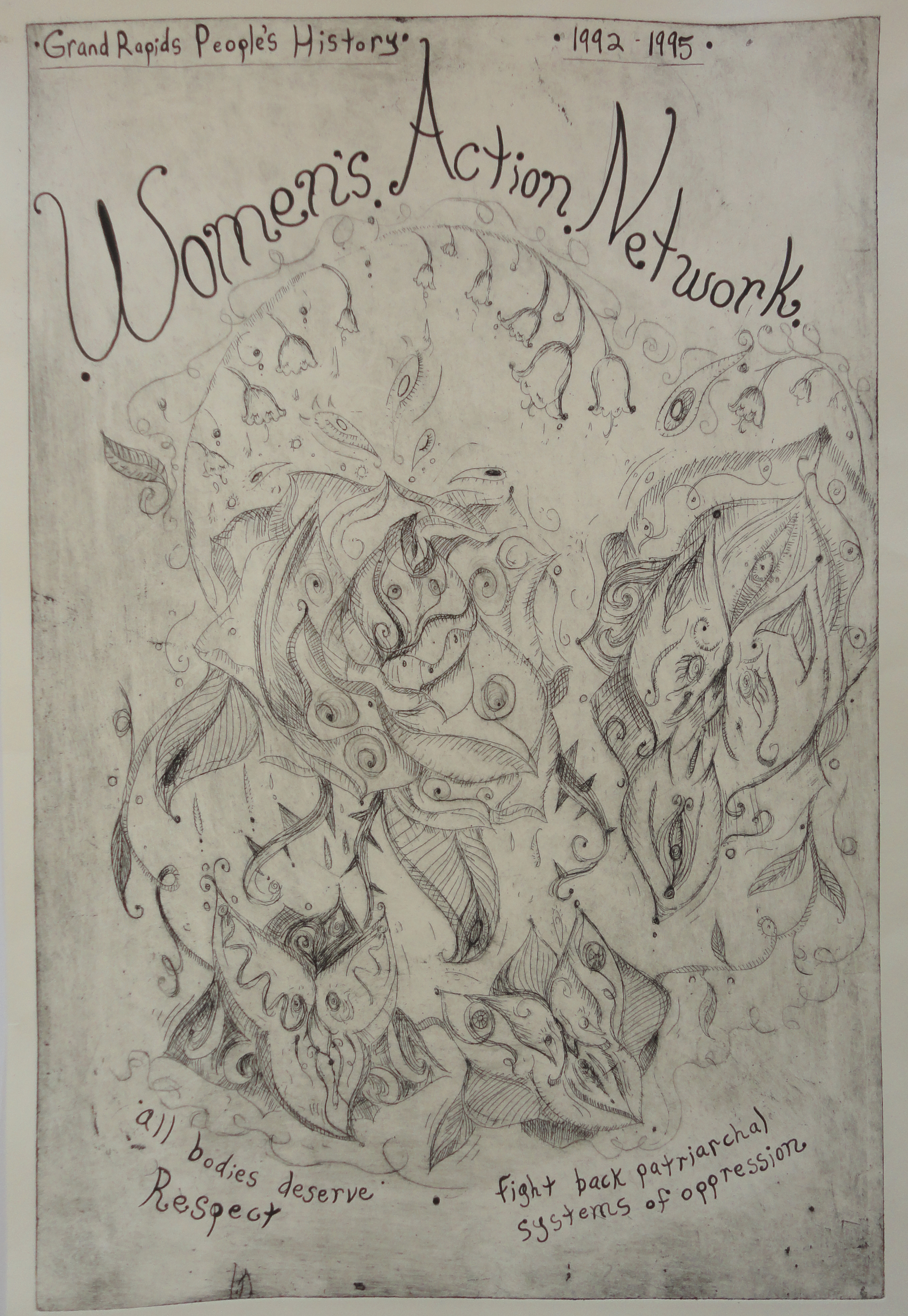 This is the third post in this series, taking a look at the history of women-led social movements in Grand Rapids. In Part I, we looked at the Women’s Suffrage Movement, and in Part II, we discuss the Reproductive Justice Movement. In today’s post, we want to look at the 1990s grassroots group the Womyn’s Action Network.
In recent years there has been a variety of activities and actions around the rallying cry of fighting “The War on Women.”
The cause for this effort has primarily been the recent national and state efforts to diminish legal protects for women around reproductive rights and rape. The organizing has mostly been inside the electoral framework of fighting legislation and supporting or opposing political candidates. While electoral politics is one strategic approach to fighting for women’s rights, it is certainly not the only one.
In the early 1990s, four Grand Rapids women, Karen Henry, Sister Jackie Hudson, Marge Kuipers and Sue Ablao, created the Womyn’s Action Network (WAN). WAN’s stated purpose from the organizational brochure was, “The Womyn’s Action Network works to eliminate violence against women and oppression of women through self-empowerment and the resurrection of womyn’s voices.”
WAN came together in 1992 and began their feminist work with a satirical event that took on media representation of women. The First Annual Media Bash was an awards ceremony, where those in attendance would look at misogynistic and empowering images of women and then give out what they called Dick and Jane awards. The Dick awards were given out to the ads that “are the most degrading, demeaning and disgusting,” while the Jane awards were given to “those ads that portray us in the most positive and affirming ways.” Marge Kuipers had this to say about the Media Bash:
Especially memorable was WAN’s “Dick & Jane Awards” which took place at the temporary UICA building on Monroe Avenue. The room was packed with an enthusiastic assembly of women (along with a few men) who hooted, hollered, and hissed at the images that were projected on the screen of the advertising industry’s exploitation of women. The “Dick Award” was presented to the ad the audience considered to be the “worst of the worst.”
Karen Henry, one of the group’s founders and an Arab-American woman, understood the importance of critically looking at representation in the media. Organizing the Media Bash was an excellent way to look at gender representation in media, specifically because of how the representation of women and girls often normalized their objectification.
In addition to the Media Bash, WAN organized or participated in Take Back the Night marches, challenged sexist local radio billboards (WKLQ), spoke on campuses, facilitated forums and created a Women Now Forever Scholarship. The scholarship was for women attending or wanting to attend college and gave preference to women of color and Lesbian or Bisexual women.
 WAN was deeply committed to confronting sexual assault. In the early 1990s, they co-sponsored a talk by the feminist author Kay Leigh Hagan, who had just come out with a book entitled, Fugitive Information: Essays from a Feminist Hothead. During Hagan’s talk, she addressed how the Take Back the Night Movement was created by women who had experienced sexual assault and rape. In the early years of the Take Back the Night marches, they were designed to be public, to raise a ruckus, and often times the marches would go through parts of the community where sexual assault was committed or in the neighborhoods of known perpetrators. Hagan made the point that these marches had become less radical, turning in to candlelight vigils, instead of a public denunciation of violence against women.
In addition to the Take Back the Night actions that WAN was involved in, they also sponsored the Clothesline Project. The Clothesline Project was designed to be a mechanism for sexual assault survivors to tell their story, by painting on a t-shirt, with images or words. These shirts would be displayed on a clothesline to provide an opportunity to inform the public and to allow friends, family and community members the chance to honored the lived-experience of those who have been sexually assaulted. One year, the Clothesline Project was displayed at 10 Weston, an art space that was run by Nancy Lautenbach.
The Womyn’s Action Network also understood how social justice issues intersected and participated in the annual Pride event in Grand Rapids, World AIDS Day, anti-war activities and community wide anti-violence campaigns.
The organization’s literature states that it was committed to looking at issues through a race/class/gender lens; challenging corporate defined beauty; fighting femicide, rape, battering and harassment; and looking at women’s health issues, like breast cancer, menopause and menstruation.
WAN only survived for three years (1992 – 1995), but accomplished an amazing amount of work in that brief time and inspired many women in Grand Rapids to find their voices and fight back against patriarchal systems of oppression.
(Editor’s note: These articles will be part of a chapter in the forthcoming book, A People’s History of Grand Rapids.)
 On March 17, Tori Sachs, the Executive Director of the Michigan Freedom Fund, wrote an opinion piece that appeared in the Detroit News, entitled, Whitmer’s talk is cheap, but gas has never been more expensive.
The Michigan Freedom Fund is a GOP front group, with a sole purpose of attacking the Democratic Party in Michigan. The Michigan Freedom Fund used to be run by the long-time DeVos operative Greg McNeily. Tori Sachs has only been with the Michigan Freedom fund for the past, although she has been a Republican operative for some time now.
Sachs previously served as the executive director of Michigan Rising Action. Michigan Rising Action’s mission statement is as follows:
Michigan Rising Action is focused on holding liberal groups and their special interest networks accountable and advancing conservative principles. We’re fighting for limited government, lowering taxes, fighting government over-regulation that stifles freedom, free enterprise, strong national security, and shaping the public policy debate in Michigan. We hold liberal groups and their special interest networks accountable, fact-checking left-wing politicians whose policies would push the state in the wrong direction, and ensuring citizens have the most accurate, up-to-date information to drive a balanced policy conversation.
In addition to Sachs’ work with Michigan Rising Action, she got some attention because of her work with Better Future Michigan, a Political Action Committee that spent millions in the 2020 Election to purchase ad time to attack Senator Gary Peters, in his race against GOP candidate John James. According to the Center for Responsive Politics, during the 2019-2020 election cycle, Better Future Michigan spent a little over $11 million in political ads attacking Democrats and only $465,000 on ads promoting Republicans.
As is evidenced by her work with these two GOP front groups, you can see why the Michigan Freedom Fund would hire her to continue attacking the Democrats, often with cheap shots or unsubstantiated claims.
This brings us to the opinion piece that that the Michigan Freedom Fund’s ED, Tori Sachs, wrote for the Detroit News. Sachs would have us believe that gas prices in Michigan are the fault of Gov. Whitmer, both because of her tax policy and because of her support of the lawsuit put forth by Attorney General Nessel against the Enbridge Line 5.
Gov. Whitmer’s veto of the GOP proposed tax bill is a weak argument, especially since it would not have primarily benefited low income and other working class families, but it would have benefited the wealthy and the business class in Michigan.
As for the Line 5 argument, there are a whole lot more contradictions. First, while Gov. Whitmer supports the AG lawsuit to shut down the existing Line 5, the Enbridge-owned Line 5 is still in operation and pumping 540,000 barrels of oil per day. If the Governor had effectively shut down Line 5, then maybe that argument might have been reasonable. Secondly, Tori Sachs fails to acknowledge the real reasons that gas prices have gone up, which is primarily about price gauging from big oil. The Russian invasion has nothing to do with it. Third, the Michigan Freedom Fund ED fails to acknowledge the fact that the federal government provides massive subsidies to the oil & gas industry and that both Republican and Democratic politicians received huge campaign contributions over the years, as we pointed out in a recent article. These facts completely demolish the notion that Gov. Whitmer is to blame for current gas prices.
Lastly, the opinion piece by Tori Sachs also cites a study by the Consumer Energy Alliance, which claims, “Michigan families could pay up to $2.2 billion more each year for their gas and diesel” if Line 5 is shut down. Despite seeking to appeal to consumers with its name, the Consumer Energy Alliance is a front group for the energy industry. https://www.sourcewatch.org/index.php?title=Consumer_Energy_Alliance Besides the analysis provided by Source Watch on this group, just look at their Board of Directors and members are represented by, making it clear that they represent the energy industry and financial interest groups.
In the closing paragraph of the opinion piece from the Michigan Freedom Fund ED, it states:
Voters aren’t dumb, motorists aren’t rich, and the state’s gas and energy policy matters. Stop the war against Line 5. Cut the income tax. Give motorists the break they need.
I mostly agree with the first sentence, but second sentence is not only ridiculous, it is misleading.
Ultimately, such commentary from the Michigan Freedom Fund is consist with their whole history, exposing them as partisan hacks, but also shills for systems of power and oppression in Michigan. Shut down Line 5, stop subsidizing Big Oil and stop voting for candidates who take money from the oil & gas industry.
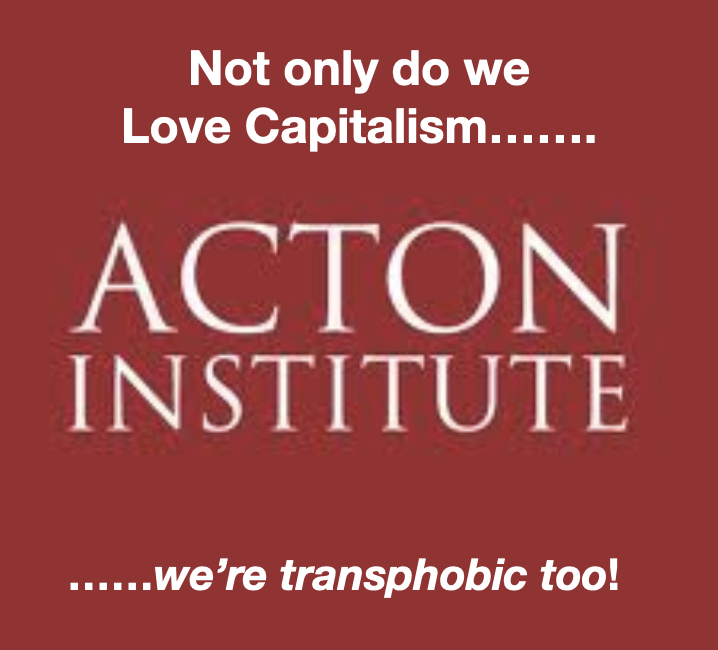 Over the years, GRIID has been monitoring the Grand Rapids-based Far Right Think Tank, known as the Acton Institute for the Study of Religion and Liberty.
The Acton Institute’s main objective is to demonstrate that Capitalism and Christianity are good bedfellows, but they have also written about and invited speakers & writers from other groups that take a hardline stance against the Black Freedom Struggle, Reproductive Justice, Public Education, and LGBTQ issues.
On Monday, March 21st, on the Acton Institute’s podcast known as Acton Unwind, the far right think tank decided to present their views surrounding the so-called controversy involving collegiate swimmer Lia Thomas. The title of the show provides listeners with a clear indication of where the think tank stands on the matter, “Lia Thomas and the nature of the human person.”
The Acton host invited two other Acton writers, Samuel Gregg and Dan Hugger, to discuss what they referred to as a “more high-minded conversation.” The three cis-gendered men spent about 20 minutes using comments like; “We lived in a confused society,” “how do we define what a human being really is,” “the Lia Thomas controversy,” and “Physicality and anthropology.” One of the show’s guest even cited Rene Descartes, “I think therefore I am,” as a means of justifying their position.
The three cis-gendered white men also perpetuated some falsehoods, like what Lia Thomas’s ranking was when they swam on the men’s team and now on the women’s team.
One of the guest on the Acton podcast then said it was hard to have these conversations because people will shut you down. If by shutting you down means, calling people out for being transphobic, then yeah, it is hard to have “these kind of conversations.” If someone was clearly making anti-Semitic statements or anti-Black statements, it is important for them to be called out on it, so why shouldn’t it be any different when people are making anti-trans statements.
In this same argument about it being “hard to have these discussions,” the Acton podcast guest then refers to the book, When Harry became Sally, by Ryan Anderson. The cis-gendered man says the book, “presents a very careful philosophical argument, that is done with sensitivity.” The book referenced is both transphobic and homophobic, and was so offensive that even the online sales behemoth Amazon removed it from their listing of books.
There was one comment that I tended to agree with, coming from one of the podcast participants. The comment was referencing the fact that people who identify as liberal or progressive, who claim to the an ally of the trans community, feel that something doesn’t seem right about trans athletes. Just based on recent social media posts, this seems to be the case, but for this writer it says more about the so-called ally community and how many of us have internalized transphobia.
Like all social justice issues, those of us who carry a great deal of privilege in this society, need to do the work to better understand what is at issue here. It is not the job of the trans community or trans athletes to educate us. We need to do that work ourselves. Here are a few resources that I have found useful in my own education.
https://transgenderlawcenter.org/
https://www.thenation.com/article/society/brittney-griner-lia-thomas/
https://www.outsports.com/trans/2022/1/6/22867761/lia-thomas-penn-swimming-trans-truth-myth
https://www.aclu.org/news/lgbtq-rights/four-myths-about-trans-athletes-debunked/
The Acton Institute’s anti-LGBTQ ideology is not surprising. In 2019, they invited Kate Anderson, who serves as legal counsel for Alliance Defending Freedom, to write an article about why they were defending Catholic Charities of West Michigan in their legal battle to defend their right to deny same sex couples the right to adopt in Michigan. We also reported in that Alliance Defending Freedom was on the Southern Poverty Law Center’s hate map, listing these claims:
- Supported the recriminalization of homosexuality in the U.S. and criminalization abroad
- Defended state-sanctioned sterilization of trans people abroad
- Linked homosexuality to pedophilia
- Claims that a “homosexual agenda” will destroy Christianity and society
No matter how “high minded” the Acton Institute wants to claim they are, the reality is that the have long demonstrated an anti-LGBTQ ideology. This ideology not only does actual harm against the Lesbian, Gay, Bisexual, Trans and Queer community, it is well funded and influences people around the world. Maybe their Acton University event, from June 20 – 24th at the DeVos Convention Center, would be a great opportunity to publicly call them out on their transphobia and other oppressive beliefs.
On Monday, MLive posted a story with the following headline, Meijer donates $1M to Hispanic chambers of commerce. In the first sentence, this donation from Meijer is clarified, saying: “Meijer is donating $1 million to 17 Hispanic chambers of commerce across the Midwest.”
Before we begin discussing the content of this MLive article, it is worth noting that MLive essentially just reposted a version of the Meijer Media Release. Not only is this another example of lazy journalism, it demonstrates a complete lack of inquiry on the part of the MLive reporter. Here are a list of questions that the MLive reporter could have asked, in order to explore the implications of the Meijer donation to various Hispanic Chambers of Commerce.
First, it would be important for the public to have a more robust response to the following statement from the Meijer Corporation, when they said:
“Our Diversity & Inclusion journey focuses not just on our own team members, customers and business partners, but on our communities at large. We look forward to seeing how the Hispanic Chambers use our gift to create intergenerational wealth and opportunity for people in our communities.”
The corporate use of the terms Diversity & Inclusion is intentionally vague, since it doesn’t really mean anything, although it does conjure certain sensibilities. Meijer claims that Diversity & Inclusion is for their team members, customers and business partners. Ok, so let’s inquire as to how true that is in meaningful terms. How many members of the Meijer Corporation are Latino/a, including executive staff, administrative staff, management and employees? Of the several dozen members of the Executive Team, maybe 2 are BIPOC. There is no way to know how many workers are BIPOC, nor of their customers.
The statement from Meijer then says they want to see how the various Hispanic Chambers “create intergenerational wealth.” Here we assume that this means intergenerational wealth of the Hispanic/Latino/a community, since that is the demographic that these Chambers of Commerce serve. In concrete economic terms, if you divide $1 million by 17, that comes out to $58,824. Therefore, each of the 17 Hispanic Chambers of Commerce will have $58,824 to use to create intergenerational wealth. This is not really a large sum of money in the business world, but lets’ assume this money would be used for business startups. If you gave 6 Latino/a members of the community $10,000 each as a start up, that would use up all of the money, which in the big picture, isn’t much. Plus, you have to factor into this dynamic, that not everyone will be successful.
A second question that could be asked would be how much do the Latino/a employees of Meijer make? Most Meijer employees make just above minimum wage in Michigan, which makes it impossible for those individuals and families to create intergenerational wealth.
Third, since Meijer included business partners and the community at large in their list of people to have an opportunity to create intergenerational wealth, a good journalist would inquire if the farms pay workers, most of which are Latino/a, a livable wage? Michigan has one of the largest migrant worker populations in the US, but their wages are low, and are often based on piece-work. Besides wait staff, migrant farm workers are not eligible to receive a guaranteed minimum wage, so farmers and agribusinesses can pay them whatever they want. Again, a good journalist would ask, how does the low wages of migrant workers create intergenerational wealth?
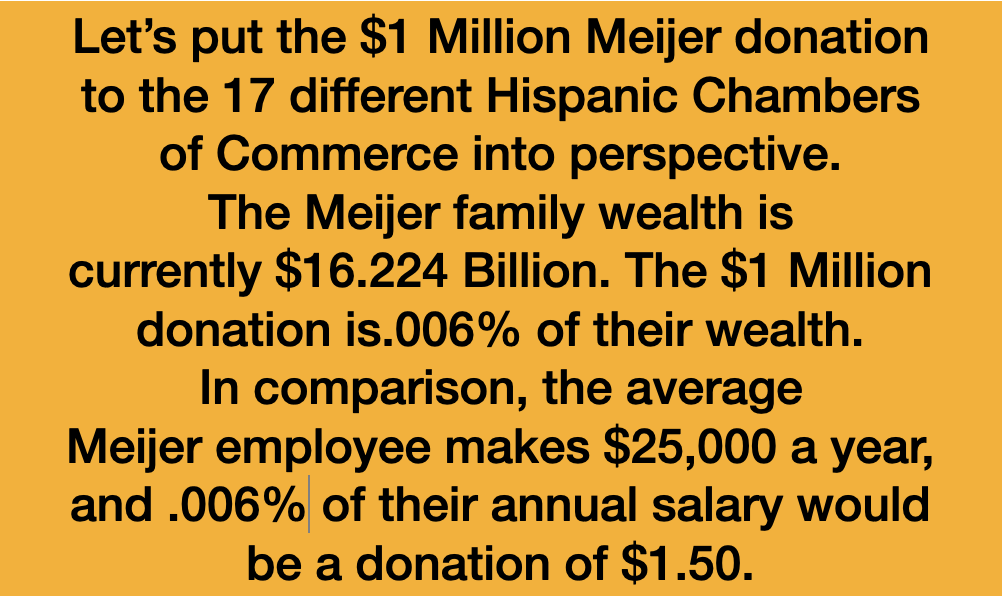
A fourth, and final question, could be to inquire as to the $1 million donation from Meijer, in relation to the wealth of the Meijer family. Based on the most recent data from Forbes list of Billionaires, Hank and Doug Meijer are worth $16.224 Billion. $1 million is .006% of $16.224 Billion. Comparatively, if someone who makes $50,000 donates .006% of the income, that comes out to $3. Therefore, a $1 Million donation from Meijer to create generational wealth is like you and I donating $3.
Since the Spring of 2018, Movimiento Cosecha, the immigrant-led movement for immigrant justice, has been demanding that the Michigan Legislature make it legal for undocumented immigrants to be be apply to apply for a driver’s license.

During the past 4 years, Movimiento Cosecha has marched, held vigils, engaged in direct action, protested outside of Secretary of State offices, organized a 75 mile pilgrimage, protested outside the homes of various state legislators and demanded that local city councils endorse their campaign to win driver’s licenses for all.
In October of 2019, several state legislators introduced legislation that would allow for undocumented immigrants to obtain a driver’s license in Michigan. However, since then there has been little movement on the legislation, despite the ongoing pressure coming from the immigrant justice movement. There was finally a public hearing scheduled for the issue of driver’s licenses in September of 2021, but the Michigan House Speaker intervened at the last second and canceled the scheduled hearing.
Just last month, Movimiento Cosecha Michigan once again went to the State Capital to protest the fact that there has yet to be a public hearing on driver’s licenses, even though it has been 2 and a half years since the legislation has been introduced.
Yesterday, I received an e-mail from Rep. Padma Kuppa, who was one of the state legislators that introduced the legislation. Here is what she said:
Thank you so much for taking the time to contact my office to voice your support for the Drive SAFE legislation: House Bills 4835 and 4836, and Senate Bills 433 and 434! I was proud to introduce HB 4835 this term to help support Michiganders and our economy.
As you know, these bills would restore the right of Michigan residents to obtain a driver’s license or state identification card regardless of their ability to produce documents affirming their legal residency. Because of advocacy like yours, there has been a renewed interest in the Drive SAFE legislation, and I was recently approached by several media outlets to discuss these bills and had an opportunity to underscore the positive impact they would have on our state, especially for those who are unable to drive safely and legally due to no fault of their own. These interviews are incredibly valuable in expanding the reach of our message.
Since 2008, our current laws have prevented immigrants and others from obtaining a driver’s license or state ID, including seniors and those in foster care who have lost documents over the years, those born on military bases, etc. As we all know how important it is to have mobile autonomy in today’s society, enacting the Drive SAFE legislation will be key to removing significant everyday barriers for Michigan residents, which would allow them to better support themselves and our economy, and in turn this would help alleviate numerous statewide setbacks such as the current worker shortage.
I also recently introduced a resolution, HR 248, to urge the federal government to quickly address the backlog in employment-based green cards, including, but not limited to, enacting H.R. 3648 of 2021, also known as the EAGLE Act. The resolution has gained bipartisan support, but we are still facing an uphill battle for its passage. Would you be interested in meeting with me and other advocates for an update on these policies and to answer any questions that you may have?
Please let me know and, once again, thank you for your advocacy. I am honored to be a voice for Michigan residents such as yourself. If you wish to monitor any Michigan legislation, you may do so at www.legislature.mi.gov. Please refer to my website (kuppa.housedems.com) or social media platforms (@MIRepPadmaKuppa on Facebook and @PadmaKuppaMI41 on Twitter) regarding our upcoming events. I also encourage you to sign up for email updates at housedems.com/padma-kuppa/enews-signup/. If you have any other concerns or questions, please do not hesitate to contact me. We are here to serve and provide the most up-to-date information possible, especially during the COVID-19 pandemic.
At one level, the e-mail was an acknowledgment of the work that has been done at the grassroots level. However, I don’t need a rundown of all of the proposed legislation the Rep. Kuppa has introduced on this matter. What immigrants need is for elected officials to do a whole lot more to get this legislation passed, such as:
- Hold a Press Conference to demand a Public Hearing on Driver’s Licenses for All.
- Engage in a disruptive action at the State Legislature, which could include civil disobedience to force the issue.
- Elected officials need to actively and publicly support the demands of the immigrant justice movement, which means showing up to their events (to support), invite their constituents to show up, participate in the marches, the protests and other types of direct action.

The undocumented immigrant community lives in constant fear of arrest, detention and deportation. Those who claim to represent them, the elected officials, need to embrace the fact that winning driver’s licenses is a very urgent matter for immigrants, even a life and death matter. Introducing legislation is not enough. We need elected officials to join the movement for immigrant justice, be part of the struggle, and to take direction from the very people who are threatened daily by local, state and federal law enforcement officials. Solidarity is more than just legislation, it means developing deep relationships from those most affected and it means actively listening to their collective stories.
 Over the passed several weeks, there have been a plethora of memes on social media that are intended to point out the brutal violence that the Ukrainians are facing since the Russian Invasion began. The text that goes with these memes usually goes something like this, “If prices go up at the pump….it’s temporary fallout. Think of it as the price of freedom. You aren’t sitting on a concrete floor in a train terminal holding your cat.”
Of course, for those of us who are not currently under military occupation, we can sympathize and realize that things could be worse. One can be outraged about how the Russian invasion has caused tremendous hardship for thousands of Ukrainians, but one can also be disgusted at the fact that gas prices have gone up significantly in recent months. Gas prices going up more than a dollar per gallon in recent months, has caused significant economic hardship for millions living in the US. These are millions of people who are already experiencing poverty, exploitation, institutional racism and the impact of the pandemic, so yeah, they have every right to complain, be outraged or disgusted with the increase in gas prices. In fact, people who are using the “don’t complain about gas prices” memes, are most likely people who have class and racial privilege.
The problem with our reactionary social views in the US, often is related to the fact that millions of people have internalized Capitalist propaganda, which often pits working class people against the poor as opposed to redirecting our collective rage against the people who own and run this country. Instead of telling people who are financially struggling to not complain about gas prices, how about we direct that energy towards the oil & gas industry, along with the economic and political system that has created our collective dependency on fossil fuel reliant means of transportation. Here are a few reasons we should be pissed off at the people who own and run this country.
First, let’s be pissed off about the fact that the oil & gas companies receive massive subsidies from the US government. The International Monetary Fund (IMF) estimates that governments around the world had subsidized the fossil fuel industry $5.9 Trillion in 2020. That is $11 Million dollars every minute for an entire year.
Second, let’s be pissed off about the fact that the oil & gas industry has contributed $814,014,243 since 1990 to political candidates in the US. Add to that, the oil & gas industry spent $115,082,396 on lobbying the US Congress in 2021 alone, according to the Center for Responsive Politics. In other words, we have a political system in the US, where the oil & gas industry generally dictates public policy.
Third, let’s be pissed off about the fact that there was an actual conspiracy in the US to destroy most forms of mass transit, involving the auto industry. GM, Firestone and Standard Oil paid millions in fines in the 1950s for their role in buying up urban street car companies, light rail and bus companies, paving the way for a car-dependent society in most US communities. See the documentary Taken for a Ride – The U.S. History of the Assault on Public Transport in the Last Century. US residents have effectively had no real say in transit, with powerful capitalist forces determining that people are car-dependent, with whole cities being designed around car use, road construction and parking areas.
Fourth, let’s be pissed off about the fact that the federal government is unwilling to radically alter our consumption of fossil fuels, by adopting a Green New Deal. People will often say that shifting to a mass transit society would take too long, so we should just continue to promote electric cars. This is nonsense. During WWII, the US war economy shifted quickly to redirect resources to war, which included the auto industry producing military vehicles and other equipment. The current auto industry could re-tool to focus on mass transit construction, while the US government could create rail systems to connect communities, just like the Eisenhower Administration did in 1956, with the passage of the Federal-Aid Highways Act to build 41,000 miles of interstate highways across the country.
Fifth, let’s be pissed off about the fact that the US military budget is the largest in the world and that US foreign policy is driven in part by the securing of access to oil & gas resources globally. According to the National Priorities Project, Michiganders are paying $19.35 Billion in taxes that go directly to the US military budget. As a tradeoff, if this money were to stay in Michigan it could provide some of the following combined:
- $84.24 Million for Public Housing Units for 1 year
- 9.65 Million children receiving low income health care for a year
- 42.48 million households with Solar electricity for 1 year
- 261,167 Clean Energy Jobs created for 1 year
All of this is to say that if current US military spending were reduced and redirected to supporting the most vulnerable in US society, then we could reduce the harm that is being done right here.
Sixth, let’s be pissed off about the fact that the US Congress just passed $13.6 Billion military aid package for Ukraine, which will likely lead to the escalation of the fighting against Russia and further destabilize that part of the world. It took the US Congress just a few weeks to send $13.6 Billion in military aid to the Ukraine, but Flint, Michigan is still waiting for a clean water infrastructure, millions of Americans are still waiting for rent relief, and millions of Americans are food insecure on a daily basis right now!
Seventh, let’s be pissed about the fact that all six of the previous reasons to be pissed off and major contributing factors to the current Climate Crisis. The most recent ICPP report makes the following comment in their summary statement:
Today’s IPCC report is an atlas of human suffering and a damning indictment of failed climate leadership. With fact upon fact, this report reveals how people and the planet are getting clobbered by climate change. Nearly half of humanity is living in the danger zone now. Many ecosystems are at the point of no return now. Unchecked carbon pollution is forcing the world’s most vulnerable on a frogmarch to destruction now. The facts are undeniable. This abdication of leadership is criminal. The world’s biggest polluters are guilty of arson on our only home.
These are just seven reasons why people can justifiably be pissed off about the rise in gas prices in the US, although there are many more reasons we could identify. Never let people tell you what to be pissed off about, especially when you are not only excluded from any decision making in the current gas price hike, you are not the ones who are exploiting the public and making massive profits while the world burns!

