After two years of the pandemic, US and Michigan Billionaires have expanded their wealth, while millions are suffering
 [Editors Note: It has recently become fashionable to use the phrase, normalize calling billionaires in the US as Oligarchs. Of course, the Billionaire Class, the Capitalist Class, the Oppressor Class have always been Oligarchs. The fact that many people are not suggesting we call them Oligarchs demonstrates how much average Americans have internalized the Capitalist myth that rich people are rich because they work hard.]
It has now been two years since the world has lived under the COVID pandemic. Just over 6 million have died globally from the virus, with just under 1 million in the US.
The pandemic has also caused tremendous harm, especially for people who were already experiencing poverty, with communities of color being disproportionately affected.
However, there is one class of people who have not been negatively impacted from the pandemic, in fact, they have profited tremendously in the past two years. The group, Americans for Tax Fairness, recently posted some analysis and data on how the Billionaire Class has benefited from the global COVID pandemic.
Two years into the biggest national health crisis in recent history, U.S. billionaires’ wealth continues to soar above the misery: as of March 10, their collective wealth has shot up by $1.7 trillion, or 57%, since the pandemic emergency was proclaimed in mid-March 2020. Their total wealth reached $4.6 trillion, up from $2.95 trillion on March 18, 2020, according to the latest report from Americans for Tax Fairness (ATF) based on Forbes data. The number of U.S. billionaires increased by 15%, from 614 to 704. Data can be found in the table below and here for all billionaires, including a state-by-state breakdown.
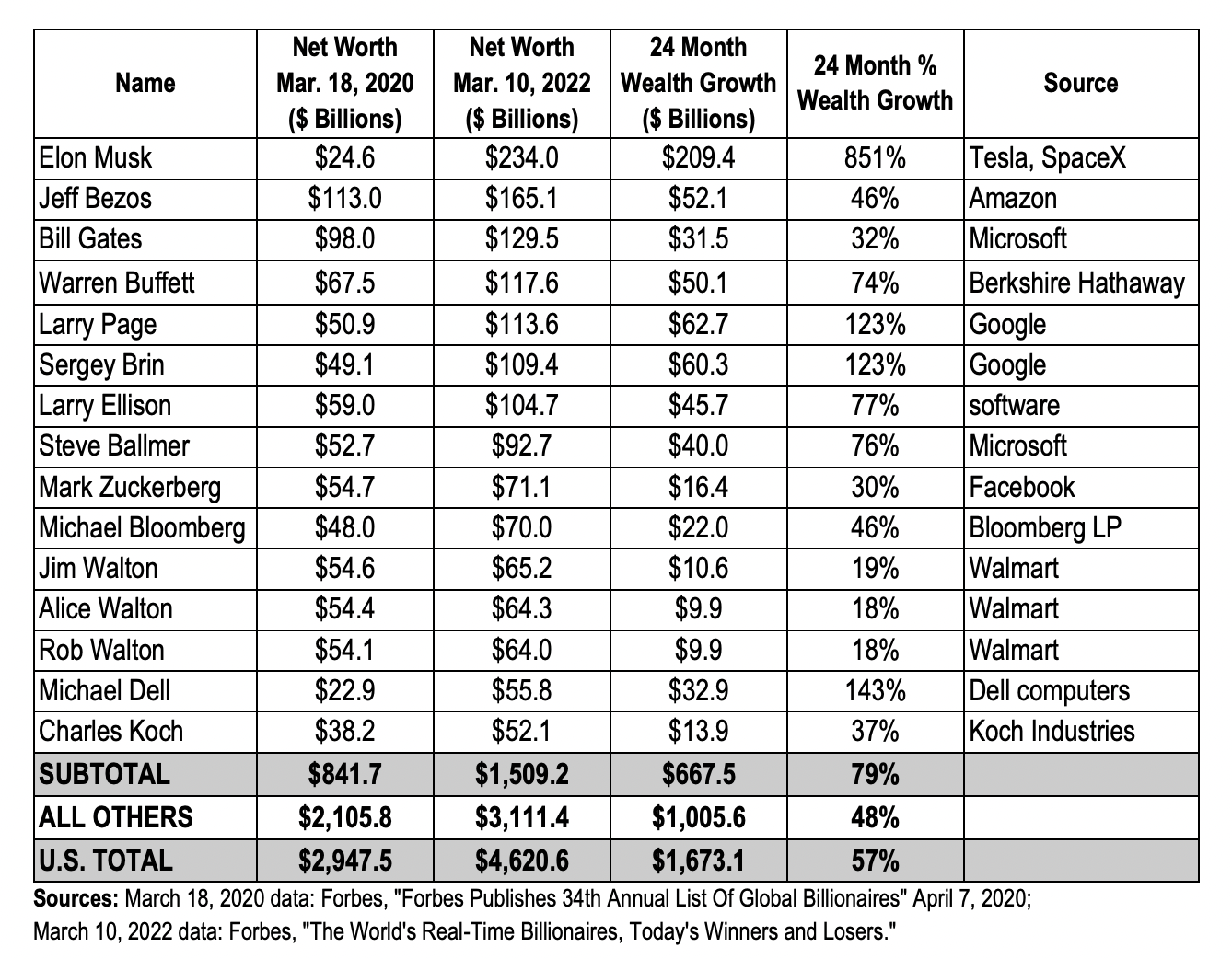
There are two pieces of data that are particularly alarming, in terms of the growth of Billionaire wealth over the past 2 years:
- The $4.6 trillion total fortune of the nation’s 704 billionaires is one-third more than the collective $3.4 trillion net worth of the entire bottom half of American society, or some 65 million households.
- The $1.7 trillion wealth gain by billionaires over the past 24 months could fund much of the 10-year $2.2 trillion cost of the Build Back Better plan of social and environmental investments passed by the House of Representatives last fall. Billionaires could pick up much of the tab and still be just as rich as they were before COVID hit.
This kind of meaningful break down of the wealth of the Capitalist Class is important, especially if we are to make sense of the vastness of their wealth to inform and mobilize people to dismantle their wealth.
The growth of Michigan Billionaire Wealth
There are several dozen billionaires in Michigan that have seen their wealth grow exponentially during the two years of the pandemic, along with newly created Billionaires. Data can be found here for all billionaires, including a state-by-state breakdown.
Two of the more prominent Billionaires who call Michigan home are Dan Gilbert and the Meijer brothers, Doug & Hank. Gilbert is the 32nd Wealthiest Billionaire in the US, according to the most recent data. The net worth of Dan Gilbert at the beginning of the pandemic was $6.5 Billion. Two years later, Gilbert’s net worth has grown to a total of over $23 Billion, with a total growth of over $16 Billion in town years. Gilbert, is the founder of Rock Ventures and the co-founder of Quicken Loans. He also owns the NBA team known as the Cleveland Cavaliers. Gilbert moved much of his base of operations to Detroit over a decade ago, buying up lots of downtown property, contributing to the gentrification of Detroit.
Hank and Doug Meijer began the pandemic in March of 2020, with a net worth of $10.2 Billion. Today, their net worth is $16.224 Billion, which is just over a $6 billion dollar growth. Just as a frame of reference, $6.2 billion is roughly 14 times the size of the 2022 budget for the City of Grand Rapids ($546 million). Imagine how much housing, health care, education, livable wages, etc. that $6.2 billion could be spent on to actually create real equity in Kent County, where the Meijer brothers reside. This would still leave them with over $10 billion, which would be more than enough to have a grotesquely comfortable life.
The Americans for Tax Fairness document advocates the taxing of the Billionaire Class in the US, which would be an important first step. However, taxing the rich, is not enough, as we have stated before. In January of this years, I wrote:
“I support taxing the rich, but that is just one tactic to be used in a much larger strategy to dismantle Capitalism. Plus taxing the rich means that the government still gets to decide what to do with that money, which often means that it will go to support other projects that the Capitalist Class endorses and often benefits from.
So, moving beyond the tactic of taxing the rich, what would a more robust strategy to dismantle capitalism look like:
Undoing the harm of the Capitalist Class would first require that they be held accountable for the harm they have caused, both legally and economically. People are members of the Capitalist Class always exploit the real wealth creators – workers, plus they exploit the use of natural resources, while at the same time producing massive amounts of toxins, pollution, carbon and other ecological catastrophes.
Acknowledging this harm cannot just be a moral stance, but have real legal and economic consequences. Workers should be paid massive back wages, which were taken from them by members of the Capitalist Class. In addition, the richest people on the planet should pay massive fines for the ecological harm done to all of us.
Secondly, members of the Capitalist Class should be required to pay massive reparations to Black, Indigenous and other Communities of Color for discrimination, exploitation and other forms of structural racism they have perpetrated for centuries. These reparations could take the form of giving land back, monetary reparations and giving over other assets to those they have caused harm to for centuries.
Now, the existing forms of representative democracy that we have in the US, at the federal, state and local level, will never embrace such a strategy, no matter who is elected. What we need to make the dismantling of Capitalism a reality will not be easy, but then again revolutionary work never is.
 On Tuesday, numerous local news agencies reported that Amway, like many of companies, was pulling out of Russia because of their invasion of Ukraine.
MLive was one of the local news agencies that reported on the Ada-based company’s decision to no longer do business in Russia. MLive also linked to the actual statement that Amway put out, which is significantly different that what most news agencies are reporting.
Here is a link to the Amway announcement, but we are also including the text here below, in case the company decides to remove their announcement.
Amway is powered by people – especially the inspiring, entrepreneurial and caring employees and Amway Business Owners (ABOs) who live our values every day across the world.
Seeing the global Amway family step forward and care for those who have left Ukraine in search of safety and shelter, and those who have stayed behind, has once again shown the heart of Amway and the strength of the bonds we share. Our team members who remain in Ukraine are also donating our healthy food and beverage products, personal care items, and dietary supplements to people in harm’s way, and to local hospitals and charities.
The reality of our business is that we have friends, colleagues and Amway Business Owners in both countries who have worked together for years in harmony with a common purpose. However, the continuing war, along with the global legal and operational environment, makes it impossible to continue business as we have been in Russia, and so we are announcing the immediate suspension of product imports and will be pausing other operations as well.
Hope – along with Freedom, Family and Reward – is one of our four Founders’ Fundamentals. We have upheld these ideals for more than 60 years, including through very challenging times in different parts of the world. It is our sincere hope that peace will prevail, and that we can return to fully supporting operations and opportunity for all who are a part of the Amway family.
What is striking about this statement, although not surprising, is that Amway makes their announcement primarily about themselves, rather than taking a principled stance to no longer do business in Russia.
First, the opening paragraph, along with the fourth paragraph centers the ideology of Amway, never saying anything about Russia and Ukraine. In the entire statement, Amway includes their own name six different times, and only names Ukraine twice and Russia once.
Second, when talking about Ukraine in the second paragraph Amway talks about how they are caring for those that left. The thousands of Ukrainian refugees are fleeing the violence brought about by Russia’s invasion and ongoing occupation. Amway then centers the fact that they are donating their own food and beverage products, making it all about them as opposed to the horrific plight of Ukrainian civilians. None of the language in that second paragraph conveys to realities nor the horror that Ukrainians are facing.
In the third paragraph, Russia is finally mentioned, but the Amway announcement doesn’t mention the invasion, nor the bombing, and nothing about the death of Ukrainians. The paragraph once again centers Amway business owners who apparently have been working in “harmony.” The statement then says:
However, the continuing war, along with the global legal and operational environment, makes it impossible to continue business as we have been in Russia, and so we are announcing the immediate suspension of product imports and will be pausing other operations as well.
In this sentence, Amway finally uses the term war, but then quickly makes it about not being able to do business there, which is why they are suspending “product imports” and “pausing other operations.” There is no mention of the international condemnation of the Russian invasion nor the position that the US government has taken.
The fourth and final paragraph yet again centers the company, even taking the opportunity to promote their founding values. Amway concludes by timidly hoping that peace will prevail, not because it will stop the bombing and the killing by the Russian army in Ukraine, but so the company can, “can return to fully supporting operations and opportunity for all who are a part of the Amway family.”
So, Amway does their best to avoid demonstrating any real solidarity with the Ukrainian people, nor do they empathize with the harsh realities that civilians are facing in Ukraine because of the Russian invasion. What Amway does do, is to constantly promote themselves and their capitalist values. In the end, the Amway corporation is not pausing operations because of human rights, they are only pausing operations because it would be an embarrassment to continue doing business in Russia. If Russia and Ukraine negotiate a peace settlement, you can bet that Amway will be back in Russia, attempting to create more little capitalists, regardless of the repressive political realities under the Putin regime.
A Brief history of Women-led Movements in Grand Rapids: Part II – The Reproductive Justice Movement
 (Editor’s Note: During the month of March – Women’s History month, GRIID will highlight three Social Movements that were led by women in Grand Rapids. These three posts will be part of a chapter that will be included in the book, A People’s History of Grand Rapids.)
In Part I, we looked at the Women’s Suffrage Movement in Grand Rapids, a movement that began in the 1870s and eventually won the fight for women to vote in local elections in 1918, along with the passage of the 19th Amendment being adopted in 1920. Today, we want to take a look at the Reproductive Justice Movement in Grand Rapids.
In the history of the United States, women have rarely had body autonomy. It wasn’t until the early 1980s in the US, that all states finally overturned laws that made women who married men, the property of their husbands.
However, there is one area that women have fought for and are still fighting for, which is reproductive justice and the right to have an abortion. What is interesting about the issue of the right of a woman to have an abortion, is that it was legal until 1873, when the federal government outlawed abortion. Contraceptives were also outlawed at the same time, with the primary sector lobbying for the outlaw of abortion and contraceptives being male doctors. This meant, that like the rest of the US, in Grand Rapids women did not have the legal right to have an abortion until the US Supreme Court decision known as Roe V. Wade.
Roe V. Wade was not adopted as a legal ruling until 1973. This doesn’t mean that women were not defying the law and choosing what to do with their own bodies. For decades prior to Roe V. Wade, women were seeking out and creating their own networks and resources to practice reproductive justice. In Grand Rapids, many people are familiar with the Choice Fund that has been part of the work done by Fountain Street Church. What is less known is that the Choice Fund had begun in the mid-1960s, in a very clandestine fashion.
In an interview conducted with Dani Vilella in 2021, I discovered that women from Fountain Street Church (FSC) were going out of state to have abortions. This eventually prompted women who were connected to FSC to create the Choice Fund. In fact, the Choice Fund had remained clandestine until the early 1990s, primarily to avoid the wrath of the anti-abortion movement, particularly the religious branch of the anti-abortion movement, which was the dominant aspect in West Michigan.
The Choice Fund did not go public with the work they were doing to raise money for women wanting to have an abortion, not until the late 1980s. The Choice Fund made this decision because of the growing anti-abortion attacks against clinics that were performing abortions. The money raised by the Choice Fund would go directly to the Heritage Clinic for Women, covering the costs for those women who wanted to have an abortion.
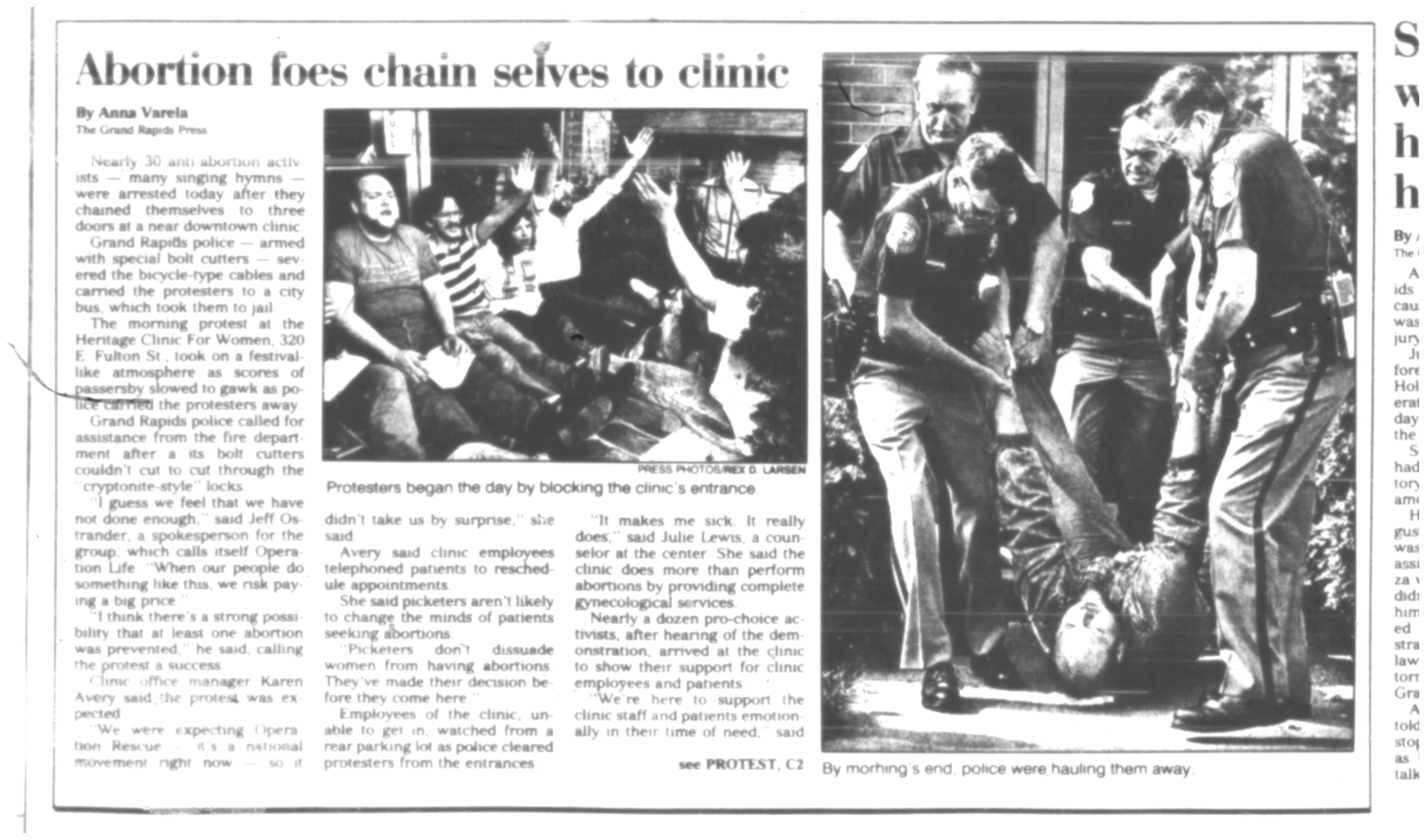
Beginning in the late 1980s, the antiabortion attacks certainly escalated in Grand Rapids. Operation Rescue, the anti-Abortion group led by Randall Terry, came to Grand Rapids on several occasions beginning in the late 1980s. Protests and efforts to stop women from choosing to have an abortion were intense and often confrontational, as you can see from this Grand Rapids Press article above.
There are literally hundreds of churches in West Michigan that embrace an anti-abortion stance, some evangelical, some Christian Reformed, along with the Catholic Church. Many of these churches would include information about protests and other so-called Pro-Life actions happening in Grand Rapids, Lansing or in Washington, DC.
Additionally, there are thousands of religious people in West Michigan that make regular contributions to Michigan Right to Life. More importantly, there are several members of the West Michigan elite that have collectively contributed millions of dollars to anti-abortion groups and other “family-values” organization that want to keep women in a subordinate role in society, which also means they do not women to have bodily autonomy. In Russ Bellant’s book, The Religious Right in Michigan Politics, he cites the DeVos family, Peter Cook, the Prince family, the Van Andel family and the DeWitt family as major funders of the anti-abortion movement. Many of these same families continue to make significant financial contributions to anti-abortions groups like Right to Life.
The financial and ideological support for an anti-abortion stance has contributed to more serious acts of hate and violence against women and organizations that do reproductive health education or perform abortions in the greater Grand Rapids area. Besides physically blockading the entrance of clinics, many clinics and other organizational offices have been hit with graffiti or doused with butyric acid, which smells like vomit and is difficult to get rid of once it is used.
Many members of the Religious Right in West Michigan have also participated in what they refer to as 40 Days of Life actions, which are primarily about people coming to one of the clinics for 40 days in a row to pray, to protest and to often shame women who enter those clinics.
As a counter, there have been 40 Days of Choice campaigns and actions done over the years, primarily as a means of countering the anti-abortion forces. People who are committed to defending a woman’s right to have an abortion, would show up to provide support to the women coming to clinics, as well as acting as volunteer security to intervene if any of the anti-abortion folks attempted to harass, shame or do bodily harm to those entering the clinic. In 2012, I conducted an interview with someone involved in the 40 Days of Choice campaign, which you can listen to at this link.
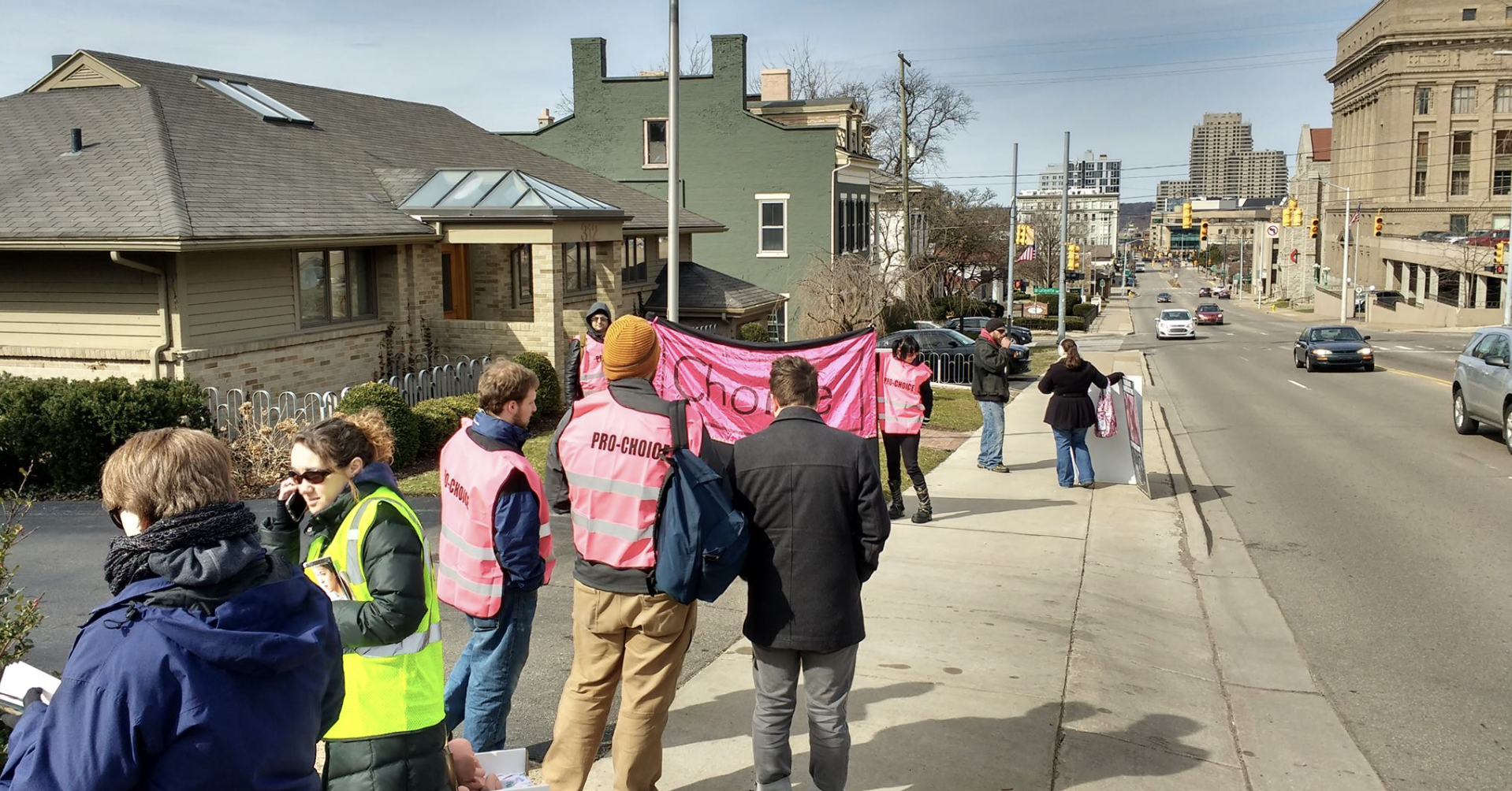
With the election of Donald Trump in 2016, those committed to defending a woman’s right to an abortion, mobilized to go to Washington, DC to protest the inauguration in early 2017. The overly anti-feminist and anti-abortion rhetoric coming from the Trump administration also reinvigorated the Reproductive Justice Movement to provide security and accompaniment at local clinics in Grand Rapids. A new wave of young people began showing up and working with the clinic to provide support to women and to keep anti-abortion protestors at a distance.
In May of 2020, there were two anti-abortion protesters arrested at the Heritage Clinic in Grand Rapids. I interviewed someone who worked there at the time, but chose to remain anonymous, for obvious reasons. Some of those involved in the protest were with the group Red Rose Rescue. Here is what the clinic employee shared with me about what happened:
On the day of their protest, they showed up in a large group, gathering outside of the clinic. When patients exited their vehicles, they would either shout loudly at the patients or would directly approach them. They were verbally aggressive and their voices were elevated (we could hear them screaming from inside the clinic). One particular protestor, a woman named Caroline Davis, was seen and heard screaming “Repent your sins”, “You’re going to regret this every day”, and more to patients. Many members of the group entered the building in the stairwell in an attempt to gain access to inside the clinic, but due to the safety and privacy measures we always have in place, in addition to the diligence of precautionary measures our staff took, they were not successful with entering.
Patients came into the clinic visibly shook up and unhappy. Patients disclosed to us that protestors had approached their cars and physically banged on their car windows. One protestor held open the door to the clinic for a patient and told her to “have a nice day” (in a way that felt insincere and manipulative to the patient). Another patient came to her appointment in a vehicle with a business logo on the side, and a protestor called that business to inform them of where they were, violating their privacy.
Towards the end of the interview, I asked the clinic employee what some of the most important aspects of reproductive rights are. What they shared was deeply moving ton this writer, so I will end with their comment:
Many times, people hear “reproductive justice” and think that it is solely a pro-choice vs. anti-choice issue. It is so much more than that, though: It is ensuring that people who want to have and raise children have the adequate means to do so, and should be able to build a family on their own terms. They should be financially prepared with a living wage, paid family leave, and unbiased employers. We need social structures that allow for anyone regardless of background to receive proper pregnancy and childbirth care. There should be easy access to free or affordable contraceptives, STD/STI/HIV testing, and safe sexual health measures, such as condoms or other birth control, PrEP medication, etc. Equal access to abortion care, regardless of reason. Comprehensive sex education in public and private schools. Freedom from sexual and domestic violence. Supporting LGBTQ parents, teen parents, birth parents, and adoptive parents. Other issues that are often overlooked or not considered to be – but are 100% interrelated with reproductive justice –include food security and access to clean water; unwavering support of gender and sexual identity/presentation; immigration justice; environmental justice; disability justice; indigenous rights; and more. We must build and sustain safe communities for EVERYONE.
 On Thursday, March 24th, workers at the Starbucks on Burton and Rosemont SE in Grand Rapids, are asking for ally support in their attempt to form a union.
There have been 6 newly formed unions at Starbucks across the country, with another 120 locations in the process of fighting for a union.
Those fighting to make the Burton & Rosemont Starbucks a unionized workplace are asking the following:
- Order your coffee with one of these phrases, plus your name: Union Yes, Union Strong or Solidarity
- Sign the letter at the Starbucks to show your support
- Spread the word in the GR community
Each of these ways of showing support are easy and risk free. However, if it means the workers at this Starbucks location will be able to form a union, then we should all finds ways to participate. In addition, if this Starbucks location forms a union, then it will be easier for workers at every Starbucks location where workers want the right to collectively bargain!
A brief history of Starbucks unionizing efforts in Grand Rapids
In June of 2008, the indy media blog Media Mouse posted a story about a Starbucks barista who was fired for attempting to organize a union:
Starbucks terminated a barista active in the IWW Starbucks Workers Union today as part of its ongoing effort to combat a growing movement of employees pushing for a living wage and secure work hours. The barista, Cole Dorsey, was fired after two years of service while he was coordinating a union recruitment drive at Starbucks stores in Grand Rapids. Starbucks’ pretext for the illegal anti-union firing was that Dorsey was guilty of some months-old attendance infractions.
“Today I joined the growing number of baristas that Starbucks has fired in its relentless union-busting campaign,” said Cole Dorsey. “Starbucks’ disrespect for the right to join a union is appalling and absolutely will not stop our efforts to have a voice at work.”
The firing comes as a National Labor Relations Board judge is set to rule after a lengthy trial on the retaliatory terminations of three New York City baristas. Even before the firing, the NLRB was investigating whether Starbucks violated a settlement agreement entered into in Grand Rapids over anti-union discrimination. In 2006, Starbucks was forced to re hire two union baristas who had been unlawfully fired for union activity. This latest firing in Grand Rapids signals that reinstalled CEO Howard Schultz will not modify the company’s practice of terminating outspoken union baristas to intimidate workers from joining up.
One month after IWW labor organizer Cole Dorsey was fired from Starbucks, the local IWW chapter organized a protest at a Starbucks location on 28th Street and the E. Beltline. The IWW sent out the following message:
 “Union members and social activists are gearing up for what may be the largest, global coordinated action against Starbucks ever. Protesters will decry what they see as an epidemic of anti-union terminations by the world’s largest coffee chain. Starbucks and its CEO Howard Schultz have exhibited a pattern of firing outspoken union baristas ever since the advent of the IWW Starbucks Workers Union in 2004 and are demonstrating the same practice against the CNT union in Spain. On July 5th people around the world will show Starbucks that we, baristas along with our supporters, will have a voice and Starbucks discrimination and repression of our efforts will not go un-checked”, said Cole Dorsey.
In November of 2008, Starbucks was taken to court by the IWW worker for being fired. The National Labor Relations Board (NLRB) provided a lawyer to fight for the fired Starbucks employee, while Starbucks hired the corporate law firm of Varnum, Riddering, Schmidt and Howlett.
Then in July of 2009, while awaiting a ruling on the case. The Grand Rapids Chapter of the IWW, organized another demonstration outside of the Starbucks in East Grand Rapids on Wealthy St. The video below includes comments from IWW organizers Cole Dorsey and Erik Foreman, a short march through East Grand Rapids and police who were called to harass those protesting.
Photo credit: Michael Johnston
The same people who created the Housing Next fund in West MI, are the same people who oppose paying workers enough to afford housing
 On March 3rd, the Grand Rapids Chamber of Commerce made the following announcement:
Through the leadership and contributions of Haworth and both the Community Foundation of the Holland/Zeeland Area and the Grand Haven Area Community Foundation, each foundation made their largest and longest commitment of funding to establish Housing Next 4 years ago. Their goal was to create workforce housing for individuals and families employed in Ottawa County who were unable to afford to live there. Housing Next has already supported the approval of thousands of new multi-family rental units and for-sale homes in Ottawa County through the revision and modernization of 6 local zoning codes with the goal of reducing regulatory barriers and increasing diversity of housing product in the market, partnering with 4 communities on the contribution of public land for affordable/attainable and market-rate housing, collaborating with 21 different developers (for-profit & non-profit) to leverage more than 3,900 new housing starts and 30 new developments across the County, managing the Ottawa and Kent Housing Needs Assessments, and assisting in the creation of the Grand Rapids Affordable Housing Fund.
While this announcement might be viewed by some as good news, it is ultimately a false solution, wrought with contradiction.
The Grand Rapids Chamber of Commerce, along with several other local chambers, furniture giant Haworth, several banks, the Windquest Group and the DeVos Family Foundation are hoping that we view this announcement with a great victory against the current housing crisis. It isn’t.
The language from the announcement is instructive, in that it states that the goal, “was to create workforce housing for individuals and families employed in Ottawa County who were unable to afford to live there.” Now, any reasonable person would ask themselves why can’t workers afford to live in the communities that they work in? The simple answer is because these individuals and families don’t make enough to afford the cost of housing in the communities that they work in.
The solution being offered by the numerous area Chambers of Commerce, is to create a fund that comes from the business community, foundations and local banks, which would allow these individuals and families to afford the cost of housing in the communities where they work. However, wouldn’t it make a whole lot more sense to have all of the companies in West Michigan make a commitment to paying people a livable wage, which would allow them to afford the cost of housing in this area?
While the idea of paying people a livable wage makes complete sense, the fact that most companies in this area don’t pay a livable wage, gets to the heart of my argument. The fact of the matter is that the Grand Rapids Chamber of Commerce and most of the partner groups with Housing Next have actively opposed an increase in the minimum wage for decades, let alone any talk of a livable wage. In addition to opposing an increase in the minimum wage or actually paying a livable wage, the Chamber of Commerce has a long history of being against a just maternity leave, union organizing, and they supported Michigan becoming a Right to Work state. Here are some other more recent stances taken by the Chamber of Commerce:
- Property tax deferment for businesses, which Whitmer has vetoed twice
- Regulatory flexibility
- A possible end to licensing fees
- Eliminate or reduce business unemployment fees
- Improve work research requirements to make people take jobs that don’t pay well
- Education testing to make sure that students are work ready. In other words, the GR Chamber sees education as talent production
- Creating more childcare options to get people back into the workforce and improve productivity
- Criminal Justice reform for the GR Chamber is about getting more formerly incarcerated people into the workforce, which the Chamber also sees as a Talent issue
- Continuation of the Going Pro Program, which transfers public money to private businesses for training purposes
In 2008, the Grand Rapids Chamber of Commerce created the West Michigan Policy Forum, which has since become an independent entity. The West Michigan Policy Forum was created to actively influence public policy at the state level, policies that would assist or hinder the business community.
Matt Haworth, Chairman of Haworth Inc., was quoted in the March 3rd announcement saying, “My decision to support this project was because of its strong alignment with our values- values that extend beyond our business to the communities and people we rely on including: embracing community learning, market-based solutions, leading with design, creating value, and working to make the world a better place.” Haworth also sits of the Board of Directors of the West Michigan Policy Forum and is a major contributor to political candidates which support the kind of public policies that benefit members of the business class, at the expense of everyone else.
In fact, if you look those who sit on the board of the West Michigan Policy Forum and the community partners of the Housing Next project you see a great deal of overlap.
The bottom line is that the Housing Next project is a false solution, since it involves the very same organizations, businesses and individuals that have done everything in their power to promote wealth creation for the business class, while creating a vast array of obstacles for everyone else who lives in West Michigan and cannot afford the cost of housing. Creating a housing fund made from money that, in essence, has been withheld from the wages of workers, should never been seen as a solution, but rather as a public relations stunt to make us all think these people and these businesses give a shit about the rest of us.
Exploitation, maintaining order and protecting systems of power: Is this what Mark Murray means by Virtuous Leadership?
 What do you get when you have a member of the Grand Rapids Power Structure interviewed for a podcast run by a Far Right Think Tank? You get a little bit of honesty and a lot of bullshit.
Recently, the Acton Institute for the Study and Religion and Liberty, invited Mark Murray to be part of a discussion on their podcast about the idea of Virtuous Leadership.
The vague concept of leadership is all the rage these days. Go into any bookstore or peruse mainstream publishing company websites, and you will no doubt come across a litany of books on leadership. You will find titles like, The Dichotomy of Leadership, Simple Truths of Leadership, Compassionate Leadership, The Leadership Space, or Leaders Eat Last. If you are a CEO or a President of a Company, it seems as though one qualification of being in that position, is that you must write (generally you get someone else to write it for you) a book on leadership.
So, naturally I was intrigued to know what Mark Murray, a member of the Grand Rapids Power Structure, thinks about virtuous leadership. The interview on Acton Vault, was not particularly riveting. To be honest, it was painful to listen to. But, there was one thing that Murray had to say that I found very instructive. Murray said, “Government has a critical role to play, which is maintaining order.”
Maintaining order is particularly critical for systems of power and oppression, like Capitalism, White Supremacy and Heterosexism. Without order, people are more prone to think critically about these systems, plus it doesn’t provide a social climate that allows people to be consumers.
Mark Murray would know a thing or two about maintaining order, both in government and in the private sector. Most people came to know Murray, when he was working in the Engler Administration as both Treasurer and Budget Director from 1999 – through the early 2000’s. In that role, Murray served as a critical component in the implementation of numerous Neoliberal economic austerity policies that were pushed by Gov. Engler. Some of these policies saw the privatization of public services, along with a massive redistribution of wealth from the public to the private sector.
My family experienced first hand the hardship that these austerity measures had on working class people. My younger brother, who has serious disabilities, was part of a day program for people with both physical and cognitive disabilities in Lansing, where he lived with my parents. One of the downsizing consequences of the Engler Administration was the elimination of state funding for the day program that my brother benefitted from. These funding cuts meant that he was home all of the time, was not able to participate in the multitude of activists provided by the day program. This put additional stress on my parents, but it also had serious consequences for my brother, who became more depressed and self-abusive. Mark Murray directly did harm to my family and numerous other families because of the kinds of state cuts that had been funding various social programs. Is this what Mark Murray means by Virtuous Leadership?
A second example of Murray practicing Virtuous Leadership, was when he was the President of Grand Valley State University (GVSU). GVSU tried to pass a domestic partner benefits policy in 1995, but was prevented from doing so by Wealthy donors – DeVos & Cook – who threatened to withhold their money from a proposed building project.
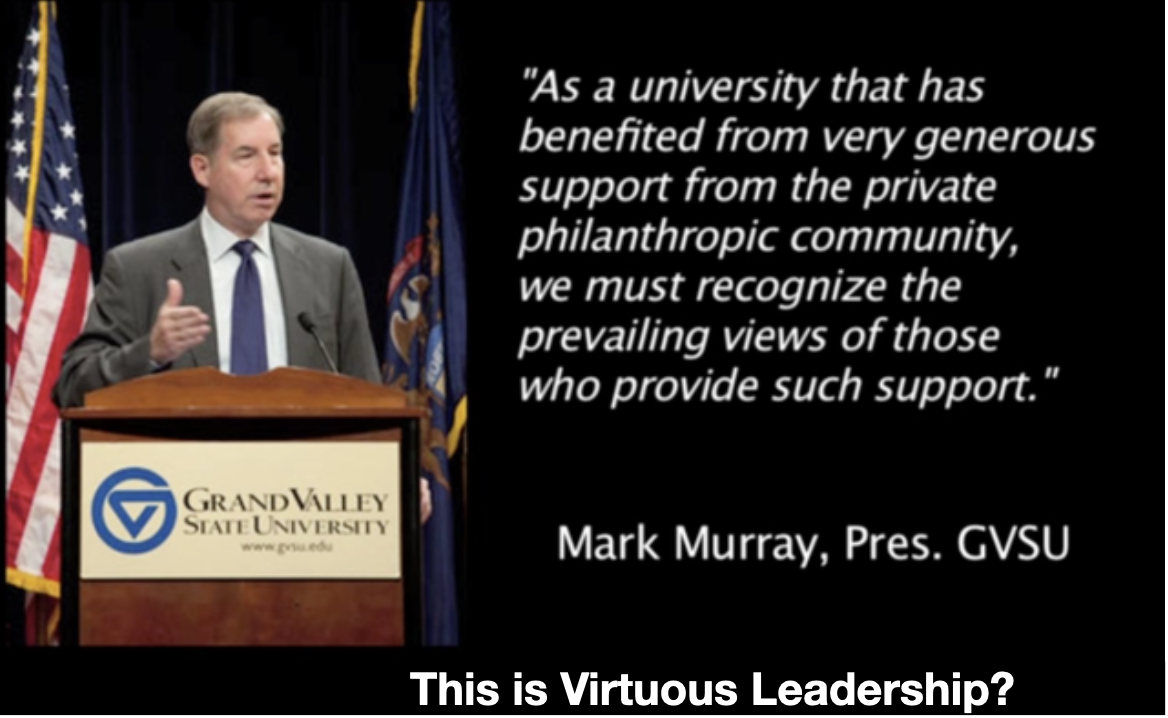
Another attempt to win domestic partner benefits was made in 2003, but then President Mark Murray blocked the attempt. Murray stated at the time, “As a University that has benefited from very generous support from the private philanthropic community, we must recognize the prevailing views of those who provide such support.” Translated, Murray was saying that he didn’t care about LGBTQ faculty and staff, he just wanted to make sure that members of the Capitalist Class in West Michigan would continue to give the university money. Again, is this what Mark Murray means by Virtuous Leadership?
A third example of Murray practicing Virtuous Leadership, can be seen in his tenure as President of West Michigan retail giant, Meijer Inc. Murray was President of Meijer Inc from 2006 – 2013, then became the CEO of Meijer for an addition two years and nine months.
During Murray’s tenure as head of Meijer Inc., the thousands of store workers continued to make poverty-level wages, while Doug & Hank Meijer saw themselves on the Forbes 400 list of Billionaires. In fact, Doug & Hank Meijer saw their wealth nearly double during the time that Mark Murray was the President/CEO of the family’s company. This dynamic at Meijer Inc continues to this day, with the massive growth of the Meijer family wealth, while most Meijer employees can’t afford the average cost of rent in West Michigan on the slightly better than minimum wages they make. Once again, is this what Mark Murray means by Virtuous Leadership?
If you pick up the latest book on leadership by one of the many CEOs across the country, despite all of their lofty rhetoric about leadership, the fact remains that their primary function is to make as much money as possible for the shareholders, even if that means exploiting those who do the real work. And you can be damn well sure that workers are being exploited.
When people like Mark Murray talk about Virtuous Leadership, what he (and they) mean is that they will do whatever is necessary to keep order, maintain systems of power and oppression, and exploit those who are the true creators of wealth, workers. So, let’s be clear, there is nothing virtuous in the exploitation of workers and the redirecting of wealth from the public to those in the Capitalist Class, like Mark Murray.
US, NATO and the Russian Invasion of the Ukraine: Part II – Historical Context and a broader Geo-Political framework
In Part I, we presented information on how the US commercial news media is reporting on the Russian invasion of Ukraine, the US and NATO responses.
Historical context is key for understanding any geopolitical conflicts, especially since current actions rarely happen in a vacuum. In today’s post we will provide some excerpts (and links to full articles) from articles we think provide some important and critical context to the Russian invasion of Ukraine.

THE WAR OVER UKRAINIAN HISTORY AND IDENTITY
“UKRAINE IS NOT just a neighboring country for us,” declared Russian President Vladimir Putin last week. “It is an inalienable part of our own history, culture, and spiritual space.” This conception of Ukrainian history forms the bedrock of Putin’s justification for invading the former Soviet republic, independent since 1991. On this week’s podcast, Ryan Grim talks with Ukrainian sociologist Volodymyr Ishchenko about his country’s history, from the Dark Ages up the current war. They discuss Ukraine’s history of anarchist politics, the 2014 Euromaidan Revolution that toppled pro-Moscow President Viktor Yanukovych, and the tangled question of modern Ukrainian identity.
The alliance’s defenders now claim that Russia accepted it by signing the 1997 NATO-Russia Founding Act. But Moscow really had no choice, being dependent then on billions of dollars in International Monetary Fund loans (possible only with the approval of the United States, that organization’s most influential member). So, it made a virtue of necessity. That document, it’s true, does highlight democracy and respect for the territorial integrity of European countries, principles Putin has done anything but uphold. Still, it also refers to “inclusive” security across “the Euro-Atlantic area” and “joint decision-making,” words that hardly describe NATO’s decision to expand from 16 countries at the height of the Cold War to 30 today.
Chomsky: Outdated US Cold War Policy Worsens Ongoing Russia-Ukraine Conflict
The tension on the Russia-Ukraine border represents an ongoing conflict between two nations with many cultural affinities, but is also part of a much larger rivalry between the U.S. and Europe on one side, and Russia on the other. As Noam Chomsky reminds us in the exclusive interview for Truthout that follows, in 2014, a Russia-supported government in Ukraine was forcefully removed from power by a coup supported by the U.S. and replaced by a U.S. and European-backed government. It was a development that brought closer to war the two main antagonists of the Cold War era, as Moscow regards both U.S. and European involvement in Ukraine and the North Atlantic Treaty Organization’s (NATO) continued eastward expansion as part of a well-orchestrated strategy to encircle Russia. The strategy of encirclement is indeed as old as NATO itself, and this is the reason why Russian President Vladimir Putin issued recently a list of demands to the U.S. and NATO with regard to their actions in Ukraine and even parts of the former Soviet space. In the meantime, senior-level Russian officials have gone even further by warning of military response if NATO continues to ignore Moscow’s security concerns.
How the U.S. Started a Cold War with Russia and Left Ukraine to Fight It
So why was negotiating a mutual security treaty so unacceptable that Biden was ready to risk thousands of Ukrainian lives, although not a single American life, rather than attempt to find common ground? What does that say about the relative value that Biden and his colleagues place on American versus Ukrainian lives? And what is this strange position that the United States occupies in today’s world that permits an American president to risk so many Ukrainian lives without asking Americans to share their pain and sacrifice?
In addition, Biden’s claim that the United States “always stands up to bullies” would be news to the Yemenis, Lebanese, Palestinians, and others who have been subjected to massive military attacks by U.S.-armed allies. His insistence that “we stand for freedom” is contradicted by his administration’s support for brutal dictatorships in Egypt, Saudi Arabia, Bahrain, the United Arab Emirates, and elsewhere. Criticism of Russia’s veto of the U.N. Security Council resolution condemning the invasion rings hollow in light of successive U.S. vetoes of resolutions challenging the U.S. invasions of Grenada and Panama, U.S. attacks on Nicaragua, and Israel’s invasions of Lebanon.
Putin, Lenin, Imperialism and the (Real) History of Ukraine
Ukraine is a place few people in this country can find on a map. Far fewer have any idea of when and how the Ukrainian state originated, or how it has related to its neighbors over time. So I might make up any random narrative about it, weaving in bits and pieces of truth here and there, and perhaps the majority of my listeners would nod agreeably at my presentation finding no flaws. There are a whole lot of ingredients to work with and to play with when it comes to Ukraine’s history.
Putin’s Criminal Invasion of Ukraine Highlights Some Ugly Truths About U.S. and NATO
Many governments of the world have denounced Putin’s actions. But when it comes to the U.S. and its NATO allies, these condemnations demand greater scrutiny. While many statements from Western leaders may be accurate regarding the nature of Russia’s actions, the U.S. and other NATO nations are in a dubious position to take a moralistic stance in condemning Russia. That they do so with zero recognition of their own hypocrisy, provocative actions, and history of unbridled militarism — particularly in the case of the U.S. — is deeply problematic. From the beginning of this crisis, Putin has exploited the militarism and past bombing campaigns of the U.S. and NATO to frame his own warped justification for his murderous campaign in Ukraine. But the fact that Putin is trying to justify the unjustifiable does not mean that we must ignore the U.S. actions that fuel his narrative.
Sanctions are Blunt Instruments Which Punish Entire Populations But Hurt Leaders Least
These are damaging blows to the Russian economy, but not necessarily to Putin and his circle or their ability to make war in Ukraine. Economic warfare seldom trumps military warfare, certainly not in the short or medium term. The Russian middle class is more likely to emigrate than rebel. Collective punishment of all Russians for what is very much ‘Putin’s war’ may even encourage national solidarity rather than turning people against the man in the Kremlin. Oligarchs may be upset by losing their grand houses in London, but they are much more frightened of being rehoused in some prison cell in Moscow.
The US-led West has broken one promise after another regarding Russia’s regional security concerns in Eastern Europe since the end of the Cold War. The US has been politically and militarily surrounding Russia since the dismantlement of the Soviet Union in 1991. In violation of a disingenuous pledge made to the last Soviet leader Mikhail Gorbachev, the US has drawn numerous Eastern European countries (Poland, Hungary, the Czech Republic, Bulgaria, Estonia, Latvia, Lithuania, Romania, Slovakia, Slovenia, Albania, Croatia, Montenegro, and North Macedonia) into the lethal NATO alliance. It has installed troops and nuclear weapons near Russia’s borders. Eight years ago, the United States backed and enabled the removal of a Ukrainian government friendly to Russia. It developed economic and military ties to the newly installed Ukrainian government, which declared that it wished to join NATO.
GRIID Class – The Function of Policing in the US and how we can work towards a world Without Police: Part VIII
 For week #8, the final week our the GRIID class, we read chapters one and six from the book written by Angela Davis, entitled, Are Prisons Obsolete? Since policing is connected to the larger Prison Industrial Complex, it is important for us to continue to investigate the function of prisons through an abolitionist lens.
In chapter one, Davis lays out for us the scope of the Prison Industrial Complex, how prisons have become a growth industry and how many components there are to this system. In addition, she discussed the increase in the prison population, where the US now has the largest percentage of their population incarcerated than any other country on the world. Davis also provides astute analysis of the economic factors behind the prison industrial complex:
The prison has become a black hole into which the detritus of contemporary capitalism is deposited. Mass imprisonment generates profits as it devours social wealth, and thus it tends to reproduce the very conditions that lead people to prison. There are thus real and often quite complicated connections between the deindustrialization of the economy-a process that reached its peak during the 1980s-and the rise of mass imprisonment, which also began to spiral during the Reagan-Bush era.
The class also discussed the fact that beginning with the Reagan years, there has been significant pushback against the gains made by the Black Freedom Struggle, with the dismantling of the Welfare System that began in the 1980s and ended in 1994 with the Clinton administration.
In chapter 6, Davis challenges and invites readers to radically imagine what a world would look like without the Prison Industrial Complex, and what we need to do create alternatives to mass incarceration:
What, then, would it mean to imagine a system in which punishment is not allowed to become the source of corporate profit? How can we imagine a society in which race and class are not primary determinants of punishment? Or one in which punishment itself is no longer the central concern in the making of justice?
The class participants had a lively discussion about how all forms of popular media are filled with narratives about crime, criminals, courtrooms and prisons. In fact, as one person noted, these themes are so normalized, that it is hard to imagine them no longer existing.
We ended our discussion around the urgency and importance of reparative and restorative justice. Reparative and restorative justice are counter to the punitive approaches of justice that the state dishes out, where the main response is a carceral response. Everyone also discussed the importance of practicing restorative and reparative justice, not just as something that other do, but as a collective practice that brings us all closer to liberation.
For those who are interested, here are links to the other seven classes, which also include all of the reading material used:
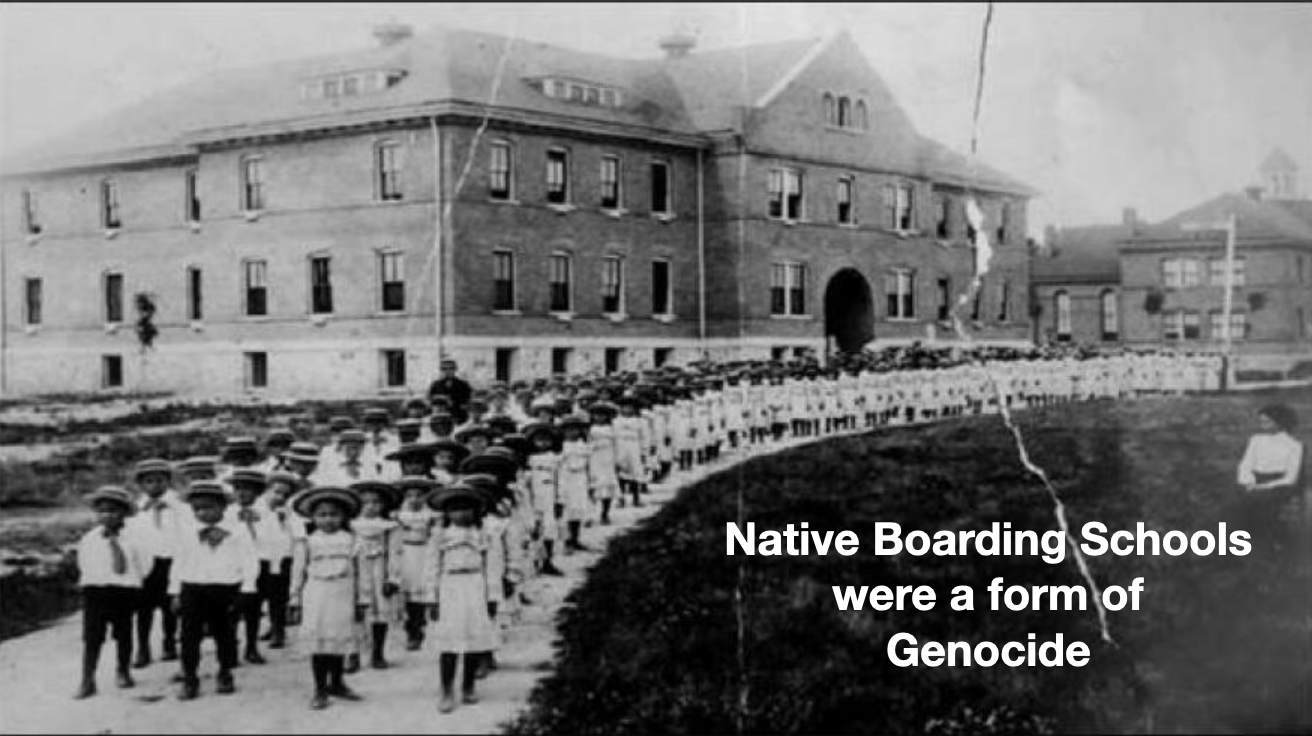 Last Monday, MLive reported that there is currently a bill in the State Legislature that would “encourage” public schools in Michigan to teach about the history of Native Boarding Schools.
The MLive article states:
Sen. Wayne Schmidt, R-Traverse City, introduced Senate Bill 876 in February in an effort to raise awareness about the history of Indian boarding schools in Michigan and encourage the State Board of Education to include the material in statewide curriculum standards.
Senator Schmidt goes on to say:
“It is important to recognize the fact that Indian boarding schools did exist in our state — even as recent as the mid-1980s. Working with tribal leaders, educators, and Indian boarding school survivors and their families, we introduced this legislation so we do not forget, nor repeat, this dark part of our state and nation’s history.”
Such an admission is encouraging, especially considering all of the pushback against Critical Race Theory across the country and in Michigan. Two of the major aspects of Critical Race Theory includes 1) the enslavement of Black people, followed by Jim Crow laws, and 2) the genocidal policies by the US government against Indigenous people.
It is interesting that if one reads the language of the proposed legislation, it is unclear how Native Boarding Schools will be presented in public schools. Those cited in the MLive article never used the term genocide when referring to the Native Boarding Schools. The language of the proposed legislation reads:
The state board shall ensure 25 that the recommended model core academic curriculum content standards for history for grades 8 to 12 include learning objectives concerning genocide, including, but not limited to, the Holocaust and the Armenian Genocide. The state board is strongly encouraged to ensure that the recommended model core academic curriculum content standards for history for grades 8 to 12 include learning objectives concerning Indian boarding schools.
The text acknowledges the Holocaust – referring to the 6 Million Jewish people murdered by the German government during WWII and the Armenian Genocide, but the word genocide is not directly connected to the words “Indian boarding schools.” This issue should not be in question, since Native Boarding Schools were a form of genocide, as is laid out in the 1948 Convention on Genocide. Article II of the Genocide Convention states:
In the present Convention, genocide means any of the following acts committed with intent to destroy, in whole or in part, a national, ethnical, racial or religious group, as such:
- Killing members of the group;
- Causing serious bodily or mental harm to members of the group;
- Deliberately inflicting on the group conditions of life calculated to bring about its physical destruction in whole or in part;
- Imposing measures intended to prevent births within the group;
- Forcibly transferring children of the group to another group.
Forcibly transferring children of the group to another group is exactly what both the State and Christian/Catholic Churches did to Native communities all across the country. Therefore, Native Boarding Schools should always be designated as a form of genocide.
I reached out to Joe Cadreau, an Indigenous activist in Grand Rapids, asking him to respond to this proposed legislation. He said:
I mean it’s great that they are bringing it, and it is a step, not the end game. But to deny it was genocide is a concern of mine. My only hope is that more people like me who go into the schools to do these presentations, continue to call it exactly what it was, a genocide.
They keep saying equity but only give us baby steps and tell us to be patient, I’m done being patient on this subject, you know? But I wonder if the whole vagueness is being used to not offend white feels, or to get the backlash that CRT is currently getting?
I also reached out to Senator Winnie Brinks to ask why she was co-sponsoring the legislation. As of this writing, I have not heard back from her office.
It is too early to know if this proposed legislation will pass and I highly doubt that it will be a priority for those who co-sponsored the bill. Plus, with all of anti-Critical Race Theory rhetoric and HB 5097, which essentially would ban Critical Race Theory from being taught in Michigan Public Schools. What is particularly instructive is that the anti-CRT legislation HB 5097 is exactly the same as SB 876, except for this one line:
The state board is strongly encouraged to ensure that the recommended model core academic curriculum content standards for history for grades 8 to 12 include learning objectives concerning Indian boarding schools.
The very fact that the proposed legislation to add teaching about Native Boarding Schools is essentially the same text that is used for the anti-CRT proposed legislation, demonstrates that State Legislators would at best want to water down the genocidal policies of the US government towards Indigenous people by never using the term genocide. If this legislation goes through it would be nothing short of revisionist history, or to more accurately put it, present history through the lens of Settler Colonialists.
A Brief history of Women-led Movements in Grand Rapids: Part I – The Women’s Suffrage Movement
(Editor’s Note: During the month of March, GRIID will highlight three Social Movements that were led by women in Grand Rapids. These three posts will be part of a chapter that will be included in the book, A People’s History of Grand Rapids.)
International Women’s Day
 International Women’s Day evolved out of a growing effort amongst women’s and socialist groups to fight for more equality for women at the end of the 19th century and the beginning of the 20th century.
In 1908, 15,000 women marched in New York City demanding shorter work hours, better wages and the right to vote. In 1909, the Socialist Party of America designated February 28 as the first National Women’s Day, which was to be celebrated on the last Sunday of every February.
In 1910, at the Second International Conference for Working Women, there was a proposal to have an international women’s day, where women around the world would press for their demands on the same day. The proposal was not adopted until the following year and International Women’s Day (IWD) was celebrated in several countries around the world. However, something happened just one week later that would galvanize this new international movement.
On March 25, a fire began at the Triangle factory in New York City. It was common practice for factory owners to lock the workers inside until the work day ended and because of that practice 140 women, most Jewish and Italian immigrants, burned to death in that fire. The international women’s movement, labor and socialist movements mobilized around the world to mourn these women and to organize for worker and women’s rights.
For years after the first, the Triangle factory fire became the focus of International Women’s Day and gave birth to the Bread and Roses Campaign. The Bread and Roses Campaign was begun by workers (mostly women) who went on strike at a textile factory in Lawrence, Massachusetts. This strike was organized by the Industrial Workers of the World (IWW) with the slogan, “We want Bread, but we want Roses too!”
The Grand Rapids Women’s Suffrage Movement
Just two years before Grand Rapids officially became a city, there was a large gathering of women being held in Seneca Falls, New York. Some historians identify the 1848 Women’s Convention as the beginning of the Women’s Suffrage Movement in the US.
However, abolitionist feminist Lucretia Mott suggests that the first women’s conference was held in 1837. The focus of the 1837 conference, also held in New York, was an Anti-Slavery Convention. The historian and author Helen LaKelly Hunt, argues that the 1837 Anti-Slavery Convention was the real origin of the modern Women’s Rights Movement, since those early suffragettes were equally committed to the end of chattel slavery as they were to women’s liberation.
In 1874, there was a campaign by the Michigan State Woman Suffrage Association (MSWSA) to get the Michigan legislature to adopt a referendum to allow women the right to vote. 1874, was also the year that the Grand Rapids Women’s Suffrage Association (GRWSA) was founded. The president of GRWSA was Judge Solomon L. Whitney, although some women did play a role on the leadership team.
A few months after their founding, the Grand Rapids Women’s Suffrage Association brought to town Elizabeth Cady Stanton, who spoke to an audience of 1,000 people at the Pearl Street Universalist Church on Pearl St.
In order to continue to build capacity to get Michigan to support the right of women to vote, local communities needed to increase their numbers. In 1880, Grand Rapids held its first Suffrage Convention, with delegates attending from across the state. Within the next year, the efforts of those fighting for suffrage was beginning to pay off, with the State Legislature granting some women the right to vote in local school board elections. However, this did not apply in communities with larger school districts, like Grand Rapids, which did not allow women to vote in school elections until 1885. In addition, women also won the right to run as candidates for school board.
The 20th Century began and women had still not won the right to vote in all elections. However, there was continued persistence, continued organization and fighting against the male-dominated political landscape. In 1908, at the State Constitutional Convention, women won the right to vote on bond measures and local taxation proposals.
In 1909, there was a major push to put women’s suffrage on the national stage, with Michigan Suffrage organizers vowing to collect 100,000 signatures from Michigan residents. Michigan women fighting for suffrage did not get the 100,000 signatures they had hoped, but they did secure 30,000, and sent delegates to Washington, DC to participate in a parade, which ended with a half a million signatures being presented to the US Congress.
In January of 1911, another attempt to win the right for women to vote was defeated in Michigan. A few months later, thousands of Grand Rapids Furniture workers went on strike, demanding better wages, better working conditions and the right to organize. In the midst of the strike, the Women’s Suffrage Movement invited English activist Sylvia Pankhurst. Pankhurst and many of the English women who were park of the Suffrage Movement, did not limit themselves to acceptable channels to make change. Even the news coverage of Pankhurst’s lecture, reported that she and others had engaged in various forms of direct action to force the British Parliament to deal with the issue of Women’s Suffrage. Diane Atkinson vividly documents the tactics and strategies used by the British Suffrage Movement in her powerful book, Rise Up Women! Other tactics that were employed were smashing windows at the British Parliament, fasting, hounding the liberal members of Parliament to take a stance on the issue, marches, and using targeted arson to force the issue. It is worth noting that the British Suffrage Movement won the right to vote in 1918, two years prior to their US counterparts. 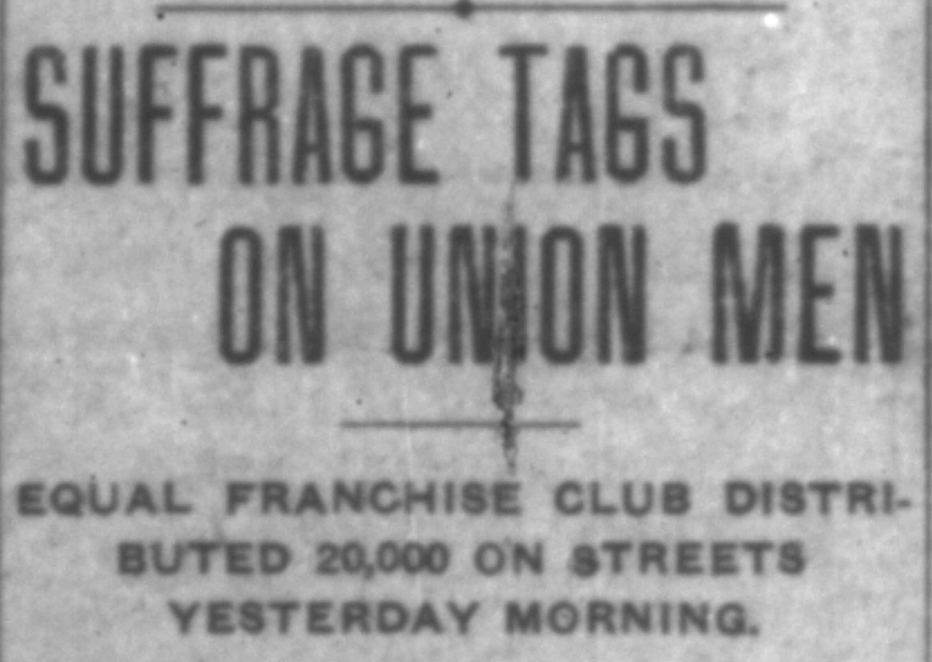
The Grand Rapids-based Suffrage Movement didn’t seem to embrace the more direct action approach to winning the right to vote, but they did eventually realize that they needed to build allies in the fight.
The Labor Day parade in Grand Rapids in 1911, involved 10,000 participants, with thousands more as spectators. The Labor Day parade was on the heels of a furniture workers strike, demonstrating there was substantial support for worker rights. Some of those in the Grand Rapids Suffrage Movement took notice of this and decided it would be a smart move to participate in the 1912 Labor Day march.
The Equal Franchise Club did indeed participate in the 1912 Labor Day parade, with a a float, that was fully decorated, with a banner that hung from the side, which said, “A Square Deal,” advocating fair wages for workers. In addition, about 40 women involved in the Suffrage Movement, handed out 20,000 tags to those in attendance, with one side saying “Votes for Women” and the other side with the same message as the banner on the float. The newspaper reported. “The suffragists met with a most encouraging reception from the men.”
As the Grand Rapids Suffrage Movement was growing in numbers and getting their message out, not everyone was welcoming to the idea that women should vote. Some Grand Rapids officials verbally opposed Women’s Suffrage, which included the City Attorney. In November of 1912, there was an election to allow women to vote in City elections, but more men voted against the giving women the right to vote over those that opposed. One of the leading sectors of men who voted against Women’s Suffrage, were men who were members of the Grand Rapids Christian Reformed Church.
Organizing continued in the following years, but in 1913, the Suffrage Movement was dealt a blow at the state level. There was also a major push for vote verification, which resulted in numerous counties, including Kent County, which saw a reduction of votes for Women’s Suffrage.
The US then entered WWI and many of the Women’s Suffrage groups, including those in West Michigan, decided to support the war effort and take an active part, particularly in the area of encouraging people to buy war bonds.There were some Women’s Suffrage groups that did not jump to aid in the US entry to WWI. The National Women’s Party came out against the war, which was met by a strong denunciation from the Grand Rapids Equal Franchise Club.
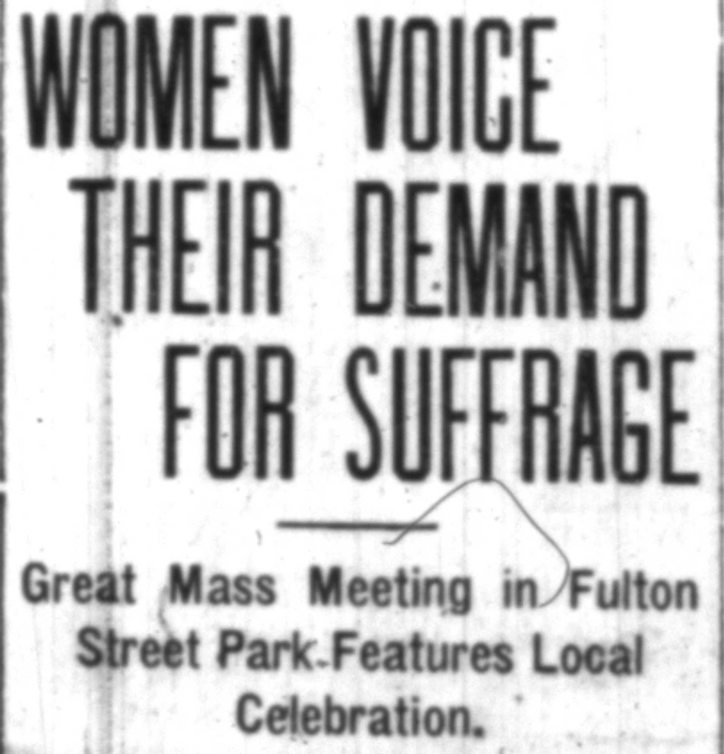
As WWI was winding down, the fight for Women’s Suffrage again took center stage, with a new vote in Grand Rapids in November of 1918. This time voters for Woman’s Suffrage won out. At the national level, the 19th Amendment was finally ratified in 1920. However, the ratification of the 19th Amendment did not mean all women could vote, just white women. As was mentioned earlier, had the National Women’s Suffrage Movement kept their original commitment to racial equality, along with gender equality, all women would have benefited. This has always been a major criticism of the Women’s Suffrage Movement in the US, which was essential a movement that benefited white women and created long-standing tensions between white women and women of color who did not trust that white women would have their back in all gender justice fights.
For more details on the Grand Rapids Women’s Suffrage Movement go to https://www.ggrwhc.org/suffrage-grand-rapids/.
Next week, in Part II, we will take a look at the Reproductive Justice Movement in Grand Rapids.

