On Friday, MLive ran an article entitled, GRPD training being questioned after Black man forcibly arrested despite police stopping the wrong vehicle.
The article details a recent arrest by the GRPD of a Black man who was on the way to his his mother-in-law’s wake. Several GRPD officers forced the man to the ground, put a knee on him and then cuffed him while he was face down in a parking lot.
However, the man the GRPD physically assaulted and arrested was the wrong person. The GRPD was looking for a Black man in a silver pick up truck and the man they ended up arresting also had a silver truck, but it was the wrong person.
Now, the Black man who was arrested was charged with resisting and obstructing a police officer, because “he was tensing his muscles in his arms.” Apparently, if the police force you on the ground and put their knees in your back, you should just relax, regardless of whether you committed a crime or not. Here is just another instance where the law supports police action, even if those actions seem to any reasonable person to be abusive, violent and just plain bullshit.
The Black man who missed his mother in-law’s wake, because he was arrested and taken to the Kent County Jail has every moral right to fight the GRPD for their wrongful arrest. However, the GRPD has the full force of the law behind them, since most laws are crafted from a pro-police framework and because the police will always be able to argue that they were justified in their actions, especially since the Black man they stopped fit the description of someone they were looking for.
The GRPD’s Internal Affairs is looking at the case, but will most likely side with the officers who falsely arrested this particular Black man, especially since he was tensing his muscles when they were trying to cuff him. The police were just doing their job and this particular Black happened to be in the wrong place at the wrong time, or at least this is what the GRPD would have us believe.
Besides, the GRPD was quoted in the same MLive article, stating:
“The GRPD continues to be dedicated to transparency and accountability regarding police operations, particularly when it comes to using force. When it is appropriate, and allowable under law, we are committed to providing full context to our encounters and answering the community’s questions and concerns.”
This rhetoric sounds nice, but the important point here is to understand what is allowable under law. The GRPD can keep as much information as they want in house and can decide what to share or not share with the news media, with the Office of Oversight and Public Accountability or anyone else for that matter, because the law works in favor of protecting the state and the police are just an enforcement unit for the the state, meaning the government.
Therefore, the Black man who was assaulted by the GRPD, arrested and taken to jail, doesn’t have the force of law behind him. The GRPD charged him with resisting arrest and obstructing a police officer, which by their definition is true. So, do you see how the system works here. Even if you did nothing that was illegal, as defined by the government, you can still get arrested for looking like a suspect. Plus, in the process of being arrested, if you resist, even though you did nothing illegal, you can be charged with a crime because your muscles tightened up while 3 cops forced you face down, on the ground and put their knees on your back.
Now, Kent County Commission Robert Womack is questioning how officers in the GRPD and being trained. What Commissioner Womack fails to understand is that this is exactly how the cops in the GRPD were trained and that the over policing in Black and Brown neighbors is the norm. Alex Vitale, author of the important book, The End of Policing, writes:
Well trained police following proper procedure are still going to be arresting people for mostly low-level offenses, and the burden will continue to fall primarily on communities of color because that us how the system is designed to operate – not because of the biases or misunderstanding of officers.
This is how the system of policing is designed to function. For the GRPD, it doesn’t matter that they stopped the wrong Black man, what matters is that they were doing their job and the wrong Black man still arrest arrested because he tightened his muscles while 3 cops were forcing him to the ground and putting their knees in his back.
Of course, the lesson we should learn from this case is that the system of policing is inherently oppressive, which is exactly why people are calling for defunding and the abolition of the system of policing, because it is a system of oppression. The GRPD and City officials can say that they are committed to re-imagining policing in Grand Rapids, but that is only because they are committed to maintaining the existing systems of power and oppression in this community, despite their well-meaning intentions. If you think that getting the right people elected to the Grand Rapids City Commission will fix this, then you don’t understand how power functions in this city. Only a popular, grassroots social movement that is calling for the defunding of the GRPD, a deep commitment to invest in Black neighborhoods and the abolition of policing will put an end to the GRPD assaulting and arresting more Black people.
Papers not crumbs: Interview with Movimiento Cosecha GR after their action in Washington DC
Last weekend, Movimiento Cosecha GR took two bus loads of people to Washington, DC to make the same demands of the Biden Administration as they did for the Trump Administration.
Movimiento Cosecha is demanding Dignity, Respect and Permanent Protection for all 11 million undocumented immigrants currently in the US.
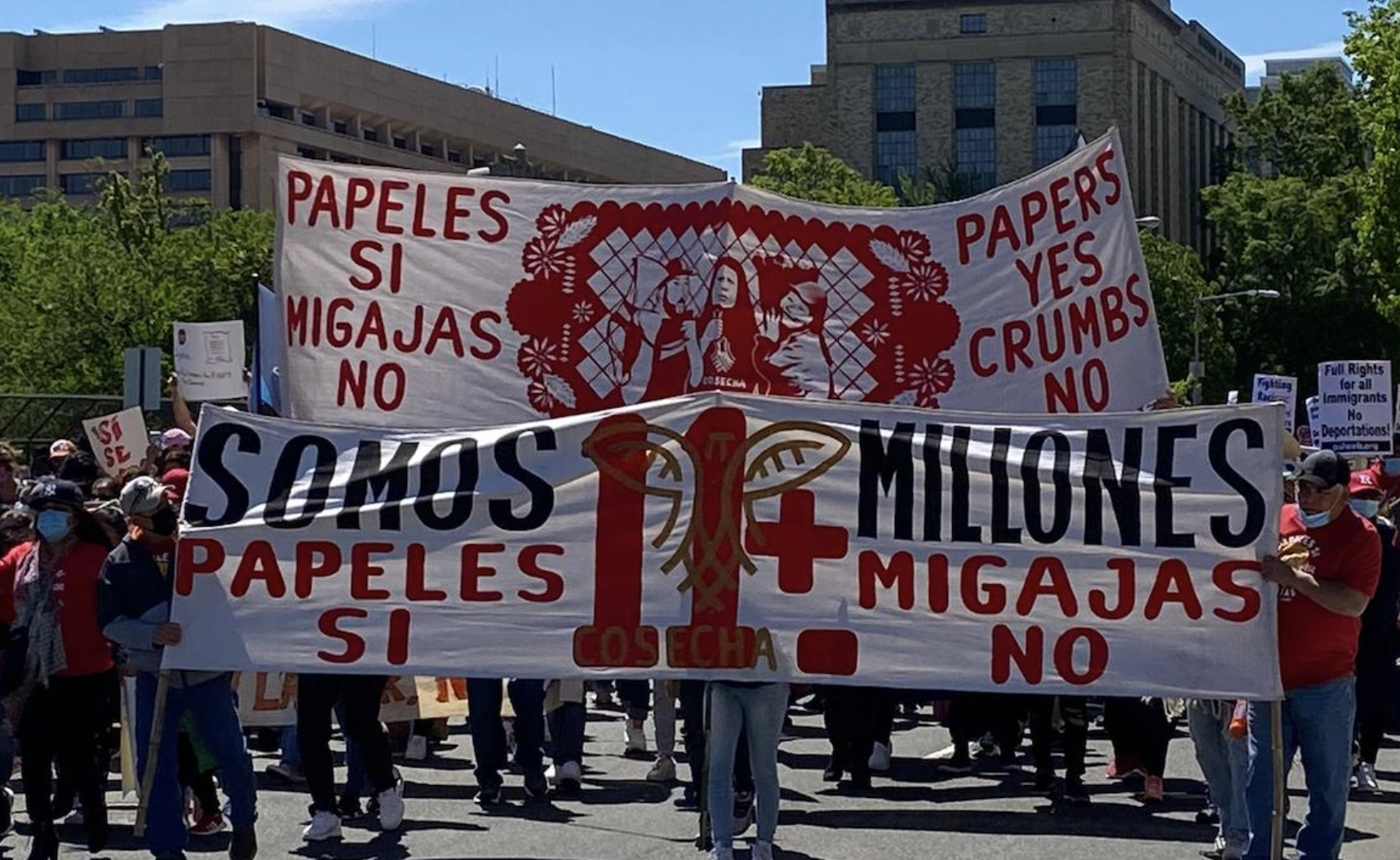
The motivation to go to DC was to make clear that like the previous US Administrations, after the first 100 days in office, the Biden Administration has not looked much different from what immigrants were experiencing under Trump.
We sat down with two of the Cosecha GR organizers, Gema and Idalia, both of who went to DC last weekend. We asked them four questions: 1) What was the main focus of going to Washington DC, since during the past 4 May Days, the actions have been local; 2) What kind of actions did you organize and take part in during the two days in Washington, DC; 3) There has been a clear drop in attention and support by the ally community since the November Election, what message do you have for allies about why it is important to continue supporting the immigrant justice movement; and 4) Those who went to DC were very energized, so how do you maintain that kind of energy and how do you get more people involved for the fight ahead?
During the interview, Gema responded in English and Idalia responded in Spanish, however both of these courageous organizers had powerful things to say. The interview is just under 16 minutes.
Yesterday, the grassroots groups Defund the GRPD and Justice for Black Lives, held a Press Conference at noon, inviting dozens of Grand Rapids-based news agencies.
The Press Conference by two of the groups that came out of the aftermath of the May 30th uprising in Grand Rapids, focused on the 2022 Grand Rapids City Budget proposal, how much the GRPD would receive and the undemocratic budget proposal process.
Unlike previous Press Conferences that Defund the GRPD has organized, both in person and online, yesterday’s Press Conference only had representatives from the Grand Rapids Press, WZZM 13 and WOOD TV 8. It’s always hard to know what drives local news coverage, but one would think that with the second largest city’s 2022 budget being decided upon in a few weeks and a well organized movement calling for defunding of the GRPD, the Press Conference would definitely be news worthy.
A representative with Justice for Black Lives spoke first, followed by someone with Defund the GRPD. Both speakers addressed the violent practices of the GRPD and Defund the GRPD laid out some clear demands (linked here) regarding funding for the GRPD and the City’s budget process.
After the comments made by organizers, there were only three questions asked by the reporters who took part in the Press Conference. The first two question came from a reporter with the Grand Rapids Press, which was followed by a question from WZZM 13. All three questions that were asked were basic questions or questions that still reflected the idea that the GRPD is becoming “more community minded.” For example, the first question asked by the GR Press was, “Does the GRPD Strategic Plan sufficiently re-imagine policing?”
The responses from organizers were solid, but the point here is that the question implies that the GRPD is on the right track. We have seen this over and over again over the years, but especially since the May 30th uprising, where the local news acts either as a PR agent for the GRPD or they act as stenographers, just reporting back what the police said, without questioning or verifying the claims made by the GRPD.
The lack of critical thinking was reflected in the three news stories about the Press Conference that each of the news agency that attended the Press Conference posted yesterday.
In each of the three news stories the stories still utilize City official comments, like the WZZM 13 story, which includes a comment from Mark Washington, recycles previous related story content – as did MLive, or reflects that the news agencies have internalized the values of the systems of power that they report on, like how WOOD TV 8 framed their story. In other words, the dominant commercial media demonstrates a lack of imagination about how reducing the GRPD budget might actually be a huge benefit to the community.
In fact, the dominant commercial media is pretty much incapable of critically examining systems of power and oppression in this community, mostly because they are part of the Grand Rapids Power Structure, as we noted in our ten-part series from 2018. In that article we made the following observation about police and the dominant commercial media:
Another example is how the news media reports on police abuse, or more accurately, mistakes made by a few officers in the police department. The GRPD or any other local law enforcement agency is general presented as serving the public good and when there are issues that arise, it is usually just some aberration, since they are essential to public safety. In other words, the very nature and function of the GRPD is never questioned or investigated, despite the significant levels of mistrust and cynicism that exists in this community about police behavior and how policing impacted particularly Black and Brown residents.
Sitting through yesterday’s press conference only affirms my view that the local dominant commercial news media is incapable of reflecting the aspirations of those working towards dismantling systems of power in this community, particularly since these news agencies are part of that power structure.
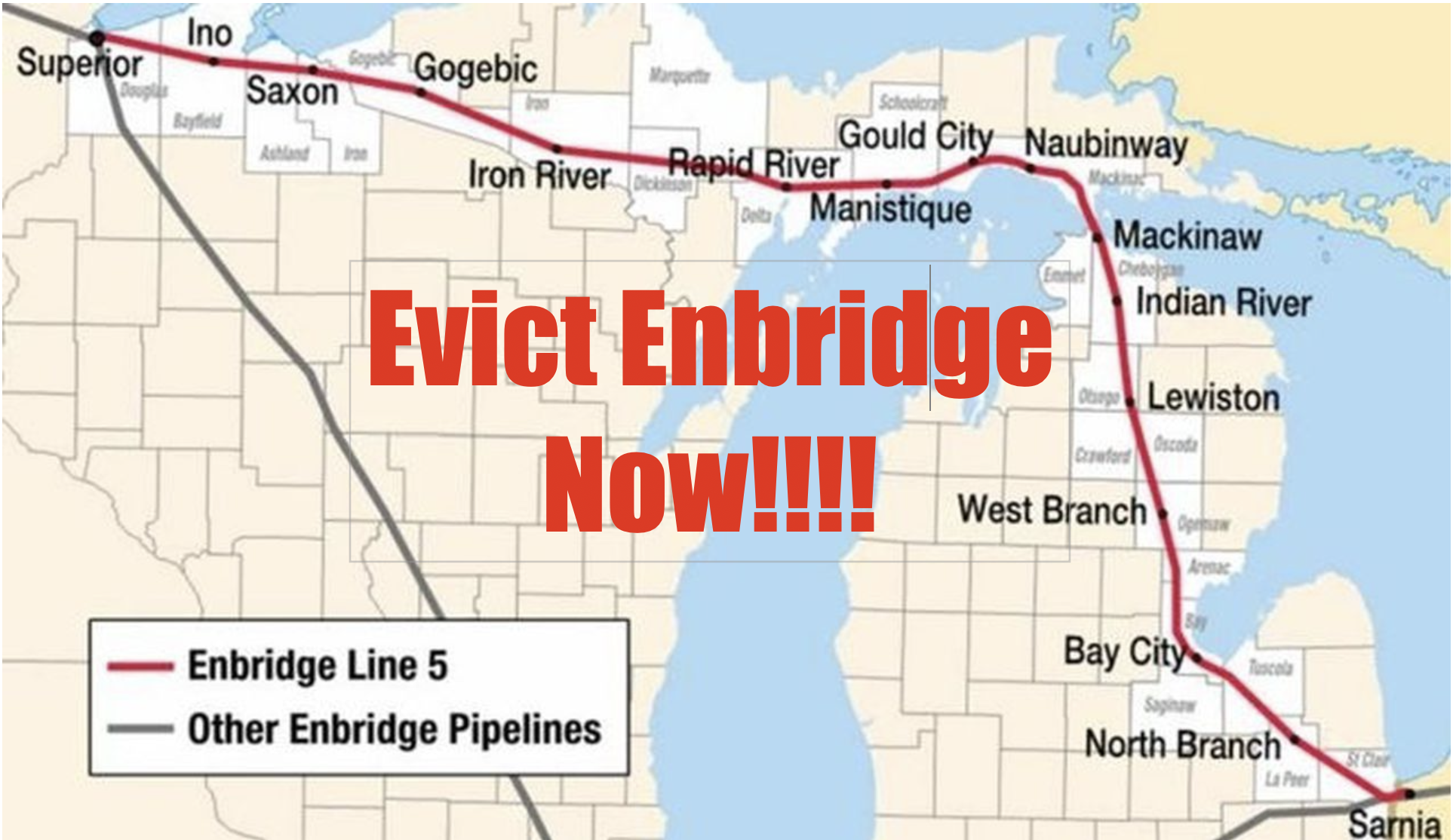
In the coming days, there will be actions against the Enbridge Line 5 oil pipeline in both Lansing and in northern Michigan.

Indigenous Water Protectors sent out a media release recently, that states:
Great Lakes Water Protectors are organizing peaceful gatherings at the Line 5 transfer sites of McGulpin Point Lighthouse at 500 Headlands Rd in Mackinaw City and at Point Labarbe at W706 Boulevard Dr. St. Ignace. Line 5 runs under the Straits of Mackinac, just west of the iconic Mackinaw Bridge.
In November of 2020, Governor Whitmer and DNR Director Eichinger, on behalf of the people of Michigan, revoked and terminated the 1953 Easement Permit allowing only 180 days of oil and natural gas liquids to flow thru pipeline 5 in the Straits of Mackinac. That date falls on May 12th, 2021. Times Up!
Water Protectors, Tribal Citizens and Grassroot Organizations are mobilizing to demonstrate support for Governor Whitmer and DNR Director Eichinger’s termination of the 1953 easement permit. Great Lakes Water Protector’s would like to invite the ALL Sovereign Tribes of the Great Lakes region and ALL State Officials from the Executive Office, Governor’s Office, EGLE, State and Federal Congressional and Senate Delegations. Tell the citizens of this State how OUR REPRESENTATIVES plan to proceed with Enbridge’s unwillingness to uphold the decision of the State.
This peaceful call-to-action will begin early morning of May 12 at McGulpin Park near the south side transfer station, 1pm there will be a time to “Speak for the Water” and the day-long observance will conclude with a potluck feast at 4pm in the park.
If you are unable to join this gathering on May 12, there is another opportunity on May 13th in both Lansing and Mackinaw City. The group Oil & Water Don’t Mix is inviting people. May 13th is the official deadline for the Enbridge Corporation to stop using their Line 5 pipeline.
The actions in Lansing and Mackinaw City are in essence an eviction notice for Enbridge, who will be illegally operating Line on May 13th. Enbridge has spent millions on advertising against Gov. Whitmer’s attempt to shut down Line 5, they have spent millions more on lobbyists and they are not attempting to get the government of Canada to defend their interests. Oii & Water Don’t Mix writes, “regular people are always required to obey the law or face consequences, but Enbridge thinks that their money buys special privileges, including the ability to violate state law with impunity. Well, we aren’t just going to sit by quietly while Enbridge keeps our Great Lakes at risk.”
If you are unable to join the action in Mackinaw City or Lansing on May 12 & 13, at least sign the petition that is demanding that President Biden support Gov. Whitmer’s call to decommission Line 5.
In addition, the Indigenous Water Protectors are asking for financial support for food while they camp out in Mackinaw City for a few days. If you are able to donate, send money here https://www.paypal.me/waterprotectors.
Last Thursday, MLive post an article with the headline, Grand Rapids mayor, manager hosting virtual town hall to talk 2021-2022 spending plan.
The proposed Grand Rapids City Budget for 2022 is a document that is 428 pages long and is not an easy read. (Linked here) The public will have to read the 428 page 2022 Grand Rapids City Budget before this Thursday, May 6th, if they want to make an informed comment about the 2022 Budget during the 1 hour virtual town hall meeting that the City is hosting. However, if you read the MLive article, it’s as if the City is doing us a favor by hosting this town hall.
The MLive article does state that there will be other opportunities to weigh in on the City’s budget”
Community members can give public comment and feedback at two of the city’s budget work sessions: one at 9 a.m. on May 4 and the other at 1 p.m. on May 11.
There are also opportunities to comment at the commission’s regular 7 p.m. meeting on May 11, as well as the public hearing on the budget at the commission’s 7 p.m. meeting on May 18.
A last opportunity for comment will be at the commission’s special meeting 9 a.m. May 20, when elected leaders are slated to approve the finalized plan.
While some might think that these other opportunities are important, they are marginal at best. Three of the 5 additional opportunities happen during the day, when most people are at work. Calling in to comment during the regular City Commission meeting is better, but still limited, since we don’t yet know if the public comment will be at the beginning of the meeting or at the end. If public comment is at the end, then people might not be able to weigh in on the 2022 City Budget until 8 or 9pm. For those who work during the day and need to get up early and for those who have children, staying up that late on a week night can be difficult, especially since people are only given 3 minutes in which to speak.
The public hearing on May 18 is the next best opportunity besides the town hall on May 6, but again, people will only have 3 minutes to speak on how they want their tax dollars to be spent by City Officials.
Even if people were able to attend and participate in all 6 meetings between now and May 20th, when City Officials will vote on the 2022 City Budget, that still only give people 18 minutes to be able to articulate their concerns and provide input on the already created 428 page 2022 Grand Rapids City Budget.
If people really believe in a democratic process and really want the public to be central to the policies that are voted on by elected officials, then this process is nothing more than a cruel joke. It is particularly cruel right now, especially since there have literally been thousands of people weighing in on the amount of money that the GRPD receives each year, along with how we are faced with a series housing crisis in this city. You could also add that there are thousands of families still deeply impacted by the COVID pandemic, the structural racism that permeates this city and the climate crisis that threatens all of life. So yes, giving people just a few minutes to weigh in on how their tax dollars are spent is a cruel joke.
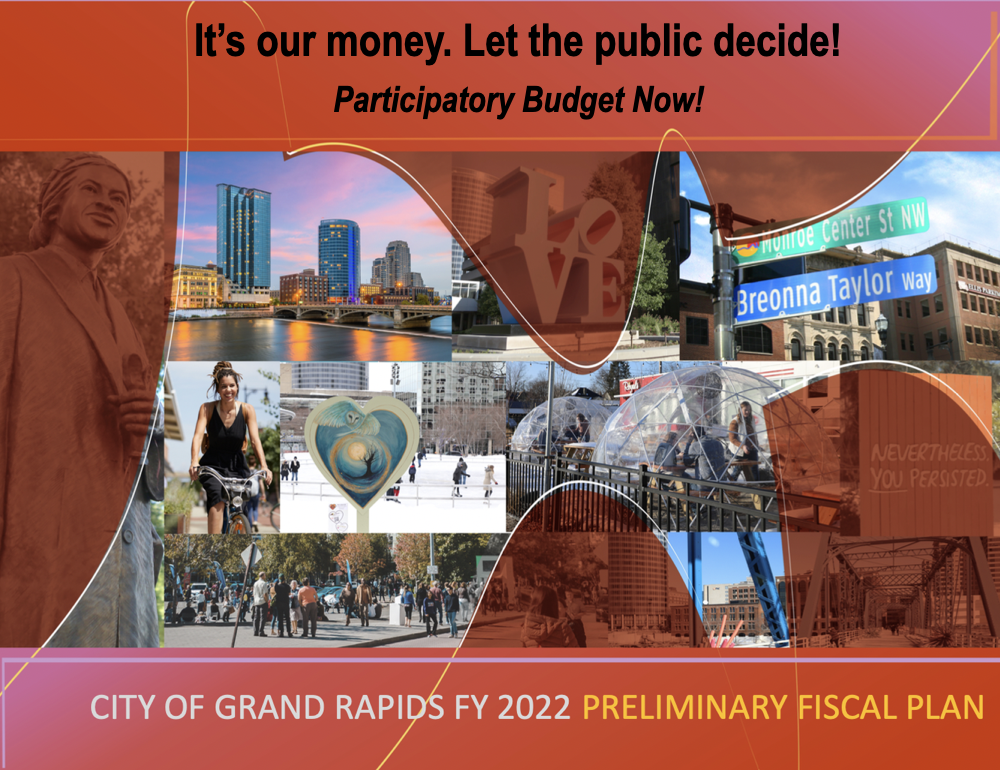
The City’s budget will determine where public tax dollars go and how they will be used, so shouldn’t the public have more time and have just as much say as City Officials? This is why we so desperately need to adopt a participatory budgeting process in Grand Rapids, a process that is more democratic and involves as many people who want to participate. In addition, people would be making these decisions and providing input over a year long process, instead of being invite to weigh in at the last minute on a budget that was already crafted. Check out the resources at the Participatory Budgeting site and let’s get organized to demand that the City of Grand Rapids adopt such a process or we will disrupt business as usual with all kinds of Direct Action!
For right now, I would encourage people to check out the information and actions that Defund the GRPD has going on over the next 2 weeks, which challenges the status quo are funding priorities for the City of Grand Rapids.
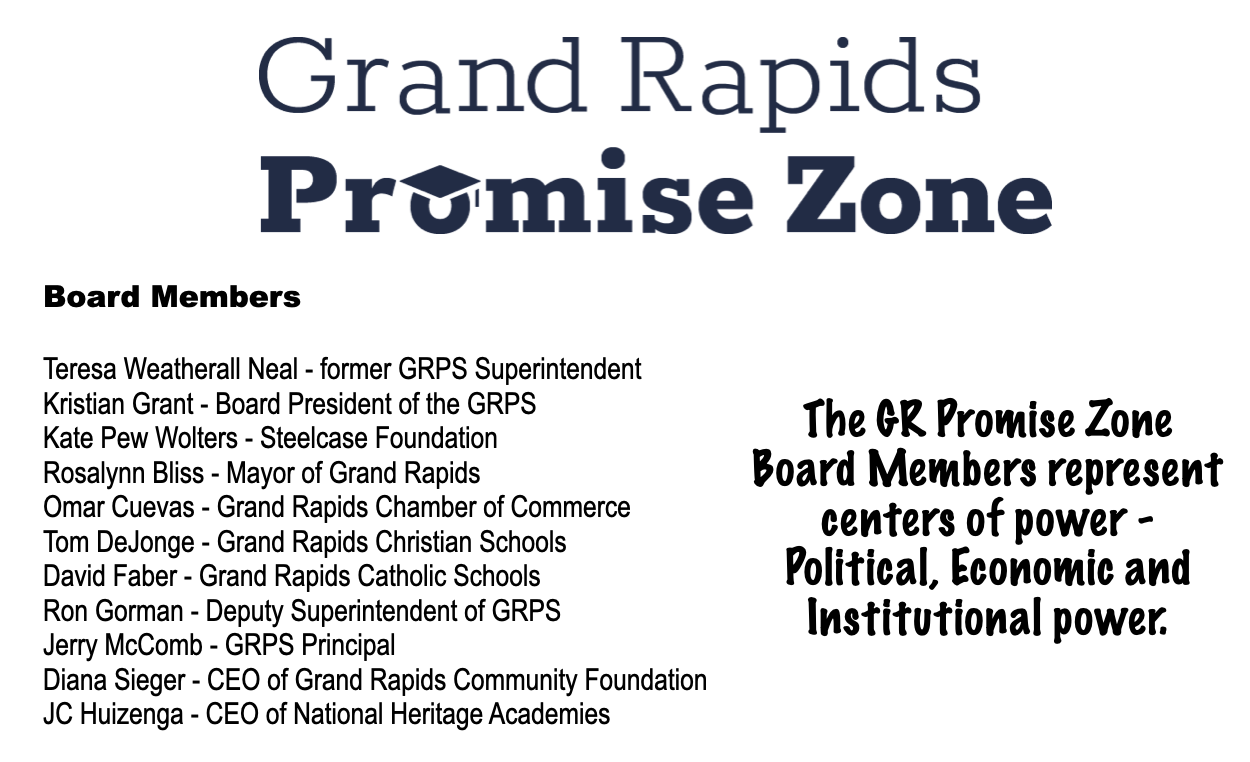
A few days ago, there was a video of a late April meeting of the Board of Directors for the Grand Rapids Promise, which you can watch here.
The Grand Rapids Promise was created in 2019, just as Teresa Weatherall Neal was stepping down as the Superintendent of the Grand Rapids Public Schools.
What grabbed people’s attention about this board meeting, was a question asked by board member JC Huizenga, then the response by Teresa Weatherall Neal. (around the 45 minute mark)
JC Huizenga asks the questions, “what does BIPOC stand for?”
Teresa Weatherall Neal says, “It’s just another name for non-sense, JC.”
JC Huizenga then asks, “I’m wondering, does this discriminate against Asian people, Jews who aren’t wealthy or Syrian Refugees?” All the while Weatherall Neal is shaking her head in affirmation of Huizenga’s comment.
Weatherall Neal talks about how she had to deal with the term BIPOC while she was GRPS Superintendent. “Black signifies all people from Africa. So everyone is lumped together.”
Now, these comments are offensive on so many levels, which people have been pointing out on social media. The comments from Huizenga and Neal are racist, anti-semitic and they demonstrate a complete lack of understanding of the importance of the use of the term BIPOC, which stands for Black, Indigenous and People of Color.
However, in addition to the racist comments that were part of the Grand Rapids Promise board meeting in late April, there is other important contextual information we think is important to share.
First, JC Huizenga is the CEO of the Charter School company known as National Heritage Academies, a Grand Rapids-based company that runs Charter Schools in 9 different states across the US. So how is it that the CEO of company that education focused not know what BIPOC means?
In addition, JC Huizenga is a member of the Grand Rapids Power Structure. Huizenga is a major contributor to the Republican Party, both at the state and federal level. The National Heritage Academies CEO also sits on the Board of Directors of the West Michigan Policy Forum, which seeks to influence public policy at the state level; plus Huizenga sits on the Board of Directors of the two major far right Think Tanks in Michigan, the Acton Institute for the Study of Religion & Liberty, and the Mackinac Center for Public Policy.
Second, it is important for this community to know that during her tenure as the Superintendent of the Grand Rapid Public Schools, Teresa Weatherall Neal not only pushed the school district to adopt a more business-friendly approach to education, plus under her leadership the structure of the GRPS created a two-tiered system of education where certain schools committed to students with promise, while other schools essentially were designed to cater to students who would not go on to college. Most importantly, Teresa Weatherall Neal did all of this under the tutelage of Betsy DeVos. In fact, Neal was the only school superintendent that went to Washington DC to be part of the swearing in ceremony for DeVos, when she became Secretary of Education in the Trump Administration.
Lastly, it is important to point out that while JC Huizenga was asking what BIPOC meant, and after Teresa Weatherall Neal repeatedly referred to the term as “nonsense”, none of the other board members of the Grand Rapids Promise spoke up or objected to the White Supremacist language that was being used during the board meeting. Grand Rapids Mayor Bliss said nothing, the head of the Grand Rapids Community Foundation Diana Sieger said nothing, the head of the Grand Rapids Catholic Schools – David Faber said nothing, GRPS Board member Kristian Grant said nothing, and Kate Pew Walters said nothing!
As Dr. King once said, “Silence is the voice of complicity.”
The Acton Institute for the Study of Religion and Liberty, which is a far right think tank dedicated to defending free market Capitalism, engaged in some extremely petty commentary recently.
On April 21st, Dan Hugger, who is a research associate with the Acton Institute, posted an article on the Acton blog entitled, The free market vs the Really Really Free Market.
Early on in the article, the Acton writer states:
“I am the last person in the world to critique people’s impulses for generosity and acts of charity. But the characterization of this as a “market” strikes me as a bit odd. Markets are traditionally understood as places where individuals, in the words of Adam Smith, “truck, barter, and exchange one thing for another.” Free markets are not free not from prices but from constraints, regulations, and other hindrances to human action … rather than free in the sense of, say, “free beer.” Markets are the hubs of networks of specialization and trade where people voluntarily exchange their own unique time, talents, knowledge, and services with others for their own gifts, creating value for themselves and their communities. They serve a coordinating function to generate both individual and social well-being.”
Hugger saw the poorly written article on MLive, about the Really Really Free Market, which is what he was basing his response on. Despite the Acton Institute’s condescending tone about what markets are, he fails to completely miss the point about what the Really Really Free Market is all about. His lack of understanding about the RRFM is compounded by the use of a Salvation Army image for the article, which confirms his belief that the RRFM is nothing more than charity.
The Really Really Free Market (RRFM) has its origins during the early years of the anti-globalization movement and is part of the DIY & anarchist growth of the period that began in the 1990s. The RRFM is inherently an anti-Capitalist activity where people bring items that they no longer want/need to a designated location, where anyone who comes may take what people have brought. The idea is that we can share resources with each other to get some of the things we need, without having to participate in the larger consumption-driven Capitalist Culture. Sprout Distro has a really good zine that explains what the Really Really Free Market is all about.
The Acton writer thinks that the Really Really Free market is charity, which is not the case at all. The RRFM is one way that people can support each other, but it is also a way of expanding people’s radical imagination to say, “maybe there are other ways we can take care of ourselves that don’t rely on this thing called the free market,” which is certainly not free.
The Capitalist free market is harsh, with all sorts of negative consequences, like labor exploitation, environmental degradation, and the growth of the wealth gap. Millions of people are in debt under the free market system and millions more have died at an early age because of a lack of regulation, over work, exposure to toxins, etc. This is exactly why it’s called the Really Really Free Market, because it’s free. There is no monetary cost to participate and the external costs are minimal – people driving to the location.
However, the far right think tank known as the Acton Institute, which holds international conferences and has access to power – state, private and religious power, felt it necessary to reject and criticize one of the few activities that DOES NOT rely on free market Capitalism. Was the Acton Institute writer threatened by the RRFM or did they just not have a clue as to what it is? It’s hard to say for sure, but we do know that the Acton Institute has been a staunch defender of Capitalism since its founding in the early 1990s and they will do anything to suppress any alternatives to the free market, especially in Grand Rapids where the members of the Capitalist Class are praised constantly.

West Michigan Foundation Watch: The Peter & Joan Secchia Family Foundation’s deceptive charity
When Peter Secchia, a member of the Grand Rapids Power Structure, died last fall, we wrote a story that was completely counter to what the dominant commercial news agencies reported.
We pointed out that Secchia used his wealth and his role in the Republican Party to engage in a great deal of harm – harm against workers, harm against women, harm against immigrants, harm agains Black people and harm against the LGBTQ community.
We also pointed out that Secchia was an early supporter of Donald Trump in his bid to win the presidency in 2016. In fact, Secchia pressured other high profiled Republicans in the country and in West Michigan to get behind the candidacy of Donald Trump.
It is in this context that we write about the Peter & Joan Secchia Family Foundation.
Compared to the DeVos Foundation the Secchia Foundation is smaller, with $11 million in assets. The Secchia Foundation also doesn’t fund the far right in the same way as the DeVos and Prince families do, although they do contribute annually to groups like the American Enterprise Institute and the Manhattan Institute.
Their larger foundation contributions mostly go to higher ed, like Michigan State University, Davenport, GVSU, or entities like the Helen DeVos Children’s Hospital and the Grand Rapids Community Legends project, which put in most of the statues in the downtown area in recent years.
Then there are the numerous small Secchia Foundation contributions that go to little projects like Mel Trotter Ministries, the Community Food Club, Blandford Nature Center and First Steps. The benefit in giving to these local non-profit endeavors is that its great PR for the Secchia Foundation. It also means that these non-profits will not be critical of the larger funding impact of the Secchia family, particularly their political funding of the Republican Party.
We can’t afford to be fooled by the so-called charity work that the Secchia Foundation contributes to, when the political work they fund supports public policy that creates the types of inequality that often result in people having to utilize the services of places like Mel Trotter or the Community Food Club, which is for Heartside residents. We have to resist the temptation to give local foundations are free pass, and instead see the larger picture about how wealth is used to manipulate, control and pacify people in this community.

On Monday, the Grand Rapids Police Officer’s Association (GRPOA) released a statement in response to the critical news coverage of GRPD officers repeatedly punching a man after pulling him out of his car.
The statement by the GRPOA is in many ways a pathetic and desperate attempt to claim that they are the victims of media propaganda. The statement, which you can read here, includes cut and paste headlines about the incident the GRPOA was responding to.
The claim that the news media had already decided what had happened to the person the GRPD pulled out of a car and punched repeatedly. The GRPOA used the phrase, “biasedly slanted against the GRPD” and then went on to say, “in their coverage of a video that was questionably leaked on social media.”
The GRPOA statement continues to lament the biased coverage and claims that the news media used this incident to fan the flames of national rage in order to get “clicks.”
What is overwhelmingly missing from the cop union statement is the fact that no where do they offer their version of what took place. In other words, the GRPOA offers no credible evidence or facts that dispute the news media’s biased coverage.
Instead of offering their perspective on what happened, the GRPOA ends their statement with a a thank you to people who in the community that have supported them, along with an appeal to those same community members to contact local elected officials to let them know that they support the GRPD.
It is instructive that the Grand Rapids Police Officer’s Association makes a point of saying, “we strive to publish our accurate and timely information, highlight our positive stories and help manage our image and brand.” Edward Bernays would be proud of of the GRPOA laying claim to managing their image and brand.
As for their tirade against the local news media, it is interesting that just since the May 30th uprising, when there has been increased scrutiny of the GRPD, that almost every story about the GRPD has been positive, especially all the fluffy news stories about cops hanging out with kids. It’s as if the GRPOA expects the news media to only report on their behavior in glowing fashion.
What we have been documenting about the GRPOA in recent years, provides a much different perspective, which we list here:
The GRPOA wants people to contact elected officials, but fails to mention that they have given thousands of dollars to local candidates, specifically Mayor Bliss and 1st Ward Commissioner Jon O’Connor.
In March of 2019, the Command Unit of the GRPOA complained that City officials were too conciliatory towards immigration protestors and that the cops wanted to arrest protesters during the May 1st, 2018 march.
In a July 2019 statement, the GRPOA claimed that they were underfunded, understaffed and that the Stop the Violence rallies did nothing to stop violence.
In August of 2019, the GRPOA Command Unit complained about the 2 day suspension of Captain Kurt VanderKooi, even though he contacted ICE on a Jilmar Ramos Gomez who VanderKooi thought was an undocumented immigrant, when in fact he was a former US Marine.
In July of 2020, the GRPOA contributed to and endorsed the far right Congressional candidate Tom Norton.
In December of 2020, the GRPOA began a campaign to encourage people to call City officials to oppose defunding the GRPD, using both billboards and a website.
In March of 2021, the GRPOA blocked several reform proposals from the Grand Rapids Police Department, specifically the attempt to transfer work from “sworn officers to non-sworn in staff.”
This most recent statement from the Grand Rapids Police Officer’s Association, is just the latest in a long line of weak attempts to avoid taking responsibility for their behavior, particularly their behavior towards Black and Brown residents in the City of Grand Rapids.
The Devil is in the Details 4/28/2021: Grand Rapids Legislative Agenda prioritizes the business class over everyone else
This is our latest installment of The Devil is in the Details, which takes a critical look at Grand Rapids politics and policies, based primarily on the public record, such as committee agendas and minutes.
Yesterday, we posted Part I of the most recent addition of The Devil is in the Details, with a look at the GRPD’s claims to protect free speech. Today, we want to take a critical look at the City of Grand Rapids Legislative Agenda for the coming year.
The City’s Legislative Agenda can be found on pages 23 – 27 in the Committee of the Whole’s Agenda Packet for the April 28th meeting.
The City’s legislative Agenda is prefaced by a page and a half of commentary, but we thought that the following portion was worth sharing, since it provides a rational and a framing statement about what the City’s Legislation Agenda is all about:
“The purpose of the legislative priority agenda is to clearly outline the position and interests of the City on priority issues and matters that impact the City’s ability to operate effectively, while allowing additional legislative and budget issues that arise during the legislative session. The proposed legislative priority agenda will promote the City’s vision to strive to be nationally recognized as an equitable, welcoming, innovative and collaborative city with a robust economy, safe and healthy community, and the opportunity for a high quality of life for all.”
The document for the Committee of the Whole meeting lays out the Top 4 Legislation priorities for the City, with numerous priorities under each of the four areas, which we will critique one at a time. Our comments will be in italics.
I. Fiscal relief, sustainability and economic recovery investment including:
- Income tax policy reform – with this include promoting a tax policy that taxes millionaires and billionaires, which would alone provide enough revenue to fund numerous sustainable projects, like affordable housing.
- Tax policy that enhances local revenue options
- Reforms to revenue sharing and municipal finance
- Permanent extension of social district enabling legislation
- Restore Headlee’s original allowance for upward and downward
fluctuations in millage rates based on actual inflationary activity to allow Proposal A and Headlee to work as intended.
These tax policies, particularly those that address municipal revenue sharing, are important, in that municipal revenue sharing has been reduced for decades, primarily because of the Neo-liberal economic policies that have been adopted since the Blandford administration in Lansing. These Neo-liberal policy adoptions have followed the model that has been in place since the Reagan years and they have been supported by both the Republicans and Democrats. These kinds of policies have led to Michigan imposing an Emergency Manager form of government on several municipalities throughout the state, particularly during the Snyder administration. The Snyder administration also made municipal revenue sharing conditioned on municipal governments adopting even more draconian Neo-liberal economic policies, particularly the elimination of certain public sector employee benefits and the privatization of previously public services.
- Local options and tools to support increased housing and ensure all residents have safe, stable and permanent housing. This should include amending the Land Bank Fast Track Act to allow a city not located in a county with a county land bank to establish a local authority or land bank. – What Grand Rapids has done on safe and affordable housing has been grossly inadequate, despite their rhetoric about equity.
- Public safety policy and investments that advance safer communities, transparency, and positive community relationships and trust, with an emphasis on:
- Responsible criminal justice reform; and – what do they mean by Responsible criminal justice reform? What the City of Grand Rapids needs to embrace is a Prison Abolitionist perspective.
- Investment in safe neighborhoods and police relationships. – The City continues to insist that their needs to be more trust between residents and the GRPD, but fail to acknowledge that the GRPD continues to harass, intimidate, brutalize and arrest a disproportionately high number of Black and Brown residents. This is why so many people are advocating to Defund the GRPD.
IV. River restoration and revitalization project. – This is just a continuation of White Settler Colonialism.
In the City’s Legislative Priorities Agenda, they continue with 7 points about how this agenda will promote sustainability and equity.
2. That in furtherance of our City values and strategic priorities, we have also prioritized legislation, public policy and investments that are sustainable and equitable as follows:
1) Encouraging, advocating and supporting legislation that promotes equity, diversity and inclusion for all. – this would be a good thing, but the City continues to demonstrate that they don’t practice this based on the number of families that live in poverty, the recent treatment of homeless people in the Heartside area, the GRPD’s constant attacks against protesters, and the continued massive subsidizes of business interests and developers with public money……just to name a few.
2) Preserving local authority as stated in the Home Rule City Act, PA 279 of 1909, particularly in the areas of planning, zoning, and public works projects.
3) Continued collaboration on reforms for the betterment of all residents including:
- a) Prevention of child lead poisoning & exposure; – again, this is a good things, but not enough funding has been put towards this.
- b) Acknowledging racism as a public health crisis and supporting policies and
opportunities to dismantle structural racism and achieve health and social
equity; – also a good thing in principle, but what will it look like in practice? The data on Black, Brown and Indigenous communities in Grand Rapids is a reflection of the fact that Structural Racism is deeply entrenched in this city and those that benefit from it, particularly those who have the most power, will fight back against any substantive changes that are proposed when acknowledging that racism is a public health crisis. - c) Restoring and maintaining Michigan’s infrastructure; – again, this is a matter of priorities. The US has the largest military budget in the world, yet infrastructure in the country is deteriorating and in many cases dangerous to people. According to the National Priorities Project, $19.35 billion in taxes is extracted from Michigan to fund US Militarism.
- d) Addressing emerging contaminant response to lead, copper and
PFAS/PFOAS; – again, this would be a good thing. However, not enough is being done to address the problem and very little is being done to prevent the use of these contaminants, particularly by the industrial sector. - e) Implement the recommendations of the Trial Court Funding Commission for
district court funding reform; - f) Protecting and ensuring long-term viability of pensions and other post-
employment benefits (OPEB); – the City does not really support the pensions of the staff who work for the city, based on fights about contracts in recent decades, but if the City of GR means all residents, then that is an even larger, more urgent position to take, since the assault on pensions and benefits has been under attack for the past 40 years from Federal and State policies. Groups like the Acton Institute, the Grand Rapids Chamber of Commerce, the West Michigan Policy Forum and the Mackinac Center have been crafting policy positions to undermine worker pensions and benefits. If the City of Grand Rapids wants to truly support worker pensions and benefits, they they would need to aggressively work on fighting many of the entities in this community that are undermining worker benefits and pensions. - g) Including transit and mobility in any road funding solution; and
- h) Providing healthcare funding flexibility for innovative prevention and treatment
options for opioid use disorder and other substance use disorders. – In this instance, the City should work closely with the Grand Rapids Red Project.
4) Responsibly protecting our environment and conserving our natural resources through policies and investments that increase climate resiliency, reduce carbon emissions, and support renewable energy production at industrial, community and residential scale. In principle, this is a good framework, but in practice, the City has been sorely lacking in protecting the environment. They need to stop using language like “our natural resources,” because they aren’t ours. That kind of language is a Capitalist mindset, which commodities trees, water, land, etc. Black and Brown neighborhoods have the most contamination and the least green space. Grand Rapids prioritizes too many parking lots and doesn’t do enough to provide better mass transit, as is evidenced during the week, especially during the morning or afternoon commute times with constant traffic jams. In addition, the City needs to adopt Environmental Justice policies, which are radically different than the white-promoted eco-friendly nonsense that is constantly saved down our throats.
5) Promoting economic development policy that is consistent with our community’s placemaking direction and that encourages catalytic investment to assist in promoting our city as a place with dynamic neighborhoods and a vibrant downtown including:
a) Post Office relocation; b) Amphitheater project; and c) Pure Michigan funding.
Economic development in this city primarily benefits those with economic and political power. Instead of providing millions in subsidies to the business class on an annual basis, why not re-direct those millions to Black, Brown and poor white neighborhoods to provide subsidies to families experiencing poverty, especially for the ridiculously high cost of rent in this city.
When the City of Grand Rapids talks about a vibrant downtown, they really mean a downtown that has been created by the local Power Structure. This is affirmed by the listing of the Amphitheater Project, which is just one of the many projects that Grand Action 2.0 is pushing for this city.
6) Supporting policies that address talent and workforce development opportunities, to include increased investment in successful programs like Going Pro. First of all, Going Pro is a program that allows businesses to use public money for employers to assist in training, developing and retaining current and newly hired employees. Why should the public fund this? In addition, the general idea of talent and workforce development is code for using public funding to attract and retain the professional class. Instead, the City of Grand Rapids should adopt a living wage policy, which for right now would be at least $20 an hour or higher, This would allow for lots of people to stay in Grand Rapids, people who are making minimum wage or slightly higher. Wanting people to stay in this city would not be driven by policies that benefit those who are already upwardly mobile, it should primarily benefit those who are experiencing poverty.
7) Promoting policy and investments that increases accessibility of affordable broadband service for all residents, as well as robust broadband infrastructure that supports business growth attraction and retention. The later part of point 7 already exists, with commercial broadband systems that primarily cater to and benefit the business class. As for providing more affordable or even free broadband, then Grand Rapids would have to offer something in place of Comcast and AT&T, meaning they would have to offer public broadband.
After reflecting on the City’s Legislative Agenda for the coming year, there are two things that stand out. First, while some of the rhetoric sounds good, the City’s track record on racism, equity, the environment, housing and policing are pretty awful, especially for the most marginalized in our community. Second, it also seems pretty clear to this writer, that the City’s legislative priorities disproportionately benefit the business class, while leaving thousands behind. In the same way the City of Grand Rapids would benefit from a participatory budgeting process, they would also benefit from adopting a process to allow the public to be involved in crafting legislative priorities. Isn’t that was the democratic process is all about?

 Grand Rapids Institute for Information Democracy