 Last week, the City of Grand Rapids announced that people could make submissions for the Participatory budgeting Pilot Project.
Participatory Budgeting began in Brazil in the 1990s, as a radical democracy initiative by the leftist Worker’s Party. The whole point of Participatory Budgeting is to shift from representative democracy to more direct democracy, where people get to decide how they want their tax money spent. In addition, Participatory Budgeting increases involvement in politics by civil society, creates more transparency, more accountability and it leads to more possibilities for social transformation.
People have been talking about and discussing the need tor Participatory Budgeting in Grand Rapids for several years now. We wrote about it in 2020, in response to news that public money would be used to benefit private interests.
The group Defund the GRPD, then demanded Participatory Budgeting in the Spring of 2021, while challenging the annual Grand Rapids City Budgeting process.
In June of 2021, the City of Grand Rapids then announced that they would be using federal funds that were allocated through the American Rescue Plan Act. GRIID has been critical of the project from the beginning, which is to say that we are not against Participatory Budgeting, only that we have been challenging how the project is being implemented here in Grand Rapids.
We raised for main points in our initial posting in June of 2021, suggesting that is was too managed and too limiting in how people could participate. Then in November of last year, we addressed some concerns about the process again, centered around which City residents would likely participate.
Yesterday, I submitted a project idea for the 2nd Ward, which is where I reside in Grand Rapids. The process was fairly easy to navigate, but I still have objections to the pre-determined parameters of the project. The categories you can submit proposals under are the following:
- Infrastructure investments related to water, wastewater and broadband
- Evidence-based violence reduction strategies
- Remediation of lead paint or other lead hazards in homes
- Economic and health impacts of COVID-19 (includes assistance to households, small businesses and nonprofits)
- Incentive pay to front-line workers
- Investments in housing and re-housing
- Addressing educational disparities
- Investing in healthy childhood environments
Now, I am not objecting to any of these categories, but why limit the scope of what this Participatory Budgeting could look like? A second objection I have to this process is that it doesn’t define certain aspects of the categories that are pre-determined. For instance, evidence-based violence reduction strategies isn’t clearly define, particularly around the definition of violence. Does their definition of violence have to do with overt violence, like gun violence, or are they open to considering proposals that take on structural violence, like the violence of poverty or racism?
Another major issue I have with this project is the sustainability of future Participatory Budgeting. Where will the funding come from the future? The City of Grand Rapids can’t rely on federal funding in the future, so where will the funding come from. One way to secure ongoing funding for Participatory Budgeting would be for the City to adopt the framework that the Movement for Black Lives has been promoting for the past 7 years, a Divest/Invest strategy. This Divest/Invest strategy was laid out in their vision document in 2015, as a response to the larger structural issues connected to the police murder of Michael Brown in Ferguson, Missouri.
The Divest/Invest strategy of the Movement for Black Lives states:
We demand investments in the education, health and safety of Black people, instead of investments in the criminalizing, caging, and harming of Black people. We want investments in Black communities, determined by Black communities, and divestment from exploitative forces including prisons, fossil fuels, police, surveillance and exploitative corporations.
The Divest/Invest strategy then lays out 7 ways to implement such a strategy, located on pages 10-11 in the document. Such a strategy is what has been driving the national call for defunding of police departments. In the Movement for Black Lives Defund the Police toolkit they state:
When we say #DefundPolice, we mean reducing the size, budgets, and power of all institutions that surveil, police, punish, incarcerate and kill Black people to zero, and investing in and building entirely new community infrastructures that will produce genuine safety and sustainability for our communities.
If Grand Rapids decides to defund the GRPD, then there will be plenty of money to not only continue the Participatory Budget process, but a radical relocation of funds will result in there not only being greater equity in the city, but eliminate the need for policing at all. The GRPD practice policing, like all police departments, disproportionately in neighborhoods of color and neighborhoods experiencing poverty, as a form of population management. In addition, the GRPD does not question or work to eliminate structural violence, which does more long-term harm than the overt forms of violence in this city. The GRPD does not arrest landlords who exploit tenants and they do not arrest businesses that exploit their workers or pollute the environment.
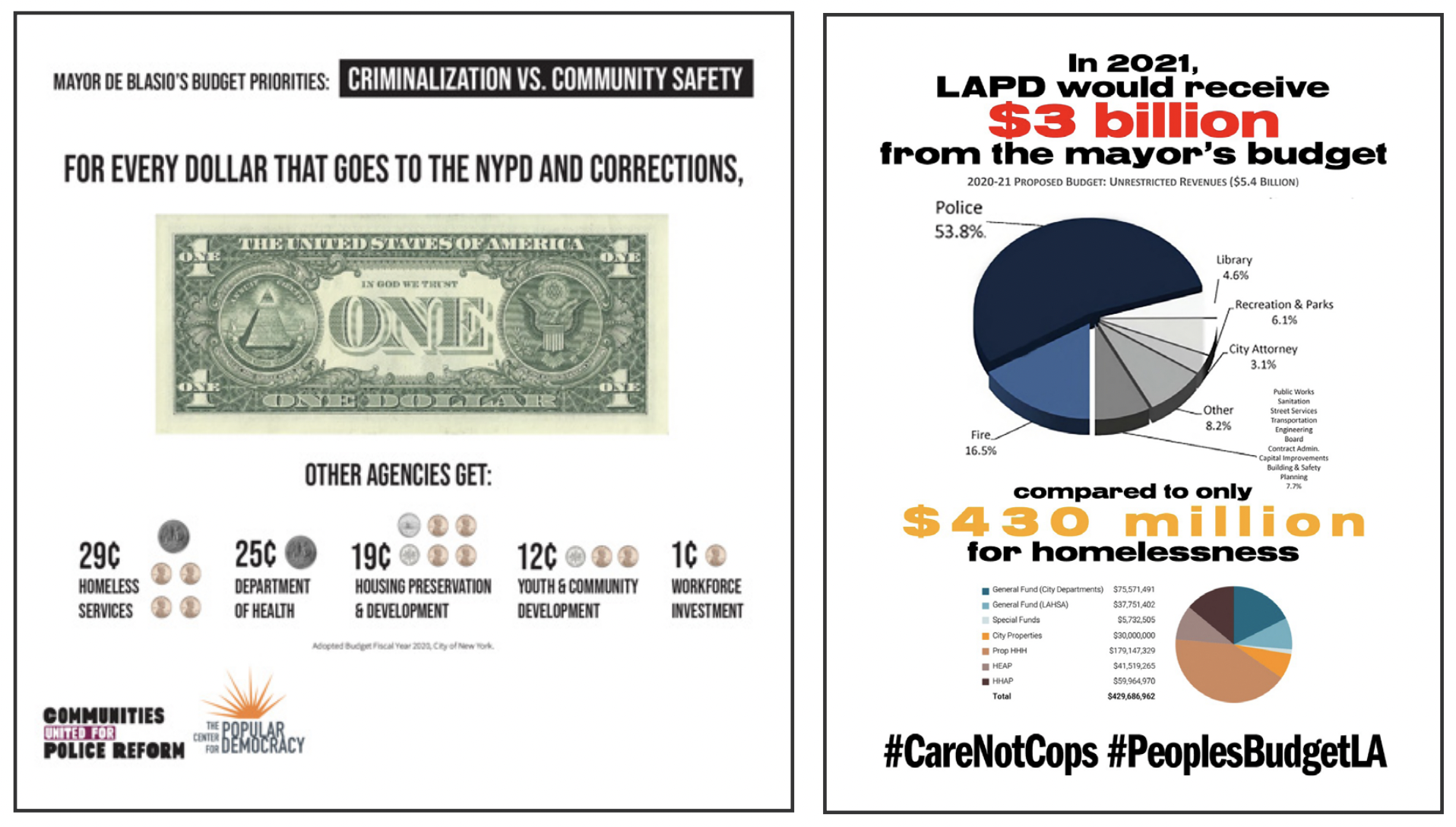
Lastly, it is worth noting that the beginnings of the Participatory Budget Movement that was born in Brazil, also did not just make decisions on a very small percentage of a municipal budget, they made collective decisions on the entire budget. Grand Rapids could do the same, which would not only get more people involved in the process, it would lead towards a movement from representative democracy, to participatory democracy, or as the great thinker W.E.B. DuBois said, such a process would lead to Abolition Democracy.
Connecting the dots on the School Choice Week event and the DeVos family obsession with destroying Public Education
A couple of weeks ago, we wrote an article about an event organized by the group Let MI Kids Learn. The event was a panel discussion, featuring Betsy DeVos, which also included several carefully selected guests, some of which were directly connected to Betsy DeVos and her family. One such guest was Cameron Pickford, who is the Communications Director for the DeVos-created and DeVos funded Michigan Freedom Fund.
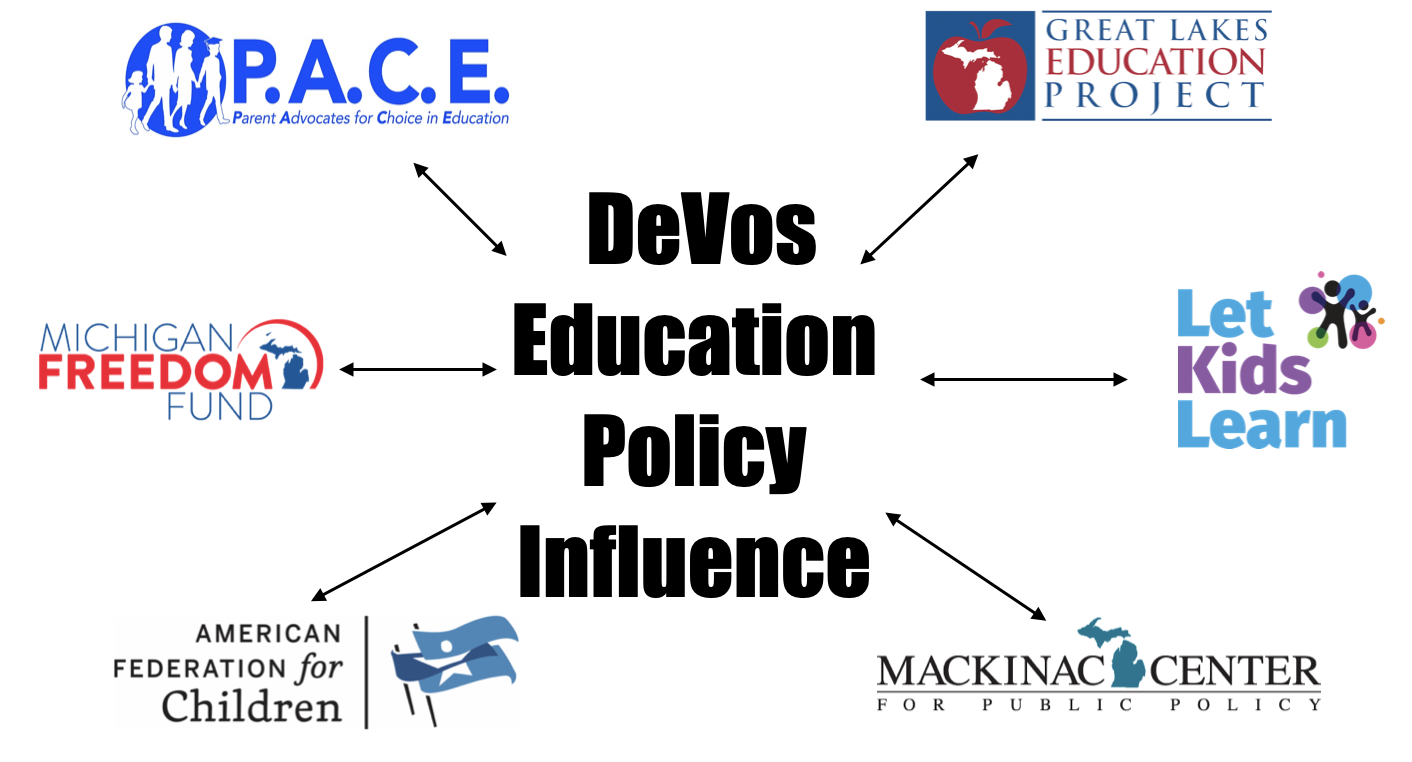
During the previous week, on Thursday, January 27th, the group Parent Advocates for Choice in Education (PACE), held an event inside the Lansing State Capital for what they called National School Choice Week. The DeVos-created group, the Great Lakes Education Project (GLEP) stated:
Last week hundreds of teachers, students, parents and activists swarmed the state Capital in Lansing to celebrate National School Choice Week and to celebrate the brighter futures, the hope, and the opportunities that can happen when we prioritize students in our schools, not bloated bureaucracies.
People did not swarm the State Capital, since they had a permit for inside the Capital, with a podium and a PA system for their speakers.
The first speaker at the National School Choice Week event was Amy Dunlap, who teaches with the Michigan Connections Academy. The Michigan Connections Academy is an online charter school, even though Dunlap was identified as a public school educator. There was also a Catholic School Student talking about the benefits of attended a private school and Jessie Bagos, a mother who is part of a lawsuit filed by the Mackinac Center Legal Foundation against the State of Michigan.
The featured speaker at the event was Corey DeAngelis, who is the national director of research at the American Federation for Children. The American Federation of Children is a national group that was started in part by Dick & Betsy DeVos, with several million dollars coming from the DeVos family over the years, as the American Federation of Children is somewhat of a clearing house for the so-called school choice movement.
The National School Choice Week event was co-hosted by the Mackinac Center for Public Policy, a far right Think Tank that has also received millions in contributions from the DeVos family, along with several DeVos family members serving on the Board of Directors over the years.
There was also a representative from Let MI Kids Learn at the National School Choice Week event. The representative used the opportunity to talk about their ballot initiative, a ballot initiative, which has received at least $300,000 from the DeVos family, according to data from the most recent campaign finance deadline.
The Let MI Kids Learn group also shares something else in common with the Parent Advocates for Choice in Education. They share the same address. Both the Parent Advocates for Choice in Education and Let MI Kids Learn groups have as their address, 2145 Commons Parkway, Okemos, MI 48864.
Interestingly enough, this is the exact same address for the Unlock Michigan campaign, which was a GOP campaign designed to oppose the early Stay at Home orders from Gov. Whitmer. But wait, there is still more at the 2145 Commons Parkway, Okemos address. That address is also the location for Doster Law Offices, PLLC. Doster Law Officers was founded by Eric Doster, who was longest-serving General Counsel in the history of the Michigan Republican Party, having served in this position from 1992 to 2017. This was the same time period that Betsy DeVos was the Michigan Republican Party Chair. Doster’s wife, Mary Doster, is a GOP insider who is treasurer of the nonprofit Michigan Redistricting Resource Institute. Mary Doster is also listed as the Principle Officer with the group Parent Advocates for Choice in Education.
So it seems that there are several groups that not only share the same address, they share the same ideological framework, they all receive lots of funding from the DeVos family and they have clear connections to Michigan GOP insiders. Plus, all of these groups are committed to dismantling Public Eduction as we know it.
GRIID Class – The Function of Policing in the US and how we can work towards a world Without Police: Part IV
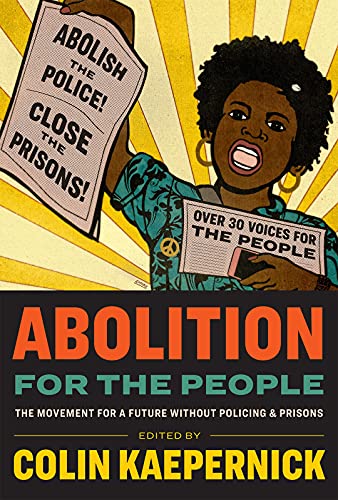 For week 4 of the class on Policing in the US, we read and discussed four essays from the book, Abolition for the People. All four essays were focused on the importance of an abolitionist approach to policing, along with a critique of police reforms.
The first essay was by Dylan Rodriguez, author of the book, White Reconstruction: Domestic Warfare and the Logics of Genocide. His essay is entitled, Police Reform as Counterinsurgency. He begins his essay by stating:
To reform a system is to adjust isolated aspects of its operation in order to protect that system from total collapse, whether by internal or external forces. Such adjustments usually rest on the fundamental assumption that these systems must remain intact—even as they consistently produce asymmetrical misery, suffering, premature death, and violent life conditions for people and places targeted by anti-Black criminalization, white supremacist police profiling, gendered racist displacement, and colonial occupation.
Rodriguez goes on to say this about reform:
Reformism defers, avoids, and even criminalizes peoples’ efforts to catalyze fundamental change to an existing order, often through dogmatic and simplistic mandates of “nonviolence,” incrementalism, and compliance.
We discussed how difficult it is to imagine a world without cops and how we are all socialized to believe that they exist to protect us. Of course, this is all non-sense, since policing has historically been about protecting order and systems of power. Rodriguez then states:
Reform is at best a form of casualty management, while reformism is counterinsurgency against those who dare to envision, enact, and experiment with abolitionist forms of community, collective power, and futurity.
The second reading is entitled, Three Traps of Police Reform, written by Naomi Murakawa. Murakawa is best know for her book, The First Civil Right: How Liberals Built Prison America. Murakawa lays out three main traps of attempts to reform the police: The first trap of reform is that reform the police usually means reward the police. The author presents details information looking at when there is a big uproar about the police, police departments end up getting more funding, more technology and more training.
The second trap of reforming the police is the passage of new laws when there is an outcry. However, as Murakawa points out: Because police seem lawless, reformers hope that new laws will rein in their power. But the premise is wrong. Policing is not law’s absence; it is law’s essence in a system of racial capitalism.14 In this system, laws affirmatively protect the police’s right to target the poor, to lie, and to kill.
The third trap of police reform argues that perpetual reform exploits and feeds the fantasy that violence is a technical glitch of policing. Because reformers refuse abolition, they can only tinker with the style of police violence.

The third reading was from radical Black historian Robin D.G. Kelley. Kelley argues that the push to demand the defunding of the police all across the US after the police murder of George Floyd, was a direct result of the abolitionist work that grassroots groups had been doing since the 1990s, groups like Critical Resistance, INCITE and Sista 2 Sista. Kelley talks about this history in an interview he did on Democracy Now, just days after the national uprisings in 2020.
The fourth and final essay we read was from independent journalist and political prisoner, Mumia Abu Jamal. Jamal talks about the history of the abolitionist movement in the US and the lessons we need to learn from it. He cites the great abolitionist Frederick Douglass, who said:
“Slavery has been fruitful in giving itself names. It has been called ‘the peculiar institution,’ ‘the social system,’ and the ‘impediment’. . . It has been called by a great many names, and it will call itself by yet another name; and you and I and all of us had better wait and see what new form this old monster will assume, in what new skin this old snake will come forth next.”
The thing about the abolitionist movement is that it was not just about ending slavery, but about creating a society that fundamentally different from the one that gave birth to slavery. White Supremacy merely evolved after chattel slavery was no longer legal, creating policies and practices to maintain the centrality of Whiteness, such as Jim Crow laws, segregation, institutional racism and mass incarceration. What Jamal is arguing, is what W. E. B. DuBois argued, that we need to develop Abolition Democracy, especially of the goal is truly freedom and liberation.
In next week’s class we will be finishing the last 3 essays from Abolition for the People, along with a discussion about the vision paper that the Movement for Black Lives developed in 2015.
Books about Black History that have informed who I am today: Part I
Books are a lifeline for me. I read as much as I can, to challenge my own understanding of the world, to gain insight into and analysis about how systems of oppression work and to be inspired by those who have come before me.
The books about Black History that have informed and formed who I am today, will be in three categories: 1) books about Slavery and the Abolitionist Movement; 2) books about the larger Black Freedom Struggle up to and including the Civil Rights Movement, and 3) book that have been written in the past 50 years, books that have expanded my understanding of the Black Freedom Struggle and why we need to dismantle the system of White Supremacy!
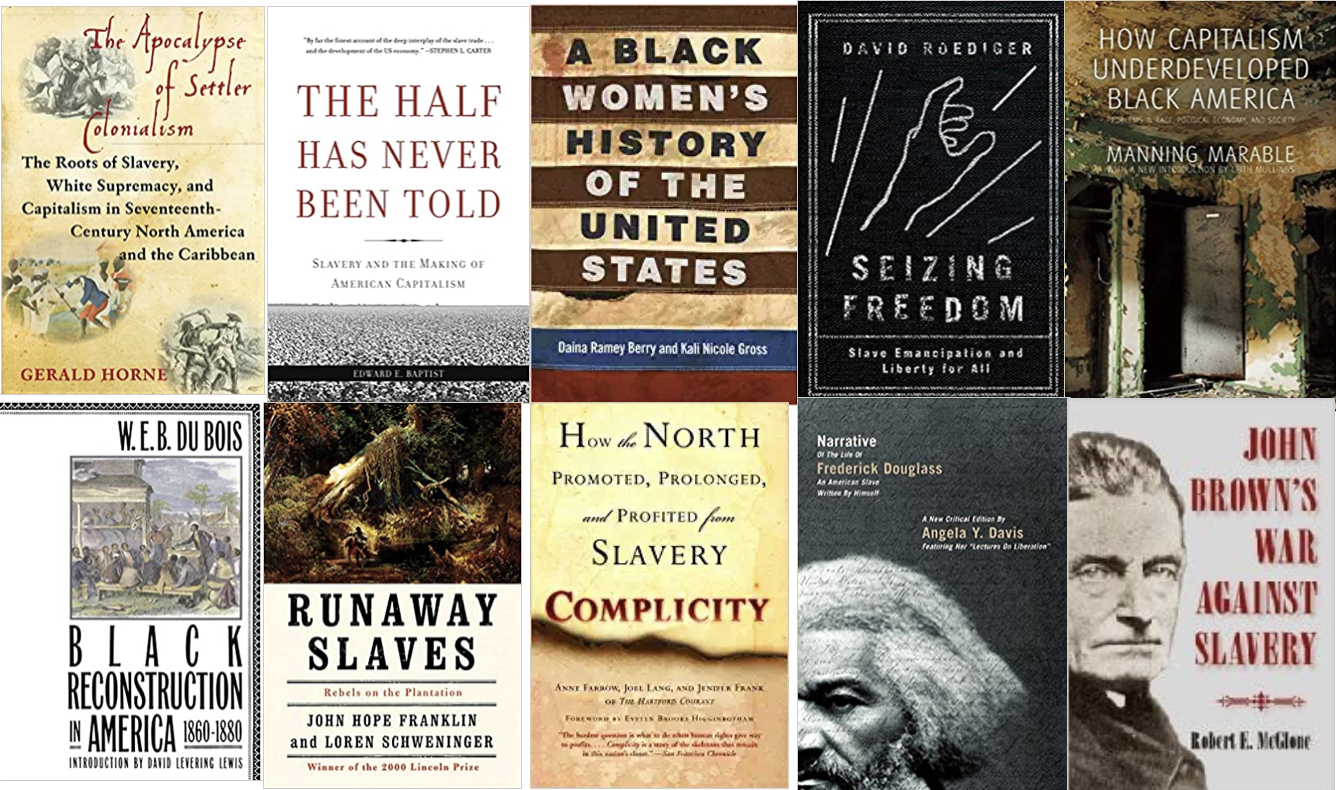
- Repair: Redeeming the Promise of Abolition, by Katherine Franke
- Complicity: How the North Promoted, Prolonged and Profited from Slavery, by Anne Farrow, Joel Lang and Jenifer Frank
- Narrative of the Life of Frederick Douglass: An American Slave Written by Himself, a new critical edition by Angela Davis
- Runaway Slaves: Rebels on the Plantation, by John Hope Franklin and Loren Schweninger
- The Half Has Never Been Told: Slavery and the Making of American Capitalism, by Edward Baptist
- The American Crucible: Slavery, Emancipation and Human Rights, by Robin Blackburn
- Seizing Freedom: Slave Emancipation and Liberty for All, by David Roediger
- Slavery and Public History: The Tough Stuff of American Memory, edited by James Oliver Morton and Lois E. Horton
- Ebony & Ivy: Race, Slavery, and the Troubled History of America’s Universities, by Craig Steven Wilder
- Gateway to Freedom: The Hidden History of the Underground Railroad, by Eric Foner Black Reconstruction in America, 1860-1880, by W.E.B. DuBois
- How Capitalism Underdeveloped Black America, by Manning Marable
- Anti-Racism in US History: The First Two Hundred Years, by Herbert Aptheker
- John Brown’s War Against Slavery, by Robert McGlone
- Five for Freedom: The African American Soldiers in John Brown’s Army, by Eugene Meyer
- Ida: A Sword Among Lions, by Paula Giddings
- The Counter-Revolution of 1776: Slave Resistance and the Origins of the United States of America, by Gerald Horne
- A Black Women’s History of the United States, by Daina Ramey Berry and Kali Nicole Gross
- The Apocalypse of Settler Colonialism: The Roots of Slavery, White Supremacy, and Capitalism in 17th Century North America and the Caribbean, by Gerald Horne
In Part II, I will share the books dealing with the 1940s through the 1970s, in the period that is normally referred to as the Civil Rights Era.
The money behind the candidates in Michigan – Part IV: Grand Rapids City Commission races
This is our fourth and final post looking at the most recent campaign finance information for this quarter. In Part I of this series, we look at the campaign contributions for the Governor’s race in Michigan, while Part II looked at the campaign funding for the West Michigan State Legislature races. In Part III, we uncover who the recipients were and how much money the DeVos family contributed in the most recent campaign finance deadline. In today’s post we take a look at campaign contributions going to candidates for Grand Rapids City Commissioner.
Now that the Grand Rapids City Commission seats are on the same year as the other elections, we’ll be able to see if those races get lost in all of the election chatter, or if they will have more people vote in those races that in previous years.
There are three seats on the Grand Rapids City Commission that will be up for grabs, with Senita Lenear being term limited and Kurt Reppart and Joe Jones running as incumbents. No other candidates have announced as of this writing, but that doesn’t mean that both incumbents haven’t been raising funds.
In the 1st Ward, Kurt Reppart will attempt to get re-elected for a second four year term. You can find campaign finance statements for all of the local candidates for City and County races by going to the Kent County Clerk’s site and clicking on Campaign Finance Reports at this link.
For the most recent quarter, Kurt Reppart reports having raised $2,855 in the past two quarter filings. We are including the past two quarter filings, since we did not report on Grand Rapids City Commission candidate campaign finances during the October deadline. Some of the larger contributions are from:
Aaron Jonker – President of Wolverine Building Group: $500
Casey Kornoelje – Owner of Farmhouse Wellness: $500
John Glover – Executive Director of Wellhouse: $300
Ryan Schmidt – Partner Indigo Design & Development: $200
Joe Jones – 2nd Ward Commissioner: $250
Milinda Ysasi – 2nd Ward Commissioner: $100
Plus two $100 contributions from people living in Pennsylvania.
2nd Ward City Commissioner Joe Jones received fewer contributions, but all of them were in larger amounts, compared to Reppart.
$1000 – Brian Britton, President and CEO, National Heritage Academies and his wife Kalli Britton contributed an additional $1000
$1000 – Darryl Elmouchi, President at Spectrum Health West Michigan
$1000 – Rosalynn Bliss, Mayor of Grand Rapids
$1000 – Mark Murray, Vice Chairman of Meijer
$1000 – Mike VanGessel, CEO of Rockford Construction, plus $1000 from Gayle VanGessel
$1000 – Christina Freese Decker, President & CEO of Spectrum Health
$1000 – Michael Price
$1000 – David Cassard, Mercantile Bank
$1000 – David Quade, Regional President of Horizon Bank
$1000 – Daniel Bowen, Principal Owner of Dempsey Ventures, plus $1000 Sharon Bowen
$1000 – Michael Jandernoa, Chairman of 42 North Partners
It is instructive that Joe Jones received $14,000 in contributions from 14 different contributors. Some of the contributors are part of the Grand Rapids Power Structure, such as Jandernoa, VanGessel and Murray, while Brian Britton works for one of the organizations that make up part of the Grand Rapids Power Structure, the National Heritage Academies.
In Part I of this series, we look at the campaign contributions for the Governor’s race in Michigan, while Part II looked at the campaign funding for the West Michigan State Legislature races. Today, we’ll take a look at the DeVos-backed candidates based on the most recent campaign finance data, specifically candidates running in Michigan.
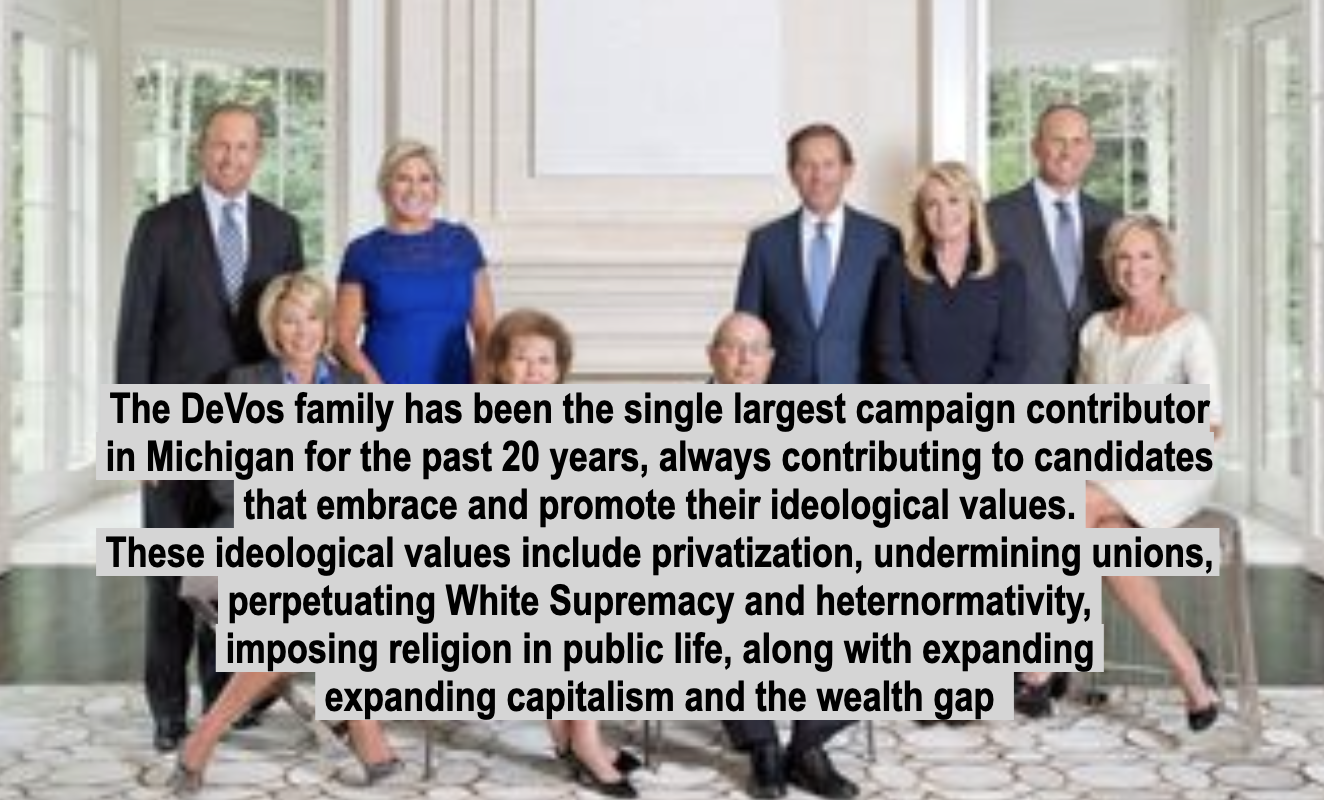
According to data from OpenSecrets.org, members of the DeVos family and DeVos-owned companies have contributed to the re-election campaign of Rep. Peter Meijer. For the most recent quarter of campaign finance data, Meijer received campaign contributions from the following DeVos family members and DeVos-owned entities:
Amway/Alticor Inc. – $5,000
CWD Real Estate – $4,583
RDV Corp – $2,900
Pamela Roland (DeVos) – $2,900
In the 4th Congressional District race, which now pits Fred Upton against Bill Huizenga (re-districting), there are no DeVos contributions to either candidate. The DeVos family has consistently supported Huizenga, but they may be waiting until the primary vote to contribute to this race.
Based on data from the Michigan Secretary of State’s office and their campaign finance requirements, here are the candidates that members of the DeVos family have contributed to, Republican Committees and contributions for the ballot initiatives run by Let MI Kids Learn:
Dick DeVos
MI Senate Republican Campaign Committee – $41,975
Wentworth Majority Fund 2 – $10,000
Kent County Republican Committee – $25,000
Let MI Kids Learn – $100,000
Betsy DeVos
MI Senate Republican Campaign Committee – $41,975
Let MI Kids Learn – $100,000
Doug DeVos
MI House Republican Campaign Committee – $41,975
MI Senate Republican Campaign Committee – $41,975
Kent County Republican Committee – $25,000
Let MI Kids Learn – $50,000
Maria DeVos
MI House Republican Campaign Committee – $41,975
MI Senate Republican Campaign Committee – $41,975
Let MI Kids Learn – $50,000
Daniel DeVos
MI House Republican Campaign Committee – $41,975
MI Senate Republican Campaign Committee – $41,975
Kent County Republican Committee – $25,000
Wentworth Majority Fund 2 – $10,000
Compete Michigan Political Action CO – $10,000
Ottawa County Republican Committee – $50
Pamela DeVos
MI Senate Republican Campaign Committee – $41,975
Cheri DeVos
Kent County Republican Committee – $25,000
Wentworth Majority Fund 2 – $10,000
Adding all of those campaign contributions to just these candidates/ballot initiatives, comes to a total of $823,208 for the most recent quarter of campaign finance reports. While this is a substantial amount of money, we know that this will increased significantly before the November Election. GRIID will continue to track this information and demonstrate once again that the politics of the DeVos family is far right, supporting candidates and initiatives that hurt BIPOC people, working people, people who identify as LGBTQ, immigrants and other marginalized communities.
Last week, in Part I of this series, we looked at the major campaign contributors to all of the candidates running for Governor in 2022. Today, we want to look at incumbents and candidates for the Michigan Senate and House races in West Michigan.
Senator Winnie Brinks – incumbent – Here are the top campaign contributors to Brinks, who represents the 29th District in Michigan.
Next Era Energy PAC – $1,500
Bob Vanstright – $1,000
Michigan Regional Council of Carpenters – $1,000
Michigan Professional Fire Fighters – $1,000
Ruth Spagnuolo – $1,000
Ford Motor Company – $1,000
Jeff Cranson – $500
Phil Skaggs – Will be running for a State House seat based on the redistricting commission map. His top contributors are:
Committee to Elect Phil Skaggs – transferred assets – $17,601.93
Phil Skaggs – $13,000
For Our Futures Fund – $50
Rep. Tommy Brann – Incumbent – Brann is currently the State Representative for the 77th District. His top campaign contributors for the most recent quarter are:
Michigan State Police Troopers Association – $1,000
Michigan Community College Association – $250
Michigan Licensed Beverage Association PAC – $250
Michigan Bank PAC – $250
Great Lakes Education Project – $250
Friends of West Michigan Business – $150
David LaGrand – Incumbent – LaGrand is currently the State Representative for the 75th District. His top campaign contributors for this quarter are:
Grand Rapids FireFighters Union PAC – $5,000
Michigan Laborers Political League PAC – $2,500
Sid Jansma (Wolverine Gas & Oil) – $1,050
Stephanies Changemaker Fund – $1,000
Robert Vanstright – $1,000
Karen Vanstright – $1,000
Jon Bylsma (Attorney Varnum) – $1,000
Bruce Bartel – $1,000
Kevin Toler (Hill Island Financial) – $1,000
DTE Political Action Committee – $500
John Hunting – $500
Rachel Hood – Incumbent – Hood is currently the State Representative for the 76th District. Her top campaign contributors for this quarter are:
Michigan Regional Council of Carpenters – $1,000
DTE Energy PAC – $500
Delta PAC – $250
Kellogg Better Government Committee – $250
Thomas Albert – Incumbent – Albert is current the State Representative for the 86th District. His top campaign contributors for this quarter are:
Michigan Values Leadership Fund II – $10,000
Albert Majority Fund – $10,000
Building Experience NOW PAC – $5,000
Comcast Co. and NBC Universal PAC – $2,500
United Parcel Service Inc. PAC – $1,000
Mark Huizenga – Incumbent – Huizenga is currently the State Representative for the 74th District. His top campaign contributors for this quarter are:
Compete Michigan PAC – $5,000
CMS Energy Employees PAC – $1,000
MI Pediatric Action Society PAC – $250
Bryan Posthumus – Incumbent – Posthumus is currently the State Representative for the 73rd District. His top campaign contributors for this quarter are:
Wentworth Majority Fund – $5,000
Wentworth Majority Fund 2 – $5,000
John Kennedy (CEO Autocam) – $1,050
Michael Jandernoa (42 North Partners) – $1,000
Mcalvey Merchant PAC – $600
Farm Bureau PAC – $600
CMS Energy PAC – $500
Steve Johnson – Incumbent – Johnson is currently the State Representative for the 72nd District. His top campaign contributors for this quarter are:
Michigan Credit Union League PAC – $1,000
Blue Cross Blue Shield MI PAC – $500
Association of Builders and Contractors PAC – $500
Michigan Retailers Association PAC – $500
National Federation of Independent Business MI PAC – $250
For all of these candidates, the amount of campaign contributions will rise significantly as we grow closer to the 2022 Elections. We will continue to track the campaign finances, because to truly understand politics, you should always follow the money!
GRIID Class – The Function of Policing in the US and how we can work towards a world Without Police: Part III
 For week 3 of the class on Policing in the US, we read and discussed three separate articles, two of which were from the book, Violent Order: Essays on the Nature of Police.
We read and discussed the introduction from Violent Order, which is entitled, On the Nature of Police. This introductory piece is important, since he provides a larger framework for how we need to think about the function of policing.
In the introduction, the authors challenge us to come to terms with how we have been socialized into think that police departments are necessary for a civilized society. To counter this socialization, the authors argue that the real function of policing is to maintain order, particularly to maintain the order of capital accumulation for the dominant class of society. With this notion of maintaining order, the police also make sure that we see nature as commodities within the economic system and that when people question or disrupt this order they are savages, animals or heathens. The police will intervene around issues of theft and assault, since those disrupt order, but they do nothing to confront structural violence, such as low wages, high rent or the corporate assault on the environment. In fact, the police will protect those forms of structural violence, since they are the result of capital accumulation.
The second piece we read from the book Violent Order, was entitled, Disrupt Order: Race, Class and the Roots of Policing. Here, the author argues that there are three ways to approach policing – to reform it, to expand it or to abolish it. There is a brief overview of the historical function of policing in the US, which then shifts to a look at how it has evolved. The author presents information on how US policing has adopted numerous tactics from the US military, which were learned during imperial occupations, such as in the Philippines during the end of the 19th century through the early part of the 20th century. The author further presents information on how the US military began to provide weaponry for police departments after the urban uprisings of the 1960s, through programs initiated by the Johnson Administration, which also included law enforcement grant programs after the Omnibus Crime Control and Safe Streets Act of 1968. (See Elizabeth Hinton’s book, America on Fire: The Untold History of Police Violence and Black Rebellion Since the 1960s.)
In addition, the reading discusses the increased use of police repression, such as the COINTELPRO by the FBI, often in cooperation with local law enforcement agencies. The use of such programs was a domestic application of the US military’s use of counterinsurgency to fight against anti-colonial forces. Applied domestically by police department, insurgent were Black, Indigenous and other groups resisting the social order and the counterinsurgency became part of the so-called “community policing” model adopted by police departments across the country.
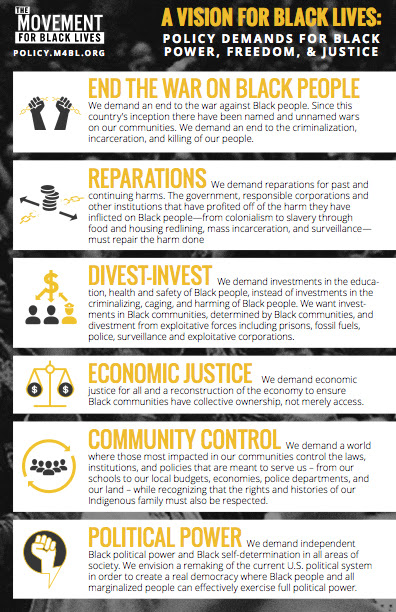 This chapter ends with a look at some efforts to move beyond reform, such as the #8toAbolition campaign, which was a direct response to the more reform minded campaign known as #8CantWait. One addition abolitionist effort that was discussed was the Movement for Black Lives vision platform, which lead to developing policies such as the BREATHE Act.
The third piece we read and discussed was from Kristian Williams, which provided further analysis of how US police agencies adopted a counter-insurgency model used by the US State Department and applied it to insurgent movements in the US. In the counterinsurgency strategies used by police departments, the tactics used are heavy surveillance of insurgent groups – often social movements – working with non-profits and churches to gather intelligence and to get residents to be informants for the police.
Another approach is “carrots and sticks”, often referred to as winning hearts and minds. Some examples in Grand Rapids would be the GRPD youth programs, which are essentially designed to present themselves as the good guy to marginalized youth, with the hope that these youth will see cops as necessary or even as a desirable profession. The other program, which is more recent, is called Clergy on Patrol, where the GRPD encourages faith leaders to work directly with them, take them out on patrol, with the underlying goal to bring clergy into their camp instead of working in opposition to the police.
In week four, we will be reading a number of essays from the book, Abolition for the People, and discussing an abolitionist vision of a world without police.
Betsy DeVos moderates panel of carefully selected people to promote the Let MI Kids Learn Ballot Initiative
On Wednesday morning, the Let MI Kids Learn campaign hosted a 45 minutes zoom call, featuring former Secretary of Education Betsy DeVos.
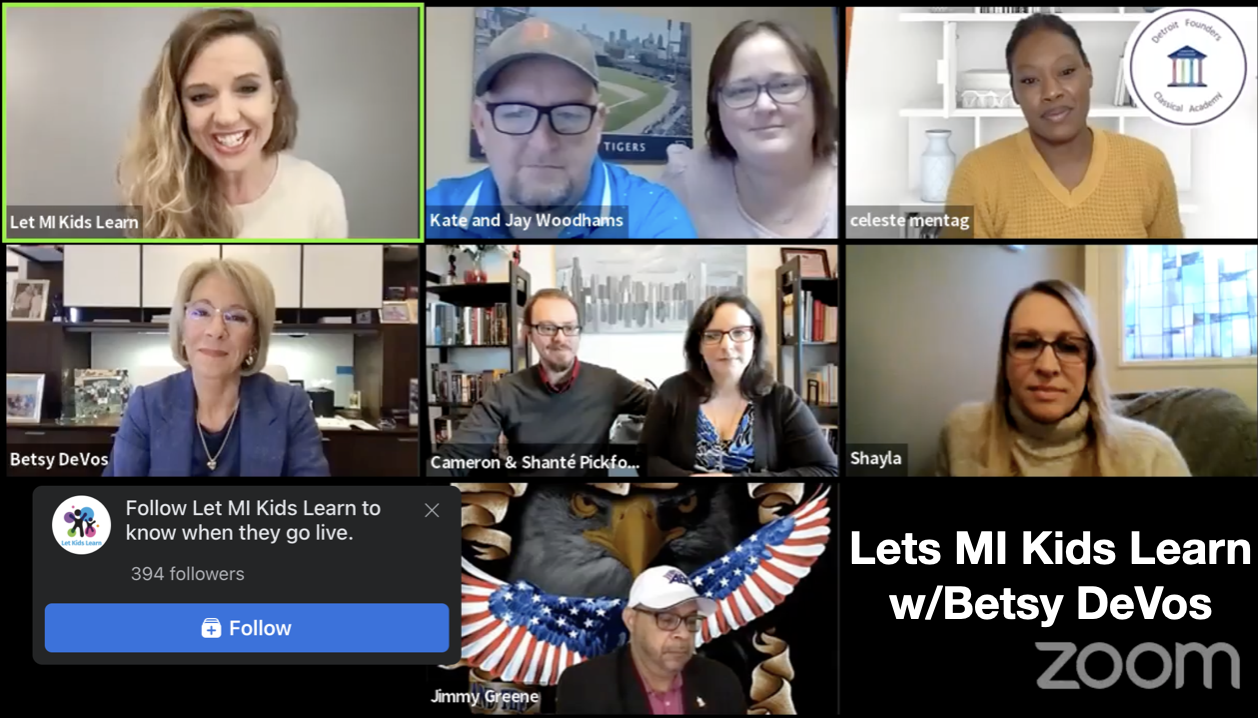
In late October, we reported on the Senate and House bills that passed in the Michigan Legislature, bills that will do what Betsy DeVos has been attempting to do since 2000, with her failed school voucher ballot initiative. Then in November, GRIID reported as a response to Gov. Whitmer’s veto of the legislation passed in October, the Let MI Kids Learn campaign had begun to undo Whitmer’s veto and put the issue on the ballot in 2022.
Betsy DeVos spoke briefly at the beginning of the forum, making her usual remarks about so-called school choice, critiques of public education and how parents are not included in their children’s education. All of these claims have been her main talking points since she began to work on dismantling public education over the past several decades.
Nothing of what DeVos had to say was new. However, what was both interesting and instructive, were the other people who were part of the zoom call.
The forum was hosted by a staff member of Let MI Kids Learn, Amy Hawkins. Hawkins runs and operates Generation Strategies, which claims to help group deliver their message. Hawkins is part of the Conservative Christian movement and her website says that her work is trusted by the likes of Hillsdale College, Unlock Michigan – which opposed the Stay at Home orders in 2020, Sen. Mike Shirkey and Citizens for Traditional Values, to name a few.
Those who were hand picked to be on the zoom call with Amy Hawkins and Betsy DeVos were Celeste Mentag, Jay & Kate Woodhams, Cameron & Shante Pickford, Jimmy Greene and someone named Shayla. Shayla, who claimed to be a public school teacher, never gave her last name, never named the school she worked for and said that she had her daughter in a private school.
Celeste Mentag is part of the Detroit Founders Classical Academy This school is sponsored by the Conservative Christian school Hillsdale College. The website for the school isn’t very transparent, plus there wasn’t a great deal of information for the public to access. However, the Facebook page for Detroit Founders Classical Academy was rather telling. There are posts saying that schools are teaching the Black Lives Matter principles, other posts that are dismissive of Critical Race Theory and Charlie Kirk, who is with the far right group Turning Point USA.
There are similar posts on Celeste Mengas’ Facebook page, such as anti-CRT posting and even a meme with Trump 2024.
Jay and Kate Woodhams did not identify with a particulate group and they were both reading from a script.
There was also Cameron & Shante Pickford, who identified as homeschooling parents. What they didn’t tell you is that Cameron Pickford is the communications director for the DeVos-created political group, the Michigan Freedom Fund, and has been in that position since 2017.
The other person who spoke on the forum hosted by Let MI Kids Learn, was Jimmy Greene. Jimmy Greene is the President of Associated Builder and Contractors of Michigan, who spoke most about students learning trades so they could better enter the workforce. Greene is also a Black Conservative, who has endorsed John James (heavily funded by the DeVos family) and many other Republican members of the the Michigan Legislature.
One thing we know about the DeVos family is that they are very strategic and that do not want to be part of efforts unless they can control the narrative. This zoom call with Betsy DeVos, which was hosted by the Let MI Kids Learn campaign, clearly demonstrated that they only wanted people invited to present who would present the same ideological and political views that the DeVos family has been about for the past three generations.
If you want to endure the content of this forum, you can watch it by going to this link.
On Monday, MLive ran two articles that focused on campaign finances and the Michigan Gubernatorial race. The first article was headlined, Rinke leads Republican fundraising for governor, but Craig collected more from supporters. The second article was headlined, Whitmer collects $2.5M for re-election, gives Michigan Democratic Party $3.5M raised for recall defense. 
Let’s start with the campaign finances for Governor Whitmer. The MLive article provides readers with a total raised through the January 31st deadline, but most of the narrative consisted of the money she raised in anticipation of a recall campaign. In fact, there are no names of donors included, except one, which was money she returned because it was from the recall campaign.
The MLive article says that 92% of donors contributed $200 or less. However, this narrative is a bit misleading, considering that the top 550 contributors gave between $1,000 and $50,000. In other words, most of what Gov. Whitmer has raised in the past fundraising period is from large donors. Some of those donors are:
Michigan Education Association – $30,500
Operating Engineers Local 324 PAC – $15,000
Plumbers & Pipefitters Local 333 PAC – $13,000
Michigan Association for Justice – $10,000
Meijer Political Action Committee – $10,000
Blue Cross & Blue Shield – $10,000
Auto Dealers of Michigan – $10,000
Independence Blue Cross PAC – $7,000
Michigan Beer & Wine Wholesalers – $6,150
Michigan Bankers Association – $5,500
Ford Motor Company – $5,000
The MLive article on the GOP candidates for Governor, focused on the top two fundraisers Kevin Rinke and James Craig, with less information on a few of the other GOP candidates, like Garrett Soldano, Tudor Dixon, Michael Brown and Perry Johnson (who just announced, so there are no campaign finance records for him). Far Right candidate Ryan Kelley, did not even receive a mention in the article. If you click on the names of the GOP candidates who raised money during this campaign finance quarter, you can see who contributed to their campaigns.
What is clear so far from the coverage, is that candidates who raise more money are given more attention, regardless of their platform or their previous involvement in electoral politics. As with most things in a Capitalist society, money rules.
 Grand Rapids Institute for Information Democracy