No Truth in advertising: Enbridge continues to lie and deceive the public right before Earth Day
As we get ready to celebrate Earth Day 2023, we need to remain vigilant to the propaganda of the fossil fuel industry.

This means monitoring the amount of money the fossil fuel industry spends during an election year and how much then spend on lobbying annually, to the way that this political influence impacts policy. Within the past month, the Biden administration has broken a campaign promise by green lighting the Willow project in Alaska, along with a more recent gas fracking project that will also happen in Alaska.
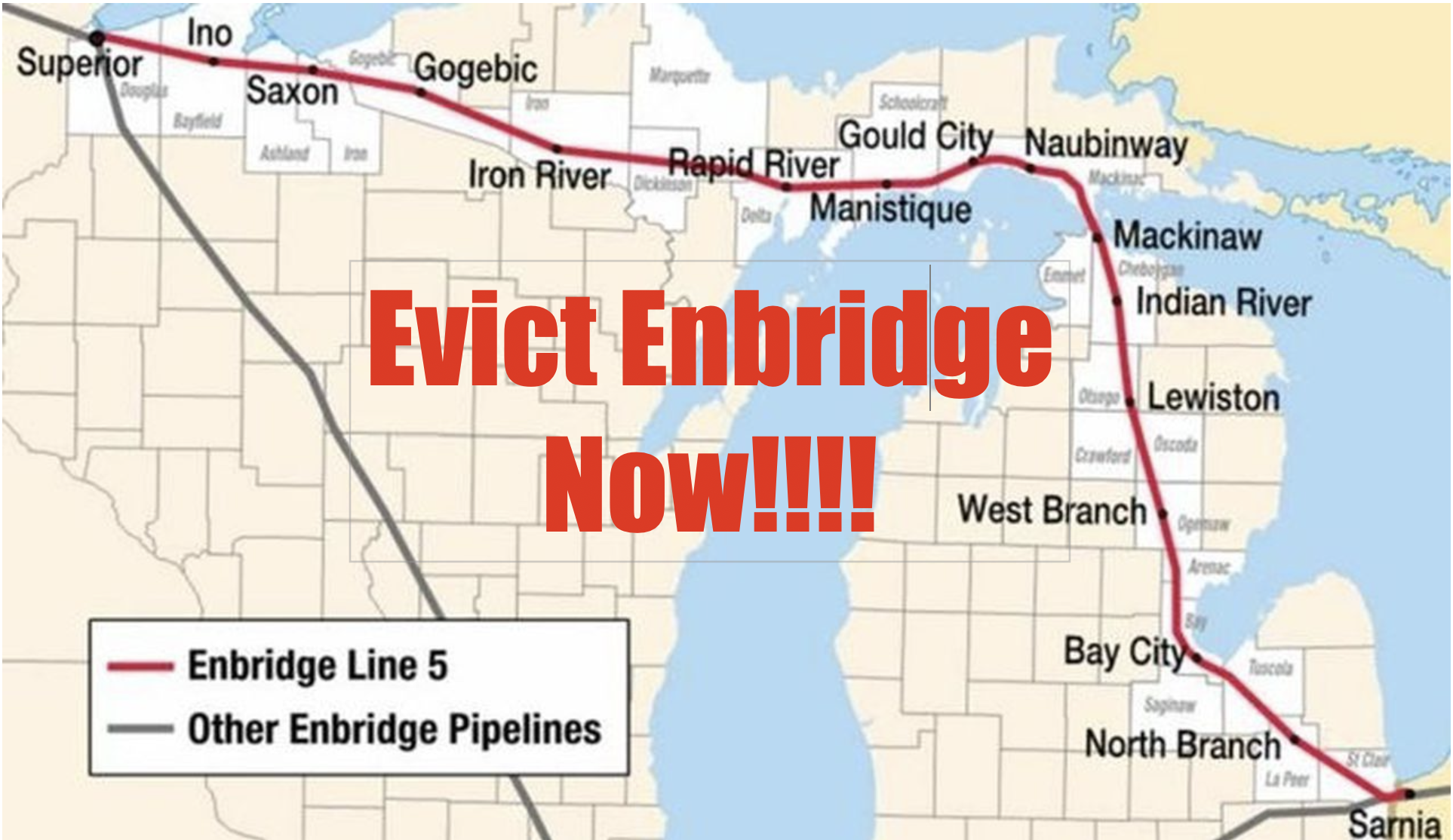
Closer to home here in Michigan, one of the most deceptive corporations, the Enbridge Corporation, which operates Line 5 and is still pushing a new tunnel underneath the Great Lakes for the tar sands oil that Line 5 pumps on a daily basis.
Despite Governor Whitmer’s claim to shut down Line 5 (made during her 2018 campaign promise), the Enbridge Corporation continues to put the Great Lakes ecosystem at risk and perpetuates Climate Change with the massive amounts of fossil fuels they are transporting in Line 5 and Line 3, just to name two of their operations in the Great Lakes.
However, these crimes against the planet haven’t prevented the Enbridge Corporation’s deceptive advertising campaigns, especially the ones that are touting the company’s sustainability practices. For example, in a recent video promotional piece, the Enbridge Corporation blatantly lies about numerous aspects of what they do.
Lie #1 – At Enbridge we are working to deliver a safer, cleaner and affordable energy future, and renewables will be an essential element of that transition. From 2002 to present, Enbridge and its joint ventures and subsidiaries reported 307 hazardous liquids incidents to federal regulators — one incident every 20 days on average. These spills released a total of 66,059 barrels (2.8 million gallons, or more than four Olympic-sized swimming pools) of hazardous liquids.
Lie #2 – Renewables are expected to be the world’s fastest growing source of electric generation through the year 2050. This lie is rather deceptive. While it is “expected” that renewables will be the fastest growing source of electric generation, Enbridge continues to be a company that is primarily focused on being a trafficker in fossil fuels. Also, using the 2050 date is a bit misleading, since, the Intergovernmental Panel on Climate Change has made it clear that we need to reduce our consumption of fossil fuels by 80% by 2030 or we will exceed the point of no return for global warming.
Lie #3 – We play a major role in transporting energy that helps build and shape the world around us. Again, this lie is rooted in deception and perception. Enbridge is a major energy transporting company and they do have an impact in shaping the world around us, but not in the same way they think they do. In this lie Enbridge wants to present themselves as the “good guy” because they supply energy, but it completely ignores the environmental, social, economic and political consequences of relying primarily on fossil fuels.
Lie #4 – To date we have invested $7 billion Canadian dollars into renewable energy. With this lie it is a matter of omission. Enbridge has invested $7 billion in renewable, but the company’s total value in 2023 is $81.1 billion currently. This means that Enbridge has invested less than 10% of the company’s worth into renewables, a percentage that is woefully inadequate to meet the 2030 fossil fuel global reduction goal.
Lie #5 – Sustainability is central to everything we do at Enbridge. This is just a bold face lie. It denies the fact that the majority of their operations are rooted in fossil fuels. Anyone organizing against their fossil fuel projects, like the Line 3 project in Minnesota, are arrested and given harsh sentences. Hard to see how that is a sustainable practice. According to OpenSecrets.org, the Enbridge Corporation has spent millions to lobby Congress on bills that will allow them to traffic in fossil fuels…..also unsustainable.
Lie #6 – Demand for energy is growing and we are helping to meet that demand in ways that are environmentally and socially responsible. How can Enbridge be environmentally responsible, when most of their company’s efforts/profits are based on trafficking in fossil fuels. It follows that if corporations are not environmentally responsible, it is impossible for them to be socially responsible. As one example, by perpetuating the use and burning of fossil fuels, the Enbridge Corporation plays a role in the air pollution, which has a major impact on the social health of people. Ambient (outdoor) air pollution is estimated to have caused 4.2 million premature deaths worldwide in 2019.
If we are serious about Climate Justice and want to even consider having a future that will be sustainable for all living things, then we must avoid being deceived by corporations like Enbridge. More importantly, we must work like hell to actively resist and shut down fossil fuel operations by primarily using Direct Action tactics and not relying on governments to create a sustainable world. According to a report put out by the Indigenous Environmental Network in 2021, Indigenous-led resistance campaigns against pipelines in the US and Canada have reduced greenhouse gas pollution by at least 25% annually since these campaigns began. These are the kinds of action we need to support and participate in if we are serious about having a future. Shut down Line 5 NOW!

In February, I made a series of posts about books on racism and the Black Freedom Struggle that have influenced me, which was followed by a series of posts in March about books on feminism that have influenced me as well.
This month I want to include three posts about books on the environment that have influenced how I view with the world around me. In Part I, I focused on books I read in the 1980s and 1990s that initially radicalized me about how I view being part of the natural world. Today, in Part II, I want to focus on book that I read in the 2000s.
Here are those books that influenced my thinking at that time:

Been Brown So Long It Looked Like Green to Me: The Politics of Nature, by Jeffrey St. Clair
EcoDefense: A Field Guide to Monkeywrenching, edited by Dave Foreman and Bill Haywood
Down the Asphalt Path: The Automobile and the American City, by Clay McShane
Just Transportation: Dismantling Race & Class Barriers to Mobility, edited by Robert Bullard and Glenn Johnson
Stolen Harvest: The Hijacking of the Global Food Supply, by Vandana Shiva
The World is Not for Sale: Farmers Against Junk Food, by Jose Move and Francois Dufour
Endgame: Volume I – The Problem of Civilization, by Derrick Jensen
Endgame: Volume II – Resistance, by Derrick Jensen
Green Gone Wrong: How Our Economy is Undermining the Environmental Revolution, by Heather Rogers
The Ecological Rift: Capitalism’s War on the Earth, by John Bellamy Foster, Brett Clark and Richard York
Hijacking Sustainability, by Adrian Parr
The Green Zone: The Environmental Costs of Militarism, by Barry Sanders
Raising Less Corn, More Hell: The Case for the Independent Farm and Against Industrial Food, by George Pyle
Dam Nation: Dispatched from the Water Underground, edited by Cleo Woelfle-Erskine, July Oskar Cole and Laura Allen
 In Part I of our series looking back at the 20th anniversary of the public resistance to the US invasion/occupation of Iraq in 2003, we focused on early organizing efforts to build an anti-war movement before the US war on Iraq even began. In Part II, we looked at the protest when President’s Bush’s visited Grand Rapids the day after his State of the Union address and the GRPD’s response during that protest.
In Part III, we looked at the Women in Black actions, the global protest against the war march that took place in Lansing, along with the People’s Alliance for Justice & Change workshops on civil disobedience that were offered to a growing number of people who wanted to do more than just hold signs. Part IV focused on student organizing against the imminent US war against Iraq, along with civil disobedience that was done at Rep. Ehlers office before the war began. In Part V, we looked back on some of the plans that anti-war organizers had put in place once the US invasion/occupation of Iraq began, along with increased GRPD surveillance. Part VI focuses on what actions took place once the US war/occupation of Iraq had begun, along with the increased intensity of GRPD surveillance and repression against anti-war organizers. And in Part VII, the focus was on how the local commercial news media reported on the US invasion/occupation of Iraq.
In today’s post, the focus will be on anti-war actions that took place after most of the organized opposition had dissipated. After the first few months of the US invasion/occupation, fewer people were involved in the opposition to what the US was doing in Iraq. This is always a dilemma for anti-war organizers is that people either lose interest, they don’t want to be seen as anti-US troops, or they don’t think that local anti-war organizing will make a difference.
Shortly after the US invasion/occupation of Iraq began in March of 2003, many people felt the need to publicly show their support for US soldiers, which included not criticizing the US invasion/occupation. This response was partly due to the pressure in 1991 during the US War in the Gulf, where the US administration and many in the commercial news media were equating failure to support the war then, with failure to support the troops.
There was also a major shift in the kinds of tactics and strategies there were used by various anti-war groups in Grand Rapids. Some felt that the most important thing after the war had started was to focus on the 2004 election, while others felt it was important to “witness” against the war with vigils advocating for non-violence. Other groups felt it was important to continue to pressure politicians who supported the war, using demonstrations and education to call out those politicians. Lastly, there were some groups who felt it was necessary to directly impact the US war machine, which meant exposing the companies that were profiting from the war, as well as engaging in counter-recruitment work, thus reducing the number of new soldiers the US military was attempting to recruit.
 In the upcoming posts in this series on anti-Iraq war organizing in Grand Rapids, we will look at the various strategies being used up until the 2008 election, when all anti-Iraq war organizing ceased. In today’s post we’ll look at the ongoing protests against the Bush administration, specifically actions that took place in in West Michigan when anyone from the Bush administration came to the area.
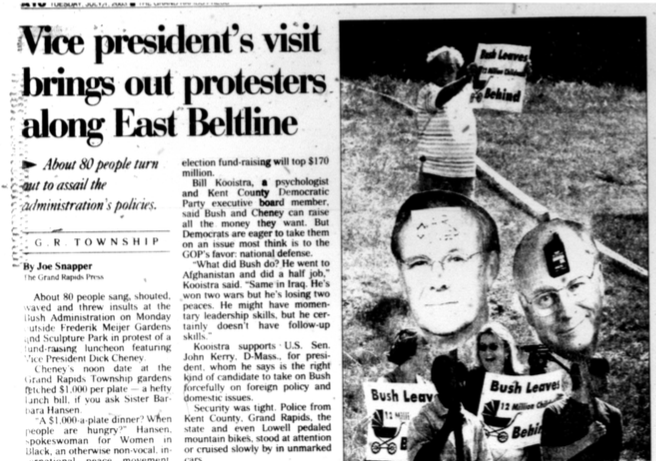
Just before the 4th of July weekend (2003) in Grand Rapids, Vice President Dick Cheney announced that he would be visiting. There were two separate protests, one organized by the People’s Alliance for Justice & Change, focusing more on US war crimes and Cheney’s war profiteering, while the other protest was organized by people involved with the Democratic Party (see image above from the GR Press).
The following July, President Bush came to Grand Rapids, while campaigning for his re-election, speaking at a closed event at the GRCC Ford Fieldhouse. There was an organized protest outside of the event, an action organized by the Republicrat (un)Welcoming Committee. At the same time that Bush spoke at GRCC, just around the corner on the corner of Division and Lyon there was another protest, this time in the form of street theater, with Billionaires for Bush, seen in this video here.
In early November of 2004, Bush again came to Grand Rapids to campaign and an estimated 100 people showed up to protest him and the US occupation of Iraq. There were many people there who were with the Democratic Party, but there was also a noise bloc, people playing instruments and making lots of noise, which annoyed the Bush supporters going in to DeVos Hall.
 The following Spring of 2005, President Bush announced he was coming to give the commencement speech at Calvin College. Students and faculty at Calvin objected and even took out an ad in the Grand Rapids Press with over 150 signatures objecting to Bush speaking at the Calvin commencement.
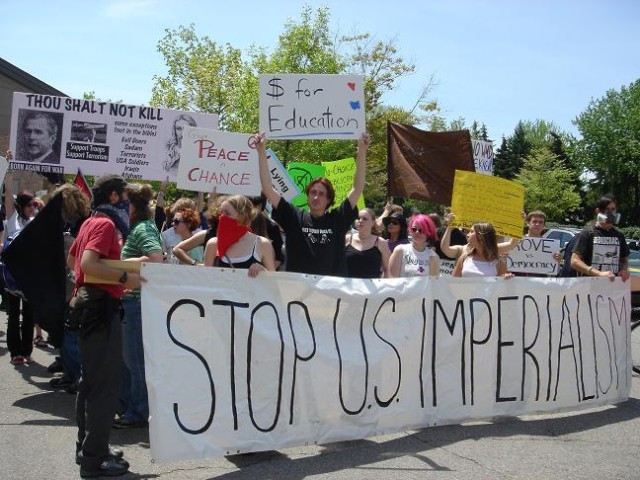
On the day of the Calvin commencement, there were hundreds of people lined up on the East Beltline, protesting Bush’s visit. Several groups were calling for the protest, but the group calling themselves Against Empire was the most organized with large banners (seen here below).
In September of 2006, Vice President Dick Cheney again came to West Michigan, this time attending a GOP fundraiser at the home of Peter Secchia in East Grand Rapids. The group ACTIVATE organized an action near Secchia’s home, but were confronted by police and told that they could not protest since the City of East Grand Rapids had a “no picketing ordinance,” which was later contested by the ACLU and the ordinance was done away with.
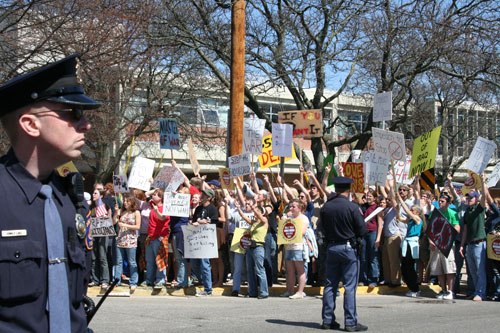
In April of 2007, President Bush came back to the area, this time speaking at the auditorium of East Grand Rapids High School. Former CIA agent Ray McGovern was in town and spoke at an anti-war rally before Bush arrived, only to be greeted by at least 1,000 protestors. There were many people unaffiliated at the demonstration, but it was organized by ACTIVATE, which distributed a 10 Reasons to Oppose the Iraq War flyer. ACTIVATE also had several large banners and attempted to challenge and bypass the police efforts to create “free speech zones.”


Vice President Dick Cheney came one more time to Grand Rapids, in September of 2007. Cheney spoke at the Gerald R. Ford Museum and another protest was organized by ACTIVATE, with an estimated 75 people participating in the action in the early part of a weekday.
In our next post we will look at anti-Iraq war actions that targeted Congressman Vern Ehlers.
 It is hard to ignore all of the anti-trans messaging and actions that are taking place across the country right now. From anti-trans legislation to all of the far right anti-trans actions and talking heads. Anti-trans ideologues like Matt Walsh, Jordan Peterson, Charlie Kirk and Ben Shapiro can be found all over social media.
Then there are the anti-trans campaigns that target organizations, entities and businesses that chose to embrace or at least market towards the trans community. The most recent example is the staged anti-trans theatrics of Kid Rock who is targeting Budweiser because they have an image of a trans person on their Bud Light cans. This statement from Kid Rock has been followed by a plethora of other anti-trans messaging, particularly attacks agains the beer company.
One example of this attack against Budweiser was recently posted on the Grand Rapids-based page of the police apologist group Silent No More. They posted this imagine of a Budweiser can – here below – with the following text:
There are opportunities in business to spread hope, honor courageous men and women who’ve DONE something, inspire positivity in a time where cynicism dominates – all instead of trying to use a skinny white boy that wears lip stick that has mental issues to advertise to a market the size of a closet.
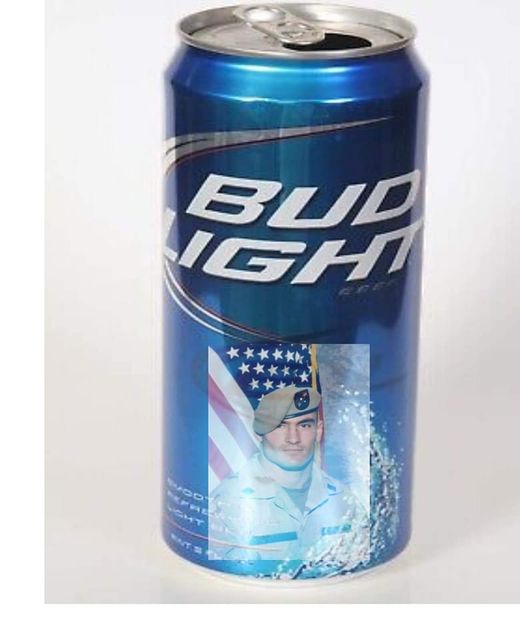 First, this hate-filled message is first and foremost an anti-trans message, that is not only repugnant, it fuels an anti-trans message that can often lead to physical violence against the trans community.
Second, this anti-trans message is posted on a site that is primarily about justifying police violence and the function of policing in general. However, as is the case with many pro-cop social media sites and pro-cop apologists, they also embrace white supremacy, heteronormativity, xenophobia, and transphobia. Taking a stance against calls to hold cops accountable or defunding of police departments has not only provided social media space for groups like Silent No More an opportunity to push their authoritarian, pro-state violence messages, it gives them license to target the most vulnerable and socially marginalized groups in the country – Black people, immigrants and those who identify as trans.
Third, and maybe the most ridiculous aspect of their Budweiser can image, is that it includes an image of the former NFL player and US soldier Pat Tillman. Now Tillman is not the patriotic poster child that those on the reactionary right might think he is. Tillman did enlist in the US military after 9/11, but he also grew increasingly critical of the US military while he was overseas. In fact, Tillman was even reading one of the most prolific critics of US foreign policy, Noam Chomsky.
Despite the fact that the reactionary right, members of the Bush Administration and the NFL has canonized Tillman as a shinning example of patriotism, there is a great deal of information and analysis about the fact that Tillman was killed by “friendly fire.” In fact, Tillman’s family, especially his mother has for years challenged the official narrative about her son’s death, as she did in this interview on Democracy Now in 2008. Pat Tillman’s mom also challenged the narrative that then Secretary of Defense Donald Rumsfeld was spinning about the former NFL star.
Now, I don’t consider Budweiser as a company that actually cares about trans people. Like any good capitalist, they care about maximizing profits and expanding their markets, even if that means appealing to the trans community.
More importantly, the spectacle created by Kid Rock demonstrates just how absurd the anti-trans community is, plus it exposes their ridiculous reasons for hating trans people. What is most unfortunate about this dynamic is the fact that the news media spends so much time promoting these so-called culture wars, but fails to report on the actual harm the current anti-trans campaign cause.
For an excellent resource to combat anti-trans disinformation, check out this document from Political Research Associates.
A friend of mine whom I provided direct care to for 8 years just died: Care work in a society of organized care-lessness
 By care, however, we not only mean hands-on care, or the work people do when directly looking after the physical and emotional needs of others – critical and urgent as this dimension of caring remains. Care is also a social capacity and activity involving the nurturing of all that is necessary for the welfare and flourishing of life. Above all, to put care centre stage means recognizing and embracing our interdependencies.
– from The Care Manifesto: The Politics of Interdependence, by the Care Collective
For the past 8 years the paid work that I do is in the capacity as a direct care worker in an adult foster care facility. I have done care work in a paid capacity in previous years as well, but this is the longest stint I have done care work for pay during my adult life.
I love the work that I do, which requires providing care to adults who cannot care for themselves. The work involves bathing people, assisting with dressing, mobility, and other daily aspects like feeding and going to the bathroom.
However, care work is more than just the physical care aspects that I just mentioned, it means being present for people, showing empathy, being a good listener, creatively engaging people in conversation, and making connections with people.
Recently, one of the residents where I work passed away. His passing has had a deep impact on me. I provided care for this person for the past 8 years. When he was in high school, he was in a bad car accident and has been unable to care for himself ever since.
For the past 8 years I have bathed this sweet person, shaved them, brushed their teeth, assisted them with getting dressed. I have also spent countless hours in conversation with this person, making jokes, laughing, listening to music, going for rides, sitting in the park, playing cards, putting puzzles together and watching horror movies. I learned early on in our relationship that this sweet person also had an affinity for horror movies, so I knew that we would be close.
We were close in age, so we grew up listening to and likely much of the same music. We would regularly watch music videos on YouTube and rock out to 70s music.
In 2017, I had to have emergency surgery for blood clots in my legs. While I was in the hospital, this sweet person came to see me. I was still pretty drugged up, but the day after surgery I remember this person sitting in their wheelchair next to my bed, holding my hand.
The adult foster care facility I worked in with this person was closing in 2022, so they were being assigned to a different facility. I requested to be transferred to that facility, specifically because I wanted to continue to provide care for this person and several other people whom I had come to know and have a deep relationship with over the years.
I was sick a few weeks back and the last time I had seen the resident I had been doing care work for eight years ended up in the hospital. Going to the hospital was pretty normal for this person, as they were tube fed and regularly needed adjustments with the tube, along with struggling with respiratory issues for most of their adult life.
When I returned to work, I found out from a co-worker that this friend of mine had passed away. I was devastated to the point where I had to sit down after hearing this heart wrenching news. After several minutes I was able to collective myself and then inquired as to the reason for this person’s passing. No details were available. My co-worker then said, “didn’t anyone call you to let you know that this person had died?” I said that no one had reached out.
My sadness had quickly turned to anger. How could someone that I had cared for for so many years, a person that everyone who worked with me knew that I had a special relationship with, not result in someone attempting to contact me? I was dumbfounded and pissed.
I then checked my work e-mail and the only information that was shared, was an obituary that this person’s family had sent out. I decided to send a message to those who work in an administrative capacity for the organization I work for. Here is what I wrote – which has blanks where this person’s name was.
I was not aware of ____ passing until 2 days ago, when I came back to work. I was shocked to find out that _____ had died and am deeply sadden by this news. I was also saddened by the fact that no one from this organization said anything about _____ death, apart from one co-worker. I never received a call or notification that ____ had died and that bothers me tremendously. Yes, I was just a care giver for _____, but their death is not just a part of the job, it deeply impacts me precisely because of the deep relationship I had with them for 8 years. I know I am not family, but their passing hurts no less for me than if a family member had passed. I find it somewhat incomprehensible that beyond the sharing of this obituary, that there has been no outreach and no effort put forth to provide some sort of comfort and closure for those of us who had a deep connection to _____. _____ was not just a person in our care, they were someone I cared about deeply. Please help me understand how _____ passing merits only a digital sharing of his obituary?
A society of organized care-lessness
I only had one person from where I work respond to my e-mail, along with the fact that most of my co-workers said nothing about the passing of friend, nor did they inquire has to how I was feeling or how their death was impacting me.
I have been thinking about this for the past several days, trying to make sense of why there seemed to be so little acknowledgement of the loss of my friend. As I reflected on this dynamic, it began to make sense to me why there was virtually no empathy being demonstrated towards me, nor any evidence of mourning from the organization. In order to do care work for the organization that I work for, you have to be trained in a number of health care aspects, all of which are necessary and important. Whether it is CPR training, administering medication, recipient rights or confidentiality issues, the organization I work for does a good job of covering these health care related matters. However, there is one area that trainings are not offered. We are not taught, nor trained in how to demonstrate empathy, which for me is as important as the health related, quality of life areas of direct care, if not more important.
The population I work with are people who have had closed head injuries, which almost exclusively means they have limited or no mobility. The level of care varies, but most of the people I have worked with will never be able to live on their own nor outside of a care facility. Many of them struggle with the trauma they have experienced, with the depression they fight against and the overall feeling of being discarded in this society. Even worse, they have to deal with the fact that for many people, their response to the condition of those I work with is pity. Pity is an awful sentiment. In fact, the demonstration of pity is an indictment of how fucked up our culture is.
We all need to learn and develop our capacity to care for each other, to be empathetic and to be in deep relationship with each other. At the beginning of the pandemic in March of 2020, we began to see how the lack of empathy and care were exposed on a national scale. Some people were in denial about what was happening, while others chose to focus exclusively on their own well being and damn the rest of society.
We saw how in a capitalist culture, that people prioritized productivity and consumption over the care and general well being of families and communities. This dynamic was not new, it was merely exposed, and had the curtain pulled back for everyone to see.
Of course, not everyone was so calloused in their response to the pandemic. In Grand Rapids, the Grand Rapids Area Mutual Aid Network (GRAMAN) was born. People rallied around and gravitated to the idea that everything we need is right here in our community. The level of collective care has been inspiring in so many ways, and I have been grateful to be part of that work.
Moving forward we need to weave direct care into every aspect of society and make care work central to how we function, thus displacing the Neoliberal economic system that prioritizes profit over people. A great resource that can assist us in this process is the book, The Care Manifesto: The Politics of Interdependence, by The Care Collective.
This post is dedicated to the memory of my dear friend who died two weeks ago. I will miss them, but I will never forgot our friendship and how much we meant to each other. Rest well dear friend.
In February, I made a series of posts about books on racism and the Black Freedom Struggle that have influenced me, which was followed by a series of posts in March about books on feminism that have influenced me as well.
This month I want to include three posts about books on the environment that have influenced how I view with the world around me. In Part I, I want to focus on books I read in the 1980s and 1990s that initially radicalized me about how I view being part of the natural world.
Here are 10 books that influenced my thinking at that time:

Silent Spring, by Rachel Carson
The Unsettling of America: Culture & Agriculture, by Wendell Berry
Diet for a Small Planet, by Frances Moore Lappe
Ecological Imperialism: The Biological Expansion of Europe, 900–1900, by Alfred Crosby
Turtle Talk: Voices for a Sustainable Future, by Christopher and Judith Plant
The War Against the Greens: The “Wise-Use” Movement, the New Right, and Anti-Environmental Violence, by David Helvarg
Dying from Dioxin: A Citizen’s Guide to Reclaiming our Health and Rebuilding Democracy, by Lois Marie Gibbs
Simple in Means, Rich in Ends: Practicing Deep Ecology, by Bill Duvall
Timber Wars, by Judi Bari
Earth for Sale: Reclaiming Ecology in the Age of Corporate Greenwash, by Brian Tokar
For the past 30 years, the Grand Rapids Chamber of Commerce has facilitated a leadership development program called Leadership Grand Rapids (LGR).
According to a recent blog post from the GR Chamber, there are 40 people who are, “hand-picked to span a diverse network of backgrounds, specializations, and industries to bring together a group that is uniquely special and capable of confronting complex problems from all directions.”

The goal of the LGR program is as follows:
LGR serves to create a network of community trustees who act on the need, the desire, and the ambition to work for the common good and serve the primary needs of others by holding our community in trust. Ultimately, we’ll drive systems-level change to create a thriving and prosperous West Michigan for all.
This whole thing about making West Michigan a prosperous place for everyone is also part of the mission statement of the Grand Rapids Chamber of Commerce, but after more than 100 years of existence, there is no evidence that the majority of residents of West Michigan are prosperous or even have their basic needs being met.
More importantly, the idea that Leadership Grand Rapids wants to drive systems-level change is just a flat-out absurd statement. Here are some thoughts about why LGR is not interested in systemic or structural change, at least not the kind that would benefit those most vulnerable in this community.
First, it you want to participate in this program (which means once a month from October – May), you have to pay $4,500 to participate ($4,000 if you are a GR Chamber member). The cost alone automatically excludes large sectors of society. Yes, they offer scholarships, but they also make it clear that participants are hand-picked, and I would argue hand-picked specifically from the business and professional classes of people in this community.
Second, in 2000, I was asked by my former boss at the Community Media Center to participate in LGR, but I declined, as my understanding of leadership is fundamentally different from what the Chamber of Commerce defines as leadership. I did however participate in the program from 2000 – 2006, as a presenter.
The way LGR was structured in those years was around specific themes for each month, and one month they would spend the day visiting media outlets and talking about the role that media played in West Michigan, primarily the role that commercial media played. However, my former CEO at the Community Media Center (CMC) convinced LGR to come to the CMC for part of the day to see how media technology could be used for non-commercial purposes. In addition, I always did a 45 – 50 minute long Media Literacy presentation, in order to get people to think critically about how media functions in our world. Participants always gave high marks for the Media Literacy portion, especially since it is a very interactive form of critical thinking.
Being involved in LGR from 2000 – 2006 gave me an interesting perspective on the make up of the LGR participants and some insight into their worldview, especially since there was lots of conversation in my Media Literacy session. So, when I say that LGR caters to primarily the business and professional class, I was speaking from experience, as we would always get a list of people involved and what company or entity they worked for.
Third, the primary sponsors of LGR should be an indicator about what the function is of this leadership training program. You have Blue Cross/Blue Shield and Corewell Health, both of which are part of the For-Profit Medical Industrial Complex. The other two main sponsors are Experience GR, the lead tourism entity in Grand Rapids, along with Amway, the global corporation that was founded by and still run by members of the billionaire DeVos and Van Andel families.
Fourth, based on my own observations and from first hand accounts of people I know who have participated in LGR, the primary function of the program is to introduce people from the business and professional classes to other “influencers” or members of the local power structure. In addition to introducing participants to these people, the other benefit is to assist younger participants who are members of the business and professional classes to network with peers who are immersed in maintaining the status quo in West Michigan.
Lastly, it is worth asking if there are any measurable systems-change impacts that LGR has had over the past 30 years? I am not aware of such systems-changing outcomes and there are no examples of this listed on the page that features LGR. One would think that if there were system-changing outcomes they would have included that information as a solid marketing tactic. In fact, the only information we get on the LGR page, beyond the goals and how to apply, are a few testimonials from previous participants.
Make no mistake about it, Leadership Grand Rapids, like most of what the Grand Rapids Chamber of Commerce does, is designed to groom future leaders in such a way that will benefit those participants and not disrupt the interlocking systems of power in West Michigan that does not welcome people who want to radically challenge the status quo.
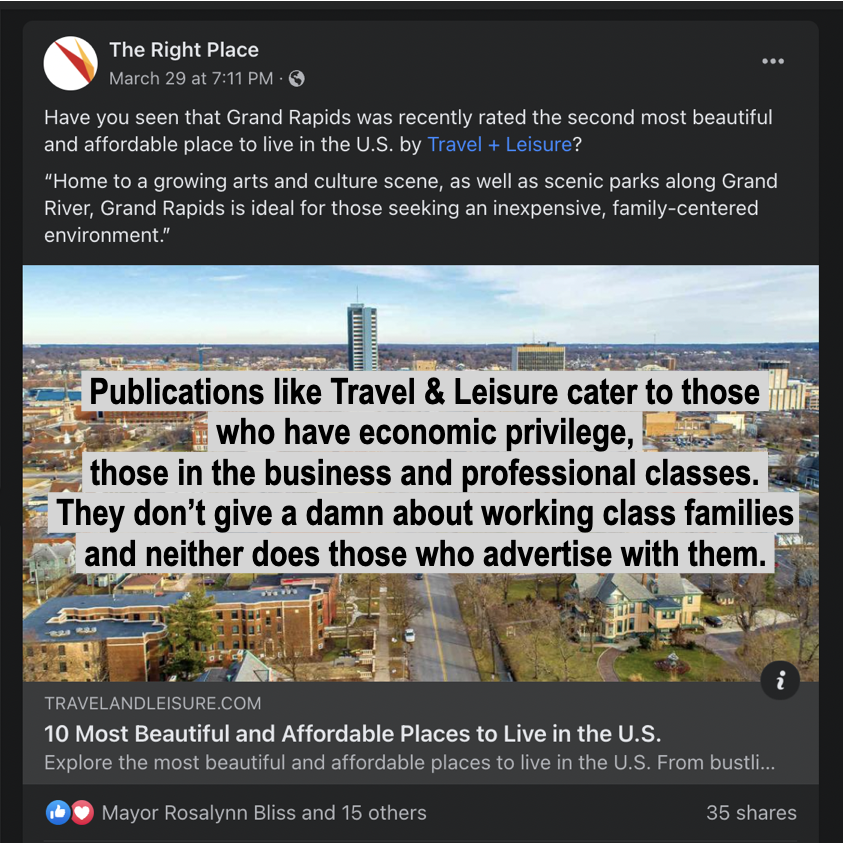 According to the highly astute publication, Travel & Leisure, Grand Rapids, Michigan ranks as the 2nd most beautiful and affordable city to live in the US.
The evidence that Travel & Leisure provides is the following:
The following list — compiled using data from U.S. News & World Report’s 2022 to 2023 rankings, including the most affordable places to live in the U.S. and the best places to live in the U.S. — offers a collection of some of the dreamiest places to live in America that won’t break the bank.
In its rankings, U.S. News & World Report evaluates the impact that cost of living, median monthly rent, median home price in relation to the national median, and quality of life have on a city, which generates a well-rounded figure for anyone looking to relocate.
As is the case with most of these best places to live is their use of averages, which is not an accurate reflection of the reality for thousands of families living in Grand Rapids. The question that always should be asked is, for whom is Grand Rapids an affordable city? According to a report from the Economic Policy Institute, Grand Rapids has the highest wealth gap of any metropolitan area in the state of Michigan.
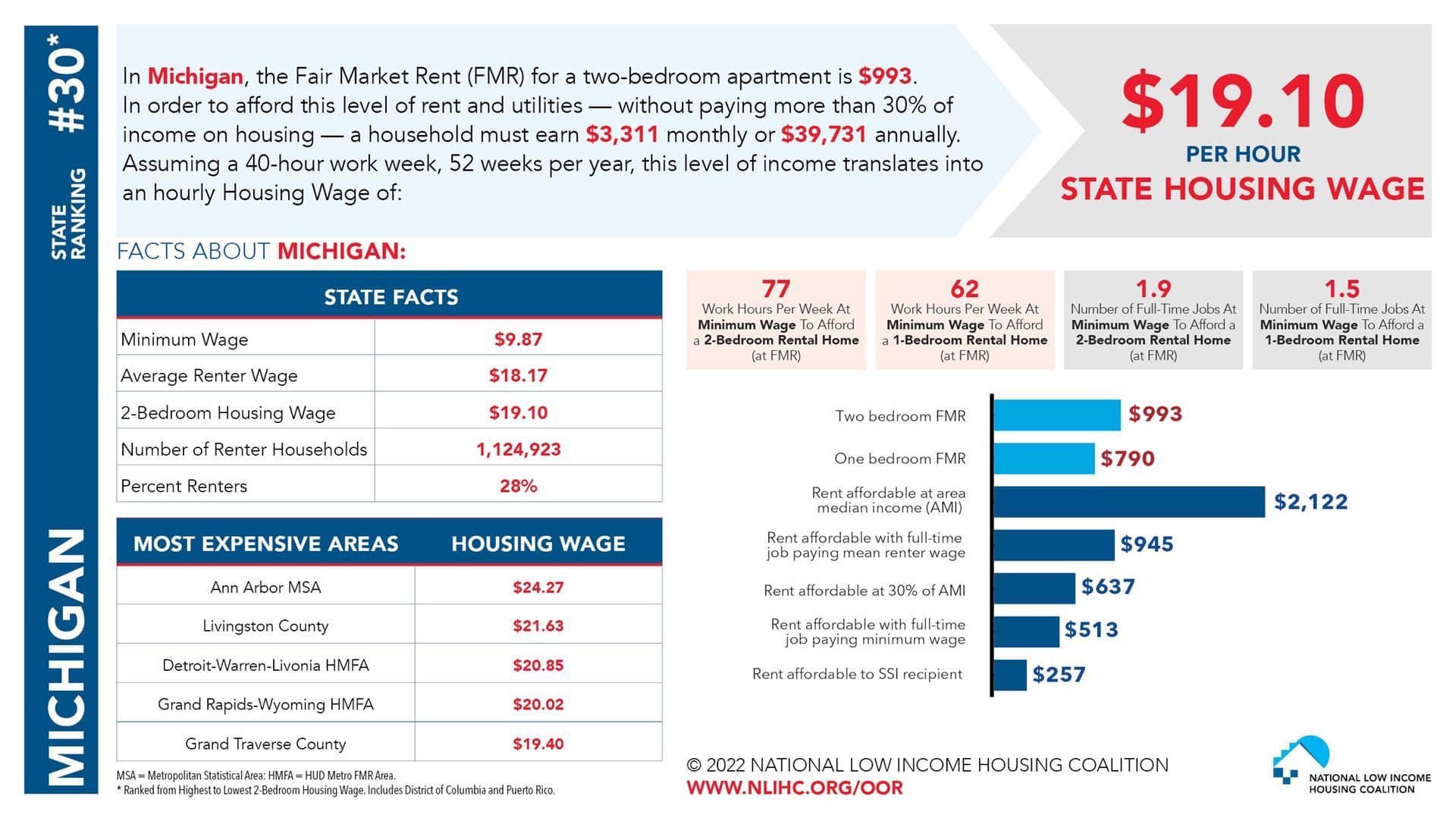
If one is looking at the average cost of rent in Grand Rapids, you can see a glaring contradiction around the issue of affordability. The National Low Income Housing Coalition provides excellent information on affordability of rent in all states, including Michigan, which you can find here https://nlihc.org/oor/state/mi. The graphic below, provides a good summary of the average cost of rent and what people need to earn per hour to afford most rent. As you can see in the graphic, for those renting in Grand Rapids, you need to earn $20.02 an hour to afford the average rent. There are literally tens of thousands of individuals and families who do not make $20 an hour in Grand Rapids, yet developers keep creating housing that is un-affordable for so many people.
I do volunteer work with the Grand Rapids Area Tenant Union and one of the most common messages we here from people who are tenants in this city is that they cannot afford to cost of rent, or that their rent is being raised once again, usually resulting in them having to move out.
Now, one of the most influential pro-business groups in Grand Rapids, the Right Place Inc., recently shared the Travel & Leisure post about Grand Rapids being the 2nd most beautiful and affordable place to live in the country. Thirty-five people shared that post, including the Mayor of Grand Rapids. However, no matter how many people actually believe these ridiculous rankings about which city is the safest or the most affordable, the reality is that for thousands of people and thousands of families in Grand Rapids, Beer City is NOT affordable.
In their last edition in March, the weekly publication MIBiz, ran an article entitled, State, local leaders ‘lay the groundwork’ for statewide housing plan.

The Michigan State Housing Development Authority (MSHDA) is holding meetings across the state to talk with “leaders” in several regions of Michigan, to both lay out the State’s plan on housing, but also to learn what regional groups are doing to address the current housing crisis. The State goal, as presented by MSHDA, are the following:
- Creating or rehabilitating 75,000 housing units that range in affordability and type.
- Reducing equity gaps in housing, and reducing homelessness.
- Increasing home energy efficiency.
According to the MIBiz article, “About 80 people from various nonprofits, local governments and businesses gathered at the Grand Rapids Area Chamber of Commerce offices for the regional kickoff meeting.”
There are several things that should be alarming about who the 80 people were at this meeting in late March. Nonprofits usually means the nonprofit housing groups like ICCF, Dwelling Place and other groups that do not fundamentally challenge to the massive wealth gap in West Michigan; government, most likely meant Grand Rapids and Kent County officials, who have also been unwilling to radically imagine what housing justice could look like, along with businesses. Of course there were businesses present, which usually translates into businesses that are developers and will profit from more construction contracts, along with businesses that want to attract talent to the area and have been demanding more new housing. When businesses say talent, they overwhelmingly mean professionals. This list should concern those who want housing justice.
Then there is the issue of who was not invited. Most important, those not invited were the unhoused and those that are housing insecure, primarily tenants.The Grand Rapids Area Tenant Union was not invited, along with other community-based groups that do advocacy and make the connections between housing insecurity, racism, poverty and other systems of oppression.
Lastly, we should all be alarmed by the fact that this meeting was held at the offices of the Grand Rapids Chamber of Commerce. The Grand Rapids Chamber of Commerce not only has a long anti-worker history, they also have consistently opposed increases in the minimum wage and most definitely living wage campaigns across the country. In addition, the Chamber of Commerce has consistently supported the Realtor Associations and Property Owners Associations (landlords) when it comes to public policy matters, this favoring these sectors of working class families seeking to find safe and affordable housing.
Not only did the GR Chamber host this meeting, the group that they created, Housing Next, is hoping to be the organization that receives funding from MSHDA to facilitate future meetings/planning centered around housing for the rest of this year. The MiBiz article states that each region will, “receive a $75,000 grant from the state to organize and facilitate community meetings, provide updates ton the region and create an action plan.” Do we really want a Grand Rapids Chamber of Commerce created entity to be the primary entity around housing in West Michigan? It would seem that MiBiz supports this notion, since the rest of the article cites the director of policy for Housing Next several times in the later half of the article, with no other potential entity being a potential recipient of the grant money even being mentioned in the article.
GRIID has written about Housing Next and their ideological leanings over the past year. About a year ago, Housing Next held a similar meeting in Ottawa County with the Grand Rapids Chamber of Commerce, along with several other local chambers, furniture giant Haworth, several banks, the Windquest Group and the DeVos Family Foundation. Housing Next had sent out an announcement about the meeting, using the following statement of purpose. The meeting “was to create workforce housing for individuals and families employed in Ottawa County who were unable to afford to live there.” Now, any reasonable person would ask themselves why can’t workers afford to live in the communities that they work in? The simple answer is because these individuals and families don’t make enough to afford the cost of housing in the communities that they work in.
The solution being offered by the numerous area Chambers of Commerce, is to create a fund that comes from the business community, foundations and local banks, which would allow these individuals and families to afford the cost of housing in the communities where they work. However, wouldn’t it make a whole lot more sense to have all of the companies in West Michigan make a commitment to paying people a livable wage, which would allow them to afford the cost of housing in this area? Therefore the Housing Next solution is based on a housing charity model, not a housing justice model.
The more recent article we have written about Housing Next was from February of 2023. In that GRIID article it states:
The “solution” to the current housing crisis, according to Housing Next, involves local government, developers and non-profits. The fact of the matter is, Housing Next offers no real solution to the housing crisis, only the same old model, the market. This is not a solution or maybe more aptly named a false solution. This is because under a market system, housing is nothing more than a commodity that can be bought and solid to make profits. For the Chamber and those sectors of society who believe in the market, housing is not a fundamental human right. Housing within a market economy, particularly home ownership, is for those who can afford it, which leaves out millions of people in the US alone.
We also include a list of other ideas that are not market based, ideas which see housing as a fundamental right for everyone. In that article we identified several tactics to address the current housing crisis, including:
- Paying people a livable wage, which right now would be $25 an hour minimum
- Reducing the wealth gap in Kent County, where there are over 600 millionaires, but 25% of the population subjected to poverty.
- Government regulated rent control
- The creation of Tenant Unions
- Stop the influence peddling by Real Estate and Rental Property Associations, especially during election cycles, as we documented in 2022.
- Re-direct part of the massive US Military Budget ($858 Billion for 2023) and use it to provide housing for people, particularly the most marginalized communities.
- Practice Radical Hospitality, particularly in the faith communities. Imagine home many people who are currently housing insecure, could benefit from the resources and hospitality of the faith communities.
- Limit large corporate property management companies or real estate investors from operating in Grand Rapids/Kent County.
- End government subsidies/tax breaks for developers.
- Promote cooperative housing and Community Land Trusts.
The bottom line is that the Housing Next model is a false solution, since it involves the very same organizations, businesses and individuals that have done everything in their power to promote wealth creation for the business class, while creating a vast array of obstacles for everyone else who lives in West Michigan and cannot afford the cost of housing. Having Housing Next be in charge of hosting community meetings, and providing updates around the current housing crisis in West Michigan will just mean that the same old failed market-based solutions will be implemented and the housing crisis will continue. We cannot let this happen.
POLICE SHOOTING RANGE UPGRADE AWARDED TO UTAH CONTRACTOR
(This article was written and submitted by Kellan Martin.)
The City of Grand Rapids has awarded a municipal auction contract to Action Target of Provo, Utah for a Grand Rapids Police Department (GRPD) practice range upgrade. The contract was voted on by the City Commission on February 21st, 2023 and officially awarded on March 9th, 2023. The contract awards a total of $167,595 to Action Target for “comprehensive upgrade[s]” to the 20-yard target range currently utilized by the GRPD.
The funds for this project were obtained through the city’s Capital Improvement Fund, a tax-funded account the City of Grand Rapids uses to make payments for maintenance and updates on city-owned assets. Action Target is a large-sized range manufacturer that, between 2000 to 2008, was awarded $42.9 million in US government contracts, and in 2004 built training facilities for the US and other national forces occupying Iraq.
In the wake of the execution of Patrick Lyoya by former GRPD officer Christopher Schurr, the City of Grand Rapids chose Action Target to install a “Fixed Turning Target System” that Tony Wojciakowski, a Buyer in the Purchasing Department of Grand Rapids writes, “…[provides] crucial training when designing courses around high stress, split-second decision making.”
City documents do not answer the question of how this development in GRPD’s shooting range will make officers choose better decisions outside of a scenario where police are in the action of shooting at someone. This further “tacticalization” of police that companies like Action Target exploit is an extension of the general trend of law enforcement militarization in the United States, and is a widely documented issue that presents itself in the form of weapons, gear, policies, and protocols.
Within the last three years, police spending nationwide has increased under federal efforts to hire more officers and to provide them with a higher level of training. What is missing from official statements from the Biden administration especially is any critical thought towards the contradictions formed from this official thought process. Officials do not want to expose the connection that this recent injection of police funding and support came into existence after calls of justice during social unrest following murders of unarmed civilians by the police such as Breonna Taylor, George Floyd, Patrick Lyoya, Tyre Nichols, and many more.
In other words, the current struggle against police brutality was only possible because of government policies acting in the interests of the property owning class that has built the capitalist US system, and institutionalized racism within it. The state violence coming out of these conscious decisions to militarize the police and allow for extrajudicial killings citizens is now being used as a narrative focal point for those in power to introduce the need for more funding and “training” of the police as a solution. But this “solution” is merely an extension of the overall issue of how conditions got to where they were in the first place.
The police reforms currently being put in place by the United States government, in Biden’s words, are “… to fund the police. Fund them with the resources and training they need to protect our communities.” But that begs multiple questions. First, what kind of further protection will a shooting range upgrade bring our communities in Grand Rapids? And second; exactly which community in Grand Rapids needed to be protected from Patrick Lyoya to the point where GRPD officer Christopher Schurr shot Patrick in the back of the head?
Sources:
http://grandrapidscitymi.iqm2.com/Citizens/FileOpen.aspx?Type=1&ID=5180
https://en.wikipedia.org/wiki/Action_Target
https://thecrimereport.org/2022/10/17/police-funding-increased-nationwide-in-2022/

