Once again, GRIID was denied the opportunity to report on the West Michigan Policy Forum Conference happening this Thursday.
It seems that those who are part of the Grand Rapids Power Structure do not want the presence of independent news media, particularly media that will not just act as a lapdog to power.
On Wednesday, September 21st, I submitted a request the West Michigan Policy Forum for a Media Pass to attend their 2022 Conference. One week later I received the following response – Thank you for your email. After reviewing your request, we are unable to provide you a media pass to the upcoming conference. WMPF Communications Team. I responded to this message by saying, “Can you provide me with a reason for not providing a media pass? I have attended numerous conferences in the past and was always provided a media pass.” The West MI Policy Forum Communications Team did not reply.

This was not the first time I was denied a Media Pass to a West MI Policy Forum Conference. In 2018, the same thing happened and you can read the ridiculous game they played back then by going to this link.
Of course, none of this is surprising, since systems of power and oppression do not want anyone to shine the light on their activities. Nonetheless, this doesn’t mean I can’t write something about the event and the speakers they have invited. This is the first conference the WMPF has held since the beginning of the pandemic, and this year’s conference is the shortest one since they began in 2008, then it was a 2-day event.
As you can see from the image above, there is a lineup of speakers, with the theme being, Reimagining Michigan’s Failing Education System and Making Michigan a Top 10 State. Having a main theme is consistent with previous WMPF conferences and this year’s theme will address two aspects of the so-called failed education system. First, the speakers will discuss how to move Michigan more in the direction of what Betsy DeVos has been advocating for over the past 3 decades, a more privatized educational system with charter schools, religious schools and private elite schools. The second aspect of the education-themed conference is to discuss the need to gear education in such a way as to generate talent, specifically labor talent, which is why there are several business people speaking.
The WMPF Conference will go from 8:30am until noon. The first speaker will be Doug DeVos, talking about the WMPF’s Historic Wins for Competitiveness. DeVos will no doubt be talking about previous “victories” for the West Michigan Policy Forum, which you can read here. The list includes items like making Michigan a Right to Work state, repealing the MI Business tax, repeal of the prevailing wage mandate, Require funding for state economic development and workforce agencies to align more closely with private sector efforts in talent development initiative, etc. Always good to start out the day bragging about how those in power have imposed their will on civil society.
At 8:36am, people will hear from Christopher D. Lloyd, with McGuireWoods Consulting LLC. McGuireWoods Consulting LLC is a firm that assists groups like WMPF on how to work with – read manipulate – government agencies. Lloyd specializes in site selection and economic development incentives negotiations, which is essentially how to get governments to use public money to underwrite or subsidize private development projects.
At 8:55am, Dr. Stan Veuger, Senior Fellow at American Enterprise Institute will address the conference crowd. Veuger will be talking on the theme of, “What’s Keeping Michigan From Being a Top 10 State.” Based on Veuger’s work, this will no doubt be about how the business class can leverage government to use public money to bolster the private sector and attract more talent, making Michigan more appealing for members of the professional and business class.
At 9:30am, there will be a panel of three business people, who will respond to what Veuger had to say. This panel will be moderated by Doug DeVos and will include: Matt Haworth, Haworth, Inc., Randy Thelen, The Right Place, and Chelsea Keeton, with Grand River Aseptic Manufacturing. Haworth is a Vice Chair of WMPF and is a major contributor to the Republican Party and Republican candidates. Randy Thelen, with the Right Place Inc, which works with West Michigan municipal governments to attract businesses, often at the public expense. The Board of Directors at the Right Place Inc. consists of many of the same people who sit on the Board of the West MI Policy Forum. Chelsea Keeton is a senior marketing and public relations leader at Grand River Aseptic Manufacturing. Grand River Aseptic Manufacturing recently received $120 Million in funding from the US Government, along with a contract with the U.S. Department of Health and Human Services and the U.S. Department of Defense.
At 10:35am there will be a presentation entitled, A Game Plan for K-12 Transformation in Michigan, Next steps for Education Transformation in Michigan. This presentation will be given by Don Nielsen, with the American Center for Transforming Education. The American Center for Transforming Education is part of the Discovery Institute, which advocates for Public Education Reform. What they mean by Public Education Reform is to push School Choice, to change education policy, make schools places that work with the business community to meet market demands through talent creation.
At 11:05am, there will be another panel to react to the comments by Don Nielsen. The panel will consist of Rep. Pamela Hornberger, John Kennedy, Autocam Medical and Kelley Williams-Bolar, School of Choice Advocate. Rep. Hornberger is the Chair of the House Education Committee, and three weeks ago she introduced a House resolution on Wednesday condemning the Michigan Department of Education’s teacher training videos on student gender orientation and reaffirming the fundamental right of parents to direct the education of their children. John Kennedy is part of the Executive Board with the WMPF and has been one of the most consisted WMPF members to speak out against Public Teacher Unions. Lastly, Kelley Williams-Bolar, an African American parent, went to jail for sending her kids to a highly ranked school near where her father lives, which was out of her home school district. Now, the far right is using her to push their own education agenda.
If the West Michigan Policy Forum gets their way, they will radically alter education policy in Michigan and effectively undermine public education for decades to come. We all need to know about their policy work and there needs to be a significant effort, even a social movement, to prevent them from achieving their goals for public education in Michigan. Unfortunately, the work of the West Michigan Policy Forum is under-reported and operates outside of the view of the public. This underscores their decision to not allow me to attend this conference as media.
Wanted for supporting the criminalization of Abortion: Acton Institute for the Study of Religion and Liberty
 This is the seventh in a series of WANTED posters, looking at individuals, families and organizations in West Michigan that have contributed significantly to the criminalization of abortion and the undermining of reproductive justice.
Today’s focus is on the Far Right Think Tank, the Acton Institute for the Study of Religion and Liberty. Unlike some of the other entities that have garnered Wanted Posters, the Acton Institute does not fund anti-abortion groups and they do contributed to anti-abortion candidates. What the Acton Institute does, is provide an ideological framework to individuals, businesses, candidates and organizations who are actively or leaning towards an anti-abortion position.
The Acton Institute was a strong ideological supporter of Amy Coney Barrett in the summer of 2020, when she was first nominated for the US Supreme Court. Barrett was one of the majority that voted to overturn Roe v Wade.
As a Catholic institution, the Acton Institute has followed the Catholic hierarchy’s stance against abortion and has discussed this position repeatedly in articles and podcasts on their website. The Acton Institute has also invited numerous people to speak on abortion, primarily at conferences, even though abortion is not the main focus of the organization, Capitalism is.
Lastly, the Acton Institute has been supported by many of the other individuals and families in West Michigan that have donated millions to anti-abortion efforts. In fact, most of these same families and individuals have sat on the board of directors of the Acton Institute since it was founded in the early 1990s. Past board members that have contributed to the criminalization of abortion are Rich DeVos, Else Prince, and Betsy DeVos. Current board members that take the same position are John Kennedy and Rick DeVos.
We encourage you to share this poster and consider directing some of your rage at the recent US Supreme Court ruling to overturn Roe v Wade towards the Acton Institute for the Study of Religion and Liberty, which is located in downtown Grand Rapids, at 98 E. Fulton Street, at the corner of Fulton & Sheldon SE.
Republican candidates demonize, while Democrats undermine the Defund the Police Movement in Grand Rapids and across the country
In May of 2020, the largest, spontaneous protests erupted all across the US, protests that were rooted in a collective outrage about policing in the United States.

In Grand Rapids, there were thousands of people who had gathered during May 30th, to march and to protest against the police murder of George Floyd, but also to protest the abuse by the GRPD of several African Americans living in Grand Rapids. We documented that action in 2020, how the Grand Rapids City Officials and the GRPD sought to control the narrative about what had happened and how a massive call to Defund the GRPD had emerged out of the May 30th uprising.
It is instructive to read the demands of the Defund the GRPD Coalition, which were presented during their Press Conference in late June of 2020. Those demands included:
- The GRPD has a long history of intimidation, harassment and violence against the Black community in Grand Rapids. Those of us who are part of this coalition have experienced this harm and have heard from countless others who have been victimized by the GRPD. There have been numerous efforts to reform the GRPD, but we know it is now time to DeFund the GRPD.
- We are demanding that the City of Grand Rapids hold an emergency meeting by June 30 to adopt a Defunding the GRPD position, wherein the police budget will be reduced to the 32% City Charter mandated level for the upcoming fiscal year.
- We are also demanding that the money from this budget cut should be refunded to the Black community and the Black community should have complete control over how this money will be used.
- DeFunding the GRPD and Refunding Black Communities must happen if there is to be any trust built with the Black community. It is one of the few things that will work to actively promote equity in the Black community, which is so desperately needed.
- The DeFund the GRPD Campaign Coalition believes that there are better ways to practice community safety and that Grand Rapids needs to begin the process of having deep conversation about how to practice community safety that does not rely on policing.
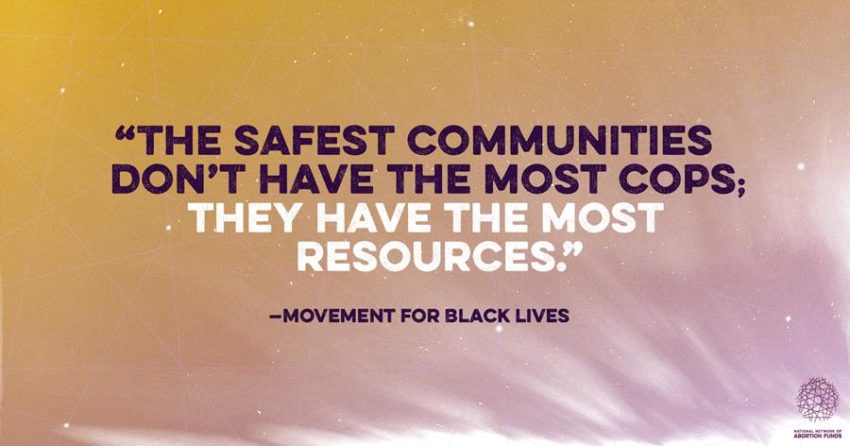
These demands were similar to what communities were demanding all across the US, demands that were particularly coming out of Black communities/organizations. These demands were somewhat solidified by the Defund the Police toolkit, which was created by the Movement for Black Lives. In fact, the Defund the Police Movement, which emerged from decades of the Black community being deceived about so-called police reforms, was a natural extension of the Black Freedom Struggle, a struggle that had its origins in the Abolitionist Movement.
So, just a little over two years ago, we have the largest protest movement in US history, a movement that was calling for the Defunding of the Police, and in many cases the abolition of policing as we know it. With this context, how did the political establishment respond to one of the most powerful social movements in recent history? We know that the GOP, led by then President Donald Trump, demonized the movement and lumped them in with antifa and referred to them as domestic terrorists.
The Democrats, who were in the midst of a campaign to beat Donald Trump in the 2020 Election, responded to the Black Lives Matter/Defund the Police Movement by calling for more funding for the police. Sure, there was some rhetoric around better police accountability and more training, but one thing was consistent, the Democrats were calling for an increase in funding for the Police.
Jump to the current electoral cycle and in West Michigan, particularly the 3rd Congressional District race, State Senate and State Representative races, and we find that in virtually every instance the Republican candidates or Republican committees are accusing Democratic Party candidates of defunding the police. Those that are funding ads for 3rd Congressional District candidate John Gibbs, are accusing Hillary Scholten of wanting to defund the police or being sympathetic to rioters. The same is the case with GOP State Senate Candidate Mark Huizenga, who is accusing David LaGrand of defunding the police, and State Representative candidate Lynn Afendoulis has been making the same claims about her opponent Rachel Hood.
The fact of the matter is that in each of these three cases, the Democratic candidates are all calling for an increase in funding for the police and both LaGrand and Hood have already voted to do just that. This dynamic is underscored by a recent MLive headline, which reads, Whitmer, Dixon duel over who supports Michigan law enforcement most.
However, the facts about bipartisan support for providing increased funds to police departments get buried in the rhetoric of electoral politics. The GOP keeps claiming that Democrats want to defund the police, while Democrats consistently vote for an increase in funds and an increase in the number of police officers. GOP supporters believe that Democrats want chaos or anarchy and Democratic supporters believe that funding for cops are necessary, since without cops people wouldn’t be safe. It’s like the standard tough on crime/soft on crime claims during electoral cycles. Candidates from both parties always support tough anti-crime laws, but it doesn’t matter if the perception of people is that – fill in the blank candidate – is soft on crime.
The result of the larger electoral strategy about Defunding the Police is that Republicans get to demonize Democrats and Democrats end up trying to convince voters that they too are committed to police funding. In the end, both parties completely ignore a growing number of people who are calling for defunding of police departments, alternative mechanisms for public safety, and even the abolition of policing.
 Within the last two weeks, all of the candidates running for the Grand Rapids School Board received a letter from the local group, Grand Rapids for Education Justice.
The letter, which you can read here, addresses concerns of the influence of people like Betsy DeVos, the recent US Supreme Court decision to allow religion into the public schools, the growth of Charter Schools within Grand Rapids, the failure of the GRPS to retain enough full time teachers, to adequately compensate teachers and the racial divide or two tiered system in Grand Rapids Public Schools, where BIPOC students are disproportionately subjected to low academic standards.
Again, each of the Grand Rapids School Board candidates received the letter, but not all responded. What follows are the candidates who did respond and their responses to the GREJ letter.
Amanda Bernes – Thank you for presenting your group’s concerns and reaching out to me directly. I very much agree with you and appreciate all you have done to serve this community. I am absolutely concerned about the very existence of our public schools and the future of public education funding. I aim to work with all of the stakeholders in order to find new workable solutions now, and funding to prepare for future needs. I would gladly listen to your suggestions and look forward to finding classic and new best practices as well as working with local concerned groups such as GREJ to find solutions now. We have a limited time to act and to ensure our kids receive a good public education and I’m committed to doing the work that’s needed. Thank you for all you do for our children, teachers, parents, and community.
Andrew Clausen – You highlight a number of issues in your letter. Some responses below:
Grand Rapids Public Schools have indeed been experiencing a significant decline in enrollment. I have talked to numerous families that choose other schools (including public school choice, public charter, private, and homeschool). Parents are trying to make the best decisions for their kids, and care most about a school’s/district’s academic achievement data as well as the reputation of the school within the neighborhood and the long-term choices that they can make about school options. GRPS students in nearly all schools have continued to perform poorly on measures of academic achievement (MME, MSTEP, SAT). The cause for this is complex, but likely overlapped with a poorly compensated teaching faculty leading to the vacancies you reference in your letter. I too have grave concern for the size and degree to which administration (specifically central office administration) is compensated while we lose the battle for teachers with neighboring schools. This is a major priority for me if elected to the board of education.
I believe that there are some back to basics, common sense steps that our district needs to take in order to provide a high quality educational experience to the students and families that it serves. I believe that a healthy GRPS is vital to a healthy Grand Rapids for all community members. I am confident that we have the resources and capacity to turn the tide of public opinion about our district and to see growth in the academic achievement of our students. I know this district needs people in leadership that make fiscally responsible decisions and have innovative solutions to the problems that we face.
Aarie Wade – There is a lot to digest in this letter. But one thing that sticks out is GRPS chartering a school within a district, a thriving school that is attracting students with a robust lottery system due to this attraction.
GRPS has to become an attractive place to learn. Not only that but an attractive place to teach as well. This to your other point, teacher pay HAS to be on the forefront of the agenda. Thriving teachers attract and produce thriving learners. The energy is different when you’re not worried about your basic needs being met, you can actually pour into the children but a lot of our educators are like empty cups. Just making it, yet they show up each day giving all of what’s left.
Paying our teachers and treating them with dignity, respect and high regard must be the priority.
The district has to be careful of the message that will be sent if we close schools. If schools close, we have given up.
Thank you for this very thought out call to action. As a parent and community member in this district I share the same sentiments. A a board member, I look forward to taking action.
Kymberlie Davis (incumbent) – After looking over your letter again, I want to let you know that the concerns that you and GREJ have are concerns that the board has as well. While I can only speak for myself, I know that many if not all of my colleagues are for public schools and against public funds being designated for private education. I know our legislative committee works to be knowledgeable of things going on at the state and federal level and as a district we take a stand on issues that directly affect public education. Can we do more, yes, of course! I would encourage you to attend the legislative committee meetings if at all possible. They are held the 3rd Monday of the month at 5:00 and are also recorded.
I have the same concerns with bussing and teacher shortages. I have heard many people in our community voice their concerns in these areas too along with the lack of custodians and cleaning in our buildings. These concerns are not being ignored. I face the same issues in the district I teach in. We are in crisis right now with vacancies all over the country. I know GRPS is working on this every day and am happy to hear of new strategies that we are taking, for instance, we will be helping to get Visas for teachers who need them in order to teach for us…
I am a teacher and I believe teachers deserve much more than they currently get. We have and will continue to advocate for pay increases.
The problems aren’t solved. I know this. The work is never ending. I want you to know that we are in it. We know the data and it isn’t what we want. We see growth but it isn’t enough and we will continue to make policy and ask questions that push for removing barriers.
I also welcome you to watch any board meetings (committee meetings as well) and let me know when you have questions OR wish I would have asked certain questions. I have gotten better at using an equity lens to inquire more from administration when we are presented with something, BUT I am only one person and I’m learning. I welcome feedback for sure.
As far as the closing and consolidation of schools goes, I would urge you to attend one of the lunch and learns on the facilities plan. We as a board really do want to make decisions that reflect what our community wants and needs and we can only do that with as much voice as possible. I also think the presentation being given by admin is very good at showing the public the data and the whys of us needing to do something.
I appreciate you for advocating for what you know is important. I welcome further conversations.
Sara Melton – The GREJ does important work for our city! As your letter articulates well, they have been at the center of decision-making, presenting data and research to help inform the direction of our district for a long time. You inform our community and are an irreplaceable catalyst for action. As an educator, I have always had my door open to the kind of accountability you are providing to the system of GRPS. Public dollars should involved public voice.
During many of the decisions referenced in this letter, I was nose-deep in teaching – not even aware of the changes that would be coming with the privatization of busing and custodians and building sales. Prior to that, the decision to include theme schools in our district made a complicated system even more so. And prior to that our city policies, transportation, and real estate practices moved our school system to segregation and inequity.
2022 should be a time when all hands are on deck, working towards equity, healing, and wholeness. I have been searching for examples of these schools since I began as a teacher in 1999. I’m driven by the hope that we can find solutions in GRPS that allow us to reflect, engage communities, work towards sustainable ways of being and organizing ourselves around the education of our children. This will naturally include a redistribution of power and compensation for staff members! This will build a better sense of belonging for staff and kids. I’m no longer nose-deep in the trenches – I’ve come up to help lead the change I believe GREJ is asking for. If I am elected as a board member of GRPS, my purpose would be to advance the individual and collective wellbeing of those involved.
Jose Rodriguez – I wanted to give some thought to your letter and to my response. I absolutely agree with the issues you brought up in your letter to the GRPS School Board. In a candidate questionnaire, I have intentionally stated that we must put our communities and GRPS families over any corporate/private partnership or political influence. I agree that we never should have had such a close relationship with individuals who are undermining public education and fighting to funnel public dollars into private schools.
If elected, I am committed to fighting for a budget that pays our teachers, support staff, and ancillary staff more money. I have been outspoken about increasing starting salary for all positions at $20/hour and I will continue that fight on the board as well. You are right in stating that we have the lowest starting salary for educators, so it is obvious why we are struggling to not only find quality educators, but retaining them from year to year.
I remember GREJ years back speaking out against the two-tiered system that was created with the addition of theme schools in GRPS and I wholeheartedly agree. I think that in order to remediate the issue, we first must address its existence and I’m not sure too many folks want to admit that we have aided in the de facto segregation that already exists within public schools.
Overall, I think all points made in the letter are valid and I am grateful that there are folks willing to bring up such crucial issues facing our district. Again, I am absolutely committed to fighting for true equity and justice within our school system and am looking forward to talking more about these issues.
Jennifer McFarlane – Not sure what response I should give. I agree with everything you said. Some of your topics bring up anxiety and anger. As a teacher in GRPS for over 2 decades, I’m disgusted with the policies, programs and general shadiness that our administration has been allowed to do unchecked since Dr. Taylor took over. Although I’m super excited with so many people expressing their voices during this election cycle, I often wonder where are these people during the school year? We are struggling in our classroom with no help from district or the community. Staff isn’t leaving for more money, that’s just a wonderful side effect. We are leaving grps because our administrators seem to care more about finding jobs for their family members and making connections to further their careers. Betsy DeVos doesn’t impact us, but Maria and Doug do. We had to spend countless hours working with Leading Educators staff (one of their pet projects) The program was completely useless and didn’t help a single student at my school. Our time would have been better spent planning our interventions and working with the students. We have to spend so much time doing busy work to make these awful programs look effective instead of actually educating our students.
I’m frustrated with the district patting themselves on the back for increasing student graduation rates when a simple look at the SAT test scores shines a very bright light on the fact that although our kids have a piece of paper, we are not giving them an education that will actually prepare them for anything. I’m tired of people being so caught up in their activism that they are losing site of what our schools should be doing… educating our students. I think it’s appalling that Larry Johnson gets paid an obscene amount of money, but somehow still found time to get side job at Evart Schools and Detroit Public where he pulls in more than our teaching staff and yet the board still can’t seem to find money to pay us more. I’m frustrated that making 5% student growth over 8 years is acceptable. That would be fine if most of our non theme schools weren’t still sitting at a proficient rating below 20%. Bottom line is that we aren’t doing our primary job of educating ALL students and haven’t been for over a decade. I don’t like vouchers personally. However, if our community isn’t going to stand up and fight for the educational needs of our students in public schools, maybe that’s a part that needs to be taken.
I think being in GRPS so long makes you not trust those that say they are advocating for our kids, because we have heard that for years and it never gets better..just worse. I’m only running to give one more shot at advocating for our students before I walk away like so many of my coworkers. It is an amazing district with so much talent, but is being run by people that have no business running a school district. If we want to change, they have to go.
From Grand Rapids Education for Justice (GREJ) – We thank the candidates for their responses and while it’s noteworthy to see their agreement with our salient points our past experience from GRPS leadership is one of acknowledgement minus any proaction for change.We would be more encouraged to see specific plans and implementation of action to remedy these most serious problems beyond general broad-brush agreement!
I plan to vote for Proposal 3, even though some of the messages being put out on social media are deeply problematic
 I plan to vote for Proposal 3 in November, not only because I support bodily autonomy and access to abortion, but also because I like being able to vote directly for policies I support.
Ballot Initiatives allow people to engage in what many call direct democracy, since voting on a ballot initiative bypasses the dysfunctional realities of representative democracy.
Problematic Messaging
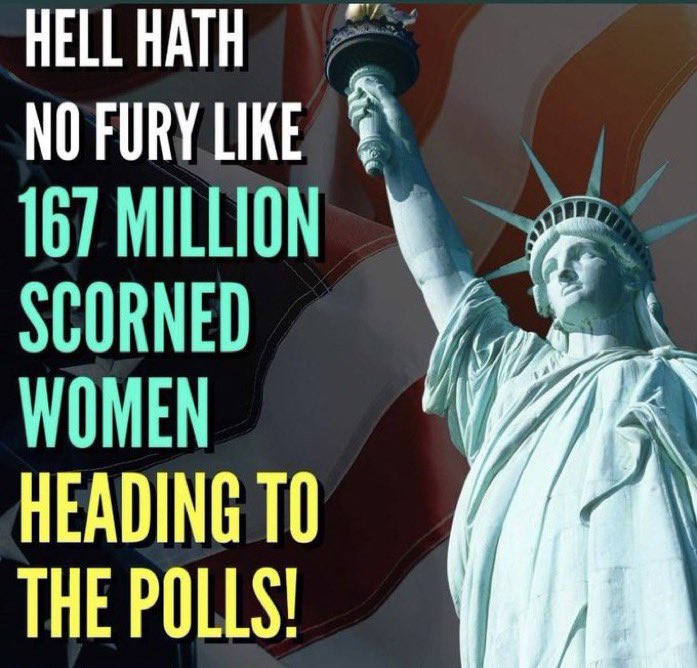
Some of the memes and other brief posts about either Proposal 3 in Michigan or other more general posts about the loss of Roe v Wade and abortion rights have been problematic to say the least. For example, the meme here on the right, with the text that says, “Hell Hath No Fury Like 167 Million Scorned Women Heading to the Polls.”
While I get the sentiment behind the meme, it is problematic in numerous ways. First, meme says there are 167 million women in the United States, which is a bit misleading. It is true that based on the 2022 US Census, there are just over 332 million people in the US, so 167 million is roughly half. However, this is a census of all people, not of all adult women who are of voting age.
In 2020, the eligible voting population in the US was 257,605,088, with roughly 128 million women eligible to vote. Thus, the 167 Million scorned women number if just not accurate. In fact, it is nearly 40 million off.
Second, the meme makes the assumption that all eligible women will vote for abortion access, meaning that all 128 million women of voting age will vote for candidates that support reproductive justice, or as in the case of Michigan, will vote for Proposal 3. Such a notion is not rooted in historical fact. If we look at what percentage of women voted for Donald Trump in the 2020 election, and Trump was clearly in the anti-abortion camp, then why did 44% of women vote for Trump?
Third, if we look at the racial component when talking about women scorned, then we have to come to terms with the fact that in 2020, 55% of White women voted for Trump. Let’s say that again, 55% of White women voted for Trump.
Another component of this dynamic is that BIPOC women have not been the face the renewed reproductive justice movement, at least not when it comes to how it is being reported on and how mainstream women’s groups and Democrats have been presenting the whole Roevember election. This is problematic, especially since we know that regressive and repressive abortion laws overwhelmingly impact BIPOC cisgendered women, along with some non-binary people, some intersex people, some Two Spirit people, and some trans men. However, this kind of language hasn’t been normalized within the mainstream women’s organizations nor the Democratic Party when it comes to talking about abortion rights.
If we are going to have these sorts of conversations, it is critical that the information, the talking points, etc, about abortion rights/access, is not only accurate, but that it is inclusive. We also need to come to terms with the fact that a high number of White women are voting against abortion rights/access. In fact, this last point should be an issue that we seriously grabble with, before we create campaigns, talking points and memes about abortion rights/access, especially with the upcoming election in November.
Why the Hell is Columbus Day still being celebrated? Settler Colonialism and ongoing Indigenous Resistance – Part II
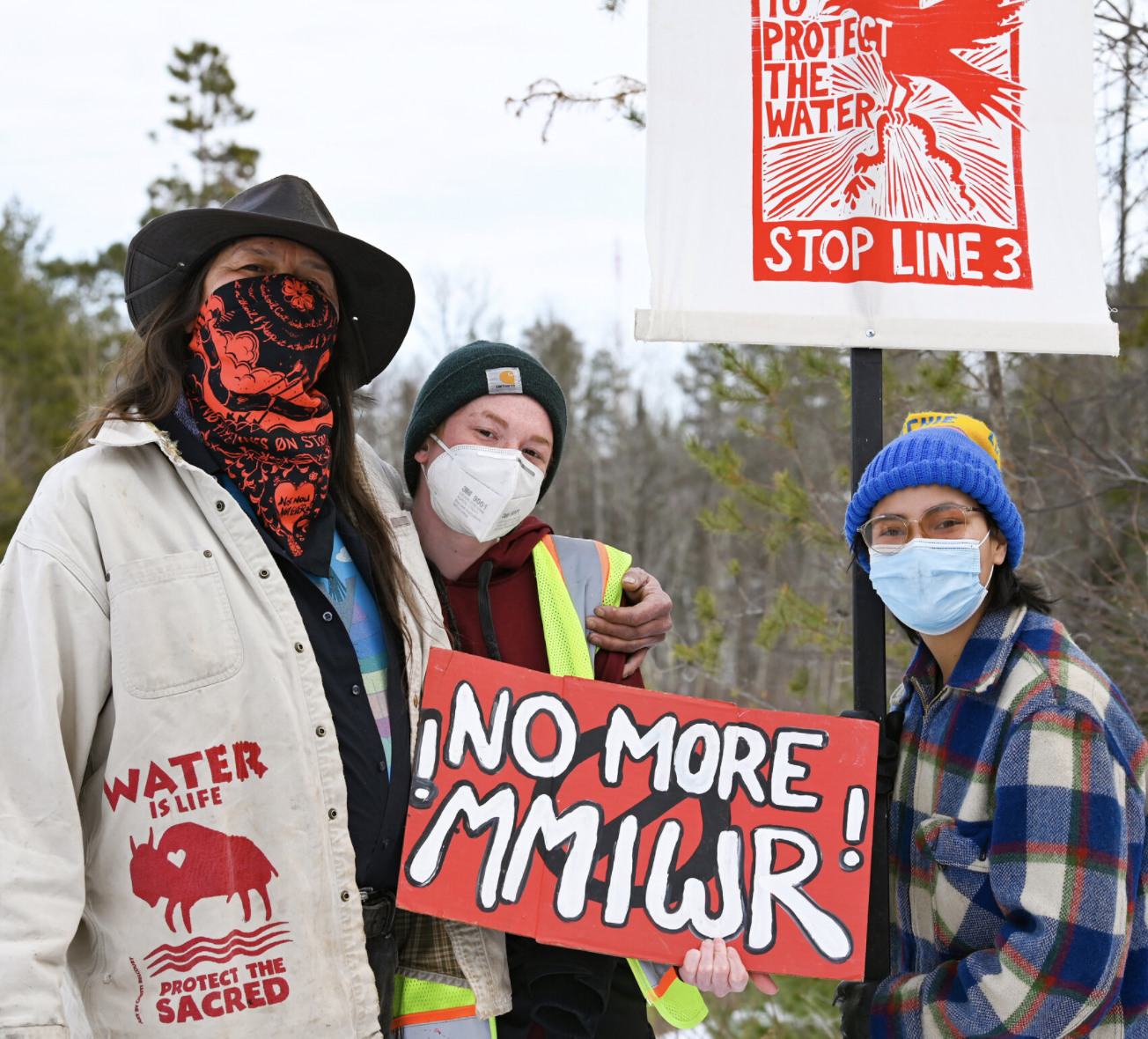 “And the Biden administration is just sitting by and watching it happen. I mean, I’m watching river after river get frac-outs on them in northern Minnesota. These are pristine river systems. You know, I’m watching things get destroyed as Enbridge ravages through our country. And then I’m watching hundreds of people get arrested trying to protect our water and to stop the climate disaster that Enbridge’s Line 3 represents.”
Winona LaDuke on Democracy Now 7/23/2021
In Part I we looked a bit at the historical legacy of Settler Colonialism, particularly in West Michigan. In Part II, we will explore issues around contemporary Settler Colonialism, specifically oil pipelines, Climate Justice, the disappearance & murder of Indigenous women/girls, and the brutal legacy of so-called Boarding Schools.
Confronting the Black Snake
The real resistance to all the fossil fuel pipelines (what Native people refer to as the Black Snake) that are happening in North America, is being led by Indigenous communities and organizers. What we saw at Standing Rock, what we are seeing by the Wet’suwet’en Nation territory, and the Indigenous-led resistance to Enbridge pipelines in Minnesota (Line 3) and Michigan (Line 5) are the result of people having a direct relationship with the land that is being threatened by extractivist practices and multinational corporations.
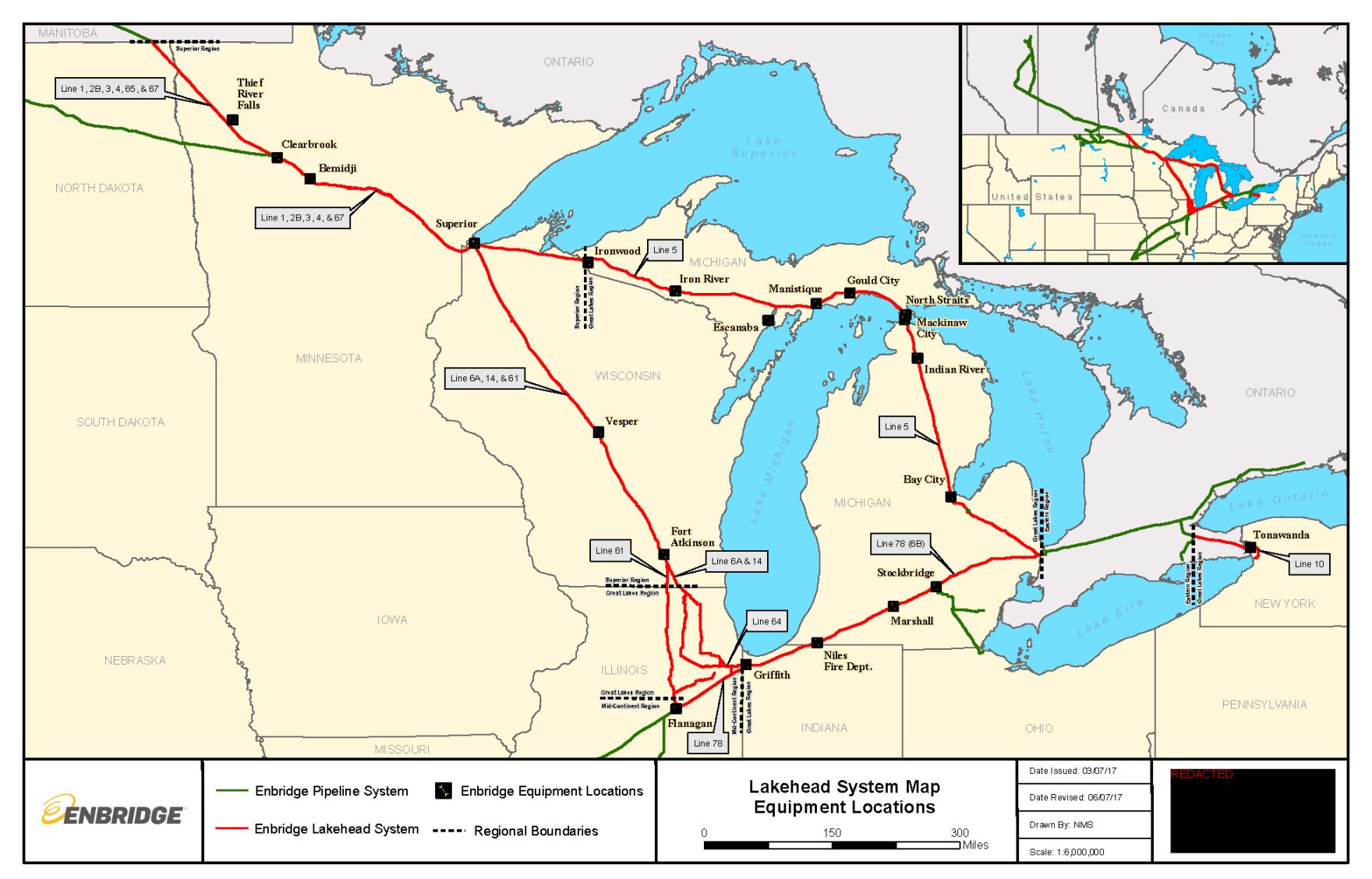
For those of us who are white, we need to 1) follow the lead of Indigenous communities when it comes to pipeline projects that directly impact their ancestral lands, and 2) we need to fully support – with financial contributions, with education/awareness, and by participating in direct action campaigns – to shut down any and all fossil fuel pipeline projects.
In a recent report entitled, Indigenous Resistance Against Carbon, it states:
Indigenous resistance has stopped or delayed greenhouse gas pollution equivalent to at least one-quarter of annual U.S. and Canadian emissions.
This is the meaningful and concrete types of resistance that we need to support, because it actually is making a difference. For white people, we need to stop wasting our time appealing to politicians and to support Indigenous-led campaigns opposing pipelines.
As we said early, much of this resistance has to do with Indigenous peoples relationship to the land. This gets back to our Part I posting, which talks about Settler Colonialism.
What Indigenous people are saying and writing about, is one simple fact. Decolonization of Indigenous lands is essential to the future of humanity. The authors of the book, The Red Deal: Indigenous Action to Save Our Earth, make it clear that decolonization of Indigenous lands is a major part of future of Climate Justice. If white people are serious about fighting for Climate Justice, then we have to see that decolonization of Indigenous lands is absolutely necessary in that fight. And it must be stated that the current New Green Deal proposal does NOT include the decolonization of Indigenous land. As white people, we need to demand the decolonization of Indigenous land if we are serious about Climate Justice. See the GRIID interview with Joe Cadreau, a local Indigenous activist who was part of the resistance to Line 3.
Another major issue that plagues Indigenous people in this hemisphere, is the disappearance and murder of Indigenous women & girls. The U.S Department of Justice found that American Indian women face murder rates that are more than 10 times the national average. These are alarming numbers, but Indigenous people are not content with leaving the data up to Settler Colonial entities like the DOJ. In fact, the group Data for Indigenous Justice states:
Our most important value is to do this work in a good way with and for our community. Our goal is to be self-determined and have sovereignty over our MMIWGS2 data in order to inform research, policy and systemic change at local, state, and federal levels and in solidarity with all Indigenous peoples. We are doing what we know is needed to strategically create change. Decolonizing data is having sovereignty over our own data. We are utilizing our data as a resource for true systemic change led by Indigenous people. We seek justice on every front.
It is instructive to note that one significant aspect of the assault and murder of Indigenous women/girls, is the relationship between fossil fuel pipeline workers and the violence against Indigenous women. An article in The Guardian from this past June states:
“Before Minnesota approved the pipeline, violence prevention advocates warned state officials of the proven link between employees working in extractive industries and increased sexual violence. Now their warnings have come true: two Line 3 contract workers were charged in a sex-trafficking sting, and crisis centers told the Guardian they are responding to reports of harassment and assault by Line 3 workers. Johnson said VIP, a crisis center for survivors of violence, has received more than 40 reports about Line 3 workers harassing and assaulting women and girls who live in north-western Minnesota.”
The Indigenous-led resistance to Line 3 in Minnesota had documented this fact a few months before The Guardian, even including an Enbridge document that demonstrates the Canadian Corporation’s anticipation in pipeline workers assaulting Indigenous women, stating:
The assaults and reports of harassment were described in a request for reimbursement from Enbridge’s public safety fund, submitted last month by the anti-violence and anti-human trafficking nonprofit Violence Intervention Project. State permits for pipeline construction stipulated that Enbridge had to create the fund to cover some law enforcement costs and anti-human trafficking efforts associated with the project.
Just as corporations consider environmental degradation a form of collateral damage, the brutalization of Indigenous women is anticipated and expected while corporations engage in “resource extraction.”
For those of us who are white, we need to condemn the relationship to extractivism and the brutalization of Indigenous women/girls, then support whatever demands the Indigenous community has around this issue.
Boarding Schools as Genocide
 When people think of genocide, they often think it means the outright slaughter of a group of people. While this does constitute genocide, there are numerous other things that can result in genocide. According to the 1948 Convention on the Prevention and Punishment of the Crime of Genocide:
In the present Convention, genocide means any of the following acts committed with intent to destroy, in whole or in part, a national, ethnical, racial or religious group, as such:
- Killing members of the group;
- Causing serious bodily or mental harm to members of the group;
- Deliberately inflicting on the group conditions of life calculated to bring about its physical destruction in whole or in part;
- Imposing measures intended to prevent births within the group;
- Forcibly transferring children of the group to another group.
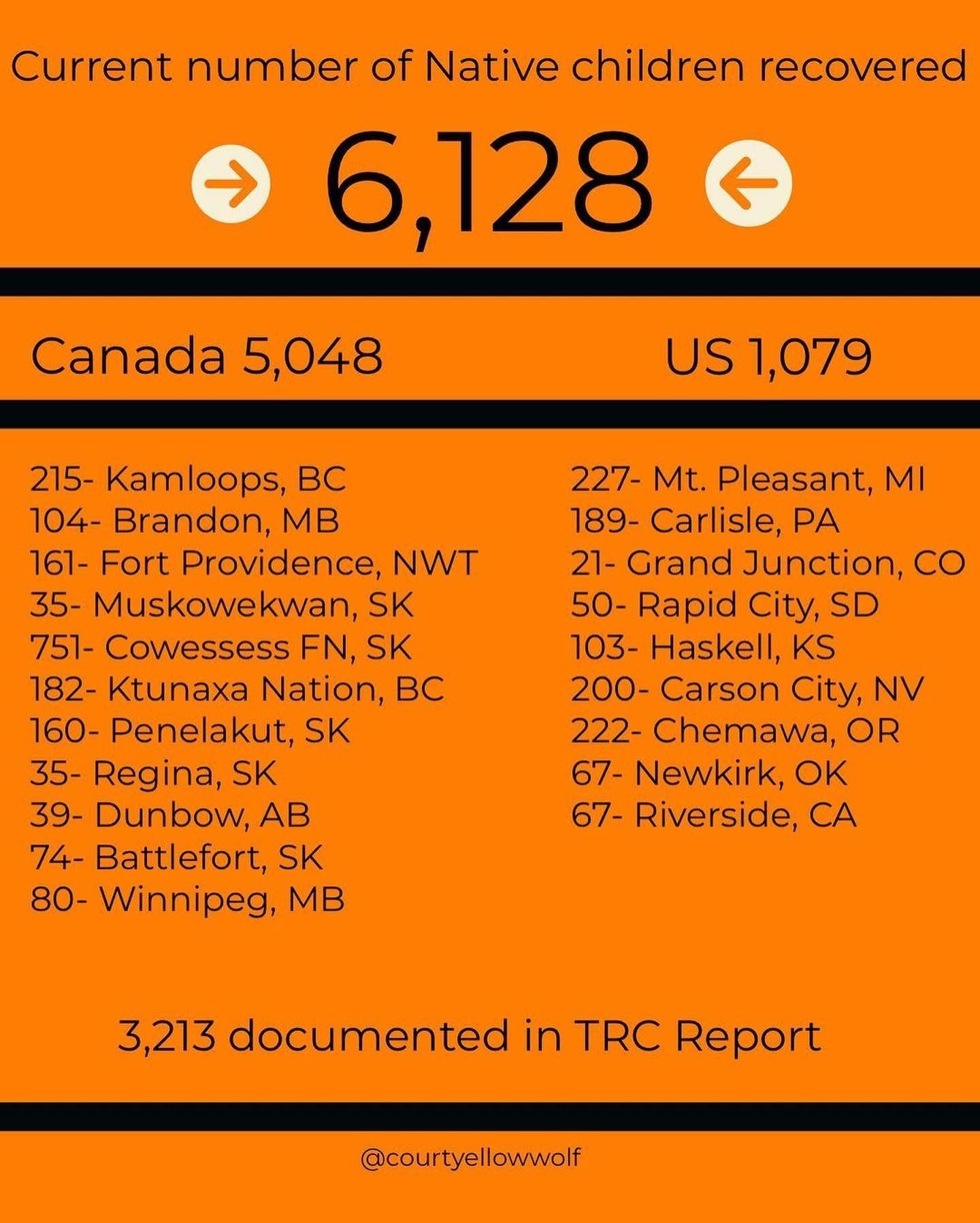
The history of so-called Boarding Schools in the US and Canada was fundamentally about forcibly transferring Indigenous children to government run or christian schools. In other words, it was a form of genocide.
Governments and Christian churches are now scrambling in the face of newly uncovered evidence of the common practice of murdering Indigenous children while attending so-called Boarding Schools. In the fact of this, the Indigenous community is exposing and pressuring these institutions for the role or their complicity in such crimes, as was highlighted in the action that the local Indigenous community organized in 2021 to confront the role of the Catholic Church in Grand Rapids.
Unfortunately, the Missing & Murdered Indigenous People rally that was held in Grand Rapids in 2022, was less confrontational and even featured a Grand Rapids City Commissioner at their event. See our interview with two Indigenous activists responding to that event.
So what do White people do in this case? Again, we need to follow the lead of Indigenous communities and provide whatever support they are asking of us. In addition, we need to be challenging Christian Churches to come clean with their role in the history of so-called Boarding Schools, allow Indigenous people access to documentation and spaces where so-called Boarding Schools existed, pay reparations and put an end to any ongoing Christian-run schools for Indigenous children.
Lastly, if those of us who are White, are going to engage in this kind of work, then it is important for us to always grapple with our own privilege. An excellent resource for White people to read on this theme, is an Indigenous-created zine entitled, Accomplices Not Allies: Abolishing the Ally Industrial Complex. This resource should be required reading, along with the fact that we, as White people, should always center the voices of Indigenous people and follow their lead when it comes to matters of doing anti-Settler Colonialism work.
Why the Hell is Columbus Day still being celebrated? Settler Colonialism and ongoing Indigenous Resistance – Part I
As Native American peoples in this red quarter of Mother Earth, we have no reason to celebrate an invasion that caused the demise of so many of our people, and is still causing destruction today.”
Suzan Shown Harjo – Creek & Cheyenne
Why in the world is Columbus Day still being celebrated throughout the Americas? Celebrating Columbus Day in the Americas would be like Europeans celebrating Joseph Goebbels Day. Both Columbus and Goebbels were given orders to implement policies and take action to improve the economic condition of their respective countries and to expand their land base.
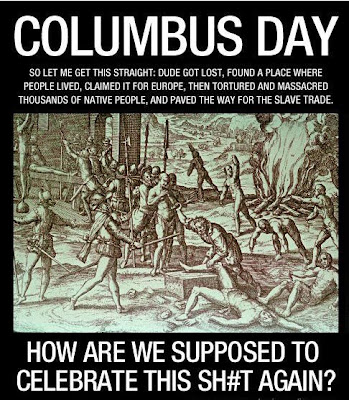
For decades in Latin America, there have been organized efforts to do away with Columbus Day, whether through pressuring governments to direct action like dismantling statues of Columbus and his accomplices. In 1992, I was in Guatemala doing accompaniment work and was asked to attend the Hemispheric Indigenous gathering against 500 years of Genocide & Slavery, which was held in Quetzaltenago, Guatemala. There were Indigenous people First Nations all throughout the Americas at that gathering, with the primary goal of building collective Indigenous power and to dismantle Settler Colonialism throughout the hemisphere. This was 30 years ago.
Today, the US government still recognizes Columbus Day as a federal holiday and has not replaced it with Indigenous People’s Day. Federal employees and many state and local employees will get the day off because the federal government still designates today as Columbus Day.
Last year the Biden Administration released a proclamation on behalf of Indigenous Peoples Day, but it is a weak and patronizing statement that does little in terms of Tribal Sovereignty and fails to acknowledge the historical and ongoing Settler Colonialism that the US government practices and benefits from.
Releasing proclamations is a meaningless gesture, when Sovereign Native nations are demanding things like an end to oil pipelines, the end to the murder and disappearance of Indigenous women/girls, along with justice & reparations for the horrendous history of so-called US Boarding Schools.
Challenging the legitimacy of Columbus Day is an important anti-racist act, but it must be seen in the larger context of challenging White Supremacy and Settler Colonialism.
It is increasingly imperative that we come to terms with the function that Columbus played in the European conquest/colonization of the what we now call the Americas. Columbus was commissioned by the Spanish Crown and sanctioned by Catholic Church (through a 1493 Papal Bull) to conquer new lands and extract resources to benefit Spain. Therefore, Columbus not only is the primary symbol of the 500 years of genocide and slavery that has plague the western hemisphere, he is the symbol of political, religious, social and cultural imperialism that continues to the present by a White Supremacist system of Capitalism.
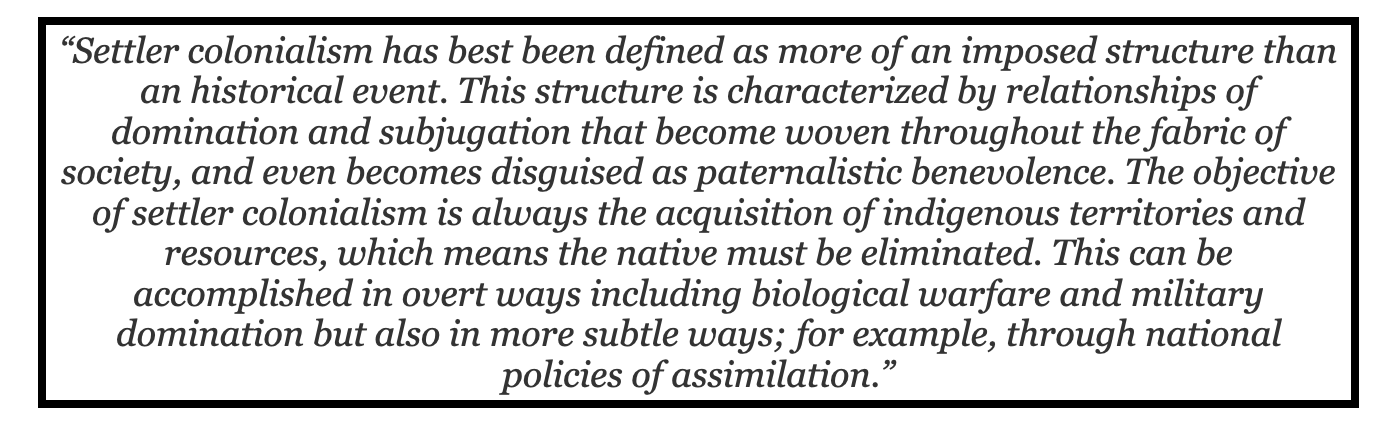
 Grand Rapids was founded on Settler Colonialism – As a foundational framework, it is vital that we come to terms with the fact that Grand Rapids, like virtually all US cities were founded on what Native scholar Roxanne Dunbar Ortiz calls Settler Colonialism. Settler Colonialism in West Michigan is the result of a larger White Supremacist strategy that included legal means (treaties), forced relocation, spiritual violence (role of churches) and cultural imperialism, most radically seen with the policy of putting Native children in boarding schools with the goal of, “Killing the Indian, Saving the Man.”
We know that hundreds of Native children from the Three Fires Nations were taken and put into boarding schools by settler colonialists, many of which were run by christians. In these instances Native children were denied the right to speak their own languages and practice their own spiritual traditions. Most of the removal of Native children from their communities happened in the later part of the 19th Century and first half of the 20th Century.
However, on the matter of christian missions attempting to make converts of Native communities in the 1820s and 1830s along the Grand River, it is less clear on whether or not this could be defined as a form of genocide. How much free will did Native people have on choosing another religion? Was the adoption of christian beliefs a form of assimilation into the dominant culture and was it tied to larger socio-economic issues like food and land?
It should come as no surprise that right after the 1821 Treaty of Chicago was signed, the first christian missions came to what is now West Michigan. The Baptist Church established a mission in 1824, under the leadership of Isaac McCoy, and Catholic missions were begun in 1833 by Fr. Frederic Baraga.
One of the things that lured missionaries to the area after the signing of the Treaty of Chicago, was a provision in the treaty which allowed funds for people to work as teachers of blacksmiths amongst the Native people along the Grand River. The government treaty called this, the “civilization fund,” a phrase that underscores the settler colonial mentality.
Isaac McCoy first arrived in 1823, only to discover: “Many Odawa were drinking and few responded to his call for a council. After some inquiries McCoy learned that the majority regarded the 1821 treaty as fraudulent and viewed his visit as an attempt to trick them into ratifying it.” (pg. 7, from Gathered at the River: Grand Rapids, Michigan and Its People of Faith)
Such a statement reflects not only that the Native people along the Grand were not in support of the government imposed treaty, but that many Natives were negatively impacted by alcohol. Alcohol was introduced by French fur traders, particularly Louis Campau and should be seen as another tool used by settler colonialism to control Native people.
McCoy, however, was not deterred from his initial observations and continued to use all means at his disposal to “win over” the hearts and minds of Native people. In 1826, McCoy set up the Thomas Mission on the westside of the Grand River. McCoy’s greatest contribution during his time along the Grand River was his relationship with Native leader Nawequageezhig, whom the white settlers call Noonday.
Noonday was one of the few Native leaders who signed the 1821 Treaty of Chicago and was viewed by many as a traitor or collaborator with the settler colonialists. Noonday went as far as to be baptized by McCoy’s successor, Rev. Leonard Slater in the summer of 1827. Another Native leader in the area, Kewwaycooshcum, also known as Blackskin, did not sign the 1821 treaty, but did develop a relationship with the catholics through his connection to Campau. It is hard to know from the limited documentation of that time, whether or not the Native people were using the tensions between the various christian factions to their benefit or if the christian were using Native compliance with the government as a means to an end. One gets a sense of the christian rivalry in a comment from Fr. Baraga, who said, “Mary, to who it is given to root out all heresies of the world……to destroy the false [Protestant} teachings with which some of the poor Indians were already infected, and suffer on His gospel to reign everywhere.” (pg. 12, from Gathered at the River: Grand Rapids, Michigan and Its People of Faith)
 However, whatever tensions existed, they were most useful in pushing Native people out of the area as more white settlers colonialists came to the area. This increase in settler colonialists, along with greater desire for land and settler colonial expansion, resulted in a new treaty being drawn up, the Treaty of Washington in 1836. This treaty turned over an additional 13,837,207 acres of land to settler colonialism’s expansionist desires.
It seems that all along, the goal with relations of Native people along the Grand were to take the rest of their land. Whether or not there was direct complicity with the early christian missions to this land takeover is not relevant, the fact remains that they did nothing to resist such an effort.
The end of chapter one from Gathered at the River: Grand Rapids, Michigan and Its People of Faith, states of the fate of Native people in West Michigan:
Keeping title proved difficult, however, as fraud, inexperience, and incompatibility of family farming with tribal tradition took their toll.
It indeed took its toll, but the authors of Gathered at the River do not call it land theft or settler colonialism or even acknowledge the role that early missions played here in the ongoing genocidal policies of US expansionism. The plight of Native people is not addressed in the rest of the book, which simply goes on to celebrate the history of christian churches in Grand Rapids. However, it seems apparent to this writer that the history of christianity in West Michigan is founded on genocide and settler colonialism.
In Part II, we will explore issues around contemporary Settler Colonialism, specifically oil pipelines, Climate Justice, the disappearance & murder of Indigenous women/girls, and the brutal legacy of so-called Boarding Schools and what Indigenous people are doing about these issues in the Grand Rapids area.
Some Resources:
The Canary Effect (film) https://www.youtube.com/watch?v=lD7x6jryoSA
An Indigenous People’s History of the United States, by Roxanne Dunbar Ortiz
All Our Relations: Native Struggles for Land and Life, by Winona LaDuke
The 500 Years of Resistance Comic Book, by Gord Hill
Custer Died for Your Sins, by Vine Deloria Jr.
A Little Matter of Genocide: Holocaust and Denial in the Americas 1492 to the Present, by Ward Churchill
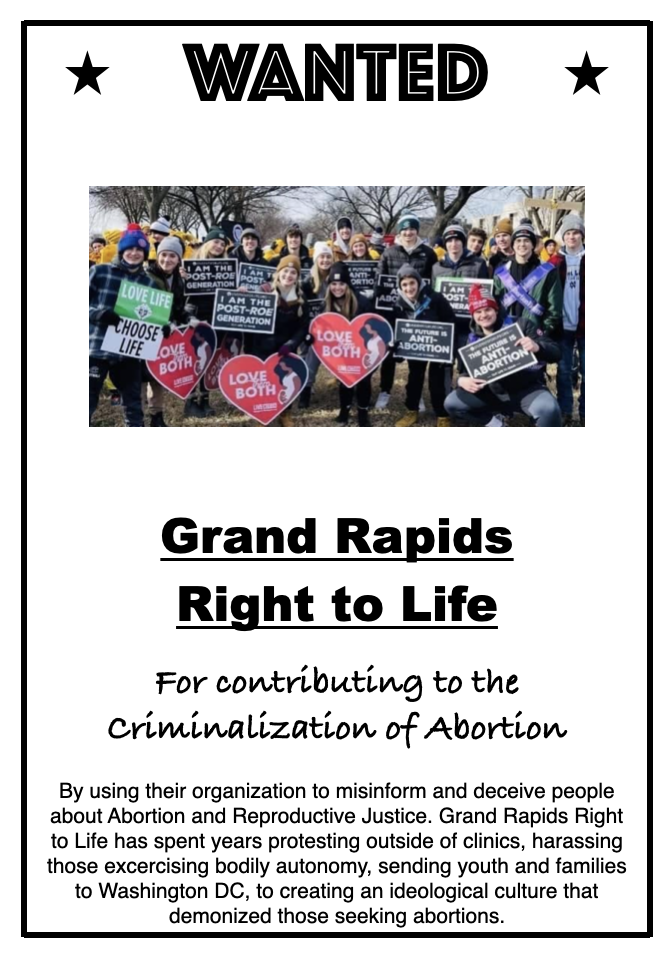 This is the sixth in a series of WANTED posters, looking at individuals, families and organizations in West Michigan that have contributed significantly to the criminalization of abortion and the undermining of reproductive justice.
Today’s focus is on the Grand Rapids chapter of Right to Life. The Grand Rapids Right to Life is the main boots on the ground anti-abortion organization in Grand Rapids. This organization provides mis-education resources, a speakers bureau, does a great deal of work with churches and targets youth to recruit them into their hatred for bodily autonomy.
The Grand Rapids Right to Life group sends people to harass and intimidate those who go to clinics and are seeking an abortion, plus they harass and intimidate those who are there to defend reproductive justice. The GR Right to Life group also sends people to Lansing and Washington, DC on an annual basis to participate in marches and to pressure legislators to criminalize abortion.
In addition, GR Right to Life produces a newsletter that goes out to thousands of households, and they have a Facebook page, a twitter and instagram account, along with a YouTube channel, all of which are weapons they use to spread propaganda and misinformation.
The Grand Rapids Right to Life is also the recipient of money from thousands of families in the Grand Rapids area, including some of the families we have highlighted in previous Wanted posters.
We encourage you to share this poster and consider directing some of your rage at the recent US Supreme Court ruling to overturn Roe v Wade towards the Grand Rapids Right to Life. Their headquarters are located at 2340 Porter Street SW, Grand Rapids, MI 49519. It would be a great place for an action!
On Wednesday, MLive posted a story entitled, Grand Rapids wedding venue owners who say they won’t host LGBTQ marriage events get civil infraction.
Apparently, the City of Grand Rapids has decided that the refusal by the owners to serve the LGBTQ community is a violation of the City’s Human Rights Ordinance.
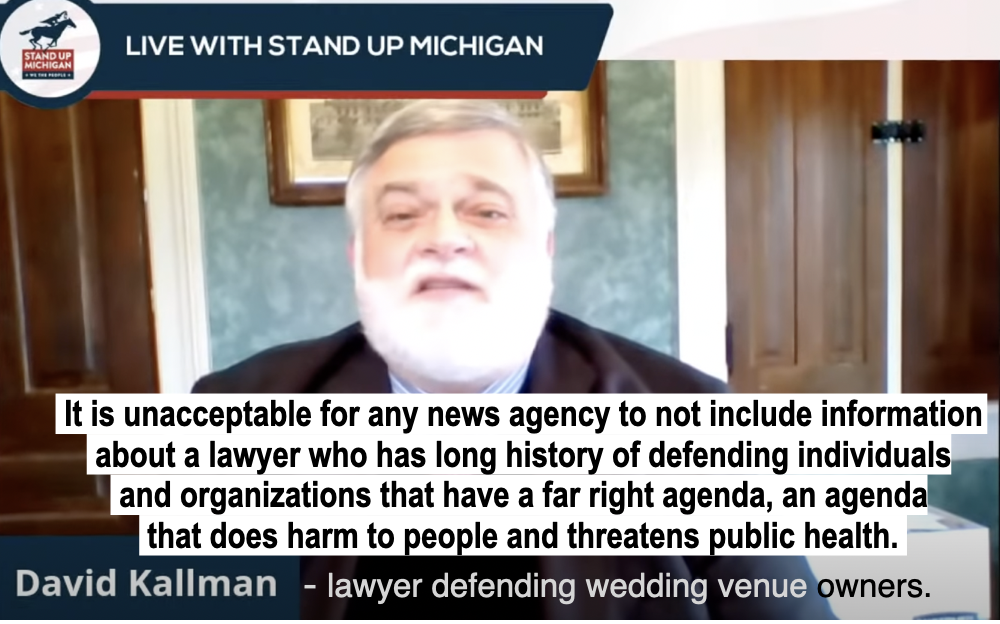
The lawyer defending the couple responded to this decision from the City of Grand Rapids, by stating, “We’re going to vigorously oppose this. They’re totally unspecific here of what it is they’re claiming my client did, but the bottom line is we’re going to oppose any claim we committed any wrong here. Obviously, based on their First Amendment rights, that trumps any ordinance (claiming) discrimination here.”
The lawyer representing the wedding venue couple, is David Kallman, with the Kallman Legal Group, something the MLive article failed to mention. In fact, this was not the only omission on the part of MLive, when it came to Kallman, a lawyer who has a history of representing and supporting far right organizations and issues throughout Michigan.
If MLive were to scratch the surface a bit more on who David Kallman is, they would not have to look very hard to find out that he is one of the preferred lawyers for those in the far right camp. For instance, this is not the first time that Kallman has defended people or organizations that are anti-LGBTQ.
David Kallman is also legal counsel for the Great Lakes Justice Center, which has a long history of defending religious groups that are anti-LGBTQ. GRIID wrote about the Great Lakes Justice Center in 2020, when they sued Gov. Whitmer for the Stay at Home orders. At that time we wrote:
The Great Lakes Justice Center, which filed the lawsuit, has a long history of defending religious groups that actively discriminate against the LGBTQ community. A Lansing-based news source, City Pulse, reported on one example and the ACLU has documented other cases against the Great Lakes Justice Center. The Great Lakes Justice Center is part of group Salt & Light Global, which was founded by William Wagner. Salt & Light Global embraces a far right political and religious worldview. The “Resources” section on their homepage is a who’s who of far right religious groups, including the Federalist Society, Hillsdale College, Wall Builders, the Discovery Institute and the Acton Institute.
Kallman has represented numerous businesses that sought to challenge the Stay at Home orders that were put in place as a response to the COVID 19 pandemic, beginning in late March of 2020, cases that are sourced here.

In The Center Square article sourced in the previous paragraph, Kallman is standing with a business owner in front of a backdrop put up by the group Stand Up Michigan. Stand Up Michigan has been a group that came into being in response to the COVID 19 pandemic and believes that, “COVID was weaponized to rip away our constitutional liberties, close our businesses and fundamentally alter our psyches.”
Some of the leadership of Stand Up Michigan host a podcast known as Live with Stand Up Michigan. Here is a sample of one of their shows where David Kallman was the guest.
The last important piece of background information on David Kallman, the lawyer defending the couple who refuse to serve members of the LGBTQ community at their wedding venue, is the issue of abortion. MLive should have easily picked up on this matter and included it in their story about the wedding venue, especially since MLive posted a story about the fact that David Kallman was representing two Republican County Prosecutors in Michigan regarding the 1931 Abortion Ban law that the courts have said are not enforceable. An MLive article from August 16 states:
Oakland County Circuit Judge Jacob Cunningham quashed the subpoena and David Kallman, a Lansing lawyer representing prosecutors Jerard Jarzynka of Jackson County and Christopher Becker of Kent County, appealed to the higher court. Becker and Jarzynka previously said they would charge providers under the law, which makes procuring a miscarriage illegal except to save a mother’s life.
The fact that Kallman is representing Kent County Prosecutor Chris Becker, should have been included in this article about the couple who is refusing to allow LGBTQ people from using their wedding venue on religious grounds, not just because Becker is the Kent County Prosecutor, but because the abortion issue is such a critical issue in Michigan right now.
While we have come to recognize that MLive often falls short of providing more robust coverage on the critical issues of the day, that standard should not be tolerated. It is unacceptable for news agencies to not inform the public about a lawyer who has a long history of defending individuals and organizations that embrace far right politics, a politics that not only does real harm to people, it threatens public health.
New Documentary takes on Militarism, Heteronormativity and White Supremacy: Behind the Shield: The Power and Politics of the NFL
 Editors note: Behind the Shield: The Power and Politics of the NFL is a must see documentary that you can watch for free until October 15th. Just go to this link to watch.
There was a time when I thought that watching sports or discussing sports was a waste of time. As I matured in my political thought and continued to read people like Dave Zirin, I came to realize that sports was no different than any other institution when it came to where people can resist White Supremacy, militarism, homophobia, Capitalism and gender discrimination.
Zirin has written numerous books on politics and sports, such as a People’s History of Sports in the United States: 250 Years of Politics, Protest, People, and Play, or The Kaepernick Effect: Taking a Knee, Changing the World. In addition, Zirin has produced several documentaries over the years, specifically through the Media Education Foundation. I was excited to see his posts on social media about Behind the Shield: The Power and Politics of the NFL, so much so that I felt it was important to do a post on GRIID about this important work.
Ten years ago, I did an interview with Dave Zirin and great Dr. John Carlos, who was one of those trailblazing athletes that used his platform to make a powerful statement about sports and politics. These two men were speaking at GVSU about their new book, The John Carlos Story: The Sports Moment That Changed the World.
After watching Behind the Shield, I was blown away. The film is not only well done, but it provides a powerful deconstruction of one of the most beloved institutions in American culture, the game of football.
This documentary provides some insight into the evolution of the game, particularly the push to use the game to make men tougher at the beginning of the 20th Century. The forces in society that want to maintain systems of power and oppression, like patriarchy, are always pushing back against efforts to create a more justice and equitable society. The push to make football a sport to toughen up men, was a direct response to the Women’s Suffrage Movement, which was not only organizing to win the right to vote for women, this movement sought to dismantle male domination is all of its forms.
As was already mentioned, Behind the Shield deals with the economic power of owners and other class dynamics, along with heteronormativity, and militarism, which began during the US domestic opposition to the war in Vietnam, but escalated after 9/11 and the US War on Terror. However, the other major theme in this film is how deeply entrenched White Supremacy is within the game and how the game amplifies structural racism based on the response by owners, the league, the news media and the fans alike.
The film takes a close look at the league and public responses to Colin Kaepernick’s decision to take a knee during the National Anthem. Kaepernick’s decision was based on his desire to challenge business as usual around the increasing number of Black people who were being killed by cops. Kaepernick was punished for such defiance, but his actions exposed how deeply racist the American culture is. However, Zirin argues that Kaepernick’s protest was vindicated when millions took to the streets in 2020, after the police murdered George Floyd.
Behind the Shield is a film that is about the power of resistance, and it is a film about how sports have always been space where systems of oppression meet the struggle for justice. This film is intersectional and engaging. Watch it Now, while if is free, or join an effort to organize a public screening to further this important public conversation.
 Grand Rapids Institute for Information Democracy