What Kind of Change Do We really want to see in Michigan: Part III
In Part I, we covered Immigration Justice, Health Care for All, Housing Justice and Education Justice. Part II covered a list of demands dealing with Today, we will explore demands centered around the Prison Industrial Complex/Policing, Racial Justice, Environmental Justice and LGBTQ Justice. In today post, which is the last in the series, we will address Economic Justice, Foreign Policy & Michigan, along with Democracy demands, where we discuss the ways in which we need to change how we govern ourselves.
“Since 1984, Republicans have used their control of the Michigan Senate to block things Michigan families need. No more.” Michigan Senate Democrats statement after the 2022 elections
The Democratic Party now has control of the State House, the State Senate and the Governor’s seat, which is the first time this has happened since the early 1980s.
With the Democrats now being in the driver’s seat through at least the end of 2024, this seems like a great time to make the kinds of demands we want, in terms of policy change. The Blue wave has come to Michigan, and since the Democratic Party is the “party of the people”, then this seems like a perfect opportunity to create a list of policy demands that the Dems can pass in Michigan. If we can take seriously the above comment from the Michigan Senate Democrats, then it is crucial to ask what it is that families living in Michigan really need?
It has been my experience over the past 40 years of doing organizing work, along with my read of US history, is that federal, state and local governments don’t generally make the necessary changes that people need. Governments must be pushed and pressured by organized movements of resistance, which is the essential message of Howard Zinn’s monumental book, A People’s History of the United States.
The following list of demands is based on movement politics that I have been involved in or movement politics that I have been following closely for the past 40 years. If you have additional ideas, then by all means send them along or create your own on a different platform, but let’s think creatively, let’s practice radical imagination and lets demand collective liberation. We will cover some of these demands in several postings, plus most of these issues intersect, so we will regularly refer back to other demands.
Economic Justice
For me, the long-term goal would be to dismantle the economic system of Capitalism, but it is not likely that governments will go along with that. It should always be the stated goal, but in the process of getting there, we can make demands. As part of the Poor People’s Campaign that the Southern Christian Leadership Conference and Dr. King were involved in, they had developed an Economic Bill of Rights, which is something we could do today.
A Living Wage/Income for all – It is always hard to determine what a real living wage should be, but given the cost of living – rent, food, transportation, utilities, etc., we should demand that no one earn less than $30 an hour in Michigan, whether you have a job or not. Think of what this will mean to people currently making he minimum wage or just above. Making $30 an hour would triple their current income. Such a guaranteed income should be for life or until we dismantled Capitalism and create a better economic system based on cooperation.
We also need to radically alter the tax policy, to make the wealthiest people pay more taxes, along with businesses/corporations and for everyone else to pay less taxes, so they can keep more of the money they earn.
Michigan need to end the practice of giving subsidies and tax breaks to businesses who want to set up shop in Michigan or move their current location. The same thing goes for developers who always want subsidies or tax breaks or utilize Brownfield Development perks.
Policy makers should remove the Right to Work status for Michigan and do everything to support, encourage and fight with workers wanting to unionize.
We have already address many economic issues in Part I and Part II of this series, but another way we can afford to make sure that a guaranteed income for all is possible, would be to address the amount of money that is leaving Michigan every year to support the US Military Industrial Complex.
Foreign Policy and Michigan
US Foreign Policy impacts Michigan in numerous ways, even if we are not think about the connection. Millions of people are displaced from their countries on an annual basis, often because of US economic and military policies, which means they often end up in Michigan.
Trade policies, like NAFTA and CAFTA have resulted in the loss of thousands of jobs in Michigan, since corporations are always seeking lower wages for workers.
Then there is the issue of US militarism. There are numerous US military installations in the State of Michigan, along with hundreds of corporations that are subsidized by public money through contracts with the Pentagon.
However, the largest issue has to do with the sheer cost of US militarism. The US Military budget is the largest on the planet. In fact, the US Military budget is larger than the next 9 highest country military budgets, combined.
The National Priorities Project monitors US military spending and provides detailed breakdowns for the amount of money leaving each state to pay for US militarism abroad. According to the The National Priorities Project, the cost of the US Military Budget for 2021, which was $740 Billion, taxpayers in the state of Michigan are paying $19.35 billion of that total. Imagine if the people living in Michigan would get to decide on how to use $19.35 Billion for just one year. Many of the other policy demands we have addressed – Medicare for All, cancelling student debt, a guaranteed loving wage for everyone, mass transit, etc, could become a reality if the US Military budget was reduced. It is never a question of there not being enough funding for things like housing, health care, education, etc., but it is a matter of priorities. In the words of Dr. King, “A nation that continues year after year to spend more money on military defense than on programs of social uplift is approaching spiritual death.”
Michigan lawmakers would not only need to meet with federal officials on a regular basis, it would mean that Michigan members of the State government would have to lobby and demand a re-direction of US military funding to fund the basic needs of people living right here.
Democracy Demands
One last aspect of the need for radical, structural change, would be to change how we are governed. As someone who embraces anarchism and anarchist principles, I inherently oppose representative democracy. I believe that each community could have their own autonomous ways of governing, such as adopting models like the Zapatistas or popular/general assemblies for each community. Another model is what the great writer and theorist Murray Bookchin called Libertarian municipalism. For Bookchin, Libertarian Municipalism is:
The immediate goal of a libertarian municipalist agenda is not to exercise sudden and massive control by representatives and their bureaucratic agents over the existing economy; its immediate goal is to reopen a public sphere in flat opposition to statism, one that allows for maximum democracy in the literal sense of the term, and to create in embryonic form the institutions that can give power to a people generally. If this perspective can be initially achieved only by morally empowered assemblies on a limited scale, at least it will be a form of popular power that can, in time, expand locally and grow over wide regions. That its future is unforeseeable does not alter the fact that it development depends upon the growing consciousness of the people, not upon the growing power of the state–and how that consciousness, concretized in high democratic institutions, will develop may be an open issue but it will surely be a political adventure.
It will certainly take time to adopt these forms of popular democracy, so in the means time there are some very easy things we can do to change the existing form of government and elections in Michigan.
- Make Election Day a State Holiday, so people don’t have to go to work or do other things that make it difficult to vote.
- Eliminate Citizen’s United, to reduce the the influence of money from the Capitalist Class, from corporations, Political Action Committees, and Dark Money groups, all of which are run by those in the Capitalist Class.
- Give all political candidates free air time on TV and radio for 30 days prior to an election.
- Eliminate campaign advertising on radio, TV and social media, in part because this is how the bulk of campaign contributions are used, but also because political advertising is inherently vague and deceptive.
- Institute a ranked-Choice voting system, which would provide people the opportunity to more accurately vote their conscience, and still allow people to vote for more than one candidate in a ranked system.
- Once candidates are elected, there could be a government run or independent social media platform that would have a list of current proposed legislation, so that people can easily see what the State government is likely to vote on. There could also be a process called participatory democracy, which is similar to participatory budgeting. With participatory democracy, there would be an opportunity for people to vote directly on proposed legislation, rather than rely on representatives to make decisions for them.
Now, my understanding of these issues, both the policy demands listed in this 3-part series, and the proposals to change the form of governance, would be met with tremendous resistance by both the Republicans and the Democrats. Both parties have a history of resisting more horizontal forms of democracy, even if party members may be open to them.
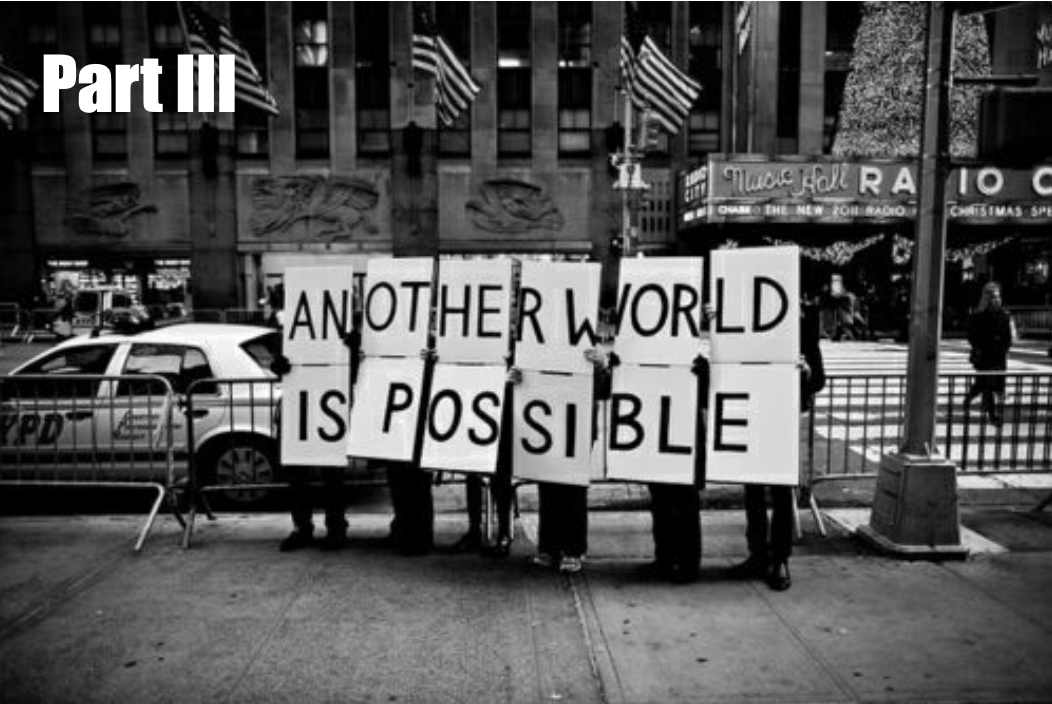
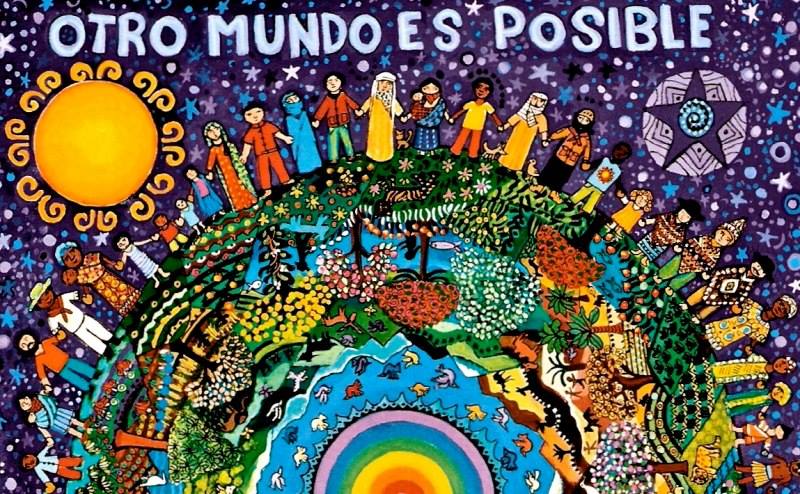
My read on history also informs me that all of the policy demands listed in the 3-part series are not likely to be adopted unless there is a significant grassroots movement(s) that would force the State Government in Lansing to heed the will of the people. This is exactly why I believe that popular social movements are essential to winning radical and structural changes to society, since it is through social movements that we learn how to create the kind of world we want to live in. El Otro Mundo es Posible!!!!
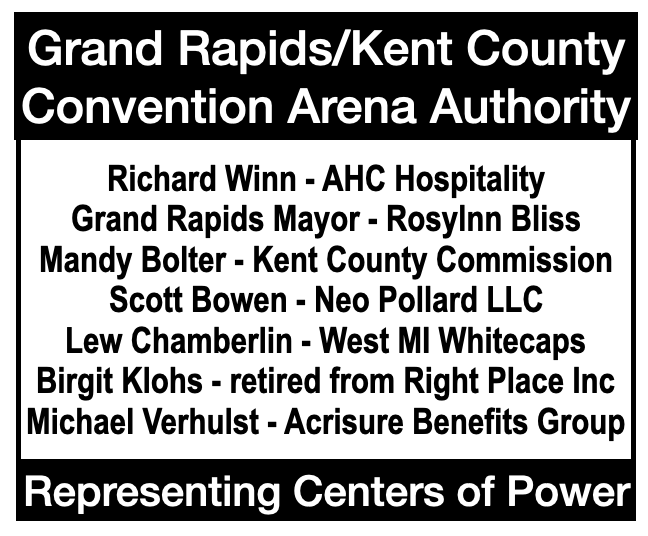
The DeVos/Grand Action 2.0 Amphitheater will officially be run by the Kent County Convention Arena Authority
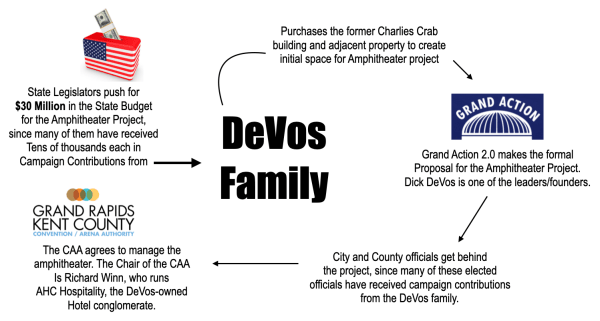
 We first heard about the plans for a 14,000 seat outdoor amphitheater back in October of 2020, when Grand Action 2.0 first announced the plans.
We have also written the following articles as this project has unfolded:
How is it that we allow groups like Grand Action 2.0 to get away with the shit they do?
Tuesday morning, during the Grand Rapids City Commission Committee Meeting of the Whole, City Officials approved the mission statement of the Amphitheater, which you can read about in the Committee of the Whole Agenda packet, pages 9 – 11.
Before getting to the mission statement, it is important to look at what real function the Amphitheater will play. On page 9 of the agenda packet, it reads:
“The property that the City will sell to the CAA is part of a larger corridor redevelopment plan, which will include a mix of uses, public access to the riverfront, and other features reflecting the Grand River’s restoration as a key place-making opportunity for the city.
The CAA and City continue to make progress on the steps necessary to complete the purchase, including creation of separate parcels dividing the city-owned property into smaller parcels for sale. Design and financial planning for the amphitheater continues through a partnership of Grand Action 2.0, the DDA/DGRI, the City, the CAA and other stakeholders.”
To be clear, this project has always been about re-developing the Market Avenue corridor, from Fulton St. all the way down to Godfrey SW. There are already plans to turn an old warehouse into high end apartments, with plans to include lots of restaurants and other commercial establishments along that route.
You also can see from the above text that City Officials are using the “place-making” terminology, which was widely adopted by cities across the country after Richard Florida wrote his 2002 book, The Rise of the Creative Class. Since then, Florida’s ideas have received a ton of criticism, mostly with the claim that his ideas helped to usher in a new wave of gentrification throughout North America. Florida even acknowledge this reality, with his 2018 book entitled, The New Urban Crisis: How Our Cities Are Increasing Inequality, Deepening Segregation, and Failing the Middle Class-and What We Can Do About It. Unfortunately, Grand Rapids City Officials have yet to acknowledge that gentrification exists in Beer City USA.
The last thing worth pointing about about the text is the listing of the now normalized Public/Private partnership group involved in the Amphitheater plans, even though there is the mysterious “other stakeholders” listed. Stakeholders is nothing more than code for people and organizations with power that primarily function to maintain economic dominance and political power.
Amphitheater Mission Statement
To encourage economic development within the West Michigan region, create jobs and provide a facility for entertainment, enjoyment and benefit of the residents in an economical manner with a priority of facility fiscal responsibility through the delivery of events that are primarily entertainment related with a secondary emphasis on artistic and community activities and public events.
The mission statement includes all of the usual vagueness of mission statements, like create jobs and benefit all residents. They never clarify if these new jobs will pay a living wage, with benefits nor do they provide any clarity on the cost of admission for a concert or other entertainment-based events.
The mission statement for the Amphitheater is nothing more than the latest project in a continuing effort to transform downtown Grand Rapids into a playground for the privileged and a destination place for tourism. It will primarily provide economic benefits for those who are already economically well off, plus the ongoing development is likely to impact the Grandville Avenue corridor and the Black Hills neighborhood. I’m not someone who gambles, but I would bet on who the real beneficiaries of the Amphitheater project will be in 5 to 10 years.
What Kind of Change Do We really want to see in Michigan: Part II
In Part I, we covered Immigration Justice, Health Care for All, Housing Justice and Education Justice. Today, we will explore demands centered around the Prison Industrial Complex/Policing, Racial Justice, Environmental Justice and LGBTQ Justice.
“Since 1984, Republicans have used their control of the Michigan Senate to block things Michigan families need. No more.” Michigan Senate Democrats statement after the 2022 elections
The Democratic Party now has control of the State House, the State Senate and the Governor’s seat, which is the first time this has happened since the early 1980s.

With the Democrats now being in the driver’s seat through at least the end of 2024, this seems like a great time to make the kinds of demands we want, in terms of policy change. The Blue wave has come to Michigan, and since the Democratic Party is the “party of the people”, then this seems like a perfect opportunity to create a list of policy demands that the Dems can pass in Michigan. If we can take seriously the above comment from the Michigan Senate Democrats, then it is crucial to ask what it is that families living in Michigan really need?
It has been my experience over the past 40 years of doing organizing work, along with my read of US history, is that federal, state and local governments don’t generally make the necessary changes that people need. Governments must be pushed and pressured by organized movements of resistance, which is the essential message of Howard Zinn’s monumental book, A People’s History of the United States.
The following list of demands is based on movement politics that I have been involved in or movement politics that I have been following closely for the past 40 years. If you have additional ideas, then by all means send them along or create your own on a different platform, but let’s think creatively, let’s practice radical imagination and lets demand collective liberation. We will cover some of these demands in several postings, plus most of these issues intersect, so we will regularly refer back to other demands.
Prison Industrial Complex/Policing
The US has the more people in prison than any other country on the planet and Michigan is part of that reality. The State of Michigan also spends a great deal of public funds on operating prisons, just like counties all across the state, which operate jails. We also know that the bulk of people who are in prison, jail, on parole or probation are people who are part of this system, even though their crimes are non-violent. Mass incarceration and the Prison Industrial Complex must be dismantled and we can begin this process by releasing people who are in for non-violent offenses.
Imagine if the prison/jail population were reduced by 75 or 80%. Then imagine of the taxpayer money used to run prisons and jails were all of a sudden put towards supporting families that have endured the harsh impact of the Prison Industrial Complex. We know that communities with the most resources are communities with the least crime. If there was a massive investment in the communities that are currently experiencing poverty, criminal activity would drastically be reduced.
Also, we demand an end to privately run prisons and detention facilities in the State of Michigan. Private prisons and detention facilities should be abolished in Michigan.
It is also no surprise that a disproportionate amount of BIPOC people are in the prisons and jails throughout Michigan. This reality is due to the fact that BIPOC communities have the least resources and because the way policing is currently done, BIPOC community members are more likely to end up being monitored, harassed and arrested by the police.
Like the Prison Industrial Complex, police forces throughout Michigan are not needed, especially if the billions spent on prisons and policing in Michigan were re-directed to community needs. We know from the research done by groups like Interrupting Criminalization, that police do not prevent most crimes or reduce violence. If the billions that are currently being spent on prisons and cops were to be spent in communities, particularly BIPOC communities, then prisons and cops would not be necessary. This is not to say that violence will never occur, but there are lots of other models of violence prevention that do not rely on heavily armed state violence workers, aka, the police.
The State of Michigan should adopted a policy of defunding the prison industrial complex, which also includes defunding the police.
Racial Justice
Some aspects of racial justice can be achieved with the abolition of prisons and policing, mentioned above. For indigenous people, the State of Michigan could honor all previous treaties that were signed, give land back and pay reparations for the harm done to indigenous people and to indigenous children from the so-called boarding schools.
More importantly, State lawmakers should convene listening sessions to ask directly indigenous communities what they want and how there can be racial justice moving forward.
This process of creating racial justice should also be done with the Black community, Latino/a community, the Arab community and the Asian community. Each of these communities should make their own specific demands for racial justice moving forward and that means that lawmakers must listen to their demands and then take appropriate action.
LGBTQ Justice
The State of Michigan must adopt policies that eliminate any forms of discriminations directed towards the LGBTQ community. This process could begin by including the LGBTQ community as part of the Elliot Larsen Act.
In addition, the State of Michigan should adopt policies to allow for same sex partner benefits, allow domestic partners to adopt and to remove any and homophobic and transphobic practices that take place in public and private institutions – legal institutions, educational institutions, civic institutions, etc. Again, the LGBTQ community should make their own demands, which means the State of Michigan should follow the same practice of holding listening sessions and then implement policies based on the demands from the LGBTQ community.
Environmental Justice
Environmental Justice includes Climate Justice, some of which we addressed in a previous post about the Enbridge Line 5. The same could be said about all fossil fuel extraction and consumption in Michigan.
State policymakers should familiarize themselves with the principles of Environmental Justice and use these principles when making policy that make Environmental Justice a reality, especially since these principles are very intersectional.
Mass Transit should be the norm moving forward, which would mean a drastic reduction in automobile use and production. Shifting to electric cars and trucks is not the answer.
Michigan agricultural policy should shift the use of land to food production that would be available for people living in the Great Lakes bio-region, not for export around the world. Shifting food production from mono-crops would also mean less production of food like corn, which is primarily for animal feed and not human consumption. There should be an end to industrial size agribusiness practices and smaller organic farming practices that are more bio-diverse, thus reducing the need for pesticides. Also, most of the people of Michigan are food insecure, so policies must be adopted to promote greater food security, food justice and food sovereignty. For a deeper exploration of the current food system, with is based on exploitation and driven by profits, go to this link.
The current climate crisis is an urgent matter and time is of the essence. Climate Justice and the larger Environmental Justice policies addressed here need to be implemented in the very near future.
In Part III of this series we will address Economic Justice, Foreign Policy & Michigan, along with Democracy demands, where we discuss the ways in which we need to change how we govern ourselves.
What Kind of Change Do We really want to see in Michigan: Part I
“Since 1984, Republicans have used their control of the Michigan Senate to block things Michigan families need. No more.” Michigan Senate Democrats statement after the 2022 elections
The Democratic Party now has control of the State House, the State Senate and the Governor’s seat, which is the first time this has happened since the early 1980s.
With the Democrats now being in the driver’s seat through at least the end of 2024, this seems like a great time to make the kinds of demands we want, in terms of policy change. The Blue wave has come to Michigan, and since the Democratic Party is the “party of the people”, then this seems like a perfect opportunity to create a list of policy demands that the Dems can pass in Michigan. If we can take seriously the above comment from the Michigan Senate Democrats, then it is crucial to ask what it is that families living in Michigan really need?

It has been my experience over the past 40 years of doing organizing work, along with my read of US history, is that federal, state and local governments don’t generally make the necessary changes that people need. Governments must be pushed and pressured by organized movements of resistance, which is the essential message of Howard Zinn’s monumental book, A People’s History of the United States.
The following list of demands is based on movement politics that I have been involved in or movement politics that I have been following closely for the past 40 years. If you have additional ideas, then by all means send them along or create your own on a different platform, but let’s think creatively, let’s practice radical imagination and lets demand collective liberation. We will cover some of these demands in several postings, plus most of these issues intersect, so we will regularly refer back to other demands.
Immigration Justice
One demand, which should be an easy one, is for a Democratic Party controlled State legislature to provide undocumented immigrants the right to obtain a driver’s license. This has been a demand of Movimiento Cosecha and the coalition known as Drive Forward Michigan.
End any and all cooperation between the State of Michigan and Immigration and Customs Enforcement (ICE). In addition, the State of Michigan should adopt a formal sanctuary policy, which would include no law enforcement cooperation with ICE, but also a public declaration to stand with the undocumented community and to provide support for them. Support could be in the form of connecting undocumented immigrants to community resources, but it might also mean providing material and legal support to prevent arrest, detention and deportation.
We know that many immigrants come to the US because their country is experiencing political violence, the effects of Climate catastrophe or the consequences of economic policies that benefit the wealthiest members of their country or foreign countries. US foreign policy is often a culprit in forced migration around the world, therefore we would call upon the State of Michigan to meet with and pressure members of Congress from Michigan to get them to fundamentally alter US foreign policy in the countries where said policy is a root cause of forced migration.
The national immigrant justice movement, Movimiento Cosecha, since it began has been demanding dignity, respect and permanent protection for all 11 million undocumented immigrants in the US. The State of Michigan should also adopt a policy that commits to working towards this goal as well.
Health Care for All
Several Michigan Democrats ran on the claim that they lowered the price of medicines. While this is a step in the right direction, it is woefully inadequate. Michigan legislators need to adopt a Medicare for All policy that is specific to Michigan. Adopting such a policy would guarantee that all people living this state would have access to health care resources and the medications they need.
There are also pharmaceutical companies based in Michigan. Get them to support Medicare for All in Michigan, if not, then those companies should be made into public assets. Health Insurance companies that operate in Michigan, like Priority Health and Blue Cross Blue Care, will also need to get behind Medicare for All, which would essentially make those companies obsolete. The State of Michigan, would then guarantee employment for any and all health insurance employees, if they so chose.
Lastly, all hospitals, clinics and health care facilities should be available for anyone to use at any time, at no cost to those individuals. If health care is a right, then it should be free. On the matter of how Medicare for All will be paid for in Michigan, see the section on US Foreign Policy and Michigan.
Housing Justice
Housing has been a longstanding issue for Michigan families, particularly around affordability. State policy should be rooted in the idea that housing is a right and should not be dictated by the market.
Our demands should include rent control, which would put limits on landlords and property Management Companies from charging whatever they want for rent in Michigan. Second, more state funds should be available for people to buy a home. One way to create a funding source for first time home buyers would be to stop providing tax breaks, tax incentives and brownfield development resources to developers and redirect them to families in Michigan wanting to buy a home.
Third, State policy should put an end to the practice of gentrification. Fourth, Vacant buildings should be rehabbed and retrofitted to provide truly affordable housing for families that need it. Fifth, real estate and rental property owner associations should not be allowed to influence future elections through political action committees. Lastly, it should be State policy to make massive investments into creating new housing complexes, which would take more of the housing market out of the private sector. In addition, the State should promote more housing cooperatives, along with Community Land Trusts, which will not only provide a larger variety of affordable housing options, but prevent future possibilities for gentrification.
Education Justice
The State of Michigan should make sure that all public schools are fully funded, to put an end to the practice of allowing public money to be used by charter schools and other private educational systems.
Public Schools should have greater autonomy to create and implement curriculum that allows for Critical Race Theory, history that centers BIPOC voices and experiences, sex education and education that allows students to be free to be themselves in a safe and healthy environment. No educational resources should be used to promote homophobia or transphobia.
Public Education should not be seen primarily as a space to create talent for the business community, but a place where critical thinking, multiculturalism and skill building for collective liberation are taught.
All Community College, Public Colleges and Public Universities should be free and accessible for anyone who wants to attend.
Religion should not be part of public school education in any capacity.
In Part II, we will explore demands around the following issues: the Prison Industrial Complex/Policing, Racial Justice, Environmental Justice and LGBTQ Justice.
Election Money and Mutual Aid: A Proposal for the Grand Rapids community
 According to Transparency USA, there has been just over $40 Billion spent on the 2022 Elections for the entire country. In Michigan, the total amount of money raised has been $399,945,494.73, but the amount spent is about $15 Million more, coming to a total of $415,768,045.15.
So, $415 Million has been spent by candidates, Political Action Committees and Political Parties, going primarily to media companies and organizations that have consulted candidates, along with organizations that have co-ordinated ballot initiatives. Not surprising that the bulk of money goes to produce those shitty sound-bites videos for TV, audio files for radio and the plethora of mailers. In the month leading up to the election, we received around 200 separate mailers. I looked at everyone of them and all of them had the most basic information, often vague or misleading about the candidates and ballot proposals.
According to the Michigan Voter Information Center, there are roughly 8,214,213 registered voters in Michigan. 5,568,097 Michiganders voted in the 2020 Election, which was the largest turnout ever. Now, just to round it out, if 5.5 million voters showed up Tuesday, that would mean that for every voter there was an average of $82 spent to convince them how to vote.
There was a total of $60 Million spent on Proposal 3 alone, with the group supporting Proposal 3 raising almost three times as much as the group that was opposing Proposal 3. Again, a great deal of money for just one ballot proposal.
In thinking about how much money is raised and spent during political campaigns, with he bulk of the money going to political ads of all kinds (although I seriously doubt that the public benefits from these ads), what would it mean if the same amount of money would be used to support the most vulnerable communities in Michigan? What sort of an impact would $60 Million – the amount spent on Proposal 3 – have if that amount was provided to the people who were having to make a decision about their reproductive health? How could $60 Million be used to provide support or direct Mutual Aid to people considering having an abortion? Now, I don’t think for a second that reproductive choice simply comes down to money, but if there was that kind of money being spent on resources or as direct Mutual Aid for people confronted with making difficult choices about whether or not to have children, my guess is that it would make those decisions less stressful.
Then there is the money raised by candidates. Again, according to Transparency USA, the total amount of money raised by Democratic Party candidates (a total of 307), was $65,091,779. This means that the average amount raised by Democratic Party candidates in Michigan was $212,025. What if those same candidates, whether they won or not, would commit to raising the equivalent amount of money – $212,025 – and provide it as Mutual Aid to the most vulnerable in their communities? What would it be like for trans youth to receive direct Mutual Aid, especially those who are not supported by their families? What would it be like for undocumented immigrants who live in constant fear from ICE and other law enforcement agencies, to be the recipients of direct Mutual Aid funds? How about BIPOC families that are struggling to afford rent or families in general that are food insecure, can’t afford medications they need, can’t afford child care and basic health care needs?
If the candidate you contributed money to ended up losing in the election, then that money is gone. However, even if the candidate you contributed to won their election, there is not real way to know if you will benefit from how they vote or what policy proposals they introduce and get passed. It is very difficult to quantify the monetary or material benefits that elected officials might be able to win for the public from policies that are passed.
However, we can make determinations about the community well being when we look at poverty, food insecurity, health conditions, employment, education opportunities, transportation costs, etc. In Kent County alone there are thousands of families that are struggling to survive when it comes to basic necessities and this has been the case since the county of Kent has existed. The question we should be asking ourselves is, why is there always a large percentage of the population that is struggling to have their basic necessities met, regardless of which political party is in control of local, state and federal governments?
 I’m not asking people to stop contributing to political campaigns, but what I am proposing is that candidates, political parties and people who contribute to them, to provide Mutual Aid to individuals and families directly that are the most vulnerable in every community. Doing so would provide direct relief to thousands in every community, it would bring a greater awareness and understanding of economic disparities in every community and it might even get candidates, elected officials and political systems to have a fundamental shift in how they do policy……..because the way they do policy right now, primarily benefits those who are already highly privileged.
Editors note: Mutual Aid is already being practiced in Grand Rapids in many people and coalitions of groups. Please consider contributing to the Grand Rapids Area Mutual Aid Network (GRAMAN), which has been doing amazing work with all volunteers, providing direct Mutual Aid to families throughout the Grand Rapids area.
Whiteness, white fear and the outcome of the Grand Rapids 1st Ward City Commission race
By now, I am assuming that most people are aware of the fact that Andrew Robbins defeated Kurt Reppart in the race for the Grand Rapids City Commission 1st Ward. The margin of defeat was small, with Robbins getting 8,042 votes to Reppart’s 7,690.
Beyond the numbers, it is important to ask ourselves, what were the factors that ultimately determined the outcome of this election. I say factors, because it wasn’t simply one reason that more people ended up voting for Robbins. What follows are some of my own reflections/observations on the factors that contributed to Robbins winning the 1st Ward election.
However, before we look at the factors, I think it is important to look at the geographical make-up of the 1st Ward. The 1st Ward is all of the westside, but it also includes whole other neighborhoods, like the Granville Avenue corridor and the Burton Heights area. (See map) When I ran as a 1st Ward City Commission candidate in 1997, I was confronted by a ton of people while canvassing on the westside, who asked where I lived. I told them I lived on LaGrave SE, near Wealthy and Division. Their responses was almost always either, “that isn’t part of the 1st ward” or “you are not a westsider.” The later response can be taken as a geographical response, but I also believe it is about race and ethnicity (more on that later).
With the boundaries of the 1st Ward out of the way, let’a talk about the factors that led to Robbins becoming a Grand Rapids City Commissioner.
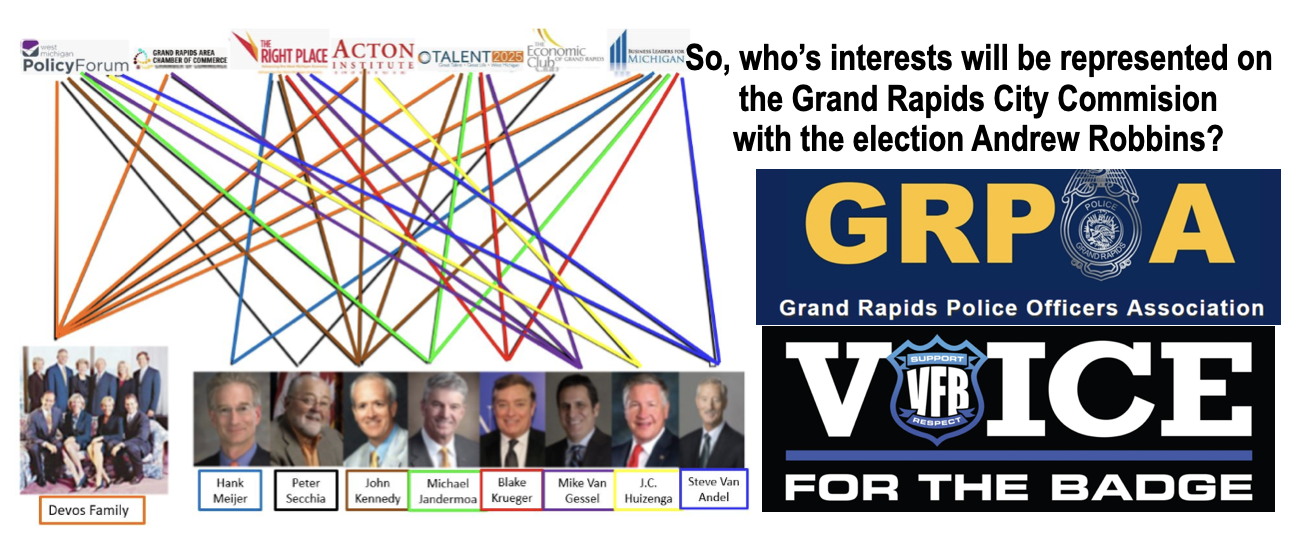
As we have noted in previous posts, Andrew Robbins received large campaign contributions from some powerful political players. Robbins received nearly $10,000 from DeVos family members/associates, along with other members of the Grand Rapids Power Structure making substantial contributions. Then there was the $10,050 contribution from the Grand Rapids Chamber of Commerce, which represents the interests of the Capitalist Class. In addition, the Grand Rapids Police Officer’s Association contributed $10,000 to Robbins, who campaigned on a Back the Blue platform.
All of these contributions were used primarily for flyers and mailers in Robbins’ campaign, which meant he had lots of money to do multiple mailers and flyer drops in the 1st Ward.
A second major factor was the white fear factor. It was revealed months ago that the SafeGR campaign was created by white people in order to discredit Commissioner Reppart as “soft on crime” and as someone who wanted to “defund the police.”
Now, it is true that Commissioner Reppart, along with Commissioner’s Ysasi and Jones, was proposing to reduced some of the budget for the GRPD in July of 2020. What the SafeGR people don’t want you to know is that these three commissioners were simply responding to thousands of letters and messages that GR City officials had received in the wake of the George Floyd protest in May of 2020. In that moment you actually had 3 commissioners who were listening to the community and a movement, which was part of one of the largest ever in US history.
In addition, the SafeGR campaign used bogus information, which was designed to paint a picture that Grand Rapids is experiencing a crime wave and that less police would mean more crime. Neither of these claims are true, and even one of the sources they used around public opinion and safety doesn’t support their claim. Go to this link, which SafeGR cited, and then click on the heading Safety.
The other component of the white fear factor is that the SafeGR campaign, like all campaigns that Back the Blue, is that when white people hear increased crime and gun violence, they overwhelmingly think of Black and Brown people. In fact, every time US governments – federal, state or local – want to increase police budgets, it is always after there has been an increase in resistance by Black and Brown communities. See Elizabeth Hinton’s excellent book, America on Fire: The Untold History of Police Violence and Black Rebellion since the 1960s. Also see my post on the 1995 campaign in Grand Rapids to change the City Charter, which institutionalized no less than a third of the City’s budget for the GRPD.
In August, the City Commission held their Commission meeting in the 1st Ward. During public comment, there were several white 1st Ward residents who all spoke against defunding the GRPD, saying things like “we need more funding for the GRPD” and “they keep us safe,” but never providing any evidence to support their claims. Then, another white dude from the 1st Ward said, that Patrick Lyoya got what he deserved because he refused to obey the cop who ended up shooting him. I remember looking at the Commissioners, then looking at the guy who said these hateful words, and then I turned around to see what kind of reaction there was from the mostly white audience. The only outward show of disgust to these comments, came from the Justice4Patrick people who were in attendance. I remember thinking to myself, the very fact that this white guy felt safe to say such a thing in public, was in part because it was in the heart of the 1st Ward. Therefore, playing to white fear on the westside was an effective strategy by the SafeGR group, disgusting, but effective.
This brings us to the last major factor that I want to talk about, in regards to Robbins’ victory over Reppart. Andrew Robbins was virtually an unknown, which means he was probably chosen to run for office. Unlike Robbins, Kurt Reppart has been been rooted in Grand Rapids, not just as a City Commissioner, but as a minister working with the Other Way Ministries, which does important housing justice, anti-poverty and food justice work. Being an unknown, Robbins had to recruit people who would support his campaign, people who are known in Grand Rapids.
One of those who endorsed Robbins early on was Johnny Brann Sr., owner of Brann’s restaurant. Besides the restaurant being an institution on the westside, Johnny Brann Sr. was the main organizing force around the group called Voice for the Badge. Voice for the Badge was created in response to the growing criticism of the GRPD, which began when Black Lives Matter GR was formed in 2014 after the police murdered Michael Brown in Ferguson, Missouri. Johnny Brann Sr. and Voice for the Badge started coming to the City Commission meetings, because Black and Brown-led movements were confronting the City Commission around policing issues, those that impacted the Black community and the immigrant community. Johnny Brann Sr. had been using the Voice for the Badge Facebook page to threaten City officials and bragged about Reppart losing his seat on the City Commission ever since the uprising in May of 2020. Not surprising, Andrew Robbins celebrated his victory at Brann’s restaurant on W. Leonard Tuesday night.
Another person who decided to endorse and stump for Andrew Robbins was Lupe Ramos-Montigny, someone who is seen as a “leader in the Hispanic community.” Lupe was very public about her support, plus she did active campaign work with Robbins. It is also worth noting that Lupe Ramos-Montigny is part of the Democratic Party, where she held the position of Chair of the Kent County Democratic Party for years and was elected as part of the Michigan State Board of Education, where she served for 8 years. Having Lupe Ramos-Montigny endorse and campaign for Robbins, in a city ward that has the largest Latino/a population, was not only a major factor in Robbins winning that seat, it is a deeply troubling and problematic that a Latina leader would endorse a pro-police candidate in 2022.
White fear, the white dominated westside, campaign contributions from the Capitalist Class and the Police union, were all factors that contributed to Andrew Robbins becoming a 1st Ward City Commissioner. This means that the police union, the Chamber of Commerce, the DeVos family and other members of the Grand Rapids Power Structure will have yet another member of the City Commission representing their interests.
What if Climate Justice were on the ballot?
I was happy this morning to cast my vote for Proposal 3, which will, “Establish new individual right to reproductive freedom, including right to make and carry out all decisions about pregnancy, such as prenatal care, childbirth, postpartum care, contraception, sterilization, abortion, miscarriage management, and infertility.”
I felt satisfied with coming for Prop 3, because it was a form of direct democracy. If Prop 3 passes, it will be enacted. Period. End of story. It won’t be left up to the legislature to try to maybe make reproductive freedom possible, it will make reproductive freedom a reality in Michigan.
Too bad there are not more ballot initiatives that we could vote for, like guaranteeing that everyone will earn enough money to take care of housing, health care, food, transportation and educational needs. Too bad there was not a ballot initiative to defund and abolish the police, despite the fact that the largest protest movement in US history – from 2020 to the present – has been demanding that. Too bad there wasn’t a ballot initiative to pay reparations to Black people. Too bad there wasn’t a ballot initiative that would end Settler Colonialism, give land back to indigenous nations and pay reparations for the centuries of harm done. Too bad that Climate Justice was not on the ballot, especially since the future of ecosystems, human and non-human species is at risk of surviving.
Imagine what it would look like in Michigan if Climate Justice was on the ballot. In some ways its too broad, since Climate justice encompasses so many things, such as the extraction and use of fossil fuels, the urgent need for real/all encompassing mass transit, the dismantling of the US Military Industrial Complex, and the end of Capitalism. Therefore, maybe we would have to narrow down said ballot initiative, to focus specifically on ending Line 5. Oh wait…..Governor Whitmer said she would do that. To be fair, Whitmer did impose an end date for the use of Line 5 in 2021, but Enbridge ignored it and got judges to say the state couldn’t do that.
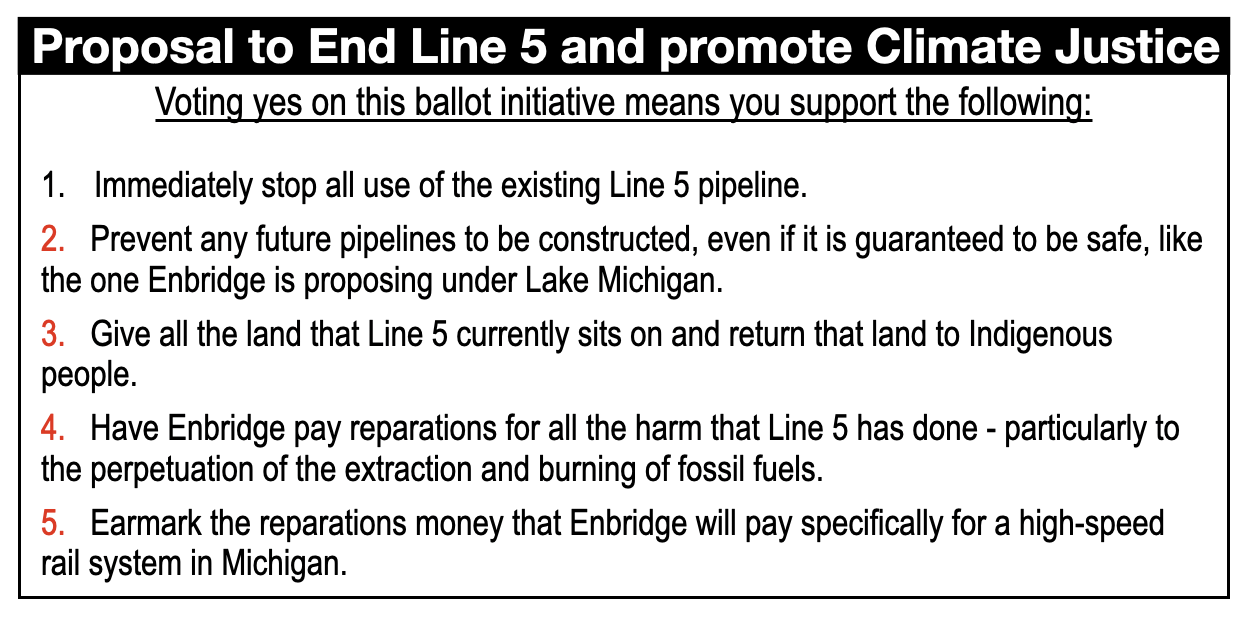
So what would a ballot initiative that would end Line 5 look like. Here is my idea, but others should come up with their own.
My idea is in 5 parts:
- Immediately stop all use of the existing Line 5 pipeline.
- Prevent any future pipelines to be constructed, even if it is guaranteed to be safe, like the one Enbridge is proposing under Lake Michigan.
- Give all the land that Line 5 currently sits on and return that land to Indigenous people.
- Have Enbridge pay reparations for all the harm that Line 5 has done – particularly to the perpetuation of the extraction and burning of fossil fuels.
- Earmark the reparations money that Enbridge will pay specifically for a high-speed rail system in Michigan.
Now, the reason that such a ballot initiative for Climate Justice or the End of Line 5 has not been put on the ballot, is primarily because the two major political parties in Michigan would never endorse such a project. Neither the Republicans nor the Democrats would endorse such a ballot initiative, simply because both parties are too entrenched in the systems of fossil fuel extraction, the system of capitalism, the role of lobbyists and the benefits of maintaining systems of power and oppression.
This means that the only effective way to end Line 5, will be through an autonomous, social movement, particularly if it is lead by Indigenous people. I say this, because the Indigenous-led resistance to oil pipelines in the US and Canada, has already proven to be the most effective strategy. In August of 2021, the Indigenous Environmental Network and Oil Change International, published an excellent report entitled, Indigenous Resistance Against Carbon.
The summary of the report states:
In this report, we demonstrate the tangible impact these Indigenous campaigns of resistance have had in the fight against fossil fuel expansion across what is currently called Canada and the United States of America. More specifically, we quantify the metric tons of carbon dioxide equivalent (CO2e) emissions that have either been stopped or delayed in the past decade due to the brave actions of Indigenous land defenders. Adding up the total, Indigenous resistance has stopped or delayed greenhouse gas pollution equivalent to at least one-quarter of annual U.S. and Canadian emissions.
Direct Action is always more effective that voting, especially in a representative democracy.
DeVos family 2022 Election spending means $12 Million worth of harm
For anyone who follows GRIID, you know that one of the things we do is to monitor and critique systems of power and oppression in the Grand Rapids area. These systems of power and oppression are the organizations and families that have a great deal of power over the masses. And of course, the family in this area that has the most power over people, is the DeVos family.
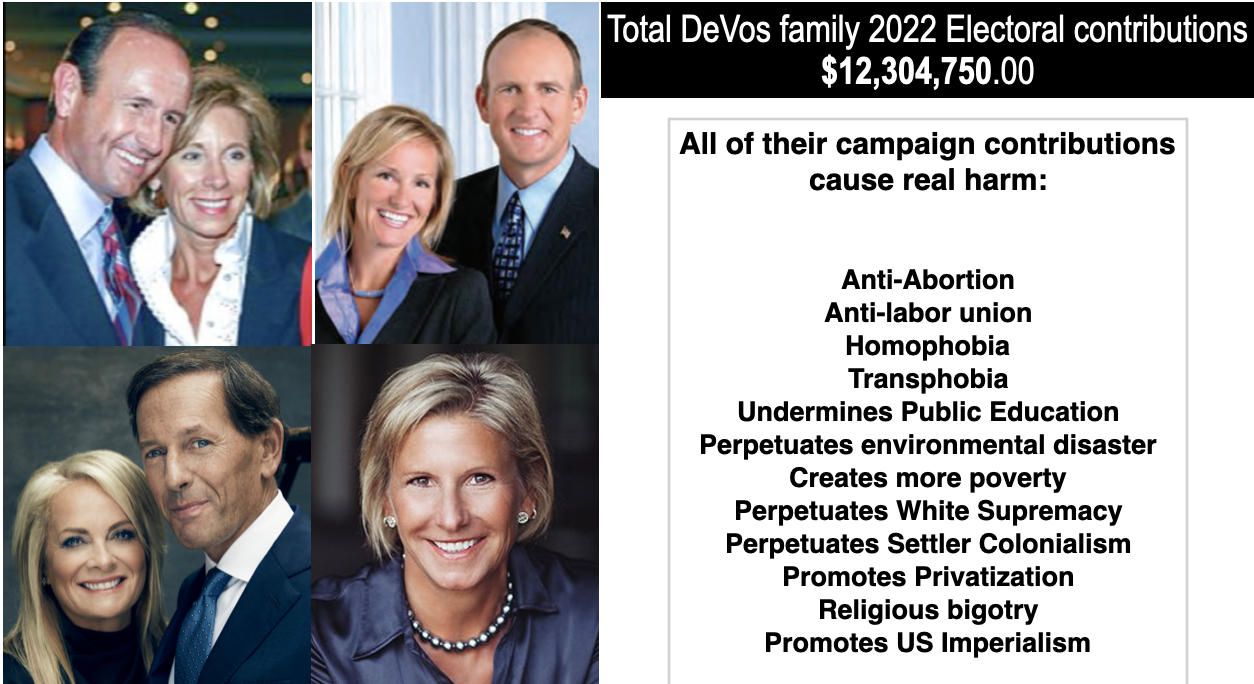
There are numerous ways in which the DeVos family has influence over people, such as their various business and other Capitalist ventures, along with their family foundations. In addition, the other way that the DeVos family exerts power over people is using their considerable wealth to buy politicians, thus buying public policy.
Over the past several decades the DeVos has been a major contributor to the Republican Party, both in the nation and in Michigan. The electoral influence began with Rich DeVos, the co-founder of Amway, but despite the fact that he has been dead for several years, the DeVos family continues to be one of the top election funders in Michigan.
When you add up all the money that each of the DeVos family members contributed at the state level, along with one of their henchmen (Stephen Ehmann – President of RDV Corp.), then include the money they have contributed in Kent County and the City of Grand Rapids for the upcoming election, the total comes to $12,304,750.
The campaign contributions made by the DeVos family have gone to candidates, to Political Actions Committees (PACs), Ballot Initiative groups, State GOP committees and the Kent County Republican Committee. Now, this $12 Million and change is just in Michigan, The DeVos family has also contributed millions to political candidates in other states, which you can research at https://www.opensecrets.org/donor-lookup. Lastly, there is Dark Money contributions that the DeVos family has made, but are difficult to track since many of these Dark Money groups do not reveal who their contributors are. For more on Dark Money groups, go here https://www.opensecrets.org/dark-money/basics.
Below is a breakdown of the Electoral contributions made by members of the DeVos family (and Stephen Ehmann), for the State, County and Grand Rapids elections. All of the $12 Million and change is funding candidates and ballot initiatives that are Republican or Republican-leaning (in the case of non-partisan races and ballot initiatives). The candidates and the ballot initiatives they have given campaign funds to will lead to policies that do real harm in Michigan, Kent County and Grand Rapids. Here is a list of what this harm looks like:
- Anti-Abortion
- Anti-labor union
- Homophobia
- Transphobia
- Undermines Public Education
- Perpetuates environmental disaster
- Creates more poverty
- Perpetuates White Supremacy
- Perpetuates Settler Colonialism
- Promotes Privatization
- Religious bigotry
- Promotes US Imperialism
Think about what this harm means the next time you attend something funded by the DeVos family, the groups that rely on their foundation money or their names on buildings that you pass by. One cannot separate the charitable contributions the DeVos family makes and all of the systemic harm they cause through their businesses and their election funding.
DeVos family campaign finance breakdown
Maria & Doug DeVos – $4,256,900
Betsy DeVos – $3,562,550
Cheri DeVos – $1,668,500
Daniel DeVos – $1,457,700
Pamella DeVos – $565,800
Dick DeVos – $400,000
Stephen Ehmann – $313,500
Kent County Commission races – $60,900
GR City Commission 1st Ward – $9450
GR City Commission 3rd Ward – $9450
Always Follow the Money: Breaking down the donations on Proposal 3, both for and against
It is difficult to not know about Proposal 3 in Michigan. Over the past few months, there have been mailers, yard signs, billboards, radio & TV ads, presenting a for and against position that would essentially do the following:
- Establish new individual right to reproductive freedom, including right to make and carry out all decisions about pregnancy, such as prenatal care, childbirth, postpartum care, contraception, sterilization, abortion, miscarriage management, and infertility;
- Allow state to regulate abortion after fetal viability, but not prohibit if medically needed to protect a patient’s life or physical or mental health;
- Forbid state discrimination in enforcement of this right; prohibit prosecution of an individual, or a person helping a pregnant individual, for exercising rights established by this amendment;
- Invalidate state laws conflicting with this amendment.
To read the full text of Proposal 3, go to this link, and scroll down to the yellow section. It is important that people read the full text, which provides clear language about what Proposal 3 will mean, but also because there has been a tremendous amount of misinformation from those who are opposing the right to reproductive freedom.
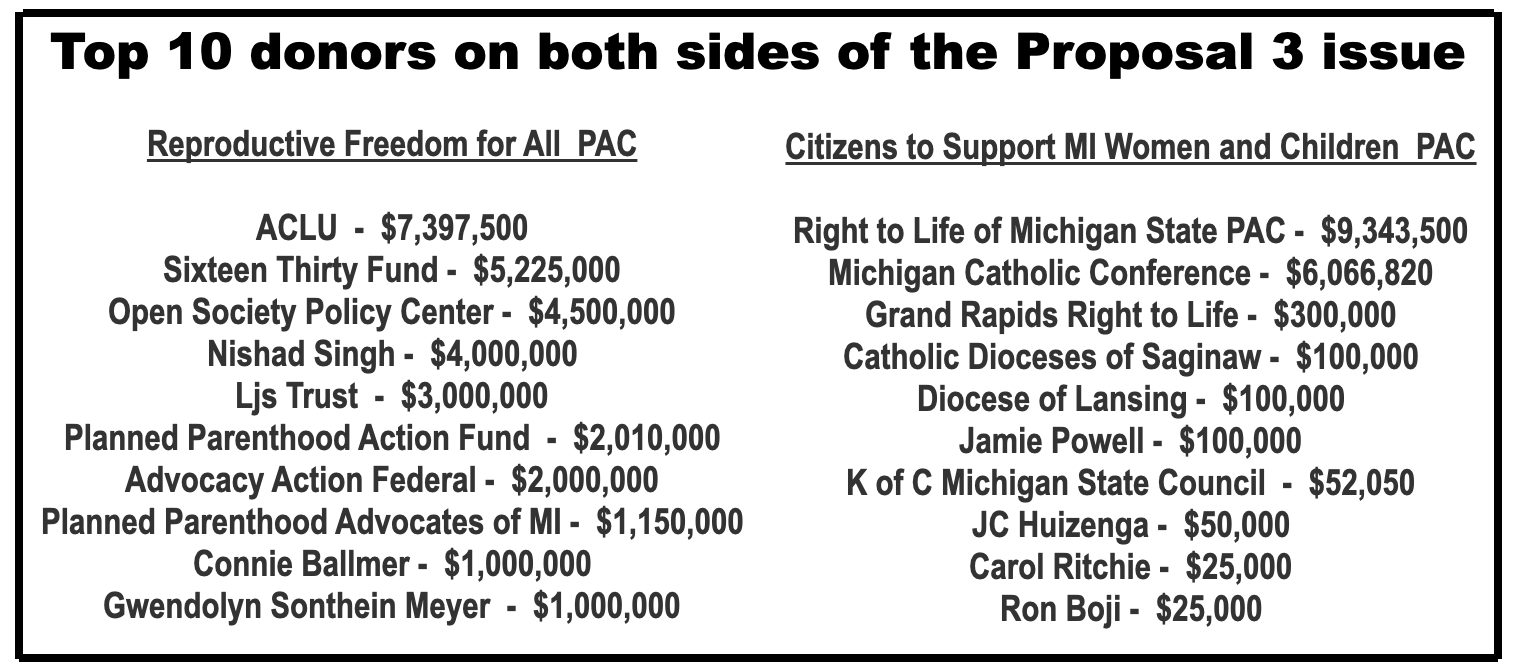
A major reason why it is difficult to not know about about Proposal 3, is that both sides have spent millions in an intense campaign. What follows is a breakdown of the Political Action Committees in support and against Proposal 3, along with information on the amount of money raised and which entities and individuals have been funding the for and against campaigns.
The Reproductive Freedom for All PAC is the group that is promoting Proposal 3. Their website doesn’t provide much information on who is directing this campaign, although the address listed on the website is also the address for the ACLU of Michigan. The Reproductive Freedom for All PAC site provides some basic facts, a list of endorsements for Proposal 3, voter information, how to get involved, how to donate and contact information.
Citizens to Support MI Women and Children PAC is the entity that is behind the opposition to Proposal 3. Their website has a summary of the amendment, a coalition of groups in opposition to Proposals 3, resources, how to donate and how to order materials. There is a great deal more content on their site, but arguably much of the content is misinformation.
The groups bankrolling the Yes and No vote on Proposal 3
According to the site Transparency USA, the Reproductive Freedom for All PAC had raised $43,627,073 and spent $33,995,387. The group opposing Proposal 3, Citizens to Support MI Women and Children PAC had raised $16,856,526 and spent $28,050,414. This means that the two groups have raised a combined $60 Million for Proposal 3. Just to provide some context and a comparison, the $60 Million raised for Proposal 3, is about one-seventh of the amount of money raised for elections in Michigan in 2022.
The top 10 donors to the Reproductive Freedom for All PAC are:
- ACLU – $7,397,500
- Sixteen Thirty Fund. – $5,225,000
- Open Society Policy Center. – $4,500,000
- Nishad Singh. – $4,000,000
- Ljs Trust – $3,000,000
- Planned Parenthood Action Fund – $2,010,000
- Advocacy Action Federal. – $2,000,000
- Planned Parenthood Advocates of MI. – $1,150,000
- Connie Ballmer. – $1,000,000
- Gwendolyn Sonthein Meyer – $1,000,000
Two of the largest donors from the Grand Rapids area are, Kate Wolters ($250,000) and Liesel Meijer ($200,000).
The top 10 donors to the Citizens to Support MI Women and Children PAC are:
- Right to Life of Michigan State PAC. – $9,343,500
- Michigan Catholic Conference. – $6,066,820
- Grand Rapids Right to Life. – $300,000
- Catholic Dioceses of Saginaw. – $100,000
- Diocese of Lansing. – $100,000
- Jamie Powell. – $100,000
- K of C Michigan State Council – $52,050
- JC Huizenga. – $50,000
- Carol Ritchie. – $25,000
- Ron Boji. – $25,000
It is worth noting that JC Huizenga is from Grand Rapids, along with the Grand Rapids Right to Life chapter, which makes 2 of the top ten donors from Grand Rapids.
We probably won’t know until next Wednesday morning what the outcome of Proposal 3 will be, but we do know that it has been an intense campaign with $60 Million being injected into the electoral process for one state ballot initiative.
Campaign Finance data for candidates for State Senate seats in the West Michigan was fairly predictable in terms of the amounts of money that were spent on these races.
- In contests where one candidate raised no funds or very little, their opponent also raised a lower amount, but enough for mailers and other Get Out the Vote efforts.
- Candidates from both parties relied heavily on contributions from Political Action Committees, funds set up by other politicians, and their county partisan headquarters.
- The DeVos family members and one their associates contributed to 2 of the 5 State Senate races in West Michigan.
- There was also over $1 Million total for media buys in the race for the 30th Senate District, which ran on local TV and cable services in this region. Media buys provide little incentive for broadcasters to conduct investigative or robust journalism about political contests, since they will pocket thousands of dollars.
18th District State Senate
Kai De Graaf (D)
No funds raised
Thomas Albert (R)
Largest Contributions:
- Southwest MI First PAC – $5000
- MI Restaurant & Lodging Association PAC – $2500
- Terri Land – $2100
- Michael Jandernoa – $2100
- Susan Jandernoa – $1900
- Ionia County Republican Committee – $1750
- Auto Dealers of MI PAC – $1750
20th District State Senate
Kim Jorgensen Gane (D)
Largest Contributors:
- John Newman – $1650
- Cynthia Evick – $1500
- Cheryl Evick – $600
- Barry Conybeare – $533
Aric Nesbitt (R)
Largest Contributors:
- Small Business PAC – $10,000
- MI Oil & Gas PAC – $5500
- Michigan Aggregates – $5000
- United Health Group Inc PAC – $5000
- Auto Dealers of MI PAC – $4000
- Michigan Altria Group inc PAC – $3500
- Eli Lilly & Company PAC – $3000
- ACPAC – $2750
- Mannik & Smith Group Inc PAC – $2500
29th District State Senate
Winnie Brinks (D)
Largest Contributors:
- American Federation of State County – $8000
- Progressive Turnout Project – $5000
- Blue Cross Blue Shield of MI PAC – $4500
- United Health Group Inc PAC – $4500
- MEA – $3750
- Auto Dealers of MI PAC – $3500
- Justice PAC – $3250
- Planned Parenthood of MI PAC – $2601
- John Hunting – $2100
Tommy Brann (R)
Largest Contributors:
Tommy Brann – $123,750
- Kent County Republican Committee – $10,000
- TGIF Victory Fund – $7000
- Nesbit Majority Fund – $5000
- Compete Michigan PAC – $2500
- Dick DeVos – $2100
- Betsy DeVos – $2100
- Pamela DeVos – $2100
- Dan DeVos – $2100
- Suzanne DeVos – $2100
- Doug DeVos – $2100
- Maria DeVos – $2100
- Steve Ehmann – $2100
- John Kennedy – $2100
30th District State Senate
David LaGrand (D)
Largest Contributors:
- Michigan Senate Democratic Fund – $30,000
- Curtis Hertel Jr for MI – $15,000
- The PAC for America’s Future MI – $11,000
- Ananich Future Fund – $10,000
- Sabo for Michigan – $9750
- Swing Left Michigan Left Fund – $7600
- Brinks for Michigan – $7500
- Operators Engineer’s Local 324 – $7000
- MI Regional Council of Carpenters – $7000
- SEIU Michigan State Council – $6000
- Kent County Democratic Party – $6000
Mark Huizenga (R)
Largest Contributors:
- Realtors PAC MI – $27,500
- Nesbitt Majority Fund – $25,000
- Compete MI PAC – $22,500
- Nesbitt Majority Fund 2 – $21,000
- Defending MI Values – $21,000
- Compete MI PAC 3 – $20,000
- Victory Values Fund – $11,000
- Compete Michigan PAC 2 – $10,000
- Blue Cross Blue Shield PAC – $8000
- MI Oil & Gas PAC – $5000
- Dick DeVos – $4200
- Betsy DeVos – $4200
- Pamela DeVos – $4200
- Dan DeVos – $4200
- Suzanne DeVos – $4200
- Doug DeVos – $4200
- Maria DeVos – $4200
- Steve Ehmann – $4200
- GR Chamber of Commerce PAC – $3300
- John Kennedy – $3100
33rd District State Senate
Mark Bignell (D)
Largest Contributors:
- Progressive Turnout Project – $3750
- Newaygo Democratic Party – $1000
- Mark Bignell – $874
Rick Outman (R)
Largest Contributors:
- Realtors PAC – $9250
- MI Action Committee for Rural Electric – $7000
- 4th Congressional District Republican Committee – $5000
- Auto Dealers PAC of MI – $4000
- Health PAC – $3500
- MI Oil & Gas PAC – $3000
- Comcast Corp/NBC Universal PAC – $3000
- Dow Inc PAC – $2000
 Grand Rapids Institute for Information Democracy