Development projects vs human needs: Kent County Commissioners vote to put more public dollars into private hands
On Thursday, the Kent County Commission demonstrated their own commitment to giving away public funding for private gain……..more than once. Kent County Commissioners voted on three separate items, all of which revealed their allegiance to Neo-liberal capitalist principles.

Before I get to the three votes from the Kent County Commission, it is worth noting that Josh Lunger, head of government affairs for the Grand Rapids Chamber of Commerce, got up to speak during public comment before the commissioners voted on critical agenda items from Thursday County Commission meeting. Lunger, who was sitting with Grand Rapids Mayor Rosalynn Bliss and chatting with her before he got up to speak, was one of the main protagonists in the City of Grand Rapids decision to adopt ordinances that further criminalized the unhoused.
At 45 minutes and 20 second into the Kent County Commission meeting, Lunger got up to say the following, regarding the items that the County would be voting on 1) giving the Arena Authority governance to operate the outdoor Amphitheater, 2) giving $15 million in public money for the Amphitheater project, and 3) approving a memorandum of understanding relating to the proposed soccer stadium – “These transformational amenities are tools to attract talent and raise the quality of life for all residents.”
Ok, so can somebody explain to me or provide me with concrete evidence that amphitheaters and soccer stadiums attract people? People move to places because of a job, because of family/friend connections, or because of the schools they want to send their kids to. Also, how do amphitheaters and soccer stadiums raise the quality of life for all residents? I mean, does anyone really believe such non-sense? Does Josh Lunger even believe this shit? People have their quality of life raised by making a living wage, by have their basic needs met, by living in communities that prioritize making sure that basic needs are met over development projects that are promoted by the rich, often at the public’s expense.
Voting in favor of transfer public funds to private interests
At 1:40:20 in the video of the Kent County Commission meeting from last Thursday, is where the commissioners begin their discussion on 1) giving the Arena Authority governance to operate the outdoor Amphitheater, 2) giving $15 million in public money for the Amphitheater project, and 3) approving a memorandum of understanding relating to the proposed soccer stadium. Let’s take a look at each of these votes.
Item 1 – The Grand Rapids/Kent County Convention and Arena Authority already oversees the arena and the Convention Center, projects that also involved millions in public funding that have primarily benefited the private sector. The Grand Rapids/Kent County Convention and Arena Authority is made up of a 6 member board. Those 6 board members include ,2 politicians – Mayor Bliss and Kent County Chair Mandy Bolter; Lew Chamberlin, the CEO of the West Michigan Whitecaps; Birgit Klohs, former CEO of the Right Place Inc., Michael Verhulst, with Acrisure Benefits Group (the company that bought the naming rights to the Amphitheater); and David Winn, Chairman of AHC Hospitality, which is owned by the DeVos family. So, we have 4 members of the Capitalist Class and 2 politicians, both of which have a history of defending the interests of the Capitalist Class.
Item 2 – The Kent County Commission voted 16 – 2 in favor of giving $15 million in public money to the Amphitheater project. This brings the total of public money to $114 million out of an estimated $184 price tag for the 12,000 seat outdoor Amphitheater. The majority of the County Commissioners voted to give $15 million in public money because they also believe in the unsubstantiated claim that having places like the Amphitheater will “attract talent.” In contrast, what if the Kent County Commission had voted to provide $15 million in rental assistance to families who can’t afford the high cost of rent. What if the County Commissioners voted to invest $15 million of public money into a more robust transit system or invest in solar panels for Kent County residents. Housing, transportation and energy costs are clearly more urgent that funding an outdoor Amphitheater, yet local governments continue to direct public money to these development projects time and time again.
Item 3 – The last item that the Kent County Commissioners voted unanimously on, was to Support the Memorandum of Understanding Relating to Public Soccer Stadium. You could use the same shitting arguments for the soccer stadium as they have used for the Amphitheater – talent attraction, tourism, and entertainment. Plus, the soccer stadium will also use public money, even though it will be owned privately, probably by Dan DeVos, who already owns multiple sports teams.
Of course all of the local news reported on these decisions by the Kent County Commissioners. However, their reporting was celebratory without any critical inquiry, analysis or discussion about what is prioritized in this community and what isn’t. When the unhoused population grows, since the City and the County both prioritize development projects over basic human needs, they will just keep adopting ordinances to further criminalize and marginalize those who are housing insecure.
On Saturday, there were an estimated 150 people who came out to a protest to show solidarity with Palestinians and to demand an immediate ceasefire in Gaza and the West Bank.

Unlike previous protests in support of Palestine, Saturday was held at Martin Luther King Jr. park, in the southeast part of Grand Rapids. The protest/march was held in that neighborhood, primarily because Rep. Hillary Scholten lives in that neighborhood.
GRIID has been posting articles critical of Rep. Scholten’s unconditional support of Israel, even prior to the October 7 Hamas attack. Most recently, I wrote a critique of Scholten’s statement on the so-called “pause.” Scholten has been the target of a fair amount of activism in the past month, including three of us getting arrested at her Grand Rapids office in the federal building about 4 weeks ago.

The protest/march yesterday began with a short rally, followed by began marching in the streets, specifically in the residential neighborhood around MLK Park. People also dropped off a small handout at the homes of those who lived on the march route. Several people who handed out the flyers, had commented that the feedback was mostly positive, and people came out of their homes to greet those showing solidarity with the Palestinian cause.
The march wove through the neighborhood surround the park and eventually arrived at the home of Rep. Scholten, who lives on Benjamin St., just south of Martin Luther King Jr. Park.

When the march arrived at Scholten’s place, someone put a makeshift yard sign in her front lawn, which demanded an end to US military aid for Israel. Someone else delivered a list of demands that is part of a larger campaign that has been targeting Rep. Scholten, along with Senators Gary Peters and Debbie Stabenow. The campaign targeting these members of Congress is demanding an immediate ceasefire in Gaza, an end to the annual $3.8 billion in US Military Aid, and a no vote on the proposed $14.3 billion the Biden Administration has been calling for over the past month. You can send an electronic message with these demands, which can be found at this link.

After about 15 minutes of chanting outside of Rep. Scholten’s home, those doing crowd safety noted that a few GRPD cruisers had arrived, parking further south on Benjamin St. A few minutes later, people got word that 2 more GRPD cruisers showed up on the north end of the same street, so crowd safety people urged those standing in front of Scholten’s house to move, in order to avoid getting boxed in by the cops.
Just as the protest march was leaving Scholten’s place, an ambulance and a fire truck arrived and pulled up in front of a house that was 2 doors down. There was also a white, unmarked cruiser, which just happened to be the Chief of Police (seen in the picture below), which made those of us doing crowd safety suspicious, since why would Chief Winstrom be out and about on a Saturday.

The march then moved to Alexander street, which is on the south side of MLK Park. All of the marchers were off the street by this time, walking back to the spot where the protest march had begun, when all of a sudden 10 GRPD cruisers showed up, with lights on, and several cops exiting their cars. The march had a car included, which was doing safety from the rear, making sure that no motorists would drive into those marching. This is a standard practices, especially after what happened in Charlottesville in 2017, when a White Supremacist drove into an anti-racists crowd of protesters killing one of the protesters.

The GRPD ended up giving a ticket to the comrade driving the safety car, saying they were blocking traffic, which of course was ridiculous, considering that on a Saturday, in a residential neighborhood, there was essentially no traffic to block. Thus, the GRPD was just looking for any excuse to harass those who were protesting. During this time, lots of people had their phones out, recording the GRPD and chanting, “Police violence is a crime, from Grand Rapids to Palestine,” which was a theme raised at the beginning of the rally by one of the speakers with the Comrade Collective, citing the example of the GRPD’s murder of Patrick Lyoya, a Congolese refugee in April of 2022.

The repressive display from the GRPD was instructive, since it demonstrated to many at the march just how insidious they could be. The Palestine Solidarity march was clearly a non-violent action, with very limited disruption, along with the fact that most of the public we encountered along the way were both supportive and appreciative of what we were doing. The GRPD’s behavior was particularly instructive to those who were newer to protest movement politics, and it also demonstrated how the GRPD reacts to actions that operate outside of the normal downtown marches, which the GRPD has grown accustomed to. The GRPD may also have been alerted to the protest because we stopped in front of Rep. Scholten’s house for some 15 – 20 minutes, further demonstrating their commitment to protecting systems of power, even when those in power who are complicit in war crimes.
The official narrative on Kissinger’s death tells you something about the celebration and normalization of US Imperialism
So, Henry Kissinger is finally dead. This is the kind of sentiment that is being expressed, both in the virtual world and amongst many who live in the Global South, where Kissinger was seen as one of the primary architects of US Imperialism since the Nixon Administration.
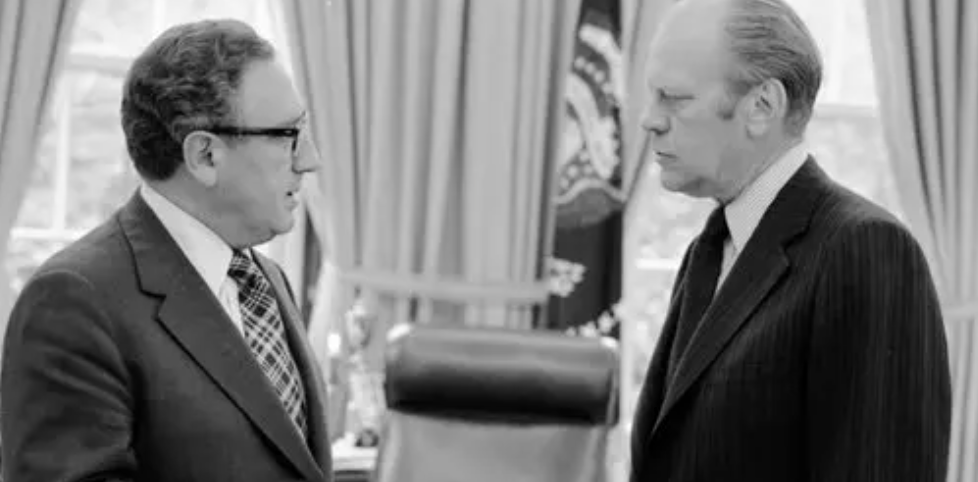
The notion that Kissinger was an integral part of US Imperialism is nowhere to be found within the narrative in commercial news media since he died on November 29th. I did a quick look at the local daily news sources in Grand Rapids and most of them were just re-printing an Associated Press (AP) obituary for the former Secretary of State and National Security Advisor, like the one that MLive re-posted.
I even looked at the Gerald R Ford Museum website to see if they had a tribute to Kissinger, especially since he played such a significant role during the Vice Presidency and Presidency of Ford. There was nothing about the passing of Henry Kissinger.
It’s possible that the local news and the Ford Museum might run something in the coming days to remember Henry Kissinger, but it would no doubt speak of him as a great statesman and scholar. Greg Grandin, who has written a critical account of Kissinger – Kissinger’s Shadow: The Long Reach of America’s Most Controversial Statesman, wrote an excellent article entitled, A People’s Obituary of Henry Kissinger.
Grandin was also interviewed on Democracy Now on Thursday, where he said:
 I mean, we can go into the details, but I do want to say that his death has been as instructive as his life. I mean, if you look at the obituaries and notes of condolences, they just — I mean, they just reveal, I think, a moral bankruptcy of the political establishment, certainly in the transatlantic world, in the larger NATO sphere, just an unwillingness or incapacity to comprehend the crisis that we’re in and Kissinger’s role in that crisis. They’re celebratory. They’re inane. They’re vacuous. They’re really quite remarkable. And if you think of — just think back over the last year, the celebrations, the feting of his 100th anniversary — 100th, you know, birthday, his living to 100 years. I think it’s a cultural marker of just how much — how bankrupt the political class in this country is. So his death is almost as instructive as his life.
I have seen lots of people in my Facebook feed referring to Kissinger as a War Criminal, which I think is accurate, but Grandin also made an excellent point about what is problematic about referring to Kissinger as a War Criminal, stating:
Christopher Hitchens popularized thinking about him as a war criminal, and that has a way of elevating Kissinger, in some ways, as somehow an extraordinary evil. And it’s a fine line, because he did play an outsized role in a staggering number of atrocities and bringing and dealing misery and death across the globe to millions of people. But there’s a lot of war criminals. I mean, you know, this country is stocked with war criminals. There’s no shortage of war criminals.
This is an important point from Grandin, since one could easily argue that since WWII, every US President and every administration has engaged in war crimes, which is to say that they were a proponent of US Imperialism. In a sense, Kissinger has normalized US Imperialism, which always includes war crimes.
Providing a counter-narrative to Official Sources on Kissinger
For those wanting more than the latest meme on Kissinger’s death, let me offer some of the following sources.
I already mentioned Grandin’s book, Kissinger’s Shadow: The Long Reach of America’s Most Controversial Statesman, plus there is the book by Christopher Hitchens, The Trial Of Henry Kissinger. The book by Hitchens, is what inspired the documentary film, The Trial of Henry Kissinger, which focuses on three main US foreign policy examples that Kissinger played a primary role in – Vietnam/Cambodia, Chile and Indonesia’s invasion of East Timor.
Then there are the excellent resources by the National Security Archives, which provides hundreds and hundreds of pages of declassified US Government documents involving Kissinger, which you can find here.
The Intercepted has done some important research and writing on Kissinger as well, with a piece on his legacy from Thursday, HENRY KISSINGER, TOP U.S. DIPLOMAT RESPONSIBLE FOR MILLIONS OF DEATHS, DIES AT 100, and an older post entitled, Blood on His Hands: Survivors of Kissinger’s Secret War in Cambodia Reveal Unreported Mass Killings.
The Jacobin Magazine also has numerous articles from a variety of contributors that were posted on Thursday, which are part of a new book you can order from them entitled, Only the Good Die Young.
Lastly, there is an excellent article from Norman Solomon on CounterPunch, entitled, For Media Elites, War Criminal Henry Kissinger Was a Great Man. In Solomon’s article he quotes the late Anthony Bourdain, who illuminated much about the world’s foods and cultures. As this century got underway, Bourdain wrote:
“Once you’ve been to Cambodia, you’ll never stop wanting to beat Henry Kissinger to death with your bare hands. You will never again be able to open a newspaper and read about that treacherous, prevaricating, murderous scumbag sitting down for a nice chat with Charlie Rose or attending some black-tie affair for a new glossy magazine without choking. Witness what Henry did in Cambodia — the fruits of his genius for statesmanship — and you will never understand why he’s not sitting in the dock at The Hague next to [Slobodan] Milošević.”
It has been a little over 4 months since GRIID last updated the DeVos Family Reader. As always, there has been plenty to report on regarding the most powerful family in West Michigan.

In Howard Zinn’s monumental book, A People’s History of the United States, he constantly juxtaposes the amazing things that people did to fight for liberation and the people behind the systems of oppression that social movements were fighting against.
This is exactly why I have spent years monitoring, investigating and critiquing the DeVos Family. They are the most recognizable and powerful manifestation of the systems of power and oppression in West Michigan. Now, I know there are plenty of people who share the belief that without the DeVos Family, Grand Rapids wouldn’t be where it is today. I fully agree with that belief, but for reasons that are the exact opposite of those who hold the most powerful family in West Michigan in high regard.
 Three times a year we try to update our DeVos Family Reader, a collection of articles that looks at the family’s history, the influence on election & public policy, their foundations, how they are reported on in the news media, ArtPrize and the section entitled Betsy DeVos Watch.
This updated version of the DeVos Family Reader includes information and analysis on a variety of local issues, even some that are not directly focused on the DeVos Family, but there are connections. In September GRIID reported on Rockford Construction getting a contract to build a new park along the river next to the Amway Grand Plaza. Rockford Construction won the contract because of their relationship with the DeVos Family.
Another example of the connections, was an article about the CEO of Acrisure paying for the naming rights for the new outdoor amphitheater, where the CEO said he learned philanthropy from the DeVos and Van Andel families.
There was also an article deconstructing one of Doug DeVos’s podcasts, a critique of a post by the DeVos-created Michigan Freedom Fund, a look at the 200 most influential people in Grand Rapids, a new national report on Philanthropy, and an update on the proposed soccer stadium which involves the DeVos Family.
The DeVos Family Reader is now up to 746 pages of history, analysis and information about the most powerful family in West Michigan.
25 Michigan Legislators send letter to Biden calling for a cease fire, but only 1 is from Kent County
Last Wednesday, 25 members of the Michigan State Legislature signed a letter that was sent to President Biden calling for a cease fire and an “enduring peace.”
The letter begins by saying:
“We write to urge you to do everything in your power as the president of the United States to reach an immediate durable cease-fire. We urge the immediate and unconditional release of all hostages, the adherence of all international laws and aid to ensure that every person living in Israel, Gaza and the West Bank can live with self-determination, dignity and humanity.”
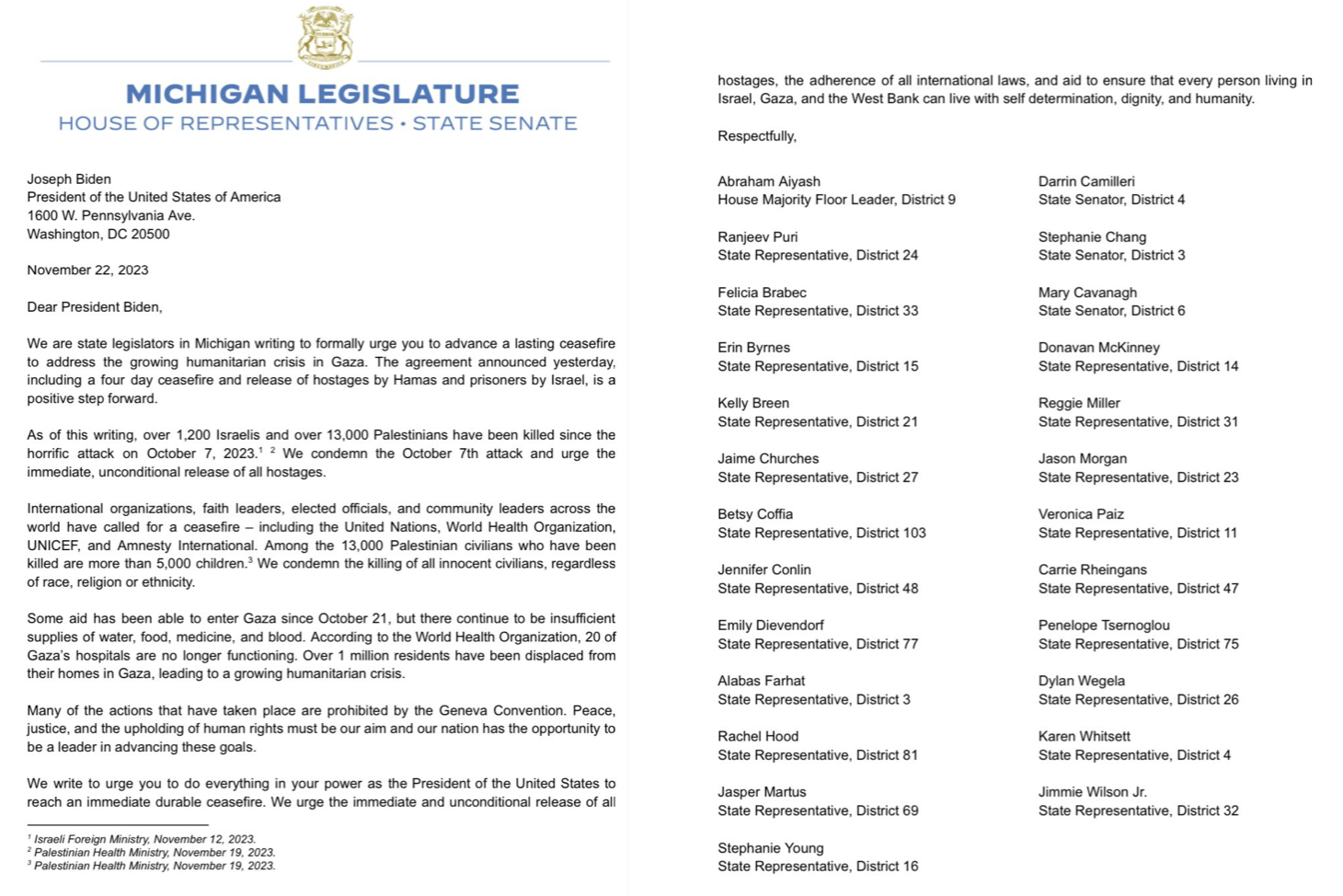
You can read the entire letter at this link, along with seeing which State Legislators signed the letter that was sent to President Biden.
The letter was signed by 25 State Legislators, 22 State Representatives and 3 State Senators. However, the only member of the State Legislature from Kent County to sign onto the letter was Rep. Rachel Hood from the 81st District.
This means that the following members from the State Legislature that represent Kent County did NOT sign the letter.
State Senators
18th District – Thomas A. Albert
20th District – Aric Nesbitt
29th District – Winnie Brinks
30th District – Mark Huizenga
33rd District – Rick Outman
State Representatives
78th District – Gina Johnsen
79th District – Angela Rigas
80th District – Phil Skaggs
82nd District – Kristian Grant
83rd District – John Fitzgerald
84th District – Carol Glanville
89th District – Luke Meerman
90th District – Bryan Posthumus
91st District – Pat Outman
GRIID certainly applaud’s Rep. Hood for signing the letter, but finds it shameful that no one else from this area signed it.
There has been ongoing and significant opposition to the unconditional US support for Israel, the failure of the Biden Administration to call for a cease fire and for the current level of US military Aid to Israel – $3.8 billion, along with the proposal to send an additional $14.3 billion to Israel. Indeed, in Michigan, there have been 3 local governments that have adopted resolutions calling for a cease fire in Gaza – Dearborn, Dearborn Heights and Hamtramck and Detroit. Grand Rapids has also been pressuring City officials to do the same.
It is shameful that more State Legislators did not sign onto this letter, considering the number of Palestinians that have been killed is now over 15,000, with over 6,000 of those deaths being Palestinian children.
Send the elected officials listed above a message, and tell them that it is shameful and cowardly that they did not sign the letter, are not speaking up in favor of a cease fire and standing in solidarity of the Palestinian people who are being brutally assaulted by the Israeli military, using US weapons.
Senita Lenear announces candidacy for Mayor: Assessing the former Commissioner’s voting record through the lens of social movement organizing in Grand Rapids
Just before the Thanksgiving break, former 2nd Ward Grand Rapids City Commissioner Senita Lenear announced that she was enter the race to be Mayor of Grand Rapids in the 2024 Election.
This means that there are now two candidates running to become the next Mayor of Grand Rapids, with David LaGrand being the first to announce earlier this summer. GRIID has posted 2 articles on LaGrand’s mayoral candidacy, one in July, which looked at his campaign finances, and a second post more recently, also regarding those who are contributing to his candidacy. In today’s post, I want to look at Senitar Lenear’s candidacy.

The local news coverage of Lenear’s announcement that she is running for Mayor of Grand Rapids did little to inform people, despite the fact that Lenear served as a 3rd ward Commissioner for 8 years. As an example, the WZZM 13 story used some of the talking points that the Lenear campaign sent out, talking points that are highlighted on her campaign website.
The soundbite from Lenear that channel 13 ran, has the former City Commissioner talking in vague pleasnatries, but with no real concrete policy ideas or issues that are critical to most working class and BIPOC residents. The story did mention that Lenear already has the endorsement of current 2nd Ward City Commissioner Ysasi, but failed to tell viewers that Ysasi is also the treasurer for Lenear’s campaign for mayor, based on her recent campaign finances filing.
The campaign website for Lenear is also full of platitudes about violence reduction and investment in the City’s 3rd Ward. There is even a heading for Grand Action 2.0, the private DeVos-run entity that has used millions in public funding for private projects like the Downtown Market, and the forthcoming outdoor amphitheater.
As someone who pays attention to social movements in Grand Rapids, my assessment of Lenear would be more critical than what the commercial news media is and will likely offer between now and the November 2024 Election. For instance, in 2019, MLive ran a series of articles on the lack of investment in the 3rd Ward, which Lenear represented from 2014 – 2022. In response to the MLive coverage, GRIID wrote:
Sadly, the reporters who wrote the pieces last week about the lack of equity in the city’s 3rd Ward, did not hold elected leaders accountable, instead they provided them with an uncritical forum to say what they wanted.
But what would accountability from the news media look like? First, MLive could have looked at all of the City Budget discussions since Senita Lenear was elected in the fall of 2014, to see what the 3rd Ward Commissioner did to fight for more equitable funding for the ward she represents. Second, MLive could have looked at the commissioner’s voting record as it related to funding issues or development projects. Lastly, MLive could have looked at who have been the major campaign funders backing Lenear as she has run for the 3rd Ward seat. There are campaign finance records that are easily accessed from the County Clerk’s office. One section of Commissioner Lenear’s 2014 campaign finance reports tells an interesting story about who back her first campaign.
What follows are some important points as it relates to social movements during Lenear’s tenure on the City Commission 2014 – 2022.
- Commissioner Lenear did not come out in support of the bus driver’s fight over their contract.
- Commissioner Lenear did not speak up about gentrification in the City, especially the southeast part of Grand Rapids, nor the sky rocking cost of housing and rent increases that have displaced people who have been unable to afford those costs.
- When the immigrant justice movement was calling for the City to fire Captain VanderKooi, who profiled Jilmar Ramos-Gomez and turned him in to ICE, Commissioner Lenear was silent.
- When the City Commission had the opportunity to propose a reduction in the GRPD budget in 2020, a month after the George Floyd protests, Senita Lenear did not support this demand.
- After the GRPD murdered Patrick Lyoya, with constant calls to defund the GRPD, Commissioner Lenear once told those who were opposed to the GRPD, that they should join the GRPD to make the changes they wanted.
- Commissioner Lenear, towards the end of her tenure, did not oppose an ordinance proposal from the GR Chamber of Commerce, which was eventually adopted, but after Lenear was no longer on the commission.
- Commissioner Lenear was also a major supporter of the Amphitheater proposal and other downtown investments that required massive public funding. The amount of money that the City, County, and State government that is going to the Amphitheater is millions, so imagine if Commissioner Lenear would have champion that kind of investment into the 3rd Ward while she was representing that area specifically.
As has been the case in the past, GRIID will monitor and track the platforms and campaign financing of the candidates running for Mayor of Grand Rapids over the next 11 months until the 2024 Election.
Activist hold a Die-In at the Grand Rapids Downtown Market to dramatize the horror of Palestinians who have been killed by the Israeli military in recent weeks
On Sunday, a group of local activists descended on the Grand Rapids Downtown Market to continue to protest US complicity in the Israeli assault on Gaza.

 The Grand Rapids Downtown Market was chosen as a site for the protest, since there has been an increase in consumers, because of the Christkindl Market, which has added dozens of additional vendors, plus entertainment and even the option for people to rent Private Chalets.
The protest that was held at the Grand Rapids Downtown Market was a Die-In, where people wrapped themselves in bed sheets and laid down next to each other. The Die-In is a visual representation of the harsh reality that Palestinians in Gaza have been facing, with over 14,000 dead. Those who have survived in Gaza will wrap the dead in sheets and place them next to one another to provide the community with an opportunity to publicly mourn the dead.
While activist engaged in the Die-In, other people handed out small flyers encouraging people to send a message to Senators Debbie Stabenow and Gary Peters, along with 3rd Congressional Representative Hillary Scholten. The message demands that the Michigan members of Congress call for an immediate cease fire in Gaza, an end to the annual US Military Aid to Israel ($3.8 billion), plus a no vote on the proposed additional $14.3 billion the Biden Administration wants to send. You can send the same message by going to this link.
There were a few people who were visibly and verbally frustrated by the Die-In and the chanting that went on, but many people took the flyer and made gestures in support of the action. A few people even came up to some of the activists to verbally tell them that they were grateful for the action. Another activist shared that they saw several parents kneel down and explain what was happening to their children, especially since the flyer that was shared had a statement which read, Every 10 minutes a Palestinian child is blown to pieces because of the Israeli bombing.
There was also one white woman, who most likely worked for the downtown market, who came out screaming at people saying, “this is private property!” While the downtown market is privately owned, it is still space that the public gathers in and there were several million dollars of public money that subsidized the construction of the so-called market. The white woman called the GRPD, which showed up 30 minutes after the Die-In began, in 6 GRPD cruisers and 10-12 cops. Those participating in the action did not intent to get arrested, so people after the police liaison distracted the cops for a few minutes, we all got up and left. However, we all walked through the outdoor portion of the market, handing out informational flyers and chanting, Free, Free Palestine!
https://www.youtube.com/shorts/H4ynRWQ8FNw
Street Theater, or what some call Guerrilla theater, is a popular form of protest throughout the world. Augusto Boal, a Brazilian, developed street theater as a political form of resistance, in what he termed the Theater of the Oppressed.
Rep. Scholten’s statement on the 4 day pause demonstrates her ideological commitment to unconditional US support of Israel
Last Tuesday, Rep. Hillary Scholten released a statement about the negotiated agreement between Hamas and the Israeli government that began on Friday.
The negotiated agreement was for a four day “pause” of the Israeli assault on Gaza and the West Bank, in order to exchange some of the hostages being held by Hamas and Palestinian prisoners that the Israeli have had since before October 7.
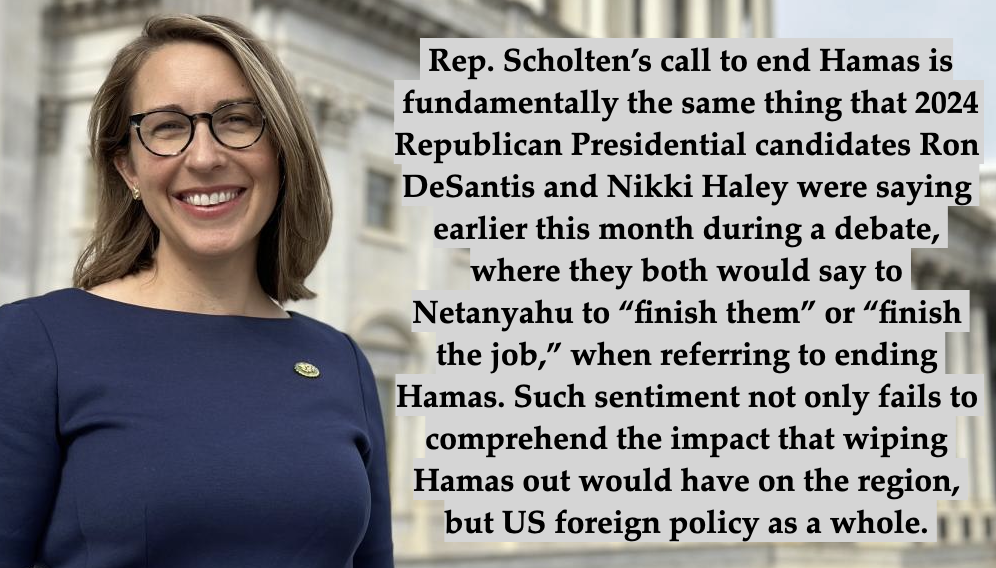
Taken from Rep. Scholten’s website, the Press Release is prefaced with this sentence, “Rep. Hillary Scholten (MI-03) issued the below statement after a vote by the Israeli cabinet approving a deal to release Hamas-held hostages”: The way that Scholten’s staff framed her statement is rather instructive. It is true that the Israeli cabinet approved the deal, but this was a deal that was between the Israeli government and Hamas. Second, it is worth pointing out that the terms of the agreement were first laid out by Hamas several weeks ago, something that Scholten fails to acknowledge.
What follows is Rep. Scholten’s statement on the negotiated agreement. Afterwards, I will provide some analysis of the statement, with independent information that contradicts the Congresswoman’s statement or at the very least provides a different perspective. The highlighted words indicate what I am responding to.
“It’s with tempered relief that we receive the news of a deal to release hostages that were held for too long by Hamas and take the first step to de-escalation in this conflict. I’d like to thank the Biden Administration for working tirelessly on this issue and for heeding calls from me and my colleagues to take action and return the hostages home as soon as possible and turn towards peace.
While this is an encouraging development in the conflict, it will never take away from the horror these victims experienced or replace the innocent lives lost since the terrorist attacks on October 7th. One thing is clear: Hamas must go.
As I have done for weeks, I continue to call for the release of the remaining hostages, for humanitarian aid to quickly reach innocent civilians in Gaza, and for Israelis and Palestinians to forge a path forward towards a two-state solution that allows for shared peace and prosperity for all. The United States should continue to facilitate strategic pauses in fighting to allow that to happen.”
- Rep. Scholten completely omits the fact that this negotiated deal was an exchange of hostages taken by Hamas for Palestinian prisoners being held by the Israeli government.
- There is no evidence that the release of hostages for prisoners will lead to a de-escalation of the conflict, since numerous writers and analysts that have been following the Israel/Palestine issue for decades believe that the October 7 assault by Hamas will provide the justification that Israel needs to forcibly remove the Palestinians from Gaza.
- Thanking the Biden Administration is no doubt what Rep. Scholten was told to write, since the Biden Administration has done nothing to works towards peace on this issue. The Biden Administration has maintained unconditional support for Israel, especially after the October 7 Hamas attack, both diplomatically and in terms of the ongoing US support of Israel with weapons and military aid. If anything, the Biden Administration is recognizing the growing domestic and international opposition to US support of Israel, which could have disastrous consequences for the 2024 Elections.
- When Rep. Scholten talks about the horror these victims experienced or replace the innocent lives lost since the terrorist attacks on October 7th, she is centering the Israeli lives lost and can’t even acknowledge the 14,000 plus Palestinians who have died from Israel’s retaliation, which includes over 6,000 dead Palestinian children.
- Maybe the most egregious thing that Rep. Scholten says in her Press Release is calling for the elimination of Hamas, using the words Hamas must go. Democrats like to present themselves as liberals, but Scholten’s call to end Hamas is fundamentally the same thing that 2024 Republican Presidential candidates Ron DeSantis and Nikki Haley were saying earlier this month during a debate, where they both would say to Netanyahu to “finish them” or “finish the job,” when referring to ending Hamas. Such sentiment not only fails to comprehend the impact that wiping Hamas out would have on the region, but US foreign policy as a whole.
- Scholten’s insistence that only Hamas is to blame in this current situation demonstrates her ideological obedience to the notion that it is a matter of policy for US politicians to unconditionally support Israel.
- The likelihood of a two state solution hasn’t seemed viable for some time now, plus it ignores the one Democratic State idea that many people, including the Israeli writer Jeff Halper, have been proposing.
- Strategic pauses will only allow Israel to continue to murder Palestinians and destroy what is left of Gaza. Much of the world understands that these strategic pauses are a joke. What is needed is a permanent cease fire and a real, longterm negotiated settlement for the future of Israel and Palestine.
Lastly, I want to quote an excellent piece from the Washington Report on Middle East Affairs, which has been providing critical analysis for decades on that region of the world and on Israel/Palestine. Here is an extended quote regarding the 4 day pause:
The agreement is significant in several respects. Perhaps most importantly, the U.S. and Israel, which repeatedly vowed to eradicate Hamas, are now negotiating with the Palestinian movement and reaching agreements with it. Qatari-Egyptian mediation, while indispensable, is ultimately a formality. The U.S. and Israel are not negotiating with Egypt and Qatar but with Yahya Sinwar, the head of Hamas in the Gaza Strip and architect of the Oct. 7 attacks.
The tenor of Israeli press reports in recent days has been that Hamas is desperate for a respite, however brief and at almost any price, from the ferocious Israeli onslaught against the Gaza Strip.
Yet the available reports about the deal suggest otherwise: Israel has committed to releasing three times as many imprisoned women and children as the Palestinians; no Israeli soldiers are included in the exchange; significantly more humanitarian supplies, including fuel, will reach the Gaza Strip; the exchange of captives will be implemented during a continuous four-day truce rather than one in which the slaughter is paused for a brief period each day; and Israeli jets and drones will be prohibited from using the airspace over the Gaza Strip for several hours each day.
This is quite close to the deal initially offered by Hamas several weeks ago, and it appears the bulk of its demands have been conceded by Israel and the U.S. If the adage that negotiations reflect reality on the ground rather than overturning it applies, Hamas—in contrast to the Palestinian population of the Gaza Strip, which has been Israel’s main target—seems far from desperate. Instead, it appears sufficiently confident to stick to its priorities until these are accepted by the U.S. and Israel.
Pursuant to the agreement, Hamas has also forced the U.S. and Israel to consent to the supply of large amounts of essential humanitarian supplies to the Gaza Strip. In other words, Hamas has in one fell swoop achieved exponentially more on the humanitarian front than the much-vaunted U.S. diplomacy to secure humanitarian relief for Gaza’s Palestinian civilians during the past month.
This confirms that the entire U.S. effort was in essence a circus—a diversionary charade to enable Israel to continue with its mass killings and transform the Gaza Strip into a wasteland and a killing field.
It bears repeating that Hamas has forced the U.S. and Israel to allow significant quantities of food, water, medicine and fuel to reach the civilian population of the Gaza Strip. Yet Hamas is the anointed terrorist organization in this equation while Israel is the light unto nations with the world’s most moral army and the U.S.—the world’s greatest democracy dedicated to spreading freedom and human rights to the rest of the planet.
New Report on how the Philanthropy of the Rich costs the public, confirms what we have seen here in West Michigan
The U.S. charitable system is shaped by laws — particularly those set out by a sweeping charitable tax reform package passed in 1969. Over the five decades since then, however, we’ve witnessed an extraordinary concentration of wealth and power in the hands of our wealthiest citizens. We’ve also witnessed the attendant explosion of a wealth-defense industry — tax attorneys, accountants, and wealth managers — who have an institutional bias toward unlimited capital accumulation, tax minimization, and dynastic succession. That bias has crept its way into the philanthropic sphere as well. The meteoric rise of donor-advised funds as giving vehicles, for example, has been driven in part by wealth advisors selling tax-avoidance products. You will get a play-by-play of financial industry shell games in our discussion of how wealthy donors are gaming foundation excise taxes and payout requirements. And there are signs that some billionaires are starting to think that certain for-profit investments are a replacement for philanthropy — or even that their own companies are more socially beneficial than any sort of giving.

This paragraph above is from a new report by the Institute for Policy Studies, entitled, The True Cost of Billionaire Philanthropy. The reason why In think this report is so important is that it confirms many of the things I have been writing about in regards to the wealthiest families in West Michigan, their philanthropy through foundations and their charitable contributions. I’m speaking specifically about the DeVos and Meijer families, the two billionaire families in West Michigan, but this new report also could apply to some of the other sizable foundations in the Greater Grand Rapids area, such as the Jandernoa Foundation, the Secchia Foundation, the Cook Foundation, the Wege Foundation, the Van Andel Foundations and the Frey Foundation.
Here are some of the major findings in the report, The True Cost of Billionaire Philanthropy, which is what we have seen with the wealthy philanthropists in West Michigan.
What Ultra-Wealthy Philanthropists Costs Us?
- We know for certain that $73.34 billion in tax revenue was lost to the public in 2022 due to personal and corporate charitable deductions.
- If we include just the little data we have about charitable bequests and the investments of charities themselves, the revenue loss is pushed up to roughly $111 billion.
- And if we also include the capital gains revenue lost from the donation of appreciated assets, the true revenue costs of charity likely add up to several hundreds of billions of dollars each year.
The news is full of stories about billionaires giving huge gifts to charity. But for all but the most generous, their giving is nowhere close to keeping up with the growth in their wealth. And while some billionaires make an earnest effort to give back, others appear to be using philanthropy more to enhance their public image, their political voice, and even their wallets.
The wealth of billionaire philanthropists has grown exponentially. For example, “The 73 living U.S. Giving Pledgers who were billionaires in 2010 saw their wealth grow by 138 percent, or 224 percent when adjusted for inflation, through 2022. Their combined assets increased from $348 billion to $828 billion over those twelve years.”
A 2021 report from the Council on Michigan Foundations, or CMF, showed that the money flowing out to working charities from donor-advised funds at community foundations in Michigan was astonishingly slow. Based on account-level data for 2,600 DAFs, CMF found that in 2018 the median payout rate for Michigan’s DAF accounts was just 3.1 percent.
And it gets worse. The CMF found that in 2020, only 43 percent of DAF accounts paid out grants to charity at 5 percent or more—the minimum currently required of private foundations. 22 percent of the accounts paid out less than 5 percent. And 35 percent—more than one third— paid out nothing at all to charity that year.
In fact, on average, 37 percent of Michigan’s DAF accounts don’t pay out any money in any given year. And most of Michigan’s community foundations require a DAF to make a distribution at least once every three years — making it likely that if this requirement didn’t exist, the portion of DAFs that didn’t distribute anything to charity in any given year would be even higher.
What Billionaire Philanthropists Cost Us? 
Our national tax system contains a large and complex set of deductions, exclusions, and other provisions related to charitable giving. All of this results in lost tax revenue, forcing less wealthy taxpayers to pick up the slack to fund crucial public services. There is broad public support for this taxpayer subsidy for charitable giving when funds reach working charities in a timely manner.
In fact, according to nonprofit law experts Ray Madoff and Roger Colinvaux, if you add up all the possible federal charitable tax reductions related to income, capital gains, estate, and gift taxes, taxpayers can subsidize wealthy philanthropists by up to 74 cents for every dollar those philanthropists donate. And the wealthier the donor, the larger the public subsidy.
The last time Congress overhauled the legal framework for the philanthropic sector was in 1969, when wealth was considerably less concentrated than it is now. This framework provided important tax-reduction incentives to encourage timely giving to charity — but it also created the loophole that allowed for the commercial exploitation of donor-advised funds. It is time to modernize the rules governing philanthropy to:
- Promote a robust independent nonprofit sector outside of individual, political, and corporate influence.
- Prevent abuses of the tax system by philanthropy primarily used for aggressive tax avoidance or as a means to maintain control over donated dollars.
- Protect democracy and public society from the undue influence of private wealth and power.
Again, I am sharing the major findings from this new report, because I believe that it is reflective of some of the same dynamics I have seen with local wealthy foundations and how it negatively impacts the community.To read the GRIID section where we monitor local wealthy foundation, go to this link. Ultimately, we need to pay attention to these dynamics, because the rich not only costs the public, it impacts how we normalize and even valorize members of the Capitalist Class to our own detriment.
Rep. Scholten says she is working hard to make sure US Imperialism wins the day in Gaza
In her most recent weekly newsletter for November 17th, Rep. Scholten once again included some comments about Israel, Palestine and US policy. The Congresswoman began her comments about this most pressing foreign policy matter with the headline: The Israel-Hamas War: Hearing your concerns.

Once again, Rep. Scholten mislabels what has been happening, since there is not a war between the state of Israel and the Palestinian political faction known as Hamas. Wars can only happen between two countries. In addition, the most important thing is that the Hamas attack on Israel on October 7 did NOT start anything. Israel has been illegally occupying Palestinian land for decades, which the international community recognizes.
What follows is the narrative from Rep. Scholten’s weekly newsletter in italics. I will offer my own responses to each of the three paragraphs.
“Even as we continue our critical work on other important issues in Washington and West Michigan, I want you to know that I am deeply engaged in and paying attention to the ongoing conflict in Gaza and Israel. This week, I attended a high-level classified briefing for members of Congress and was updated on the status of the Israeli operation to recover hostages and dismantle Hamas’ military capabilities, the civilian casualties and the humanitarian aid being delivered. I also called the White House to impress on the President how critical it is that the United States not minimize the loss of human life as we work with Israel to regain these hostages, and emphasize that we must do all we can to return those hostages as soon as humanly possible.”
First, it is important to point out that Rep. Scholten was at a classified briefing regarding the Israeli army’s plan to “recover hostages and dismantle Hamas’ military capabilities.” We can look at a recent example of how the Israeli army operates, specifically the military raid on Al-Shifa, the largest hospital in Gaza.
The Biden Administration and the Israeli government have made the claim that Hamas has been using the Al-Shifa hospital as a command center, which is below the the hospital. However, there has been no concrete evidence that after the hospital raid that Hamas had a command center underneath, as has been reported by the Electronic Intifada and by a recent post on Common Dreams, entitled, Probe Demanded Over ‘Absurd’ Israeli Narrative About Gaza’s Al-Shifa Hospital.
In the second paragraph Rep. Scholten states:
“Like so many of you, I cannot watch the constant images of death and destruction, the loss of precious and vulnerable human life, hear from the families of hostage victims longing to see their loved one again, and not be stirred to action. Every day, I am working to make sure we can negotiate the safe return of over 240 hostages (including American citizens), remove Hamas from power, and establish a viable two-state solution for shared peace and prosperity between Israel and Palestine.”
In this paragraph, Rep. Scholten never mentions the fact that as of this writing, the number of Palestinians who have been killed by the Israel assault on Gaza is up to 13,000 in just 5 weeks. The second point, which is pretty alarming, is that Rep. Scholten says she is working to “remove Hamas from power.” Rep. Scholten, nor the Biden administration, has the right to remove Hamas from political power, and even to suggest that the US can play this role smacks of imperialism.
In the final paragraph, Rep. Scholten engages in misinformation lofty sentiment, stating:
“Whenever I face a challenging moment of deep division, I always do the same thing–I close my eyes and refocus on the fundamentals that unite us. In listening to so many different voices on this issue, one thing that rises to the top for me is that at the heart of this issue, everyone truly wants the same thing. From our neighbors here in West Michigan, to the overwhelming majority of my colleagues in Congress, and our leaders in the White House, we all want the same thing–a return of the hostages, an end to the violence, and lasting peace and prosperity for Israelis and Palestinians. I will continue to work toward these things every day.”
Everyone does not want the same thing. Many of the people who have been organizing in West Michigan and across the US want Rep. Scholten and the Biden Administration to demand an immediate ceasefire and an end to US military aid to Israel. In addition, Rep. Scholten is either engaging in self-deception or is lying to those of us who live in the 3rd Congressional District when she says that she is working to put an end to the violence. Rep. Scholten has stated repeatedly that she does NOT support an immediate ceasefire and an end to the Israeli assault on Gaza. On top of that, saying you are working towards peace is just a lie. No member of Congress or the Biden Administration can say they want peace and prosperity for the Israelis and the Palestinians, when they only provide military aid to one side, the Israelis. On top of that, the Biden Administration wants to send an additional $14.3 Billion is US military aid to Israel. Providing massive amounts of military aid to Israel will never result in peace it will only mean the deaths of thousands more Palestinians.
Rep. Hillary Scholten needs to stop sentimentalizing what she thinks people want to hear and actually start listening to what most Americans are actually saying, which is for the Biden Administration to push for an immediate ceasefire. As Jeremy Scahill recently wrote, “As Israel intensified its attacks on Gaza last week, including strikes against multiple hospitals, and presided over a forced exodus of hundreds of thousands of civilians from their homes, President Joe Biden was asked about the chances of a Gaza ceasefire. “None,” Biden shot back. “No possibility.” The resistance continues………..

