Palestine Solidarity rally organizers expose the cowardly lack of action by the Kent County Democratic Party
Last night, about 75 people showed up to the Kent County Democratic Party headquarter on Fuller NE to demand that they do the following:
- Call for an immediate ceasefire in Gaza and the West Bank
- Call for an immediate end to US military aid to Israel, which is $3.8 billion annually
- Publicly oppose the Biden Administration’s proposal to send an additional $14.3 billion in US military aid to Israel

During the rally people marched and chanted along Fuller, but several times marched along the side road where the Democratic Party headquarters are located and looped around the parking lot, chanting loudly in front of the main entrance in order to disrupt their monthly meeting.
Several individuals Democrats came out to “talk” with those protesting, but when they were confronted with the Party’s unwillingness to call for a ceasefire and the Biden Administration’s unconditional support for Israel, the conversation ended. Another Democratic Party member told rally organizers that if the crowd became larger than 70 people, that he, “was legally obligated to call the Sheriff’s Department.”
Despite efforts on the part of individual Democratic Party members to make nice with rally organizers, it was clear that they were irritated by the presence of the protesters.
The rally lasted a little more than an hour, but the energy was high the entire time, especially when they were prompted by a rally organizer with the Comrades Collective.
I was talking with one of the organizers about the rally and said that the disruptive tactics were important, since there were lots of people who are newer to movement organizing and anytime they see that people can escalate tactics challenge systems of power, it provides space for people to do the same, eventually becoming more comfortable with disruptive actions.
Another conversation I had was with a local Palestinian American, who told me that 18 members of his family have been killed over the past two months of the Israeli assault on Gaza. This was an emotional gut punch and a sobering reminder that US complicity in Israeli war crimes obligates all of us to resist what is happening. Palestinians are having to deal with the trauma of losing family members, and we just need to sit with that fact for a moment…….and then figure out how to respond and to be part of any resistance efforts that are taking place right now in our communities. #FreePalestine, #CeasefireNow, #EndtheOccupation!
Once again Grand Rapids City officials are unwilling to be part of a global movement for justice in Palestine
Last night, between 50 – 60 people came out to a vigil for the nearly 20,000 Palestinians who have been killed from the Israel assault on Gaza and the West Bank that began after the October 7th Hamas attack on Israel.

People came to show respect to the lives lost, to listen to speakers and to then go up to the Grand Rapids City Commission meeting to further push a set of demands from the City, demands that were first presented to them on Tuesday, November 14. These demands were crafted by a coalition of grassroots community groups that has generated nearly 5,000 electronic messages to City officials. Here are the three demands:
- Make a public statement in favor of a ceasefire in Gaza and the West Bank as specified by UN General Assembly’s Resolution made on October 27th, 2023.
- To contact Senators Gary Peters and Debbie Stabenow, along with Rep. Hillary Scholten, to demand back the tax money that leaves Grand Rapids to fund Israel’s decades-long occupation of Palestinian land and the current assault on Gaza. That money should stay in Grand Rapids so we can fund critically urgent community needs.
- To communicate with the public what kind of a response you received from Peters, Stabenow and Scholten.
Several dozen activists in solidarity with Palestinians spoke during public comments to push these demands, many of which pointed out to Grand Rapids City officials that since that City Commission meeting on November 14th, there have been at least 4 municipalities in Michigan that have publicly adopted a resolution calling for an immediate and lasting ceasefire in Gaza. Those municipalities are – Dearborn, Dearborn Heights, Hamtramck and Detroit. This further proves that local municipalities can take a stance on these matters, especially when community members make demands.
Grand Rapids City Officials have taken a stand on US foreign policy matters in the past
The response that this is “outside” of the work that City Commissioners are tasked with is simply false. In the early 1980s, when community members who were working on an South African Anti-Apartheid campaign approached the City, they were able to get the City of Grand Rapids to divest funds from the bank the City had their money in and move it to a different bank, since the bank they had been doing business with was profiting from South African Apartheid. You can read the resolution that was adopted by Grand Rapids City officials at this link, pages 33 – 35, plus all the community organization letters endorsing the effort that follow.
In addition, it is worth noting that beginning in 2003, community members had demanded that the City take a stance against the US invasion/occupation of Iraq. The City never fulfilled that demand, but they did hold several listening/discussion sessions on the matter, thus demonstrating once again that if the community engaged them to act around issues that were outside of City business, that they listened to the community.
Grand Rapids Commissioner maintained their unwillingness to act against genocide in Gaza
Despite all of the impassioned pleas from activists and organizers, several of which were Palestinian Americans living in Grand Rapids, City officials refused to take a stand and meet the demands that were presented to them. The refusal on the part of Grand Rapids City officials to meet the demands, begs the question as to why?
 Passing a resolution that would call for an immediate ceasefire would demonstrate that City officials do not condone the murder of nearly 20,000 Palestinians, which includes over 7,000 Palestinian children. Such a resolution would signal to the mostly young activists that elected officials can be swayed to do the right thing and be part of a global movement that is also demanding an immediate and lasting ceasefire in Gaza.
The 2nd demand was to merely request that Grand Rapids City officials have a conversation with Rep. Scholten and Senators Peters and Stabenow, primarily around the idea that of the of the federal taxes that leave Grand Rapids on an annual basis – $2,815,720.00 – goes towards the $3.8 billion that the US provides to Israel in military aid. These kinds of conversations are critical, since it means that members of Congress have to think about how local communities, like Grand Rapids, are impacted and how that amount of money could go directly to things like the current housing crisis that plagues this city. These kinds of potential conversations are what we need Grand Rapids City officials to have with members of Congress, since that amount of money, which is currently being used to murder Palestinian civilians, could meet the concrete needs of so many people right here in Grand Rapids.
Despite the unwillingness of Grand Rapids City officials, activists and organizers who are committed to being in solidarity with Palestine will continue to organize and speak out until there is a ceasefire and an end to the Israeli occupation of Palestine. For updates on actions and events go to https://www.facebook.com/PalestineSolidarityGR.
News coverage of new downtown benches omits important information, critique of hostile architecture
On Friday, WOODTV8 ran a story about the new benches being installed in downtown Grand Rapids.

The headline for the online post on channel 8 reads, Grand Rapids’ new benches: ‘Beautiful’ or ‘aggressive’? The story interviews the director of Communications for Downtown Grand Rapids Inc, Bill Kirk. The channel 8 story claims that the new benches are being installed because of Downtown Grand Rapids Inc., which they identify as a non-profit.
Additionally, WOODTV8 interviewed Kelly Roper, the owner of SHOW Salon, who also supports the new benches, along with Anthony Cargill, who is experiencing homelessness, according to the reporter. Cargill doesn’t support the new benches, because they don’t allow people to lay down on them. The new benches have dividers, which Kirk says will assist people when standing up.
While I appreciate the fact that someone who is part of the unhoused community was interviewed, channel 8 didn’t interview community groups that were part of the effort to oppose the ordinances that the City of Grand Rapids adopted, ordinances that some community groups said would further criminalize the unhoused. In fact, the Grand Rapids Area Tenant Union was the primary group involved in the organized opposition, which started in late 2022, when the Grand Rapids Chamber of Commerce put forth their own proposed ordinance, with the city adopting their own version – although similar – in July of 2023.
These new benches that Downtown Grand Rapids Inc. has initiated are part of a strategy being used by municipalities in the past few decades that is a direct response to city officials and businesses communities trying to keep the unhoused away from downtown areas. Some refer to this as anti-homeless architecture, while others call it hostile architecture. Here are some examples of what hostile architecture looks like, with number 2 being similar to the benches that Downtown Grand Rapids Inc. has initiated in Grand Rapids.
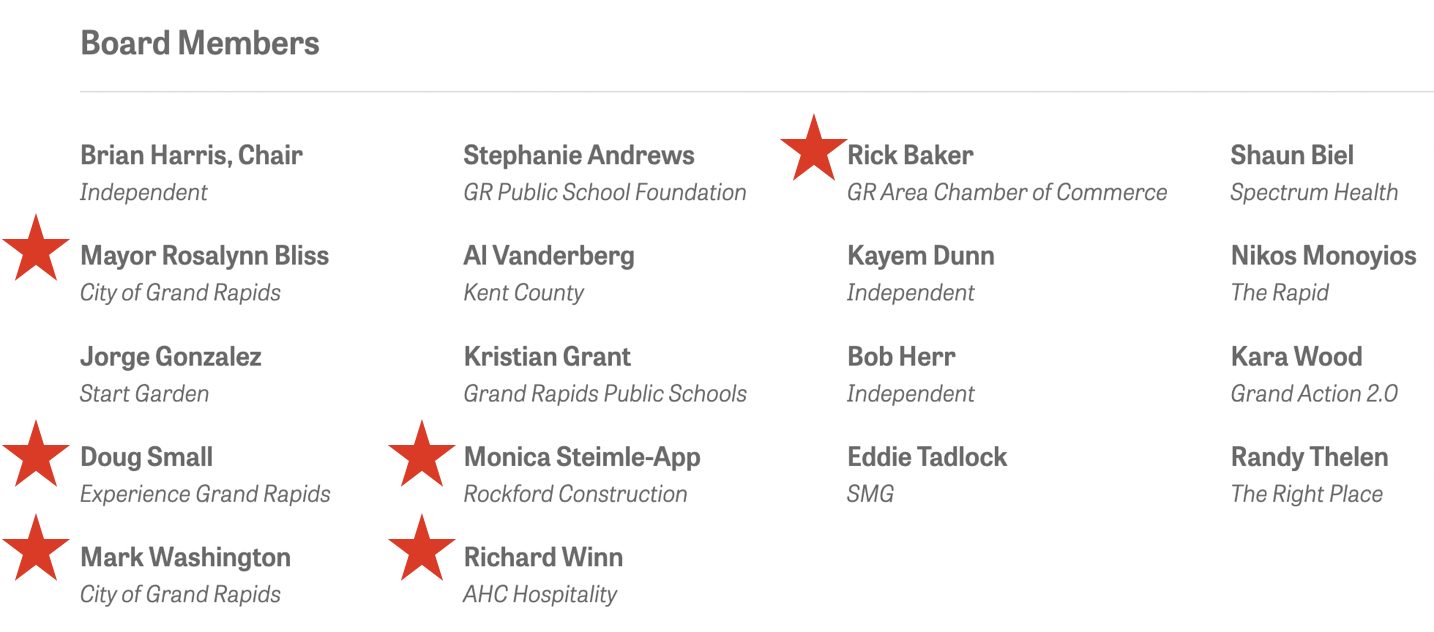
Another major omission in the WOODTV8 story is their failure to see the connection to those who signed on to the GR Chamber of Commerce ordinance proposal and its connection to those who are Board Members of Downtown Grand Rapids Inc. (DGRI). In screen shot below is that of the current DGRI Board, with a star next to the names of people who were signatories to the GR Chamber of Commerce proposed ordinance and the two Grand Rapids City officials who endorsed the criminalize the unhoused ordinances adopted in July. Groups like Downtown Grand Rapids Inc. will also have people on their boards who reflect either centers of political power or economic power. I’m guessing that channel 8 didn’t even consider these connections, as for-profit news agencies don’t often consider how systems of power function, and rarely do they even shine a light on those same systems.
Henry Kissinger was not a war criminal, says the Acton Institute, and other far right claims
For people who are regular readers of GRIID, you will know that since GRIID first became an Indy media site – providing on the ground coverage of local news, first hand accounts of social movements, acting as a media watchdog and monitoring systems of power and oppression – that we have been writing about the Grand Rapids-based far right think tank, the Acton Institute for the Study of Religion and Liberty.

The Acton Institute went from being a small think tank in the early 1990s to a national, even global think tank, with connections to other far right/conservative institutions abroad, and ties to the State Policy Network, which acts as sort of a clearinghouse for think tanks across the US.
Even before GRIID came into being, several of us had been monitoring the Acton Institute through other Indy media sources such as The FUNdamentalist and Media Mouse, both of which are sourced at the end of SourceWatch’s information on the Acton Institute.
GRIID has been monitoring the work of the Acton Institute, in part because of their deep commitment to defending the system of Capitalism, but also because the think tank also embrace other far right perspectives, such as White Supremacy, an anti-LGBTQ stance, US Imperialism and a hatred for public education. However, on their most recent podcast, Acton Unwind, they might have produced their most over the top show ever.
On the Acton Unwind show for December 11th, they cover some of the recent activities of the Venezuelan government, the US Congressional Hearings on antisemitism and the death of Henry Kissinger, which they refer to as “Remembering Henry Kissinger.” The show is sort of a tri-fecta of far right ideology.
The podcast begins with a conversation about Henry Kissinger, where they read a bit from the Conservative Online source, The Morning Dispatch. A one point they talk down on the idea that Kissinger could have been a war criminal, saying, “The characterization that Kissinger was a war criminal is a bit overdone.” In addition, one of the guests on the show, although did not read Kissinger’s book on diplomacy, believes, “the book will be read for many years to come.”
In fact, all of the participants on Acton Unwind, wax eloquently about Kissinger, that he was such a towering intellectual. It is unfortunate that the Acton Institute talking heads didn’t talk about the role he played in the Ford Administration, avoiding the abvious connection to Grand Rapids. Now, GRIID did a post about the legacy of Henry Kissinger, which you can read here, but if there is one source that you should read, check out the declassified US documents on Kissinger, since these documents properly frame Kissinger’s influence in US foreign policy as brutal and imperialist.
Acton Unwind then shifts to talking shit about Venezuela, particularly Venezuela’s President Maduro whom the Acton talking heads refer to as an autocrat. This is consistent with the Acton Institute’s position on Venezuela, since Chavez was President, since he dared to challenge the US domination of Latin America.
The Acton podcast then ends with some discussion about the US Congressional hearings on antisemitism on US campuses. Here, the Acton Institute also sources The Morning Dispatch, which essentially mocks the presidents of several US universities because they have “tolerated” students and faculty for being involved in criticizing the Israeli assault on Gaza that is taking place right now.
What you don’t find on Acton Unwind of the so-called hearings on antisemitism is that it is really just another form of McCarthyism. In fact, the editor of Jewish Currents, Peter Beinart, in a recent interview on Democracy Now!, stated a much different critique of the Congressional hearings:
This really isn’t about those individual presidents. It’s about the fact that given the extraordinary slaughter that’s happening in Gaza, there is a movement on college campuses and across America for a ceasefire and to end American complicity in that slaughter. And in response to that, the effort is now to try to limit the ability of people who want to protest U.S. policy and support Palestinian rights from being able to organize on college campuses. So the reason that you’re going after these presidents is to try to set a precedent and bring in people who will be much tougher on restricting the ability of students and faculty and others who want to organize politically against this war in Gaza. This is what this is about.
As I stated earlier, this may have been the most ideologically-driven podcast from the Acton Institute that I have listened to, and it demonstrates how reactionary and far right the Acton Institute is on critical issues of the day. This is exactly why I can’t stress enough why it is important that we become familiar with the Acton Institute’s role in the larger far right movement in the US, and why I believe they not only need to be exposed, but they need to be resisted.
The bullshit response I got from Rep. Scholten in response to our demands calling for an immediate ceasefire and an end to US Military Aid for Israel
I hate it when politicians send form letters, especially when they don’t even address the content of our demands.
Rep. Scholten, as we have been documenting for several months, has unconditionally supported Israel, ever since they began their brutal retaliation for the Hamas attacks on October 7. There is no way that she could NOT know where lots of her constituents stand on this issue, since there was a large protest last weekend that came to her home just south of Martin Luther King Jr. Park in Grand Rapids. In addition, various groups collaborated on sending her (and Senators Stabenow and Peters) an action alert with the following 3 demands:
- A Call for an immediate ceasefire in Gaza
- An End all US military aid to Israel
- For her to vote no on the proposed additional $14.3 Billion in US military aid to Israel
Rep. Scholten’s failure to address our demands is not only insulting, it is cowardly. What is worse is the fact that Scholten’s response reeks of pandering, even gaslighting. What follows is Rep. Scholten’s response in italics, with some commentary from me in bold.
Thank you for reaching out to my office regarding the ongoing conflict in the Middle East. Words matter and this opening comment avoids naming what is actually happening, which is the brutal Israeli assault on Palestinians, particularly in Gaza and the West Bank. This is NOT a conflict, but a heavily armed state punishing civilians.
I’m so grateful for your care and concern about this important issue, and I share your deep compassion for the loss of human life, and the humanitarian crisis. It is imperative the United States shows our support for the innocent lives impacted by this crisis, and of course, to respond–and urge our allies to respond–within the parameters of international law. Really, when does the US care about innocent lives and international law. What Israel is doing right now, are clearly War Crimes, as defined by the Geneva Convention.
Internationally, peace and dignity for all individuals and cultures is always the ultimate goal. My heart breaks for all Israelis and Palestinians whose lives have been lost and those who are now in danger due to the ongoing war between Israel and Hamas. The United States should continue to work with Israeli and Palestinian leaders to help negotiate a two-state solution and block harmful efforts to circumvent those negotiations, such as unilateral actions and human rights abuses. We must support efforts to foster peace and allow for humanitarian aid to reach innocent people. However, we need willing partners on both sides to make those efforts possible. Peace and dignity for all has not been the history of US foreign policy. See the long list of US Military Interventions that were compiled by Professor Zoltan Grossman, which also provides the reasons for the intervention. The idea of a negotiate settlement or working on a two-state solution has never been part of the US agenda with Israel/Palestine. See any of the 16 book list we put together on this history, particularly, Dishonest Broker: The US Role in Israel and Palestine, by Naseer Aruri.
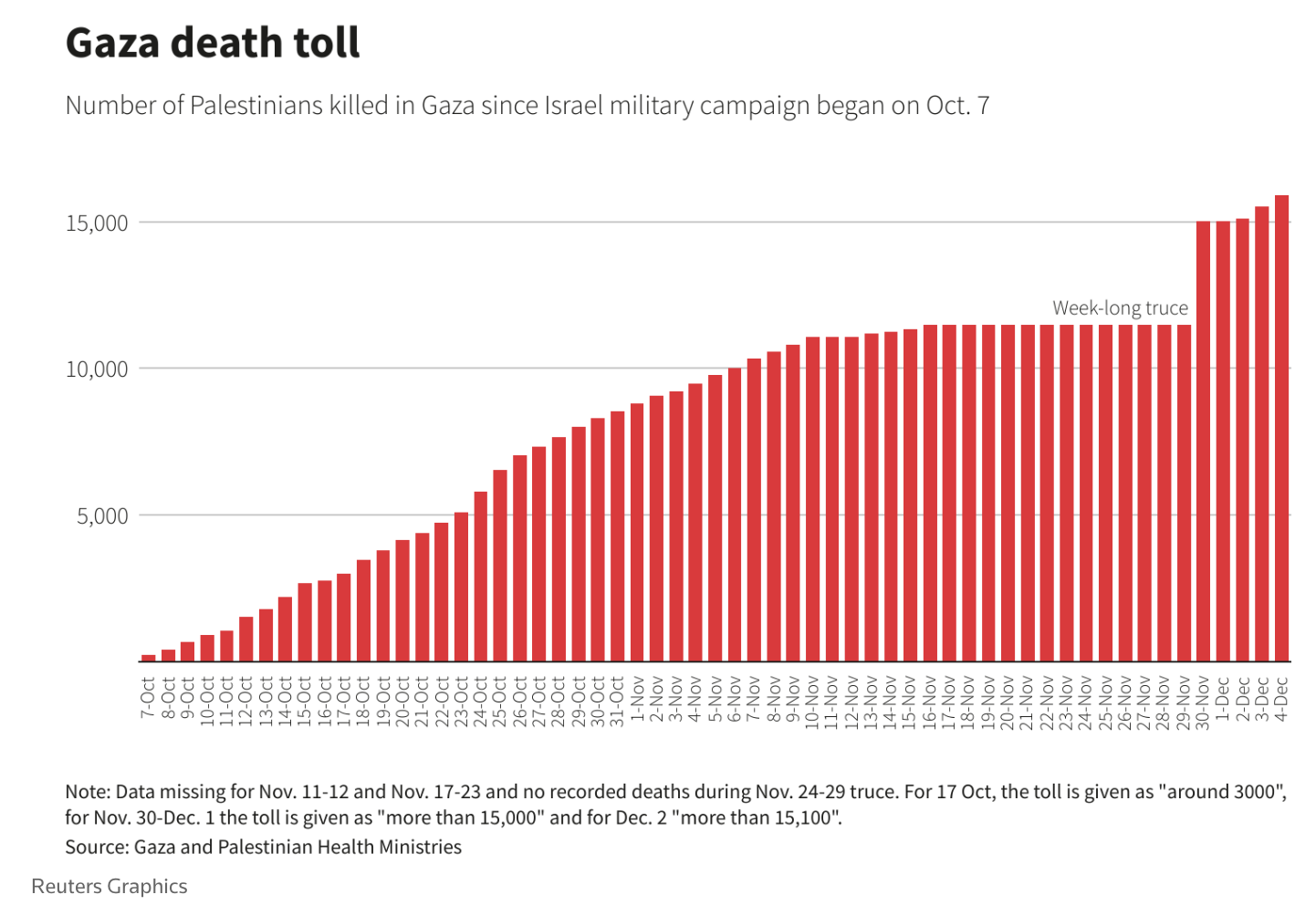
I want to make sure you’re aware of some of my actions on this matter since the beginning of this conflict. First, I signed a bipartisan letter urging the State Department to use all resources necessary for Americans who are currently in Israel and struggling to come home. Our office has helped facilitate such returns directly. Additionally, I have joined my colleagues in sending letters to both the Biden Administration and the Egyptian Ambassador, urging the creation of safe zones for civilians in harm’s way and a rapid deployment of humanitarian aid to those in need in the Gaza region. I have been aware of what Rep. Scholten has been doing, as I have been critiquing her stance on this matter since July, when she voted for a resolution stating that Israel is not an Apartheid State. Rep. Scholten can send all the letters she wants to the Biden Administration, but they are doing nothing to guarantee the safety of civilians who are in “harms way.” First, Palestinians are not in harms way, they have been told by the Israeli government to vacate Gaza, which is illegal, and they are experiencing the brutal Israeli air and ground assault, which has left over 16,000 Palestinians dead, with over 6,000 of them being Palestinian children.
The United States played a critical role in the recent pause in fighting and accelerating the delivery of food, water, and medicine in the region. We remain engaged to facilitate the continued release of hostages and deliver more aid to those in need. I am in constant communication with the White House about the importance of the United States playing a prominent role in protecting human life and ensuring we can achieve lasting peace for Israelis and Palestinians alike. Rep. Scholten provides no evidence that the US played a role in the recent pause or the humanitarian aid that was to be made available to Palestinian civilians. In the second sentence of this section, Rep. Scholten continues to ignore that the Israeli hostages are contingent on the release of Palestinian prisoners, thus excluding a critical aspect of the exchange. Lastly, Rep. Scholten can be in as much communication as she wants with the Biden Administration, but she completely ignores the fact that the US is complicit in Israeli war crimes, since the US provided diplomatic support for Israel has provided many of the weapons they are using to murder Palestinian civilians, along with the $3.8 billion in US Military Aid to Israel this year alone. These facts make a mockery of the notion that the US wants to protect life and ensure a lasting peace between Israelis and Palestinians, especially since the Israeli could not commit war crimes without the US.
There is more in the letter response from Rep. Scholten, but that information has to do with how to contact her in DC and her office hours in Grand Rapids.
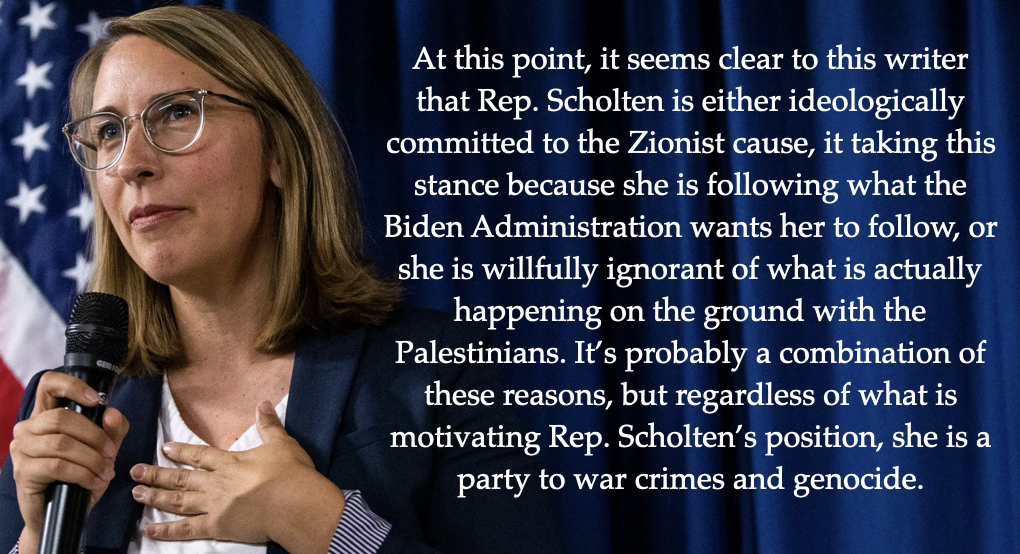
At this point, it seems clear to this writer that Rep. Scholten is either ideologically committed to the Zionist cause, it taking this stance because she is following what the Biden Administration wants her to follow, or she is willfully ignorant of what is actually happening on the ground with the Palestinians. It’s probably a combination of these reasons, but regardless of what is motivating Rep. Scholten’s position, she is party to war crimes and genocide.
GRIID 2024 Winter Class – A People’s History of Grand Rapids
 I will be offering a class using my new book, A People’s History of Grand Rapids, beginning on January 22nd.
The class will be on Mondays from 7 – 9m and will be a virtual class, using zoom. The class will be either 8 or 10 weeks, depending on how much time participants want to commit to the class. We will determine how many weeks the class will last during the first class on Monday, January 22nd.
I am suggesting a $25 donation for the class, but this is just a donation, so no one will be turned away if they don’t contribute monetarily.
We will be using my book, A People’s History of Grand Rapids, which if you don’t have you can either purchase through Schuler Books or directly through me. I also have PDF copies of the book, which you can also purchase.
I am limiting the class to 15 participants, and it will be on a first come first serve basis. If you want to sign up for the class, send me a message at sjeff987@gmail.com.
Weekly Palestine Solidarity Information, Analysis, Local Actions and Events: Part I
 It has become clear that the Israeli government will continue their assault on Gaza and the West Bank. The retaliation for the October 7 Hamas attack in Israel, has escalated, therefore, GRIID will be providing weekly links to information and analysis that we think can better inform us of what is happening, along with the role that the US government is playing. We will also provide information on local events and actions that people can get involved in.
Information
Watch: Debunking Israel’s “mass rape” propaganda
Released Palestinians reveal horrors in Israeli prisons
‘Death Zone’: Over 700 Killed in 24 Hours as Israeli Bombing Blitz of Gaza Rages
Press Relayed Israeli Claims of Secret Hospital Base With Insufficient Skepticism
Amid Israel’s Brutality in Gaza, It’s Time to Commit to Anti-Zionism
We blew up Israeli houses on 7 October, says Israeli colonel
Analysis
Krystal Ball interviews author and political scientist Norman Finkelstein on Israel’s war in Gaza.
Two months that shock the world: The first phase of the Gaza War
Local Events and Actions
Rally to Demand a Ceasefire from the Kent County Democrats
Graphic included for this post comes from https://visualizingpalestine.org/.
Rep. Hillary Scholten voted for resolution that conflates Anti-Zionism with Antisemitism
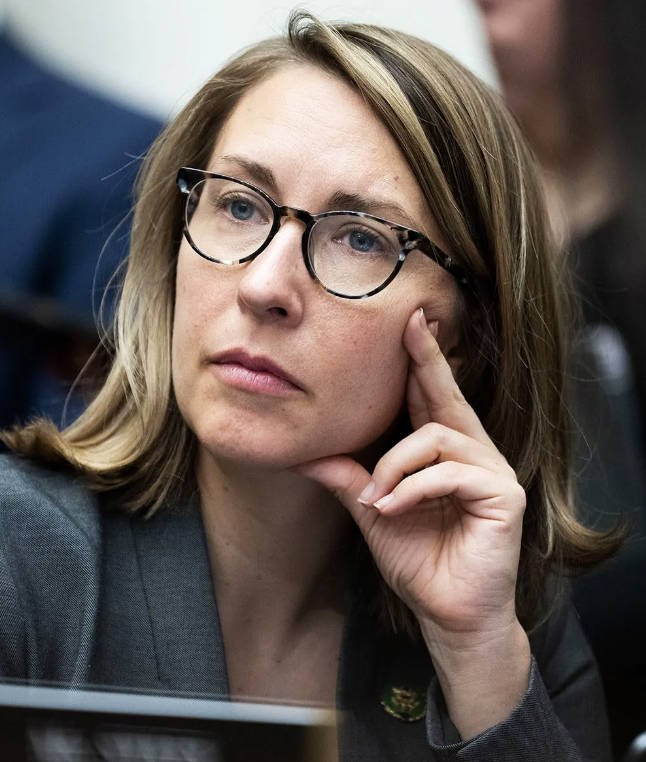 As the US support for Israel’s assault on Gaza continues, the US House of Representatives voted to pass a resolution that equates criticism of Israel with Antisemitism.
According to a recent post on Common Dreams, “The resolution, which embraces the International Holocaust Remembrance Alliance’s controversial working definition of antisemitism, was widely condemned by progressive and Jewish groups this week ahead of the vote.”
House Resolution 894 was introduced by Republican Rep. David Kustoff. The Resolution passed last night with 216 Republicans and 95 Democrats supporting it, with 92 Democrats choosing to vote “present.”
Michigan’s 3rd Congressional Representative, Hillary Scholten, voted yes on the resolution that equates criticism of Israel with Antisemitism. Scholten’s vote is consisted with the fact that she has been a recipient of pro-Israel lobby money, voted in favor of a resolution in July, which claimed that Israel is not an Apartheid state, took an AIPAC sponsored trip to Israel in August, and has supported the Biden Administration’s unconditional support for Israel, including the vicious assault on Gaza and his proposed to send an additional $14.3 billion in US military aid, which we have documented.
I checked Scholten’s website for any comments about her vote, along with her political Facebook page, and in both cases found nothing as of this posting.
New Energy bills signed into law by Gov. Whitmer receives criticism from Environmental Justice Group
 “This package of bills is a vital step toward building a clean energy future here in Michigan that creates jobs and grows our economy,” said Chair of the Michigan Democratic Party Lavora Barnes. “While Republicans sit back and do nothing to address the climate crisis, Democrats are proving they will not leave Michiganders behind. We are thankful to our Democratic leaders who continue to make Michigan an example for the rest of the country when it comes to innovation and industry.”
This celebratory statement has been consistent with much of the coverage on the recent set on energy bills that Michigan State Legislators voted on, and Gov. Whitmer signed into law last week. The Detroit Free Press reported:
“By 2040, 100% of Michigan’s energy is set to come from clean sources under a new law approved by Gov. Gretchen Whitmer on Tuesday. The state now has one of the most ambitious clean energy goals in the U.S., after Whitmer approved heavily debated bills that passed both chambers of the Legislature along party lines.”
However, not everyone was so quick to celebrate the new energy legislation in Michigan. No, I’m not talking about the Republicans, who still think that Climate Change is a hoax. I’m talking about groups like the Union of Concerned Scientists and the Michigan Environmental Justice Coalition.
In a post from last week, the Union of Concerned Scientists (UCS) made it clear that there were several things not included in the energy bills that were just signed into law by Gov. Whitmer:
Specifically, it weakened or completely eliminated environmental justice communities’ key priorities regarding affordability, reliability, and equity. Going forward, Michigan policymakers must incorporate these policies, which will mean standing up to utilities and other corporate interests.
The UCS critique also stated:
Additionally, SB 271 requires utilities to achieve a “clean energy” portfolio of at least 80 percent in 2035 and 100 percent in 2040. However, the bill’s definition of what constitutes clean energy includes nuclear power (which doesn’t emit carbon but isn’t “clean”) and fossil gas power plants that capture and store at least 90 percent of their carbon emissions. The Michigan Public Service Commission (MPSC) will ultimately determine whether such gas plant projects—if proposed—are technically and economically justifiable. Even so, it is concerning that legislators included fossil gas in the definition of clean energy given the risk of continuing our reliance on fossil fuels and the impact of emissions from gas production, transportation, and combustion. Giving the MPSC the final decision on what counts as clean energy may force environmental justice advocates to take up the fight once again to protect their communities.
Notably, SB 271 encourages the growth of energy storage in Michigan by setting a statewide target of 2,500 megawatts of capacity. It also encourages distributed generation, such as rooftop solar, by raising the cap when utilities can deny customers the ability to connect their systems to the grid from 1 to 10 percent of the utility’s average annual load. This is a welcome improvement, but it was a result of compromise and negotiation with utilities—and it does not go far enough. There should be no limit on customers who want to install solar, and they should be better compensated for the value locally owned solar provides to the grid. Regrettably, community solar was left out of SB 271 entirely.
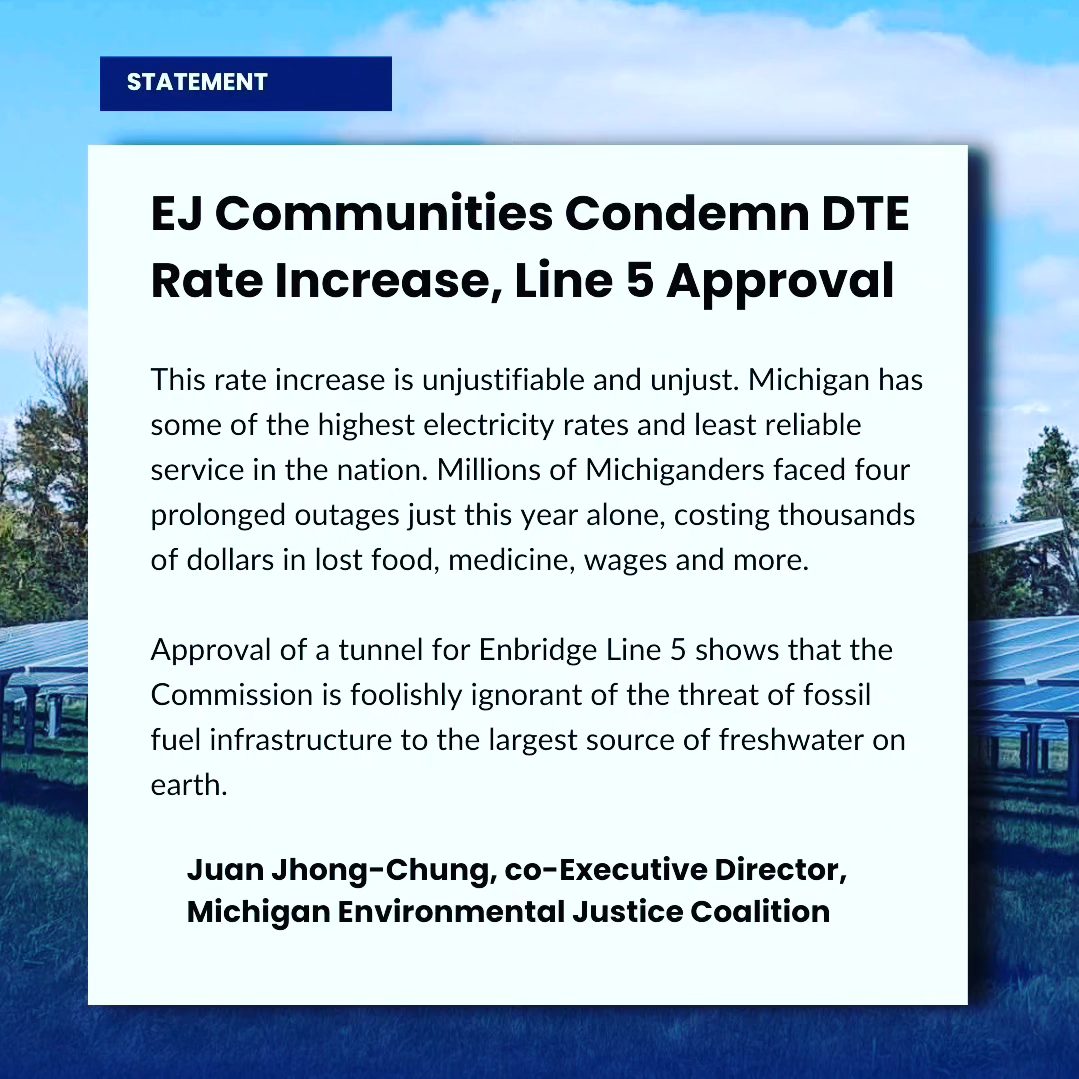
The Michigan Environmental Justice Coalition was equally as critical of the new energy bills signed into law by Gov. Whitmer last week. The coalition released a statement with the heading, EJ Communities Condemn DTE Rate Increase, Line 5 Approval. Their statement reads:
This rate increase is unjustifiable and unjust. Michigan has some of the highest electricity rates and least reliable service in the nation. Millions of Michiganders faced four prolonged outages just this year alone, costing thousands of dollars in lost food, medicine, wages and more.
Approval of a tunnel for Enbridge Line 5 shows that the Commission is foolishly ignorant of the threat of fossil fuel infrastructure to the largest source of freshwater on earth.
The DTE rate increase is particularly infuriating, so much so that the Michigan Environmental Justice Coalition created an Action Alert specifically to condemn DTE, stating in part:
DTE Energy is leaving us in the dark, when we need energy the most. They rely on dirty energy sources that harm our environment, polluting the communities they think can’t fight back while leaving everyone with unreliable and expensive service when we need to heat our homes, cook, and gather with friends.
And, they spend millions of dollars to keep it this way. on political influence to maximize their profit, hiking our rates and leaving us with no other options, paying off some politicians through campaign contributions, secretive “dark money” groups, and an army of lobbyists. All while rigging the rules to influence elections and various laws or regulations, and funding the phony think tanks that fudge data that supports their bottom line.
To sign onto the Coalition’s Action Alert targeting DTE, go to this link.
Last week, the Michigan Public Service Commission voted to approve a permit for the Enbridge Corporation to build an underground tunnel for an oil and gas pipeline that currently sits on bottomlands in the Straits of Mackinac.

There are only three members of the Michigan Public Service Commission and one of them abstained for the vote, thus making it 2 votes in favor of Enbridge. It addition, it should be noted that all three of the commission members were appointed by Gov. Gretchen Whitmer. So, the very Governor who campaigned 5 years ago on the promise that she would shut down Line 5, has not only failed to keep her campaign promise, she appointed the very people who just gave Enbridge a permit to build a pipeline tunnel under the largest body of freshwater on the planet.
Now, the Michigan Public Service Commission, according to the State of Michigan, exists to do the following:
We are committed to developing action-oriented strategies that reinforce the Michigan Public Service Commission as a safe, welcoming work environment and an organization that serves all Michiganders equitably. We address systemic and overt racism, both internally and externally, prevent discrimination, and adjust how we interact with one another as well as our community. We are dedicated to providing the necessary resources and leadership that will support the further development of the Michigan Public Service Commission’s diversity, equity, and inclusion efforts, and we will continue to address institutional or cultural barriers that historically have inhibited or may inhibit progress toward these goals, including both within our organization and in the energy and telecommunications industries we oversee.
If this is indeed the mandate of the commission, then they have failed miserably, especially with their granting a permit to build a pipeline under the Straits of Mackinac.
Nearly four years ago, I wrote: During the election cycle of 2018, then Gubernatorial candidate Gretchen Whitmer and candidate for Attorney General, Dana Nessel, both made the promise that they would shut down the Enbridge oil pipeline that runs through the state and under Lake Michigan, also known as Line 5.
It has been more than five years that Whitmer and Nessel made the promise to shut down the Enbridge owned and operated, Line 5. So why is Line 5 still operating?
We know that Gov. Whitmer tried to use legal means to deal with Line 5, but we all know how limiting that the legal system can be, especially when you have a multi-billion corporation like Enbridge, which had a very large legal team. Regardless, Whitmer and Nessel made a promise to shut down the Enbridge Line 5 and have failed to do so. On top of that, Governor Whitmer appointed the very people who approved the permit for Enbridge to build an underground tunnel for Line 5.
When are we going to stop giving these politicians a free pass and allow them to deceive us into thinking they would actually do the right thing and shut down Line 5? When are we going to take matters into our own hands and shut down Line 5 ourselves? The very existence of Line 5 violates Indigenous treaties and it perpetuates climate injustice.

