Editor’s note: As a matter of full disclosure, I was an active participant in yesterday’s May Day march, organized by Movimiento Cosecha.
Last week, we posted an interview with Gema Lowe, one of the volunteer organizers with Movimiento Cosecha about the upcoming May Day march in Grand Rapids, along with a timeline of all the previous May Day marches that Cosecha has organized since 2017.

Last night, despite the rain and wind, some 200 people gathered at Garfield Park in Grand Rapids and marched for 2 hours to demand Driver’s Licenses for All!
As people began to filter in for the march, the GRPD showed up to tell us what we could do, but mostly what we couldn’t do. They produced a piece of paper (although they never gave us a copy), which they read from, with a long list of rules. They were pretty emphatic about us not march onto a highway or even getting close to a highway on ramp. They were also clear about the consequences of our failure to comply. We passed this information onto the leadership.
Before the march began, people gathered under one of the pavilions in Garfield Park, where several speakers addressed the crowd. Most people focused on the current demand of driver’s licenses and the 15 years of hardship they have had to endure, since it was 15 years ago that Michigan stopped allowing undocumented immigrants the right to a driver’s license. As always the stories that people shared were moving and communicated a deep sense of urgency, since not having a driver’s license creates a climate of fear and the real world possibility that people could be stopped, arrested, detained and even deported…..all because they don’t have a driver’s license.

Once the march began, we walked out on the road going east on Burton St. There were people with large banners, handmade signs, and some using bullhorns to lead the chants that would continue for the next two hours. However, before we even walked the length of Garfield Park, several GRPD officers, sitting in their cruisers, began to threatened people with arrest if they didn’t get out of the road. To be clear, Movimiento Cosecha uses tactics that are often disruptive, like marching in the road, because they believe that disrupting business as usual is especially necessary for communities most impacted by state violence, which is the case with the undocumented immigrant community. Movimiento Cosecha will often say, “we will stop interrupting your lives, when you stop interrupting and often destroying our lives.”
Once marchers were back on the sidewalk, they proceeded east on Burton St, often receiving affirming honks from motorists, along with numerous people who came out of their homes to cheer them on, to record the march on their smart phones or to offer verbal affirmations for what they were fighting for. In fact, during the whole two hours that we marched yesterday, at no time did the energy of the crowd dissipate or diminish, despite the fact that was raining the whole time we marched.
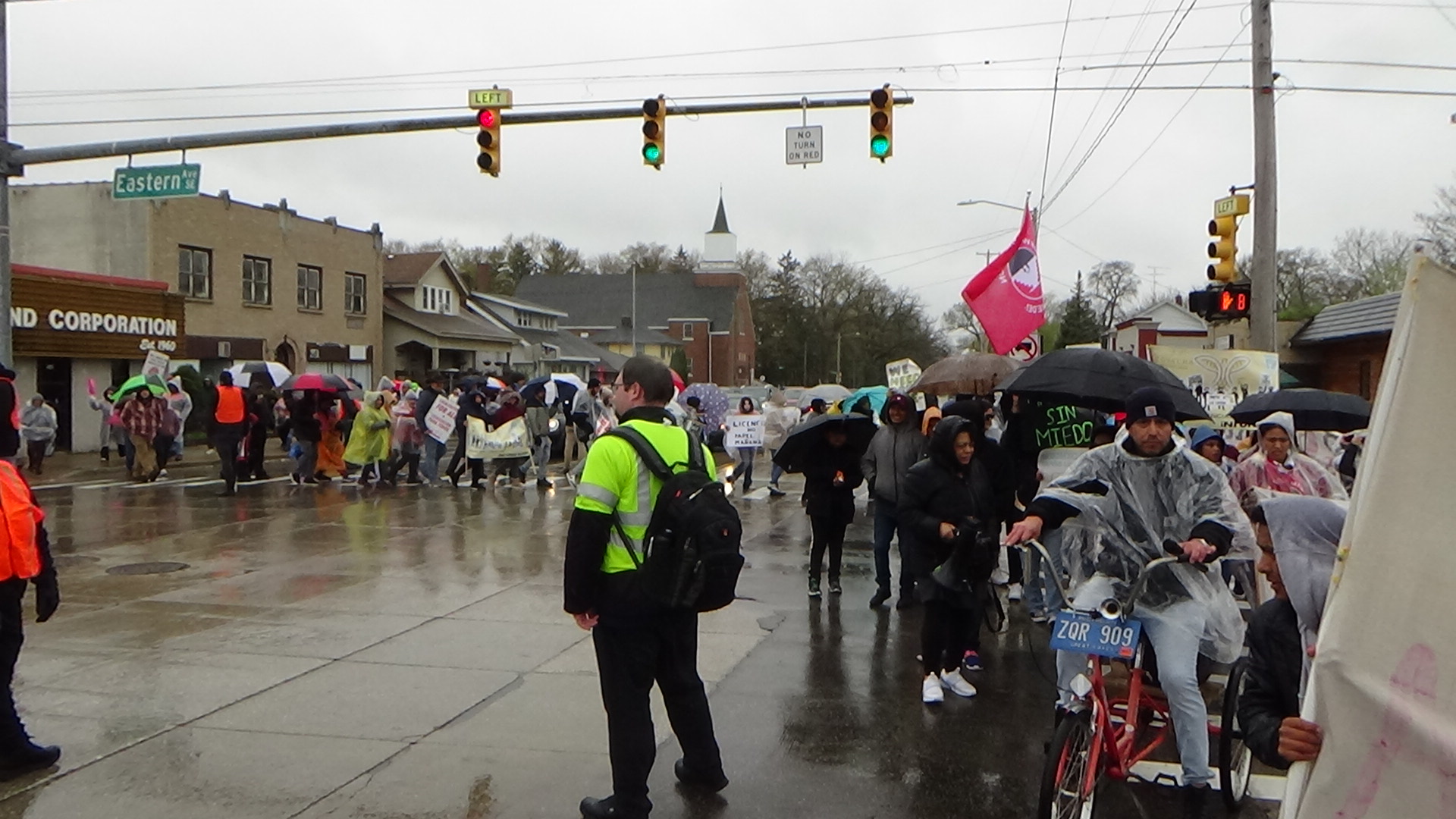
There were a few times where we crossed over Burton St., so people could see the size of the march and to engage in a bit more disruption, as you can see in the photo above, where we crossed at Eastern and Burton.
We eventually stopped off at a church on Burton and Kalamazoo, so that marchers could use the bathrooms and take a break from the rain. While we were at the church, Cosecha organizers decided to end the march, since people were cold, tired and wet. Cosecha had several vehicles that were following the march in case anyone got hurt or needed a break, and those drivers then began to shuttle people back to Garfield Park, where people gathered again to share hugs and get some refreshments.
What was evident was the lack of white allies at yesterdays march. The small number of white allies has been the case over the past 2 years, primarily over the belief that since there is a Democrat in the White House that the political climate for immigrants is better. This is simply not the reality, as the Biden Administration has continued many of the same policies that existed during the Trump Administration, which we have documented. Movimiento Cosecha has always been clear from the beginning of their movement, when they stated right after the 2020 Election that “Democrats deport us too!” State violence against immigrants is a bi-partisan reality and if you aren’t aware of this, you haven’t been paying attention.

The participation of the immigrant community, as always, was amazing. The energy and commitment they bring is always an inspiration for anyone who pays attention to movement work. Granted, movements like the Immigrant Justice movement need allies to create enough political pressure to make the necessary changes in policy. However, this movement must be lead by those most affected and those of us who carry a whole lot more privilege need to take our cues from movement organizers if we truly want to be in solidarity with them. Hasta La Huelga!
On Friday, there was a Black man who was shot and killed on the Southeast side of Grand Rapids. WOODTV8 ran a story about the shooting, which included comments from Grand Rapids Police Chief Eric Winstrom.

In the channel 8 story, Winstrom commented about what may have caused the shooting, but then used the opportunity to take a shot at those who have been calling for the GRPD to be defunded:
Winstrom questioned why those who continue to push to defund the police aren’t out supporting their neighborhoods.
“There’s people willing to come to every (Grand Rapids City) Commission meeting to advocate for abolishing the police; every commission meeting,” he said. “I didn’t see any one of those people at this murder scene, talking to the mom, advocating for the residents of the 3rd Ward.”
These comments from Winstrom are very instructive and reveal a great deal about him and how he views people who are not only participating in the very limited democratic process during City Commission meetings, but also people who are, and have been deeply committed to neighborhoods in Grand Rapids for decades.
It is also instructive that Winstrom goes out of his way to point out that those calling for police defunding were not present in the neighborhood where the shooting occurred. First, the cops are the ones who were called and they have all the technology they could ever want to quickly respond to shootings. Second, those who have attended City Commission meeting demanding the City defund the GRPD also have jobs and do other work in the community and can’t at the drop of a hat show up to things like shootings in the City. Third, Winstrom is making an assumption that there was no one present (of those who have attended City Commission meetings) offering support to the families members and residents where the shooting took place. I seriously doubt that the Police Chief could identify everyone who has been involved in this movement, unless of course his department has dossier’s of those who have been demanding the GRPD be defunded since 2020, two years before Winstrom was even hired.
More importantly, when Winstrom says he doesn’t see those calling for the GRPD to be defunded out supporting their neighbors, it only reflects his ignorance and his arrogance. What follows is just a brief list of the ways that many of the very same people who have been demanding that the GRPD be defunded are working directly with their neighbors, particularly BIPOC neighbors and other marginalized residents in Grand Rapids.
- The Grand Rapids Area Mutual Aid Network (GRAMAN) has raised $295,566 over the past 3 years. All of this Mutual Aid money is prioritized to BIPOC people for rent, food, transportation, medical expenses, etc, and many of the recipients who have benefited from this Mutual Aid, live in the 3rd Ward. In addition, GRAMAN has delivered food, appliances and furniture to families who have requested these kinds of items. Their motto, which is practiced on a daily basis is, “Everything we need is right here in out community.” GRAMAN is not charity, it is Mutual Aid, and Mutual Aid is a form of direct action and solidarity with our neighbors.
- Several of those who show up to City Commission meetings also are involved in community garden projects, which also benefit the community, both the beautification of neighborhoods, fighting food insecurity and sharing fresh produce with our neighbors.
- There have been organized efforts to do snow removal in the Third Ward for senior residents and those with disabilities.
- People demanding the Defunding of the GRPD regularly are involved in providing food, clothing and other necessities to the unhoused community, often distributing items at Heartside Park.
- Several people have made food and sold it to raise money for the children of Patrick Lyoya, along with other Mutual Aid projects, which also goes directly to BIPOC residents and neighbors.
- Other people work with the Grand Rapids Area Tenant Union, which provides support to tenants who are being harassed and threatened by landlords and Property Management Companies. The tenant union provides support for those facing eviction and increased rent. Tenants are our neighbors and live in the neighborhoods that Chief Winstrom is talking about.
- Some people work with GR Rapid Response to ICE, which provides support, solidarity and Mutual Aid for undocumented immigrants who have been impacted by ICE violence. This involves in ongoing Mutual Aid requests, transportation to immigration court hearings, legal support and providing bond funds for those who are in detention. These neighbors who have been impacted by ICE violence live throughout Grand Rapids, many of them in the 3rd Ward.
- Then there are those who work with Movimiento Cosecha GR, which is an immigrant-led organization that is fighting for immigrant justice. Their current campaign is to win driver’s licenses for all. There are undocumented immigrants in Grand Rapids, including the 3rd Ward and are our neighbors.
- There are also several people in the group of activists that Chief Winstrom so callously criticized who are social workers and direct care staff, working with Grand Rapids residents who experience poverty, struggle with mental health issues, and those who are marginalized in this city. These people work real neighbors in real neighborhoods throughout Grand Rapids.
I could go on with all of the amazing things that people who are demanding the defunding of the GRPD do in this community, but it doesn’t seem to matter to Chief Winstrom, who is using his position of power to take pot shots at people who are currently, and have been doing amazing community work for neighbors in Grand Rapids for decades.
In February, I made a series of posts about books on racism and the Black Freedom Struggle that have influenced me, which was followed by a series of posts in March about books on feminism that have influenced me as well.
This month I want to include three posts about books on the environment that have influenced how I view with the world around me. In Part I, I focused on books I read in the 1980s and 1990s that initially radicalized me about how I view being part of the natural world. In Part II, I focused on books that I read in the 2000s, and in today’s post I will focus on environmental books that I’ve read over the last decade and have had a significant influence in how I think.
Here are those books that influenced my thinking at that time:
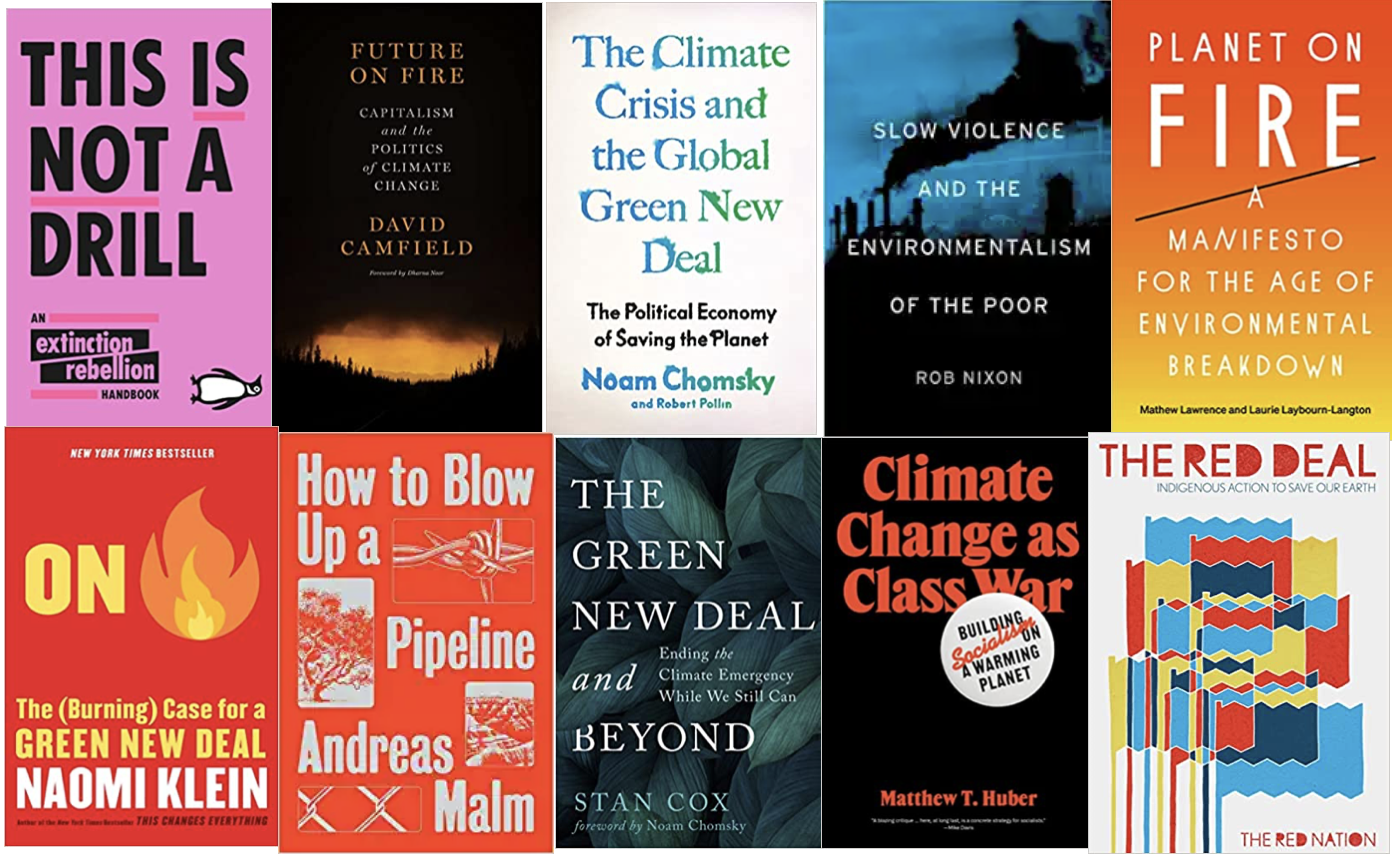
Slow Violence and the Environmentalism of the Poor, by Rob Nixon
The Green New Deal and Beyond: Ending the Climate Emergency While We Still Can, by Stan Cox
The End of Ice: Bearing Witness and Finding Meaning in the Path of Climate Disruption, by Dahr Jamail
Climate Change as Class War: Building Socialism on a Warming Planet, by Matthew T. Huber
This Is Not A Drill: An Extinction Rebellion Handbook, by Extinction Rebellion
Planet on Fire: A Manifesto for the Age of Environmental Breakdown, by Mathew Lawrence and Laurie Laybourn-Langton
On Fire: The (Burning) Case for a Green New Deal, bu Naomi Klein
The Red Deal: Indigenous Action to Save Our Earth, by The Red Nation
Future on Fire: Capitalism and the Politics of Climate Change, by David Camfield
How to Blow Up a Pipeline, by Andreas Malm
Is Science Enough?: Forty Critical Questions About Climate Justice, by Aviva Chomsky
Climate Crisis and the Global Green New Deal: The Political Economy of Saving the Planet, by Robert Pollin and Noam Chomsky
All four daily commercial Grand Rapids-based news media reported on the Tuesday night Public Hearing at the City Commission meeting, a hearing specifically on the issue of whether or not the GRPD should purchase and utilize drones.

Now, WXMI 17 did not have a reporter in the room during the public hearing, they simply watched the video recoding of the hearing that the City of Grand Rapids provided online and on their Facebook page.
The problem with not having a reporter in present in the room is that they did see or hear everything that went down on Tuesday, in part because Mayor Bliss suspended the hearing at some point and cut the mic for some who were publicly opposed to drone use by the GRPD.
The channel 17 reporting was lazy, but the largest damage was done by beginning with lengthy portions of Chief Winstrom’s presentation, followed by the lone supporter, even though the lone supporter didn’t get up to speak until 28 people who opposed drones had already spoken. Only after the pro-drone person who spoke, did viewers see comments from those opposed, but just two people. The WXMI 17 story then went back to Winstrom’s presentation and failed to say anything about the fact that the Mayor had suspended the public hearing, or the fact that there was clearly a double standard being applied to those who spoke against drones for the cops and the lone person who spoke in favor. The channel 17 story was a classic example of constructed news that did not adequately reflect what happened at the public hearing.

WOODTV8 was another news outlet that didn’t bother to send a reporter to the hearing on Tuesday, relying soling on the City’s recorded video, also with a clear bias in the constructed news story. The channel 8 story was 1 minute and 49 seconds long, and we only hear two perspectives in the story, the first being from Chief Winstrom who was given 38 seconds of time, followed by just one of those who opposed drone use by the GRPD, who was given 30 seconds of airtime. However, the other 27 who spoke were not heard from in the story and viewers of WOODTV8 would not even know that the Mayor had suspended the public hearing because of the threatening comments from a drone supporter, followed by those who opposed the drones pointing out the double standard that exists at the City Commission meetings, where those who are anti-GRPD are berated and those who are pro-cop are given lots of freedom to violate City Commission protocol.
Now, WZZM 13 did have a reporter present, along with a camera operator, yet despite being present for the 2 hour public hearing, the channel 13 story still gave more airtime to Chief Winstrom and never challenged any of the claims he made in the presentation he gave prior to the public comment period. GRIID was present for the Public Hearing and we wrote about how problematic it was to have the Police Chief give yet another presentation on drones, knowing full well that the Chief would be given more airtime than those who were critical of drone use by the GRPD. GRIID wrote:
It is also important to note that having Chief Winstrom speak first, essentially undermined the public comment period for this Public Hearing. It set a tone and potentially intimidated people who came to speak on this matter. Lastly, his presentation also serves as an “expert testimony” on this topic, whereas the people who spoke during the public comment period are merely providing their “opinion” framework, despite the fact that those who opposed drones for the GRPD had well thought out arguments with sourced facts.
Like the stories from FOX 17 and WZZM 13, the WOODTV8 story presented Winstrom as “the expert” and those who opposed drone use by the cops as just having an opinion, despite the fact that many of those who opposed cited credible sources and had well thought out arguments.
In addition, WZZM 13 did a poor job of communicating why the Mayor suspended the public hearing and the fact that cops quickly surrounded those who spoke out against drones, even though the channel 13 camera operator was present and I witnessed them filming what happened after the public hearing was suspended. This means that the news chief at WZZM 13 made it clear that none of that footage would be used for their story.
Of all the four daily Grand Rapids commercial news outlets, MLive did the best coverage. First, their headline was more reflective of what happened at the public hearing, More than 2 dozen voice opposition to Grand Rapids police drones.
Second, the article begins by saying that there was significant push back against the GRPD use of drones, along with the fact that they stated that there were 28 people who opposed drones. Third, before the article provided more details Public Hearing, the MLive reporter recounted the reason why the Mayor suspended the hearing, citing a comment from the lone supporter of drones who said, Grand Rapids police officer Christopher Schurr “did a great job taking a monster off our street.” Fourth, the MLive article then recounts several arguments provided by those who opposed drones, which the TV coverage failed to do at that level.
The later half of the MLive article was weaker, since it relied primarily on recycled information from previous stories that have done on the GRPD’s proposal to purchase and utilize drones, specifically citing Chief Winstrom and City Manager Mark Washington. Where the MLive article failed, like the TV coverage, was that their reporter never questioned or challenged the claims made by Winstrom or other City officials, they merely reported what happened at the public hearing.
Overall, the coverage from local news media was often biased, omitted much of what happened during the public hearing and often framed the coverage from the point of view of Chief Winstrom. This was specifically the case of the TV coverage, which provided way more comments from Chief Winstrom than they did from the 28 people who spoke against drones. Lastly, the failure of local news reporters to question or verify the claims of City officials or Chief Winstrom is a major flaw in how they do journalism in general.
Since February, GRIID has been writing about the GRPD’s proposal to purchase and utilize drones as technology for their practice of policing in Grand Rapids.
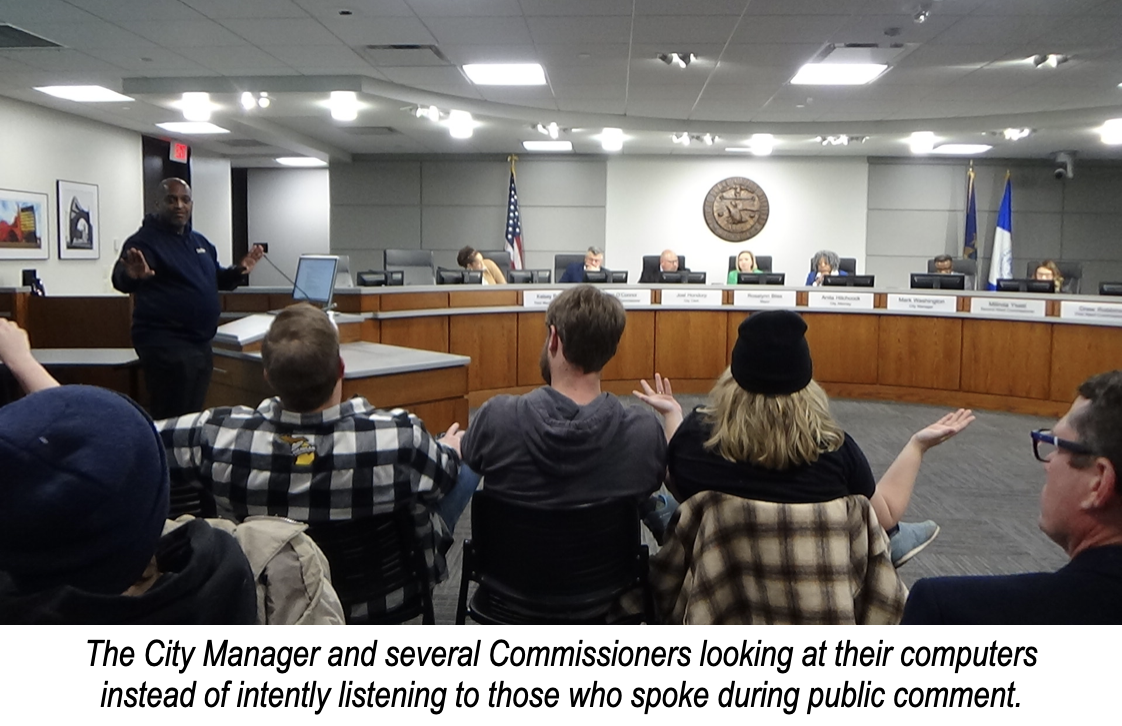
From the very beginning GRIID has critiqued both the news media’s coverage of said proposal and the GRPD’s narrative about what they would use drones for. In a February 22nd post, we critiqued the coverage from MLive, which was based on proposal that police Chief Eric Winstrom made to the Public Safety Committee in regards to obtaining drones.
On March 29th, GRIID once again critiqued the local news coverage of Chief Winstrom’s presentation to the Public Safety Committee, where the news agencies failed to ask important and probing questions about the GRPD’s proposal to use drones. On the very next day, March 30th, GRIID presented its own analysis of what the GRPD presented to the Public Safety Committee. Earlier this week, we provided a critique of a survey that the City of Grand Rapids sent out, which we believe to be misleading and even deceptive in regards to the GRPD’s proposal to use drones.
Public Hearing on the GRPD’s proposal to use drones
Last nights public hearing on the issue of the GRPD using drones started off poorly, in terms of process. I say that because when the Public Hearing on the GRPD’s acquisition and use of drones the police chief was given the floor to do yet another powerpoint on why the GRPD needs drones. The presentation that Chief Winstrom gave was essentially the same presentation he gave at the Public Safety Committee meeting previously, which we reported on March 30th, which also included a link to the video presentation that Winstrom gave then.
It is also important to note that having Chief Winstrom speak first, essentially undermined the public comment period for this Public Hearing. It set a tone and potentially intimidated people who came to speak on this matter. Lastly, his presentation also serves as an “expert testimony” on this topic, whereas the people who spoke during the public comment period are merely providing their “opinion” framework, despite the fact that those who opposed drones for the GRPD had well thought out arguments with sourced facts.
Surveillance curates mistrust
There were numerous arguments against the GRPD’s proposal to purchase and utilize drones, such as an invasion of privacy. Other points that were made centered around issues like a lack of public trust that the cops would not abuse the use of drones, the litany of current lawsuits that the GRPD is already facing around civil rights violations, that drones would be used to monitor and target activists and organizers, plus the defund the police argument, which says that money for drones should be redirected to meet community needs and not expand the already bloated police budget.
There were also some people who felt that this public hearing was merely a formality and that it had already been decided that the GRPD would get whatever they wanted.
I counted 28 people who opposed the GRPD’s proposal to use drones and only one person in support. There were other people who were lined up to speak who would have expressed opposition to drones for cops, but the Mayor suspended the Public Hearing.
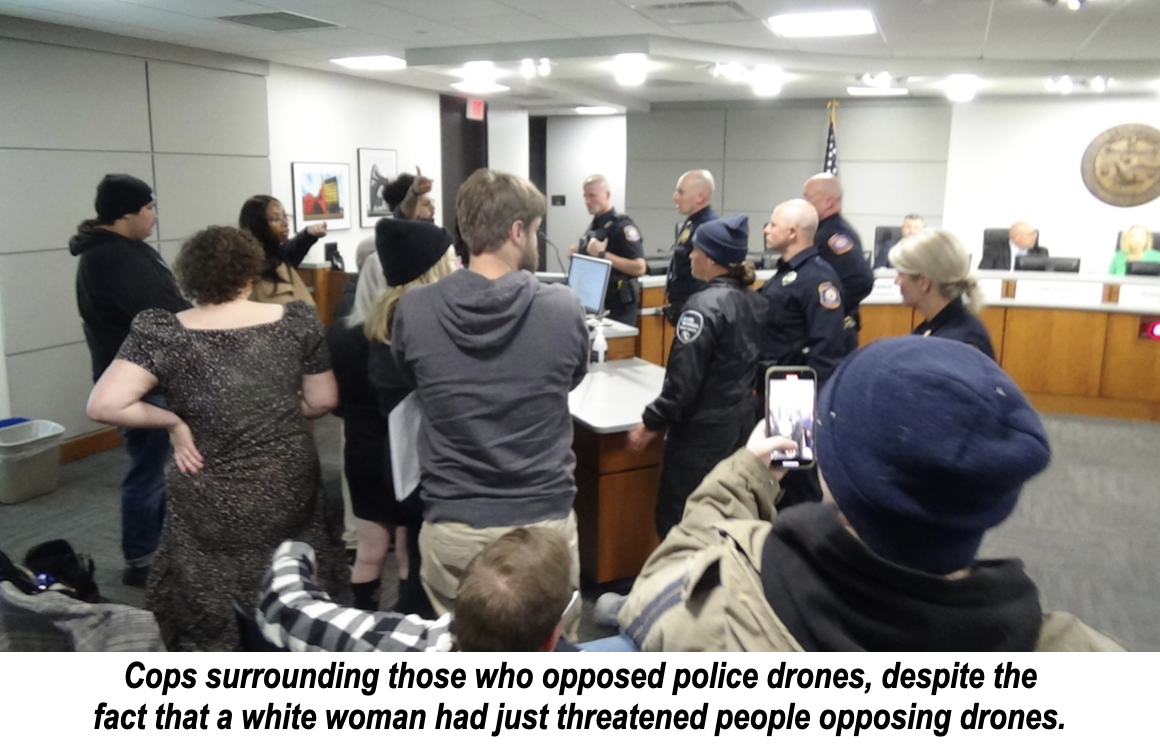
The one supporter of the GRPD’s proposal to use drones said during their comment, that former Grand Rapids police officer Christopher Schurr “did a great job taking a monster off our street.” Many of those in attendance took offense at Patrick Lyoya being referred to as a monster, especially since Schurr shot Lyoya in the back of the head while sitting on top of him.
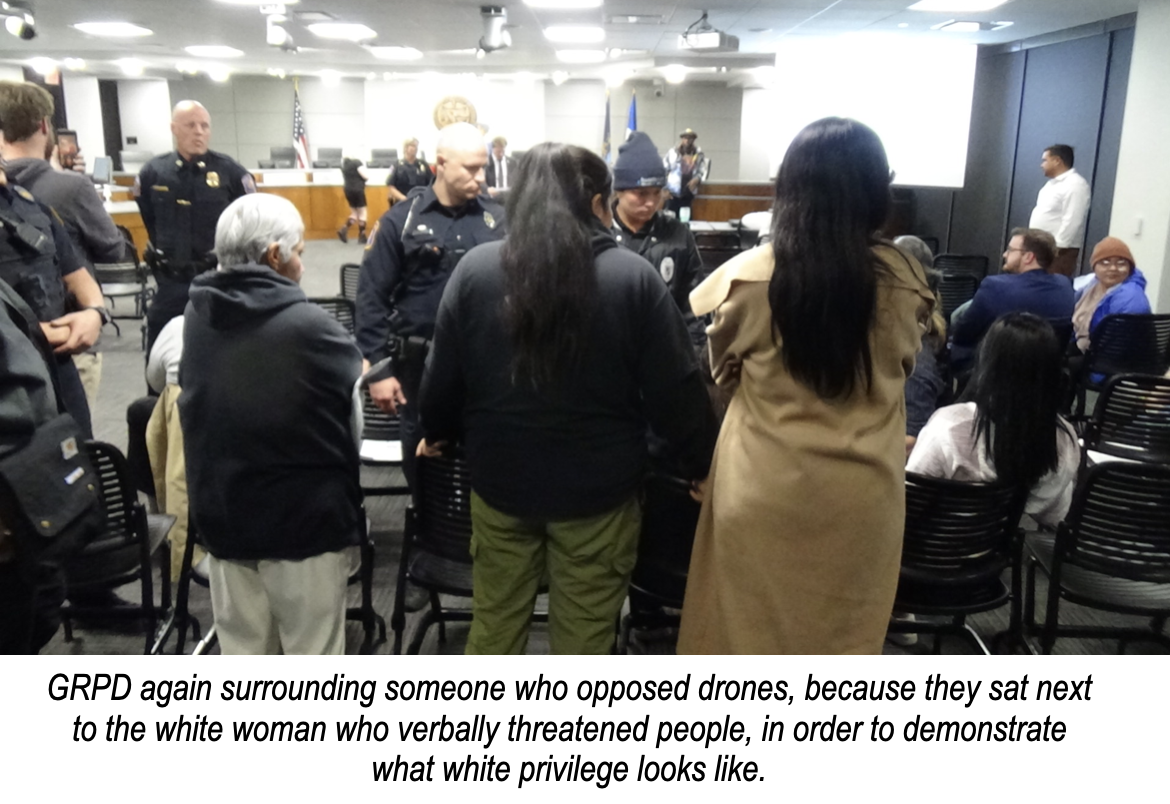
However, the reason that the Mayor suspended to public hearing was more complicated than the reaction people have to the comment about Patrick Lyoya. The person who made the comment, when walking back to their seat lobbed a verbal threat against some of those seated in the front that had already spoken against drones. One of those members got up and approached Chief Winstrom and said, “this person just threatened people, what are you going to do about it?” Winstrom did nothing and in fact that the cops who were there last night began to surround those who opposed drones while the white woman who made threatening and despicable comments was left alone. This was the context for why the meeting was suspended by the Mayor…….white privilege.
My comments for the public hearing
I have been part of an organized effort to oppose the GRPD from purchasing and utilizing drones since the proposal was first announced earlier this year. We have created educational material and invited people to sign our statement of opposition, with some 660 letters already sent to this elected body.
I also saw the City’s survey about the GRPD’s proposal to use drones, a survey I found to be misleading and deceptive. While I understand that the City already has a policy in place on technology use by the GRPD, this policy is ultimately meaningless, since Grand Rapids City officials can always use Extenuating Circumstances as a justification to use drones to monitor activists, organizers or protests whenever they feel like it.
The issue of Extenuating Circumstances was discussed in an April 11 article on MLive, where City Manager Mark Washington said that drones could be used to monitor protests that aren’t permitted and are potentially interfering with roadways. In case there is any confusion about that, most of the autonomous groups that I have been involved with in recent years NEVER obtain a permit to protest, because we do not need your permission or anyone else’s permission to protest or resist oppression. Many of these same groups also engage in disruptive tactics, like shutting down traffic. Disruption of business as usual is a longstanding tradition that has been practiced by social movements since the Abolitionist movement in the 19th Century, the labor movement, anti-war movements, the Civil Rights Movement, the Environmental Justice Movement, the Climate Justice Movement, the Immigrant Justice Movement, the Disability Justice Movement and the LGBTQ Movement. We believe we are in pretty damn good company when we use disruptive tactics.
In that same MLive article from April 11, it also stated that drones may be used by the GRPD “in the case of civil unrest and large gatherings where an aerial view is necessary to ensure safety and minimize the number of officers involved on the street,” Chief Winstrom wrote to commissioners in an April 11 memo.” Again, Extenuating Circumstances is the rational that can and will be used in these circumstances.
Another thing about the recent survey on drones that was deceptive was in Question #2 of the survey where it stated that drone use including reporting all deployments, making photos/video subject to records retention policies and available under FOIA records requests. This might sound like transparency, but the fact remains that even if someone submits a FOIA request it doesn’t mean that the GRPD will honor that request to turn over any and all documentation. For example, when we submitted a FOIA request to the GRPD in 2019, a request that focused on all of the GRPD monitoring & surveillance of Movimiento Cosecha’s 2019 May Day march, we received 271 pages the GRPD had on that action. However, between 80 and 85% of those 271 pages were redacted, they were blacked out, so we couldn’t read what the GRPD was doing or saying about the surveillance of the immigrant justice movement that is deeply committed to non-violence. We paid $551 for the 271 pages, with most of the content redacted. This is all to say that if the City of Grand Rapids allows the GRPD to use drones, then the public should know that if they submit a FOIA request on drone use by the GRPD, the GRPD gets to decide what information they chose to share, which is the complete opposite of the concept of transparency.
With that I simply want to urge this elected body to reject the GRPD’s request to purchase and utilize drones, which in the end will be used to monitor, surveil and target activists, organizers and autonomous groups that are committed to fighting against repression and fighting for collective liberation.
GRIID interviews Movimiento Cosecha before the upcoming May 1st Immigrant Justice march in Grand Rapids
On Monday, May 1st, beginning at 4pm, Movimiento Cosecha is inviting people to participate in their annual May Day action in Grand Rapids.

This year’s action begins at 4pm, with people gathering at Garfield Park on the south side of Grand Rapids.
Recently, GRIID interviewed Gema Lowe, an organizer with Movimiento Cosecha, asking her questions about the status in the fight for Driver’s Licenses for All in Michigan, how the news media has been reporting on this issue, the decline of ally participation in this movement since the 2020 election and why driver’s licenses is such a critical issue for the undocumented immigrant community. There is also a timeline after our interview, a timeline of the Cosecha organized actions for May Day since they began in 2017.
Movimiento Cosecha May Day Actions Timeline since 2017
At GRIID, we thought we would take a moment to celebrate the previous actions that have been done for May Day in Grand Rapids, actions which have not only brought out thousands to demand dignity, respect and permanent protection, but actions which have disrupted business as usual, since immigrants know all too well how their lives have been disrupted by US government policy and the ICE enforcement goons.
May 1st 2017 Action – Movimiento Cosecha started their circle in 2017 and one of the first action they did was to organize a May 1st march from Garfield Park to downtown Grand Rapids. We wrote the following:
Those marching were mostly Latinos, Latinx, and indigenous people from Mexico, Central America and numerous Caribbean nations. Some proudly displayed flags from their country of origin, while other carried signs with demands to stop Separating Families because of the decades-long policy of deporting those without documentation.
The march organizers did not obtain a permit, since they felt that it was their right to march for what they were demanding. The GRPD was frantic before the march, calling organizers and others connected to the movement, but no one was giving up any information. The GRPD decided to close down roads on their own to clear a path for the march, but the march organizers were clear in that they were providing enough protection for marchers on their own.

May 1st 2018 Action – The 2nd annual May Day march by Movimiento Cosecha, began in the southwest part of the city, at Roosevelt Park, marching down Grandville Avenue and ending up in downtown Grand Rapids. We wrote:
There were other beautiful moments during the march. First, when people didn’t comply with the GRPD route, it clearly showed people that police do not need to be obeyed, based on how animated people got when they changed their route.
Second, when the march was going under the 131 s-curve on Market Street, the echo provided a great opportunity for those marching to get even louder. The marchers stop for a few minutes to revel in their excitement.
Third, the march organizers who were talking through a sound system during the whole march, not only led chants, but provided important information about the realities that immigrant families face on a daily basis. They talked about the constant fear that the community lives in and how people are being detained and deported by ICE agents. Those leading the march also addressed the oppressive role that the GRPD plays in their struggle and made numerous comments at the exact same time that Police Chief Rahinsky was present on Grandville Avenue.
May 1st 2019 Action – The 3rd annual May Day march organized by Movimiento Cosecha GR, began again at Garfield Park. This time the GRPD was threatening to arrest people if they marched in the street. We wrote:
Despite the weather and despite the levels of state violence that the immigrant community has endured, there was no indication that those who were slowly gathering at Garfield Park would be anything but intimidated by the threats of arrest. Movimiento Cosecha GR organizers and volunteers did an amazing job preparing for this march, making connections with people and following the lead of those in the community who have told them over and over again that the ability to obtain a drivers license would be a huge win.
The insurgent hope that grew as we got closer to noon could be felt in the crowd that was gathering, it could be heard in the excitement in people’s voices as they began to chant and urge each other on in this struggle and it could felt in the deep affection and solidarity being exchanged in the embraces people gave each other.
2019 Addendum – Because the GRPD was so bent on arresting people if they marched in the streets, we decide to submit a FOIA request to see what the GRPD was doing prior to the 2019 march.
It should be stated that since Movimiento Cosecha GR and it’s ally group, GR Rapid Response to ICE, began organizing in early 2017, the GRPD has consistently engaged in surveillance, monitoring, harassment and intimidation tactics of this movement. On many occasions, when organizers engaged in specific actions, there were as many, and at times, more police officers present than there were those protesting.
In what follows, you will see that the GRPD spent a great deal of energy, resources and taxpayer money to monitor, harass and threaten a consistently non-violent movement for immigration justice.
The FOIA documents we obtained can be viewed at this link, with 271 pages of e-mail communication, text messages, photos, and other documents related to the 2019 May Day action that Cosecha GR had planned.
On pages 269 – 271, you can see the final cost of the FOIA request, which was $551.01. However, if one goes through the pages, it is clear that 90-95% of the documents were redacted by the GRPD. Here is the explanation they provide on the redaction:
Your request for these records is GRANTED in part and DENIED in part. Please be advised that information has been redacted from the documents under MCL 15.243(1)(a)(information of a personal nature release of which would constitute a clearly unwarranted invasion of an individual’s privacy) and MCL 15.243(1)(b)(iii) (law enforcement records release of which would constitute an unwarranted invasion of personal privacy). It is the City’s position that the public interest in the disclosure of this information is outweighed by the public interest in keeping this information private. The core purpose of the FOIA is to contribute significantly to public understanding of the operations or activities of the government. Requests for information that involve private citizens in government files that reveal little to nothing about the inner working of government do not serve the core purpose of the FOIA.
Apparently, the GRPD does not want the public to know what they did, and more importantly, how they operate. So much for transparency.

May 1st 2020 Action – Because we were in the midst of a pandemic, Cosecha organizers decided to do a car caravan and keep people safe. Here is what we wrote about that day:
Movimiento Cosecha GR was once again demanding driver’s licenses for all, but they also emphasized the fact that immigrant workers are essential workers, particularly migrant workers. Migrant workers do the back breaking work in the fields that puts food on all of our tables, work that is so essential, that without them the food system would collapse. Another important point that Movimiento Cosecha GR made yesterday was that the 11 million undocumented immigrants in the US are not eligible for any of the COVID-19 relief funds coming from the federal government, thus causing even extra hardship for the immigrant families that are already terrorized by law enforcement.
May 1st 2021 Action – Since there was a Democratic Party controlled Congress and White House, Movimiento Cosecha decided to do their May Day action in Washington, DC. They wanted to make the point that Democrats also Deport us! We interviewed two of the volunteer organizers just after they got back from their time in Washington, DC. We wrote:
We sat down with two of the Cosecha GR organizers, Gema and Idalia, both of who went to DC last weekend. We asked them four questions: 1) What was the main focus of going to Washington DC, since during the past 4 May Days, the actions have been local; 2) What kind of actions did you organize and take part in during the two days in Washington, DC; 3) There has been a clear drop in attention and support by the ally community since the November Election, what message do you have for allies about why it is important to continue supporting the immigrant justice movement; and 4) Those who went to DC were very energized, so how do you maintain that kind of energy and how do you get more people involved for the fight ahead?
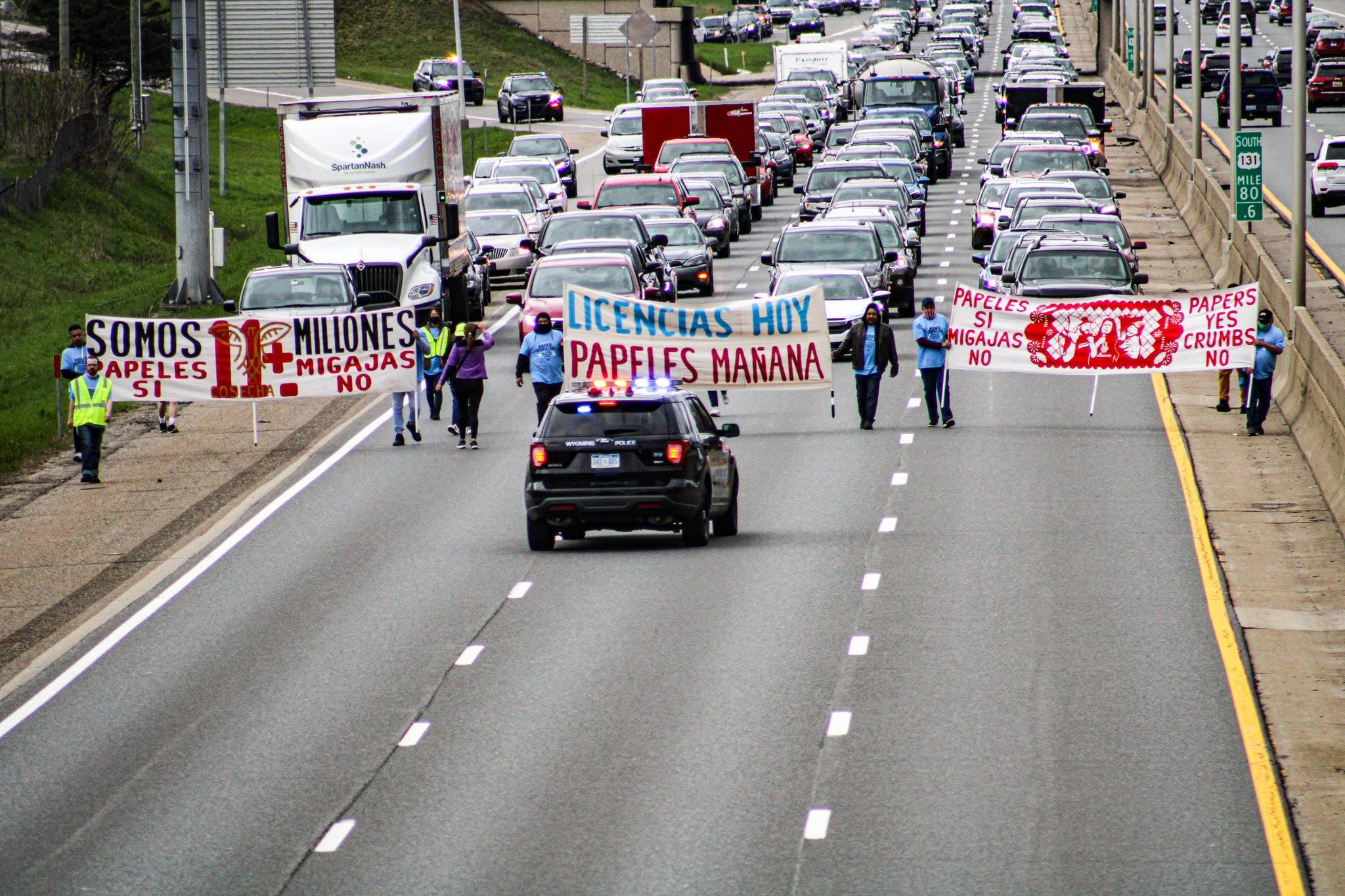
In May 1st 2022, the Cosecha action involved shutting down the northbound traffic on US 131 for about 20 minutes, along with a march near the same area and community gathering at Clemente Park in the southwest part of Grand Rapids.
The only meaningful apology from the MillerKnoll CEO would be to give substantial bonuses to the same employees that were insulted
You probably have heard by now the infamous rant by Andi Owen, CEO and president of MillerKnoll, which was acquired by Herman Miller in 2021.

You can go to this video (1:08 into the video) and hear what Owen had to say, which was essentially shaming employees for complaining about not receiving bonuses from 2022. Here is some of what Owen said to her employees:
“Don’t ask about, ‘What are we going to do if we don’t get a bonus?’ Get the damn $26 million,” Owen said, referring to an undisclosed internal metric. “Spend your time and your effort thinking about the $26 million we need and not thinking about what you’re going to do if you don’t get a bonus. All right? Can I get some commitment for that?”
However, what was even more egregious than the CEO’s rant against employees was the fact that Andi Owen’s compensation package for the 2022 fiscal year approached $5 million.
The backlash has been significant, with numerous news outlets reporting on the contemptuous comments from Owen, comments that were directed at workers. Here is one example of this story as reported on by VICE.
Last week the Holland Sentinel reported that MillerKnoll was also threatening to fire employees who pushed back against the CEO’s comments, particularly if those employees spoke with news reporters.
“We have a meeting at the beginning of every shift,” the employee wrote in a message Wednesday, April 19. “Last night the comments were brought up in the meeting and they said if anybody spoke out it wouldn’t be good for them and they could be terminated.”
A spokesperson with MillerKnoll denied this allegation.
At the opposite end of the spectrum, Crain’s Grand Rapids – the newly created business press that has replaced both the Grand Rapids Business Journal and MiBiz – reported that the CEO and President of MillerKnoll had made a formal apology for her comments about workers going to “pity city.”
The Crain’s Grand Rapids article, headlined, MillerKnoll CEO apologizes to staff following viral comments on employee bonuses, doesn’t really provide any details on the apology, nor does it quote Owen directly on her apology. I checked the MillerKnoll website and there was no formal apology listed, which makes me question whether or not it even happened.
More importantly, even if the MillerKnoll CEO made an apology, those are simply empty words when you consider that she received $3.5 million in stock awards and other compensation in 2022. The only meaningful response would be to give employees a just bonus for 2022. In fact, the best form of an apology would have been for And Owens to divide her $3.5 million bonus for 2022 amongst the employees.
For working class people increasing their pay or providing substantial bonuses are the only meaningful thing a CEO can do, short of stepping down from their position and having the company be run by the workers. These kinds of apologies will not happen within a Capitalist system, not unless workers rise up and take what is owned to them.
Grand Rapids City officials have sent out a survey on the issue of the GRPD wanting to purchase and use drones, or what they are calling Small Unmanned Aircraft Systems (SUAS).
In many ways this survey should be seen as a counter to the Action Alert sent out by Defund the GRPD and their coalition partners, an Action Alert that was demanding that Grand Rapids City officials deny funding for the GRPD to purchase drones.

The City’s survey on drones is framed in such a way as to limit what they want you to know and to present themselves as saying that the GRPD would never use drones to monitor the public. The failure of the City to be transparent and forthcoming about policing in this city has been a consistent pattern for several years, with an increase in their misinformation since the 2020 uprising and calls to defund the GRPD.
Here is a link to the survey, and below we provide all of their questions, with our own commentary on what the questions are misleading.
Introductory narrative to the survey
The Grand Rapids Police Department is collecting community input on the potential use of Small Unmanned Aircraft Systems (SUAS). Sometimes referred to as “drones”, SUAS technology is already in use by many law enforcement agencies across the state to increase public safety.
Survey Question #1
Which types of activities do you believe SUAS technology would benefit public safety in our community? (Check all that apply)
The options listed are meant to convey the idea that the GRPD just does work that keeps people safe. The reality is that it doesn’t include options about civil unrest, un-permitted protests or what the City refers to as Extenuating Circumstances.

Survey Question #2
Do you know that the City of Grand Rapids already has a policy (15-03) in place that would govern SUAS use including reporting all deployments, making photos/video subject to records retention policies and available under FOIA records requests (similar to body worn cameras), and audited by the Office of Oversight and Public Accountability (OPA)?
What the survey doesn’t tell you about policy (15 – 03) is that because of Extenuating Circumstances, they can deploy the use of drones whenever they deem it necessary. For example, in a recent MLive article, City Manager Mark Washington added that drones could be used to monitor protests that aren’t permitted and are potentially interfering with roadways. In addition, even though people can submit a FOIA request for drone captured pictures or video, the GRPD can determine what pictures or footage they will release. See our 2020 post on FOIA documents on the 2019 May Day action by Movimiento Cosecha GR.
Survey Question #3
Do you know that this policy prohibits the use of SUAS to “harass, intimidate, or discriminate against any individual or group”?
Once again, not if Extenuating Circumstances are applied. The April 11 MLive article cited earlier, also states: “The situations in which a drone might be used include dangerous and reckless driving, river drowning and rescue, apprehension of a fleeing felon, accident scene reconstruction, crime scene documentation, missing persons search, civil unrest and large gatherings “where an aerial view is necessary to ensure safety and minimize the number of officers involved on the street,” Winstrom wrote to commissioners in an April 11 memo.”
Survey Question #4
Did you know that both Kent County Sheriff’s Office and the Michigan State Police have and use SUAS in and around the City of Grand Rapids, but the City’s policy does not apply to these entities? Use is governed by those agencies.
As you can see, the survey is not only brief, it purposefully leaves out information, necessary information that would not only promote transparency, but allow people to make a more informed decision.
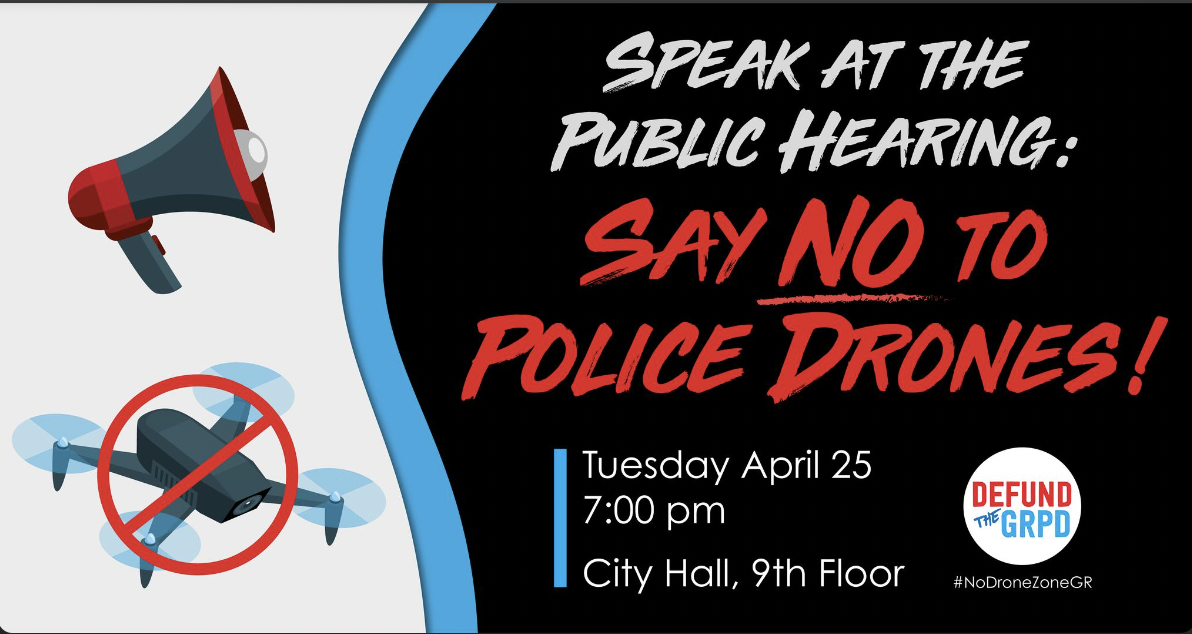
People can make their own choice about whether to participate in the survey or not, but if you oppose the GRPD from purchasing and using drones in Grand Rapids, then please join Defund the GRPD and their coalition partners in coming to the City Commission meeting tomorrow – April 25th, and speaking up during the public hearing on the GRPD’s request to purchase and use drones. Here is a link to the Facebook event inviting people to show up and say no to drones for the GRPD!
GRIID interview with Urban Core Collective on the Climate Justice march in Grand Rapids
 GRIID – Besides April 22nd being Earth Day, what is the focus of the Climate Justice march happening in Grand Rapids?
The focus of the climate justice march is to activate people to be part of something and to bring them together for them to hear from our speakers who will talk about actionable steps they can take, today, to own their own carbon footprint, use their voice and personal/institutional influence to help us push on key issues. Issues like:
- the Roosevelt Park Neighborhood truck route, which is no longer a truck route but the GRPD refuses to enforce truck traffic that is violating
- Shedding light no what a terrible company DTE Energy is as indicated by how they provide two levels of service to frontline communities, their shutoffs of peoples electricity, their sale of people’s debt to a 3rd party who is harassing people, and even how they’ve hired actors to make favorable statements at the Michigan public service commission hearings.
- Work being done by local environmental justice organizers and organizations like the Community Collaboration on Climate Change, Grand Rapids Climate Coalition and Creston Neighborhood Association.
GRIID – Will there be any demands made of the City of Grand Rapids, the private sector, or residents of Grand Rapids, in terms of what needs to change to have a livable future?
Multiple speakers will be asking for the City of Grand Rapids to pursue more aggressive goals to reach carbon neutrality by 2030. The city just isn’t committed enough to reach these goals as is evident in their city budget, which was analyzed and presented to the public through the Reinvest GR campaign.
Speakers will be asking Consumers Energy and DTE Energy to improve on reliability, to stop slowing down the development of rooftop solar and distributed generation.
GRIID – I am aware that the Urban Core Collective is one of the groups involved in the April 22nd Climate Justice march. How does climate change impact BIPOC communities differently than white people, and why is it important for white people to follow the lead of BIPOC communities on the issue of Climate Justice?
BIPOC communities are disproportionately represented in low income communities and these are the communities who tend to live in industrial and flood zones. This is where the cheapest dwelling units tend to be, so not surprisingly, these areas tend to suffer from disinvestment from municipalities. The aging and inadequate infrastructure and lack of tree canopy expose them first to the impacts of severe weather events like flooding, heat and cold waves, loss of power and are the last to receive aid. As with any movement or enterprise, we must allow the experts to develop the strategies and to establish the priorities and pace of the solutions or to lead the movement. In this case, BIPOC communities are experts in how climate change and environmental injustice affects them, not middle class folks from the suburbs who will engage with systems with approaches that have worked for them.
GRIID – At the federal level, the Biden Administration has committed more of the budget towards the Pentagon and militarism than on Climate Justice and renewable energy. In Grand Rapids, the City government commits more of the budget for policing than on Climate Justice. Why do you think governments are unwilling to spend more on Climate Justice than they are on militarism and force? How could the $60 million that goes to the GRPD on an annual basis be used for Climate Justice outcomes?
Short answer is Capitalism. Our city prioritizes the interest of business and their doctrine of “what’s good for business is good for Grand Rapids” is based on neoliberal economic theories which are never tested. We spend millions of dollars every year on giving tax credits to attract companies to our city with the promise of jobs which are never confirmed and an economic boost which is also never confirmed. There is no accountability for those promised benefits. Climate justice means policy and ordinances which would regulate business and their carbon footprint and pollution. It would upset business interests which have a powerful interest on our city department heads.
They can invest in tree canopy to bring neighborhoods like the Roosevelt Park Neighborhood up to par with wealthier communities. They could establish a find to weatherize and insulate homes in GR. Insulation is not required by law in our city. They could replace all lead pipes. They can bring all drain infrastructure up to par with infrastructure found in downtown GR. They can establish a fund and partnership with appliance and contractor companies to start switching BIPOC communities to electric appliances so that the cost isn’t an issue in the switch. They can establish a fund that would front all costs for programs which are based on rebates. Folks can’t afford thousands of dollars up front.
GRIID – According to a report put out by the Indigenous Environmental Network in 2021, Indigenous-led resistance campaigns against pipelines in the US and Canada have reduced greenhouse gas pollution by at least 25% annually since these campaigns began. Will the Grand Rapids Climate march be advocating for Direct Action as a larger strategy to achieve the kind of systemic changes that are necessary in the Climate Justice fight?
Currently this march is the largest action the partners involved are doing. The environmental justice moments are at different stages of their development but all relatively young, especially those which are centering or are being led by BIPOC communities. We are very much interested in bringing in training to build organizing capacity in community. Reinvest GR is another collaborative stakeholder approach which may be part of a larger movement. Our hope is to head in the direction of larger strategy for systemic change.
Earth Day activities were planned across the country on April 22, 1970. Grand Rapids was also included in those communities that celebrated Earth Day.
Based on articles from the Grand Rapids Press, there were three separate activities that received attention in Grand Rapids.
In the afternoon, there was an event with song and signs on the Calder Plaza, with the featured speaker being Rep. Guy VanderJagt, a Republican from Cadillac. The comments by VanderJagt, as reported in the Grand Rapids Press, spoke of the urgency to take action. However, the representative from Cadillac framed the environmental urgency in terms of how much people would be willing to pay in taxes to get clean air and clean water.
There was also a large community event, with an estimated 1,500 people in attendance at the Civic Auditorium in the evening. The event featured images on the big screen, musicians and speakers.
Senator Philip Hart got the biggest applause from the audience, according to the Press. Hart spoke about not separating humanity from nature and that the “drive to save the environment” will outlast recent crusades such as those of civil rights and the war on poverty.
At one point the image of Vice President Spiro Agnew appeared on the screen, which received a lot of boos from the audience. Representative Gerald Ford spoke, and he too received boos, shouted comments about the war in Vietnam and sometimes loud stamping of feet.
Ford’s comments, according to the GR Press, were limited to personal sacrifices, consumer dollars and taxes. Ford also suggested we “reduce pollution from the internal combustion engine.” He claimed that President Nixon, along with the private sector, would be creating a “virtually pollution-free automobile within five years.”
 There were a whole list of other speakers, including representatives from business, the faith community and non-profits.
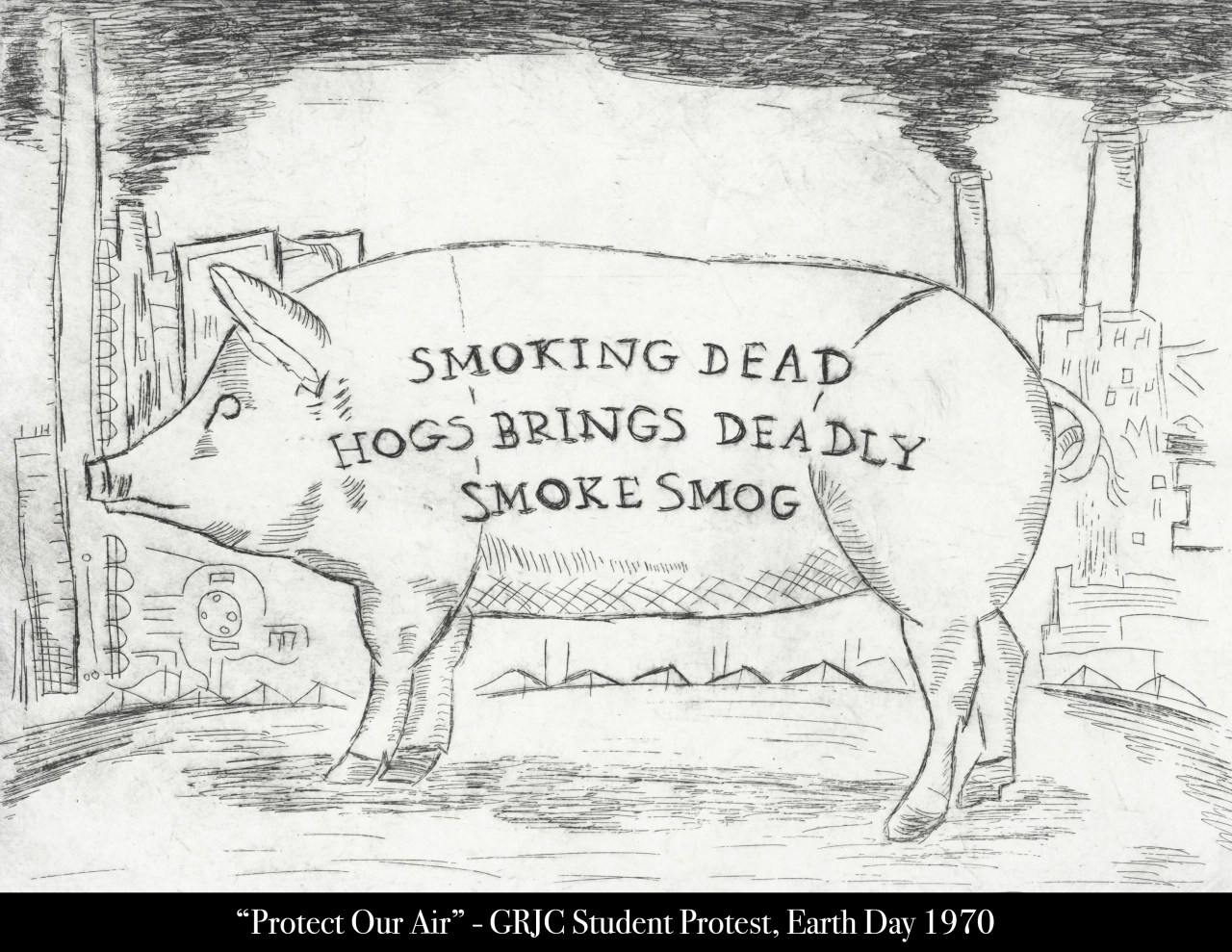
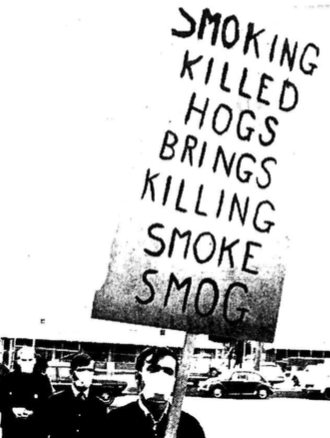
The other major activity that people took part in on Earth Day in Grand Rapids in 1970, was a protest organized by students from the Grand Rapids Junior College.
Students chose to protest at a meat factory, because of the pollution the business was emitting as a result of how the company cured the meat. The factory had been the target of complaints from neighbors for years because of the pollution.
The owner of the business was cited as saying that he was in the process of addressing the air pollution, but didn’t know what kind of timetable there would be to address the issue.
This last action, organized by students, is more reflective of the kinds of actions people were taking across the country, which focused attention on corporate pollution or structural pollution. In fact, in its early years, Earth Day actions were either to engage in collective actions that would promote ecological integrity or to confront those most responsible for environmental destruction, the corporate/industrial sectors.
Artwork above was created by Joey Parks.
 Grand Rapids Institute for Information Democracy