Rep. Scholten releases a statement that denies Israeli genocide, embraces US militarism, and ignores immigrant justice demands
Over the past week, there have been proposals and debates in both the US House and the US Senate regarding additional US military funding for Israel, Ukraine and the US/Mexican Border.
The Biden Administration wants funding for all three of these items, with a proposed $61 billion going to Ukraine, a proposed $10-$14 Billion to Israel and a smaller amount going for what is framed as “border security.”

Most Democratic members in Congress support what the Biden Administration, while the Republicans have been making alternative proposals for immigration and border security.
Rep. Hillary Scholten, who is just in her second year as the 3rd Congressional Representative, has consistently supported US military funding for Ukraine, for Israel and for border security. On Tuesday, Rep. Scholten released a statement regarding H.R. 7217, which she did not support, primarily because of some of the provisions in the GOP proposed bill.
What follows is Rep. Scholten’s statement from 2/6/2024, which will be followed by the GRIID response.
“The legislation put on the floor by Speaker Johnson fails to meet this moment by playing politics with our national security, and further, has no chance of becoming law.
“I support Israel’s right to exist as a democratic homeland for the Jewish people, and to ensure that right, Israel must defend itself against its enemies, including Hamas in the wake of the brutal terrorist attacks of October 7. For decades, this has been a bipartisan issue, and there is still a strong bipartisan coalition ready to support Israel. But today’s vote was not about supporting Israel and its right to defend itself.
“I have been working with bipartisan members urgently – for months – on a deal. Speaker Johnson abandoned those bipartisan negotiations and put forward a non-serious messaging bill that he knew would fail. This bill does not include much-needed humanitarian aid for innocent civilians who are suffering in Gaza. It does not include essential support for Ukraine, which continues to wage its war against the spread of authoritarianism. And it does not include a critical border security package that is essential to addressing the immigration crisis at our southern border.
“Our national security is a serious issue and demands a serious vote, not a political ploy, so I voted against this bill. I continue to push the Speaker to honor the comprehensive package that the president supports and that has bipartisan agreement in the Senate.”
“Now more than ever we must stand together as the United States of America and link arms with our democratic allies around the world, continue our tireless work to bring home the hostages still held by Hamas, send critical aid to those afflicted by war, and protect our security at home through comprehensive immigration reform.”
Point #1 – When Rep. Scholten blames Speaker Johnson for putting forth a proposal that she doesn’t think will become a law, she ignores the fact that this is a longstanding tactic of the Democratic Party as well.
Point #2 – Rep. Scholten makes it clear that Israel has her total support, since she essentially uses language that the Israeli government uses. Scholten also acknowledges that US support for Israel has been historically bi-partisan, which is true, and will continue to be so as both parties have always backed Israel no matter what the international consequences are. More importantly, Rep. Scholten fails to say anything about the now 5 month Israeli assault on Palestinians resulting in over 27,000 dead Palestinians. Like President Biden, Rep. Scholten supports the genocidal campaign being waged by Israel against the Palestinians, a designation that the International Criminal Court gave a few weeks back.
Point #3 – In paragraph 3 Rep. Scholten acknowledges her support for US military funding for Ukraine, for Israel and “a critical border security package that is essential to addressing the immigration crisis at our southern border.” In this paragraph, Scholten also mentions that the GOP version doesn’t support humanitarian aid for Gaza. What Scholten fails to mention is that the Biden Administration has voted to defund support for UNRWA, which is the United Nations Agency for Palestinian refugees. UNRWA is the best way to get humanitarian relief to Palestinians. As for the “immigration crisis at our southern border,” Rep. Scholten wants us to believe that she is a defender of immigration justice, when in fact, the legislation that she has proposed, the Dignity Act falls way short of embracing immigration justice. We addressed this issue in August, when Scholten was being interviewed by WOODTV8, writing:
The Dignity Act is not Comprehensive Immigration Reform, nor does it address more structural elements of root causes of immigration, such as the US role in supporting military and trade policies in Latin America that have destabilized most of the region, along with the fact that more and more people are being displaced and forced to flee their homelands because of Climate Change.
Point #4 – In paragraph 4, Rep. Scholten gets a little preachy saying that national security is a serious matter. However, Scholten fails to mention that the Biden Administration pushed through the largest military spending bill in US history ($886 Billion), a bill that received plenty of support from the GOP, as I noted in December when the military spending bill was adopted.
Point #5 – In the last paragraph of Scholten’s statement, we see her re-affirm her commitment to US military aid to Ukraine and to Israel, along with the Israeli PR playbook mantra, “bring home the hostages still held by Hamas.” Again, Scholten refuses to acknowledge Israeli genocide and US complicity in that genocide. Scholten also uses the language, “protect our security at home through comprehensive immigration reform.”
In this final sentence, Rep. Scholten makes it clear that US immigration policy is centered around national security and not immigration justice. Lastly, while calling what she supports comprehensive immigration reform, there is nothing comprehensive about the immigration legislation she support or the fact that it ignores the demands by immigration justice groups across the country like Mijente and Movimiento Cosecha that have a very different idea of what immigration justice looks like.
Palestine Solidarity Information, Analysis, Local Actions and Events for the week of February 7
 It has become clear that the Israeli government will continue their assault on Gaza and the West Bank. The retaliation for the October 7 Hamas attack in Israel, has escalated, therefore, GRIID will be providing weekly links to information and analysis that we think can better inform us of what is happening, along with the role that the US government is playing. We will also provide information on local events and actions that people can get involved in. All of this information is to provide people with the capacity of what Noam Chomsky refers to as, intellectual self-defense.
Information
Bipartisan Border Bill Would Block All Funding to UN Palestine Relief Agency
Report Finds “No Evidence” in Key Dossier to Support Israel’s UNRWA Allegations
Revealed: An Israeli businessman’s post-genocide plan for Gaza
Ceasefire elusive as Gaza genocide enters fifth month
Solidarity During a Time of Genocide: Why Gaza Matters
Israel’s Use of Starvation as a Weapon of War Brings Gaza to the Brink of Famine
Analysis & History
Colonial Law and the Erasure of Palestine
Israel’s Ruthless Propaganda Campaign to Dehumanize Palestinians
Local Events and Actions
No upcoming actions.
Graphic used in this post is from https://visualizingpalestine.org/#visuals
Buying Elections: 2024 Grand Rapids Mayoral Race
 The deadline for election campaign finances were due on Wednesday, January 31st. As it has been a practice of GRIID for several years now, we plan on post several articles in the coming days specific to the most recent round of campaign finances that are for the 2024 Elections.
Today, I want to look at the two announced candidates so far, David LaGrand and Senita Lenear. To access the Kent County Campaign Finance records click on Campaign Finance Report, then you will have to do a search by candidate name.
Grand Rapids Mayoral Candidate – David LaGrand
GRIID has already posted two articles about campaign finances for David LaGrand, with the first post in July and the second post in November of 2023.
In the most recent campaign finance cycle David LaGrand has raised $17,891.59, bringing the total to $49,715.24. During this current campaign finances cycle, 87 people/groups have contributed to LaGrand’s campaign. Here is the link for the campaign contributions and what follows is a list of some of the largest donors.
Largest Contributions
- Grand Rapids Fire Fighters Union PAC – $2,500
- Johnny Brann Jr. – $1,000
- Joan Secchia – $1,000
- Jessie Douglas – $516.45
- Ron DeWaard – $516.45
- David Dorner – $500
- Brandon Kanitz – $500
- Jeff Schutz – $500
- Robert Vanstright – $500
- Emily Loeks – $500
- Steve Pestka – $400
- Gary De Kock – $300
- Kenneth Heffner – $300
- David Diephouse – $258.32
- Gerald Lykins – $258.32
- Hal Ostrow – $258.32
- Harvey Koning – $258.32
- Case Hoogendorn – $250
- Thomas Hoeksema Sr. – $250
- Matthew Heun – $250
- Jessica Lowery – $250
- John Helmholdt – $250
- Mary Jackson – $250
- Grace Bradford – $250
- Roger Rice – $250
- Lori Keen – $250
- Carol Rottman – $250
- Emily Brink – $250
- David Leonard $250
- Hardy Lee – $250
Of the 30 top contributors to LaGrand’s campaign, they collectively donated $13,315 out of the $17,891.59. This means that the other 57 contributors gave a total of $4,576, which is about 25% of the total. These disparities are nothing like the 4 Kent County elected positions I wrote about yesterday, but there are definitely some of the same players and those that are purchasing electoral influence.
Besides the campaign finance date for LaGrand, his website has not changed in recent months, especially the section that lists “priorities.” Also, his Facebook page continues to lack any real substance or responses to critical issues facing the City of Grand Rapids.
Grand Rapids Mayoral Candidate – Senita Lenear
GRIID has only posted 1 previous article about Senita Lenear’s mayoral campaign, since she announced months after LaGrand. In that post, I did provide an overview of Lenear’s track record as a City Commissioner.
In the most recent campaign finance cycle Senita Lenear has raised only $3,737.78, which is the total for the campaign to date. During this current campaign finances cycle, 20 people have contributed to Lenear’s campaign. Here is the link for the campaign contributions and what follows is a list of some of the largest donors.
Largest Contributions
- Milinda Ysasi – $500
- David Sarnacki – $500
- Mary Alice Williams – $500
- Janay Brower – $400
Lenear’s campaign website provides some of her stances while she was a City Commissioner, although there is not a great deal of emphasis on priorities and what she would fight for as Mayor. Lenear’s Facebook page doesn’t have any new content posted, with the last content from November when she announced.
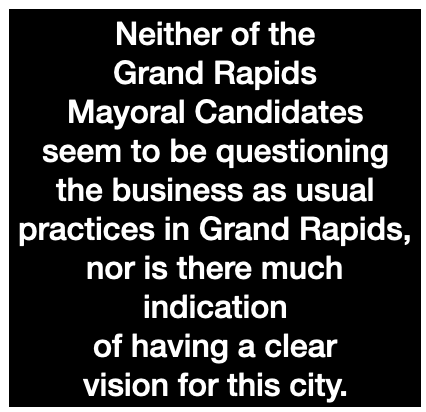
As of this writing, there is no indication that either mayoral candidate will challenge the status quo in Grand Rapids, especially when it comes to the Grand Rapids Power Structure. GRIID will continue to follow the campaign money as we get closer to the election, as well as providing some analysis of where these candidates stand on critical issues in this city.
How well did the local news media report on the highly organized campaign to improve education at the Grand Rapids Public Schools Board meeting?
As we reported in our post from this morning, the Community Report Card Campaign had a massive turnout last night for the Grand Rapids Public Schools Board Meeting.
In fact, according to one of the GRPS Board members, the meeting didn’t end until 11:30pm. That would have made it a 5 and a half hour School Board meeting. In addition, according to someone posting on the Grand Rapids Education Association social media page, the school board – without prior notification – had reduced public comment time from 3 minutes to 2 minutes.
Nevertheless, the turnout and the collective response from the community was powerful, so much so that the Grand Rapids School Board and the Grand Rapids Public School administration was put on notice.

Considering how long last nights School Board meeting was, how many people attended and spoke, and the sharing of the Community Report Card Campaign information, one would have thought that every possible news agency in Grand Rapids would have reported on last nights meeting.
Unfortunately, as of early Tuesday afternoon, I could find no stories about the massive public engagement of the GRPS on both MLive and WXMI Fox 17. To be fair, there were stories on WXMI and MLive regarding Gov. Whitmer’s visit yesterday to a GRPS school to make an announcement about expanding pre-K education to four year olds. However, Whitmer’s presence yesterday may have undermined the incredible effort by the Urban Core Collective’s Education Justice campaign. In addition, Whitmer was accompanied by several area Democratic Party politicians, who should have known about the Community Report Card Campaign and the potential conflict in news coverage. Politicians should always know about local organizing efforts, then get behind them in whatever way they can.
Two stories about last night
There were two daily news agencies that reported on the massive community engagement effort with the GRPS, with both WOODTV8 and WZZM 13 providing coverage. I want to take a look at this coverage, look at framing, sources used, etc.
The WOODTV8 story did a pretty good job of framing the issue by talking about the Urban Core Collective’s Community Report Card Campaign. Framing the story that way makes it clear that this was a community-based effort. In addition, the channel 8 reporter did acknowledge how many people responded to the questions provided to the community, teachers, students and parents, which also centered the input from the public.
The channel 8 story even walked through the Community Report Card, with video of students asking questions and community members in attendance holding up grades for each category and question. Unfortunately, just before viewers would see the interactive and participatory way that students presented their findings, WOODTV8 included comments from the GRPS media spokesperson. The response from the GRPS spokesperson should have come later, so that viewers could see the entirely of the Community Report Card presentation before allowing any sort of response.
There were four different people who viewers heard from in the channel 8 story, with a parent talking about how they value teachers, and a teacher talking about how the GRPS took too long to respond to their demands for an increase in salary, only to be insulted by a $375 salary increase.
Also problematic was the fact that channel 8 gave the GRPS spokesperson 32 seconds of uninterrupted commentary, which is rather long in the world of local TV news. The GRPS spokesperson also did not respond directly to the presentation about the Community Report, choosing to instead talk about the size of the district, the complexities of the problems they face, the millage, and the need for lawmakers to become more involved. The GRPS spokesperson did nothing more than deflect and avoid addressing the critical issued raised by the community at last nights board meeting.
WOODTV8 did mention at the end that people could access the Community Report Card information on their website. Their story on last nights GRPS Board meeting last 3 minutes and 24 seconds.
The WZZM 13 story was significantly shorter, coming in at 2 minutes and 8 seconds. The channel 13 story also framed their coverage around the Community Report Card campaign, and the first person that viewers heard was a GRPS student. The channel 13 story also providing ample time to show how the information was presented, with questions being asked, followed by participants holding up grades.
In addition to two students voices being heard in the WZZM 13 coverage, there was one parent who was given a few seconds within the channel 13 story. However, like the channel 8 coverage, the GRPS spokesperson was afforded the most airtime, with a full 26 seconds on the channel 13 story. The comments from the GRPS spokesperson in WZZM 13’s coverage didn’t deflect as much as they did in the channel 8 coverage, but they were given the last word, since the story ended with the GRPS spokesperson comments.
In both the channel 8 and channel 13 stories, the coverage could have been improved if the stories ended with someone involved in the Community Report Card Campaign having an opportunity to speak to what outcomes or demands they were wanting to see from the GRPS Administration and the School Board. Failing to provide that opportunity simply left viewers feeling like there was no resolution and no timeline for the changes that so many in the community are hoping to see.
If you have not read the Community Report Card document, please do so now and share it with people who are concerned about public education in Grand Rapids.
For nearly 2 years now, the Urban Core Collective’s Education Justice campaign has been working hard to identify problems and potential solutions to the issues that students, parents, teachers and community members in the Grand Rapids School District have been ignored for too long.
On Monday, the Urban Core Collective provided some documentation of the 414 responses they received for their Community Report Card Campaign. You all remember Report Cards, those things that we used to get when we were students. Report Cards, the piece of paper we received that either had a rushing home to show our parents what kind of a student we were, or feelings of dread that our parents might not be too happy with the grades we have been given.
Report Cards are a measuring stick and a concrete way for the community to make some assessments about the quality of public education in Grand Rapids. The Urban Core Collective’s Education Justice campaign released the results of the Community Report Card Campaign.
The Community Report Card covers feedback in the overarching categories, GRPS Administrators, GRPS School Board Members and Student Outreach. In each of these three overarching categories there were numerous questions, there was feedback and there were recommendations for the school district.
In regards to how respondents felt about GRPS Administrators, here are a few comments that are both thoughtful and challenging:
“In fairness, I think the district does “name” (i.e.; acknowledge) the issues, but what they fail to name is what standards of excellence (or even an acceptable standard) look like for those issues. The posture is persistently defensive (cleaning up messes or meeting minimum standards), rather than aspirational… “Reimagining Transportation” should not mean “we get reports from Dean.” It should mean kids get safely to/from school on time, every day.”
“I’m appreciative that the district offers listening sessions, but I have often walked away with the perspective that the district is using these sessions to defend their position rather than listen to community feedback. When big decisions are announced, GRPS generally states that these decisions are made a result of community feedback but doesn’t present the information in a way that shares how this feedback is reflected in their decision-making…”
“Se pasan la vida con planes y planes sin acción, la acción se queda en el papel.” They spend their lives with plans and plans without action, the action remains on paper.
Under the category of GRPS School Board Members, there were also powerful comments and feedback from the community:
“There are a few board members who consistently ask questions and seek change. The rest seem fine with the status quo and are not asking enough questions or holding people accountable.”
“The district’s budget is extremely complicated. I don’t feel informed enough about where BOE has discretion and where it doesn’t. Also, the budget isn’t presented/broken down in terms of those five priority areas? Is that something we could ask for?”
“There is a way to come together around the same goals, where dissent is not seen as an attack on the district. However, we need leadership that is exploring new ways of approaching our problems. More of the same will not work!”
“I know board members care, but we need to see them show their work a little more publicly on how they are trying to improve the district. I’m really hoping that they will take a stronger role in the budget process this year to ensure that parent, teacher, and student priorities are reflected in the budget.”
Lastly, under the category of Student Outreach, we read excellent comments from GRPS students.
“They’ll ask us questions or do surveys but financially they don’t do anything to show us they care.”
“I was going to grade them a ‘C’, but I wrote a ‘D’ instead because they don’t do even an average job. I remembered when they banned backpacks. I have to walk 25-30 minutes to school and carry a lot of stuff. I first used a box and was told no, then a plastic bag and was told no, and then had to carry everything by hand.”
“They don’t do enough to collaborate with students, and when they do nothing happens. We had a meeting with a school board member and I felt she was very stuck in her own ways. She was talking about how we should be more appreciative about our school. One thing we did like was talking with the food service director and sharing how we need more choices and he mentioned how we would get fresher fruits and veggies from local farmers. But when we talked about the menu options, he kept bringing up the two options that the school had already decided. We gave food feedback last November, but haven’t seen those changes.”
The Community Report Card document also shared some instructive comments on this whole process. Here is one thing they wrote which is deeply problematic:
“While the Urban Core Collective has strong relationships with a variety of community non-profit partners who have close ties to communities of color in Grand Rapids. We did outreach to some of fifteen organizations, and many were reluctant to share information or support in disseminating the report card to their stakeholders. These leaders express concern about openly participating in the campaign for fear of jeopardizing their relationships with GRPS. This is important feedback, given the fact that providing opportunities for students and parents/caregivers to provide feedback should be a neutral activity in and of itself.”
The Community Report Card Campaign document ends with these powerful words:
“We unequivocally recognize the need for communities of color, who make up nearly 80% of the GRPS student population, to be at the center of any transformative education justice work in the district. As such, these response demographics are also a call for our team to continue to build networks and trust with folks who have for so long felt excluded from actively participating in the education process. We are committed to continued growth and learning. As Angela Davis reminds us, “You have to act as if it were possible to radically transform the world. And you have to do it all the time.” We believe in the power of collaboration and real power-sharing to radically transform GRPS, and we look forward to opportunities to move this work forward alongside district leaders, students, parents/caregivers, and other partners.”
This document was shared at an event hosted by the Urban Core Collective last night. In addition, people from the community attended the Grand Rapids School Board meeting and presented some of the findings from Community Report Card Campaign.
As an organizer and community member I highly recommend that people do the following. First, please read the Community Report Card Campaign report. Every aspect of this report is important, it is visionary and it speaks to the power that communities can have when them come together with a common purpose.
Second, share this report. We all need to make sure that this information, this input and this analysis is shared widely especially if we hope to move systems of power to act in our best interest.
Third, I would encourage as many people as possible to join this campaign. If we can build a sustained critical mass of students, parents, teachers and community members we can dismantle the awful practices of the GRPS and we can collectively imagine new ways of providing the very best educational opportunities for students.
Lastly, I would say that we all need to learn about how to do community engagement and this Community Report Card Campaign is an excellent model. We cannot settle for just being invited to a meeting, instead we need to host our own meetings. We can’t just react to problems, we have to radically imagine new possibilities. In addition, we need to change power dynamics. If we want a vibrant public school system then we need to make sure that students, parents, teachers and community members are equal partners in this thing we call the Grand Rapids Public Schools.
In tomorrow’s post I want to look at how the local commercial news media reported on the incredible work done by the Community Report Card Campaign and why it matters.
Buying Elections: 2024 DeVos family campaign contributions to key Kent County elected positions
 The deadline for election campaign finances were due this past Wednesday, January 31st. As it has been a practice of GRIID for several years now, we plan on post several articles in the coming days specific to the most recent round of campaign finances that are for the 2024 Elections.
Kent County elected positions will be part of the 2024 Elections, with County Commission races and other more administrative positions. Since there have been so few announcements by candidates to challenge Kent County Commissioners, there wasn’t much campaign finance activity. However, the four main administration positions that people get to vote on – County Clerk, County Treasurer, County Prosecutor and the Kent County Sheriff – all had significant campaign contributions reported for this most recent filing deadline.
To access the Kent County Campaign Finance records click on Campaign Finance Report, then you will have to do a search by candidate.
Kent County Clerk – Lisa Posthumus Lyons
Lisa Posthumus Lyons is the current Kent County Clerk and her campaign finances for the most recent filing can be found here. Lyons has raised $97,954.37 since October and she has spent $3,043.47. The total number of contributors was 117, although the bulk of the total amount raised are from just a few large donors.
Largest Contributions
- TGIF Victory Fund – $10,000
- Cheri DeVos – $8,325
- Steve Ehmann – $8,325
- Doug DeVos – $8,325
- Maria DeVos – $8,325
- Dick DeVos – $8,325
- Betsy DeVos – $8,325
- Daniel DeVos – $8,325
- Pamela DeVos – $8,325
- Joan Secchia – $4,000
- Mark Murray – $3,100
- Jim Williams – $2,604.10
- John Kennedy – $2,000
- J.C. Huizenga – $1,200
- Tom Bylenga – $1,200
- Dave Dishaw – $1,050
- Jo DeMarco – $1,040.82
- Mike Ellis – $1,000
- Mark Bissell – $1,000
The total amount of contributions from the lop 16 donors equals $92,794. This means that the remaining 101 contributors gave only gave $5,160 collectively, which is around 5% of what Lyons raised in campaign contributions
Kent County Treasurer – Peter MacGregor
Peter MacGregor is the current Kent County Treasurer and his campaign finances for the most recent filing can be found here. MacGregor has raised $121,893.39 since October and he has spent $4,098.69. The total number of contributors was 149, although the bulk of the total amount raised are from just a few large donors.
Largest Contributions
- TGIF Victory Fund – $10,000
- Cheri DeVos – $8,325
- Steve Ehmann – $8,325
- Doug DeVos – $8,325
- Maria DeVos – $8,325
- Dick DeVos – $8,325
- Betsy DeVos – $8,325
- Daniel DeVos – $8,325
- Pamela DeVos – $8,325
- Daniel Hibma – $8,325
- Heather Lombardini – $8,325
- Joan Secchia – $4,250
- Jim Williams – $2,104.10
- Charlie Secchia – $2,000
- John Kennedy – $2,000
- J.C. Huizenga – $1,200
- Tom Bylenga – $1,200
- David Bilardello – 1,020.82
- Lucas Middleton – $1,000
- Martin Spaulding – $1,000
- Mike Ellis – $1,000
- Mark Bissell – $1,000
The total amount of contributions from the lop 22 donors equals $111,024. This means that the remaining 133 contributors gave only gave $10,869 collectively, which is less than 10% of what MacGregor raised in campaign contributions.
Kent County Prosecutor – Chris Becker
Chris Becker is the current Kent County Prosecutor and his campaign finances for the most recent filing can be found here. Becker has raised $104,578.39 since October and he has spent $1,182.55. The total number of contributors was 105, although the bulk of the total amount raised are from just a few large donors.
Largest Contributions
- TGIF Victory Fund – $20,000
- Cheri DeVos – $8,325
- Steve Ehmann – $8,325
- Doug DeVos – $8,325
- Maria DeVos – $8,325
- Dick DeVos – $8,325
- Betsy DeVos – $8,325
- Daniel DeVos – $8,325
- Pamela DeVos – $8,325
- Joan Secchia – $4,000
- Charlie Secchia – $2,000
- John Kennedy – $2,000
- Jim Williams – $2,000
- Mike Ellis – $1,000
- Mark Murray – $1,000
- Tom Bylenga – $1,000
- Mark Bissell – $1,000
The total amount of contributions from the lop 18 donors equals $100,000. This means that the remaining 87 contributors gave only gave $4,578 collectively, which is around 4% of what Becker raised in campaign contributions.
Kent County Sheriff – Michelle LaJoye-Young
Michelle LaJoye-Young is the current Kent County Sheriff and her campaign finances for the most recent filing can be found here. LaJoye-Young has raised $94,478.39 since October and she has spent $1,355.97. The total number of contributors was 103, although the bulk of the total amount raised are from just a few large donors.
Largest Contributions
- TGIF Victory Fund – $10,000
- Cheri DeVos – $8,325
- Steve Ehmann – $8,325
- Doug DeVos – $8,325
- Maria DeVos – $8,325
- Dick DeVos – $8,325
- Betsy DeVos – $8,325
- Daniel DeVos – $8,325
- Pamela DeVos – $8,325
- Joan Secchia – $4,000
- Charlie Secchia – $2,000
- John Kennedy – $2,000
- Jim Williams – $2,000
- Mike Ellis – $1,000
- Mark Murray – $1,000
- Tom Bylenga – $1,000
- Mark Bissell – $1,000
The total amount of contributions from the lop 17 donors equals $90,000. This means that the remaining 86 contributors gave only gave $4,478.39 collectively, which is less than 5% of what Becker raised in campaign contributions.
When the Grand Rapids Power Structure buys elections
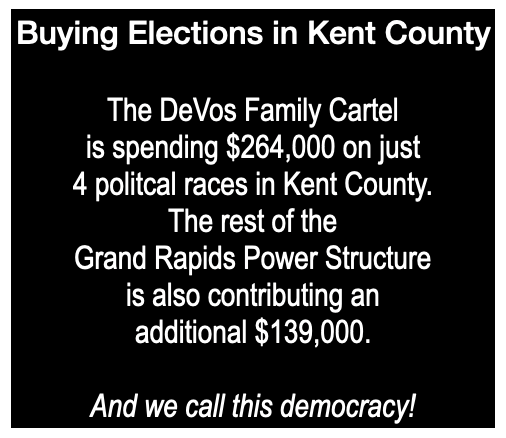
As anyone can see from the data we have provided here the electoral process is automatically corrupted by the influx of large sums of money by members of the Grand Rapids Power Structure. You have 8 members of the DeVos family contributing a total of $264,000 for just 4 Kent County elections, plus we still have 9 months till election day.
Of course, the close associates of the DeVos family, like the Secchia family, John Kennedy, Mark Murray, Mark Bissell and several others are also part of the Grand Rapids Power Structure and are playing their part in determining public policy in this community. Also, in case people were wondering, the TGIF Victory Fund has some of the same funders that are listed above, it’s just another avenue for the Capitalist Class to dictate politics in this community. I know that we were all taught in 8th grade civics class the notion of, “one person, one vote,” but that is not how real electoral politics is played and never has been.
Company that supplies Tesla is using $20 million in public funds to mine nickel in Michigan’s UP
MLive reported yesterday:
“The Michigan Department of Natural Resources (DNR) approved a mineral lease for Talon Metals to explore for nickel deposits under 23,000 acres in Baraga, Houghton, Iron and Marquette counties, the company announced Wednesday, Jan. 31.”

The online news agency also reported, “The approval follows Talon’s 2022 acquisition of mineral rights to explore for deposits on 400,000 private acres in the UP, and a $20 million federal defense grant last year.”
The Upper Peninsula has a long history of being mined, with serious environmental consequences that have been document in books like,
In a previous MLive story, from last September, the reporter stated:
“In 2022, President Joe Biden ordered the Department of Defense to consider five metals — lithium, cobalt, graphite, nickel and manganese — as essential to national security under the Defense Production Act because of their importance to battery technology.”
So, the Biden Administration is declaring certain minerals are essential to national security, but is providing corporate welfare to companies that already make massive profits. In addition, this mining underscores one of the least talked about aspects of the shift to electric cars, which is the need to escalate the mining of certain minerals that are necessary for electric vehicle batteries.
Lastly, all of this is happening on Indigenous land that was taken from them in the 19th Century with the Treaty of Chicago, which was before Michigan even became a state. So, $20 Million in public funds was given to a private corporation, which will contaminate ecosystems in the UP, which the public will then have to pay for. And, all of this is happening on stolen land.
Palestine Solidarity Information, Analysis, Local Actions and Events for the week of January 31st
 It has become clear that the Israeli government will continue their assault on Gaza and the West Bank. The retaliation for the October 7 Hamas attack in Israel, has escalated, therefore, GRIID will be providing weekly links to information and analysis that we think can better inform us of what is happening, along with the role that the US government is playing. We will also provide information on local events and actions that people can get involved in. All of this information is to provide people with the capacity of what Noam Chomsky refers to as, intellectual self-defense.
Information
Defunding UNRWA Is Collective Punishment
American Federation of Teachers Joins Call for Gaza Cease-Fire
U.S. MILITARY PERSONNEL IN IRAQ PUT ON STANDBY TO SUPPORT GROUND INVOLVEMENT IN ISRAEL’S WAR ON GAZA
Israeli Cabinet Members Join Settler Event of Thousands Calling for Ethnic Cleansing of Gaza
Analyst Rips Biden Admin for Touting Record Arms Sales Amid Gaza Carnage
Israel kills hundreds of Palestinians in Gaza after ICJ ruling
Analysis & History
BIDEN STANDS AT THE PRECIPICE OF A GREATER WAR IN THE MIDDLE EAST AND HIS POLITICAL FUTURE
Local Events and Actions
Saturday, February 3 at 1pm
Meet at the corner of 28th Street and East Beltline in solidarity with the Yemeni and Palestinian resistance.
Mall Action for a Free Palestine
Sunday, February 4 at 1pm
Meet at the mall entrance, near Macy’s
Graphic used in this post is from https://visualizingpalestine.org/#visuals
Grand Rapids activists make demands of the Catholic Bishop regarding the current genocidal campaign by Israel against the Palestinians
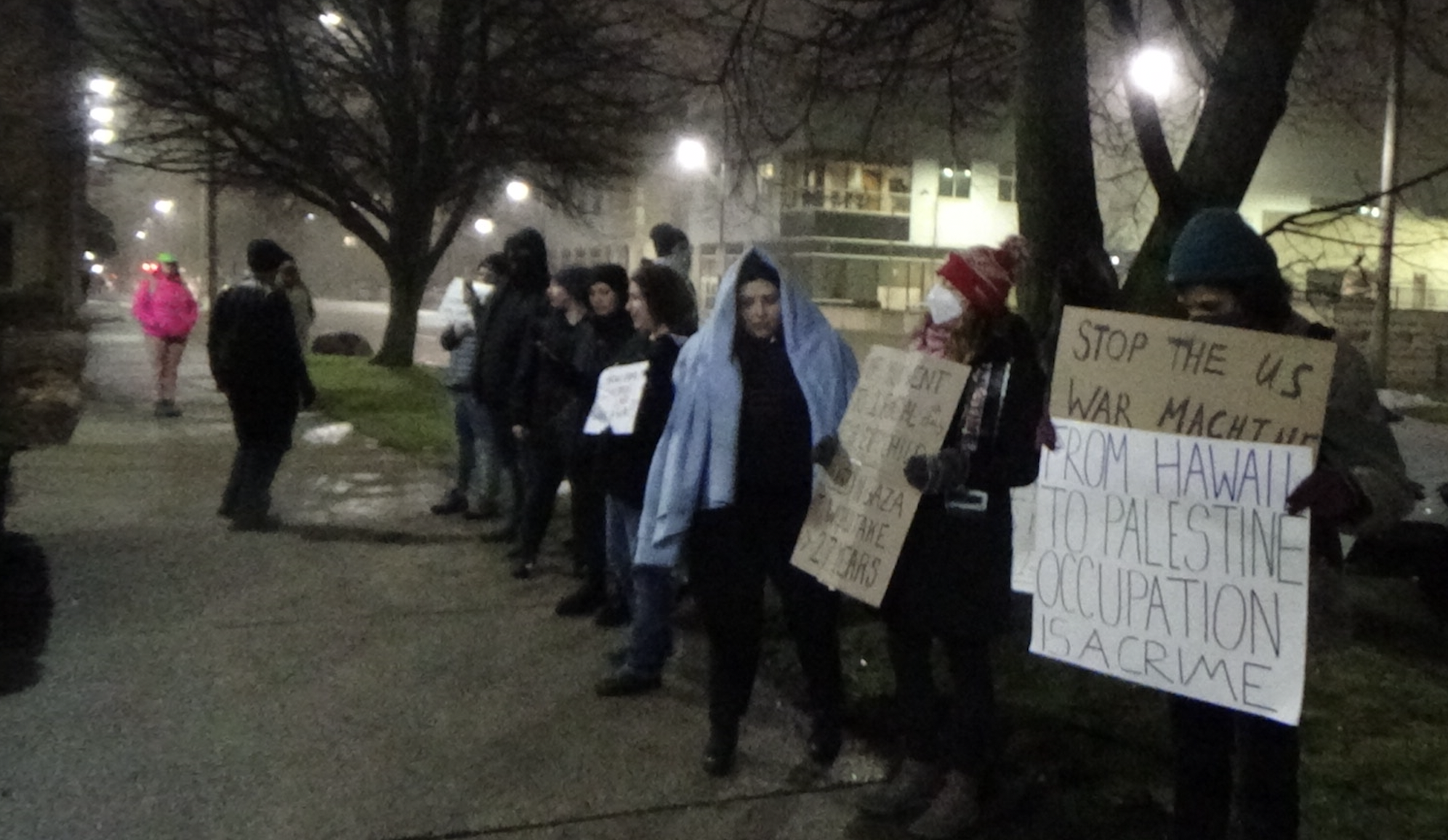
Last night, 15 activists showed up outside of the residence of the Catholic Bishop to make demands that the church leader publicly speak out against what the International Court of Justice (ICJ) has called a genocidal campaign by Israel against the Palestinian people.
Organized by the Comrades Collective, people held signs and chanted out the building on Sheldon SE, which houses the office of the Catholic Bishop and his residence. The Comrades Collective sent out a Media Release, which read:
“The protest is to demand that Bishop David J. Walkowiak make a public statement calling for an immediate ceasefire in Gaza and to demand that the US government end all US Military Aid to Israel.
Bishop David J. Walkowiak is the moral leader of one of the most influential spiritual traditions in West Michigan, thus it is his duty to condemn the current genocidal campaign by Israel against the Palestinians living in Gaza. The International Criminal Court has even called what Israel is doing to the Palestinians as genocidal.
Bishop David J. Walkowiak has spoken out against other political matters, based on his previous statements, which people can view at this link.
To date, there have been more than 25,000 Palestinians killed by the Israel military campaign in Gaza, with the majority of those civilians being women and children. In addition, the Palestinians living in Gaza are facing massive food shortages, along with limited access to water. Lastly, most of the hospitals and other health care facilities in Gaza have been destroyed from the Israeli military assault.
It is imperative that Bishop David J. Walkowiak condemn such actions. In the words of Dr. Martin Luther King Jr., “A nation that continues year after year to spend more money on military defense than on programs of social uplift is approaching spiritual death.” In this instance, it applies both to the Israeli and the United States governments.”
The Comrades Collective also sent Bishop Walkowiak a letter last night stating:
“We are members of a Grand Rapids based social justice group known as the Comrades Collective.
Since early October, we have been participating in numerous non-violent actions throughout the Greater Grand Rapids area, calling for the immediate ceasefire in Gaza and for Israel to stop their brutal assault on Palestinians.
As you probably know the most recent estimates are that over 25,000 Palestinians have been killed during the first 100 days of the Israeli assault on Palestinians, with the majority of those killed being civilians, with roughly 10,000 of them being children.
We are aware of the fact that you have taken a public stance and issue statement on issues that are very political. We are asking you to take a stand now on behalf of the Palestinians.
We are demanding that you issue a public statement calling for an immediate ceasefire in Gaza and to demand that the US government end all US Military Aid to Israel. US Military Aid to Israel is currently $3.8 billion annually.
Bishop David J. Walkowiak, as the moral leader of one of the most influential spiritual traditions in West Michigan, it is your duty to condemn the current genocidal campaign by Israel against the Palestinians living in Gaza. The International Criminal Court has even called what Israel is doing to the Palestinians, as genocidal.
It is imperative that you condemn such actions, to add your name to the growing list of leaders calling for an immediate ceasefire, especially since you can influence so many people who are part of the Catholic faith. In the words of Dr. Martin Luther King Jr., “A nation that continues year after year to spend more money on military defense than on programs of social uplift is approaching spiritual death.” In this instance, it applies both to the Israeli and the United States governments.
We look forward to your response and your commitment to peace and justice. If you would be interested in meeting with some of us to have a conversation, we would welcome that.”
If the Bishop’s office responds, we will provide an update. In the meantime, it is important to ask the question, “How can a religious leader remain silent on one of the most important human rights issues of our day?”
Housing Next has been appointed the spokesperson on the GR Housing crisis, but they only provide false solutions
Within the past month, the local news media has anointed the Grand Rapids Chamber of Commerce-created group, Housing Next, as the “official” spokesperson on the current housing crisis in Grand Rapids.
For example, check out these stories from WOODTV8 from January 12 and January 19th. In these stories the channel 8 reporter talks to Housing Next staff, some developers, people with the Grand Rapids Planning Commission and a few housing non-profits. These groups identify the current housing shortage and even issues around affordability, but the solutions they offer are reformist at best and ultimately false solutions.
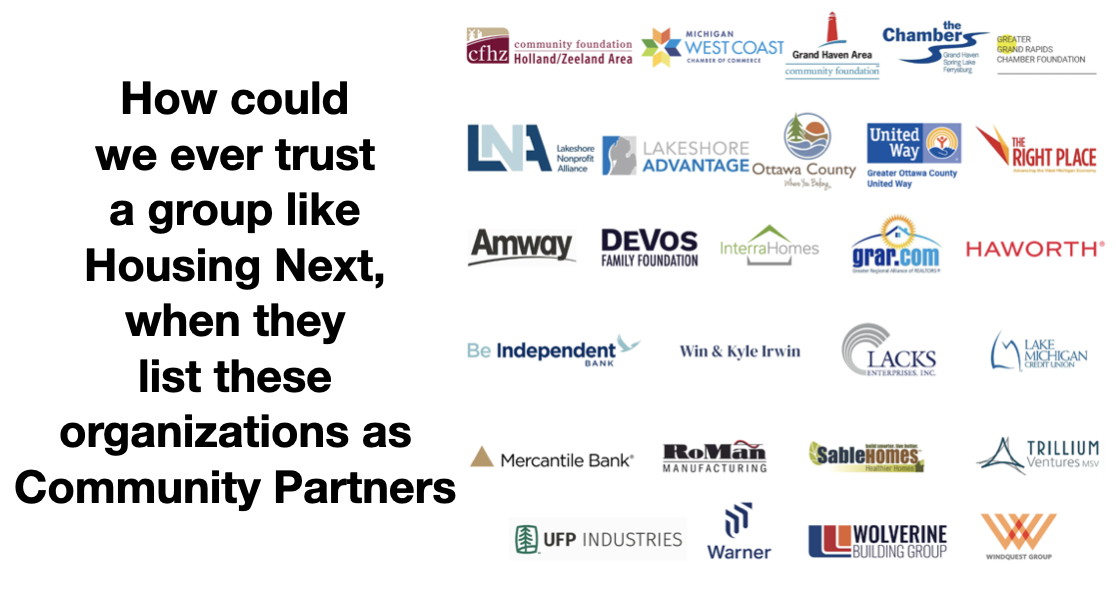
The “solution” to the current housing crisis, according to Housing Next, involves local government, developers and non-profits. The fact of the matter is, Housing Next offers no real solution to the housing crisis, only the same old model, the market. This is not a solution or maybe more aptly named a false solution. This is because under a market system, housing is nothing more than a commodity that can be bought and solid to make profits. For the Chamber and those sectors of society who believe in the market, housing is not a fundamental human right. Housing within a market economy, particularly home ownership, is for those who can afford it, which leaves out millions of people in the US alone.
If you want to understand who is really behind the Housing Next effort, along with the ideological framework they operate under, just look at the list of “community partners” in the graphic above.
Last week, Housing Next sent out an Email encouraging people to attend the Grand Rapids planning commission meeting, in order to adopt some new zoning recommendations. All of these recommendations were reformist and none of them would address the structural issues that are central to the current housing crisis.
In addition, the so-called community partners that Housing Next was inviting to pressure the GR Planning Commission on these false housing solutions consisted on landlords and Property Management Companies, along with people like Greg McNeilly. McNeilly is the CEO & President of the Windquest Group, which is part of Dick and Betsy DeVos’ empire. In his letter to the Grand Rapids Planning Commission, McNeilly used trending terms like “upzoning” to try to influence the planning commissioners.
Not surprising, the Grand Rapids Planning Commission adopted the recommendations from Housing Next, which will eventually have to be approved by the Grand Rapids City Commission.
These false solutions are similar to what Michigan Governor Whitmer announced recently. The statewide coalition known as The Rent is Too Damn High, responded to Whitmer’s housing proposal by stating:
Here’s the truth: Behind the headlines, the Governor’s housing plan is mostly more of the same. It relies on huge giveaways to corporate landlords to build more housing. Landlords are sitting at the table to make these policies; organized renters are not. A small increase in affordable housing is a step to relieve the pain for some, but the rent is going to stay too damn high until we change the power relations at the heart of our housing system. That’s why we’re organizing to build power and demanding the solutions that renters deserve.
 This is exactly what the Grand Rapids Area Tenant Union believes. In fact, the local tenant union believes that it is impossible to address the current housing crisis unless two things are done. First, housing must be taken out of the market and be made a right, where massive amounts of public money can be used to construct Social Housing. Second, until there is greater economic justice, there will always be a housing crisis. According to the most recent data from the Low Incoming Housing Coalition, for people living in the Grand Rapids/Wyoming area, they need to earn $25.50 an hour to afford the average cost of rent in this market. People need to make a living wage, otherwise there will continue to be a large class of people who will continue to not be able to afford rent or the option to purchase a home.
Lastly, as a counter to the false solution narrative of groups like Housing Next, the Grand Rapids Area Tenant Union will be hosting a Tenant Assembly on April 13th in order to not only inform tenants of their rights, but to build power amongst tenants as a means to challenge the power of landlords and property management companies. Check out the flyer included here and check the Facebook page of the Grand Rapids Area Tenant Union to find out how to register for the Tenant Assembly. You can also send an Email to the GR Area Tenant Union to request a registration form, at gratunion@gmail.com.

