Buying Elections: 2024 DeVos family campaign contributions to key Kent County elected positions
 The deadline for election campaign finances were due this past Wednesday, January 31st. As it has been a practice of GRIID for several years now, we plan on post several articles in the coming days specific to the most recent round of campaign finances that are for the 2024 Elections.
Kent County elected positions will be part of the 2024 Elections, with County Commission races and other more administrative positions. Since there have been so few announcements by candidates to challenge Kent County Commissioners, there wasn’t much campaign finance activity. However, the four main administration positions that people get to vote on – County Clerk, County Treasurer, County Prosecutor and the Kent County Sheriff – all had significant campaign contributions reported for this most recent filing deadline.
To access the Kent County Campaign Finance records click on Campaign Finance Report, then you will have to do a search by candidate.
Kent County Clerk – Lisa Posthumus Lyons
Lisa Posthumus Lyons is the current Kent County Clerk and her campaign finances for the most recent filing can be found here. Lyons has raised $97,954.37 since October and she has spent $3,043.47. The total number of contributors was 117, although the bulk of the total amount raised are from just a few large donors.
Largest Contributions
- TGIF Victory Fund – $10,000
- Cheri DeVos – $8,325
- Steve Ehmann – $8,325
- Doug DeVos – $8,325
- Maria DeVos – $8,325
- Dick DeVos – $8,325
- Betsy DeVos – $8,325
- Daniel DeVos – $8,325
- Pamela DeVos – $8,325
- Joan Secchia – $4,000
- Mark Murray – $3,100
- Jim Williams – $2,604.10
- John Kennedy – $2,000
- J.C. Huizenga – $1,200
- Tom Bylenga – $1,200
- Dave Dishaw – $1,050
- Jo DeMarco – $1,040.82
- Mike Ellis – $1,000
- Mark Bissell – $1,000
The total amount of contributions from the lop 16 donors equals $92,794. This means that the remaining 101 contributors gave only gave $5,160 collectively, which is around 5% of what Lyons raised in campaign contributions
Kent County Treasurer – Peter MacGregor
Peter MacGregor is the current Kent County Treasurer and his campaign finances for the most recent filing can be found here. MacGregor has raised $121,893.39 since October and he has spent $4,098.69. The total number of contributors was 149, although the bulk of the total amount raised are from just a few large donors.
Largest Contributions
- TGIF Victory Fund – $10,000
- Cheri DeVos – $8,325
- Steve Ehmann – $8,325
- Doug DeVos – $8,325
- Maria DeVos – $8,325
- Dick DeVos – $8,325
- Betsy DeVos – $8,325
- Daniel DeVos – $8,325
- Pamela DeVos – $8,325
- Daniel Hibma – $8,325
- Heather Lombardini – $8,325
- Joan Secchia – $4,250
- Jim Williams – $2,104.10
- Charlie Secchia – $2,000
- John Kennedy – $2,000
- J.C. Huizenga – $1,200
- Tom Bylenga – $1,200
- David Bilardello – 1,020.82
- Lucas Middleton – $1,000
- Martin Spaulding – $1,000
- Mike Ellis – $1,000
- Mark Bissell – $1,000
The total amount of contributions from the lop 22 donors equals $111,024. This means that the remaining 133 contributors gave only gave $10,869 collectively, which is less than 10% of what MacGregor raised in campaign contributions.
Kent County Prosecutor – Chris Becker
Chris Becker is the current Kent County Prosecutor and his campaign finances for the most recent filing can be found here. Becker has raised $104,578.39 since October and he has spent $1,182.55. The total number of contributors was 105, although the bulk of the total amount raised are from just a few large donors.
Largest Contributions
- TGIF Victory Fund – $20,000
- Cheri DeVos – $8,325
- Steve Ehmann – $8,325
- Doug DeVos – $8,325
- Maria DeVos – $8,325
- Dick DeVos – $8,325
- Betsy DeVos – $8,325
- Daniel DeVos – $8,325
- Pamela DeVos – $8,325
- Joan Secchia – $4,000
- Charlie Secchia – $2,000
- John Kennedy – $2,000
- Jim Williams – $2,000
- Mike Ellis – $1,000
- Mark Murray – $1,000
- Tom Bylenga – $1,000
- Mark Bissell – $1,000
The total amount of contributions from the lop 18 donors equals $100,000. This means that the remaining 87 contributors gave only gave $4,578 collectively, which is around 4% of what Becker raised in campaign contributions.
Kent County Sheriff – Michelle LaJoye-Young
Michelle LaJoye-Young is the current Kent County Sheriff and her campaign finances for the most recent filing can be found here. LaJoye-Young has raised $94,478.39 since October and she has spent $1,355.97. The total number of contributors was 103, although the bulk of the total amount raised are from just a few large donors.
Largest Contributions
- TGIF Victory Fund – $10,000
- Cheri DeVos – $8,325
- Steve Ehmann – $8,325
- Doug DeVos – $8,325
- Maria DeVos – $8,325
- Dick DeVos – $8,325
- Betsy DeVos – $8,325
- Daniel DeVos – $8,325
- Pamela DeVos – $8,325
- Joan Secchia – $4,000
- Charlie Secchia – $2,000
- John Kennedy – $2,000
- Jim Williams – $2,000
- Mike Ellis – $1,000
- Mark Murray – $1,000
- Tom Bylenga – $1,000
- Mark Bissell – $1,000
The total amount of contributions from the lop 17 donors equals $90,000. This means that the remaining 86 contributors gave only gave $4,478.39 collectively, which is less than 5% of what Becker raised in campaign contributions.
When the Grand Rapids Power Structure buys elections
As anyone can see from the data we have provided here the electoral process is automatically corrupted by the influx of large sums of money by members of the Grand Rapids Power Structure. You have 8 members of the DeVos family contributing a total of $264,000 for just 4 Kent County elections, plus we still have 9 months till election day.
Of course, the close associates of the DeVos family, like the Secchia family, John Kennedy, Mark Murray, Mark Bissell and several others are also part of the Grand Rapids Power Structure and are playing their part in determining public policy in this community. Also, in case people were wondering, the TGIF Victory Fund has some of the same funders that are listed above, it’s just another avenue for the Capitalist Class to dictate politics in this community. I know that we were all taught in 8th grade civics class the notion of, “one person, one vote,” but that is not how real electoral politics is played and never has been.
Company that supplies Tesla is using $20 million in public funds to mine nickel in Michigan’s UP
MLive reported yesterday:
“The Michigan Department of Natural Resources (DNR) approved a mineral lease for Talon Metals to explore for nickel deposits under 23,000 acres in Baraga, Houghton, Iron and Marquette counties, the company announced Wednesday, Jan. 31.”

The online news agency also reported, “The approval follows Talon’s 2022 acquisition of mineral rights to explore for deposits on 400,000 private acres in the UP, and a $20 million federal defense grant last year.”
The Upper Peninsula has a long history of being mined, with serious environmental consequences that have been document in books like,
In a previous MLive story, from last September, the reporter stated:
“In 2022, President Joe Biden ordered the Department of Defense to consider five metals — lithium, cobalt, graphite, nickel and manganese — as essential to national security under the Defense Production Act because of their importance to battery technology.”
So, the Biden Administration is declaring certain minerals are essential to national security, but is providing corporate welfare to companies that already make massive profits. In addition, this mining underscores one of the least talked about aspects of the shift to electric cars, which is the need to escalate the mining of certain minerals that are necessary for electric vehicle batteries.
Lastly, all of this is happening on Indigenous land that was taken from them in the 19th Century with the Treaty of Chicago, which was before Michigan even became a state. So, $20 Million in public funds was given to a private corporation, which will contaminate ecosystems in the UP, which the public will then have to pay for. And, all of this is happening on stolen land.
Palestine Solidarity Information, Analysis, Local Actions and Events for the week of January 31st
 It has become clear that the Israeli government will continue their assault on Gaza and the West Bank. The retaliation for the October 7 Hamas attack in Israel, has escalated, therefore, GRIID will be providing weekly links to information and analysis that we think can better inform us of what is happening, along with the role that the US government is playing. We will also provide information on local events and actions that people can get involved in. All of this information is to provide people with the capacity of what Noam Chomsky refers to as, intellectual self-defense.
Information
Defunding UNRWA Is Collective Punishment
American Federation of Teachers Joins Call for Gaza Cease-Fire
U.S. MILITARY PERSONNEL IN IRAQ PUT ON STANDBY TO SUPPORT GROUND INVOLVEMENT IN ISRAEL’S WAR ON GAZA
Israeli Cabinet Members Join Settler Event of Thousands Calling for Ethnic Cleansing of Gaza
Analyst Rips Biden Admin for Touting Record Arms Sales Amid Gaza Carnage
Israel kills hundreds of Palestinians in Gaza after ICJ ruling
Analysis & History
BIDEN STANDS AT THE PRECIPICE OF A GREATER WAR IN THE MIDDLE EAST AND HIS POLITICAL FUTURE
Local Events and Actions
Saturday, February 3 at 1pm
Meet at the corner of 28th Street and East Beltline in solidarity with the Yemeni and Palestinian resistance.
Mall Action for a Free Palestine
Sunday, February 4 at 1pm
Meet at the mall entrance, near Macy’s
Graphic used in this post is from https://visualizingpalestine.org/#visuals
Grand Rapids activists make demands of the Catholic Bishop regarding the current genocidal campaign by Israel against the Palestinians
Last night, 15 activists showed up outside of the residence of the Catholic Bishop to make demands that the church leader publicly speak out against what the International Court of Justice (ICJ) has called a genocidal campaign by Israel against the Palestinian people.
Organized by the Comrades Collective, people held signs and chanted out the building on Sheldon SE, which houses the office of the Catholic Bishop and his residence. The Comrades Collective sent out a Media Release, which read:
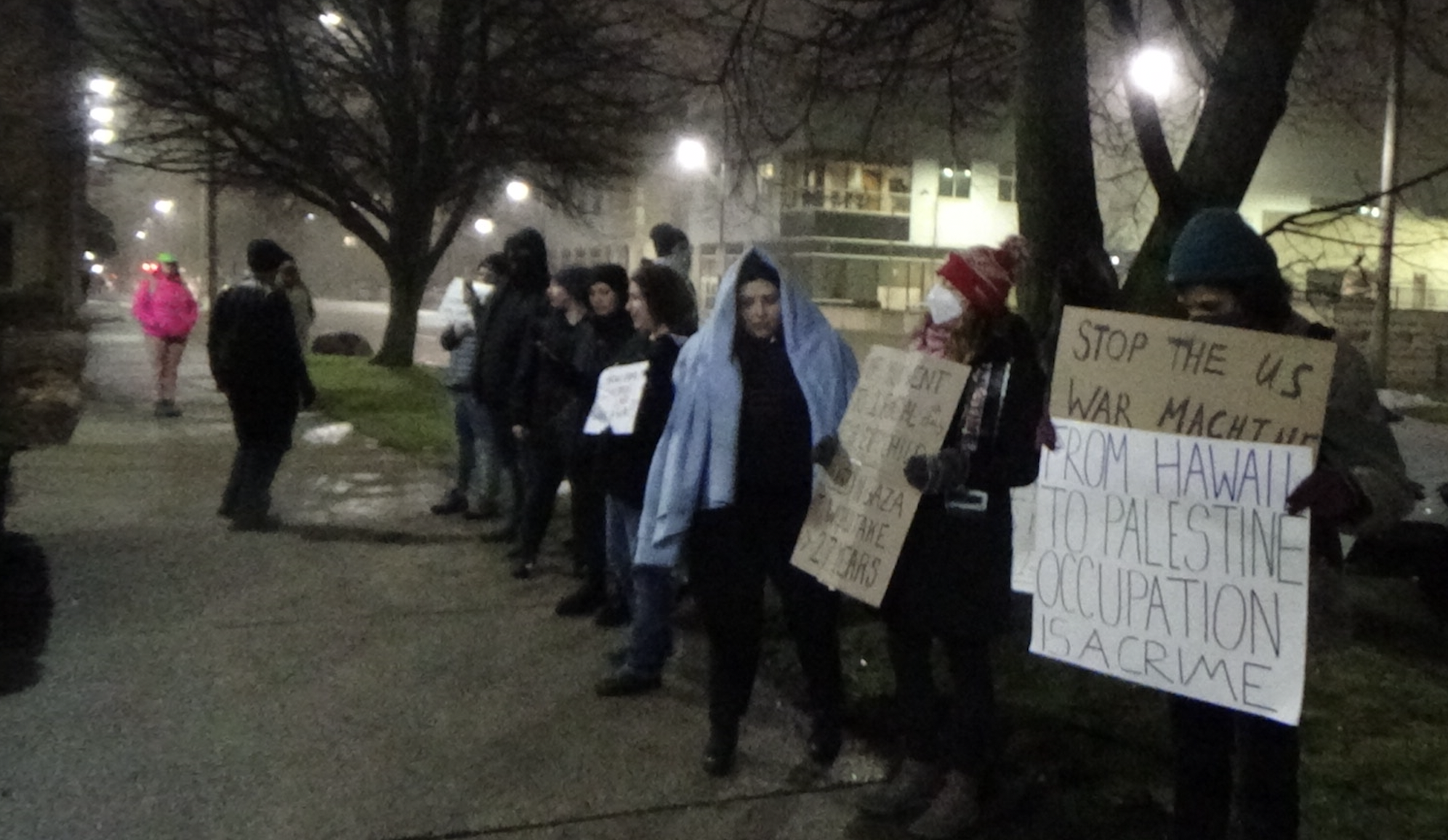
“The protest is to demand that Bishop David J. Walkowiak make a public statement calling for an immediate ceasefire in Gaza and to demand that the US government end all US Military Aid to Israel.
Bishop David J. Walkowiak is the moral leader of one of the most influential spiritual traditions in West Michigan, thus it is his duty to condemn the current genocidal campaign by Israel against the Palestinians living in Gaza. The International Criminal Court has even called what Israel is doing to the Palestinians as genocidal.
Bishop David J. Walkowiak has spoken out against other political matters, based on his previous statements, which people can view at this link.
To date, there have been more than 25,000 Palestinians killed by the Israel military campaign in Gaza, with the majority of those civilians being women and children. In addition, the Palestinians living in Gaza are facing massive food shortages, along with limited access to water. Lastly, most of the hospitals and other health care facilities in Gaza have been destroyed from the Israeli military assault.
It is imperative that Bishop David J. Walkowiak condemn such actions. In the words of Dr. Martin Luther King Jr., “A nation that continues year after year to spend more money on military defense than on programs of social uplift is approaching spiritual death.” In this instance, it applies both to the Israeli and the United States governments.”
The Comrades Collective also sent Bishop Walkowiak a letter last night stating:
“We are members of a Grand Rapids based social justice group known as the Comrades Collective.
Since early October, we have been participating in numerous non-violent actions throughout the Greater Grand Rapids area, calling for the immediate ceasefire in Gaza and for Israel to stop their brutal assault on Palestinians.
As you probably know the most recent estimates are that over 25,000 Palestinians have been killed during the first 100 days of the Israeli assault on Palestinians, with the majority of those killed being civilians, with roughly 10,000 of them being children.
We are aware of the fact that you have taken a public stance and issue statement on issues that are very political. We are asking you to take a stand now on behalf of the Palestinians.
We are demanding that you issue a public statement calling for an immediate ceasefire in Gaza and to demand that the US government end all US Military Aid to Israel. US Military Aid to Israel is currently $3.8 billion annually.
Bishop David J. Walkowiak, as the moral leader of one of the most influential spiritual traditions in West Michigan, it is your duty to condemn the current genocidal campaign by Israel against the Palestinians living in Gaza. The International Criminal Court has even called what Israel is doing to the Palestinians, as genocidal.
It is imperative that you condemn such actions, to add your name to the growing list of leaders calling for an immediate ceasefire, especially since you can influence so many people who are part of the Catholic faith. In the words of Dr. Martin Luther King Jr., “A nation that continues year after year to spend more money on military defense than on programs of social uplift is approaching spiritual death.” In this instance, it applies both to the Israeli and the United States governments.
We look forward to your response and your commitment to peace and justice. If you would be interested in meeting with some of us to have a conversation, we would welcome that.”
If the Bishop’s office responds, we will provide an update. In the meantime, it is important to ask the question, “How can a religious leader remain silent on one of the most important human rights issues of our day?”
Housing Next has been appointed the spokesperson on the GR Housing crisis, but they only provide false solutions
Within the past month, the local news media has anointed the Grand Rapids Chamber of Commerce-created group, Housing Next, as the “official” spokesperson on the current housing crisis in Grand Rapids.
For example, check out these stories from WOODTV8 from January 12 and January 19th. In these stories the channel 8 reporter talks to Housing Next staff, some developers, people with the Grand Rapids Planning Commission and a few housing non-profits. These groups identify the current housing shortage and even issues around affordability, but the solutions they offer are reformist at best and ultimately false solutions.
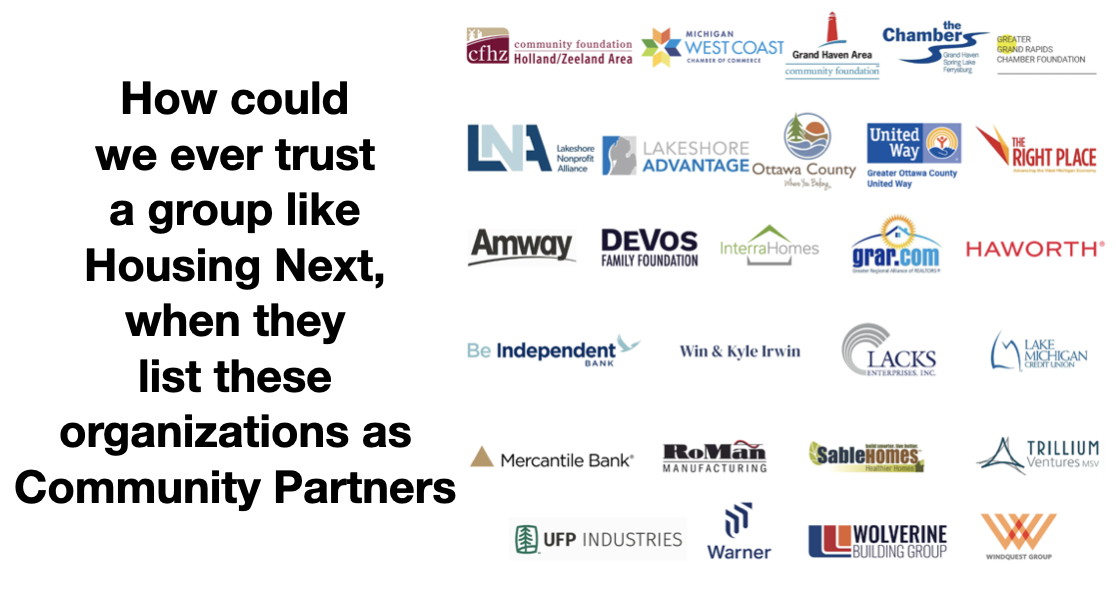
The “solution” to the current housing crisis, according to Housing Next, involves local government, developers and non-profits. The fact of the matter is, Housing Next offers no real solution to the housing crisis, only the same old model, the market. This is not a solution or maybe more aptly named a false solution. This is because under a market system, housing is nothing more than a commodity that can be bought and solid to make profits. For the Chamber and those sectors of society who believe in the market, housing is not a fundamental human right. Housing within a market economy, particularly home ownership, is for those who can afford it, which leaves out millions of people in the US alone.
If you want to understand who is really behind the Housing Next effort, along with the ideological framework they operate under, just look at the list of “community partners” in the graphic above.
Last week, Housing Next sent out an Email encouraging people to attend the Grand Rapids planning commission meeting, in order to adopt some new zoning recommendations. All of these recommendations were reformist and none of them would address the structural issues that are central to the current housing crisis.
In addition, the so-called community partners that Housing Next was inviting to pressure the GR Planning Commission on these false housing solutions consisted on landlords and Property Management Companies, along with people like Greg McNeilly. McNeilly is the CEO & President of the Windquest Group, which is part of Dick and Betsy DeVos’ empire. In his letter to the Grand Rapids Planning Commission, McNeilly used trending terms like “upzoning” to try to influence the planning commissioners.
Not surprising, the Grand Rapids Planning Commission adopted the recommendations from Housing Next, which will eventually have to be approved by the Grand Rapids City Commission.
These false solutions are similar to what Michigan Governor Whitmer announced recently. The statewide coalition known as The Rent is Too Damn High, responded to Whitmer’s housing proposal by stating:
Here’s the truth: Behind the headlines, the Governor’s housing plan is mostly more of the same. It relies on huge giveaways to corporate landlords to build more housing. Landlords are sitting at the table to make these policies; organized renters are not. A small increase in affordable housing is a step to relieve the pain for some, but the rent is going to stay too damn high until we change the power relations at the heart of our housing system. That’s why we’re organizing to build power and demanding the solutions that renters deserve.
 This is exactly what the Grand Rapids Area Tenant Union believes. In fact, the local tenant union believes that it is impossible to address the current housing crisis unless two things are done. First, housing must be taken out of the market and be made a right, where massive amounts of public money can be used to construct Social Housing. Second, until there is greater economic justice, there will always be a housing crisis. According to the most recent data from the Low Incoming Housing Coalition, for people living in the Grand Rapids/Wyoming area, they need to earn $25.50 an hour to afford the average cost of rent in this market. People need to make a living wage, otherwise there will continue to be a large class of people who will continue to not be able to afford rent or the option to purchase a home.
Lastly, as a counter to the false solution narrative of groups like Housing Next, the Grand Rapids Area Tenant Union will be hosting a Tenant Assembly on April 13th in order to not only inform tenants of their rights, but to build power amongst tenants as a means to challenge the power of landlords and property management companies. Check out the flyer included here and check the Facebook page of the Grand Rapids Area Tenant Union to find out how to register for the Tenant Assembly. You can also send an Email to the GR Area Tenant Union to request a registration form, at gratunion@gmail.com.
Palestine Solidarity Information, Analysis, Local Actions and Events for the week of January 24
 It has become clear that the Israeli government will continue their assault on Gaza and the West Bank. The retaliation for the October 7 Hamas attack in Israel, has escalated, therefore, GRIID will be providing weekly links to information and analysis that we think can better inform us of what is happening, along with the role that the US government is playing. We will also provide information on local events and actions that people can get involved in. All of this information is to provide people with the capacity of what Noam Chomsky refers to as, intellectual self-defense.
Information
Biden’s support for Gaza genocide is fueling bigger war
FOR PALESTINIANS, U.S. TALK OF A “REVITALIZED” PA IN GAZA IS CODE FOR OUTSOURCED OPPRESSION
Some Palestinians in Gaza Turn to Animal Fodder for Food as Starvation Sets In
Backed by AIPAC, 62 Dems Join GOP in Condemning Genocide Case Against Israel
Gregory Shupak on Gaza and Genocide
Ironclad Support For Starving, Blinding, Shattering Children
Analysis & History
The Historical Roots of Israel’s Purge and Purify Strategy
Gaza: A Ghastly Window into the Crisis of Global Capitalism
Solidarity During a Time of Genocide: Why Gaza Matters
Local Events and Actions
Thursday, January 25 from 6 – 8pm
Documentary Night – And There Was Israel
Details at https://www.facebook.com/events/1232847551005134?ref=newsfeed
Michigan’s minimum wage is now $10.33: Why minimum wages in the US are insultingly low and the failure of partisan politics
On January 1st of this year, the minimum wage in Michigan went from $10.10 and hour to $10.33 an hour. Imagine trying to live off of this insultingly-low of a wage.
For those who are 16 or 17 in Michigan, the minimum wage is worse, landing at $8.78 an hour. For tipped wage earners, their hourly wage in $3.93 an hour, adding new meaning to the term exploitation.

The fact is that individuals and families who are paying for rent, utilities, transportation and food, cannot live off of the minimum wage in Michigan. Actually, most people can’t live off $15 an hour. And, according to the Low Income Housing Coalition, for people living in the Grand Rapids/Wyoming area, they need to earn $25.50 an hour to afford the average cost of rent in this market.
The above data helps us to properly put the housing crisis into perspective. While groups like the Grand Rapids Chamber of Commerce created Housing Next like to frame the housing crisis around zoning or supply and demand, the fact is that the income of most working class individuals and families is completely inadequate to afford most rental costs and the capacity to purchase a home.
What is needed in Michigan is not just more housing units, but for people to be able to earn a living wage. In addition, we need to remove housing from the free market and move towards social housing. This is one of the components of what the Rent is Too Damn High Coalition was proposing last fall, when tenants and other groups came together to make demands of state policy makers. And while Michigan Democrats were in control of state government, they fundamentally ignored these demands (listed below, with more details in this link) by not even holding a single hearing on the housing crisis last fall.
- Rent Control – Remove the state-wide ban on rent control so municipalities can take action to stabilize rents and protect tenants.
- Social Housing – $4 billion for social housing in FY25 state budget.
- Housing First – $1 billion for people experiencing and at risk of homelessness in FY25 state budget.
- A Renter’s Bill of Rights – Renters around the country are insisting on more protections against landlord abuse and empowerment of renters as a class
In 2024, Michigan Democrats are not likely to embrace the list of demands from the Rent is Too Damn High Coalition, in part because this is an election year, along with the fact that the Democrats no longer control a majority of the State House.
What the Rent is Too Damn High Coalition is proposing for 2024 is to keep pressuring the State Legislature to meet these four demands, while simultaneously hosting Tenant Assemblies across the state, with one scheduled in April right here in Grand Rapids. Right now there is an interest in building tenant power in order to achieve housing justice, especially without relying exclusively on partisan politics.
In addition, Michigan might benefit from having a state ballot initiative to dramatically raise the minimum wage. People in other states are realizing the importance of such campaigns, since partisan politics has utterly failed the public around wage increases. For nearly twenty years there has been a push to make $15 an hour the new minimum wage. However, while $15 an hour might have worked in 2000, in 2024, $15 an hour is grossly inadequate.
Right now there are currently 22 campaigns across the US to raise the minimum wage. Communities in Michigan should seriously consider such a campaign in this state, not only because of the effectiveness of the Abortion Rights ballot initiative in 2022, but primarily because most people would embrace having a livable wage and a minimum wage of no less than $25.00 an hour.

When the Democrats took control of the Michigan Legislature in 2022, they talked a great deal about wanting to put more money in the pockets of working class residents. However, for Democrats that meant adopting minor reformist economic policies, which have had little impact to create economic security for the majority of Michiganders. A $25 minimum wage ballot campaign would actually put more money into the pockets of working class people in this state and is something for organizers to seriously consider in 2025, since the minimum wage in Michigan will only be a measly $10.56 an hour. People deserve better.
Both Michigan Senators Gary Peters and Debbie Stabenow vote against a resolution that would scrutinize future US military aid to Israel
On Tuesday, the US Senate voted to table a resolution introduced by Vermont Senator Bernie Sanders, which would put conditions on any future US military aid to Israel. The proposed resolution is an update to the 1961 Foreign Assistance Act.
The primary question within the resolution that Sen. Sanders put forth was, “Do you support asking the State Department for information on whether human rights violations may have occurred using U.S. equipment or assistance in Israel’s current military campaign?”
The resolution, linked here, provides some political leverage that Congress could adopt. However, the resolution does not go far enough. In a statement released by Sen. Sanders he states. “This resolution is not prescriptive – it does not alter aid to Israel in any way. It simply requests that the State Department report on how our aid is being used…I hope it is not controversial to ask how U.S. weapons are being used.”
Interestingly enough, even though this resolution only shines the light on how US military aid to Israel would be used, most members of the Senate voted to table to resolution in a 72 – 11 vote. Both Michigan Senators Gary Peters and Debbie Stabenow voted to table the resolution.
Part of the reason for tabling the vote is summed up well in an article from the Roll Call:
Senate Foreign Relations Chairman Benjamin L. Cardin, D-Md., made the motion to table Sanders’ motion, averting a floor vote on an issue that many Democrats wanted to avoid. Though many of them acknowledge the civilian cost of Israel’s effort to eliminate the Palestinian militant group Hamas from the Gaza Strip, they also don’t want to be seen as critics of Israel’s response to Hamas’ deadly attack on Oct. 7, 2023.
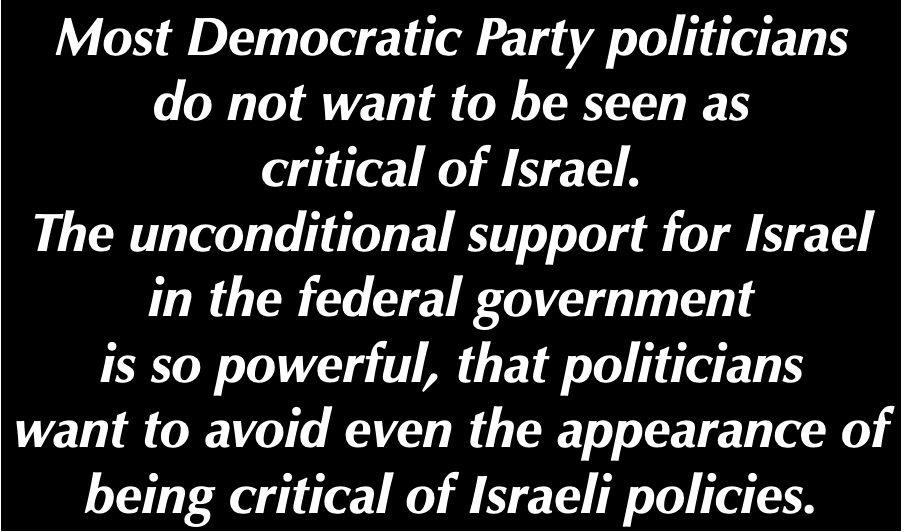
The last sentence in Sen. Cardin’s comment underscores what is at issue here…….the fact that most Democratic politicians do not want to be seen as critical of Israel. The unconditional support for Israel in the federal government is so powerful, that politicians want to avoid even the appearance of being critical of Israel. This fact is reflected in the data below, provided by Open Secrets, which shows that since 1990, the Democrats have always been the larger recipient of Pro-Israel PACs.

Palestine Solidarity Information, Analysis, Local Actions and Events for the week of January 15th
 It has become clear that the Israeli government will continue their assault on Gaza and the West Bank. The retaliation for the October 7 Hamas attack in Israel, has escalated, therefore, GRIID will be providing weekly links to information and analysis that we think can better inform us of what is happening, along with the role that the US government is playing. We will also provide information on local events and actions that people can get involved in.
Information
How Israel Uses an AI Genocide Program to Obliterate Gaza
Israel blocking aid, fuel to Gaza hospitals
100 Days Into Genocide, Nearly 100,000 Palestinians Killed, Injured or Missing
ISRAEL BOMBED AN AL JAZEERA CAMERAMAN — AND BLOCKED EVACUATION EFFORTS AS HE BLED TO DEATH
Analysis & History
Watch: A collection of breakdowns and analyses of resistance videos from Gaza
Local Events and Actions
See graphic included in this post for protest at GVSU.
Direct Action/Civil Disobedience Training for Gaza
Sunday, January 21st, beginning at 2pm. Details in the link.
A military contractor in the Grand Rapids area was called out for their role in the Israeli genocidal campaign in Gaza
We are now into the fourth month of the Israeli assault on Gaza, which began immediately after the October 7 attack from Hamas.
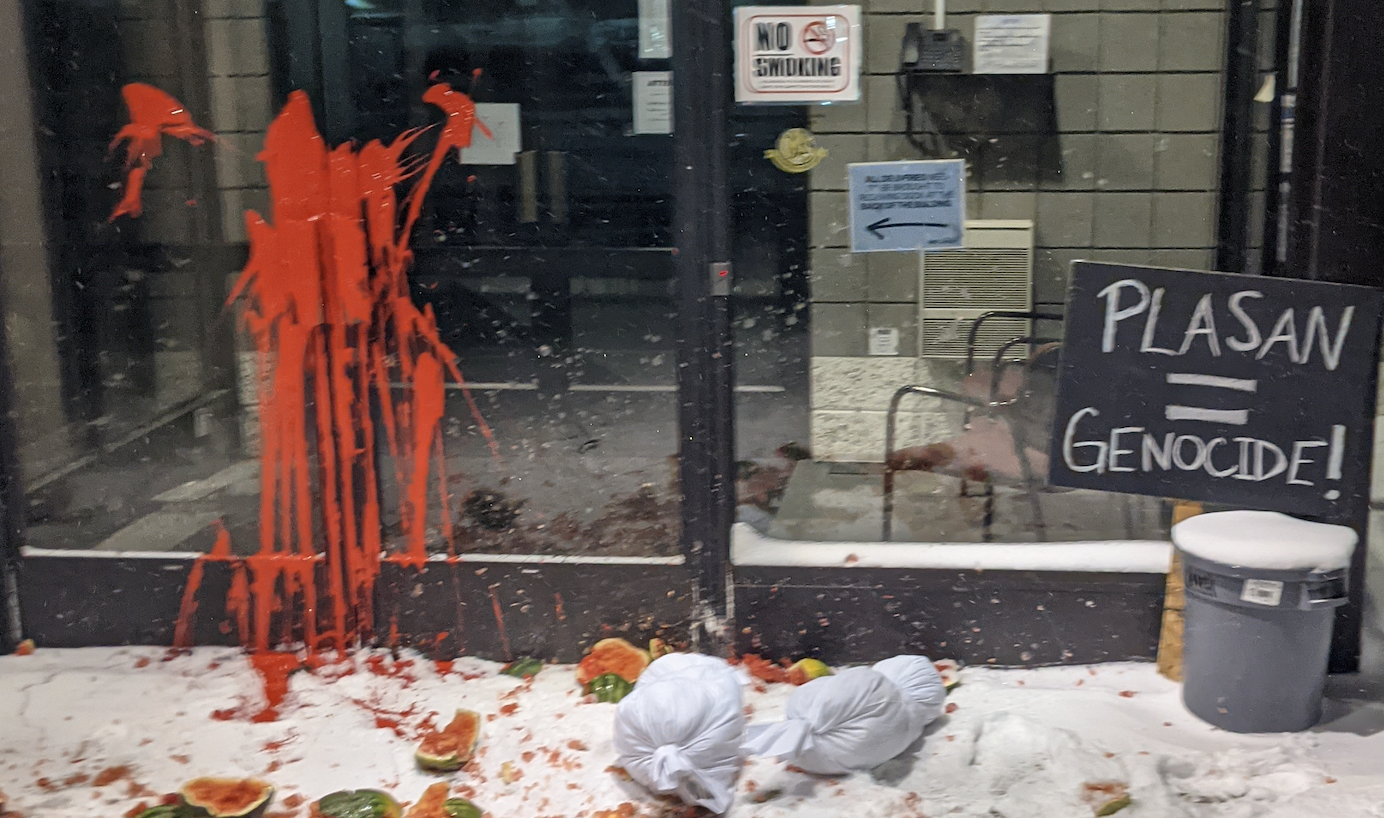
Since that time, GRIID has posted two articles about the Israeli-owned military contractor in Walker, Michigan, known as Plasan North America.
In early November, GRIID posted a piece about the Israeli company, with information about the kinds of military contracts they have, the parts they manufacture for military vehicles, the company’s relationship with The Right Place Inc., and the company’s involvement in the statewide group called the Michigan Israel Business Bridge (MIBB).
Then in December, GRIID posted a follow up story with information on research done by the American Friends Service Committee, which published a report on military contractors that are profiting from the current Israeli 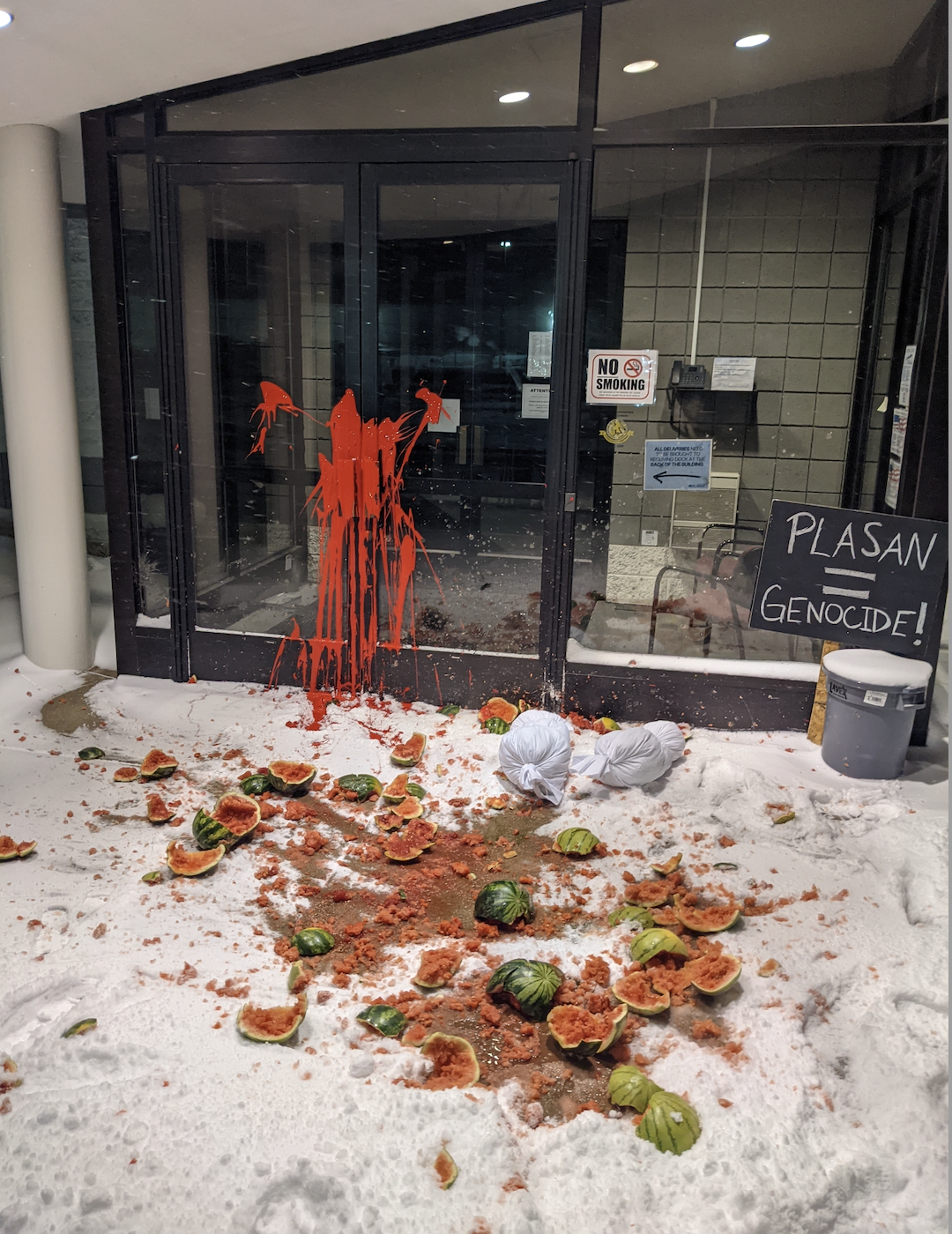 assault on Gaza. The report included the following information for Plasan North America:
- A private Israeli military vehicle manufacturer that makes the SandCat light armored vehicle for the Israeli military. At least some of these vehicles are manufactured at the company’s factory in Grand Rapids, Michigan.
- Since Oc. 7, Plasan has delivered dozens of SandCat Tigris armored vehicles to the Israeli military and has produced “hundreds of ballistic plates every day” for its use.
- The company also makes the armor for Oshkosh’s Joint Light Tactical Vehicles (JLTVs). According to the section in the AFSC report – “In October, Israel requested to purchase 75 Oshkosh Joint Light Tactical Vehicles for its 2023 attack on Gaza.” In addition, Plasan makes AM General’s Humvees and JLTVs, which are included in the AFSC report. The Israeli military has used all of these vehicles in its 2023 attacks on Gaza.
- On Dec. 6, a U.S. cargo plane delivered Plasan-armored Humvees to Israel.
The photos that GRIID obtained from an anonymous source shows the front of the Company’s building, with a sign that says, Plasan = Genocide, paint in their windows to symbolize blood, two items wrapped in bed sheets to symbolize how Palestinians are burying their dead children, and watermelons, which are a symbol of the Palestinian resistance, a symbol that has been in use since the 1967 war.

