Last week, a worker at WOODTV8, posted a comment on social media stating that management at channel 8 had sent out a memo, which said that they were going to scale back on Pride coverage and that if they are covering Pride events to “consider how to make the story balanced and get both sides of the issues,” according to a story on MLive.

The MLive article also cited a WOODTV8 News anchor Michele DeSelms, who wrote on Twitter that by mandating staff cover the “other side” of Pride events, they would be required to give “equal time to hate and discrimination.” DeSelms also stated:
“Our newsroom immediately stood up to the 2 managers who wrote a memo mandating that we cover ‘the other side’ of Pride events: essentially requiring us to give equal time to hate and discrimination. We said no, and will continue to fight for our LGBTQ colleagues, family members, friends and the community. This fight is not over.”
These comments, and others, from channel 8 staff are encouraging. In addition, A spokesperson for Nexstar Media Group, the corporate parent of WOOD TV, issued an apology Thursday, June 15, and said the memo isn’t consistent with the company’s values.
“We’re looking into the situation at WOOD-TV, as the communication regarding the station’s coverage of Pride month activities in the area is not consistent with Nexstar’s values, the way we cover the news, or the respect we have for our viewers,” said Nexstar spokesperson Gary Weitman.
Personally, I’m not convinced by the Nexstar “apology”, considering that broadcast media conglomerates are primarily driven by ratings, not by content or journalistic integrity. As someone who has monitored the local commercial media market in West Michigan over the past three decades, I can tell you that providing space for anti-LGBTQ voices and perspectives happens all the time, whether those voices are coming from the political right or the religious right. In fact, so much of the parent push-back on book bans and school curriculum is driven by organized homophobia and transphobia. And the parent groups, politicians and religious leaders who take an anti-LGBTQ point of view are regular sources in local news media reporting, including WOODTV8.
A second point about this controversy over reporting on LGBTQ issues, like Pride, is that to the degree that there has been improvement from local newsroom is a direct result of the decades-long organizing that the LGBTQ movement has done to challenge institutions like the news media. We need to always remember this point, whether we are talking about racial justice or LGBTQ justice, the work of movements is at the root of why things have changed or improved.
WOODTV8 giving space to the Religious Right and the LGBTQ movement holding them accountable
In 2009, the Indymedia group I was involved in, Media Mouse, posted this story on how WOODTV8 was planning on providing an anti-LGBTQ group a slot to post their hate message. Here is that story:
According to reports in the Grand Rapids Press and online, WOOD-TV is considering airing a paid program produced by the American Family Association that purports to expose “the radical homosexual agenda” and “its impact on the family, the nation, and religious freedom.”
 The special–titled “Speechless”–was originally supposed to air on WOOD TV an hour before President Barack Obama’s news conference Monday. However, the program was pulled because the station believed that it was not the appropriate lead-in to the news conference. WOOD TV 8’s General Manager released a statement saying:
“The scheduling of the show slipped through our filters…
We don’t pre-judge people’s ideas or opinions…
However, we have restrictions on controversial programming and key time periods. We are willing to sell a paid program time period during traditional paid program times. We have offered them Saturday, Feb. 14, 2009 from 2-3 p.m. We have not heard if they have accepted that time period. If the show airs, we will have disclaimers at the beginning and end of the show stating that these are not the opinions or views of this station.”
WOOD TV is clearly intending to run the program–lets not forget that it will make them money–thereby ignoring the anti-gay nature of the program. Critics have pointed to the American Family Association’s history of anti-gay activism as well as inaccurate claims made in the film as reasons for the station not to air it.
Colette Beighley of Grand Valley State University’s Lesbian, Gay, Bisexual, and Transgender Resource Center called the program “irresponsible programming” in The Grand Rapids Press stating:
“If an organization came into Grand Rapids and wanted to air biased programming slamming the Asian community, West Michigan would send a message that that puts Asians brothers and sisters at risk.” Beighley also said. “Grand Rapids wants to be a cool city and one of the cornerstones of a cool city is diversity.”
There was also a Facebook group that got lots of people to contact WOODTV8 and demand that they not give the American Family Association airtime to promote their anti-LGBTQ ideology. The campaign was effective and channel 8 pulled the plug, thus denying the American Family Association an opportunity to broadcast their hate-filled message in West Michigan.
Juneteenth celebrations are happening all throughout Grand Rapids over the next several days, like the one that is happening on Monday, June 19th at Dickinson Park.
Interestingly enough, when I visited the City of Grand Rapids site, I came across information about how most City services will be closed on Monday, in observation of Juneteenth. Certainly one might think, well how nice that the City of Grand Rapids is not only acknowledging Juneteenth, but giving many of their employees the day off. I’m not as excited by the City’s announcement, in fact, I am pissed off by it.

Juneteenth is celebrated because on June 19th 1865, some 2,000 Union troops arrived in Galveston Bay, Texas to make sure that Black people who were still enslaved in Texas would be able to gain their freedom. The army announced that the more than 250,000 enslaved black people in the state, were free by executive decree. This day came to be known as “Juneteenth,” by the newly freed people in Texas.
So, if Juneteenth is rooted in Black people gaining their freedom, then shouldn’t we evaluate the City of Grand Rapids’s current treatment of Black people in this community? Actions do speak louder than words.
Grand Rapids and the Black Community
There are no shortage of metrics to figure out how Black people are doing in Grand Rapids and how committed the City of Grand Rapids is to supporting the only emancipation of Black people.
According to a Kent County Health Department report, 32.9% of Black people live in poverty in Grand Rapids.
The City of Grand Rapids has not adequately invested in the 3rd Ward, where a disproportionate number of Blacks live. However, the City doesn’t hesitate to spend millions when it comes to projects like the downtown Amphitheater.
Most Black people living in Grand Rapids do not make a living wage, which means a disproportionate number of Black people do not own homes and are forced to rent. However, even with rental costs at an all time high, according to the National Low Income Hosing Coalition, rental costs in Grand Rapids would require people to make on average $25.50 an hour to afford rent.
The level of policing by the GRPD in Black neighborhoods is disproportionately higher than white majority neighborhoods. Black people continue to be targeted, harassed and intimidated by the GRPD, which results in their being a higher incarceration rate for Black people from Grand Rapids.
Black-led groups like Defund the GRPD have been demanding a reduction of the GRPD’s budget since 2020, a reduction to at least the 1995 Charter minimum of 33% of the budget. This would free up millions that could be invested in the Black community to meet the needs that they would determine.
The GRPD murder of Patrick Lyoya, despite BIPOC organizers pleas to defund, plus these same organizer predicted this would happen. On top of that, since Patrick’s murder, the BIPOC organizers who have been speaking out against his death at the hands of the GRPD, which has resulted in the GRPD targeting them with harassment and arrest. Even a Coalition of Grand Rapids Pastor’s called out the city for their treatment of people protesting Lyoya’s murder.
These are only a few examples of how Black people are treated in Grand Rapids. However, the evidence is pretty damning and if Grand Rapids wants to really celebrate and honor Juneteenth, then they ought to work on advocating for the ongoing freedom that Black people deserve.
The Political function of Philanthropy: DeVos Family Foundations – Dick and Betsy DeVos Foundation
“In any case, the hidden hand of of foundations can control the course of social change and deflect anger to targets other than elite power.”
– Joan Roelofs, Foundations and Public Policy
For the past 10 years, GRIID has been monitoring foundations in West Michigan, particularly the large family foundations that those who are part of the Grand Rapids Power Structure have created. Our monitoring of local foundations has been part of our larger critique of the Non-Profit Industrial complex in Grand Rapids.
Over the next several weeks, GRIID will provide some information and analysis of the most recent 990 documents that foundations are legally required to submit. These 990 documents must be submitted within a three-year period, which is why the 990s that we will be examining are from 2020, since most foundations prefer to submit their 990 documents at the last minute, thus minimizing possible scrutiny.
Dick and Betsy DeVos Foundation
GRIID has always begun our Foundation Watch work by looking at the foundations associated with the most powerful family in West Michigan, the DeVos family. The Dick and Betsy DeVos Foundation has been one of the largest in West Michigan, which was founded in 1989, the same time that Dick DeVos was the CEO of Amway. According to GuideStar, in 2020, the Dick and Betsy DeVos Foundation contributed $12,994,900, leaving them with $50,056,750 of funds left in their foundation. To see the 990 document for 2020 from the Dick and Betsy DeVos Foundation, go here.
The Dick and Betsy DeVos Foundation made contributions to dozens of entities in 2020, but there are some clear categories of groups they contributed to, such as the Religious Right, Think Tanks, Education-centered groups, and social service entities, to name a few. Below is a listing of each from these categories, with a dollar amount and a brief analysis.
We also include groups that are DeVos owned or created, along with liberal non-profits. With the liberal non-profits, we believe that funding from foundations like the DeVos family foundations is a form of hush money. When we say hush money, we mean that these entities will not publicly challenge the system of Capitalism, the wealth gap, structural racism and other systems of oppression, which the DeVos family benefits from and perpetuates through their own political funding.
Religious Right
- Family Legacy Missions International – $10,000
- Haggai Institute International – $10,000
- Museum of the Bible Inc. – $50,000
- Partners Worldwide – $25,000
- Right to Life of Michigan – $25,000
- School of Missionary Aviation Technology – $120,000
- Teachers Who Pray Inc – $100,000
- Willow Creek Association – $860,000
These religious groups practice varying degrees of conservative politics, which fit into the ideological framework that the DeVos family is committed to. For instance, Right to Life Michigan spent $9,343,500 to defeat Prop 3, which allows people to legally chose to have an abortion.
Far Right Think Tanks
- Acton Institute – $70,000
- American Enterprise Institute – $350,000
- Claremont Institute for the Study of Statesmanship and Political Philosophy – $640,000
- Mackinac Center for Public Policy – $50,000
- National Review Institute – $150,000
- Prager University Foundation – $70,000
These Think Tanks influence public policy in individual states, like the Acton Institute and the Mackinac Center for Public Policy does in Michigan. The American Enterprise Institute does the same think at the federal level, which is why they are based in DC.
Education-centered groups
- Alliance for School Choice – $1,000,000
- Ferris State University – $10,000
- Foundation for Excellence in Education – $10,000
- Grand Rapids Community College Foundation – $150,000
- Grand Rapids Student Advancement Foundation – $25,000
- Grand Valley State University – $150,000
- Holland Christian Education Society – $100,000
- Michigan State University – $212,500
- Northwood University – $253,000
- Potter’s House – $400,000
- University of Maryland Park College Foundation – $750,000
Some of these education centers are local, where the DeVos family has spent decades cultivating relationships and influencing campus policies. Then there are groups like Alliance for School Choice, which promotes education privatization, an organization that has worked closely with Dick and Betsy DeVos for several decades.
DeVos-owned, created or connected groups
- ArtPrize Grand Rapids – $250,000
- Grand Action Foundation 2.0 – $100,000
- Grand Rapids Initiative for Leaders – $10,000
- Orlando Magic Youth Foundation – $90,000
- Start Garden Foundation – $200,000
- West Michigan Aviation Academy – $390,000
Of course all these entities that were created by DeVos family members, also promote their ideological religious and capitalist values. On top of that, it also means that DeVos family members are funding their own entities and using their foundation to fund their own pet projects, like Start Garden – which promotes entrepreneurial capitalism – or the West Michigan Aviation Academy – because it promotes the privatization of education.
Groups receiving Hush $
- Dégagé Ministries – $105,000
- Dwelling Place of Grand Rapids – $200,000
- Family Promise of Grand Rapids – $100,000
- Inner City Christian Federation – $25,000
- Kids Food Basket – $5000
- Mel Trotter Ministries – $5000
- Wedgewood Christian Services – $255,000
These groups all provide some sort of social service – people fleeing domestic violence, those who are housing insecure, people with disabilities, adoption and immigration. There are root causes to all of these issues, but these groups are not likely to address root causes and larger systems of oppression. When the DeVos family foundations make contributions, this will increase the likelihood that systems of oppression will not be addressed by these groups.
Foundations rarely make contributions without strings attached. The Dick and Betsy DeVos has a long history of funding far right and religious right groups, which GRIID documented 10 years ago when we started this project. Lastly, it is worth noting that the Dick and Betsy DeVos Foundation, like all of the DeVos family foundations, compliments the campaign contributions they make to further impact public policy and promote their religious and capitalist ideologies.
On Monday, a headline from MLive read, Parking, sound generate conversation at Grand Rapids amphitheater open house. This article was based on a public forum that Grand Action 2.0 held regarding the 12,000 seat amphitheater that will begin construction in May of 2024.

I get that issues like sound and parking are of concern to people, particularly those who live near the proposed Market Ave SW site, but the MLive story, like most of the coverage since 2020, when the first announcement of the about the amphitheater, has always talked about the project in favorable terms without asking larger, more investigative questions.
I attended the zoom meeting on Monday, which was held earlier in the day, with only a dozen people participating, not including a Grand Action 2.0 spokesperson and two people with Progressive AE, the firm that is doing the design for the project. The session only lasted 30 minutes and provided very little new information. I was the only non-business person on the zoom call.
The Progressive AE person had lots of fancy slides to show, but not much information, particularly on what the project will cost or how much public money was going to be used. However, I do want to address some of the content in the slides, plus a few additional points that have pretty much been ignored since we first learned about the amphitheater proposal in 2020.

In the first slide, with the heading Economic Impact, we are led to believe that the amphitheater project will be good for the economy. I would argue that these numbers are misleading at best, even irrelevant to most people in Grand Rapids. First, $7 million in annual wage earnings doesn’t tell us much since, we do not know how many people will benefit from this $7 million. Like many of these projects, a large percentage will go to those in charge, which will be booking the musical acts and managing the site. The people who tend to maintain the space, those who take tickets or work concessions often do not make a living wage. Second, there are numbers for job creation, but again, we don’t know if they are full-time or part-time, if they pay a living wage, what kind of benefits will people get, etc. Third, there is this $490 Million projected economic impact for the City over a 30 year period. Again, no mention of how much of that money will go to downtown hotels, restaurants, private parking companies, bars, etc. We know who owns most of the companies that will be the primary beneficiary of this 30 year economic impact and it won’t people those who are currently experiencing poverty or housing insecurity.

In this second slide we are provided with another laundry list of so-called benefits from this development project – more housing, river activation, local, minority-owned pop-up restaurants, shops, etc, plus the added claim that the whole project “will generate lasting community and cultural enhancements.” I’ll address housing in the next slide, but lets start with minority-owned pop-ups, etc. It seems rather fashionable for projects like these to make claims about hiring Black contractors or claiming it will create minority-owned business opportunities. Such claims are part of the whole DEI rhetoric that ultimately doesn’t benefit the majority of people from BIPOC communities. If the City of Grand Rapids and Grand Action 2.0 really want to do something that would benefit BIPOC communities, how about giving the “expected to exceed $116 million” cost of the amphitheater to BIPOC communities and let them do what they want with it.

In this third slide, we see a more detailed look at the larger development project, both of the amphitheater and the adjacent areas, particularly proposed housing. Now, the previous slide it says mix-income housing, but that is rather vague and often means that a very small percentage of the housing will be listed as “affordable.” So, we don’t know if these will all be apartments or condos. More importantly, we don’t know how much the rent will be for the proposed apartments. Then there is the issue of a private developer being involved with the land just south of the amphitheater, where it says 300 – 400 units, 600 spaces. During the Progressive AE presentation, the design firm spokesperson said that this was going to be a private developer project, without any additional information. All of us on the zoom were given an e-mail of one of the Progressive AE representatives, so I sent them a message, asking who this private developer was. I have yet to hear back. Lastly, there is the issue of what impact will this development project have on neighborhoods, particularly to the south, along the Grandville Avenue corridor or the Black Hills neighborhood. Both of these neighborhoods are primarily Latino/a and Latinx, with medium to lower incomes. What impact will the cost of housing in the new 31 acre Market Avenue corridor have on these adjacent neighborhoods? Will raise property taxes and rental costs? Will it begin a process of gentrification? These questions have not been explored in the presentations by Grand Action 2.0 and Progressive AE, nor the commercial news media, but these questions need to be explored.
Lastly, I wanted to address the issue of how much public money is going into this ever growing development project. When GRIID first wrote about this issue in the fall of 2020, I made the point that these types of projects are met with such enthusiasm by the business community and local government officials. However, the same kind of enthusiasm and funding is rarely applauded when it comes to investing in BIPOC communities.
More recently, I looked at how much this project will cost the public and I came up with $58 million from local and state government, which means it’s public money. On top of that it was reported in the business press that Grand Action 2.0 will be seeking brownfield development incentives. This means that public money will be used to clean up the site, before new development happens, which translates into even more public money being directed to the amphitheater project, even though the public has no say it the matter. But this is always the case, since such projects are always designed to benefit the wealthiest people who want to continue to create a downtown play space for themselves and to entertain other privileged people – ie tourists, who come and spend money at businesses in the downtown area that are primarily owned those with deep pockets.
It has been almost a year since the Grand Rapids Chamber of Commerce first sent a letter to the City Commission complaining about unhoused people in downtown Grand Rapids.

Then, a second letter complaining about the unhoused was sent in September, this time from a downtown Grand Rapids Law Firm, which GRIID also wrote about.
In December, the Grand Rapids Chamber of Commerce had sent a proposed ordinance to Grand Rapids City officials, a proposal that would essentially criminalize the unhoused. This letter was accompanied by a letter of support, with 120 signatories, most of the business people and several members of the Grand Rapids Power Structure, just days after the December 6th ordinance proposal from the Chamber.
In response, a coalition of groups, led by the Grand Rapids Area Tenant Union, called for a boycott of downtown Grand Rapids and the Chamber of Commerce the very next day. Part of the boycott involved a protest at the Grand Rapids Chamber of Commerce headquarters, where people occupied their office and demanded that they rescind the ordinance proposal and apologize for wanting to criminalize the unhoused.
Because of these efforts, the City of Grand Rapids was confronted by the public, demanding they not embrace the ordinance proposal from the Chamber of Commerce. The City did not move forward with the proposed ordinance, but that hasn’t meant they weren’t entertaining other possibilities to further police and criminalize the unhoused.
In March, the City of Grand Rapids paid an outside entity a bunch of money to host a few forums on the issue of public safety in downtown Grand Rapids. I attended one of those meetings and found it to be a highly managed event, with a very narrow definition of what it means to feel safe. All of these forums were recorded and the feedback was presented in written form at the May 23rd Public Safety Committee Meeting.

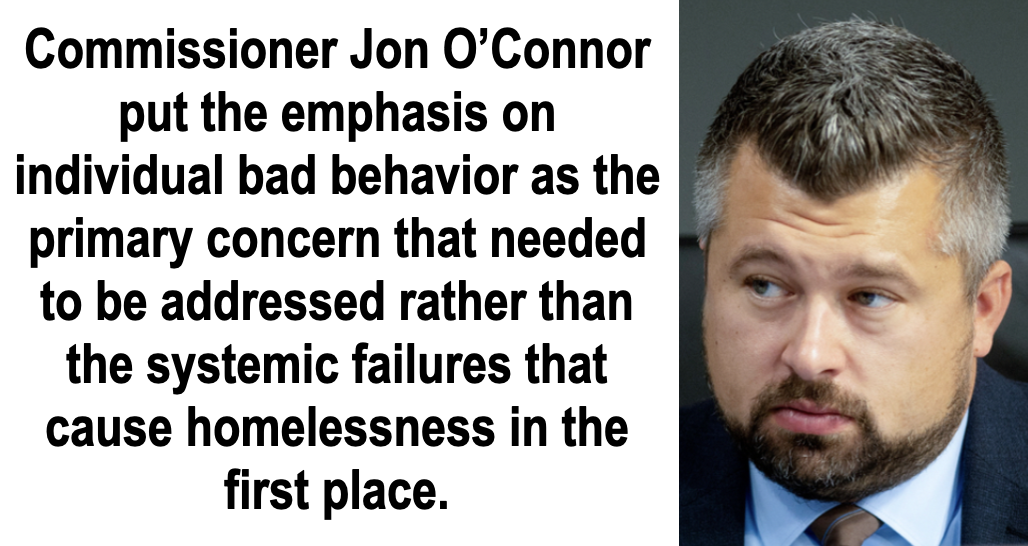
Fortunately for the public, Defund the GRPD has been providing excellent summaries of Commission Meetings, along with the Public Safety Committee meetings, since there is ongoing discussion about the GRPD. At that May 23rd Public Safety Committee meeting, some really awful stuff was said by members of that committee about the unhoused and in support of the GRPD’s role in policing and criminalizing the unhoused. The graphics you see in this post are based on the comments from members of the Public Safety Committee, comments that are offensive and should be roundly denounced.
Community Action will make demands of the Grand Rapids Public School Board on funding priorities
On Monday, June 12th, there will be a Community Speak Out, with an opportunity to tell the Grand Rapids Public School Board how you want them to prioritize the 2023 – 2024 GRPS School budget.

People will be gathering at 4pm right across the street from the GRPS Administration building on MLK/Franklin St., just east of Martin Luther King Park, to share food build relationships. Then, at 5:30pm, the community will have a chance to directly communicate with School Board members how they want public money to be spent on public eduction. See the Facebook event for this action here.
This action is being organized by the Urban Core Collective, which has been doing lots of preparation work for this action. The Urban Core Collective has a list of demands that are based on input and feedback that is directly from the community. Those demands include:
- Improving the Food Service for GRPS students
- Ensuring the Black students that attend GRPS schools that are appropriately staffed Monitor and publicize indoor air quality for all GRPS buildings
- Guarantee dependable transportation service for GRPS communities
- Support student mental health
In addition, there are also Community Budget Priorities, which the Urban Core Collective has identified as:
Improve Food Service for GRPS students
- Set aside funds for food service facilities updates in schools – prioritizing the ability to do scratch cooking and food preparation.
- Set aside funds for appliance purchases/repairs/updates that ensure schools have the ability to cook and prepare food.
Monitor and publicize indoor air quality for all GRPS buildings
- Prioritize Internal Air Quality improvements including HVAC upgrades, that constitute an engagement with the environment surrounding a school building. These updates should prioritize schools located within environmentally hazardous census tracts.
 Invest in extracurriculars and the facilities necessary to sustain them
- Prioritize investments that improve extracurricular experiences at GRPS (e.g. art studios, music production, theaters, athletic facilities, etc.)
Utilize a “repair criteria” that aligns with the Strategic Plan goals
- Ensure that facility level improvements are aligned with the strategic objectives of improving outcomes for Black and Latinx students. Align this strategic objective with a repair criteria that accounts for divestments in these student populations over time.
All of the details of these demands can be found at this link.
Building on a legacy of community demands, direct action and participatory democracy with the GRPS
This campaign by the Urban Core Collective is part of a growing movement to demand participatory budgeting, even participatory democracy, where we no long leave major decision making into the hands of election officials. Making demands of elected officials, particularly demanding to have equal input on how we want public money spent is ultimately a form of Direct Action. Direct action is a form of political activism which seeks immediate remedy for perceived ills, as opposed to indirect actions such as electing representatives who promise to provide remedy at some later date.
 This practice of Direct Action, which the Urban Core Collective is inviting the community to participate in, is not new, rather it is based on a long tradition that comes out of social movements that have existed over the past two centuries in this country. One such example, which was applied to the Grand Rapids School Board in 1985, was the result of the South African Anti-Apartheid Movement in Grand Rapids.
The campaign to get the GRPS Board to take a stand against Apartheid was undertaken in 1985. You can read a letter (pages 1 – 2) that Rev. Van Doren had sent to the Finance Committee of the GRPS Board in late August of 1985, which was in response to a meeting the South African Working Group had with GRPS. The letter concludes by saying:
“Finally, let me say that I am very impressed with the seriousness and sense of responsibility Mr. Nienhuis and the Committee has brought to this task. My hope, of course, is that you will recommend to the School Board a resolution for full divestiture. I think it is both the morally and fiscally responsible thing to do. I respect the fact that you are looking at it thoroughly and seriously. That seriousness will be reflected in whatever comments I make about your recommendations, whatever you decide to do.”
The efforts of the local anti-Apartheid group certainly paid off, since the Grand Rapids Public School Board voted 7 – 2 in favor of condemning South African Apartheid. Here is part of that resolution, which emphatically condemns racial apartheid.

The entire resolution can be read here (pages 4 – 5), which includes the names of Board members who voted for the resolution and those who did not. The resolution’s position on divestment, was to take a stand against any new investments in South Africa and that they would not do business with corporations also involved in South Africa.
This example of direct action was initiated by the community and made clear demands of the Grand Rapids Public Schools. What the Urban Core Collective is doing with their GRPS demands is simply building on legacy of previous community demands, demands that are rooted in collective liberation. And just like the demands that the Grand Rapids Public Schools not make any investments or have GRPS in any financial institution that was profiting off of South African Apartheid, we can win the funding demands that the Urban Core Collective has organized today!
Growing up in a culture of homophobia and transphobia has meant that I have been in the process of unlearning the dominant social norms about people in the LGBTQ community.
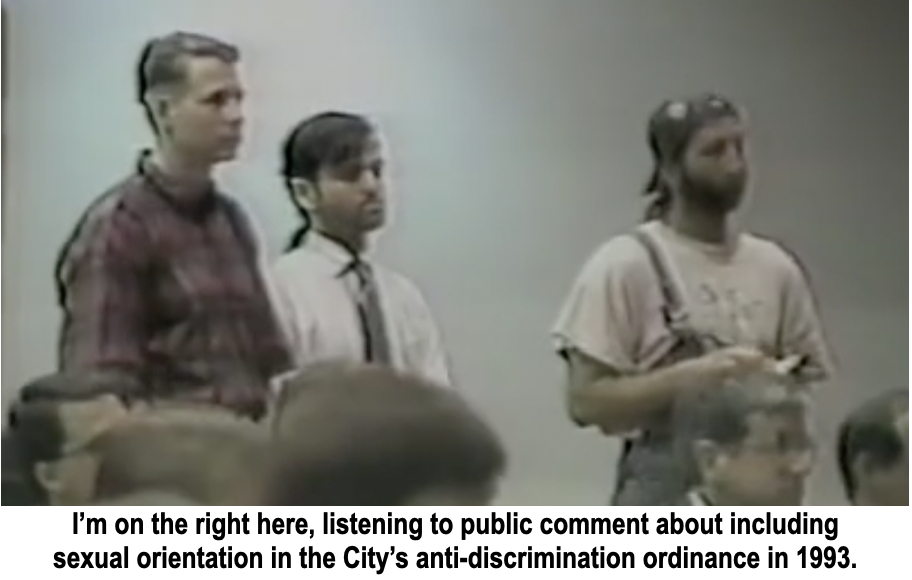
There have been some pivotal and more visceral moments since I first began to challenge myself to resist heteronormative bullshit. I remember attending the public hearings in the early 1990s, when The Network was fighting to get sexual orientation as part of the City’s anti-discrimination ordinance. I remember feeling a deep contrast being those in the LGBTQ community – many of whom shared stories about being discriminated against – to those who practiced heteronormativity, and how ignorant and hateful they were.
A second pivotal moment was attending my cousin’s Tiffany’s funeral. Tiffany was part of the LGBTQ community, even though she not out to many in the family. She was a softball coach and played softball for years, until she died suddenly from causes that were never determined. At her funeral, several dozen of her fellow softball players and closest friends spoke beautifully about what kind of person Tiffany was to them and how she touched all of their lives. Some family members were clearly uncomfortable and even angry at the display of affection and intimacy that these women shared towards Tiffany. I was so grateful to Tiffany’s friends for their moving tribute, but was also angry with some in my family who were either in denial about who Tiffany was or visibly disgusted by who she was.
Lastly, in 2011, the GVSU LGBT Resource Center had invited those of us who were involved in the Grand Rapids People’s History Project, to produce a documentary on the history of the LGBTQ community in Grand Rapids. I spent months reading about LGBTQ history, going through stacks of archived documents, newspapers and video tapes. We did interviews with nearly 80 people and heard powerful stories, then used those stories and the archival material to create a feature length documentary, A People’s History of the LGBTQ Community in Grand Rapids.
I continue to want to learn, listen and read books from LGBTQ writers, particularly from those who identify as queer, since that usual means they embrace an anti-racist, anti-Colonialist and anti-Capitalist framework. The list of books that are included here are books that are certainly more queer-centered and resist any sort of reformist or assimilationist strategy. Not only do I resonate with what these writer have to say, I am deeply challenged by what they have to say and I encourage you to be challenged as well.
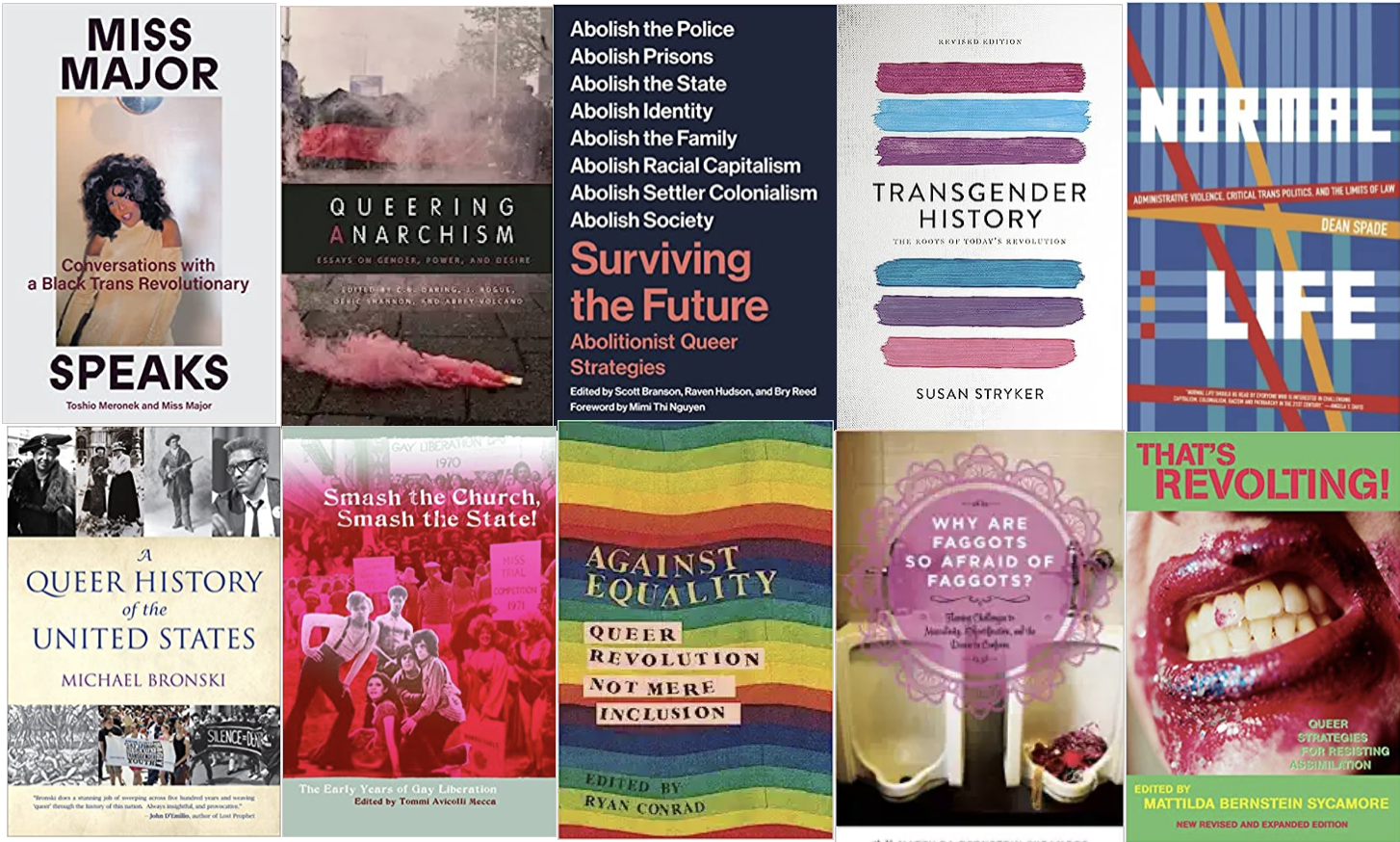
- Transgender History, by Susan Stryker
- Gender Outlaws: The Next Generation, by Kate Bornstein and S. Bear Bergman
- Why are Faggots so Afraid of Faggots? Flaming Challenges to Masculinity, Objectification, and the Desire to Conform, edited by Mattilda Bernstein Sycamore
- Homocons: The Rise of the Gay Right, by Richard Goldstein
- Smash the Church, Smash the State: The Early Years of Gay Liberation, edited by Tommi Avicolli Mecca
- That’s Revolting: Queer Strategies for Resisting Assimilation, edited by Mattilda Bernstein Sycamore
- Queer America: A People’s GLBT History of the United States, by Vicki Eaklor
- Gay Power: An American Revolution, by David Eisenbach
- Against Equality: Queer Critiques of Gay Marriage, edited by Ryan Conrad
- Against Equality: Prisons Will Not Protect You, edited by Ryan Conrad
- Against Equality: Don’t Ask to Fight Their Wars, edited by Ryan Conrad
- Normal Life: Administrative Violence, Critical Trans Politics, and the Limits of Law, by Dean Spade
- Captive Genders: Trans Embodiment and the Prison Industrial Complex, edited by Eric A Stanley and Nat Smith
- Queering Anarchism: Addressing and Undressing Power and Desire, edited by C.B. Daring, J Rogue, Deric Shannon and Abbey Volcano
- A Queer History of the United States, by Michael Bronski
- Surviving the Future: Abolitionist Queer Strategies, edited by Scott Branson, Raven Hudson and Bry Reed
- Miss Major Speaks: Conversations with a Black Trans Revolutionary, Toshio Meronek and Miss Major
The Political function of Philanthropy: DeVos Family Foundations – Richard and Helen DeVos Foundation
“In any case, the hidden hand of of foundations can control the course of social change and deflect anger to targets other than elite power.”
– Joan Roelofs, Foundations and Public Policy
For the past 10 years, GRIID has been monitoring foundations in West Michigan, particularly the large family foundations that those who are part of the Grand Rapids Power Structure have created. Our monitoring of local foundations has been part of our larger critique of the Non-Profit Industrial Complex in Grand Rapids.
Over the next several weeks, GRIID will provide some information and analysis of the most recent 990 documents that foundations are legally required to submit. These 990 documents must be submitted within a three-year period, which is why the 990s that we will be examining are from 2020, since most foundations prefer to submit their 990 documents at the last minute, thus minimizing possible scrutiny.

Richard and Helen DeVos Foundation
GRIID has always begun our Foundation Watch work by looking at the foundations associated with the most powerful family in West Michigan, the DeVos family. The oldest of these family foundations is the Richard and Helen DeVos Foundation. GRIID relies on GuideStar.org to access the 990s of each of their foundations and it appears that 2020 will be the last year that the Richard and Helen DeVos Foundation will exist. According to GuideStar, in 2020, the Richard and Helen DeVos Foundation contributed $19,170,000, leaving them with only $31,037 of funds left in the foundation. To see the 990 document for 2020 from the Richard and Helen DeVos Foundation, go here.
The Richard and Helen DeVos Foundation made contributions to dozens of entities in 2020, but there are some clear categories of groups they contributed to, such as the Religious Right, Think Tanks, Education-centered groups, and social service entities, to name a few. Below is a listing of each from these categories, with a dollar amount and a brief analysis.
We also include groups that are DeVos owned or created, along with liberal non-profits. With the liberal non-profits, we believe that funding from foundations like the DeVos family foundations is a form of hush money. When we say hush money, we mean that these entities will not publicly challenge the system of Capitalism, the wealth gap, structural racism and other systems of oppression, which the DeVos family benefits from and perpetuates through their own political funding.
Religious Right
- Alliance for Children Everywhere – $150,000
- Back to God Ministries – $25,000
- Christian Leaders NFP – $150,000
- Christian Reformed Church in North America – $635,000
- David House Ministries – $35,000
- Evangelism Explosion III – $100,000
- Front Porch Ministries – $50,000
- Luis Palau Association – $150,000
- Madison Square Christian Reformed Church – $300,000
- Partners Worldwide – $250,000
- Right to Life of Michigan – $20,000
- Words of Hope Inc – $25,000
- World Renew – $150,000
- Youth for Christ USA Inc – $50,000
These religious groups practice varying degrees of conservative politics, which fit into the ideological framework that the DeVos family is committed to. For instance, the Luis Palau Association is a Latin American based group that was founded by Luis Palau, an evangelist who had a long history of supporting far right and military dictators throughout Latin American, which we have documented in a previous GRIID post.
Education-centered groups
- Calvin Theological Seminary – $150,000
- Grand Rapids Community College Foundation – $1,000,000
- Grand Valley State University – $1,000,000
- InterCollegiate Studies Institute Inc – $100,000
- King’s College – $5,500,000
- Rehoboth Christian School Association – $300,000
- Western Theological Seminary – $200,000
- Zuni Christian Mission School – $50,000
Richard and Helen DeVos have been using the massive wealth to influence education systems in West Michigan and abroad, with an emphasis on Christian Schools, such as Calvin College, Western Theological Seminary and the White Savior schools that are part of the longstanding practice of imposing christianity on Native communities. Contributions to GRCC and GVSU also is a long standing practice, primarily to influence the curriculum in those colleges. Rich DeVos used to be a trustee at Grand Valley State Colleges back in the 1970s and was instrumental in getting ride of the William James and Thomas Jefferson Colleges at GVSC, plus the played a role in getting GVSU to build a campus in downtown GR, along with the creation of the Seidman College of Business.
DeVos-owned, created or connected groups
- Christian Leaders NFP – $150,000
- Grand Rapids Initiative for Leaders – $10,000
- Spectrum Health Foundation – $3,350,000
Groups receiving Hush $
- Bethany Christian Services – $150,000
- Guiding Light Mission – $50,000
- Hope Network – $180,000
- Mel Trotter Ministries – $25,000
- Safe Haven Ministries – $25,000
These groups all provide some sort of social service – people fleeing domestic violence, those who are housing insecure, people with disabilities, adoption and immigration. There are root causes to all of these issues, but these groups are not likely to address root causes and larger systems of oppression. When the DeVos family foundations make contributions, this will increase the likelihood that systems of oppression will not be addressed by these groups.
Foundations rarely make contributions without strings attached. The Richard and Helen DeVos has a long history of funding far right and religious right groups, which GRIID documented 10 years ago when we started this project. In addition, investigative journalist and author Russ Bellant, documented the same sort of dynamics in several of his books on the far right/religious right, specifically with his book, The Religious Right in Michigan Politics, published in 1996.
GRPD uses their podcast program to disseminate misinformation about their plans to purchase and use drones
In their ongoing effort to dictate the narrative around the use of drones, the GRPD podcast, Behind the Badge, interviewed Chief Winstrom about the Police Department’s plan to purchase and utilize drones.
The podcast was recorded on June 4th and posted on the GRPD’s Facebook page late Monday evening. The podcast is 31 minutes long, with the host lobbing nothing but softball questions at Chief Winstrom. In fact, the host was openly endorsing the GRPD’s plan to purchase drones with public money.

What follows is a summary of the podcast, with the questions highlighted. One can easily see how there was nothing that challenged Winstrom, since the show was designed to provide Winstrom with yet another platform to control the narrative about why the GRPD wants to purchase drones and how they would use them.
What is the interest in drones from the GRPD? Winstrom said that the “culture here in Grand Rapids is skeptical of government surveillance.” The Chief of Police essentially was arguing that since other police departments already have them, the GRPD should too.
Do you have stats or success stories from other cities where drones are being used? Winstrom very matter of fact said, “We are using drones, like the recent case of a shooting, where the Kent County Sheriff’s Department brought their drone to help us evacuate a building quicker.” Winstrom went on to say, “Whether or not we get approval to obtain drones, we are going to use them, since we have relationships with other law enforcement agencies in the area.”
Lots of other industries use drones, so why not the GRPD? Winstrom agreed with the intent of the question, but then spoke about some of the people who are opposing police use of drones. Winstrom said there was about 10 people who spoke against drones at City Commission meeting. Actually, there were 28 against and one in support who spoke during the public hearing on April 25th. Winstrom then went on to say that he supports their right to free speech, but then went on to share that a local news outlet spokesperson came over during that City Commission meeting, and told him they had two drones in their vehicle. Like this matters or makes sense. News agencies do not enforce the laws of the state, like cops do, which often involves using force.
Winstrom then talked about how one objection is that drones could chill free speech, like at protests, which they have already been using to monitor large protests after Patrick Lyoya was killed (by the GRPD) but never to identify people or read sign messages. Winstrom claims that drones used during protests are to reduce the need for cops and to assist in determining protest march routes. Of course there is not verification or evidence to support such a claim, because the public does not have access to what was filmed by the drones during said protests.
Winstrom did say that they have civilian oversight and public accountability, which is Brandon Davis’ office. Davis will look at the footage and make a determination if the drone footage is used unconstitutionally. Again, the public has no say and there is no real transparency.
If I saw a drone fly over my house, there must be a reason for it? Winstrom said that some places are using drones in response to 911 calls. The GRPD wouldn’t be using them for this, but for specific ways to respond quicker to certain circumstances and as a tool for public safety, whether it is the Riverbank Run, a protest or a 4th of July event. Winstrom then said that It also keeps cops safer, without any real concrete evidence to support such a claim and of course the host never asks, “shouldn’t the goal be to keep the pubic safe?”
We are not here to invade your privacy, it’s to catch the bad guy, right? There was talk about helicopters being used for surveillance, etc, but Winstrom essentially said, ee just want to put a camera in the sky.
Does Brandon Davis’ office engage the community? Winstrom said that his office does, but never states how. The Police Chief then went on to announce the public form at Lifequest Church on June 6th.
Take the protests – if you protest peacefully – when they see drones, what are they going to do with them? Here Winstrom engages in some serious misinformation and outright lies, when saying that in the protests since the officer involved shooting (which is code for GRPD cop shot Patrick Lyoya in the back of the head), Winstrom said there has been no real violence, no property destruction and no arrests. In fact, there have been numerous arrests made by the GRPD against those protesting the murder of Patrick Lyoya.
So you are just waiting for City approval? Winstrom says yes and that if approved there would be initial costs, with about $120,000 annually for training and updates. However, Winstrom did not provide a clear timeline for when this might happen.
Hope this conversation provides answers for the public. Drones would just be another tool in your toolbox? Winstrom agrees.
Final comment from the host…..You should probably throw away your phone if you are concerned about surveillance. Winstom chimes in as well about date mining etc, which are real issues. However, when the State engages in surveillance and data mining it can often lead to the harassment, arrest, imprisonment and even death of members of the public, particularly members of the public that considered a threat to the interests of the State.
Lastly, it is important to have access to resources that provide a counter-narrative to what the GRPD and Grand Rapids City officials have been saying about drones. Here is a link to an excellent toolkit put together by the autonomous, grassroots group Defund the GRPD.

Diane Yentel, president and CEO of the National Low Income Housing Coalition, wrote on Twitter that the agreement is “cruel and shortsighted,” pointing to the work requirements and real-term cuts to rental assistance “during an already worsening homelessness crisis.”
Over the weekend, President Joe Biden celebrated what he called a bipartisan success by passing the debt ceiling deal, which not only will do tremendous harm to working class people, it will further entrench Neoliberal economic policies.

The Fiscal Responsibility Act of 2023, also known as the debt ceiling bill, will benefit some of the following groups of people:
- Defense Contractors, because of the increased amount to an already bloated Pentagon Budget
- Millionaires and Billionaires, who will continue to cheat the public by not having to pay a reasonable amount of taxes on their wealth.
- Fossil Fuel companies, who are given more flexibility to extract oil and gas, along with new pipeline construction, such as the Mountain Valley Pipeline project, which will not only be devastating for those who along the proposed pipeline route, but it will add to the already dismal record of the Biden Administration on Climate Change policies.
The Fiscal Responsibility Act of 2023, also known as the debt ceiling bill, will be a detriment to some of the following groups of people:
- Working Class people will be impacted, since they will be required to cover more of the tax burden than the wealthiest people in the country.
- People who are food insecure – since it will be even more difficult to access food assistance, plus the new work requirements for people seeking food assistance.
- Tenants, which will face even more reductions to rental assistance, despite the fact that millions have not financially recovered since the beginning of the pandemic.
- Families and communities who will be devastated from new oil and gas pipeline projects, such as the Mountain Valley Pipeline project.
- Students, who will not have to pay back their students loans.
The reality of the vote on the Fiscal Responsibility Act of 2023 in the House and the Senate, before it was signed by Biden, is that most Democrats supported it. In Michigan alone, every Congressional Representative supported the legislation, except for Rep. Tlaib. In addition, both Michigan Senators, Senator Peters and Senator Stabenow voted for the legislation. In a statement released on June 1st, Senator Gary Peters said, “Allowing our nation to default would have been catastrophic, risking an economic crisis and significant job losses, higher prices, and Americans’ hard-earned retirement savings.” Peters, like so many loyal Democratic politicians, are either unaware of or in denial over how this legislation will hurt hard working Americans.
David Sirota speaking on Democracy Now! Interviewed yesterday said,
Well, the losers are everybody else. The losers, in particular, very, very poor people. Again, as you discussed, the changes to the food stamp program, to make it harder for lots of people to access food stamps, at a time of an affordability crisis, that’s a big loss. I think student debtors, where, again, in the middle of an affordability crisis, you’ve got student debt payments that are going to start up again. So, basically, the working class of this country was deeply harmed by this bill.
I wonder how this kind of legislation, which will negatively impact working class people, how it will impact voters in the 2024 election. More importantly, will the continued bipartisan commitment to neoliberal economic policies be enough to push people into the streets and to make revolutionary demands of the rich and reduced public funding of Capitalist entities like military contractors and fossil fuel companies?
Additional sources and analysis:
https://www.commondreams.org/news/senate-mountain-valley-pipeline
https://theintercept.com/2023/05/26/deconstructed-debt-limit-economy/
 Grand Rapids Institute for Information Democracy