I was invited by All Souls Community Church to talk about A People’s History of Grand Rapids, so here is my non-sermon
This past Sunday, the good people of All Soul Community Church invited me to talk about my book, in place of where the sermon would normally go. The community was very welcoming and they were very receptive and affirming of what I had to say. Here is the non-sermon that I delivered on Sunday.
I wrote A People’s History of Grand Rapids for several reasons. First, I wanted to provide a counter-narrative to the official version of the City’s history, a history based primarily on Rich White men, most of whom identified as Christians, you know, the men who have their names on buildings all across the city.

Second, I wanted to demonstrate that despite the conservative label that Grand Rapids gets, there is a rich history of organized resistance against oppression, whether we are talking about Indigenous people resisting Settler Colonialism, workers fighting against exploitation, the African American community engaging in the Black Freedom Struggle, community members opposing war, those fighting for environmental justice and those in the LGBTQ community resisting heterosexism, homophobia and transphobia.
Third, I want to write a book that adequately provides historical context for the various social movements throughout the history of Grand Rapids, that each of these movements were fighting against systems of power and oppression that I would argue are central to Grand Rapids, from its founding to the present.
Lastly, I wanted to write a book for the current and future generations. I do a fair amount of organizing with young activist/organizers in Grand Rapids, and I wanted them to know that their actions are an extension of the struggle for justice that has been going on for two centuries in this community. Their resistance to current injustices is part of this powerful legacy of resistance.
However, since the country will be celebrating Labor Day on Monday, I wanted to talk a bit about the legacy of radical organizing within the labor movement and the movement for economic justice.
Again, despite the claims that Grand Rapids is conservative, there have always been workers that have challenged the Capitalist Class in this community. The first effort to organize around an 8-hour workday, was done by city workers in 1867. Remember, the whole point of a labor union is to democratize our workplaces, not just to fight for better wages.
In May of 1891, both cable and horse car workers went on strike for higher wages and union contracts. The street railway company began hiring scab workers immediately. As the week progressed, workers tried to keep cars from running, first by inducing others not to take their jobs, but later by blocking the cars directly. This was a tactic that falls under the strategy known as Direct Action. Direct Action is when people decide to take matters into their own hands to make change, rather than just appeal to those in positions of authority or those in power. This is why I chose that quote from the great freedom fighter Assata Shakur, where she said, “Nobody in the world, nobody in history, has ever gotten their freedom by appealing to the moral sense of the people who were oppressing them.”
The reading for today was a summary of the great 1911 Grand Rapids Furniture Workers Strike. It is important to note a couple of other things about that strike that was not included in the reading. Also, I would encourage people to read Jeffrey Kleiman’s book entitled, Strike!: How the Furniture Workers Strike of 1911 Changed Grand Rapids.

Not everyone in a position of power took the side of the furniture barons. The Catholic Bishop of Grand Rapids, Bishop Joseph Schrembs, spoke out against the injustice being done to the workers. He said, “I consider the present labor situation in our city as a most deplorable one from every point of view. I would welcome and hasten the day when compulsory arbitration will force men dealing with their fellow men to let fairness and justice come to their own through reasonable methods rather than through the cowering of men’s hearts through the cruel pangs of hunger of their wives and children.”
Such a demonstration of solidarity did not come without a cost. Because he sided with workers, the Vatican had Schrembs reassigned to the Diocese of Toledo.

Now, the 1911 Furniture workers strike did not end in victory, but it did pave the way for future labor organizing and it demonstrating the importance of solidarity and community care that workers and their families participated in. Just 1 month after the strike ended, 10,000 people marched in the Labor Day parade, which was about 10% of the population of the city at that time. This doesn’t even include the people greeting them along the parade route, cheering for them and thanking them for their courage.
In addition, it is important that we recognize that the Furniture Barons were so threatened by the strike, that they decided to change the City’s Charter in 1916. During the strike, Grand Rapids had a 12 ward political system, with many of the wards divided along ethnic lines – German, Polish, Lithuanian, Dutch, etc. The Furniture Barons put forth a ballot initiative to change the 12 war system into a 3 ward system and to end having a strong mayor to a mayor that would be nothing more than a glorified commissioner. The initiative passed and the Capitalist Class won that round of class warfare, thus consolidating political power in the city.
Another theme in my book is the idea that when people take bold action or engage in radical imagination, it tends to open up new spaces for other people to do the same thing. What I mean by Radical Imagination is best said by the great Puerto Rican poet, Martin Espada, who stated, “No change for the good ever happens without it being imagined first, even if that change seems hopeless or impossible in the present.”
At the end of 1936, autoworkers in Flint did something that had not been seen in the US, they engaged in a wildcat strike, where workers occupied the factories and would not allow production to happen until they won their demands. The wildcat strike was so successful that is was repeated all across the country, even in Grand Rapids. Workers at the Kelvinator refrigerator and domestic appliances factory were victorious in their fight to unionize in 1937, because they used a wildcat strike model.
However, after WWII, with the anti-communist purges brought on by the McCarthy Hearings and then the passage of the Taft-Hartley Act, which made it illegal for workers to go on strike, the labor movement became less militant. On top of that, most of the mainstream labor groups began to redirect union dues to fund Democratic Party candidates, which has not affectively won them any significant labor battles over the pas 60 years.
Some of the labor complacency changed after the Reagan years, as more and more labor rights were being undermined. In 1994, when the Clinton Administration adopted the North America Free Trade Agreement, there was a massive relocation of manufacturing jobs to Mexico, which gutted union membership. Two years later, the Clinton Administration adopted the Personal Responsibility and Work Opportunity Reconciliation Act, which essentially dismantled much of the welfare system that provided a safety net to working class families.
 It wasn’t until the WTO protests in 1999 in Seattle, that the labor movement and economic justice struggles were beginning to gain attention. In Grand Rapids there were campaigns to challenge global trade policies, efforts to expose the realities of sweatshops that made our clothing and increased efforts to shine the light on service workers that have been exploited for decades. Now we know about efforts among Amazon and Starbucks workers to unionize their workplace, but it is important that these current campaigns were because of worker groups like the IWW, which first began a campaign to unionize baristas at Starbucks in 2006. More importantly, this campaign to unionize Starbucks baristas began in Grand Rapids.
I wanted to end by saying that over the past four decades of being part of social movements and researching this two century history in Grand Rapids, that when injustice exists, there are always people who will rise up to fight it. I have also seen long lasting relationships blossom between people who have engaged in these struggles for liberation. While at times it may seem like we are not making the necessary changes to create more freedom and justice and equity, please know that you are part of a long standing tradition of fighting for collective liberation, even when we don’t see an immediate outcome.
People I have met in the struggle for justice want to win, but what I have witnessed is that when people engage in these struggles they are transformed because of the struggle. While I was in Chiapas, a young Mayan told me, “my people have not only endured 500 years of oppression, we have never lost sight of who we are as a people.” In the end, maybe that is enough.
“It is better to die on your feet fighting, than to live on your knees in submission.” Emiliano Zapata
Those in power have been telling us behind closed doors not make any noise about the murder of Patrick Lyoya
Recently, a federal judge has dismissed Grand Rapids City as a defendant in a lawsuit seeking millions after a police officer fatally shot Congolese immigrant Patrick Lyoya.
On the heels of this recent legal setback, the father of Patrick Lyoya, lawyer Ben Crump and former Kent County Commissioner Robert Womack, along with the support of the Grand Rapids Alliance Against Racist and Political Repression, held a rally and a march in downtown Grand Rapids.

With an estimated 60 people turning out, participants marched from Calder Plaza to the Kent County Courthouse to demand justice for Patrick Lyoya, the young Congolese man who was shot in the back of the head by a GRPD cop after being pulled over during a routine traffic stop.
The march went past the federal building and crossed at Ottawa, where people doing crowd safety made sure that traffic did not put people in danger. Motorists who were on Ottawa crossing Michigan had to wait 30-40 seconds, while the mostly Black marchers crossed the road. Despite such a short amount of time it took for motorists to cross, some were visibly upset and other yelled at those marching once they were cleared to cross the road. It was yet another clear example of privileged people being upset over their day being interrupted by those who are seeking justice for a victim of state violence.

Once the marchers reached the Kent County Courthouse, people began to gather to hear speakers. A sound system was provided by members of the Stagehands Union, IATSE. The speakers included Peter Lyoya, a representative from the Grand Rapids Chapter of the NAACP, a local Black Pastor, Robert Womack, Ben Crump, a member of the Comrade Collective, someone from the Black Lives Matter group in Lansing and a few others. What follows are some of the themes that were addressed by those that spoke.
- Patrick Lyoya was a father who just wanted to go home and see his family. He tried to get away from the cop that pulled him over, resisted while being tased, but was eventually shot in the back of the head while lying face down on the ground.
- People should not give up in this fight for justice.
- The video footage of the murder of Patrick Lyoya clearly demonstrates that he was not a threat to the GRPD cop who shot him.
- The GRPD cop who shot Patrick, Christopher Schurr, is not the only problem. The larger, more systemic problem is the function of policing in the US, particularly as it is applied to the Black community.
- People should stop voting for elected officials that have remained silent on this issue and refused to participate in the campaign to win justice for Patrick Lyoya. There was only one local elected official at the rally.
- Local politicians have been meeting behind closed doors with the family of Patrick Lyoya and some of the organization supporting this fight, urging them to trust the process and to not burn down the city. We see what the process has got us…..no justice for Patrick Lyoya!
Lastly, people who attended the rally were urged to show up on Wednesday, September 6th at the Kent County Courthouse for another short rally at 9am, then to pack the courtroom where the Michigan State Court of Appeals will be hearing arguments related to the case of “People of MI v. Christopher Paul Schurr.” Here is a link to that event.
Sins of Omission: MLive article on lawsuits leaves out essential information in regards to the plaintiffs involved
Last week, MLive ran a story with the headline, Catholic church, school lawsuits against Michigan civil rights law thrown out.
The article is a follow up to a story they posted last December, involving a Catholic School and a Catholic Church, specifically Sacred Heart Academy in Grand Rapids and St. Joseph Catholic Church in St. Johns.
The lawsuits filed by St. Joseph’s and Sacred Heart Academy both were in response to the expanded version of the Elliott-Larsen Civil Rights Act, where the two Catholic institutions believed that new sex and gender protections in the law prevent the institutions from hiring and teaching according to their faith.
According to the MLive article:
St. Joseph church claimed, in part, the Supreme Court’s decision last year threatened its affiliated school’s “religious mission,” which includes teachings “that marriage is a lifelong commitment between one man and one woman, that sexual relations are limited to marriage, and that human beings are created as either male or female.”
Sacred Heart, similarly, claimed it would have to hire faculty and staff who oppose the faith, speak messages that violate doctrine and refrain from articulating beliefs in teaching and advertising to prospective students or job applicants.
Sacred Heart Academy said they would go so far as to shut the school down if they felt that practicing their faith as they think it needs to be practiced is compromised.
This dynamic of faith groups filing lawsuits against State governments has been going on for several decades now, but the amount of lawsuits has increased in recent years.
Sins of Omission
While the details of the lawsuit are reported on adequately, the MLive story omits some of the key players in these lawsuits. First, the law firm representing St. Joseph’s Church is Becket Fund for Religious Liberty, which claims to represent all faith groups, even though their board seems to lean to the right, like those connected to the Federalist Society.
The Sacred Heart Academy is being represented by the Alliance Defending Freedom, which the Southern Poverty Law Center identifies as a hate group. The Southern Poverty Law Center lists Alliance Defending Freedom as a Hate Group on the Hate Map, with the following list of grievances:
- Supported the recriminalization of homosexuality in the U.S. and criminalization abroad
- Defended state-sanctioned sterilization of trans people abroad
- Linked homosexuality to pedophilia
- Claims that a “homosexual agenda” will destroy Christianity and society
According to the site SourceWatch.org, the Alliance for Defending Freedom is essentially a non-profit committed to countering the legal stance of the ACLU. In addition, the Alliance Defending Freedom has been taking on lots of high profile cases across the US, specifically when Christian Institutions believe that their right to practice their faith as they see fit, is being threatened by the secular world.
Lastly, the MLive article fails to mention that the Sacred Heart Academy is closely connected to the Grand Rapids-based group, the Acton Institute for the Study of Religion and Liberty. The pastor of Sacred Heart Church is the Rev. Robert Sirico, who is also the founder and President of the Acton Institute. Plus there are members of the Board of Directors of Sacred Heart Academy to also have direct connection to the Acton Institute, as we reported on in September of 2020.
These sorts of connections and the law firms representing these two Catholic institutions are vital to the public’s understanding of these legal cases. Therefore, the omission of this context is nothing short of a dereliction of journalistic duty on behalf of MLive. Considering how critical these legal battles are to civil society, the public needs to know who these players are.
The Political function of Philanthropy: The Jandernoa Foundation
“In any case, the hidden hand of of foundations can control the course of social change and deflect anger to targets other than elite power.”
– Joan Roelofs, Foundations and Public Policy
For the past 10 years, GRIID has been monitoring foundations in West Michigan, particularly the large family foundations that those who are part of the Grand Rapids Power Structure have created. Our monitoring of local foundations has been part of our larger critique of the Non-Profit Industrial complex in Grand Rapids.
GRIID has been providing information and analysis on the various DeVos Family Foundations, using the most recent 990 documents that foundations are legally required to submit. These 990 documents must be submitted within a three-year period, which is why the 990s that we will be examining are from 2020, since most foundations prefer to submit their 990 documents at the last minute, thus minimizing public scrutiny. So far we have posted articles about the Richard and Helen DeVos Foundation, the Dick and Betsy DeVos Foundation, the Doug and Maria DeVos Foundation, the Dan and Pamela DeVos Foundation, the Cheri DeVos Foundation, the Jerry & Marcia Tubergen Foundation, the Steve and Amy Van Andel Foundation, and the David and Carol Van Andel Foundation.
The Janderoa Foundation
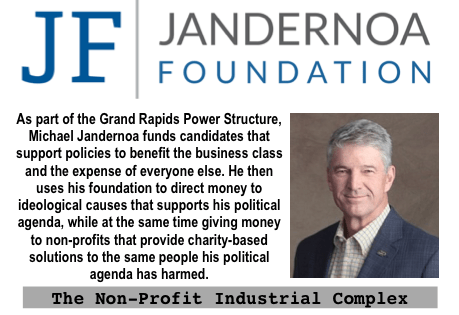
Michael Jandernoa is part of the Grand Rapids Power Structure, although his name is not as familiar as DeVos, Van Andel, Seechia or Meijer. Jandernoa is a former executive with the Perrigo Company and is now the head of 42 North Partners in Grand Rapids. The Jandernoa Foundation began in 1993 and currently has $5,191,772 in assets, while contributing $2,981,127 in 2020, which is the most recent 990 document available on Guidestar. What follows is a breakdown of some of the larger contributions the Jandernoa Foundation has made in each of the four categories we have been using.
Conservative Christian Groups
- Diocese of Grand Rapids – $80,000
- Madison Square Church – $100,000
- Mel Trotter Ministries – $187,500
It is interesting that the Jandernoa Foundation has also contributed to Mel Trotter Ministries, just like most of the other foundations we have looked at over the past few months. This demonstrates that many members of the Grand Rapids Power Structure contribute to the charity work that Mel Trotter does, primarily because they are a religious entity and have no commitment to challenging the root causes of housing insecurity in this city.
Political Right and Think Tanks
- Greater Grand Rapids Chamber Foundation – $50,000
Education Institutions
- Aquinas College – $50,000
- Catholic Central High School – $150,000
- Grand Valley State University – $125,000
- Michigan Colleges Alliance (Private schools) – $80,000
- University of Michigan Business School – $957,877
You can see from this list that over half of the education groups are religious and/or private education groups, plus the largest contribution was to U of M’s business school. Jandernoa is a huge proponent of Entrepreneurial Capitalism.
Groups receiving Hush Money
- Disability Advocates of Kent County – $40,000
- Habitat for Humanity Kent County – $150,000
- Heart of West Michigan United Way – $350,000
- Kids Food Basket – $20,000
None of these four groups listed here challenge systems of power, nor do they seek to address the root causes of societal problems like housing insecurity or food insecurity.
In addition, the Jandernoa Foundation gets to buy their silence, making it very improbable that these groups will speak out against the public policy decisions that are adopted by the politicians that Jandernoa and other members of the Grand Rapids Power Structure are funding. In fact, according to FollowtheMoney.org, Jandernoa has contributed a total of $4,299,096 in campaign money over the past 27 years, mostly to GOP candidates. Like most private foundations, their owners create social problems through exploitation and buying politicians, then turn around and contribute to charity groups that serve the very same people harmed by their wealth.
It has been a little more than two weeks ago that senior reporter at WOOD TV 8, Rick Albin, interviewed Rep. Hillary Scholten on his Sunday talk show, To the Point.

The interview with Rep. Scholten last for 22 minutes and 50 seconds, with Albin asking questions about the 3rd Congressional District Representative’s first 7 months in Congress, Child Labor, funding for the Kent County Airport, US immigration Policy and the US Military Budget.
What I found instructive about this interview was the fact that both Rick Albin and Rep. Scholten have internalized the values of the US political system, often agreeing on certain truisms in regards to US Imperialism and US militarism.
We often hear about the need for bipartisan support on policy issues and there have almost always been bipartisan support around two major issues within US politics – 1) the need to support and perpetuate the economic system of Capitalism, and 2) the importance of having the largest military in the world, which includes the largest military budget. These two truisms are embraced by both the Democrats and the Republicans, no matter who sits in the White House.
The necessity of US Militarism
On the matter of funding for the US military, Rick Albin said that most people believe that having a well funded defense is important. Rep. Scholten responded by saying, “We need to make sure we have a fully funded and capable defense.” The $886 Billion US military budget is the largest it has ever been, plus the US Military budget is larger than the next 10 largest countries military budget combined. Part of the vastness of the US Military budget is due to the hundreds of US military bases scattered across the global, the deadly weaponry, the amount of training and advising the US military provides to other militaries around the world, plus military aid to countries like Israel and Saudi Arabia. And let’s be clear, the only thing that the US is defending around the world is global dominance and the defense economic interests.

None of these issues came up in the channel 8 interview with Rep. Scholten. Instead, they talked about the riders that the GOP has added on to the military budget, which to be sure are deeply problematic, but the point here is that Rep. Scholten has no issue with supporting the largest US military budget in history, nor how the US military operates globally. This has been consistent when Democrats are in the White House, where US militarism is seen as a tool of humanitarianism, but when Republicans are in the White House they are nothing more than War Criminals. This theme is explored in more detail in the following two books – The Liberal Defense of Murder, by Richard Seymour, and Savage Mules: The Democrats and Endless War, by Dennis Perrin.
US Immigration Policy
The second major issue discussed in the interview with Rick Albin, was US Immigration Policy. Albin begins by framing his question as follows “Lets talk about immigration policy, which is contentious. There hasn’t been any comprehensive immigration policy since the Reagan Administration. You have introduced bipartisan legislation, so what needs to happen?”
First, it is important to note that while there were some major immigration policy changes during the Reagan years, specifically the Immigration Reform and Control Act of 1986, this policy was not comprehensive, since it increased funding of the US Border Patrol by 50% and did not address any of the root causes of immigration, particularly from the south. See Daniel Denvir’s book, All-American Nativism: How the Bipartisan War on Immigrants Explains Politics as we know it.
Rep.Scholten response to Albin’s question was to talk about the Dignity Act, which she introduced. The Dignity has some positive elements to it, but it also has an emphasis on enforcment, which Scholten spoke to. She said, “Crossing have increased, but so has enforcement. Border agents do have adequate technology resources, which means more enforcement.” Rep. Scholten discussed the need to enforce the existing US immigration laws, but failed to bring up the issue of why so many people are fleeing Mexico and Central American, to come to the US.
Scholten also talked about having bipartisan support for the Dignity Act, specifically with Rep; Salas from Florida. However, the Dignity Act is not Comprehensive Immigration Reform, nor does it address more structural elements of root causes of immigration, such as the US role in supporting military and trade policies in Latin America that have destabilized most of the region, along with the fact that more and more people are being displaced and forced to flee their homelands because of Climate Change. (See Todd Miller’s excellent book, Storming the Wall: Climate Change, Migration and Homeland Security.)
For additional resources on US Immigration Policy and US Immigration History:
GRIID Popular Education Class on History of US Immigration Policy
Commercial Media source MLive shockingly frames the potential UAW strike as “bad for the economy”
This coming weekend is Labor Day in the United States, and while people will be having cook outs and going camping, it is always an important time for people to reflect on who actually creates wealth in this world, the workers. Therefore, today’s post will center workers, more specifically the United Auto Workers.
A little more than a week ago, MLive posted an article with the following headline, UAW strike against Big Three could cause over $5B in economic losses, report finds.
The article is primarily about the report, which was conducted by the Anderson Economic Group, which represents corporations, which also includes the auto companies that the UAW would be striking against.
Thus, the Anderson Economic Group is cited in the early part of the article, followed by a comment from US President Joe Biden, who is calling for the UAW and the auto companies to come to a settlement. Towards the end of the article, the President of the United Auto Workers, Shawn Fain, is cited as well, where he states:
company executives for taking in a reported $21 billion in combined profits while “workers who spent long hours wrecking their bodies on the line” struggle with long hours and low wages.
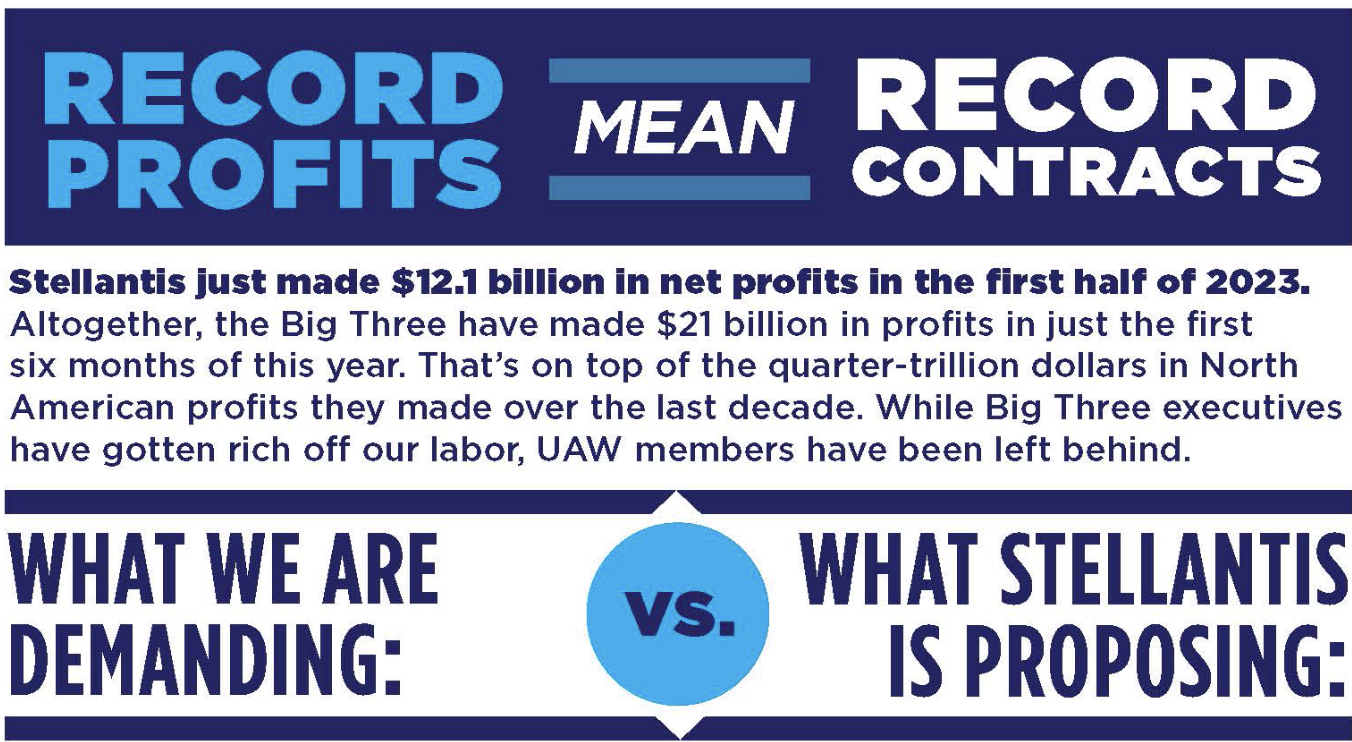
To be clear, the Big 3 automakers made $21 Billion in combined profits just in the first six months of 2023 alone.
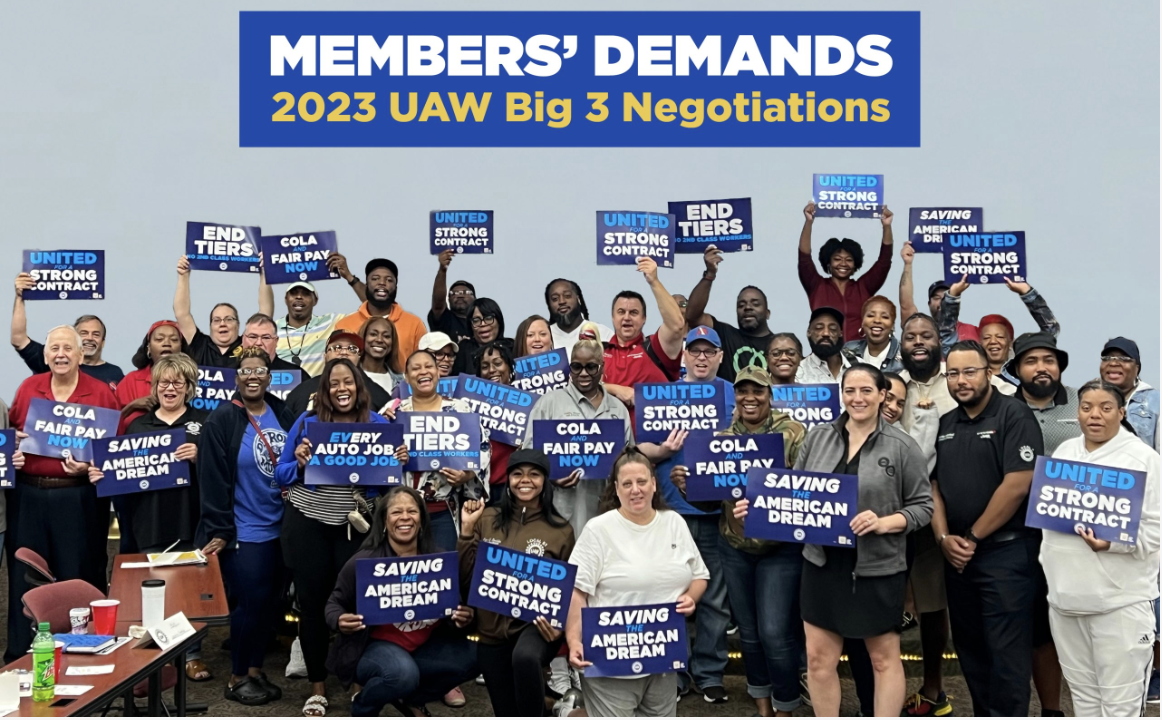
Now, what is missing from the MLive article, is probably the most relevant aspect of the potential strike that the UAW might engage in……..a list of what their demands are. According to a recent post from the group Labor Notes, the demands include:
- Eliminating tiers on wages and benefits, plus double-digit raises for all
- Restoring cost-of-living adjustments, which were suspended during the Great Recession
- Restoring the defined-benefit pension and retiree health care for all; workers hired since 2007 have neither
- Increasing pensions for current retirees; there’s been no increase since 2003
- The right to strike over plant closures
- A “working family protection program.” If the companies shut down a plant, they would have to pay laid-off workers to do community service work.
- Making all current temps permanent employees, with strict limits on the future use of temps
- Increasing paid time off
One additional demand centers on the issue of Electric Vehicle (EV) production. Again, Labor Notes shares some important content from the UAW on EV production, stating:
The union is simultaneously pushing to improve conditions for electrical vehicle (EV) battery workers employed at joint ventures between the Big 3 and South Korean firms. A letter signed by 28 Senators urged the companies to fold these battery workers into their master agreements with the UAW. “These are highly skilled, technical, and strenuous jobs,” read the letter. “It is unacceptable and a national disgrace that the starting wage at any current American joint venture EV battery facility is $16 an hour.”
The companies say these proposals are too expensive and threaten their competitiveness, especially when they are ramping up investment to convert to EVs. Fain says this argument ignores recent history: “When the Big 3 say the future is uncertain and the EV transition is expensive, remember that they’ve made a quarter of a trillion in North American profits over the last decade and have poured billions of it into special dividends, stock buybacks, and supersized executive compensation.”
This last demand around EV production and wages is an important one. As a recent Jacobin article pointed out:
Eliminating tiers is the highest priority for many workers. What this means in practice is a bit complicated, especially on the electric vehicle (EV) front. Some EV construction now happens under joint-venture projects like Ultium (General Motors and LG), but tiers under preexisting UAW contracts are already fulfilling much of our EV work. With potentially dozens of battery plants being planned and built in the United States alone, however, that may be changing.
One thing is clear: the elimination of joint-venture battery tiers as well as all other tiers is necessary for a just transition to green manufacturing and infrastructure. Fighting climate change must not come at the expense of workers’ livelihoods — we all deserve the same rights, benefits, and pay won at the bargaining table.
Another aspect of EV production, as it relates to Michigan, is the fact that the State of Michigan is providing an estimated $1.63 Billion in subsidies for EV battery production, which GRIID wrote about earlier this year.
With Labor Day coming up in the next week, it is critical that we think about the realities that working class individuals and families face in the current Neoliberal Capitalist economy. Centering the voices and lived experiences of workers in vital, especially if we hope to develop a greater sense of solidarity with people.We can’t expect the commercial news media to make worker’s lives relevant, which is exactly why we need to seek out other sources of information, and in this case, particularly information coming from the Labor Press. Solidarity Forever!
Check out more information on UAW worker demands at this link.
“In any case, the hidden hand of of foundations can control the course of social change and deflect anger to targets other than elite power.”
– Joan Roelofs, Foundations and Public Policy
For the past 10 years, GRIID has been monitoring foundations in West Michigan, particularly the large family foundations that those who are part of the Grand Rapids Power Structure have created. Our monitoring of local foundations has been part of our larger critique of the Non-Profit Industrial complex in Grand Rapids.
GRIID has been providing information and analysis on the various DeVos Family Foundations, using the most recent 990 documents that foundations are legally required to submit. These 990 documents must be submitted within a three-year period, which is why the 990s that we will be examining are from 2020, since most foundations prefer to submit their 990 documents at the last minute, thus minimizing public scrutiny. So far we have posted articles about the Richard and Helen DeVos Foundation, the Dick and Betsy DeVos Foundation, the Doug and Maria DeVos Foundation, the Dan and Pamela DeVos Foundation, the Cheri DeVos Foundation, the Jerry & Marcia Tubergen Foundation, and the Steve and Amy Van Andel Foundation.
The David and Carol Van Andel Foundation
GRIID has always done our Foundation Watch work by looking at the foundations associated with the most powerful families in West Michigan, like the DeVos family and the longtime family friends, the Van Andel family. The David & Carol Van Andel Foundation was founded in 2005, with assets of $114,38,885. The most recent 990 document for their foundation is 2021, where a total of $8,016,755 was spent in contributions.
As we reported previously, the David & Carol Van Andel Foundation has contributed heavily to the Religious Right and the Political Right, along with charity-based non-profits in West MI, which we categorize as hush money.
Below we provide some categories of organizations/entities that have been the beneficiaries of Van Andel Foundation funds, with some analysis. To view the 990 document for the David & Carol Van Andel Foundation, go to guidestar.org and you can find the information they are required to make public.
Religious Right/Conservative Christian Groups
- Cascade Fellowship Christian Reformed Church – $70,000
- Mel Trotter Ministries – $1,500,000
Mel Trotter Ministries is part of what we refer to as the Homelessness Industrial Complex in Grand Rapids, since they only seek to play a savior/charity role and not address root causes of why people are housing insecure. Mel Trotter Ministries also recently endorsed both the GR Chamber of Commerce proposed ordinance, along with the two separate ordinances that the City of Grand Rapids adopted in late July, ordinances that will criminalize the unhoused.
Political Right and Think Tanks
- Grand Action Foundation – $350,000
- Acton Institute – $125,000
- US Chamber of Commerce Foundation – $250,000
The Grand Action Foundation is part of what is now known as Grand Action 2.0, which has used millions of dollars of public money for development projects – Van Andel Arena, Downtown Market, and the upcoming outdoor Amphitheater – all of which are designed to attract tourists who will spend money in the downtown area, ultimately benefiting the members of the Capitalist Class.
The quarter of a million in contributions to the US Chamber of Commerce Foundation is largely because David Van Andel’s father, Jay Van Andel, was the President of the US Chamber of Commerce during the early part of the Reagan years.
Education Institutions
- Cornerstone University – $300,000
- Grand Rapids Christian Schools – $500,000
- Hope College – $525,000
- Western Theological Seminary – $252,000
Groups receiving Hush Money
- Bethany Christian Services – $600,000
- ICCF – $170,000
- John Ball Zoological Society – $1,500,000
- Kids Food Basket – $60,000
- Wedgewood Christian Services – $75,000
- YMCA of Greater Grand Rapids – $164,000
The David & Carol Van Andel Foundation has contributed lots of money to ICCF, like in 2017, when they, along with other large foundations gave millions to ICCF to purchase 177 homes from a Chicago based private equity group. ICCF also doesn’t address the root causes of the current housing crisis, particularly the market-driven Neoliberal economic model that has made housing so expensive.
Foundations rarely make contributions without strings attached. The David and Carol Van Andel Foundation has a long history of funding far right and religious right groups, which GRIID documented 10 years ago when we started this project. Lastly, it is worth noting that the David & Carol Van Andel Foundation compliments the campaign contributions they give to GOP candidates, which is also pretty substantial, according to OpenSecrets.org. The GOP candidates they contribute to adopt policies which cause tremendous harm to working class people and benefits the business class that the Van Andels are part of.
In the Agenda Packet for the most recent Grand Rapids City Commission meeting, there was a letter from the CEO of Rockford Construction, Mike VanGessel.

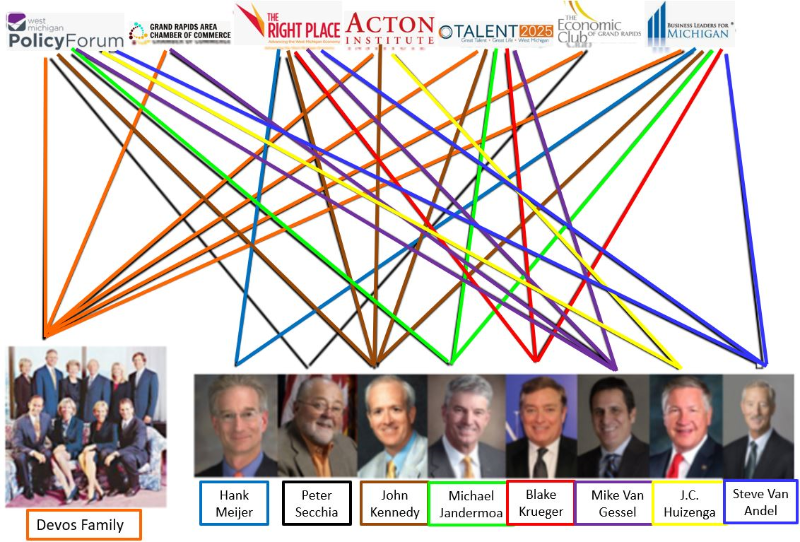
If you have been following GRIID over the years, you know that Mike VanGessel is also part of the Grand Rapids Power Structure. Now, he is not in the same league and the DeVos and Meijer families, but he is what we refer to as part of the second tier of the local power structure, particularly because of his involvement in organizations that are deeply entrenched in the Grand Rapids Power Structure.
In addition, as CEO of Rockford Construction, VanGessel has developed a close relationship with the DeVos family, particularly with their role in purchasing millions of dollars in land in the Southeast part of Grand Rapids before the residents even knew about it, and since then has been collaborating with AmplifyGR to push a specific type of development agenda. Lastly, with most the the larger development projects that Rockford Construction has been involved within the city, Grand Rapids government officials have provided the company with major subsidies/tax breaks for these development projects.
Ok, back to the letter from VanGessel. The letter can be read on pages 75-76 of the Agenda Packet. In many ways this is a love letter from VanGessel to Grand Rapids officials, thanking them for adopting the most recent ordinances that will criminalize the unhoused. In the letter VanGessel says, “Contrary to your critics, you are not “panhandlers”, but our servant leaders.”
Now, I find it very instructive that this is how the CEO of Rockford Construction sees elected officials, especially when he and his fellow members of the local Capitalist Class wouldn’t have the first clue of what it means to be a servant leader. When it comes to real leadership, which is always about centering those who are most impacted by systems of oppression, VanGessel and his ilk are no where to be found. For example, VanGessel was a part of the Mayor’s Housing Task force, when he should have given up his seat for someone who was unhoused or experiencing housing insecurity. People with that kind of lived experience know what is best for them, not people who build housing.
Sources used for the top graphic:
https://www.accesskent.com/Departments/Elections/campaign_finance.htm
Sixty years ago this week, hundreds of thousands of people participated in the 1963 March on Washington. Dozens of people from Grand Rapids also made the trek to demand racial justice, jobs and freedom. In what follows we take a look at the Grand Rapids Press coverage of the march in Detroit (in June of 1963) and the larger march on August 28th in Washington, DC. Here is a link to all of the articles from the GR Press for both marches in 1963.
Detroit march was a testing ground for DC
 There were two articles in the Grand Rapids Press (Pages 1 – 4) about the march on Detroit in June of 1963, some two months before the march on Washington. Neither of the articles on the Detroit march were on the front page and a great deal of the focus was on whether or not the march was peaceful. There was some coverage of the fact that a list of demands on civil rights were made, but only a few of those demands were mentioned in the articles.
The June 23, 1963 march on Detroit was organized primarily by Dr. King’s organization, the Southern Christian Leadership Conference and the UAW. Both Dr. Martin Luther King Jr. and the UAW President Walter Reuther were featured speakers at the march.
In many ways, the Detroit march was held as sort of a test run to see if these organizations could pull off a march with hundreds of thousands of people. Detroit was chosen because the UAW had a large number of union members in the Motor City and Detroit was also one of the most critical northern cities with a major black population that was representative of police violence against blacks and other forms of structural racism.
In Preparation for the 1963 March on Washington
The first article on the 1963 march on Washington, DC, is a piece about the various groups that were organizing delegations to participate. The GR Press article (on page 5) states that the UAW, the NAACP and the Congress on Racial Equality (CORE), were all sending people to participate in the historic march.
The same article in the GR Press mentions that the AFL-CIO, the Grand Rapids Urban League and the Human Relations Commission from the City of Grand Rapids, did not send their members to the historic march.
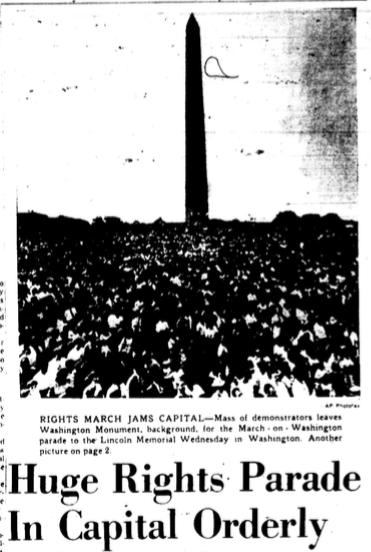 The first article on the march in August of 1963 (page 6) uses a photo of marchers with the Washington Monument in the background, with the headline that read, “Huge Rights Parade in Capital Orderly.”
The national mainstream news coverage of the march on Washington was obsessed with the idea that the only way that the march could be successful would be if it was passive and orderly. In fact, most of the major labor organizations and the Catholic Church told Dr. King and the other Civil Rights leaders that if civil disobedience would be part of the march, they would pull their support.
Another aspect of the march on Washington, DC in 1963, which is rarely discussed or even acknowledged, is that the Federal government had mobilized the military and law enforcement to make sure that people were not going to disrupt business as usual in the nation’s capital.
According to Gary Younge’s book, The Speech, the White House codenamed the March on Washington, Operation Steep Hill. Younge writes, “One thousand troops and 30 helicopters were deployed in the DC area. The Pentagon put 19,000 troops on stand by. The Eighty Second Airborne Division, based in Fort Bragg, North Carolina, stood by with C-82 boxcars loaded with guns, ammunition, and food, ready at a moment’s notice to make the 320 mile trip to Andrews Air Force Base in Maryland, from which soldiers would be dispatched to the Mall by helicopter to quell riots. About six thousand law enforcement officers of different kinds would be deployed that day, all armed with guns, clubs and tear gas. The one concession to civil rights sensitivities was that there would be no dogs.”
This was the context in which the march took place, in terms of what the state was willing to allow, for those that took part in the historic march.
On page 10 of the document, the Grand Rapids Press did publish a list of the 10 demands that the marchers were bringing to the nation’s capital that day.

The very next article on page 11 & 12, shows marchers from Grand Rapids meeting with then Congressman Gerald R. Ford, with a headline reflecting how Congress was not in a hurry to listed to the demands of the marchers.
The subsequent article on page 13 provides some feedback from the Kennedy Administration on the historic march. Kennedy is quoted as saying he thinks the march help to further the “Negro cause.” What the GR Press article does not mention is that President Kennedy pleaded with the organizers of the 1963 march to stress personal responsibility. “It seems to me with all the influence that all you gentlemen have in the Negro community, that we could emphasize, which I think the Jewish community has done, on educating their children, on making them study, making them stay in school and all the rest.” Such sentiment is in direct contradiction of what the march organizers were demanding.
 One final article from the Grand Rapids Press coverage of the 1963 March on Washington, was written after the marchers had returned from DC. The photo that accompanies the article shows 5 people, 4 with the NAACP and one from the UAW, looking at newspaper coverage of the march.
The article that accompanied the photo provided some basic reflection from the 5 featured in the article, about what they liked and what they were impressed by. Unfortunately, the article did not reflect any sense of urgency that the marchers had brought to DC that day, not much of a sense of the efforts put into making the march happen or the larger historical context of the 1963 march on Washington. Besides Gary Younge’s book, The Speech, another excellent resource is, Nobody Turn Me Around: A People’s History of the 1963 March on Washington, by Charles Euchner.
The Grand Rapids Press editorial and White Paternalism
In Jeanne Theoharis’s important book, A More Beautiful and Terrible History: The Uses and Misuses of Civil Rights History, she makes the point that we often look back to events like the 1963 march on Washington and think that the majority of the country supported such events.
The reality is much different. In fact, the federal government was monitoring the organizing leading up to the march and the event that day on August 28, 1963. The federal government was so concerned about what might be said, that they had it set up that they could cut the sound system when necessary, to make sure people were not calling for an uprising that day.
The major news outlets around the country reported on the march with some suspicion, specifically how the march was too polarizing and that it did not reflect what most Americans wanted. This sentiment was true, based on polls taken during the 1960s. According to Theoharis, a Gallup Poll taken in 1961, showed that only 22 percent of Americans polled supported the Freedom Rides. In 1968, another poll that was taken by Gallop, shortly after Dr. King was assassinated, showed that 73% of whites said that blacks in their community were treated the same as whites.
As an example of how the news media played a role in forming public opinion about the Black Freedom Struggle, let’s take a look an editorial from the Grand Rapids Press about the 1963 March on Washington.

Besides the Grand Rapids Press editorial on the 1963 march on Washington, we include three opinion pieces from non-Grand Rapids sources. We include these pieces, because this is what people were reading in the Grand Rapids Press in the editorial section, which also influences how people understand what took place in the summer of 1963 – which are linked here.
The Grand Rapids Press editorial uses supportive language and taken out of context might seem like those who wrote this editorial were endorsing the 1963 march on Washington. However, upon closer review, within historic context, we can see that this editorial is really framed through the lens of White Paternalism.
The GR Press editorial staff practices White Paternalism by using phrases like, “more orderly and better controlled.” This signals that had there been any civil resistance, the marchers would have lost all credibility in the eyes of the GR Press editorial staff. The fact is, that the Southern Christian Leadership Conference and other black groups involved wanted to have civil disobedience as part of the march, but they were pressured by the Kennedy administration, the AFL-CIO and the Catholic Church not to engage in that kind of action.
The Press editorial writer then goes on to say that “this was a responsible assembly,” and then he compares it to the negative response from David Lawrence’s commentary, which the Press published alongside their editorial. (see link above).
Apparently the restraint exhibited in the marchers was also a demonstration to the world that these kinds of actions need not be violent, which would surely have been the case if this took place in Russia, at least according to the GR Press editorial.
The rest of the editorial again valorizes the fact that there was no violence expressed on the part of the marchers. Nothing is included in the editorial about what it was that those who spoke or the march organizers were demanding from the federal government. In fact, the only person identified by name in the editorial, was Congressman Gerald Ford. Black voices were not centered in this editorial, indeed they were completely absent and seemingly irrelevant.
 Ironically, there was violence at the 1963 march on Washington. The violence was demonstrated on the part of the state, by rigging the microphone to cut off if what was said was not found acceptable. There was the threat of violence with the presence of over 1,000 cops ready to arrest people if they were not “orderly.” Then there was the violence of state surveillance, since we know that the communications between organizers was being monitored and their hotel rooms were being bugged by the FBI. In fact, there were an estimated 150 FBI agents there, just to monitor the crowd, according to Gary Younge’s book, The Speech.
In addition, there was the systemic violence, which is why thousands came to DC, to express their grievances. The segregation, the white supremacy and the brutality of police violence that black people experienced on a regular basis, were the grievances people brought to the nation’s capitol, as Dr. King pointed out in his speech at the march on Washington. King also made it clear that the federal government failed to make good on its promissory note to blacks to be granted equal rights. King makes it clear that the violence of poverty, poor housing and lack of jobs for black people was the violence that the system imposed on black people every day.
As we remember the historic march on Washington in 1963, we should all be asking ourselves why the same grievances are at the forefront of the Black Freedom Struggle 60 years later?
I was invited to talk a little Grand Rapids People’s History during an East Hills Council of Neighbors walking tour on Monday night
 This past Monday, I was invited by one of the East Hills Council of Neighbors staff (big shout out to Jessica Young) to share some People’s History that was specific to that neighborhood.
Like all neighborhoods, there is a tremendous amount of history that has to do with social movement work, and the East Council of Neighbors area is no different.
Vietnam War Resistance
I began by talking about two houses that were involved in organizing and resistance work during the Vietnam War. On the 300 block of Charles Street, there was the Hennacy House, named after Ammon Hennacy, a writer, pacifist, Wobblie and part of the Catholic Worker Movement.
The Hennacy House was a community house, but it also was a place where anti-war organizing/planning took place, along with people who were trained to do Conscientious Objection trainings. During the Vietnam War, there was still a draft, but people had options of either leaving the country, resisting the draft (which often led to jail) or to become a Conscientious Objector (CO). One of the people deeply involved with the CO work was Jasiu Milanowski. Jasiu’s bother, Paul Milanowski, is a Catholic Priest, who was also active in anti-war work.

On the 300 block of Henry Street, there was another Catholic Worker house, the Grimke House, named after the 19th century abolitionist Grimke sisters. The Grimke House was also involved in anti-war resistance during the Vietnam era, along with being a house of hospitality for the unhoused.
The Central American Sanctuary Movement
The Grimke House shut down eventually, but other people took over and made it another community house for a few years, until 1987, when they sold it to the Koinonia House, which became a Sanctuary House in 1986. The Koinonia House was located on LaGrave Avenue SE, but just months after several Guatemalan families arrive in 1987, the Koinonia House used the house on Henry as a Sanctuary House. In fact, one of the original families that was in sanctuary, still lives in that house and has used it as place for new Guatemalans who arrive in West Michigan and needed a place to stay until they could get settled.
A Safe Haven for the LGBTQ community in Grand Rapids
The last part of the segment of the East Hills Neighborhood tour that I was on, had to do with a bookstore/cafe that existed in the 1990s called Sons and Daughters. Sons and Daughters was started Jeff Swanson and Dennis Komack, a couple that had moved to Grand Rapids from San Diego.Dennis was hired by the Grand Rapids Art Museum in the mid-1980s.
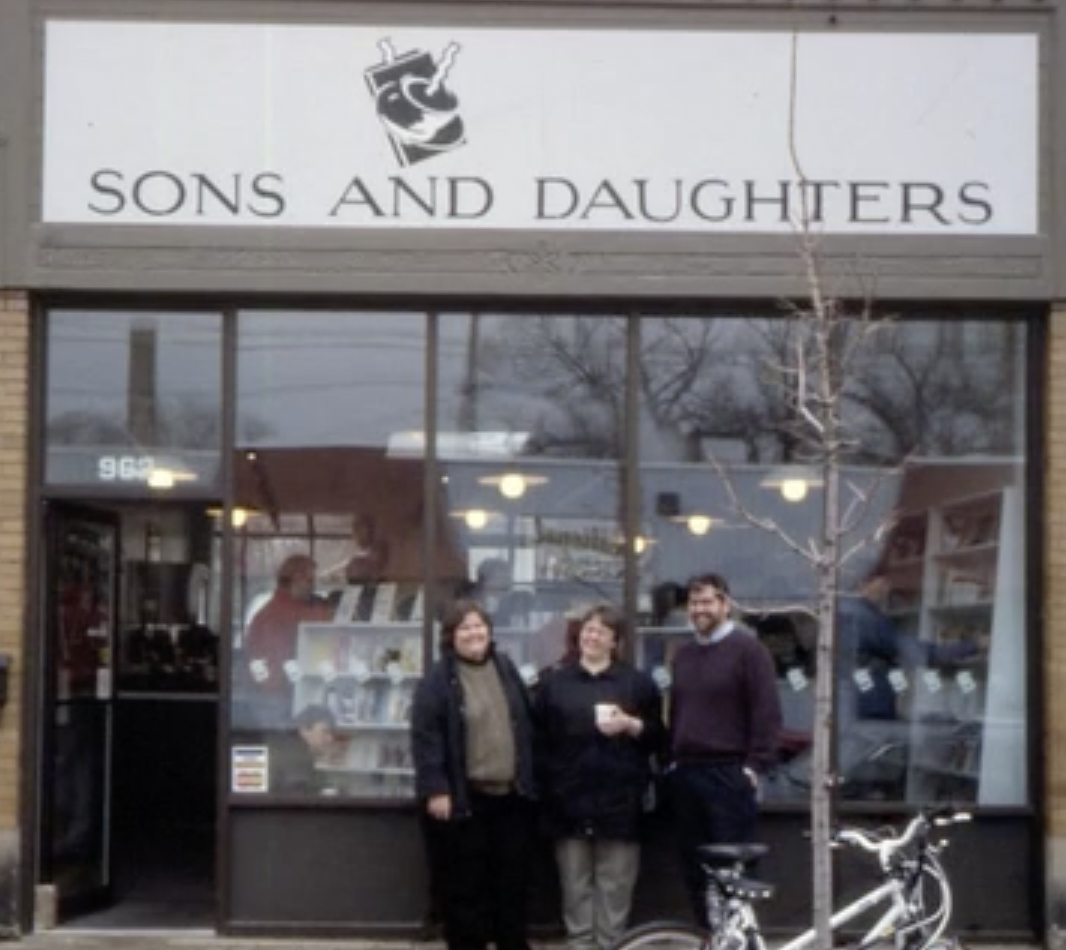 When we were making the documentary about the LGBTQ community in Grand Rapids in 2011, one thing we kept hearing about was the gay bookstore/cafe, Sons and Daughters. People talked about how it was one of the few safe spaces for people who identified as part of the LGBTQ community, apart from several bars in town. People also talked about the important role that this bookstore played, especially for those who just coming out. Sons and Daughters was not only a safe space, but it was a place where people could go and learn about the history of the LGBTQ movement, along with meeting other people and connecting to other resources in the community. To listen to people share stories about Sons and Daughters, go to this link to watch A People’s History of the LGBTQ Community in Grand Rapids. The section on Sons and Daughters begins at 1:01:10.
Our film about the history of the LGBTQ community in Grand Rapids was first screened in October of 2011, on the downtown campus of GVSU in the Loosemore Auditorium. Over 700 people came out to watch the film and we received a standing ovation when the film was over. However, not everyone was happy with the film.
The very next day, the GVSU LGBT Resource Center got a call from legal counsel for GVSU. The lawyer told a staff member at the LGBT Resource Center that they needed to change some of the content in the film. As we mentioned earlier, Dennis Komack was a co-owner of Sons and Daughters, while he was working for the Grand Rapids Art Museum. His partner, Jeff Swanson, shared with us that Dennis was told by the President of the Board at the Art Museum that if he did not disassociate himself from the bookstore, that he would lose his job. Dennis refused and he was fired. The person who delivered the ultimatum was Kate Pew Wolters. The reason that the lawyer called and demanded to have the filmed changed is because in 2011, GVSU was doing a capital campaign to raise money for a new library that would be called the Mary Idema Pew Library. Mary Idema Pew was the mother of Kate Pew Wolters and the lawyer felt that since Dennis Komack was fired by Kate Pew Wolters, that it might threaten the fund raising efforts of the new library. We refused to alter the content of the film and the new library at GVSU was built.
In reflecting on my small role at Monday night’s East Hills Neighborhood walking tour, realized once again how important the history from the ground up is in any community. Thinking about this gave me some additional inspiration and excitement for our event on September 23rd, when we are doing A Radical Walking Tour of Grand Rapids. We hope you can join us.
 Grand Rapids Institute for Information Democracy