This is the introduction to my latest book, Radical Grand Rapids: Places, dates, actions and people. This book is a companion to my A People’s History of Grand Rapids. I hope to have it printed and available this September, so stay tuned!

Introduction
The word radical has numerous meanings, but one of the most important is, to get to the root of something.
With the title, Radical Grand Rapids, I want to get to the root of things, both in terms of highlighting major aspects of the history of this city — Settler Colonialism, Racial Capitalism and White Supremacy — plus I want to share stories of when organized people took action to address systems of power and oppression. This is what I mean by getting to the root of something, getting to the root of oppression.
The book is divided into four sections, places, dates, actions and people. With these four sections, I want to briefly illuminate how organized people have fought back against oppression and organized money.
In his insightful book, Lies Across America: What Our Historic Sites Get Wrong, radical historian James Loewen takes us on an enlightening tour of the US and examines historical markers in big cities and small towns to examine the lens through which history is presented.
Grand Rapids also has many historical markers, especially in the downtown area, most of which have been sanctioned by Grand Rapids City officials or by other entities that are reflective of those who run this city. I challenge some of those historical markers, but I also share stories that can change how we see spaces in Grand Rapids. I want people to know that organized actions have taken places in these spaces, actions that were radical, in order to give people a new way of experiencing those spaces as places of resistance and liberation.
In her book, Abolition Geography: Essays Towards Liberation, Ruth Wilson Gilmore says, “Abolition geography starts from the homely premise that freedom is a place.” Building on Wilson’s notion of abolition geographies, we can then understand the importance of mapping the political, social, and economic terrain of Grand Rapids. Therefore, I am arguing that freedom and liberation can be a place, but it can also be about dates, actions, and people.
I am only including forty places, dates, actions and people in this short book, since many more stories of the powerful and radically imaginative actions that people have taken in Grand Rapids over the past two centuries are explored in my book, A People’s History of Grand Rapids. I want show people, especially young people, that when we take radical actions, we open spaces for people, and we allow them to radically imagine that another world is possible.
Radical Grand Rapids also includes images from various actions, documents, and archival resources that communicate their own stories and messages beyond the printed word.
I hope that people will be inspired by the stories in this book and then make some of their own, thus building on the rich tradition of radical organizing that has been part of this mostly suppressed and radical history of what we call home.
Photo credit: Barb Lester – from a protest at the Gerald R. Ford building in downtown Grand Rapids in the mid-1980s.
West Michigan Far Right Watch: GR Chamber of Commerce, the Acton Institute and the Great Lakes Education Project
In this week’s edition of West Michigan Far Right Watch, we look at 3 separate groups and what they are up to.
We begin with the Grand Rapids Area Chamber of Commerce, which hosted another event with State Legislators. The GR Chamber of Commerce does this event throughout the year, since they are always pushing their own policy agenda and because they provide lots of campaign contributions to candidates or incumbents that will be on the upcoming 2024 ballot.
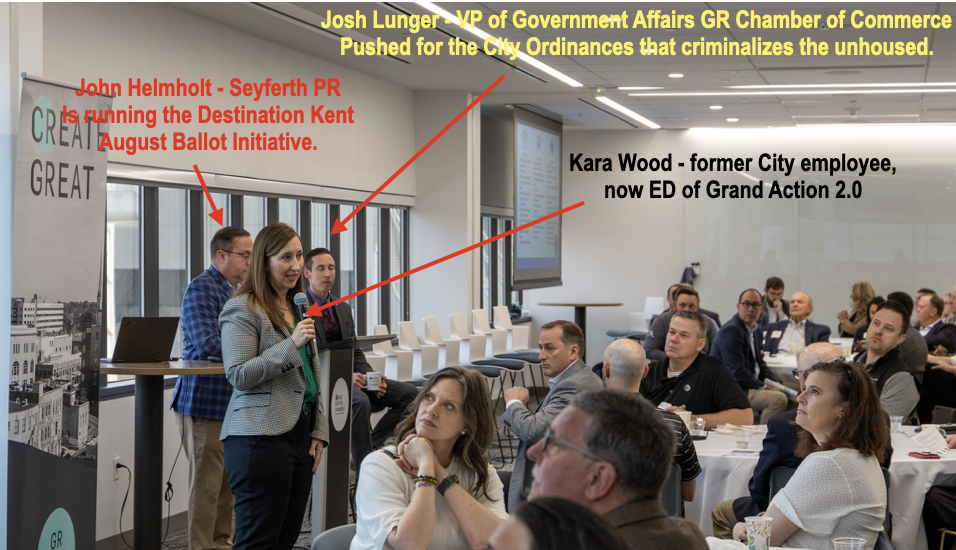
In the picture above, you can see that it involves Kara Wood, the Executive Director of Grand Action 2.0, John Helmholt, with SeyferthPR, who is heading up the Destination Kent Committee, and Josh Lunger, the VP of government affairs for the Chamber.
The presentation at the recent Legislators Luncheon, by Wood, Lunger and Helmholt, was to present information to the Grand Rapids Chamber of Commerce members on the upcoming hotel tax ballot initiative, which will be on the August Primary. The Destination Kent Committee has already filed with the County Clerk as the entity that will be accepting campaign contributions to get the hotel tax increase passed in August, something I wrote about in early May. The fact that Grand Action, SeyferthPR and the Grand Rapids Chamber of Commerce wants this ballot initiative to pass should be cause for concern from people, indeed it should be enough reason to not support the ballot initiative in August. These are the same people who crafted and endorsed the GR Chamber of Commerce ordinance proposal in late 2022, which would criminalize the unhoused, plus these groups also then endorsed the City of Grand Rapids ordinances that did criminalize the unhoused in 2023.
The second example comes from a recent article that appeared on the Acton Institute’s website, entitled, Fighting for the Church in a Time of Crisis: The Barmen Declaration.
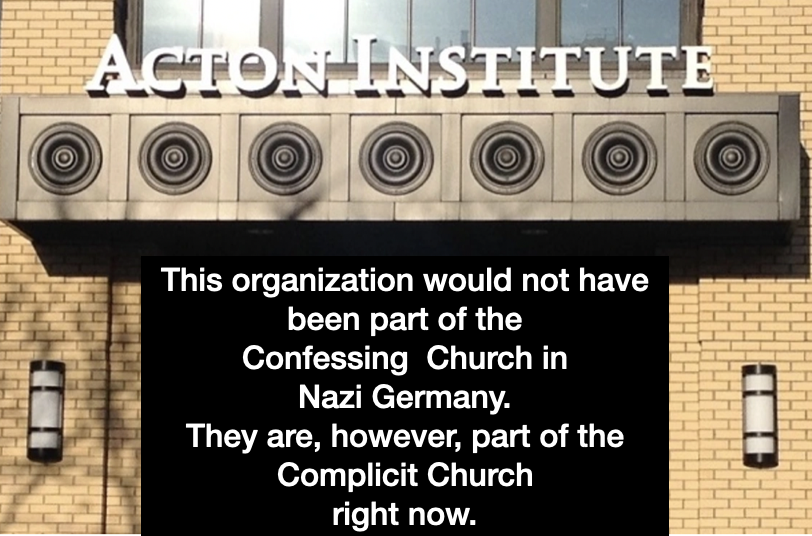 Surprisingly, the article promotes the Confessing Church, which was a sector of Christian Churches in Germany that opposed Adolf Hitler and the Nazi Party. The Acton article references the Barmen Theological Declaration and even mentions the German Theologian Dietrich Bonhoeffer, as examples of what the Christian community should do to oppose and resist the Nazis. Some of you might be aware of the fact that Bonhoeffer was arrested for his role in the plot to assassinate Hitler, but may not know about his larger role within the Confessing Church, which he wrote about and can be found in the book, Dietrich Bonhoeffer: Letters and Papers from Prison. Another excellent source on the Confessing Church was published locally by Eerdmans entitled, The Third Reich and the Christian Churches: A Documentary Account of Christian Resistance and Complicity During the Nazi Era.
I found myself agreeing with much of what was included in this Acton Institute article, but was confounded by the deep contradiction this article presented when put next to the overall ideological purpose of the far right think tank known as the Acton Institute. Most of what I have written about the Acton Institute over the past 30 years demonstrates that the Acton Institute would not have stood with the Confessing Church in Germany during the Nazi era, rather they would have complicit in the heinous crimes then, just as they do now by hating on the Movement for Black Lives, organized labor, LGBTQ justice, reproductive justice, as well as celebrating the economic system of Capitalism. 
The last group I wanted to mention was the Betsy DeVos created group, the Great Lakes Education Project (GLEP). In a recent post, GLEP announces a list of candidates they are endorsing because of their position on education, which aligns with the right wing, anti-Public Education framework that Betsy DeVos has been promoting for the past 4 decades.
If you have been following the Grand Rapids Area Tenant Union (GRATU) on social media lately, then you are aware of what we have been doing with a tenant that has suffered the violence and trauma of an eviction.
For the past several years GRATU has been working with one particular tenant that has been threatened with eviction repeatedly. In addition to the constant threat of eviction, this tenant has dealt with a landlord who would not meet aspects of the lease agreement, such as taking care of the lawn, snow removal or trash removal in a timely fashion. On top of that, the landlord failed to make repairs when the tenant made them know to the landlord, and in many cases waited months until dealing with the problem.
Once the landlord finally got around to fixing basic things like a sink, they would then charge the repair costs to the tenant, even though it was not part of the lease.
Over the past two years GRATU has written letters to the landlord asking them to be responsible and not retaliate against the tenant. GRATU has also done pressure campaigns, which involved getting as many people as possible to send Emails or make phone calls to the landlord, in order to pressure them to meet the demands that the tenant crafted.
In addition, GRATU has done court support for the tenant, which often is just being present for someone who has to go before a judge to either plead their case for what has been happening or because the landlord had begun eviction proceedings. In the last court appearance of this tenant, they had friends and a member of GRATU present, both for support and to offer testimony to support the claims of exploitation and intimidation from the landlord. The judge refused to allow other people to speak and said that the case was closed.
At this point it is important to note that, including all of the eviction threats, failure to make repairs and failure to fulfill their end of the lease agreement, the landlord had also raised the cost of rent by $450 a month in recent years. At a mediation between the tenant and the landlord earlier this year, when asked why the landlord had jacked up the rental costs so much, she simply said, “because the market says I can charge this much.”
The tenant has had a fairly fixed income, so how do landlords and the courts expect people to pay skyrocketing rental fees, when their personal income is not increasing at the same rate?
Alarmed at what the judge said and the fact that the landlord had filed another eviction case with this tenant, the tenant asked GRATU to organize a protest at the home of the landlord.
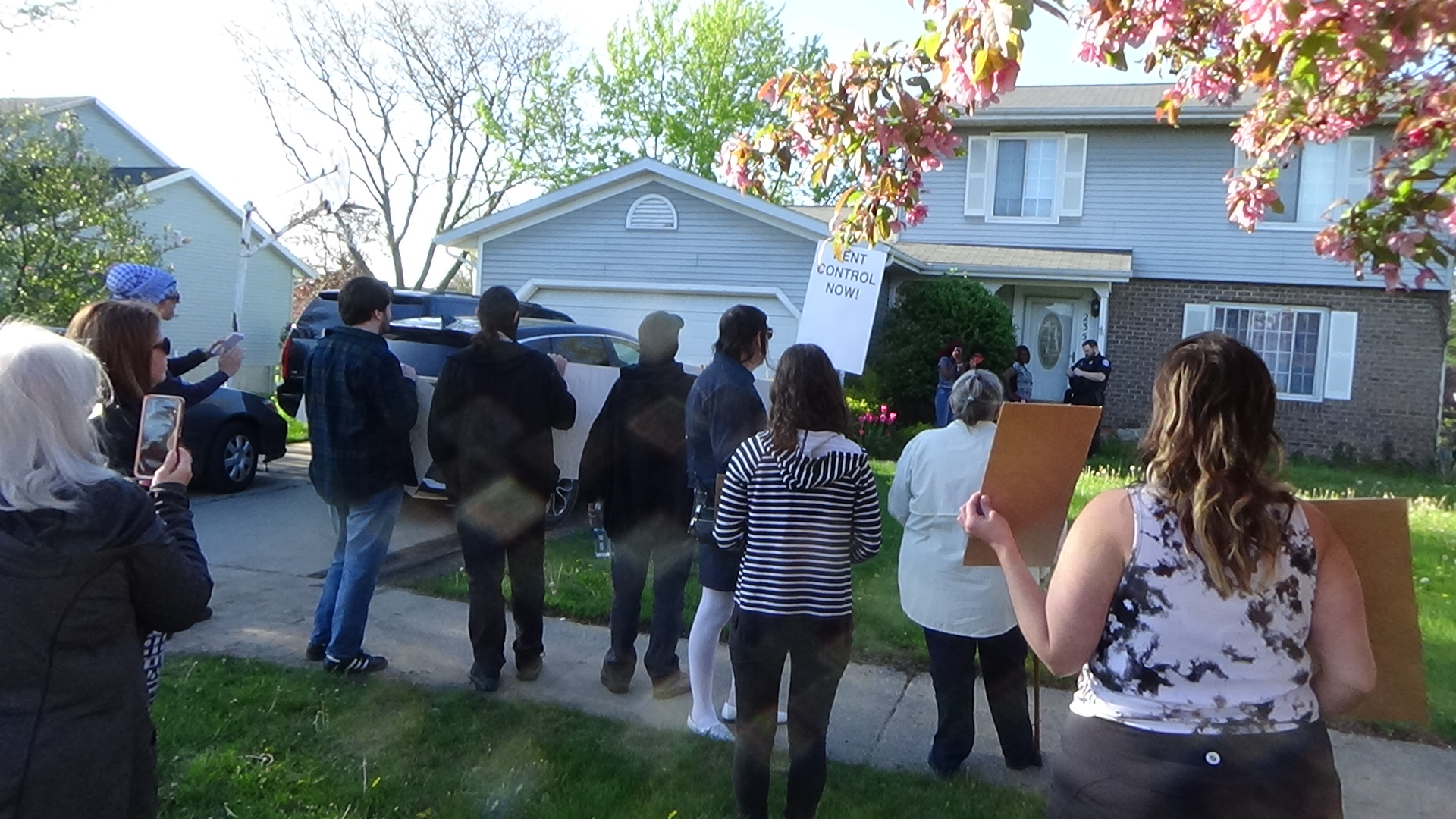
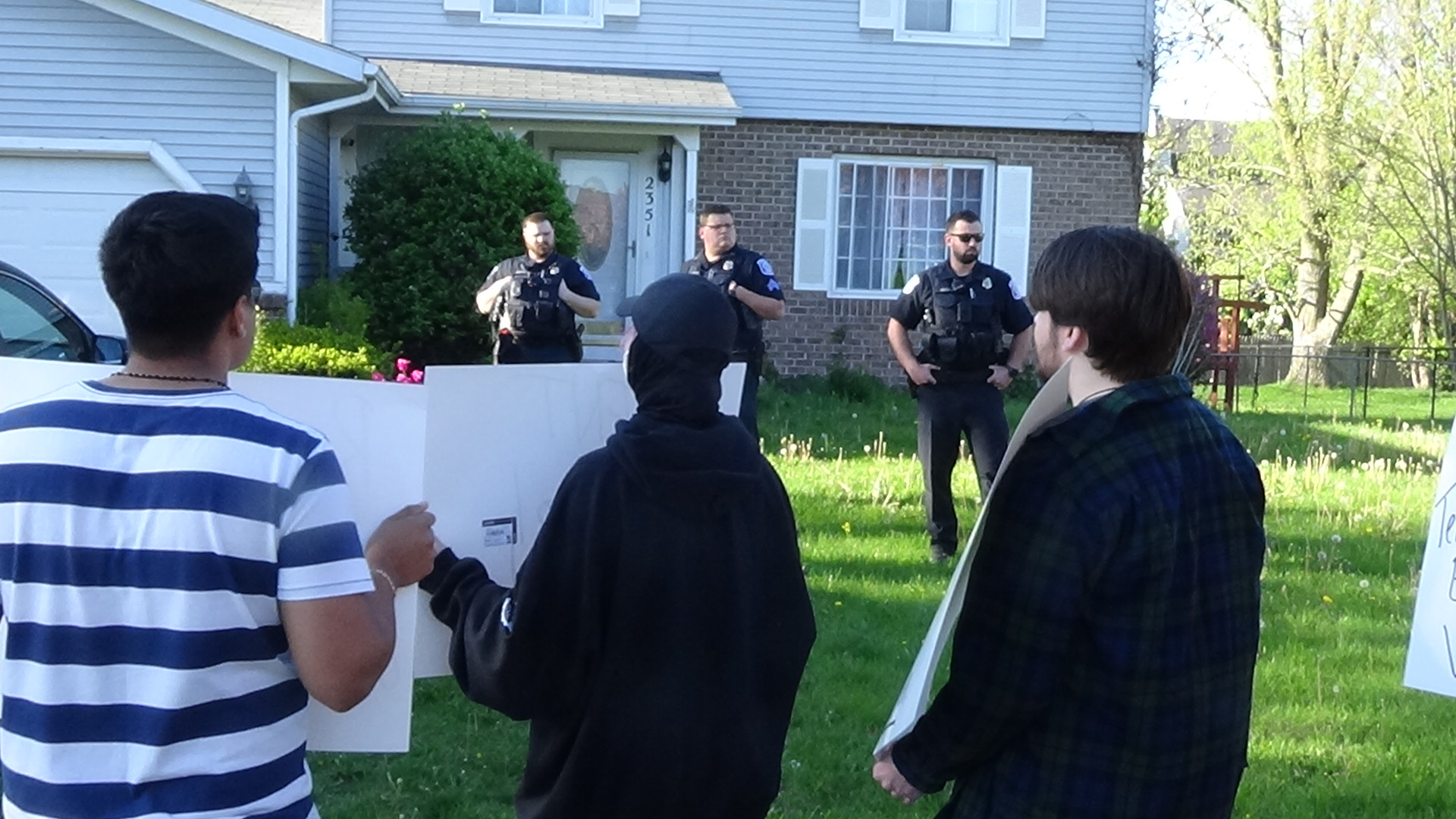
On April 30th, about 15 people showed up to support the tenant and participate in a protest at the landlord’s home, which GRIID posted about here. What was interesting about the protest was that the neighbors didn’t know that their neighbor was a landlord and some of the neighbors thought that the house the landlord lived in was a rental property, especially since they were not taking care of the property, which had high grass, weeds, a car in the driveway with a flat tire and a garage that was filled with stuff and partially open. The landlord came home during the protest and right away called the Kentwood Police, which could do nothing because the protest was on the sidewalk.
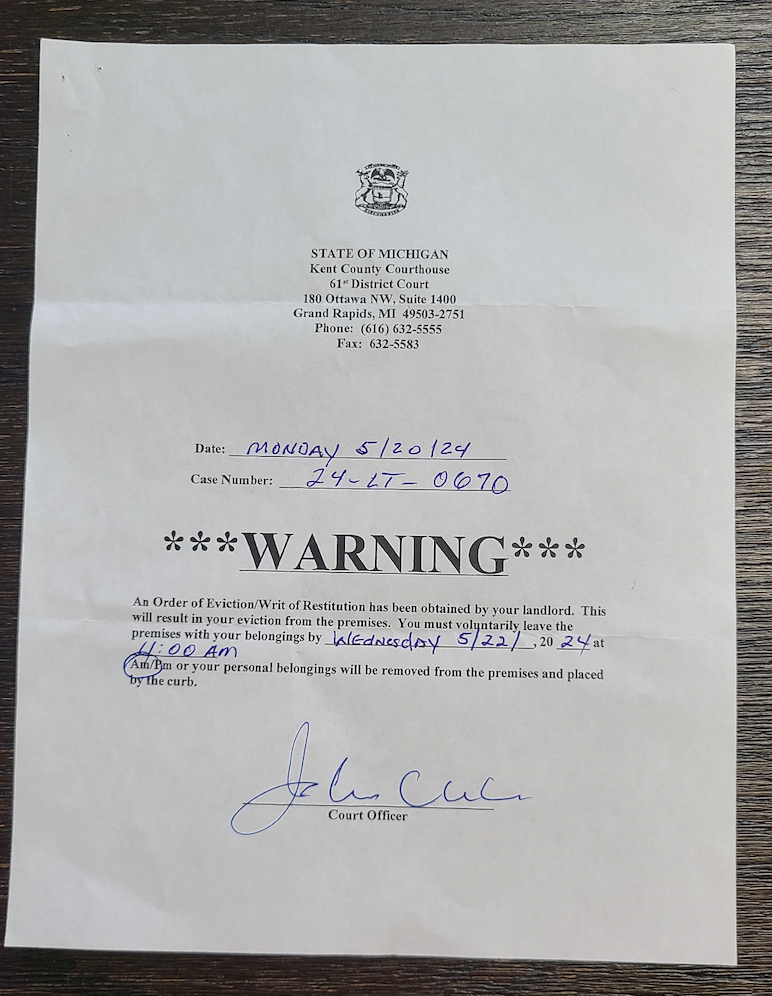 In the afternoon of May 20th, someone from the court came to the tenant’s residence and posted a notice to vacate, but the notice did not provide the legally required time to allow the tenant to vacate the property. (Notice can be seen here on the right)
GRATU then put out a call to people to provide some eviction defense. The tenant, who was now very afraid of what was happening, decided that they no longer wanted to live in a property owned by this landlord. The tenant asked if GRATU could help them move. GRATU agreed to assisting the tenant with moving, beginning on the morning of the notice to vacate.
GRATU volunteers and the tenant were packing things up and loading them onto a U-Haul truck, when the same person from the court who posted the notice to vacate showed up. This person, who was rude and combative said that the tenant needed to be out immediately, before the movers who worked for the landlord came and put the tenants things by the curb. The person from the court could clearly see that people were there and moving items into the U-Haul truck, but that did not matter to him. He decided to be petty and called the landlord.
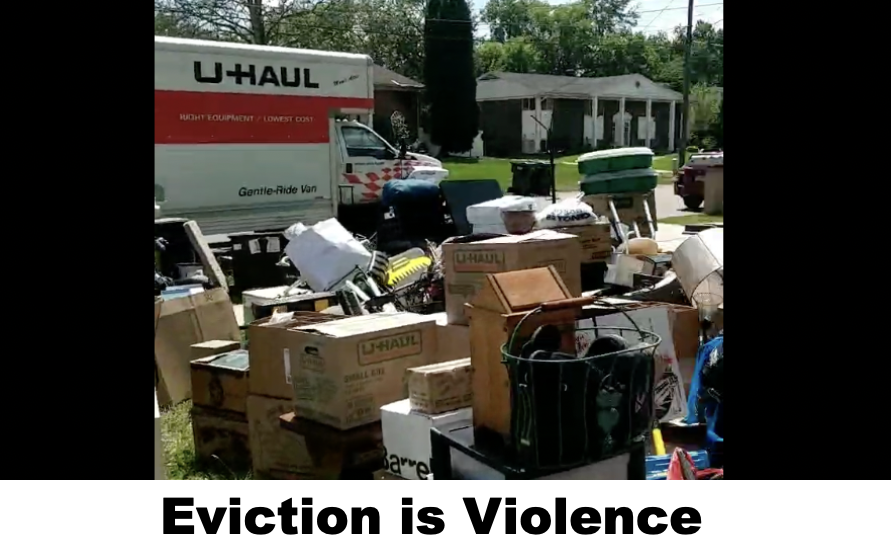
Within 30 minutes of the confrontation with the court employee, people who worked for the landlord showed up and began taking stuff out of the house and placing them in the grass near the edge of the street. These people could have just as easily put these items in the U-Haul, but chose not to and yet another retaliatory action. This retaliation went on for several hours and even before the tenant got all of their property out of the home they had lived in for 10 years, the landlord had their workers change the locks on the property, even though the tenant had not removed all of their items from the home.
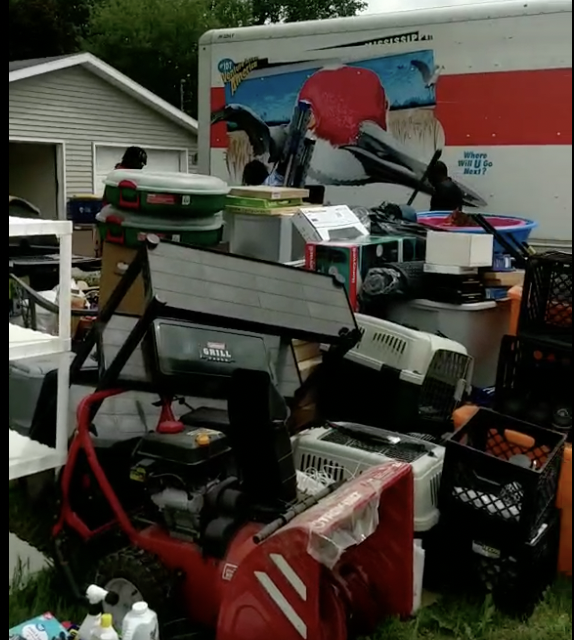
Despite this awful display of retaliation and vindictiveness, the tenant with GRATU volunteers were able to get everything out later that day.
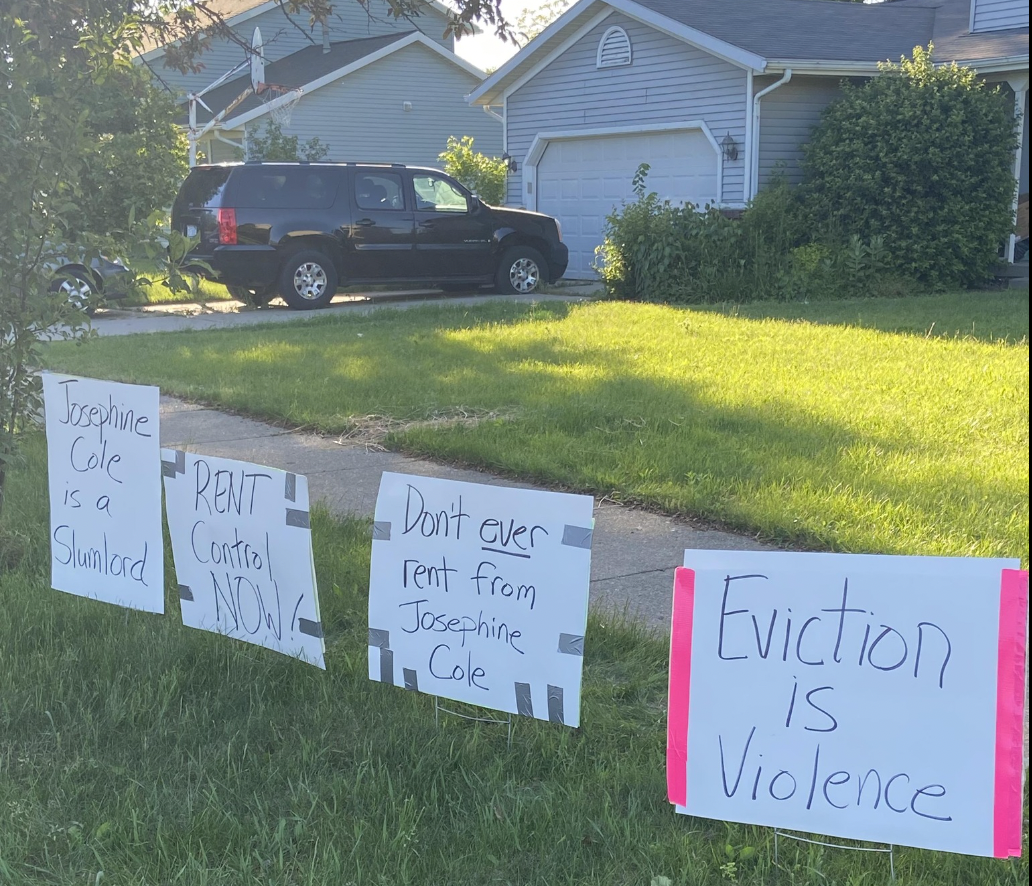
Infuriated, the tenant asked GRATU to organize another protest a week later. Not as many people were able to attend a second protest at the landlord’s home, they did make yard signs and left them in the front lawn with messages like Eviction is Violence, Rent Control Now, Josephine Cole is a Slumlord and Don’t Ever Rent from Josephine Cole.
GRATU even created a Mutual Aid request for the tenant, to provide some economic relief for the tenant who was forcibly evicted because the courts sided with an exploitative landlord who had an awful track record of not caring for her properties.
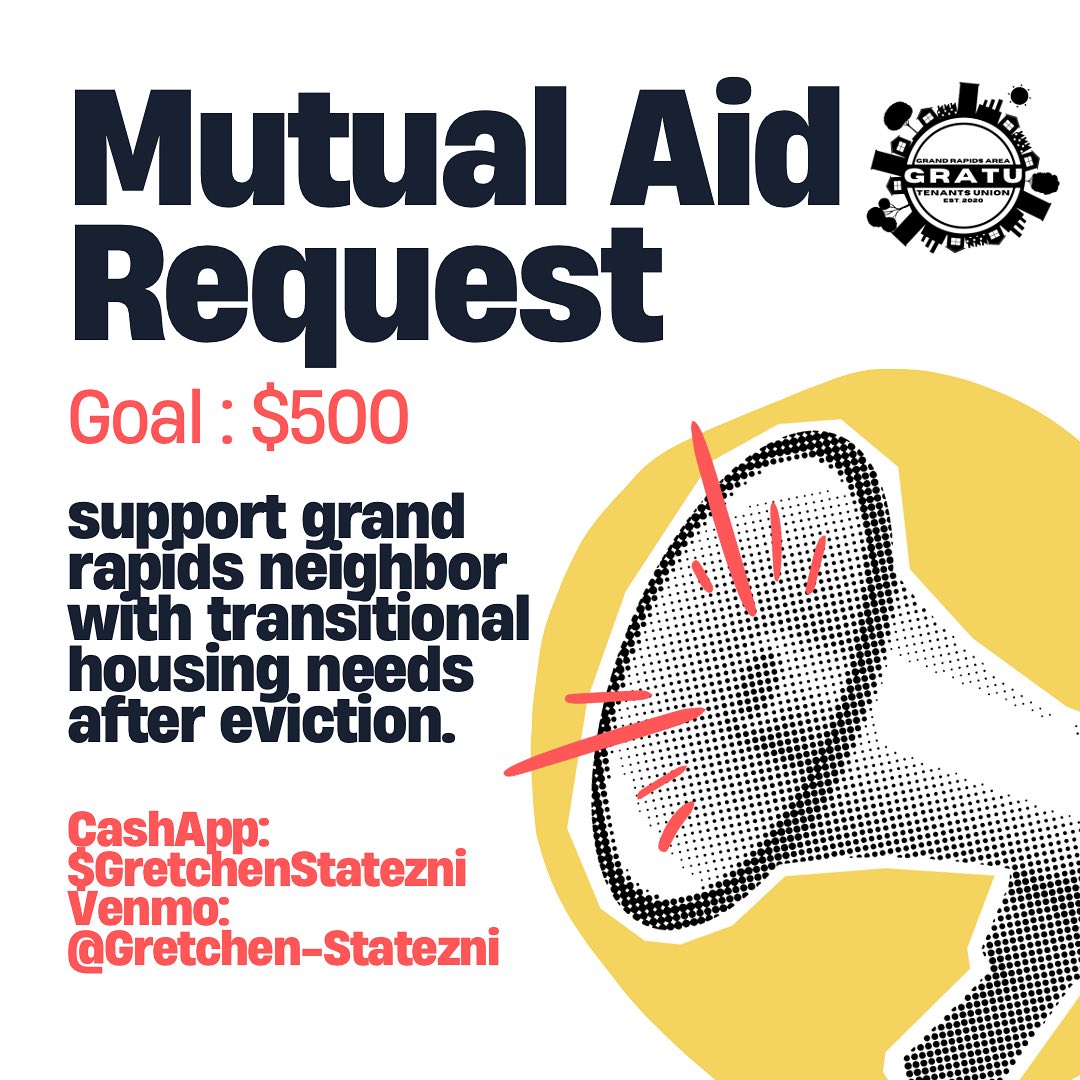 While the outcome was traumatic and violent, GRATU volunteers did an amazing job of demonstrating solidarity with a tenant that was being evicted. For those of us who do solidarity and Mutual Aid work we often say, “We take care of each other.” In fact, what the GRATU volunteers did with this tenant was a demonstration of housing justice. While those in power are demanding more housing, they do nothing to support the thousands of tenants in Grand Rapids who are housing insecure and facing constant harassment from landlords, including threats of eviction. The Grand Rapids Area Tenant Union chooses to practice housing solidarity and housing justice.
If you are a tenant that is experiencing the same kind of issues or you know someone who is, please have them contact the Grand Rapids Area Tenant Union at gratunion@gmail.com.
On Sunday MLive posted an article with the following headline, $318M incentive plan for high-rise towers, downtown venues OK’d by Grand Rapids board.
The “board” that the MLive reporter refers to is the Grand Rapids City Commissioners. The Grand Rapids Mayor and the six City Commissioners voted unanimously to provide $318 million of incentives, through what is known as the Transformational Brownfield plan, which was the exact amount requested by Grand Action 2.0.
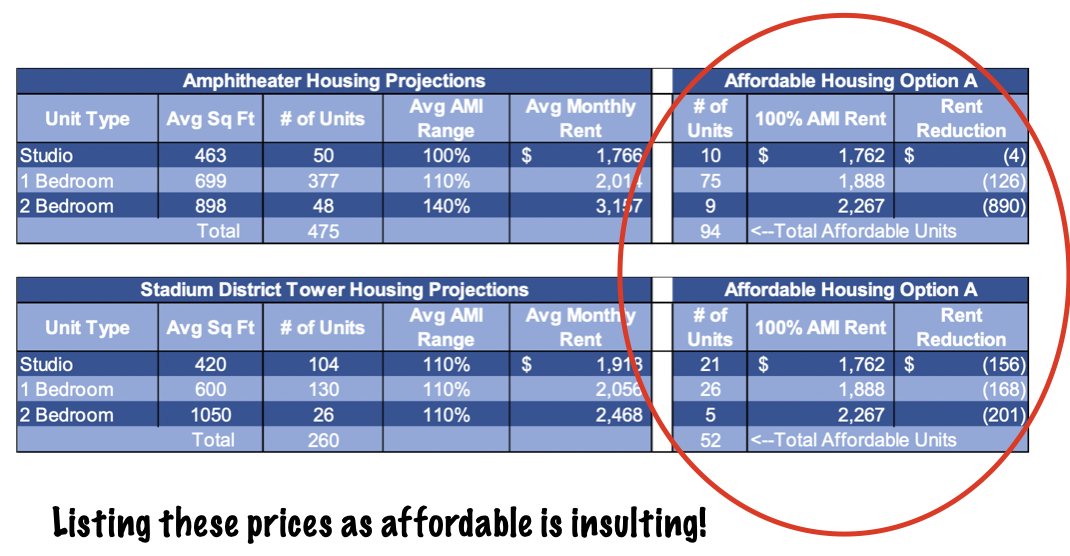
The Grand Rapids City Commission voted unanimously to approve a $318 Million incentive – which is code for subsidy – to an organization that is comprised of the economically and politically most powerful people/families in West Michigan, along with people who have relationships with those with power and often do their bidding. You can watch the very brief discussion they had at this link. The discussion about approving the $318 million subsidy to Grand Action 2.0 begins at 14:40 in and ends at 15:50.
Of the 735 units, only 146 would be affordable, and the notion that those 146 apartments are affordable is questionable at best, but for this writer Grand Action 2.0’s notion of affordable is insulting. Included here above is a graphic provided to the City Commissioners in the agenda packet listing the so-called affordable apartments that will be built next to the Amphitheater and the soccer stadium. How are these number actually affordable for most people who are struggling to survive? Clearly, as I noted in a post two weeks ago when MLive first reported on the $318 million subsidy, Grand Action 2.0 doesn’t want low income people to live in these apartments.
Now that the Grand Rapids City Commission has unanimously signed off on the incentive plan, the Michigan Strategic Fund (MSF) must do the same. The MSF is the public funding arm of the Michigan Economic Development Corporation. As you can see, the board members of the Michigan Strategic Fund are primarily from the private financial sector, along with a few members of the Michigan government. Notice that Randy Thelen, the president and CEO of The Right Place, Inc., also sits on this board. Thelen will surely voted yes to use more public money to subsidize unaffordable housing that Grand Action 2.0 has proposed, especially since 10 of the board members of The Right Place Inc. also sit on the board of Grand Action 2.0. The centers of power in this city are so god damn incestuous, or what is known as interlocking systems of power.
But Wait, there’s more!
It is important to note that the Grand Action 2.0 Amphitheater and Soccer Stadium apartment projects are not only relying on the $318 Million Transformational Brownfield plan, they also listed in the agenda packet for last week’s Committee of the Whole meeting likely additional subsidies.
Economic Development staff have been working with Grand Action to submit a grant application requesting up to $1 million from the Michigan Department of Environment, Great Lakes and Energy (EGLE) to support demolition and environmental cleanup costs associated with the amphitheater development. Pending review by EGLE, a request to approve the grant submission would be presented to the board at its next meeting.
The residential components of the project both meet the requirements for the Neighborhood Enterprise Zone exemption, which may be considered by the City as the projects develop further. Based on projections, the NEZ could provide up to $24 million of tax savings for the amphitheater apartments, and $6.8 million of tax savings for the stadium district tower, each over a period of 15 years.
If these other tax incentives and grants are approved, then Grand Action 2.0 will get an additional $31.8 million, bringing the total cost to the public $349.8 million. Don’t you just love it when the public pays for projects that are crafted by the Capitalist Class, projects they could easily afford themselves?
Palestine Solidarity Information, Analysis, Local Actions and Events for the week of May 27th
It has been almost 8 months since the Israeli government began their most recent assault on Gaza and the West Bank. The retaliation for the October 7 Hamas attack in Israel, has escalated to what the international community has called genocide, therefore, GRIID will be providing weekly links to information and analysis that we think can better inform us of what is happening, along with the role that the US government is playing. We will also provide information on local events and actions that people can get involved in. All of this information is to provide people with the capacity of what Noam Chomsky refers to as, intellectual self-defense.

Information
Hundreds of Palestinian Doctors Disappeared Into Israeli Detention
Israel’s Priority Is Killing Gazans, Not Freeing Hostages
From Strikes to Encampments, Faculty Join Campus Movement for a Free Palestine
Israel’s War Is Not About Bringing Down Hamas
Biden’s Response to Israel’s ICC Prosecution Is an Attack on International Law
Top Ten Ways to Soften a Genocide
Israel’s Response to ICJ Order to Halt Rafah Assault? More Bombing
Analysis & History
The Dead End of Liberal American Zionism
Nakba Resurrected – How the Gaza Resistance Ended Segmentation of Palestine
Local Events and Actions
Power to Palestine: Weekly Rally in Grand Rapids
Wednesday, May 29 from 6pm – 7pm, Monument Park
Graphic used in this post is from https://visualizingpalestine.org/#visuals
Yesterday, MLive posted an article entitled, Grand Rapids leaders face calls to drop charges after pro-Palestinian protesters arrested.
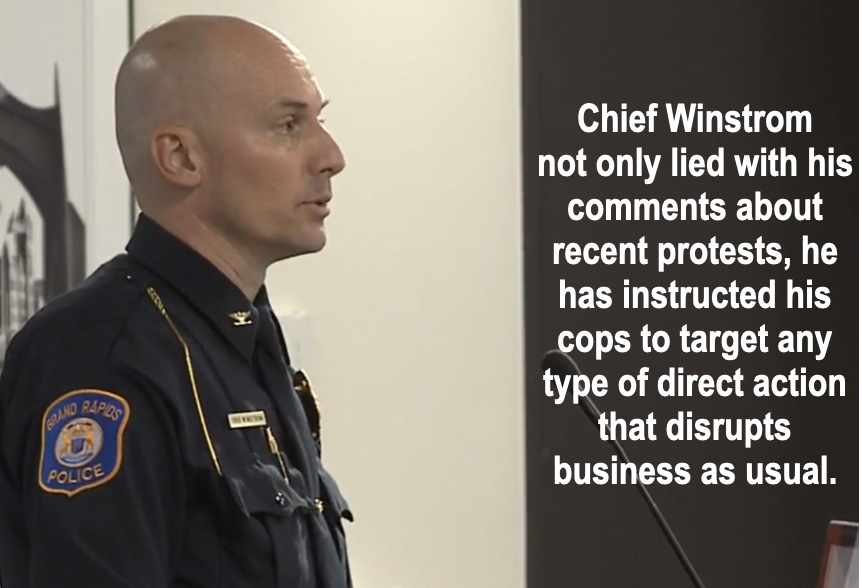
The article is pretty straight forward on what happened at a recent Palestine Solidarity protest in downtown Grand Rapids and why the group was calling on GR City officials to drop charges against people. However, the reporter included comments from Grand Rapids Police Chief Eric Winstrom about why they arrested four people during last week’s protest. In one part, the MLive article states:
Grand Rapids Police Chief Eric Winstrom said his department often uses discretion in enforcing that rule, giving more leniency to protests that are spontaneous, like the march that happened after the city released body camera footage of the killing of Patrick Lyoya in April 2022 by a now-former Grand Rapids police officer.
I’m sorry, the example that Winstrom gave here wasn’t discretion, it was because they knew that if the GRPD had tried to prevent people from marching the streets right after the public saw the footage of then officer Christopher Schurr shoot Patrick Lyoya in the back of the head while sitting on top of him, things would have escalated even further.
The MLive article then states:
He (Winstrom) mentioned an instance when protesters marched through a neighborhood near Martin Luther King Park, blocking off traffic and an ambulance that he said was attempting to get through.
This statement here, that the march to Rep. Scholten’s home because she is complicit in genocide, did NOT prevent an ambulance from getting through, since at that point the ambulance had come from the north entrance side of the street next to MLK Park and the protest had stopped a few houses south of where the ambulance needed to go. I know, I was there doing crowd safety. Chief Winstrom didn’t show up until later, which means his comment is an outright lie!
In addition, what Chief Winstrom failed to acknowledge in his comments about what happened late last year at MLK Park, is that he sent 10 GRPD cruisers to that protest and at the very end they arrested the person who was driving a safety car behind the march in order to keep people safe and prevent a motorist from ramming into the marchers. This has been a standard tactic that marches have at least since what happened in Charlottesville in 2017, when a white supremacist drove into the crowd of people who were protesting the white supremacist rally, killing one person.

In fact, Chief Winstrom instructed his cops to do the same thing during a march to demand justice for Patrick Lyoya just last month, which also included targeting two BIPOC activists and charging them with misdemeanors and in one case a felony weeks after the march took place, which I wrote about in my recent article, The criminalization of dissent in Grand Rapids.
Near the end of the MLive article Winstrom states: “It’s not just about their First Amendment rights; just because you have a right to speak doesn’t mean you have the right to communicate your message in an illegal way to people who aren’t interested in hearing it. You don’t have a right to be heard that way.” How the hell does Winstrom know who wants to hear the message from people demanding justice? He doesn’t, so Winstrom should just shut the hell up.
Marching in the streets is not illegal, but the City of Grand Rapids and Chief Winstrom has decided it is. What is really at issue is that the City of Grand Rapids doesn’t want people disrupting business as usual, especially in downtown Grand Rapids. And lets be clear about who is putting pressure on the City of Grand Rapids and the GRPD for criminalizing dissent. The people who run this city, those who own most of the property downtown, the GR Chamber of Commerce and those who have family names on some of the buildings, are the ones who do not want any kind of disruption to take place, especially since it disrupts their ability to increase their profits.
What do you get when journalism panders to wealthy interests? You get an uninformed public who buys into dominant narratives created by those with economic and political power.
Over the past few days, the organization Grand Action 2.0 has likely been celebrating the local commercial news coverage of the latest downtown development project that will attract more tourists, the 12,000 seat outdoor Amphitheater.

The May 20th article from MLive truly demonstrates how local journalism has embraced Neoliberal Capitalism, where the voices of the rich and powerful are centered and not a critical murmur can be found.
The May 20th MLive article includes pithy comments from Dick DeVos and Mayor Biss, then shifts to the long-dreamed of idea for the amphitheater and the creation of Grand Action 2.0, the very group that made the outdoor concert venue a reality.
The other major theme in the MLive article is how the public is lead to believe that this public/private partnership will really benefit the public. However, even within the article itself, you can find an important truth. The cost of the new downtown Amphitheater is expected to be $184 million. Of that, $114 million would come from public sources and $70 million from private sources.
We learn in the MLive piece that State Legislators got the State of Michigan to re-direct public tax dollars to the Amphitheater project. We also learn how much the county and the City of Grand Rapids has kicked in, and as Dick DeVos says, the next phase of fleecing the public will be the Hotel Tax ballot initiative, which people will get to vote on in August.
It really is a marvel to see the private sector – Grand Action 2.0, get the public sector – state and local government, to turn over so much money for a development project, which will primarily benefit the people who run Grand Action 2.0 and their friends. The public has had no say in how their tax dollars are being used for the Amphitheater. Yes, the public will get to vote on the Hotel Tax in the August Primary Election, but they don’t have a say in how the money generated from the tax will be used. It really is astounding how those in power can get elected officials to put so much effort into making the Amphitheater a reality.
The question I have at this point is, why can’t elected officials go the extra mile to use public money that would truly benefit the public? Image if $114 million was spent on providing housing for the most vulnerable in this city. $114 million could provide 456 families with a new home at a cost of $250,000 each. If we wanted to look at the cost of rent, with a lower end in this market at $1200 a month, which is $14,400 a year, then $114 million could provide 10,000 people with no rental costs for a year. Image how much relief that would provide to people who are constantly struggling to survive. It would not only provide people tremendous economic relief, but it would also mean less physical and emotion stress for people. Plus, it would mean that renters who have money to spend on something else, like consumers items, which the bloody Capitalist love to hear.
MLive then posted two additional articles, one entitled, 5 things to know about $184M Grand Rapids amphitheater, which is sort of a crib notes version of the original story, plus another article centering more of the voices of those who make up the Grand Rapids Power Structure.
When are we ever going to see journalism in this city that will not just pander to those in power, but center the voices of working class people, communities of color and people who have been negatively impacted from all of the downtown development projects that have happened in the last 30 years? When are we gonna see local journalism that explores the idea that if we can raise $184 Million for an entertainment venue, why can’t we raise the same level of funds to make sure that the residents of this city have their basic needs met. The answer should be obvious – there are no profits to be made when people get their basic needs met.
Not only does Rep. Scholten support genocide, she recently voted for more policing and protection for cops
For anyone who has been reading the GRIID blog in recent months, you know that I have been very clear about all of the votes and the rhetoric that Rep. Hillary Scholten has engaged in to defend Israel’s genocidal campaign against the Palestinians. All of this was summarized in my post from May 13 with the title, Rep. Hillary Scholten has the blood of Palestinians on her hands, which includes a wanted poster of the war crimes she is complicit in.
Today, I want to point out that Rep. Scholten also has voted for and supports policies and funding for more police and to further protect cops from any real accountability.

Last week was Police Week in the US, which in and of itself is such a strange Orwellian dynamic. During Police Week, Rep. Scholten made the following statement:
“Every single day, law enforcement officers put their lives on the line to protect their communities. I’ve had the honor of meeting hundreds of these heroes during my time in Congress, and I am in awe of their willingness to put others above self in a time when serving one’s community is all the more challenging. As we work to make policing stronger and safer for all in West Michigan, it’s so important to recognize our safety heroes who do this work every single day. This week, the House came together in a bipartisan way to advance several pieces of legislation that will improve the lives of officers around the country, and I was proud to be a part of this much-needed effort.”
The most problematic point in this statement, and there are many, is Rep. Scholten’s belief that cops keep us safe. There is an important document from the group Interrupting Criminalization, entitled, Cops Don’t Stop Violence, which deconstructs the whole notion of crime, how crime data is misused to serve policing interests and how police consistently engage in their own crimes against people they stop, detain and arrest.
The report is well researched and full of data, that is presented in a very readable fashion. The report concludes with the following statement:
It’s time to recognize that decades of pouring more money, resources, and legitimacy into policing in an effort to increase safety have failed — because policing is functioning as it is intended to: to contain, control, and criminalize Black and Brown communities rather than to prevent and reduce violence. It’s time to invest in meeting community needs and building non-police community safety strategies. It’s time to invest in just recovery.
Beyond the awful rhetoric coming from Rep. Scholten, she lists the following votes:
- H.R. 3325 – The Recruit and Retain Act to authorize law enforcement agencies to use Community Oriented Policing grants for recruitment activities, in an effort to address an unprecedented crisis in hiring and retaining qualified personnel. GRIID – she voted for more public money to be used to recruit more cops, which are state violence workers.
- H.R. 7581 – The Improving Law Enforcement Officer Safety and Wellness Through Data Act to require the U.S. Attorney General–within 270 days of enactment–to submit reports that detail acts of violence against law enforcement officers and the efficacy of programs intended to provide law enforcement with wellness resources. GRIID – Let’s find more money and created programs to assist cops with wellness, but not for the families of the 426 people that the cops have killed so far in 2024, according to https://mappingpoliceviolence.org/.
- H.R. 7343 – TheDetain and Deport Illegal Aliens Who Assault Cops Act to require that non-U.S. nationals who assault law enforcement officers must be arrested, detained, and removed from the U.S. GRIID – really, this shit. Does Rep. Scholten want us believe that there is an epidemic of undocumented immigrants assaulting cops? PLEASE!
- H.Res. 1213 – A resolution regarding violence against law enforcement officers. GRIID – This resolution begins by stating, “Whereas, beginning in 2020, and in conjunction with the “defund the police” movement, respect for the rule of law and law enforcement officials diminished;” This is very telling, since it equates the Black-led Defund the Police Movement with the lack of respect for the rule of law. How can any reasonable person respect cops who brutalize Black people, or in the case of Patrick Lyoya, shot them in the back of the head while sitting on top of them?
All of these votes by Rep. Hillary Scholten is not only insulting to BIPOC folks, it means she is either unaware of or doesn’t give a damn about the fact that just in the past month cops have killed Samuel Dajon Sterling and Riley Doggett. Is Scholten that clueless? Has the representative sat with these families and felt their pain? No, Rep. Hillary Scholten would prefer to spend more money to recruit cops and vote for legislation and resolutions which provide event more legal protections for the cops. #ACAB
The criminalization of dissent in Grand Rapids
It has been very interesting to see how the City of Grand Rapids, through the use of violence workers (also known as the GRPD), has been responding to organized social movements and acts of public dissent.
Shortly after the May 30th, 2020 uprising in Grand Rapids, the GRPD has been somewhat more tolerant of public dissent, at least in the months that followed. However, this has not been the case with BIPOC organizers and activists, whom have been the primary target of GRPD monitoring, harassment and arrests.
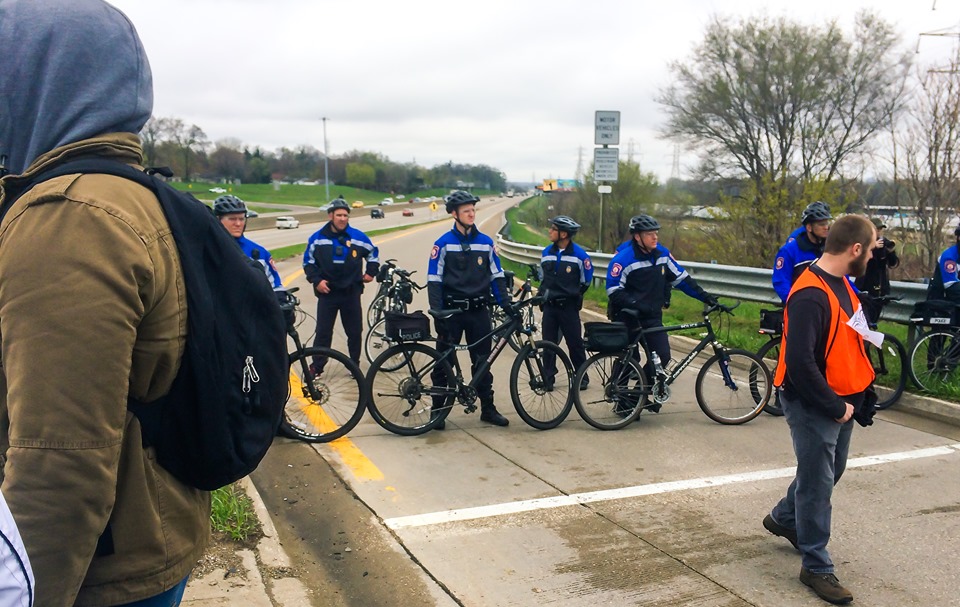
This same type of repressive and threatening posture from the GRPD was also directed at Movimiento Cosecha and allies in the immigration justice movement even before the COVID pandemic began, specifically in 2019, when the GRPD threatened to arrest people on May Day of 2019 if they marched in the streets. To be clear, Movimiento Cosecha had marched in the streets on May Day in 2017 and 2018, but the GRPD decided they would no longer tolerate disruption of traffic and commerce. Cosecha and their allies obtained FOIA documents that verified that the GRPD was prepared to use force against people marching in the streets. Here is the Dispersal Announcement the GRPD made:
I am (Rank and Name) of the Grand Rapids Police Department. I am now issuing a Public Safety Order to disperse and I command all those assembled at (specific location) to immediately disperse, which means leave the area. If you do not do so, you may be arrested (cite ordinance or law) or be subject to other police action. Other police action could include the use of Chemical Agents or less-lethal munitions, which may inflict significant pain or result in serious injury. If you remain in the area just described, regardless of your purpose, you will be in violation of city and/or state law. The following routes of dispersal are available: (provide escape route details). You have (provide a reasonable amount of time) minutes to disperse.
The targeting of primarily BIPOC organizers and activists began with actions organized by Defund the GRPD and Justice for Black Lives in the fall of 2020 and throughout 2021. The City of Grand Rapids then hired Eric Winstrom to be the acting Chief of Police for Grand Rapids. Winstrom came from Chicago, a city which has a long and brutal history of repression by the police. (See the book, Chicago’s Reckoning: Racism, Politics, and the Deep History of Policing in an American City.)
Shortly after Winstrom began his tenure as the head of the GRPD, a cop murdered Patrick Lyoya on April 4th of 2022. The very next day, Chief Winstrom, along with other City leaders, held a Press Conference. What was instructive about that Press Conference is how polished Winstrom was as a PR man.
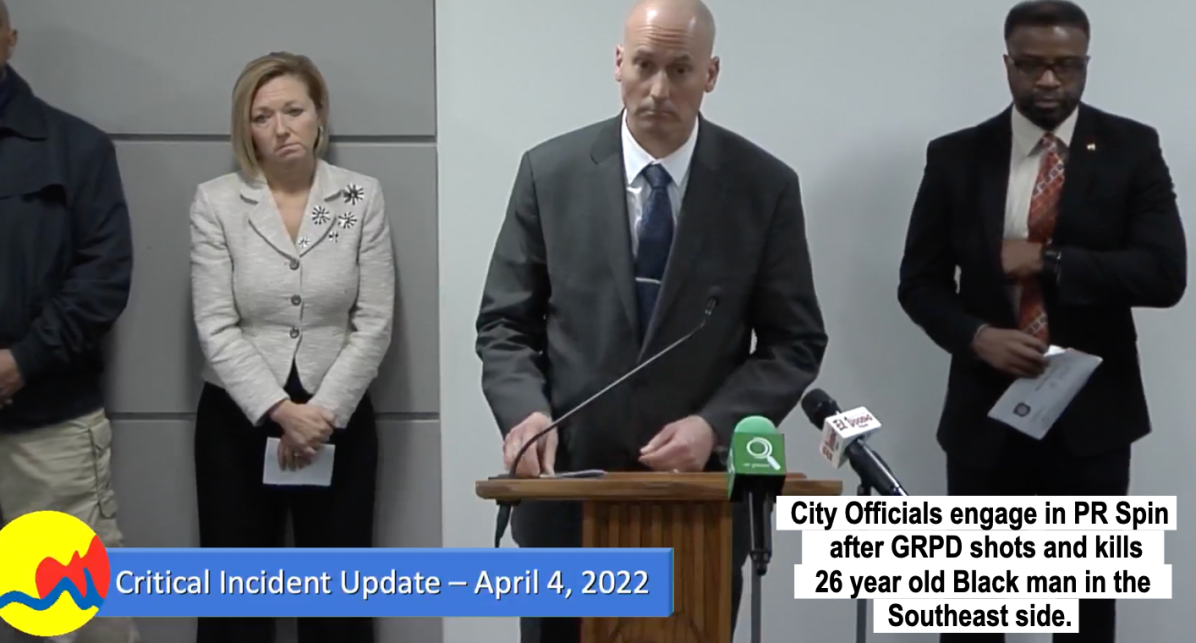
Two months after Patrick Lyoya was murdered, there was another “officer involved shooting, so Chief Winstrom once again held a Press Conference where he started to use the phrase, “the Ferguson Effect.” Winstrom was using that term to make the claim that whenever there is an “officer involved shooting,” that crime usually goes up, especially crime in the Black community. Of course, Winstrom offered to verification of this claim because when people in positions of power make such claims they must be true, according to the dominant narrative used by the commercial news media.
The phrase “Ferguson Effect”, was coined by Heather MacDonald, which Chief Wonstrom named during the Press Conference. What Winstrom didn’t mention is the fact that Heather MacDonald is a senior fellow at the right-wing Manhattan Institute. The use of the phrase, the “Ferguson Effect” was looked at in an article by the media watchdog group, Fairness in Accuracy & Reporting in June of 2015. The article states:
The point of the “Ferguson effect,” though, is not to be accurate. It is instead to distract us from the growing evidence about the magnitude and extent of police use of lethal violence in the United States—as powerfully documented just this week by the Guardian and the Washington Post—and to besmirch the #BlackLivesMatter movement.
It’s a strategy that Republican presidential candidate Barry Goldwater inaugurated in his campaign in 1964, almost single-handedly turning crime into a political weapon against the civil rights movement.
This is exactly what Chief Winstrom was doing, which the local media seemed to be eating up. WOODTV8 repeated the Ferguson Effect claim in their coverage on Friday.
Since last year, the GRPD is targeting more dissident groups and calling un-permitted marches illegal. When the Comrades Collective joined Palestine Solidarity Grand Rapids for a march that began at MLK Park, then went to Rep. Scholten’s home, the GRPD showed up in big numbers and arrested the safety car driver. Safety cars have been used in recent years during marches as a means of protecting those marching from motorists that want to ram into people who are in the streets, just like what happened in Charlottesville in 2017.
The same thing happened during the march for Patrick Lyoya, which took places 2 days after the second anniversary of his murder on April 6th. The GRPD arrested the safety car person and then impounded their car.
However, a few weeks after that happened, two BIPOC activists then received calls from the GRPD to turn themselves in, since one was being charged with a misdemeanor and the other a misdemeanor and a felony.
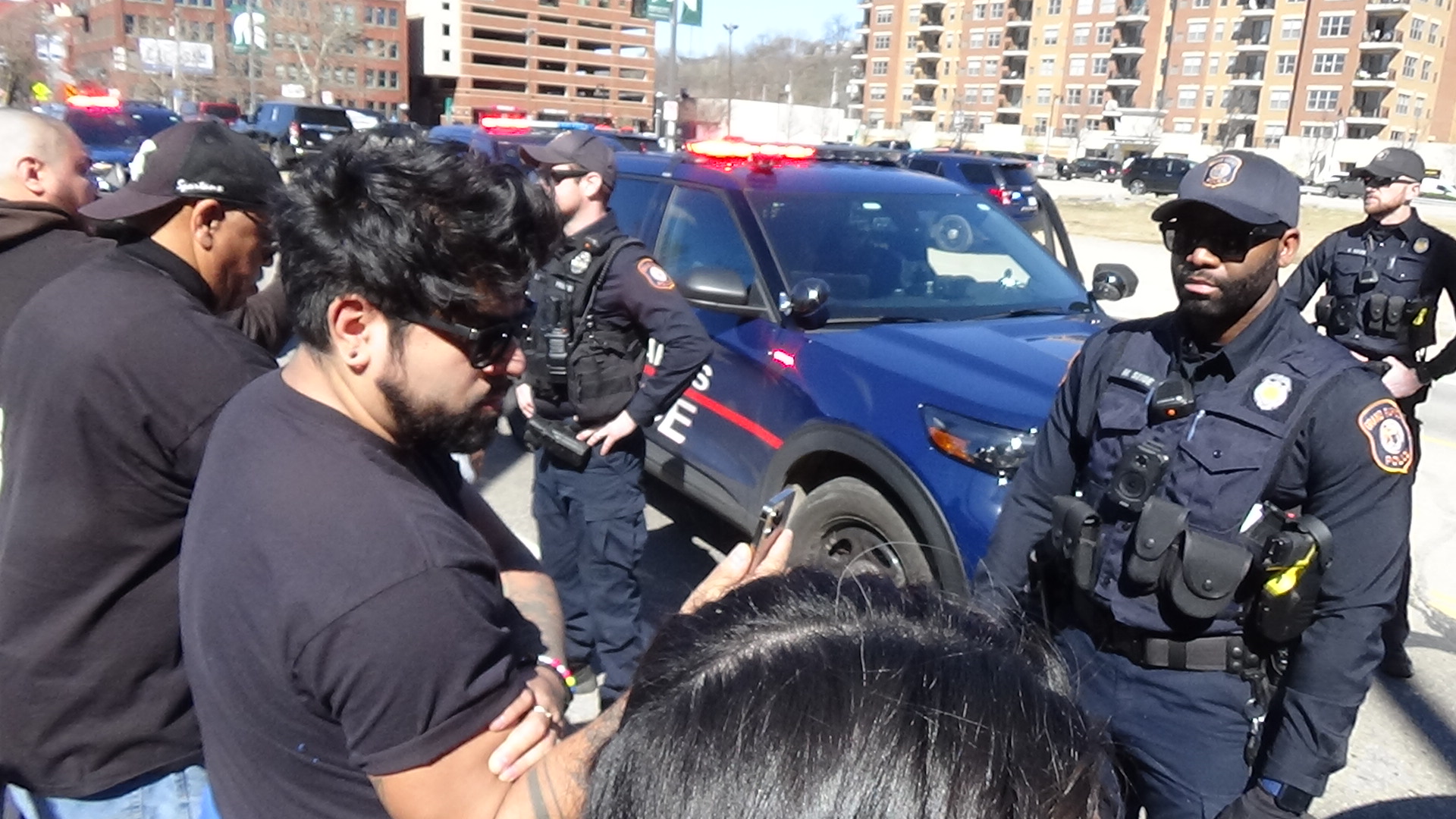
Just last week, during a protest organized by Palestine Solidarity Grand Rapids, the GRPD once again showed up and arrested 4 people, specifically those that were acting as crowd safety. Here is what the GRCC students newspaper reported:
After protesters marched around the downtown area and disrupted traffic, around 35 Grand Rapids police trailed behind the group stating that they could be subjects of arrest if they didn’t comply with the law. Protestors moved over to the sidewalk while going down Monroe Avenue but marched down the middle of Monroe Center Street.
After Protesters made it back to Monument Park on the corner of Fulton Street and Division Avenue, Police detained four individuals after they were blocking roads according to GRPD Police Chief Eric Winstrom.
“This group has had probably 20 marches since Oct. 6 when Israel was invaded by a group of terrorists,” said Winstrom when referencing when the Palestinian Sunni Islamist group Hamas killed around 1,200 Israeli citizens on Oct. 7. “They (protesters) have not had a permit at any point in time. They continually block streets, creating traffic hazards for individuals. We have been extremely tolerant in accommodating them in their activities, even though they have been illegal…”
It is instructive to note that Winstrom clearly has a Zionist view of what happened in early October, failing miserably to understand the historical context of the actions of Hamas. Winstrom’s lack of clarity on US foreign policy regarding Israel and Palestine aside, what is most important is what he said that is in bold in the previous paragraph. What is at issue here is that Winstrom will not tolerate people engaging in un-permitted marches, especially if those marches are disruptive in nature.
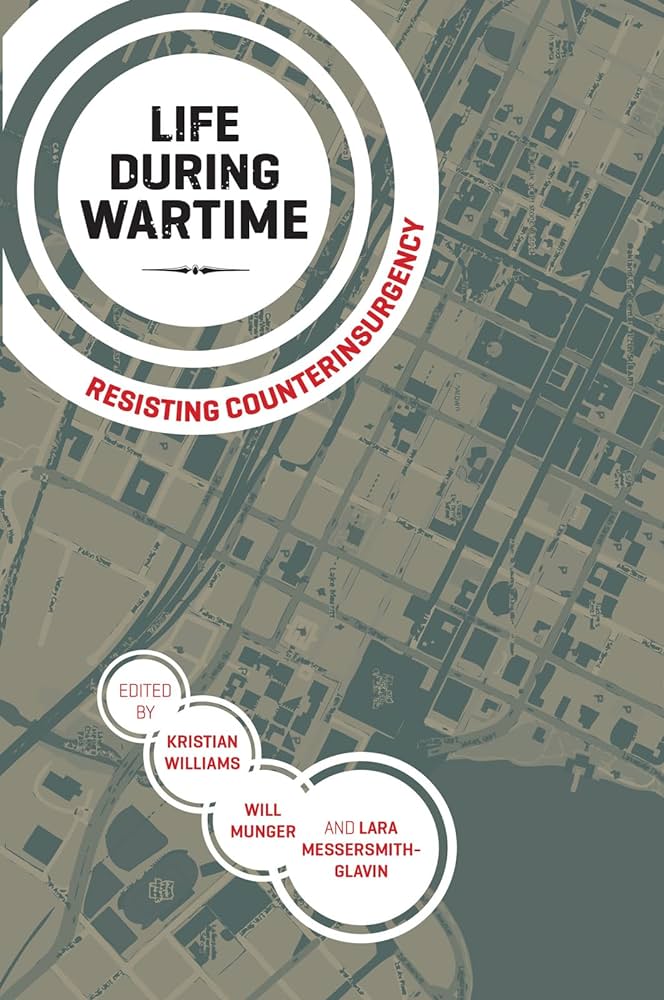 In Kristian Williams’ book, Life During Wartime: Resisting Counterinsurgency, (a book which discusses the history use of counterinsurgency by police departments – something they learned from the US Military), the author states that one of the primary tactics of counterinsurgency is to engage in “preserving order” and “social management.”
Alex Vitale, in his book, The End of Policing, confirm’s this function of social control, when he writes:
The reality is that the police exist primarily as a system for managing and even producing inequality by suppressing social movements and tightly managing the behaviors of poor and nonwhite people: those on the losing end of economic and political arrangements.
We should all expect the repression of social movements and organized dissent to increase in Grand Rapids. We need to expect the worst and plan accordingly when we engage in public acts of disruption. Disruption is a long-held tactic of social movements. Dr. King and the Civil Rights Movement used disruption, which he wrote about:
“We do not need allies more devoted to order than to justice,” Martin Luther King, Jr. wrote in the spring of 1964, refusing calls from moderate Black and White leaders to condemn a planned highway “stall-in” to highlight systemic racism in New York City. “I hear a lot of talk these days about our direct action talk alienating former friends,” he added. “I would rather feel they are bringing to the surface latent prejudices that are already there. If our direct action programs alienate our friends … they never were really our friends.”
It would be understandable, in light of the increased GRPD repression, for people to pull back on direct action. However, we also know that if we are committed to systemic change and collective liberation, we cannot afford to lessen our resistance. We do need to take care of each other and protect those that are the primary targets of this repression, but we must not diminish our resistance, no matter the cost.
I’ll just end with this observation from Kristian Williams’ book, Gang Politics: Revolution, Repression, and Crime, he writes:
“The challenge for liberatory movements, then, is not merely to launch an insurgency capable of overturning the existing power structure but to create new ways of relating, of organizing, of exercising and sharing power, that do not themselves reproduce the logic of a protection racket, like the police.”
GRIID Interview with Ky: Police repression happens especially when activists want to hold the GRPD accountable
I sat down with Ky last Thursday to talk about why the GRPD contacted them two weeks after they participated in a march demanding Justice for Patrick Lyoya, and then charged them with a felony and a misdemeanor.

The march, which took place on April 6th, just two days after the second anniversary of the GRPD murder of Patrick Lyoya. The march was organized by the Comrades Collective, which included several members of Patrick Lyoya’s family.
There is also a GoFundMe to raise funds for legal support because of these charges. Please contribute if you are able to and share with your circle.
Below are the six questions I asked Ky during the 12:50 interview:
- Can you tell us what your involvement was during the April 6th Justice for Patrick Lyoya march organized by the Comrades Collective?
- How many days after the march were you contacted by the GRPD and what were they charging you with?
- If you weren’t doing anything different than the dozens of people who participated in the march on April 6th, why do you think the GRPD is targeting you?
- It’s not lost on many of us that the two people that the GRPD have targeted with charges after the protest are BIPOC. DO you think that the GRPD’s actions are in part racially motivated?
- Why do you think what happened to you is important for people to know?
- In what ways can people support you and be involved in the campaign to fight for justice for Patrick Lyoya?

