Senita Lenear announces candidacy for Mayor: Assessing the former Commissioner’s voting record through the lens of social movement organizing in Grand Rapids
Just before the Thanksgiving break, former 2nd Ward Grand Rapids City Commissioner Senita Lenear announced that she was enter the race to be Mayor of Grand Rapids in the 2024 Election.
This means that there are now two candidates running to become the next Mayor of Grand Rapids, with David LaGrand being the first to announce earlier this summer. GRIID has posted 2 articles on LaGrand’s mayoral candidacy, one in July, which looked at his campaign finances, and a second post more recently, also regarding those who are contributing to his candidacy. In today’s post, I want to look at Senitar Lenear’s candidacy.

The local news coverage of Lenear’s announcement that she is running for Mayor of Grand Rapids did little to inform people, despite the fact that Lenear served as a 3rd ward Commissioner for 8 years. As an example, the WZZM 13 story used some of the talking points that the Lenear campaign sent out, talking points that are highlighted on her campaign website.
The soundbite from Lenear that channel 13 ran, has the former City Commissioner talking in vague pleasnatries, but with no real concrete policy ideas or issues that are critical to most working class and BIPOC residents. The story did mention that Lenear already has the endorsement of current 2nd Ward City Commissioner Ysasi, but failed to tell viewers that Ysasi is also the treasurer for Lenear’s campaign for mayor, based on her recent campaign finances filing.
The campaign website for Lenear is also full of platitudes about violence reduction and investment in the City’s 3rd Ward. There is even a heading for Grand Action 2.0, the private DeVos-run entity that has used millions in public funding for private projects like the Downtown Market, and the forthcoming outdoor amphitheater.
As someone who pays attention to social movements in Grand Rapids, my assessment of Lenear would be more critical than what the commercial news media is and will likely offer between now and the November 2024 Election. For instance, in 2019, MLive ran a series of articles on the lack of investment in the 3rd Ward, which Lenear represented from 2014 – 2022. In response to the MLive coverage, GRIID wrote:
Sadly, the reporters who wrote the pieces last week about the lack of equity in the city’s 3rd Ward, did not hold elected leaders accountable, instead they provided them with an uncritical forum to say what they wanted.
But what would accountability from the news media look like? First, MLive could have looked at all of the City Budget discussions since Senita Lenear was elected in the fall of 2014, to see what the 3rd Ward Commissioner did to fight for more equitable funding for the ward she represents. Second, MLive could have looked at the commissioner’s voting record as it related to funding issues or development projects. Lastly, MLive could have looked at who have been the major campaign funders backing Lenear as she has run for the 3rd Ward seat. There are campaign finance records that are easily accessed from the County Clerk’s office. One section of Commissioner Lenear’s 2014 campaign finance reports tells an interesting story about who back her first campaign.
What follows are some important points as it relates to social movements during Lenear’s tenure on the City Commission 2014 – 2022.
- Commissioner Lenear did not come out in support of the bus driver’s fight over their contract.
- Commissioner Lenear did not speak up about gentrification in the City, especially the southeast part of Grand Rapids, nor the sky rocking cost of housing and rent increases that have displaced people who have been unable to afford those costs.
- When the immigrant justice movement was calling for the City to fire Captain VanderKooi, who profiled Jilmar Ramos-Gomez and turned him in to ICE, Commissioner Lenear was silent.
- When the City Commission had the opportunity to propose a reduction in the GRPD budget in 2020, a month after the George Floyd protests, Senita Lenear did not support this demand.
- After the GRPD murdered Patrick Lyoya, with constant calls to defund the GRPD, Commissioner Lenear once told those who were opposed to the GRPD, that they should join the GRPD to make the changes they wanted.
- Commissioner Lenear, towards the end of her tenure, did not oppose an ordinance proposal from the GR Chamber of Commerce, which was eventually adopted, but after Lenear was no longer on the commission.
- Commissioner Lenear was also a major supporter of the Amphitheater proposal and other downtown investments that required massive public funding. The amount of money that the City, County, and State government that is going to the Amphitheater is millions, so imagine if Commissioner Lenear would have champion that kind of investment into the 3rd Ward while she was representing that area specifically.
As has been the case in the past, GRIID will monitor and track the platforms and campaign financing of the candidates running for Mayor of Grand Rapids over the next 11 months until the 2024 Election.
Activist hold a Die-In at the Grand Rapids Downtown Market to dramatize the horror of Palestinians who have been killed by the Israeli military in recent weeks
On Sunday, a group of local activists descended on the Grand Rapids Downtown Market to continue to protest US complicity in the Israeli assault on Gaza.

 The Grand Rapids Downtown Market was chosen as a site for the protest, since there has been an increase in consumers, because of the Christkindl Market, which has added dozens of additional vendors, plus entertainment and even the option for people to rent Private Chalets.
The protest that was held at the Grand Rapids Downtown Market was a Die-In, where people wrapped themselves in bed sheets and laid down next to each other. The Die-In is a visual representation of the harsh reality that Palestinians in Gaza have been facing, with over 14,000 dead. Those who have survived in Gaza will wrap the dead in sheets and place them next to one another to provide the community with an opportunity to publicly mourn the dead.
While activist engaged in the Die-In, other people handed out small flyers encouraging people to send a message to Senators Debbie Stabenow and Gary Peters, along with 3rd Congressional Representative Hillary Scholten. The message demands that the Michigan members of Congress call for an immediate cease fire in Gaza, an end to the annual US Military Aid to Israel ($3.8 billion), plus a no vote on the proposed additional $14.3 billion the Biden Administration wants to send. You can send the same message by going to this link.
There were a few people who were visibly and verbally frustrated by the Die-In and the chanting that went on, but many people took the flyer and made gestures in support of the action. A few people even came up to some of the activists to verbally tell them that they were grateful for the action. Another activist shared that they saw several parents kneel down and explain what was happening to their children, especially since the flyer that was shared had a statement which read, Every 10 minutes a Palestinian child is blown to pieces because of the Israeli bombing.
There was also one white woman, who most likely worked for the downtown market, who came out screaming at people saying, “this is private property!” While the downtown market is privately owned, it is still space that the public gathers in and there were several million dollars of public money that subsidized the construction of the so-called market. The white woman called the GRPD, which showed up 30 minutes after the Die-In began, in 6 GRPD cruisers and 10-12 cops. Those participating in the action did not intent to get arrested, so people after the police liaison distracted the cops for a few minutes, we all got up and left. However, we all walked through the outdoor portion of the market, handing out informational flyers and chanting, Free, Free Palestine!
https://www.youtube.com/shorts/H4ynRWQ8FNw
Street Theater, or what some call Guerrilla theater, is a popular form of protest throughout the world. Augusto Boal, a Brazilian, developed street theater as a political form of resistance, in what he termed the Theater of the Oppressed.
Rep. Scholten’s statement on the 4 day pause demonstrates her ideological commitment to unconditional US support of Israel
Last Tuesday, Rep. Hillary Scholten released a statement about the negotiated agreement between Hamas and the Israeli government that began on Friday.
The negotiated agreement was for a four day “pause” of the Israeli assault on Gaza and the West Bank, in order to exchange some of the hostages being held by Hamas and Palestinian prisoners that the Israeli have had since before October 7.
Taken from Rep. Scholten’s website, the Press Release is prefaced with this sentence, “Rep. Hillary Scholten (MI-03) issued the below statement after a vote by the Israeli cabinet approving a deal to release Hamas-held hostages”: The way that Scholten’s staff framed her statement is rather instructive. It is true that the Israeli cabinet approved the deal, but this was a deal that was between the Israeli government and Hamas. Second, it is worth pointing out that the terms of the agreement were first laid out by Hamas several weeks ago, something that Scholten fails to acknowledge.
What follows is Rep. Scholten’s statement on the negotiated agreement. Afterwards, I will provide some analysis of the statement, with independent information that contradicts the Congresswoman’s statement or at the very least provides a different perspective. The highlighted words indicate what I am responding to.
“It’s with tempered relief that we receive the news of a deal to release hostages that were held for too long by Hamas and take the first step to de-escalation in this conflict. I’d like to thank the Biden Administration for working tirelessly on this issue and for heeding calls from me and my colleagues to take action and return the hostages home as soon as possible and turn towards peace.
While this is an encouraging development in the conflict, it will never take away from the horror these victims experienced or replace the innocent lives lost since the terrorist attacks on October 7th. One thing is clear: Hamas must go.
As I have done for weeks, I continue to call for the release of the remaining hostages, for humanitarian aid to quickly reach innocent civilians in Gaza, and for Israelis and Palestinians to forge a path forward towards a two-state solution that allows for shared peace and prosperity for all. The United States should continue to facilitate strategic pauses in fighting to allow that to happen.”
- Rep. Scholten completely omits the fact that this negotiated deal was an exchange of hostages taken by Hamas for Palestinian prisoners being held by the Israeli government.
- There is no evidence that the release of hostages for prisoners will lead to a de-escalation of the conflict, since numerous writers and analysts that have been following the Israel/Palestine issue for decades believe that the October 7 assault by Hamas will provide the justification that Israel needs to forcibly remove the Palestinians from Gaza.
- Thanking the Biden Administration is no doubt what Rep. Scholten was told to write, since the Biden Administration has done nothing to works towards peace on this issue. The Biden Administration has maintained unconditional support for Israel, especially after the October 7 Hamas attack, both diplomatically and in terms of the ongoing US support of Israel with weapons and military aid. If anything, the Biden Administration is recognizing the growing domestic and international opposition to US support of Israel, which could have disastrous consequences for the 2024 Elections.
- When Rep. Scholten talks about the horror these victims experienced or replace the innocent lives lost since the terrorist attacks on October 7th, she is centering the Israeli lives lost and can’t even acknowledge the 14,000 plus Palestinians who have died from Israel’s retaliation, which includes over 6,000 dead Palestinian children.
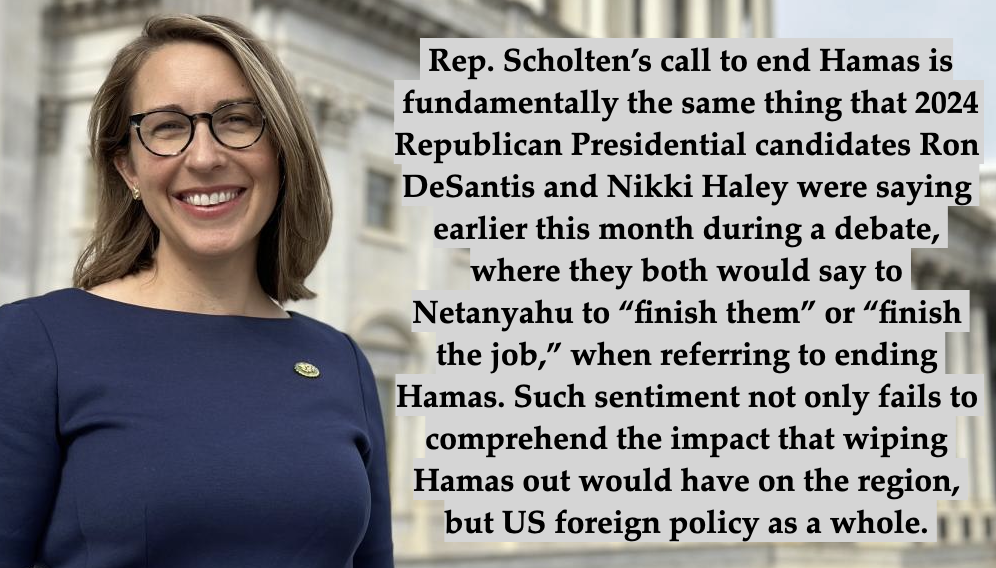
- Maybe the most egregious thing that Rep. Scholten says in her Press Release is calling for the elimination of Hamas, using the words Hamas must go. Democrats like to present themselves as liberals, but Scholten’s call to end Hamas is fundamentally the same thing that 2024 Republican Presidential candidates Ron DeSantis and Nikki Haley were saying earlier this month during a debate, where they both would say to Netanyahu to “finish them” or “finish the job,” when referring to ending Hamas. Such sentiment not only fails to comprehend the impact that wiping Hamas out would have on the region, but US foreign policy as a whole.
- Scholten’s insistence that only Hamas is to blame in this current situation demonstrates her ideological obedience to the notion that it is a matter of policy for US politicians to unconditionally support Israel.
- The likelihood of a two state solution hasn’t seemed viable for some time now, plus it ignores the one Democratic State idea that many people, including the Israeli writer Jeff Halper, have been proposing.
- Strategic pauses will only allow Israel to continue to murder Palestinians and destroy what is left of Gaza. Much of the world understands that these strategic pauses are a joke. What is needed is a permanent cease fire and a real, longterm negotiated settlement for the future of Israel and Palestine.
Lastly, I want to quote an excellent piece from the Washington Report on Middle East Affairs, which has been providing critical analysis for decades on that region of the world and on Israel/Palestine. Here is an extended quote regarding the 4 day pause:
The agreement is significant in several respects. Perhaps most importantly, the U.S. and Israel, which repeatedly vowed to eradicate Hamas, are now negotiating with the Palestinian movement and reaching agreements with it. Qatari-Egyptian mediation, while indispensable, is ultimately a formality. The U.S. and Israel are not negotiating with Egypt and Qatar but with Yahya Sinwar, the head of Hamas in the Gaza Strip and architect of the Oct. 7 attacks.
The tenor of Israeli press reports in recent days has been that Hamas is desperate for a respite, however brief and at almost any price, from the ferocious Israeli onslaught against the Gaza Strip.
Yet the available reports about the deal suggest otherwise: Israel has committed to releasing three times as many imprisoned women and children as the Palestinians; no Israeli soldiers are included in the exchange; significantly more humanitarian supplies, including fuel, will reach the Gaza Strip; the exchange of captives will be implemented during a continuous four-day truce rather than one in which the slaughter is paused for a brief period each day; and Israeli jets and drones will be prohibited from using the airspace over the Gaza Strip for several hours each day.
This is quite close to the deal initially offered by Hamas several weeks ago, and it appears the bulk of its demands have been conceded by Israel and the U.S. If the adage that negotiations reflect reality on the ground rather than overturning it applies, Hamas—in contrast to the Palestinian population of the Gaza Strip, which has been Israel’s main target—seems far from desperate. Instead, it appears sufficiently confident to stick to its priorities until these are accepted by the U.S. and Israel.
Pursuant to the agreement, Hamas has also forced the U.S. and Israel to consent to the supply of large amounts of essential humanitarian supplies to the Gaza Strip. In other words, Hamas has in one fell swoop achieved exponentially more on the humanitarian front than the much-vaunted U.S. diplomacy to secure humanitarian relief for Gaza’s Palestinian civilians during the past month.
This confirms that the entire U.S. effort was in essence a circus—a diversionary charade to enable Israel to continue with its mass killings and transform the Gaza Strip into a wasteland and a killing field.
It bears repeating that Hamas has forced the U.S. and Israel to allow significant quantities of food, water, medicine and fuel to reach the civilian population of the Gaza Strip. Yet Hamas is the anointed terrorist organization in this equation while Israel is the light unto nations with the world’s most moral army and the U.S.—the world’s greatest democracy dedicated to spreading freedom and human rights to the rest of the planet.
New Report on how the Philanthropy of the Rich costs the public, confirms what we have seen here in West Michigan
The U.S. charitable system is shaped by laws — particularly those set out by a sweeping charitable tax reform package passed in 1969. Over the five decades since then, however, we’ve witnessed an extraordinary concentration of wealth and power in the hands of our wealthiest citizens. We’ve also witnessed the attendant explosion of a wealth-defense industry — tax attorneys, accountants, and wealth managers — who have an institutional bias toward unlimited capital accumulation, tax minimization, and dynastic succession. That bias has crept its way into the philanthropic sphere as well. The meteoric rise of donor-advised funds as giving vehicles, for example, has been driven in part by wealth advisors selling tax-avoidance products. You will get a play-by-play of financial industry shell games in our discussion of how wealthy donors are gaming foundation excise taxes and payout requirements. And there are signs that some billionaires are starting to think that certain for-profit investments are a replacement for philanthropy — or even that their own companies are more socially beneficial than any sort of giving.

This paragraph above is from a new report by the Institute for Policy Studies, entitled, The True Cost of Billionaire Philanthropy. The reason why In think this report is so important is that it confirms many of the things I have been writing about in regards to the wealthiest families in West Michigan, their philanthropy through foundations and their charitable contributions. I’m speaking specifically about the DeVos and Meijer families, the two billionaire families in West Michigan, but this new report also could apply to some of the other sizable foundations in the Greater Grand Rapids area, such as the Jandernoa Foundation, the Secchia Foundation, the Cook Foundation, the Wege Foundation, the Van Andel Foundations and the Frey Foundation.
Here are some of the major findings in the report, The True Cost of Billionaire Philanthropy, which is what we have seen with the wealthy philanthropists in West Michigan.
What Ultra-Wealthy Philanthropists Costs Us?
- We know for certain that $73.34 billion in tax revenue was lost to the public in 2022 due to personal and corporate charitable deductions.
- If we include just the little data we have about charitable bequests and the investments of charities themselves, the revenue loss is pushed up to roughly $111 billion.
- And if we also include the capital gains revenue lost from the donation of appreciated assets, the true revenue costs of charity likely add up to several hundreds of billions of dollars each year.
The news is full of stories about billionaires giving huge gifts to charity. But for all but the most generous, their giving is nowhere close to keeping up with the growth in their wealth. And while some billionaires make an earnest effort to give back, others appear to be using philanthropy more to enhance their public image, their political voice, and even their wallets.
The wealth of billionaire philanthropists has grown exponentially. For example, “The 73 living U.S. Giving Pledgers who were billionaires in 2010 saw their wealth grow by 138 percent, or 224 percent when adjusted for inflation, through 2022. Their combined assets increased from $348 billion to $828 billion over those twelve years.”
A 2021 report from the Council on Michigan Foundations, or CMF, showed that the money flowing out to working charities from donor-advised funds at community foundations in Michigan was astonishingly slow. Based on account-level data for 2,600 DAFs, CMF found that in 2018 the median payout rate for Michigan’s DAF accounts was just 3.1 percent.
And it gets worse. The CMF found that in 2020, only 43 percent of DAF accounts paid out grants to charity at 5 percent or more—the minimum currently required of private foundations. 22 percent of the accounts paid out less than 5 percent. And 35 percent—more than one third— paid out nothing at all to charity that year.
In fact, on average, 37 percent of Michigan’s DAF accounts don’t pay out any money in any given year. And most of Michigan’s community foundations require a DAF to make a distribution at least once every three years — making it likely that if this requirement didn’t exist, the portion of DAFs that didn’t distribute anything to charity in any given year would be even higher.
What Billionaire Philanthropists Cost Us? 
Our national tax system contains a large and complex set of deductions, exclusions, and other provisions related to charitable giving. All of this results in lost tax revenue, forcing less wealthy taxpayers to pick up the slack to fund crucial public services. There is broad public support for this taxpayer subsidy for charitable giving when funds reach working charities in a timely manner.
In fact, according to nonprofit law experts Ray Madoff and Roger Colinvaux, if you add up all the possible federal charitable tax reductions related to income, capital gains, estate, and gift taxes, taxpayers can subsidize wealthy philanthropists by up to 74 cents for every dollar those philanthropists donate. And the wealthier the donor, the larger the public subsidy.
The last time Congress overhauled the legal framework for the philanthropic sector was in 1969, when wealth was considerably less concentrated than it is now. This framework provided important tax-reduction incentives to encourage timely giving to charity — but it also created the loophole that allowed for the commercial exploitation of donor-advised funds. It is time to modernize the rules governing philanthropy to:
- Promote a robust independent nonprofit sector outside of individual, political, and corporate influence.
- Prevent abuses of the tax system by philanthropy primarily used for aggressive tax avoidance or as a means to maintain control over donated dollars.
- Protect democracy and public society from the undue influence of private wealth and power.
Again, I am sharing the major findings from this new report, because I believe that it is reflective of some of the same dynamics I have seen with local wealthy foundations and how it negatively impacts the community.To read the GRIID section where we monitor local wealthy foundation, go to this link. Ultimately, we need to pay attention to these dynamics, because the rich not only costs the public, it impacts how we normalize and even valorize members of the Capitalist Class to our own detriment.
Rep. Scholten says she is working hard to make sure US Imperialism wins the day in Gaza
In her most recent weekly newsletter for November 17th, Rep. Scholten once again included some comments about Israel, Palestine and US policy. The Congresswoman began her comments about this most pressing foreign policy matter with the headline: The Israel-Hamas War: Hearing your concerns.

Once again, Rep. Scholten mislabels what has been happening, since there is not a war between the state of Israel and the Palestinian political faction known as Hamas. Wars can only happen between two countries. In addition, the most important thing is that the Hamas attack on Israel on October 7 did NOT start anything. Israel has been illegally occupying Palestinian land for decades, which the international community recognizes.
What follows is the narrative from Rep. Scholten’s weekly newsletter in italics. I will offer my own responses to each of the three paragraphs.
“Even as we continue our critical work on other important issues in Washington and West Michigan, I want you to know that I am deeply engaged in and paying attention to the ongoing conflict in Gaza and Israel. This week, I attended a high-level classified briefing for members of Congress and was updated on the status of the Israeli operation to recover hostages and dismantle Hamas’ military capabilities, the civilian casualties and the humanitarian aid being delivered. I also called the White House to impress on the President how critical it is that the United States not minimize the loss of human life as we work with Israel to regain these hostages, and emphasize that we must do all we can to return those hostages as soon as humanly possible.”
First, it is important to point out that Rep. Scholten was at a classified briefing regarding the Israeli army’s plan to “recover hostages and dismantle Hamas’ military capabilities.” We can look at a recent example of how the Israeli army operates, specifically the military raid on Al-Shifa, the largest hospital in Gaza.
The Biden Administration and the Israeli government have made the claim that Hamas has been using the Al-Shifa hospital as a command center, which is below the the hospital. However, there has been no concrete evidence that after the hospital raid that Hamas had a command center underneath, as has been reported by the Electronic Intifada and by a recent post on Common Dreams, entitled, Probe Demanded Over ‘Absurd’ Israeli Narrative About Gaza’s Al-Shifa Hospital.
In the second paragraph Rep. Scholten states:
“Like so many of you, I cannot watch the constant images of death and destruction, the loss of precious and vulnerable human life, hear from the families of hostage victims longing to see their loved one again, and not be stirred to action. Every day, I am working to make sure we can negotiate the safe return of over 240 hostages (including American citizens), remove Hamas from power, and establish a viable two-state solution for shared peace and prosperity between Israel and Palestine.”
In this paragraph, Rep. Scholten never mentions the fact that as of this writing, the number of Palestinians who have been killed by the Israel assault on Gaza is up to 13,000 in just 5 weeks. The second point, which is pretty alarming, is that Rep. Scholten says she is working to “remove Hamas from power.” Rep. Scholten, nor the Biden administration, has the right to remove Hamas from political power, and even to suggest that the US can play this role smacks of imperialism.
In the final paragraph, Rep. Scholten engages in misinformation lofty sentiment, stating:
“Whenever I face a challenging moment of deep division, I always do the same thing–I close my eyes and refocus on the fundamentals that unite us. In listening to so many different voices on this issue, one thing that rises to the top for me is that at the heart of this issue, everyone truly wants the same thing. From our neighbors here in West Michigan, to the overwhelming majority of my colleagues in Congress, and our leaders in the White House, we all want the same thing–a return of the hostages, an end to the violence, and lasting peace and prosperity for Israelis and Palestinians. I will continue to work toward these things every day.”
Everyone does not want the same thing. Many of the people who have been organizing in West Michigan and across the US want Rep. Scholten and the Biden Administration to demand an immediate ceasefire and an end to US military aid to Israel. In addition, Rep. Scholten is either engaging in self-deception or is lying to those of us who live in the 3rd Congressional District when she says that she is working to put an end to the violence. Rep. Scholten has stated repeatedly that she does NOT support an immediate ceasefire and an end to the Israeli assault on Gaza. On top of that, saying you are working towards peace is just a lie. No member of Congress or the Biden Administration can say they want peace and prosperity for the Israelis and the Palestinians, when they only provide military aid to one side, the Israelis. On top of that, the Biden Administration wants to send an additional $14.3 Billion is US military aid to Israel. Providing massive amounts of military aid to Israel will never result in peace it will only mean the deaths of thousands more Palestinians.
Rep. Hillary Scholten needs to stop sentimentalizing what she thinks people want to hear and actually start listening to what most Americans are actually saying, which is for the Biden Administration to push for an immediate ceasefire. As Jeremy Scahill recently wrote, “As Israel intensified its attacks on Gaza last week, including strikes against multiple hospitals, and presided over a forced exodus of hundreds of thousands of civilians from their homes, President Joe Biden was asked about the chances of a Gaza ceasefire. “None,” Biden shot back. “No possibility.” The resistance continues………..
WOODTV8 story on the BringThemHomeNow event in Grand Rapids was rife with misinformation and omissions
Last Thursday, there was an event in Rosa Parks Circle that centered on the hostages that Hamas took on October 7.
The only local news agency that covered the event was WOODTV8. In channel 8’s coverage they state:
Multiple people who support Israel spoke out at Thursday’s demonstration at Rosa Parks Circle. Yellow balloons and photos of children, teenagers and adults were put on display. Organizers said the people on the posters are those who have been kidnapped and held hostage by Hamas.

Those who attended the demonstration said that this was not a Pro-Israel or Pro-Palestine event. “If this makes me look pro-Israel, that doesn’t mean I am anti-Palestinian. I’m pro-people. If we don’t stand up to terrible things that’s happened, that started this, if we think that’s OK, for any reason, if that is ever justified, then it’s only a matter of time before somebody uses that on us,” Franson said.
The channel 8 story misses a few key elements and never challenges or questions what this event was really all about. First, it is worth noting that the woman who was interviewed by channel 8, Jennifer Franson, is the founder of the group iCI Nation, a group that supports cops, which GRIID has reported on numerous times.
Second, for Franson to say that this wasn’t a pro-Israel event is ridiculous, when there were numerous people at the event with Israeli flags.
Third, there is no mention of the fact that the resources used by the organizers on Thursday, which focused on the hostages taken by Hamas on October 7, are from the group BringTheHomeNow. If one looks at the website or the Facebook page of BringThemHomeNow, it is clear that they are a pro-Israel entity.
Fourth, during the WOODTV8 comments from their reporter, she refers to Hamas as, “a Palestine terrorist group that controls the Gaza Strip.” This is the language that the US State Department uses, along with the Biden Administration. However, calling Hamas a terrorist group is an over simplification. One could certainly call what Hamas did an act of terrorism on October 7, but the reality is that Palestinians have lived under occupation for decades, a reality that is almost always ignored in US news coverage. In addition, Palestinians voted for Hamas, which means that simply saying they “control the Gaza Strip” is also an inaccurate statement.
Fifth, at the end of the written piece from channel 8, it states: “I don’t think this is just a one-people issue,” Franson added. “To talk about the hostages, really focuses on the humanitarian effort of any group, that we value life, and that doesn’t matter what side.”
If this was only a humanitarian effort then why did the group that held the event on Thursday not talk about all of the Palestinian civilians that have been killed (roughly 11,000) since Israel’s retaliation for the Hamas attack on October 7. And why didn’t the group call for a ceasefire, which would only improve the chances of Hamas releasing the hostages. The continued Israeli aerial and ground assault in Gaza and the West Bank, with US diplomatic and weapons support, will not help the chances of releasing the hostages being held by Hamas.
For me, this event held in Grand Rapids last Thursday was clearly a Pro-Israel event, that only focused on Israeli lives, which used resources provided by a national Pro-Israel organization, and the only person interviewed in the story is the founder of a Kent County pro-cop organization. Lastly, it is worth noting that WOODTV8. or any other local news agency, did not cover the admittedly Pro-Palestinian vigil/City Commission action on Tuesday.
Always Follow the Money: Campaign Finances for State Representatives and State Senators from West Michigan in 2023
 This will be my last post dealing with campaign finances for this quarter. I want to focus on campaign finances for area State representative and State Senators, including the total they have raised so far and some of their top campaign contributors. These numbers will only increase over the next 12 months as candidates will be gearing up for the 2024 elections.
There are 15 people listed below, five being State Senators and the other ten being State Representatives. So far, they collectively have raised $875,000, with a great deal of that money coming from corporate PACs. With one more year of fundraising, it will like put the total for the candidates who are running for re-election between $2 – 3 million, which doesn’t even include how much money their opponents will raise. The campaigns that will challenge these incumbents could reasonable raise between another $2 – 3 million, which would put the total at somewhere between $4 and 6 million.
What if these candidates keep very little of this money for campaign purposes, since so much can be done on social media these days. Instead, what if they all gave the majority, let’s say 75% of what they raised during the campaign to people who really need it – those struggling to afford rent, health care costs, transportation, food and education. Seventy-five percent of the money raised by just the 15 incumbents and their challengers, could be $3 – $4 million. Imagine how much good, and how much press these candidates would receive, by actually providing some relief to thousands of families in West Michigan and making an immediate difference, as opposed to maybe impacting policy, that more often than not is reformist at best.
What we do know for sure is that the companies and the other entities that are contributing significant sums of money to these incumbents know is that they will be buying access and influence with future legislative and policy decisions in Michigan.
State Representatives
Total raised so far for this election cycle – $25,160.00
Top contributors
- Grand Rapids Firefighters Union PAC – $2,500
- McCalvey Merchant PAC – $2,000
- Priority Health PAC – $1,500
- Michigan Laborer Political League – $1,000
- American Federation of State County – $1,000
Total raised so far for this election cycle – $172,352.00
Top contributors
- Jeff Sakwa, Realtor – $1,225
- Michael Callton, Consultant – $1,225
- Amy Herbrucks, Herbrucks Poultry – $1,000
- William Wortz, Public Affairs – $750
- MI Association of Health Plans PAC – $500
Total raised so far for this election cycle – $92,981.83
Top contributors
- Scott Tubergen, Tubergen Construction – $1,075
- Judy Tubergen, Tubergen Construction – $1,075
- ABC PAC, Associated Builders and Contractors – $250
Total raised so far for this election cycle – $30,743.29
Top contributors
- Joshua Griffin, Public Affairs Firm – $1,000
- Ledger8760 Inc, Carbon management – $1,000
- Michigan Manufacturers Association – $500
- Cindy Kreig, not employed – $500
- Michigan Optometric Association – $500
82nd District – Kristian Grant
Total raised so far for this election cycle – $18,410.00
Top contributors
- Joe Jones, Hekima Group LLC – $1,225
- Marlin Feyen – $1,000
- Michigan League of Conservation Vote – $1,000
- Michigan Home Health Association PAC – $1,000
- Shoran Williams, Lawyer – $1,000
- Meijer PAC – $500
83rd District – John Fitzgerald
Total raised so far for this election cycle – $89,100.23
Top contributors
- Michigan Laborers Political League – $5,000
- Joe Tate Leadership PAC – $4,725
- AFSCME Non-Federal PAC – $2,500
- Michigan LCV PAC – $2,000
- Ruth Fitzgerald, Clergy – $1,225
- Meijer PAC – $1,000
- United Health Group Incorporated PAC – $1,000
- COMCAST Corp and NBC Universal PAC – $1,000
- DOW Inc PAC – $1,000
- DTE Energy PAC – $1,000
84th District – Carol Glanville
Total raised so far for this election cycle – $98,982.04
Top contributors
- Joe Tate Leadership PAC – $9,725
- Michigan Laborers Political League – $2,500
- AFSCME People PAC – $1,000
- Michigan Regional Council of Carpenters – $1,000
- Michigan Health & Hospital Association – $1,000
- Michigan Association of Health Plans – $1,000
- Michigan League of Conservation Vote – $1,000
- Michigan Education Partners – $1,000
- Realtors PAC of Michigan – $550
Total raised so far for this election cycle – $33,835.00
Top contributors
- Jordan Dendulk, Dendulk Dairy Farm – $1,225
- Gina DeJong – $1,225
- Marieta Dendulk, Dendulk Dairy Farm – $1,025
- Daniel Barcheski, Grand Ventures – $1,000
- Realtors PAC of Michigan – $1,000
90th District – Bryan Posthumus
Total raised so far for this election cycle – $114,801.00
Top contributors
- CMS Energy PAC – $1,200
- UPS PAC – $1,000
- Molina Health Care PAC – $1,000
- United HealthGroup PAC – $1,000
- Auto Dealers of Michigan – $500
Total raised so far for this election cycle – $14,725.00
Top contributors
- Michigan Action Committee for Rural Electric – $2,000
- Auto Dealers of MI PAC – $500
- ACEC Michigan PAC – $500
State Senators
18th District – Thomas A. Albert
Total raised so far for this election cycle – $17,000.00
Top Contributors
Albert has no contributors for the most recent campaign finance period.
Total raised so far for this election cycle – $20,749.10
Top Contributors
- ACEC Michigan PAC – $1,000
- UPS PAC – $1,000
- Jeff Kirkpatrick, Universal Fire & Casualty Insurance – $1,000
- NFIB MI PAC – $500
Total raised so far for this election cycle – $76,525.01
Top Contributors
- Mcalvey Merchant PAC – $5,000
- United Health Group PAC – $4,000
- UPS PAC – $3,500
- Dykema Gossett State PAC – $2,500
- Consulting Engineers Council – $2,500
- Ford Motor Company Civic Action Fund – $2,000
- Altria Group Inc PAC – $2,000
- NRG Energy Inc PAC – $2,000
- Constellation Energy Corporation – $1,000
Total raised so far for this election cycle – $42,211.21
Top Contributors
- Gerald Abraham – $2,186.13
- Julie Ann Abraham – $1,561.52
- Jim Williams, Williams Distributing – $1,450
- Amanda Williams, Williams Distributing – $1,000
- Comcast and NBC Universal PAC – $1,000
- CMS Energy Employees PAC – $1,000
- Molina Health Care PAC – $1,000
- Associated Builders and Contractors – $1,000
- MI Beer and Wine Wholesalers PAC – $1,000
Total raised so far for this election cycle – $31,753.81
Top Contributors
- Blue Cross Blue Shield – $1,000
- DTE Energy PAC – $1,000
- Comcast Corporation/NBC Universal PAC – $1,000
- Michigan Infrastructure & Transportation Association PAC – $750
- Delta PAC – $750
There has been an increase in FOIA requests, primarily because of the increased repression by the GRPD against dissident groups in Grand Rapids
On Tuesday, the Grand Rapids City Commission approved an additional $194,942 for the GRPD, in order to hire two more people for their Police Records Unit.

According to the Agenda Packet (page 209) for Tuesday’s City Commission meeting, the GRPD provides the following reason(s) for the increased staff:
Since 2018, the Police Records Unit experienced a 100 percent increase in Freedom of Information Act (FOIA) requests. This number continues to rise in connection to GRPD’s use of new technology, such as body cameras and small unmanned aerial systems. Without appropriate staffing adjustments, new gun reform laws taking effect early in 2024—including establishing universal background checks for gun purchases and the extreme risk protection orders package (or “red flag laws”)—will further strain response times and operations of the Records Unit. The Grand Rapids Police Department (GRPD) Records Unit (Records Unit) requests the addition of two (2) Police Records Specialist (civilian) positions to its permanent personnel roster. The annual estimated cost for these two positions using FY2024 rates at the C-Step is $194,942. These additional staff resources to better manage the workload, combined with process improvements and efficiencies, will improve the responsiveness, transparency, and accountability of GRPD. Failure to adequately staff the Records Unit in response to the current FOIA and records request backlog and in preparation for the additional workload demands anticipated under the new firearms law will result in additional—and avoidable—delays to the detriment of both efficient service to the public and other entities and to the responsiveness, transparency, and accountability of the department. This budget amendment request would appropriate sufficient funding for these positions over the remainder of FY2024. These positions will be projected for the full year in FY2025 and beyond as part of the annual budget development process.
One important question we should all ask ourselves about this nearly $200,000 request from the GRPD to add two additional staff is, why has there been a 100% increase in FOIA requests since 2018?
The GRPD request doesn’t provide an answer, and the City Commissioners didn’t raise the question before approving the extra $200,000. As someone who has requested FOIA documents from the GRPD and some who has been the target of GRPD surveillance, harassment and arrest, thus the subject within FOIA documents, I would like to offer up some observations about why FOIA requests to the GRPD have increased since 2018.
After the election of Donald Trump in 2016, the increased repression of the Trump Administration and how white supremacists and white nationalist had become more emboldened, there was a growing desire on the part of activists and organizers to escalate tactics within social movements to both expose the repression of the state and because of the urgency to resist what was happening throughout the country and in Grand Rapids. In 2017, groups like Movimiento Cosecha and GR Rapid Response to ICE were formed in response to the increased activity of Immigration and Customs Enforcement, along with the anti-immigrant rhetoric coming from the White House. Both of these groups and the larger Immigrant Justice Movement were using more Direct Action to challenge state repression.
 In May of 2020, after the more high profile cases of police murdering Black people, plus the George Floyd protest, people began to question and critique the very existence of the GRPD and policing in general. Groups like Justice for Black Lives and Defund the GRPD began organizing and using Direct Action to address the urgent issues around state repression.
Since then there have been other groups that have formed and morphed, especially after the GRPD murdered Patrick Lyoya in April of 2022. Therefore, the increase in FOIA requests is a direct response to the increase in police surveillance, harassment and repression against movement groups that have been using Direct Action as a primary tactic to demand justice.
For example, in 2019, GR Rapid Response to ICE submitted a FOIA request surrounding the GRPD’s role in monitoring and attempted repression of the immigrant justice movement, particularly around the time of the annual May Day march that Movimiento Cosecha had been organizing. A FOIA request was submitted in September of 2019, but documents were not released until January of 2020. However, the majority of the 271 pages received were redacted (linked here), leaving out vital information on what the GRPD knew, who they were targeting and what their plans were to suppress dissent. What follows is a brief analysis of what the 271 FOIA documents revealed.
It is the City’s position that the public interest in the disclosure of this information is outweighed by the public interest in keeping this information private. The core purpose of the FOIA is to contribute significantly to public understanding of the operations or activities of the government. Requests for information that involve private citizens in government files that reveal little to nothing about the inner working of government do not serve the core purpose of the FOIA.
Apparently, the GRPD does not want the public to know what they did, and more importantly, how they operate. So much for transparency.
On page 255, the FOIA document states this:

One could certainly make the point that the work of Movimiento Cosecha GR is anti-fascist, but the idea that there are “professional protesters” is just plain ridiculous.
Even more disturbing in the document on page 238, which shows what the GRPD was threatening to do if people marched in the street:
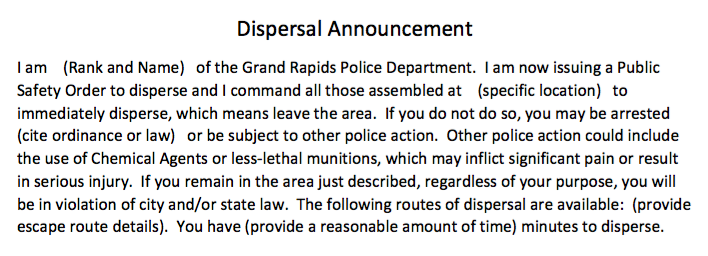
In late May of 2023, GRIID and the Comrade Collective submitted a FOIA request for GRPD surveillance, harassment and arrests of activists and organizing that had begun after Patrick Lyoya was murdered by the GRPD. We requested documentation that covered from the first protest after Lyoya’s murdered in April of 2022, through the first anniversary of his death on April 4, 2023.
The GRPD responded by saying:
A preliminary search resulted in thirteen (13) incident reports and five (5) SRT operation plans. One (1) incident report has been previously released under FOIA. This one (1) incident report is included in this response and produced free of charge.
In addition, they wrote:
Please be advised that due to the amount of FOIA requests we’re currently processing, it is estimated that once deposit payment is received, it will take eight to ten (8-10) months until you receive the final invoice and/or records.
Therefore, it is likely that we will not received the FOIA-requested documentation until January of 2024 at the earliest or no later than March of 2024. Once we have those documents in hand and have had a chance to assess their meaning, we will likely hold a press conference to reveal what the documents tell us about how the GRPD was responding to the movement to demand justice for Patrick Lyoya.
It seems clear to this writer that the only real reason that the GRPD wants to add two more staff people to deal with the increased requests for FOIA documents, is specifically because there is not only greater scrutiny of the Grand Rapids Police Department, but a greater awareness of the ways that the GRPD suppresses dissent in this community.
Grand Rapids residents demanding a cease fire in Gaza are ignored by City officials
Last night more than 100 people attended a vigil in support of the Palestinian people, to mourn those who have been killed during the Israeli assault on Gaza and to demand an immediate ceasefire.
There were a few speakers, some of whom were Palestinians. At one point I noticed that the Grand Rapids officer manager for Representative Hillary Scholten was there with her husband. When three of us were arrested last week for a sit-in at Rep. Scholten’s office we spoke directly with the Congresswoman’s staffer. I would like to think that the conversation we had with her last Tuesday had an impact.

Many people who attended held candles and many more places flowers at the makeshift alter, which had a list of some of the now 11,000-plus Palestinians who have been killed since the Israeli army’s retaliation after the October 7 Hamas attacks. Some people shared stories from the news about the attacks that have targeted hospitals, which have been devastated by the weeks long shelling, while others talked about how people were being displaced, stating that this looked similar to the 1948 Nakba, where 750,000 Palestinians were forced to flee their homes and their land.
As 7pm drew closer, many people began to head into City Hall to speak during the Public Comment period, to express their anger and to share the demands are included in an action alert that have been send to City Commissioners prior to last night’s meeting. Indeed, near the beginning of the meeting, the City Clerk acknowledged that there had been numerous messages they had received from the community, when in fact some 4,400 had already been sent by the time the commission meeting had begun.
A couple of comments stood out to me, while sitting through the nearly 60 people who addressed the issue of what the Israeli army was doing to people in Gaza and the West Bank. There was emphasis on how the $2,815,720.00 in federal tax dollars that in part of the $3.8 Billion would particularly benefit BIPOC communities if it were to stay in this community. Maybe the most heart wrenching comment, came from a young Palestinian, who said, “I am unwittingly supporting the use of my tax dollars to murder my own people.”
The Action Alert, which people can still sign here, said the following:
Nearly a month has passed since Israel began its most recent assault on Gaza in response to legally justified resistance against occupation. As of this writing, this has resulted in over 10,000 Palestinian civilians being killed. 4,000 of them are children.
The international community is calling for an immediate ceasefire, but the Biden Administration has said no. Instead, the US government has signed a resolution in full support of Israel and is proposing to send $14 billion in military aid on top of $3.8 billion in military aid the US provides to Israel annually.
The bombs that are being dropped on Gaza, along with other military hardware, are provided by the US government using taxpayer dollars. We say, NOT IN OUR NAME.
Of the $3.8 billion of US taxpayer money that goes to Israel for military purposes $2,815,720.00 is from the residents of Grand Rapids, Michigan. Residents of Grand Rapids need that money to stay in our community and fund things like housing, public education, and to support BIPOC families who are struggling to survive. (Source: https://uscpr.org/acti…/us-military-funding-to-israel-map/)
Therefore, we are calling on the Grand Rapids City Officials to fight for our city and do the following:
1. Make a public statement in favor of a ceasefire in Gaza and the West Bank as specified by UN General Assembly’s Resolution made on October 27th, 2023.
2. To contact Senators Gary Peters and Debbie Stabenow, along with Rep. Hillary Scholten, to demand back the tax money that leaves Grand Rapids to fund Israel’s decades-long occupation of Palestinian land and the current assault on Gaza. That money should stay in Grand Rapids so we can fund critically urgent community needs.
3. To communicate with the public what kind of a response you received from Peters, Stabenow and Scholten.
Unfortunately, several people misunderstood the demands created in the Action Alert, thinking that the City of Grand Rapids had budgeted $2.8 million to be sent to the Israeli government. Several Commissioners themselves had pointed out that this was false information, which it was. However, equally culpable were the commissioners, since it was clear that they had NOT read any of the 4,400 letters that had been sent to them, which clearly stated that the $2.8 million was the amount of federal tax dollars from Grand Rapidians that was part of the annual $3.8 billion the US government sends to Israel to perpetrate the kind of cruelty we are currently seeing in Gaza and the West Bank.
After about 2 and a half hours of public comment, the City Commissioners themselves responded, at least those that had bothered to attend. OF the seven member body, only 4 showed up. Commissioner’s O’Connor, Knight and Perdue were not even present during last nights meeting.
 The commissioners who were in attendance, while expressing some sympathy for what was happening to civilians in Gaza, danced around the issue and stated that such matter were out of their hands and that their role was to only deal with what happens in Grand Rapids. Not only was this a bogus response, it once again demonstrated that City Officials ignored very clear demands that they could make happen. After September 11, 2001, City officials did make statements regarding what had happened, even though it was not specific to Grand Rapids. I made the point that the City of Grand Rapids divested their funds from a bank that was profiting off of the oppression in South Africa in the early 1980s because of the Apartheid regime in that country.
City commissioners could have made a public declaration in support of a ceasefire, they could have contacted Scholten, Peters and Stabenow to demand that the $2,815,720.00 in federal tax dollars that leaves Grand Rapids on an annual basis to fund the Israeli government be kept in this community, since as so many people had stated, that there are critically urgent needs right here in Grand Rapids. And, City Officials could make public whatever communication they had with members of Congress as a matter of transparency.
As always, if you want to watch/listen to the public comments from last night’s commission meeting, go to this link. At the 35:30 point in the video is where the public comments about Palestine began. At 3 hours and 18 minutes into the video is when City Officials made their comments.
Always Follow the Money: PHILPAC?
Quite often elected officials start up their own PACs, with the intent of re-directing money to other candidates or the political party that they are connected to. One new Political Action Committee is PHILPAC, which is a PAC created by State Rep. Phil Skaggs. Skaggs is a former Kent County Commissioner and former staffer for David LaGrand, when LaGrand held a state seat. While he was Kent County Commissioner, Skaggs referred to the immigrant led group Movimiento Cosecha’s protests demanding Kent County to end their contract with Immigration and Customs Enforcement (ICE) as Bolshevik cos-play.
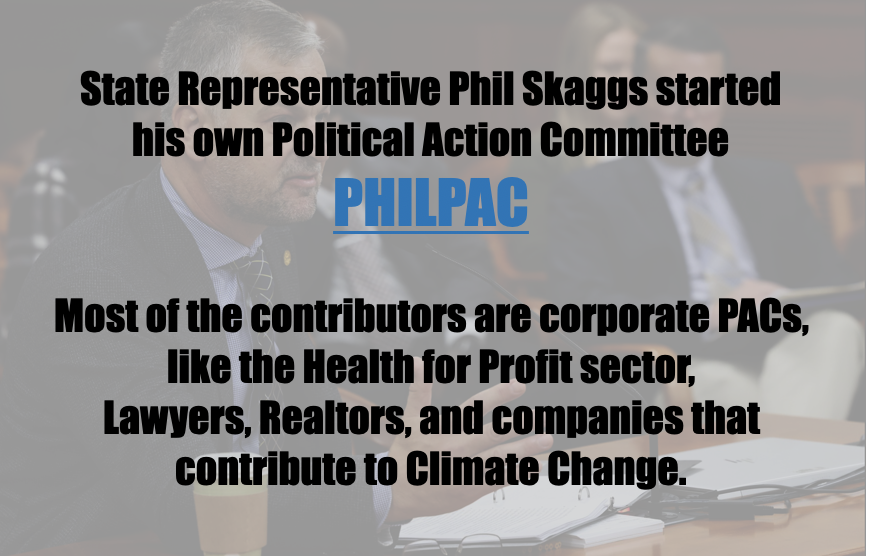
According the most recent state campaign finance records, PHILPAC had raised $23,550.00. As far as contributions to PHILPAC, there were 15 separate contributions in this quarter of campaign finances. Here is a list of those 15 contributors from the largest to the smallest:
- Realtors PAC 1 $1,450
- Delta Dental PAC $1,250
- Health PAC $1,250
- Blue Cross Blue Shield PAC $1,000
- DTE PAC $1,000
- Michigan Association of Recreation Vehicles & Campgrounds PAC $1,000
- Michigan Regional Council of Carpenters PAC $1,000
- Muchmore Harrington Smalley & Associates $750
- Michigan State TROOPERS PAC $500
- Henry Ford Health PAC $500
- Auto Dealers of Michigan PAC $450
- Michigan Association of Counties PAC $300
- Centene Corporation PAC $250
- American Federation of Teachers PAC $200
- Justice PAC $200
As you can see, of the 15 different contributions, 12 of them came from Business/Corporate PACs, two from organized labor (carpenters and teachers) and one from a government PAC. I don’t include the Troopers PAC as labor, since cops are a whole other kind of political animal. Thus, it would seem that the newly formed PHILPAC, by State Representative Phil Skaggs, relies heavily on corporate money, Realtors, the for profit health industry and lawyers. Politicians and candidates who will be taking this money, will no doubt be beholden to the interests of their paymasters.
 Grand Rapids Institute for Information Democracy