Congresswoman Hillary Scholten just voted to for a bill that cements genocide as official US policy.
On Friday, 185 Democrats and 101 Republicans voted in favor of H.R. 2882, a $1.2 Trillion spending bill that is 1.012 pages long.
A total of 112 Republicans and just 22 Democrats voted against this bill, with most of the Democrats opposing the legislation being from the Progressive Caucus.

One of the main reasons why members of the Democratic Progressive Caucus voted against H.R. 2882 was because of what it included regarding the Israeli genocide being committed against the Palestinians. There were three essential aspects of H.R. 2882, which are relevant to the US support for Israel’s current genocidal campaign:
- The legislation gives Israel $3.8 billion in weapons.
- The legislation defunds UNRWA while Palestinians are starving.
- The legislation defunds a UN investigation into Israel’s violations of international law.
- The legislation sanctions the UN Human Rights Council if it highlights Israeli abuses.
According to Stephen Semler, a co-founder of the Security Policy Reform Institute, the adoption of H.R. 2882, “cements genocide as official US policy.”
Oh, and by the way, both Michigan Senators Gary Peters and Debbie Stabenow voted for the Senate version of the $1.2 Trillion spending bill just after midnight on Friday, which was then signed by President Biden on Saturday.
Interestingly enough, in her weekly newsletter, Rep. Scholten said nothing about what was in the $1.2 trillion spending bill and only complained about Republicans did. Rep. Scholten said nothing about voting for another massive US military budget, and most importantly, she said nothing about US military aid to Israel and the other three points listed above. It seems that Rep.m Scholten is ok with the Israeli genocide against the Palestinians, especially since she has been voting for it and justifying it since she went on her AIPAC-funded trip last August.
Palestine Solidarity Information, Analysis, Local Actions and Events for the week of March 24
 It has become clear that the Israeli government will continue their assault on Gaza and the West Bank. The retaliation for the October 7 Hamas attack in Israel, has escalated, therefore, GRIID will be providing weekly links to information and analysis that we think can better inform us of what is happening, along with the role that the US government is playing. We will also provide information on local events and actions that people can get involved in. All of this information is to provide people with the capacity of what Noam Chomsky refers to as, intellectual self-defense.
Information
What’s the real purpose of Biden’s Gaza port?
International Legal Rulings Are Helping Block Arms to Israel
Israel killed Israelis, confirms new 7 October documentary
Israel Is Still Flouting the ICJ’s Genocide Order
More Than 40 Pro-Palestine Orgs Refused to Meet With Biden in Chicago Last Week
Trade Unionists Shut Down UK Arms Factories Demanding Halt Of Arms Exports To Israel
Biden’s Sanctions on Israeli Settlers Are Just for Show
Analysis & History
“WE HAVE TO START THINKING IN TERMS OF DECOLONIZATION”
“Humanitarian Violence” in Gaza: Architect Eyal Weizman on Mapping Israel’s “Genocidal Campaign”
Local Events and Actions
See above graphic for protests in Grand Rapids.
Tell the City to pass a Move the Money resolution
Call on the Grand Rapids City Commission to follow in the footsteps of the City of Hamtramck, which passed a “Move The Money” resolution, that urges Congress and Biden to divest from war and fund our communities instead. Email the City Commission here: https://bit.ly/MoveTheMoneyGR
It’s Women’s History month and one good way to celebrate it is to look back at the incredible work that women’s movements have done in Grand Rapids. This is a three part series, focusing on the women’s suffrage movement, the movement for reproductive justice, and the fight against sexual assault and objectification of women. This 3 part series is taken from my book, A People’s History of Grand Rapids.
The Reproductive Justice Movement
In the history of the United States, women and gender non-conforming people have rarely had bodily autonomy. Not until the early 1980’s did every US state finally overturn the laws that made married wives the property of their husbands.
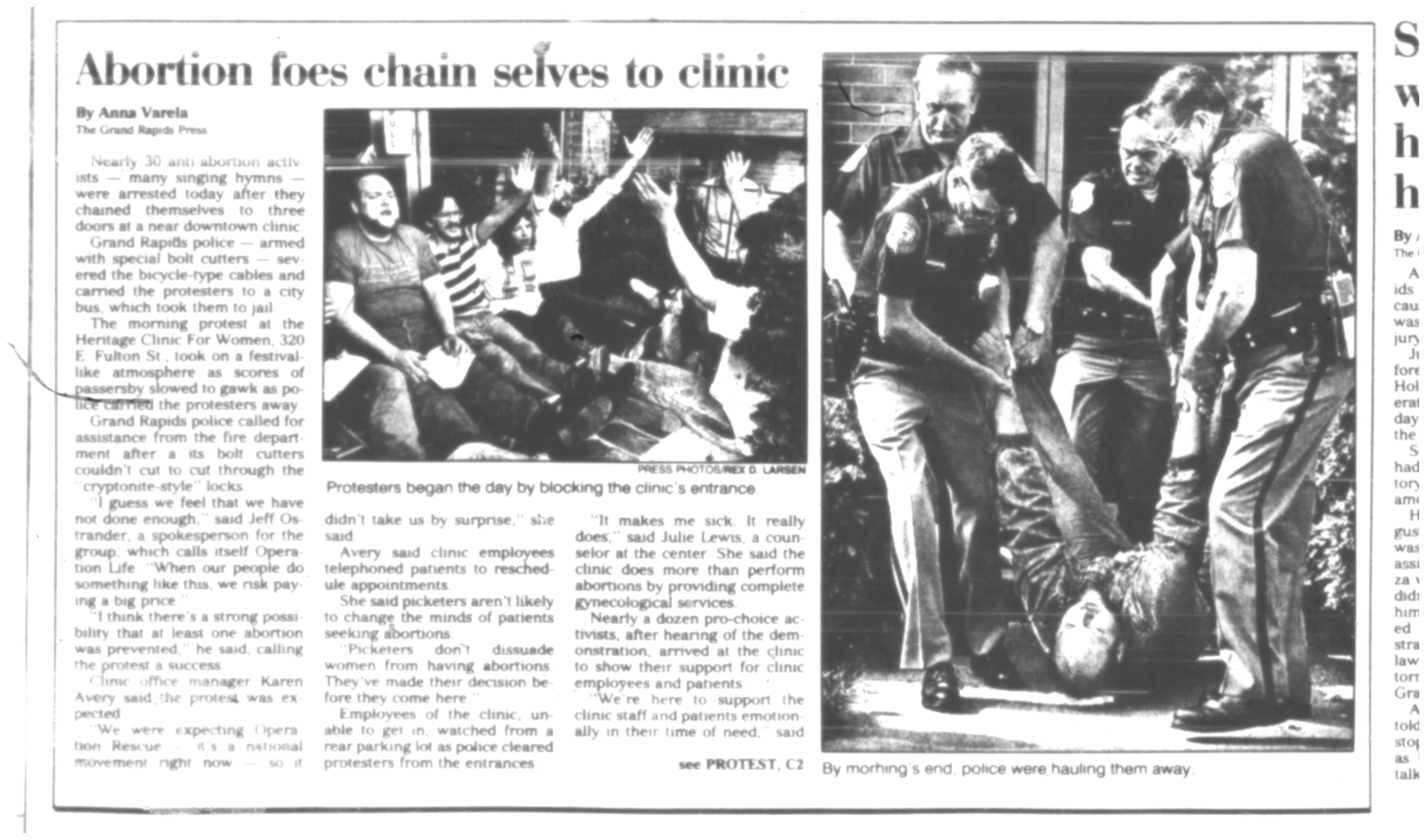
There is one area of bodily autonomy which remains an active struggle: reproductive justice and the right to an abortion. Abortion was legal until 1873, when the federal government outlawed it. Contraceptives were outlawed at the same time, after a contingent of male doctors lobbied intensively for these changes. Like the rest of the US, in Grand Rapids, people did not have the legal right to have an abortion until the 1973 US Supreme Court decision known as Roe V. Wade made it legal.
This doesn’t mean that people were not defying the law and choosing what to do with their own bodies. For decades prior to Roe V. Wade, birthing-age people were seeking out and creating their own networks and resources to practice reproductive justice.
In Grand Rapids, many people are familiar with the Choice Fund at Fountain Street Church (FSC), which provides funds for people seeking abortions and reproductive medical care to help cover costs, transportation, and more. What is less known is that the Choice Fund had begun in the mid-1960s in a very clandestine fashion, long before Roe V. Wade made medical abortion legal.
In a 2021 interview, Dani Vilella, a long-time reproductive justice activist, shared that people working with FSC were going out of state to have abortions. This eventually prompted those who were connected to FSC to create the Choice Fund. In fact, the Choice Fund remained clandestine until the early 1990’s, primarily to avoid the wrath of the anti-abortion movement. The danger was harassment, especially from the religious branch of the anti-abortion movement that dominated West Michigan, which violently targeted clinics that were performing abortions. The money raised by the Choice Fund would go directly to the Heritage Clinic for Women, covering the costs for those who wanted to have an abortion.
Beginning in the late 1980’s, the anti-abortion attacks escalated in Grand Rapids. Operation Rescue, the anti-abortion group led by Randall Terry, came to Grand Rapids on several occasions. Protests and efforts to stop people from choosing to have an abortion were intense and often confrontational.
In response, John Nuerenberg co-founded the group Pro-Choice Advocates of Greater Grand Rapids (PCA), in part because of groups like Operation Rescue protesting at clinics in Grand Rapids. “One of our main purposes was to act as patient protectors against the Operation Rescue folks at the area women’s health clinics.”
Even if Operation Rescue had never come to Grand Rapids, literally hundreds of churches in West Michigan embrace an anti-abortion stance, some evangelical, some Christian Reformed. The Catholic Church is also heavily invested against abortion rights. Many of these churches would include information in their church bulletins about protests and other so-called “pro-life” actions happening in Grand Rapids, Lansing, or in Washington, DC, even sharing a call to action from the pulpit to target reproductive clinics and their patients.
 Additionally, there are thousands of religious people in West Michigan that make regular contributions to Michigan Right to Life. Several members of the West Michigan elite have collectively contributed millions of dollars to anti-abortion groups and other “family values” organization that want to keep cisgender men in a dominant role in society, which means they do not want women and other genders to have bodily autonomy. In Russ Bellant’s book, The Religious Right in Michigan Politics, he cites the DeVos family, Peter Cook, the Prince family, the Van Andel family, and the DeWitt family all as major funders of the anti-abortion movement. Many of these same families continue to make significant financial contributions to anti-abortions groups like Right to Life.
40 Days of Choice and More
The financial and ideological support for an anti-abortion stance contributed to more serious acts of hate and violence against reproductive health patients, clinics, and health educators. Besides physically blockading the entrance of clinics, anti-abortion protestors use graffiti or douse the entrance with butyric acid, which smells like vomit and is difficult to get rid of once it is used.
Many members of the Religious Right in West Michigan have also participated in a campaign they refer to as 40 Days of Life, which started around 2008 and has continued to this day. During the Lent season, religious extremists come to a reproductive health clinic for 40 days in a row to pray, to protest, and to shame patients as they enter and exit.
As a counter, abortion defenders created 40 Days of Choice campaigns and actions over the years, primarily as a means of countering the anti-abortion forces. Defenders would show up to provide support to the patients coming to clinics, as well as acting as volunteer security to intervene if any of the anti-abortion folks attempted to harass, shame, or do bodily harm to those entering the clinic. In a 2012 interview, a 40 Days of Choice participant said that she would often witness anti-abortion protesters spitting on the women who came to the clinic. In addition, the people who owned the building right next door to the clinic were staunchly anti-abortion, so the clinic staff would have to constantly remind people to not park on their property, since they were known to be both verbally and physically abusive towards those who came to show support for the patients who came to the clinic.
With the election of Donald Trump, the overtly bigoted and misogynistic Republican presidential candidate, in 2016, those committed to defending the right to an abortion mobilized to go to Washington, DC to protest the inauguration in early 2017. The blatantly anti-feminist and anti-abortion rhetoric coming from the Trump administration reinvigorated the Reproductive Justice Movement to provide security and accompaniment at local clinics in Grand Rapids. A new wave of young people began showing up and working with the clinic to provide support to their patients, keeping anti-abortion protestors at a distance.
In May of 2020, two anti-abortion protesters were arrested at the Heritage Clinic in Grand Rapids. In an anonymous interview at the time, a clinic employee shared that some involved with the protest were the group Red Rose Rescue.
On the day of their protest, they showed up in a large group, gathering outside of the clinic. When patients exited their vehicles, they would either shout loudly at the patients or would directly approach them. They were verbally aggressive and their voices were elevated (we could hear them screaming from inside the clinic). One particular protestor, a woman named Caroline Davis, was seen and heard screaming to patients, “Repent your sins”, “You’re going to regret this every day”, and more. Many members of the group entered the building in the stairwell in an attempt to gain access to inside the clinic, but due to the safety and privacy measures we always have in place, in addition to the diligence of precautionary measures our staff took, they were not successful with entering. Patients came into the clinic visibly shook up and unhappy. Patients disclosed to us that protestors had approached their cars and physically banged on their car windows. One protestor held open the door to the clinic for a patient and told her to “have a nice day” (in a way that felt insincere and manipulative to the patient). Another patient came to her appointment in a vehicle with a business logo on the side, and a protestor called that business to inform them of where they were, violating their privacy.
Towards the end of the interview, the clinic employee shared some of the most important aspects of reproductive rights:
Many times, people hear ‘reproductive justice’ and think that it is solely a pro-choice vs. anti-choice issue. It is so much more than that, though. It is ensuring that people who want to have and raise children have the adequate means to do so, and should be able to build a family on their own terms.They should be financially prepared with a living wage, paid family leave, and unbiased employers. We need social structures that allow for anyone regardless of background to receive proper pregnancy and childbirth care. There should be easy access to free or affordable contraceptives, STD/STI/HIV testing, and safe sexual health measures, such as condoms or other birth control, PrEP medication, etc. Equal access to abortion care, regardless of reason. Comprehensive sex education in public and private schools. Freedom from sexual and domestic violence. Supporting LGBTQ parents, teen parents, birth parents, and adoptive parents. Other issues that are often overlooked or not considered to be – but are 100% interrelated with reproductive justice – include food security and access to clean water; unwavering support of gender and sexual identity/presentation; immigration justice; environmental justice; disability justice; indigenous rights; and more. We must build and sustain safe communities for EVERYONE.
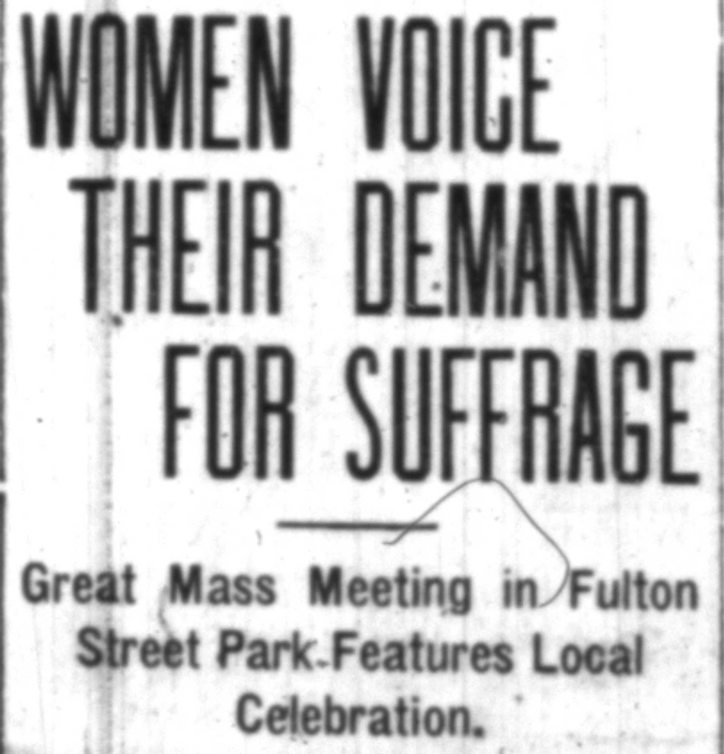 It’s Women’s History month and one good way to celebrate it is to look back at the incredible work that women’s movements have done in Grand Rapids. This is a three part series, focusing on the women’s suffrage movement, the movement for reproductive justice, and the fight against sexual assault and objectification of women. This 3 part series is taken from my book, A People’s History of Grand Rapids.
Just two years before Grand Rapids officially became a city, a large gathering of women held in Seneca Falls, New York. Some historians identify this, the 1848 Women’s Convention, as the beginning of the Women’s Suffrage Movement in the US, though it largely excluded Black women. But 19th century abolitionist and feminist Lucretia Mott suggested that the first women’s conference was actually 11 years before, the Anti-Slavery Convention of American Women of 1837 in New York City.
The National Scene: Fighting Patriarchy while Upholding White Supremacy
21st century feminist historian and author Helen LaKelly Hunt agrees with Mott that the 1837 Anti-Slavery Convention was the real origin of the modern Women’s Rights Movement, since the early suffragists who attended were as equally committed to the end of chattel slavery, which would liberate Black women and families, as they were to white women’s liberation.
However, by 1866, in a meeting where Black freedom fighter Frederick Douglass and white feminist Susan B. Anthony argued about whether to prioritize suffrage for Black men or suffrage for white women, Anthony said, “I will cut off this right arm of mine before I will ever work or demand the ballot for the Negro and not the woman.”
Sojourner Truth gave her famous speech in 1866 in Akron, Ohio, where it’s reported she said, “I feel I have the right to have just as much as a man.” (The speech that became widely known during the Civil War by the title “Ain’t I a Woman?” was in fact a variation of the original speech. It was re-written by a white woman that portrayed Truth speaking in a stereotypical Southern dialect, though Sojourner Truth was from New York and grew up speaking Dutch as her first language.) Through the late 19th century, Black feminists Frances Harper and Anna Julia Cooper continued to fight for Black women to be included in the women’s movement. And in the 1913 suffrage parade in Washington DC, Black organizer Ida B. Wells-Barnett defied the racial segregation imposed by white feminists. Instead of walking at the back of the procession as instructed, Wells-Barnett declined to participate at all, only to jump from the crowd during the march to join her state’s white delegation, taking and holding her place between two white women.
While the national suffragist movement struggled with white supremacy, the fight in Grand Rapids, just as white in nature if not more so, had its additional challenges.
The Women’s Suffrage Movement in Grand Rapids
In 1874, there was a campaign by the Michigan State Woman Suffrage Association (MSWSA) to adopt a referendum in the Michigan legislature to allow women the right to vote. The Grand Rapids Women’s Suffrage Association (GRWSA) was founded the same year. Although some women played a role on the leadership team, the president of GRWSA was Judge Solomon L. Whitney, a white man.
A few months after their founding, the Grand Rapids Women’s Suffrage Association invited writer and women’s rights activist Elizabeth Cady Stanton, who spoke to an audience of 1,000 people at the Pearl Street Universalist Church.
To build the movement to win women’s voting rights in Michigan, local communities and suffrage associations needed to increase their numbers. In 1880, Grand Rapids held its first Suffrage Convention, with delegates attending from across the state. Efforts like these paid off, for the state legislature granted some women the right to vote in local school board elections the very next year. Yet these rights did not yet extend to communities with larger school districts, like Grand Rapids. There, women could not vote in school elections until 1885, a big year in that more women won the right to, not only vote for school boards, but to run as candidates themselves.
The heralded 20th century arrived, yet women had still not won the right to vote in all elections. However, through persistent and continued organization, the fight against the male-dominated political landscape raged on. In 1908, at the state constitutional convention, women won the right to vote on bond measures and local taxation proposals.
In 1909, there was a major push to put women’s suffrage on the national stage, with Michigan Suffrage organizers vowing to collect 100,000 signatures from state residents. Though they did not get the 100,000 signatures they had hoped, the Michigan suffragists did secure 30,000 such designations and sent delegates to Washington, DC to participate in a parade. The march ended with a half a million signatures being presented to the US Congress.
Solidarity Tactics
 In January of 1911, another attempt to win the right for women to vote was defeated in Michigan. A few months later, the Grand Rapids Furniture Strike began, with thousands of workers, mostly male, demanding better wages, better working conditions, and the right to organize.
Amid the furniture strike, perhaps in a spirit of solidarity, the Grand Rapids suffragists invited a women’s rights activist from England, Sylvia Pankhurst, who was in the US on a speaking tour. In her time in the US, Pankhurst visited with incarcerated strikers in Chicago as well as laborers in factories and workhouses, and she also witnessed the criminalization of African Americans in the South.
Pankhurst and many English suffragists did not limit themselves to so-called acceptable channels to make change. As the Grand Rapids news coverage of Pankhurst’s lecture reported, she spoke about how she and her fellow activists used direct action to force the British Parliament to face the issue of women’s suffrage. Tactics such as smashing windows at the British Parliament, fasting and hunger strikes, hounding liberals in Parliament to take a stance on suffrage, marches in the streets, and targeted arson: all were used by English suffragists to force the issue. The British suffrage movement won the right to vote in 1918, two years prior to their US counterparts. (Diane Atkinson vividly documents the tactics and strategies used by the British suffrage movement in her powerful book, Rise Up Women!)
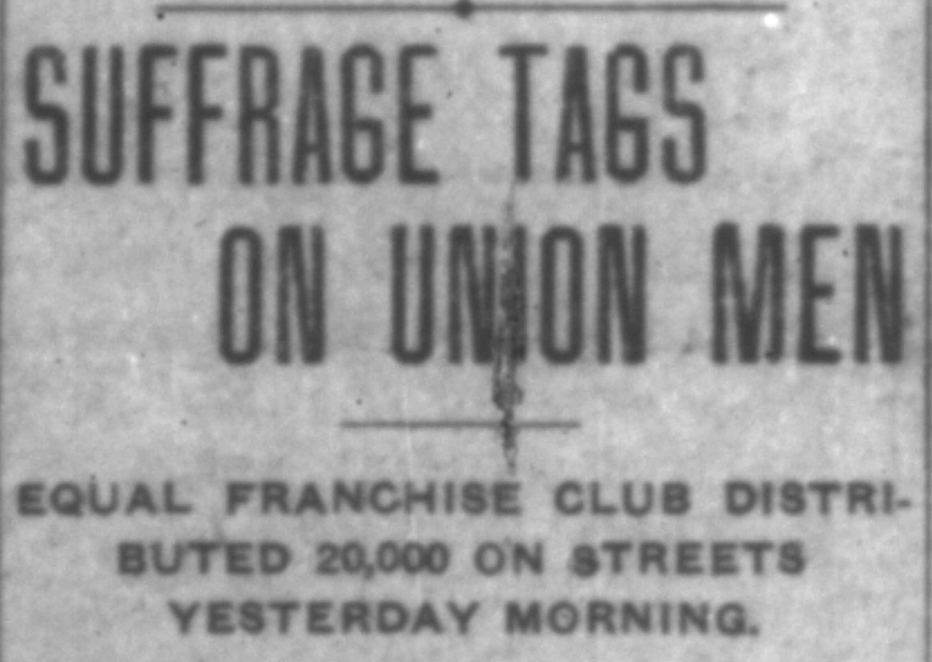
Though the Grand Rapids-based Suffrage Movement didn’t seem to embrace the more direct-action approach, they did decide to build allies in the fight. The 1911 Grand Rapids Labor Day parade, on the heels of the furniture workers strike, involved 10,000 participants, with thousands more as spectators. Grand Rapids suffragists took notice and decided to participate in the 1912 Labor Day march.
The Equal Franchise Club had a fully decorated float in the 1912 Labor Day parade, sporting a side banner that advocated fair wages for workers: “A Square Deal.” In addition, about 40 suffragists handed out 20,000 tags to those in attendance: “Votes for Women” on one side while the banner message for fair wages occupied the second side. The Grand Rapids Herald reported, “The suffragists met with a most encouraging reception from the men.”
As the Grand Rapids suffrage movement grew in numbers, not everyone welcomed the idea that women should vote. The City Attorney and other Grand Rapids officials publicly opposed women’s suffrage, as did large sectors of men in the Grand Rapids Christian Reformed Church. In November of 1912, there was a local ballot initiative to allow women to vote in city elections, but influenced by these conservative factors, more men voted against than for.
In 1913, the active and growing suffrage movement felt a blow at the state level: the Michigan Equal Suffrage Amendment lost by less than a thousand votes. Suffragists were outraged that the vote was “stolen” from them during the referendum, according to an article in the Jackson Citizen Patriot on December 19, 1912. Following the election was a major push for vote verification, which resulted in numerous counties, including Kent County, marking a further reduction of votes for women’s suffrage.
When the US entered World War I in 1917, many women’s suffrage groups, including those in West Michigan, decided to support the war effort and take an active part, particularly to encourage people to buy war bonds. The Equal Franchise Club even sent a telegram to President Wilson asking him to grant women’s suffrage as a war measure. “To a large number of thinking women in America the granting of the franchise to women by federal amendment would be a pledge of sincerity and integrity in our great war for democracy.”
Yet some women’s suffrage groups that did not jump to aid in the US entry to WWI. The National Women’s Party came out against the war, which was met by a strong denunciation from the Grand Rapids Equal Franchise Club. The Club wrote in response to the NWP’s anti-war stance, “It is unfortunate that so much publicity is given to the tactics of the woman’s party, comprising only 5 percent of the suffragists of this country, while 95 percent of the suffragists are active in war work.”
As WWI was winding down, the fight for women’s suffrage again took center stage, with a new vote in Grand Rapids in November of 1918. This time, voters for women’s suffrage won the majority vote for city elections. At the national level, the 19th Amendment was finally ratified in 1920.
Yet the ratification of the 19th Amendment did not mean all women could vote: only white women. Along the way, the national women’s suffrage movement lost their original 1837 commitment to racial equality, replaced by an allegiance to white supremacy. The movement lost the ability to say that their work benefitted all women. This has always been a major criticism of the women’s suffrage movement in the US, which created long-standing tensions between white women and women of color who did not trust that white women would have their back in all gender justice fights.
Once again we see Grand Rapids continuing this path of development in the downtown area, projects that will attract tourists and talent, all at the expense of the thousands in this city that are struggling to survive.
In the March Downtown Development Authority (DDA) agenda packet, on page 28, there is a list of 7 projects, with the expected costs and a map of their location, shown here.
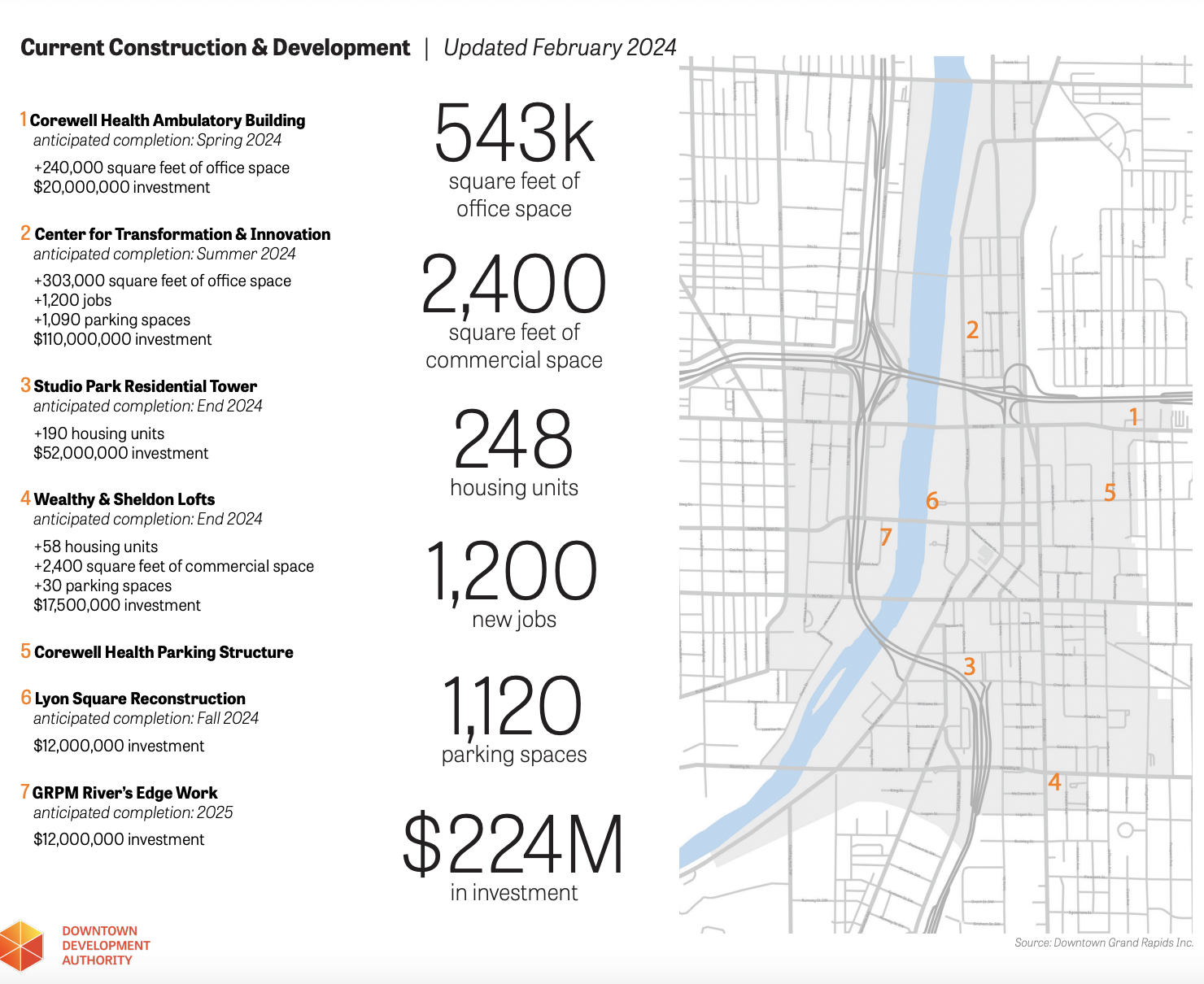
The cost for each of the projects are:
- Corewell Health Ambulatory Building – $20,000,000 investment
- Center for Transformation & Innovation – $110,000,000 investment
- Studio Park Residential Tower – $52,000,000 investment
- Wealthy & Sheldon Lofts – $17,500,000 investment
- Corewell Health Parking Structure
- Lyon Square Reconstruction – $12,000,000 investment
- GRPM River’s Edge Work – $12,000,000 investment
Total investment – $223,500,000
The Corewell Health Parking Structure is on hold – as best I can tell – which is why there is no estimated cost next to that project.
The Corewell Health Ambulatory Building is a project that will put lots of money in the coffers of Rockford Construction, which GRIID has been monitoring for the past decade, particularly their involvement in the DeVos/AmplifyGR project.
The Center for Transformation & Innovation is another Corewell project that continues to perpetuate the Medical Industrial Complex.
According to an article on MLive, the Studio Park Residential Tower will likely have, “44 studio apartments, 99 one-bedroom units and 22 two-bedroom units. Previous estimates provided to the city of Grand Rapids indicated a studio would go for $1,594, while a one-bedroom would go for $2,028. A two-bedroom unit would cost $2,870. The 24 condos in this project would start at $595,000 and up for each.
The Wealthy & Sheldon Lofts, which are on the corner of Wealthy and Division, will have 58 apartments, with retail space on the ground floor. The studio apartments would go for $1,175 a month, the one-bedroom for $1,531, and the two-bedroom for $2,817, according to another MLive article.
GRIID has previously written about the Lyon Square Reconstruction project, which is also being managed by Rockford Construction, a project that will create a pocket park along the Grand River between the Amway Grand Plaza and DeVos Place.
Lastly, the Grand Rapids Public Museum’s River’s Edge Work project will upgrade the riverfront portion of the Public Museum, along with improvements to the trails that connect the downtown GVSU campus, the Gerald R. Ford Museum, and Ah-Nab-Awen Park.
The $23,500,000 price tag for these project will see more than 50% of the funding come from the pubic sector, specifically through the State and City use of tax dollars, even though the public has had no real say in such projects, despite the claims of community engagement.
In addition, all of these projects will fulfill the goals of Grand Rapids City officials and the Grand Rapids Power Structure, which are to attract more professional talent to the area, along with making the downtown more attractive to tourists when they attend an event at the Convention Center, the arena, for ArtPrize, or the soon to be developed outdoor Amphitheater and the Soccer Stadium.
It’s never a question of money, but priorities
One thing that GRIID has been pointing out over the last decade has been the inherent contradiction with the City’s willingness to support and subsidize development projects at the expense of neighborhoods, particularly low income neighborhoods where a disproportionate number of BIPOC people live. On top of that GRIID has also been shouting out the fact that the City and the Business Class can always find and use public money for these sorts of projects, while claiming there just isn’t enough funding for truly affordable housing, mass transit, combating food insecurity or for people to make a living wage (which is $25 p/h at the low end).
As always it is important to talk about what $223,500,000 could be used for, particularly to benefit the thousands of families that are struggling to survive in this city. For example, if we could imagine providing families with say a home that was valued at $150,000, which is not a lot these days, but could provide some housing security, how many homes at $150,000 could be bought and paid for from $223,500,000. The answer would be 1,490 family homes. Given the current housing crisis in Grand Rapids, wouldn’t providing paid for homes to nearly 1500 families be preferable? Besides, the Capitalists in this city can certainly afford to pay out of pocket for all these projects without using one cent of public money.
 Last week, on the fourth anniversary of the police murder of Breonna Taylor, Grand Rapids Police Chief Eric Winstrom used the day to exploit the memory of Breonna and those fighting to expose and abolish policing in Grand Rapids.
On Wednesday, March 13th, Chief Winstrom submitted an opinion piece in the Detroit Free Press, headlined, I’ve worked on hundreds of search warrants. No-knock warrants do more harm than good. There is a lot to unpack in Winstrom’s opinion piece, but there are a few important critiques I was to make here.
First, I think it is important to point out that Winstrom, like all cops, is using what some refer to as Copaganda, which is a form of double speak that cops use to justify their actions. While Winstrom makes the claim that no-knock warrants do more harm than good, he repeatedly provides so-called exceptions in his opinion piece. Early on in Winstrom’s piece he states:
“Now, let me be clear, search warrants are a valuable and necessary tool to help provide for public safety. Evidence of some of the most heinous crimes and arrests of the most violent criminals are often the result of the effective use of the search warrant tool. But immediate entry no-knock warrants do more harm than good and should be eliminated except in the most extreme circumstances.”
Ok, so what exactly is an extreme circumstance and who gets to make that call? We all know that cops get to make that decision, so what might be extreme to some could be normal to others. This is similar to the GRPD’s drone policy where City officials said that drones use that violated privacy or was used to monitor protests and target activists are instances of “extenuating circumstances.” City Manager Mark Washington said that drones could be used to monitor protests that aren’t permitted and are potentially interfering with roadways. Again, the GRPD gets to decide on what is extreme and what is not. Winstrom then gave several examples of where no-knock warrants are still “necessary.”
Second, Winstrom seeks to downplay the violence and traumatic realities with warrants. Chief Winstrom says:
“The GRPD has transitioned to a safer “surround and call out” tactic. In the “surround and call out” procedure, officers secure the perimeter of the dwelling subject to a search warrant, attempt to establish communication with any occupants, and provide individuals the opportunity to leave the residence prior to making entry to conduct a search.”
Having one’s residence surround by the police, who are fully armed with multiple weapons, announcing they have surrounded your residence can induce life-long trauma for people they are targeting. This assessment contradicts Winstrom’s claim that, in using their approach to warrant searches, “it can prevent trauma and violence to all involved and avoids unnecessary damage to property.” And let’s be clear, the disproportionate number of people who have the cops surround their place of residence are poor people and BIPOC people. Plus, in those circumstances where the police are outside your place of residence demanding to come in can often result in people being shot or forced entry because the police heard something or saw people moving around. I would challenge anyone who says they would not be psychologically impacted by the fact that their place of residence was surrounded by cops who will justify taking you out if THEY determine you did or said something they felt was extreme or fell under he extenuating circumstances category.
Third, the comment that Winstrom made about Breonna Taylor was nothing short of insulting. He said:
“I am reminded of just how important this policy change is given that our Grand Rapids Police Department’s headquarters sits on commemorative Breonna Taylor Way — a constant reminder of the tragic impact police decisions can have on human life and public trust in police. Today is the anniversary of Taylor’s death. The Grand Rapids native was fatally shot when officers entered her Louisville, Kentucky, home with a no-knock warrant.”
I seriously doubt that Winstrom gives a shit about Breonna Taylor, especially considering how the Louisville PD has dealt with this case from day one. There is a scathing report from the Department of Justice accusing the Louisville police of unlawfully discriminating against the city’s Black population, as well as people with behavioral health disabilities. People might also do well to watch the Democracy Now! episode with an attorney and community activist speaking on the 3rd anniversary of Breonna Taylor’s murder.
It is also instructive that Winstrom mentions that the GRPD headquarters sits on the street that has a commemorative designation of Breonna Taylor Way. The only reason there is a commemorative street designation is because activist and family members of Breonna Taylor fought to get the designation. In fact, many of the same activists involved in that effort have been harassed, abused and targeted by the GRPD since the May 2020 uprising in Grand Rapids.
Lastly, it is worth pointing out that on the 4th anniversary commemoration of Breonna Taylor in Grand Rapids, Winstrom was present, based on the media coverage. It’s bad enough that Winstrom dared to show his face at such an event, but what is even more insulting is that he used that event as an additional opportunity to promote his position on no-knock warrants. The arrogance of cops and of white people, like Chief Winstrom, to take up space at an event about a Black woman murdered by cops is disgusting. Such an event should be an opportunity to center the voices of those who have been most affected by police murders. White people, especially cops, should not only keep their mouths shut during such events, they should not attend an event that commemorates a victim of police violence.
On Sunday morning I received a very interesting Email from someone with the Steinreich Communications Group, Inc., which you can read below.
I was curious why a PR firm would contact me without any solicitation, especially since they were “offering” to provide analysis of who would be the next likely Prime Minister of the Palestinian Authority.

Immediately, I wanted to check out the Steinreich Communications Group, Inc., which I discovered has the largest number of Israeli and Jewish clients of any agency in the US. I also discovered that in December of 2020, the Steinreich Communications Group, Inc., had hired Joshua Lavine, a former Israeli mission to UN Speechwriter & American Israel Public Affairs Committee (AIPAC) professional. Lavine then left Steinreich Communications Group, Inc., and now serves as advisor to Israel’s Ambassador to the United Nations, Gilad Erdan. Lavine’s role is to Advise Ambassador Gilad Erdan on foreign policy and international media strategy.
When South Africa brought charges against Israel at the ICJ in January, here is what Joshua Lavine advised the Israel’s Ambassador to the United Nations, Gilad Erdan, had to say, according to the Associated Press:
Israel’s U.N. Ambassador Gilad Erdan called the case a “new moral low” and said that by taking it on, “the U.N. and its institutions have become weapons in service of terrorist organizations.”
It is very instructive that such a high powered PR Firm as the Steinreich Communications Group, Inc., with long standing ties to the Israeli government and AIPAC, would contact GRIID out of the blue. Are they really that threatened by such a small, Grand Rapids-based blog, that they would waste their time trying to put me in touch with a former Israeli Intelligence Official? I don’t know if this is a mild attempt to co-opt or threaten GRIID, but it certainly demonstrates that they are deeply concerned about the growing public opposition in the US to the Biden Administration’s unconditional support for Israel’s genocidal campaign against the Palestinians.
Editor’s note: I did write then back and said, “Hi Josh, just curious, why have you reached out to me specifically, as I am but a lowly blogger in Grand Rapids, Michigan?”
I’m still waiting for a response.
Hi Jeff,
According to Former Israeli Intelligence Official and regional analyst Avi Melamed (bio below), Abbas’s choice of Dr. Mohammad Mustafa to serve as the next prime minister of the Palestinian Authority (PA) was an expected choice, meant to illustrate progress yet failing to show meaningful pragmatic progress towards the “reformed Palestinian Authority” that world leaders have called for, and the “Palestinian street” needs.
Melamed shared:
“Abbas’s choice of Dr. Mohammad Mustafa to serve as the next prime minister of the Palestinian Authority (PA) was an expected choice as Mustafa, an Abbas-loyalist was previously appointed by the aging Palestinian President to oversee the Palestine Investment Fund (PIF) and its $1,000,000,000 portfolio.
While Abbas seeks for this change to placate those calling for a technocratic, reformed PA, the reality is that Hamas’s actions have proven the ability that those independent of the Palestinian Authority have to dictate radical agendas, and the PA will not be seen as the legitimate representative of the Palestinian people in Gaza until it can represent the vast majority of them, to control the post-war strip, and to police radical actors.
Ultimately while the ongoing reforms in the Palestinian Authority are meant to illustrate progress, they fail to show meaningful change including open elections, a succession plan for Abbas, and reforms to bridge the gap between the Palestinian street and those sitting in palaces in Ramallah.”
I’d welcome the opportunity to connect you with Avi to learn more about his analysis on the war.
Let me know when works best for you.
Best,
Josh
Palestine Solidarity Information, Analysis, Local Actions and Events for the week of March 17
 It has become clear that the Israeli government will continue their assault on Gaza and the West Bank. The retaliation for the October 7 Hamas attack in Israel, has escalated, therefore, GRIID will be providing weekly links to information and analysis that we think can better inform us of what is happening, along with the role that the US government is playing. We will also provide information on local events and actions that people can get involved in. All of this information is to provide people with the capacity of what Noam Chomsky refers to as, intellectual self-defense.
Information
A New Surge of Settler Outposts is Terrorizing Palestinians Off Their Land
Biden’s regime change agenda prolongs Gaza genocide
DHS USING HAMAS TO EXPAND ITS REACH ON COLLEGE CAMPUSES
Israel killed Israelis, confirms new 7 October documentary
The Genocide in Gaza Is Filling Our Beautiful Month of Ramadan With Dread
Here’s Every U.S. Factory Making Bombs For Israel
Analysis & History
ISRAEL’S USE OF MASS STARVATION AS A WEAPON OF WAR
NYT’s Morning Newsletter Blames Everyone but Israel for Israeli Crimes
Local Events and Actions
Tell the City to pass a Move the Money resolution – Tuesday, March 19 from 6 – 9pm. Join us for a vigil to honor the children of Gaza and call on the Grand Rapids City Commission to follow in the footsteps of the City of Hamtramck which passed a “Move The Money” resolution that urges Congress and Biden to divest from war and fund our communities instead. Email the City Commission here: https://bit.ly/MoveTheMoneyGR
 On Wednesday, March 13th, the US House overwhelmingly voted for H.R.7521, known as the Protecting Americans from Foreign Adversary Controlled Applications Act.
Every member of the House from Michigan voted in favor of the bill, except for Rep. Tlaib. Rep. Hillary Scholten, who represents the 3rd Congressional District, which includes Grand Rapids, said the following on her Facebook page:
“I just voted YES on the Protecting Americans from Foreign Adversary Controlled Applications Act. Misinformation abounds, but let’s be clear— this is NOT a ban on TikTok. It’s a necessary step to keep Americans’ data out of the hands of the Chinese Communist Party & protect our kids from foreign influence. TikTok can still continue in the United States…but not under the control of a foreign adversary.”
Interestingly enough, the far right think tank, the Heritage Foundation, shares the same sentiment as Rep. Scholten. They said in an article from last year:
“U.S. policymakers have a duty to safeguard America’s social fabric and protect young citizens from the whims of a hostile, foreign nation.”
Ok, so let’s be real. Virtually all social media is an invasion of privacy. Every time I search for a produce online, my Facebook feed then has numerous ads for that specific product and/or other brands. It is called Data Mining, and corporations have been doing it for decades. So why target TikTok? And why doesn’t the US Congress apply the same approach to Facebook? Facebook engages in data mining and they have a history of sharing information with the US government.
The reason seems to be that while US government can get Facebook to turn over data on the public, the Chinese government cannot be trusted. US is good and benign, the Chinese government is bad and evil.
Several national groups have come out against this legislation. The ACLU recently posted the following statement:
“We’re deeply disappointed that our leaders are once again attempting to trade our First Amendment rights for cheap political points during an election year,” said Jenna Leventoff, senior policy counsel at the American Civil Liberties Union. “Just because the bill sponsors claim that banning TikTok isn’t about suppressing speech, there’s no denying that it would do just that. We strongly urge legislators to vote no on this unconstitutional bill.”
The ACLU has repeatedly explained that banning TikTok would have profound implications for our constitutional right to free speech and free expression because millions of Americans rely on the app every day for information, communication, advocacy, and entertainment. And the courts have agreed. In November 2023, a federal district court in Montana ruled that the state’s attempted ban would violate Montanans’ free speech rights and blocked it from going into effect.
Like Montana’s blocked TikTok ban, this legislation would forbid app stores and internet service providers from offering TikTok so long as the company remains under foreign ownership. The proposed legislation would also let the President block other foreign-owned apps that they deem a national security threat.
The Electronic Frontier Foundation has also taken a strong stance against this legislation. On Tuesday, they posted a statement, which partly says:
“Make no mistake—though this law starts with TikTok specifically, it could have an impact elsewhere. Tencent’s WeChat app is one of the world’s largest standalone messenger platforms, with over a billion users, and is a key vehicle for the Chinese diaspora generally. It would likely also be a target.
The bill’s sponsors have argued that the amount of private data available to and collected by the companies behind these applications — and in theory, shared with a foreign government — makes them a national security threat. But like the RESTRICT Act, this bill won’t stop this data sharing, and will instead reduce our rights online. User data will still be collected by numerous platforms—possibly even TikTok after a forced sale—and it will still be sold to data brokers who can then sell it elsewhere, just as they do now.”
MLive reported that the bill will now head to the US Senate, but that President Biden has already stated that he will sign the bill into law. Unfortunately, the MLive piece did not explore the intent of the legislation nor the larger political and social implications.
A good example of a critical perspective on the House passed legislation to censor TikTok, would be an interview done recently by Democracy Now! with Ramesh Srinivasan, professor of information studies at UCLA. Here is an excerpt from that interview:
“It’s disenfranchising to many young people in the United States. It is alienating to them. And it is singling out TikTok and China without any evidence whatsoever that they are engaging in any nefarious or spying activity or are any more extreme in their algorithms and their ways in which they polarize American users than any of the Big Tech companies, you know, which we’ve discussed before. So, it’s absurd and it’s theatrical for people like Mark Zuckerberg, etc., to be paraded in front of Congress multiple times, and even publicly shamed, while the actual legislation that takes roots is one that singles out TikTok, primarily because it’s a Chinese company, and possibly because it’s so prominent amongst Americans and young people in general in this country.”
In Rep. Hillary Scholten’s most recent weekly newsletter, the Congresswoman states:
As many of you know, I took a trip down to the southern border recently to see the situation on the ground. We have a crisis at the border – it’s a humanitarian crisis, an economic crisis, and a national security crisis, and it demands immediate, bipartisan action. I sat down with WZZM 13 to talk about what I learned and how I’m working toward bipartisan, comprehensive immigration reform.
The WZZM 13 story that Scholten refers to can be found here, a story that I want to look at.

Early on in the channel 13 story the reporter states, “Under the Biden administration, expulsions and apprehensions of non-citizens have spiked amid a rise in illegal border crossings.”
This acknowledgement by the reporter is true, as many commentators are noted. In an article by Tina Vasquez, it states:
Biden is currently considering an executive action that would prevent migrants who enter the U.S. outside of ports of entry from claiming asylum, a devastating blow to longstanding legal procedures that require migrants to be on U.S. soil to request protections. The order is a key part of a failed bipartisan bill Biden championed that would have implemented Trump-era immigration policies and granted the president the unilateral power to shut down the Southern border.
That Democrats signed off on the bill signals they have taken a hard-right turn on immigration during an election year. The party’s wanton disregard for asylum law will almost certainly lead to further human rights violations against migrants, who are already brutalized all across the detention system where the number of people detained has nearly tripled since Biden took office in January 2021.
This analysis shows that the reality of the Biden Administration’s US immigration policy is that it has changed much since the Trump years. Even Rep. Scolten acknowledges that the current US immigration policy is flawed. She said, “The system that we have is not set up to meet just the insurmountable demands that are being presented every single day at our southern border,” she continued. “It is truly a national security, emergency humanitarian crisis and an economic disaster.”
Rep. Scholten then goes on to say:
“[Part of the solution] is addressing the root causes of migration that are happening in these sending countries,” Scholten said. “Right now, insurmountable numbers coming from Venezuela, as well as still out of the Northern Triangle in Central America – we have to be working with those countries, as well as our neighbor to the south, Mexico, to deal with the flow of these individuals.”
I agreement with Rep. Scholten that part of the root causes are people from various Latin American countries, but she does really address why they are fleeing. I would argue, that people from Mexico and Central American countries in particular, are fleeing primarily because of the political, economic and social conditions in those countries that the US has imposed on those countries for decades, such as direct US military interventions, the funding and training of militaries from many Latin American countries, adopting disastrous trade policies like NAFTA and CAFTA, the US support for corrupt Latin American governments, along with the role that Climate Change plays in displacing people, which is well documented in Todd Miller’s excellent book, Storming the Wall: Climate Change, Migration and Homeland Security.
Rep. Scholten also talked about having bipartisan support for the Dignity Act, specifically with Rep; Salas from Florida. However, the Dignity Act is not Comprehensive Immigration Reform, nor does it address more structural elements of root causes of immigration that we have already addressed. If Rep. Scholten wants to be serious about address the immigration & border crisis, then she needs to acknowledge the harm that the Biden Administration has done and their rightward shift on immigration policy.
For additional resources on US Immigration Policy and US Immigration History:
GRIID Popular Education Class on History of US Immigration Policy
 Grand Rapids Institute for Information Democracy