Last year GRIID posted some articles about the 2023 Policy Conference hosted by the Grand Rapids Chamber of Commerce. I noted in that article that the GR Chamber of Commerce has a vision, but most people are not part of it.

I also did a follow up to that analysis piece with a second article talking about who attended the annual event and what that means in terms of their priorities.
On Tuesday, the Grand Rapids Area Chamber of Commerce held its 2024 Policy Conference at Frederick Meijer Gardens. To attend such an event you needed to pay $200 as a member or $250 for non-members. For an event that costs that much and lasted only 5 hours, made it prohibitive for most people to attend.
The featured speaker for the event was predictably made up of politicians and business leaders. There was also a presentation about a recent poll that the Chamber of Commerce had done by contracting with a Virginia company called TargetPoint. Based on the results, the number of people who were polled was small, only 83. We don’t know who the polling questions were sent to, but my guess would be Chamber of Commerce members, meaning people who part of the economic elites in West Michigan.
However, besides discussing the polling numbers, most of the day seemed to be spent on local elections, particularly the candidates running for Mayor of Grand Rapids. There was a panel discussion entitled, Local Government Leaders on Future Prosperity, a discussion that no doubt centered around the ongoing development projects in Grand Rapids, what are often referred to as Transformational Projects. This is usually what the Chamber center’s their attention around, meaning what kinds of projects can we promote to bring more revenue to business owners, especially in the downtown area.
Still, elections, the election process and candidates were the focus of the day. The Grand Rapids Chamber of Commerce invited David LaGrand and Senita Lenear, both of who are running for Mayor of Grand Rapids. There is a 3rd mayoral candidate, Steve Owens, but he was not invited.
The question I would have for both David LaGrand and Senita Lenear is, why would you agree to meet with the Grand Rapids Chamber of Commerce, which represents a small sector of the city, especially considering their track record for funding candidates that embrace neoliberal capitalism, along with pushing ordinance changes that essentially criminalized the unhoused in order to keep they away from profit making entities?

Earlier this year, GRIID posted a piece about LaGrand and Lenear as mayoral candidates, making the point that neither candidate was interested in challenging systems of power and oppression in this city, based in part by their platforms, along with who some of their larger campaign contributors are. However there is another quarterly campaign finance deadline coming up next week, so we’ll see an updated version of campaign financing for both LaGrand and Lenear.
Earlier today, MLive posted a story with the headline, Michigan Democrats win special elections to regain full control of state government.
With the Democrats now back in control of the State Legislature and the Governor’s office, they no longer can give any excuses for not passing the Drive Safe Bills that were re-introduced in April of 2023. According to the Democrats who sponsored the Drive Safe Bill, this legislation does the following:
The Drive SAFE (Safety, Access, Freedom, and the Economy) bill package would apply to everyone living in Michigan who meets the definition of having a residence in the state and is being introduced to increase public safety, grow local economies and preserve human dignity.
The push to win driver’s licenses for all began in 2017-2018, when Movimiento Cosecha began organizing around that demand, partly because one of the main reasons that undocumented immigrants end up being picked up by ICE is when they are stopped by police.
Movimiento Cosecha has been pushing this issue in Michigan for the past 6 years and were told over and over again in 2022 that if they supported Democratic candidates at the state level, that driver’s licenses for all would pass. This has not happened, so Movimiento Cosecha began to pressure the Democrats again in Lansing in 2023, with demonstrations and even occupying the offices of prominent Democrats like Senator Winnie Brinks, which happened in November of 2023.
The MLive article about the Democrats regaining control of state government stated at the very end, “Lawmakers will be working against the clock. They are set to take a summer break at the end of June and representatives will soon begin campaigning in their districts.” It is true that elected officials will spend the bulk of their time between now and the November election trying to get re-elected, so the window for them to pass the Drive Safe Bills should happen before they go on summer break.
In a recent communique from Movimiento Cosecha, they state:
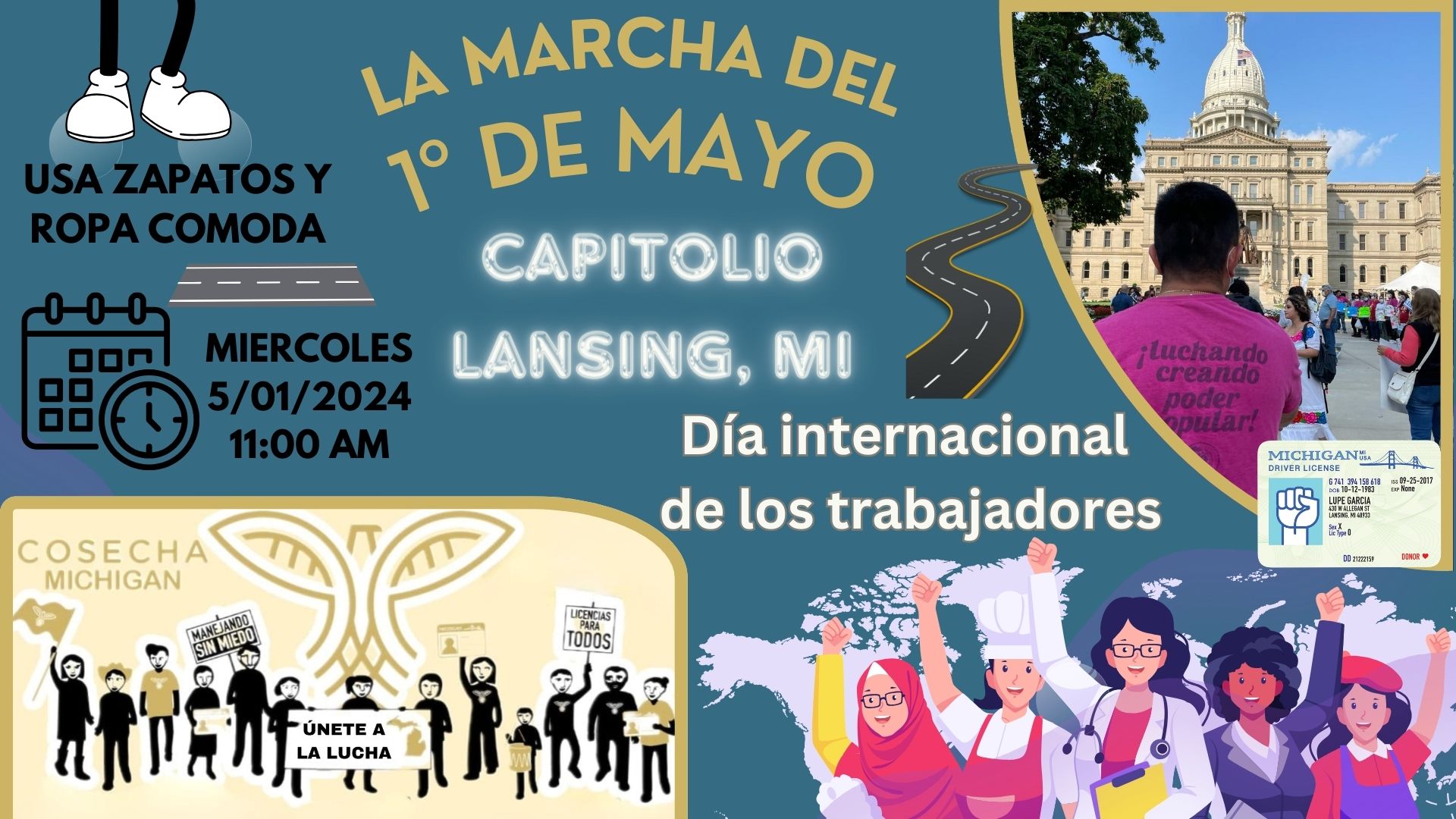
As we do every year, Movimiento Cosecha Michigan is gearing up for our May Day march “International Workers Day,” and this year, we’ll be marching in Lansing. Our ongoing efforts to advocate for the passage of the Drivers Licenses for All bill have positioned us at the forefront of this fight, and now we’re taking our message directly to the Michigan Capitol to keep the pressure on legislators.
Undocumented workers across Michigan drive every day to sustain our state’s operations, and they deserve the right to Drive without Fear. We’re asking for your support to make this march a success, and there are several ways you can get help us:
- Promote and join the march on May 1st. 2024 at 11 am at the Capitol in Lansing.
- Here is the FB event https://fb.me/e/55yQhKpcJ
- Here is the FB event https://fb.me/e/55yQhKpcJ
- Take a role:
- Crowd safety (training is required): It will be a zoom training on Sat 4/20 at 6:00 pm bit.ly/zoomcosechagr
- Crowd care (no training required): Handing out water or snacks and checking on the well being of marchers
- Street Medic (previous training is required): Recognize and address minor accidents during the march.
- Drive people to and from the march from your community
- Crowd safety (training is required): It will be a zoom training on Sat 4/20 at 6:00 pm bit.ly/zoomcosechagr
- Support financially the costs of the march like transportation, food, materials, etc.
-
- Write a check to Movimiento Cosecha and reach out to one of the Cosecha Michigan members. (Your contribution is tax deductible)
- Donate online https://secure.actblue.com/donate/cosecha-michigan
- Donate food, snacks, drinks, etc at the meeting places:
- 9:00 am in GR St. Dominic’s church (50 Bellevue Ave. SW Grand Rapids, MI)
- 11:00 am at the Capitol in Lansing (100 N. Capitol Ave. Lansing, MI)
- 9:00 am in GR St. Dominic’s church (50 Bellevue Ave. SW Grand Rapids, MI)
- Write a check to Movimiento Cosecha and reach out to one of the Cosecha Michigan members. (Your contribution is tax deductible)
A few days back, the Grand Rapids Chamber of Commerce posted on their Facebook page an article from Forbes entitled, 5 Ways A Growing City Can Define Their Brand, an article which highlighted Grand Rapids.
Before we jump into the 5 talking points I wanted to just address the idea of cities creating a branded identity. Branding is essentially a PR tactic, to that people can identify your brand based upon an image, a logo, a phrase or a tag line. Everyone knows the golden arches or the Nike swoosh, corporate branded identities that people are bombarded with in advertising and PR campaigns. However, for cities to brand their identify would on face value seem more complex. For Grand Rapids it means that they are trying to appeal to a certain demographic or targeted audience in their brand. As I have noted in numerous GRIID posts over the years, Grand Rapids tends to target businesses, the professional class and tourism as their primary targets in their brand identity. In fact, much of the Grand Rapids identity has been centered on what the city offers in the downtown area, which is both the primary economic and tourism hub.

Now let’s look at the 5 Ways A Growing City Can Define Their Brand, I will post what the article includes for each of the 5 ways, but one at a time, followed by a GRIID response.
1) Start By Sharing Your City Name. Located in the heart of the manufacturing Midwest, Grand Rapids, Michigan may be an unlikely candidate to be one of the best places to live, work, study, retire and raise a family. But the city of 200,000 (metro over 1 million) appears in more top lists than any of its size and stands up competitively with any major metro.
GRIID response – apparently self-promotion is what Forbes identifies in the first way to brand a city. Grand Rapids certainly has done that, appearing in numerous lists, but let’s be clear the lists are pro-market orgs listing Grand Rapids in their lists. The lists are not centered on social justice, equity, or collective liberation.
2) Organize Leaders In The Community. Grand Action, an organized group of action-oriented leaders, partnered to create necessary amenities to attract and retain talent. They built the 12,000-seat Van Andel Arena as well as a massive convention center in DeVos Place, a downtown market, community theater and played a part in luring a major medical school from a Big Ten University.
GRIID response – Of course the Forbes article cites Grand Action as “leaders.” Grand Action was a brain child of the DeVos family and other members of the local power structure. Grand Action has pushed projects, beginning with the Van Andel Arena and most recently the outdoor Amphitheater and Soccer Stadium, which primarily benefits the companies that own downtown restaurants, bars, entertainment venues and parking lots. In addition, Grand Action has revolutionized the private/public partnership, which translates into the transfer of public money into privately owned and controlled projects. In addition, by naming Grand Action as the entity organizing leaders, it means that working class people, labor unions, grassroots groups, BIPOC communities and other marginalized groups are not seen as leaders.
3) Embrace New Industries For Growth. Grand Rapids’ metro has long boasted a successful group of privately held businesses. Several appear in Forbes’ top privately held businesses list. Grand Rapids and, to a larger degree, West Michigan as a whole, established itself long ago as “furniture city.” Office furniture giants MillerKnoll, Steelcase, and Haworth are all headquartered there. While the global growth of Amway created another boom, the dominant regional growth of Midwestern leading grocery chain Meijer launched yet another. And there’s no slowing down ahead, as top-10 global insurance broker Acrisure is ushering in insurance and tech booms driving more growth and jobs.
GRIID response – So, new industry growth means industries and companies such as MillerKnoll, Steelcase, Haworth, Meijer and Amway, which just happened to be run by the most powerful families in the area, are good for Grand Rapids branding. The Forbes article even cites Dick DeVos in #3 as someone who can attest to the “creativity” of the business community in Grand Rapids. Of course the business community here is creative, since they push the whole use of public money for private gain, since they use campaign contributions to get state policies that benefit their bottom line, since they use their foundations to fund non-profits who provide social services and don’t question the wealth gap in this community……of course they are creative when it comes to screwing over the general population to get what they want.
4) Have Hard Conversations. Not all efforts are focused on creating the next big thing, however. Some of the biggest needs any city faces appear when challenges arise; where success is determined by how a city leans in (or doesn’t) to exploring and implementing long-term solutions, such as what Grand Rapids has faced when seeking to ensure safety for all people and care for unhoused populations.
GRIID response – Wow, talk about arrogance and ignorance. The very policies that the City of Grand Rapids embraced to “ensure safety for all people and care for unhoused populations,” was nothing more than members of the Grand Rapids Power Structure coming together to get what they wanted. Of course, getting what they wanted in this instance was increased policing and criminalizing the unhoused.
5) Play To Your Strengths. When others are asked to define Grand Rapids, the answer is not about being the biggest, and it doesn’t seek to be. It’s a right-size city. It has an affordable but robustly growing housing market, backed by a community that prioritizes maintaining this trajectory. As recently as 2019, Realtor.com’s hottest zip code in America was 49508, nestled squarely on the south end of Grand Rapids. Interior designers and planners like Jean Stoffer, host of Magnolia Network’s The Established Home, have been drawn to the area to work, film, and help improve the lives of others in the city and surrounding neighborhoods.
GRIID response – I’m sorry, but the housing market in Grand Rapids is anything but affordable. There were 80 people at last Saturday’s Tenant Assembly who would beg to differ with such a claim. To support their claim, Forbes once again cities an industry spokesperson from the Magnolia Network’s The Established Home, rather than talking to people in Grand Rapids who have any sense of the housing crisis in this city.
In the end it makes perfect sense that the Grand Rapids Chamber of Commerce, which represents to Capitalist Class in this city, would post a Forbes article talking about how to brand your city. Just talk to the wealthiest people and the organizations they operate if you want input on how to brand Grand Rapids and make it a tourist destination. This is exactly what Forbes did and the Grand Rapids Chamber just assisted them in promoting what they are ideologically committed to – expanding the wealth gap in Grand Rapids.
Rep. Hillary Scholten voted for bill that will allow the US Government to spy on US residents
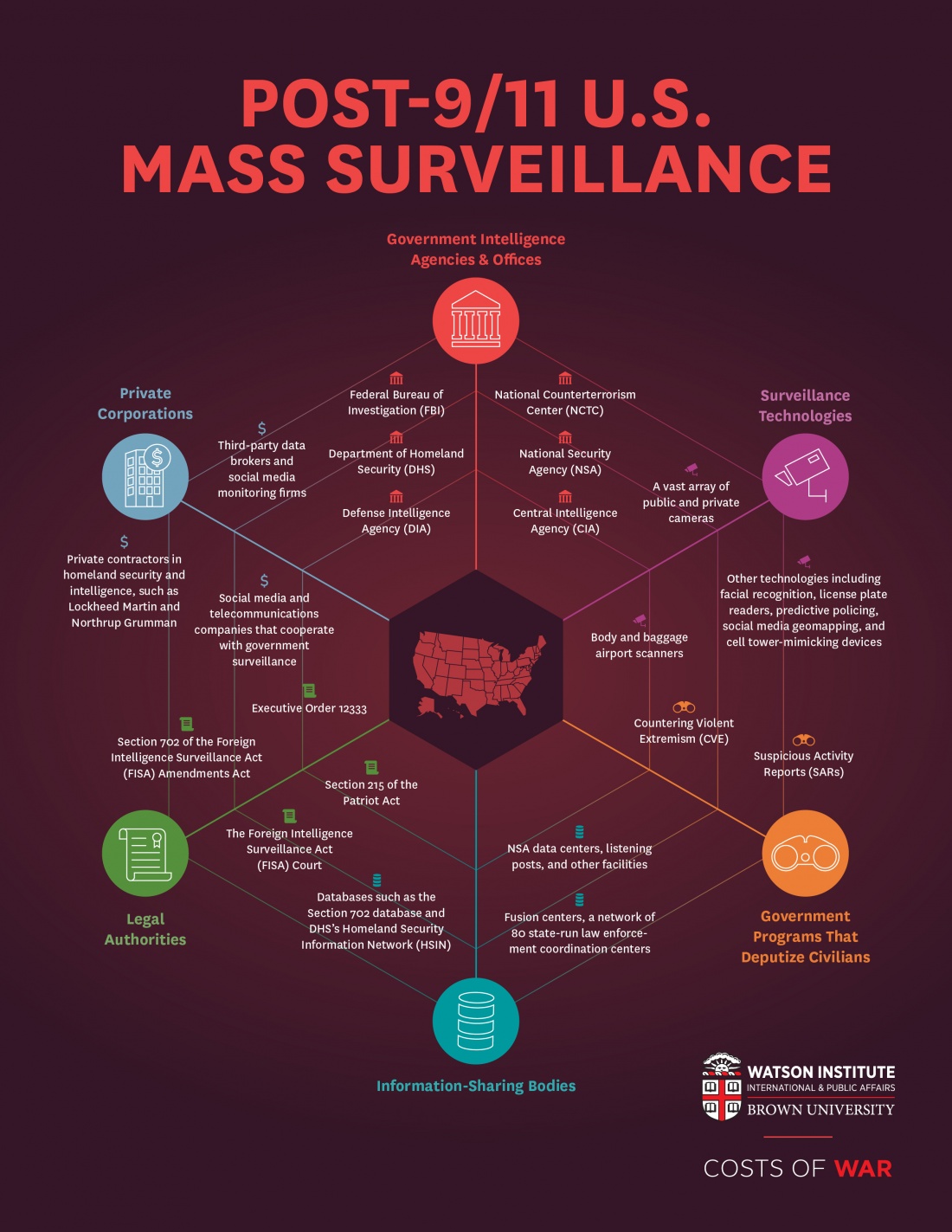 Last Friday, the US House of Representatives voted on H.R. 7888, the Reforming Intelligence and Securing America Act. This bill was passed in the US House by a margin of 273 – 147, with 11 members of Congress opting to not vote.
The vote was evenly split between both parties and 3rd Congressional District Representative Hillary Scholten voted for the bill. Scholten did not post anything about her decision to support US Government spying on US residents, both on social media or her Congressional page.
One response from a progressive organization stated:
“The first amendment would put in place the largest expansion of domestic surveillance since the Patriot Act… and I don’t say that lightly,” Elizabeth Goitein, co-director of the Liberty and National Security Program at the Brennan Center for Justice, wrote on social media late Thursday. “It would hugely inflate the universe of companies required to assist the government in conducting surveillance.”
The ACLU also released a statement highly critical of the vote, which read in part:
When the government wants to obtain Americans’ private information, the Fourth Amendment requires it to go to court and obtain a warrant. The government has claimed that the purpose of Section 702 is to allow the government to warrantlessly surveil non-U.S. citizens abroad for foreign intelligence purposes, even as Americans’ communications are routinely swept up. In recent years, the law has morphed into a domestic surveillance tool, with FBI agents using Section 702 databases to conduct millions of invasive searches for Americans’ communications — including those of protesters, racial justice activists, 19,000 donors to a congressional campaign, journalists, and even members of Congress — without a warrant.
The ACLU statement also made the following point:
In the last year alone, the FBI conducted over 200,000 warrantless “backdoor” searches of Americans’ communications. The standard for conducting these backdoor searches is so low that, without any clear connection to national security or foreign intelligence, an FBI agent can type in an American’s name, email address, or phone number, and pull up whatever communications the FBI’s Section 702 surveillance has collected over the past five years.
How can any politician, especially those who claim to protest the rights of US residents, vote in favor of legislation that will promote US Government surveillance and spying? Shame on you Rep. Scholten.
Grand Rapids Tenant Assembly successfully got renters together to talk about building a movement centered on building tenant power
On Saturday, roughly 80 tenants and allies gathered in the Linc Up gallery at an event hosted by the Grand Rapids Area Tenant Union and the Community Owned Safety Coalition.
Most of the day was spent in smaller breakout groups, where tenants shared their collective experience as renters, how tenants can collectively organize to win housing justice demands, how to combat the threat of evictions, along with how to work on local and state policies that center housing justice, such as rent control.
As a volunteer organizer with the Grand Rapids Area Tenant Union, since it began in March of 2020, I wanted to share the information I presented to those in attendance at the Tenant Assembly, information that was meant to provide some historical context around the fight for housing justice and how the movement is framing the fight for Tenant Power. What follows is a written form of what I presented, which includes some of the slides I used. To view all the slides go here.
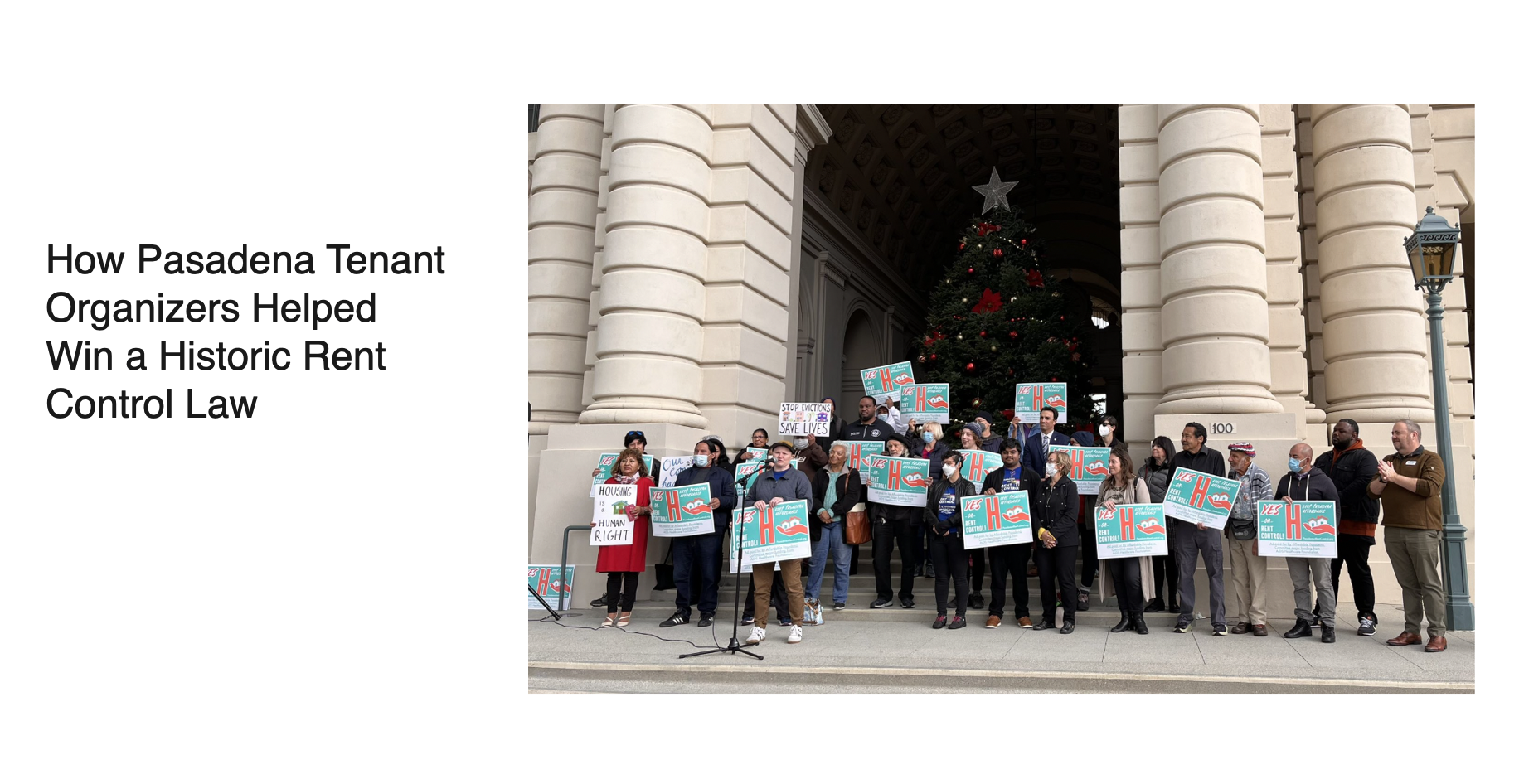
I began by talking about an example of what tenant power can look like, by talking about what a tenant union did in Pasadena, California. (See slide above) In 2022, tenants won comprehensive rent control, including protections from retaliation against tenants who were trying to organize.
Next, I showed a slide headlined What Are We Here for? In that slide I identified what the tenant movement was built on, which included:
- To create Tenant Solidarity – was in which we can support each other as tenants
- To fight against exploitation from Landlords and Property Management Companies
- To demand housing as a human right. This is different than fighting for more affordable housing, since that tactic is woefully inadequate.
- To demand living wages. If we have real living wages which would be enough to cover current rental costs and all of our other expenses within the Capitalist system, then we would not need “affordable housing for a few”
- To build Tenant Power. This is the ultimate goal, with tenant power being the ability to win our collective demands no matter what the housing market tries to impose upon us.
In the 3rd slide, I discussed how we got in the predicament we are in. Again, I included 5 major points, which included:
- We have an economic system of Capitalism that sees housing as a commodity, not as a right for everyone.
- In response to the 2008-2009 economic crash, the US Congress provided a $700 Billion bailout, the primarily went to Wall Street, to large Banks, to Insurers and to the Auto Industry.
- Currently in the US, there are 7.4 million families that live in poverty.
- If Congress had bailed out the 7.4 million families living in poverty, each of those families would have received $94,594.00
- In addition, the 2008-2009 economic crash saw the rise of corporate housing owners, like Blackrock, which alone is worth $120 Billion. See the report Wall Street Landlords turn American Dream into a Nightmare.
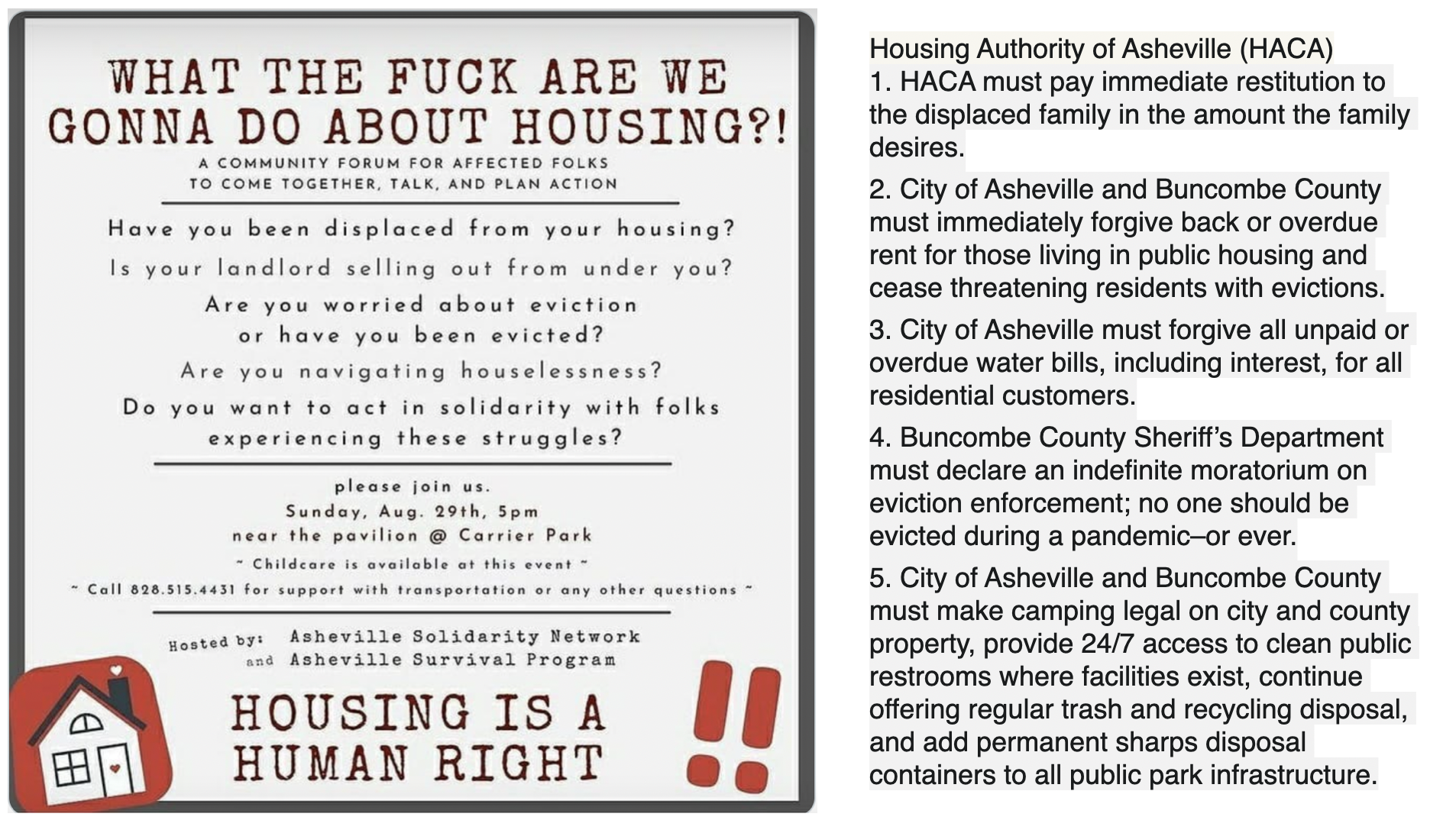
In the fourth slide, I went back to looking at another tenant victory, this time in Asheville, North Carolina. Included here is a great flyer from the community in Asheville, along with what they won.
After discussing another concrete tenant victory, I then showed this graphic, which comes from the National Low Income Housing Coalition, which tracks the cost of rent in every state along with the average cost in cities like Michigan. You see here that they note that in the Grand Rapids area, for people to afford the cost of rent for a 2-bedroom apartment, you would have to earn $25.50, just to cover your rent costs each month.

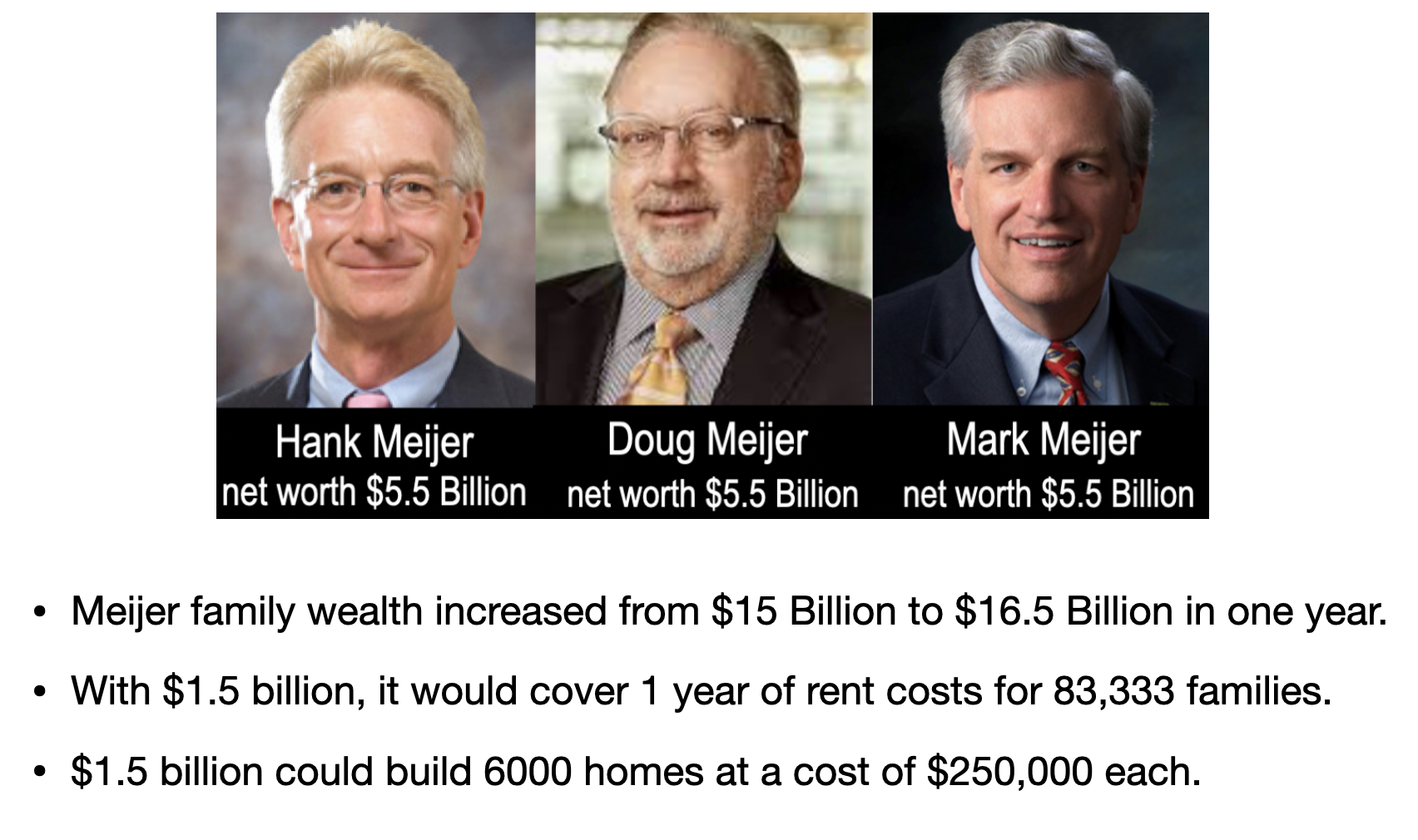
Building on the wealth disparity in the cost of housing across the US and in the Grand Rapids area, I then talked about the wealth gap that exists in this community, using the wealth of the Meijer family as an example. According to a recent Forbes posting about family wealth in the US, the Meijer family is one of the richest in the country with $16.5 Billion collectively. In the slide below, I broke down how the $1.5 billion they made in the past year could be used for new housing or how many families could pay rent for a year with the $1.5 billion. Of course, the Meijer family would still have $15 billion and it seems reasonable that they would still be able to live comfortably off that amount.
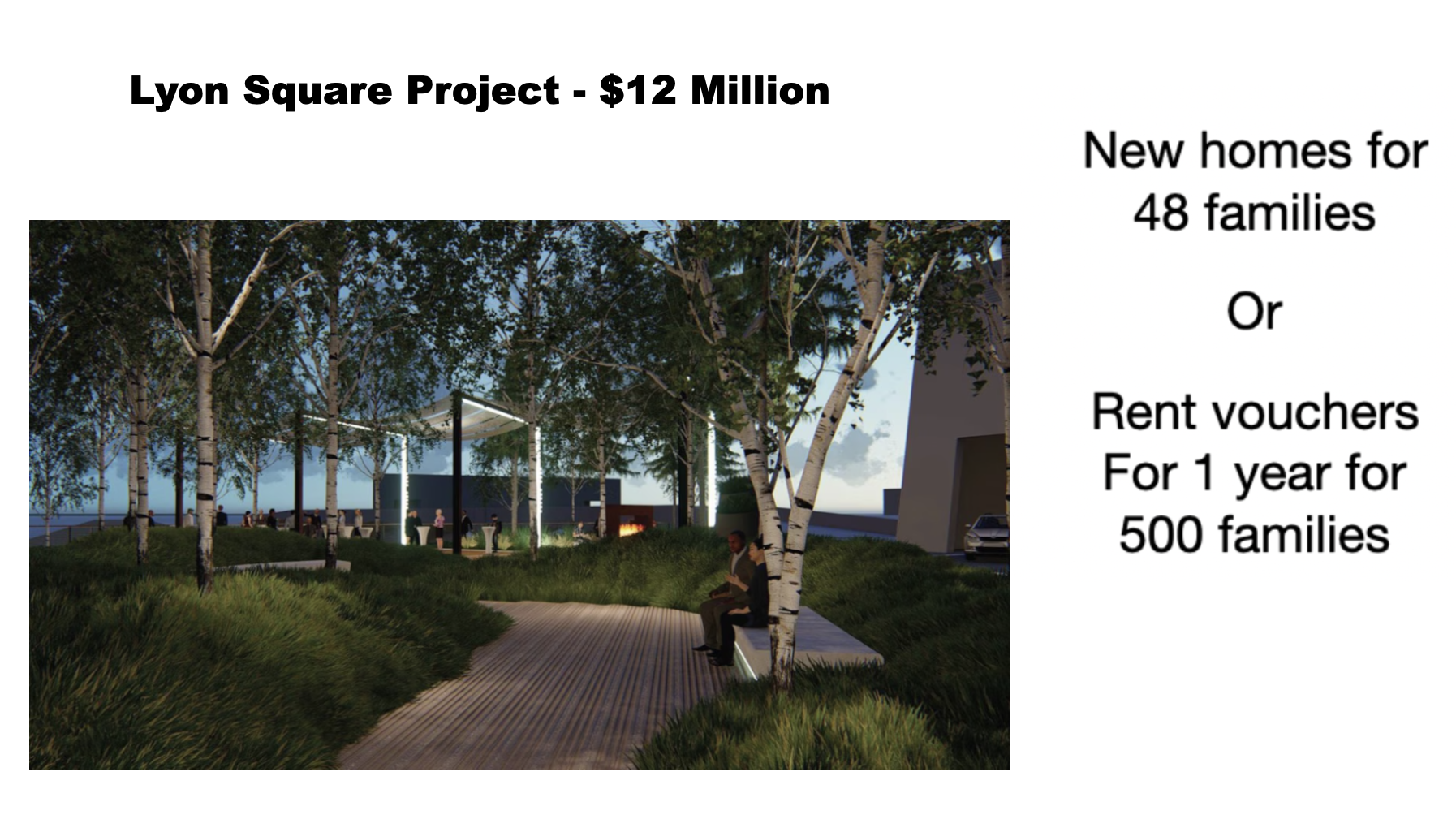
I then looked at wealth and spending realities through the lens of the Lyon Square Project, which is a beautification project that will happen between the Amway Grand Plaza and the old Welsh Auditorium. The Lyon Square Project with cost $12 million, which if redirected to real housing needs would provide what the slide shows.
A third example of tenant power that we looked at was from Oakland, California, which shows a tenant victory through organizing a Community Land Trust.

The OakCLT (Oakland Community Land Trust purchased the building for $3.3 million dollars using municipal bond funds from Oakland’s Measure KK, an infrastructure bond passed in 2016. The use of municipal infrastructure bond funds for the decommodification of housing indicates an emerging commitment to the preservation of affordability as well as a recognition that homes, and existing tenants of those homes, are part of the city’s critical infrastructure — a testament to years of hard work put in by tenants and organizers. (Although the funding available under Measure KK has run out, ACCE and other organizations are campaigning for another housing and infrastructure bond measure that will be on the ballot in November.) It’s also a departure from the last forty years of entrepreneurial city governance that has prioritized for-profit projects and policies strategically designed to attract investment, encourage economic growth, and improve the city’s standings with bond-rating agencies over public need.

In the slide above I talked about what I call the Non-Profit Housing Industrial Complex. The organizations listed in the slide are not “bad,” rather none of them work on addressing the root causes of the housing crisis, which for the Grand Rapids Area Tenant Union are the commodification of housing and economic inequity or the wealth gap in Kent County. However, I did point out that the group Housing Next, which was created by the Grand Rapids Area Chamber of Commerce, does do tremendous harm, since they are currently controlling the narrative around housing in Kent County, a narrative that promotes a market rate ideology. The slide below lists the so-called Community Partners of Housing Next, which is why they embrace a market narrative around housing.

In the final slide, I showed a montage of images from the Grand Rapids Area Tenant Union’s work over the passed for years, which was centered on confronting landlords and Property Management Companies and some of the local victories that have been won.
If you are interested in getting involved in the Grand Rapids Area Tenant Union or the Movement for Tenant Power, contact the tenant union at gratunion@gmail.com or through their Facebook page.
Remembering the Grand Rapids Furniture Workers Strike of 1911: Lessons for contemporary organizing and resistance
 This week marks the 113th anniversary of when some 6,000 furniture workers went on strike in Grand Rapids to protest working conditions, wages and the lack of an 8 hour work day.
I have been researching this historic event over the years and want to offer the following information for those who want to familiarize themselves with this history, learn from it and think about the significance of working class tactics for todays organizing efforts.
First, I highly recommend Jeffrey Kleiman’s book, Strike: How the Furniture Workers Strike of 1911 Changed Grand Rapids.
In addition, on the Grand Rapids People’s History site, I have written or republished numerous articles based on my own research over the years as it relates to the 1911 Grand Rapids Furniture workers strike.
 There is a two-part article written by Michael Johnston, who is know by many as the unofficial labor historian of Grand Rapids. In Part I of his two-part series, Johnston provides important historical context, a context that led to the massive worker walkout on April 19 of 1911.
In Part II, Johnston writes about the role that the IWW (industrial Workers of the World) played in the 1911 strike and how the local power structure and even many of the other unions saw them as a threat.
I also include in this primer on the 1911 furniture workers strike, some articles about other factors that played into the outcome of the strike. First, I look at the role of religion and how Christian Reformed Church members were told not to participate in the strike, while the Catholic Bishop at the time was in full support of the striking workers.
Then there are those who documented the strike at the time. I wrote a piece that contrasted the observations of Viva Flaherty, a socialist, who provides a great reflection on what happened during the 1911 strike, and how one of the Furniture barons (R. W. Irwin) gave his opinion about what took place.
 In another article I have written, I note that there were 10,000 workers marching in the Labor Day parade in 1911. Not only was this an impressive number of workers, but it was essentially about 10% of the entire population of Grand Rapids in 1911. Imagine if 10% of working class people took part in a contemporary Labor Day parade, march or direct action.
In yet another piece, I contrast the living conditions of those in the capitalist class – the Furniture Factory owners – and those who actually created the wealth for these men – the furniture workers.
Lastly, I include an article about the backlash from the 1911 furniture workers strike. The capitalist class was not happy about the 1911 strike, even though they ended up winning. However, those in power are never content with just winning certain battles, they want to prevent future attempts to challenge their power. What the Robber Baron class did was to change the City Charter, which resulted in decreasing the number of city wards to just 3 and eliminating a strong mayor position. The result of this charter change would make it harder for working class people to have real representation on the city commission and to make the mayor a glorified commissioner.
Again, it is important that we come to terms with understanding this local history, reflecting on it and think about what it means for current struggles against the power structure in Grand Rapids. How can working class people organize today? Do we need a union for those in the Non-Profit sector and is it important to create new union models that are not simply extensions of the Democratic Party, but truly independent and autonomous of systems of power, unions that actually represent the interests of working class people?
Palestine Solidarity Information, Analysis, Local Actions and Events for the week of April 15th
 It has been 6 months since the Israeli government began their most recent assault on Gaza and the West Bank. The retaliation for the October 7 Hamas attack in Israel, has escalated to what the international community has called genocide, therefore, GRIID will be providing weekly links to information and analysis that we think can better inform us of what is happening, along with the role that the US government is playing. We will also provide information on local events and actions that people can get involved in. All of this information is to provide people with the capacity of what Noam Chomsky refers to as, intellectual self-defense.
Information
As Surgeons, We Have Never Seen Cruelty Like Israel’s Genocide in Gaza
‘Genocide Enablers’: Gaza And The Corporate Media
Israel’s killing of aid workers is no accident. It’s part of the plan to destroy Gaza
AMID GAZA WAR, COLLEGE CAMPUSES BECOME FREE SPEECH “TESTING GROUND”
Israel and US deliberately gutting international law in Gaza
Israeli Firms Are Working Overtime to Sell Stolen Palestinian Land to US Jews
Analysis & History
These Stunning Images Show Palestinian Life Before the Nakba
Presumptively Antisemitic: Islamophobic Tropes in the Palestine-Israel Discourse
Local Events and Actions
Power the Palestine: Weekly Protest in Grand Rapids
Wednesday, April 17 at 6pm – 7pm, Monument Park
Graphic used in this post is from https://visualizingpalestine.org/#visuals
The world is watching genocide unfolding before its very eyes. Palestinians, aid workers and journalists are being murdered by the Israeli military, often using US weapons, and still the US Congress and the Biden Administration continue to send weapons and voted for more military aid to Israel.

Just yesterday, in a story from Aljazeera, their reporter stated, “At least 33,545 Palestinians have been killed and 76,094 wounded in Israeli attacks on Gaza since October 7. The death toll in Israel from Hamas’s October 7 attacks stands at 1,139, with dozens still held captive.”
There was also a recent story about two US trauma surgeons who just came back from Gaza. They stated in a recent opinion piece they wrote, entitled, As Surgeons, We Have Never Seen Cruelty Like Israel’s Genocide in Gaza.
As humanitarian trauma surgeons we have both seen incredible suffering. Collectively, we were present at Ground Zero on 9/11, Hurricane Katrina, the Boston Marathon bombing, and the 2010 earthquake in Haiti on the first day of these disasters. We have worked in the deprivation of southern Zimbabwe and the horrors of the war in Ukraine. Together we have worked on more than 40 surgical missions in developing countries on three continents in our combined 57 years of volunteering. This long experience taught us that there was no greater pain as a humanitarian surgeon than being unable to provide needed care to a patient.
But that was before coming to Gaza. Now we know the pain of being unable to treat a child who will slowly die, but also alone, because she is the only surviving member of an entire extended family. We have not had the heart to tell these children how their families died: burned until they resembled blistered hotdogs more than human beings, shredded to pieces such that they can only be buried in mass graves, or simply entombed in their former apartment buildings to die slowly of asphyxia and sepsis.
This is why I was so disgusted to see a recent post on Facebook from Rep. Hillary Scholten who engaged in a hypocritical and performative act centered around the Israeli hostages, despite the fact that she has never publicly condemned the Israeli genocide of Palestinians. Here is what she wrote:
Today, I’m wearing blue to show my support for the hostages who have been held by Hamas since the horrific attacks on October 7th. We continue to pray for their safe return and must do everything in our power to bring peace to the region.
AIPAC must really have Rep. Scholten in their pocket to get such a disgusting display out of her in the midst of the Israeli genocide against the Palestinians.
 A meme can be an excellent way to communicate powerful messages with few words and sometimes images. At the same time, a meme can oversimplify or distort historical facts. GRIID will now regularly deconstruct memes, in part because memes continue to increase in number on social media, but also because they often engage in misinformation.
Two weeks ago, we deconstructed a meme that was clearly created to make a point about the 2024 Elections and the Presidential candidates, which was rather misleading. In today’s Deconstructing memes, I want to look at a meme that makes certain claims about what is means to be an anti-fascist.
There are no images with this meme, just text, which reads:
There is no organization called “ANTIFA.” Antifa stands for anti-fascism. World War II veterans were Antifa because they fought fascism. Anyone who is against fascism in Antifa. There is no membership card. Everyone should be Antifa.
There certainly are some parts of this text that I agree with, such as the fact that antifa is not an organization, but it is often small groups of people organizing against fascism. It is also true that there is no membership card, and that anyone can be an antifascist.
The parts of this meme that are problematic and misleading are the point about “anyone who is against fascism is antifa” and “World War II veterans were Antifa because they fought fascism.”
It is important that we understand the history of the anti-fascism. There are several good books on the topic, such as Mark Bray’s Antifa: The Anti-Fascist Handbook, Jason Stanley’s How Fascism Works: The Politics of Us and Them, and Gord Hill’s, The Antifa Comic Book: 100 Years of Fascism and Antifa Movements.
First, it is important that those who first identified as antifascists, were groups in Italy, Spain and Germany that were actively resisting the growing fascist movements led by Hitler, Mussolini and Franco. Those movements had been around for more than a decade before the US entered WWII. In each of these cases, the antifascists were made up of either anarchists, socialist or communist groups, all of which opposed fascism and capitalism.
Another common element about antifascist groups have been that they engaged in direct resistance, often using force. In addition, antifascist groups wanted to replace fascism with social and economic relations that were based on cooperation instead of competition.
A third element of what makes someone an antifascist is that whenever fascism gets organized, antifascists respond. In a contemporary settling, this means that when the Proud Boys, the KKK, or other ALT Right groups come to town, antifascists will confront them and kick them out of their communities. It’s an active form of resistance, one that doesn’t allow for people to sit back and just make statements.
On the matter of World War II veterans automatically being antifascists, it is a bit of a grey area. First, those in the US military during WWII were fighting against Hitler and Mussolini because they didn’t have a choice. Those soldiers were merely following orders, not helping to plan an antifascist plan. Equally important to note is the fact that the local Italian and French antifascist groups that were able to win back their communities and cities from fascist forces, were often removed from power by British and US forces who came through after the fact. As Noam Chomsky notes in his book, Deterring Democracy, US and and British military forces actively removed the socialist, anarchist and communist movements that had defeated the fascists in Europe. Chomsky states that these antifascist forces were often replaced by fascists collaborators they had defeated, “to weaken unions and other popular organizations, and to block the threat of radical democracy and social reform.” The fascist collaborators were more inclined to embrace capitalism and the social order that came with it.
I understand the sentiment reflected in the ANTIFA meme, but apart from being too simplistic, it is also misleading and doesn’t sever the public since it doesn’t provide a more robust history or understanding o what antifascism really is.
 This week, the Acton Institute posted a story by one of their contributors, Mike Cosper, who does Christian podcasts for various religious media outlets.
Cosper posted an article entitled, There Shall Be None to Make Him Afraid: American Liberty and the Jews. In my opinion the article is all over the place, where the author is trying to make connections that make no sense.
The article begins with talking about the police murder of Michael Brown in Ferguson, Missouri, although Cosper doesn’t call it a murder and offers questionable information to justify the police murder of the 18 years old Brown. Cosper continues to make wild claims with the next paragraph, stating:
“The impact is easy to trace. Diversity, Equity, and Inclusion (DEI) departments were opened in academic, corporate, and government institutions. The New York Times published the 1619 Project, a Pulitzer Prize–winning work of revisionist history that reframes America’s founding myth around the institution of chattel slavery and not the personalities and ideas of the founding. A new race consciousness permeated Hollywood, reshaping unwritten criteria for casting and awards.”
Clearly, Cosper is of the persuasion that DEI practices are somehow radical and that Hollywood is to blame for much of the race-centered culture war. Of course this is nonsense, since the response to the police murder of Michael Brown was rooted in an abolitionist critique of policing which has existed for decades within the Black Freedom Struggle. DEI workshops and trainings had nothing to do with the Movement for Black Lives and the national outrage over the police murder of Black and other BIPOC people.
Cosper then makes another ridiculous claim that Black Lives Matter chapters around country “celebrated the Hamas massacre of Israelis on October 7.” It is true that the Black Freedom struggle and solidarity with the Palestinian struggle has deep roots (see article in the Nation), but to claim that the Movement for Black Lives is antisemitic is just not based in fact. I would also suggest that people read Angela Davis’ book, Freedom Is a Constant Struggle: Ferguson, Palestine, and the Foundations of a Movement.
Ultimately, the article that Mike Cosper posted on the Acton Institute site argues that BLM activists and Kyle Rittenhouse are the result of right and left “radical binaries.” Again, an absurd comparison, where Cosper offers no meaningful articulation of his claim.
Cosper then makes another leap in his so-called analysis, to suggest that the existence of antisemitism should be how we measure the social fabric of the country. In a section subtitled, The Canaries in the Coal Mine, Cosper states: “Anti-Semitism’s reemergence here and now ought to serve as final, damning proof of the corruption of the political ideologies that have come to dominate our culture.” While I agree that antisemitism should be rejected and not tolerated in social justice movement politics, it is not the only measuring stick. Anti-Blackness, white supremacy, xenophobia, transphobia, anti-Islam and any form of collective discrimination and systemic oppression should be rejected.
Lastly, Cosper then uses George Washington as a model for rejecting antisemitism, based on some letters he wrote to Jewish communities after he became President in 1790. While I get the sentiment reflected in the letters that Copser cites, we should not forget the fact that under Washington’s presidency, chattel slavery was legal, that women were the legal property of their husbands and those who didn’t own land couldn’t vote. In fact, the only people who could vote when Washington was President were white men who owned land. In addition, Washington was part of a landed gentry system that continuously engaged in the theft of Indigenous land, which was reflected in how Washington saw Indigenous people when he said, “Indians are both beasts of prey, tho’ they differ in shape.”
If Mike Cosper thinks that George Washington is a model for how to treat people, because he wrote welcoming letters to Jewish communities, while simultaneously marginalizing Black, Indigenous, immigrant and non-christians communities, then that is a pretty fucking low bar for what liberty means.
Once again, a contributing writer to the Acton Institute displays both their ignorance and ideological bias, thus making it clear that the Acton Institute always supports the dominant narratives of the Capitalist Class within the US.
 Grand Rapids Institute for Information Democracy