Rep. Scholten continues to vote in support of genocide, censorship and to suppress international solidarity
Last week I reported on Rep. Hillary Scholten’s vote to censor and punish campus protests that are happening across the country, with her claims that students were engaging in antisemitism.

Since then, Rep. Scholten has continued to vote on the wrong side of history and the wrong side of justice. On Wednesday, May 1st, Rep. Scholten voted for H.R.6090, known as the Antisemitism Awareness Act of 2023.
This legislation is essentially a gap order and an attempt to silence people who are critical of the Israeli government and their genocidal campaign against Palestinians. Many groups, particularly Jewish groups, have come out against HR 6090. Americans for Peace Now said that while it is “deeply concerned about the escalating antisemitism in the United States and globally,” the legislation “poses a significant threat to free speech and open discourse.”
“Equating criticism of the Israeli government with antisemitism is a tactic used to stifle important discussions on Israeli policies and actions, thereby hindering the broader effort to combat true instances of hatred and discrimination against Jewish communities,” the group added.
Jewish Voice for Peace Action slammed what it called the HR 6090’s definition of antisemitism as, “controversial and dangerous mis-definition that does not help fight real antisemitism and is only a tool for silencing the movement for Palestinian rights.”
The other recent piece of legislation that Rep. Scholten voted for was H.R.6408. This legislation would grant the secretary of the treasury broad power to designate any charity as a “terrorist supporting organization” and remove its tax-exempt status within 90 days.
According to an excellent article from TruthOut, “This legislation is ominous given recent charges of terrorism disingenuously and inaccurately slapped on U.S.-based Palestinian organizations and student groups. In October 2023, for example, Jason Miyares, the Republican attorney general of Virginia, called for investigation of American Muslims for Palestine, and the Anti-Defamation League and the Louis D. Brandeis Center for Human Rights Under Law wrote a letter to presidents of nearly 200 universities, requesting that all chapters of Students for Justice in Palestine be investigated for potentially providing material support to a foreign terrorist organization.
In response, the Charity & Security Network, a resource and advocacy center for nonprofit organizations that work in conflict zones, warned that without proper evidence such allegations constituted “a dangerous precedent for not only the U.S. legal system and the state of free speech but also for charitable giving and operations in crisis contexts like Gaza.”
By voting for these bills, Rep. Scholten has demonstrated that she will not question or challenge the Biden Administration on the matter of Israel and their current genocide against the Palestinians. Rep. Scholten also demonstrates her continued defense of Zionism by equating criticism of Israel with antisemitism, which not only promotes censorship, it stifles free speech and it threatens groups that want to practice international solidarity.
In Part I of this two part series, I looked at how the local commercial news media reported on the sunsetting of the Richard & Helen DeVos Foundation. I concluded that the local news was rather subservient to the DeVos family and miserably failed the public by not providing a more honest and transparent view of the foundation.
I (and others) have been monitoring the Richard & Helen DeVos Foundation since the late 1980s. When I was involved in the Indy Media project known as Media Mouse, we regularly monitored and wrote about their foundation. Prior to that, the independent journalist Russ Bellant was writing about the DeVos family for a variety of publications, but then published a book in 1996 entitled, The Religious Right In Michigan Politics.

Beginning in 2013, GRIID began to more methodically report on the most powerful foundations in West Michigan, which included the Richard & Helen DeVos Foundation. I have continued to do so on an annual basis to not only report on how much money they were providing in grants, but to what entities and how that impacted the public. However, before we get to an analysis of the Richard & Helen DeVos Foundation, I want to talk briefly about the function of foundations in general.
The function of foundations and the non-profit industrial complex
Foundations are primarily created by the rich and the powerful to fulfill several functions:
- Foundations are a way for members of the Capitalist Class to hide their wealth and not have it taxed.
- Foundations provide a public relations role for members of the Capitalist Class as a way to demonstrate their “generosity” and to shift the public’s attention away from how they made and expanded their wealth.
- Foundations provide the Capitalist Class with an opportunity to fund far right organizations and think tanks, which not only defend Capitalism, they craft public policy positions that benefit those with tremendous wealth.
- Foundations get to influence what Non-Profits do, since the grant money foundations provide always comes with strings attached that are at best reformist in nature and social service driven.
- By providing grants to Non-Profits, foundations also are able to condition Non-Profits into not criticizing what foundations do or the Capitalists that create them.
- Lastly, foundations provide funding to social service entities that assist individuals who are hurting, as a way to manage inequality, thus preventing working class people from rising up against the Capitalist Class. The agencies that provide social services act as a buffer for those with power.
In their groundbreaking book, The Revolution Will Not Be Funded: Beyond The Non-Profit Industrial Complex, the group INCITE! identified the Non-Profit Industrial Complex as a relationship between the State, the owning classes, foundations and the non-profit/NGO, social service and sometimes social justice organizations. These relationships often result in the surveillance, control, derailment, and everyday management of political movements. For the women of INCITE! the state and private power uses non-profits to:
- Monitor and control social justice movements;
- Divert public monies into private hands through foundations;
- Manage and control dissent in order to make the world safe for capitalism;
- Redirect activist energies into career-based modes of organizing instead of mass-based organizing capable of actually transforming society;
- Allow corporations to mask their exploitative and colonial work practices through “philanthropic” work;
- Encourage social movements to model themselves after capitalist structures rather than to challenge them.
All of this is to say that foundations, like the Richard & Helen DeVos Foundation, don’t operate in a vacuum. In fact, the Richard & Helen DeVos Foundation has always been a very strategic part of how the DeVos family uses their wealth, which we will now explore.
Funding hate, harm and far right Think Tanks
If you look at the 990 record of the Richard & Helen DeVos Foundation over the decades, you see certain entities that have received millions of dollars. These groups often are faith-based groups, groups that defend Capitalism or Think Tanks that influence public policy.
Some of the faith-based groups that have received funding from the Richard & Helen DeVos Foundation are:
- Focus on the Family
- Family Research Council
- Coral Ridge Presbyterian Church
- Haggai Institute
- Luis Palau Evangelistic Association
- Right to Life
- Prison Fellowship Ministries
Some common themes from all of these faith-based groups, and many more that have received funding from the Richard & Helen DeVos Foundation, are that they embrace an anti-LGBTQ politics, oppose reproductive freedom, preach a very heteronormative family structure, believe that people should pull themselves up by their bootstraps, and have close relationships with conservative and repressive governments.
Groups that defend Capitalism and are often Think Tanks that have received tens of millions in funding from the Richard & Helen DeVos Foundation are groups like:
- The Heritage Foundation
- The American Enterprise Institute
- Americans for Prosperity
- Freedom Works
- The Acton Institute for the Study of Religion and Liberty
- The Mackinac Center for Public Policy
You can investigate what each of these groups promote by using the invaluable online site SourceWatch.org
All of the groups that I have listed so far that have received funding from the Richard & Helen DeVos Foundation have been the recipient of much larger amounts of money than most of the groups in West Michigan. I say this, since I think it is important that we understand that these groups don’t do charity work, they influence public policy and promote a religious right perspective that does real harm in this world.
Business Education, Religious Schools and the undermining of Public Education
A third major group that has received funding from the Richard & Helen DeVos Foundation are systems of education or groups that promote the privatization of education.
 Regarding Universities and Colleges the Richard & Helen DeVos Foundation has consistently contributed to Calvin University, Calvin Theological Seminary, Western Theological Seminary, GVSU, GRCC, Davenport University in this area, and to King’s College and Northwood University. In some of these cases the funding was purely to support religious education, while places like GVSU has more to do with influencing campus policy and/or to promote Business Departments.
The Richard & Helen DeVos Foundation has also supported the promotion of charter schools or the privatization of education, which are also the function of many of the Think Tanks mentioned above.
A fourth Major area of funding for the Richard & Helen DeVos Foundation has been organizations that provide social services to individuals or families. Many of these groups are also faith based, but none of them advocate systemic change, only individual achievement. These groups also won’t question or speak out against how the DeVos family spends money in the political arena, which often goes to candidates that do not support an increase in the minimum wage, who don’t support labor unions or which don’t promote higher taxes for the super rich. When the Richard & Helen DeVos Foundation provides grants to these groups, I call it hush money, which just guarantees that the entities receiving the funds won’t question how the DeVos family increases their wealth or how they influence political outcomes. Some of these group that are local are:
- Guiding Light Mission
- Hope Network
- Mel Trotter Ministries
- Safe Haven Ministries
- ICCF
- Bethany Christian Services
One last arena that the Richard & Helen DeVos Foundation provide funding to are projects which were started by their children. This provides an opportunity to just shuffle funding around in house, since it ultimately goes to a project that was created by another DeVos. Some examples are:
- ArtPrize
- Start Garden
- Grand Rapids Initiative for Leaders
- Christian Leaders NFP
- West Michigan Aviation Academy
Anyone can see that the analysis that I have provided is way different than what the local news reported. While this is what the local news media should be doing, they have demonstrated over the past few decades that I have done news monitoring, that they are nothing more than stenographers for those with power. More importantly, we need people of conscience to understand and social movements to expose the blatant hypocrisy of the DeVos Family Foundations and not be fooled by their so-called philanthropy.
Last week, if you consumed any of the daily local commercial news media, it would have been near impossible for anyone to not come across the announcement from the DeVos family. The announcement was centered around the closing of the Richard & Helen DeVos Foundation, which has now ended after 54 years.

I counted 10 stories collectively from local commercial news media outlets about the sunsetting of the Richard & Helen DeVos Foundation. Last Tuesday hundreds of people – family members, friends, community leaders and non-profit groups – gathered at the Amway Grand Plaza to “pay tribute to the couple’s philanthropic legacy,” according to MLive.
In many ways, the MLive article encompassed the general tone of the all the local news media stories about the Richard & Helen DeVos Foundation’s history. Of course there were DeVos family members who were cited in the local commercial news coverage, along with people like former GVSU President’s Arend Lubbers and Mark Murray. Not surprising was the fact that both men had nothing but glowing words for the now deceased couple.
However, the public record is not so kind, or at least it is a bit more honest about what the legacy of the Richard & Helen DeVos Foundation. For example, while producing a documentary about the history of the LGBTQ community in Grand Rapids, I discovered in 1994, when faculty and staff at GVSU were meeting with then President Lubbers over the university’s willingness to offer domestic partner benefits, word got out that this was going to happen. At the time GVSU was raising money for a proposed health education building on Michigan St and Peter Cook and Rich DeVos had pledged millions. Once DeVos and Cook found out about the proposal by GVSU to offer domestic partner benefits, they threatened to withdraw their financial support if the university would support a domestic partner benefits policy. GVSU acquiesced to the wish of DeVos and Cook. Arend Lubbers sided with DeVos on this matter, not GVSU faculty and staff.
Another attempt to win domestic partner benefits was made in 2003, but then President Mark Murray blocked the attempt. Murray stated at the time, “As a University that has benefited from very generous support from the private philanthropic community, we must recognize the prevailing views of those who provide such support.” Translated, Murray was saying that he didn’t care about LGBTQ faculty and staff, he just wanted to make sure that members of the Capitalist Class in West Michigan – like Richard and Helen DeVos – would continue to give the university money.
Another example of how the local commercial news media treated the closing of the Ricard & Helen DeVos Foundation as some sacred entity, was a piece that WOODTV8 did, where two of the channel 8’s media personalities sat in the studio with Dick DeVos for 4 minutes. What is astounding was all of the superlatives the channel 8 people used when talking about Richard and Helen DeVos, but also how they did not question the narrative coming from Dick DeVos. Watch that WOODTV8 piece and you’ll see how subservient they are to the most powerful family in West Michigan.
In the end, the local commercial news media failed to not only include different perspectives on the legacy of the Richard & Helen DeVos Foundation, they failed to provide people in this community with a more robust understanding of the function of foundations. It’s difficult to know why the news coverage was so subservient to the DeVos family, although I suspect that a great deal of it has to do with not wanting to piss off the most powerful family in the area. In addition, after methodically monitoring the local commercial Neds media for the past 30 years, I would say that the simplistic coverage of the Richard & Helen DeVos Foundation coming to an end has to do with the fact that the local commercial news media – both editors and journalists – both have internalized the values of the rich and powerful, thus deferring to reporting on them as celebrities and saints.
In Part II of this series, I will explore the function of foundations, plus a more robust analysis of the 1,000 non-profits that the Richard & Helen DeVos Foundation contributed to over the passed 54 years.
I sat down with Jose Rodriguez on Sunday to talk about why the GRPD contact him two weeks after he participated in a march demanding Justice for Patrick Lyoya and then charging him with a misdemeanor.

The march, which took place on April 6th, just two days after the second anniversary of the GRPD murder of Patrick Lyoya. The march was organized by the Comrades Collective, which included several members of Patrick Lyoya’s family.
Below are the six questions I asked Jose during the interview:
- Can you tell us what your involvement was during the April 6th Justice for Patrick Lyoya march organized by the Comrades Collective?
- How many days after the march were you contacted by the GRPD and what were they charging you with?
- If you weren’t doing anything different than the dozens of people who participated in the march on April 6th, why do you think the GRPD is targeting you?
- It’s not lost on many of us that the two people that the GRPD have targeted with charges after the protest are BIPOC. DO you think that the GRPD’s actions are in part racially motivated?
- Why do you think what happened to you is important for people to know?
- In what ways can people support you and be involved in the campaign to fight for justice for Patrick Lyoya?
West Michigan Far Right Watch: Cop apologists and those calling for student campus protesters to be expelled
In today’s West Michigan Far Right Watch we want to look at a recent rant from our favorite cop apologists, Voice for the Badge, as well as a recent podcast from the Acton Institute, where 3 white dudes are calling for students that are organizing pro-Palestine encampments across the country to be expelled!

Photo by Alex Kent/Getty Images
A few days ago, the founder of the police apologist group, Voice for the Badge, posted this simplistic and childish post on their Facebook page. The founder wrote in all caps, because he wants us to take him seriously.
THIS MUST STOP
4 OFFICERS MURDERED—AMBUSH
I AM SAD—MAD—COWARDS—CAPITOL PUNISHMENT FITS
PRAYERS FOR OUR FALLEN HEROES/THE FAMILIES AND ALL THE BLUE FAMILY.
PROTESTS–SEEMS LIKE OUR POLICE ARE ALWAYS THE VILLIANS–UNREAL—WRONG AS WRONG CAN BE.
SAW IN THE MEDIA—OUR POLICE ARE OVER POLICING—–B/S.
POLICE BRUTALITY-INCLUDES WHEN OUR OFFICERS SNEEZE?
TO LISTEN TO VERBAL ABUSE/F—YOU—PIGS—WITHOUT RESPONDING—HOW BOUT THAT—WELL I CAN SAY TO THE COP HATERS—F—-U.
JOHNNY BRANN SR.
THE VFB STANDS WITH THE BLUE.
Wow, profanity from the founder of Voice for the Badge. More importantly, is Johnny Brann Sr.’s narrow minded view of the world. According to mappingpoliceviolence.org, the cops have killed 369 people so far in 2024. However, when a cop is killed, he equates it with the crucifixion of Jesus.
The protests that Johnny Brann Sr. is most definitely referring to are the student-led protests on campuses that are denouncing the Israeli’s genocide of Palestinians and the US government’s complicity in that genocide. When cops are beating students, spraying them with mace and shooting them with rubber bullets, it seems like a good time to say, Fuck You Pigs! The founder of the Voice for the Badge concludes his little rant with a big FU to anyone who doesn’t like cops. This means that Johnny Brann Sr is saying fuck you to everyone who has had a family member murdered by the police, beaten by the police, and arrested by the police. It means that he is saying Fuck you to the family of Patrick Lyoya and the family of Samuel Dajon Sterling.
It also means that he is saying fuck you to most BIPOC people, since they are the primary targets of the cops, along with political dissidents, who are also often the target of state violence. Brann can tell us to fuck off all he wants, but we will not stop us from having a deep critique of state violence, nor will he stop us from our collective resistance to policing.
Our second part of this edition of West Michigan Far Right Watch has to do with an April 29th edition of Acton Unwind, the podcast of the Acton Institute.
The headline for the April 29 podcast was, Decamping Campus Encampments. The discussion the Acton Unwind trio have about the campus protests begins near the end, at about the 50:45 mark.
Someone sort of lays out what is happening on campuses across the US, although he says it is primarily “elite” campuses. The Acton Unwind host then says that what happened at the University of Texas at Austin was not a great example of how to deal with campus protesters, even though he has nothing but distain for the growing student-led movement to resist the Israeli genocide, US complicity in that genocide, and force campus Board’s of Trustees to divest from companies who are profiting off of Israel’s genocide, occupation and apartheid.
One of the mouth pieces on Acton Unwind said that Ben Sasse, the President of the University of Florida had the correct response, although he doesn’t share what Sasse said. Sasse stated:
“This is not complicated: The University of Florida is not a daycare, and we do not treat protesters like children — they knew the rules, they broke the rules, and they’ll face the consequences. For many days, we have patiently told protesters — many of whom are outside agitators — that they were able to exercise their right to free speech and free assembly. And we also told them that clearly prohibited activities would result in a trespassing order from UPD (barring them from all university properties for three years) and an interim suspension from the university. For days UPD patiently and consistently reiterated the rules. Today, individuals who refused to comply were arrested after UPD gave multiple warnings and multiple opportunities to comply.”
The Acton Unwind guy then talks about how police deal with MSU “riots” after football games. He suggests that University Presidents should call MSU so they can counsel them to have cops come in riot gear and use tear gas, since that is a “non-lethal ways of dealing with protesters.”
Another one of the ideologically-driven Acton Unwind guys then says that there was a picture of “a long haired white dude with a guitar who was standing in front of a Hamas flag. And that guy was probably there to pick up chicks. He probably has no idea what is even happening with Israel and Gaza.”
The third Acton Unwind guy thinks there should be a distinction between public and private universities. If the protests are at public universities, then you have to “deal with the free speech issue.” However, according to the Acton Unwind dudes, universities should not be a place for debate or an open forum. What? Universities should absolutely be places for debate or open forum, which in the end promotes more critical thinking.
The whole discussion was just a ridiculous attempt to denigrate the campus protests and to promote what Biden said last week about the Rule of Law. One of the Acton Unwind guys also said that student protesters think that history has always vindicate campus protests, using the Vietnam War as an example. However, he then said he went to a lot of Tea Party protests on campus. Of course he did, because he, like his fellow Acton Unwind buddies are part of the far right. Actually, they are the ivory tower version, since they would never get their hands dirty by truly engaging people in public settings.
The Acton Unwind guys then end their show with two very instructive comments. First, they suggested that student organizers of the campus protests should be expelled. Second, they all believe that going to college is not the “real world” it is just to prepare you for the real world. This is rather ironic since all three of the Acton Unwind guys aren’t in the real world. They don’t produce anything, they simply work for an organization that is ideologically dogmatic on most major issues, primarily on the defense of Capitalism. In the end they get paid to give their opinion about the real world, regardless of their limited interaction with the real world.
Palestine Solidarity Information, Analysis, Local Actions and Events for the week of May 5th
 It has been roughly 7 months since the Israeli government began their most recent assault on Gaza and the West Bank. The retaliation for the October 7 Hamas attack in Israel, has escalated to what the international community has called genocide, therefore, GRIID will be providing weekly links to information and analysis that we think can better inform us of what is happening, along with the role that the US government is playing. We will also provide information on local events and actions that people can get involved in. All of this information is to provide people with the capacity of what Noam Chomsky refers to as, intellectual self-defense.
Information
Gaza’s new and terrifying reality
The Palestinian Resistance Isn’t a Monolith
How Extremists Became the New Face of Israel
What the Student Movement for a Free Palestine Teaches Us
Cable News Viewers Have a Skewed Attitude Toward Gaza War, Survey Finds
‘We Do Not Support’ ICC Probe of Israeli War Crimes in Gaza, Says White House
Last Night’s Palestine Crackdown Was Authoritarian
Analysis & History
JUDITH BUTLER WILL NOT CO-SIGN ISRAEL’S ALIBI FOR GENOCIDE
Local Events and Actions
Power the Palestine: Weekly Protest in Grand Rapids
Wednesday, May 8 from 12pm – 1pm, Monument Park
https://www.facebook.com/events/956092489355434?ref=newsfeed
Wednesday, May 8 at 6pm
Zionism and Local Policing
https://www.facebook.com/events/973132437497973?ref=newsfeed
Graphic used in this post is from https://visualizingpalestine.org/#visuals
This is the third and final article where we look at entities that are making substantial campaign contributions to people at the state level for the upcoming Primary Election in August and the November 2024 Election.
In the past week GRIID has looked at which candidates are receiving funding from the Grand Rapids Police Officers Association and the Grand Rapids Chamber of Commerce PAC and what that means for policy issues in Grand Rapids and across the state. Today, I want to look at the Michigan Realtors PAC and the Rental Property Owners Association of Kent County.
In 2022, GRIID noted that the Michigan Realtors PAC and the Rental Property Owners Association of Kent County contributed tens of thousands of dollars to candidates with the intent of insuring that those who promote a market-driven housing framework will be able to maintain that, in light of the growing housing justice movement in West Michigan and across the state. Last fall, the Rent is Too Damn High Coalition brought out 500 people to protest the housing crisis in Michigan and to present a list of demands that certainly threaten a market-driven housing reality.
2024 Campaign Contributions from the Michigan Realtors PAC
According to the Michigan Secretary of State’s Campaign Finance data for this quarter, the Michigan Realtor’s PAC made 126 separate contributions. Here is a list of some of the larger contributions and contributions to West MI candidates:
- Michigan Senate Democratic Fund – $25,000
- Michigan House Democratic Fund – $25,000
- Senate Republican Campaign Committee MI – $15,000
- House Republican Campaign Committee MI – $15,000
- Michigan Forward Fund – $5,000
- Brinks Victory Fund – $2,500
- Kristian Grant – $1,000
- Grant Leadership Fund – $1,000
- Mark Huizenga – $1,000
- Bryan Posthumus – $1,000
- Albert Majority Fund – $1,000
- Carol Glanville – $1,000
All of this makes sense when you consider that the Democrats control the State Legislature, so naturally they would receive the highest amounts. It is also important to note that Rep. Kristian Grant is the Chair of the recently formed Housing Committee, which is why the Realtors PAC threw money at her.
2024 Campaign Contributions from the Rental Property Owners Association of Kent County
The amounts that the Rental Property Owners Association of Kent County are naturally smaller than the Realtor’s PAC, since they are primarily interested in influencing policy in Kent County. However, this year they are making contributions to candidates outside of the county, especially considering that issues like Rent Control and a Renters Bill of Rights are part of what the Rent is Too Damn High Coalition is pushing for.
According to the Michigan Secretary of State’s Campaign Finance data for this quarter, the Rental Property Owners Association of Kent County made only 5 separate contributions.
- Michigan House Democratic Fund – $1,000
- Kristian Grant – $250
- Stefanie Chang – $250
- House Republican Campaign Committee – $250
- Sylvia Santana – $250
These numbers will go up before the August Primary and the November General Election, but again, it is clear that the campaign contributions from the Rental Property Owners Association of Kent County are strategic and targeted. GRIID will certainly follow the money in the upcoming campaign finance reporting deadlines later this summer and fall, so that people can see how those with deep pockets are influencing public policy in Michigan.
Grand Rapids Area Tenants Union and Community Members Stand United Against Exploitative Landlords
Editor’s note: This article was written by Kellan Martin.
On April 30th at 6:00pm, dozens of community members along with organizers from the Grand Rapids Area Tenants Union joined Gretchen Statezni and Audrey Campbell to protest against the exploitative practices of their landlord, Josephine Cole.
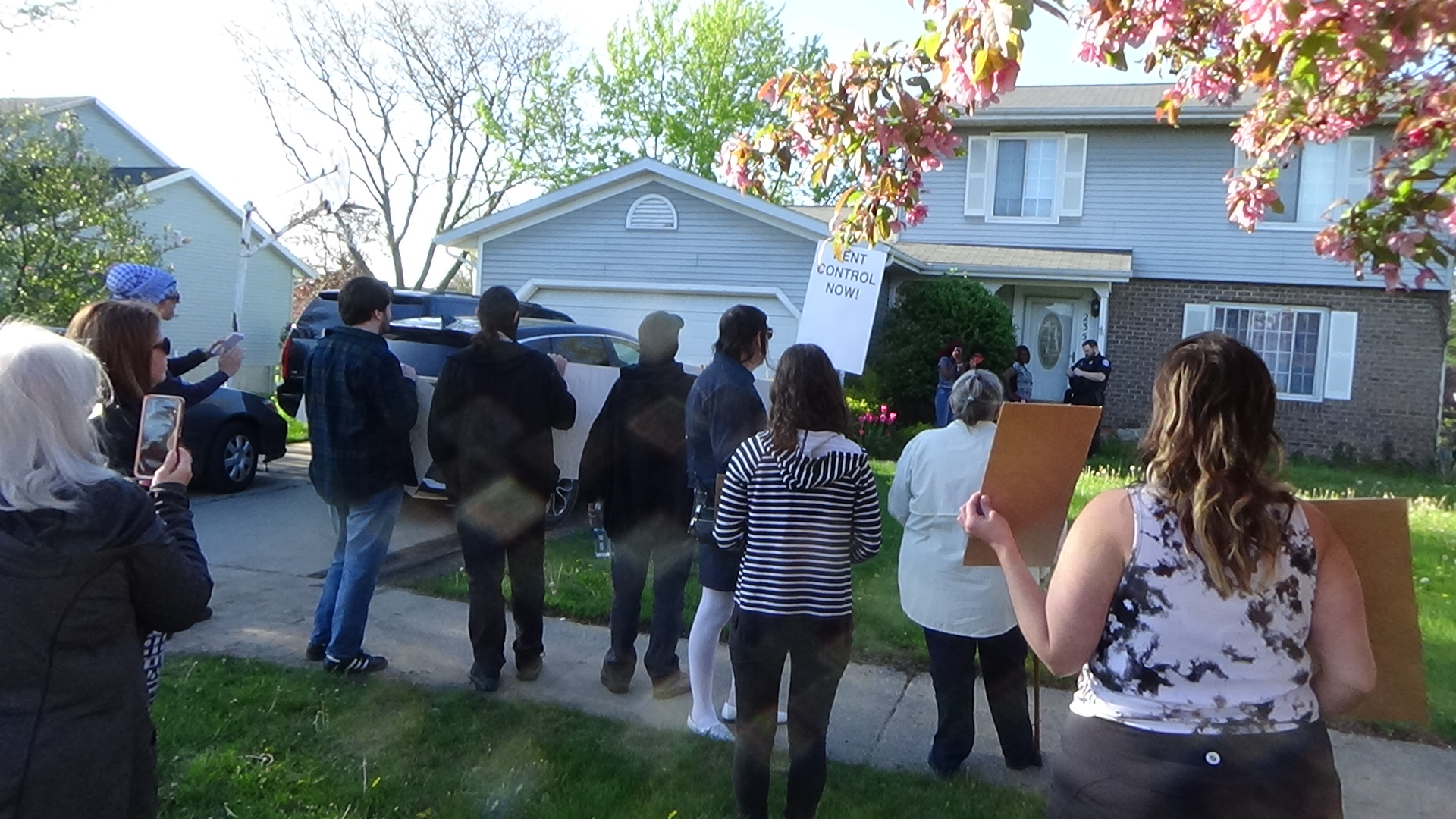
Protesters gathered in front of Cole’s house and heard details of Cole’s exploitative “slumlord” actions. The conditions that both tenants face in their relationship with Cole include deliberate mishandling of paperwork, non-payment of utility bills, rent increases of over $6,600/year since 2020, and threats of eviction. These unfortunate situations and more have culminated into what is an exploitative relationship that Cole has with Statezni and Campbell.
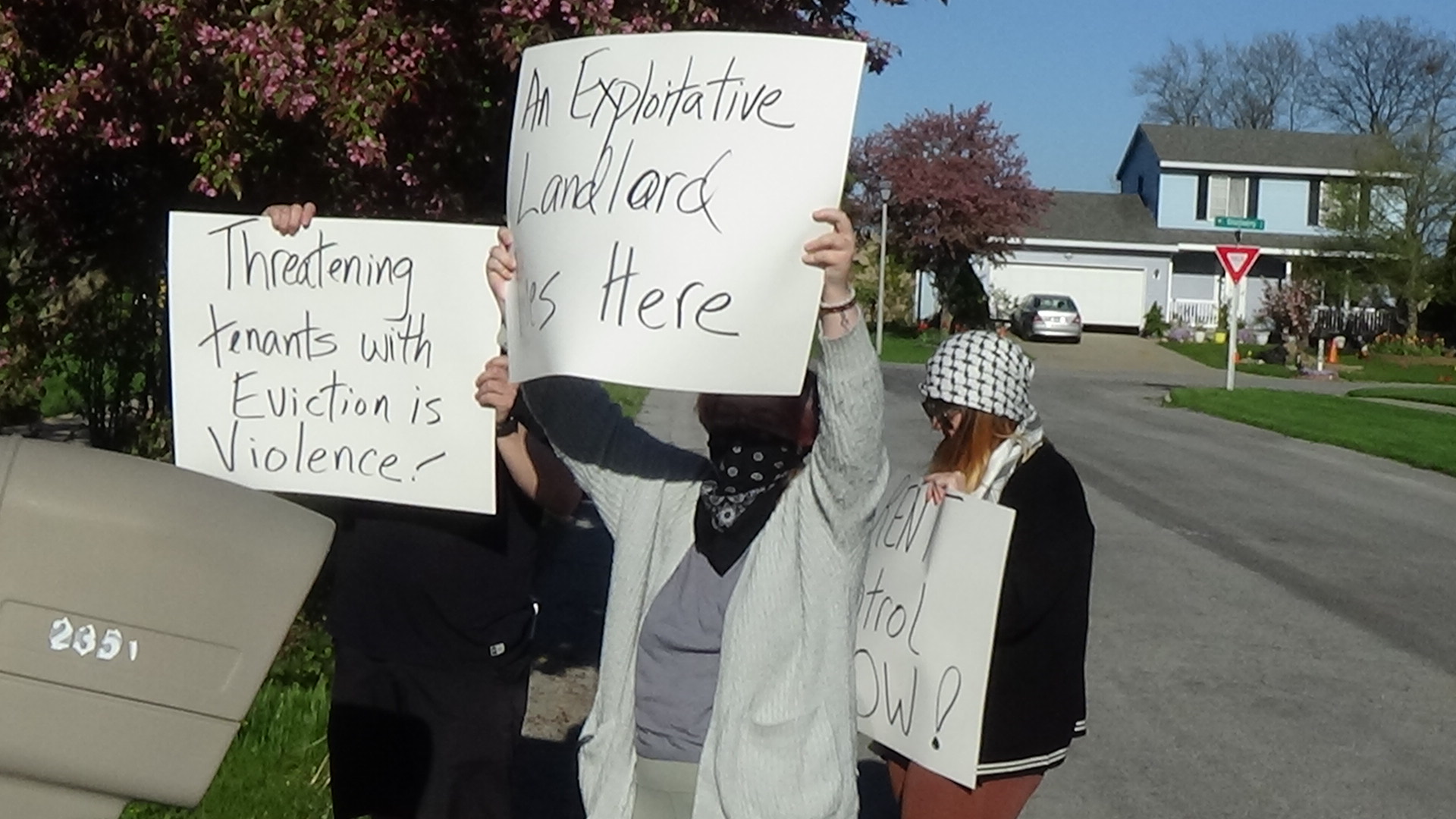
Statezni noted to attendees that it is primarily rent price hikes that have caused the most amount of damage over the years. Methods of relief such as rental assistance cause more issues instead of help. Since rental assistance is usually provided under guidance and consent of the property owner, Cole knew about these new sources of income. Statezni recounted multiple instances of receiving rent increases from Cole just days after being granted rental assistance.
Protestors talked to people in the neighborhood where the landlord lived to broadcast the profit-mongering nature of Cole’s business practices. Chants of “Eviction is violence!” and “Rent control now!” rang through the suburban complex. After a while protestors were met with four police officers, contacted by residents of Cole’s household. The police and Cole ultimately left when they realized they could not legally stop members of the community calling out a property owner for their exploitative practices! By the time the protest ended, both renters voiced their concern about retaliation from Cole as it has happened in the past.
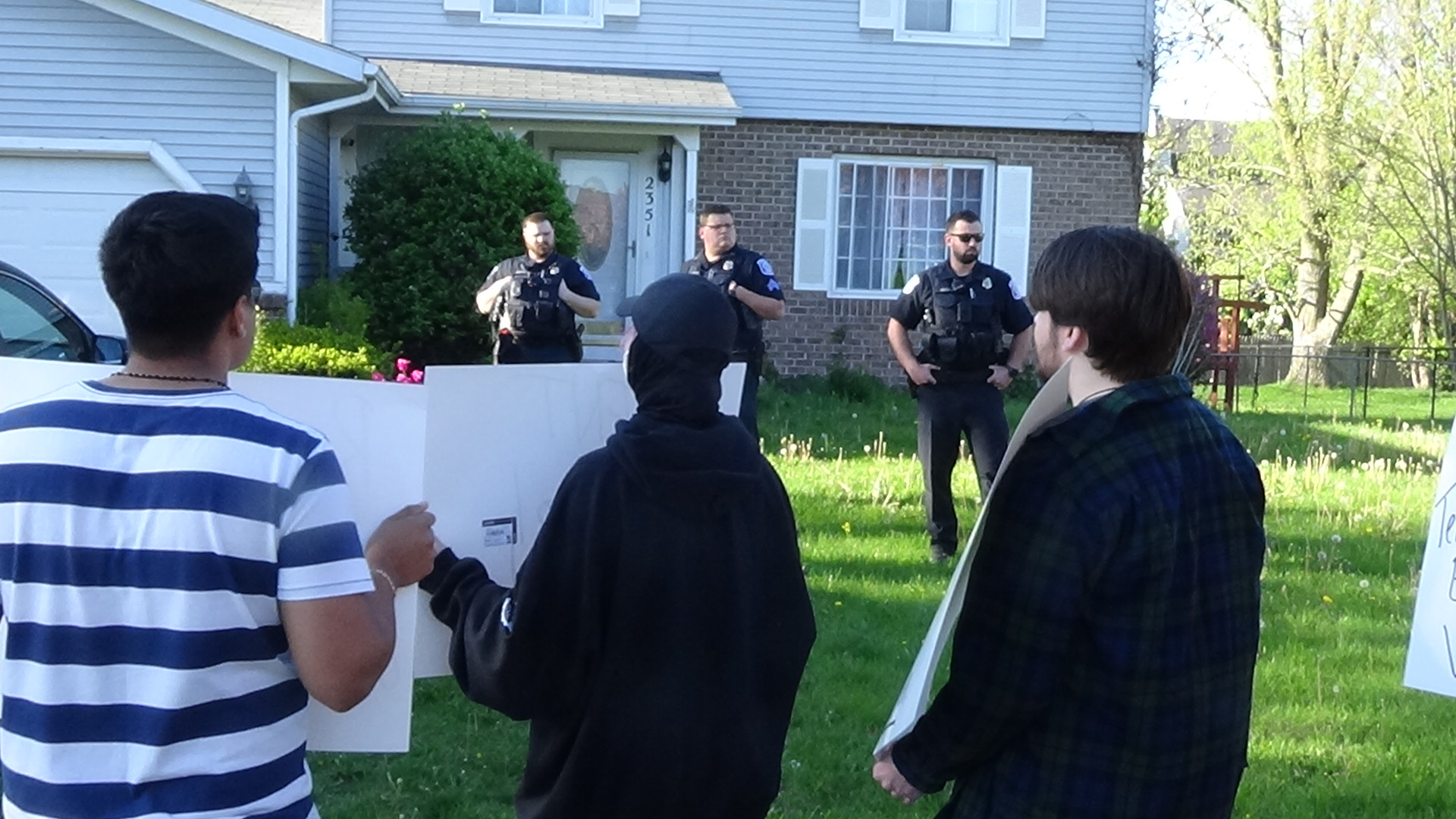
The conditions that Statezni and Campbell face are shared by almost every renter in the US. A capitalist system with a low home-ownership rate and, in the case of Michigan, no laws to control rent mean that every year large portions of the US population face the experience of seeing their greedy landlord’s leases in the mail that demand hundreds of dollars more per month of stolen income from renters.
Collective actions against landlords such as this one held by GRATU show people in need that they are not alone, and those in power that they cannot act with impunity and must face accountability for their violence. The struggle of tenants to build their collective power is therefore connected with the struggle for liberation of all oppressed people under capitalism.
If you are a renter and need support and solidarity from the Grand Rapids Area Tenants Union, you can contact them at gratunion@gmail.com. Tenants can also attend the next GRATU meeting, which will be held on Saturday, May 11 at 10am. Go to this link for location and other details.
Yesterday, during their annual May Day action, about 100 Movimiento Cosecha organizers and supporters came to the Lansing State Capital to demand driver’s licenses.
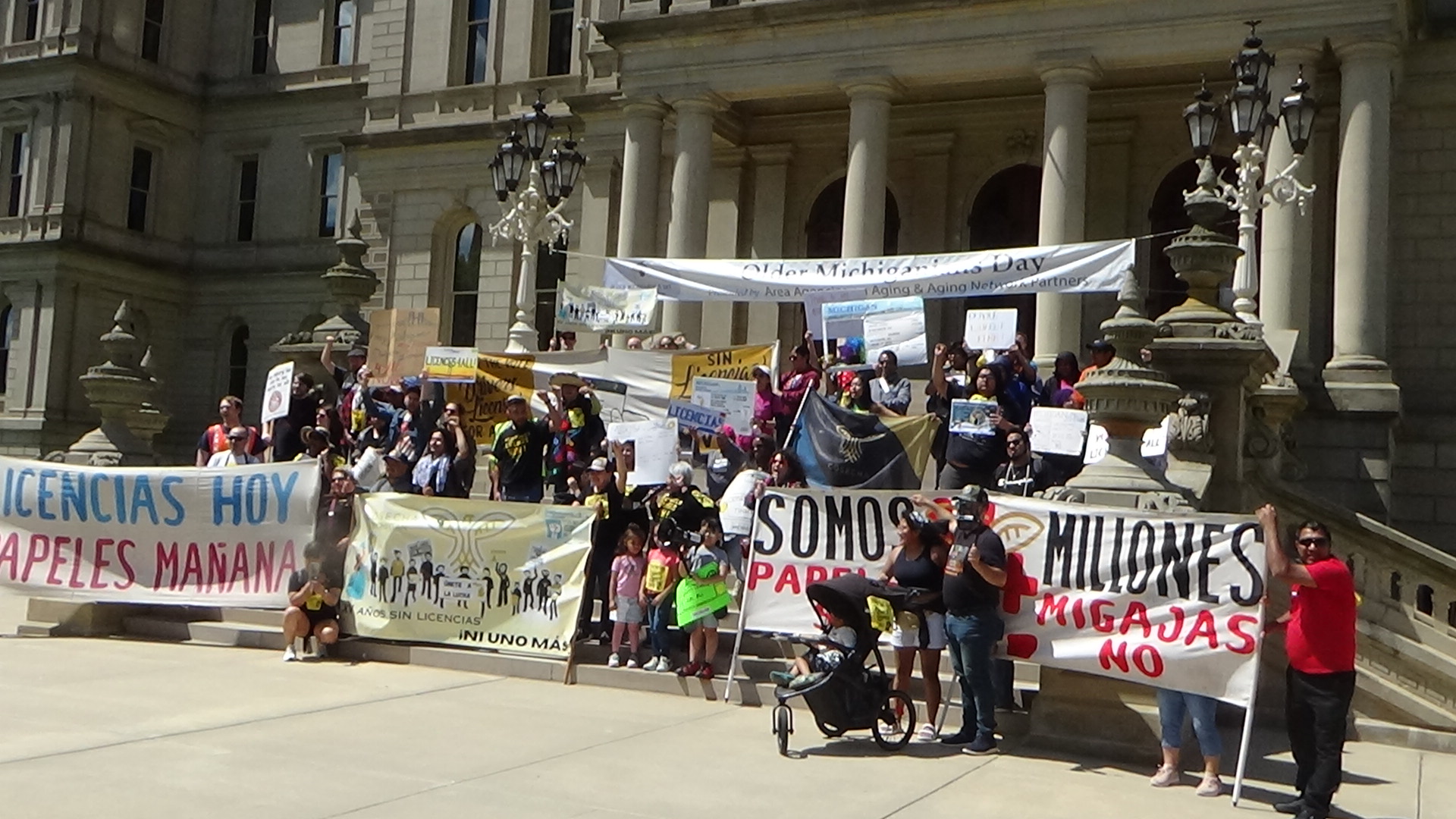
People came from different parts of Michigan and arrived in Lansing around 11:00am. The Cosecha action began in front of the State Capital, with some announcements and to inform participants of what would be happening throughout the day.
From the very beginning the energy was high, the banners and signs were plenty and the bi-lingual chants were passionate.
First, the roughly 100 participants marched down Michigan Street, passed the Lansing Police Station and around the roundabout. However, instead of just walking around the big traffic circle, those holding banners were strategically placed at all four exits of the roundabout, which prevented vehicles from entering. This allowed the rest of the marchers to take the streets for the next half hour, which included chants and caused traffic to back up, or in some cases, motorists just turned around and went in the opposite direction. Interestingly enough, the police didn’t even bother to show up and force the marchers off the street.
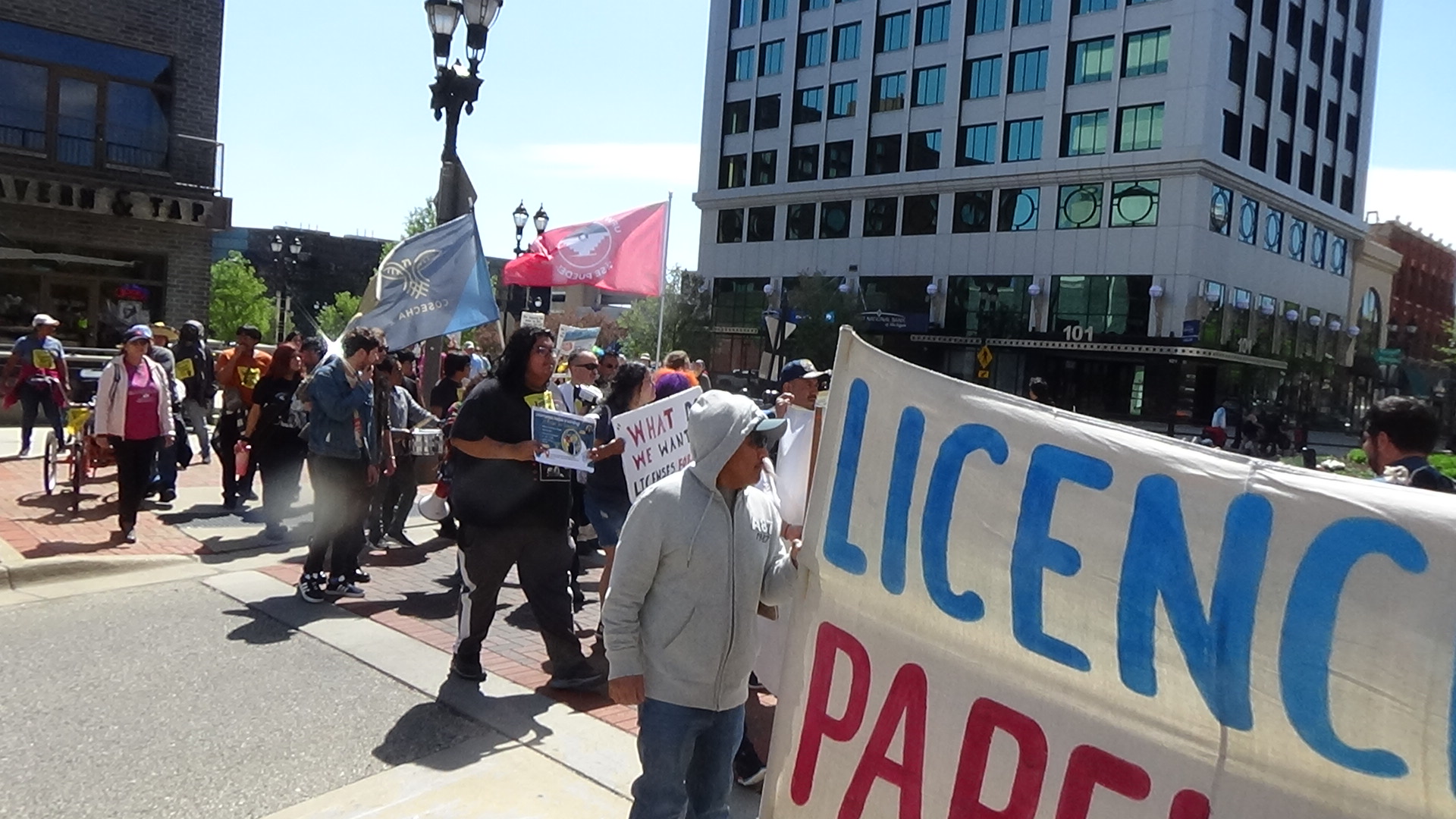
Eventually, the Cosecha May Day action moved back towards the State Capital, where people re-grouped in front of the Capital steps. At this point several Cosecha organizers spoke about their work and the campaign to win driver’s licenses. Cosecha organizers then invited other organizations to speak about their work and the importance of building cross-movement solidarity, which was delightful to witness.
After about 30 minutes, Cosecha organizers then explained the next part of their May Day action, which was to go up to the 3rd floor about the same time that the Michigan State House of Representatives would be starting a session.
Participants then entered the State Capital one at a time, since the Capital Police require everyone to go through metal detectors. Once we were all in the rotunda area, people began walking up the steps to the 3rd floor where the State House session was about to start.
The area outside of the State House chambers is not terribly spacious, but about 75 people were packed into that space, chanting and disrupting the proceedings. Members of the State House and some of their staffers had to weave through the crowd of Cosecha activists and supporters, while other politicians decided to take pictures of those protesting.
 All of this was very familiar, since Movimiento Cosecha has utilized very similar tactics in previous protests at the State Capital. What was noticeably different about yesterday’s action was what people were chanting. People were chanting the phrase, No Licencias, No voto!, meaning if you (elected state officials) don’t pass the driver’s licenses bill, we will not be voting for you! Movimiento Cosecha organizers had made up enough patches for everyone to pin on their shirts, with some in Spanish and others in English. In fact, one Cosecha organizer has shared with me that they will likely follow the model of the uncommitted vote in the upcoming August Primary Election, where people will withhold their vote for State Representatives if they do not pass the Driver’s Licenses bill. As a Cosecha organizer said, “we are leveraging out vote to make demands of politicians. If they want us to vote for them, then they need to give us what we have been demanding for years.”
After another 30-40 minutes those who came to the Cosecha May Day action then descended back down to the ground floor of the State Capital and went outside to share refreshments that had been prepared for them.
The 100 or so immigrant justice activists sat on the grass, shared food, shared laughter and shared affirmations about what the day had meant to them. A few Cosecha organizers then used their portable sound system to offer thanks and gratitude to those who came out to the annual May Day action and those who contributed in a myriad of ways. The Cosecha May Action 2024 action most definitely demonstrated the power of organized people and the hopefulness of constant struggle. Once again, I felt a sense of pride to be part of this movement.
Kent County residents rally against Democratic Party fundraiser, condemn complicity in Gaza genocide
 GRIID is re-posting a statement from Palestine Solidarity Grand Rapids.
Residents Temporarily Occupy Stairwell at Democratic Fundraiser, Face Physical Assaults from Party Donors
GRAND RAPIDS – On Saturday, April 27, over a hundred Kent County residents gathered at the Kent County Democrats Spring Gala fundraiser at the Eberhard Center in downtown Grand Rapids to protest the ongoing violence in Gaza and the Democrats’ support for Israel and U.S. warmongering.

 Inside the venue, a dozen community members chanted for a free Palestine and an end to the occupation, temporarily blocking access to the main stairwell and disrupting the registration process. In response, Kent County Democrats reacted with physical aggression, pushing and grabbing peaceful protestors. One young community member had her hijab pulled, while another organizer was shoved against a wall and pushed into a heavy glass door. The violence perpetrated by institutionalized Democrats onto young peaceful activists is abhorrent and telling of the underlying values system that keeps them funding the genocide in Gaza.
Despite these physical assaults, the anti-apartheid protesters held strong, recited chants and relayed the message that the Democrats are failing their constituents. In the 2024 presidential primary, Grand Rapids voted uncommitted by 17%, and Kent County voted uncommitted by 13.7% in protest against Biden’s involvement in the ongoing ethnic cleansing in Gaza. Democrats–especially Congresswoman Hillary Scholten–should take note of these figures that reflect the support for Palestine and for an end to U.S. aid to Israel in Kent County, a swing-county and bellwether county for the whole nation.
The disruption at the Spring Gala lasted over 45 minutes, delaying registrations and amplifying their voices until the Grand Rapids police dispersed the crowd. Despite attempts to intimidate, community members stood by their anti-colonialist values, demonstrating their refusal to comply with violence by the ruling class.
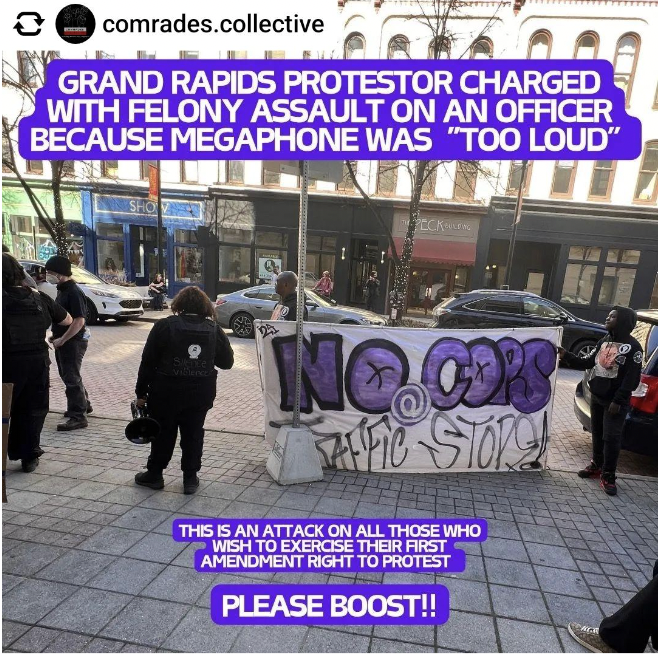 Thankfully, there were no arrests, but this demonstration highlighted two crucial points: the need for unwavering solidarity to ensure community safety when facing the police and the pervasive white supremacy culture within the GRPD, leading to unequal treatment of Black and Brown organizers and community members.
While several organizers present were white, shielding the demonstration from harsher police repression, the disparity in treatment is stark, as evidenced by the political repression faced by Black and Brown comrades, such as the ongoing incident of a protester facing felony charges for amplifying their voice at a protest against the violence and murders that the police has committed in our city and wider community.
Protesting is not a crime, and all charges must be dropped. We stand with our comrades against police brutality and the heinous murders of Patrick Lyoya and Samuel “SD” Sterling. We echo the demand by the National Alliance Against Racist & Political Repression for community control of the police.
As our conditions worsen, it is crucial to expose the inhumanity within our system and organize to improve the lives of our community members. That is why Palestine Solidarity Grand Rapids has joined the many organizations, unions, and grassroots movements nationwide calling for a march on both the Republican and Democratic National Convention to demand an end to U.S. aid to Israel, freedom for Palestine, community control of the police, advancement on immigrant rights, and to oppose the right-wing policies both parties have embraced at the expense of our communities.
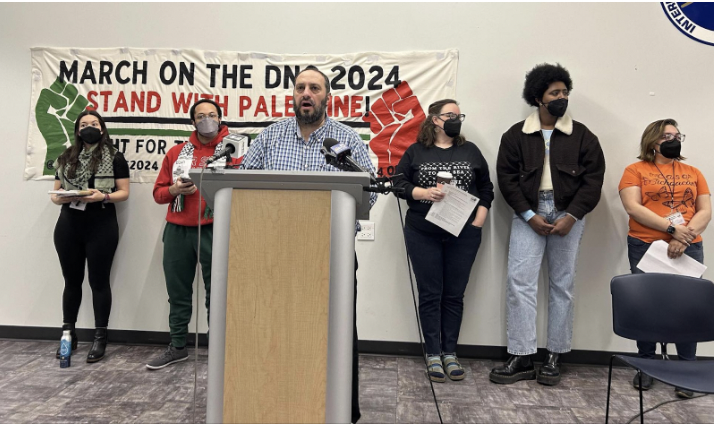
Representatives of members of the Coalition to March on the DNC speaking at a press conference in Chicago on April 13, 2024

Graphic for the anti-war contingent for the March on the RNC
PSGR is organizing a contingent to march on the Republican National Convention in Milwaukee on July 15 and the Democratic National Convention in Chicago on August 19.
“The genocide in Gaza is waking people up to how the system of electoral politics in the United States works and who it’s really meant to serve,” says organizer Emerson Wolfe. “There is no lesser of two evils when they work together to fund a genocide.”
 Grand Rapids Institute for Information Democracy