Within the past 2 weeks I have received two different mailers endorsing the is usually referred to as the Hotel Tax ballot initiative that will appear on the August 6th Primary Ballot.
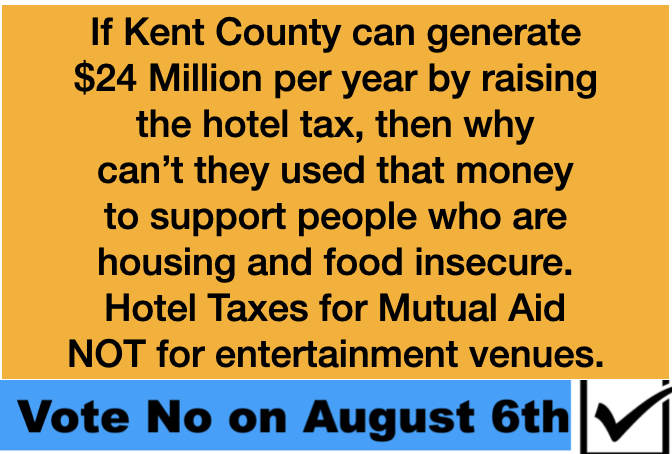
One of the mailers came from the committee that is responsible for promoting the Hotel Tax ballot initiative, the Destination Kent Committee. According to their website, the Destination Kent Committee was formed earlier this year with the following members:
Grand Rapids Mayor Rosalynn Bliss – voted for ordinances in 2023 to criminalize the unhoused, has consistently voted for massive subsidies and tax breaks for developers, has opposed community calls to reduce funding for the GRPD, has been a recipient of the Grand Rapids Police Officers Association PAC and the Grand Rapids Chamber of Commerce PAC, known as Friends of West Michigan Business.
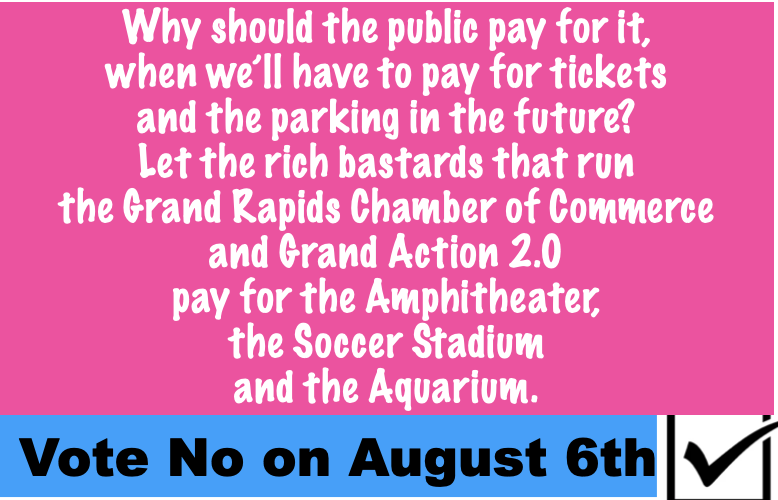
Kara Wood of Grand Action 2.0 – used to work on economic development for the City of Grand Rapids and started at Grand Action 2.0 in 2022. Grand Action was created by the DeVos family and other members of the GR Power Structure to get the city and county to use public funds to finance projects like the Van Andel Arena, the Convention Center, the Downtown Market and now the Amphitheater, the Soccer Stadium and the proposed Aquarium.
Joshua Lunger from the Grand Rapids Chamber – is the VP of Government Affairs for the Chamber, which means he is a paid lobbyist who spends his time getting local and state politicians to adopt policies that benefit business interests. Lunger was the architect of the push to criminalize the unhoused in downtown Grand Rapids, which the City adopted in 2023.
John Helmholdt of SeyferthPR – has previously worked as director of communications for the Grand Rapids Public Schools, along with working for Republican State Senator Glenn Steil Sr. Helmholdt also endorsed the ordinance adopted last year in Grand Rapids that criminalizes the unhoused.
Bill Jackson of McAlvey Merchant & Associates – Bill was the first Director of the West Michigan Policy Forum, which has worked to eliminate the Michigan Business Tax, made Michigan a Right to Work State from 2012 – 2022, has worked to keep Michigan’s minimum wage low and has worked to undermine public sector unions. McAlvey Merchant & Associates is also a Michigan lobbyist group.
Bob Herr as treasurer – Bob Herr also sits on the Board of Directors of the Economic Club of Grand Rapids and is the Chairman of the Downtown Improvement District.
The other mailer, which was the standard glossy political mailer, but was an 8.5 by 11 inch mailer, came from the Grand Rapids Kent County Convention Arena Authority (CAA). It is no surprise that the CAA sent out their own mailer in favor of the 3% increase in the hotel tax, especially when you consider who sits on their board and the fact that the CAA had previously benefited from the use of public funds for the venues that they manage, which will include the Amphitheater once it is completed.
Dissecting Talking Points
The Destination Kent Committee has been using several primary talking points to try to convince the public to vote for the 3% hotel tax increase on August 6th. Here are a few of those talking points:
- The venues that will be the beneficiaries of the 3% hotel tax increase will have an economic impact that will generate $1 billion in economic impact and create 1,200 plus jobs. While $1 billion might be spent because of these new venues, that almost always means that the bulk of those profits will go to those who already have deep pockets. When people come to the Amphitheater, the Soccer Stadium or the Aquarium, they will have to pay for parking, which will mean more revenue for Ellis Parking or the City of Grand Rapids, neither of which really benefits the general public. Most of the hotels that people will stay at in the downtown area are owned by the DeVos family and the restaurants and bars that people will go to will benefit those businesses, but will not translate into increased wages for those who wait tables, wash dishes, tend bar, janitorial crews, etc.
- The 1,200 plus jobs that are cited is an estimate at best or is more likely way off. Then there is the fact that most of these jobs will not pay a living wage with good benefits. These jobs might also be part-time or temporary. Using the job creation argument is an old Capitalist Class mantra, but more often then not it means lower wage jobs and temp jobs.
- Another talking point is that the 3% hotel tax increase is a modest increase. For many people it is a modest increase, but for thousands that are housing insecure, staying in a hotel for a day, a week or a month could be costly. There are lots of people who stay in hotels/motels for the weekly rate, since they don’t have more permanent housing. The 3% hotel tax would be a burden on those who have limited housing options and stay in motels for a week at a time or more.
- One last talking point is that the increased hotel tax would be for “community owned assets.” This is just an outright lie. The community will not own the Amphitheater, the Soccer Stadium or the Aquarium, just like they don’t currently own the Convention Center the Van Andel Arena or the Downtown Market. These are privately owned and privately managed venues, which generate a shit ton of money for those who already control a great deal of the economy in Kent County.
As I have stated previously, why don’t the people and the organizations who are pushing for the increased hotel tax pay for the Amphitheater, the Soccer Stadium and the Aquarium themselves. Not only can they afford it, they will be reaping the benefits every time people purchase tickets at these venues and primarily spend their money in and near the downtown area.
More importantly, according to the Destination Kent Committee, 1 year after the increased hotel tax would generate $24 million dollars. Imagine if $24 million were put to providing social housing for families, rental assistance for tenants, addressing food insecurity, improved health care and more environmental justice outcomes for the people who already live in this city and are struggling to survive. When are we going to put the lives of Kent County residents ahead of the tourists who visit this community?
Palestine Solidarity Information, Analysis, Local Actions and Events for the week of July 7th
It has been 9 months since the Israeli government began their most recent assault on Gaza and the West Bank. The retaliation for the October 7 Hamas attack in Israel, has escalated to what the international community has called genocide, therefore, GRIID will be providing weekly links to information and analysis that we think can better inform us of what is happening, along with the role that the US government is playing. We will also provide information on local events and actions that people can get involved in. All of this information is to provide people with the capacity of what Noam Chomsky refers to as, intellectual self-defense.

Information
‘A Full-Fledged War Crime’: Israel Condemned Over New Human Shield Footage
Israel Has Forcibly Displaced 1.9 Million Palestinians in Gaza
US Troops are Quitting the Military Over Gaza
‘The Land Theft Continues’: Israel Announces Biggest West Bank Seizure in Over 30 Years
FREE SPEECH UNDER FIRE: HOW ISRAEL’S TECH GUARD IS KILLING FREE SPEECH ONLINE
As Israel Refuses to End Genocide in Gaza, Threat of War With Hezbollah Looms
‘Complicit in the Genocide’: First Muslim Biden Appointee Resigns Over Gaza
“This Must End”: Israel Orders New Mass Evacuation, Continuing Attacks on Gaza Health System
Analysis & History
UNDERSTANDING ISRAEL’S “SYSTEM OF DOMINATION”
Local Events and Actions
Sign this Action Alert demanding that the City of Grand Rapids Divest from companies profiting from the Israeli Occupation, Israeli Apartheid and the Israeli genocide.
Power to Palestine: Weekly Rally in Grand Rapids
Wednesday, July 10, 6pm – 7pm, Monument Park
Palestine Solidarity Grand Rapids is hosting an insightful rally led by veterans supporting an end to the genocide in Palestine on Sunday, July 14 at 5 pm at Veterans Memorial Park (101 Fulton, next door to Monument Park) in Grand Rapids, MI
Graphic used in this post is from https://visualizingpalestine.org/visual/citi-banking-on-genocide/
Foundation Watch: The Edgar & Elsa Prince Foundation
In any case, the hidden hand of foundations can control the course of social change and deflect anger to targets other than elite power.”
– Joan Roelofs, author of the book, Foundations and Public Policy
For the past 10 years, GRIID has been monitoring foundations in West Michigan, particularly the large family foundations that those who are part of the Grand Rapids Power Structure have created. Our monitoring of local foundations has been part of our larger critique of the Non-Profit Industrial complex in Grand Rapids.

Edgar & Elsa Prince Foundation
Edgar and Elsa Prince are the parents of Erik Prince and Betsy DeVos. Although Edgar has been dead for several years, the foundation that is in his wife and his name, continues the legacy of funding the Religious and Political Right. The Edgar & Elsa Prince Foundation began in 1979, and currently has $2,830,899 in assets. The information that follows is based on the 990 document for 2022, where the foundation distributed $1,650,650 to the five categories I have been using throughout the series on local foundations. You can find this information on GuideStar.org just by typing in the Edgar & Elsa Prince Foundation.
Religious Right
- Christian Leadership Institute $25,000
- American Values $30,000
- Gateways to Better Education $30,000
- Women’s Rights Without Frontiers $20,000
- Pregnancy Resource Center $10,000
- Alliance Defending Freedom $50,000
- Protect Life Michigan $73,400
- Wycliff Bible Translators $10,000
- Focus on the Family $1,500
The Alliance for Defending Freedom is a Conservative Christian group of lawyers that defends religious groups around anti-LGBT policies and other religious right issues. They are a far right version of what the ACLU is. American values is a group that was started by Gary Power, which put their emphasis on fighting against abortion and defending Israel.
Political Right and Think Tanks
- Freedom Alliance $30,000
- Media Research Center $20,000
- Council for National Policy $15,000
- Mackinac Center for Public Policy $10,000
- Rutherford Institute $25,000
- Mom’s for America $5,000
Freedom Alliance is an entity that was founded by convicted Iran Contra scandal participant Col. Oliver North. The Media Research Center is a right wing media “watchdog” group run by president and founder Brent Bozell. It is predominately funded by larger right-wing foundations. The Mackinac Center for Public Policy is a right-wing pressure group based in Michigan. Founded in 1987, it is the largest state-level “think tank” in the nation. It was established by right-wing activists to promote “free market,” pro-business policies. Moms for America is a group of women that fights against Critical Race Theory in schools, opposes the Movement for Black Lives, was involved in the January 6th, 2021 insurrection, plus the Southern Poverty Law Center designates them as a Hate Group.
Education Institutions
- Holland Christian Schools $110,000
- Potter’s House Christian School $12,500
- Zuni Christian Mission School $20,000
- Allendale Christian Schools $30,000
- Hope College $5,000
DeVos-owned, created or connected groups
- Christian Leadership Institute $25,000
- West Michigan Aviation Academy $122,500
Groups receiving Hush money
- Wedgewood Christian Youth and Family Services $20,000
- Family Promise $20,000
These groups all provide some sort of social service. There are root causes to all of these issues, but these groups are not likely to address root causes and larger systems of oppression. When the Prince family foundation makes contributions, this will increase the likelihood that systems of oppression will not be addressed by these organization, which is why we call it hush money.
You can clearly see that the Edgar and Elsa Prince Foundation primarily funds the Religious Right and the Political Right, even though sometimes it is difficult to distinguish the two. The Edgar and Elsa Prince Foundation is a perfect way for the family to hide some of their wealth from taxation, but allows them to use it just like direct political contributions, often working in tandem with campaign contributions.
The Gentrification of a neighborhood is now nearly complete, but MLive doesn’t bother to acknowledge that fact
 “Interest in market-rate housing on the southern edge of Downtown is driven by the location.” Mike Coyne CEO of Cella Building Company
On Sunday, MLive posted an article with the headline, “First units in new 58-unit ‘all electric’ apartment building to open in late August.”
The article celebrates the addition of 58 new market-rate apartments on the corner of Wealthy and Division, just south of Downtown Grand Rapids. More importantly, the article centers the perspective of the CEO of the development company, Mike Coyne, who is the only source used in this story. The MLive article is problematic in several areas, besides only citing the developer the journalist fails to discuss the significance of market-rate housing vs more affordable housing, the amount of public money used in this project without public input, and the fact that there is no historical context to house this project came about in that neighborhood.
Historical Context
(For transparency purposes, I lived in the neighborhood on LaGrave from 1984 – 2012. This allowed me a first hand experience of how the neighborhood had changed.)
The history of the neighborhood where the new 58 market-rate units constructed by the Cella Building Company is conveniently omitted. The neighborhood that the new development sits in used to be called the Forgotten Corner Neighborhood.
A century ago that neighborhood was occupied by Europeans immigrants. However, after WWII, many of those residents began to move out of the area and into the suburbs. Many of the new residents were African American, many of whom had migrated from the South to Michigan in search of a better life. However, some of the European immigrants still owned many of the homes, which were now disproportionately rental units.
In the summer of 1967, this neighborhood became the epicenter of the 1967 riot in Grand Rapids. The 1967 riot included the destruction of a few businesses, but mostly rental units which became targets since white absentee landlords were the owners. Several houses were either burned or left in disrepair for decades, right up to the time when I moved there in 1984.
By the early 80s, most of the residents in the Forgotten Corner Neighborhood were Black and Latinx. Beginning in the late 1980s, downtown Grand Rapids began to see a major injection of money and development projects, which included the expansion of what was then St. Mary’s Hospital. As with all commercial development projects, parking becomes a central issue. St. Mary’s and Mary Free Bed Hospitals began purchasing land south of Wealthy into the Forgotten Corner Neighborhood, primarily for the construction of surface parking lots.
Seeing the writing on the wall, residents in the Forgotten Corner Neighborhood decided to organize to prevent further encroachment, along with the increased possibility of gentrification, which had already begun in the 1990s in the Wealthy St. corridor. ICCF had also moved into that neighborhood and once they found out that residents were organizing they decided to get involved and eventually undermined the desires of residents, some of whom had lived in the neighborhood since the late 1950s.
Between 2003 and 2010 there was no movement on the part of ICCF, or so those of us who lived in the neighborhood had thought so. Out of nowhere, there appeared a front page story in the Grand Rapids Press, with the CEO of ICCF talking about what they were calling the Tapestry Square. ICCF had bought up all the vacant land in the 400 & 500 blocks of LaGrave, Sheldon and Division and then began approaching landlords and homeowners in the area. By the end of 2010, the remaining houses on the 400 block of Sheldon had been bought by ICCF, with apartment dwellers having to vacate and home owners selling their property.
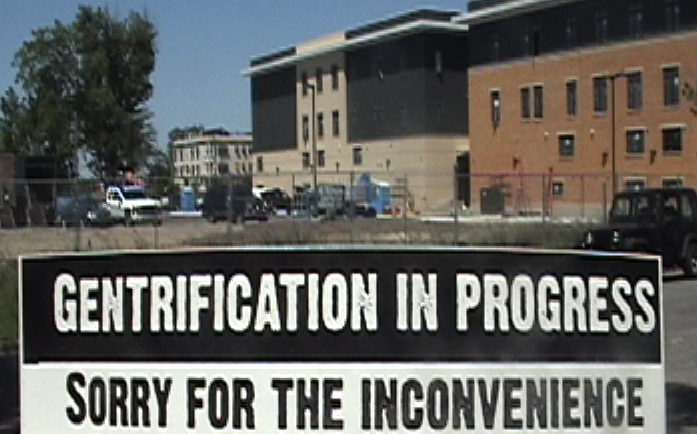
This behind the scenes land grab was not what residents were told at the last large neighborhood meeting with ICCF. In the 2002 Wealthy – Jefferson Development Initiative, it stated, “All current home owners will be able to continue to enjoy their homes, including some form of protection against tax increases that could threaten their ownership in the future.” The residents, who participated in the 2000 and 2002 planning sessions, were also assured that they would not have to leave and that new development would be built around existing property. Clearly, ICCF had other plans.
Before I moved out of the neighborhood in 2012, MLive continued to ignore this history and only focus on the new development projects.I wrote about the MLive omissions twice on December 2nd and December 4th of 2012.
Unaffordable Housing that used public subsidies
The most recent MLive article about the 58 market-rate housing units does state that the cost will range from $1,299 to $2,099, with 38 one-bedroom units, six studios and 14 two-bedrooms. The studio apartments will no doubt be the $1,299 price and the two-bedroom at the $2,099 price. MLive does not tell us what the 38 one-bedroom units will cost, but they will likely be between $1500 and $1800 a month. These costs are prohibitive for many people, especially for those who are part of the working class poor, which makes up thousands of people in Grand Rapids. According to the National Low Income Housing Coalition, for people to afford the average rent in Grand Rapids, they would need to earn $25.50 an hour. And since minimum wages in Michigan is $10.33, there will be lots of people who will not be able to afford the cost of rent at the new Cella Building Company apartments on Wealthy & Division.
Lastly, the MLive article does note that the Michigan Strategic Fund approved a $3 million Michigan Community Revitalization Program loan for the project, along with the city of Grand Rapids also approving a $1.3 million reimbursement over 14 years from its brownfield program to help offset the cost of developing contaminated, functionally obsolete properties.
In the end, developers used public money to create rental units that are unaffordable to large sectors of the population in Grand Rapids, even though millions of public dollars were used to subsidize the Cella Building Company apartments.
This could be the last of the gentrification process that has been happening in the Forgotten Corners Neighborhood, where most of the residents were displaced over time, were unaware of the development plans by ICCF for roughly a decade and and then removed from history by the ongoing reporting of MLive and the other commercial media sources. Hopefully, this post will make it more difficult to relegate the decades-long gentrification process to the dustbin of history.
This print below was created by Christi Wiltenburg.
Palestine Solidarity Information, Analysis, Local Actions and Events for the week of July 1st
It has been more than 8 months since the Israeli government began their most recent assault on Gaza and the West Bank. The retaliation for the October 7 Hamas attack in Israel, has escalated to what the international community has called genocide, therefore, GRIID will be providing weekly links to information and analysis that we think can better inform us of what is happening, along with the role that the US government is playing. We will also provide information on local events and actions that people can get involved in. All of this information is to provide people with the capacity of what Noam Chomsky refers to as, intellectual self-defense.

Information
Israeli Officials Hiding Data About Forced Starvation of Gaza Prisoners: Report
Biden Releasing Part of Bombs Shipment to Israel That Was Paused Over Rafah Raid
ISRAEL’S WAR ON GAZA IS THE DEADLIEST CONFLICT ON RECORD FOR JOURNALISTS
Israel Is Bombing “Safe Zones” for Refugees in Gaza
21,000 Children Are Missing in Gaza, on Top of Over 15,000 Killed by Israel
TOP US LAW SCHOOLS PRESENT UNDENIABLE EVIDENCE OF ISRAEL’S GAZA GENOCIDE
Israeli Military Has Killed 500 Gaza Healthcare Workers—Two a Day Since Assault Began
The ‘Israel Lobby’ Works for the US Military Industrial Complex
Analysis & History
Armed Vs. Peaceful Resistance – What You Need to Know about Muqawama in Gaza
Settler Violence = State Violence
AUTOMATED APARTHEID: WALKING THROUGH HEBRON SMART CITY
Local Events and Actions
Sign this Action Alert demanding that the City of Grand Rapids Divest from companies profiting from the Israeli Occupation, Israeli Apartheid and the Israeli genocide.
Power to Palestine: Weekly Rally in Grand Rapids
Wednesday, July 3, 12pm – 1pm, Monument Park
Graphic used in this post is from https://visualizingpalestine.org/visual/field-tested-elbit-systems-2024-update/
Rep. Hillary Scholten voted to prevent the US Government from citing the Israeli perpetrated death toll in Gaza
 Yesterday saw a new low in the US propaganda war to deny what Israel is doing to the Palestinians.
Sixty two Democrats joined the Republicans in adopting Rep. Jared Moskowitz’s (D-Fla.) amendment to H.R. 8771, which bans State Department officials from using agency funds to cite any statistics from the Gaza Health Ministry. The Health Ministry’s figures are the only official death counts coming out of Gaza.
Rep. Hillary Scholten, who has made several posts about playing in a softball game for charity on her Facebook page in recent days, didn’t bother to share with her the people she claims to represent, that she voted with the Republicans to ban the State Department from citing the Gaza Health Ministry on official death counts coming out of Gaza.
I have been documenting Rep. Scholten’s complicity in the role that the US Government has played in the Israeli genocide against the Palestinians, beginning with her vote to deny that Israel is an Apartheid state, her AIPAC-paid trip to Israel in 2023, and her unconditional support for Israel’s brutal assault on Gaza.
Yesterday’s vote is just the latest demonstration of how complicit Rep. Scholten is on the matter of Israeli War Crimes, denying that it is even happening.
The new house 100 people in 100 days campaign is just the latest false solution to the current housing crisis in Grand Rapids
“In March, a delegation of public, private, and philanthropic stakeholders from Grand Rapids traveled to Houston to meet with leaders who helped lead a significant turnaround in homelessness outcomes over the last decade.”
This comment above was from the Grand Rapids Chamber of Commerce quarterly government affairs information. None of this was presented during this afternoon’s announcement of the house 100 individuals in 100 days campaign at the Grand Rapids Public Library.

Besides not providing any background information on how this effort came to be, the staged event from Thursday was just another private/public partnership that claimed to want to end homelessness, but offered no actual solution besides a partnership between housing providers, the governments of Kent County & Grand Rapids, along with private partners such as the Grand Rapids Chamber of Commerce (the same people who got Grand Rapids to adopt policies to criminalize the unhoused), the DeVos Family Foundation, the Frey Foundation and Trillium Investments (which owns apartments in Kent, Ottawa and Muskegon County – not the affordable kind.)
I’m not saying that some of the housing partners involved don’t do any good, but they can not and do not address the root causes of the current housing crisis. The house 100 people in 100 days might address some of what was referred to during today’s event as assisting those who are chronically unhoused, but it will only be another bandaid approach to addressing a systemic problem. It was a lovely performance, with comments from housing providers, government officials and those in the private sector, but since there was no opportunity for the news media or the public that gathered to ask questions, the housing crisis that plagues thousands in this city will continue.
The problem, as many people have pointed out for years, is fourfold.
First, the problem is not homelessness, the problem is housing insecurity, which impacts more than those who are unhoused in this city. Thousands of individuals and families are housing insecure, because they cannot afford the cost of rent or a mortgage.
Second, those who were in the room for today’s announcement, particularly those who were on stage, were primarily public policy decision makers, representatives of the Capitalist Class and those who work in the Non-Profit Housing Industrial Complex. This means that the 100 in 100 days campaign is being designed and implemented by those who are not affected by the housing crisis.

Third, is the fact that there is a widening gap between the haves and have nots, so much so that large numbers of people simply cannot afford the cost of housing in this city, as I noted in a post yesterday. This is in part because the minimum wage in Michigan is only $10.33 an hour. In fact, the National Low Income Housing Coalition has made it clear that in 2024, for someone to afford the average rental costs in Grand Rapids, they would have to earn no less than $25.50 an hour. No one on stage today mentioned anything about the wealth gap or the fact that people’s income level does not match up with the cost of housing.

Fourth, – which is very much tied to point three – is the fact that housing is driven by “the market”, that forces of speculative capital which only seeks to make profits and never sees housing as a fundamental human right. The market is exactly what the GR Chamber of Commerce created Housing Next organization operates in, as does Trillium Investments, along with the DeVos and Frey Foundations.

Therefore, the house 100 in 100 days might work, but it does nothing to solve the larger housing crisis. If we are serious about confronting and ending the current housing crisis, then we need to acknowledge and act on the four points laid out here. Failure to do so will just see an increase in housing insecurity, despite the performative false solutions being offered by those who have too much control in this city.
A recent study by the group Smart Asset showed that the cost of housing went up across the US, with Grand Rapids identified as having the 8th largest increase.

Now, considering the fact that the housing crisis in Grand Rapids has been one of the most talked about issues over the last decade, the new study didn’t garner much attention. In fact, only WZZM 13 ran a story based on the Smart Asset study, but kept their coverage to the simple numbers from the study. In fact, the channel 13 story doesn’t even bother to talk about what this means for home buyers or renters.
The Smart Asset study also reported the data, which shows that not only did the average cost of housing go up by 12% over the past year, it went up 64.4% over the past 5 years.
Now, one would think that any reasonable person would ask the question, have people’s incomes gone up by 64.4% over the past 5 years? If the cost of housing has increased that much, then it seems like an important question to ask regarding the income level of people wanting to buy a home. Of course, we know that most people’s income did not increase by 64.4% over the past 5 years, except for the super rich, like the Meijer family.
Remember, the past 5 years would be 2019 – 2024, which included the COVID 19 pandemic, where many people lost jobs or couldn’t work because of the public health risks.
So, how is it that local news agencies failed to report on this increase in the price of housing, especially since housing is such a hot topic? Could it be that the local commercial news agencies have internalized the belief that the market dictates the price of housing, instead of housing by a right for everyone?
In addition, the price of rent in this city has gone up tremendously over the past decade, making the rental prices unattainable by many. In fact, the increases rental costs are so high that according to the National Low Income Housing Coalition, for people to afford the average cost of rent in Grand Rapids they would have to earn $25.50 an hour with a full time job. These are the kinds of questions we need to ask and these are the discussions we need to have if we really want housing justice in this city.
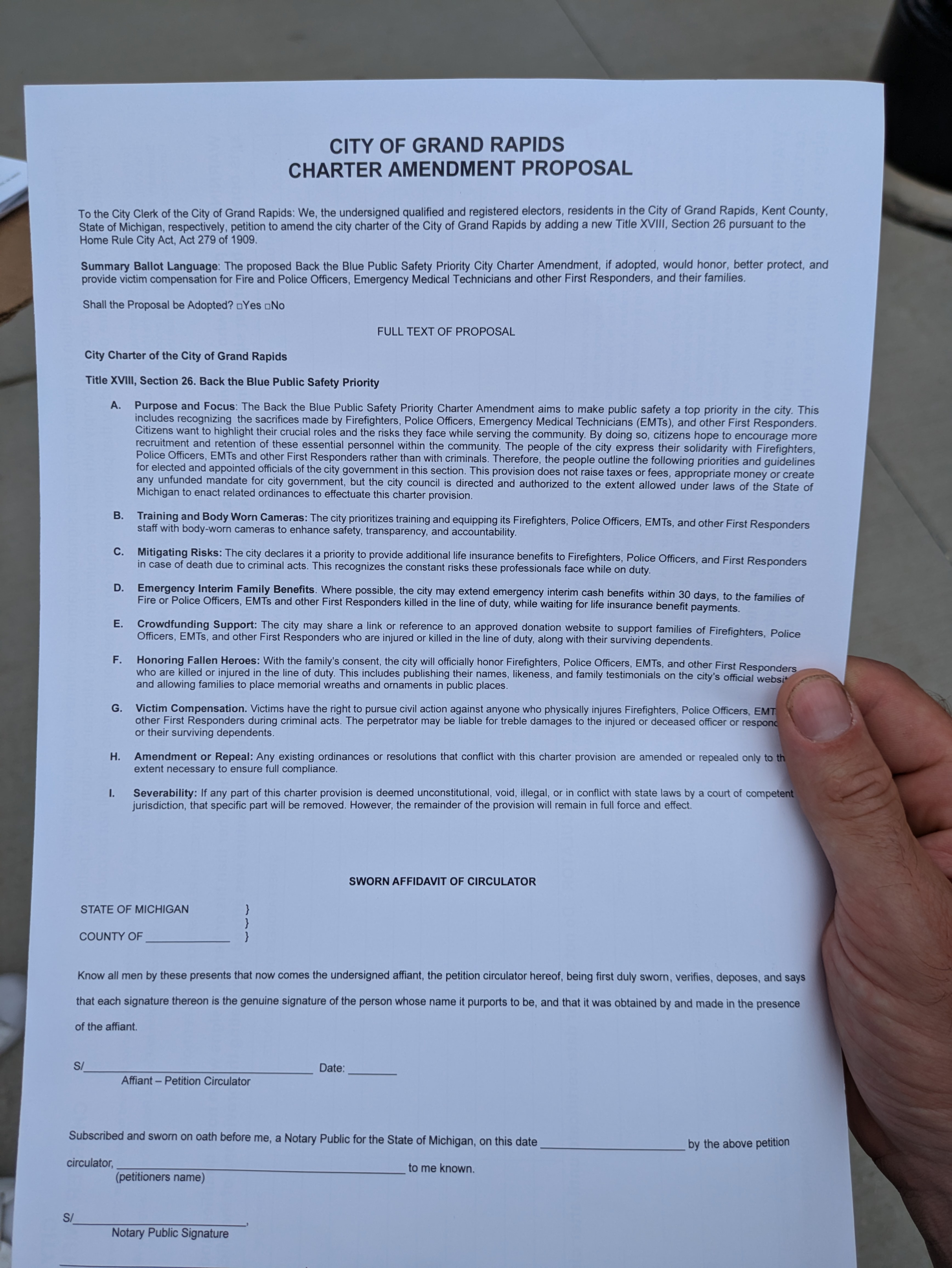
Pro-cop group Back the Blue GR was collecting signatures at GR Pride last Saturday for a local ballot initiative
 Someone sent me a copy of the ballot language that is being circulated in Grand Rapids, which I am including here at the bottom.
The Summary Ballot Language reads: The proposed Back the Blue Safety Priority City Charter Amendment, if adopted, would honor, better protect, and provide victim compensation for Fire and Police Officers, Emergency Medical Technicians and other First Responders, and their families.
What is most alarming about the ballot initiative to change the City’s Charter is point G, which reads:
“Victim Compensation. Victims have the right to pursue civil action against anyone who physically injures Firefighters, Police Officers, EMT and other First Responders during criminal acts. The perpetrator may be liable for treble damages to the injured or deceased officer or responders or their surviving dependents.”
According to Wikipedia: In United States law, treble damages is a term that indicates that a statute permits a court to triple the amount of the actual/compensatory damages to be awarded to a prevailing plaintiff. Treble damages are usually a multiple of, rather than an addition to, actual damages, but on occasion they are additive, as in California Civil Code § 1719. When such damages are multiplicative and a person received an award of $100 for an injury, a court applying treble damages would raise the award to $300.
Equally alarming about this campaign to collect petition signatures to put it on the ballot, the campaign to change the Grand Rapids City Charter is being organized by the group Back the Blue Michigan. According to their website, Back the Blue Michigan has chapters in Warren, Sterling Heights, Warren and Grand Rapids. This is rather instructive, since the only chapter is not in SE Michigan is Grand Rapids.
The person heading up the Grand Rapids chapter of Back the Blue Michigan is Cindy Amante. Amante garnered some attention last year when she was defending Ottawa Impact member, Commissioner Lucy Ebel, claiming that the effort to recall Ebel was an “attack on the Latino community.”
The MLive article cited above also mentions that Cindy Amante is executive director of Propósito of Michigan. The Proposito of Michigan website says this about this mission:
We are working with the Hispanic community to give you the tools to get engaged in the culture war to save The American Dream. God has given us all a purpose, and we are here to encourage and support you to achieve your full potential. We work with organizations and individuals throughout the State of Michigan to offer education and activities that will develop the skills needed to succeed and build your confidence. Come join us at a local monthly meeting to see what your “Propósito” is. You don’t have to be Hispanic to be a part of the movement!
From what I can tell from the Facebook page of Proposito of Michigan, that they are proponents of numerous far right ideas – anti-Abortion, anti-Critical Race Theory, anti-LGBTQ, etc. There are also numerous links to the Republican Party, which makes sense, since Cindy Amante was a candidate for the 83rd State House District, but then dropped out a few months ago.
In addition, someone was circulating a Back the Blue Grand Rapids ballot initiative to change the City Charter at the Grand Rapids Pride Celebration this past Saturday. What is even more insidious than an anti-LGBTQ group attending Pride, was the fact that they were misleading people when asking for signatures. The person sent me the petition language below, followed the Back the Blue Grand Rapids person for sometime and heard them ask people to sign the petition using the following talking point – “this is to stop them from killing black kids and turning their cameras off.”
It goes without saying that you should not sign the petition to put this crap on the ballot. The Back the Blue group is run by people who are racist, transphobic a police apologists. Spread the word and tell others about this campaign, and remember ACAB!
GRIID Interview with Jessica Powell with Boycott John Ball Zoo: Paving over John Ball Park
 GRIID – When did you find out about plans to expand the paved parking area in John Ball Park and how did the organized effort to oppose this come about?
Jessica – I found out about the zoo’s paving plans through a neighborhood group called “Save John Ball Park”. Their petition generated 1,346 signatures in opposition to paving John Ball Park. https://sign.moveon.org/petitions/save-john-ball-park This group surveyed the community and found that majority of the community members who took the survey opposed paving the park. The community generated many alternative solutions for the zoo rather than paving parkland including preferences as to where they should build their parking garage. We spoke at a couple Kent county commissioners’ meetings, asking them to stop the zoo’s construction plans to develop more of the park; paving 10-12 acres or more and building a road through the park. The majority of the commissioners sided with the zoo. The zoo and county are in this together. Its county land we are fighting for as the city sold this park to the county in the 80s. The community has always recognized this green space as John Ball Park. However the zoo and county have been slowly taking more and more of the parkland. In January after our last Kent County commissioners’ meeting it became clear to me that our local government would not protect our park. I saw a need for direct action. I think that businesses listen most when their revenue is affected. I saw on social media that other community members stated they were also boycotting the zoo because of their paving plans.
I rolled out our boycott on social media in April. The boycott is being amplified on FB, IG and X; search for “BoycottJBZoo” or #boycottJBZoo. We will have a protest on 6/27/24 at John Ball Park, 5:00 p.m. – 6:15 p.m. to amplify our boycott. Bring signs! We are meeting on West Fulton on the sidewalk near one of their entrances by the wooden JBZoo sign.
GRIID – What are the main arguments this campaign has been using for why they oppose more paved parking at John Ball Park?
Jessica – We are fighting for a 140 year old park that is free for the community to use. Paving the park would take away desperately needed green space for our community. A place for people to enjoy nature, have fellowship and recreation. There are many old growth trees in the park including a massive, 200 year old Gingko tree. This tree resides in the area slated for pavement. The zoo has told the community to come and say goodbye to their favorites trees. The construction would also displace the park animals who live there. It would deplete biodiversity which is essential to our health. The zoo touts itself as caring about the community and conservation. Paving the park does not demonstrate these core values that they claim to have.
We also cannot ignore the wild animals who live in small enclosures at John Ball Zoo. The zoo wants to expand by adding more wild animal exhibits in small spaces, including an aquarium. We just can’t stand behind this. There are already community members boycotting the zoo because of the zoo’s practice of keeping wild animals in captivity for profit. We are also concerned for their treatment of animals. Last year a sitatunga named Chopper was killed because of the zoo’s negligence. The zoo wanted to put a sitatunga and a hippo in the same exhibit. The hippo had 8 encounters with the sitatunga where it showed signs of aggression. The zoo had an opening party planned for their new exhibit and they put the two animals together despite the hippo’s signs of aggression. This sadly resulted in Chopper’s death.
We want to save the future animals that the zoo would purchase because of their planned expansion. Their expansion does not include a lot of space for the animals. More animals in captivity means more animals bred in captivity and then sold to zoos for human entertainment. We also don’t want the current park animals being displaced. We want to save the beautiful old growth trees from being torn out and replaced with concrete. And we want to stop the park from being paved so that future generations can enjoy it.

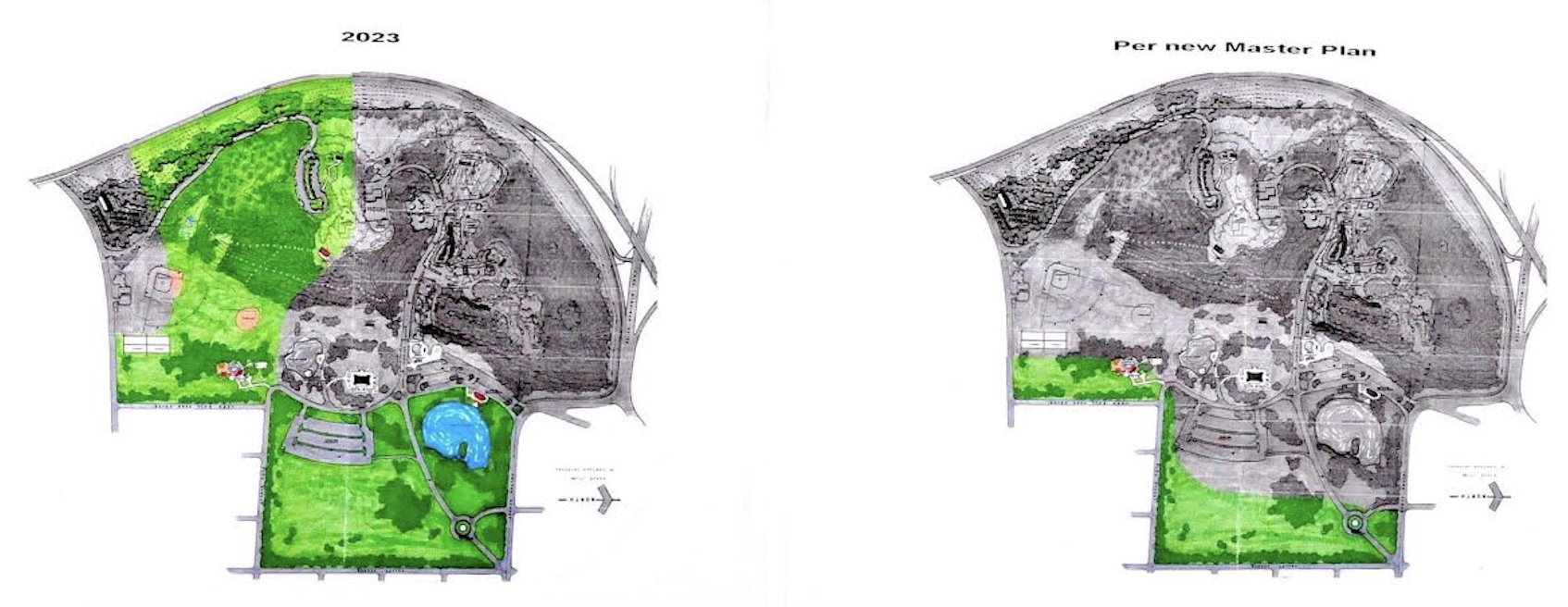
Map Description: Included here are 4 maps that our community member, Peter Carlberg put together. It shows the progression of the zoo’s takeover of our park. The lower right hand corner map labeled “per new master plan” shows the end result and how much green parkland the zoo intends to leave our community. The grey colored areas indicate parkland that the zoo has taken over.
GRIID – How much of the paved parking expansion push for the park driven by the proposal to add an aquarium to the John Ball Zoo?
Jessica – I think the aquarium is definitely driving this decision to pave the park. The CEO, Peter D’Arienzo stated that once they pave 10-12 acres or more of the park that this still wouldn’t be enough parking for their business. He said after they pave the park they plan on putting a parking garage into the wooded hillside on the southwest end of the park. Their parking strain was typically for their nighttime parties. During the week for normal zoo business hours, the overflow parking in the grass (now gravel) was sufficient. It seem obvious now that they want more onsite parking for the aquarium they plan to build.
GRIID – Parking is a growing problem in Grand Rapids, especially with the new Amphitheater and Soccer Stadiums in the downtown area. How are people like yourself who live on the near westside dealing with parking issues in general, and does your group oppose the hotel tax ballot proposal for the August Primary since it names the various development projects and the Aquarium has the recipients of the tax?
Jessica – Currently where we live, near John Ball Park, we have street parking and we have little issue parking on the street. However with these new developments that could change. Recently there was a proposal to have a portion of Grand Rapids, including the SWANN neighborhood, that would require residents to pay for an annual parking permit to park in their neighborhood. This was met with a pushback from the community and they have tabled this proposal for now.
We are encouraging everyone to vote no on the “Sports and Entertainment Facilities” proposal on August 6th, 2024. We the taxpayers do not want to fund the development of the aquarium, the soccer stadium or the amphitheater. Why should we? The hotel tax would also hurt those who seek shelter in hotels/motels due to being unhoused. The aquarium is just another place to keep wild animals in captivity for profit. The soccer stadium will most likely provide a lot of low paying, part time jobs. And the amphitheater will provide unaffordable concerts.

Map Description: Here is a map of John Ball Park. The area circled in red is where the zoo will pave. The area marked in yellow is where the zoo has taken over most of our main playing field by laying down a gravel parking lot, a road, and planting trees to border the parking lot and road.
GRIID – What is the campaign to oppose the expanded paved parking in John Ball Park proposing as an alternative?
 Jessica – We want the zoo to skip paving the park entirely. We want the zoo to honor our community and preserve the park. Our community has already provided the zoo with many great alternatives to paving the park. They could, if they wanted to, incentivize public transportation or provide a shuttle from other, existing parking lots. The zoo states their customers just wouldn’t come to the zoo if they can’t park onsite. We’re saying if they truly need more onsite parking, we want them to build their parking garages on the already existing black top areas that they have, ideally where they have their maintenance building at the south end of the park or their existing parking lot or choose another location to build the parking garage that does not diminish any more of our parkland. They do have other choices. They do not have to destroy the park.
GRIID – Any other aspect of this issue that you want to address, and how can people support the campaign?
Jessica – We have a business that exploits wild animals for profit wanting to pave over our community’s park. This is a 5013c non profit that pays zero taxes. Once the park is paved there is no turning back. But the damage they have already done could still be reversed and the park can be restored. It’s not too late!
We need people to support us by joining our boycott and encouraging others to join. The zoo plans to start major construction in August. We need to create enough pressure to force them to stop their development and construction of the park. We also want the current damage that they have done to the park to be restored back to parkland. Please support us by following us on Facebook, Instagram and X.
Reach out if you have ideas to support the boycott and or have ways you want to volunteer to further our efforts. If you would like any fliers to distribute please DM Boycott JBZoo on social media.
Also please go and vote no on August 6, 2024 on the Sports and Entertainment Facilities proposal!
 Grand Rapids Institute for Information Democracy