Deconstructing Memes: Facts do matter, but only when they are verified and sourced
In today’s Deconstructing Memes, I want to look at another meme that is currently being used on social media, a meme that is meant to make claims about the economy as we approach the November Election.

The meme states:
4 YEARS AGO: Dow at 19,000. Today it closed at 41,250. 4 YEARS AGO: unemployment was 9.2%. TODAY: 4.2%. FACTS MATTER!
This meme is deeply problematic and it might be the dumbest I have seen in recent years, for a number of reasons. However, before I get to the reasons why this meme is problematic, let me just say as someone who tries to think critically and has taught media literacy for the past 30 years, one should never assume that what is presented is factual, especially without any sources to back it up. This meme doesn’t provide any evidence or sourcing so that people can verify the claims that are being made.If facts matter, then so do the verification of said fact.
Besides the lack of sourcing for the meme, the first major issue with this meme is the use of the phrase 4 years ago. Four years ago the US (and the rest of the world) was 6 months into one of the worst global pandemics humanity has ever seen. The COVID 19 pandemic resulted in lockdown policies being adopted (like in Michigan), which saw millions of people unable to go to work and support themselves. Of course unemployment was up, because it was too dangerous for people to be at work, especially at jobs that were not front line jobs like health care workers. Of course the DOW would close at a lower number 4 years ago, since the stock market was in a bit of a free fall because of the pandemic.
Second, people really need to have a better understanding of the economy system. Just because the stock market is doing great doesn’t mean that most of the people are doing great. We know that the majority of stocks are owned by members of the Capitalist Class. According to inequality.org, the richest 1% own a greater share of the stock market than ever before. In fact, only 1% of the stock market wealth is owned by the Bottom half of households in the US. The stability or success of the stock market should not be the measuring stick for how the economy is doing, especially for the majority of the population. Did we not learn anything from the Occupy Wall Street Movement?
Another aspect of the US economy is that even if unemployment is down, it does not translate into people being better off. We should all be asking what kind of wages and benefits people are getting while they are employed, and not just celebrate the fact that they have a job. In July, I wrote about new data from the ALICE report. ALICE stands for Asset Limited, Income Constrained, Employed. In that report, it states that 47% for Grand Rapids households are living paycheck to paycheck! Again, just because people are employed doesn’t mean that they are doing ok economically.
Lastly, memes like these are predicated on the notion that “our side is right” or “our side is better.” Too often we want to show that our political party is better than the opposition. Because of the partisan blinders we have on, it often leads to believing anything that affirms our allegiance, no matter what the truth is. Facts indeed do matter, just make sure that they are sourced and and verified.
The harsh realities of the cost of rent in Grand Rapids and why so-called affordable housing is a false solution
For years now politicians and developers in Grand Rapids keep telling us that there needs to be a significant increase to the amount of new housing units in this area. In fact, the Grand Rapids Chamber of Commerce created group, Housing Next, states on their website that in Kent and Ottawa Counties there needs to be 14,618 new rental homes in 2025 and 17,278 new homes to for sale in 2025.

This increase in housing units is based on projections for the growth of Grand Rapids and the rest of West Michigan. And as we all know, within a capitalist economy growth is good, hell bigger is always better.
In the last 9 months there have been several new apartment complexes announced in Grand Rapids, with the cost of said units in the MLive stories I want to look at.
In January of 2024, MLive reported on the apartment building project that is happening on Plainfield Avenue, right next to the former Creston Brewery. According to the MLive article, the one-bedroom units will go for $1,400 to $1,600 a month. The two-bedroom apartments will go for “around $2,200 a month.”
In May of 2024, MLive reported that there will be new apartment buildings that will be built next to the new downtown Amphitheater and the new soccer stadium. These two new projects received received a $290 million subsidy from the City of Grand Rapids.
According to the MLive article, “Estimated monthly rental rates for the amphitheater housing show an income-restricted, one-bedroom apartment would be $1,888 per-month, according to the city. The same unit at the market rate would be a $126 more at $2,014 per-month. A two-bedroom unit in the same building would go for $3,157 per month at the market rate, and $2,267 per-month for an income-restricted unit.”
In the past few days, there have been two new apartment projects announced, one in Boston Square Neighborhood and the other one in the Wealthy Street corridor. The Boston Square Neighborhood project is 57 housing units, and “Depending on household size and income, the apartments could range in price from $453 to $2,500 a month,” according to MLive.
The last example was announced on Sunday, with MLive reporting that, “The three apartments that will be located upstairs will include a one-bedroom unit and two two-bedroom units, starting at $2,500 a month.”
Now, none of these four examples from this year seem to be “affordable”, even within the current area median income (AMI) for Kent County. In the article about the Amphitheater and Soccer stadium apartment projects, 2nd Ward City Commissioner Ysasi made this comment regarding “affordability”:
“I think with every project we want to get to 60% or 80% AMI,” said Commissioner Ysasi, referring to AMI levels that are lower than what’s included in the amphitheater and soccer stadium housing plan. “We also recognize what are the realities of a transformational project.”
It would seem that making apartments affordable isn’t really a priority to the City, especially since transformational projects are the priority. And let’s be clear, when local elected officials say transformational, they mean it will bring lots of tourist dollars to the city, which always trumps affordability.
Why housing affordability is a false solution
As you can see from the graphic below, in order for people to afford the average cost of rent in Grand Rapids – for a 2 bedroom apartment – they would need to earn $26.33 an hour. And that is just to cover the cost of rent, which excludes food, utilities, transportation, health care costs, student loan payments, etc.
Using the term “affordable housing” as a framework is deeply problematic and it will ultimately be a false solution. Affordable housing in Grand Rapids happens only because the developer has received significant state, county or city subsidies or tax breaks. Only through the use of public funding can developers afford to build new housing units and then charge what are labeled affordable prices. However, in many cases, the developer or the company that will own the apartments, can then chose to charge “market rates” a few years down the road. This means that the public makes it possible for developers construct new apartment buildings because they are supposedly affordable, but within a few years they can charge a whole lot more because the market dictates they can.

There are several reasons why using the affordable housing narrative problematic. First, such a narrative makes it seems like poor and working class people are getting special privileges, since the tax breaks and subsidies make it so. However, the fact is, the developers/Property Management companies are the ones receiving public assistance.
Second, if people actually made a living wage, a wage where they could afford the cost of rent, food, utilities, transportation, health care, etc., then affordability is useless. We need to flip the narrative and say…..if people earned a living wage they could afford the cost of housing.
Third, the affordable housing narrative is often used in the same narrative that says that housing is a human right, just like the GR Chamber created group Housing Next says. If housing were truly a human right, then there would be no profitability in housing. We don’t say to people you have a right to free speech, the right to vote or the right to not experience discrimination – only if you can afford it. No, because we view these things as rights and not through the lens of market Capitalism.
If we are serious about making sure that everyone has a right to a place to live, then we should stop using the “affordable housing” narrative. If we want to practice housing as a human right and housing justice, then we need to address the fundamental problem of Capitalism, where everything and everyone is ultimately a commodity.
We obviously need to organize and support tenant unions, like the Grand Rapids Area Tenant Union, which fights to build tenant power. I would also suggest that you read the book, Abolish Rent: How Tenants Can End the Housing Crisis, co-authored by Tracy Rosenthal and Leonardo Vilchis. We can continue to pressure elected officials, but the most effective strategy is to be organized, so we can force elected officials, landlords and Property Management Companies into meeting the demands of tenants.
Palestine Solidarity Information, Analysis, Local Actions and Events for the week of September 15th
It has been more than 11 months since the Israeli government began their most recent assault on Gaza and the West Bank. The retaliation for the October 7 Hamas attack in Israel, has escalated to what the international community has called genocide, therefore, GRIID will be providing weekly links to information and analysis that we think can better inform us of what is happening, along with the role that the US government is playing. We will also provide information on local events and actions that people can get involved in. All of this information is to provide people with the capacity of what Noam Chomsky refers to as, intellectual self-defense.
Information
From Gaza to the Occupied West Bank, Israel’s Ethnic Cleansing of Palestinians Is Underway
Zionism vs Zionism – Ben-Gvir and the Acceleration of the Collapse of Israel
Witness: Israeli troops in West Bank intentionally killed US activist
“The Brutality Is Truly Unprecedented” in West Bank: Mariam Barghouti on Israel’s Deadly Incursions
The New Antisemitism and Neo-McCarthyism
Israeli Torture Chambers Aren’t New; They Are What Provoked the Violence of October 7
Cartography of Genocide: Why Netanyahu Erased Palestine from the Map
U.S. ARMY IS UPGRADING AN ISRAELI BASE TO HELP FIT BOEING WARPLANES
Analysis & History
BDS impacts in times of genocide
From Sabra and Shatila to Gaza: Never-ending Massacres
Local Events and Actions
Power to Palestine: Weekly Rally in Grand Rapids
Wednesday, September 18th, 6 – 7pm, Corner of Pearl St and Monroe in downtown GR.
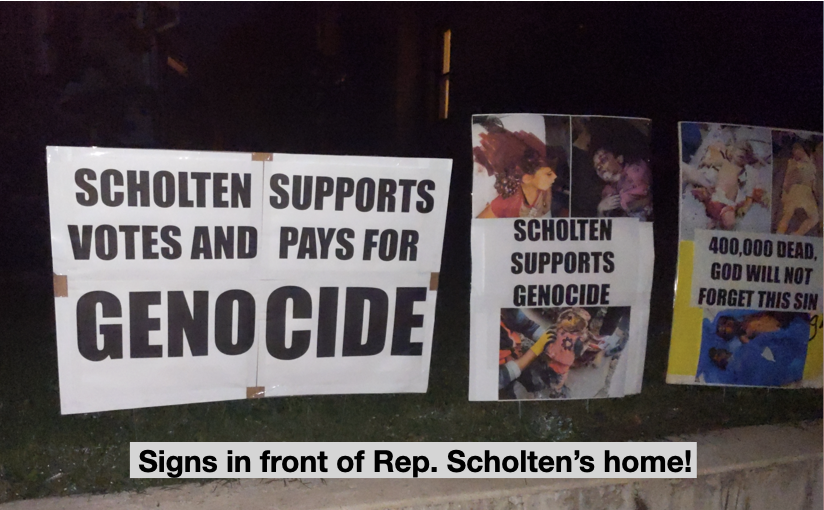
Images included here are from a protest in front of Rep. Scholten’s home, where signs were placed calling out the Congresswoman who is complicit in genocide!
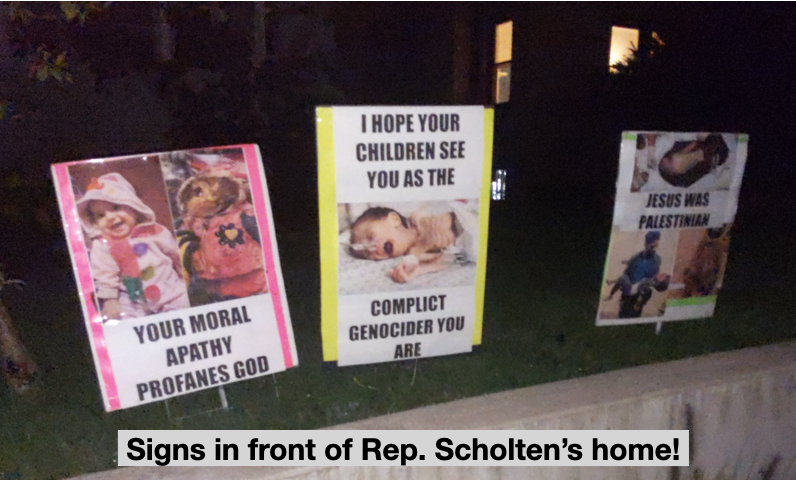
What does Rep. Scholten’s Christian faith have to say about her unconditional support for Israel killing over 40,000 Palestinians?
 While people were preparing for the US Presidential debate on Tuesday night, several activists were busy putting up posters in the neighborhood where Rep. Hillary Scholten lives.
The posters they were putting up, were wanted posters, which specifically called out Rep. Scholten for her unconditional support for Israel, complicity in Israeli war crimes and the ongoing Israeli genocide against the Palestinians.
GRIID has methodically documented the role that Rep. Scholten has played in Israel’s war crimes and the ongoing genocide, which you can read here.
It is instructive that ever since Hillary Scholten ran for the 3rd Congressional seat on Michigan, beginning in 2020, she has made her Christian faith a central part of her campaigns. In her current re-election campaign page, under the section “meet Hillary” it states:
My West Michigan roots, my family, and my Christian faith have shaped who I am, and inspired me to always think critically, and stand up for what’s right.
My question for Rep. Scholten is, how does your Christian faith makes sense of your unconditional support for Israel, for supporting the Biden Administration’s sending over 600 weapons shipments to Israel in the past 11 months, and the killing of between 40,000 and 186,000 Palestinians, most of which are women and children?
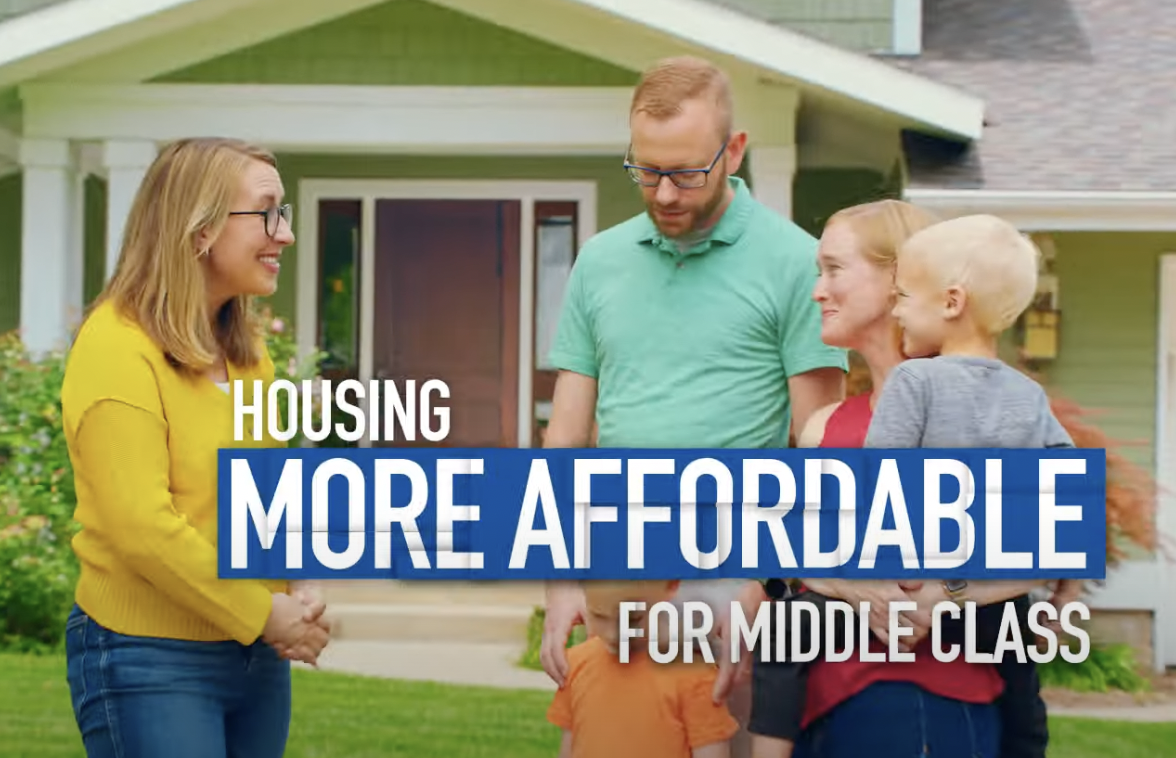
In a recent political ad, Rep. Scholten is seen with a happy, white middle class family, where she says she wants to work to provide more opportunities for middle class families to afford a home. (What about working class and poor families???) This pristine image is in sharp contrast to what Palestinian families are experiencing on a daily basis, in part because of Rep. Scholten’s continuous support for Israel’s genocidal campaign.
For example, what does Rep. Scholten’s Christian faith have to say about the killing of 18 Palestinians at a school in a safe zone? What does Rep. Scholten’s Christian faith have to say about the Israeli military’s killing of at least 8 Palestinians who were standing in a bread line at a United Nations-run school in Gaza’s Jabalia refugee camp? What does Rep. Scholten’s Christian faith have to say about the Israeli massacre of at least 40 Palestinians by bombing tents housing people displaced from other areas of Gaza in al-Mawasi, west of Khan Younis? Rep. Scholten’s political ads don’t talk about what is happening to Palestinian families on a daily basis, like this image below of a wounded Palestinian child following an Israeli bombardment at al-Bureij refugee camp in the central Gaza Strip in June of this year.

Now, I am well aware of the fact that the election is less than 2 months away, but elections should never prevent any of us from talking about what kind of policies that any candidate has endorsed or voted for. One major policy that Rep. Scholten has endorsed and voted for is the Israeli genocide being perpetrated against the Palestinians, an issue that I cannot be silent on, regardless of the outcome of the election.
For those who want to use the Rep. Hillary Scholten wanted poster, you can download it here.
West Michigan Foundation Watch: David and Carol Van Andel Foundation
Foundations are a way for members of the Capitalist Class, which made their wealth by exploiting workers, to hide some of their wealth from taxation, only to then turn around and use foundation funds to undermine social movements and generate positive PR for themselves.
“In any case, the hidden hand of of foundations can control the course of social change and deflect anger to targets other than elite power.”
– Joan Roelofs, Foundations and Public Policy
David and Carol Van Andel Foundation
GRIID has always begun our Foundation Watch work by looking at the foundations associated with the most powerful family in West Michigan, the DeVos family. GRIID has already looked at the Dick and Betsy DeVos Foundation, the Doug and Maria DeVos Foundation, the Dan and Pamela DeVos Foundation, and finally the CDV5 Foundation. Today, I am going to look at the other family associated with the creation Amway, the Van Andel family.
I am using the data from the foundation’s 990 document for 2022, which is the most recent year that is available. The David and Carol Van Andel Foundation has $104,586,135.00 of assets in the foundation’s account, which is just another way that members of the Capitalist Class to be able to hide their money from taxation.
Before I dive into how the David and Carol Van Andel Foundation distributed their funds, I wanted to point out that David Van Andel is chairman and CEO of Van Andel Institute in Grand Rapids, along with numerous other business investments. In addition it is important to point out that the David and Carol Van Andel Foundation paid Adabelle Capital $51,019.00, a hedge fund entity with an office at 250 Monroe Avenue in Grand Rapids, along with paying Donald Smith $52,243.00, with his address being listed on the 990 document as living in Pennington, New Jersey. Both Smith and Adabelle Capital were paid for investment management.
The David and Carol Van Andel Foundation made contributions to dozens of entities in 2022, but there are some clear categories of groups they contributed to, such as the Religious Right, Think Tanks, Education-centered groups, and social service entities, to name a few. Below is a listing of each from these categories, with a dollar amount.
Religious Right
- Cascade Fellowship CRC – $70,000
- Mel Trotter Ministries – $1,000,000
Think Tanks
- Acton Institute – $103,500
Education-centered groups
- Ada Christian School Education Foundation – $1,015,000
- Cornerstone University – $100,000
- Grand Rapids Christian Schools – $400,000
- Hope College – $25,000
- Potters House – $85,000
- Western Theological Seminary – $2,001,000
Van Andel-owned, created or connected groups
- Van Andel Research Institute – $52,600
Groups receiving Hush $
- Bethany Christian Services – $1,200,000
- Home Repair Services – $61,500
- John Ball Zoological Society – $750,000 (a representative of the David and Carol Van Andel Foundation sits on the Board of Directors) https://jbzoo.org/staff/
- Kids Food Basket – $180,000
- Opera Grand Rapids – $285,000 (a representative of the David and Carol Van Andel Foundation sits on the Board of Trustees) https://www.operagr.org/board-of-trustees/
- Salvation Army – $85,000
- Special Olympics Michigan Inc. – $350,000
It is instructive to see that in 2022, the David and Carol Van Andel Foundation contributed $1 million to Mel Trotter Ministries, an organization that supported the original GR Chamber of Commerce proposal that criminalized the unhoused in 2022. It is also worth noting that the David and Carol Foundation provided $1.2 million to Bethany Christian Services, which has reverted back to it’s more ridged and ideological stance on issues like only hiring Christian staff and taking an anti-LGBTQ position. Like the DeVos family, the Van Andel family doesn’t give money just for the fun of it, they use their foundation funds to strategically support the Christian and political right entities, especially in West Michigan.
FOIA request took more than a year to get regarding GRPD surveillance and arrests of those protesting Patrick Lyoya’s murder
On May 4, 2023, I submitted a FOIA request to the GRPD to obtain documents and communication from the GRPD regarding their surveillance and arrests of people who were protesting the murder of Patrick Lyoya. The FOIA request covered the period of April 4, 2022 to April 4, 2023, which was the one year anniversary of Patrick’s death.
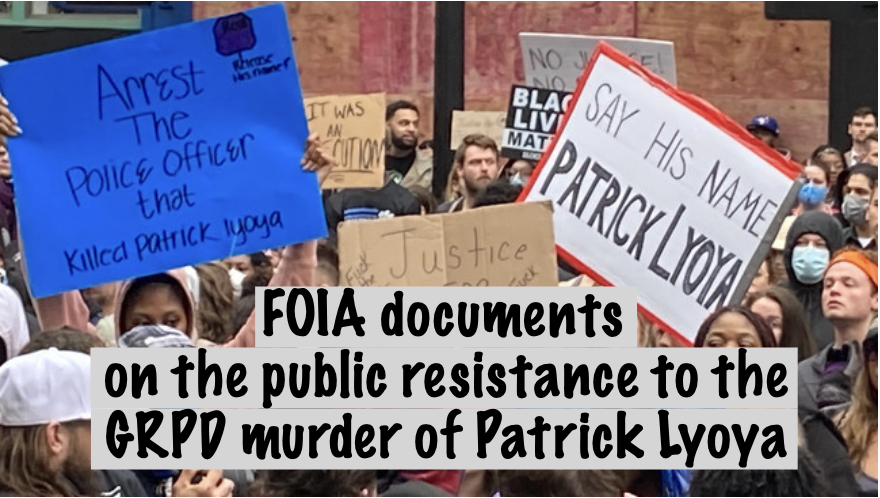
The GRPD has been receiving a substantial increase in FOIA requests, so I was told that it might take 8 – 12 months. In November of 2023, the GRPD requested more funding and more staffing to assist with the increase in FOIA requests, which Grand Rapids City Officials approved. I wrote about the city’s decision to provide more funding to the GRPD, but despite the additional staff I did not receive the final FOIA requested documents until late this summer. Therefore, even with the added staffing the GRPD did not released the requested FOIA documents until 14 months after my initial request. You can see a breakdown of the cost of the FOIA request here.
There were 2 main documents that I received, one that was called Additional Incident Reports – Redacted, which provides the GRPD version of what happened during the various protests of 2022. The second set of documents was entitled Combined Additional Documents – Redacted.
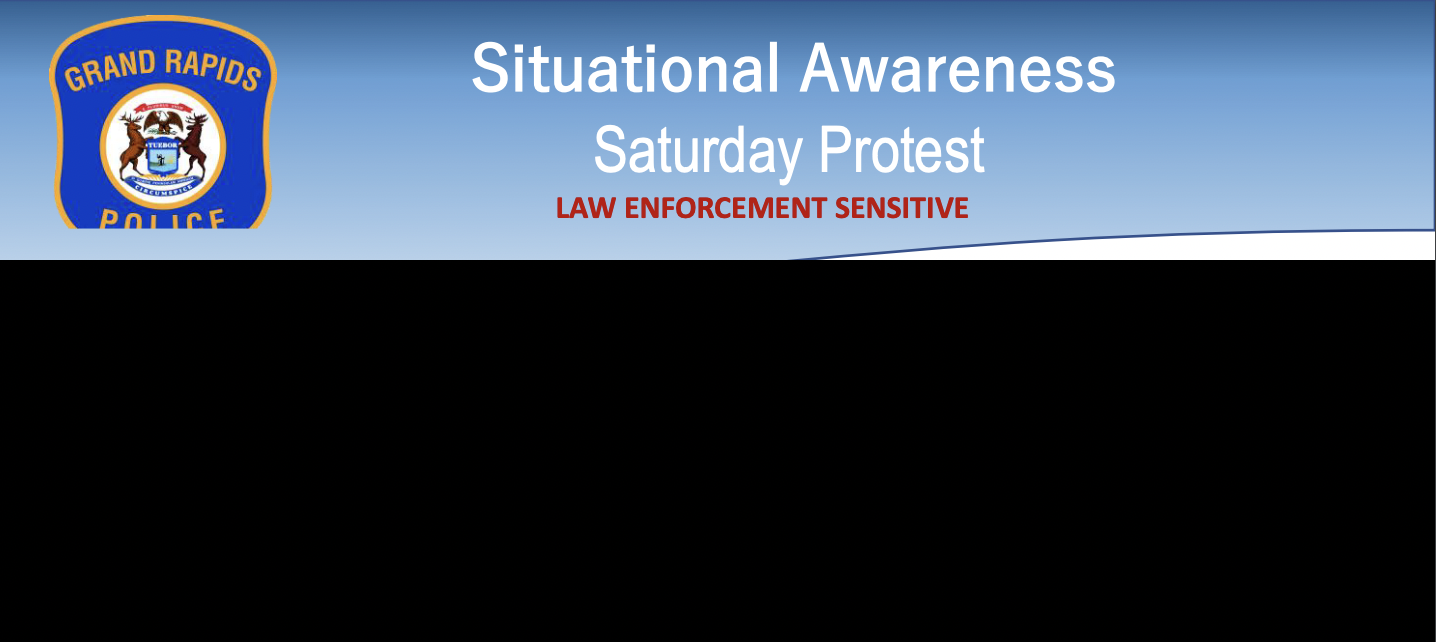
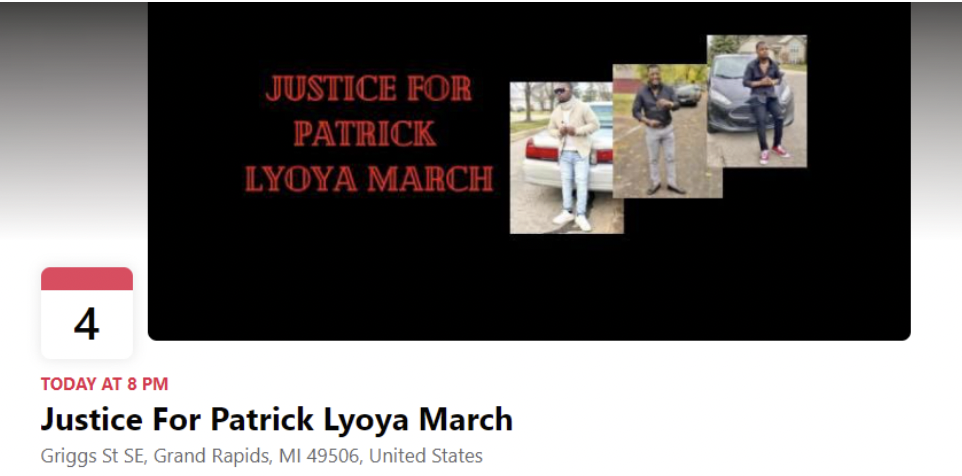
I’ll address the second set of documents, primarily because so much of these documents are redacted that it is difficult to address what took place. You can read headings like React Team One, or Operational Plans. In both cases everything but the heading is redacted, except for the maps, the City’s free speech policy, Dispersal Announcements and some of the flyers that the community made for the various protests demanding Justice for Patrick Lyoya. You can see on page 89 of this set of documents, that the GRPD had included a screenshot of the protest organized on May 4th by the Comrades Collective at the spot where Patrick Lyoya was murdered by the GRPD. There were also several pages with the heading Situational Awareness – Saturday Protest, with all details redacted.
The documents that read Additional Incident Reports – Redacted, only redacts names and license plate numbers. This set of documents is 66 pages long and is fundamentally what happened from the point of view of the GRPD. There are a couple of things worth pointing out here, that the GRPD demonstrate contempt for people who engage in disruptive protests, plus they continuously remark that the police officers felt threatened by the protesters and therefore had to arrest them. Many of these documents are also quite repetitive.
What this process tells me, as someone who has requested Freedom of Information Act documents on numerous occasions, is that the GRPD spend a tremendous amount of energy monitoring and harassing people who engage in public protests or forms of Direct Action. Secondly, there are likely documents that the GRPD didn’t release, precisely because of the fact that they can withhold whatever documents they want to, since the only way to try to obtain all documents is to take them to court. Going to court is extremely expensive, especially for those who do not shy away from protesting or disruptive actions.
A third important point to make here is that the GRPD will always redact details of the protests, along with whatever plans they have to contain and suppress organized resistance. This means that we will never know what their plans are ahead of time, which is exactly why much of these documents are redacted. The GRPD, with the backing of the City of Grand Rapids, has most of the power in these circumstances, and they don’t plan on giving up the power to contain and suppress social movements that are demanding justice.
Lastly, it is worth noting that when it comes to holding the GRPD accountable, it is a false notion. The GRPD gets to do what it wants, there is no real transparency and they can act with impunity on these matters. Think about the fact that Patrick Lyoya was murdered over 2 years and 5 months ago and still former cop Christopher Schurr is free and has note gone to trial for his decision to shoot Patrick Lyoya in the back of the head.
Additional sourcing: Below are numerous articles that GRIID posted regarding many of the protests that are cited in the GRPD FOIA’d documents. These post are chronological from the bottom up.
Understanding the GR Power Structure – Part IX: The Non-Profit Industrial Complex in Grand Rapids
In Part I of this series I began an updated version of a Grand Rapids Power Analysis, which lays out the ground work for what the Grand Rapids Power Structure looks like and what it means for this community.
When I use the phrase, the Grand Rapids Power Structure and who has power, it is important to note that I mean power over. A local power analysis is designed to investigate who has power over – who oppresses, exploits and engages in policy that benefits them to the exclusion of everyone else – the majority of people living in Grand Rapids.
In Part II of this series on the Grand Rapids Power Structure, I looked at the DeVos family, which I argue is the most powerful family in this city, in terms of economics, politics, social and cultural dynamics. In Part III of this series I looked at some of the other families and individuals that also wield tremendous power in this city, economically, politically and socially. In today’s post I will focus on the private sector organizations that also have tremendous power and influence on daily life in Grand Rapids.
In Part IV, I focus on private sector organizations, many of which have individuals who are part of the Grand Rapids Power structure sitting on their boards. These private sector organizations serve a vital role in dictating local policy, which primarily benefits their own interests. Part V took a critical look at the role that the Grand Rapids City Commission and the Kent County Commission play in representing the interests of the private power sector, along with how they use fear and violence against residents who are actively challenging the local power structure.
In Part VI, I looked at how the major daily local news agencies normalize systems of oppression that protect and expand the Grand Rapids Power Structure. Then in Part VII, I discussed the role that local colleges and universities play when it comes to the Grand Rapids Power Structure. Part VIII focused on religious organizations in Grand Rapids and their relationship to the local power structure.
In today’s post I want to look at the function of the non-profit as it relates to the Grand Rapids Power Structure. First, I think it is important to state that not all non-profits are alike. Some non-profits genuinely make an effort to move beyond social services and education, even at times challenging systems of power. However, those non-profits are generally the exception and not the norm. Second, I understand that most non-profits do some form of “good”, which often translates into provided some support, relief or resources to those who are struggling.
However, regardless of the “good” that non-profits do or the support they provide to people, what they don’t do, or don’t do very often, is to challenge systems of power and oppression. In the chapter Social Service or Social Change, from the book, The Revolution will not be Funded: Beyond the Non-Profit Industrial Complex, Paul Kivel talks about the primary function of the non-profit, which is to act as a buffer for systems of power and oppression. Kivel identifies three ways in which the non-profits act as a buffer zone for the small percentage of people who control most of the wealth and political power.
- First, non-profits take care of those who are struggling economically. Take care of them primarily means offer services or resources.
- The second buffer zone function of non-profits is to keep hope alive, which translates into connecting individuals and families to opportunities in the community to improve their economic standing.
- The third function is to maintain a system of control. Non-profits do this consciously or unconsciously by discouraging people from getting organized and to make sure that they do not engage in socially disruptive acts.
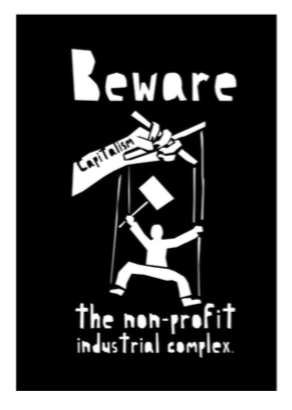 The Non-Profit Industrial Complex is a relationship between the Private Power, the State, foundations, the non-profit/NGO, social service agencies and sometimes social justice organizations. These relationships often result in the surveillance, control, derailment, and everyday management of political movements. The feminist group INCITE!, has identified the following ways in which non-profits function as it relates to private and state power.
- Monitor and control social justice movements;
- Divert public monies into private hands through foundations;
- Manage and control dissent in order to make the world safe for capitalism;
- Redirect activist energies into career-based modes of organizing instead of mass-based organizing capable of actually transforming society;
- Allow corporations to mask their exploitative and colonial work practices through “philanthropic” work;
- Encourage social movements to model themselves after capitalist structures rather than to challenge them.
In looking at non-profits in Grand Rapids and their relationship to private power, it is easy to see that these organizations rely heavily on the very foundations run by the wealthiest families who make up the Grand Rapids Power Structure, which we have been documenting here. These foundations channel millions of dollars to local non-profits, which results in; 1) the non-profits will not speak out about the power these families have in influencing public policy, and 2) the non-profits will not look at the root causes of the issues they are organized to respond to. In fact, the members of the Grand Rapids Power Structure, through their efforts to influence public policy, are part of the root cause of the issues that non-profits are responding to. The foundation money that goes to non-profits is what I call hush money.
Besides foundation funding to local non-profits, members of the Grand Rapids Power Structure, or their representatives, will often sit on the boards of directors of these non-profits. One example I reported on recently was the board of directors and the strategic partners that work with the non-profit Housing Kent.
I have spent lots of time writing about and engaging non-profits in a variety of ways, but let me give three examples of how non-profits have served those in power or remained silent about systems of power and oppression.
The first example has to do with silence. In 2017, it was reported that the non-profit group – Inner City Christian Federation (ICCF) – had received millions in funding from the DeVos family specifically to purchase dozens of properties in Grand Rapids. I asked three main questions of ICCF, questions I wrote about and questions I sent to them. I never got a response from ICCF to my questions.
A second example has to do with the group Kids Food Basket. I have written numerous article about this organization over the years, primarily about their failure to truly address food insecurity and hunger. Then in 2021, when a coalition of autonomous groups in Grand Rapids nominated them for being one of the worst non-profits in the area. In response, instead of choosing to do better or enter into a dialogue with these autonomous groups, Kids Food Basket had their lawyers send threatening letters to some of the BIPOC members of these autonomous groups. You can read about what happened in my article entitled, White Liberals, Kids Food Basket and the Non-Profit industrial Complex in Grand Rapids.
The final example I want to provide has to do with the non-profit group AmplifyGR. AmplifyGR is a non-profit that was created by the DeVos family, specifically with founding from the Doug and Marie DeVos Foundation in 2017. Many of the DeVos members also sit on the Board of Directors for AmplifyGR. In 2017, when there was an organized effort to question the role of AmplifyGR in the Southeast part of GR, specifically at several community forums in June and July of 2017, AmplifyGR decided to cancel any future community forums in order to prevent pushback from the community.
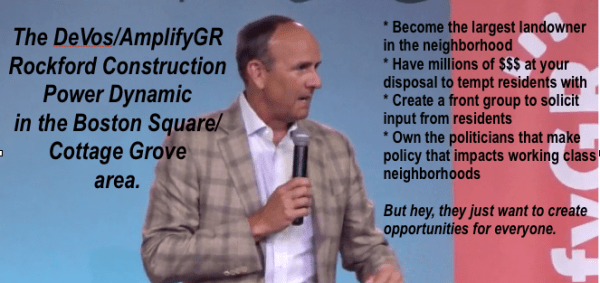
Non-profits do not have to act as buffers for systems of power and oppression, even if the way non-profits are structure limits their ability to work towards structural change. This is why I don’t have any expectations that non-profit work will lead to the dismantling of systems of power and oppression. We need local autonomous groups and movements, ones that don’t operate within the constraints of the non-profit industrial complex or within partisan politics. Autonomous groups and movements have the freedom to fight these systems and to create other possibilities, which can truly lead to collective liberation for those that the Grand Rapids Power Structure seeks to control.
In Part X, I will highlight some of these autonomous groups that exist in Grand Rapids and the work they have done that moves in the direction of collective liberation.
Police apologist group, Voice for the Badge, posts offensive message on Labor Day, a message that comes from an anti-Immigrant nationalist organization
Johnny Brann Sr. has been putting lots of money behind pro-cop candidates in Grand Rapids during some of the recent Grand Rapids City Commission races. This most recent example is with 1st Ward candidate Dean Pacific, which both Johnny Brann and the GR police union provided Pacific with thousands of dollars.
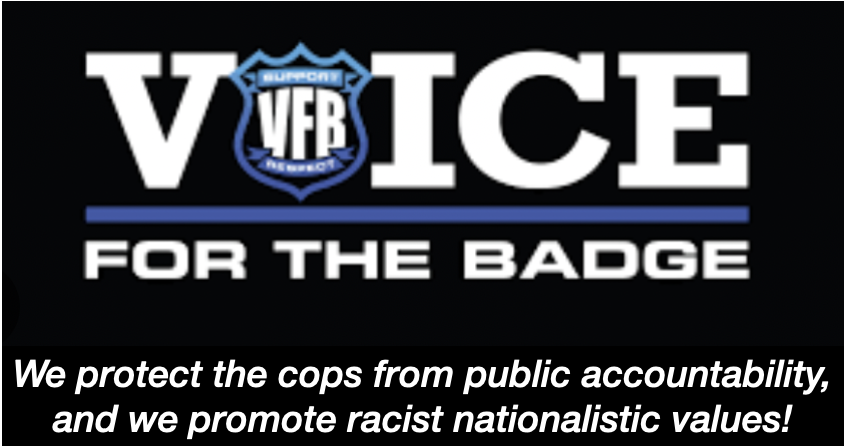
In addition, Johnny Brann Sr. founded the pro-cop group, Voice for the Badge, which continues to show how far right they are as an organization. For Labor Day, Brann/Voice for the Badge posted this comment:
To all who hold the line we are truly grateful! From the men and women who are first to hear our cry for help, to the officers and fire fighters who save and keep us safe, to the hospital staff that save and heal our lives, to the men and women who protect our freedom and all who work to support them we wish you a very Blessed Labor Day! Your strength, dedication and sacrifice does not go unnoticed. You are loved and appreciated 365/24/7!
Be safe today and everyday!
The Voice For The Badge.
Besides posting this message, which is an insult to labor history and working class people’s history, Voice for the Badge reposted a meme from the group NumbersUSA. According to SourceWatch, NumbersUSA is an anti-immigrant organization that was tied to the larger anti-immigrant network that was created by now deceased Michigan physician John Tanton.
If you look at NumbersUSA’s Facebook page, you can see that they embrace a far right, anti-immigration, pro-Trump agenda. None of this should be surprising to anyone who is familiar with Voice for the Badge, but it is important that we acknowledge that their organization is more than pro-Cop. Voice for the Badge is also a far right, nationalist and white supremacist organization that we need to expose and confront.
On Thursday, Mlive posted an article entitled, West Michigan wage growth declining amid economic uncertainty.
The article begins by stating: The rapid wage growth spurred by the COVID-19 pandemic is showing signs of slowing down, according to a Michigan employer survey.
The survey that was cited came from the American Society of Employers West Michigan, even though the MLive article never really tells readers anything about this business association apart from the fact that they have merged with another group.
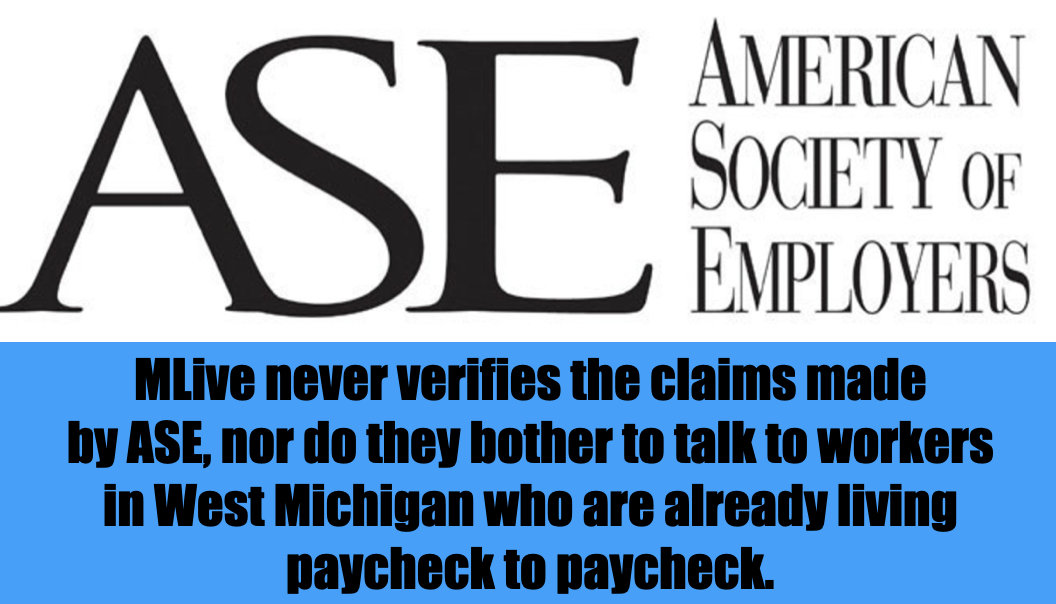
However, the article does cite lots of statistics from the survey, along with comments from the organization’s CEO. In addition, it is important to point out that the MLive article pretty much just relies on a Press Release from the American Society of Employers West Michigan, which the organization posted on August 28th.
So, we have an MLive article, which:
- Relies primarily on a Press Release from a business association.
- Only cites the business association.
- Doesn’t investigate the accuracy of the data provided by the business association.
- And the reporter fails to ask the most basic question – how will this impact workers.
One could also certainly make the case that MLive should have done a follow up story where they talk to workers about the prospect of having their wages reduced, especially in an economy where the basic cost of living has gone up – food, gas, utilities, etc.
Equally important is the fact that in late July, MLive reported, “that 41% of Michigan households live paycheck to paycheck.” This was based on the ALICE report. ALICE stands for Asset Limited, Income Constrained, Employed. In that same MLive article they provided a map of Michigan, which allowed readers to see what percentage of the population by county is living paycheck to paycheck.
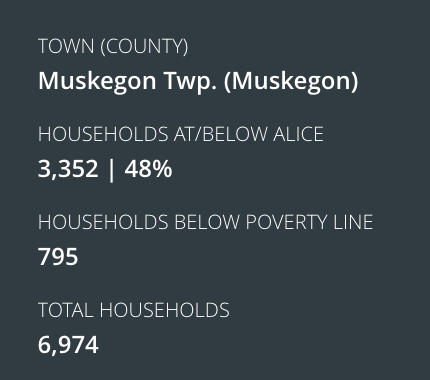 The MLive story that this GRIID post first looked at, had Muskegon, Michigan as the location of the article, since the American Society of Employers West Michigan is based there. If you look at the ALICE data for Muskegon County, it shows that 48% of the households in that county are living paycheck to paycheck. If the wages are going to decrease, it would mean that more than 50% of the households in Muskegon County would be living paycheck to paycheck.
THIS should be the story that the MLive reporter should be pursuing, not the unverified data provided by a business association. Just one more example of how the commercial news media in this area demonstrates a clear class bias, favoring the opinions of the business class over the working class.
Palestine Solidarity Information, Analysis, Local Actions and Events for the week of September 8th
It has been 11 months since the Israeli government began their most recent assault on Gaza and the West Bank. The retaliation for the October 7 Hamas attack in Israel, has escalated to what the international community has called genocide, therefore, GRIID will be providing weekly links to information and analysis that we think can better inform us of what is happening, along with the role that the US government is playing. We will also provide information on local events and actions that people can get involved in. All of this information is to provide people with the capacity of what Noam Chomsky refers to as, intellectual self-defense.

Information
ISRAEL’S WEST BANK ATTACKS FUEL ITS ANNEXATION PLANS
Israeli Treatment of Palestinians Remains Unchanged Over 75 Years
IDF Attacks Gazans Buying Bread as Netanyahu Tanks Cease-Fire Hopes
We’ve Organized for Palestinian Liberation for Years. Here’s What We Learned.
On the Frontline of Resistance: The Women of Palestine
Thousands of Palestinian Children in Gaza Are the Principal Victims of Israel’s Genocide
From ‘Defense’ to Destruction: The Evolution of Zionist Aggression
Campaign against Project Nimbus gathers steam and supporters
Analysis & History
Israel Has Built an Economy Fueled by Genocide at Home and Abroad
Local Events and Actions
Power to Palestine: Weekly Rally in Grand Rapids
Wednesday, September 11th, Noon – 1pm, Corner of Pearl St and Monroe in downtown GR.
The People’s Poetry for Palestine
Thursday, September 12 at 6pm
Canal Park in Grand Rapids
Saturday, September 14 from 1 – 2pm
Visual used in this post comes from https://visualizingpalestine.org/ from 2021.
 Grand Rapids Institute for Information Democracy