When Bi-Partisan votes translate into abandoning the working class: The Michigan Legislature votes for Wage Theft
“We commend Michigan legislators for reaching a bipartisan compromise to amend the state’s onerous paid sick time and tipped wage laws.
While the compromise is not perfect, jobs, businesses and people’s livelihoods were saved last night. Shared power between Michigan’s legislative chambers is leading to more pragmatic solutions for the people and job providers of our great state.”

The above words were posted by the West Michigan Policy Forum on their Facebook page, after learning that the Democrats abandoned the interests of working class people and gave in to the demands of the business class. For those who read this blog, you know that the West Michigan Policy Forum was created in 2008 as a project of the Grand Rapids Chamber of Commerce, to mobilize members of the Grand Rapids Power Structure to lobby state legislators to embrace the interests of the Capitalist Class. The GR Chamber of Commerce also celebrated this vote, as you can see from their message here below.
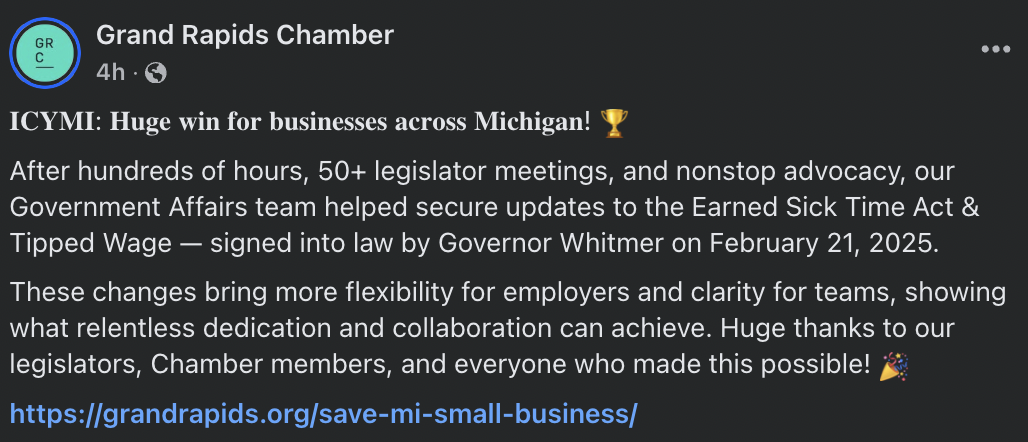
An article in Crain’s Grand Rapids highlights how the working class continues to be betrayed by both Republicans and Democrats. The article states:
“The Democratic-led Senate passed a revised version of House Bill 4002 on a 26-10 vote following weeks of negotiations. The Republican-controlled House quickly approved the legislation, 81-29, about 35 minutes later. The Democratic governor was poised to swiftly sign it and revisions to a minimum wage law, potentially overnight, but not before new laws they will replace took effect after midnight.”
It would do us all well to remember that in 2018, Michigan voted for a ballot initiative to increase the minimum wage in Michigan. According to the group One Fair Wage, the group behind the 2018 ballot initiative, stated that Governor Whitmer was “stripping millions of dollars” from Michigan workers’ paychecks. One Fair Wage president Saru Jayaraman, in a released statement after the Michigan Legislature betrayed workers stated:
“Michigan’s highest court ruled that these wage increases should take effect. Michigan workers have already earned this raise, and taking it away is not a compromise—it is wage theft. We are mobilizing to ensure voters—not politicians—have the final say on whether these protections remain in place.”
Here is what the Thursday vote will mean for working class people. SB 8 will phase in an increase in the lower wage for servers and bartenders, now 38% of the general minimum wage, until it reaches 50% by 2031. The tipped wage, which businesses can pay as long as their employees’ tips make up the difference, had been scheduled to equal the regular minimum wage by 2030.
The legislation also will accelerate a boost in the general minimum wage to $15 by 2027 instead of $14.97 by 2028. It went up to $12.48 from $10.56 on Friday under the law that went into effect overnight and the one Whitmer will sign.
The fact is, that waiting until 2027 for the $15 an hour minimum wage increase should tell us that those who voted for this are not people who are struggling to make ends meet. For instance, according to the National Low Income Housing Coalition, for people living in Michigan, they need to make $23.16 an hour to be able to afford the average cost of rent in this state. The fact that this was a bi-partisan vote should tell you that both parties are ultimately in the pocket of the Capitalist Class and will not fight for working class people……only we can fight for ourselves.

GRIID Class on the Prison Industrial Complex in Kent County – Week #3
For week #3, participants in the discussion on the Prison Industrial Complex in Kent County, we looked at two items before we talked about the main reading.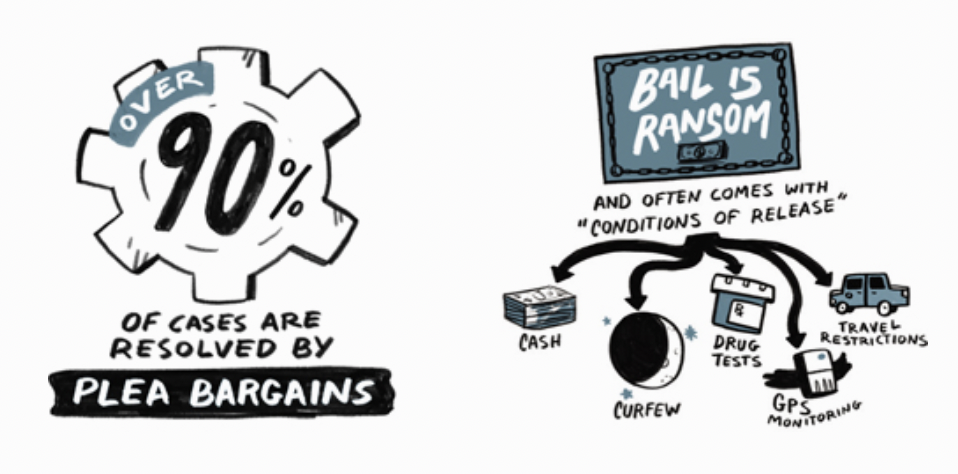
The first item was a follow up to Week #2, where we discussed a specific news story about how the Kent County Prosecutor determined that the GRPD “followed procedure, when they shot an unarmed Black man who was struggling with mental health issues. I sent them a link to a new report entitled, GRIID 2024 News Monitoring Project, which has data and analysis about news coverage on policing/public safety.
Two major findings in the study were 1) of the 673 policing/public safety stories over the past 12 months, there were only 16 stories about community-based groups doing crime prevention work; and 2) of all these 673 stories that centered around crime, there were only 11 stories about the GRPD actually preventing crime, which means in most of the stories the GRPD showed up after a crime had already been committed.
The second thing we discussed had to do with the 2025 Kent County Budget. I provided them with a link to the budget document and asked if they could determine how much of the county budget was spent on the Sheriff’s Department, on the Kent County Jail and the court system in Kent County, including the Prosecutor’s office. There was an interesting conversation around issues like how the budget is deliberately difficult to read, how their are hidden costs associated with those departments (grant funds, etc), and how there was no listing of contracts that Kent County had with private contractors related to the jail, the courts and the Sheriff’s Department.
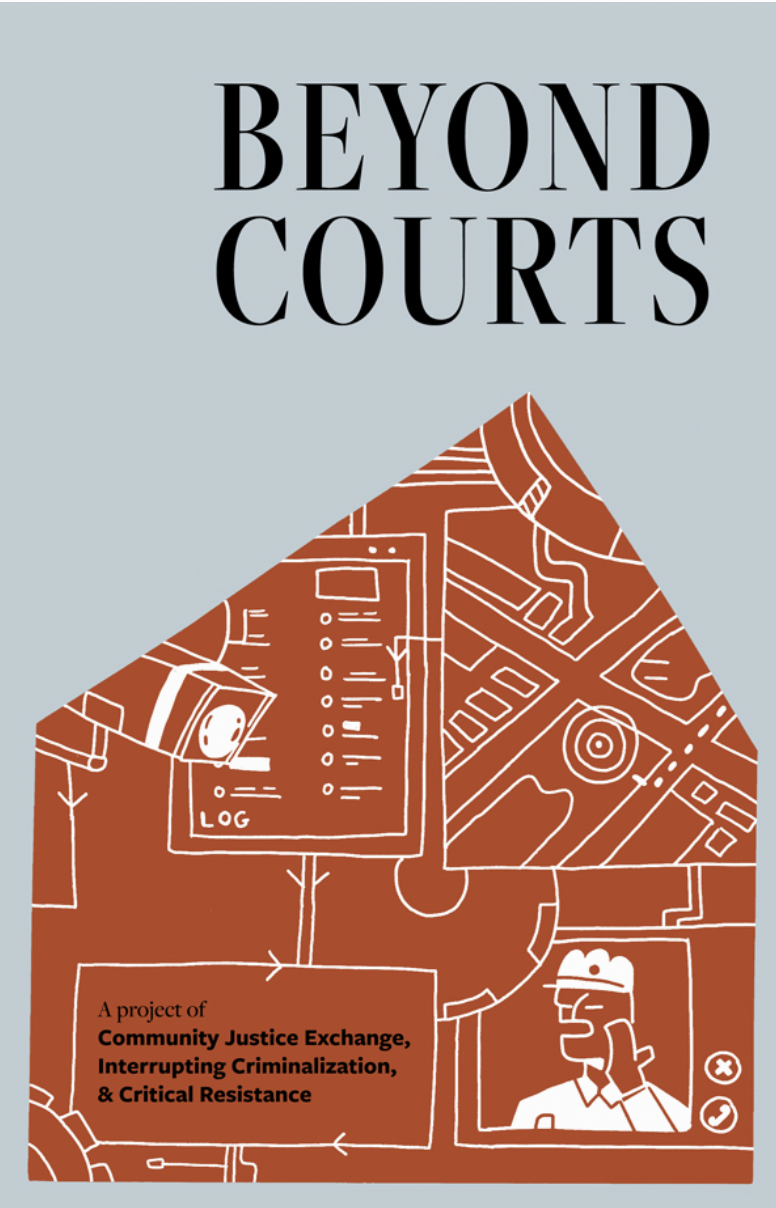 The bulk of Week #3 was spent discussion the first two chapters of the book, Beyond Courts. The book is one of the best I have come across that provides a critical analysis of the court system, which usually receives less attention when we talk about the Prison Industrial Complex.
Chapter One provides a great introduction to the court system, with the chapter title being Criminal Courts 101. However, unlike most 101 bits of information, this book provided a more robust critique about the court system and why it is primarily used as a way to punish members of the working class and BIPOC communities. Chapter Two raised great questions about the court system, along with well researched analysis and great graphics & visuals, which acted as excellent popular education tools to communicate ideas, like graphic at the top.
Lessons on the history of US Immigration Policy #5: Countering false anti-immigrant narratives
So far in this series on lessons on the history of US Immigration Policy, I have looked at the question – Is the US a Nation of Immigrants in Part I; how anti-immigration policies in the US are bipartisan in Part II; the dominant narrative around how we talk about immigrants in Part III; and an investigation into the root causes of people migrating to the US, especially those coming from Latin America, in Part IV. Today, I want to look at false narratives about immigrants.
For decades now, there have been certain narratives about immigrants, especially undocumented immigrants, narratives that are false. Despite these false and unsubstantiated narratives, politicians parrot them, and most commercial news agencies perpetuate them. Here are a few of the more dominant false anti-immigrant narratives:
- Immigrants take jobs fro real Americans
- Immigrants drive down wages
- Immigrants don’t pay taxes
- Immigrants are a drain on the US economy
It is important that we create accurate narratives to counter these false narratives, so let’s do that for each of these 4 dominant anti-immigrant narrative. Much of what I am sharing here comes from an excellent book by Aviva Chomsky, “They Take Our Jobs!”and 20 other myths about immigration.
 Immigrants take jobs fro real Americans – In one sense, the idea that there are American jobs is somewhat meaningless, especially since the economy is increasingly a global economy. More importantly, immigrants to take jobs away from anyone, they actually do work that so few are willing to do. If we look at migrant worker jobs, where people are doing seasonal work, primarily outdoors, under harsh conditions, and for very little money, to claim that immigrants are taking migrant jobs from real Americans is ridiculous.
A narrative that we should be thinking about and promoting is, corporations take our jobs. As I mentioned in Part IV of this series, NAFTA had a huge impact on Mexican workers, but it also impacted jobs in the US. Grand Rapids was impacted by de-industrialization since the 1970s, which escalated with NAFTA being adopted in 1994. According to data compiled by Public Citizen, since NAFTA, Michigan lost over 168,000 jobs (21.3 percent) because companies had relocated. Corporations and their pursuit of profits take our jobs, not immigrants.
Immigrants drive down wages – This false narrative is similar to the first one, in that immigrants have no control over wages. Business owners and corporations set low wages and they don’t care who takes their shitty jobs. The fact that undocumented immigrants take low paying jobs has more to do with their level of desperation to support themselves, but because many of them send money back how to family members still living in their country of origin. In addition, if there was more class solidarity amongst working class people, which included a push to invite undocumented immigrants to be part of labor unions, then they might be able to improve wages for immigrants and everyone else who should earn a livable wage.
Immigrants don’t pay taxes – This might be the most absurd of the false anti-immigrant narratives. First, if people are employed and receive a paycheck, federal, state and local taxes are automatically taken out of your paycheck. The majority of undocumented workers obtain fake social security numbers, in order to find employment. However, when federal, state and local taxes are taken out of their paycheck, they can’t claim them. So what happens to the tax money taken out of undocumented worker checks? Those taxes stay in the coffers of state and federal governments. The reality is, if undocumented immigrants are part of the formal economy, they have taxes taken out, but they can’t claim them. This is why this false narrative is so awful. Can you imagine if average American workers who were paying taxes, were unable to claim those taxes? There would be an uprising amongst the working class.
Immigrants are a drain on the US economy – This false narrative is tied to the previous narrative about immigrants not paying taxes. Undocumented immigrants do pay into the system through taxes, but don’t have equal access to resources and services available to those with government sanctioned immigration status. The area that undocumented immigrants use more government services than everyone else are food assistance programs such as food stamps, WIC, and free or reduced-cost school lunches. However, it’s not the immigrants themselves who use this aid – they are not usually eligible – but rather their US-born children, who are citizens.
When we have clear and well substantiated counter-narratives to the false anti-immigrant narratives being tossed about by politicians and perpetuated by commercial news media, we can contribute to reducing the hate and harm being directed at the undocumented immigrant communities.
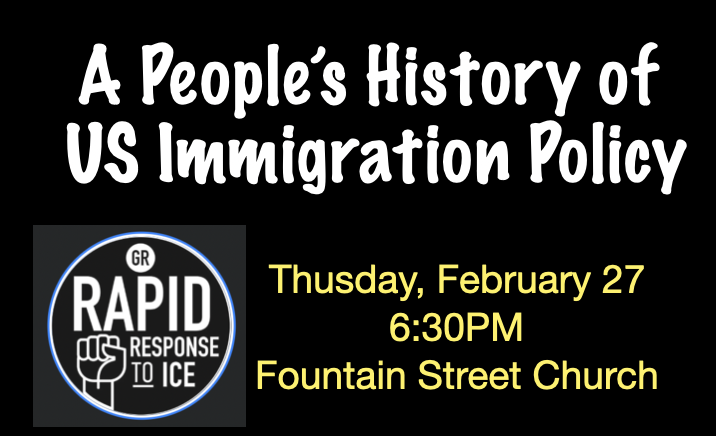
For those who want to learn more about the history of US immigration policy, contact info@grrapiresponsetoice.org for information on workshops and presentations on this topic. Also, there is a scheduled presentation entitled, A People’s History of US Immigration Policy that will be held on Thursday, February 27, beginning at 6:30pm at Fountain Street Church. Details of that event can be found here.
Palestine Solidarity Information, Analysis, Local Actions and Events for the week of February 23rd
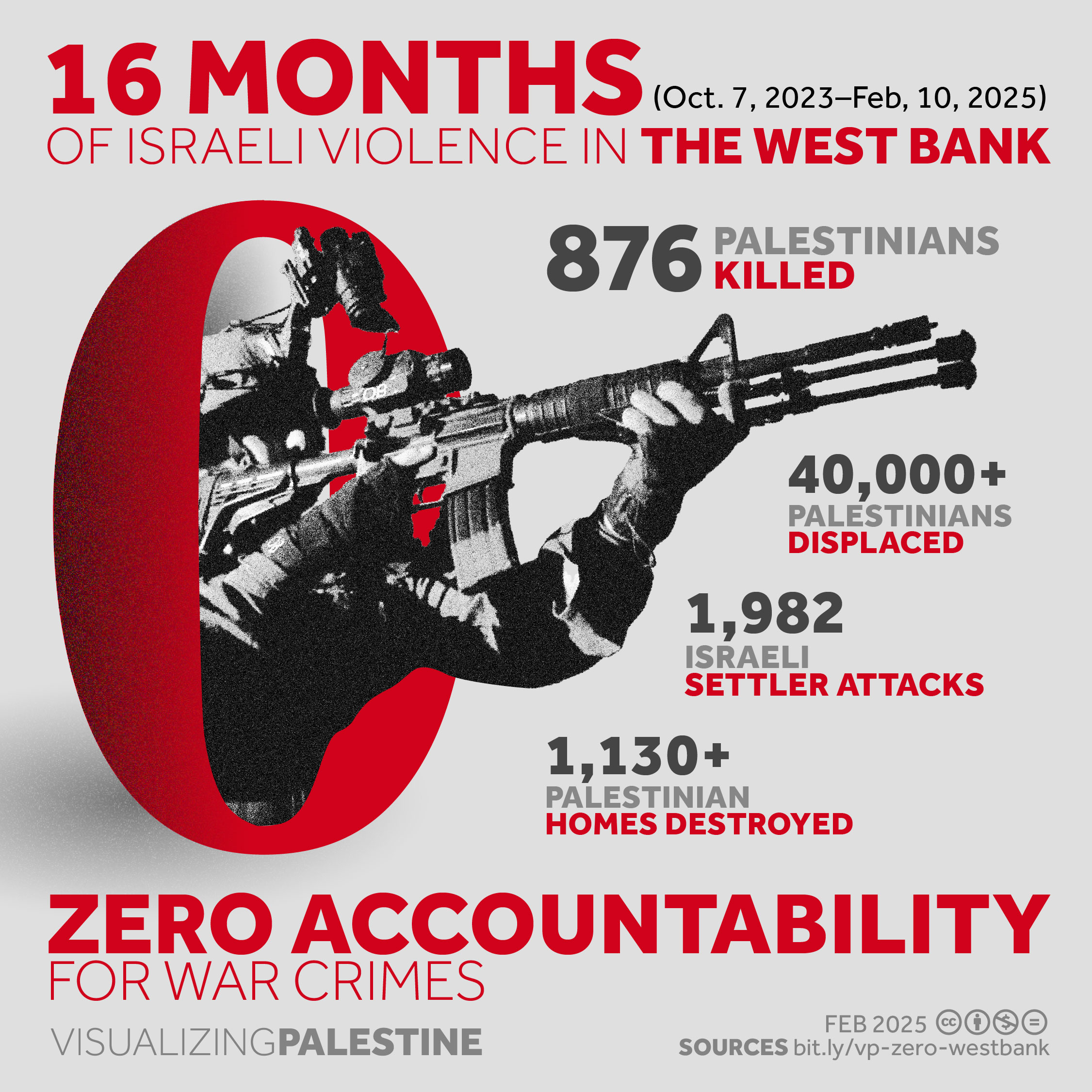
It has been more than 16 months since the Israeli government began their most recent assault on Gaza and the West Bank. The retaliation for the October 7, 2023 Hamas attack in Israel, has escalated to what the international community has called genocide, therefore, GRIID will be providing weekly links to information and analysis that we think can better inform us of what is happening, along with the role that the US government is playing. We will also provide information on local events and actions that people can get involved in. All of this information is to provide people with the capacity of what Noam Chomsky refers to as, intellectual self-defense.
Information
Coverage of Israeli and Palestinian Captives Demonstrates Dehumanization in Action
Israel Plans 1,000 New Settlement Homes as West Bank Raids Intensify
Thousands March to US Embassy in London With Message for Trump: ‘Hands Off Gaza’
Media Afraid to Call Ethnic Cleansing by Its Name
PARIAH STATE: ISRAELI SOLDIERS FACE ARRESTS AND TRAVEL BANS WORLDWIDE
Another Blackrock? Nearly 100 U.S. Mercenaries are in Gaza Right Now
Gaza First Amendment Alert (February 21, 2025)
Analysis & History
Image used in this post is from https://visualizingpalestine.org/visual/zero-accountability-west-bank/
GRIID Interview with Ximón Kittok – Executive Director of the Grand Rapids Trans Foundation, about recent Anti-Trans policies
 On Thursday, GRIID conducted an interview with Ximón Kittok, the Executive Director of the Grand Rapids Trans Foundation.
I encourage you all to visit their website to find out about all the good work they are doing, plus to watch my interview with Ximón. Here are the questions below that I asked, with a link to an anti-trans legislation tracker site.
GRIID – Before we talk about current events, I was wondering if you could share a little bit about the history of the Grand Rapids Trans Foundation and the work you all do in this community?
GRIID – It has been a few weeks since President Trump has issued Executive Orders that are fundamentally anti-Trans. Can you talk a bit about what this will mean for the trans community?
GRIID – It is also worth noting that after the Federal anti-Trans Executive Orders that Michigan has introduced legislation that to so degree mimics what the federal change will mean. How is the GR Trans Foundation reacting to this and are there groups in the state that are mobilizing to address these anti-Trans policies?
GRIID – How do these state and federal policies impact the lives of people in the Trans community?
GRIID – How can allies and accomplices support your work and how can we be engaged in the fight against anti-Trans policies and all the harm directed at the Trans community?
Lessons on the history of US Immigration Policy #4: We will never solve immigration issues until we address root causes behind immigration
So far in this series on lessons on the history of US Immigration Policy, I have looked at the question – Is the US a Nation of Immigrants in Part I; how anti-immigration policies in the US are bipartisan in Part II; and the dominant narrative around how we talk about immigrants in Part III. Today, I want to look at the root causes of people migrating to the US, especially those coming from Latin America.
The bulk of undocumented immigrants that are crossing into the US every year are primarily Mexican, Central America and to a lesser degree, people from various Caribbean countries. Immigrants from the countries listed are coming to the US because of decades-long political violence, drug cartel and state violence, debilitating poverty that has been driven by de-valuing national currency, the displacement of people living off the land, and lastly, because of the growing ecological and social consequences of Climate Change.

Decades-long US sponsored counter-insurgency wars
In Aviva Chomsky’s book, Central America’s Forgotten History: Revolution, Violence, and the Roots of Migration, the author methodically documents how decades of US sponsored and funded counterinsurgency wars displaced millions of Central Americans beginning in the late 1970s. The consequences of these wars saw large a number of Central Americans fleeing to the US, which led to the US Sanctuary movement of the 1980s. During the peak of the US Central American Sanctuary Movement, there were 400 sanctuaries across the US, a movement that I was part of here in Grand Rapids.
The US government provided billions in military aid to Central America for more than a decade, along with military advisors and the training of soldiers from those countries at the infamous US Army School of the Americas at Fort Benning, Georgia. Rarely, is there an acknowledgement about how US military policies were a major reason for so many Central Americans leaving their country and ending up in the US seeking a better life.
By the mid-1990s, when the wars in Central America had ended, the US then began to impose Neoliberal economic policies on those countries. These Neoliberal economic policies further displaced people from the land, forced them to urban centers to work in so-called Free Trade Zones where they made low wages and often could not support their families.
This same dynamic was happening in countries like Haiti and Mexico, where Neoliberal economic policies imposed by the US radically altered the national economies and forced people into manufacturing jobs making products that were primarily for export.
With Mexico, this dynamic was further exasperated in 1994, when the US, Canada and Mexico signed the North American Free Trade Agreement (NAFTA). Mexican farmers were hot particularly hard because of NAFTA, which saw the US flood Mexico with cheap, subsidized corn, making it impossible for Mexican farmers to compete with US produced corn. See the report, Mexico’s Agriculture Crisis: How Free Trade, the United States and Transnational Corporations Made It Happen.
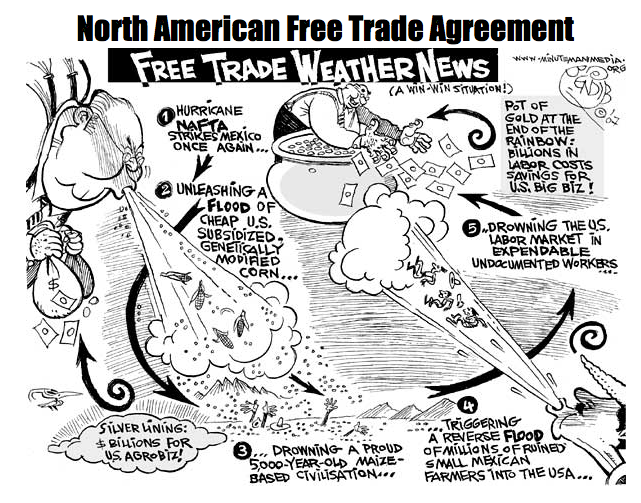
These trade policies and the imposition of Neoliberal economics on Mexico and Central America, forced millions over the past 25 years to flee debilitating poverty and find work in the US. Once in the US, immigrants continue to face economic exploitation, especially in the agricultural and food service sector. Still, the money that immigrants make in these sectors is enough to sustain them here in the US, plus it allows them to send money home to families still living in their countries of origin. The same kind of impact that NAFTA had on Mexicans, was repeated with the adoption of the Central American Free Trade Agreement (CAFTA). See the report, CAFTA’s Tragic Legacy in Central America: Failed Trade Policy That Drove Millions From Their Homes.
 Another consequence of decades of war and Neoliberal economic policies has been the rise of drug cartels in Latin America. Since the beginning of the 21st Century, the Mexican Drug Cartels have become even more violent and powerful, which has resulted in another kind of political violence in Mexico, plus the cartels have recruited thousands of Mexicans who have been impacted by NAFTA and Neoliberal economic policies to be part of the drug trade, often as mules. See Dawn Paley’s excellent book, Drug War Capitalism, on how these economic policies have impacted Mexico.
The last major contributor to displacement of people from Central American and Mexico, is the consequences of Climate Change. According to Todd Miller’s book, Storming the Wall: Climate Change, Migration, and Homeland Security, since 2008 there have been over 20 million people every year that have been displaced by Climate Change globally.
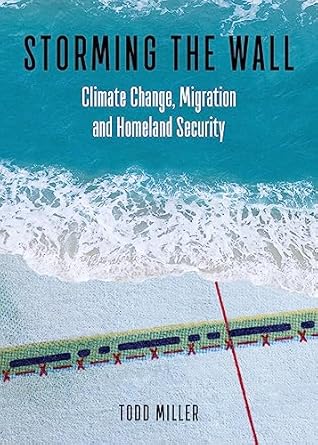 We also know that the Global North, which includes the US, generates more carbon emissions and consumes more fossil fuels that those living in the Global South. However, Climate Change impacts those in the Global South, especially those who live closer to the equator, thus the US is also a major contributor to why so many people from Mexico and Central America are displaced from their country of origin.
The bottom line with all of this is, that until and unless we come to terms with the root causes of why people are coming into the US at the US/Mexican border, we will never had just immigration policies. The narrative that people should only come to the US through “proper channels” completely dismisses the root causes for people coming to the US, and it coldly denies the levels of desperation for people who are fleeing decades-long political violence, drug cartel and state violence, debilitating poverty that has been driven by de-valuing national currency, the displacement of people living off the land, and lastly, because of the growing ecological and social consequences of Climate Change.
For those who want to learn more about the history of US immigration policy, contact info@grrapiresponsetoice.org for information on workshops and presentations on this topic. Also, there is a scheduled presentation entitled, A People’s History of US Immigration Policy that will be held on Thursday, February 27, beginning at 6:30pm at Fountain Street Church. Details of that event can be found here.
As the Trump Administration attempts to dismantle various US programs, is threatening to target organizations and movements that have been resisting for years, and wants to adopt policies that will primarily benefit the Capitalist Class, we need to be care about just reacting and think more strategic.
Before I talk about what kind of resistance and strategies we could be engaging in, it is absolutely necessary to talk about what does not work and what we can not rely on, especially if we are serious about resistance work and collective liberation.
When the Democrats go to a fight they show up with a switch-blade, the Republican show up with a howitzer
If your first reaction is to center the strategy of electoral politics, then I believe we will continue to make the same mistakes. If you believe that the Democratic Party will save us, then you will be disappointed. Just look at how weak and shallow the Democratic Party has been since the inauguration. The majority of Trump’s nominees have been approved, which means too many Democrats voted for those nominees. Democrats have also voted with Republicans to support Legislation that will do harm, especially to vulnerable communities and communities that are being targeted. (See the Laken Riley Act vote)
More importantly, the Democratic Party doesn’t seem to learn from their failures. They elected Ken Martin as the new DNC chair and in his first speech after winning that position, Martin said that there are “good billionaires.” Such sentiment is both naive and shows that the DNC doesn’t have the kind of class consciousness that will challenge nor dismantle the system of Capitalism. There is no such thing as a good billionaire.
The Democrats simply want to blame 3rd Party voters or those that chose to not vote, rather than to actually listen to its base and develop a platform that moves us to collective liberation. Just look at what happened during the Biden Administration:
- There were more deportations in the last four years than there were during the first Trump Administration.
- The Biden Administration approved more fossil fuel extractions on US soil than the Trump Administration did.
- The wealth gap has expanded during the Biden Administration, especially amongst the Billionaire Class.
- The Biden Administration increased US military funding every year for the past 4 years.
- The Biden Administration increased funding for policing, even in the era of Black Lives Matter.
- The Biden Administration was completely and utterly complicit in the war crimes and genocidal policies of Israel, refusing to end weapons sales to Israel, being complicit in allowing Israel to block humanitarian aid to Gaza and always voting against most of the rest of the world when the United Nations condemned what Israel was doing.
- The Biden Administration was not only silent, but did not actively oppose the repression of the US campus Pro-Palestine movement.
- Rent increases went up during the Biden Administration, which did very little to address the current US housing crisis.
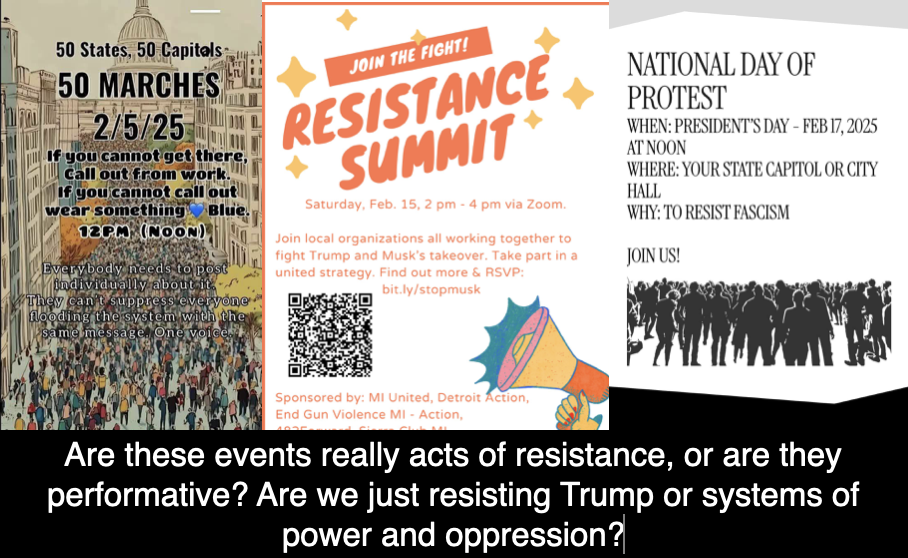
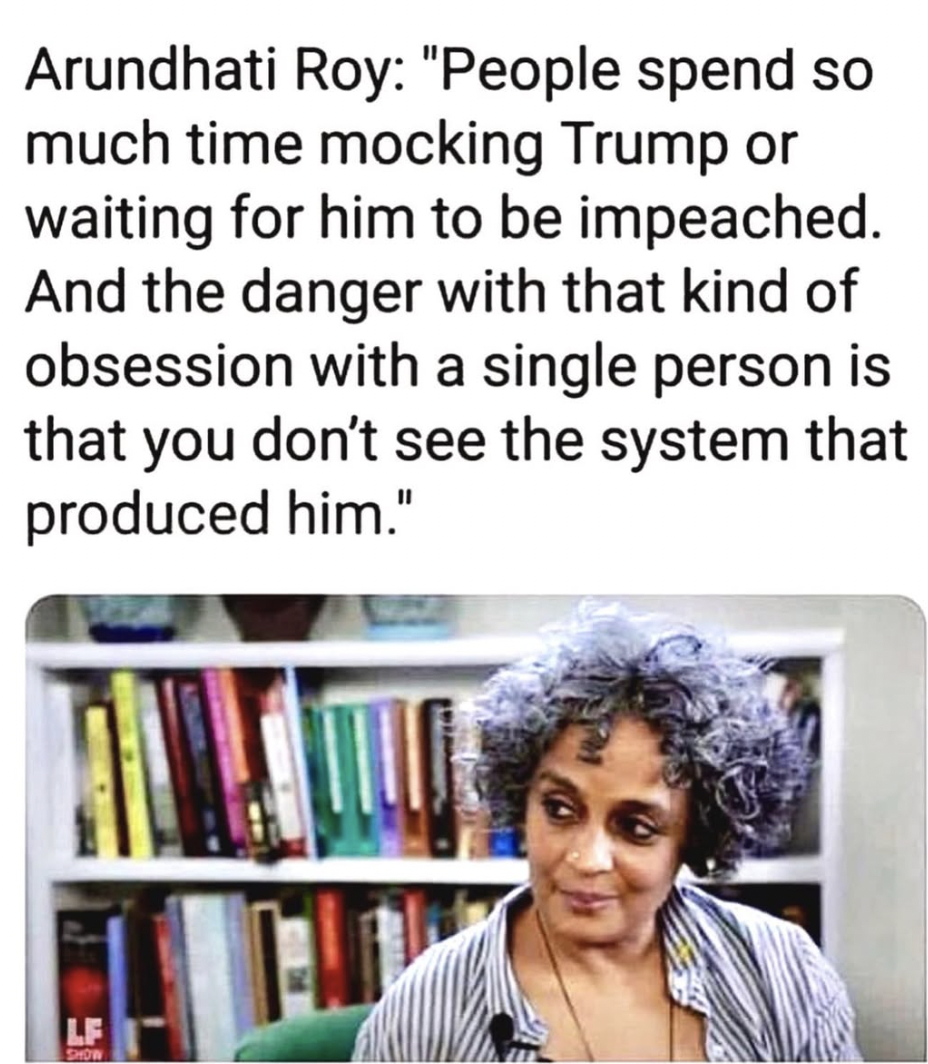 This list could be longer, but you get they point. Still, people are falling for the let’s get behind the electoral plans of the Democrats and the banality of the Democrats calling what they are doing as resistance. I call BULLSHIT. The 50 States, 50 Capitals protest that happened last week, even though the memes for this event did not provide a source for who was behind it, should have been a red flag for what was happening. I tracked down who was behind it, which there were three main groups, the 50501Movement, Political Revolution and Protest for Human Rights. All three of these groups are primarily pushing the electoral politics as a strategy, plus to advocate for business as usual approaches to systemic change.
Then there are events like the one that happened in Michigan for February 15, where they are inviting people to “join the Resistance.” Look at the list of orgs that were part of this virtual summit, all of which are 501-C3 groups that have historically collaborated with the Democratic Party and wouldn’t know the first thing about what real resistance looks like.
Thinking strategically to practice resistance, engage in movement building and fighting for Collective Liberation
When people went to the 50 States, 50 Capitals protest, what was the goal, and what were the strategies and tactics that were used. As far as I can tell, people were protesting a broad range of Trump’s Executive Orders, but to what end? There is nothing wrong with voicing opposition to the Executive Orders, but standing in front of the capital in Lansing makes no sense. Why not have people show up at federal buildings or the offices and homes of members of the US House or US Senate? However, even that isn’t sufficient.
Here are are some suggestions about moving forward, especially if we are about more than opposing the Trump Administration.
First, this is not just about Trump and Musk! Sure, these people are awful and despicable human beings, but we have to focus on systems of power and systems of oppression if we are ever going to fundamentally change things. The list of things that happened during the Biden Administration that I mentioned earlier, were also awful shit, causing tremendous harm, but where was the outcry and the sense of urgency then? Why just now? I think part of it is that white people are starting to worry about certain dynamics, but for BIPOC people, immigrants, working class poor, queer & trans people, and people with disabilities, this been an ongoing shit show of harm. As Noam Chomsky points out in this video interview (from 2003), every US President since WWII could be tried for War Crimes. The horror that the US practices domestically and internationally has been a constant.
Second, we can’t just be reactive to what is happening, we have to think about what we really want. We can’t just want to get rid of Trump and Musk, we have to start thinking about, practicing radical imagination, then strategize and organize around what we really want, not just what we are against.
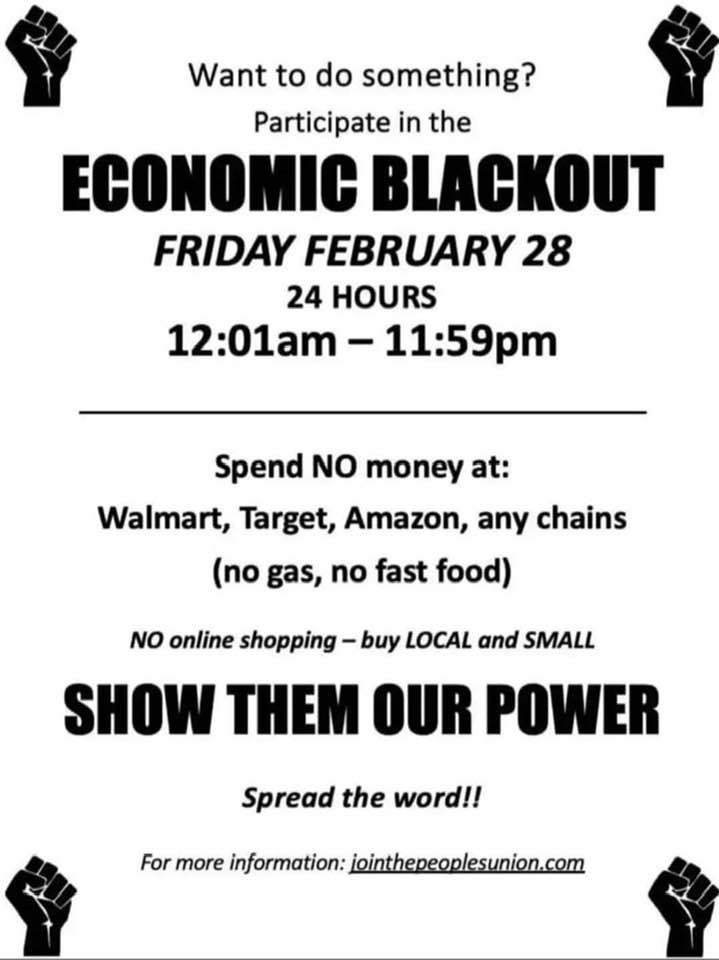 Third, we should think more critically about the memes and information being shared on social media. There have been memes that are used calling for protest, without knowing who is behind them or any serious investigation of who is behind them. For example, there is an Economic Blackout being called for February 28. The website calling for this used to be the people’s union, but they founder of this group changed it to this, https://theonecalledjai.com/. Yes, John Schwartz says he started this movement, a businessman who likes to meditate. Movements aren’t created by those with privilege, they come out of the collective lived experienced of people who have been oppressed. Now, I’m not saying that boycotts or economic strikes is a bad thing, but we should be looking to movements that have been doing boots on the ground work for decades or longer, to see what they are advocating and then support that.
Fourth, we need to learn from the history of social movements, along with paying attention to the current movements for radical social change and collective liberation, not people who are just pissed off about Trump. For example, in Grand Rapids, the immigrant-led group Movimiento Cosecha GR, which began in 2017, is part of the national movement that is immigrant led and began during the Obama years after that administration deported millions of their family members. Beginning in 2017, Movimiento Cosecha GR saw lots of allies join the fight, but just as soon as Biden was elected, people abandoned that movement. Why? The Biden Administration continued many of the same anti-immigrant policies that existed under Trump, but without the rhetoric. The first action that Movimiento Cosecha GR took after the 2020 Election, was to hang a banner near City Hall in GR, a banner that said, “Democrats deport us too.”

Fifth, we need to acknowledge that no significant economic, political or social change has ever happened in the US because of politicians. Social change has always happened when organized social movements force politicians to adopt policies. The end of chattel slavery was because of the decades of Black-led resistance; plantation revolts, the Underground Railroad, creating networks of solidarity and self-care; which also included white allies who provided financial support, used media and created safe houses for those fleeing slavery. Labor conditions for workers did not change because of bosses, but because of strikes, work stoppages, and the creation of labor unions. Jim Crow era policies did not change because of politicians, but because of the BlackFreedom Struggle/Civil Rights Movement that forced America to adopt political and economic policies that Black people demanded.
I was recently talking about this the other day with Movimiento Cosecha organizers, since the last time a sitting president adopted a sweeping immigration policy that was beneficial to undocumented immigrants, was 1986, during the Reagan Administration, the Immigration Reform and Control Act of 1986. This immigration policy provided amnesty for approximately 2.7 million immigrants that were in the US as undocumented. The reasons why this happened is because there was a robust Central American Solidarity Movement. There were roughly 400 Sanctuaries across the US for Central Americans fleeing US-sponsored and funded counter-insurgency wars, there a Sister Cities Movement, there were thousands of people from the US going to do either solidarity work in Central America or fact finding missions that helped to change the public conversation about what was happening in Central America. There was the national Pledge of Resistance, where people pledged to do Civil Disobedience, there was Veterans for Peace, Pastors for Peace and there was the blow back from the Iran Contra scandal. All of these things made it possible for the Immigration Reform and Control Act of 1986 to be adopted.
Sixth, those of us who have lots of privilege need to make sure that the voices of those who are most marginalized are now centered and amplified. I was having a conversation with someone from Indivisible Greater Grand Rapids the other day and they were saying to me that they would like to see younger people and people of color join their movement. I responded by saying that this has always been the problem of white-led movements. White people need to stop thinking this way and start learning from BIPOC communities, immigrants, queer & trans people, people with disabilities, and the working class poor. We need to find out what kind of support these communities and movements want from us, if anything, and then leverage our privilege to benefit their struggles and their demands.
Seventh, when we develop strategies, we need to start using tactics that do not perpetuate business as usual. For everyone who thinks that going to visit with politicians and telling them what you think is going to actually change anything, then you haven’t been paying attention. People should be occupying the offices of politicians, disrupting commission meetings and engaging in creative demonstrations at the homes of those who claim to be public servants. More importantly, we need to once again learn from previous social movements and utilize tactics that threaten systems of power and oppression. We need to disrupt business as usual, we need to make sure that the grinding machine of Capitalism comes to a halt.

Lastly, it is fairly common for people to compare what the Trump Administration is doing to what the Nazi Party did in Germany. If you believe this – there are some similarities – then maybe we all need to start acting like the Germans who resisted the Nazi Party. In other words, we need to think more about getting out of our comfort zones and start taking risks. No meaningful social change ever cam about without people taking risks. If you truly believe we are experiencing a coup and living under a dictator, then we need to take risks. Engaging in symbolic protests will not get us very far, not if we want real change. It’s time for us to stop be reactive and starting fight for what we want. Another World is Possible!
For the 3rd time in the past 5 weeks, Rep. Scholten voted with Republicans on legislation that punishes the immigrant community. In early January, I reported that Scholten had voted for the Laken Riley Act, stating:
“3rd Congressional Rep. Hillary Scholten was one of 48 Democrats that voted with Republicans to pass this legislation, which once again demonstrates how Democrats also embrace more draconian policies regarding immigrants, especially undocumented immigrants.”
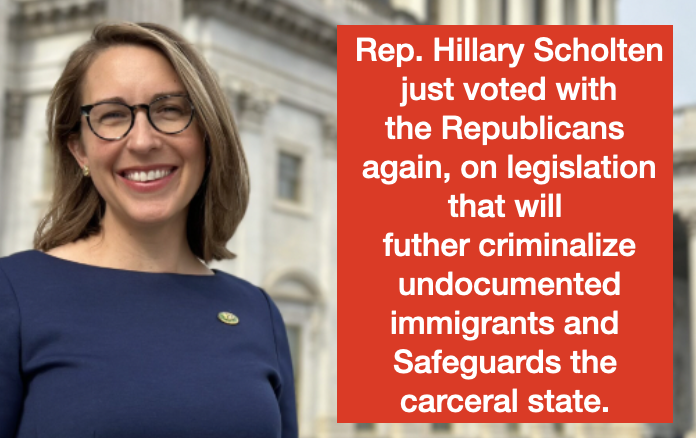
In late January, I reported that Rep. Scholten had voted for the Preventing Violence Against Women by Illegal Aliens Act, H.R. 30. Republicans were claiming that the Preventing Violence Against Women by Illegal Aliens Act would protect women and children. Republican Rep. Nancy Mace from South Carolina argued that the legislation was necessary to protect women and children from a “hoard” of undocumented immigrants sexually abusing “American” women and girls.
In response to H.R. 30, at least 200 organizations that fight against domestic violence have condemned the legislation and are saying that the Preventing Violence Against Women by Illegal Aliens Act will make it easier to deport survivors who get caught up in the criminal legal and child welfare systems as a result of the abuse they suffered.
Last Thursday, Rep. Hillary Scholten voted again with Republicans to pass H.R.35 – Agent Raul Gonzalez Officer Safety Act. Scholten was one of 50 Democrats who voted for this piece of legislation, which states:
A person commits an offense under this section by operating a motor vehicle within 100 miles of the United States border while intentionally fleeing from – ‘’(1) a pursuing U.S. Border Patrol agent acting pursuant to lawful authority; or ‘‘(2) any pursuing Federal, State, or local law enforcement officer who is actively assisting, or under the command of, U.S. Border Patrol.
The penalties for violating this law are:
any person who commits an offense described in subsection (a) shall be—‘‘(A) imprisoned for a term of not more than 2 years; ‘‘(B) fined under this title; or ‘‘(C) subject to the penalties described in subparagraphs (A) and (B) ‘‘(2) SERIOUS BODILY INJURY.—If serious bodily injury results from the commission of an offense described in subsection (a), the person committing such offense shall be—‘‘(A) imprisoned for a term of not less than 5 years and not more than 20 years; ‘‘(B) fined under this title; or ‘‘(C) subject to the penalties described in subparagraphs (A) and (B). ‘‘(3) DEATH.—If the death of any person results from the commission of an offense described in subsection (a), the person committing such offense shall be— ‘‘(A) imprisoned for a term of not less than 10 years and up to life; ‘‘(B) fined under this title; or ‘‘(C) subject to the penalties described in subparagraphs (A) and (B).’’.
To put this is plain language, those who flee from Border Patrol Agents or other cops assisting them will get up to 2 years in jail and a lot more if any of the Border Patrol Agents or cops are injured or killed pursuing them.
The fact is that people coming into the US, crossing the Mexico/US border, are fleeing either political repression, political violence, debilitating poverty or the climate crisis. It is a reasonable response for people fleeing these circumstances to not want to be arrested, detained and deported back to what they fled in the first place.
This bill not only punishes people from other countries who cross into the US from Mexico, it ignores the context of why people are fleeing their country of origin and it elevates the carceral state, which expects everyone to follow the rule of law, even if those laws are unjust and target certain populations.
For as much as Rep. Scholten likes to remind us that she was an immigration lawyer, she continues to vote for policies that further criminalizes undocumented immigrants, and policies that the Republicans introduced. It would appear the Rep. Scholten is more interested in getting re-elected in the 3rd Congressional District, rather than using her vote to fight for immigrant justice.
GRIID Class on the Prison Industrial Complex in Kent County – Week #2
In our last class we talked about several different items related to the Prison Industrial Complex in Grand Rapids. The first item was a news story that I had sent everyone from last year, a story featuring Kent County Prosecutor Chris Becker talking about why the GRPD were not being charged for anything in the shooting of a Black man they thought was armed.

Participants talked about how awful this news story was, since it not only didn’t provide adequate context for the mental health issues of the man that was killed by the GRPS, the reporter never questions or challenges what the County Prosecutor had to say. Here is a GRIID deconstruction of that story, which I wrote just before the holiday break.
The second thing we discussed in week #2 was some research that was done for the non-profit Linc Up, research that has some instructive data on race, class and other aspects of the Prison Industrial Complex in Kent County. The slide above is just one of the examples from this research, which you can access here.
However, most of our time in week #2, was spent discussing a two-part documentary entitled, Re-Visions of Abolition, which you can watch here. Some of the themes address in this documentary were:
- What is the Prison Industrial Complex (PIC)
- Gender Violence and the PIC
- Mothers and how the PIC destroys communities
- The War on Drugs
- The Culture of the Carceral State

- Capitalism and the PIC
- Abolition: Past, Present & Futures
- Abolition Not Reform
- Critical Resistance
- The L.E.A.D. Project
- The Future of Abolition

The documentary generated a great deal of conversation, with important observations and input from the participants. There was great conversation around the the War on Drugs, Capitalism and the PIC and Abolition Not reform. Next week we will begin to read from the new book Beyond Courts, which was written by Interrupting Criminalization, Community Justice Exchange, and Critical Resistance. This book takes a critical look at how the court system in the US really functions, through an abolitionist lens.
A timeline of GRPS stance on the threat of mass deportation, plus a powerful response from Denver Public Schools to Immigration Customs and Enforcement (ICE)
The Grand Rapids Public Schools has pretty much stuck to their initial response when it comes with policies regarding Immigration and Customs Enforcement (ICE) coming to schools within the District. Here is a link to what they send to faculty and parents regarding ICE.
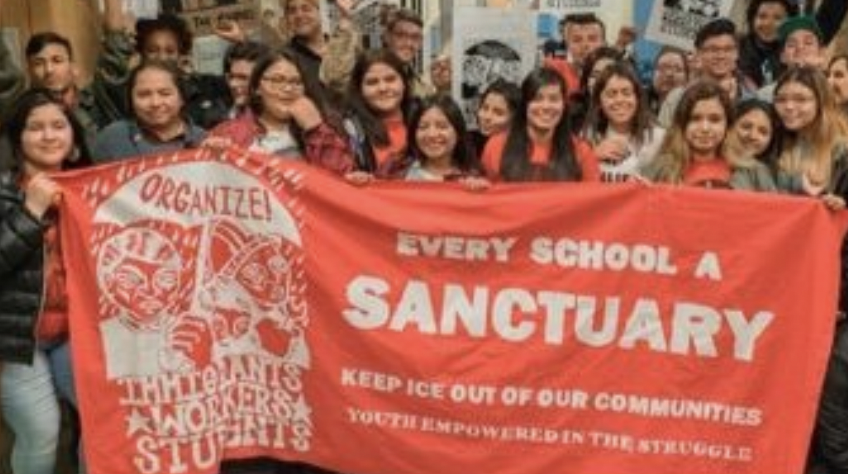
The problem with this response is simply that it is a one-way street. What would it have looked like if the GRPS held a meeting, or meetings, in the community, particularly with communities that are high risk for arrest, detention and deportation? Holding listening session with the affected communities would have been a much better response, as opposed to the GRPS Administration thinking that they know what is best for immigrant communities who are facing the threat of mass deportation.
Around the same time that the GRPS sent out their own policy position on ICE, GR Rapid Response to ICE had created an Action Alert for people to sign, an Action Alert that had some demands and reasons for those demands, which you can read here.
I then wrote about the GRPS Board meeting that was held on January 13th, which had students, parents and community members calling for the District to adopt a Sanctuary policy. There was overwhelming support from the public.
 GRIID has also been sharing toolkits on Sanctuary for Schools, in both English and Spanish, which are modeled after what schools in Detroit were doing.
On January 27th, at the Grand Rapids School Board, there was additional discussion about a Sanctuary policy and some School Board members questioned why the Action Alerts that were being sent to School Board members were being suppressed, which I also wrote about.
GR Rapid Response to ICE sent a letter to the GRPS regarding the censured Action Alert messages the following week. GRPS School Board President Kim Davis responded in an Email, which you can read from the GR Rapid Response to ICE Facebook page here.
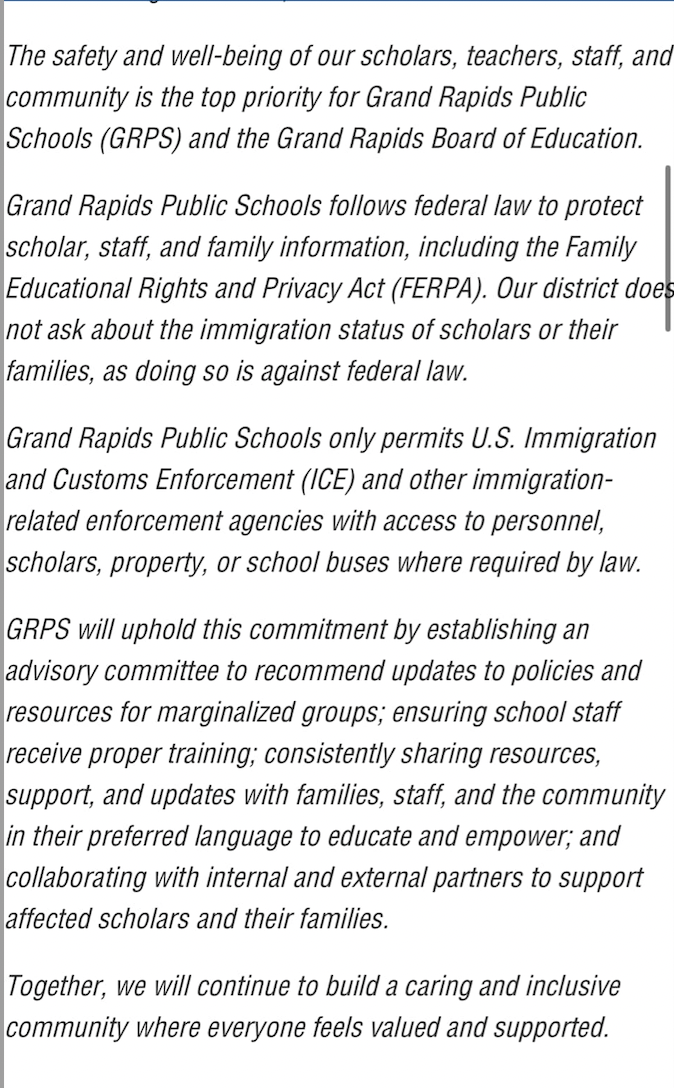
Last Monday, February 10th, the GRPS adopted the following resolution, which is posted here on the right. The GRPS School Board member who pushed for the GRPS to take a more robust stance on the threat of mass deportations, Jose Rodriguez, was the only GRPS School Board member to vote no on this resolution.
A Lake of Radical Imagination
As I stated earlier, GRPS making decisions without listening to input from communities at risk of mass deportation, normalizes a power dynamic that is one way, where the GRPS knows better on matters of immigration policy and the threat of mass deportation.
However, not all schools are adopting superficial policies regarding how to deal with Immigration and Customs Enforcement (ICE). Just last week, the Denver Public Schools (DPS), “sued the Trump administration in federal court, alleging “irreparable harm” from the repeal of a policy that put schools, churches and other sensitive locations off-limits for raids.”
According to the Colorado Newsline, the DPS put out this statement:
“For decades, DPS, its students, and their families have relied on this Protected Areas Policy to provide education and services for their students,” says the district’s lawsuit, filed in the U.S. District Court of Colorado against the Department of Homeland Security.
The DPS went on to say, ““DPS has been forced to divert resources from its educational mission to prepare for immigration arrests on DPS school grounds,” says the lawsuit. “DPS has therefore spent significant time and resources implementing policies ensuring student safety and training staff and faculty to effectively respond to encounters with individuals claiming to be conducting immigration enforcement activities on school grounds.”
Lastly, according to the Colorado Newsline, “The district’s lawsuit seeks a temporary restraining order barring DHS from “implementing, enforcing, or acting pursuant to” the new policy on protected areas. In a statement Wednesday, DPS Superintendent Alex Marrero said that the district was acting to ensure that schools can remain a safe place for all students and their families, regardless of their immigration status.”
Imagine if the Grand Rapids Public Schools had taken a similar stance as the Denver Public Schools. Imagine how the communities impacted by the threat of mass deportation would feel in Grand Rapids, if GRPS had taken this action. It seems clear that the Denver Public Schools are listening to affected communities on these urgent matters, instead of adopting tepid resolutions.

