Statewide Group Targets Consumers Energy CEO
Today in Grand Rapids 15 people gathered in front of the Consumers Energy offices in Wyoming, Michigan to kick-off a new campaign targeting David Joos, CEO of Consumers Energy. The Press Conference was one of many throughout the state, where consumers, activists and environmental organization came together to say no to more coal plants that are proposed in Michigan.

Representatives from the Sierra Club, Clean Water Action, Michigan Citizen Action & a Consumers Energy ratepayer spoke to a variety of reasons for opposing more coal plants in the state of Michigan. One of the reasons for coal plant opposition was the negative impact of coal, from both the mining and burning of coal.
Another issue that was addressed was the possibility for Michigan to generate its own renewable energy. Erin Knott with Michigan Citizen Action sited a recent study by the Natural Resources Defense Council, which supports the idea that Michigan can meet its energy needs through a combination of renewable sources. Some of the finds from this study are:
- Energy efficiency programs could save Michigan $3 billion in electricity costs over the next 20 years.
- Michigan’s previous energy plan, written in 2007, is out of date, with unrealistic projections of future electrical demand, limited implementation of energy efficiency and renewable energy, and reliance on outdated 20th century coal technologies.
- Clean renewable energy is less expensive, cleaner, faster, more economically robust, and creates more jobs in Michigan than a 20th century plan based on new but obsolete large power plants driven by fossil fuels.
Lee Sprague with the Sierra Club ended the Press Conference by encouraging people to sign the online petition that Clean Energy Now is circulating that tells Consumers Energy CEO David Joos to put an end to coal plants in Michigan and to invest in Green Jobs and clean energy.
Below is a video of the Press Conference in its entirety.
New GR Press Editor Speaks to the Progressive Women’s Alliance
Starting last July, Paul Keep has been the editor for the Grand Rapids Press, replacing long-time editor Mike Lloyd. Wednesday night Keep spoke at a forum hosted by the Progressive Women’s Alliance.

Keep began his talk by reading some comments from readers about Sarah Palin’s visit to Grand Rapids, with one of them being from a someone who referred to the GR Press as “liberal,” a comment that drew laughter from the crowd of about 75 people who came to hear the new Press editor speak.
The speaker talked about the reasons that newspapers are financially challenged in the US. Keep said that one of the big things that have happened at newspapers across the country was lay-offs. However, the editor said that the Press did not lay people off, rather they offer employees a buyout. Another change that is evident at the Press has been the reduction in the size of the paper.
Keep said there were three main reasons for these changes at the only daily newspaper in Grand Rapids. First, he said, the national economy’s recession has meant that Sunday inserts are cut or reduced to fewer weeks, since national companies were spending less on advertising. Second, since Michigan’s economy was also hurting regional businesses like Art Van’s and Meijer were also reducing their advertising revenue.
At this point Keep wanted to make it clear to the audience that 75% of the revenue that the Press generated was from advertising and since advertising revenue was down they had to make changes. The third, and last reason for the changes was the role that the Internet was playing. More people are getting their news content online and less likely to read newsprint. Keep did say that the Internet has been a positive aspect for the paper in some ways since it allows their reporters to do more with video and audio. However, fewer people are paying for ad space in the classified section, so again it seems that all three reasons for the changes at the Press were based on a decline in advertising revenue.
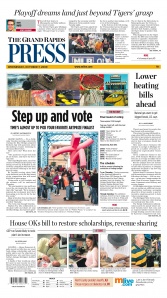
Keep then wanted to reassure the audience that the news side of things will stay the same and that the Press “will do whatever it can to provide good news, with an emphasis on local.” He said that national and international news changes so much, so what they print in the morning is old news by the time that people receive their paper, which is why local reporting is important.
The editor mentioned that the Grand Rapids Press was part of the Booth Newspaper chain and that it was a family business. While it is true that the Press is part of the Booth newspaper chain, Booth is just a subsidiary of a much larger media conglomerate known as Advance Publications, which owns dozens of newspapers across the country, magazines and some broadcast media. So it seemed a bit dishonest to present the Press as owned by “a family business.”
Keep went on to say that the Booth Newspapers have made changes in the past year across the state, but he didn’t mention that the consolidation of the Booth papers meant that the Grand Rapids office would been doing the design and copy editing for all the Booth papers. The Press editor did say that the Booth chain was doing some experimenting right now with their papers and he provided three examples for the audience.
First, reducing the size of the paper in Grand Rapids is one experiment. They reduced the amount of national and international news and also moved it to the back of section A opposite the editorial page. A second experiment is what happened in Ann Arbor where the decision was to shut down the print paper and go to an online presence. They did start up a different print publication that is only printed on Thursdays and Sundays. The Third experiment is with the papers in Flint, Saginaw and Bay City, which are share some content, national news and local sports. They cut out 4 days of publication, leaving Thursday, Friday and Sunday as the days people would get newspapers. Keep said they are waiting to see which of the three experiments works best.
The Press editor concluded by saying, “We are a profit making company, so we need to make more than our expenses. Since it is a big retail time, it is also an important time for the papers.” Apparently ad revenues are big this time of the year for the paper. Keep also said that he thinks that journalism is going to be fine and that newspapers will be fine, based on the fact that people will always want local information.
There was a question and answer period after the talk but most of the questions continued to deal with issues like readership, advertising and competition with the Internet. There was one question about the editorial process used in deciding which candidates to support and Keep said there are four of their staff, which makes that decision.
Someone also asked about the GR Press relationship to the Rapidian. Keep said that they have had conversations with them, but frankly he hasn’t followed the site much in recent weeks.
Another person asked about process for deciding local stories versus wire service stories in the religion section of the paper. Keep said that that depends on what is happening locally, how many reporters they have available and whether or not the wire story has interesting content.
GRIID did ask Keep about their claim to have a commitment to local news. We asked him about our recent study that concluded that the Press gave way more coverage to ArtPrize than they did to local elections this fall. Keep responded by saying that they want to focus more on local elections and then said they plan on doing monthly election issue themes leading up to the 2010 Governor’s race. Apparently, his definition of local is different than ours.
Corporate Front Group Presents on Climate Change
The Consumer Energy Alliance (CEA) hosted an event today in Grand Rapids that was billed as “A Business Primer on Federal Climate Change and Energy Legislation.” About 30 people gathered to listen to Tom Mullikin, who the CEA refers to as an “environmental attorney.”
Mullikin began his talk with what he called background on the issue of Climate Change. He said that the issue is usually framed by the two most polar opposite ends – the far right, which denies global warming and the far left, which says we need to reduce global carbon emissions by 83%. I understand how denying global warming is a polarizing perspective, but to say that an 83% reduction of carbon emissions is far left perspective, dismisses the leading scientific body, the Intergovernmental Panel on Climate Change (IPCC), which agrees that there needs to be about an 80% reduction in carbon emissions by 2050.

Next Mullikin talked about the “bad precedent that was set at Kyoto.” The speaker said that the language of Kyoto framed the debate of global warming between developed nations and developing nations in such a way as to exempt developing nations from any responsibility for global warming. Mullikin thinks that countries like China and Brazil are more responsible for carbon emissions than the US or the European Union. What he failed to address is that while China produces a significant amount of carbon emissions, the US proportionately generates more since we have a significantly smaller population.
Mullikin showed the audience lots of graphs and charts to support his main points, all of which downplayed US responsibility for global warming. Some of the main points he made were:
- Human activity on generates about 5% of Green House Gases (GHG)
- The US is only responsible for 17.9% of GHG
- US manufacturing is 3 times more energy efficient than in Asia
Mullikin told the story of when he was in Minnesota as part of an effort to bring a new steel plant to that state. He said that environmentalists were opposed to it because of all the carbon emissions generated, but countered by saying that the same steel plant in China would generate more carbon emissions in China because there was less regulation.
In fact, Mullikin seems to direct most of his criticism towards China, but offered no context. When I asked him about manufacturing jobs moving to China and the causes he said it had to do with “currency manipulation,” ignoring trade policy and minimizing the profit motive of large corporations to find a cheaper wage market.
Mullikin concluded his presentation by saying that if the Waxman-Markey legislation is adopted, Michigan will lose 90,800 jobs. Mullikin did not explore the content of the Waxman-Makey bill and his source for the data on Michigan job loss was a study by the National Association of Manufacturers (NAM).
Using sources like NAM, which represents business interests, was typical of most of the sources he cited. Other sources were Energy Matters MidWest, another business-centered group, Secure Our Fuels (part of CEA) and the American Petroleum Institute, which represents Big Oil.

In fact, when looking at the website for the Consumer Energy Alliance, it becomes clear that they don’t represent a non-profit, non-partisan perspective, rather a very pro-corporate alliance. The organization’s affiliates is a who’s who of energy companies, business associations and conservative Think Tanks. If anything the Consumer Energy Alliance should be seen as an astroturf organization that was created and funded by a corporate alliance in order to promote that agenda.
Mulliken said throughout his presentation that the audience shouldn’t take his word for the data he was offering. This was good advice, since most of what he presented was at best biased, but more accurately deceptive, since there was no honest commentary about how the Consumer Energy Alliance came to be and whom it represents.
Media Bites – Product Placement and Viral Marketing
This week’s Media Bites takes a look at how advertising continues to infiltrate all kinds of media. We first look at the use of Product Placement in films like Zombieland and X-Men Wolverine. We also look at a recent attempt by the Captain Morgan brand to pay NFL football players to strike the Captain Morgan pose during games. This technique is what the industry calls viral marketing, which is effective when the public starts to mimic what the use of the brand.
Heartwell fills in for Mayor Daley at Econ Club event
Mayor George Heartwell spoke Monday afternoon on short notice to the Grand Rapids Economics Club. The scheduled speaker was to be Mayor Richard Daley of Chicago. Daley was forced to cancel at the last minute due to the apparent suicide of Michael Scott, President of the Chicago School Board. Heartwell used the opportunity to make a speech full of plenty of nice quotes about where he would like to see Grand Rapids in the future, but did not seem to have much substance to actually back it up.
Calling Grand Rapids “a little Chicago” and stating that the city is “making a transformation from manufacturing to a knowledge based economy”, the mayor put great emphasis on the city’s attempts to retain young professionals. The same sentiment was recently put forward by Frey Foundation President Milt Rohwer in the Grand Rapids Business Journal.
According to Heartwell, this young talent will be “lured to Grand Rapids by things like Founders Brewing Company and Metallica concerts”, but had few words on what jobs might be here for these people.
He also spoke briefly about Grand Rapids Public Schools, stating that on a recent tour of a few of them, he found “the learning environment different from that of popular mythology” and that “students were engaged and discipline was not an issue.”
While only once at the beginning mentioning that the city is facing a “budget deficit of $28 million”, and not bringing up at all the recent decision to lay off 125 city workers, the mayor talked about grandiose plans to bring about more public transportation and bike paths.
As the mayor wrapped up his talk with the quote, “I am so damn proud of Grand Rapids,” he was given a standing ovation by the crowd of around 500, most of which represent the area’s economic elite.
Journalism as Advertising: The GR Press & Black Friday
On Monday the Grand Rapids Press ran as the lead front-page story an article about local retailers “leaking” their Black Friday Deals to the public. The headline of this story read, “Black Friday buildup begins.”

Both Meijer and Target spokespersons are quoted in this article about why they have decided to release their sale items early. The Meijer spokesperson said, “The indicators are saying retail sales in general will be flat for the season. We’re basically trying to amp up the game.”
In many ways you could argue that this story is nothing more than a glorified ad for both Meijer and Target stores. There doesn’t seem to be any journalistic value, since there are no other sources cited, sources, which might be talking about the current economic troubles or comments from working people who have limited resources for holiday shopping.
Instead, the Press story includes the website Gottadeal.com, which is essentially an advertising site. One wonders why the only daily newspaper in Grand Rapids would be compelled to report such a story, let alone make it the lead article. Considering that in the 16-page section of the November 16 edition of the Press there were already 5 ½ pages of advertising, there is no need to use limited space to “amp” up sales for big retailers.
Road to Copenhagen Part 2: Climate Rage
Yesterday it was announced by world leaders that there would be no clear goals determined at the International Climate Summit next month in Copenhagen, Denmark.
According to the Reuters story “negotiations have been bogged down, with developing nations accusing the rich world of failing to set themselves deep enough 2020 goals for curbing greenhouse gas emissions.” The article also suggests that the delay might give the US Senate time to pass its version of Climate Change legislation, which we will analyze later this week.

This delay by world leaders will no doubt fuel the growing Climate Rage that Naomi Klein just wrote about in an article for Rolling Stone Magazine. This idea of Climate Rage is reflecting in a growing international movement, particularly in developing nations, to confront the rich nations of the world (G8 nations), who have been the primary generators of carbon emissions.
Movements within the developing world are even now calling for Climate Debt, which is the idea that “rich countries should pay reparations to poor countries for the climate crisis.” A Bolivian delegate Angelica Navarro better articulated this idea of Climate Debt at a recent UN gathering. Navarro said, “Millions of people – in small islands, least-developed countries, landlocked countries as well as vulnerable communities in Brazil, India and China, and all around the world – are suffering from the effects of a problem to which they did not contribute.”
Klein has also been suggesting that we can expect the kind of direct action and public resistance at Copenhagen that the world has seen since Seattle.
“There is certainly a Seattle quality to the Copenhagen mobilization: the huge range of groups that will be there; the diverse tactics that will be on display; and the developing-country governments ready to bring activist demands into the summit. But Copenhagen is not merely a Seattle do-over. It feels, instead, as though the progressive tectonic plates are shifting, creating a movement that builds on the strengths of an earlier era but also learns from its mistakes.”
We plan to report on this resistance and critique the commercial media’s coverage of Copenhagen, since there is no indication that the mainstream news media will report on the real motives and actions of the thousands of people on the streets.
For some good discussion on Climate Change and Climate Rage, watch this 2 Part interview with Naomi Klein on Ring of Fire Radio.
Local Screening of documentary on Children & Commercialism
The local child advocacy group STOK – Stop Targeting Our Kids – is hosting a public screening of the documentary Consuming Kids: The Commercialization of Childhood.
Produced by the Media Education Foundation, the documentary “throws desperately needed light on the practices of a relentless multi-billion dollar marketing machine that now sells kids and their parents everything from junk food and violent video games to bogus educational products and the family car. Drawing on the insights of health care professionals, children’s advocates, and industry insiders, the film focuses on the explosive growth of child marketing in the wake of deregulation, showing how youth marketers have used the latest advances in psychology, anthropology, and neuroscience to transform American children into one of the most powerful and profitable consumer demographics in the world.”
When: Thursday, November 19 at 7pm
Where: Wyoming Park United Methodist Church, 2244 Porter SW in Wyoming, MI
For more information contact STOK at stokaction@gmail.com.
Interview with Dennis Banks
We had a chance to interview Dennis Banks, co-founder of the American Indian Movement (AIM), while he was in town participating in the Great Lakes History Conference. We talked with Dennis about the US Policy of removing Native children from their communities, what led to the creation of AIM, the 1973 occupation and current Native struggles across the country. The interview is in 4 parts.
The Business Class and Talent Production
One way to understand the business class is to read the business press. Quite often the reporting is more honest in the sense that they are more up front about what they are doing since their audience is primarily the business community.
In the most recent issue of the Grand Rapids Business Journal there was a short interview with Frey Foundation President Milt Rohwer. Rohwer was asked what he thinks needs to happen in order for Michigan’s economy to thrive. Rohwer thinks that people need to support “education to generate the high-quality talent needed for the economies and jobs of the future.”

Rohwer goes on to say, “To me it’s really an issue of understanding the globally competitive nature of the economy and the extent to which prosperity is related to jobs that require a very high degree of skill and education.”
In the Business Journal interview Rohwer says that he is trying to improve education in Michigan, particularly education that would create economic talent. Rowher does this work through mainly through an organization called Michigan Future Inc. According to the website, “Michigan Future, Inc. is a non-partisan, non-profit organization. Our mission is to be a source of new ideas on how Michigan can succeed as a world class community in a knowledge-driven economy.”
Education, through the lens of Rohwer and Michigan Future Inc., is really about creating future talent for the business community throughout the state. This is reflected in who sits on the board of Michigan Future Inc. Some of the notable board members are from DTE Energy, the Detroit Chamber of Commerce, Crain’s Detroit Business and the New Economy Initiative. In addition, Michigan Future Inc. has people from the Detroit Public Schools, the business law firm of Jaffe, Raitt, Heuer & Weiss, and several Michigan Foundations, including the Frey Foundation.
In the interview Milt Rohwer affirms this notion of education serving the interests of the business class when he states, “I’m hopeful employers will make their voice known in terms of their needs for very well trained people coming out of higher education and K-12 school systems.”
People will argue that this is a good thing if it provides people with good paying jobs, but what is usually not included in this discussion is that only a small percentage of people will get high paying jobs, even though taxpayers subsidize the public education system that provides the “talent” for these businesses. In this sense the business community only sees our educational system merely as a mechanism to groom new and talented employees that will help create the profits they seek to remain “competitive in the global economy.”

