Today, the Grand Rapids Press ran a front-page story about the decision of a US judge to dismiss charges against Blackwater security guards for shooting Iraqi civilians in 2007.

The Associated Press (AP) story quotes Judge Ricardo Urbina as saying the case was “contradictory, unbelievable and lacking in credibility.” The article includes comments from lawyers on both sides and a Justice Department spokesperson who says they are “reviewing the opinion and considering our options.”
Another source cited in the story in Bill Huizenga, a life long friend of Blackwater founder Erik Prince, and current candidate for the Congressional seat being vacated by Pete Hoekstra. In fact, Huizenga is cited more than anyone in the story and says, “the government has used Erik Prince and Blackwater as a political football.”
If Blackwater is being used as a political football, then why does the current administration continue to give Blackwater substantial taxpayer funded contracts in places like Afghanistan? Another question that should be asked is why does one of Prince’s buddies become a news source for this story? Why not include comments from Iraqis who lost family members in the 2007 Blackwater shootings?
The AP did run comments from one Iraqi man who lost his wife and son in the 2007 shootings. Dr. Haitham Ahmed responded to the US judges’ decision by saying, “the whole thing has become a farce.”
Jeremy Scahill, independent journalist and author of an in depth book on Blackwater posted a response to Judge Urbina’s decision to dismiss the charges against Blackwater. Scahill feels that the decision “is a stunning blow for the Iraqi victims’ families and sends a clear message that US-funded mercenaries are above all systems of law—US and international.”
Scahill goes on to write,
In a memo defending his opinion, Urbina cited a similar rationale used in the dismissal of charges against Iran-Contra figure Oliver North—namely that the government violated the rights of the Blackwater men by using statements they made to investigators in the immediate aftermath of the shooting to build a case against the guards, which Urbina said qualified for “derivative use immunity.” Urbina wrote that he agreed that “the government violated [the Blackwater guards’] constitutional rights by utilizing statements they made to Department of State investigators, which were compelled under a threat of job loss.” He added that the “government is prohibited from using such compelled statements or any evidence obtained as a result of those statements” to bring indictments.
It seems that the judge did not deny the fact that Blackwater mercenaries killed Iraqi civilians in 2007, only that their prosecution did not follow “proper procedures.”
Zapatista Struggle Continues 16 Years Later

Today marks the sixteenth anniversary of the EZLN (Ejercito Zapatista Liberacion Nacional) uprising in Chiapas, Mexico. Mostly Mayan campesinos organized an armed uprising against an oppressive Mexican government, which negotiated the North American Free Trade Agreement (NAFTA), which the Zapatistas saw as a death sentence to their way of life.
For sixteen years the Zapatistas have fought government and economic repression and have created autonomous communities throughout Chiapas. The have built schools, clinics and created a cooperative model of living that has inspired millions around the world.
The Zapatistas have a rich history of struggle that has been well documented. We encourage everyone to become familiar with this history so that we might learn to struggle for our own liberation from war, racism and economic exploitation.
Here is video from a non-violent action that several thousands Zapatistas participated in on the anniversary of their uprising in 2001. People marched to a nearby military base to occupy it and demand that the soldiers leave.
ALBA Declaration on Copenhagen Climate Summit
The following is the statement issued by the Bolivarian Alliance for the Peoples of Our America (ALBA) on 18 December in response to the results of the UN Copenhagen Climate Summit.
We, the countries that make up ALBA, denounce before the world the threat that the results of the United Nations Conference in Copenhagen pose for the destiny of humanity.

In the first place, the process of negotiations was corrupted by the violation of the essential principles of the multilateral system. This undemocratic process has not recognised the equality of all, was dishonest, not very transparent, and exclusive. It was designed to guarantee the positions of a small group of countries.
Our response to climate change must be in accordance with the principles of the United Nations Charter. This process has lacked legitimacy; it has violated all the principles of multilateralism and the United Nations Charter, above all those of sovereign equality between all countries.
The main characteristic of this unfortunate failed meeting is that a very small group of countries, coordinated and convoked by Denmark, have been for the last few weeks writing an accord that they have unilaterally named “Interested parties”, excluding the large majority of the world, establishing first class and second class countries as criteria.
While the chair of the Summit sent countries to take up the groups again, in order to continue editing and cleaning up the texts that were approved by the particpants as a basis of negotiation, at the same time, the Danish prime minister convoked the presidents of a group of countries to edit a document behind our backs.
Further evidence of the exclusive nature of this event is the call of a group of Presidents behind closed doors, without participation of the majority and without explaining the criteria behind the selection.
It’s clear that we can’t consider the issue of climate change without considering changing the system. The model of capitalist production and consumption is bringing life on the planet to the point of no return and to a crucial moment in human history, and the debate in these situations can’t be reduced to the economic interests of a small group.
Until now very little has been achieved, however it is important to preserve the current climate agreements: the United Nations Framework Convention on Climate Change and the Kyoto Protocol. They are important platforms for advancing the defence of life. Here we have an important world political accord, where all of us agree that climate change is a problem that has to be urgently addressed, and where the countries who are historically responsible for the problem have agreed to commit themselves to reducing emissions by amounts that allow the problem to be addressed.
The current scenario is seeing all this take a big step backwards, and requires us to forget the Kyoto Protocol. In this summit we haven’t managed to write accords that address the obligations of the developed countries: to establish aims of reducing emissions or to establish a second period of commitments for the Kyoto Protocol.
There are offers on the table, but none of them compare. The United States doesn’t want to commit itself on the basis of the efforts of other developed countries. The developed countries came to this meeting with a prior agenda, and they are violating every democratic proceeding in their attempt to impose it.
In the Bali Plan of Action, approved in 2007, it was agreed that the developed countries would have obligations of mitigation, to which they would add voluntary actions of mitigation of the developing countries.

Now, the developed countries have dedicated themselves to misunderstanding the Bali Plan over the last two years, in order to try to use this manifestation of our will to unite our efforts as a way of transferring their obligations to us. The efforts and will to mitigate of the developing countries can’t be used as a way to manipulate us and tell us, after they have destroyed the world, that now its our turn to mitigate so that they can continue contaminating and destroying on the basis of their patterns of exploitation, production, and consumption.
There is also the issue of principles here. We, the developing countries, are dignified and sovereign nations and victims of a problem that we didn’t cause. This moral principle, based on historic responsibility, is the reason why the developed countries should provide sufficient resources for the complete implementation of the principles of the Convention.
The environmental crisis as a result of the increased temperatures of the atmosphere is a consequence of the capitalist system, of the prolonged and unsustainable pattern of production and consumption of the developed countries, of the application and imposition of an absolutely predatory model of development on the rest of the world, and the lack of political will for the full and effective fulfilment of the commitments and obligations of the Kyoto Protocol.
Developed countries have over exploited the atmospheric space. This climatic debt in the widest framework of ecological debt includes an emission debt as much as it includes an adaptation debt that should be honoured by developed countries. It’s not about charity or a handout, but a judicially bound obligation.
Category 1 countries accumulated a total of $1,123 billion in military expenses in 2008. The United States spent $711 billion in 2008, according to the budget for the 2009 financial year, which includes $170 billion for military operations in Iraq and Afghanistan. So the world knows that they have the capacity, but what they don’t have is the political desire to respond to their international commitments and obligations to struggle against climate change. They are trying to use and abuse the needs of the poorest in order to force illegal accords.
Today, through the carbon markets, those who cause climate change, continue contaminating, while the weight of emissions reductions transfers to the developing countries. They thought that in Copenhagen they could convince us to buy their right to contaminate, in exchange offering promises of paltry amounts of money.
1. We strongly denounce and we request that the documents generated by the chair of the summit without the mandate of the participants, be contested, and that we can state our position against the groups of friends of the chair openly. The chair has not guaranteed equality of participation at all levels, including the presidential level.
2. We reiterate our commitment to the struggle against climate change and to the principles of the Kyoto Protocol, now more valid than ever, whose content we consider capable of improvement with the decisions of the participants, and subsequent accords, but something that we shouldn’t allow to die. The complexity of the recent negotiations has shown us that the economic interests in conflict wont allow an accord if the developing countries won’t accept respect for the principles.
3. In this sense, we express our political desire to continue working in the framework of the Convention and the Kyoto Protocol. The relaunch of these negotiations should be based on respect, inclusion, transparency, and legitimacy.
4. We recall that while the conference failed in an irreversible way, the voices of the youth who know that the future is theirs, grows stronger. They strongly denounce the manoeuvres of the developed countries and they know that the struggle will continue. We join with them and their protests, and we salute and support them. The people must stay on their guard.
Today more than ever, before the lamentable manoeuvring that has been practiced in Copenhagen for petty economic interests, we reiterate that, “Don’t change the climate, change the system!”.
Translated by Tamara Pearson for Venezuelanalysis.com
Eight Media Predictions for 2010
A generally hate these kinds of columns and I am not into making predictions, but considering how the news media functions on key issues of the day it seems like the following comments are less about predictions and more about critical thinking.

- Michigan’s Gubernatorial Race will be painful to watch I. None of the candidates for the two major parties seem to have any clue or creativity in how to deal with the current economic woes that confront this state. The best that Democratic candidate John Cherry can come up with is to say he will add a tax to bottled water sold in Michigan to raise money for public education. Great, lets encourage more bottled water consumption and all the negative consequences that come with that.
- Michigan’s Gubernatorial Race will be painful to watch II. The public will be inundated by paid political ads with lots of mud slinging. This means the polis will get little information, lots of propaganda and the radio & TV broadcaster will make tons of money to air political trash talk.
- Green Capitalism will continue to be celebrated. Beware of any media coverage that doesn’t question the claims of entities that say they are GREEN – businesses, governments, and even NGOs. Why does the for-profit media not question when corporations say they are sustainable, governments elevate LEED certified buildings and NGOs who say they are saving the environment one foundation grant at a time?
- Michigan’s Economy will improve for some and screw the rest. The local news media will continue to defer to Upjohn Institute Economist George Erickcek and Right Place President Birgit Klohs on matters of the economy and employment in West Michigan while thousands of working class people will lose jobs, lose benefits and have their wages stagnate or decline. We should stop believing people who don’t really do work.

- Celebrity Journalism will continue to dominate news coverage. In the past year we had plenty of coverage about Michael Jackson’s death, Michael Phelps pot smoking, Taylor Lautner’s connection to West Michigan and the Tiger Woods infidelity deception. This kind of “reporting” will continue, just change the names of the plastic, product pimping celebs.
- The Afghan War will continue to be reported from the perspective of the Pentagon. As the US occupation continues to escalate while public support in America declines. More unmanned drones will bomb Afghan civilians and private military contractors will exceed 100,000. We are not likely to hear about all of this, because a Nobel Peace Prize inhabits the White House and news media still believes the US is bringing peace and democracy to the rest of the world.
- Institutional Racism and White Supremacy will not be a story. I know we live in a post-racial America since a Black man sits in the White House, but hate crimes and institutional racism are alive and well. The far right radio pundits will claim that Obama hates White people, but the fact remains that racial minorities in the US will continue to be disproportionately imprisoned, unemployed, and live in substandard housing. Anti-immigrant groups, the Klan and other White Supremacist groups are very active in Michigan, but the news media refuses to acknowledge them.
- ArtPrize II will be bigger and better than ArtPrize I. The West Michigan media will be fighting to out report each other on the well crafted and manufactured event called ArtPrize. Critical voices will continue to be pushed out, as will the economically undesirable who live near downtown. Lots of money will flow to downtown businesses and Rick DeVos, Kurt Kimball and the rest of the ArtPrize intelligentsia will be given a free pass by the news media because they just want to sell papers or get those juicy ratings.

I wish I could say that I hope these things will not come to pass in 2010, but I don’t believe in hope, and more importantly these things will come to pass because this is how the for-profit news media functions. To expect them to change is like expecting Wal-Mart to be environmentally friendly.
When some workers get laid off it’s front page news
Yesterday the Grand Rapids Press ran a front page story about five GR police officers who are being laid off because of city budget cuts. How nice to see the faces of working people and a personal profile for each one who lost their job.

The question is, why doesn’t the Grand Rapids Press do this every time working people lose their jobs? Why don’t we see pictures and profiles of teachers who lose their jobs, service workers, health care workers, factory workers or even migrant farm workers? Are these other workers less valuable?
As I have written before, it seems that the news media in this community treats police officers with a different standard than other workers. When a police officer dies it receives much more attention and is viewed as a much larger tragedy than when any other worker dies.
Beyond the double standard of how news tends to report on police versus other working people, this type of coverage also fails to question the function of police in our society. Modern police forces evolved out of the desire of economic & political elite’s desire to manager public outrage at growing economic inequalities in the US. (For an excellent review of this history see Kristian Williams book, Our Enemies in Blue.)
This is not to say that police officers do nothing positive in their daily duties, but when coverage of police officers receives special treatment in the news media it makes it all the more difficult to have an honest assessment of their role and function in society.
What We Are Reading
Below is a list of books that we have read in the past month. The comments are not a review of the books, instead sort of an endorsement of ideas and investigations that can provide solid analysis and even inspiration to struggle for change. We plan to do this on a monthly basis. All these books are at The Bloom Collective, so check them out and stimulate your mind.

Tree Spiker, by Mike Roselle – This book was a delight to read. Roselle recounts his own radicalization in the late 60’s and 70’s. He talks about being involved in the anti-war movement and then the early years of the environmental movement. Roselle, who spent years in Montana and surrounding states, felt that mainstream environmental groups too often sold out the protection of wilderness. He eventually became involved in the radical environmental group known as Earth First! Since the 1980s, Roselle has been tirelessly defending the planet and is currently involved in anti-coal direction action with the group Climate Ground Zero.

Smash the Church, Smash the State: The early years of Gay Liberation – This collection of essays by a variety of authors was not only enlightening but very inspiring. These early gay liberation activists not only had an amazing analysis, they challenged the very core of what many of us hold sacred in society.

Violence Over the Land: Indians and Empires in the Early American West, by Ned Blackhawk – I heard Ned Blackhawk speak at a conference in Grand Rapids a few months ago and was very impressed by his scholarship. In his first book, the young Native scholar takes a look at both the policies of the US government towards Indians living in the western territories, he also provides an interesting assessment of how American writers of the last half of the 19th century portrayed these Indian nations.

Israeli Apartheid: A Beginners Guide, by Ben White – Taking on a little discussed topic, White provides readers with an excellent introduction and analysis of how Israel’s policies towards Palestinians can be called nothing other than apartheid. One of the best aspects of the author’s analysis was his comparison to South African Apartheid to see how Israeli Apartheid is similar and uniquely different.

The Old Man: John Brown at Harpers Ferry, by Truman Nelson – John Brown is one of the many misunderstood and misrepresented characters in American history. Truman Nelson’s book not only helps us understand what happened at Harpers Ferry in 1859, but provides readers with an important insight into the person of John Brown. After reading this book John Brown has now become one of my role models.

Capitalism Hits the Fan: The Global Economic Meltdown and What to Do About It, by Rick Wolff – There is still so much about the 2008 economic collapse that we do not understand and that is due in part to the tremendous propaganda that the news media, government and Wall Street foist upon us. In this collection of essays, the author not only provides important analysis of the collapse, but of the real cause…..capitalism. This is not an analysis you will find on talk radio or TV, but Wolff provides us with an important critique that will inform how we should respond.

The Taming of the American Crowd: Stamp Riots to Shopping Sprees, by Al Sandine – The content of this book is as fun as the title. Sandine explores the dynamic of crowds in American history and the factors that contributed to its evolution. What motivated people to take action against injustice and oppression before has too often led to crowds becoming docile consumers and spectators.
Media Bites – Exxon/Mobil
In this week’s Media Bites we look at a recent Exxon/Mobil commercial, where the oil giant tries to present itself as an environmentally responsible company. After deconstructing the ad we address issues like Exxon/Mobil’s funding of junk science, the human and environmental costs of oil production and the political influence the company has in Washington.
The GR Press and End of the Year Journalism
Yesterday’s Grand Rapids Press even outdid its usual weak journalism by filling its pages with end of the year and the decade in review articles.
The Press has downsized its Sunday edition over the past year due in part to the decline in ad revenues, according to comments given by the new Press editor at a public forum several weeks ago. However, economics cannot be the only factor that determines content. Here is a breakdown of Section A of Sunday’s edition of the Grand Rapids Press.

Section A had a total of 16 pages. Three of those pages were made up of editorials and public comment. Another seven and one half pages were taken up by advertisements, leaving five and one half pages of articles.
Three pages of the news content that was taken up by wire stories. On page 3 there was a near full page devoted to what was headlined as Disaster and Triumph. This wasn’t really a story but a series of pictures with captions looking at everything from 9/11 to Katrina, the economic meltdown and the election of Barack Obama.
Then there were the standard World/Nation in Brief snippets, where we get a print version of what CNN popularized as your world in 30 seconds. The Press has also begun adding its own version of snap shot stories that look at what is happening in Michigan. These “briefs” took up another page of content.
There were four other wire stories throughout Section A. On page six there was an AP story on the top 10 stories of 2009. On page 8 there was an AP story about a two-legged dog working with someone with disabilities. Page 9 brought more in depth journalism with a story about the Top 10 video games of 2009, just in case you wanted to add to your gaming collection.
Then on page 11 there was another Decade in Review piece from the Washington Post entitled, “Bad ideas couldn’t have come at a worse time.” Here the story identifies five bad ideas of the decade; Giving up on bin Laden, Compassionate Conservatism, The Sarbanes-Oxley Act, The Blackberry and Housing prices. Each bad idea is given less little space for explanation, but they layout breaks up the page well.
As for local stories in Section A, there were a total of four. One story was about reactions from Congressmen Ehlers and Hoekstra on the “failed” Detroit airport terrorist attack. Another story focused on what “local leaders” (meaning CEOs, politicians and University Presidents) think about the future economic outlook for West Michigan.
The rest of the local stories were part of what the Press called part of a series where they will explore recent immigrants who have started their own businesses. Interesting, but why not write a series on other achievements of recent immigrants or ways they contribute to the West Michigan community? This series could be followed by the difficulties that recent immigrants face, particularly cultural, social and institutional discrimination? However, it wouldn’t be wise to hold your breath waiting for these kinds of stories.
Movie Review: Avatar and Real World Struggles
Sometimes popular culture can provide us with a critique of the way the world really is. That’s not to say that it is perfect or even a great critique, but it can provide a forum to engage people in how to learn of the world.

I just saw the holiday-hyped movie Avatar and despite all of the flaws of Hollywood, this film does provide an interesting and timely critique of what I would identify as ecological and cultural Imperialism.
Once we can get past the fact that this film has come with lots of product tie-ins, that it will make tons of money for News Corp (which owns 20th Century Fox), and McDonalds is using it as a major marketing tool, we might be able to discuss how Avatar is a useful critique of contemporary forms of imperialism.
The film in many ways is retelling an old story – a genocidal policy based on the desire to dominate another culture for the basic purpose of stealing the natural resources from that cultures land base. To do this the predatory culture uses a variety of means to achieve it’s end.
First, the dominant culture tries to win over the “natives” by using a cross between anthropologists and missionaries. The do-gooders provide a school for the children and even learn their language. However, like all anthropological endeavors, the intent is to study their subjects for the benefit of the dominant culture.

Another tactic that is employed in the story-line is to create avatars as a way to infiltrate the native population. Members of the dominant culture try to become natives by creating avatars that are nearly identical to the genetic make up of the Native population. The intent here is to convince the Natives to flee their lands so that the dominant culture can extract the mineral resources.
However, it becomes clear early on in the film that the primary method that the dominant culture uses is military force. It is particularly interesting that in this movie the military personnel that are used are a privatized military, much like Blackwater and Dyn-Corp.
The problem is that one of the private soldiers decides to “turn native,” much like Kevin Kostners character in Dances With Wolves. The marine/avatar is converted by the Native culture, which is rooted in the idea that all creation is sacred. I thought the most profound comment made in the film was when one of the Native females said “we all are just borrowing energy, which eventually we must give back.”
Unfortunately, I fear that audiences in this culture, the current dominant culture, will be too distracted by the special effects, other world creatures and battle scenes that they will not see the larger picture.
Any good historian could say that the human-like species in this film are fantasy representations of Native Americans, cultures that suffered the genocidal policies of Euro-Americans. However, anyone familiar with global politics could easy use the film to make comparisons to current US foreign policy.

The mineral extraction that justifies genocide in the film could easily be compared to what US backed corporations are doing all over the world. The film is a depiction of what is happening in places like Guatemala, where serious human rights abuses are happening because of resistance to gold mining. You could also look at the case of what Shell Oil has been doing in Nigeria for decades, polluting the native lands and killing those who resist the company’s plans.
Another good example is what Chevron is doing in the Amazonian part of Ecuador. Here the petroleum company is killing indigenous communities through contamination and brute force. Joe Berlinger’s, Crude: The Real Price of Oil, captures this reality in a powerful new documentary, which will unfortunately not be seen by a majority of Avatar’s target audience.
In fact, one could go to a website like Mining Watch or read books like Al Gedick’s The New Resource Wars: Native and Environmental Struggles Against Multinational Corporations to see that the plot of Avatar is being played out all across the globe.
For anyone who was moved by the plight of the Na’vi in Avatar, we would encourage you to become familiar with the struggles against imperialism and genocide happening in the world today and take action to affect change.
Gaza: One Year Later
It was one year ago when the Israeli military began a 22-day assault on the people of Gaza, killing 1,400 Palestinians, injuring thousands more, and causing billions of dollars in damage to Palestinian civilian infrastructure.
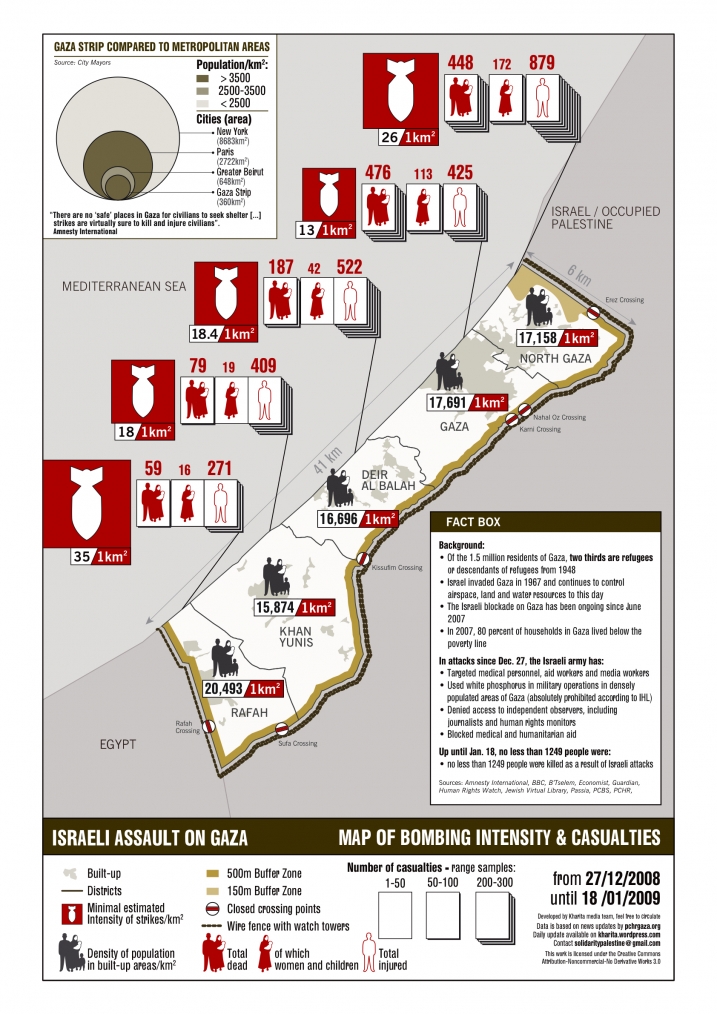
The situation today remains dire as Israel’s blockade of the Gaza Strip remains in place–a recent report from Gisha, the Israeli Legal Center for Freedom of Movement, shows the drastic contrast between the amount of aid that is allowed in monthly versus the amount that is needed. In addition, Agence France Presse reported today that a new Israeli assault has resulted in the deaths of six more Palestinians.
One important question to ask through all of this is what has been the response of the Obama administration? The new administration has responded much like previous ones……it maintains full support of Israel.
The Obama administration has rhetorically challenged the Israeli government to stop building new settlements on Palestinian land. Israel has ignored the US and continued since the Obama administration has done nothing concretely to pressure Israel into changing its position.
The US continues to provide billions of dollars in military equipment and aid, maintained all diplomatic support for Israel’s illegal occupation and ignored the Goldstone Report, which roundly condemned the Israeli military actions in Gaza. In fact, the US not only ignored the Goldstone Report, Congress voted overwhelmingly in November to condemn the report.

However, not everyone is responding to the Israeli brutality against Gaza with silence or complicity. People from around the world are participating in a march with Palestinians to commemorate the 1 Year Anniversary of the Israeli attacks and demand an end to the occupation.
The Gaza Freedom March will have an estimated 1,400 participants from 43 different countries and will march from Gaza to the Israeli border. Israeli activists will march from Israel and meet the other marchers at the border in this historic action.
In response to this courageous action there are several other marches taking place around the world in solidarity with those marching in Gaza to end the occupation. In addition, the US-based End the Occupation Campaign has a list of other actions people can take to be in solidarity with the people of Gaza.


