Vigil Kicks Off Domestic Violence Awareness Month
About 50 people gathered at the downtown YWCA West Central Michigan facility for a candlelight vigil to kick off Domestic Violence Awareness Month. The YWCA has hosted this event for more than a decade.

Eileen McKeever with the YWCA welcomed the crowd and talked a bit about the statistical reality for domestic violence victims across the US. According to the most recent Department of Justice statistics (2005), more than 1,200 people died from domestic violence. Another sobering statistic was that when looking at male and female murder victims in the US, 33% of all women who were murdered last year were murdered by an intimate partner, but in the case of men who were murdered only 3% were murdered by an intimate partner.
In addition to these comments, several women from the community who work in the area of domestic violence prevention and victim services each read the names and information about 16 women who were murdered as a result of domestic in Michigan. The list of 16 was only a partial listing for 2009. In addition, those present watched a YouTube video that stressed the importance of thinking about how Domestic Violence is a learned behavior with children.
We spoke with Eileen McKeever after the event……
What Will the Media Report on After ArtPrize?
The first voting phase of ArtPrize has just been completed and before we know it the finally tallies will be in and ArtPrize will be over. Based on the type of and amount of local news coverage this event has generated, we thought it might be useful to place ArtPrize coverage next to other issues of importance to the community.
Before making any comparisons, it is worth looking at the ongoing coverage of ArtPrize in recent weeks. We have already looked at the ArtPrize media phenomenon is a previous posting from September 19, but here are some observations since then.
The local TV stations continue to provide daily coverage of ArtPrize with specific ArtPrize sections on their web sites like this one at WOODTV8. Most of the local news outlets tended to mimic each other’s coverage, like the story about how downtown restaurants were overwhelmed by the weekend traffic generated by ArtPrize. The FOX 17 story was typical, with lots of language about this being the most amazing event Grand Rapids has ever experienced, but with emphasis on how restaurant owners made out like bandits.

WZZM 13 had a few other elements that were tapping into the ArtPrize buzz. First, the added to the web site banner in big letters “The Place to See ArtPrize.” They also included on their main page a banner and link to their own photo contest under the heading “What is Art?” The contest is also based on voting, with the winner receiving $1,300. WZZM 13 partnered with local furniture company Haworth to promote their own contest.
The Grand Rapids Press has in many ways been the most zealous of ArtPrize supporters in local media. Beyond what we have already documented, the very first day they altered the design of the front page so that it looked like an ArtPrize magazine cover. They continue to provide daily front-page coverage and several other pages full of stories and photos.
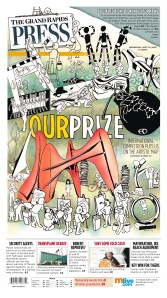
The most egregious example to date was the Monday, September 28 coverage, driven mostly by the reporting on the Rob Bliss paper airplane spectacle. The Press did several stories about this ArtPrize entry days before it happened, but the coverage afterwards was pretty astounding. The main story on 9/28 gushed with praise of the event created by what the Press reported has dubbed “urban event organizer Rob Bliss.”
There has been plenty of online discussion about whether or not the paper airplane drop was art or not, but as we have said all along the real beneficiaries of the ArtPrize phenomenon has been the downtown business and property owners. The financial incentive is tremendous, which is exactly why the local media has created so much content around ArtPrize, because this is what they believe will bring people to their web sites and thus, bring visitors to see the multitude of ads that inhabit those electronic destinations. As in the print version of the Press and the broadcast channels of the tv stations, advertising is king, because advertising is where they make their money. These news entities would not even entertain hosting a website if it was not driven by the advertising that pays for the sites.
Imagine ArtPrize-like coverage for other issues
Since it is painfully clear that local media coverage of ArtPrize has been all ArtPrize all the time, lets turn our attention to what this might look like with other issues of import to the local community.
A month from now there will be elections for local political office and several ballot proposals. According to the Kent County Clerk’s office, there are 45 candidates running for local office in Grand Rapids and other communities in Kent County. Imagine how what it would look like over the next few weeks if the local news media paid as much attention to the candidates, people who will make decisions that impact our lives everyday, as they have to ArtPrize.
There could be lead stories on the TV stations everyday with details about the candidates and particularly about the incumbents and what their voting records have meant for the people thus far. The GR Press could run front-page stories that featured in-depth analysis of the candidates and the issues they face with current budget problems, unemployment and sustainability efforts. Would this type of coverage translate into more people showing up at the polls on November 3? We will probably never know, since the coverage of local elections that we have documented over the past 10 years has been abysmal.
Imagine if the local news media was reporting on the lives of people, which number in the thousands in Kent County, who have lost jobs or are about to lose their unemployment benefits. How would we all perceive what is going on in our community if we were made aware of in detail the hardships that these people face?
The same could be said about the thousands of Kent County residents that currently have no health care insurance. Imagine if these thousands of people who are at greater risk of disease and suffering because they can’t afford health care got the same attention as the thousands of paper airplanes that kind of floated down to the streets of Grand Rapids. How would this type of coverage how we view our community?
“60 Minutes” Gives Gen. McChrystal a Free Pass on Proposed US Troop Increases in Afghanistan
On Sunday, the CBS news show “60 Minutes” featured an interview with President Obama’s top military general speaking on Afghanistan. Despite the popular notion that “60 Minutes” is a hard hitting and investigative program, reporter David Martin did not challenge McChrystal on the eve of the 8th anniversary of the US occupation of Afghanistan.

Online journal editor Bruce Jackson provides some excellent analysis of the “60 Minutes” episode in a piece that was posted on CounterPunch. Jackson states early on in the piece,
“The interview was more than just another “60 Minutes” puff piece. Four-star battlefront generals don’t put on dog-and-pony shows for reporters without a very good reason for doing so, and he put on a very fancy show for Martin, with stops at his room, his office, his briefing room, trips in his helicopter and SUV, and much more. It’s difficult to imagine that McChrystal’s reason was anything other than putting pressure on the Obama administration to give him the series of very large troop increases he thinks he needs to win his war.”
With growing public opposition to the US war in Afghanistan and McChrystal asking for an additional 40,000 US troops, it is no time for the news media to fail the public on asking hard questions to people who will make decisions that will affect us all.
We encourage you to watch the “60 Minutes” interview and judge for yourself.
Media Bites – Levi’s & Corporate Branding
This week’s Media Bites takes a look at a Levi’s commercial, which is part of their new “Go Forth” campaign. The spot uses crisp clean images of average Americans while viewers hear the words of a Walt Whitman poem called “America.” This Levi’s campaign has a significant web component as well, but the irony of the emphasis on America in the Levi’s campaign is that they no longer produce jeans in the US. This commercial is a great example of how corporations are always trying to brand themselves.
Top 25 Censored Stories of 2009
Every year Project Censored publishes its Top 25 Censored stories in the US. Project Censored has been documenting censorship in the US media since 1976 and has trained thousands of students who have participated in this project. The Top 25 stories are always published in book form and this year the introduction was written by independent journalist and author, Dahr Jamail.

Here are the Top 25 censored stories for the past year:
1. US Congress Sells Out to Wall Street
2. US Schools are More Segregated Today than in the 1950s
3. Toxic Waste Behind Somali Pirates
4. Nuclear Waste Pools in North Carolina
5. Europe Blocks US Toxic Products
7. Obama’s Military Appointments Have Corrupt Past
8. Bailed out Banks and America’s Wealthiest Cheat IRS Out of Billions
9. US Arms Used for War Crimes in Gaza
10. Ecuador Declares Foreign Debt Illegitimate
11. Private Corporations Profit from the Occupation of Palestine
12. Mysterious Death of Mike Connell—Karl Rove’s Election Thief
14. Congress Invested in Defense Contracts
15. World Bank’s Carbon Trade Fiasco
16. US Repression of Haiti Continues
17. The ICC Facilitates US Covert War in Sudan
18. Ecuador’s Constitutional Rights of Nature
19. Bank Bailout Recipients Spent to Defeat Labor
20. Secret Control of the Presidential Debates
21. Recession Causes States to Cut Welfare
22. Obama’s Trilateral Commission Team
23. Activists Slam World Water Forum as a Corporate-Driven Fraud
March to Count the Cost of War
October 2009 marks the 8th anniversary of the US war on Afghanistan and the War on Terror. The costs have been horrific… more than a million lives lost, billions of dollars spent–billions of dollars that could be spent in the US on healthcare, education, and infrastructure. We invite one and all to join for a march, street theatre, and rally. Bring banners, signs, drums, noisemakers, puppets… we must be heard!
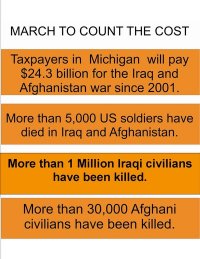
Sign up on Facebook and help spread the word!
Saturday, October 3
Noon – meet at Heartside Park
301 Ionia SW
Downtown Grand Rapids.
Press Coverage of the G20 Summit
On Saturday the Grand Rapids Press published two Associated Press articles that dealt with the Group of 20 Summit in Pittsburgh, Pennsylvania. The longer AP article on page 2 focused on what the heads of state had to say.
Most of the article quotes US President Barack Obama, but it also cites the British and German leaders. The original version of the AP article also included comments from the Chinese leader and more details of what the G20 leaders decided on.
The AP article also does not verify the claims made by the world leaders, particularly Barack Obama who said, “We brought the global economy back from the brink. We laid the groundwork today for long term prosperity.” The reporter does not challenge these comments or include other voices that may have disagreed with what the US President and the other world leaders were saying about the global economy.
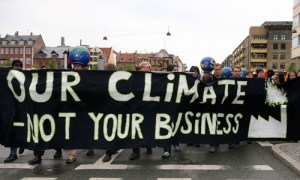
There were plenty of dissenting voices present in Pittsburgh, but their voices were either ignored or marginalized in the mainstream media. Greenpeace activists produced a short video that communicates why they came to Pittsburgh and what they are demanding from the G20 leaders. Another video was produced by the Bail Out the People movement, which set up a tent city in Pittsburgh.
Democracy Now! interviewed on Friday the author of a book about the industrial decline of Pittsburgh, which many groups highlighted in their organizing against the G20 Summit. In addition, there was plenty of online documentation of the variety of direct action organizing against the Summit and lots of analysis of what was wrong with the G20 agenda.
The second AP article that the Grand Rapids Press published on Saturday dealt with the repressive force of the police at the G20 Summit. The Press version of the article mentions what type of weapons that the police used and cited a Pennsylvania representative of the ACLU. The original version of the story included comments from people who were abused by the police. The article also mentions that some of the protestors, referred to as vandals, smashed some windows. This has been a pattern of mainstream reporting since the 1999 WTO demonstration in Seattle, where the focus tends to be on property damage and not police behavior.
Community Rally to Save Only Black Radio Station in Town
This morning in Grand Rapids between 250 – 300 people gathered to march in support of the only radio station in West Michigan that primarily serves the Black community, 1140AM, WJNZ. People came together at Rosa Parks Circle in downtown Grand Rapids to march to the Kent County Courthouse where Judge Yates would be deciding on who legally has the rights to own the popular radio station.

Before marching WJNZ DJ Robert S. addressed the crowd. He said that it would be unacceptable for the city of Grand Rapids to lose the only Black radio station. “If African Americans lose their voice we will be set back 30 years in terms of our civil rights gains.” Robert S. spoke to the issue of how few Black owned stations there are in the country, but that cities like Lansing and Saginaw do, so Grand Rapids needs to keep this station a Black owned station.
Robert S. also said to the crowd, “What power exists in Grand Rapids that does not want us to have a radio station? You know that when you get to the top 1 percent of people who run this city you lose minority representation.” According to a 2007 report entitled “Off the Dial,” African Americans comprise roughly 13% of the American population, yet they only own 3.4% of all full-powered commercial broadcast radio stations. Comparatively, Whites in this country own 92.7% of all full-powered commercial broadcast radio stations.
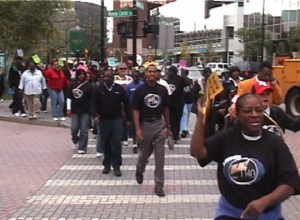
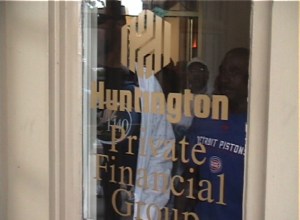
The marchers then left Rosa Parks Circle en route to the Kent County Courthouse. Along the way they made an impromptu stop at a downtown branch of Huntington Bank, since they are the financial institution involved in the foreclosure of the radio station’s assets. Once the marchers arrived at the courthouse, most of them were directed to an overflow room so they could watch the court proceedings on a big screen.
The Judge hearing this case was Judge Yates. Those addressing the Judge were representatives of the receiver, the legal entity responsible for overseeing the radio station’s assets during the sales process, the creditor company, which would financially gain from the sale, and the three parties who had bid on the radio stations: Holy Family Radio, Praise Place, and the group that Robert S. was involved with.
Holy Family Radio says that they had the highest bid and made a formal contract with the receiver for the sale of the station. The group that Robert S. represented says that the bidding process was not fair and transparent and that they had made a bid just before the deadline that they were assured was the highest. The group Praise Place might also put in a separate bid, but said that they are for the most part acting in concert with the group Robert S. represented.
The court proceedings consisted of hearing concerns from all parties involved about the sales process and whether or not there were any irregularities. There was no agreement on this issue, so the Judge decided there will be a hearing in 14 days and that each party involved must submit legal briefs within the next 7 days as to their account of the sales proceedings.
The Judge also felt that in order for the group represented by Robert S. and Praise Place needed to put in escrow $315,000 to demonstrate that they could pay the amount they would have bid had the process been without irregularities. There was some back and forth discussion over whether or not Holy Family Radio would have to do the same, but in the end the Judge let them stick to the original $50,000 deposit they claimed was part of the contracted sale.
Holy Family Radio
Not much has been reported in the local media about the organization that is attempting to acquire WJNZ, Holy Family Radio. The Grand Rapids Press mentions a bit about the organization and printed a statement from a representative of the group, but there has been no real investigation into what interests they represent.
According to the group’s web page, they were formed in 2008 as an educational and evangelical outreach of the Catholic Church. They currently broadcast 6 hours of programming each week in West Michigan on WPRR AM and WTKG AM. One look at the programming offered by the station and you can get a sense of their politics.
One of the shows Holy Family Radio offers is hosted by Sr. Ann Shields, is part of a charismatic catholic group based out of Ann Arbor. The Catholic charismatic movement historically is very reactionary and conservative. Sr. Ann Shields show is syndicated through Ave Maria Radio, also a very conservative Catholic Radio group. Holy Family Radio offers other shows produced by Ave Maria Radio.
In addition they offer shows from EWTN (Eternal Word Television Network), which was founded by a woman named Mother Angelica, also associated with the conservative Catholic charismatic movement. The other programs that are offer are also syndicated, which means that none of the programming offered by Holy Family Radio is locally produced or has any direct connection to West Michigan. This is a notable difference to the current WJNZ programming which focuses hours of local talk/call-in radio for the Great Grand Rapids area.
Middle East Scholar Speaks at GVSU
On Tuesday September 22, Middle East expert Rashid Khalidi, addressed a large crowd at Grand Valley State University as part of its Fall Arts Celebration 2009. His presentation, “The Great Powers and the Middle East: Yesterday and Today,” was based on his newest book, Sowing Crisis: American Hegemony and the Cold War in the Middle East (2009).
Khalidi opened with a brief history of the region, noting that its location and seaways have had strategic significance since the times of the Pharaohs. In modern times, the Middle East served as an important arena of confrontation during both World Wars I & II. That significance remained throughout the Cold War years (post WW II through 1990), with the United States and Russia (USSR) staging various proxy wars in the region, sometimes as foes and sometimes as allies. “For all of their severity, the conflicts around the Arab and Israeli wars were self-contained in some measure . . . defined by the Cold War system,” Khalidi stated.

According to Khalidi, when the USSR fell apart, the US was left as the sole superpower. This propelled conflicts previously contained within the region into crises with global consequence. Other factors Khalidi cited for this global overspill were: (1) the Iranian revolution; (2) The Afghanistan wars, 1979-1988; (3) Iraq’s disastrous invasion of Kuwait; and (4) the failures of Madrid peace talks (between Israel and Palestine).
Because of these factors, lasting and close connections developed between Afghanistan, Pakistan and the rest of the Middle East, whereas previously, the latter two were not even considered a part of the Middle East.
Meanwhile back on the Ranch
After the 9-11 attacks, President Bush decided to launch the “Global War on Terror,” a misnomer from the get-go as this “war” was not global—it only targeted countries with Muslim populations. “Not to minimize 9-11, but terrorists don’t pose an existential danger to this republic (the US) . . . Terrorists do different things in different places for different reasons. They are not all plotting day and night to blow up Americans,” Khalidi said. “But they (the Bush administration) launched us on something that was a real war. So far, we have spent $600 billion, lost 800 soldiers in Afghanistan, 3,000 in Iraq and how many civilians.”
This real war has destroyed the Iraqi state, leaving a power vacuum in the region and a surge of sectarian violence. The same is happening in Afghanistan. The US trained and equipped the radical extremists so they could overcome their Russian invaders. These same extremists took brutal control of Afghanistan, giving rise to the Taliban and its harsh rule. Today, the US says we are fighting a “good”’ war that will free Afghani women all the while supporting its hand picked Karzai government that recently legalized rape.
“We can’t be the world’s godfather.”
Khalidi said that during the Cold War, the US was, at least, a respected power in the Middle East. However now, its standing is declined as has its influence. “What more can we say? The new regional configuration poses different dangers. There are no clear rules of the game. (During the Cold War) we felt like adults were in charge. Today, we face shadowy, non-state actors in a world without rules.”
Khalidi stated that the “framework has been degraded” by the Bush administration and that the current administration is continuing the course. This course promulgates Arab states that are no longer the subjects, but rather the objects, of their own history. The US must figure out that it cannot carry out political change and democratization by force and occupation. “Events do not stand still. Crises will emanate, wars, terrorism. It may take such a crisis to get the US and other powers to act differently . . . Democracy does not grow out of the barrel of a gun.”
Obama, the UN and Climate Change
On Monday, President Barack Obama addressed the General Assembly of the United Nations. In his speech he addressed the issue of global climate change by saying, “Our generation’s response to this challenge will be judged by history, for if we fail to meet it – boldly, swiftly, and together – we risk consigning future generations to an irreversible catastrophe.”
For many these were encouraging words, but they are still just words. President Obama offered no concrete solutions or commitment from the United States to actually work towards a significant reduction in greenhouse gases.

Something else that was missing from much of the US media coverage was other perspectives on the issue of climate change. The international women’s organization MADRE said this is response to Obama’s remarks;
“You correctly identified climate change as a key issue of our time. Yet, missing from your comments were concrete solutions and the recognition that rural women hold key solutions to climate change. Women are the traditional managers of rural communities’ food, water and other environmental resources. Women farmers in Nicaragua who have led the way in sustainable, organic agriculture; women in Kenya who have brought wells for clean water to their communities; women in Panama who have preserved biodiversity by protecting seed banks—these are the on-the-ground experts to whom we should be turning for models of sustainable resource management.”
Unless you read the independent news media you would not come across the perspective of people like Constance Okollet, a farmer from Uganda, who has suffered from tremendous drought conditions brought about by climate change.
The international environmental group Friends of the Earth issued a statement on Wednesday to US President Barack Obama demanding that the US do what they claim they will in being a leader on climate change.
“The U.S. Congress is dragging its heels on climate legislation in the lead up to Copenhagen in December, where key international climate negotiations will take place. The Obama administration must make good on its pledge that the United States will be a global ally in the fight against climate change.”
Copenhagen is the site of the first international conference on climate change since Kyoto that involved the world’s leaders. According to Indian activist Vandana Shiva the US has done very little to address the carbon emissions it has produced as a nation, despite the promises that came out of Kyoto.
“The Kyoto Protocol, adopted in December 1997, set binding targets for these countries to reduce their greenhouse-gas emissions by 5 per cent on average against 1990 levels by 2012. But by 2007, America’s greenhouse-gas levels were 16 per cent higher than 1990 levels. The American Clean Energy and Security Act, which was passed in June, commits the US to reduce emissions to 17 per cent below 2005 levels by 2020, yet this is just 4 per cent below 1990 levels.”
Shiva believes that one of the biggest obstacles to achieving significant reductions in carbon emissions is the market-based plan that the rich nations of the world have adopted, what is called “carbon trading.” Carbon trading essentially allows rich countries of the world the ability to continue to pollute at unsustainable levels and at the same time use the resources and people of poorer nations as offsets.
For more information about what grassroots people are doing about climate change check out Beyond Talk and 350.org.
 Grand Rapids Institute for Information Democracy