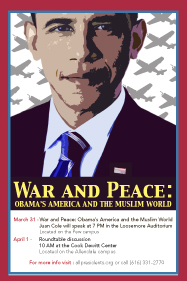
Last night GVSU hosted an event featuring Professor and author Juan Cole at the downtown campus. Cole, who writes a blog called Informed Comment, was given the task of assessing the first year of the Obama administration on relations with the Muslim world.
However, before talking about the Obama administration Cole provided some context by looking at the Bush administration’s approach to the Middle East and the Muslim World. Bush felt that the US could bring democracy to the rest of the world through the barrel of a gun.
Cole also thought that the countries of the Middle East saw the US as an alternative to traditional colonialism before Bush. After 9/11 that changed as the US now directly sought to control the governments of at least two countries – Iraq and Afghanistan. Cole believes that to some extent you could add Pakistan to that list.
Before the Bush administration the general attitude, based on polls, demonstrated the majority of Muslim countries had a relatively positive view of the US. Since, the US occupations of Iraq and Afghanistan that view has changed.
Cole also mentioned that the torture and detention facilities, like Guantanamo, Bagram and Abu Ghraib, what Cole referred to as essentially concentration camps, have also contributed significantly to a growing anti-American sentiment in the Muslim world. The Muslim world saw the US as barbaric and murderous, once the world knew what was happening in these detention centers. However, Cole failed to mention that torture has continued under the Obama administration and that Obama has failed to close Guantanamo despite his campaign promise to do so.
Professor Cole then addressed the demonizing of the Muslim world, particularly the label Islamofascism. This notion is ridiculous, Cole said, since fascism has nothing to do with the religion of Islam. Fascism emerged out of Europe and was a specific ideology, which Muslims have never adopted.
However, the word became part of the media and the administration, in many ways normalizing the use of such derogatory terms. Cole believes that what the use of the word Islamofascism ultimately did was incense many in the Muslim world, but Cole failed to acknowledge what impact the term has had on campuses across the US in recent years.
Obama Administration Report Card
The Obama administration has been more sensitive since taking office, at least rhetorically said Cole, beginning with acknowledgement of the Persian New Year. Cole also points out the two major speeches he gave in Turkey and in Cairo. The new administration has also had open talks with Iran and Obama has spoken about a two state solution with Israel/Palestine. Lastly, the new administration has said they wanted to withdraw US troops from Iraq and eventually from Afghanistan.
The Muslim world has said that they want better relations with the US, but they would rather have development aid instead of military aid. Cole also said that polls show that in Saudi Arabia over 80% of the public says they are worried about terrorism. In addition, the level of support for Al-Qaeda has dropped to around 10% in recent years, since terrorism has also impacted many Muslim countries.
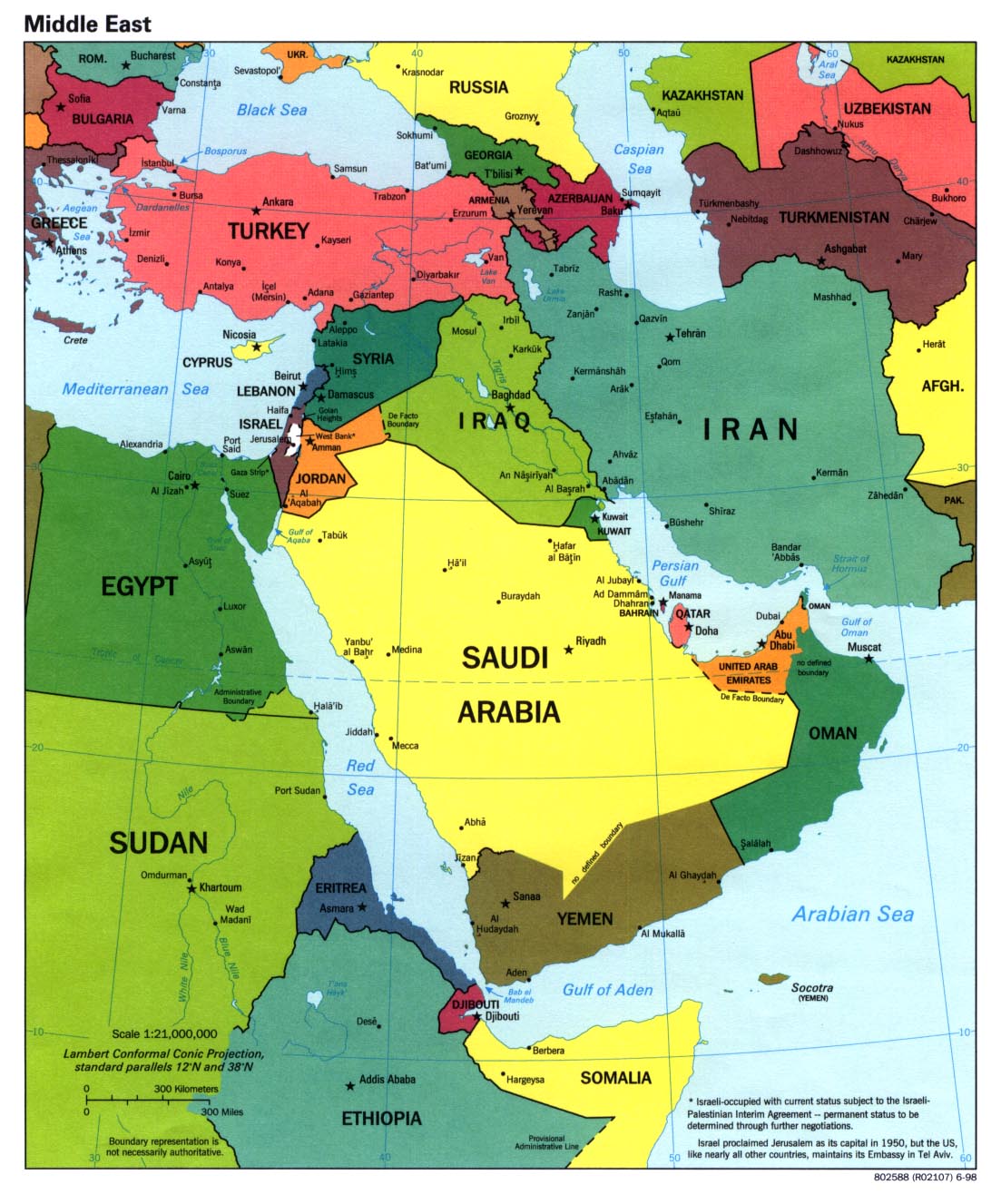
Cole then shows a map and talk about what countries in the Muslim world are Pro-American. He says that many of the Muslim countries are also secular and conservative, such as Morocco, Tunisia, Algeria, Egypt, Jordan, Turkey, and Bahrain. When looking at the Muslim countries that are anti-American or a threat to America Cole says that the countries are the Sudan, Somalia, Iraq and Syria.
So what should the US relations with the Muslim world be? Cole says that the Muslim population is projected to be about 1/3 of the world’s population by 2050, so it would not be good policy to have a negative relationship.
Professor Cole said the major security issues are the Pakistan-Afghanistan nexus, the Jihadis from the Soviet invasion of the 1980s, Kashmir, threat of a further Indo-Pak War, and Israel’s treatment of Palestine.
Cole then addresses the fact that 70% of the world’s petroleum reserves and 65% of the natural gas reserves are in the Middle East/Muslim world. Since China and India have growing energy needs, the US is in greater competition for these “energy needs.”
The speaker then addresses the distinction between the Arab and Muslim world. For the Arab world the number one issue is the US occupation of Iraq. Relations with the Arab world would be a complete withdrawal from Iraq. Cole looks at the Status of Forces Agreement (SOFA) agreement with Iraq and says that the Obama administration has done fairly well with the process for withdrawal. Obama has pledged that the US will be out by the end of 2011. Cole thinks this is a win for Obama. However, other Middle East experts like Phyllis Bennis have argued that the Obama administration plans on leaving up to 50,000 US troops in Iraq and has no plans to remove the numerous US military bases.
One of the major problems facing the current administration is the Af-Pak War. Pakistan and Afghanistan both have a significant number of ethnic Pashtuns, some of which are part of the Taliban. Obama has put more pressure on Pakistan to deal with the ethnic Pashtuns. Cole thinks that the campaign was a win for the administration. However, Cole failed to mention the increased use of predator drone attacks, which have led to increased anti-America protests in Pakistan.
In Afghanistan the Taliban power has increased, so the new administration is escalating the occupation. Obama thinks that this policy will work and withdrawal can happen by the summer of 2011. Cole mentions that this will be a challenge, because of corruption, levels of poverty and violence. So, Cole thinks that Afghanistan is a big question mark. This seems to be a bit of an understatement, since there is growing criticism around Obama’s Afghan policy, both from independent analysts to people within his own administration.
On the matter of Iran, the Obama administration was concerned with improving relations with Iran, but has had to deal with Iranian domestic discontent. Cole thinks that Iranian hardliners aren’t interested in dialogue, but some analysts believe that the Obama administration is continuing the same policy towards Iran as the Bush administration, especially since pressure to impose sanctions on Iran have increased.
On the matter of Israel/Palestine the Obama administration has made no progress, according to Cole. The Israeli government does what it wants. His conclusion is that it is a mixed picture, but that the Obama administration is headed in the right direction. Cole seemed to contradict himself here, since it is clear that the US is putting no pressure politically on Israel to stop the expansion of settlements and there have been no consequences for Israel’s ongoing brutality of Palestinians, particularly in Gaza.
Cole concluded by saying that he would give the Obama administration a B+ on its policy in the Middle East. To this writer that seems quite generous, considering that little has changed from the Bush years to now, except rhetorically.
Students Host Cesar Chavez Celebration at GVSU

Today, about 100 students and faculty marched on campus to kick off a celebration of the life and work of labor organizer Cesar Chavez. After the march, people gathered in the Cook-Dewitt Center to listen to speakers and enjoy some refreshments provided by the Latino Student Union.
The first presenters were two students with the Latino Student Union, who gave a short presentation about the life and work of Cesar Chavez. They stated that in 1952 Cesar became an organizer with the Community Service Organization (CSO). Later, Chavez began to work with the United Farm Workers of America. (UFW)
The students also addressed some of the conditions that farm workers faced in the 1960s. Workers were subjected to harsh conditions, both living and working conditions. Child labor was widespread at that time, conditions that are still prevalent today in Michigan.
The students went on to say that Chavez began to organize marches and campaigns to challenge farmer owners and the agribusiness industry. The first big campaign was targeted at grape farmers, since farm workers in this sector were treated worse than in other areas. Over the years, the UFW won better worker conditions better wages and even union co-ops and credit unions. But they students impressed upon everyone in attendance that farm workers are still fighting for justice and need our public support.
Chicano Movement
Speaking in place of Dolores Huerta (who was scheduled to speak but had to cancel), was a professor of modern languages and history at GVSU. The focus of her talk was the Chicano movement in the US, which often overlapped with that of the farm worker movement.
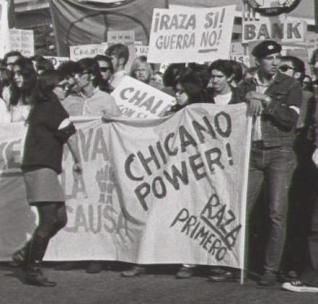
The Professor started off by looking at some of the history between the US and Mexico and the importance of land that was taken in the US-Mexican War. Chicanos are basically Mexicans who were born and raised in the US, she said, who identified with Mexican culture and became part of the movement of La Raza – “The Race” or “The People.”
During the 1960s the Chicano Movement and Chicano Power came into being, demanding civil rights and forming political and community based organizations. Some in the early Chicano movement advocated for reclaiming land that was lost under the Treaty of Guadalupe Hidalgo in 1848.
The Chicano movement also gained strength during a youth conference in 1969, a conference that focused on discrimination, justice and oppression. There were two major outcomes of this conference. First was the creation of the Chicano Student Movement, which organized around an effort to fight for land rights. The other outcome was the development of Chicano studies at the university level.
Many who were involved in the Chicano movement also participated with Cesar Chavez and the UFW in the 1960s in marches and boycotts. She also mentioned that because of the power of the UFW, Robert Kennedy agreed to meet with Chavez during the tail end of one of his fasts. Kennedy endorsed their campaign and in turn the UFW endorsed RFK for President in 1968.
Other aspects of the Chicano Movement there was a lot o cultural revolution. Prof. mentions the origin of the Zoot Suit movement, the influence of music, literature, and independent news. A great deal of this cultural influence was focused on identity and heritage of Mexican American people. One other manifestation of this culture was the Teatro Campesino, the poor workers theater.
The presenter also mentioned that more scholars are beginning to recognize the role of Chicana women in the movement, but the scholarship is still limited in recognizing the contributions that women made to the vitality of the movement.
The Professor also mentions the emergence of Chicana feminists, particularly writers. It is here that the speaker talked a bit about Dolores Huerta. Huerta faced her own challenges as an organizer with the UFW, such as being attacked for not being “a traditional mom” and for questioning male dominance in the movement.
While the focus ended up not being primarily about Cesar Chavez and farm workers, the information shared was important for understanding the movements that Mexican/Americans and Chicanos made to civil rights in the US.
Media Bites – Go Daddy
In this week’s Media Bites we take a look at two new commercials from the Internet domain hosting company Go Daddy. Both of these ads continue a trend using racecar driver Danica Patrick, with hyper-sexualized plots as a means to get you to go to their website.
Capitalists to Consumers: Spend, Spend, Spend
This week, there was a big announcement in the mainstream media: Things are looking up! The economy is getting back on track, thanks to us. Consumer spending was up in February, and Wall Street stocks rose on the strength of this news. One economist said it was “an encouraging sign of consumer revival.”

But before we all start celebrating, a reality check.
This sign of “recovery” is an increase in spending that, economists admitted, was not accompanied by any rise in wages, which are stagnant and have been for years. Plus, unemployment is up; the national rate is 9.7 percent and here in Michigan, it’s 14 percent. These are 26-year highs. So far, Corporate America has eliminated nearly 9 million jobs in the US, with most experts saying that only a fraction of them will ever be restored here.
The captains of industry clearly don’t feel that they need to hand out raises with such a huge pool of desperate employees to choose from. And let’s not forget that the few jobs that are “coming back” are in the low-paying service sector, often unaccompanied by any benefits or the chance of union membership.
Now, let’s push aside the Wall Street rejoicing, and see what Americans felt they just had to buy more of in Feruary. Not cars. Not appliances. Not bikes. Not furniture, rugs, or lamps. In fact, sales of durable goods actually fell in February.
That means that Americans were spending their money on what the economists call “nondurable goods.” And in February, that was primarily food and clothing.
That’s right: food and clothing, two of the three basic needs for survival. Your kid outgrows his shoes. Your winter coat finally falls apart. And you need to feed your family. Despite recent claims that food prices are deflating, there was so much price-gouging in food over the past two years that the prices are actually simply falling back to something like normal levels. That means people are able to buy a little more of it. To be exact, 0.3 percent more.
This is the big turnaround that Wall Street tycoons are touting. Why? Because news of any spending increases is good for the capitalist economy. Don’t fool yourself: economists are aware that this spending comes at a heavy cost to workers. Ken Mayland, the president of an economic analysis group in Ohio, noted that “step one in lifting consumer spending was the lowering of the personal saving rate. That’s pretty much played out now.”
In other words, we are right where corporate America wants us: with our backs to the wall. We need to eat. We need clothing. We’re unemployed or underemployed. And our savings have been successfully tapped out. So back we go to the stores with our credit cards in hand, because we have no other way to pay. After all, as we are constantly reminded, this recovery is all on our shoulders. Only we can spend our way out of it, even if we have no money to spend.
If that’s not an exposure of the absolute corruptness of the capitalist system, I don’t know what is.
Remember as you read about the so-called spending recovery in the news, there are simple ways to stop buying into the myth that consumer spending is going to fix things in this country. Want to do something about the cost and quality of your food? Grow a garden if you can and have the space to do it. Buy from local farmers rather than chain supermarkets. As for clothing, give the mall a pass. Shop at garage sales, flea markets, resale stores. Swap items and services with friends. And check out the Really, Really Free Markets, held once a month in Grand Rapids.
Don’t let the capitalists consume you in order to restore their corporations to health.
Take Action: On Land Day – March 30th

March 30th has been known as Palestinian Land Day since 1976, when the Israeli military shot and killed six young Palestinian citizens of Israel as they were protesting the confiscation of their land. In the wake of last year’s devastating assault on the Gaza Strip, the World Social Forum declared March 30th to be an international day of action for the BDS movement. Today, Land Day symbolizes Palestinian resistance to Israel’s ongoing land expropriation, colonization, occupation, and apartheid.
This year, the Palestinian BDS National Committee called for Land Day once again to be an international day of action for BDS. They called for four types of actions to take place on March 30th
1. Boycott and divest from Israeli and international corporations that sustain Israel’s apartheid, colonialism and occupation. There are some good resources on companies like Caterpillar, Motorola and Ahava Beauty Products.
2. Take legal action towards ending Israel’s impunity, including by investigating and prosecuting suspected Israeli war criminals in national courts and international tribunals.
3. Promote and apply pressure to implement arms embargoes against Israel as well as a freeze or cancellation of free trade and other preferential agreements with it, as a crucial and urgent step towards full-fledged sanctions against Israel.
4. Launch academic, cultural and sports boycott actions against Israel and its complicit institutions.
There are World Land Day actions happening in cities all around the world as part of a growing movement against Israeli crimes against Palestinians.
The Triple Bottom Line and Sustainability?
This is the second article in a series that will investigate environmental issues for the 40th Anniversary of Earth Day.
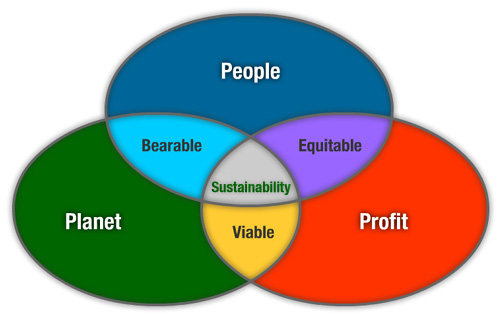
As we mentioned in the first article in this series, there has been a significant shift around environmental issues, from challenging corporate polluters to green consumerism or green capitalism.
Green capitalism promotes the idea that the market will solve our environmental problems, since the market provides the only real incentive to make the necessary changes. This mentality has manifested itself in what many in the green capitalism sector call the Triple Bottom Line (TBL) – Profits, Planet and People.
The advocates of TBL believe that we can save the planet respect people and make a profit all at the same time. Thousands of companies promote themselves as practicing the TBL, even many of the Fortune 500 companies like Wal-Mart. The TBL philosophy is also what local business entitles promote, like the West Michigan Sustainable Business Forum.

Business publications have also been promoting the TBL principles, like the paper that MiBiz puts out called TBL. The featured article for the most recent TBL is entitled, “Ford’s Sustainable Shift.”
The article provides an overview of what the Ford Motor Company has done in recent years to promote what they think is a more sustainable business practice. This all began by hiring someone to do public relations work and eventually someone who would develop a strategic plan on how to move the auto company in that direction.
The company sustainability person, John Viera, does acknowledge that climate change is real, but ultimately says that even if they build more energy efficient vehicles, “consumers are looking for affordability, not fuel economy.” So it seems that Ford is just responding to ”market demands.”
The most interesting comment from Viera was, “Electric vehicles are not part of our core strategy right now. The bottom line is if you want to have a significant impact on CO2, you need to do it with high volumes.” So, Ford’s solution to reducing carbon emissions is to sell more cars. This notion is affirmed later in the article when Viera says, “The biggest challenge is going to be in developing countries. Today, there are about 750 million vehicles in the world. By 2030, there will be 2 billion. If you think automotive is a dying industry, you’re misleading yourself.”
Nowhere in the article is there any concrete evidence that Ford will actually make any real changes to reducing carbon emissions globally. In fact, it appears that they will do just the opposite.
Even if the vehicles of the future use less fossil fuels or run completely off of renewable energy, it doesn’t take into account the amount of energy and natural resources used to make cars – metals, plastic, rubber, computer parts, etc. If Ford is projecting correctly that there will be 2 billion cars in the world by 2030 that would also mean more roads and parking space, which means more asphalt and concrete, which will cover more of the land.
Any discussion about the future of transportation and sustainability must look at the importance of mass transit for the majority of people, redesigning communities that promote more walking & bicycling, and less mobility. None of this is what the Ford Motor Company is advocating, so we have to seriously question their so-called commitment to sustainability.
Media Alert: Internet Neutrality Battle Continues
The following Media Alert is from the group Free Press.

Phone and cable lobbyists have flooded the FCC with fiction about Net Neutrality. They continue to recycle old rhetoric that Free Press and others have repeatedly debunked. Show the FCC that you don’t buy these bogus claims — and why they shouldn’t either.
Fiction: “The government wants to become the Web’s traffic cop, shutting down free speech online.”
Before the FCC decided to pursue Net Neutrality protections, Fox News Channel’s Glenn Beck warned his audience that the government was “trying to take over the media.” Beck later said that Net Neutrality would “wildly affect your life and free speech” by forcing a “Marxist utopia” on the Internet.
Fact: Net Neutrality ensures everyone has an opportunity to be heard.
The founders of the Internet built it with open standards to ensure that everyone with a connection could communicate with everyone else online. This basic Net Neutrality principle turned the Internet into an essential forum for free speech. Without the FCC stepping in to protect the free-flowing Web, Internet service providers have an incentive to decide whose voices are more important and whose views won’t be heard.
Fiction: “Net Neutrality is a solution in search of a problem.”
Industry front group Americans for Prosperity wrote that there hasn’t been “a single significant incident of egregious behavior” by phone and cable companies,” adding that Net Neutrality is “a solution in search of a problem.”
Fact: The problem is real. The solution is Net Neutrality.
High-profile violations of Net Neutrality include Comcast’s efforts to block popular file sharing applications and Madison River’s blocking of Internet-based telephone services. AT&T has met with motion picture and record industry execs over a proposal to spy on all online communications and throttle those they deem “illegal.” ISPs have also talked about using new discriminatory technology — called deep packet inspection — as a way to filter content and impose new tolls on users.
Fiction: “Net Neutrality will defeat efforts to close America’s digital divide.”
David Sutphen, co-chair of the AT&T-funded Internet Innovation Alliance, says that Net Neutrality is a “distraction” that “only concerns those already online.” Sutphen calls Net Neutrality rules “divisive new regulations,” which could have “unintended consequences” for those seeking to bridge the digital divide.
Fact: Investment increased under Net Neutrality rules
AT&T and Comcast claim that unless they can discriminate online, they won’t be able to close the broadband gap. But history shows otherwise. During the two years that AT&T operated under Net Neutrality rules, required as a condition its merger with BellSouth, the company recorded gross profits of more than $140 billion. In those same years, AT&T invested billions to build out networks and reach new communities. When the Net Neutrality conditions expired, AT&T reduced its investment.
Fiction: “Net Neutrality will undermine innovation and consumer choice”
Rob Atkinson of industry-funded front group ITIF told the FCC that while Net Neutrality advocates “bemoan the state of competition in the American broadband marketplace (often with little foundation) there is always at least one alternative to the local telephone or cable provider: non-participation.”
Fact: Net Neutrality gives consumers choice and fuels innovation.
Phone and cable companies control more than 96 percent of high-speed Internet connections to homes in America. The proposed Net Neutrality rules would prevent abuses in a highly concentrated and uncompetitive market. Without these protections, providers have a strong incentive to control not just access but also the content that flows across their networks. Net Neutrality protects competition, maximizes consumer choice, and ensures that we have unfettered access to the Web’s dynamic mix of new ideas.
Obama in Afghanistan
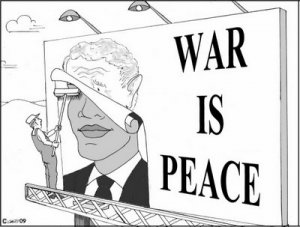
Yesterday, President Obama made a “surprise” visit to Bagram airfield in Afghanistan. The speech that Obama gave continues a line of thinking on US foreign policy that is very similar to Bush.
Dave Lindorff, an independent journalist observed that the President made his visit just weeks after the new counter-insurgency campaign that has resulted in more civilian deaths and no real progress in suppressing the Taliban.
Lindroff also notes:
“The government US forces are propping up is so weak and corrupt that it doesn’t really “rule” anything but the capital city of Kabul, and it, and its police and army enforcers, are largely viewed by the majority of Afghans as little more than an official mafia. It is well known that President Hamid Karzai stole the last election and thumbed his nose at world opinion (his opponent simply quit the race in disgust during the ballot counting).
And it was this usurper Karzai whom the visiting Obama was left to plead with to clean up the mess of a government he runs. Clean up how? Karzai’s own brother is a leading warlord and opium baron. Even the country’s opium crap is being left untouched by US forces, for fear of alienating the country’s farmers, so we’re actually in there fighting to defend the world’s leading producer of opium for the heroin trade! How on earth do you “clean up” a government in a country like that?”
In addition, Rethink Afghanistan has produced a short video critique of the President’s speech in Afghanistan. Rethink Afghanistan points out some of the major flaws of Obama’s Afghan policy.

This article is the first in a series that will look at environmental issues for the 40th Anniversary of Earth Day.
This April the country will be celebrating the 40th Anniversary of Earth Day and already there is all kinds of online promotions from national groups about what this anniversary means and what we should all do to take care of the planet.
The Earth Day Network is coordinating celebrations and is lists on its action section for people to promote tough climate legislation, engage in environmental education, get fresh foods into our schools and of course to change our light bulbs for more efficient ones.
The Earth Day Action Center is promoting 5K runs for a greener planet, tree-planting kits for children and organic lawns. This sounds nice and all but this doesn’t have much to do with the focus and organizing that lead to the first Earth Day in 1970.
The organizing that came out of the 1960s was a result of both the popular organizing that was being done around other issues like civil rights, feminism and anti-war activities. There was also the groundbreaking work of people like Rachel Carson who’s research exposed and challenge the chemical and pesticide industries that were participating in the so-called “Green Revolution.”
Environmental writer and activist Vandana Shiva defines the “Green Revolution” as a mechanism for industrial nations to impose an agribusiness model on the rest of the world. This model included growing food for export, the use of pesticides & fossil fuel fertilizers, and promoting large-scale food production instead of localized production.
Origins of Earth Day
What Carson was advocating and what the first Earth Day organizers emphasized was the need to directly confront polluters and force the federal government to adopt some regulations. After all, it was the first Earth Day that forced the Nixon administration to create the Environmental Protection Agency (EPA). Of course there was also the message of personal responsibility that came with the first Earth Day celebrations, but this was not the focus.
The advocates of capitalism were quite concerned about this light being shinned on the environmental damage they were doing so they began their own campaign to counter what environmentalists of the 1960 – 70s were advocating for.
The business community created the Keep America Beautiful Campaign, which could be considered one of the first corporate Greenwashing campaigns in the country. Some of the most notable companies were Coca Cola, the American Can Company and the National Association of Manufacturers. Their campaign was designed to take the focus off of corporate capitalism’s destructive environmental practices and get people to think about their own personal behavior.
The centerpiece of this campaign became moving attention away from industrial waste and pollution to personalized trash known as litter. The Keep America Campaign even came up with the label “litterbug,” a term which is used even today to describe individuals we all should look down upon. The campaign worked beautifully and by the second Earth Day celebration these corporate entities financed the creation of a powerful TV ad using a Native America actor Iron Eyes Cody. The Native man is seen at numerous places – in the woods, along the beach – and everywhere he goes there is trash. Again the emphasis was on individual behavior and not so much on industry.
Green Consumption & Green Capitalism
This same emphasis is what we see today with individuals being encouraged to have a light carbon footprint on the planet. Of course the best way to achieve this is through the consumption of eco-friendly products. Buy a Prius and feel better about yourself. Drink a latte of fair trade coffee and you’ll sleep well. Use your own canvas grocery bag while you shop at Meijer and save the planet.

Not only is there little emphasis on corporate malfeasance, corporations and businesses are now seen as the heroes of environmental sustainability. In fact, corporations are now GREEN, so just shop with a conscience and all is well.
Pay attention over the next several weeks to the kinds of advertising you will see that accompanies this year’s Earth Day festivities. See how much corporations and businesses sponsor eco-events and watch to see how much emphasis is put on buying GREEN products.
However, don’t be seduced by the shop for the planet mantra. Investigate for yourself what the root causes are of environmental destruction in your community and in the world. Lets put the emphasis back on exposing and confronting the polluters, while we construct a world that is not determined by the profit motive, instead a world that is determined by the Seventh Generation principles.
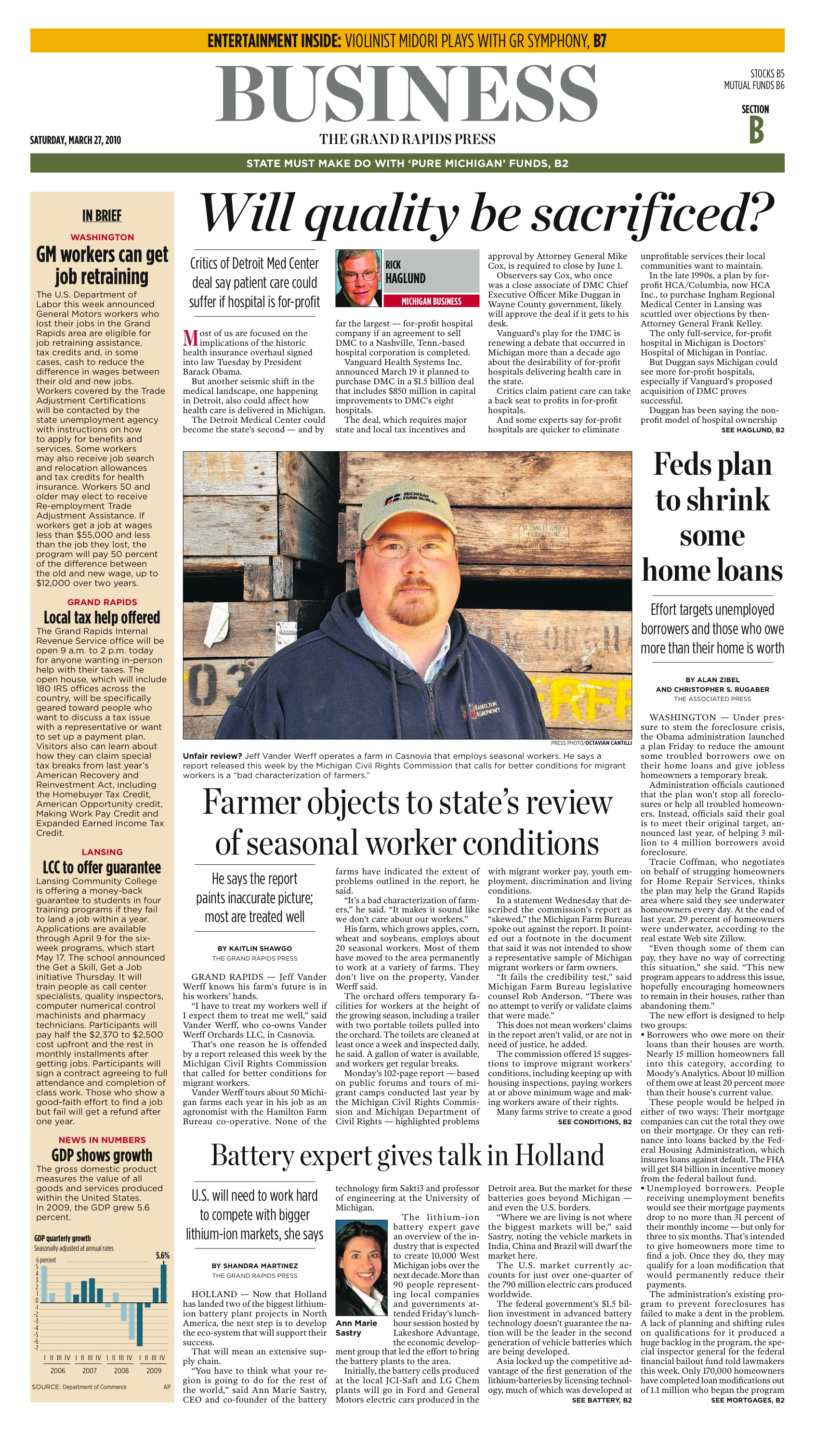
As we reported on Thursday, the local news media’s response to the Michigan Civil Rights Commission report on migrant labor and living conditions gave significant print space and broadcast time to farm bosses, particularly the Michigan Farm Bureau.
On Saturday, the Grand Rapids Press gave even more print space to farm owners who “object” to the new report on migrant labor and living conditions. In a front-page article of the Business section the headline reads, “Farmer objects to state’s review of seasonal worker conditions.”
The story begins with a farmer complaining that the Michigan Civil Rights Commission report “is a bad characterization of farmers. It makes it sound like we don’t care about our workers.” The article also reiterates the comments by the Michigan Farm Bureau that earlier in the week said the report was “skewed.”
Later in the article the Press reporter does cite a lawyer with the Michigan Migrant Legal Assistance Project who said that the report is reflective of what she characterized as “problem farms.” The Press article does near the very end state, “Although mostly critical of migrant worker conditions, the commission acknowledged that visits to Michigan farms yielded “a wide spectrum of living and working conditions.”
In fact, the report cites examples of farms that treat workers well. However, it seems as though some farm owners and the Michigan Farm Bureau are not tolerant of any serious criticism of their industry, since they have been aggressively responding to the claims made in the report.
Absent from the story on Saturday and the initial coverage were any voices of migrant workers and their families. It is worth asking weather or not migrant workers would get the same amount of coverage if they objected to claims being made by farm owners.

