Area folks gearing up for the US Social Forum
 A small group of people met at The Bloom Collective today to talk about the upcoming US Social Forum, which takes place June 2 – 26 in Detroit. Representatives from The Bloom, GRIID and Our Kitchen Table (OKT) who plan on attending the USSF with their organizations and others who plan on attending on an individual basis all shared excitement about the potential impact the USSF could have Grand Rapids and the globe.
Some present hope people coming back to Grand Rapids after the USSF would be able to do education about the negative impacts of globalization measures being brought forth by the World Bank, World Trade Organization and the International Monetary Fund. Others want to learn how to better build a radical community here in Grand Rapids.
The discussion group will meet again Friday April 23 at 1 p.m. at The Bloom Collectives’ former space, 1134 Wealthy St. SE. Please join us… it’s about you.
GR IWW bottom-lines
MayDay2010 10 a.m. – 8 p.m. May 1
- Live music, speakers and kids’ activities
- 11 a.m. – 1 community potluck
- 2 – 4 p.m. Really Really Free Market
Martin Luther King Park
Fuller & Franklin SE, Grand Rapids
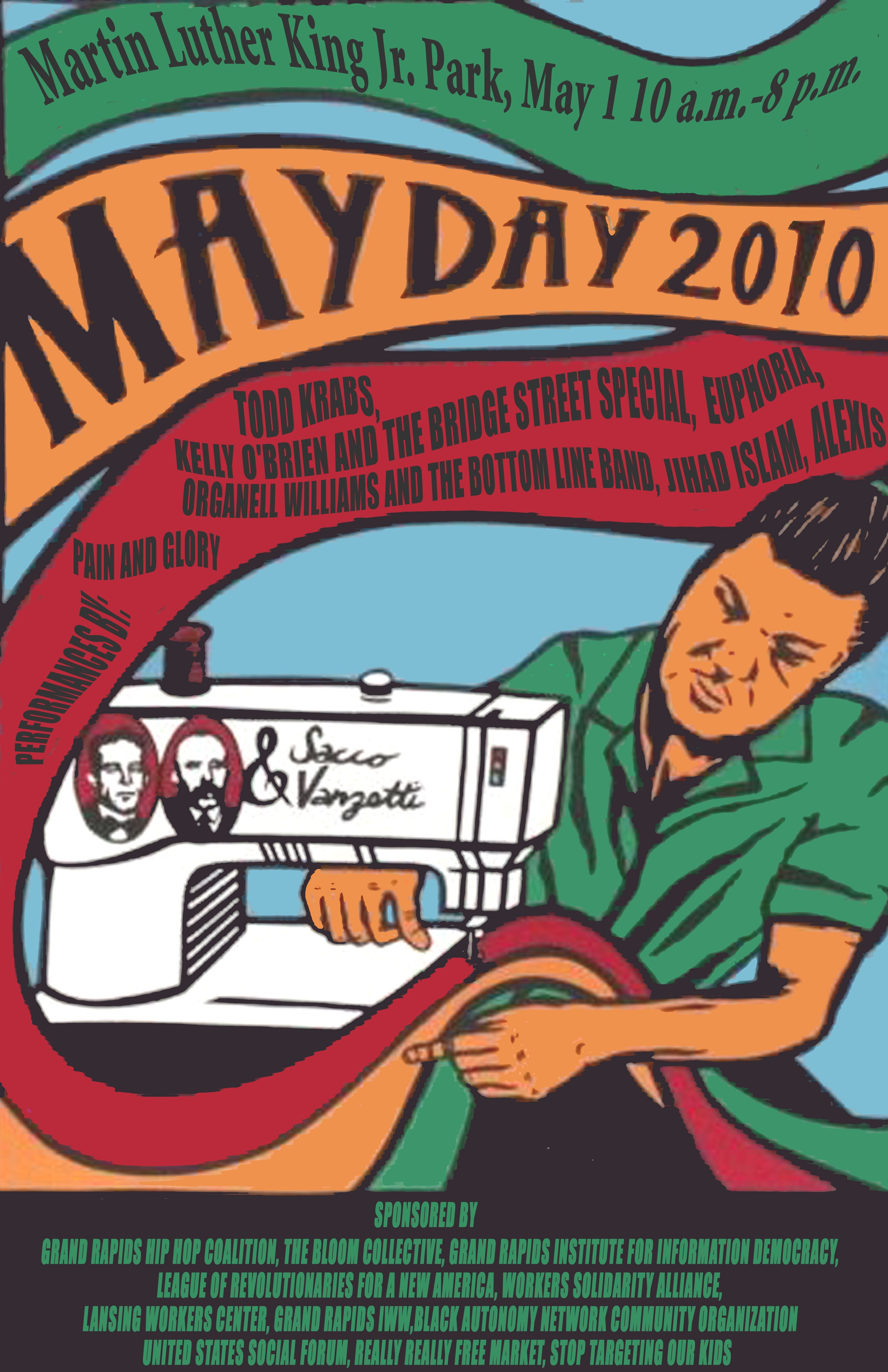
Local community organizations, labor groups and performers are coming together for MayDay 2010, a huge community event in the spirit of solidarity on Saturday May 1, 2010―the 124th anniversary of International Workers Day.
International Workers’ Day originated in 1886, when hundreds of thousands of workers across the United States went on strike. In Grand Rapids, 7,000 furniture workers of the Knights of Labor left their workplaces for an impromptu march. Workers demanded that their 10- and 12-hour work days be shortened to an 8-hour day with no reduction in pay. Over the next few years, thousands of workers won the 8-hour  workday that many take for granted today.
“In these times of layoffs and bank bail-outs working people need to regroup and realize the force for change lies among us,” said Cole Dorsey, IWW Organizer and an organizer for the event. “We want people to leave the May Day event informed and energized to take action that will benefit everyone in the working class.”
The Industrial Workers of the World (IWW) is a rank-and-file labor union open to all workers. During MayDay 2010, Grand Rapids IWW will announce plans for future organizing efforts and a local economic justice campaign.
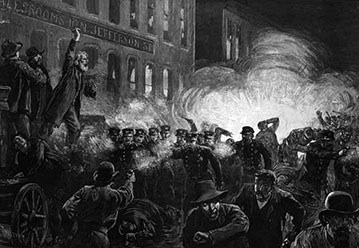 MayDay 2010 also celebrates the memory of the Haymarket Martyrs, eight labor activists framed for an explosion in Haymarket Square, Chicago, where striking workers were assembling. After a trial riddled with lies and contradictions, all eight were found guilty of the bombing. The Haymarket trial is still regarded today as one of the most grossly unjust trials in US history.
The celebration begins at 10 a.m. at Martin Luther King Jr. Park in Grand Rapids. Events include a community potluck from 11a.m. to 1 p.m. and a Really, Really Free Market, where people give and take items at no cost, from 2 to 4 p.m. Live music performances will include many genres including solo, rock, hip-hop and electronic.
The local group Stop Targeting Our Kids (STOK) will offer fun kids’ activities such as face painting, puppets, coloring and a quiet puzzle place. Speakers and resources will be available on issues such as home foreclosures, immigrant rights, workplace organizing and more.
Co-sponsors of MayDay 2010 include Grand Rapids Hip Hop Coalition, The Bloom Collective, League of Revolutionaries for a New America, STOK, Workers Solidarity Alliance, Grand Rapids Institute for Information Democracy (GRIID), Lansing Workers Center, Black Autonomy Network Community Organization (BANCO), United States Social Forum (USSF), and the Grand Rapids IWW.
Activist Enola Aird to speak in GR Saturday
Stop Targeting Our Kids (STOK) welcomes
Activist Enola Aird
of Mothers for a Human Future
Fighting the Commercialization and
Commodification of Children
5-6:30 pm, Saturday April 17, 2010
Institute for Global Education,
1118 Wealthy SE GR
(next to the Wealthy Theater)

Stop Targeting Our Kids (STOK) will host activist mother Enola G. Aird for a presentation at IGE this Saturday, April 17 from 5 to 6:30 p.m. Aird is the founder and director of Mothers for a Human Future, a new initiative focused on fighting the forces promoting the commercialization of childhood and the commodification of children.
Mothers for a Human Future is the successor to the Motherhood Project, a mothers’ campaign that convened a national symposium of mothers who worked to stem the media-generated “mommy wars” and conducted a national motherhood study that pointed to key elements of a mothers’ agenda for social change. Aird currently works to help bring mothers’ voices into the public conversation about new technologies that could fundamentally alter the genetic make-up of future human beings.
STOK member Mindy Holohan arranged for Aird’s visit “I recently returned from attending the Campaign for a Commercial Free Childhood summit in Boston,” she said. “One exciting development that grew from the trip was the opportunity to connect with activist Enola Aird who just so happened to be headed to Grand Rapids this coming weekend.”
Born in the Republic of Panama, Aird is a Phi Beta Kappa graduate of Barnard College and received her J.D.from Yale Law School. She is a member of the Steering Committee of the Campaign for a Commercial-Free Childhood and has worked for the Children’s Defense Fund as well as a variety of media organizations, including the predecessor entities of Time Warner and Viacom. She and her husband, Stephen L. Carter, are the parents of two adult children.
For information, email stokaction@gmail.com
How Your Tax Dollars Are Being Used

Every year many Americans fret over filing tax forms with the hope of getting something back. However, too often there is little information and limited discussion about how our tax dollars are being spent. Here are a few examples from various national sources for your consideration.
The War Resister’s League (WRL) every year provides a useful breakdown on how much of our tax dollars go for war and the military. “Over $1 trillion spent so far on the invasions and occupations of Iraq and Afghanistan since October 2001, with nearly half of each tax dollar going to the Pentagon and military contractors. Cities and states are closing schools, cutting services, furloughing staff. Thousands of civilians and soldiers killed with no evidence that the world is safer.”
The WRL advocates all kinds of actions around tax resistance, from education and awareness building on the matter to information on how to be a tax resister. They even provide an online “how to guide” for those wanting to challenge paying war taxes.
The group Jobs with Justice also has a Tax Day message, which is focused on the amount of your tax dollars that have gone to bailout Wall Street Banks.
“For 30 years, corporate CEOs and Wall Street speculators have put the squeeze on workers with globalization, privatization and union-busting.

They used their rising profits to buy Congress, convincing them to hand out tax breaks to the rich and gut banking regulations and consumer protections. Then they invented unscrupulous mortgage and investing practices, turning our financial system into a casino. When their speculation didn’t pay off, they got Congress to bail them out to the tune of $15,000 for every household in America.
A tax on the speculators of the Wall Street casino could put 3 million people to work fixing our infrastructure, teaching our children, making our factories more sustainable and improving our public services.”
One additional group that is organizing around tax day and tax issues is Reform Immigration For America. They are advocating that if the US reformed its immigration policy the US could be generating more tax dollars for important social services.
“A report from the Immigration Policy Center and the Center for American Progress found that legalization of undocumented immigrants would generate between $4.5 billion and $5.4 billion in tax revenues over three years.”
That’s $1,650,000,000 every year
It’s $4,517,453.80 every day
It’s $188,227 every hour
It’s $52.29 every second, that we could be generating in tax income. That money could fund infrastructure and public services – but until Congress acts, we’ll be leaving money on the table that could help our communities.
One action they are encouraging people to take is to send a blank tax form to Congress to show what kind of impact immigrants could have on the economy.
At noon today, Dr. Joia Mukherjee, medical director of Partners in Health (PIH), spoke to staff at Spectrum Health on their work in Haiti. Dr. Joia said that in all of her years of doing this work, nothing has taught her more about social justice than her work in Haiti.

Before she talks about what has happened since the earthquake she felt it was important to talk about Haiti’s history. Dr. Joia felt it was important to provide a context for the current situation in Haiti, unlike how most news agencies have reported since the January 12 earthquake.
Dr. Mukherjee said that 1 in 10 people affected by the catastrophe died immediately after the cataclysm. Then the punch line was, “from the slave trade.” To illustrate the importance of Haitian history, Dr. Joia that “Haiti would not be what it is without the trans-Atlantic slave trade. Haiti is a country really born out of slavery, the first country to end slavery and the only country to be founded out of a slave rebellion.”
The response to the Haitian revolution from the US was an embargo by the Jefferson administration. “Why is this relevant?” asks Dr. Joia. “If we look at what happened in Chile, where the earthquake was bigger, fewer people died. So we have to ask ourselves why more Haitians died?” The doctor stated it is because of the history of exploitation of Haiti by various imperial powers, which has created more systemic poverty and a failing infrastructure.
Haiti has become increasingly an urbanized country, in part because US grains have flooded the country making it difficult for Haitian farmers to make a living off the sale of their crops. More people crowded into urban centers increased the chances of people dying during the earthquake. According to Dr. Joia, the number of dead was 250,000 and an additional 300,000 injured. Again this is due to the failed infrastructure in Haiti, particularly with inadequate housing and government buildings.
PIH relies a great deal on using and training local health care workers. Their approach to health care is a systems approach and everyone of their staff in Haiti are Haitians. When the earthquake hit they PIH staff immediately went to the communities to determine what they would do. But the hard question facing them was “how does a human rights and health organization respond to the needs of disaster relief?”
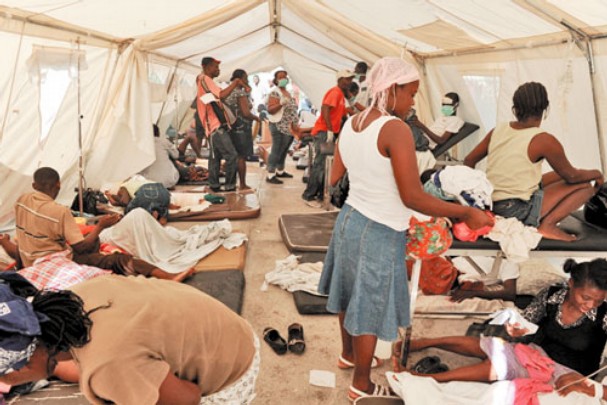
PIH has historically focused a great deal of attention around doing work and seeking funding to support HIV treatment and prevention. When they first started clinics around HIV/AIDS work they were successful because they eliminated any fees at the clinic, but the other thing they did was to pay the staff. For PIH health care is a right. The third thing they did was to provide free medicines and the fourth thing was to send health care workers into the community who couldn’t come to the clinic. “The key here,” according to Dr. Joia, “was that this whole approach was not about a building, rather it was about the people.”
During the relief work they always insisted on a fully integrated medical team with Haitians and outside volunteers, instead of just allowing foreign volunteers to work separately. “We believe that this will have lasting impact because of these kinds of partnerships so that Haitians can build their capacity for responding to these kinds of problems in the future.”
Dr. Joia sees the possibilities of increased funding for Haiti as an opportunity to focus on long-term infrastructure improvement instead of funding as a response to the disaster work where money gets channeled to NGOs who are generally not engaged in the Haitian communities. In contrast, PIH hired hundreds of Haitians to go into the communities to find the sick and wounded, do some assessments and then bring them to the health care facilities they operate. At present they see about 1,000 people per day in the clinics.
A few other areas of interest that PIH focuses on are rehabilitation and mental health care. These are issues that generally get ignored in the top-down approach to medical care, especially since the earthquake.
The last thing they do is to do promotional work to stop a brain drain of Haitian doctors, so PIH promotes the amazing work done by Haitians to show that Haitians are really the ones doing the important work.
The ongoing challenges of the earthquake will be the resettlement of 2 – 3 million refugees, needs for all kinds of shelter/housing and ongoing medical support as the immediacy of the earthquake is less in the news now.
In her critique of many of the mainstream and US-based NGOs Dr. Joia said that many of the groups that have raised a ton of money “because they have sophisticated media machines. They don’t care if people spoke Creole or not.” She even says that there is graffiti in some parts of the country that says “down with NGO thieves.” NGOs have lots of vehicles, lots of bosses and less staff on the group. Dr. Joia said that 46% of the US money went to the US military and the bulk of the rest went to US NGOs, which have a large overhead.
We asked her about Naomi Klein’s critique that the earthquake is another example of the Shock Doctrine, where more of Haiti’s basic services are being privatized. She agreed with Klein’s analysis and said that PIH wants to do the work to empower the local communities and the government in order to prevent or minimize the push to privatize Haitian services.
Dr. Joia’s presentation was passionate and impressive. It’s too bad that the local news media was not present to share this analysis with the broader West Michigan community.
Last night a small group of people gathered in the Wayland High School auditorium to hear Megan Quinn Bachman speak. Bachman, who is with Community Solutions, was invited to town by the Michigan-based organization Local Future.
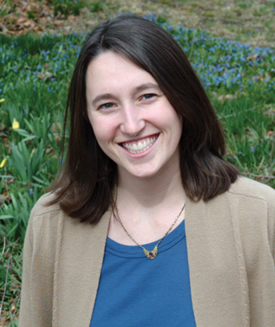
The speaker begins by talking about the fact that we are at a critical crossroads in human history, which we have been before. She gives the example of Easter Island, where massive deforestation occurred, which anthropologists believe led to the destruction of the people on that island. The only thing different now Bachman said, is that the Island is our whole planet.
People too often think that there is a technological fix, but more and more we are realizing that technology cannot save us from the ecological crises that we face. Bachman shows a slide called the Energy Curve of History, where in the US we went from use of wood to coal to petroleum. This energy curve also demonstrated that humans have only experienced major energy consumption in the past 150 years or so, ever since the beginning of the industrial revolution.
What the energy curve also shows is that humans could do more with fossil fuels than with human labor or human energy. For example one gallon of gas is equal to six weeks of human labor. Bachman also had the statistic which stated that US daily oil use is equal to 20,000,000 years of human labor.
She provided a few more statistics, like 93% of the energy we use now will be in decline in the next 25 years. Megan argues that peak oil is now, where demand has exceeded new oil discovery and production. In fact, 64 of the 98 oil-producing Nations are in decline.
So where are we going?
Bachman laid out some scenarios about what will happen in the future as a result of the energy crisis and the massive ecological destruction. These scenarios were an immediate crash, which would be the result of no fundamental change to what we are doing now. Another scenario is what she called the techno fantasy scenario, where we all believe that technology will save us.
A third scenario she identified is called the green tech stability scenario. In this scenario we rely heavily on bio-fuels and other green technology, but don’t make many fundamental changes to our levels of consumption. This third scenario is sort of what the Green Capitalists would like us to embrace, where we can just buy “green” products. The last scenario Bachman offered up is what she called creative descent, where we make significant changes to our consumption patterns, rely mostly on renewable energy and focus on building sustainable, localized communities.

Bachman said this last scenario, creative decent, is the direction that her organization advocates. It’s what Community Solutions calls Plan C. Plan C calls for conservation & curtailment of resource use, along with cultural and lifestyle changes. Bachman said that in a Plan C model, people don’t relying on government and the business community to make the change that is necessary.
One model that fits with Plan C was what Cuba did after the collapse of the Soviet Union, which meant a major loss of oil. She said the government provided some assistance, but urban communities started localized food systems. What was impressive about the Cuban model was their ability to maintain a good standard of living. About 90% of Havana’s vegetables come from the City and 80% of the production is organic. The Cuban model impressed Bachman so much that she and others from Community Solutions produced a documentary called The Power of Community: How Cuba Survived Peak Oil.
What do we need to do?
Bachman said change starts with us and that we all need to take steps to a sustainable life. These steps include a reduction in our purchases, purchasing more local, conservation measures, gardening, organic purchasing, walking/biking, reducing debt, diet change, preventative health, more efficient car, store emergency supplies, learn survival skills, use bartering, get a CSA membership, use mass transit, share a car or get rid of your car, and retrofit our homes to be energy efficient.
Bachman said that in her research there has also been more career/job shifts, where new farmers is the fasting growing sector, followed by activism, teaching and small micro-businesses. She also said that there are barriers to change. Her research showed that people have a hard time driving less, changing their diet and that habits & family practices are hard to overcome. However, Bachman said we can live a better life, which is why many people are motivated to make a change. People have expressed to her that learning new skills, having better relationships, and cooperating with people are motivating factors to change.
Bachman also said we need community level strategies, particularly around food and energy. She said in order to be sustainable we need to be producing what we consume. This is important because it requires us to move from an abstract to a real economy, where we are able to see what is actually happening. Real wealth, Bachman said, is the community, when we rely on each other. Monetary reform is one tactic to use, where we can create our own wealth systems and take our money out of commercial banks. There are state banks that are being proposed around the country and one that is operating in North Dakota.
Bachman ended her presentation with a quote from Buckminster Fuller, which said – “don’t fight the existing reality, build a new model.” While it is extremely important to build new models for living, it seems that we can’t ignore the systems of power that are perpetuating the massive ecological destruction around the world. It seems that resisting this destruction is necessary at the same time that we build new models of living.
Media Bites – Monsanto’s Roundup
In this week’s Media Bites we take a look at a new commercial for Monsanto’s weed killer Roundup. The seasonal commercial uses an old theme in ads where nature must be conquered. However, the biggest problem in the commercial is what they don’t tell you, which is the ecological and human health consequences of the use of this herbicide.
The ‘Obama Doctrine’: Kill, Don’t Detain
(This article is re-posted from the Guardian)
In 2001, Charles Krauthammer first coined the phrase “Bush Doctrine”, which would later become associated most significantly with the legal anomaly known as pre-emptive strike. Understanding the doctrine with hindsight could lead to a further understanding of the legacy that the former administration left – the choice to place concerns of national security over even the most entrenched norms of due process and the rule of law. It is, indeed, this doctrine that united people across the world in their condemnation of Guantánamo Bay.

The ambitious desire to close Guantánamo hailed the coming of a new era, a feeling implicitly recognised by the Nobel peace prize that President Obama received. Unfortunately, what we witnessed was a false dawn. The lawyers for the Guantánamo detainees with whom I am in touch in the US speak of their dismay as they prepare for Obama to do the one thing they never expected – to send the detainees back to the military commissions – a decision that will lose Obama all support he once had within the human rights community.
Worse still, a completely new trend has emerged that, in many ways, is more dangerous than the trends under Bush. Extrajudicial killings and targeted assassinations will soon become the main point of contention that Obama’s administration will need to justify. Although Bush was known for his support for such policies, the extensive use of drones under Obama have taken the death count well beyond anything that has been seen before.
Harold Koh, the legal adviser to the US state department, explained the justifications behind unmanned aerial vehicles (UAVs) when addressing the American Society of International Law’s annual meeting on 25 March 2010:
“[I]t is the considered view of this administration … that targeting practices, including lethal operations conducted with the use of unmanned aerial vehicles (UAVs), comply with all applicable law, including the laws of war … As recent events have shown, al-Qaida has not abandoned its intent to attack the United States, and indeed continues to attack us. Thus, in this ongoing armed conflict, the United States has the authority under international law, and the responsibility to its citizens, to use force, including lethal force, to defend itself, including by targeting persons such as high-level al Qaeda leaders who are planning attacks … [T]his administration has carefully reviewed the rules governing targeting operations to ensure that these operations are conducted consistently with law of war principles … “[S]ome have argued that the use of lethal force against specific individuals fails to provide adequate process and thus constitutes unlawful extrajudicial killing. But a state that is engaged in armed conflict or in legitimate self-defense is not required to provide targets with legal process before the state may use lethal force. Our procedures and practices for identifying lawful targets are extremely robust, and advanced technologies have helped to make our targeting even more precise. In my experience, the principles of distinction and proportionality that the United States applies are not just recited at meeting. They are implemented rigorously throughout the planning and execution of lethal operations to ensure that such operations are conducted in accordance with all applicable law.”
The legal justifications put forward by Koh are reminiscent of the arguments that were used by John Yoo and others in their bid to lend legitimacy to unlawful practices such as rendition, arbitrary detention and torture. The main cause for concern from Koh’s statements is the implication that protective jurisdiction to which the US feels it is entitled in order to carry out operations anywhere in the world still continues under Obama. The laws of war do not allow for the targeting of individuals outside of the conflict zone, and yet we now find that extrajudicial killings are taking place in countries as far apart as Yemen, the Horn of Africa and Pakistan. From a legal and moral perspective, the rationale provided by the State Department is bankrupt and only reinforces the stereotype that the US has very little concern for its own principles.
Despite the legalities of what is being conducted, the actuality of extrajudicial killings, especially through UAVs is frightening. The recent revelations by WikiLeaks on the killing of civilians by US Apache helicopters in Iraq has strongly highlighted the opportunities for misuse surrounding targeting from the air. In the Iraq case, there were soldiers who were supposed to be using the equipment to identify so-called combatants, and yet they still managed to catastrophically target the wrong people. This situation is made even worse in the case of UAVs, where the operators are far removed from the reality of the conflict and rely on digital images to see what is taking place on the ground.
Conservative estimates from thinktanks such as the New American Foundation claim that civilian causalities from drone attacks are around one in three, although this figure is disputed by the Pakistani authorities. According to Pakistani official statistics, every month an average of 58 civilians were killed during 2009. Of the 44 Predator drone attacks that year, only five targets were correctly identified; the result was over 700 civilian casualties.
Regardless of the figures used, the case that extrajudicial killings are justified is extremely weak, and the number of civilian casualties is far too high to justify their continued use.
A further twist to the Obama Doctrine is the breaking of a taboo that the Bush administration balked at – the concept of treating US citizens outside of the US constitutional process. During the Bush era, the treatment of detainees such as John Walker Lindh, Yasser Hamdi and Jose Padilla showed reluctance by officials to treat their own nationals in the way it had all those of other nationalities (by, for instance, sending them to Guantánamo Bay and other secret prisons). The policy of discrimination reserved for US citizens showed that there was a line the US was not willing to cross.
At least, today, we can strike discrimination off the list of grievances against the current president. The National Security Council of the US has now given specific permission to the CIA to target certain US citizens as part of counter-terrorism operations. Specifically, Anwar al-Awlaki has been singled out for such treatment, as it has been claimed that he was directly involved in the planning of the Major Hasan Nidal killings and the Christmas Day bomber attacks. Indeed, it is claims such as this that bring the entire concept of targeted assassinations into question. The US would like us to believe that we should simply trust that they have the relevant evidence and information to justify such a killing, without bringing the individual to account before a court.
The assumption that trust should be extended to a government that has involved itself in innumerable unlawful and unconscionable practices since the start of the war on terror is too much to ask. Whatever goodwill the US government had after 9/11 was destroyed by the way in which it prosecuted its wars. Further, the hope that came with the election of Barack Obama has faded as his policies have indicated nothing more than a reconfiguration of the basic tenet of the Bush Doctrine – that the US’s national security interests supersede any consideration of due process or the rule of law. The only difference – witness the rising civilian body count from drone attacks – being that Obama’s doctrine is even more deadly.
Another look at the proposed downtown farmers market
A few weeks ago the Grand Rapids Press reported on a proposed plan by the local group Grand Action to build a year round farmers market at the south end of downtown Grand Rapids.
It was reported that Grand Action hired an out of town firm to do a feasibility study to determine if Grand Rapids was ready for such a proposal, as well as, a cost/benefit analysis. The company hired was Market Ventures Inc., which prepared a document on the details of the plan. One glaring omission from our read of the document shows that no residents, either of Heartside or the neighborhood just south east of the proposed site were included in the 125 interviews the company conducted. It seems that area residents should have been consulted considering that such a project would increase traffic, which always has consequences on any neighborhood.

The response so far has primarily been positive, with the GR Press endorsing the plan, along with numerous individuals who have expressed support online at MLive.com. In addition, there is a Facebook group that is also endorsing the proposal.
The most recent edition of MiBiz also featured a front-page story about the project proposed by Grand Action. In that article they site someone from Market Ventures, Local First, the Michigan Farm Bureau, Starting Block Inc., and David Frey, one of the co-chairs of Grand Action. The article mostly focuses on the business benefits of such a project with limited discussion about the benefits of having an additional venue to sell food. Farmers, residents and groups like the Great Grand Rapids Food Systems Council or Our Kitchen Table were perspectives not sought out by the reporter, even though they both do local food advocacy and food justice work.
So it seems that this proposal is moving forward based on the premise that Grand Rapids needs another farmers market and that Grand Action has “a proven track record of successful economic development projects.”
First, lets be clear that what is being proposed in just about a year-round farmers market. In fact, the farmers market is only one small piece of the proposal. The bulk of the space would be used for additional restaurants, bars and other “entrepreneurial” ventures. Second, does the downtown area need more bars and restaurants? If the so-called hub of this proposal is a farmers market, why not utilize the land for urban food production and classes on how to grow food. This could also provide employment opportunities for people and it provides important skills to a larger sector of the population.
A third question that could be asked is about whether or not such a proposal would increase traffic and parking demands. Increased traffic and parking spaces means additional air pollution and water contamination from surface run-off. Instead of having a centralized farmers market hub, why not develop numerous markets throughout the city, which would not only facilitate less car traffic, it would provide needed investments in neighborhoods, which might include more specialized markets depending on the ethnic make-up of each neighborhood. These neighborhood-based farmers markets could all include designated space for growing food, composting and educational classes/workshops for people who live in those areas. There could even be community kitchens constructed, which could provide greater opportiunities for people to share food and prepare meals in common, something that Our Kitchen Table has been proposing.
A fourth question that could be asked, and has been asked, is where will the funding for such a project come from? If there are State and Federal dollars involved, then shouldn’t the public have more of a role in determining what such a project will look like? Then there is the question of who will operate such a project and who will benefit financially?
If we look at previous Grand Action projects like the arena, the real beneficiary is the DeVos family, which owns both the professional hockey team and the arena football team. Will this project primarily benefit the elite sectors of the business community? If the public finances such a project, even if it is only part of the funding, shouldn’t the public have more say in what is ultimately proposed? Before we get behind such plans, it is important for a great community conversation to take place so that basic rights like eating healthy food will not be determined by a handful of individuals who have demonstrated that they are primarily motivated by profits.
The Tea Party Express Comes to Grand Rapids
On Saturday, about 1,000 people gathered at Riverside Park in Grand Rapids to greet the Tea Party Express, a touring group of people who are part of the national movement that has surfaced since the beginning of the health care debate.
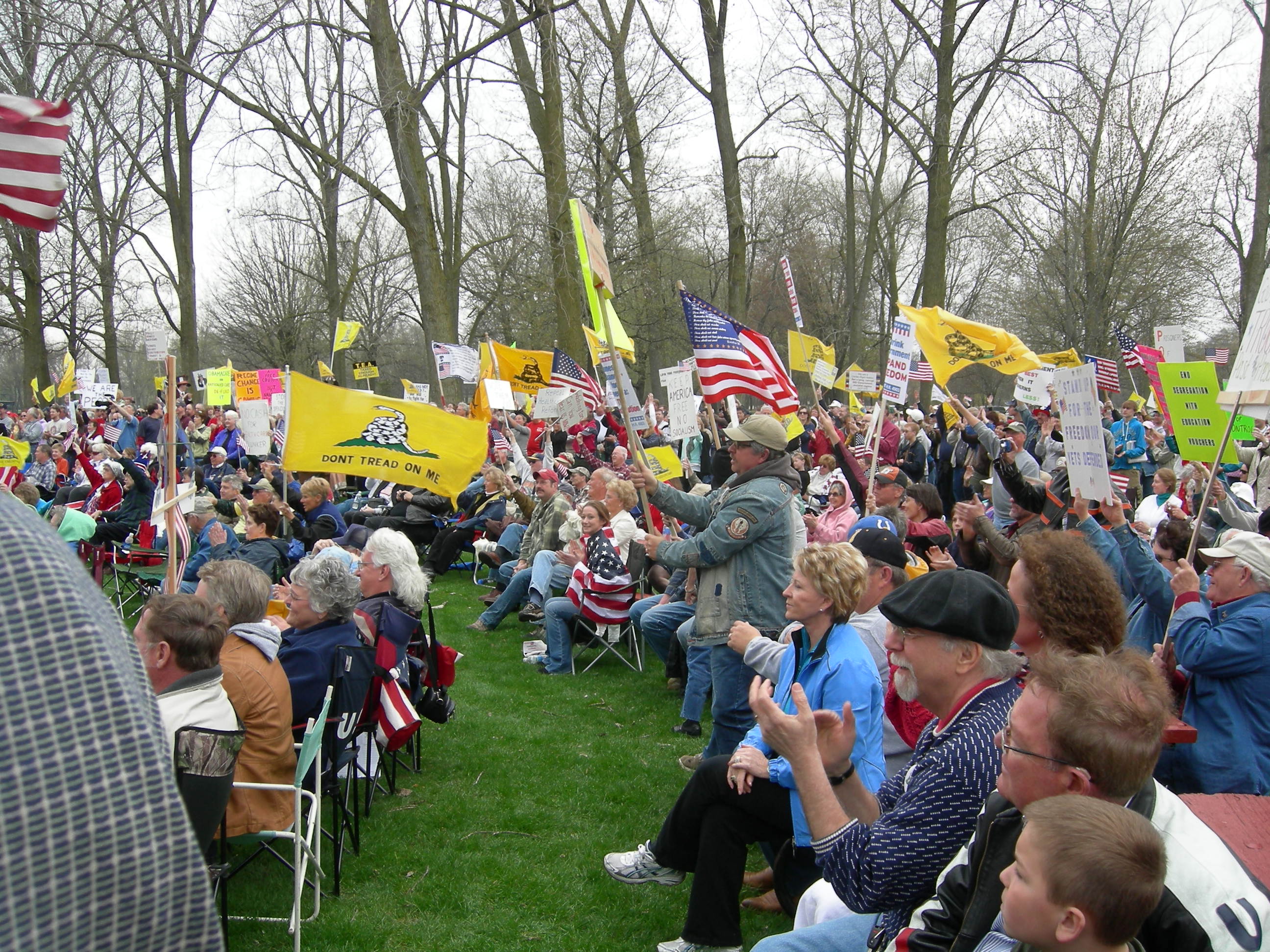
The West Michigan chapter of the Tea Party organized the rally where a series of speakers addressed the crowd before the Tea Party Express buses arrived.
Many of the speakers addressed themes like gun rights, Patriotism, supporting US troops, the Constitution and religion. None of the Tea Party members spoke for very long, but many of them expressed their displeasure with the US government, from President Obama to members of Congress. In fact, most speakers were clear that they were not happy with politicians from either party.
However, once members of the local Tea Party chapter had spoken, a whole litany of candidates took turns at the podium and all of them were running as Republicans. Gubernatorial candidates Mike Cox and Mike Bouchard were there. Both spoke about the importance of protecting the constitutional right to have guns and Bouchard even had a pistol on his hip. Pete Hoekstra was not in attendance, but his people were there handing out campaign literature.
Candidates for other State and federal seats also addressed the crowd. One candidate, Bob Overbeek, said he was limiting the amount of money he would receive from people to $1 per person and stated “we have to stop letting the wealthy determine who gets elected.” Overbeek even said, “if you want the Amway/Alticor twins in office then vote for them, but I am not for sale.” However, when looking at Overbeek’s platform he seems to embrace the same policies that most on the right, minus the campaign finance issue.

Eventually, three buses arrived with members of the Tea Party Express, the traveling group of people who are touring the country in order to give local chapters some support, but also to spread their message.
This part of the rally was like a patriotic road show, with singers, comedians and right wing media personality like Mark Williams. Not much substance was presented by those on tour, but the performers did get the crowd fired up with slogans and sound-bites.
The rally also consisted of vendors with buttons, t-shirts, books, CDs, DVDs and other items to promote the principles of the Tea Party. Many of the buttons and t-shirts were words and images critical of President Obama, with many of them claiming the administration to be socialist.
There were also tables for people to oppose the health care legislation, candidates wanting to get their name on the ballot and another table with people claiming to be the “political arm of the Tea Party.” We spoke with people from this table for several minutes and they told us that their role was to vet candidates for the Tea Party. We were told that there are 80 questions candidates must answer before they will endorse anyone, but those questions were not found on the group’s website. The website does say that they do not endorse Third Party candidates, so it seems clear that they are working within the confines of the Republican Party.

