Another Look at the Proposed Urban Market – Part II
Last month we posted a story that took a critical look at the downtown “urban market” that has been proposed by Grand Action. Since then there has been additional news coverage of the Grand Action plan and some community discussion.
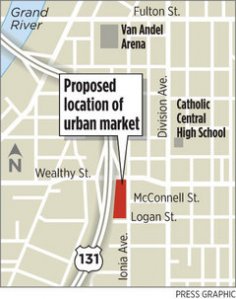
In this article we will look at a recent community meeting on the topic, additional news coverage and some power analysis by looking more closely at whom Grand Action is comprised of.
Public Dialogue
Because this project has raised some red flags for people who do justice work, a meeting was hosted by Kent County Commissioner Jim Talen with the intent of trying to provide some answers to questions people in the community have about the project.
Members of Our Kitchen Table, community organizers and a few residents from the near Southeast part of Grand Rapids came together to ask questions. Commissioner Talen was upfront with those in attendance by saying that Grand Action was a group of “rich white guys” who have vested economic interests. The commissioner also said that even though Grand Action has been working on this proposal for two years there are things that they would not talk about in public. For instance, Grand Action will not provide a list of the people who have been consulted from the community, nor will they share much of the financial details at this point.
Commissioner Talen did say that Grand Action does have a larger agenda, which is to re-develop the area south of Wealthy Street, one of the concerns that people expressed at the meeting. The project proposal states that 1,200 jobs would be created, but nowhere does it state what kind of jobs will be created and whether or not they would pay a living wage. When asked if the proposal has any commitment to hiring residents near to the proposed site, Commisioner Talen responded that he was unaware of any such commitment.
Other issues that were raised at the meeting was the consequences of increased traffic congestion, increased air pollution because of more traffic and traffic jams, whether or not public dollars would be used in the process, why no transparency in the process and why such a high price tag for such a proposal?
Many of these questions could not be answered by the commissioner, but he did reveal to those in attendance that on top of the $27 million price tag, there was an additional $600,000 – 900,000 needed to move forward just for pre-construction purposes. In addition, since our first story on the proposed project the Grand Rapids Downtown Development Authority (DDA) has approved $100,000 towards the project, which means that public dollars are now involved.
Additional News Coverage
Since the initial stories about the proposed “Urban Market,” there have been a few new stories. First, there was a critical article in the May issue of new month publication, Positive Voices. Writer Peter Carlberg asks some important questions and makes sound observations. The current issue in not yet online, but should be by the end of the month if you can’t get hold of a print copy.
The other article that recently appeared was from the business journal MiBiz, which ran a story headlined, “Urban market sprouts collaboration, education.”
The article only cites the guy whom Grand Action hired to do an initial study for the project and someone from the Michigan Department of Agriculture. The story states that the planned market would generate “$775 million in regional economic activity in a decade.” One question to be asked based on that statement is who will be the primary beneficiaries of that $775 million?
The article also states that the project could train “entrepreneurs in good agricultural practices, leveraging technology to help agribusiness become more efficient to meet the needs of retailers and consumers.” Why do we need to help agribusiness become more efficient? Shouldn’t the real goal of truly sustainable project promote agriculture that involves more people and provides healthy food because it is everyone’s right?
However, the driving force behind such a project seemed to be captured in a comment by the representative from the Michigan Department of Agriculture who said he expected the “urban market to be a catalyst for adjacent redevelopment projects, spurring residual economic benefit and job growth.”
This statement should cause us all to question the larger motive behind such a project and whom it will benefit.
Interlocking Systems of Power
As we stated in the previous article about this issue, the primary beneficiaries of such a project will no doubt be those who are the major proponents of such a project – members of Grand Action.
Dick DeVos, David Frey and John Canepa are the “General Chairs” of Grand Action. Most of our readers know what economic interests Dick DeVos has (Amway & The Windquest Group). David Frey is recently retired Bank One Chase executive and is the current Chairman of the Frey Foundation. John Canepa is a former Old Kent Bank executive and now works as a financial consultant for the Crowe Horwath.
The Executive Committee for Grand Action is a who’s who of the areas economic powerbrokers. The list includes Marty Allen (businessman), David Haynes (Lobbyist), Richard Haslinger (West Michigan Chase Bank President), Steve Heacock (Van Andel Institute), Bob Hooker (Doctor), Mike Jandernoa (former CEO of Perrigo, Bridge St. Capital Management & head of Janderoa Entrepreneurial Mentoring), Kurt Kimbal (former Grand Rapids City Manager), Birgit Klohs (Executive Director of The Right Place), Jim Leach (President Leach Food Equipment), Donald Maine (Chancellor Emeritus of Davenport), Mary Ellen Rodgers (Deloitte LLC), Steve Van Andel (Chairman of Alticor), Carol Van Andel (Van Andel Foundation), Michelle VanDyke (CEO Fifth Third Bank of West Michigan) and Casey Wondergem (former Amway executive and now with the Van Andel Foundation).
Clearly these people represent a small sector of elites in West Michigan. However, in addition to their professions they solidify their economic and political influence by being part of inter-locking systems of power locally.
For instance, Richard Haslinger and Michelle VanDyke are both board members of The Right Place, which has tremendous influence on economic development locally. Kurt Kimball and Richard Haslinger are both members of the Economics Club of Grand Rapids.
John Canepa is a member of the Grand Rapids DDA and Mary Ellen Rodgers is on the Siedman School Advisory Board. Birgit Klohs is a member of the Grand Rapids Chamber of Commerce and the Michigan Economic Development Corporation. Jon Nunn, the Executive Director of Grand Action sits on the board of the Grand Rapids/Kent County Convention Center and Visitors Bureau. Mike Jandernoa is on the board of the Van Andel Instiute, Carol Van Andel is on the GVSU Foundation board and Steve Van Andel is the with the Center for Private Enterprise.
These interlocking systems of power should certainly tell us something about what might be motivating the downtown urban market proposal and who is likely to be the primary beneficiaries of such a project.
Indian author & activist Arundhati Roy interview
(This article/video is a re-post from Common Dreams.)
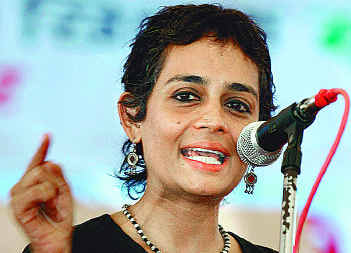
In 1997, Arundhati Roy’s first novel The God of Small Things made her the first Indian woman to win the prestigious Booker Prize. More than six million copies of the book were sold worldwide.
Since then, she has turned her pen to politics. During the Bush years, she was a fierce critic, calling the invasion of Afghanistan “an act of terror on the people of the world”.
In India, she has campaigned against mega dams projects, denounced the rise of Hindu nationalism, and has been imprisoned by the Supreme Court of India for “corrupting public morality”.
Her latest essay describes her trip into the heart of India’s Maoist insurgency, the movement, India’s government has launched a major military campaign to crush.
Fault Lines caught up with Arundhati Roy during a rare US appearance.
She talks to Avi Lewis about fighting on the ground, battles over corporate control of Indian land, India and the US after the Cold War, ‘Islamophobia’ and terrorism, tribal resistance in India and Afghanistan, and the issues behind the so-called Maoist insurgency.
The Origins of Mother’s Day
As we are all carpet-bombed with ads admonishing us to buy something for our mothers, it is important that we look back at the origin of Mother’s Day in the US.

Mother’s Day came about as an extension of the efforts of women who were involved in abolition and suffragist struggles. Most radical historians say that Mother’s Day can be traced to the person of Julia Ward Howe.
This courageous woman is best known for writing the Battle Hymn of the Republic, which she wrote in response to visiting wounded men in the camps during the Civil War. It was in this context that Julia Ward Howe began to think about both the human and economic toll of war.
When war broke out at the international level in 1870, with the Franco-Prussian War, Howe called for women all around the world to rise up against war. She wanted women to come together across national lines, to recognize what we hold in common above what divides us, and commit to finding peaceful resolutions to conflicts.
She also issued a declaration which spoke out against war by saying things like, “Our husbands will not come to us, reeking with carnage,” and “Our sons shall not be taken from us to unlearn all that we have been able to teach them of charity, mercy and patience. We, the women of one country, will be too tender of those of another country to allow our sons to be trained to injure theirs.”
Her attempts to have a formal Mother’s Day for Peace was not successful, but another woman named Anna Jarvis took up where Julia left off. Jarvis organized to have a Memorial Day for Women who lost husbands or sons due to war.
The first time it was celebrated in any official capacity was in 1907 in West Virginian church, where Anna Jarvis’s mom had taught Sunday school. The custom spread and eventually was adopted by 45 states. In 1914, President Woodrow Wilson declared Mother’s Day to be a national holiday.
It would do us all well to honor the origin of this holiday and to stand with mothers around the world and call for the end of war.
NYT Has No Space to Tell You It’s an Oil Industry Group Saying That Spills Aren’t So Bad
(This article is re-posted from Fairness & Accuracy in Reporting.)
The formula for “contrarian” journalism was aptly summed up by Wonkette (1/6/09):
Take a widely accepted belief (e.g., “Dogs make good pets”) and write a cool 600 words arguing why its opposite is SECRETLY truer (“Why all dogs should die”).
Of course, it helps if the upside-down world you’re proposing turns out to be one that is surprisingly cozy to powerful corporate interests. Thus the piece that appeared on the front page of the New York Times today (4/4/10) arguing that maybe we’re all a little too worried about that oil spill in the Gulf.
To back up this counterintuitive notion, reporters John Broder and Tom Zeller turn to an “expert”:
“The sky is not falling,” said Quenton R. Dokken, a marine biologist and the executive director of the Gulf of Mexico Foundation, a conservation group in Corpus Christi, Texas. “We’ve certainly stepped in a hole and we’re going to have to work ourselves out of it, but it isn’t the end of the Gulf of Mexico.”
Who is this “conservation group” minimizing the impact of a massive oil spill on the area it specializes in conserving? That’s what Marian Wang of ProPublica (5/4/10) wondered, too. Turns out it’s not really a conservation group at all:
At least half of the 19 members of the group’s board of directors have direct ties to the offshore drilling industry. One of them is currently an executive at Transocean, the company that owns the Deepwater Horizon rig that exploded last month, causing millions of gallons of oil to spill into the Gulf of Mexico.
Seven other board members are currently employed at oil companies, or at companies that provide products and services “primarily” to the offshore oil and gas industry. Those companies include Shell, Conoco Phillips, LLOG Exploration Company, Devon Energy, Anadarko Petroleum Company and Oceaneering International.
The Gulf of Mexico Foundation’s president is a retired senior vice president of Rowan Companies Inc., an offshore drilling contractor.
Meanwhile, Transocean hosted the group’s winter board meeting in January and sponsored a dinner for the board of directors. Past board meetings have been hosted in full or in part by Anadarko Petroleum Company, Shell Exploration and Production, Valero Refinery and Marathon Oil Corporation.
So it’s not exactly surprising that the executive director of such a group would have a nonchalant view of the impact of oil spills on the Gulf. What is maybe a little surprising is that the New York Times would present a coalition of offshore drilling interests as neutral experts on the environment.
And it’s not like the Times reporters didn’t know who they were quoting. In an addendum to her ProPublica piece, Wang quotes an email response from Zeller:
We were aware of GMF’s industry partnerships–and for what it’s worth, I believe they also have members from the agriculture and fishing industries, among others. As you’ll note from Dr. Dokken’s bio, the group also includes marine scientists.
You could certainly mount the argument that such co-mingling might influence his assessment of the oil slick and how bad it might get, but as I understand it, the bulk of GMF’s operating budget comes from federal and state grants, so that wasn’t my sense.
So because the group gets government grants, the Times reporters thought it wasn’t worth mentioning that half the group’s board represents the very industry whose damage to the Gulf is being minimized?
“Of course, it’s probably always better to err on the side of full disclosure,” Zeller tells ProPublica–as if revealing that you’re quoting an industry group speaking in its own defense would be bending over backwards–“but we operate within space constraints as well–and I believe we did link out to the various websites, so enterprising readers could peruse their boards and sponsors.”
Here’s a tip for the Times: Next time you are running into “space constraints,” maybe you can free up some room by killing the piece that revolves around an industry spokesperson telling readers not to worry about the damage the industry that employs him has done to the environment.
UPDATE: The New York Times published an Editor’s Note on May 5 saying that the article “should have included more information about” the Gulf of Mexico Foundation: “While the group says the majority of its funding comes from federal and state grants, it also receives some money from the oil industry and other business interests in the gulf, and includes industry executives on its board.” While few readers–“enterprising” or not–would realize from that additional info that offshore drilling interests represent half the group’s board, we suppose it’s better than Tom Zeller’s response.
It has been just two weeks since Arizona pass a controversial law that gives law enforcement agents the power to question anyone they suspect of not having documentation. The new law is doing what some commentators thought it might do……give strength to the immigrant rights movement.

Some organizations like the National Council of La Raza (NCLR) have called for a boycott of Arizona. Their Press Release from yesterday states, “When a law so contrary to our values is passed, we must act decisively. We are calling for a boycott because this law will blow open the door to increased racial profiling, wrongful arrests, and other discrimination.”
The boycott is calling on people to not do any business in Arizona or visit Arizona as a tourist. The NCLR has created a pledge that they are asking individuals and organizations to sign on to, a pledge that details the parameters of the boycott.
The call for a formal boycott has already resulted in at least 23 major meetings/conferences in Arizona that will cost the state $6 million dollars. In addition, some truckers are refusing to make deliveries into Arizona, an action they are organizing over their CB radios.
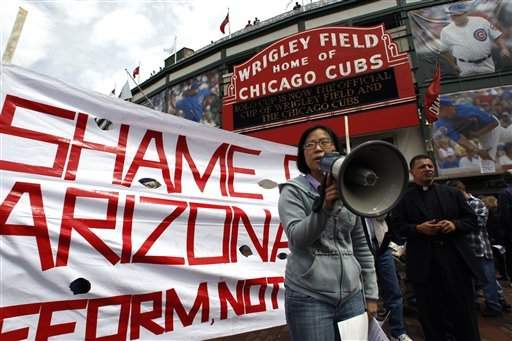
One of the more interesting arenas of resistance is in the world of professional sports. The professional baseball team from Arizona, the Diamondbacks, are being greeted with protests whenever they play on the road. Last week when they were playing in Chicago they were greeted with an organized protest of immigrant rights groups, holding a large banner that said “Shame on Arizona.”
The players union of professional baseball also has come out against the anti-immigrant law in Arizona. In a May 4 media release they state, “The Major League Baseball Players Association opposes this law as written. We hope that the law is repealed or modified promptly. If the current law goes into effect, the MLBPA will consider additional steps necessary to protect the rights and interests of our members.”
According to Left sports writer Dave Zirin, the pressure against the Arizona baseball team has forced the owner, Ken Kendrick (a long time supporter of anti-immigrant laws), to publicly state that he now is against the Arizona law. Zirin believes that the pressure needs to increase and that fans should call for a boycott of the Major League All Star Game, which is scheduled to be played in Phoenix this July.

But baseball is not the only sport that his making headlines in opposition to the racist Arizona law. The NBA team based in Arizona, the Phoenix Suns, in a statement of solidarity wore jerseys that said “Los Suns” on May 5th, Cinco de Mayo, to support immigrant rights and to challenge the Arizona law. Team owner Robert Sarver, released a statement on May 5 that read in part: “The frustration with the federal government’s failure to deal with the issue of illegal immigration resulted in passage of a flawed state law. However intended, the result of passing this law is that our basic principles of equal rights and protection under the law are being called into question, and Arizona’s already struggling economy will suffer even further setbacks at a time when the state can ill-afford them.”
One player on the Phoenix Suns, Steve Nash, stated recently on a sports talk program that the law is bad for civil liberties and will create a climate of racial profiling. Taking these kinds of positions is not new for Nash, he was the first professional athlete to speak out against the US invasion of Iraq in 2003.
We are encouraged by these actions and will continue to report any new developments in this struggle for immigrant and racial justice in the coming weeks and months.
US to Expand Pakistan Drone Strikes
(This article is re-posted from Common Dreams.)
The Central Intelligence Agency (CIA) has been granted approval by the US government to expand drone strikes in Pakistan’s tribal regions in a move to step up military operations against Taliban and al-Qaeda fighters, officials have said.

Federal lawyers backed the measures on grounds of self-defence to counter threats the fighters pose to US troops in neighbouring Afghanistan and the United States as a whole, according to authorities.
The US announced on Wednesday that targets will now include low-level combatants, even if their identities are not known.
Barack Obama, the US president, had previously said drone strikes were necessary to “take out high-level terrorist targets”.
Conflicting figures
“Targets are chosen with extreme care, factoring in concepts like necessity, proportionality, and an absolute obligation to minimise loss of innocent life and property damage,” a US counterterrorism official said.
But the numbers show that more than 90 per cent of the 500 people killed by drones since mid-2008 are lower-level fighters, raising questions about how much the CIA knows about the targets, experts said.
Only 14 of those killed are considered by experts to have been high ranking members of al-Qaeda, the Taliban or other groups.
“Just because they are not big names it does not mean they do not kill. They do,” the counterterrorism official said.
The US tally of combatant and non-combatant casualties is sharply lower than some Pakistani press accounts, which have estimated civilian deaths alone at more than 600.
Analysts have said that accurately estimating the number of civilian deaths was difficult, if not impossible.
“It is unclear how you define who is a militant and who is a militant leader,” Daniel Byman, a counterterrorism expert at the Brookings Institution’s Saban Center for Middle East Policy, said.
Jonathan Manes, a legal fellow at the American Civil Liberties Union, said: “It is impossible to assess the accuracy of government figures, unattributed to a named official, without information about what kind of information they are based on, how the government defines ‘militants’ and how it distinguishes them from civilians.”
US message
Former intelligence officials acknowledged that in many, if not most cases, the CIA had little information about those killed in the strikes.
Jeffrey Addicott, director of the Center for Terrorism Law at St Mary’s University, said the CIA’s goal in targeting was to “demoralise the rank and file”.
“The message is: ‘If you go to these camps, you’re going to be killed,'” he added.
Critics say the expanded US strikes raise legal as well as security concerns amid signs that Faisal Shahzad, the suspect behind the attempted car bombing in New York’s Times Square on Saturday, had ties to the Pakistani Taliban movement, known as Tehrik-e-Taliban Pakistan.
CIA-operated drones have frequently targeted the group over the past year in Pakistan, and its members have vowed to avenge strikes that have killed several of their leaders and commanders.
Shah Mehmood Qureshi, Pakistan’s foreign minister, told CBS television channel that the US should not be surprised if anti-government fighters try to carry out more attacks.
“They’re not going to sort of sit and welcome you [to] sort of eliminate them. They’re going to fight back,” Qureshi said.
(This article is re-posted from the Center for Responsive Politics.)

On Thursday, oil giant BP asked for U.S. government assistance in cleaning up massive amounts of crude oil ominously approaching the coast of Louisiana — the messy results of a recent oil rig explosion 40 miles off-shore.
In response, the Obama administration promised support in both clean up and containment of the environmental crisis. The president also sent clear signals indicating a potential federal investigation to determine cause and responsibility for the accident.
If BP faces heavy federal scrutiny, it’s well-positioned to fight back: The London-based company has consistently spent top dollar to influence legislative and regulatory activity in Washington, D.C., the Center for Responsive Politics finds.
During the 2008 election cycle, individuals and political action committees associated with BP — a Center for Responsive Politics’ “heavy hitter” — contributed half a million dollars to federal candidates. About 40 percent of these donations went to Democrats. The top recipient of BP-related donations during the 2008 cycle was President Barack Obama himself, who collected $71,000. BP regularly lobbies on Capitol Hill, as well. In 2009, the company spent a massive $16 million to influence legislation. During the first quarter of 2010, it spent $3.53 million on federal lobbying efforts, ranking it second (behind ConocoPhillips) among all oil and gas industry interests.
Its registered lobbyists include a number of former federal government and high-ranking political campaign officials, including longtime political operative Tony Podesta, former congressional chief of staff Bob Brooks, former congressional legislative director David Pore and vice presidential aide Michael S. Berman, the Center’s research shows.
The oil and gas industry, of which BP is a member, reported $169 million in 2009 lobbying expenditures.
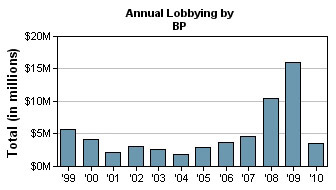
Comparatively, the entire environmental movement spent $22 million on lobbying in 2009 – not much more than BP alone spent for the year. The most active member of the environmental industry, the Nature Conservancy, reported $2.2 million in 2009 expenditures. Last year, BP was active lobbying on the American Clean Energy Leadership Act of 2009, which allows increased oil and gas leasing in the Gulf of Mexico, in areas closer to shore than current law allows.
The bill also calls for additional research and inventory of oil and gas reserves in the U.S. Outer Continental Shelf. The bill is sponsored by Sen. Jeff Bingaman (D-N.M.), who has received $14,000 in campaign donations during the past two decades from those associated with BP, the Center finds. In 2009, BP also lobbied on the Oil Spill Prevention Act of 2009 and the Clean Water Restoration Act. The oil spill, which has yet to be remedied, was caused by an explosion on a BP-leased oil rig on April 20.
A state of emergency has since been enacted in Louisiana, and the White House has designated it an event of “national significance.” The oil well is reportedly leaking between 1,000 and 5,000 barrels a day, and rescue crews are trying to eliminate the oil by setting it on fire, breaking it up with chemicals and skimming it off the surface of the ocean. Already, questions are being asked about cause and responsibility. Upon hearing the cry for help in the Gulf of Mexico, Rep. Henry A. Waxman (D-Cal.), chairman of the House Energy and Commerce Committee, called for a “full blown investigation.”
In 2009, individuals and political action committees associated with BP donated $16,000 to members of the House Energy and Commerce Committee. In addition, five of the all-time top 10 recipients of BP money in the House of Representatives sit on the House Energy Committee: John D. Dingell (D-Mich.) Joe Barton (R-Tex.), Ralph M. Hall (R-Tex.), Roy Blunt (R-Mo.) and Fred Upton, (R-Mich.). All have received upward of $13,000 from BP-related individuals and political action committees during the past two decades. Dingell, the second most favored recipient of BP money in the House, has received $31,000.
Last night, Jeremy Scahill, investigative journalist and author of the book Blackwater: The Rise of the World’s Most Powerful Mercenary Army, spoke in Holland to over 200 people. Scahill’s talk was just hours after Erik Prince spoke at the Tulip Time Festival luncheon.

Scahill began by saying that the message that Prince gives for the public is different than what he gives to private, conservative groups like the one at U of M, which was taped and sent to the Nation magazine, the publication Scahill writes for.
Much of what Scahill said in his talk is in the analysis he wrote about a few days ago for the Nation, which is worth reading in its entirety. One point that the journalist emphasized throughout the night was that using private mercenary forces means there is no accountability for the politicians who don’t want to be held accountable.
Scahill wasn’t just referring to Bush & Cheney, but to the current members of Congress and the Obama administration. In fact, Scahill said that under President Obama, private military contractors have increased in Afghanistan, from 70,000 a year ago to 104,000 today.
The Blackwater author also said that Prince uses people who have worked in the intelligence community – the CIA, FBI and DEA. Blackwater provides body guards for US Ambassador to Afghanistan Karl Eikenberry and to other US diplomats when traveling to Afghanistan. This means that members of Congress, when visiting Afghanistan on a fact finding mission, the same Congress which has been investigating Blackwater, is guarded by that private mercenary group when in Afghanistan.
Scahill says that when the FBI investigated the Iraq killings from 2007, in which Blackwater was accused of killing innocent Iraqi civilians, the FBI agents were going to be guarded by Blackwater personnel. Blackwater controls four forward operating bases in Afghanistan, according to Scahill and even bragged that they have the closest base to Pakistan. Blackwater was responsible for making the biggest drug bust ever in Afghanistan and they called in air strikes from NATO. Scahill asks the rhetorical question – “how can a private company call in air strikes from NATO?”
Scahill mentioned that during Prince’s talk at the Tulip Time Festival that the Blackwater CEO said that no one has died who was being protected by Blackwater security people. The author said that there were 8 CIA agents killed in Afghanistan recently who were under the protection of Blackwater.
Then Scahill tells the story about an Iraqi, Mohammad Kanani. Kanani welcomed US troops in 2003 when they arrived in Baghdad and was a supporter of the US occupation. In 2007 he took his son near downtown Baghdad one day where they came to a stop at an intersection. Gunfire opened and people were killed, and Kanani’s car was shot and his son was hit. The Iraqi man got out of his car to go to the other side and saw his son’s limp body. “My son, my son, they’ve killed my son,” he cried out. His brain had been shot out. The people that shot Ali Kanani that day were Blackwater mercenaries. This story that Scahill was recounting was Nisour Square shootings, where 17 Iraqi civilians were killed by Blackwater personnel. Scahill said we never hear the details of these killings, because the media in this country does not really care about the lives of innocent people that US soldiers and mercenaries take in these wars.

Scahill went on to say that they originally offered Mohammad hey $10,000 in compensation for the loss of his son. Originally said no, but later he said yes and gave half of the money to the US military to pay for a soldiers’ funeral. The US courts let the Blackwater personnel responsible for the killings go free. Mohammad Kanani said that the only thing he wanted was a public apology from Erik Prince, because Prince had said during the Congressional hearings that he believes that some Iraqis kill themselves so that they can collect money from the US government. Mohammad was so outraged by this statement that he demanded an apology, but Prince said that his company does not make apologies.
There is one legal case still open from the Nisour Square killings being held in North Carolina. Scahill said that recently Blackwater asked US Attorney General Eric Holder to step in and take responsibility for the deaths. He Private mercenary company even said they should be tried in Afghanistan under Sharia law since that is the legal system there.
What about the four Blackwater emplyees who were killed in Falluja? All of them were decorated veterans put in a ridiculously dangerous situation. The families wanted to know what happened that day. Blackwater stonewalled them. Blackwater executives told them they would have to sue the company to get the information, which they did. In turn, Blackwater sued the families for violating the contract that the men had signed.
Scahill concluded his remarks by saying that we could talk until we are blue in the face, but the problem is not just Blackwater, it is a thirst for militarism and US imperial wars. He said that there is a push to privatize all aspects of our country – education, health care, etc and until we address that and the incredible power that corporations wield in this country, we will not solve the problem of companies like Blackwater.
This comment was the most important thing that Scahill said all night, but it was not a statement that people wanted to address during the Q&A. Most of the questions were specific to Blackwater and Prince and not the larger power structure that Scahill exposed.
Lastly, I think it is worth pointing out that at the Price talk yesterday there were dozens of news reporters in attendance. For the Scahill lecture I only saw a reporter from the GR Press and the Holland Sentinel. The Press article was very short and had virtually none of the analysis Scahill provided in his talk. The Holland Sentinel had not posted a story on their website by the time we posted this story.
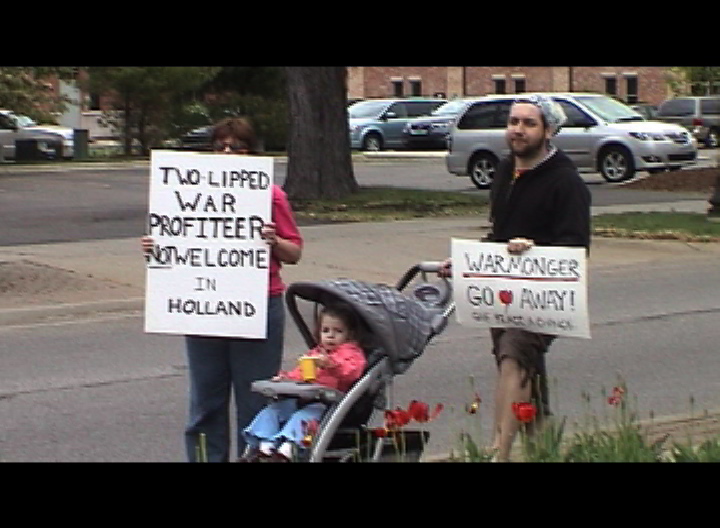
The Holland Tulip Time Festival officially kicked off today with a luncheon attended by roughly 800 people. An event that was originally closed to media, the Tulip Time Festival Committee changed their mind and allows news agencies to attend the luncheon to hear the founder of Blackwater, Erik Prince.
GRIID was at first scrutinized by the media liaison and then questioned by the Holland Police Department, only eventually to be “cleared” as a legitimate news entity.
Prince spoke for no more than 30 minutes and gave a somewhat dispassionate, pre-written speech. He spoke about his family roots and growing up in Holland, but emphasized how his family made it through tough times without any government assistance.
This theme of “self-sufficiency” was spread throughout Prince’s speech and he took every opportunity to criticize what he called big government that is rife with bureaucracy. At one point Prince quoted Ronald Reagan who said once that the most frightening words were, “I’m the government and I’m here to help.”
Prince also talked about American values and what made this country great – liberty, entrepreneurship and hard work. He said that what makes this country great was embodied by something that happened in 1969, the year that he was born, the Apollo mission. He contrasted this with another event in that same year that reflected what he saw as something that has attacked the moral fiber of this country – Woodstock.
Prince spoke briefly about his decision to join the military, eventually becoming a Navy Seal. He said, “It was the best job I ever had.” After Prince left the military he eventually got the idea to start Blackwater. Prince says he was inspired to create the internationally known private mercenary group because of what he saw as a lack of action from the US during the Rwandan genocide.
Prince responded to what he called his critics by saying that the US was founded on the help of private military contractors and that what Blackwater does was consistent with what has always existed in America.
The former Navy Seal said his company was contracted by the US Government after the USS Cole was attacked in 2000. Ever since then, according to Prince, his company has not received one cent from any grant money or other US tax money. The fact is, that every time the US government gives contracts to Blackwater, they do so with public taxpayer money.
Prince said that his company was called upon 40,000 times to protect diplomats and reconstruction contractors in Iraq and that not one of them was ever injured. However, Prince failed to mention the civilians that his private soldiers killed in Iraq and the role that Blackwater has played in a targeted assassination campaign involving the CIA in the Af-Pak War.
Prince beamed with pride when he said that Blackwater continues to train “security personnel” from countries like Egypt and Pakistan. He also boasted of the amount of cargo that Blackwater has brought to US troops in Afghanistan. Again, Prince failed to mention that his company was caught stealing US weapons in Afghanistan through one of its contracting partners Paravant.
Prince also talked about Blackwater’s role after the devastating effects of Hurricane Katrina. Prince said they provide some relief work early on in New Orleans, but eventually was hired by private companies to do security work, companies like Wal-Mart.
Holland’s native son did not miss an opportunity to trash the US government, especially now that it “just wants to spends its way out of trouble.” Prince said that US taxpayers are saddled with debt and that there seems to be more “class war going on.” He also said that the lack of free market principles hinders our country’s ability to compete with India and China.
Prince concluded his remarks by reflecting on what makes this country great – liberty and the free market. This may have been the most honest thing he said during his speech, especially since Blackwater has made money from militarism.
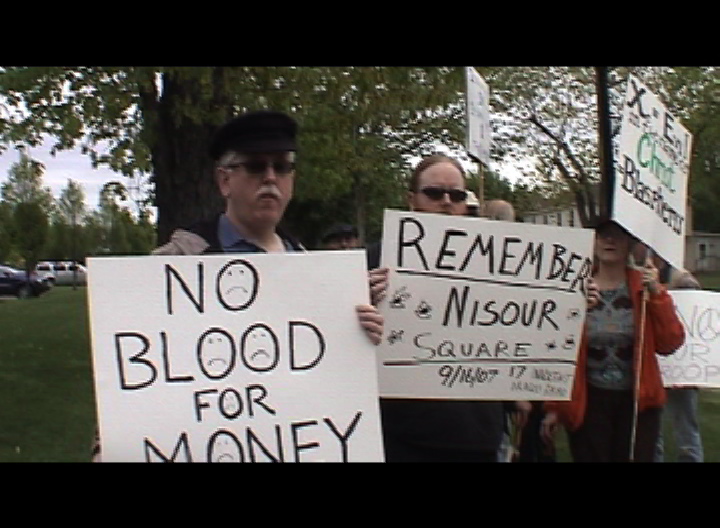
The luncheon crowd gave Prince a standing ovation, but not everyone there today supported the Holland native. Outside of the Hope College Fieldhouse about 75 gathered to protest Prince’s visit. We had a chance to interview some of those who came out to express their disgust with the Tulip Time Festival’s decision to invite the war-profiteer.
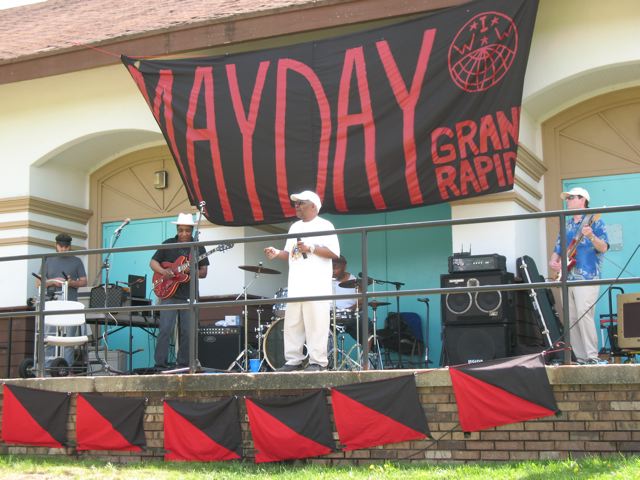
When the IWW May Day 2010 event, sponsored by a number of local groups and successful in every sense of the word, was not covered by the Grand Rapids Press, I decided to find out why. I wrote a letter to Paul Keep, editor: “On May Day, over 200 residents of Grand Rapids gathered in Martin Luther King Park for an event sponsored by several local and area groups. There were bands, a neighborhood potluck, events for children, and information booths. The Press was alerted in advance about this event, and yet there was no coverage of it in the paper.
“Leading up to May Day, the Press published three different articles about Rob Bliss—would he or wouldn’t he cancel his May Day event downtown? What was the weather going to be like? Would Rob decide to go forward or back down? That’s a lot of coverage for something that didn’t happen.
“On Sunday, you stated in your column that you felt that the Press needed to be the go-to place for people to learn about events and opinions in the community. You also stated you wanted to encourage community participation.
“Please explain to me the wisdom of ignoring an event that many local people worked on and which actually did go forward with a significant community turnout, while giving triple coverage to an event that didn’t even occur. I’d especially like to know if the Press’s political slant had anything to do with your decision not to mention the Martin Luther Park event.”
Paul Keep wrote back promptly, courteously, and in surprising detail. But I found what he didn’t say was as interesting as what he did. He started out by assuming I was one of the organizers of the event (I wasn’t), and assured me that the paper did in fact get word about it: “I asked our metro editor, who is in charge of making the decisions on what we cover locally, about this and he reported that we did indeed receive the advance notice of the May Day event at Martin Luther King Park.”
Then Keep went on to list all of the events that were covered—and weren’t—on May Day: “As you know from reading the paper, our reporters covered a number of other things going on in town on Saturday, including the first day of the statewide smoking ban, GVSU’s graduation, the first day of census takers hitting the street, a Grandville apartment fire and a regional high school technology fair (more than 800 projects). Our photographers shot pictures to go with all of these stories plus the Tulip Time opening, the Latin festival and Right to Life Bike & Hike Fest (although the latter photos did not run, for space reasons). We were unable to get to the event you mentioned and also the Grace Hunger Walk, because of the limitations of staff and space resources. And, of course, we had sports reporters covering a number of local stories and they used some of our staff photographer time as well.”
He added, “It was an unusual weekend, too, in that a number of our sports reporters and photographers were in Las Vegas covering the Saturday night fight of GR-native Floyd Mayweather.”
Keep’s conclusion? “I can assure you that politics did not play any role at all in our selection of stories to cover. The editorial page, where opinion is encouraged, does not make the coverage decisions for our newsroom. Your event sounds perfectly worthy of coverage, we just ran out of people to cover things.”
And that left me with an interesting handful of statements to study. First, note that Keep did not even address the advance coverage given to the Rob Bliss May Day event that never took place. In a newspaper of limited resources, that level of attention still seems like a strange decision.
And I know that Keep isn’t kidding when he says that he ran out of people to cover events. The Press laid off 65 employees in January, and that was after large-scale cuts to wages and benefits in 2009. In July last year, the Press lost a number of long-time reporters and columnists, some of whom apparently have since decided to work for the paper freelance. The fulltime staff can best be described as skeletal for the amount of work it has to handle.
With that in mind, I was left to dissect what had and hadn’t been found “worthy” enough to receive a reporter and/or photographer assigned to it. Tulip Time always gets plenty of press, and so do school events, so the technology fair coverage made sense. I was glad to see that the Press chose to cover, however minimally, the Fiesta celebration put on by the Latin Americans United for Progress. But the first day of census taking? And the first day of the smoking ban? Those have been marked multiple times in the Press already, and surely there was little to say about the very first day of the smoking ban—why not cover it after the weekend was over?
I also couldn’t help but notice the Right to Life event received reporter attention, although apparently didn’t make the final cut for the paper—while two more progressive events, May Day 2010 and the Grace Hunger Walk, did not.
But the really bizarre thing was that the Press had chosen to send “sports reporters and photographers” to Las Vegas to cover the Floyd Mayfield fight.
Paul Keep has reiterated a number of times that the reason that local news lands on the front page of the paper, trumping all national events, is that local coverage is the Press’s “niche.” On March 21 of this year, he wrote, “Everyone knows about the earthquakes in Haiti and Chile right after they hit, but how will you find out about important events occurring in a city, village, or township neighborhood near you? That’s why you see the Press front page today dominated by stories that are local or regional…Perspective and deeper understanding is our niche.”
With that mission in mind, I guess I can understand sending a Press reporter to the Las Vegas event to dig for local-angle stories about the Mayweather-Mosley fight. But a whole team of Press staffers? These guys were so pressed to keep filing stories that they ended up, absurdly, doing video interviews of each other.
And for a sports event covered by every major network and wire service, why did the Press need its own photos—let alone video clips and Tweets? After all, it picks up most of its national and international content and images from wire service reports. Photos of the Mayweather fight fill pages and pages of a Google search, and the Press photos are nothing different or unusual from photographs available from other sources. Meanwhile, coverage of truly local events—the Press’s main focus, according to its editor—were left begging for notice.
I find trying to decode this newspaper is always a puzzle. As in many times in the past, today I watch the ship of state that is the Grand Rapids Press sailing on: listing ever to the right and veering off on a course charted by its own inscrutable editorial decisions.

