Naomi Klein reports on the BP oil disaster
Journalist Naomi Klein is in Louisiana reporting on the BP oil disaster and provides some useful analysis of what the Obama administration is likely to do based on how they handled the Wall Street Bailout.
Memorial Day Revisited

Memorial Day is a national holiday commemorating U.S. men and women who have died in military service. It was first established after the Civil War, a war in which the vast majority of people who died, soldiers and civilians, were in fact American citizens.
But things have changed. Since the holiday has mainly morphed into a day of cookouts, the opening of summer cottages, and the end of a long weekend at the beach, it seems to time to think about meaningful alternatives to Memorial Day. Let’s reject the narrow official focus. We can change our thinking about whom we should honor as having fallen because of U.S. military policies.
We could choose to honor the Afghan and Iraqi citizens who have been killed since our war of occupation of those countries were begun by war criminal George W. Bush. In Iraq, the estimated number is 96,381 for a minimum number and some sources have the number over 1 million dead Iraqis since the US invasion of 2003. In Afghanistan, tracking from 2001 with the first U.S. air strike, the estimate of civilian deaths is approximately 12,000 to date, and will be rocketing higher soon because of our re-strengthened invasion of that country under the Obama Administration.
Another memorial we could choose for this holiday is the reflection on the number of civilians killed because of interference of the U.S. government via covert military operations, waged by the CIA and other forces in Europe, South America, Asia, and other locations. Let’s take the example of Guatemala. The CIA-engineered military coup in 1954 destabilized the country and over the following four decades led to the deaths of as many as 250,000 civilians.
In another case, the CIA’s operation–likely sanctioned by President Eisenhower himself–to bring the Shah of Iran back to power resulted in U.S. control of Iranian oil at the cost of thousands of civilian arrests and torture or death for those who tried to prevent the takeover of their country. (For details of US interventions since World War II see Bill Blum’s book Killing Hope: US Military and CIA Interventions since WWII and Zoltan Grossman’s “A Century of US Interventions.”)
Another population of people victimized by aggressive U.S. policies are immigrants who have been killed in their attempts to enter the United States or who have died because of the denial of basic rights—such as water or food—after being arrested. Deaths from Border Patrol use of force, killings by vigilante groups, and killings by coyotes (immigrant smugglers profiting from repressive U.S. immigration policies) are all on the rise along the border with Mexico.
In the two-year period of 1988 to 1990 alone, the Mexican government accused the U.S. of 117 cases of human rights abuses that led to severe injuries or deaths of people attempting to cross the border. In 2006, in just one example, a Border Patrol officer killed a 20-year-old Mexican named Guillermo Rodriguez because the unarmed Rodriguez was attempting to defend himself by throwing rocks. Groups such as No More Deaths are attempting to build consciousness over the toll of this militarized action on our southern border.

Or, we could take this day to remember the very beginnings of American imperialism: when colonists and later the U.S. government sought to annilhate the Indian nations who possessed the land that they wished to occupy. In his book American Holocaust, historian David Stannard estimates the total number of American Indian deaths at 100,000,000. This includes both those killed during military engagements and those who died from European-imported diseases brought to North America by settlers.
This Memorial Day, let’s think about those who have sacrificed everything in wars waged by the United States. But there are far more of the fallen than our country calls attention to on this national holiday… millions of victims who the U.S. would like us to forget.
Carl Levin and the Military Industrial Complex

We reported earlier this week that Michigan Senator Carl Levin voted against any timetable for US troops to be out of Afghanistan. He, like the majority of those in the Senate voted against a bill put forth by Wisconsin Senator Russ Feingold.
Senator Levin also announced this week that the Senate Armed Services Committee, which Levin chairs, completed a final version of the National Defense Authorization Act for fiscal year 2011.
Included in this bill is language that would end the “don’t ask, don’t tell” policy of discriminating against gays in the military, but it also includes further funding for the US military operation in Afghanistan & Pakistan. Levin states, “I am pleased that the Committee provided funding, authorities, and capability to defeat al Qaeda, its affiliates and other violent organizations, with a major focus on Afghanistan and Pakistan.”
Levin goes on to say that one of the highlights of the proposed military budget is that it, “Enhances the capability of the armed forces to conduct counterinsurgency operations and applies the lessons of Iraq to Afghanistan.” Of course Senator Levin doesn’t clarify what he means by the counter-insurgency techniques that were used in Iraq and should be applied in Afghanistan. These are two distinctly different countries, with different terrain, histories, insurgencies and ethnic groups. To continue to apply the same counterinsurgency tactics will be as disastrous for the civilians in Afghanistan as it was for the civilians in Iraq.
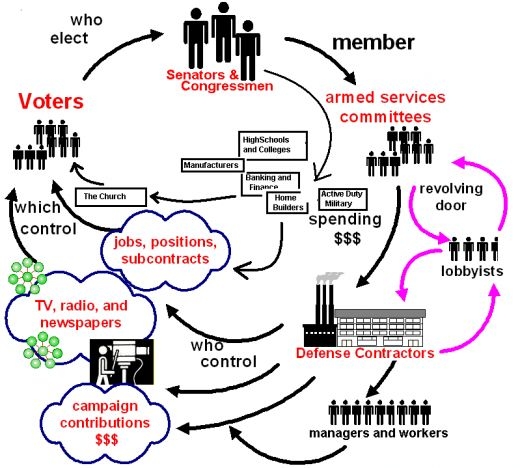
Military Industrial Complex
The proposed budget for the US military in this bill would be $725.9 billion, with the funding breakdown in three main areas:
- $548.9 billion for the base budget of the DOD
- $159.3 billion for overseas contingency operations (OCO), which funds the wars in Iraq and Afghanistan, and
- $17.7 billion for national security programs in the DOE and the Defense Nuclear Facilities Safety Board.
This proposed budget will continue the level of military funding that the nation saw during the 8 years under Bush and it reflects Senator Levin’s commitment to militarism, despite his “progressive” public image.
Levin also made it a point to announce this week that Michigan will “benefit” from the proposed military budget for 2011. The bill includes funding for Michigan based military contractors and universities. Levin states, “By connecting Michigan universities and companies with vital defense needs, we make our troops safer, stronger and better prepared for the threats they face.”
Some of the Department of Defense (DOD) funded projects in Michigan would include production of the Army’s Stryker armored vehicle, Abrams main battle tank, Bradley Fighting vehicles, grenade launchers and the Lightweight 155mm Howitzer.
Michigan Universities, which will receive funding for DOD research projects are: Michigan State University, Western Michigan University, Wayne State University, Oakland University, Henry Ford Community College, Michigan technical University, Eastern Michigan University and Central Michigan University.
What all of this military funding means is that US taxpayers will be subsidizing private industry and public universities to further the US military industrial complex, a structure which Senator Levin seems quite entrenched in.
BP Blocking Media Access to Oil Disaster Sites
(This article is re-posted from the Center for Media & Democracy.)

News photographers are saying that their efforts to document the oil spill disaster in the Gulf of Mexico are being thwarted by local and federal officials working with BP.
TV crews, news reporters and photographers on the ground in Louisiana are reporting that BP and Coast Guard officials are denying members of the media flights over the oil disaster area, and blocking their access to oil-covered beaches and staging areas for cleanup.
Mother Jones published a reporter’s first-hand account of his repeated attempts to get access to oil-soaked beaches and cleanup operations amid. The most recent report of the press being denied access to affected areas came from a company called Southern Seaplane, Inc. The company was scheduled to take a photojournalist from the New Orleans Times-Picayune for a flyover on May 25, but was denied permission after BP officials found out a member of the press would be on board.
In instances when access is granted it is conducted under tight oversight by BP and Coast Guard officials. BP officials escort reporters and photographers on BP-contracted boats and aircraft, so the company decides what the media sees and when they see it.
What We Are Reading
Below is a list of books that we have read in the past month. The comments are not a review of the books, instead sort of an endorsement of ideas and investigations that can provide solid analysis and even inspiration in the struggle for change. All these books are available at The Bloom Collective, so check them out and stimulate your mind.

Color-Blind: The Rise of Post-Racial Politics and the Retreat From Racial Equity, by Tim Wise – In his sequel to Between Barack and a Hard Place, Tim Wise once again provides us with sharp analysis of the current racial politics in the US. While we are witnessing racist dynamics from Arizona’s immigration policy to Tea Party rallies, Wise argues that the bigger problem is what he names as “Post-Racial Liberalism.” Post-Racial Liberalism is the idea that racial inequities are no longer of much concern and that people of color are disproportionately in prison, in poverty and have limited economic opportunities because of “other factors.” Wise does a great job of exposing Post-Racial Liberalism and shows us how institutional racism is still deeply entrenched in the US.

New World of Indigenous Resistance, edited by Lois Meyer and Benjamin Maldanado Alvarado – A wonderful collection of essays by educators and indigenous organizers throughout Latin America. After centuries of colonization, indigenous communities are beginning to reject state educational system, which minimize or deny traditional cultures, language and learning practices. This book provides important voices from Bolivia, Guatemala, Mexico, Ecuador and Peru, which articulate the importance of communal autonomy when it comes to pedagogical practices.

Resistance Against Empire, by Derrick Jensen – Resistance Against Empire is a collection of interviews conducted by Derrick Jensen with a variety of activists and organizers that deal with topics that range from war to consumerism. Jensen interviews Juliet Schor, Christian Parenti, Alfred McCoy, Katherine Albrecht, Ramsey Clark, Anuradha, J.W. Smith, Kevin Bales, Stephen Schwartz and Robert McChesney. A great collection of interviews that continues the kind of dialogue that Jensen gave us in How Shall I Live My Life?

The Punishment of Gaza, by Gideon Levy – Gideon Levy is a journalist that writes for the Israeli paper Haaretz. The Punishment of Gaza is a collection of columns that Levy has written that deal specifically with life in Gaza and Israeli policy towards that Palestinian community from 2006 through 2009. Levy provides readers with a first hand account of what is really happening on the ground in Gaza. The journalist humanizes the US-backed Israeli policy of brutalizing Palestinians who have endured for decades.

The Politics of Genocide, by Edward Herman and David Peterson – The authors argue in this book that the use of the term genocide has been overuse and misused in recent decades, particularly by US administrations. Herman and Peterson investigate the differences between a high profile case like Rwanda and a little discussed in the West case like the Democratic Republic of Congo. The authors use the principles of the Genocide Convention of 1948 to assess which cases can actually be called genocide and which cases are not. Their analysis is also a critique of US foreign policy and how the US uses the term genocide when it suits US interests.
(This article is re-posted from Common Dreams.)
The Senate rejected a proposal on Thursday to require President Barack Obama to submit a timetable for pulling U.S. forces out of Afghanistan, despite unease among some members of his party over the nine-year-old war.
The 80-18 vote nixed a bid by liberal Democrat Russ Feingold for a detailed troop timetable, which he argued would avoid future “emergency” war spending bills such as the $33 billion one now before the Senate.
But most members of the Democratic-majority Senate proved unwilling to dictate to the president, with a buildup of 30,000 additional troops still underway that Obama ordered to Afghanistan and a new military push in the Kandahar area.
Adopting Feingold’s plan would “reinforce the fear … that the United States will abandon the region,” Armed Services Committee Chairman Carl Levin, a Democrat, said.
Levin said this was unwise as the Taliban is “doing everything it can” to convince Afghans that U.S., NATO and Afghan forces cannot protect them.
Senate Majority Leader Harry Reid, a Democrat, also voted against Feingold’s proposal. “I’ve felt no impatience about Afghanistan in my caucus,” he said on Wednesday.
But several Democratic senators are increasingly anxious now that U.S. combat deaths have passed the 1,000 mark in Afghanistan and the cost of the war topped $300 billion.

The war in Iraq has cost over $700 billion, with 4,400 U.S. military dead since 2003.
“I’m impatient. Time to start thinking about a different approach, I think,” Senator Tom Harkin said earlier this week.
Senator Jeff Bingaman, another Democrat, said: “I think there’s a high level of impatience, but exactly what should be done legislatively about that issue, I don’t know.” He voted against Feingold’s proposal; Harkin voted for it.
END DATE SOUGHT
Feingold acknowledged Obama had set July 2011 as a starting date for removing U.S. troops, but said there should also be an end date. “The president should convey to the American and Afghan people how long he anticipates it will take to complete his military objectives,” he said.
There were no Republican votes for his plan.
“Thanks to the McChrystal strategy, American forces have already brought pressure on the Taliban in Afghanistan. We need to keep that pressure up if this counterinsurgency strategy is to succeed, and it must,” Republican leader Mitch McConnell said. General Stanley McChrystal is in charge of U.S. and NATO forces in Afghanistan.
The Senate also shelved a Republican proposal to find ways to pay for the new war spending with cuts to other programs. Reid scoffed at this idea, saying Republicans “never raised a fuss about paying for the war under President Bush.”
Reid wants the Senate to finish the war spending bill this week. The money must also be approved by the House, where Speaker Nancy Pelosi calls it a “heavy lift” among Democrats wary of spending more on the battlefield.
The House Appropriations Committee was expected to vote on its version later on Thursday.
Obama requested $33 billion in February to pay for his Afghan surge, but Congress has been busy with domestic priorities and worried about scarce budget resources. The money comes on top of about $130 billion that Congress already approved for Afghanistan and Iraq through Sept. 30.
The Senate version includes around $4 billion for a “civilian surge” of economic aid for Afghanistan and Pakistan.
Corporate Gardens?
In yesterday’s Grand Rapids Press there was a story in the business section headlined, “Why West Michigan firms say corporate gardening is good for business.”

The article features two local businesses that have decided to grow a garden that employees will take care of. One of the businesses is Progressive AE, a company that does design and consulting work for private businesses and government agencies. The idea to do a garden came about at one staff meeting and they hope gardening will be a community building exercise.
The other business is a restaurant in Grand Rapids called The Winchester. The employees will also be doing the garden work and what they harvest will end up in the menu.
At one level it seems like a positive thing when people get together and grow a garden. However, when one reads the rest of the article it raises questions about is behind corporate gardening and why this is news at all.
The Press article cites a New York Times story about larger corporations who have recently begun setting up gardens at their business facilities around the country. The Press even includes a side-bar in the article, which lists the corporations involved in gardening – PepsiCo, Google, Yahoo, Sunset magazine, Kohl’s, Toyota, Aveda and Best Buy.
These are all multi-million or multi-billion dollar corporations which have made huge profits and in some cases exploiting people and the planet. PepsiCo products (soft drinks and snack foods) have contributed negatively to public health and as well as exploitation of natural resources. Google and Yahoo have made billions off the Internet, a system, which was funded by public money during its research and development period.
Best Buy sells high-end electronics, which have not only contributed to making people less engaged in civil society, but has contributed to serious environmental destruction through the production and distribution of such products. Toyota produces cars, which is a major source of carbon emissions and has a history of labor abuses.
This quick look at these companies should lead us to ask what real good is being done by having a few employees grow a garden? Is their decision to have corporate gardens another form of greenwashing, where businesses attempt to distract the public from their inherently destructive practices by adopting something that can be perceived as being green? At one point it is important for journalists (and all of us) to ask why we should salute a company like PepsiCo for starting an employee vegetable garden, when they are trying to get the rest of us to eat unhealthy food products.
These contradictions are further illustrated in the Press article when they cite a study done by the National Gardening Association (NGA), a study funded by Scotts Miracle Grow Co. Miracle Grow is known to be toxic for the soil and for plants that humans will eat, which obviously does not support healthy, organic gardening practices. Not only did Scotts Miracle Grow fund the garden study the article cites, they are one of the NGAs major corporate sponsors.
If the Press really wanted to present information on the real benefits to gardening they could have cited the Rodale Institute, which advocates organic gardening in a truly sustainable model or City Farmer News, which highlights a variety of urban gardening/farming projects across the country.
3rd Congressional debate gets limited coverage
On Monday, the Grand Rapids Chamber of Commerce and Davenport University held a forum for candidates running in the 3rd Congressional District race. Six of the seven candidates vying for the seat that will be vacated by Vern Ehlers participated in the debate held at Davenport’s campus on Kraft near the Southbelt.
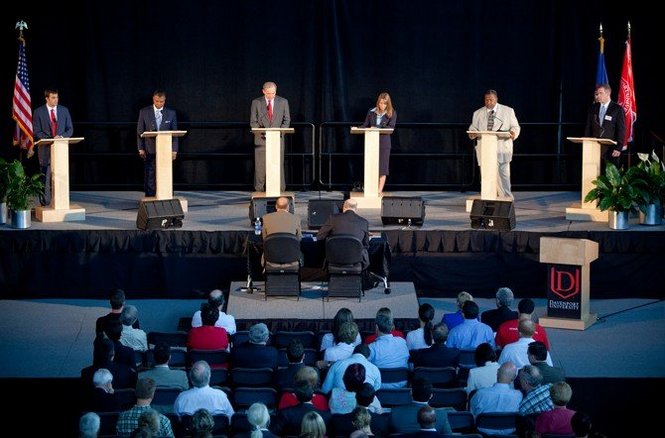
The only news agency to cover the debate was the Grand Rapids Press. Press editor Jeff Cranson was the moderator for the debate, a fact the Press article omitted. The debate was scheduled to last for two hours.
The Press coverage of the debate was very limited, offering only a single comment from each of the candidates. The article did start out stating, “the five Republicans hewed to the right, criticizing health care reforms, corporate bailouts and taxes in general while trying to avoid being labeled a “politician.” However, there were no details as to why these candidates took those positions, nor what policies they would put forth if elected.
The reporter mentioned the lone Democrat (Paul Mayhue) at the debate near the end of the article stating he, “defended the Obama Administration’s health care legislation and its bailouts of the auto industry.” Candidates used words like taxes and free trade and the only question asked from the moderator included in the article was about Asian carp. It’s hard to imagine that there wasn’t something more substantive asks of candidates during the two-hour debate.
The Press reporter could have at least looked at the comments candidates made and compare them to what they have posted on their websites. As of this writing Justin Amash has more platform information than any other candidate, although 75-words or less on issues like education, health care and the economy is not very impressive. Amash’s issues page states that he believes in the “free market,” protecting private property, a private health care system, lowering taxes, gun rights and a strong military.
Bill Hardiman has limited information about where he stands on issues and only addresses government spending, national defense, limiting government and putting less restrictions on business.
Former Kent County Commissioner Steve Heacock only has information about his stance on health care and Louise Johnson’s issue page is blank. Bob Overbeek has a 10-point plan, which consists on just bullet points. Overbeek is the only candidate who mentions the US wars in Afghanistan and Iraq, as well as immigration and Cap & Trade legislation. The Democratic candidate Paul Mayhue has limited information on education, health care, jobs and seniors.

Congress just sold you out to Comcast and AT&T. Seventy-four House Democrats and 37 Senate Republicans just signed their names to industry letters telling the FCC to halt efforts to protect Internet users and prevent phone and cable companies from blocking Internet traffic.
Almost every one of these elected officials has accepted massive contributions from the phone and cable lobby. In exchange, they are handing control of the Internet to companies that can’t be trusted to protect the public interest.
Speak out against this unethical behavior. Sign this letter to demand that Congress and the FCC stand with the people they represent and support an open and affordable Internet for everyone.
Journalism or an ad from the Visitor’s Bureau?

It was announced a few weeks ago that Grand Rapids was awarded a Green City status by the US Chamber of Commerce and the Siemens Corporation. We critiqued that announcement in a pervious posting and now the Grand Rapids Press is continuing to promote the idea that this city is sustainable without providing much evidence to support that claim.
The front page of yesterday’s Press has the headline “Greentown, USA?” The lead story was only about 50 words long and stated that this new identity was due to the recent Chamber award and a 2007 United Nations University designation, which called Grand Rapids a “Regional Center for Enterprise in sustainable development.
No explanation of this designation is provided in the Press article, just 6 pictures with captions that somehow demonstrate the city’s commitment to sustainability. The pictures are of the local recycling program, rooftop planting, electricity from methane, LEED certified buildings, a new citywide sewage/storm-water run-off system and a new Meijer store on 28th street and Kalamazoo.
The obvious first question is, how does Meijer’s new store construction demonstrate sustainability? While Meijer may have their origins in West Michigan, the company is a regional food distributor that sells mostly non-organic and processed food stuff. How anyone could defend that Meijer stores promote sustainability is almost laughable.
However, the larger problem is that the Press in the case is not practicing journalism. They monopoly daily paper is merely presenting information from sources of power – the City of Grand Rapids, the United Nations University and the US Chamber of Commerce – without questioning or verifying the claims made in this so-called article.
The Press should have followed the intent of the headline (Greentown, USA?) and actually questioned the idea that Grand Rapids is actually promoting sustainability. Without any questioning the story might as well be an ad from the Grand Rapids Convention and Visitor’s Bureau.

