Oscar Romero and the Texas State Board of Education
“To those who are hungry, give bread. To those who have bread, give a hunger for justice.
Archbishop Oscar Romero
On the anniversary of Oscar Romero’s death, it seems appropriate to discuss the legacy of this great man. Except, of course, if you live in Texas.

If you are a resident of Texas, you will no longer find any mention of Romero’s work, beliefs, or activism in the Texas schools. It has been forbidden by the Texas Board of Education, per a vote they took on March 10. He used to be a featured part of a unit in the Texas curriculum about leaders who stood up to political oppression and social injustice. The TBE removed Romero from that unit because they said he wasn’t as important as Nelson Mandela, Gandhi, and others. One member commented that Romero “didn’t have his own movie like the others.”
Actually, however, there is more behind Romero’s consignment to obscurity in Texas than his lack of film cred. In the Lone Star State, he’s now in the company of people like Thomas Jefferson, Martin Luther King, Jr., and Abigail Adams, among others. The Texas Board of Education is relentlessly right-wing and heavily Christian fundamentalist in make-up. They are tailoring the state’s teaching requirements to their political agenda. Here are a few other changes that they have made this year to the state’s curriculum:
• Removal of any mention of Dolores Huerta, a co-founder of the UFW and important activist. The board decided that she is a bad role model for children because she was a socialist.
• A ban on teaching anything about the holiday of Martin Luther King Jr. Day in Grade One. Instead, teachers must instruct children about Veterans Day.
• A ban on the teaching of a unit about Harriet Tubman. It was replaced with one on Clara Barton.
• Required teaching of the McCarthy era as a part of the “fight against the communist infiltration of the U.S. government” in the 1950s and 1960s. One TBE member insisted that the curriculum specifically teach that Joseph McCarthy’s actions had been “vindicated” by current political events.
• A required unit on “conservative heroes” such as the Heritage Foundation members, the Moral Majority, and Phyllis Schlafly.
• The removal of specific units about the struggle for civil rights by women and minorities, with one TBE member noting that women and minorities owed thanks to men from the majority (e.g., white men) for their rights. The board was forced at another meeting to back down in part from this decision.
• The removal of a high school unit about American imperialism, and the replacement of it with a unit on the positive effects of U.S. “expansionism” instead.
• The removal of a unit from Grade Three based on a book called Brown Bear, Brown Bear, What Do You See? because the board was concerned that the author, Bill Martin, had the same name as the Bill Martin who wrote Marxism and the Call to the Future. Under heavy protest from teachers, this decision was also reversed.
• Removal of any mention of Thomas Jefferson from a middle-school world history unit about important political thinkers. Jefferson was replaced with, of all people, John Calvin.
• A ban on a former requirement to teach “the reasons the Founding Fathers protected religious freedom in America by barring government from promoting or disfavoring any particular religion over all others” in discussions about the Constitution.
Here’s what’s particularly scary about decision-making like this. Educational companies gear their textbooks and supplemental educational materials to the two largest states in the country. Those states are California and Texas. Authors and editors are told to follow the curriculum of those two states when creating new materials. If something forbidden or removed from the Texas state curriculum ends up in a book, educational publishers know that its sales can go down by as much as 50 percent—because those two states represent so much business.
So the shock waves of this type of skewed decision-making will quickly find its way into the country’s published educational materials. Heroes like Oscar Romero will virtually disappear from instruction across the country, not just in Texas.
It is up to grass-roots movements to stop this under-the-radar type of change before it reaches the classroom. One way to do so is to carefully monitor the curriculum choices in our own states to see that they are not influenced by the decisions of boards like Texas. If teachers are required to continue teaching about people and topics like Thomas Jefferson, the separation of church and state, or the civil rights movement, they will do so even if they have to research and create their own materials.
To read an NPR synopsis of the Texas Board of Education’s recent work, click here.
Thirty years ago today, Salvadoran Archbishop Oscar Romero was gunned down while saying mass in a small chapel in San Salvador. A Salvadoran soldier who was the graduate of the US Army School of the Americas, it was revealed later, killed Romero.

There has been much written about Romero since his assassination and the factors that led to his eventual death. However, it is important to note that Romero wasn’t always a radical priest or a proponent of Liberation Theology.
Before Romero was chosen as the new Archbishop of El Salvador, he was a quiet and conservative bishop. Romero was even a member of the Opus Dei, a movement within the Catholic Church that began in Spain in the early part of the 20th century and supported the dictatorship of Franco.
However, Romero was a close friend of Fr. Rutillio Grande, a priest in one of El Salvador’s rural communities. Grande was a proponent of Liberation Theology and when he was assassinated for serving the poor and challenging the wealthy oligarchy in El Salvador, Romero began to see the light. This moment of transformation is what Jesuit scholar Jon Sobrino called “Rutillio’s Miracle,” because it was the catalyst that transformed Romero into the Voice of the Voiceless.
Quickly Romero began to not only speak out on behalf of the poor, he began acting in such a way that soon thousands of Salvadorans would come to call him simply “Monsignor.” Romero turned the facilities at the cathedral into a space for people to come for relief, food and medical assistance. Romero also began hearing the stories of countless Salvadorans who told him how their family members were disappeared, tortured and killed.

Romero then began to challenge the power structure in El Salvador, mostly through his Sunday sermons and his weekly radio broadcast. Romero understood all to well that the poverty and violence that people endured was because of the unjust economic power that the country’s wealthy possessed.
Romero also understood that the political violence that was terrorizing the country’s poor and working class people was a direct result of US military aid to El Salvador. Five weeks before Romero was assassinated he wrote a letter to then US President Jimmy Carter. He asked Carter that if the US really wanted to support justice in El Salvador that the US should stop sending weapons to his country and that the US should not directly intervene in any way into the political, economic, military or diplomatic affairs of El Salvador.
Noam Chomsky writes in the book Manufacturing Consent, that after Romero sent the letter to Carter, the Carter administration put pressure on the Vatican to try and curb the activities of the archbishop.
Romero also understood that many of the foot soldiers in the Salvadoran military were poor people who had been forced into the army. The day before Romero was assassinated he made a special appeal to the soldiers in El Salvador to not kill their fellow Salvadorans. Romero ended his sermon with these words:
We want the government to seriously consider that reforms mean nothing when they come bathed in so much blood. Therefore, in the name of God, and in the name of this long-suffering people, whose laments rise to heaven every day more tumultuous, I beseech you, I beg you, I command you in the name of God: Cease the repression!
We honor Romero’s life and death today and look to his message and his actions as an inspiration for struggle and resistance against all military and economic repression in the world.
For those of you who understand Spanish, here is Romero’s last sermon where he appeals to those in the Army to stop killing their brothers and sisters.
Media Bites – Budweiser and public disasters
In this week’s Media Bites we take a look at two Budweiser ads that both have a disaster theme. In both of these commercials the public seems indifferent to their circumstances until beer is included, as if to say that alcohol is what motivates people to do good. The reality is that alcohol use has serious social and economic consequences worldwide.
World Water Day – Challenges and Co-optation

Yesterday the United Nations designated March 22 as World Water Day. The UN has designated March 22 as a day to focus on water since 1993. Each year the United Nations highlights efforts to improve global access to clean water as well as the obstacles to making sure that everyone enjoys this basic human right.
One of the harsh realities of human access to water in the world today is that about 1.5 million children die each year because they consume contaminated water. According to a new study from the World Health Organization (WHO), “every day two million tons of sewage, industrial and agricultural wastes enter the Earth’s waters, while every 20 seconds a child under the age of five dies from water-related diseases.”
More often than not the blame for water contamination, particularly in Third World countries, is the unsanitary practices of poor people rather than on industrial and agribusiness practices. The framing around global water issues is increasingly contested terrain, with large multinational companies weighing in, especially those who use and misuse the world’s water resources.
The Center for Media & Democracy recently noted that Starbucks even created their own website trying to co-opt World Water Day. The Center for Media & Democracy also created a water issues clearinghouse, which allows people to track water news and to monitor corporate Greenwashing campaigns around water.
Lastly, a new educational video is online that provides some great analysis of the bottled water industry and all the problems it creates.
Health Care Lobbying Costs
On Sunday, Congress passed Health Care Reform legislation and while it is too early too know what this all means we do know how much effort was put into lobbying around this issue in the past year.

According to the Center for Responsive Politics the number of registered federal lobbyists just on health care for 2009 was 1,541. “These clients span special interest groups and economic sectors, ranging from more traditional health players such as hospitals, medical professionals, health insurers and drug companies to more diverse interests including organized labor, business groups, energy companies, food and beverage companies, defense contractors, retailers, municipalities, universities and religious-affiliated groups.”
The Center for Responsive Politics tracked this lobbying effort by fiscal quarters, because that is when federal reporters are published disclosing who registered as a lobbyist. The CRP found that there were 326 entities, which lobbied all four quarters for the fiscal year 2009.
Some of theses entities were: the “Drug industry trade group Pharmaceutical Research and Manufacturers of America (PhRMA), insurance industry trade group America’s Health Insurance Plans (AHIP), Blue Cross/Blue Shield, Pfizer, Planned Parenthood, the National Right to Life Committee, the U.S. Chamber of Commerce, the National Association of Realtors, AARP, the Service Employees International Union, the National Council of La Raza, United Parcel Service, Target, Safeway, Eastman Kodak, Hewlett-Packard, the government of the U.S. Virgin Islands and McDonald’s.”
At look at the drug company Pfizer and you see that they spent $21,930,000 in 2009 lobbying members of Congress. The US Chamber of Commerce, one of the most aggressive lobbyists on this issue spent $144,496,000 lobbying Congress on health care reform in 2009.
One thing to keep in mind of course is that we still don’t have the figures for how much lobby money was spent for the first quarter of 2010, which is no doubt in the billions of dollars. This should tell us something about how “democracy” works in this country and who the primary beneficiaries are of legislative decisions.
Woman power rocks at free health workshop
 Last Saturday, a small group of women, ranging in age from 16 through 60, met for The Bloom Collective’s Empowered Women’s Health workshop. The group not only learned valuable information from the wise women who presented, they also gained invaluable advice and sisterly support from each other.
Conversations covered everything from how to handle catcalls and sexual “compliments” in the workplace to the need for men and boys to take sexual responsibility in relationships.
Simple Herbal Remedies for Mothers and Others

Nettle, or "stinging nettle," is native to our area.
Chrysta Coronado opened the day by offering the group an herbal tea alternative to coffee that calmed stress and naturally awakened the body’s own energy.
She then shared techniques for brewing infusions, decoctions and tinctures made from common herbs that grow wild in our yards and nearby wild areas, such as red clover, red raspberry, dandelion and nettle. “Once we bleed, we need iron and calcium. Nettles are a woman’s ally,” Coronado said. “Nettles have magical serpent energy. They provide iron, calcium, vitamin A, vitamin C and they are diuretic, toning to the uterus.”
After polling the group, she focused her talk on herbs that help regulate the menstrual cycle, thereby relieving cramps, irregular bleeding and symptoms of PMS. She shared about herbs that boost fertility and others that discourage pregnancy.
Women & AIDS: Alive and Well in Kent County
Kelly Knudtson, a Bloom core member who works at The Grand Rapids Red Project CleanWorks needle exchange program, spoke about the relationship between women’s lack of power and the AIDS epidemic. AIDS is the number 1 killer of women worldwide and now infects more women than men. While the  epidemic is perceived as being more widespread in developing countries, HIV and AIDS are alive and well in the US, Michigan and Grand Rapids. Last year, three infants were born with HIV in Grand Rapids. With prenatal drugs now available, this simply should not have happened.
Girls and women are more likely to contract AIDS than boys and men not only because receptive sex is more likely to transmit the virus but also because females often lack power in relationships, due to gender inequality and violence. Many girls and women find it difficult to insist on condom use, even when violence is not a threat. “Poor women and girl are at highest risk,” Knudtson said. “Women are not involved in AIDS policy making. Women have less access to healthcare and to jobs. Sex work is an unfortunate reality even in Grand Rapids.”
Teen girls are at risk for HIV in Grand Rapids. Clamydia outbreaks among teens locally means that these kids are engaging in the same behaviors that put them at risk for HIV and AIDS. “Teenage girls are less likely to negotiate condom use,” Knudtson said. “Media sensationalizes teenage pregnancy. The girls carrying around babies could just as well be carrying HIV and AIDS.”
De-sanitizing Our Menstrual Health
After a delicious potluck lunch, the day concluded with a highly informative presentation on menstrual health. Rachael Hamilton shared facts and figures from her studies that encompassed marketing campaigns for menstrual products and how they cash in on our cultures’ twisted view of menstruation as something private, dirty, gross and disabling. “We have a spectrum of choices that we are not made aware of, from mainstream products found on the grocery store shelf to DIY pads,” Hamilton said. “Tampons are convenient but they cause cancer, are bad for the environment and made by companies that are concerned with making money, not with our comfort or health.”
 Commercial tampons not only contain carcinogens (bleach and dioxins) they also cause microscopic tears in the vaginal wall, making women more susceptible to Toxic Shock. Their use is also linked to endometriosis.
While the group sewed their own menstrual pads, Rachael shared information on the range of ways women can deal with their monthly flow.
Organic commercial tampons are somewhat less harmful. Menstrual cups (Diva and The Keeper) are healthy alternatives. Teen girls might be more comfortable using sea sponges as a tampon alternative. One participant suggested rolled up baby socks.
Most commercial pads contain carcinogens, as well, though exposure is somewhat less as they are not used internally. Women can purchase reusable cloth pads online (Glad Rags, Luna Cloths), or make their own. Patterns and directions are easy to find online as well. “The way we view menstruation can impact our health,” Hamilton said. “Women who lack menstrual knowledge have fewer tools to navigate sexual situations and have more difficulty saying ‘no.’ They are less likely to breastfeed their babies. And, there is a mental health component. Menstruation is a natural process that should build confidence, self-esteem and a communal time for women rather than make them feel dirty and be an isolating event.”
While hundreds, maybe thousands, more women may have attended last week’s commercially motivated Women’s Expo downtown, this writer doubts that they received anything as valuable, relevant or empowering as this simple gathering provided. As the workshop demonstrated, women have a great store of wisdom to share with each other in community.
Yesterday the Grand Rapids Press ran part three of a series of stories focusing on issues during the 2010 election cycle. Michigan’s environment was the stated focus of yesterday’s stories, but in reality the focus was on seeing Michigan’s natural environmental as resources.

The three articles that were included in the Press were all framed around how Michigan’s economy can benefit from the use of natural resources throughout the state. The lead story was headlined, “Are Michigan’s natural resources for sale? Next harvest must make sense for economy, environment and society.”
The story, written by Press reporter Jim Harger, begins with some reflection on how Michigan’s forests were devastated 100 years ago because of industry and then asks the rhetorical question whether these same natural resources help Michigan rebound economically. Harger writes, “Perhaps surprisingly, the answer is often yes.” Harger also accepts the language of those promoting this free market model, the triple bottom line, which says it has to be profitable, good for the environment and socially responsible.
Of course, you have to look at whom the question is being asked of in order to understand why the answers are favorable to using resources for profit. The first person sourced in the article is some from the Land Policy Institute at MSU, which tends to have a pro-business approach to land conversation. Soji Adelaja says that the state must attract young “knowledge workers” who can plug in their laptops to make a living and still go backpacking, thus the emphasis is on attracting workers, not environmental protection.
The next sources cited in the story are all in the agricultural sector. They include someone from the State Department of Agriculture and the Michigan Farm Bureau, a pro-agribusiness lobby group, which has tremendous influence on the state’s agricultural policies. In this section both sources are coming from pro-business perspective and discuss the benefits of large agricultural practices. There are no perspectives provided by the growing number of small, organic farmers and what impact they are having on local economies and protecting the soil.
The State Agricultural Department source cites the amount jobs Michigan has due to the agricultural sector, but he doesn’t say how many of the 1 million jobs are those of migrant workers. The article also doesn’t mention that the Michigan Civil Rights Commission is releasing today a new report on how bad worker conditions are in the state for migrant workers.
The next section of the article discusses urban sprawl and land use. The only sources cited here are the Michigan Farm Bureau and Russ Harding with the Mackinac Center for Public Policy, an ultra-right think tank. Harding is quoted as saying that the free market should dictate land use not urban planners.
The article also has sections on the use of forests as resources as well as oil, gas and mineral extraction. The source cited in the section of forest is with the Michigan Timbermen Association, a pro-business/pro-industry group, which also lobbies the state on forest policies.
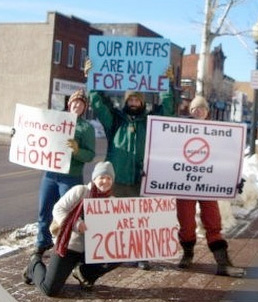
In the oil, gas, and mineral section the sources cited are the Wolverine Oil & Gas Company and the Kennecott Eagle Minerals Company, which was recently given permission by the state to extract nickel from the Upper Peninsula. The article does mention that there are environmental groups opposed to the mining of nickel, but none of the groups are mentioned by name, nor the reasons for their opposition.
An Environmental Perspective at the end
It is not until the very end of the article that an environmental perspective is included in an article about Michigan’s environment. The only source cited is James Clift with the Michigan Environmental Council, based out of Lansing. The MEC does mostly policy work and is not even in the trenches of doing environmental protect around the state.
The Press reporter not only minimizes environmental voices, but he excludes grassroots environmental activists and the point of view of the Native communities throughout the state. This article is not only brazenly pro-business it also adopts the pro-business language of “sustainability,” which concludes that Michigan’s resources are commodities.
Water as a commodity and tourism
There were two supplemental stories included in yesterday’s Press that were included with the election year story. The first article dealt with the issue of water diversion, which is just a technical term for privatizing Michigan’s water.
The article included some background information on the legislative language, which allows Michigan’s water to be privatized. The article cites Michigan Congressman Bart Stupak, Noah Hall (A legal expert at Wayne State University), a spokesperson from Nestle, which is selling Michigan water and Russ Harding from the Mackinac Center for Public Policy. Again, there are no environmental perspectives included even though water privatization has been a major battle that groups like Michigan Citizens for Water Conservation have been fighting. The only picture included with this story was one from inside a Nestle water bottling plant.
The other article included in this series was one on Michigan’s tourism. Once again the story is written from the point of view of how Michigan’s beaches and forests are a great way for the state to make money. The perspectives provided here are from the tourism industry, the state and a Michigan Association of Recreational Vehicles and Campgrounds spokesperson who says, “RVs are a means to get back to nature. We need to do more to put more money into promoting tourism in Michigan and enticing RV owners from other areas in the country to come and experience what we have.”
Anyone who cares about the environment in Michigan should be appalled by this type of reporting and demand that the Press not only include other voices when reporting on environmental issues, but that they question the premise of today’s green business approach and its claims of “sustainability.”
Getting Your Voice Heard: Choosing the New City Commissioner

Recently, GRIID posted a report on the selection process by the City Commissioners of a replacement for David LaGrand. I found it disturbing that there appeared to be minimal participation allowed by Grand Rapids citizens, even though LaGrand’s term runs for nearly another two years. I was also concerned that commissioners, having selected the field of candidates, had already announced to the media who they felt the “front-runner” was, before they’d even gotten citizen input on their choices. Lastly, it was puzzling why the Commission didn’t simply vet a group of candidates and then place them on the ballot in early May. After all, LaGrand had been selected by the people of Grand Rapids. Why not his successor?
For answers, I turned to Commissioner Rosalynn Bliss. I chose to write to Bliss partly because I knew she had voiced her own concerns that the selection process was not inclusive enough or open enough to the public. I wrote her an e-mail outlining my questions. She answered, in part, “The current appointment process is what is required under the City Charter, which we are bound to comply with as a commission. I recognize that it is different than an election and have attempted to create a process that allows for as much community input as possible. The first round interviews we held were just that, first round and yes the candidates were given copies of the questions but it was because they had 30 minutes before the commission. There was a public hearing last Tuesday night where community members could come forward to provide input.”
I then pointed out to her that in the Grand Rapids Press, (January 13, 2010) it stated that the Commission and Mayor Heartwell had chosen the process they were currently following, because “City Attorney Catherine Mish said the charter does not spell out a process to replace a commissioner who resigns.” I told her that that seemed to imply that the Commission had authority to do anything it wished, including a ballot vote by the public, so I asked her to explain she and the other Commissioners had settled on this particular process.
In her second e-mail, Bliss was more explicit. She replied, “Kate, I apologize if there was confusion in my response. Let me try to clarify. The charter specifically says that a commission vacancy ‘shall be filled by a majority vote of the City Commission at any regular meeting.’
“What is/was at the discretion of the commission is the appointment process such as: how long we would accept applications, what we would ask for on the application, how many interviews we wished to complete, if we would have a public forum, how would be determine final candidates, and how we would make a final decision. The appointment process is what the Mayor worked on, had flexibility with and brought back to the Commission to discuss and determine. And this is when I offered and recommended having a community forum and ample time for public comment at public hearings.”
Concerning the “front-runner” announcement, Bliss did not speak to the inappropriateness of some Commissioners announcing their preferences to the media (and she wasn’t one who did so), but she did say, “In regards to rating the candidates, we also discussed this and the various options we had to determine the final round of candidates. It was difficult because we had to in some way identify our final candidates, particularly since we didn’t know how many people would apply. Ranking candidates and then weighing the various ranking to come up with the final three was our decision. It then turned out that we had a tie so now there are 4 final candidates.”
So it appears that the Commission was limited by the city charter to select a replacement for David LaGrand itself, regardless of the length of his remaining term. Bliss appears to have been the one who insisted on adding public forums to gather views from citizens prior to a final vote. As for the “front-runner” comments, it’s difficult to tell whether these were mis-reported or played up by theGrand Rapids Press or whether it was, as Bliss has stated, simply that identifying rankings became a necessary part of the process in order to determine the final candidate pool. In fact, it appears that the Press has been guilty of sloppy and patchy reporting throughout this process.
Here’s the bottom line: Grand Rapids citizens who desire any input in this process have only two more chances: First, on Monday, March 22, 7PM, Rosalynn Bliss will be moderating a candidate forum at the Wealthy Street Theater where voters can listen to candidates and also fill in written forms that will go to the Commission. Second, on Tuesday, March 23 at 7PM, there will be an opportunity at the Commission hearing when people can voice their views directly to Commissioners.
Since the Commission could have chosen a completely closed process, it’s important for people to share their opinions. If you can’t make either of the meetings, you can write an e-mail to the Commissioners or to Mayor George Heartwell with your views. Tell them which candidate you feel is best qualified. You could also voice your opinions about this current replacement process and how it could have been improved.
March 13 Iraq Protest in GR

About 60 area folks marched against the occupation of Iraq last Saturday--about the same number that iraqbodycount.org reported killed by the occupation in Iraq this past week.
On Saturday March 13, approximately 60 area folks met at the corner of Division Avenue and Fulton Street downtown Grand Rapids to mark the seventh anniversary of the US occupation of Iraq. Prior to marching, many held up signs condemning the ongoing violence in Iraq. People driving by responded with encouraging honks, peace signs, waves and smiles.
This past week, many larger protests of the Iraq occupation took place all across the US, but like here, they received little or no coverage by corporate media, leaving many Americans with the false impression that the Iraq occupation is over or that the war has been won. These lies are two of the issues that the organizers of the Grand Rapids’ action hoped to bring to light.
GRIID spoke with one of the organizers after the march.
GRIID: What motivated you all to organize this Iraq Occupation Protest?
Organizer: The real motivation is always to spread the word and to draw attention to the cause, not because we think it will end the war. It was about the realization of power and radical potential. We were aggressive about taking the streets and disregarding authority. There were a lot of younger people there who hadn’t been involved before. It got the word out.
Another reason for the march was to confront the idea that the war in Iraq is over–and, to bring attention to Afghanistan. And it wasn’t just anti-war. Hopefully the march inspired people to explore the real reasons for US military aggression, the economic causes, and to consider the will of the people being occupied. Less than 1% of Iraqis want US involvement there.
GRIID: Some local antiwar groups disagreed with organizers’ tactics beforehand, and suggested that the march be coordinated via the City Grand Rapids permit process. Why no permits?
Organizer: This was an anarchist organized event with an anti-state perspective on the war. Dissent isn’t a privilege to be paid for. We took on non-authoritarian, non-passive tactics—but no violence. We believe there needs to be a diversity of tactics. Still, a few pacifist folks were afraid and voiced concerns. We could have done a little better job of explaining things to them.
GRIID: What kind of reaction did folks get from people on the street?
Organizer: It always is positive. One city bus driver stopped the bus, honked and gave us a thumbs-up.

Once relegated to the margins of society, pornography has emerged as one of the most visible and profitable sectors of the cultural industries, assuming an unprecedented role in the mainstream of our popular culture at the same time that its content has become more extreme and harsh, more overtly sexist and racist.
This eye-opening and disturbing film tackles the complexity behind this seeming paradox, placing the voices of critics, producers, and performers alongside the observations of men and women as they candidly discuss the role pornography has played in shaping their sexual imaginations and relationships.
Honest and non-judgmental, The Price of Pleasure moves beyond the liberal versus conservative debates so common in the culture to paint a myth-busting and nuanced portrait of how pleasure and pain, commerce and power, liberty and responsibility have become intertwined in the most intimate area of our lives.
Thursday, March 25
7pm
Bloom Collective 1134 Wealthy
$3 Suggested Donation
Discussion to follow the film.
 Grand Rapids Institute for Information Democracy