
This article is the first in a series that will look at environmental issues for the 40th Anniversary of Earth Day.
This April the country will be celebrating the 40th Anniversary of Earth Day and already there is all kinds of online promotions from national groups about what this anniversary means and what we should all do to take care of the planet.
The Earth Day Network is coordinating celebrations and is lists on its action section for people to promote tough climate legislation, engage in environmental education, get fresh foods into our schools and of course to change our light bulbs for more efficient ones.
The Earth Day Action Center is promoting 5K runs for a greener planet, tree-planting kits for children and organic lawns. This sounds nice and all but this doesn’t have much to do with the focus and organizing that lead to the first Earth Day in 1970.
The organizing that came out of the 1960s was a result of both the popular organizing that was being done around other issues like civil rights, feminism and anti-war activities. There was also the groundbreaking work of people like Rachel Carson who’s research exposed and challenge the chemical and pesticide industries that were participating in the so-called “Green Revolution.”
Environmental writer and activist Vandana Shiva defines the “Green Revolution” as a mechanism for industrial nations to impose an agribusiness model on the rest of the world. This model included growing food for export, the use of pesticides & fossil fuel fertilizers, and promoting large-scale food production instead of localized production.
Origins of Earth Day
What Carson was advocating and what the first Earth Day organizers emphasized was the need to directly confront polluters and force the federal government to adopt some regulations. After all, it was the first Earth Day that forced the Nixon administration to create the Environmental Protection Agency (EPA). Of course there was also the message of personal responsibility that came with the first Earth Day celebrations, but this was not the focus.
The advocates of capitalism were quite concerned about this light being shinned on the environmental damage they were doing so they began their own campaign to counter what environmentalists of the 1960 – 70s were advocating for.
The business community created the Keep America Beautiful Campaign, which could be considered one of the first corporate Greenwashing campaigns in the country. Some of the most notable companies were Coca Cola, the American Can Company and the National Association of Manufacturers. Their campaign was designed to take the focus off of corporate capitalism’s destructive environmental practices and get people to think about their own personal behavior.
The centerpiece of this campaign became moving attention away from industrial waste and pollution to personalized trash known as litter. The Keep America Campaign even came up with the label “litterbug,” a term which is used even today to describe individuals we all should look down upon. The campaign worked beautifully and by the second Earth Day celebration these corporate entities financed the creation of a powerful TV ad using a Native America actor Iron Eyes Cody. The Native man is seen at numerous places – in the woods, along the beach – and everywhere he goes there is trash. Again the emphasis was on individual behavior and not so much on industry.
Green Consumption & Green Capitalism
This same emphasis is what we see today with individuals being encouraged to have a light carbon footprint on the planet. Of course the best way to achieve this is through the consumption of eco-friendly products. Buy a Prius and feel better about yourself. Drink a latte of fair trade coffee and you’ll sleep well. Use your own canvas grocery bag while you shop at Meijer and save the planet.

Not only is there little emphasis on corporate malfeasance, corporations and businesses are now seen as the heroes of environmental sustainability. In fact, corporations are now GREEN, so just shop with a conscience and all is well.
Pay attention over the next several weeks to the kinds of advertising you will see that accompanies this year’s Earth Day festivities. See how much corporations and businesses sponsor eco-events and watch to see how much emphasis is put on buying GREEN products.
However, don’t be seduced by the shop for the planet mantra. Investigate for yourself what the root causes are of environmental destruction in your community and in the world. Lets put the emphasis back on exposing and confronting the polluters, while we construct a world that is not determined by the profit motive, instead a world that is determined by the Seventh Generation principles.
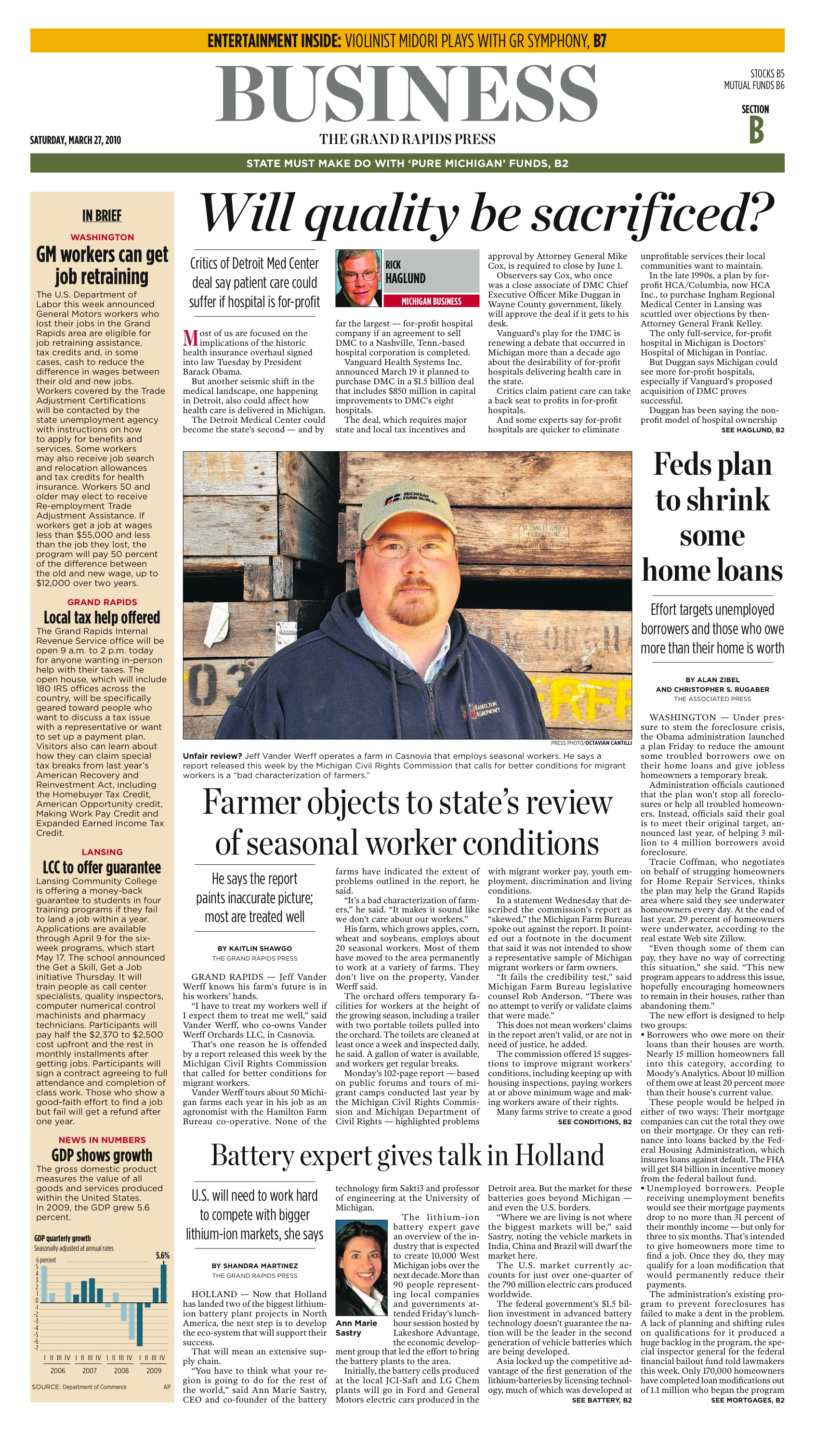
As we reported on Thursday, the local news media’s response to the Michigan Civil Rights Commission report on migrant labor and living conditions gave significant print space and broadcast time to farm bosses, particularly the Michigan Farm Bureau.
On Saturday, the Grand Rapids Press gave even more print space to farm owners who “object” to the new report on migrant labor and living conditions. In a front-page article of the Business section the headline reads, “Farmer objects to state’s review of seasonal worker conditions.”
The story begins with a farmer complaining that the Michigan Civil Rights Commission report “is a bad characterization of farmers. It makes it sound like we don’t care about our workers.” The article also reiterates the comments by the Michigan Farm Bureau that earlier in the week said the report was “skewed.”
Later in the article the Press reporter does cite a lawyer with the Michigan Migrant Legal Assistance Project who said that the report is reflective of what she characterized as “problem farms.” The Press article does near the very end state, “Although mostly critical of migrant worker conditions, the commission acknowledged that visits to Michigan farms yielded “a wide spectrum of living and working conditions.”
In fact, the report cites examples of farms that treat workers well. However, it seems as though some farm owners and the Michigan Farm Bureau are not tolerant of any serious criticism of their industry, since they have been aggressively responding to the claims made in the report.
Absent from the story on Saturday and the initial coverage were any voices of migrant workers and their families. It is worth asking weather or not migrant workers would get the same amount of coverage if they objected to claims being made by farm owners.
US Soldier Deaths Double from Last Year in Afghanistan
Yesterday, the Associated Press reported that the number of US troops “killed in Afghanistan has roughly doubled in the first three months of 2010 compared to the same period last year.”

The report also noted that the number of US wounded has also increased in recent months due in part to the major US/NATO offensive in Afghanistan. “The number of U.S. troops wounded in Afghanistan and three smaller theaters where there isn’t much battlefield activity rose from 85 in the first two months of 2009 to 381 this year, an increase of almost 350 percent. A total of 50 U.S. troops were wounded last March, an average of 1.6 per day. In comparison, 44 were injured during just the first six days of March this year, an average of 7.3 per day.”
The AP article cites several US & NATO officials who are trying to justify the increased number of US soldier deaths. “We must steel ourselves, no matter how successful we are on any given day, for harder days yet to come,” Adm. Mike Mullen, chairman of the Joint Chiefs of Staff, said at a briefing last month.
“In total, 57 U.S. troops were killed here during the first two months of 2010 compared with 28 in January and February of last year, an increase of more than 100 percent, according to Pentagon figures compiled by The Associated Press. At least 20 American service members have been killed so far in March, an average of about 0.8 per day, compared to 13, or 0.4 per day, a year ago.”

However, the AP article does not talk to US ground forces or families of fallen soldiers, thus avoiding any of the real pain inflicted on the American public because of the current US military offensive in Afghanistan.
In addition, there was no mention of the number of Afghan civilian deaths as a result of the US/NATO offensive, even though there seems to be some data that suggests that the number are up and that it could contribute to growing anti-occupation sentiment.
Religion in the News: 2009
The Project for Excellence in Journalism just completed a study of US news coverage of religion. This study is done in conjunction with the Pew Forum on Religion & Public Life.
Pope Benedict XVI and the Obama administration generated the most religion-related coverage in the U.S. press in 2009.
The pope, though he made no visits to the United States last year, was the subject of two of the top 10 religion stories, while the Obama administration accounted for three of the top 10 religion-focused storylines during the year.
No single event dominated religion news coverage in 2009 the way the pope’s visit to the U.S. did in 2008. Instead, when religion made the news, it was often just one element of a larger story, such as the debate over abortion funding and health care reform, the impact of the recession on religious institutions, or the actions of President Barack Obama’s administration, including its continuation of the “faith-based initiative.”
These are some of the findings of a new study by the Pew Research Center’s Project for Excellence in Journalism and the Pew Forum on Religion & Public Life that examined news stories from January through December 2009.
Among other key findings:
- The overall amount of religion coverage remained fairly steady, at 0.8% (compared with 1% in 2008) of the newshole – the total space or time available for news content in newspapers, on television and in other media.
- About two-thirds of religion coverage in 2009 focused on stories that took place in the United States. About a third of the content focused on stories outside the U.S., down from 42.3% in 2008.
- Religion-related issues drew more attention in new media than in traditional press outlets. In a separate analysis of blogs throughout 2009, religion-related news made a list of top stories in 11 out of the 45 weeks studied. The topics that showed up in new media ranged from a Swiss ban on construction of minarets to a French trial of a group of Scientologists to the debate about same-sex marriage.
- The importance of new media platforms as a place for news and discussion about religion may grow as the number of religion writers in traditional news outlets decreases. According to the Religion Newswriters Association, at least 16 major print news outlets have reduced or abandoned their religion beats since 2007.
The study of traditional news sources analyzed more than 68,700 stories from newspapers, the internet, network and cable television, and the radio (for details, see the full methodology). The new media content was analyzed separately by aggregating and coding a sample of blogs, tweets and other sources monitored by Technorati and Icerocket, which track millions of blogs and social media entries (for details, see the full New Media Index methodology).
Religion Coverage Overall in 2009
Religion accounted for 0.8% of the mainstream media’s newshole in 2009.1 This level of attention was on par with press attention to several other specialty areas, such as education and immigration. While some news topics received much more attention in 2009 than they had a year earlier, religion coverage remained fairly steady. Health news coverage, for example, nearly quadrupled to 11% of the overall newshole, an indication of media interest in the debate about health care reform. Religion coverage saw a slight dip, dropping from 1.0% of overall news coverage in 2008 to 0.8% in 2009.
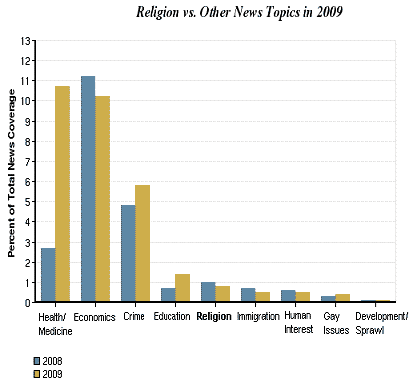
The bulk of the religion coverage in American media outlets in 2009 (67.0%) focused on stories that took place in the United States. About a third of the content (32.8%) focused on stories outside the U.S., primarily on coverage of Benedict’s travels and activities in Europe, the Middle East and Africa. Attention to events on foreign soil was down from 2008, when 42.3% of religion-related coverage dealt with events abroad.
Top Stories of the Year
The pope’s visit to the Middle East from May 8-15 accounted for 4.5% of all religion news last year, making it the No. 2 religion news story of 2009. The only storyline to receive more attention was the role of religion in the Obama administration, but this narrative ebbed and flowed for several months, following a number of different actions taken by the new administration. Obama and Benedict also dominated many of the other top religion stories of 2009, such as the president’s speech to the Turkish parliament in April and the papal pardon of a controversial bishop.

Taken together, the various actions of the pope accounted for 7.3% of religion coverage for the year. Religion storylines related to the Obama administration made up 9.6% of all religion-related news.
Their Daily Bread Art Exhibit Opens
Last night was the opening of an art exhibit in Grand Rapids featuring the work of four women artists – Anna Campbell, Mandy Burrow, Margie Erlandson and Alynn Guerra.
The exhibit is taking place inside a house in the Heritage Hill historic district. Each artist uses a different medium to deal with issues of gender struggles, feminism, class and gender identities. The show is in The Leonard at Logan House located at 440 Logan SE, in Grand Rapids. You can see the exhibit today (March 27) from 4 – 8pm and tomorrow (March 28) from noon – 4pm.
Some of the artists agreed to speak with us on camera about their work.
Gaga for Product Placement

The Center for Media & Democracy reported that “Lady Gaga is raising eyebrows with her latest racy music video, Telephone, but this time it’s not because of the overt sexuality, the wacky costumes or even the fact that her co-star is Beyonce’. What’s grabbing attention is the video’s flagrant product placement.
Gaga prominently displays at least ten different brands in the video, including Virgin Mobile (sponsor of her Monster Tour), Miracle Whip, Wonder Bread, Polaroid and Diet Coke. Of the many products shown, only a few brands paid to be included, according to Gaga’s manager, Troy Carter. Wonder Bread’s appearance was unpaid, but Miracle Whip paid to be featured, even though in the video Gaga combines the two products to poison a diner full of patrons. Polaroid cameras appeared after Gaga signed a new deal to become creative director for the Polaroid company. She is charged with reinvigorating the brand, which was killed off by the digital camera revolution (but is attempting a comeback).
Gaga now reportedly has a financial interest in the company, and her own line of Polaroid products is slated to come out later this year. After its release, the Telephone video generated close to 4 million views on YouTube in under 24 hours.”
The video also uses a vehicle from the Tarantino film Kill Bill, known as the Pussy-Wagon. It is also worth critiquing the hyper-sexual prison scenes which misrepresents and sanitizes the level of sexualized violence which happens to women in US prisons. Check out the video for yourself and let us know what you think.
Michigan Migrant Worker Conditions Deplorable
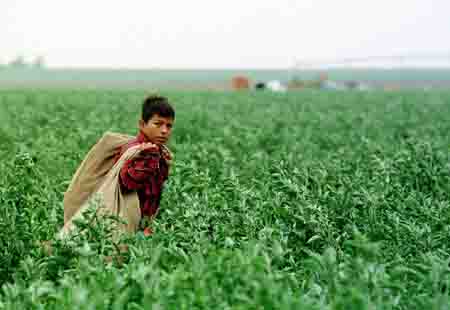
On Monday, the Michigan Civil Rights Commission released a report on the living and working conditions of migrant and seasonal workers in Michigan. The report, which is based in part on the testimony of migrant workers, provides some of the most critical assessments of migrant worker conditions in decades in the state.
Some of the reports major findings are:
- People are forced to live in sub-standard housing conditions, including structural defects, overcrowding, close proximity to pesticides and poor sanitation.
- Increased risk of diseases due to poor sanitation and overcrowding in housing.
- Lack of funding for the Funding and Staffing for the Migrant Labor Housing Program.
- Discrimination of migrant workers because of familial status.
- Sexual Harassment and Discrimination against female workers.
- Wage theft of Farmworkers’ earnings.
- The use of Child Labor.
- Lack of enforcement of State and Federal regulations.
One statement that was quite telling in the reports makes the claim that living and working conditions in the migrant camps today is as bad if not worse than it was 40 years ago.
Local News Coverage of the Report
Considering the severity of the findings within the Michigan Civil Rights Commission report, we thought it would be useful to look at how the local news media reported on this issue.
WOOD radio ran a short story that presented little on the report’s findings and spent half of the time reflecting the response by farm bosses and the Michigan Farm Bureau. WOOD TV 8 ran story on Tuesday that provided a brief summary of the report with a follow up story on Wednesday with a response from the Michigan Farm Bureau, which says the report is “misleading and one-sided.”
WZZM 13 followed a similar pattern by running a brief story followed by a response from the Michigan Farm Bureau. The exact same story was run on WXMI 17, which suggests that some of the local news agencies were running a version of a Press Release put out by the Michigan Farm Bureau.
The Grand Rapids Press ran a longer story that cited several members of the Civil Rights Commission, but spent little text on what the actual findings of the report were.
John Ross Speaks to Grand Rapids Crowd

Last night about 60 people came out to hear radical journalist and author John Ross speak as he travels the country on his current book tour. Ross just published the book El Monstruo: True Tales of Dread and Redemption in Mexico City.
Ross began the talk by reading a poem from Subcommandante Marcos entitled Hasta Cuando – Until When, which speaks about the cry from the oppressed who ask the question “until when, will we have justice and freedom?”
The author was asked to address two aspects of US policy as it relates to Mexico, immigration and the drug war. Ross harkened back to May of 2006, when millions marched in the US for immigration rights. Ross mentions the significance of May 1 by discussing what happened to immigrant workers at the Haymarket incident in 1886. Immigrant workers were striking for an 8-hour workday in Chicago when a bomb went off killing several policemen. Labor organizers were accused of killing the cops and were executed. Around the world workers have since the Haymarket killings have marched on May 1 to commemorate worker struggles everywhere.
Ross then mentions that 200,000 people marched in DC last Sunday for immigrant rights to show that there is some continuity between the mass protests on May 1, 2006 and what kind of organizing is taking place today. Ross said that the Bush administration attacked immigrant rights by using Immigration & Customs Enforcement (ICE) to threaten, detain, arrest, and deport immigrant workers after the 2006 demonstrations, which have kept many immigrants in the shadows politically.
Ross said people need to find a way to have some of the same kind of organizing and mobilizing this year, especially for immigrant rights and real immigration reform. However, Ross was critical of the proposed legislation that is being put forth on Immigration Reform, particularly by Senator Charles Schumer. For a good analysis of that legislation see a recent article from long time immigration activist David Bacon.
Anti-immigrant commentary in the US, Ross said, is really just a form of Mexico bashing. “It is a mechanism to avoid talking about what is really going on in the US.” He also said that whatever agreements the US makes about immigration always comes with some demand on Mexico that will ultimately benefit the US. Ross said that the NAFTA negotiations were in part a deal that the US made some concessions on immigration in order to have greater access to the Mexican economy.
The journalist/author made the same point about the so-called war on drugs in Mexico, in that whenever the US has become involved there have been trade offs. Ross said he hates to talk about the drug war because it gives a negative image about Mexico that prevents us from talking about how civil society is engaged in social change. But the drug war plays well in US media, since headlines about the violence associated with the drug trade sells papers.
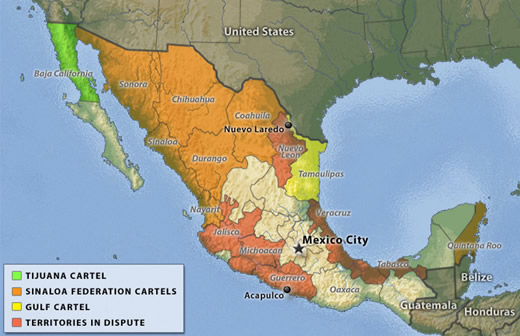
Ross noted that there have been numerous campaigns against drug trafficking in Mexico with the most recent drug war beginning when Mexican President Calderon was sworn-in in 2006. Many people believed that Calderon won that election by fraud. In fact, the election was so contested that the day when he was sworn-in Calderon had to be escorted by the military, because the opposition was trying to actually prevent him from making his first address to the Mexican government. Six days later Calderon began his war on drug by sending 30,000 troops to Michoacán, which has resulted in the deaths of thousands of civilians.
Ross said that all Mexican presidents have gone after specific drug lords as a way of winning political points, particularly with the US. When US President Clinton bailed out Mexico in 2005, Clinton demanded a drug lord in return. Mexican President Ernesto Zedillo complied and then the Juarez cartel took over as the main drug gang in the late 90s. It was during this time that several Mexican Generals were arrested and implicated in the drug trade, which raised more questions about the effectiveness of the drug war. The drug cartel doesn’t use the military anymore because they are so corrupt.
A man by the name of El Chapo Guzman is now the lead narco-lord in Mexico, according to Ross and Guzman hasn’t been seen since 2001, which suggests that the Mexican government is not really interesting in shutting down his operation. To illustrate this point Ross mentioned a recent study that looked at 50,000 drug arrests in Mexico and virtually none of those arrested were Chapo’s people. Ross believes that President Calderon may be collaborating with Chapo, so as to have some negotiating power with the drug lord when it comes to rival drug gangs.
At this point Ross made the distinction between the drug war and the drug problem in Mexico. It used to be kids were sniffing glue or paint thinner from Sherman Williams. Now kids are on the street using crack.
The violence from the drug trade, according to Ross, is turf wars between local drug gangs. He says what you see in Mexico is like what is depicted on the HBO show The Wire, in terms of the kinds of violence associated with the drug trade. However, Ross pointed out that when 4 out of 10 Mexican workers who had jobs are out of a job, you have a serious problem, which makes the drug trade very inviting.
Add to the problems associated with the drug war and increased poverty and unemployment the fact that people can’t get out of the country because of increased border patrol. “So the country is a powder keg with the lid ready to blow off,”
Ross concluded his comments by making mention of the visit that Hillary Clinton and other high ranking US officials made to Mexico the other day. During this visit it was announced that there would be a joint US/Mexican control center in Mexico City, which will allow the US greater influence in Mexican politics. The DEA, FBI, ICE and US military are all involved in Mexican agencies, which threatens national sovereignty, according to Ross. This infiltration of the Mexican security apparatus is an attempt by the US to regain control over Mexican, and potentially other Latin American countries, that have shifted left in recent years.
DOJ Might Be Facebook-Stalking You
(This article is a re-posting from the Center for Media & Democracy http://www.prwatch.org)

Facebook might be selling you out to the government.
With the help of the University of California Berkeley’s Samuelson Clinic, the Electronic Frontier Foundation (EFF) filed a Freedom of Information Act (FOIA) request for documents from the government about how they monitor and use social networking sites like Facebook, MySpace, Twitter and LinkedIn to gather information for investigations. The EFF struck gold with this request, as both the IRS and the Department of Justice released training presentations on social networking sites. While this may seem benign, the training material from the DOJ suggests that feds go undercover on sites such as Facebook to gather information on crime.
The DOJ slide show presentation (pdf) also discusses how cooperative these social networking sites are in complying with requests for private data. For example, Facebook, a highly popular social networking site, was described as “often cooperative with emergency requests,” while Twitter was less cooperative because they refused to preserve data without legal process.
The IRS also provided EFF with a 2009 training course (pdf) that teaches IRS employees how to use social networking sites and search engines like Google to investigate taxpayers. On the positive side, the IRS training manual prohibits IRS employees from using deception or creating fake social networking accounts to obtain information.
The DOJ slideshow on sites like Facebook is more troubling. The fact that Facebook would comply with government requests for private data without legal process is disturbing, and poses a threat to the privacy of American citizens. While the request must be an “emergency,” the DOJ slideshow fails to define exactly what constitutes an “emergency request.” Privacy settings on Facebook may protect users’ privacy from companies and employers, but it appears to be no match for the government. More documents on monitoring social networking sites are to follow on EFF’s website.
The Press environmental coverage Part II
On Monday, we looked at three stories in the Grand Rapids Press that were part of their Michigan 10.0 series leading up to the 2010 Elections. These stories all dealt with what the Press called an “environmental” theme.

However, as we noted in our previous analysis the coverage on Sunday was mostly focused on economic development and the role that Michigan’s natural resources play in that development. Virtually every source cited in those stories affirmed the need for and importance of using Michigan’s natural resources to help rebuild Michigan’s economy. The Press continued with this trend in the stories that ran on Monday and Tuesday.
On Monday there were two articles in the Press that explored the use of Michigan’s natural resources. The first was a Q & A with Rebecca Humphries, the director of the newly reconfigured Department of Natural Resources and Environment and Russ Harding, former director of the DEQ and now with the ultra-conservative think tank the Mackinac Center for Public Policy. Harding was also a major source for the lead story in Sunday’s paper as well.
There were a total of seven questions asked of the two “experts” and it is interesting to note how similar their answers were. All seven of the questions pretty much had to do with the theme touched on Sunday, “how can Michigan benefit financially from the use of its natural resources?” Both Harding and Humphries emphasize that environmental protection can occur with economic growth, although neither of them provide much concrete analysis of how this will work or whether it will be truly sustainable.
The second article from Monday dealt with the current battle over putting up wind turbines along the lakeshore. This article features a bit more diversity in terms of sources used, such as a spokesperson from the West Michigan Environmental Action Council, the Michigan Environmental Council, an environmental consultant and a resident who opposes wind turbines. However, the story also cites someone from the Michigan Department of Energy, Labor & Growth, The Right Place economic development agency, Mackinaw Power and the Executive director of the West Michigan Strategic Alliance, a pro-business coalition that has tremendous influence on economic development and policy issues.
The conversation about wind turbines ranged from creating jobs, to reducing the state’s need for coal power, to the economic benefits of wind turbine energy. Nowhere in the story was there a discussion about current energy consumption for the area or projected energy use based on industry and population size. There was also no discussion about energy conservation or the issue of whether or not energy production should be done by the private sector or be run by residents and taxpayers.
On Tuesday, the Press ran the last article in this series with an environmental theme. The story’s focus was on farmland preservation versus urban sprawl. Much of the article discussed a recent tactic to preserve farmland, know as “purchase of development rights” or PDRs. PDRs are when municipalities get farmland owners to legally agree to not sell their land for development purposes.
The sources cited in this article were a dairy farmer, president of the Eastbrook Development Co. and the West Michigan Strategic Alliance. The article did not explore the environmental impact of urban sprawl nor the issue of roads and transportation problems that come with urban sprawl.
Like the feature stories in Sunday’s Press, these additional articles were too narrow in scope, used a limited range of sources and continued to accept the premise that Michigan’s natural resources are essential to economic growth.
 Grand Rapids Institute for Information Democracy